Public opposition to immigration declines as Ottawa mulls newcomer targets
2026/10/27 Leave a comment
Latest survey showing same trend:
Public opposition to immigration has shifted, with the proportion of Canadians who think too many people are moving here declining by 10 percentage points since 2024, a new poll by the Environics Institute has found.
The findings come as Immigration Minister Lena Metlege Diab prepares to announce in the coming weeks the government’s immigration targets for the next three years, both for permanent and temporary residents, including international students.
The government is facing calls to increase the numbers of immigrants it will admit to meet skills gaps to supply the work force needed for Prime Minister Mark Carney’s ambitious list of major projects, including a new oil pipeline to the West Coast….
Public support for immigration has plummeted in recent years, after a rapid increase in new arrivals to the country. The number of newcomers doubled from 1.2 million in 2021 to 2.4 million in 2023.
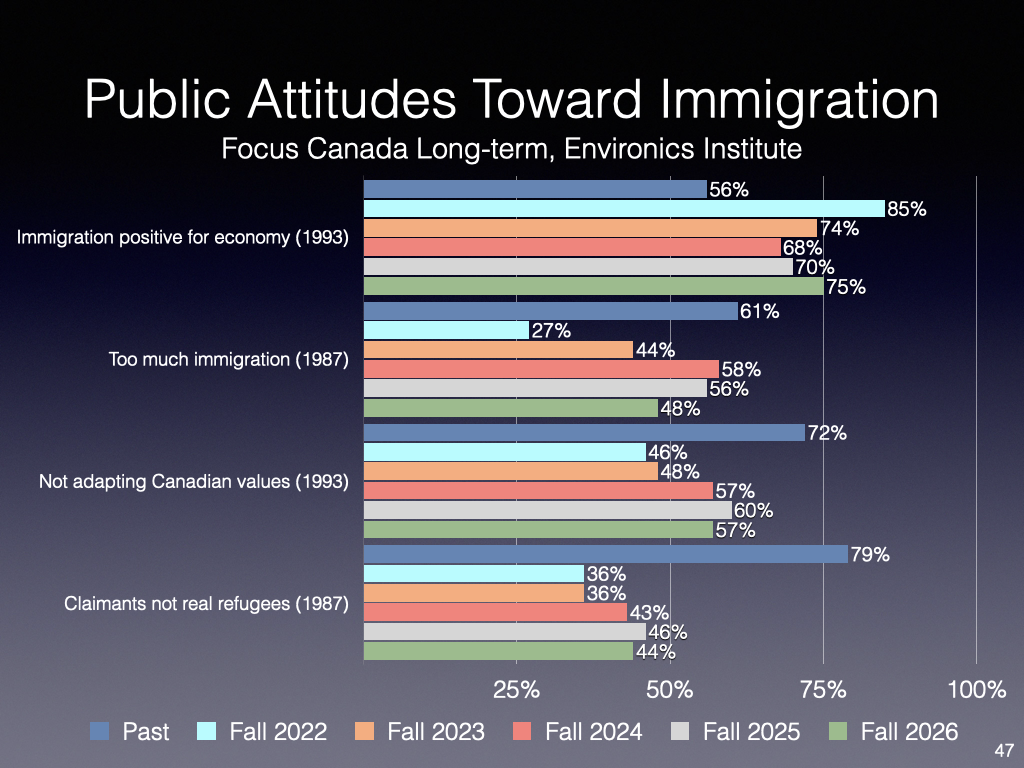
Between 2022 and 2024, the proportion of Canadians who thought there was too much immigration doubled from 27 per cent to 58 per cent, the Environics Institute’s surveys showed.
In response to plummeting public support, starting in 2024, the federal government reduced the number of permanent residents it would accept each year, and capped the number of international student visas it issued. This led to a small drop in Canada’s population in 2025….
Source: Public opposition to immigration declines as Ottawa mulls newcomer targets
From the Environics Report:
Public discussion and public policy relating to immigration in Canada have evolved significantly over the past five years. As the pandemic receded, the intake of new arrivals – both permanent and temporary –rapidly increased, sparking criticisms about the selection criteria and the country’s capacity to build the necessary infrastructure – particularly housing. These criticisms were accompanied by a stark shift in public opinion: between 2022 and 2024, the Environics Institute’s Focus Canada surveys tracked a doubling in the proportion of Canadians who agree that there is too much immigration (from 27% to 58%). Beginning in 2024, the federal government made a number of policy changes, including significant reductions to the numbers of new immigrants across all categories that the country would welcome each year.
In the wake of these developments, the latest Focus Canada survey conducted this past September finds that – after a year of little change in 2025 – public opinion has begun to swing back toward more openness on immigration. While the extent of the opinion shift varies from question to question, the direction of the trend across all questions is consistent: the public is somewhat less concerned this year about the overall level of immigration, and the possible negative impact of immigration on the economy and jobs. Despite these changes, opinions on the whole remain more negative than they were prior to the shift that began in 2023….
In 2026, Canadians are evenly split on the question of whether, overall, there is too much immigration to Canada: 48 percent agree and 48 percent disagree. This represents a significant shift compared to last year toward more openness on immigration.
A large majority of Canadians continue to agree that immigration has a positive impact on the economy. Most Canadians also reject the proposition that immigrants take away jobs from other Canadians.
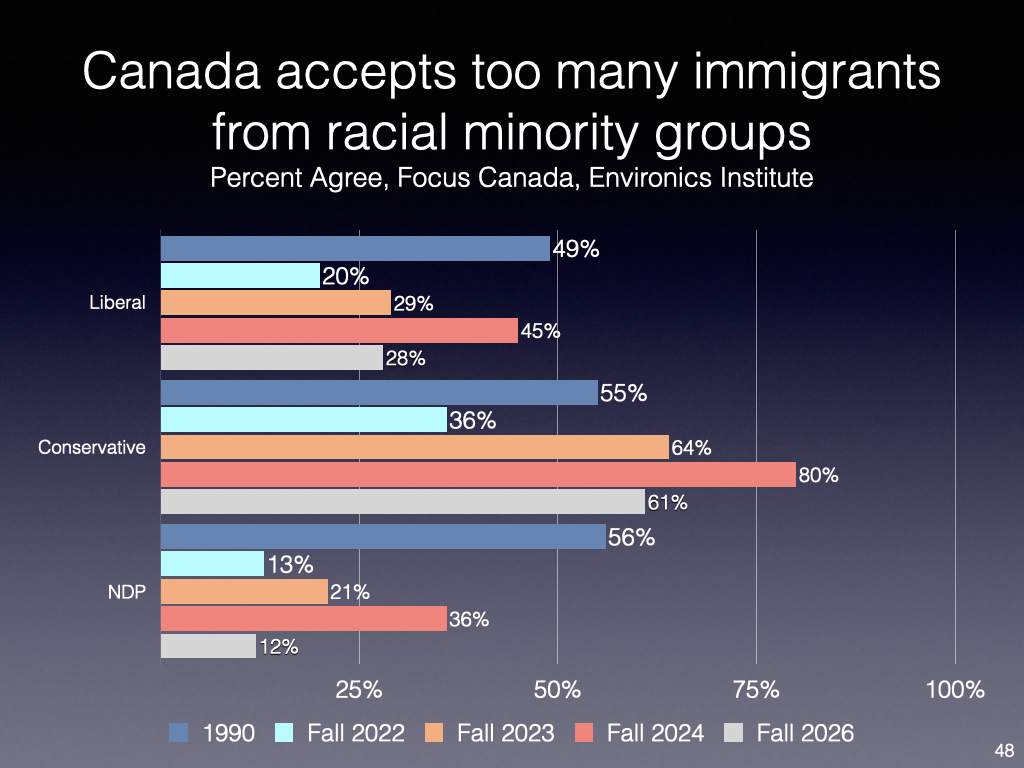
The proportion agreeing that too many immigrants are not adopting Canadian values, and that Canada accepts too many immigrants from racial minority groups, have both seen modest declines since last year.
In the case of these two questions – on immigrants adopting Canadian values, and on racial minority immigrants – the opinions of immigrants and non-immigrants, and of white and racialized Canadians, are very similar.
There has been no significant change since last year in the proportion agreeing that many refugees are not legitimate (a decline of only 2 points), although the direction of change is consistent with that for the other questions in this year’s survey.
A significant difference of opinion between supporters of the Conservative Party, onthe one hand, and supporters of the Liberal Party and the NDP, on the other, is evident on most of these questions. For instance, Conservative Party supporters are currently twice as likely as Liberal Party supporters and four times as likely as NDP supporters to agree that there is too much immigration. And, while large majorities of Liberal Party and NDP supporters agree that the economic impact of immigration is positive, Conservative Party supporters are divided.
In 2026, more than twice as many Canadians say that immigrants settling in their local community makes it a better place, rather than a worse place.
Among those who believe that immigration makes their communities a better place, the top reason given is that they value what immigrants bring in terms of multiculturalism and diversity.
The top reason given by those who say that immigrants make their communities a worse place pertains to concerns about weakening local culture or identity. A much smaller, and declining, proportion mention the impact of immigration in their community on housing affordability and availability. This proportion has fallen by seven percentage points since 2025.
 About Andrew


