Biden’s Unlikely Better on Immigration: Canada’s Trudeau

Funny to see American conservatives using Trudeau to attack Biden on Mexican migration:

While President Biden was engaging last week in border-security political theater on the Rio Grande, Canada actually took concrete measures to stem the flow of Mexican asylum seekers. Even Prime Minister Justin Trudeau can act to protect his country’s national interest from out-of-control migration. Meanwhile, the immigration and border policies of the Biden administration are reaching new lows.

Like the United States, Canada is overwhelmed with economic migrants who are exploiting a poorly designed national asylum process. Our northern neighbor’s asylum system is currently at its breaking point with about 144,000 claims filed in 2023. This number might seem modest, even negligible, compared to the backlog the United States is facing, but, in the context of Canada’s population size, the equivalent number for the United States would be well over a million claims.

Remarkably, Trudeau ordered his government to return to the sensible policy that requires Mexicans to qualify for a Canadian visa before simply buying an airplane ticket, flying to Canada, and filing an asylum claim.

Trudeau, although rhetorically committed to his own version of open-borderism, is for the moment retreating in the face of political reality. Of the 144,000 asylum claimants in Canada in 2023, some 24,000 were Mexicans. In 2016, the corresponding number of Mexicans was just 260. Even our easy-going neighbors to the north know when enough is enough.

Trudeau was facing pressure from Canadian conservatives as well as from provincial authorities in Quebec, where his own family is rooted and easy immigration, particularly from the francophone world, has always been encouraged. Quebec province is about as politically conservative as is New York City, but as Mayor Eric Adams has discovered, basic common sense is rearing its head everywhere these days—except in the White House.

Even abstract open-border ideology melts in the face of trying to actually accommodate, in winter, tens of thousands of uninvited “newcomers,” who arrive with their elderly parents and children, speaking a different language, adhering to different mores, with limited capacity to work and little financial means.

Americans are still waiting for Biden to act a la Trudeau as our national crisis spins out of control. Amazingly, after his recent visit to Brownsville, Texas, it seems that the U.S. open-border lobby, whose smiling face is DHS Secretary Alejandro Mayorkas, still controls the waning political judgment of our aging 81-year-old president. …

Blurring the line between criticism and bigotry fuels hatred of Muslims and Jews | Kenan Malik

Good balanced and nuanced commentary:

Where do we draw the line between criticism and bigotry? From the uproar over Lee Anderson’s remarks about the London mayor, Sadiq Khan, being “controlled” by Islamists to the condemnation of slogans used on pro-Palestinian demonstrations, it is a question at the heart of current debates about Muslims and Jews, Islam and Israel.

The distinction between criticism and bigotry should, in principle, be easy to mark. Discussions about ideas or social practices or public policy should be as unfettered as possible. But when disdain for ideas or policies or practices become transposed into prejudices about people, a red line is crossed. It’s crossed when castigation of Islamism leads to calls for an end to Muslim immigration. Or when denunciation of Israeli actions in Gaza turns into a protest outside a Jewish shop in London.

In practice, though, that line can appear blurry. Claims about “Islamophobia” or “antisemitism” are often wielded in ways designed specifically to erase the distinction between criticism and bigotry, either to suppress dissent or to promote hatred. Such muddying enables some to portray criticism of Islam or of Israel as illegitimate because it is “Islamophobic” or “antisemitic”. It also allows those promoting hatred of Muslims or Jews to dismiss condemnation of that hatred as stemming from a desire to avoid censure of Islam or Israel.

It is for this reason that I have long been a critic of the concept of “Islamophobia”; not because bigotry or discrimination against Muslims does not exist, but because the term conflates disapproval of ideas and disparagement of people, making it more difficult to challenge the latter. It is, in my view, more useful to frame such intolerance as “anti-Muslim prejudice” or “bigotry”. The issue, though, is not one of wording; what matters is less the term employed than the meaning attributed to it.

The concept of Islamophobia became popularised in the 1990s, partly through an influential report from the Runnymede Trust thinktank entitled “Islamophobia: A Challenge For Us All”. The report acknowledged the term as “not ideal” but thought it “a useful shorthand way of referring to dread or hatred of Islam – and, therefore, to fear or dislike of all or most Muslims”. Ironically, the “useful shorthand” itself exposes the problem, eliding hostility to beliefs (“dread or hatred of Islam”) with prejudice towards a people (“fear or dislike of all or most Muslims”).

In 2018, the all-party parliamentary group (APPG) on British Muslims defined Islamophobia as “a type of racism that targets expressions of Muslimness or perceived Muslimness”, a clumsy formulation that has nevertheless been adopted by the major political parties apart from the Conservatives. The APPG report dismissed the “supposed right to criticise Islam” as “another subtle form of anti-Muslim racism”.

It argued, too, that “Islamophobia” refers to Muslims being targeted by non-Muslims. Yet, the charge of “Islamophobia” or “hatred” is often aimed by Muslims at other Muslims, from Salman Rushdie to Monica Ali, from Hanif Kureishi to Sooreh Hera, to make their arguments appear illegitimate. It is a means of “gatekeeping”, of certain people taking it on themselves to police a community and determine what can be said about it.

The elision of criticism and bigotry works the other way, too: to deflect challenges to hatred. Some commentators have responded to the pushback against Anderson’s conspiracy theories about Khan by claiming that labelling his comments “Islamophobic” is intended “to stop criticism of Islamic extremism”.

The actions of hardline Islamists can have horrifying consequences, from forcing a teacher into hiding to the murder of an MP. Too often, as with the recent parliamentary mess created by the speaker, Lindsay Hoyle, politicians and institutions accede to threats rather than confronting them. None of this should lead us to conclude, though, that challenging anti-Muslim bigotry is a distraction from confronting Islamism. Opposing the one without opposing the other weakens our ability to challenge either.

The historical roots and contemporary manifestations of anti-Jewish and anti-Muslim hatred are different. Nevertheless, the charge of “antisemitism” can similarly be deployed to marginalise dissent while also providing racists with an alibi for their racism.

Take the insistence that “anti-Zionism is antisemitism”. It is a claim that has become increasingly accepted in recent years by mainstream politicians and organisations, from the French National Assembly to the US House of Representatives.

Zionism is a set of ideas and social practices. Yet, many who insist that Islam, as a set of beliefs and practices, should be open to robust challenge refuse to countenance similar scrutiny of Zionism.

In 2016, the International Holocaust Remembrance Alliance (IHRA) formally adopted its “working definition of antisemitism”, a definition that has been embraced by many governments, universities and civil institutions. It has also become, in the despairing words of one of its own drafters, Kenneth Stern, “a blunt instrument to label anyone an antisemite”.

For Stern, director of the Bard Center for the Study of Hate, the IHRA definition was never meant to be a “hate speech code” but developed rather to help monitor antisemitism. It has, however, become a means by which supporters of Israel now “go after pro-Palestinian speech”. “As a Zionist, I don’t agree with some of the speech,” Stern notes, but such speech “should be answered, not suppressed”.

This is particularly so because “there is a deep internal Jewish conflict about … attitude[s] toward Israel”. “For many Jews,” Stern points out, “Zionism, and what it means for Palestinians, is irreconcilable with what Judaism says about treating the stranger or repairing the world.” Again, blurring the line between criticism and bigotry facilitates gatekeeping, in this case by making dissenting Jewish voices seem illegitimate.

The drive to suppress criticism of Israel and support for Palestinians has been aided by some on the left lacing their anti-Zionism with antisemitic tropes. And, mirroring the tactics of anti-Muslim bigots, too many dismiss criticism of their antisemitism as a kind of Zionist shield against scrutiny.

Anti-Zionism is not necessarily antisemitic; but it can be, and too often is. The answer is not to label all expressions of anti-Zionism as antisemitic but to call out the latter, while acknowledging the legitimacy of the former.

In the polarised debate about antisemitism and anti-Muslim bigotry, too many who rightly condemn antisemitism are less robust in challenging bigotry against Muslims. And too many of those who excoriate anti-Muslim bigotry turn a blind eye to the hatred of Jews. In both cases, blurring the line between criticism of ideas and bigotry against people narrows debate and nurtures hatred.

Kenan Malik is an Observer columnist
Source: Blurring the line between criticism and bigotry fuels hatred of Muslims and Jews | Kenan Malik

Khan: Gender-equality rights, it turns out, aren’t safe from the notwithstanding clause

Of note:

… Perhaps the most jarring analysis is the Court’s dismissal of arguments by the bill’s opponents based on section 28, which enshrines gender-equality rights in the Charter. That argument makes the point that Bill 21 disproportionately restricts the freedom of religion and expression of Muslim women compared to men. The notwithstanding clause cannot be used to shield laws that discriminate between women and men – i.e., it cannot override section 28.

In fact, during the drafting of the Charter, Canadian women demanded the exclusion of section 28 from the notwithstanding clause. They had the foresight to ensure that gender-equality rights could not be denied by the potential whims of future governments.

But Quebec’s appeals court took great pains to explain that section 28 is, in fact, included in the notwithstanding clause. How? Well, by actually being included in each of the rights enshrined in sections 2 and 7 to 15, and thus having no stand-alone value in of itself.

For example, the Court considered a hypothetical law that gives police the power to detain and search all women unaccompanied by a male in public between midnight and 5 a.m. This violates sections 8 (security against unreasonable search) and 9 (no arbitrary detention). The Court argues that if the notwithstanding clause was invoked to shield the law, section 28 cannot be used to declare the law unconstitutional on the basis of gender inequality, since its only value lies in its association with existing rights – not rights that have been suspended.

The Court’s logic reminds me of the following imperfect analogy: it’s the pre-1960era, section 28 is an unmarried woman, and her only value is through her association with a man, say a father, a brother, a husband, a son (any one of sections 2 and 7-15). Where no such man exists, she has no real inherent value of her own.

The Court’s logic is also dangerous, as it means there is no real protection for women against discriminatory laws if a legislature pre-emptively invokes the notwithstanding clause. Her personal agency and equal opportunity can be taken away at the behest of a hostile legislature. Just ask Muslim women in Quebec.

Source: Gender-equality rights, it turns out, aren’t safe from the notwithstanding clause

ICYMI: Canada’s immigration loophole abused by an airline employee who allegedly admitted Indians with no visa

Ever wonder why there are secondary checks from CBSA officials or contractors?

A former British Airways employee has allegedly fled to India after being arrested for allegedly helping Indian citizens get around immigration laws so they could claim asylum in Canada.

As initially reported in The Times of London on Tuesday, the employee who worked at Heathrow airport in London, U.K., is said to have enabled people without proper documentation to get on flights to Canada so that they could claim asylum upon entering the country. He allegedly charged £25,000 per person or about $43,000. The alleged scam is estimated to have made 3 million pounds or over $5.1 million.

After taking the money from the Canada-bound asylum seekers, the 24-year-old former employee allegedly told them to fly from India to the U.K. on a temporary visa.

According to the Times of London, Canadian immigration officials raised concerns after noticing an influx of people flying to Toronto or Vancouver without proper documentation, and claiming asylum.

Normally, airline employees would check if passengers are eligible to fly to their destination, but, using his position at British Airways, the 24-year-old was allegedly able to falsely claim that his victims had the proper documentation for travel to Canada. The former employee’s process was allegedly to make sure that the prospective immigrants came to his check-in desk at the airport. Later, he would allegedly meet them again during the boarding process and falsely report they had the correct documents a second time.

The former British Airways employee was arrested on Jan. 6, but after making bail, he and his partner, who also worked for British Airways, allegedly fled to India, where he reportedly owns multiple properties and is still on the run from U.K. and Indian authorities. If he is captured, India and the U.K. have an extradition treaty.

British Airways, said in a statement to National Post that they “are assisting the authorities with their investigation.”

This is not the first time that Indian citizens have entered Canada on false pretences. Over the past half-decade, dozens of Indian students faced deportation after unknowingly using falsified acceptance letters to Canadian universities.

National Post reached out to Immigration, Refugees and Citizenship Canada for comment, but did not hear back before publication.

Source: Canada’s immigration loophole abused by an airline employee who allegedly admitted Indians with no visa

Quebec’s latest Bill 21 ruling fuels debate on notwithstanding clause

Next likely stop Supreme Court of Canada, which would oblige the government and political parties to take less equivocal public stand, and reinforce the political and public divisionss:

….For groups that challenged the law, the ruling was a disappointment.

“I think it’s important for everybody that we take note of the devastating impact the notwithstanding clause has when it’s used by a government to violate the rights of marginalized communities in a particular location,” said Noa Mendelsohn Aviv, the executive director of the Canadian Civil Liberties Association.

Mendelsohn Aviv said that while there were a number of reasons the clause was included by drafters of the Constitution — “it was never meant as anything other than a last resort. We don’t think it’s a legitimate use of the notwithstanding clause to use it to violate fundamental rights of minorities.”

But for supporters of the religious symbols ban, the decision was a victory for democracy.

“The Court of Appeal is explicitly saying that this is about democracy, that the notwithstanding clause is not something that violates rights, it’s not something that goes against democracy,” said Guillaume Rousseau, a lawyer for Mouvement laïque québécois, a group that intervened in the case to support the government. “It’s part of our democracy and it’s up to the elected officials to decide.”

Source: Quebec’s latest Bill 21 ruling fuels debate on notwithstanding clause

ICYMI: Federal minister calls ‘garbage’ on Ontario’s complaints it was blindsided by international student cap

Not diplomatic but he is a relatively direct speaking politician and largely correct on this and some of this other comments like “puppy mill” colleges:

Immigration Minister Marc Miller said his government gave provinces ample notice that international student numbers would be capped and any suggestion otherwise is “complete garbage.”

This after Ontario’s College and Universities Minister Jill Dunlop told the London Free Press Monday she was “very disappointed” with what she said was the federal government’s “unilateral decision, without any consultation” to limit international students.

“This was dropped on us,” Dunlop said.

Miller announced a cap on international student numbers earlier this year. Universities and colleges across the country have brought in increasing numbers of international students in recent years, rising to nearly 900,000 this year.

On Tuesday, Miller rejected any suggestion provinces weren’t fully informed.

“That’s complete garbage,” he said. “We said quite clearly they need to get their houses in order. We spoke specifically about Ontario that has the largest number of international students. They should have known it. They’ve had auditor general reports. We’ve spoken quite publicly about it.”

Miller said his government invited provincial counterparts to meetings that they did not attend.

“It’s beneath me to share text messages with journalists, but the reality is that there was communication that just was never followed up on,” he told reporters….

Source: Federal minister calls ‘garbage’ on Ontario’s complaints it was blindsided by international student cap

La capacité d’accueil, un concept qui rebondit à travers l’histoire

Good discussion and analysis of absorptive capacity. Le Devoir’s Champagne is one of the few Quebec journalists focussing on immigration with considerable understanding and nuance:

Il n’y a pas de consensus scientifique sur la capacité d’accueil, une expression qui résonne de plus en plus souvent à Québec. À travers l’histoire et les idéologies politiques, des concepts analogues ont souvent été utilisés pour poser des limites à l’immigration et exprimer des malaises, voire de l’hostilité, disent deux politologues et un historien.

« Le concept est remis au goût du jour, ça revient cycliquement dans les débats, mais c’est vrai que ce n’est pas nécessairement nouveau », dit d’emblée Mireille Paquet, politologue à l’Université Concordia.

La capacité d’accueil n’appartient pas qu’au domaine mathématique, elle oscille plutôt entre « des discours d’opinion et des dialogues qu’on voudrait baser sur les données », selon elle. Au-delà de l’obsession pour les chiffres ces dernières années, c’est aussi une manière de « projeter beaucoup d’insécurité par rapport à l’immigration, sans utiliser les mots ou les concepts moins acceptables dans le discours public ».

C’est avant tout une expression liée à l’émotion, selon l’historien Pierre Anctil. « Souvent, les perceptions, les notions abstraites sont cachées sous un vocable rationnel, mais au fond, il y a une émotion négative. » Avec les expressions autour de « l’accueil », « on cherche une manière de déclarer notre hostilité sans être hostile », souligne aussi ce professeur émérite de l’Université d’Ottawa. Il y a aujourd’hui un amalgame de cette capacité avec des mots lourdement chargés, comme « menace », mais cette fois, elle est tournée principalement vers la langue.

Historique

Durant la première décennie du XXe siècle, la plus importante vague migratoire se déploie au pays, et Montréal y participe vigoureusement. Il arrive alors plus de deux millions de personnes au Canada. Entre 1911 et 1931, la proportion d’immigrants dans la population est alors de 22 %, et il faudra près d’un siècle (en 2021) pour retrouver un pourcentage aussi élevé.

Les communautés non catholiques et non chrétiennes sont alors perçues comme « menaçantes », explique M. Anctil, et il n’est pas besoin d’aller très loin pour comprendre « cette hostilité générale à toute forme d’immigration ». Cette méfiance est particulièrement exprimée dans Le Devoir, et de façon parfois très virulente, comme sous la plume du directeur Georges Pelletier dès 1913. Les Juifs sont alors décrits comme « les déchets de l’Europe » qui « vont nous nuire et qu’on ne réussira jamais à assimiler », raconte l’historien. Même à l’aube de la Seconde Guerre mondiale et après, les élites et la population ne souhaitent pas recevoir les victimes du régime nazi.

Il n’y a alors aucun effort qui est fait pour la francisation ou pour intervenir auprès des populations immigrantes afin de les aider à trouver un emploi ou un logement, « parce qu’essentiellement, on jugeait que c’était impossible », note M. Anctil. Il faudra attendre la Révolution tranquille, la création d’un ministère provincial de l’Immigration et la loi 101 pour que le Québec tente de trouver des solutions. Une fois le « quotient religieux retiré », il devient possible de devenir Québécois sans devoir se convertir. La situation globale du français s’est aussi améliorée, soutient le professeur. On le voit lorsque l’on compare les statistiques d’aujourd’hui avec celles des années 1970 et 1980, dit-il.

De concept en concept : absorption, intégration, accueil

Mais pour arriver à l’expression « capacité d’accueil », il faut encore reculer dans le temps. Cette idée que la société, le territoire ou le gouvernement peut recevoir un volume donné de nouveaux arrivants a surgi dans les années 1930 sous l’expression « absorptive capacity ». Elle est principalement utilisée par Mackenzie King, premier ministre du Canada durant trois mandats entre 1921 et 1948, qui cherche à justifier des limites posées à l’immigration.

Mais le terme est alors « vague et indéfini » et prend en compte les naissances en plus de l’immigration, signale Catherine Xhardez, professeure de science politique à l’Université de Montréal. Il n’est alors pas question de tenter d’en faire la comptabilité.

À l’époque, l’expression est aussi tout près des discours sur la possibilité ou non « d’assimiler » culturellement de grandes populations (voir l’encadré). « Dans l’histoire, ce concept de capacité d’absorption se basait sur l’ethnicité, sur la capacité à absorber ces gens non anglo-saxons dans la culture, par exemple », expose quant à elle Mme Paquet, aussi directrice scientifique de l’Équipe de recherche sur l’immigration au Québec et ailleurs (ERIQA).

Ce n’est qu’en 1962 que le Canada élimine les critères raciaux explicites dans sa politique d’immigration. Celle-ci devient alors encore plus foncièrement économique, même si elle cherche déjà depuis la fin du XIXe siècle à pourvoir des emplois précis. Dans ces mêmes années apparaît aussi peu à peu le concept de « capacité d’intégration », surtout au travail, dans le discours. Le taux idéal dépend alors du pouvoir de l’économie à fournir des emplois aux immigrants aux salaires qui ont cours.

En 2010, c’est au tour du Vérificateur général du Québec de reprocher au ministère provincial de l’Immigration de ne pas utiliser « d’indicateurs socioéconomiques pour bien cerner la capacité réelle » d’accueil de la province. « Vous n’évaluez pas les programmes d’immigration et il n’y a pas de suivi », disait en gros le rapport, selon Catherine Xhardez.

« Évidemment, il y a tout un champ d’évaluation des politiques publiques », rappelle-t-elle à propos de sa discipline. Les immigrants ont-ils accès aux mêmes emplois que les natifs ? Ont-ils les mêmes perspectives ou la même qualité de vie ? « Il y a des programmes qui fonctionnent très bien et des résultats sur le terrain. […] Moi, je crois à l’évaluation », dit la professeure.

Mais le débat sur la capacité d’accueil « semble dire autre chose », à savoir qu’un calcul permettrait de faire une prédiction, et non pas d’évaluer des politiques passées. « Il y a des politiques qui fonctionnent bien, il faut le dire, il y a des résultats sur le terrain. Mais il faut aussi pouvoir évaluer des systèmes qui ne fonctionnent pas et dire : “Ici on a investi, mais ça ne donne pas de résultats” », expose-t-elle.

L’insistance sur la capacité d’accueil « vient surtout chercher notre rêve de se dire : l’immigration, c’est compliqué, mais peut-être que si on trouvait la bonne formule, la bonne équation, ce serait mieux », explique Mireille Paquet.

Dans la littérature scientifique, rien ne semble indiquer qu’un « seuil magique » existe ou non, notamment quant à la réaction de la population. « Les backlashs ou les retours de flamme, ce n’est pas un nombre absolu à partir duquel les gens sont fâchés », note Catherine Xhardez. C’est plutôt le rythme d’arrivée, les augmentations subites, et surtout leur médiatisation accrue.

Politisation plutôt que calcul

Les partis politiques jouent un grand rôle en influençant et en donnant les termes du débat, disent ces deux spécialistes. Ensemble, elles ont étudié les programmes des partis politiques entre 1991 et 2018. Elles ont conclu que la Coalition avenir Québec (CAQ) a été un « agent de politisation » de l’immigration dès 2012, lorsque le parti a introduit dans son programme l’idée de diminuer les niveaux d’immigration.

La réduction proposée est de 20 %, pour que ces seuils reflètent « notre capacité d’accueil et d’intégration », est-il inscrit dans son programme.

Dès 2018, la CAQ reproche aussi au gouvernement libéral d’avoir « ouvert la porte à une forte remontée des immigrants temporaires, sans planifier d’aucune façon leur accueil et les impacts sur la langue, le logement ou les infrastructures ». Ce sont d’ailleurs les mêmes critiques qui sont maintenant adressées au gouvernement, alors que les résidents non permanents ont atteint des records.

Ces mêmes critiques leur sont maintenant adressées puisque le sujet de l’immigration temporaire rattrape le gouvernement depuis au moins un an, le nombre de résidents non permanents ayant atteint des records.

Y a-t-il une manière de sortir de la politisation ? La plupart des experts consultés sont incertains quant à la possibilité de calculer la capacité d’accueil. Doit-on la calculer sur une année ? Sur 10 ans ? Jusqu’à quel point les indicateurs peuvent-ils devenir objectifs ? L’appel récent aux projets de recherche diffusé par le ministère de l’Immigration répondra peut-être à certaines de ces questions, mais pour l’instant, ni Mme Xhardez ni Mme Paquet ne connaissent de chercheurs qui se sont lancés.

Source: La capacité d’accueil, un concept qui rebondit à travers l’histoire

Keller: Economically speaking, we’re all living in Brian Mulroney’s Canada [immigration]

Fair observation. Harper conservatives also maintained levels during 2008 financial crisis. Unclear whether Poilievre will maintain current plan of 500,000 new Permanent Residents by 2015 or not, not to mention curbing the steep rise in temporary workers and international students:

…There’s one more legacy of the Mulroney era that never gets talked about: immigration.

Until the early 1960s, immigration to this country was largely restricted to Europeans and Americans. Then, under John Diefenbaker’s Progressive Conservatives, Canada for the first time opened itself to the world, adopting a race-neutral immigration policy.

A quarter-century later, Mr. Mulroney’s PCs made a second big change to immigration, by moving to permanently increase annual immigration levels, regardless of economic conditions. Until then, Canada’s quotas had fluctuated year-to-year. In the boom times of 1967, for example, a Liberal government admitted 223,000 new Canadians. But numbers were sharply reduced under Pierre Trudeau, reaching a low point of just 84,000 arrivals in 1985.

The Mulroney government decided to not only steeply raise the annual targets, but to keep them there. In 1993, Canada accepted just shy of 257,000 immigrants.

The Chrétien Liberals would scale back those numbers, but only slightly. For most of the Chrétien era, the number of immigrants remained north of 200,000 a year, and at around 0.7 per cent of the population. That continued through the Harper era.

The Mulroney decision, paired with the Diefenbaker decision, slowly changed this place. The Canada of a couple of generations ago often talked about itself as the product of two founding peoples, British and French. Such phrasing now sounds anachronistic, and it is. But in the early 1980s, the visible minority population was less than 5 per cent of the national population.

Today, that figure is closer to 30 per cent. The mayors of Toronto, Vancouver, Edmonton and Calgary are all visible minorities, three of them are immigrants – and nobody cares. That too is part of the Mulroney legacy.

source: Economically speaking, we’re all living in Brian Mulroney’s Canada

Rahim Mohamed: National Muslim group demands MPs denounce Israel or face wrath

We shall see the extent the relevant priority that this issue has in 2025 in relation to other issues, and what percentage of Muslim voters decline to vote or vote NDP (CPC harder pro-Israel line). Seen some analysis of the Michigan results that the absolute number of uncommitted not out of line with traditional numbers.

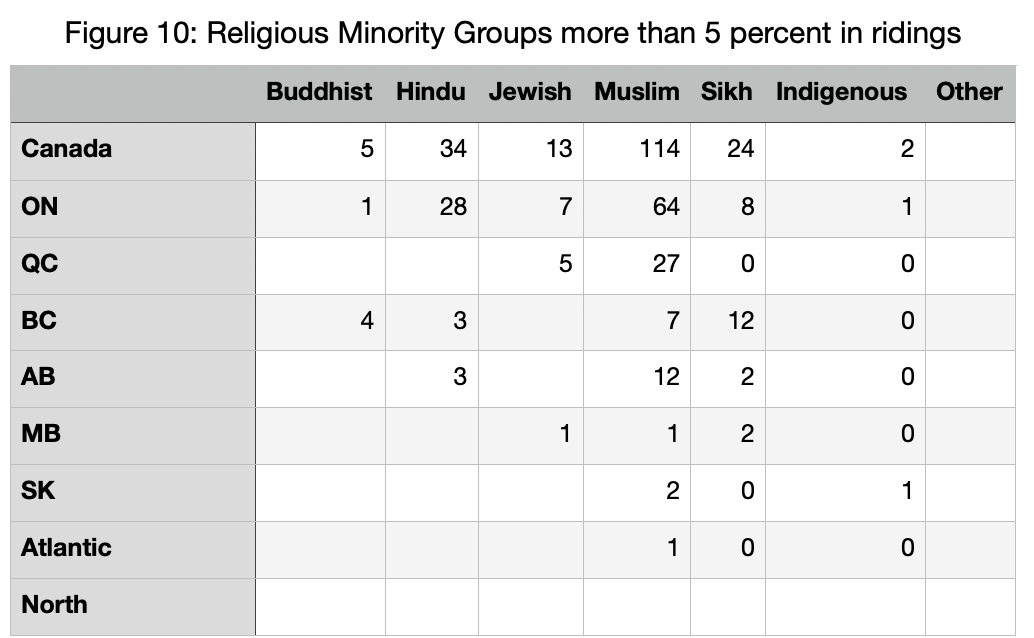
That being said, there are 114 ridings where Muslims form more than 5 percent of the electorate.

… Liberal party insiders were no doubt looking at the Michigan primary results with trepidation. The backlash among Muslim voters to the Stephen Harper government’s niqab ban for citizenship ceremonies and “barbaric cultural practices” hotline likely played a role in helping the Justin Trudeau-led Liberals secure a surprise majority in 2015. Since then, the party has made relations with the community a priority. Trudeau himself stages regular photo-ops at mosques, no doubt savouring every chance he gets to flex his sock game in a setting where shoes are prohibited.

But Trudeau, who appeared to be losing his touch with Muslim Canadians even before Oct. 7, now looks to be in freefall with the community. His multiple calls for a “sustainable ceasefire” in Gaza haven’t been enough to placate intransigent pro-Palestinian activists, who’ve even mobbed the prime minister in public settings. Trudeau has likewise found mosques to be less receptive to him than normal in recent months.

For now, Trudeau doesn’t appear to be too worried about the prospect of a Ramadan mosque ban. When asked on Thursday about the open letter, Trudeau said he’d visit any mosque that would extend him the invitation and gave no indication that he’d publicly commit to the terms enumerated in the statement. Yet Trudeau can’t be overjoyed about the prospect of having to keep his socks firmly in shoe during Islam’s holiest month, especially after seeing Biden’s humiliation in Michigan.

The results of Michigan’s just-held Democratic primary hint that the war in Gaza has triggered a rising tide among Muslim voters in the U.S. Whether electorally vulnerable members of Parliament cede to the demands of the NCCM and its affiliates or risk being shut out of mosques during a critical month for Muslim outreach could be an indication of just how strong the pull of this tide is in Canada.

Source: Rahim Mohamed: National Muslim group demands MPs denounce Israel or face wrath

Douglas Todd: Population growth squeezing Canada’s young adults like never before

More on the generation squeeze and immigration with good quotes from Wright and Skuterud:

… But that hasn’t stopped politicians and business people from constantly raising the spectre of aging baby boomers, with Ottawa making it the primary rationale for “supercharged levels of immigration,” Wright said.

“Sometimes I talk about the ‘baby boom derangement syndrome.’ So much of public policy has been driven by this apprehended catastrophe of the baby boom retiring and then putting great demands on the public purse,” he said. The trouble is it’s creating a population bubble of people under 40.

“We should not be at all surprised that all of a sudden housing markets are under great stress now. It’s absurd that politicians pretend to be surprised by it,” Wright said, pointing to a February report revealing then-Immigration Minister Sean Fraser had been warned that Canada was accepting newcomers at a far higher rate than houses could be built. Early last year Wright predicted this would affect public opinion about immigration, and that has been borne out.

“What Ottawa is doing is making it damn difficult for young people to get a proper start in life,” Wright said. “That’s primarily in the housing market, but in the labour market as well, because you’re competing with a lot of people your age.”

Ontario’s University of Waterloo labour economist, Mikal Skuterud, has been among those tracking how the federal Liberals have drastically hiked the number of guest workers and study-visa-holders, most of whom work while in Canada and intend to apply for permanent resident status.

Last year more than one million foreign students were in Canada, three times the number when Prime Minister Justin Trudeau was first elected. (B.C. had 176,000 in post-secondary schools). While wages in some sectors are up, gross domestic product per capita has been flat for six years. Skuterud suggested low-skill workers, whose wages are actually declining, could be the most impacted by the surge of new residents.

In regard to life choices, Wright also wonders how much the country’s housing crunch — including the prospect of “living in a 700-square-foot hamster cage” — might be a significant factor behind why some young Canadians aren’t having larger families.

Cardus, a think-tank, commissioned the Angus Reid Institute to conduct a poll last year of 2,700 women in Canada ages 18 to 44. It found nearly half have fewer children than they desire. Canadian women intend to have, on average, 1.85 children per woman, but desire 2.2 children.

Given such personal strains, especially for millennials and Gen Z, the National Bank’s economists have declared Canada is caught in a “population trap” in which the population is growing faster than can be absorbed by the economy, society and infrastructure.

With so many facing stagnant wages and housing distress, National Bank economists Stéfane Marion and Alexandra Ducharme said: “At this point we believe that our country’s annual total population growth should not exceed 300,000 to 500,000.”

Source: Douglas Todd: Population growth squeezing Canada’s young adults like never before