Keller: Justin Trudeau has the power to fix one of his biggest political problems. Joe Biden isn’t so lucky

Not as easy as portrayed but definitely compared to the USA:

….Mr. Biden and Democrats want to address this. This year, after Senate Democrats gave in to long-standing Republican demands and agreed to a tough border bill, the President said he would gladly sign it the minute it hit his desk.

Former president Donald Trump responded by ordering Republicans to kill the bill. He wants disorder at the border.

And Canada?

Our immigration surge – a mix of low-wage temporary foreign workers, schools peddling visas to aspiring low-wage workers, and refugee claimants arriving as alleged tourists from countries such as Mexico – is having effects similar to those in the U.S. Similar, but bigger.

On the one hand, GDP is higher than it would have been. But GDP per person has been shrinking since 2022. A country with a history of lagging productivity is lagging more than ever. Each piece of pie is getting smaller.

And population growth has been so large and fast that rental housing vacancies are at a record low, and heading lower. Rents are very high relative to wages, and unlikely to moderate any time soon. Ditto housing prices. Voters have noticed.

Mr. Biden can’t fix his immigration problem because Mr. Trump’s congressional minions won’t let him.

Prime Minister Justin Trudeau, in contrast, has all the tools to rewrite the story he authored.

Most of what needs doing – downsizing but up-skilling the student visa program; eliminating temporary foreign work visas outside of agriculture and high-wage jobs; reimposing visa requirements on countries such as Mexico; returning permanent immigration to a focus on skilled immigrants – is up to the executive in the Canadian system.

If he wants to, the PM can make like Nike, and Just Do It.

Source: Justin Trudeau has the power to fix one of his biggest political problems. Joe Biden isn’t so lucky

Horn: The Return of the Big Lie: Antisemitism is winning

Long read with concluding thoughts applicable to all groups on what universities and other institutions need to do:

It is fairly obvious what Harvard and other universities would need to do to turn this tide. None of it involves banning slogans or curtailing free speech. Instead it involves things like enforcing existing codes of conduct regarding harassment; protecting classroom buildings, libraries, and dining halls as zones free from advocacy campaigns (similar to rules for polling places); tracking and rejecting funding from entities supporting federally designated terror groups (a topic raised in recent congressional testimony regarding numerous American universities); gut-renovating diversity bureaucracies to address their obvious failure to tackle anti-Semitism; investigating and exposing the academic limitations of courses and programs premised on anti-Semitic lies; and expanding opportunities for students to understand Israeli and Jewish history and to engage with ideas and with one another. There are many ways to advocate for Israeli and Palestinian coexistence that honor the dignity and legitimacy of both indigenous groups and the need to build a shared future. The restoration of such a model of civil discourse, which has been decimated by heckling and harassment, would be a boon to all of higher education.

Harvard has already begun signaling change in this direction: The university recently reiterated and clarified rules regarding the time, place, and manner of student protests. For Harvard to take more of these steps would be huge, but I have struggled to understand why all of them still feel so small. Perhaps it’s because the problem is a multi-thousand-year fatal flaw in the ways our societies conceive of good and evil—and also because somewhere deep within me, I know what has been lost. There was a time, not so very long ago, when we didn’t have to prove our right to exist.

Among the mountains of evidence that Jewish students sent me, one image has stayed in my mind. There are videos of crowds chanting “Long live the intifada!” inside Harvard’s Science Center, and “There is only one solution: intifada revolution!” in Harvard Yard, along with other places equally familiar from my student days. But I keep coming back to the crowds marching and screaming in front of Harvard Law School’s Langdell library, because Langdell is a sacred place for me. On my 22nd birthday, in 1999, when I was a senior at Harvard, a law student I’d met at Hillel took me up through Langdell’s maintenance passageways to the library’s rooftop, where he asked me to marry him. I said yes.

I watched the video of the students marching and screaming in front of Langdell, and in an instant I remembered everything: studying in campus libraries for my Hebrew- and Yiddish-literature courses, talking for hours with Muslim and Christian and progressive and conservative classmates, inviting friends of all backgrounds to join me at Hillel, scrupulously following the Jewish tradition of “argument for the sake of heaven” in even the most heated debates, gathering for Shabbat dinners crowded with hundreds of students—and over those long and beautiful dinners, falling in love. My classmates and I often disagreed about the most important things. But no one screamed in our faces when we wore Hebrew T-shirts on campus. No one shunned us when we talked about our friends and family in Israel, or spat on us on our way to class. No crowds gathered to chant for our deaths. No one told us that there should be no more Jews. That night, my future husband and I worried only about getting in trouble for sneaking up to the library roof.

Source: THE RETURN OF THE BIG LIE: ANTI-SEMITISM IS WINNING

Barclay: Systemic change needed to recognize harms of antisemitism in the public service

Yet another pressure (and DEI in general has discounted Jews and antisemitism). That being said, recognizing Jews as a separate category would also require recognizing other religions, further muddying the waters between gender, racialized minorities and religious minorities, making intersectionality analysis likely beyond the capacity of the public service.

Analysis would be stronger if there was some data presented in terms of discrimination and harassment reported cases (sorry, “reported” without references or actual data doesn’t cut it):

In 2022, the Jewish Public Service Network (JPSN) petitioned the Employment Equity Act Review Task Force to designate Jewish public servants as an “employment equity ginvroup” in response to the blatant antisemitism, anti-Jewish hatred, and oppression that have become endemic within Canada’s public service.

However, only months before Hamas’ savage attacks against the state of Israel on Oct. 7, 2023, the Employment Equity Act Review Task Force rejected the JPSN’s request and stated that, despite the rampant antisemitism that Jewish public servants have been forced to endure, the Task Force does not “recommend the creation of a separate category for some or all religious minorities at this time.”

Unfortunately, although the Employment Equity Act Review Task Force has refused to designate Jewish public servants as an “employment equity group,” it is readily apparent that Jewish people throughout Canada’s public service are consistently the victims of overt antisemitism, explicit oppression, and anti-Jewish hatred.

For example, data shows that antisemitic incidents have become increasingly frequent and are consistently permitted to transpire throughout Canada’s public service, particularly in the wake of Hamas’ recent attacks against the state of Israel. Even the Task Force itself was forced to acknowledge in its final report that it was “especially concerned by the reported rise in anti-Semitism [in Canadian society and Canada’s public service].” In fact, whenever the Israel-Palestine conflict erupts, antisemitic incidents and violent antisemitism inevitablyskyrocket.

In addition, antisemitic canards about Jews and money are routinely invoked, and countless macabre antisemitic delusions about the Jewish community have been allowed to migrate freely throughout Canada’s public service. For instance, when one Jewish public servant dared to eat matzah at work, she was immediately beset by a colleague who asked, “How could you eat that given it is made from the blood of Egyptian children?”

Sadly, it is clear that the Employment Equity Act Review Task Force has struggled profoundly to accurately locate the Jewish experience within the public service, and has completely failed to earnestly interface with the intersectionality that is inherent to every Jewish identity, ideology, and experience.

For example, the word “antisemitism” only appears twice throughout the Task Force’s entire final reportFurthermore, the words “Jew,” “Jewish,” and “antisemitism” do not appear at all within the report’s executive summary. In contrast, the Black community and the 2SLGBTQI+ community are referred to more than 300 times and 175 times, respectively.

In addition, the Task Force has remained particularly unable to reconcile the fact that it is impossible to classify the Jewish identity as merely “race” or “religion.” As the JPSN itself was forced to reiterate: “Jews are often described as a ‘religious minority’… [However,] the Jewish people are an ethno-religion. Both the ethno and the ‘religion’ are important.”

Unfortunately, the Employment Equity Act Review Task Force’s utter inability to earnestly interface with the challenges that are innate to Jewish identity and to empathize with the plight of Jewish people is not a unique phenomenon.

Rather, Canadian society and the international community have long remained doggedly committed to the myth that the Jewish community is a rich, white, homogenous mass.

Moreover, throughout the advent and onset of “identity politics,” the Jewish nation’s alleged “whiteness” and purported ideological uniformity have consistently been used as the impetus for countless antisemitic tropes, as well as blatant antisemitic abuse and violence.

In fact, countless political actors and organizations deny the plight of Jewish people around the world and dismiss the constant surge of anti-Jewish violence and antisemitism throughout the international political system, simply because the Jewish community does not satisfy the requisite “diversity criteria.”

Therefore, although Jewish identity is certainly the product of centuries of vigorous tradition and customs, it has become essential for all Jewish people and every Jewish ally to expose and embrace anew the vibrant diversity that is inherent to the Jewish community and its fundamental ethos.

Canadian society and the myriad structures that comprise its political apparatus, such as the Employment Equity Act Review Task Force, must first accept the premise that every Jew is an individual and that Jews are real people, replete with problems, social needs, and ills aplenty, before any Jew will truly be treated as a human being in Canada.

William Barclay is a political theorist and consultant who has collaborated with political actors and organizations throughout North America and Europe in order to inform policy and help successfully resolve various unique political challenges.

Source: Systemic change needed to recognize harms of antisemitism in the public service

Lisée | Le remède imaginaire [immigration]

Blast from the past, still relevant, perhaps even more so, along with commentary on the French language commissioner’s comments on how francisation will never match demand, particularly given the large number of temporary workers and students (the latter likely to decline sharply given tougher French language requirements:

Il a fait son apparition dans le débat public en 2011, cosignant un ouvrage choquant. Le malotru utilisait des chiffres probants pour crever un dogme. Le livre s’intitulait Le remède imaginaire (Boréal). Le dogme qu’il trucidait était celui de l’immigration comme solution à la pénurie de main-d’oeuvre et au vieillissement de la population et comme levier pour l’enrichissement. Les études existantes, osait-il affirmer contre l’avis unanime des gouvernements, du patronat et d’associations de gauche, démontrent que ce n’est tout simplement pas le cas. L’immigration peut avoir d’autres vertus, mais pas celles-là.

Treize ans plus tard, les constats des auteurs Benoît Dubreuil et Guillaume Marois ont fini par percoler dans le débat public, même si les zones de résistance perdurent. L’économiste Pierre Fortin a mis à jour le consensus scientifique dans ses propres publications, y compris dans un rapport de 2022 pour le gouvernement de la Coalition avenir Québec (CAQ). Il vient d’ailleurs de surenchérir. Analysant les dernières données disponibles des pays du G9 et de quatre provinces canadiennes, il conclut dans cette étude que « l’immigration contribue surtout à modifier la répartition de la pénurie entre secteurs de l’économie, mais qu’elle ne produit pas de réduction globale significative de la rareté de la main-d’oeuvre. Dans les cas étudiés, elle paraît au contraire l’avoir aggravée ». Ouch !

Benoît Dubreuil est un récidiviste. Désormais commissaire québécois à la langue française, il a utilisé le même outil — sa maîtrise des chiffres — pour dégonfler une autre baudruche : l’efficacité de la francisation pour renverser le déclin du français. « On a accumulé un passif, a-t-il expliqué, dans le sens où les gens qui sont arrivés au cours des dernières années, même si on voulait avoir des classes de francisation pour tout le monde, on n’y arriverait pas. Et même si on avait des classes de francisation, il faudrait avoir des incitatifs financiers beaucoup plus forts pour amener les gens à s’inscrire et pour amener les gens à y mettre un nombre d’heures conséquent. » 

On a beau doubler, tripler, quintupler les budgets de francisation, la cible est simplement inatteignable. C’est comme vouloir mettre le lac Saint-Jean en bouteille. On peut, comme le fait la ministre de l’Immigration, de la Francisation et de l’Intégration, Christine Fréchette, proclamer qu’on fait des progrès considérables, le niveau du lac ne bouge pas, et les rivières continuent de s’y déverser.

« Une majorité d’immigrants temporaires [ne parlant pas français] ne s’inscrivent pas aux cours de Francisation Québec, et ceux qui y obtiennent une place n’y consacrent pas suffisamment de temps pour dépasser le niveau débutant », dit Dubreuil. Le gouvernement de la CAQ a l’impression d’avoir frappé deux grands coups en exigeant l’obtention d’un niveau 4 (sur 12) pour renouveler les permis de travail après trois ans et d’un niveau 5 pour les étudiants en fin de premier cycle de McGill et de Concordia venant de l’extérieur du Québec.

« Moi, a dit Dubreuil devant les journalistes mercredi, un diplômé qui a un niveau 5, je ne l’embauche pas, OK ? Puis, je connais quand même pas mal l’apprentissage des langues, là. On ne peut pas prendre la personne puis la mettre dans une réunion de travail, on ne peut pas la mettre ici dans la salle puis penser que la personne va comprendre ce qui se passe. » On ne peut pas non plus l’inviter à souper. Le niveau 8, pour lui, devrait être visé « de façon générale pour assurer une intégration sociale ».

On est loin du compte, car l’afflux de travailleurs temporaires, calcule-t-il, a un impact majeur sur l’augmentation de l’utilisation de l’anglais au travail. Entre 2011 et 2023, le nombre de salariés utilisant principalement l’anglais a bondi de 40 %. C’est sans précédent, explique-t-il (mais il semble oublier la Conquête, puis l’afflux de loyalistes fuyant la révolution américaine). Reste que son évaluation est en deçà de la réalité, car il n’a pas les données pour les arrivées de 2024. Et c’est évidemment concentré à Montréal, où le gain anglophone est le plus fort et crée une spirale de l’anglicisation de l’immigration.

« La plupart des gens qui ne parlent pas français au Québec sont en immersion anglaise. Donc, si vous arrivez, vous connaissez bien l’anglais, vous êtes en immersion anglaise à temps plein et vous faites du français trois, quatre, cinq heures par semaine. Si je reviens vous voir un an, deux ans, trois ans plus tard, quelle va être votre langue forte ? Celle que vous allez privilégier dans un environnement comme celui de Montréal où, dans les faits, il n’y a pas beaucoup de contraintes à l’utilisation d’une langue plutôt que l’autre ? » La langue de Shakespeare, évidemment. 

C’est donc, je le suppose, pour sortir les décideurs de leur torpeur qu’il a évalué la somme que tous les intervenants — gouvernement, entreprises, immigrants — devraient investir pour franciser correctement les immigrants temporaires arrivés avant la fin de 2023 : près de 13 milliards de dollars. Or, cette somme n’inclut ni le coût de francisation des résidents permanents qui ne parlent pas le français, ni celui des 32 % d’Anglo-Québécois qui ne le parlent toujours pas près d’un demi-siècle après l’adoption de la loi 101, ni celui des 25 % d’allophones qui ne le parlent pas non plus, ni même celui des immigrants temporaires arrivés après le 31 décembre 2023.

On peut certes mieux franciser des immigrants qui ont fait l’effort, avant de venir ici, d’acquérir des bases. Mais sinon, la francisation comme solution au déclin linguistique est un mirage. Une inaccessible étoile. Un fantasme dont la réitération rituelle par le patronat, ainsi que par les élus libéraux et solidaires, fait écran au réel et laisse place à la dégradation de la situation.

Je ne doute pas un instant de la volonté de François Legault et de plusieurs membres de son équipe de laisser en héritage la fin du déclin. Et il est indubitable que plusieurs des mesures annoncées depuis six ans sont courageuses, inédites et structurantes. J’ai bon espoir que le plan que déposera bientôt le ministre de la Langue française, Jean-François Roberge, inclura des éléments positifs.

Mais c’est le drame de ce gouvernement d’avoir simultanément présidé, d’abord par inconscience — il n’a pas vu venir la hausse des immigrants temporaires —, ensuite par laxisme — il fut informé de la perte de contrôle dès 2021 —, à ce grand phénomène d’anglicisation de l’ère moderne. Réagissant jeudi au dépôt du rapport, la ministre Fréchette a invité Ottawa à « sortir de sa bulle » en ce qui concerne l’inégale répartition géographique des demandeurs d’asile. Bien. Mais au sujet de l’impact anglicisant des immigrants temporaires, elle semblait confortablement campée dans la sienne.

Source: Chronique | Le remède imaginaire

Douglas Todd: Record population growth ‘massive problem’ for housing in B.C

No real surprise but nevertheless of note:

The statisticians describe the unprecedented number of people streaming into B.C., while the province’s mayors explain how difficult and costly it is to try to house everyone.

A special housing meeting of the Union of B.C. Municipalities heard this week that B.C.’s population has jumped like never before — and that more than 600,000 new dwellings are needed just to get back to supply and demand ratios similar to a couple of decades ago.

“All of our growth is international,” said Brett Wilmer, B.C.’s director of statistics. B.C.’s population would basically remain flat, Wilmer said, if it weren’t for the dramatic hikes it has experienced in permanent residents, and especially of foreign students and guest workers.

More than 80 per cent of B.C. newcomers are moving to Metro Vancouver, Victoria, the Fraser Valley and the Central Okanagan, said Wilmer.

While B.C.’s population expanded by a near-record three per cent last year, an economist for the Canada Mortgage and Housing Corporation, Braden Batch, said new housing supply is not matching outsized demand.

“Population growth has put real strain on the housing system. It’s a massive problem,” said Batch, adding new dwellings would have to be built 2.5 times faster to keep up.

The hundreds of mayors, councillors and urban planners attending the UBCM housing summit were told that B.C.’s population will grow by almost one million in the next eight years.

Batch’s charts showed that, under current scenarios, B.C. is set to have a housing shortfall of 610,000 units by 2030.

That prompted the director of Simon Fraser University’s Cities Program, Andy Yan, to say: “We’re going out to offer the Canadian dream to people around the world, but we seem to be OK throwing them into a housing nightmare.”

B.C.’s mayors described how hard it is to get developers to build affordable new housing. They also warned it is costly for taxpayers to provide the transit, sewer systems, schools and medical care to support prodigious population growth.

During a panel titled “Housing the Next Million British Columbians,” five mayors from across the province expressed decidedly mixed feelings about the way B.C. Premier David Eby and Housing Minister Ravi Kahlon last year pushed through sweeping legislation to respond to dramatic urban population growth.

While some mayors complained they weren’t consulted, the B.C. government is now requiring municipalities to allow between three and six units per lot in virtually all low-density residential neighbourhoods, plus highrises near the transit hubs of 31 towns and cities.

Despite some mayors expressing cautious support for Victoria’s plan, they nevertheless said they didn’t think it would improve affordability.

Instead, the mayors described the high cost of supporting more people in more congested neighbourhoods, and expressed dissatisfaction about overstretched staff, loss of green space, parking debacles and a dire shortage of construction workers.

Burnaby Mayor Mike Hurley said it will cost taxpayers an average of $1 million to upgrade a typical 100-metre row of detached houses to provide the infrastructure for four- and six-plexes.

“I’m also not sure we have the workforce, the tradespeople, to do it,” said Hurley, remarking that “hopefully half of the those million more people who are arriving will be in the housing construction industry.”

Both Hurley and Richmond Mayor Malcolm Brodie said the NDP’s push for multi-unit housing throughout cities is creating chaos for their long-range community plans, which have emphasized high density around SkyTrain lines and certain town centres.

“The densification we’ve done is really stark,” said Hurley, referring to massive new skyscraper clusters Burnaby has encouraged at Metrotown, Brentwood and Lougheed town centres.

Citing Richmond’s much-praised Steveston, a community with detached homes on small lots on the south arm of the Fraser River, Brodie argued the B.C. government’s mass upzoning scheme “will destroy a fine neighbourhood.”

None of the five mayors on the “Housing the Next Million British Columbians” panel believed that efforts to increase housing supply will actually lead to affordable dwellings for middle-class and other families.

In recent years, Brodie said, Richmond “has built 50 per cent more housing units than the population has grown. But prices have still gone up by 60 per cent. It simply does not follow that supply reduces prices.”

Bluntly, the mayor of Burnaby added: “The idea that supply will lead to affordability is an absolute fallacy.”

Although speakers agreed projections about the future are hard to get right, Hurley suggested it’s possible development could slow down.

That echoed Wilmer, who told delegates the huge spike in foreign students and guest workers approved by Ottawa in the past two years should “drop back to historical levels this year and next.”

Such non-permanent residents put the most pressure on rental costs, which are at record highs in Metro Vancouver.

While Victoria Mayor Marianne Alto talked about how accommodating vigorous population growth means her city “can only go up, up, and only go in-fill,” Janice Morrison, the mayor of 11,000-resident Nelson, lamented the inevitable “loss of urban green spaces, which is a big reason a lot of people move to smaller cities.”

Richmond’s mayor disagreed over parking with Nathan Pachal, the mayor of the City of Langley. Saying it costs $90,000 to create one parking space, Pachal supported the NDP’s plan to drastically reduce off-street parking for new multi-unit housing buildings. But Brodie said it will create a parking nightmare.

Meanwhile, Nanaimo Mayor Leonard Krog was among those expressing guarded support for the provincial government’s aggressive “good intention” to provide shelter to more people through blanket upzoning.

Like some others, however, Krog suggested the strongest hope for creating more units, especially of the affordable kind, lies in government-subsidized housing — especially from the national government, which he said got out of housing incentives 30 years ago.

All in all, the mayors called firmly on the federal Liberals to show more common sense. That means, they said, Ottawa must be more pragmatic in aligning its international migration targets with the ability to provide housing for all.

Source: Douglas Todd: Record population growth ‘massive problem’ for housing in B.C
Eric Kaufmann: Canadians aren’t actually ‘woke’

Pretty flawed methodology as the polling questions focus on contemporary controversies rather than probing for more underlying perspectives, where many other polls and research highlight significant differences. The classic analysis of how polling can be misleading is from Yes, Prime Minister, https://www.youtube.com/watch?v=ahgjEjJkZks. Poll questions appear designed to generate these responses and advance Kaufmann’s viewpoint rather than being more objective:

Canadians have nearly identical views on culture war issues to Americans and Britons. Across some fifty questions concerning free speech, national heritage, and transgender issues, Canadians, like Britons and Americans, lean around two-to-one against the “woke” cultural socialist option and in favour of cultural liberalism or conservatism. This is the story that emerges from my new report for the Macdonald-Laurier Institute, “The Politics of the Culture Wars in Canada.”

Woke refers to the sacralization of historically marginalized race, gender, and sexual identity groups. This belief system elevates equal outcomes and emotional harm protection for such groups as its highest value. As a result, woke activists seek to cancel speakers or historical figures deemed to be offending the sensibilities of the most hypothetically sensitive member of a minority group. In this clash of values, cultural socialism trumps expressive freedom and symbolic attachment.

Prime Minister Justin Trudeau has distinguished himself on the world stage as the paragon of this belief system, and many outside Canada assume he reflects an equally woke Canadian public. But is this truly the case? To better understand Canadian views, The Macdonald-Laurier Institute asked Maru Public Opinion Polls to conduct a nationally representative survey of 1,500 adults, in which I fielded numerous questions previously put to American and British samples. 

What did I find? Surprisingly, despite their reputation, Canadians largely reject the woke ideology. For instance, they oppose the idea of separating pupils in class by race—assigning whites as privileged and minorities as oppressed—by a whopping 92 to 8. By 85-15, they reject the idea of teaching children that “There is no such thing as biological sex, only gender preference.” Excluding those with no opinion, 80 percent of respondents were against the idea of J.K. Rowling being dropped by her publisher. By a similar slant, Canadians say “political correctness has gone too far.”

In most cases, respondents came out strongly against established practices found in Canadian institutions. For example, when Toronto teacher Richard Bilkszto pushed back against diversity trainer Kike Ojo-Thompson’s characterization of Canada as more racist than the United States, none of his colleagues defended him and his travails eventually drove him to suicide. Yet, by a stunning 95-5 margin, Canadians overwhelmingly reject the idea that their country is more racist than other countries. Among those with an opinion, just 30 percent say that Canada is a racist country while 70 percent disagree. A similar share says they do not want schoolchildren taught that the country is racist.

Or consider the fact that almost all statues of Sir John A. Macdonald have been removed from major Canadian cities. Yet, Canadians oppose removing statues of Canada’s Father of Confederation by a two-to-one ratio. Among those with an opinion, a mere 8 percent say activists should be allowed to remove statues without government approval, with 92 percent against. Almost 45 percent of Tory and PPC voters strongly disagree with removing Macdonald. In addition, only 5 percent of Liberal, NDP, and Green voters strongly agree that his statues should be removed. The majority of left-wing voters oppose rather than support Macdonald’s removal.

Canada has been one of the most trans-affirming societies on earth. Only in the past year have conservative premiers in New Brunswick, Saskatchewan, and Alberta begun to curb trans activism in education by requiring schools to inform parents of their children’s change of pronouns. And only recentlyhas Pierre Poillievre been willing to oppose puberty blockers for minors. In Premier Doug Ford’s Ontario, not to mention in provinces run by the NDP or Liberals, the writ of trans activism runs through government and the schools. 

But when we look at public opinion on the trans question, an entirely different picture emerges. By a four-to-one ratio, Canadians oppose gender reassignment surgery for those under 16. By two-to-one, they want parents informed of pronoun changes at school and don’t want transgender women (i.e. biological males) to enter women’s sports competitions. Three in four Canadians say we talk too much about transgenderism. Even when it comes to people displaying their pronouns in work emails or social media profiles, more Canadians disapprove of this practice than support it, placing them even to the right of the British public.

It is striking how similar Canadian public opinion is to that of supposedly more conservative America or Britain. Across 30 questions I asked in Britain in 2022 and Canada in 2023, the average difference in opinion between the two countries is just 0.3 of a percentage point. Furthermore, of the 13 questions asked in the U.S. in 2021, the average gap with this Canadian survey was just one point! There is essentially no appreciable difference—especially if we take variation in date and sample (as well as random error) into account. Canadians are somewhat more likely than Britons or Americans to say biological males who identify as women should be allowed in women’s sports, and somewhat more supportive of Black Lives Matter. But they are considerably less likely than Britons or Americans to say their country is racist. Canadians under 35, in particular, stand out as being far less likely than their American or British youth counterparts to call their respective country racist.

French-English differences are also much smaller than the stereotype of woke English Canada versus plain-speaking traditional French Canada would lead us to expect. Francophones are somewhat less woke than Anglos on many transgender questions and more inclined to colourblindness rather than race and gender-conscious Diversity, Equity, and Inclusion (DEI) policies. However, Anglophones are more critical of Black Lives Matter than Francophones, more likely to say political correctness has gone too far, and more opposed to removing statues and renaming buildings—though the examples tested involve Anglophone figures such as Macdonald or Ryerson, to whom Francophones have weaker historical attachments.

English Canada’s culturally-left political and media elite contrasts with that of red-state America, and, to a lesser degree, with Britain and Quebec. If English-Canadian public opinion is largely aligned with the others, why have its policies and politicians diverged from their British, American, and Quebecois equivalents? 

One possible answer is Canadians’ relatively high trust in elites and institutions. More than half of Canadians trust journalists while fewer than 20 percent of Britons and barely a third of Americans do. Even 30 percent of conservative Canadians trust journalists compared to 11-15 percent of conservative Americans and Britons. A somewhat similar pattern holds with respect to academics and teachers. Canadians’ elevated trust in their largely progressive-dominated institutions gives the Canadian elite more leeway to deviate from public opinion.

The key takeaway is that culture war issues are far less settled than a lot of mainstream commentary would have Canadians believe. Polling irrefutably shows that Canadians are as inclined as Americans or Britons to disagree with a lot of the woke shibboleths that are present in the media, universities, and other major institutions. As for the political implications, these findings may represent a glaring opportunity for conservatives and a glaring risk for progressives. 

Source: Eric Kaufmann: Canadians aren’t actually ‘woke’

Campaign to crack down on fake immigration lawyers aims to protect newcomers from ‘scam artists’

Perennial problem:

Newcomers to Canada often turn to lawyers to help them navigate the ins and outs of the immigration system. But increasingly, in Montreal, people posing as immigration lawyers are taking advantage of immigrants and refugees, which can cause serious problems.

The Montreal Bar is investigating a growing number of allegations of people posing as immigration lawyers, leading it to warn newcomers to be vigilant.

“The impact and the consequences are quite significant,” said David Ettedgui, president of the Montreal Bar. That’s why the bar has launched an awareness campaign to “prevent people from falling victim to these scam artists,” he said.

In 2022, nearly 40 per cent of the bar’s investigations into the illegal practice of the profession of law were related to immigration, up from 13 per cent in 2018, Ettedgui said.

The fake lawyers often approach their victims on social media and can end up costing victims hundreds or thousands of dollars.

“They’ll go to their victims, say that they are lawyers, take on their files and if they do it at all, most often it’ll be poorly done,” Ettedgui said.

The bar’s campaign will reach people online and through community groups with links to new immigrants and refugees. It aims to raise awareness about the risks and help prevent newcomers from falling into a trap. It includes links to verify a lawyer’s credentials and information about where to file complaints…

Source: Campaign to crack down on fake immigration lawyers aims to protect newcomers from ‘scam artists’

Court ruling OK’s Amnesty Canada intervention in Black Class Action lawsuit

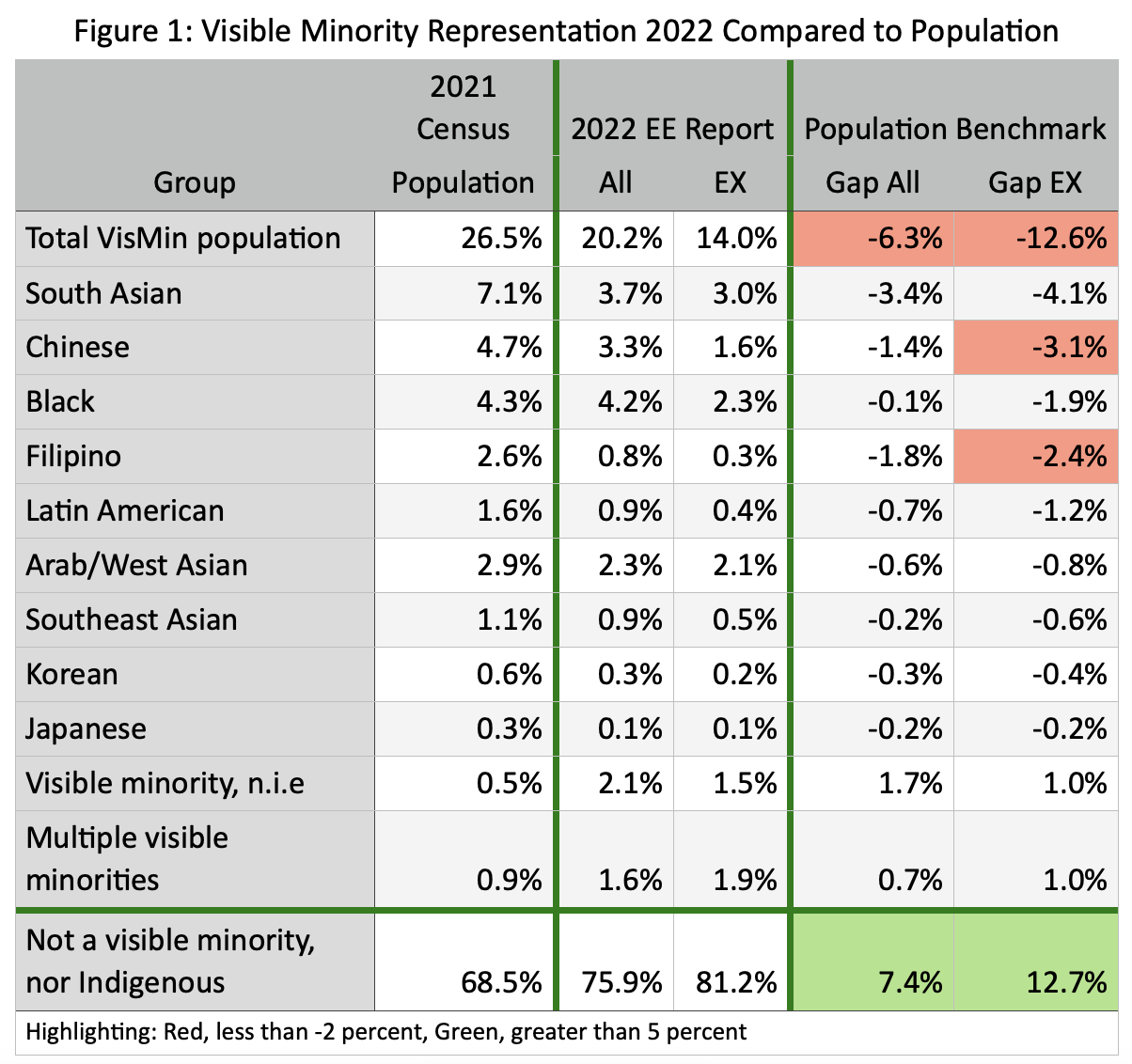
Fair enough but would have thought higher priorities, particularly given overall representation number of Black public servants compared to other visible minority groups:

….In October 2022, the federal government called for a Federal Court judge to dismiss the uncertified class action seeking $2.5 billion in compensation, arguing workers should pursue other avenues for redress, including filing complaints with the Canadian Human Rights Commission.

Amnesty Canada applied to the court to intervene last summer, with the organization’s counsel noting in a cross-examination a few months later that its participation would be “limited to making legal arguments regarding the defendant’s obligations under international law.”

“Canada’s duty to uphold federal workers’ rights goes beyond the Charter and domestic employment equity legislation,” Ketty Nivyabandi, Secretary General of Amnesty International Canada’s English-speaking section, said in a news release about the decision. “As we will stress to the court, Canada also has clear obligations under international law to promote equity, counter racism and provide an effective remedy when people are subjected to systemic discrimination.”

The court decision stated that the government was the only opponent to the motion, “largely on the basis that the proposed submissions are substantive in nature and not relevant to the procedural issues raised in the certification motion and motion to strike, and on the basis that, in any event, these issues are not governed by international law.”

In a news release, the Black Class Action Secretariat said it welcomed the court’s decision to allow Amnesty International Canada’s intervention in the lawsuit despite the government’s efforts to “vehemently oppose it.”

“This pivotal ruling underscores the necessity of incorporating international human rights perspectives in the fight against systemic discrimination within the federal public service,” a BCAS statement read. “This intervention highlights the national and international importance of our cause and the urgent need to address these injustices.”

The certification hearing is expected to take place after May 3, but BCAS said it called on the government to consent to the certification of the class action instead of “forcing workers to relive decades of trauma.”

“This step is crucial in moving forward toward a fair and just resolution for the affected Black workers,” its statement read. “We urge the government to commit to meaningful actions that address and rectify the discrimination within the public service, thereby restoring trust and integrity in Canada’s federal public service.”

Source: Court ruling OK’s Amnesty Canada intervention in Black Class Action lawsuit

La langue ne peut pas être le critère principal dans la répartition des demandeurs d’asile, dit Québec

A noter. Quick rebuke to proposal from the French Language Commissioner:

Le critère de la langue ne peut pas être le facteur principal dans la répartition des demandeurs d’asile à travers le Canada, selon le gouvernement caquiste. Si ce dernier souhaite toujours voir davantage de ces immigrants se diriger vers d’autres provinces, cela doit d’abord se faire « sur une base volontaire », a indiqué jeudi la ministre de l’Immigration, Christine Fréchette.

L’élue du gouvernement de François Legault réagissait ainsi au plus récent rapport du commissaire à la langue française, Benoît Dubreuil, qui recommandait mercredi que la maîtrise de la langue française devienne un critère dans la répartition des demandeurs d’asile. Dans ce scénario, les demandeurs qui ne parlent pas français seraient redirigés vers le reste du Canada.

« Il y a exactement une année, le fédéral avait mis en place un système pour faire en sorte de donner de l’oxygène au Québec, pour faire en sorte de répartir l’ensemble des demandeurs d’asile davantage en Ontario et dans les provinces atlantiques », a rappelé jeudi la ministre Fréchette en mêlée de presse avec son collègue à la Langue française, Jean-François Roberge. « Nous, on demande de reprendre cette approche-là et de faire en sorte que, sur une base volontaire, les demandeurs d’asile soient [redirigés]. »

Interrogée sur le critère de la langue française, Mme Fréchette a répété qu’elle demandait « au fédéral d’agir sur une base volontaire pour la répartition des demandeurs d’asile ». « Les moyens qu’il utilisera pour le faire, c’est à sa discrétion », a-t-elle ajouté.

À Ottawa, le ministre fédéral de l’Immigration, Marc Miller, n’a pas attendu pour rejeter les propositions du commissaire à la langue française. En réponse à une question du député de Lac-Saint-Jean, le bloquiste Alexis Brunelle-Duceppe, il a soutenu que « déporter des gens qui ne parlent pas le français au [reste du] Canada » serait « un geste illégal, immoral, qui manquerait d’humanité ».

La langue parlée « ne devrait pas être le critère principal », a-t-il poursuivi lorsqu’interrogé directement sur la recommandation du commissaire Dubreuil.

Ottawa doit « sortir de sa bulle »

Au début de l’année, le premier ministre François Legault avait envoyé une lettre à son homologue fédéral, Justin Trudeau, pour exiger que les demandeurs d’asile, qui arrivent en grande partie par l’aéroport Montréal-Trudeau, soient mieux répartis à travers le Canada. « On a une situation qui est critique au Québec », a dit jeudi Mme Fréchette, tout en demandant à Ottawa de « sortir de sa bulle ».

Or, depuis, rien. Bien que le ministre Miller ait assuré jeudi travailler pour « répartir le fardeau que porte le Québec ».

Au Salon bleu, jeudi, le chef du Parti québécois, Paul St-Pierre Plamondon, a accusé le gouvernement caquiste d’être « responsable du pire déclin linguistique de notre histoire ». Son collègue député Pascal Bérubé a accusé la ministre Fréchette de ne pas vouloir « froisser son homologue fédéral ». Comme le commissaire à la langue française, la formation souverainiste appuie l’idée d’une répartition basée sur la langue. « C’est une bonne proposition », a dit M. Bérubé, porte-parole péquiste en matière d’immigration.

En réponse à M. St-Pierre Plamondon, le ministre Roberge a rappelé que son gouvernement travaillait à un « réveil national » sur la langue française. « Ça prend du culot pour […] demander un réveil national quand on dort à ce point-là sur cet enjeu-là », a répliqué le chef péquiste, avant d’être rappelé à l’ordre par la présidente de l’Assemblée nationale pour l’utilisation du mot non parlementaire « culot ».

S’il appuie le commissaire à la langue française sur la nécessité d’une meilleure répartition des demandeurs d’asile, Québec solidaire souhaite, comme la Coalition avenir Québec, que ces transferts se fassent de manière « volontaire ». « On ne mettra pas du monde qui ne veut pas aller ailleurs dans un autobus. De toute façon, on ne peut pas faire ça », a soutenu le porte-parole solidaire en matière d’immigration, Guillaume Cliche-Rivard.

« Du moment où ça va être volontaire, ça ne sera pas inhumain. Du moment où les gens vont être consentants », a-t-il ajouté.

Le Parti libéral du Québec, lui, ne voit pas les choses du même oeil que le commissaire Dubreuil. « Si les immigrants veulent rester de façon permanente, on doit mettre en place des programmes qui leur permettront d’apprendre le français. On ne peut pas se mettre à la porte et dire : “Vous ne parlez pas français, on vous refuse l’accès” », a soutenu le chef intérimaire du parti, Marc Tanguay.

Source: La langue ne peut pas être le critère principal dans la répartition des demandeurs d’asile, dit Québec

UK: Shadow minister says Labour will investigate allegations as antisemitism row deepens

Of note:

The shadow defence secretary has said Labour will “follow the hard evidence” to ensure anyone who does not meet the standards of the party will be investigated.

His remarks come as Keir Starmer’s party was plunged into a damaging row about the handling of antisemitism allegations, with parliamentary candidate Graham Jones suspended on Tuesday, only a day after Labour was forced to suspend and withdraw its backing for Rochdale by-election candidate Azhar Ali.

Mr Starmer was forced to act after audio, obtained by website Guido Fawkes, appeared to capture Mr Jones using the words “f****** Israel” at the same meeting Mr Ali attended, while also allegedly suggesting that British people who volunteer to fight with the Israel Defence Forces should be “locked up”.

John Healey today urged anyone else at the meeting who witnessed antisemitism or unacceptable comments to report it to the party.

Speaking to Sky News, the shadow minister said: “Anyone at that meeting, if there is evidence that they have, that people acted or spoke in a way that doesn’t meet the standards, or is incompatible with the values of our Labour Party, they need to report it, provide it and the Labour Party will take it seriously and investigate it.

He added: “It’s what we do with every case.”

Pushed on whether Mr Ali was properly vetted, Mr Healey said the Rochdale candidate was “widely respected” and “widely supported across communities, including the Jewish community in the North West”.

He also said that there are “strong checks” and “due diligence” in the process. “But you can’t see everything everywhere. What’s important is that if new information comes to light, as in this case, we will act to investigate, we will act to block those who are not fit to serve as MPs,” he added.

It is too late now to replace Mr Ali as the Labour candidate so he will still appear on the ballot paper as the party’s choice.

On Tuesday the Labour leader Sir Keir Starmer addressed the controversy for the first time since the allegations broke.

“Information came to light over the weekend in relation to the candidate [and] there was a fulsome apology. Further information came to light yesterday calling for decisive action, so I took decisive action,” he said.

The Labour leader added: “It is a huge thing to withdraw support for a Labour candidate during the course of a byelection. It’s a tough decision, a necessary decision, but when I say the Labour party has changed under my leadership I mean it.”

Labour has been criticised for not taking tougher action sooner, with some suggesting Mr Ali was given favourable treatment because he was an ally of the leadership.

Source: Shadow minister says Labour will investigate allegations as antisemitism row deepens