Sandra Griffith-Bonaparte has worked 22 years for the government. She’s never gotten a promotion

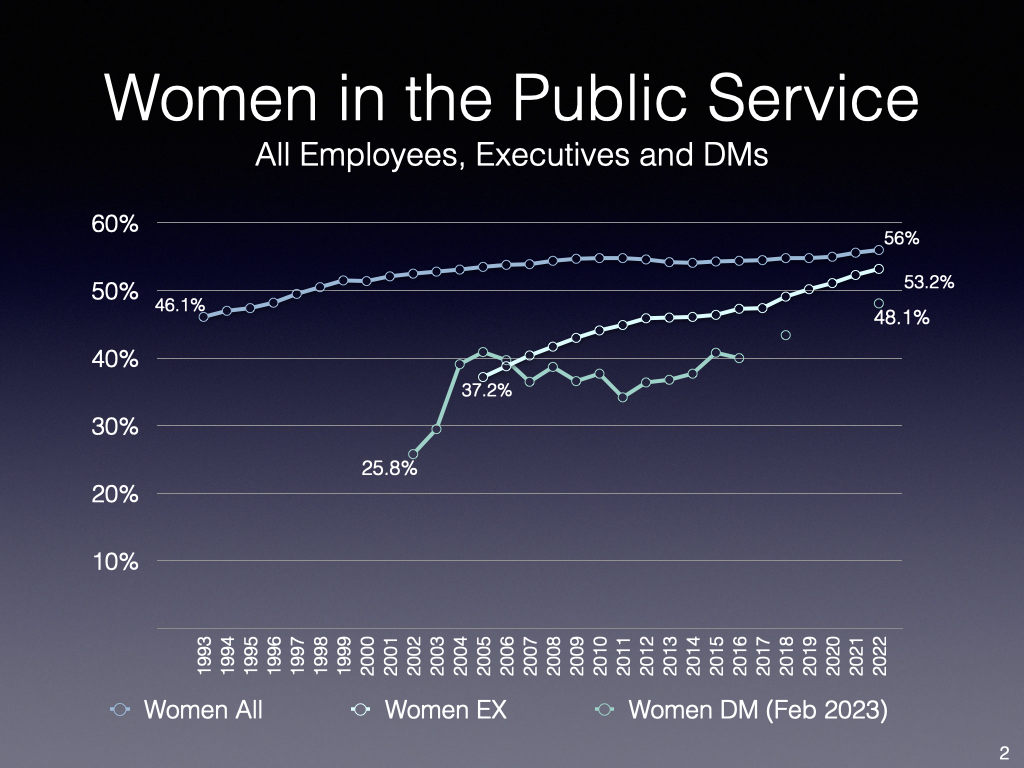
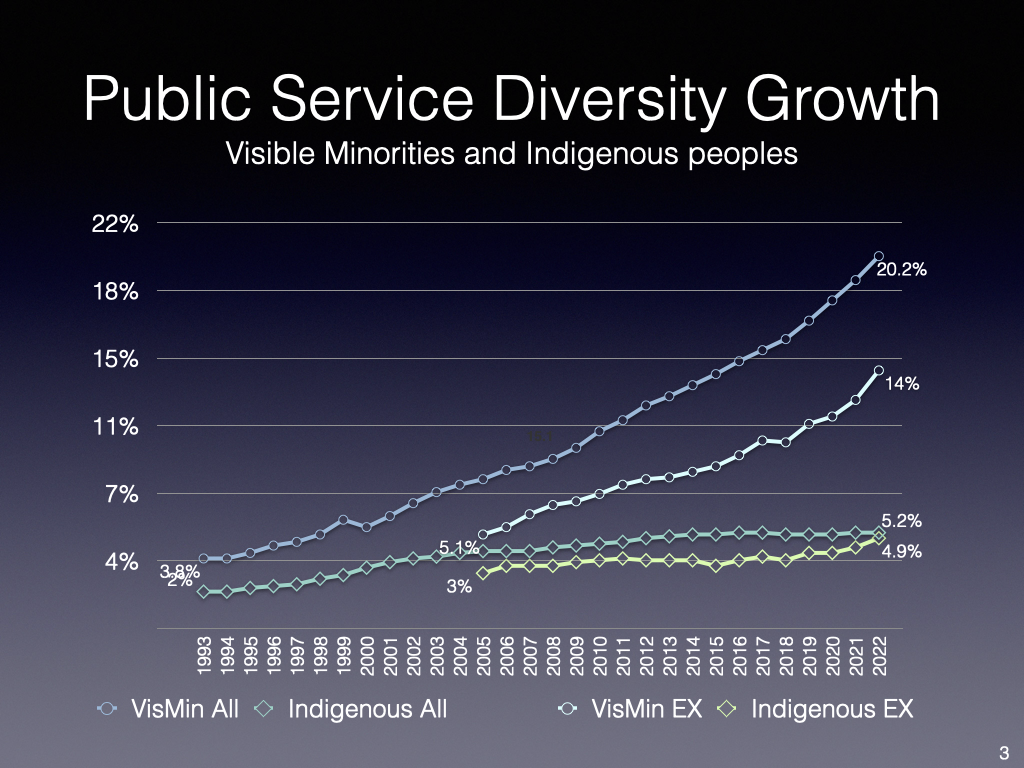
The numbers are less negative than presented in the article and by the Black Class Action Secretariat given the ongoing increase in representation at all levels.

Will be doing an intersectionality analysis once I have the 2022 data tables broken down by visible minority and Indigenous groups and gender but last year’s analysis showed women visible minorities and Indigenous peoples were doing better than men and that recent hiring was largely representative of overall demographics.
Sandra Griffith-Bonaparte hasn’t gotten a promotion in her 22 years of working for the government.

And it’s not for a lack of trying.

Despite having work experience as a high school teacher in Grenada, before she immigrated to Canada from Grenada in 1988; two undergraduate degrees from Carleton University; a Master’s of Arts and Public Ethics at St. Paul’s University and the University of Ottawa, she still does the same clerical work at the Department of National Defence.

“Time and time again, I’m either blocked, overlooked, ostracized, and this has me questioning: Why?” she says. “My story is not unique, this is happening all over in the Canadian government, in the public service, in the city, in provincial workplaces. Highly qualified, hardworking and dedicated public servants, like me, are being really kept in very low positions.”

Griffith-Bonaparte’s struggle for her own career—and financial—advancement echoes data shared in the Treasury Board of Canada Secretariat’s latest employment equity report, which indicates that women, Indigenous people, members of visible minorities and people with disabilities continue to be over-represented in the lowest salary levels of the public service.

In its Employment Equity in the Public Service of Canada report for the 2021-2022 fiscal year, Treasury Board President Mona Fortier states the government is committed to working towards creating an “inclusive and diverse federal public service,” with the document outlining plans to continue modernizing self-identification methods and improving the recruitment, retention and advancement of employees with disabilities.

Fortier acknowledged there is “still work to do” to improve representation.

“As the country’s largest employer, we know that strength lies in our diversity, which is why we must continue to work to create a workplace that is truly inclusive and one that better reflects the diverse communities we serve,” Fortier said.

Between 2020-21 and 2021-22, the core public service gained 7,788 employees, according to the report. Over that time, the number of employees identifying as belonging to the four employment equity groups — women, visible minorities, Indigenous people, and people with disabilities — increased by 7,472 to a total of 161,649 (or 68.4 per cent) of the 236,133 public servants, as of March 31, 2022.

The report found that Black employees represented 20.6 per cent of the visible minority population, or 4.2 per cent of the entire core public service.

Despite growing numbers of people in equity groups, those employees were over-represented in the lowest salary levels and under-represented at the highest, the report found.

While women account for 56 per cent of the 236,133 total employees, they made up less than half all employees earning more than $75,000, according to the report. And of the nearly 95,000 employees earning in the $50,000 to $74,999 salary range, two-thirds of them are women. However, half of the 422 employees earning between $200,000 and $250,000 are women.

Indigenous employees were similarly over-represented in salary ranges below $100,000 and under-represented in all salary ranges of $100,000 and above.

Employees with disabilities and employees identifying as members of visible minorities were also over-represented among those with salary ranges below $75,000.

Though not included as an equity group, the report found that Black employees were disproportionately earning salary ranges below $75,000.

Nicholas Marcus Thompson, executive director of the Black Class Action Secretariat, which has launched a lawsuit seeking long-term solutions to permanently address alleged systemic racism and discrimination within the public service, said the Treasury Board’s latest report demonstrates that Black employees remain at entry-level positions within the government.

He said it also points to the need for amendments to the Employment Equity Act, specifically including Black employees as a separate equity group.

“It confirms that the systemic barriers are continuing with very small progress,” Thompson said. “We want real change.”

When she first entered the public service, Griffith-Bonaparte said she was paid around $30,000, a number that has slowly grown to $54,800 due to inflation.

Without being promoted, Griffith-Bonaparte said she had been stuck doing clerical work such as booking conference rooms, which has both left her in a difficult financial situation and has greatly affected her mental health, leading her to suffer from anxiety and depression. While she has applied for countless jobs within the public service in hopes of moving up, she has never been offered an opportunity to advance within her unit or other units.

Due to her low-paying salary, Griffith-Bonaparte said she started teaching singing lessons on the side in order to make her mortgage, buy food, pay utilities, and support her family. She also started working as a union representative over 16 years ago to have something rewarding to work on related to the public service, and is now the president of the Union Of National Defence Employees Local 70607 in the National Capital Region.

“Sometimes I regret ever entering the public service,” she said, “It saddens me greatly to see I’ve accomplished nothing in the federal public service at all.”

Source: Sandra Griffith-Bonaparte has worked 22 years for the government. She’s never gotten a promotion

Canada’s federal budget promises anti-hate action, but can the government actually do anything?

Valid questions, applies more broadly than LGTBTQ:

While the 2023 federal budget released last month had very little that was new for queer and trans communities, mostly pointing to previous investments that had been made, there was promise buried within to introduce a new Action Plan to Combat Hate later in the year. Just what exactly they’re promising is murky, and it’s hard to tell how many dollars are actually attached to this plan. It notes that between 2019 and 2021, police-reported hate crimes rose by 72 percent, but just how the federal government proposes to tackle that is unclear.

“To confront hate in all its forms, including hate faced by 2SLGBTQI+ communities, the federal government plans to introduce a new Action Plan to Combat Hate later this year,” the budget reads. “This new Action Plan will include measures to combat hateful rhetoric and acts, building on measures being taken in Budget 2023 to build safer, more inclusive communities.”

The dollar figure attached to that is $49.5 million over five years, starting in the 2023–24 fiscal year, with Public Safety Canada to expand its existing Communities at Risk: Security Infrastructure Program. This largely goes toward things like providing more security to synagogues and mosques, which LGBTQ2S+ community centres could also access (if they haven’t already), but there aren’t many of them across the country, and most are situated in bigger cities. The budget indicates that this means an additional $5 million this year, and $11 million for each of the four subsequent fiscal years.

The infrastructure program is not without its critics within the queer and trans communities. The Canadian Centre for Gender and Sexual Diversity (CCGSD), an education, advocacy and research organization, put out a statement decrying the lack of specific investment to combat anti-LGBTQ2S+ hate.

“In its current form, we do not feel confident that the Communities at Risk: Security Infrastructure Program is structured in a way that will protect at-risk 2SLGBTQI+ events (such as pride festivals or drag story hours),” the CCGSD statement reads. “While we look forward to the Action Plan to Combat Hate, there is no indication in Budget 2023 that it will contain any specific funding dedicated to combating anti-2SLGBTQI+ hate.”

This is the part where I start to raise questions, because I’m not sure just what the federal government should be doing about Pride festivals or drag story hours, given that those are largely under the jurisdiction of local governments. Yes, federal governments past and present have given funding support to Pride festivals through Canadian Heritage or tourism grants to help with things like operational funding, but how does the federal government enhance security at a Pride festival? While the CCGSD doesn’t specify what they think the federal government should be doing, I wonder what would those federal dollars be funding for security that shouldn’t be provided by the municipality through local police? I have a hard time seeing a case for millions of federal dollars to be dispersed to provide private security for these festivals, even if some of the larger ones in the country may rely on it as part of their festival operations, particularly because that private security is unlikely to be equipped to deal with potential hate crimes.

This is the part where I start to raise questions, because I’m not sure just what the federal government should be doing about Pride festivals or drag story hours, given that those are largely under the jurisdiction of local governments. Yes, federal governments past and present have given funding support to Pride festivals through Canadian Heritage or tourism grants to help with things like operational funding, but how does the federal government enhance security at a Pride festival? While the CCGSD doesn’t specify what they think the federal government should be doing, I wonder what would those federal dollars be funding for security that shouldn’t be provided by the municipality through local police? I have a hard time seeing a case for millions of federal dollars to be dispersed to provide private security for these festivals, even if some of the larger ones in the country may rely on it as part of their festival operations, particularly because that private security is unlikely to be equipped to deal with potential hate crimes.

Likewise, most drag story hours are held in public libraries, which are the responsibility of municipal governments, and the fervent right-wing animosity toward them are both recent and unlikely to be sustained, and shouldn’t justify permanent security infrastructure funding. Any protests are an issue for local police to deal with—and no, it’s not the federal government’s job to deal with the failures of local police in this country. Policing is a provincial jurisdiction, and civilian oversight should be with the hands of the local police services board (though their efficacy can depend on just how much local involvement there is).

I do think that a federal program to combat hateful rhetoric is a good thing, but we need to see more details about what this is going to look like. We also need to be aware that trust in government when it comes to delivering messages to the public has been eroded thanks to a steady stream of misinformation and disinformation during the pandemic, which capitalized on early mistakes by public health officials, and the evolving nature of our understanding of the virus itself. Because trust is low, combatting that rhetoric could be harder, because there will be those who insist that if the government is trying to combat it, then their homophobic and transphobic rhetoric must be justified. That’s going to be a problem.

If the idea is a national ad campaign that says we should embrace diversity, stamped with the Canada wordmark at the end, that is less likely to be as effective as something akin to providing communities with tools to local police or community organizations to help de-radicalize individuals and groups that are targeting these events. Those tools, whatever they may look like, are more in keeping with what kinds of supports that are appropriate for the federal government to provide.

There is also the ongoing funding for the 2SLGBTQI+ Action Plan, and the various project and community funds that are part of it. This is helping a number of queer and trans organizations and communities across the country build resilience in the wake of increasing hate, but there should also be warning signs here—that groups receiving the funding should be thinking about capacity-building and sustainability. These funds may not survive a change in government, and there has been no move to create a self-sustaining endowment fund like has been done for the Black community, leaving the queer and trans communities that rely on this federal funding more vulnerable. Sustainability is work that these groups should be aware of and working towards.

Source: Canada’s federal budget promises anti-hate action, but can the government actually do anything?

Leuprecht: Closing Roxham Road loophole a benefit to all migrants

Of note:

To stem the surge in irregular migration at Roxham Road, the U.S. and Canada recently extended their Safe Third Country Agreement (STCA), to apply between ports of entry as well. Under the renegotiated STCA migrants must apply to a Canadian agency before crossing from the U.S. into Canada, and vice versa.

Both countries can now turn back asylum seekers attempting to cross irregularly or without authorization. This “new deal” is good news for migrants and for the continent overall. In lieu of border disorder, it affirms three fundamental principles of a sustainable migratory system: the orderly processing of documented migrants, due process and the rule of law, as well as the efficient and effective use of scarce public resources.

Migrant advocates often argue that borders should be open: Whoever shows up at a border should be allowed to cross and lodge a claim. But who shows up is not random. Rather, Darwinian survival-of-the-fittest is fundamentally incompatible with a principled approach to the protection of refugees and asylum seekers. Instead of unequal access for those who can afford to pay, the STCA is an important step toward levelling the playing field for all vulnerable people in genuine need of protection.

Neither domestic nor international law offer an internationally accepted definition of “migrant.” To the contrary, the careless and indiscriminate use of the term ignores the democratic socio-political process that defines a non-citizen’s status, which determines conditions of admissibility that distinguish undocumented migrants from economic immigrants, refugees and asylum seekers. States have legal and moral obligations to immigrants and refugees, and to consider asylum claims. Under domestic and international law, these obligations differ by such criteria as human vulnerabilities, labour needs and other material and ethical considerations.

Public perception of queue jumping at Roxham Road challenges the legitimacy of a well-administered migration policy that is fair for the most vulnerable and grounded in the rule of law. Irregular migration puts at risk the integrity, sustainability and legitimacy of the social contract on which the domestic migratory regime is based. Such a contract preserves the integrity of a state’s borders and the successful political and economic socialization and integration of migrants, as well as social justice and the collective benefit of migration in fostering prosperity.

These are the three cornerstones for the legal regime that admitted a record one million newcomers (immigrants and non-permanent residents) to Canada in 2022. However, polls show that the impression that government is no longer able or committed to the orderly management of the state’s borders causes popular support for legal migration to decline and risks stoking nativist populism that calls into question the sustainability of the entire migratory system.

With population expected to grow by 2.5 billion in the Global South over the next 25 years, that system is coming under massive strain. The number of people who strive for asylum or refugee status in the Global North vastly exceeds the fiscal and social capacity of receiving countries. The current refugee system sprung up after the Second World War in an acknowledgement that certain people deserve temporary protection. Evidence in Canada and the U.S. shows that many asylum seekers today are not seeking temporary protection: their intent is to immigrate.

In a world where travel is relatively cheap and easy, refugee and asylum provisions have become a back door for economic immigrants who would not otherwise be admissible, and who do not qualify under exemptions that would allow them to lodge a claim at an official port of entry. In 2022, for example, 40,000 people crossed into Canada irregularly from New York at Roxham Road, whose location has made it a semi-unofficial port of irregular entry. Yet, almost half had entered the U.S. legally. At Roxham Road, 40 per cent who cross end up having their claims denied. Although the rate is above average, even failed claimants are unlikely to be removed.

For all intents and purposes, many are economic migrants. Claimants originate in countries marred by conflict, corruption and dire economic conditions: Central America, Venezuela, Cuba, Haiti. Sophisticated human smuggling networks, which fall under the UN Convention on Transnational Organized Crime, prey on their misery. Yet, it is not illegal for someone to avail of the services of a smuggler or even to commit identity fraud for the purposes of making an asylum claim. In fact, the UN Office on Drugs and Crime estimates the vast majority of people who try to make it to North America engage the services of human smugglers and what is now a $10-billion-a-year industry.

The STCA discourages irregular (asylum) or illegal entry (human smuggling) at Roxham Road. Claimants who fall under an exemption can still register their claims at Lacolle, Que., which is the closest point of entry. The only “new” element is that on either side of the border claims have to be registered at a formal port of entry. The renewed STCA manifests the open border paradox: co-operative bilateral and binational governance and border management is actually essential to advance mutual security, prosperity and democracy, while mitigating the exploitation of vulnerable migrants.

To be sure, the STCA is no silver bullet. Its effectiveness hinges on co-ordinated enforcement at and beyond the border, Canada stepping up to take a bilateral and trilateral approach with Mexico and the United States to help relieve despair at the U.S.-Mexico border, far-reaching reforms to the UN Convention on Refugees and to the U.S. asylum system, as well as greater access to legal migration pathways in the Global North, where jobs are aplenty and demand for unskilled labour is high.

Victims in need of protection should have equal opportunity to lodge their claim, offshore, while people on the move should lodge a claim in the first country where it is safe for them to do so. Instead of ideological turf wars over the STCA by critics intent on stigmatizing inequalities between the U.S. and Canadian systems, comprehensive reform of the North American and global migration systems is in order if such tragedies as the detention centre fire in Ciudad Juárez, Mexico, that killed 40 last month, and the eight migrants who drowned in the St. Lawrence River two weeks ago, are to be prevented.

Special to National Post

Christian Leuprecht is Professor at the Royal Military College of Canada and Queen’s University, and a senior fellow at the Macdonald-Laurier Institute. Guadalupe Correa-Cabrera is Professor in the Schar School of Policy and Government at George Mason University. 

Source: Opinion: Closing Roxham Road loophole a benefit to all migrants

COVID-19 Immigration Effects – February 2023 update

Latest monthly update. Of particular interest, percentage of TR2PR of permanent resident admissions is over 60 percent in both January and February. Not sure whether this reflects a conscious decision to address housing availability and affordability concerns, given TRs already in Canada, or not.

Nicolas: Catho-laïcité

Great column:

Dans ma cohorte à l’école primaire, il y avait une poignée d’enfants qui n’étaient pas catholiques. On savait tous qui ils étaient. Parce que nous, les enfants « normaux », regardions les enfants « bizarres », inscrits en morale, sortir de la classe pendant que nous nous préparions pour notre cours de catéchèse. En effet, nos institutions publiques avaient déjà le don de faire se sentir les minorités religieuses comme des extraterrestres bien avant l’apogée de nos débats sur la laïcité.

Nous, les enfants « normaux », disais-je, avions des chansons à apprendre sur Zachée, Lazare, les noces de Cana. Du sérieux, quoi. Le prêtre visitait l’école, puis on passait des soirées dans le sous-sol de l’église de la paroisse à chanter encore pour orchestrer une scène de la nativité pour la messe de Noël, encore pour préparer notre première communion, puis notre confirmation. C’était là un éventail d’activités normal pour des enfants « normaux » d’une école primaire publique, à la fin des années 1990, dans une région certes plus conservatrice que la moyenne, au Québec.

Au secondaire, dans une école officiellement déconfessionnalisée mais que tout le monde continuait d’appeler « couvent » quand même, les religieuses étaient encore très impliquées dans l’enseignement et l’administration de notre quotidien. Dans les années 2000, donc, j’ai récité des « Je vous salue Marie » avant de commencer mon cours de français. Le prêtre venait toujours — dans la salle dédiée à la prière de l’école, n’est-ce pas, qui était tout simplement une chapelle — pour nous encourager à faire le carême, avouer tel ou tel péché sous un mode certes un peu plus créatif que le confessionnal traditionnel et nous accorder le pardon. Les élèves « bizarres » étaient toujours les bienvenus parmi nous. Les crucifix et autres statues de Marie décoraient des salles de classe… inclusives.

J’ai un rapport complexe à cette éducation catho-laïque, plus importante que celle de bien des jeunes de mon âge élevés dans la « grand ville ». Pour le moins, je pense qu’avoir grandi ainsi m’aide à faire des nuances.

Je sais bien, par exemple, qu’aucun élève LGBTQ+ de mon école n’a fait son coming out au secondaire, et que ce n’est certainement pas dans un cours de Formation personnelle et sociale donné par une religieuse qu’on aurait pu se sentir à l’aise de discuter de la diversité sexuelle. Ce tabou, je suis profondément contente qu’il soit moins vécu de front par la génération qui me suit.

Je sais aussi que les soeurs qui m’enseignaient avaient eu l’occasion de faire de longues études, parfois jusqu’au doctorat, qui étaient demeurées inaccessibles à ma grand-mère, pourtant de la même génération. Je comprends que des femmes, dans une société profondément patriarcale, ont choisi de cesser d’exister comme objet sexuel et reproducteur, en quelque sorte, pour avoir des carrières, voyager et contribuer plus largement à leur société.

Cela ne m’empêche pas de comprendre le rôle de l’Église dans la perpétuation de la violence coloniale dans les Amériques et l’Afrique, y compris la mise sur pied des pensionnats autochtones. Il y a quelques jours encore, le pape devait encore s’excuser pour la « doctrine de la découverte », une idéologie qui a légitimé la dépossession territoriale, et donc la « fondation » du Canada.

Et je sais encore que des mouvements politiques ancrés dans la théologie de la libération a nourri des soulèvements des classes populaires en Amérique latine et que les églises afro-américaines ont joué un rôle central dans la mobilisation pour les droits civiques. Et qu’il est tout à fait possible de créer des espaces de subversion et de réflexion critique porteuse au sein même des institutions religieuses.

Tout ça, on s’en rend compte lorsqu’on s’intéresse aux phénomènes religieux et spirituels dans toutes leurs complexités et en nuances. Et lorsqu’on ne sait pas faire d’analyse nuancée de son propre héritage religieux, on est aussi probablement très mal outillé pour avoir des conversations franches, tout aussi pleines de nuances, avec des croyants d’autres confessions qui cherchent aussi du sens dans leurs héritages complexes capables de beauté comme de violence, d’oppression comme de libération.

Les valeurs de solidarité et de partage sont promues par toutes les grandes religions, sous une forme ou sous une autre. Par exemple, la générosité envers les plus démunis est une valeur fondamentale dans l’Islam, une valeur particulièrement à l’oeuvre durant le ramadan, en ce moment même. Et si ce n’était pas de l’entraide, le peuple juif n’aurait pas pu traverser tous les millénaires de son histoire — ni même se libérer, avec Moïse, de l’esclavage en Égypte, ce qu’on célèbre, justement, lors de la Pâque juive, ces jours-ci. Et dans le reste du pays, les communautés anglo-protestantes construisent des filets sociaux les uns pour les autres, sans attendre nécessairement que l’État s’en mêle. C’est une autre manière de voir les institutions, certes, mais certainement pas une absence de solidarité.

Aller dire — par exemple, comme ça — que le catholicisme aurait une espèce de monopole de la valeur de la solidarité, alors que les trois religions du Livre partagent un moment particulièrement fort serait donc un geste d’une profonde insensibilité et inculture. Lorsqu’on est un chef d’État qui doit représenter et traiter équitablement tous ses citoyens, peu importe leur foi, présenter une religion comme « meilleure » sur un aspect ou un autre est une grave erreur politique. Lorsqu’on a fait une partie de sa carrière politique sur le concept de la laïcité a en plus, la déclaration devient tragicomique.

Mais surtout, peu importe le rôle de la personne qui le déclare, sur le fond, il y a un truc qui ne tourne pas rond dans cette hiérarchisation, parfois. On se dit que l’auteur d’une telle sortie aurait besoin d’un bon cours d’éthique et culture religieuse. Et que c’est probablement parce qu’il lui en manque qu’il a voulu l’abolir.

Source: Catho-laïcité

Ladha: I’m horrified by the suggestion of cancelling in-person citizenship ceremonies

Shortened version by Ladha getting wider circulation:

Citizenship ceremonies are emotional and personal experiences, especially for those of us who had the privilege of participating in one. The Department of Citizenship and Immigration is contemplating an end in-person citizenship ceremonies in favour of a “secure online solution.”

I still remember the citizenship ceremony that I had to attend when I proudly became a Canadian citizen in 1975. I was with my wife and son, all dressed up in our finest (Hugo Boss suit for me), lined up with new Canadians of all backgrounds, happily showing off the Canadian flags.

When the time came to sing the newly memorized national anthem, I was so emotional that my eyes welled up with tears. Every Canada Day, I still have visions of my heartbreaking citizenship ceremony experience.

I am horrified the government is proposing to abolish this special welcoming in-person citizenship ceremonies with an administrative online box and do away with a group singing “O Canada.”

The fact that Canada, the most friendly and welcoming nation in the world, would resort to a computer-oriented system to announce its citizens is appalling. Ceremonies in everyone’s life, be it a birthday or a retirement party, play an important part, signifying milestones in their lives.

A former minister of immigration under then Prime Minister Jean Chretien was so upset that he wrote an op-ed for this newspaper, calling it “an insult.” “For years, my parents would recount how momentous and meaningful (the ceremony) was. Why would government want to rob future citizens of this feeling of attachment?”

Another prominent defender, former Gov. Gen. Adrienne Clarkson, also a former refugee and presided over a few citizenship ceremonies herself as an Officer of the Order of Canada, said she was “horrified” by the proposed change.

Tareq Hadhad, a Syrian refugee famous for founding the Nova Scotia-based chocolatier Peace by Chocolate, described Canadian citizenship ceremonies as “the magical rituals that bring together everyone (new and old citizens) to celebrate the true meaning of the Canadian dream.”

Source: I’m horrified by the suggestion of cancelling in-person citizenship ceremonies

The U.K. a role model for political diversity

A more compete survey can be found here: https://commonslibrary.parliament.uk/research-briefings/sn01156/.

While the UK is far ahead of Canada in terms of political leaders, less so in terms of MPs: 10 percent visible minorities compared to about 16 percent in Canada:

History shows us that governments that are representative of all their people are often better run and more meritocratic. Representative governments tend to implement more inclusive policies while at the same time elevating a diverse set of role models. These leaders bring more creative insights to the policy-making table that can lead to alternative solutions and thus make decisions that better serve everyone.

While Canadian governments have been getting more diverse in their representation over the past few years, unlike in Britain, the top jobs in Canadian politics have largely eluded the grasp of racialized and new Canadians.

As India and Pakistan gained their independence just over 75 years ago, the stage was set for a rapid wind down of the British Empire over the next two decades. Britain benefited from its post-colonial relationships by attracting waves of African, Asian and Caribbean immigrants as a postwar labour shortage forced it to look beyond its shores in order attract the workers needed to keep its economy running. This migration changed the face of cities like London, Manchester and Glasgow during the latter half of the 20th century.

Yet it was not all milk and honey for these newcomers. On arrival, many often faced racism and discrimination, which was not officially outlawed in Britain until 1965. While the struggle against systemic discrimination continues, there is no doubt that at least when it comes to political representation, the descendants of these post colonial migrants have made their mark on British society in a big way.

Today, arguably the top three political jobs in the U.K., that of British prime minister, Scottish first minister and Lord mayor of London, are held by Rishi Sunak, Humza Yousaf and Sadiq Khan respectively. Their grandparents lived under British Colonial rule in South Asia.

More importantly, they each hail from different parties across the ideological spectrum and they all rose to political heights without facing significant backlash from a British society that appears to have moved beyond seeing race as a determining factor in selecting its leaders. Across the Irish Sea, Leo Varadkar, whose father was born in Bombay (Mumbai), has twice served as prime minister of the Republic of Ireland since 2017.

So, how do we Canadians fare in comparison to our cousins in the British Isles?

Despite our overt commitment to multiculturalism and the fact that Statistics Canada projects racialized Canadians will make up between 38 to 43 per cent of the Canadian population by 2041, Canada has never had a person of colour serve as a first minister, apart from Ujjal Dosanjh’s very brief stint as premier of British Columbia more than 20 years ago.

Source: The U.K. a role model for political diversity

Why ‘golden’ passports and visas shouldn’t be abolished, but made better

Somewhat self-serving from one of the leading citizenship-by-investment companies:

Armand Arton has eight passports.

It’s a collection fitting for the CEO (or as Arton prefers, “Chief Global Citizen”) of a firm that helps ultra-wealthy people purchase second citizenships.

The passport business boomed during the pandemic, especially among wealthy Americans who, for perhaps the first time in their lives, were barred from entering many countries around the world.

Now, as Europe reckons with housing crises, inflation, extreme weather, and war, governments from Portugal to Ireland are banning foreigners from purchasing so-called golden passports and visas.

“Golden passports,” formally known as citizenship by investment programs, allow foreigners to receive citizenship in exchange for investing a certain amount of money in a country, often by purchasing real estate. Their less-advantageous siblings, “golden visas,” provide temporary residence permits in exchange for investment, as opposed to permanent citizenship.

Europe’s recent crusade against the programs boils down to a single question threatening the foundation of the $20 billion industry: is it fair to sell citizenship?

Arton thinks so — and not only because it pays his salary.

The CEO, whose firm has helped attract over $4 billion in foreign investment to various countries in the last 5 years, was born in communist Bulgaria after his family fled the Armenian genocide. When he drove with his parents through over a dozen countries to their new jobs in Morocco, he learned younger than most how your place of birth determines the degree to which you can move freely throughout the world.

“We had to go and apply for 14 visas, and convince 14 governments that were not refugees,” he said. “It makes you feel inferior and threatened everywhere you go, just because of the passport that you hold, which is not your choice.”

A lost financial opportunity

At the Carlyle hotel in Manhattan’s Upper East Side, the CEO wears a blue blazer and beaded rope bracelets, signifying that he is one of those wealthy people who is, or would like to be perceived as, down-to-earth. While Dr. Christian H. Kälin, the chairman of rival firm Henley & Partners goes by the nickname “passport king,” Arton tells me he thinks of himself as the “Robinhood of passports.”

“The rich will anyways get from point A to point B,” he says, beginning his pitch. “So removing the price they have to pay, it’s a lost financial opportunity.”

Instead of banning golden passports and visas outright, countries should adjust their investment requirements to match the current economic landscape and financial needs, he says.

In February, Portugal announced it will stop accepting new applications to its golden visa program as part of a package to help alleviate the housing crisis. Last year, approximately half of Portuguese workers made less than €1,000  per month, with many residents facing eviction.

But while blaming wealthy foreigners for rising housing costs is an easy political win, Arton says, the country would be better served if Portugal funneled the $7.4 billion in foreign investment brought in through the program since 2012 into projects that benefit local residents, like affordable housing or refugee services.

“Portugal should have stopped and said, listen, real estate doesn’t work for us anymore. Let’s find something else that the country needs,” he told Insider.

Dr. Kristin Surak, an Associate Professor of Political Sociology at the London School of Economics and author of “The Golden Passport: Global Mobility for Millionaires,” says that while firms like Arton’s obviously have a financial interest in the programs continuing, the founder does make some fair points.

According to Surak, there aren’t enough golden visa recipients to destabilize the entire country’s housing market. Since the program’s inception in 2012, Portugal has issued 11,628 investor visas, equating to approximately 0.1% of the national population.

“I think there’s a little bit of racism, to be quite honest, in terms of the way these programs get blamed for different things,” she said, noting that most foreign property owners in Portugal are from EU countries like France and Sweden. Meanwhile, Chinese and Brazilian nationals make up the majority of the country’s golden visa recipients.

A golden tax

In a country like Syria, home to the world’s largest refugee crisis, Arton has clients that pay hundreds of thousands to millions of dollars to purchase second citizenship and fly away on their private jets.

The stark contrast between the migration opportunities for the elite and the impoverished prompted Arton to advocate for a Global Citizen Tax, a 1% to 5% tax on all investor citizenship and residence applications to be put toward the nation’s most pressing needs.

“For me, it’s something that I really want to be able to make an impact on a larger scale, not only for the guys in first class and private jets,” he said.

A scandalous history

But golden passports don’t only raise the issue of inequality, the European Commission argues, they also pose a threat to national security. Following Russia’s invasion of Ukraine, sanctioned oligarchs were accused of using the schemes to dodge sanctions. And in 2020, an Al Jazeera investigation found that Cyprus’ now-defunct program sold citizenship to criminals and political fugitives.

Arton believes national security concerns may have been the motivation behind Ireland’s recent program closure, which happened right around the time of the Chinese spy balloon scare. Last year, 282 of Ireland’s 306 golden visa applications came from Chinese citizens, The Irish Timesreported.

Arton said due-diligence for vetting applicants could use improvement, and is in favor of increasing industry regulation and data-sharing between nations. However, he argues that the odds are much greater that so-called “unsavory actors” enter a country via undocumented routes.

“If I’m a terrorist, if I’m really somebody that wants to threaten the security of the European Union, the last thing I’m going to do is apply through one of these programs,” he said.

Surak said that, by the numbers, golden visas and passports are neither national security nor money laundering issues, and said in her experience, investor migration tends to invoke moral outrage among people who already have strong passports and have never had to think strategically about immigration.

“Migration is always somehow fundamentally economic,” she said. “I think it’s complicated, which is not to say there aren’t problems with the programs. But I think there’s also a lot of hypocrisy and that the inequalities and power dynamics aren’t exactly what one expects.”

Source: Why ‘golden’ passports and visas shouldn’t be abolished, but made better

Yalnizyan: Allowing undocumented immigrants to stay and work in Canada — permanently — would benefit us all

Rather than another piecemeal change to immigration policy, the government needs to move from the narrow Permanent Residents focus of annual planning and expand that to include targets (i.e., caps) on temporary workers and students and align a global permanent and temporary resident immigration plan with housing, healthcare and infrastructure capacity.

Not convinced that the economic benefits will be as strong as Armine suggests and we would be largely increasing the numbers of lower-paid and lower-skilled, rather than the higher-skilled needed to improve productivity.

It would also be helpful to have more accurate numbers on the number of undocumented, including visa overstays as the US regularly does as the figures cited by advocates have never been rigorously substantiated (CBSA should be able to collect information on visa overstays):

Want higher pay? A bigger economy with more household purchasing power? More revenues for public programs? Less exploitation of people at work and in society?

It’s all possible. Everyone can win, but the argument is counterintuitive, and may challenge your notions about fairness, process, and who gets to be Canadian. Stay with me on this.

The problem

Canada has long issued permits for people to temporarily come work and study in Canada, but the recent growth in this practice is staggering. By the end of 2022, in the name of fast-tracking solutions to labour shortages for business, the number of temporary foreign workers increased by 50 per cent compared to 2021, to almost 800,000 people.

In less than a generation, there has been an 8.5-fold increase in the numbers we permit to temporarily come work and study here, to 1.6 million in 2022 from 189,000 such residents in 2000. There was no public debate if this was good policy.

Colleges and universities now rely on the high fees they can charge international students, and we now take for granted the endless army of permanently temporary workers who chop and clean in restaurant kitchens, erect and renovate buildings, clean at night and care for your loved ones during the day.

We don’t know what share of temporary residents come here hoping to stay, but the complex maze of rules and conditions — requiring multiple applications and precise timing — guarantees some people will find no pathways to permanence, and others will run out of time trying.

Some leave, some are deported, and some live among us without official status. That opens the door to all sorts of bad economic outcomes. In 2007, the RCMP said between 200,000 and 500,000 were undocumented. It’s surely higher today, given how we’re expanding the inflows. That’s bad for them, and it’s bad for us. 

The fix

The solution is a regularization program for those who have simply overstayed time-stamps on their authorized entries, or whose official authorization is about to run out, with either no path to permanence or a tortured one, at best.

We need them, and they want to be here. Let them stay. Permanently.

Let me show you what this could mean for just one person.

Meet Sam

Sam (I have changed his name to protect his identity), came to Canada from India in the spring of 2019 as a bright and hopeful 17-year-old international student, legally permitted to study and work here.

His parents borrowed the first instalment of $8,500 for his $25,000-a-year, two-year business degree at a southern Ontario college. He worked part-time at a gas station, where he made $900 a month, covering his rent ($550), food and bus fare, but not much else. He, too, had to borrow money to cover the costs of education. 

When COVID hit, he was worried he’d fail because online learning was such a disorganized disaster, so his boss suggested he switch immigration status from international student to temporary foreign worker. The boss introduced him to an immigration “specialist” who charged $3,500 to prepare a Labour Market Impact Assessment, $2,500 for a work permit, and a $1,000 fee.

The specialist bungled the application process, leaving Sam in legal limbo after almost a year of waiting. Meanwhile, he was working 50 hours a week, for cash. It was half the minimum wage. He knew what his rights were, but could not enforce them.

Desperate to avoid deportation, he applied for a temporary work permit through the International Mobility Program. Another year, another negative result because of filing mistakes, another $3,000.

Sam was exploited by everyone: the post-secondary system, his employer, the immigration specialist. He is terrified of staying. He’s terrified of going.

As an undocumented worker, he can only find cash jobs that are dirty, dangerous and difficult. Returning to India would mean he would never earn enough to repay his loans.

I met Sam through the Migrant Workers Alliance for Change, whose ambitious and strategic advocacy on this issue has built pressure on the federal government to make good on its promise to deal with a problem of its own making. A move is expected soon.

That could mean a lot of things. All involve better economic outcomes. How much better? 

By the numbers

According to a 2021 study by the Center for American Progress, regularizing the undocumented in the United States could add $1.7 trillion in GDP over the next 10 years and 439,000 jobs over and above the work done under the table by the roughly five million undocumented workers in the U.S.

(Canada is a country more reliant on newcomers than the U.S.; and while I was unable to find such analysis here, similar dynamics apply, on a smaller scale.)

It is estimated these workers would see about $4,000 more a year in the first five years after becoming a permanent resident (a 10 per cent increase), and $14,000 more annually in the next five years (a 32 per cent increase).

That’s because regularization permits workers to find better jobs, better opportunities, and the chance to openly use their skills. Status also gives people access to education and health care, and protection by labour standards lessens workplace injuries and illness.

Then there’s the payoff: better-paid workers and those no longer in the underground cash economy pay more sales taxes, property taxes (embedded in rents), and income taxes, supporting more public goods.

Regularization = better jobs + stronger public services + more economic resilience. It’s beautiful math. 

Win-win-win … when?

Regularization is a common practice in Europe, but it hasn’t happened in Canada since 1973. 

When Pierre Trudeau regularized almost 40,000 people, 60 per cent were undocumented residents, but 40 per cent were those seeking transition from temporary to permanent status, mostly international students and visitors.

It was a legacy move, securing decades of newcomer support for Liberals, but it was not an obvious thing to do. In 1973, unemployment was rising due to the first global oil price shock.

David Moffette, professor of immigration policy at the University of Ottawa, underscored a surprising fact: “Nobody politicized the issue. Nobody said, ‘Don’t let these people in.’ There was no trace of opposition to the program.” The reality was that these people were already living and working here. Nobody wanted a growing population of the undocumented in Canada. We’re at a similar moment.

Locking the doors isn’t enough

The recent closing of Roxham Road and all unauthorized entry points to Canada locks the back door; but unauthorized entries (roughly 40,000 people in 2022) have never been the main source of undocumented populations. The vast majority become undocumented by overstaying time-stamps on authorized entries.

The federal government is aware.

Immigration Minister Sean Fraser’s mandate letter requires he build on pilot projects his government created in 2021-22 to regularize the status of some undocumented workers in critical sectors like health care and construction.

The take-up has been underwhelming, with these projects welcoming fewer than 10,000 people into the Canadian family, largely due to highly restrictive rules. Therein lies the clue for what comes next, and it looks a lot like the program of 1973: accept those who are already here — working, studying and contributing to communities across Canada — who want to build their lives here.

As the economy slows, providing permanent resident status to the undocumented and those holding temporary permits would maximize their economic and fiscal contributions.

That’s the business case. 

The humane case is an even easier one to make.

Instead of creating impossible Catch-22 situations for Sam and hundreds of thousands of people just like him, we could unlock his future — and in so doing, ours.

Source: Allowing undocumented immigrants to stay and work in Canada — permanently — would benefit us all

Arab Autocrats are Masking Repression with Religion

Of note:

On March 1, the Abrahamic Family House opened to the public on Saadiyat Island in Abu Dhabi, the capital of the United Arab Emirates. Hailed as a beacon of tolerance and modernity in the Middle East, the interfaith complex hosts the Imam al-Tayeb Mosque, St. Francis Church, and Moses Ben Maimon Synagogue.

The complex, part of a UAE government effort marketed as a way to foster interreligious harmony in a region that is regularly depicted as lacking such a quality, began development in 2019, following a visit by Pope Francis to the UAE during which he, along with the Grand Imam of al-Azhar in Egypt, Ahmed el-Tayeb, signed the “Document on Human Fraternity” with the hope of fostering interreligious unity.

Such government-directed initiatives—marketed as a mechanism to advance peace, tolerance, and moderation—have become increasingly common throughout the Middle East over the past decade, with countries such as Egypt, Jordan, Morocco, Saudi Arabia, the UAE, and many others launching various international initiatives focused on interfaith dialogue, countering extremist religious practices and interpretations and promoting so-called “moderate Islam.”

However, despite outwardly projecting an image of tolerance and moderation, many of these same governments simultaneously employ religion to buttress their authoritarian rule, legitimize repression, limit their citizens’ freedoms, and justify aggressive policies abroad. For example, the UAE is not only fiercely repressive at home but is also one of the Middle East’s most interventionist states, pursuing policies that have prolonged the region’s civil wars, created humanitarian crises, crushed democratic aspirations, and fueled the underlying grievances that lead to unrest.

Increasingly, many Middle Eastern governments are wielding religion as a tool of soft power alongside other efforts—including sportswashing, greenwashing, and other PR campaigns—designed to absolve themselves of their culpability in human rights abuses and destabilization of the Middle East while maintaining the support of their Western benefactors.


A considerable proportion of academic and policy analyses examining the relationship between religion and politics in the Middle East tends to focus overwhelmingly on how Islam drives political outcomes in the region. Less attention is devoted to how politics often drives religious outcomes. The government-sponsored project of so-called moderate Islam is an example of politically driven religious messaging.

There are two key elements to this government-sponsored moderate Islam.

First is the promotion of a politically quietist and statist conceptualization Islam that stresses absolute obedience to established authority. Governments depict obedience to the ruler of the state as a religious obligation. These governments embrace an interpretation of Islam that is subservient to the state, incapable of challenging the regime’s legitimacy or policies, while also delegitimizing alternative sources of religious or political authority.

Critical to such a strategy is the portrayal of all forms of Islamism—whether mainstream or more radical—and all forms of political opposition as manifestations of “extremism” and “radicalism” in order to eliminate all independent or dissenting religious and political voices capable of challenging state authority.

Aiding these efforts are strategically constructed anti-terrorism laws that have proliferated throughout the Middle East in two main waves: one following the attacks on Sept. 11, 2001, and the other following the 2011 Arab uprisings. The language of such legislation was always designed in a vague manner in order to be capable of targeting almost any challenge to the status quo. This kind of legislation has been used to target all forms of dissent in countries such as Egypt, Jordan, Saudi Arabia, the UAE, and elsewhere.

By painting challenges to the status quo as extreme and casting such opposition as a manifestation of religious radicalism, these governments are simultaneously able to deflect attention from how their authoritarian policies are often the underlying catalysts for regional instability and repress anyone they deem as a threat to their own rule under the guise of countering so-called extremist behavior. Such framing allows these governments to monopolize discussions surrounding Islam, reform, and politics in the Middle East.

Second, in the efforts to brand themselves as moderate, these regimes have also adopted the strategic usage of interfaith tolerance. In particular, outreach by these states to various Christian and Jewish communities, organizations, and figures has proved particularly effective. By framing their actions as in-line with Western initiatives designed to protect religious freedom and encourage interfaith relations, these governments have received regular praise from political leaders and religious groups in the United States. This has allowed them to project an image of tolerance while also currying favor with influential actors in certain key countries.

Engagement with other faith communities and leaders abroad not only advances the image of these governments as tolerant and progressive actors, but also presents an opportunity for these states to project themselves internationally as the sole legitimate representatives of the global Muslim community. The curation of such an image is designed to present these actors as stabilizing forces throughout the Middle East despite their repressive policies at home and aggressive foreign policies that contribute to the underlying sources of regional instability.

The government-sponsored project of moderate Islam is primarily a product of the post-9/11 era. Following the 9/11 terrorist attacks, the West proceeded to construct arbitrary categories of what the scholar Mahmoud Mamdani referred to as “good” and “bad” Muslims. The Islam that autocratic regimes in the Middle East practice and promote is presented to the West as “good” and “moderate,” and is designed to depict these governments as the best—perhaps only—partners capable of working with the West to combat “bad” and “extreme” Islam.

As the United States began pouring money and weapons into the pockets of these governments under the notion of supporting counterterrorism, these regimes were able to harness these resources and utilize them in the widespread repression of any who challenged the status quo. These patterns were accelerated by the 2011 Arab uprisings as ruling elites jockeyed to delegitimize and repress opposition to their rule while maintaining Western support. Presenting themselves as upholders of stability, these autocratic governments have been able to deflect attention away from how their policies and the nature of their rule have contributed to the underlying sources of regional instability.

The project of moderate Islam is directed primarily toward the West, particularly the United States, which remains the security guarantor for many of the governments spearheading these projects. Successfully selling this image on a global scale is a critical component to other complementary soft-power initiatives and efforts to legitimize the domestic and international policies of these autocratic actors.

Two states in particular lead the enterprise that is moderate Islam: Saudi Arabia and the UAE.

Saudi Crown Prince Mohammed bin Salman, hailedby many as a long-awaited reformer, made headlines upon his vow to return Saudi Arabia to moderate Islam. Domestically, the crown prince has made several changes, including attempts to distance official Saudi Arabian history from ultra-conservative Wahhabism; allowing women to drivelive alone without male permission, and travel without a male guardian; limiting the religious police’s powers; permitting public entertainment venues such as cinemas and concerts; and arresting religious clerics and scholars labeled as extremists by the regime. State religious figures and institutions continue to praise Mohammed bin Salman as a “modernizer” and “renewer,” and the Council of Senior Scholars, the preeminent religious body in Saudi Arabia, regularly endorses his controversial domestic and foreign policies.

Internationally, the crown prince has overseen the projection of moderate Islam to Western audiences. Institutions such as the Saudi-based Muslim World League, led by Secretary-General Mohammed al-Issa and representing a virtual extension of the Saudi state, have spearheaded such efforts, particularly outreach to Jewish and evangelical Christian communities. In November 2018, Saudi Arabia hosted a delegation of evangelical Christian leaders from the United States, who were received by Mohammed bin Salman and Issa. A similar delegation visited the kingdom again in September 2019. In January 2020, al-Issa led a delegation of Islamic scholars in an unprecedented visit to the site of the Auschwitz concentration camp in Poland, accompanied by representatives of the American Jewish Committee. A year later, Pope Francis received Issa at the Vatican.

Likewise, the UAE under the leadership of Mohamed bin Zayed has projected an image of the Emirates as a beacon of tolerance, modernity, and stability in the Middle East. The UAE embassy in the United States stresses that “values of inclusion, mutual respect and religious freedom have been ingrained in the UAE’s DNA since before the country’s founding in 1971.” It notes the Emirates “has a forward-looking vision for the Middle East region—a path that promotes moderate Islam, empowers women, teaches inclusion, encourages innovation and welcomes global engagement.”

After the Arab uprisings, the UAE created a series of new institutions to cement this image domestically and promote it abroad, such as the Muslim Council of Elders, the Forum for Promoting Peace in Muslim Societies, and the UAE Fatwa Council; and in 2016, it established an official minister of tolerance position, currently held by Sheikh Nahayan Mabarak al-Nahayan. The year 2019 was proclaimed the “Year of Tolerance” in the Emirates, further advancing this image of the UAE as a source of stability and prosperity in the Middle East.

Internationally, the number of interfaith initiatives spearheaded by the UAE or involving institutions based in the Emirates is considerable. Programs such as the UAE’s Alliance of Virtue seek to “bring together religious leaders of good-will for the benefit of humanity”; the alliance’s steering committee is composed of leading Muslim, Christian, and Jewish individuals from around the world. The newly formed Jewish Council of the Emirates serves as the representative body of Jews within the UAE and, in 2019, New York University Chaplain Yehuda Sarna was named the country’s first chief rabbi.

More than any of the other interfaith efforts the UAE has pursued, the crowning jewel remains the Abraham Accords. The accords were marketed as a way forward for the Israel-Palestine conflict and a broader framework for Middle Eastern peace. When the Abraham Accords were announced, signatories emphasized how this historic declaration would be a tool for “maintaining and strengthening peace in the Middle East and around the world based on mutual understanding and coexistence.” The UAE described the accords as “catalyst for wider change in the Middle East” and a mechanism to “promote regional security, prosperity, and peace for years to come.”

Yet, despite these initiatives, Saudi Arabia and the United Arab Emirates are among the most autocratic governments in the world. Bothcountries are engaged in widespread human rights abuses at home and support a wide array of autocratic actors throughout the region engaged in similar abuses.

Saudi Arabia and the UAE are the vanguards of the authoritarian resurgence taking place across the Middle East. At home, they are fiercely repressive, forcibly silencing any form of dissent or opposition to the policies pursued by the government. Both states are witnessing a strengthening and intensification of personalistic rule whereby Mohammed bin Salman and Mohamed bin Zayed have sought to eliminate institutional constraints and amass an unprecedented amount of power.

Abroad, these two leaders spearheaded an ongoing military offensive in Yemen that has resulted in the world’s worst humanitarian crisis, continue to pour financial and military resources into supportingallied authoritarian actors engaged in gross abuses, and are engaged in sophisticated campaigns of transnational repression and surveillance targeting activists and dissidents around the world. Additionally, they have played critical roles in supporting China’s repression of its domestic Muslim communities, and both Saudi Arabia and the UAE continue to engage in illegal activities within the United States.

Despite many of the interfaith initiatives being marketed as a way to promote moderation, tolerance, and peace, they have increasingly paved the way for expanded cooperation and collaborationon strategic issues. For example, Israel, Saudi Arabia, and the UAE have increasingly coordinated their lobbying efforts in Washington to advance mutually-shared objectives in the Middle East and across the globe, namely the preservation of the prevailing illiberal status quo and regional balance of power.

The Abraham Accords in particular did not represent a breakthrough for peace in the Middle East, but rather the solidification of a top-down, imposed regional order designed to advance the interests of political elites. Instead of a mechanism to promote peace, interfaith initiatives for Middle East actors are often steeped in shared political objectives between actors with a vested interest in maintaining the status quo.

Interfaith initiatives and the promotion of religious moderation and tolerance are themselves not problematic and should be encouraged. The problem is autocratic regimes are using the government-sponsored project of moderate Islam as a mechanism to whitewash their repressive, aggressive domestic and foreign policies while projecting a false image to their Western benefactors. The initiatives pursued by these regimes are inherently political, designed to support the domestic and geopolitical objectives of these autocratic governments instead of actually countering specific religious interpretations or practices.

Jon Hoffman is research director at Democracy for the Arab World Now (DAWN). Twitter: @Hoffman8Jo

Source: Arab Autocrats are Masking Repression with Religion