One-quarter of front line employees surveyed at Canada’s border agency said they had directly witnessed a colleague discriminate against a traveller in the previous two years.
Of these respondents, 71 per cent suggested the discrimination was based, in full or in part, on the travellers’ race, and just over three-quarters cited their national or ethnic origin.
The figures are drawn from a survey conducted as part of an internal Canada Border Services Agency evaluation that looked at how the agency processed travellers, using a lens of gender, race, ethnicity, religion, age, and mental or physical disability, and the interaction between these factors.
The agency recently posted the results of the evaluation, which focused primarily on people flying into Canada, on its website.
As part of the research, 922 border services officers and superintendents were surveyed from March 2 to 22, 2020.
Of those who said they saw a colleague engage in discrimination, just over two in five did not report what they observed. Some mentioned fear of reprisal or simply feeling uncomfortable.
Sixteen per cent of those who witnessed discrimination reported what they saw. However, some of these respondents indicated that they faced challenges in doing so or that their reports were not taken seriously or acted on, the evaluation report says.
The CBSA’s traveller processing activities do not intentionally set out to target people based on perceptions around their race or ethnicity, the report says. The agency uses a combination of information sources, such as global trends and reports, in the development of scenarios, which are systematically reviewed for human rights and other considerations.
“However, certain practices can have unintended consequences that result in the overrepresentation of racialized communities in the law enforcement context,” the report says.
For example, when targeting rates are higher for certain origin countries, there could be unintended consequences for travellers of specific racial or ethnic groups when those groups make up a larger proportion of incoming travellers from those countries, it adds.
The reviewers found the agency could conduct only “very limited analysis” based on travellers’ racial or ethnic identities when using operational data.
“If faced with public complaints or claims of racial discrimination, the agency can neither prove nor disprove with its data whether its policies or practices discriminate against travellers, due to the complexity of this issue. If the agency were to attempt this type of analysis in the future, it would have to consider and develop new approaches on data collection, storage and analysis.”
The CBSA People Processing Manual provides personnel with guidance concerning awareness of a traveller’s culture, a prohibition on racial profiling and services provided to those with disabilities.
A large majority of survey respondents said they agreed or somewhat agreed that in order to do their jobs effectively, they need to recognize their personal and implicit biases.
The evaluation makes several recommendations, including a call to develop and implement a plan to improve the awareness and reporting of mistreatment and discrimination of travellers witnessed by border agency personnel, without fear of reprisal.
In a response included with the evaluation report, the border agency agreed to devise such a plan and set out a timetable to put changes in place this year.
Misleading header as story is regarding provincial equivalency, not foreign:
A foreign-educated nurse has won an appeal and will be allowed to work in Manitoba — a significant development overruling the provincial nursing regulator, which repeatedly denied her a licence due to a nursing competency test requirement.
An appeal panel of the Council of the Colleges of Registered Nurses of Manitoba unanimously ruled Thursday that Ronna Sigua must be allowed to register with the provincial college of registered nurses.
To not do so, the council said in a decision obtained by CBC, would violate Canadian free-trade laws, which the college must heed under the Regulated Health Professions Act.
Sigua, who was educated in the Philippines, was denied registration in 2013 by the Manitoba college unless she upgraded her basic nursing education. She was told, however, she required more education than could be provided at the time in Manitoba by two programs in place for international applicants.
Sigua instead finished a Quebec-based upgrading program, passed a Quebec professional nursing exam and was licensed there in 2019 and, a year later, in Ontario.
Sigua again applied for a Manitoba registration in March 2021 as a labour-mobility applicant, seeing as she was registered elsewhere in Canada.
The College of Registered Nurses of Manitoba again denied her, saying she needed to first undergo a clinical competency test. Sigua instead filed her appeal, which was heard July 26.
The appeal panel, chaired by public representative and former Law Society of Manitoba president Irene Hamilton, was of the view the college’s refusal to license Sigua “could not stand,” a four-page written decision said.
The ruling quotes from free-trade agreements that oblige signatories to certify people working in regulated professions in one jurisdiction to work in another “without any requirement for any material additional training, experience, examinations or assessments” as part of the process.
“It is the decision of the panel that these provisions apply to Ms. Sigua,” the ruling states. “Therefore we allow her appeal and direct that the CRNM register Ms. Sigua as a registered nurse in Manitoba.”
‘Stressful, expensive’ appeal
Winnipeg lawyer Evan Edwards, who represented Sigua, said the decision could have far-reaching implications.
“Ms. Sigua is pleased with the decision … which is important for so many nurses seeking to work in Manitoba,” he said in an emailed statement.
“She is looking forward to getting back to work as a registered nurse and having an opportunity to help ease the burden on the strained health-care system,” Edwards said.
But fighting the case has taken a toll on her and others in similar positions, as well as the provincial health system, the lawyer said.
“For her this litigation has been time-consuming, stressful, expensive, and in her opinion, completely unnecessary. Further, while the college was fighting this case, the province has been deprived of the much-needed services of a number of fully qualified registered nurses,” Edwards said.
The decision also comes at a time when the provincial health ministry is removing obstacles for nurses in similar positions to Sigua, as Manitoba contends with a nursing shortage, called a “crisis” on Thursday by Health Minister Audrey Gordon.
Gordon has issued a compliance order compelling the nursing college to remove its requirement that internationally educated nurses already licensed in other Canadian jurisdictions be subject to further testing if they’re trying for a second time to get licensed in Manitoba.
The order asserts the college’s clinical competence assessment demand — which Sigua was told she had to go through again but subsequently challenged — violates numerous domestic trade agreements and Manitoba’s Labour Mobility Act. Not all Canadian jurisdictions require the same clinical competence assessment.
The appeal panel’s decision said it was presented with Gordon’s order on July 26, the day of Sigua’s hearing — but after it had deliberated and reached its decision in her case.
The College of Registered Nurses of Manitoba says it’s working to implement the outcome of the appeal panel’s decision and Gordon’s compliance order.
The change is expected to impact fewer than 10 applicants coming from other parts of Canada who had previously submitted an application for registration, the college said in an emailed statement on Monday
Tenir compte du contexte est une condition de la possibilité de débattre et de discuter. Les mots peuvent blesser, humilier ou exclure. Mais le refus de considérer le contexte d’énonciation d’un mot ou de la diffusion d’une image constitue une grave menace à la liberté d’expression. Il est impossible d’appliquer quelque règle limitant des activités expressives si on postule que le contexte d’énonciation d’un mot ou de diffusion d’une image est sans pertinence.
Les normes d’usage du langage reflètent les évolutions qui se manifestent sur le plan des sensibilités. Celles-ci reflètent les changements dans la reconnaissance de certaines réalités. Par exemple, en 2022, une personne raisonnable n’utilisera pas à tort et à travers des mots portant une charge douloureuse pour des personnes appartenant à des minorités raciales. Alors qu’au début du XXe siècle, certains mots aujourd’hui jugés péjoratifs étaient consignés même dans les documents officiels, il est admis de nos jours qu’une personne raisonnable doit les utiliser avec un minimum de précautions.
Il est légitime de critiquer quelqu’un qui fait le choix de s’exprimer comme on le faisait il y a plusieurs décennies en faisant fi des significations douloureuses de certains mots ou certaines images. Chacun a la faculté de faire des reproches à une personne qui s’exprime de façon maladroite.
Par contre, les autorités publiques ne peuvent punir que les propos contrevenant à une règle de droit, c’est-à-dire une règle connue édictée par les élus. La possibilité pratique d’appliquer les lois requiert de regarder le contexte des mots et des images. Lorsque la liberté d’expression a valeur constitutionnelle, il est essentiel de convenir des raisonnements par lesquels on détermine si un propos a dépassé les limites permises par les lois. Cela est impossible si on ne prend pas la peine de considérer le contexte d’énonciation d’un propos.
De fait, toutes les lois qui punissent ou interdisent des propos prescrivent de regarder le contexte d’énonciation. Au regard de la loi, il n’y a pas de mots ou d’images qui seraient interdits en toutes circonstances. Mais selon le contexte, l’usage d’un mot peut se révéler fautif au regard de la loi. Par exemple, la loi fait une différence entre le fait d’apostropher une personne en lui lançant le mot en n précédé du mot « sale » et le fait de citer le titre d’un livre comportant le mot.
C’est pourquoi l’appel à des sanctions pour avoir prononcé un mot ou exhibé un signe sans égard au contexte est un indice affligeant de la détérioration des conditions qui permettent d’appliquer les limites aux libertés expressives. C’est une entrave à la possibilité de débattre.
Cibler les propos malveillants
En quoi le fait d’accabler ceux qui s’expriment en dehors de tout dessein malveillant permet de faire avancer la lutte contre le harcèlement, l’exclusion et les discriminations ? Il est plutôt à craindre que cela contribue à légitimer les positions de ceux qui s’opposent à la mise en place de mesures proportionnées destinées à lutter contre les propos vraiment abusifs.
Ici et dans d’autres pays, les autorités publiques s’apprêtent à mettre de l’avant des mesures législatives afin de lutter contre le harcèlement et l’intimidation raciste, homophobe ou sexiste, notamment dans les environnements en ligne, où c’est un fléau. Certains sont prompts à crier à la censure aussitôt que de telles mesures sont mises de l’avant. On brandit en exemple les sanctions imposées ou réclamées à l’encontre de ceux qui font un usage parfaitement légitime de certains mots.
Dans une société qui reconnaît la liberté d’expression, il est essentiel de distinguer l’usage malveillant et les usages légitimes des mots et des images. Les lois limitant la liberté d’expression ne peuvent s’appliquer qu’en examinant le contexte d’énonciation des mots et de diffusion des images. Faire fi de cela conduit à censurer dès lors qu’une personne se met à affirmer que certains mots lui sont choquants. C’est incompatible avec la liberté d’expression.
Il est légitime de rappeler, comme on le fait chaque fois qu’éclate une controverse, que des mots sont associés à des souffrances et sont trop souvent utilisés dans un contexte malveillant. Mais pendant que l’on s’épuise à multiplier les condamnations pour des mots et des images pris hors contexte, les propos haineux — les vrais — continuent de sévir. Confondre les propos méprisants et ceux diffusés sans malveillance contribue à délégitimer la mise en place de mesures efficaces contre les propos vraiment préjudiciables. Ce sont les victimes de harcèlement raciste, sexiste ou homophobe qui paient le prix de ce refus de considérer le contexte des mots et des images.
I was in working at the Canadian Embassy in Tehran when Rushdie spoke in Toronto and appeared on stage with then premier Bob Rae. We were worried regarding potential fall-out and possible threats but fortunately none materialized. (I read The Satanic Verses in Tehran, adding another personal twist to my time there).
Usual trenchant commentary by Atwood:
A long time ago – 7 December 1992, to be exact – I was backstage at a Toronto theatre, taking off a Stetson. With two other writers, Timothy Findley and Paul Quarrington, I’d been performing a medley of 1950s country and western classics, rephrased for writers – Ghost Writers in the Sky, If I Had the Wings of an Agent, and other fatuous parodies of that nature. It was a PEN Canada benefit of that era: writers dressed up and made idiots of themselves in aid of writers persecuted by governments for things they’d written.
Just as the three of us were bemoaning how awful we’d been, there was a knock on the door. Backstage was locked down, we were told. Secret agents were talking into their sleeves. Salman Rushdie had been spirited into the country. He was about to appear on stage with Bob Rae, the premier of Ontario, the first head of government in the world to support him in public. “And you, Margaret, as past president of PEN Canada, are going to introduce him,” I was told.
Gulp. “Oh, OK,” I said. And so I did. It was a money-where-your-mouth-is moment.
And, with the recent attack on him, so is this.
Rushdie exploded on to the literary scene in 1981 with his second novel, Midnight’s Children, which won the Booker prize that year. No wonder: its inventiveness, range, historical scope and verbal dexterity were breathtaking, and it opened the door to subsequent generations of writers who might previously have felt that their identities or subject matter excluded them from the movable feast that is English-language literature. He has ticked every box except the Nobel prize: he has been knighted; he is on everyone’s list of significant British writers; he has collected an impressive bouquet of prizes and honours, but, most importantly, he has touched and inspired a great many people around the globe. A huge number of writers and readers have long owed him a major debt.
Suddenly, they owe him another one. He has long defended freedom of artistic expression against all comers; now, even should he recover from his injuries, he is a martyr to it.
In any future monument to murdered, tortured, imprisoned and persecuted writers, Rushdie will feature large. On 12 August he was stabbed on stage by an assailant at a literary event at Chautauqua, a venerable American institution in upstate New York. Yet again “that sort of thing never happens here” has been proven false: in our present world, anything can happen anywhere. American democracy is under threat as never before: the attempted assassination of a writer is just one more symptom.
Without doubt, this attack was directed at him because his fourth novel, The Satanic Verses, a satiric fantasy that he himself believed was dealing with the disorientation felt by immigrants from (for instance) India to Britain, got used as a tool in a political power struggle in a distant country.
When your regime is under pressure, a little book-burning creates a popular distraction. Writers don’t have an army. They don’t have billions of dollars. They don’t have a captive voting block. They thus make cheap scapegoats. They’re so easy to blame: their medium is words, which are by nature ambiguous and subject to misinterpretation, and they themselves are often mouthy, if not downright curmudgeonly. Worse, they frequently speak truth to power. Even apart from that, their books will annoy some people. As writers themselves have frequently said, if what you’ve written is universally liked, you must be doing something wrong. But when you offend a ruler, things can get lethal, as many writers have discovered.
In Rushdie’s case, the power that used him as a pawn was the Ayatollah Khomeini of Iran. In 1989, he issued a fatwa – a rough equivalent to the bulls of excommunication used by medieval and renaissance Catholic popes as weapons against both secular rulers and theological challengers such as Martin Luther. Khomeini also offered a large reward to anyone who would murder Rushdie. There were numerous killings and attempted assassinations, including the stabbing of the Japanese translator Hitoshi Igarashi in 1991. Rushdie himself spent many years in enforced hiding, but gradually he came out of his cocoon – the Toronto PEN event being the most significant first step – and, in the past two decades, he’d been leading a relatively normal life.
However, he never missed an opportunity to speak out on behalf of the principles he’d been embodying all his writing life. Freedom of expression was foremost among these. Once a yawn-making liberal platitude, this concept has now become a hot-button issue, since the extreme right has attempted to kidnap it in the service of libel, lies and hatred, and the extreme left has tried to toss it out the window in the service of its version of earthly perfection. It doesn’t take a crystal ball to foresee many panel discussions on the subject, should we reach a moment in which rational debate is possible. But whatever it is, the right to freedom of expression does not include the right to defame, to lie maliciously and damagingly about provable facts, to issue death threats, or to advocate murder. These should be punished by law.
As for those who are still saying, “yes, but …” about Rushdie – some version of “he should have known better”, as in “yes, too bad about the rape, but why was she wearing that revealing skirt” – I can only remark that there are no perfect victims. In fact, there are no perfect artists, nor is there any perfect art. Anti-censorship folks often find themselves having to defend work they would otherwise review scathingly, but such defending is necessary, unless we are all to have our vocal cords removed.
Long ago, a Canadian member of parliament described a ballet as “a bunch of fruits jumping around in long underwear”. Let them jump, say I! Living in a pluralistic democracy means being surrounded by a multiplicity of voices, some of which will be saying things you don’t like. Unless you’re prepared to uphold their right to speak, as Salman Rushdie has done so often, you’ll end up living in a tyranny.
Rushdie didn’t plan to become a free-speech hero, but he is one now. Writers everywhere – those who are not state hacks or brainwashed robots – owe him a huge vote of thanks.
Of interest and thanks to Sarkonak for noticing this change and The Line for bringing it to wider attention.,
Significant change from softer encouragement to hard targets, one that suggests the government may adapt a similar approach to employment equity in the public service and possibly federally-regulated sectors (e.g., bank, communications and transport), even if the original policy based on self-declaration and annual reporting has resulted in a much more diverse public service.
I also think their caution that such overt political goals run the risk of undermining the perceived independence of the CRTC and the CBC, one that a future government may use for its own political priorities:
We at The Line have a confession: we don’t slavishly follow every item coming and going out of the CRTC — although it is becoming increasingly clear that we ought to. So we admit that we missed, in June, the decision that came from this regulatory body that renewed CBC’s broadcasting license for another five years.
Because, frankly, this is usually pretty rubber stamp stuff.
So credit where it is due, we must tip the hat to Jamie Sarkonak for noticing some pretty significant changes in this renewal notice.
We read through the renewal notice ourselves and, yeah, she is correct. The CBC has a vague public mandate to inform and entertain Canadians for the purpose of creating a kind of shared national identity. Implicit in this mandate is the notion that the public broadcaster ought to broadly reflect and represent the Canadians who pay its bills. To that end, although previously the CBC could certainly choose to devote resources to “Canada’s equity-seeking communities” (and it certainly has!) never before to our knowledge has it been required to devote specific expenditure requirements to those communities as part of its license renewal.
From the ruling:
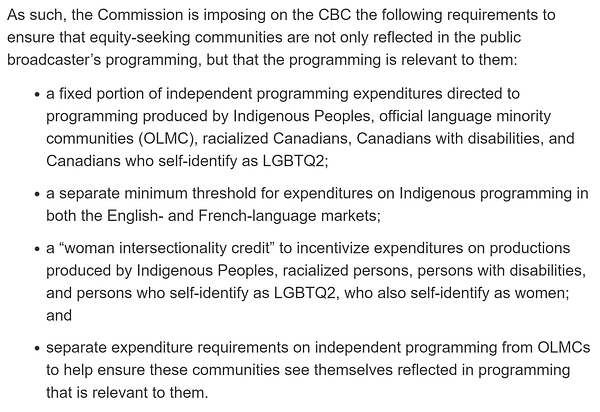
“As such, the Commission is imposing on the CBC the following requirements to ensure that equity-seeking communities are not only reflected in the public broadcaster’s programming, but that the programming is relevant to them.”
The CRTC is demanding a “fixed portion of independent programming expenditures directed to official language minority communities (OLMC), racialized Canadians, Canadians with disabilities, and Canadians who self-identify as LGBTQ2.” Additionally, it will grant a: “‘woman intersectionality credit’ to incentivize expenditures on productions produced by Indigenous Peoples, racialized persons, persons with disabilities, and persons who self-identify as LGBTQ2, who also self-identify as women.”
There are additional requirements for French language programming, of course.
This line also caught our attention from the notice:
“The Commission supports the Government of Canada’s commitment to renewing the relationship with Indigenous Peoples, based on the recognition of rights, respect, co-operation and partnership. On a broader level, the Commission also recognizes thatCall to Action 84 of the Truth and Reconciliation Commissionand theUnited Nations Declaration on the Rights of Indigenous Peoples(UNDRIP) tie into some of the objectives of theBroadcasting Actin that they refer to the reflection of Indigenous Peoples in the programming broadcast by the CBC.”
The CRTC is demanding changes to the election of the CBC ombudsman to ensure he or she is “sensitive to issues surrounding Indigenous people, racialized Canadians and other equity-seeking communities.”
It is also setting out “new expectations regarding the CBC’s Journalistic Standards and Practices to help ensure that journalists can provide relevant feedback and equity-seeking communities are consulted in any future review of the JSP.”
(The JSP is basically the bible of CBC journalism and guides its employees in how it approaches reporting, analysis and opinion. The JSP has come under particular scrutiny in recent years when it was alleged that the expectation of “objective” journalism would distort how the outlet approaches racism. Attentive readers will note the obvious allusion to “moral clarity” here.)
Whether or not you agree with the outcomes being sought, what is clear is that the CRTC (which is appointed by the governor general, on advice of the privy council) is having explicitly political goals written into its license renewals.
Now, don’t misread us, here. The CBC ought to be free to pursue equity goals in programming, or reviews of its JSP, or whatever it feels necessary to meet its mandate according to its own discretion. We happen think these outcomes are best exercised by trusted leaders and experienced producers who have the latitude to use editorial discretion, rather than by rigid quota or expenditure goals.
To have these demands placed on it by an external regulator in order to fulfil the political goals of that regulator and, ultimately, its political masters, is playing with fire in the worst kind of way.
For starters, one of the first pieces we ran here at The Line was from a documentary filmmaker who noted the ways in which diversity quotas shifted incentives in filmmaking. Just as students write to the test, quotas of this sort shift the focus in content production, forcing creators to produce content that checks a box, rather than fulfil a real audience desire. This creates a CBC that is dooming itself to be less relevant to the general public even as its relevance is growing more crucial thanks to the economic collapse of private media. The system is all the more insulting considering there is, in fact, a real audience desire for different voices and perspectives in our media landscape.
(The Line can think of two such examples of CBC shows that were compelling and worth watching regardless of their diversity requirements: check out Sort Of and Trickster if you haven’t already. Unfortunately, the latter was cancelled when it was revealed that director Michelle Latimer was not as Indigenous as previously stated.)
The second most obvious problem with all of this falls under the maxim “Do not give your enemies the weapons they will use to kill you.” In other words, having established this norm, do you not think that Prime Minister Pierre Poilievre, having done his damndest to stack the CRTC, will not do the same thing in turn? What is the CBC going to do when its license renewal is subject not to fulfilling the requirements of UNDRIP, but rather to concepts like “viewpoint diversity” and “journalistic objectivity,” as defined by Poilievre’s crew? The pendulum always swings back, friends, and it usually swings back harder when pushed.
Of note. Not an easy process for those trying to get out but arguably IRCC capacity has been overly stretched given overall government priorities and related backlogs:
A year after the Taliban seized control of Kabul, Canada’s resettlement efforts have lagged behind official targets and the efforts to help those fleeing the war in Ukraine.
More than 17,300 Afghans have arrived in Canada since last August compared to 71,800 Ukrainians who have come to Canada in 2022 alone, according to government statistics. The federal government has promised to resettle 40,000 Afghans.
Canadian activists and MPs accuse the Liberals of not doing enough to help people who worked with the Canadian Forces in the country, including as interpreters.
They say some families are in hiding from the Taliban as they await approval of their immigration applications, while others have been split up, with children and spouses of applicants left behind.
New Democrat MP Jenny Kwan, who has been in contact with many Afghan refugees who worked with Canadian Forces, said there is a “stark difference” between the government’s treatment of those fleeing the Taliban and those fleeing the Russian invasion.
She said the situation for Afghans who helped Canada is “grave,” with many unable to escape the country and facing persecution by the Taliban.
She said some received no reply to their applications from the immigration department other than an automated response. Others seeking visas from the Taliban authorities to escape their regime were put in peril if they identified themselves.
“Their lives are in danger. They told me what the Taliban are calling them: they are called ‘the Western dogs,'” Kwan said.
“We owe them a debt of gratitude. We cannot abandon them.”
Amanda Moddejonge, a military veteran and activist, said she has witnessed families being split up, with only some making it to Canada. She also warned that Afghans who worked for Canadian Forces “are being hunted” by the Taliban.
“Nobody should face death for working for the Government of Canada, especially when this government can identify those who worked for them and is able to provide them life-saving assistance,” she said.
The warnings come as aid agencies working in Afghanistan raise alarms that the country is in a dire humanitarian crisis, with 18.9 million people facing acute hunger.
Asuntha Charles, national director of World Vision Afghanistan, said aid workers have encountered acute poverty and malnutrition, including among children.
“At least one million children are on the brink of starvation, and at least 36 per cent of Afghan children suffer from stunting — being small for their age — a common and largely irreversible effect of malnutrition,” she said.
“In the four areas we work, we’ve found that families live on less than a dollar day. This has forced seven out of 10 boys and half of all girls to work to help their families instead of going to school.”
Vincent Hughes, a spokesman for immigration minister Sean Fraser, said the Afghan and Ukrainian immigration programs are very different.
He said refugees who arrived through programs set up to bring them to Canada have a right to stay permanently, whereas it’s believed many Ukrainians who have fled to Canada intend eventually to return to Ukraine.
Helping get people out of Afghanistan and to Canada was very challenging, he added, as Canada has no diplomatic presence there and does not recognize the Taliban government.
“Our commitment of bringing at least 40,000 vulnerable Afghans to Canada has not wavered, and it remains one of the largest programs around the world,” he said.
“The situation in Afghanistan is unique as we are facing challenges that have not been present in other large-scale resettlement initiatives.”
Easier to see from a service perspective in certain localities where numbers warrant but does pose significant operational challenges. The risk of an exemption, of course, is that it may provoke further requests for exemptions:
Senior civil servants explored offering Indigenous-language training to federal employees and possible exemptions to those who already speak one from requiring fluency in both English and French, newly released documents show.
Deputy ministers from several departments discussed the issue last fall.
A memo, released to The Canadian Press under federal access-to-information laws, flagged a “growing tension” between official-language requirements and Indigenous languages.
Under Canada’s Official Languages Act, federal institutions must offer working environments for employees to communicate in both French and English, and offer services to Canadians in either language.
As such, communicating in both is expected for senior executives and there are a number of public-service jobs where bilingualism is mandatory. There is room, however, for an employee to take classes and learn French or English as a second language.
The memo issued last fall said a working group was held about making changes to the official-language requirements. It said some Indigenous public servants belonging to a network of around 400 who work for the federal government asserted the need for a “blanket exemption.”
“My own personal view is there are opportunities for exemption – if the individual speaks an Indigenous language,” Gina Wilson, a deputy minister who champions the needs of federal Indigenous public servants, wrote in an e-mail to colleagues last November.
“Our GG [Governor-General] is a good example.”
Inuk leader Mary Simon’s appointment in 2021 sparked a discussion – and some controversy – over bilingualism in Canada’s highest offices, given how Ms. Simon, the first Indigenous person named as Governor-General, spoke English and Inuktitut, but not French.
Ms. Simon, who was born in Kangiqsualujjuaq, in the Nunavik region of northern Quebec, said she attended a federal day school and wasn’t able to learn French.
She committed to doing so after her appointment and has been taking lessons, delivering some French remarks in public speeches.
Commissioner of official languages Raymond Théberge said more than 1,000 complaints about Ms. Simon’s lack of French were lodged with his office after Prime Minister Justin Trudeau named her to the role.
Language training has been identified as one of the issues preventing Indigenous employees in the federal public service from advancing in their careers.
A report authored by public servants around the celebration of Canada’s 150th anniversary recommended those who are Indigenous be exempt from official-language requirements and instead be provided with chances to learn the language of their community.
It’s unclear if Ottawa plans to move ahead on changes to language requirements, training or exemptions.
A spokeswoman for Crown-Indigenous-Relations and Northern Affairs Canada said both that ministry and Indigenous Services Canada “have no plans to offer departmentwide Indigenous language training,” noting employees have offered workshops in the past.
It said Indigenous employees are encouraged to talk to their managers about language training.
Crown-Indigenous Relations Minister Marc Miller, an anglophone who speaks French and is learning Mohawk, said in an interview that the idea of an exemption is a sensitive issue.
“Inevitably, when you have to make one of those decisions, it is more often than not, and almost always, at the expense of jettisoning French,” said Mr. Miller, who represents a riding in Montreal.
“I don’t think that’s something that most people would find palatable … there are resources to learn it and I think there is the availability to do so.”
In their talks last fall, senior officials proposed ways to address concerns from Indigenous public servants about languages.
Ideas included providing more time to learn a second language and even offering Indigenous-language training, including to non-Indigenous public servants, as a show of reconciliation.
“I certainly recall during my French classes having this nagging thought in the back of my mind that I would be so much more open to this if I had the opportunity to be given training in my own Algonquin language,” Ms. Wilson wrote in her e-mail.
“I had a pretty good base in both, but of course my French is much better than my Algonquin now.”
Mr. Miller said he supports the idea of Ottawa providing classes, particularly to Indigenous public servants who were not provided the chance to learn these languages for themselves.
He said one challenge to doing so would be making sure Ottawa wasn’t taking language teachers away from communities.
“When you look at the fragility of Indigenous languages across the country, you would not want to be in a circumstance where we’re taking really valuable assets … people in many circumstances that are quite older, and just walking dictionaries out of their communities where communities are struggling to regain their languages.”
The same concern was highlighted by government officials. Both they and Mr. Miller said Ottawa faces calls to ensure it provides services to Inuit in Inuktitut.
“We could do better on that,” he said.
One change Lori Idlout, Nunavut’s federal member of Parliament, said should happen – and which officials also pitch in the memo – is for Ottawa to extend the $800 annual bonus it pays to employees who are bilingual to those who speak an Indigenous language.
The representative says she’s been approached by a union about federal employees in Nunavut who speak Inuktitut but are unable to access the compensation because they are not bilingual in French.
“Meanwhile, they’re providing valuable services to Inuit in Inuktitut,” she said. “It’s a huge issue.”
Ms. Idlout said Nunavut residents face many barriers when it comes to accessing federal services in general, including in Inuktitut.
According to the memo, officials recommend the government explore a pilot in Nunavut where jobs that require they speak Inuktitut “would not require competency in a second official language.”
Ongoing saga. Understandable that some would feel need to game the system or engage line-up placeholders:
Canadians are getting creative trying to cut the long waits for passports that have been dragging on for close to five months after a surge in post-pandemic travel demand overwhelmed the system.
By Aug. 11, a total of 1,092,560 passport applications had been filed this year – with more than 550,000 of those applications flooding in since April.
Service Canada said it’s prioritizing the applications of people traveling imminently, increasing staff and processing sites.
Despite all this, applicants say they are spending thousands of dollars to travel to less-busy passport offices — or even faking travel plans to speed the process to beat the 340,000-application backlog.
Federal officials say they are working to fix the problem.
Fake trips impact entire system
Karina Gould, the minister responsible for passport services, said Canadians are getting their passports on time, and there’s no need to “fake” travel — booking a flight you do not plan to take — to be eligible for Passport Canada’s urgent 48-hour approval mechanism.
“That impacts the whole system. There are a lot of people who did the right thing. They sent off their passports well in advance. Their applications are impacted by anyone who books fake travel,” Gould told CBC in a phone interview on Friday.
She had heard of the practice, but doubts it is widespread.
“I would be very disappointed to hear that, because that would be putting additional pressure on a system that is already pressured,” said Gould.
Meanwhile in Toronto, a man who CBC agreed to call Robert, said he has spent the past 59 days organizing 10 staffers to hold spots in lineups for about 500 absent passport applicants.
He said he has earned up to $1,000 per day offering this service.
No passport number needed to book many online flights
“Most of my customers book fake flights just to get their passports so they can drive across [the border],” said Robert.
“You’re going through more hoops to drive across [the border] than to fly. So what they do is just book a fake flight. It’s usually Toronto to New York or Toronto to Miami, and within 24 hours, they cancel it,” he said of his customers.
Multiple travel agents and Air Canada confirmed that many flights can be booked online without a passport number, and full-fare or business class ticket is often refundable.
Other travellers head to out-of-province Service Canada offices where the lines are not so long, with some citing shorter waits in Halifax or St. John’s.
St. John’s photographer Robert Young often gets called on for passport photos.
He said lately more travellers from other parts of Canada are utilizing the passport processing services in at Newfoundland.
“We’ve always gotten people from the edges of the world — like Pangnirtung (Baffin Island) — but now they are showing up from bigger cities,” said Young.
Government promises fix is working
Gould said lineups have decreased with the hiring of 500 new staffers, extended hours and the prioritizing of applicants with imminent travel plans, within 48 hours.
Back on July 25, Service Canada expanded passport pick-up services, adding five more locations in Ontario, Quebec, Alberta and B.C. to the 29 existing passport offices.
In Ontario and Quebec, a business has popped up to deal with the long waits for passport applications. Line standers charge about $40-$60 per hour or a flat fee of about $240 to line up at dawn and hold applicant’s place so they can apply to get a Canadian passport or renewal. (Roger Thompson)
This and other measures – like transferring application files to one of the 300 Service Canada offices upon request — aimed to reduce passport processing waits.
But many who mailed in applications last spring say the turnaround remains sluggish.
It’s difficult to get anybody on the phone or get an accurate status on an application, according to many applicants, including Paula Langley, a Canadian living in the U.S. who applied for a new passport in April.
Updates difficult to get
“The biggest problem is people being unable to get an answer about where in the process their passport is. I think the issue is partially technology. They are likely using outdated software. Other countries let you check your status in an online portal,” said Langley.
“It is very difficult to even get somebody on the phone to ask questions. The 1-800 number just cuts off after the queue of callers gets too high.”
On Passport Canada’s website, delivery is promised in 46 days or six and a half weeks. But anyone needing a passport within two business days can go to specialized sites offering urgent service, if they have proof of travel.
The government’s plan was to ease backlogs, but it’s given some a chance to jump the queue by booking and then cancelling travel.
Broken system
“It’s upsetting,” said Leanne MacLeod who runs Getaways by Leanne out of Toronto and offers passport advice online. What’s not helping, she said, is booking a “fake” trip that you cancel to get travel documents.
“I’ve seen people recommend booking a refundable hotel, then cancelling,” she said. “It’s really what’s holding up the whole process right now. For every person who gets ahead, one gets bumped.”
Taylor Bachrach, the New Democratic Party’s transport critic, said the fact that people are trying to work around the system is evidence it’s not working.
“It shows how frustrated people are and the lengths they are willing to go,” said Bachrach.
“If people are having to ‘game’ the system to get their documents, that shows how broken the system is.”
People in his Skeena Bulkley Valley constituency in Northern B.C. live a 12-hour drive from the nearest passport office.
Bachrach has one staffer who has spent the past several weeks devoted to helping constituents secure passports.
Family trips at risk
“I have a constituent whose family needed to travel to the United States, and we were able to work with the federal government to arrange for the passports to be picked up. But he had to incur $2,000 in extra travel costs to get from here in Smithers, B.C., all the way to Victoria to pick up the passports. … This obviously has a big impact on people.”
Bachrach said these months of passport chaos are “unacceptable.”
“The increased demand for passports was entirely predictable. But the Liberals failed to act even though they had months to prepare for travel to return.”
That lack of foresight has left many Canadians apprehensive, with only a few weeks of summer left. Joseph Ivens of Terrace, B.C., applied to renew his two teens’ passports back on April 4.
The family of five has saved for a trip to Mexico for four years. The flight is booked for Aug. 27, but the passports have not come.
Minister promises family passports are coming
The father of three said he’s made hundreds of calls, several requests for a file transfer and appealed to his member of parliament. He may be forced to travel to Calgary or Vancouver at the last minute to try to secure the travel documents so the holiday is not lost.
“It’s causing my family massive stress with loss of sleep. It’s breaking us,” said Ivens. “I have no recourse.”
Gould, the minister responsible for passport services, told CBC on Friday that Ivens will get travel documents on time.
“He will get his passport. I understand people are stressed, but everyone is getting their passport on time,” said Gould.
Paul Laurence Dunbar was perhaps the pre-eminent Black poet of the era after Reconstruction. In a new biography, the Princeton University English professor Gene Andrew Jarrett takes Dunbar’s rather glum, shortish life and pulls off a book that pulls you along like an open bag of potato chips; for the first 100 or so pages, I could barely put it down. But there’s one thing that jars like a wrong note every time it comes up: Dunbar regularly and casually referred to Black people of a lower social class than his with the N-word. An example: “I dressed at the hall dressing room in all clean linen, but had to send a [N-word] out for a standing collar because mine were all lay-downs.”
Sadly, this wasn’t atypical for more fortunate Black people of the era. Dunbar’s erudite and accomplished wife, Alice Dunbar Nelson, also used the word freely in their letters. The mother of the late-19th- and early-20th-century Black composer and conductor Will Marion Cook used the word in dismay at her classically trained son’s pursuing popular music with sometimes salty lyrics.
That kind of open classism — particularly when directed by middle- and upper-class Black people of the Victorian era toward working-class Black people — can be startling for contemporary readers. Today, for a well-heeled Black person to denigrate a less well-off Black person in this way would be deemed malicious at worst or elitist respectability politics at best.
Knowing this about Dunbar might sour someone’s opinion of him as an individual, but his use of the N-word and the sentiment behind it are unlikely to reduce his stature as a literary figure. And almost no one would consider this as grounds for a retroactive reckoning, reconsideration or, yes, cancellation of the kind to which the legacies of various historical figures are now subject. If for no other reason, then probably because his is a case of intra-Black offense being given.
One can quibble about what being canceled really means; the answer probably lies somewhere between Woodrow Wilson’s name being removed from Princeton’s public policy school and Gina Carano being dropped from the cast of “The Mandalorian.” But with Dunbar, it’s hard to imagine anyone kicking up much dust or writing, let’s say, a think-piece asking us to affix his condescension toward fellow Black people to him like a Homeric epithet, nullifying or adulterating his intellectual contributions.
That’s a good thing. We should be able to evaluate various figures, past and present, by noting their indecorous or hateful views and continuing to appreciate, even celebrate, their achievements without making them candidates for cancellation. And Dunbar’s case gets me thinking about people with less immediately dismissible stains on their records for whom the almost recreational hostility of cancel culture has held off.
Being Black and a woman seems to discourage the mob, for example. And my point, to be very clear, isn’t that Black women wrongly benefit from some kind of special pleading. It’s that, on the contrary, the forbearance that’s been extended to a number of prominent Black women in recent times should be the norm.
The Pulitzer Prize-winning novelist Alice Walker has produced writing and made statements that are readily interpreted as antisemitic, and while there have been a few protests and disinvitations and criticism aplenty, no real movement has arisen to demand that her artistic achievements be viewed through this prism. As The Atlantic’s Caitlin Flanagan argued, Walker has been treated rather “gently” about this issue, specifically in a New Yorker article written this past spring, whereas few could imagine similarly gentle treatment of J.K. Rowling for views many interpret as transphobic. Flanagan notes that in contrast, in 2020 The New Yorker asked, about another literary figure, “How Racist Was Flannery O’Connor?”
A few weeks after apologizing for her anti-Israel “Benjamins” tweet in 2019, Representative Ilhan Omar of Minnesota got the chance, in the pages of The Washington Post, to clarify her stance on the Israel-Palestinian conflict and remains a hero to many on the political left; this week, she won her Democratic primary.
In 2015 the actress Phylicia Rashad said of her former co-star Bill Cosby’s accusers, “Forget these women.” Last year, when Cosby’s sexual assault conviction was overturned, she tweeted, “FINALLY!!!!” before deleting it, tweeting a walk-back and apologizing to the Howard University community. She remains the dean of Howard’s college of fine arts.
The MSNBC host Joy Reid was revealed to have written homophobic blog posts in the aughts, and her later attempts to explain them away weren’t terribly convincing. This blotted her record, but after a brief outcry, her career as a progressive oracle on prime-time TV remains intact.
Contrast Reid’s situation to the Emmy-winning actress Roseanne Barr being fired from the sitcom she starred in because of a racially demeaning tweet about the former White House adviser Valerie Jarrett. Try to imagine a white male university official getting so smooth a ride as Rashad after caping for Cosby. Ponder the stock response of Democratic voters to a white male member of Congress accused of antisemitism.
Is there a sense on the left — where it seems the canceling impulse is strongest — that Black women should get more of a pass on transgressions of social justice etiquette because of the double burden of being female and Black? I’m not sure.
But whatever our verdict on that, I am sure that this measure of forbearance should be the default for public or historical figures. Of course, it’s fair, maybe necessary in some instances, to chastise these figures. Of course, sometimes there will be transgressions so widely condemned that the transgressors are irredeemable. But most of the time, emphasizing people’s contributions despite their flaws — seeing them in totality and not boiling down their lives to their specific missteps — is just civilized rationality. The idea that an isolated breach of social justice etiquette should derail a career is calisthenic. So when we see that happening, we should hesitate and, in most cases, root for outcomes where people get criticized, perhaps, for their wrongthink but not shoved out of the public square.
I recommend Walker’s “The Temple of My Familiar,” a book that left me ashamed of being a man and yet wanting to read it again. Reid’s career as a broadcaster outweighs any parochial views about gay people she now disavows. I’d happily see Rashad in acting roles forever, despite my disappointment in her take on Cosby. I, frankly, wouldn’t vote for Omar but accept that voters in her district see things differently.
We know, certainly, there are situations where people other than Black women have avoided cancellation. Dave Chappelle comes to mind. My point, again, is that some degree of grace is called for in most cases — for the college professor who says something impolitic in class and the historical figure whose words are appalling now but were consistent with his times.
We need to rethink the entire practice of treating unpretty sentiments as if they summed up anyone’s life or work, whether you’re talking about a political titan or a contemporary celebrity. That Thomas Jefferson was an enslaver and thought of Black people as inferior is a sad aspect of his totality, and his hypocrisy on race should be noted. But it doesn’t negate all else he accomplished, including drafting the Declaration of Independence, a document that guides and governs our very way of life.
Back to O’Connor and the racism that has caused some to reconsider her work. Yes, she used the N-word freely in letters and wrote, “About the Negroes, the kind I don’t like is the philosophizing prophesying pontificating kind, the James Baldwin kind. Very ignorant but never silent.” It reflects a bigotry and a parochialism not unlike Dunbar’s. (And she’s just wrong about Baldwin.) But that doesn’t dilute the brilliance or literary value of a story such as her “Parker’s Back.” And it won’t work to claim that the difference between O’Connor and Dunbar is that his objectionable remarks were intra-Black. By today’s woke standards, wouldn’t classism tinged with racism be an intersectional double whammy? If there’s room to look beyond his flaws, O’Connor should get the same treatment.
One more: The biologist E.O. Wilson, who died last year, faced accusations of racism, a charge that continues to be explored. One article describes an epistolary cordiality with the Canadian psychologist J. Philippe Rushton, who had openly racist views about Black people. In one such letter, Wilson reportedly praised Rushton’s paper arguing that “Black and non-Black people pursue different reproductive strategies.” That’s far from ideal, but even less ideal is any sense that this aspect of Wilson must be ongoingly considered amid our assessment of his pioneering genius. I was knocked out by his book “Consilience: The Unity of Knowledge,” about the progress of our understanding of the world, and considering how he may have felt about Black people would have been quite irrelevant to the experience.
Whether we’re talking about the past or the present, the idea that being insufficiently progressive or sensitive can wind up being the measure of a person’s worth is a call to disavow intelligent assessment in favor of gut-level impulses. It’s an all-or-nothing kind of thinking that, in the guise of insight, teaches a form of dimness. We seem to spontaneously understand this in some instances. We need to extend that basic common sense, that basic ability to make distinctions and see the whole picture, when evaluating trespasses by people of all walks of life and across time.
Of note. The extent to which this will influence decisions remains to be seen:
At the Association of International Educators (NAFSA) conference in Denver this year, there was much discussion about global instability and what this means for international higher education.
Clearly, geopolitical tensions, the diminished but by no means ended implications of COVID-19, the climate crisis and, most recently, global inflation and likely economic challenges to follow all weigh heavily on student and scholar mobility and on broader aspects of internationalisation.
But one aspect that did not seem to get much attention from the largely US audience was the key challenge of the instability of the United States in a more diverse and competitive global higher education environment.
The fact is that the United States is seen by many around the world as a significantly unstable society with an uncertain future. This perception, based largely on reality, has, and will continue to have, implications for US higher education attractiveness and relations with the rest of the world.
It is worth examining the nature and possible implications of this instability. The argument here is not that US higher education is collapsing, or that the United States will not continue to attract the world’s largest international student population in absolute numbers, or that it will not continue to be an attractive environment for postdocs or international faculty; rather, that there are, and will be, significant headwinds and a decreasing relevance and market share.
It is worth examining the largely ignored but serious challenges that are increasingly evident to students and academics outside the United States.
The past and, perhaps, future of Trumpism
The direct impact of the Trump administration and the ideas and practices that underlie it have been influential and are, by now, part of the way that US higher education and society are perceived around the world.
The overall nationalistic and populist ideology that characterised the Trump years, and continues to have a significant influence on a large segment of the American population, in particular the Republican Party, also plays a role. Many around the world – and in the United States – are concerned about a second Trump presidential term or of someone like him.
The recent highly conservative decisions of the Supreme Court, outlawing abortion and expanding the use of guns, and the controversy surrounding these decisions, have also received much negative coverage outside the United States.
All of these trends are especially evident in ‘red’ (conservative) states, and universities in those states may be negatively affected. It is in those states that the public higher education sector is already facing severe budget cuts and lower local and international student numbers and that the private, not-for-profit higher education sector is less known for its international reputation and quality than in the ‘blue’ (Democratic) states.
Is the United States safe?
Mass shootings (some 300 so far in 2022), other gun violence and steady media reports of crime are on the minds of students and families as they think about a choice of where to study.
It becomes particularly relevant when international students fall victim to gun violence, such as the random shooting of a Chinese student near the campus of the University of Chicago, in broad daylight, in November 2021.
The Supreme Court decision versus New York State on the carrying of weapons also strengthens a negative image that students are not safe, even in states and cities that are popular among international students.
Racism
The tide of racial tensions and incidents of racial hate, stimulated in part by Trumpism, cause potential international students and staff to question whether they will be welcome in the United States.
Violence against blacks and Asians including, but by no means limited to, the senseless shooting of six Asian women in Atlanta, is widely reported – and of special relevance to the preponderance of students coming from east Asia, still the largest region in sending students and academics to the country.
The politicisation of higher education
This theme will affect graduate students, postdocs and prospective international faculty hires rather than undergraduates.
A steady stream of stories about state government interference in university affairs, including forbidding teaching about Critical Race Theory in a number of ‘red’ states, debates about ‘wokeism’ and ‘cancel culture’ and other political issues may deter some graduate students and professionals, in particular those who want to escape from authoritarian regimes and a lack of academic freedom in their own countries (for instance, Russian students and faculty after the invasion of Ukraine and related academic restrictions in Russia).
The ‘China Problem’
Because half of international undergraduate students – and an even larger percentage of graduate students – come from China, and US-China academic and research relations are so important, it is also relevant to focus on China in this article.
Chinese students have long seen the United States as a primary study destination. Their overall enrolment climbed fivefold between 2000 and 2001 and 2020-21.
However, geopolitical tensions between the United States and China in recent years, during which Chinese students and researchers have repeatedly been used as ‘political pawns’, have turned the United States into an unwelcoming study and work destination.
The surge of anti-Asian hatred toward the Asian American and Pacific Islanders, or AAPI, communities, as well as rampant gun violence, have furthered the concerns of Chinese families. The 15% drop in Chinese student enrolment during the pandemic was a clear signal that interest in the United States among Chinese students had significantly declined.
The perception of Chinese students that they are viewed simply as ‘cash cows’ does not help US higher education institutions to create an inclusive environment.
On the one hand, Chinese families still see the United States as a sought-after destination for their children’s college education; on the other, they are increasingly wary about sending their children to a country where they may be in harm’s way.
A direct result of this dilemma is the recent trend of Chinese students applying to colleges in multiple countries instead of primarily the United States. This directly threatens the future mobility of Chinese students to US colleges, potentially weakening the strength of innovation and global competitiveness of US higher education.
Other concerns
Difficulties obtaining visas (of course, greatly exacerbated by the COVID-19 crisis) also enter into the thinking of potential students and scholars. Recent research notes that the United States is among the main receiving countries with the longest delays in issuing visas for international students and researchers.
The high inflation in the United States is also not helping. High tuition fees were already a barrier, but increasing costs of living will become even more of a challenge for international students. And, while Europe, China and Russia are looking at Africa as a new source of international students and faculty, the United States is rather absent in that region.
Looming realities
Of course, several of the challenges and concerns mentioned here (racism, rising costs, geopolitical tensions with China and politicisation) also apply to other leading countries, in particular the United Kingdom and Australia, but that is not an excuse for the United States to ignore these challenges.
It will remain the country with the largest number of highly ranked universities, an overall effective higher education system serving many different constituencies and a sophisticated, productive and reasonably well-funded research system.
But the instability and challenges discussed above are accelerating the United States’ decline as the undisputed global academic leader. The consistently ‘upbeat’ views of the Institute of International Education and others do not reflect looming realities.
Philip G Altbach is research professor and distinguished fellow, Center for International Higher Education, Boston College. Hans de Wit is professor emeritus and distinguished fellow at the same institution. Xiaofeng Wan is associate dean of admission and coordinator of international recruitment, Amherst College.


 Multicultural Meanderings