Bailey: Harnessing the Best of Automation While Minimizing the Downside Risks

A good summary of some of the issues. Arguably, the USA is ahead of us given our (over) reliance on immigration, both permanent and temporary, to address labour shortages rather that developing and implementing technologies:

The pandemic and economic disruptions have accelerated the adoption of automation technologies that will introduce important benefits to businesses and consumers but may also create disruptions for many workers and communities. Policymakers and leaders can take steps now to help navigate these disruptive changes.

Automation covers a broad range of technologies and advances in artificial intelligence (AI) and robotics that are deployed in novel ways to increase productivity or expand business capabilities. The Federal Reserve’s most recent Beige Book included observations from several districts noting that companies facing labor shortages were turning to automation as a solution. A McKinsey survey of 800 business executives found that 85 percent were accelerating their digitization and automation as a result of COVID-19. Companies across North America also spent a record $2 billion for almost 40,000 robots in 2021.

These new technologies are increasingly being deployed in a wide range of economic sectors. For example, in agriculture, drones such as the Agras MG-1 can provide precision irrigation for over 6,000 square meters of farmland in just under 10 minutes. John Deere is piloting autonomously driving tractors that can plow fields and plant crops with minimum human interaction. The autonomous robot created by Carbon Robotics can kill 100,000 weeds per hour, leading to increased crop yields, and reduce the use of pesticides by using nothing but lasers. 

These and other innovations will bring numerous benefits to businesses and consumers alike, but the transition could be disruptive to workers and communities. Policymakers should consider several actions to help harness the best of automation while minimizing the downside risks.

Community Dynamism. Policymakers and community leaders have a broad array of community development tools in their toolboxes, including Opportunity ZonesNew Markets Tax Credits, and Coronavirus State and Local Fiscal Recovery Funds. But they should first take a step back and consider how to create the conditions for dynamism, which AEI’s Ryan Streeter notes is “a culture rooted in a taste for discovery and betterment [that] can shape—indeed, has shaped—our institutions and policies, from how we structure patents to how we tax capital investments.” It offers a conceptual way to think through, structure, and orient all the existing policies and projects aimed at strengthening communities.

Boost Research and Development. The US must continue investing and expanding research and development on emerging technologies, including AI, to power the next generation of smart technologies, robotics, and drones. Addressing the computer chip shortage is critical, including bolstering domestic manufacturing capabilities. Various proposals being considered in the Bipartisan Innovation Act will advance this important work.

Invest in Human Capital. Automation is eroding jobs further up the skills ladder, which is raising the skill level for every new job while creating entirely new lines of work. Boston Consulting Group and the Burning Glass Institute analyzed more than 15 million job postings to understand how skill requests changed from 2016 to 2021. They found an acceleration in the pace of change. Nearly three-quarters of jobs changed more from 2019 through 2021 (with a compound annual growth rate of 22 percent) than they did from 2016 through 2018 (19 percent). The main driver was found to be technology, which redefined jobs sometimes radically and sometimes more subtly. The US should strengthen its entire skills pipeline to ensure individuals have the skills these jobs require. Community college programs will need to align with these new trends and employer needs. Companies should also explore apprenticeships to provide work-based learning opportunities for individuals transitioning careers. Skilled immigration, through ideas such as Heartland Visas, can also bolster the human capital available to communities.

Broadband Build-Out. State and community leaders must begin preparing their broadband plans to make the most of the $65 billion in new broadband fundingavailable through the Infrastructure Investment and Jobs Act. Connectivity enables smart devices and AI systems to talk to and coordinate with one another. It allows scaling of critical services, including telehealth and online job training. Leaders must begin developing their plans and priorities now to ensure projects support broader economic and community needs, prevent overbuilding, and ensure the funds build out future-proof infrastructure to underserved communities.

Regulatory Sandboxes. Policymakers should create regulatory sandboxes that invite experimentation with new technologies and automated systems. These are a win-win because they give policymakers the chance to better understand the new technologies they are responsible for regulating, while providing entrepreneurs and investors with clearer regulatory pathways and guardrails toward which they can develop. North Carolina launched a FinTech Regulatory Sandbox that allows pilot projects to test emerging technologies and business models, including technologies that would otherwise be illegal under existing regulations. Arizona created a regulatory pathway for safely developing and testing autonomous and connected vehicle technologies. These flexible regulatory environments can accelerate innovation and lead to smarter polices and regulations that protect consumers.

AI and automation will introduce important benefits to communities, businesses, and society. Policymakers and community leaders have important roles in helping to accelerate the use of these technologies while minimizing the disruption they pose for different communities.

Source: Harnessing the Best of Automation While Minimizing the Downside Risks

‘Conservatives are losing traction in ethnic communities:’ Will their leadership race make it even worse?

Likely premature call.

As we know, voters in the 905 have flipped between Conservatives and Liberals, and Doug Ford won most of these ridings in 2018 and 2022.

And during the recent leadership debates, there was remarkable consensus in favour of immigration and no opposition to the current government’s ongoing increase in immigration levels:

Cyma Musarat still remembers being accused of having lost her mind when she ran for the federal Conservatives in 2019.

As a Muslim woman, she was asked time and time again how she could cast her lot with a party that promoted policies condemned as racist.

In her riding of Pickering-Uxbridge, it was a particularly sensitive topic — during the 2015 election campaign, the Tories held an event in a pocket of the riding where they promised a so-called “barbaric cultural practices” tip line for people to report on their neighbours.

The tip line proposal and support for a ban on face coverings during citizenship ceremonies were seen as key contributors to the party’s defeat in the election.

And not just that year.

The policies effectively bombed the bridges the party had built with ethnic communities, and the issues surfaced in the 2019 and 2021 campaigns as the Tories failed to make the gains in urban centres.

What it will take for the Tories to win the next election is the question at the heart of the party’s current leadership race.

But how ethnic communities factor into the equation is a point of contention, and an issue not being debated enough, some say.

So far, the race has not seen debate over social issues like systemic racism or inequality, or even how the party can and must embrace equity and inclusion internally, said long time political activist Sukhi Sandu, who backed the Tories in the last federal campaign.

“The Conservatives are losing traction in ethnic communities, and they seem not to understand the issues that pertain to those racialized groups,” Sandu said in an interview from Boston, where he’s working towards a master’s degree in diversity, equity and inclusion.

Musarat believes the party must first acknowledge these issues exist, then move beyond a process of just checking off boxes.

For her, that’s why Brampton Mayor Patrick Brown’s leadership bid is so appealing.

“He openly says that Islamophobia exists,” she said. “That’s where the journey starts. That’s where the change will start: acknowledge the problem. Once you’ve acknowledged it, and then you find a solution to fix it.”

Brown built his leadership bid on his outspoken opposition to Quebec’s Bill 21, which bans people in positions of public authority in that province from wearing religious symbols, like turbans or hijabs, at their workplaces.

He went on to promise a multi-faith, multicultural coalition that would restore trust between the Tories and ethnic communities.

While signing up what his campaign says are 150,000 new party members, Brown has made specific promises to different ethnic groups.

In turn, he has been accused of playing diaspora politics — an accusation his backers say is proof most candidates aren’t willing to do the hard work of sitting down with voters to listen to their specific concerns and address them.

“People have this misconception that someone stands up at the front door on stage and says, ‘We’re all gonna support Patrick,’ and, you know, 50,000 people sign up for the man,” said Jaskaran Sandu, a volunteer on the Brown campaign.

“That’s not how it works. It’s painstaking, person-to-person relationship building that only works if there is sincerity and a track record.”

Brown has also been unsparing in his attacks on rival Pierre Poilievre, challenging the Conservative MP for remaining silent when the Tory government introduced the niqab ban and proposed the tip line.

Poilievre’s campaign co-chair Tim Uppal has apologized for not personally pushing back against those policies when he was an MP — and minister of state of multiculturalism.

Uppal said he had no concerns that the candidates’ positions on tackling racism aren’t getting a broad airing on the campaign trail. An issue like that only gets debated if there’s a flashpoint which prompts it, he said.

He said while Brown is recruiting in diverse communities, so too is Poilievre, citing a recent speech to a packed mosque, among others.

“What I’ve talked to people a lot about is that they’re being included because of issues that are important to them, which is taxes and other issues that affect all Canadians,” he said.

Leslyn Lewis, a Black woman making her second run for the Conservative leadership, did not respond to questions from the Star about how she views the future of the party’s relationship with ethnic communities.

Vonny Sweetland is working on Jean Charest’s leadership bid, a decision based on the depth of the former Quebec premier’s experience — and his willingness to bring people like Sweetland onto his team.

The leader sets the tone, said Sweetland, who is Black, and Charest’s is inclusive and progressive.

But both Sweetland and Sandhu said they have concerns about what will happen to the party if the populist elements that appear to be playing a major role in this race ultimately triumph.

Sandhu pointed to the tension between members recruited with a promise the Conservatives will embrace diversity and those brought in over concerns about global institutions like the World Economic Forum, around which conspiracy theories with racist undertones persist.

“Why do you expect us to be involved or continue if that’s the type of rhetoric that’s going to be included back into the party?” he said of those recruited by Brown.

“That doesn’t actually solve the issue — it goes back to the basis of the problem, which is that the Conservative party is not ready to look in the mirror and evolve and realize why it falls short in places like the 905.”

Sweetland said while he’s planning to give the new leader is some runaway, whoever it is, there is anxiety among other Black conservatives.

“I’ve seen, people, particularly people of colour, feel that this is not only a leadership race — and I’m sure you’ve heard this quote, it’s not mine, but I agree with it — that this is the battle for the soul of our party,” he said.

“And many people of colour feel that way.”

Source: ‘Conservatives are losing traction in ethnic communities:’ Will their leadership race make it even worse?

COVID-19 Immigration Effects – April 2022 update

My latest monthly update.

April 2022 is the two-year first full month comparison. As a result, the changes are particularly dramatic given the full impact of travel restrictions such as the shut-down of citizenship, the virtual shutdown of visas and the impact on permanent resident arrivals and Temporary Foreign Workers.

The number of Permanent Residents admissions declined slightly in April, as did the number of TR2PR transitions, the latter continuing a trend since December 2021, suggesting that the “transition pool” may be drying up.

Temporary foreign workers, both IMP and the TFWP also increased, the former returning to pre-pandemic levels, the latter showing both the seasonal increase in agriculture workers as well an increase compared to pre-pandemic levels for workers with a LMIA, suggesting an impact of labour shortages.

The number of students continues to increase, well beyond pre-pandemic levels. Students from India comprise more than 40 percent of all study permits. This reflects in part that many of these students, particularly at private colleges, using study as an immigration pathway. Unfortunately, IRCC data for post-secondary studies is not broken down by type of institution.

While citizenship dipped in April compared to March, it is too soon to tell whether this is a blip or a sign of operational difficulties.

The number of Ukrainians arriving in Canada, mainly under the Canada-Ukraine authorization for emergency travel continued to increase, more than tripling from March to almost 68,000.

Federal government now posting passport wait times online as long lineups continue

Interesting reference to consideration being given to issuing passports along with citizenship. Given that IRCC is responsible for both, eminently doable and makes sense, but not a high priority for IRCC and the government.

But this would be a real tangible service improvement for new Canadians, and an opportunity to integrate citizenship and passport pathways:

Passport offices are still dealing with a surge of applications, the minister responsible says, and wait times are “far from acceptable.”

Karina Gould says those long wait times are her top priority, but she cannot say when things may return to normal.

The federal government says 72 per cent of Canadians who apply for a passport in any manner will get it within 40 business days, while 96 per cent of people who submit their application in person will get their passport within 10 business days.

The government’s website now includes estimated wait times for visits to passport offices, updated three times a day, to help people plan.

On Monday afternoon you could expect to wait four hours and 45 minutes at the Ottawa location, three hours in Toronto, and six hours and 45 minutes in Vancouver.

Gould says her department is considering further changes, including moving the application process online.

She also says her department is working with Immigration, Refugees and Citizenship Canada to determine if there’s a way to issue passports to people as they get their citizenship instead of requiring a separate application. Both examples will take time to implement.

There are typically between two million and five million passport applications per year in Canada. During the pandemic, only about 1.5 million passports were issued over two years.

As a result, passport staff were given other work during that time and Service Canada is now trying to shift that work elsewhere.

And while Gould says 2022 is on track to be at the high end of the typical range, close to five million, “we’ve typically been able to manage that volume throughout the year but we’re seeing the surge happening all at the same time, which of course is leading to long lineups.”

Australia’s passport processing times are six weeks, according to Gould, while it takes 10 weeks to get a passport in the United Kingdom and 11 weeks to get one in the United States.

Source: Federal government now posting passport wait times online as long lineups continue

Paddington, go home: Home Office staff pin up faked deportation notices

Witty but inappropriate behaviour by public servants:

Over the past week mocked up immigration enforcement notices have begun to appear on internal Home Office staff noticeboards, featuring photographs of Paddington Bear, stating that he is wanted so he can be placed on a relocation flight to Rwanda.

Elsewhere, staff have noticed a rash of Refugees Welcome stickers, affixed to Home Office printers and pieces of furniture in departmental buildings around the country.

The organiser of the Our Home Office protest group, bringing together staff opposed to Rwanda deportations, said unease about the proposed removals has galvanised employees from all over the government department to take subversive action.

“It’s still a small, low-level campaign, but it’s growing and is already networked in offices throughout the country,” the group’s founder said, asking not to be named in order to protect his job at the department. “The announcement of the Rwanda transportation plan was really a significant moment for a lot of staff members who were quite shocked by how barbaric a proposal it is, particularly the way that it seems to be against the refugee convention and the principles that we are trying to uphold of giving people fair treatment.”

More rolls of Refugees Welcome stickers have been posted out in the past few days to members of staff who have got in touch through a protest group website, the organiser said. “No one expects working in the Home Office to be easy but this has pushed a lot of people over the edge,” the employee said.

Refugees Welcome sticker
Refugees Welcome stickers have begun to appear in Home Office buildings. Photograph: Twitter

Source: Paddington, go home: Home Office staff pin up faked deportation notices

Turkish Bar Associations Union takes citizenship through investment to top court

Pushback on citizenship-by-investment program given negative impacts:

The Turkish Union of Bar Associations (TBB) has applied to the country’s top court for the reversal of a regulation allowing foreigners to gain Turkish citizenship through investment, Diken news site reported on Monday.

“The current regulation, which came into effect in 2013, is both in violation of the Constitution and lacking any legal foundation,” it cited the TBB as saying in the application submitted to the Council of State.

Turkey’s “Citizenship by Investment Programme,” which allows citizenship through the sale of housing to foreigners, came into effect almost a decade ago. The programme initially allowed foreigners who owned property in Turkey equivalent to $1 million to become citizens. This amount was reduced to 250,000 in 2018, sparking a rapid hike in foreigners seeking to own a home in the country.

The figure was increased to $400,000 on Monday, according to a decree published in the Official Gazette signed off by President Recep Tayyip Erdoğan.

The latest change was prompted by a spike in the price of new and existing homes of almost 100 percent annually, which has made it effectively impossible for citizens to purchase homes. Builders in the country are charging more for new homes after the raw material costs jumped, partly due to a slump in the value of the lira, which lost 44 percent of its value against the dollar in 2021 and around 25 percent this year.

“The Turkish Republic’s constitution urges that the conditions for attaining citizenship should be regulated through the law,” the TBB said. “There is no regulation in the (related) law, which states that …. Turkish citizenship can be obtained through investment made in foreign currency.”

The citizenship programme also provides a Turkish passport to foreigners who invest  $500,000 in government bonds, companies, investment funds or a local bank account.

Erdoğan’s government has come under criticism for offering investment incentives to foreign nationals as citizens continue to feel the squeeze of soaring inflation on their wallets.

Last month, Erdoğan said his government would help alleviate the cost of higher property prices by offering zero interest rate mortgages to low income families. He also said the government would provide financing for unfinished housing projects provided the developers froze prices for a year.

Source: Turkish Bar Associations Union takes citizenship through investment to top court

Millions believe in conspiracy theories in Canada

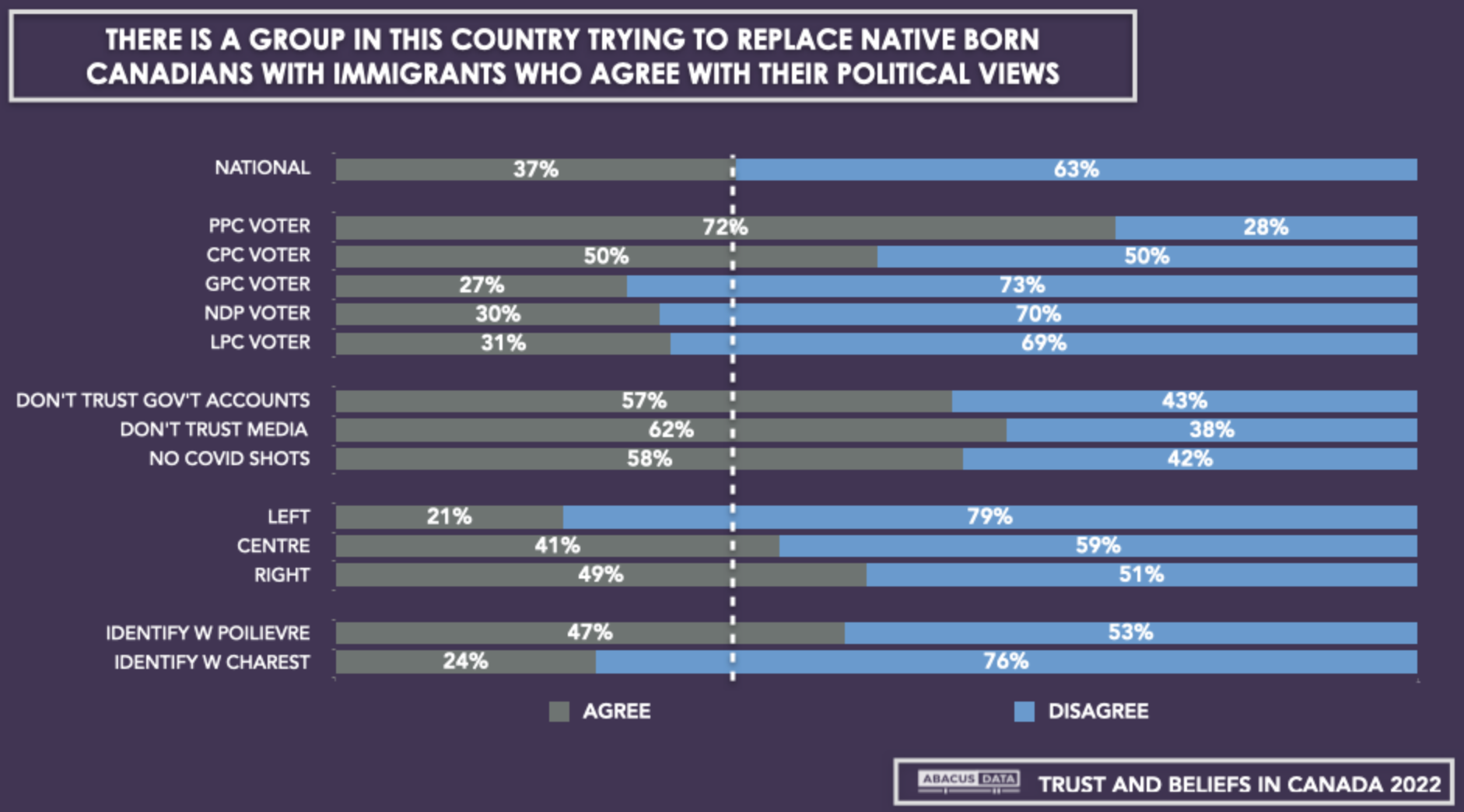
Interesting public opinion research and worrisome. The “great replacement” slide below is the one that most attracted my attention. It does track, to a certain extent, the Focus Canada question, “Too many immigrants do not adapt Canadian values,” 48 percent Fall 2021:

We recently completed nationwide surveying among 1500 Canadians.  The focus was on the levels of trust people have in institutional sources of information, and belief in conspiracy theories.  This is the second in a series called “Trust & Facts: What Canadians Believe”

• 44% (the equivalent of 13 million adults) believe “big events like wars, recessions and the outcomes of elections are controlled by small groups of people working in secret against us”. Almost as many agree “much of our lives are being controlled by plots hatched in secret places

• 37% (or 11 million) think “there is a group of people in this country who are trying to replace native born Canadians with immigrants who agree with their political views. This is an articulation of what is commonly referred to as replacement theory.

• 20% believe it is definitely or probably true that “the World Economic Forum is a group of global elites with a secretive strategy to impose their ideas on the world.” Another 37% think it is possibly true or aren’t sure either way.

• 13% think it is definitely or probably true that Microsoft founder Bill Gates is using microchips to track people and affect human behaviour. Another 21% say it’s possible, or aren’t really sure.

A deeper dive into demographic and other variables that correlate with these beliefs revealed:

• Belief in these theories is higher among supporters of the People’s Party, those who self-identify on the right of the spectrum, those who have not received any COVID-19 shots, and those who think media and official government accounts of events can’t be trusted. Those who feel Pierre Poilievre is the Conservative leadership candidate closest to their values and ideas are more likely to believe these theories when compared to those who feel more aligned with Jean Charest.


THE UPSHOT

Canadians who want to believe that Canadian society is relatively unaffected by conspiracy thinking will find little comfort in these results. Millions believe that our lives are controlled by secret plots to undermine our interests.

That such beliefs correlate strongly with the instinct to mistrust what media report and what governments say –is a challenge that threatens all institutions that depend on an informed body politic and is like a poison affecting our civil discourse. Only recently we’ve witnessed how a massive demand for the protection offered by Covid 19 vaccines fostered a strenuous effort by those who disbelieve government and media to deny the value of those same vaccines.

This question of whether people can and should trust in institutional voices and known facts is the central theme running through the current leadership dynamic within the Conservative Party leadership race. The data make it clear that to compete for votes from the People’s Party base, Conservatives could choose to embrace conspiracy thinking, but in so doing would alienate a good portion of others, and create hesitancy among half their current voter coalition.

Perhaps the most disconcerting thing in these numbers is the fact that mistrust of institutional accounts isn’t simply neutral skepticism – it is often accompanied by a willingness to believe dangerous contrarian theories. This threatens to undermine the ability of political parties, businesses, civil society groups, and governments to help build consensus and make progress together.

Source: Millions believe in conspiracy theories in Canada

Tolley: Women and racialized political candidates are being set up to fail

I’m less pessimistic than Tolley given overall progress election to election, albeit slower than desired. And gender equity may be more of a factor in winnable ridings as visible minority and Indigenous candidates are largely, but not universally, as a function of riding demographics:

Recent elections have resulted in more women, racialized and Indigenous people holding political office in Canada. That’s good news, but we’ve got a long way to go. Elected institutions still do not reflect the demographics of the populations they claim to represent. These representational gaps are a clear indicator of democratic inequality.

It’s not that there is a shortage of qualified candidates from diverse backgrounds. It’s that the major parties still tend to privilege candidates who are white, male and middle-aged. Parties have many of the tools they need to address electoral under-representation, but rather than being a gateway into politics, parties are frequently the gatekeepers. It’s time this changed.

Political parties are the central pressure point in any effort to address electoral under-representation. The problem isn’t really voter bias: Canadians tend to base their voting on party and leader preference, and this inclinationtends to override all but the strongest prejudices against local candidates. There also isn’t a shortage of qualified candidates, but parties frequently underestimate the electoral potential of those who don’t fit the mould.

If all parties nominated a more diverse slate of candidates in winnable districts, elected institutions would be more representative.

In the lead-up to Ontario’s most recent election, commentators pointed to the high number of women and racialized candidates, including many with immigrant and minority backgrounds. But when the votes were counted, the legislature’s gender composition remained stalled at just 39-per-cent women.

What happened?

We need to look beyond aggregate candidate “diversity” numbers. It’s not just who gets nominated, but also where they run. Realizing it is electorally advantageous, some parties have attempted to recruit more women and racialized candidates, but women especially continue to be disproportionately nominated in ridings the party has no hope of winning. This isn’t inclusion.

And although there has been some progress in the right direction, it’s not enough – and it hasn’t been across all parties at all levels of government.

For example, prior to the Ontario election, the Liberals set aside 22 ridings and designated them women-only nomination contests. In the end, the party’s dismal electoral fortunes meant they only eked out a victory in one of those designated ridings, but polling indicates this was more a rejection of the party and its leader than the individual candidates.

If all parties committed to nominating more women in winnable ridings, the demographics of our elected institutions would shift.

International evidence confirms the key role that parties can play.

In 2005, Britain’s Labour Party introduced legislation that permits parties to use all-women short lists to achieve gender equality in Parliament. In the 2019 election, 51 per cent of the party’s elected MPs were women. There is noevidence voters punished Labour for using a positive discrimination measure, and the selected women were every bit as qualified as other candidates, often even more so.

There is a straight line between more equitable nomination practices and increased gender representation. Political parties that are serious about democratic equality should take note.

But parties need to think about diversity beyond gender.

In Canada, the primary beneficiaries of most diversification efforts are white women. Federally, my own research shows that racialized candidates come forward for party nomination in numbers that exceed their share of the population, but parties still show a preference for white candidates, even in some of the country’s most diverse ridings. And even when they nominate more diverse slates, parties nonetheless funnel more money to prototypical white, male candidates.

Without financial and organizational support, candidates are being set up to fail.

Politics is increasingly seen as inhospitable. Electoral engagement is at an all-time low. If parties wait to see which candidates knock on their door and want to run, chances are it will be one of the usual suspects. The time to think about candidate recruitment and organizing is now – not just at election time or the few frantic months that precede it.

Enough hand-wringing. Parties need to recognize their role and commit to action. To open the gates, they must pro-actively identify, recruit and support a more representative slate of candidates with money and organizational capacity in ridings where they can actually win.

Source: Women and racialized political candidates are being set up to fail

Learn French in 6 months? Quebec commissioned report that shows why that’s nearly impossible

Not a good look when reports are buried or hidden. Governments, of course, have no obligation to accept report findings:

A report commissioned by the Quebec government — and then kept hidden — lays out in detail why many newcomers are likely to require more than six months to learn French, contrary to new rules put forward in the province’s updated language law.

The study was ordered by the province’s Immigration Ministry in 2019 and presented in April 2021, a month before the Coalition Avenir Québec government introduced Bill 96.

It was never made public, and was obtained by CBC News under access-to-information legislation.

Source: Learn French in 6 months? Quebec commissioned report that shows why that’s nearly impossible

Analysis: Quebec focuses on French speaking immigrants as companies plea for workers

More coverage:

Quebec’s plans to attract more French-speaking newcomers are unnerving some business owners who say they need immigrants from varied backgrounds to address a tight labor market in the Canadian province.

Unlike other provinces, Quebec gets to choose its economic immigrants. The government previously lowered the number of new permanent residents it brings in, relying more on temporary workers, and says it has increased the francophone share of economic immigrants.

Premier Francois Legault’s Coalition Avenir Quebec (CAQ) is determined to protect French, which he says is vulnerable in mostly English-speaking North America, ahead of an Oct. 3 election.

His government announced a new minister for French and passed a sweeping law requiring, among other things, newcomers to receive most non-health services in French after six months in the province.

While Legault campaigns on attracting more francophones, some business owners warn the move could put off immigrants with critical skills. Quebec has Canada’s second-highest job vacancy rate among provinces.

Montreal entrepreneur Vince Guzzo, whose businesses include restaurants and movie theaters, said he is desperate for dishwashers no matter what language they speak.

“I would download an app … and my phone would translate it in Punjabi if I had to,” Guzzo told Reuters.

According to Statistics Canada data from the fourth quarter of 2021, Quebec accounts for almost 40% of Canada’s estimated 81,000 vacant manufacturing positions. Manufacturing accounted for 12.6% of Quebec’s gross domestic product in 2021 – higher than any other sector.

“We’re not saying that French isn’t important. But it does become a limiting factor when we’re looking to attract the best people and talent that we need,” said Veronique Proulx, president of Quebec Manufacturers and Exporters.

She called Quebec’s shift toward temporary work a “band-aid” for manufacturing’s labor shortage. “We have some companies that are thinking of shutting down production lines.”

Quebec minister Jean Boulet, who is responsible for labor and immigration, said via email that his government has taken steps to attract foreign students and lure workers in priority sectors. He said the new law would include services making it easier to learn French.

Quebec plans to take in more than 71,000 permanent residents in 2022 after immigration numbers fell to 25,225 in 2020 due to the pandemic.

Boulet said CAQ deliberately brought in fewer new permanent residents after coming to power in 2018 to help newcomers integrate, and that it is making efforts to better recognize foreign credentials.

Quebec’s share of Canada’s total new permanent residents dropped to about 12.4% last year from 21.3% in 2012, according to government data.

Quebec also risks losing newcomers to other Canadian regions. About 16.3% of immigrants who came to Quebec in 2009 had left for other provinces by 2019, nearly double that of Ontario, according to Statistics Canada data.

‘NOT ALWAYS REALISTIC’

Quebec has historically been a popular destination for immigrants to Canada. But changing criteria for making temporary residents permanent and long waits to gain residency could discourage newcomers, said Montreal-based immigration lawyer Rosalie Brunel.

Boulet said 84% of economic immigrants admitted in 2021 spoke French, compared with 56% in 2019.

His office said Quebec increased its francophone share through selection of applicants in certain immigration streams and by making French programs accessible to temporary residents.

Legault wants Quebec to choose people who immigrate to join their families – a power held by Canada’s federal government – so it can select more French-speakers.

The head of one manufacturer said the government wants companies to recruit French-speaking workers.

Quebec said companies can also turn to alternatives such as automation.

“The dream is to have well-trained workers who are French speaking, but that’s not always realistic,” said Technosub Chief Executive Eric Beaupre. Technosub, based in rural Rouyn-Noranda, Quebec, produces and repairs pumps for mining and other sectors.

With limited local labor, Technosub is taking on more temporary workers from Latin America and the Philippines who have needed skills and learn French on the job, he said.

Emmanuel Suerte Felipe arrived at Technosub as a temporary worker from the Philippines in 2018. His French is good enough for the job but he worries about it passing muster for permanent residency as he wants to bring his family to Quebec.

“I would love to stay here,” he said. “I found my dream job.”

Source: Analysis: Quebec focuses on French speaking immigrants as companies plea for workers