#COVID-19: Comparing provinces with other countries 21 April Update

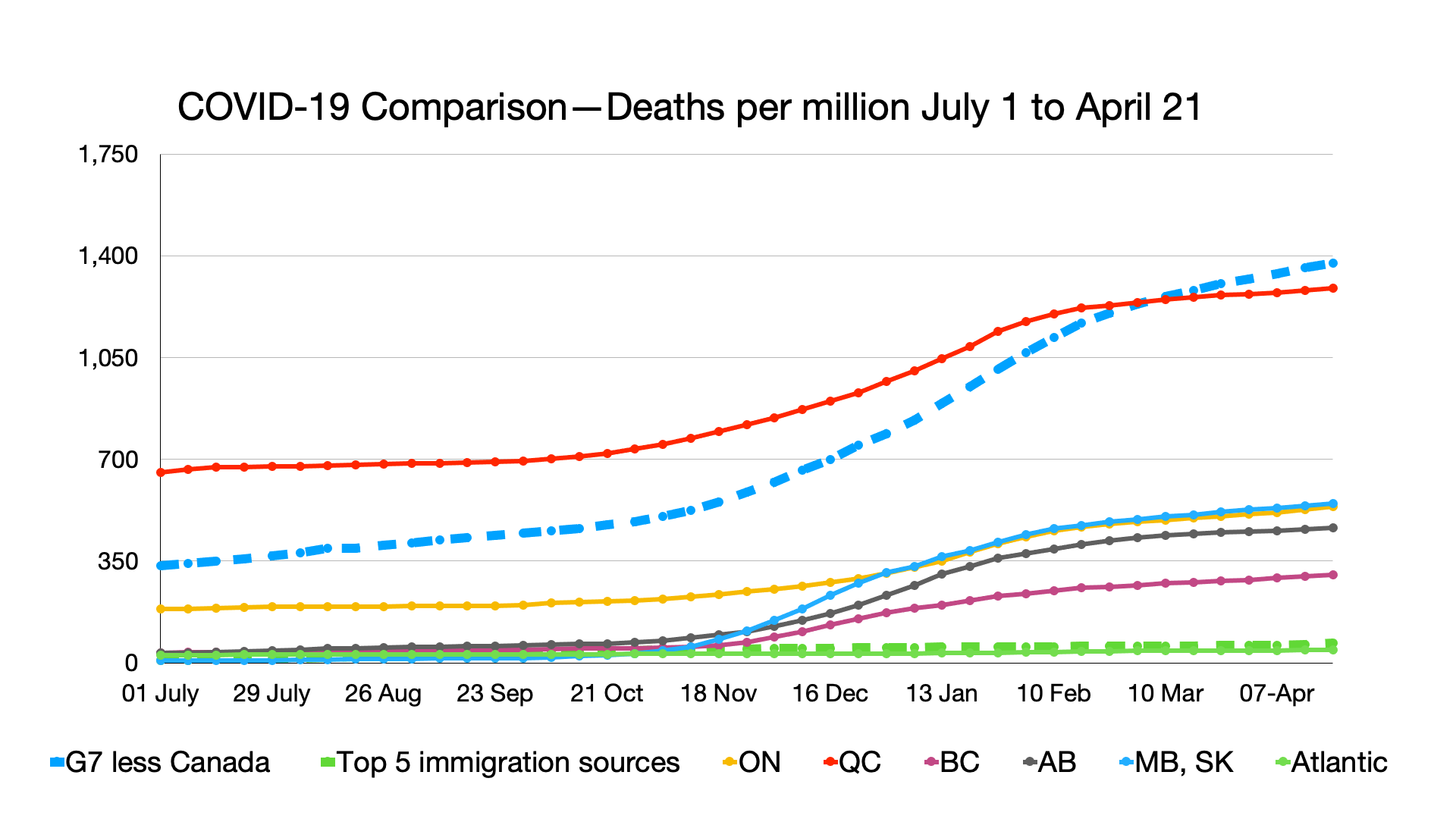
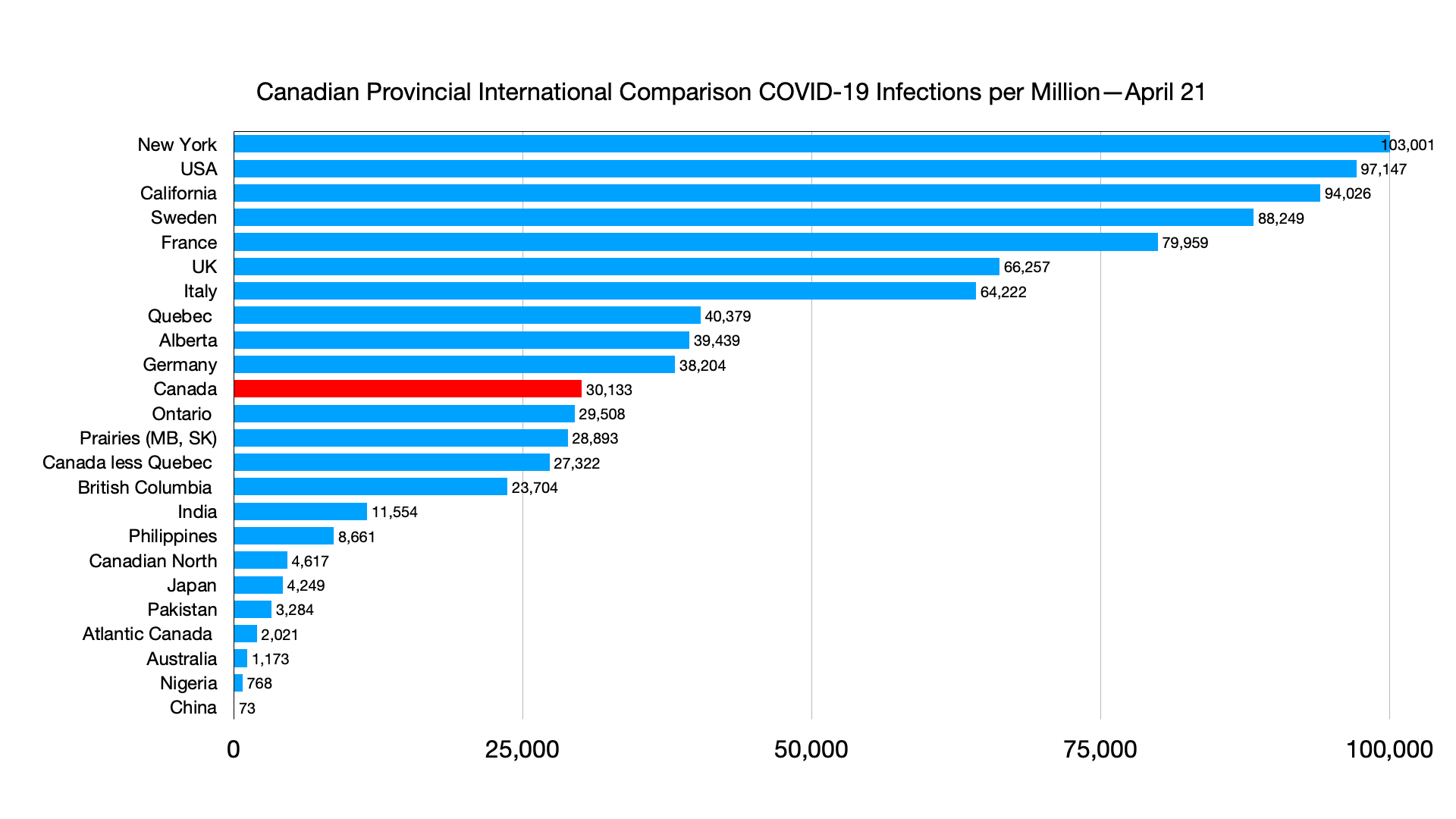
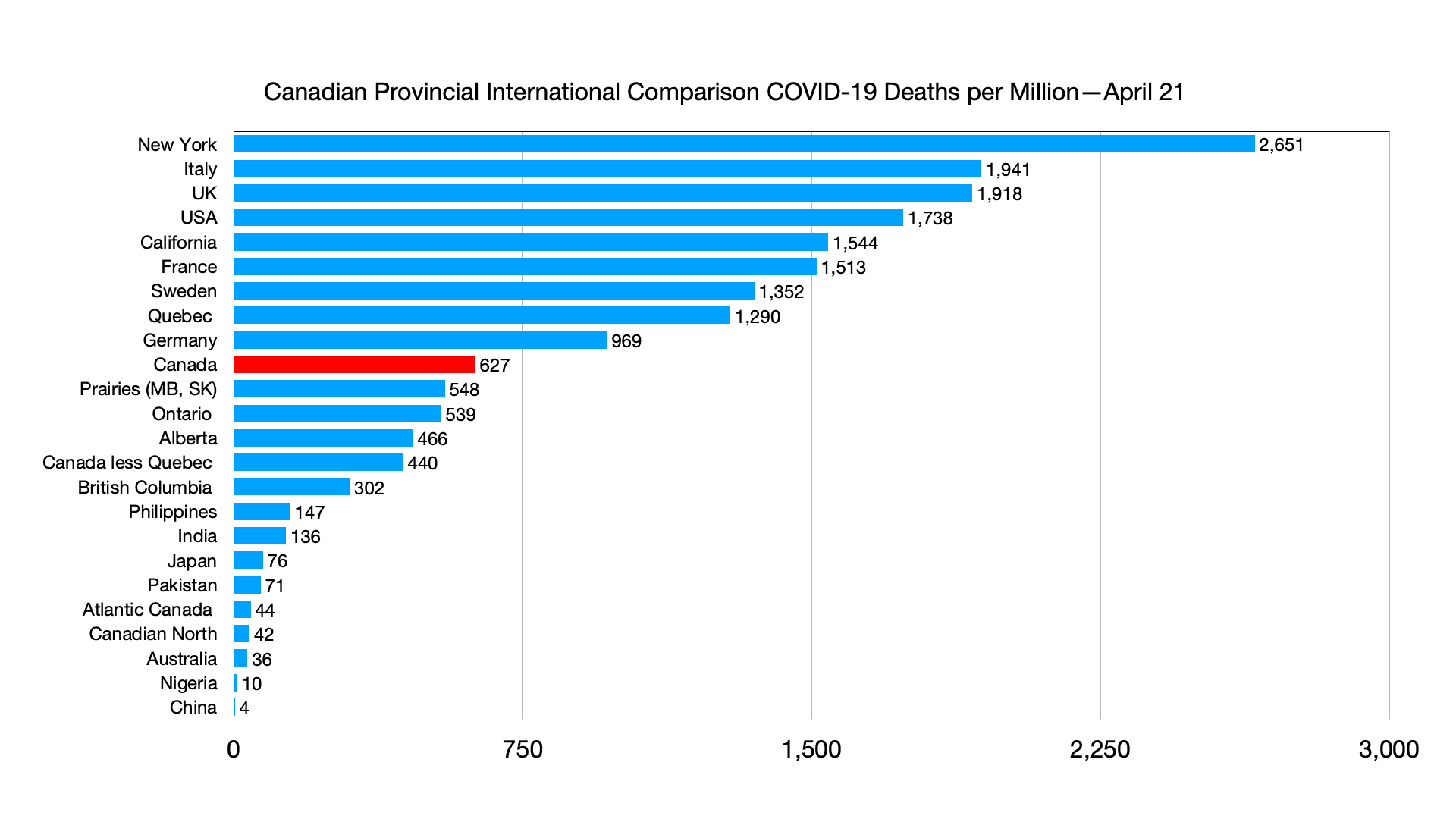
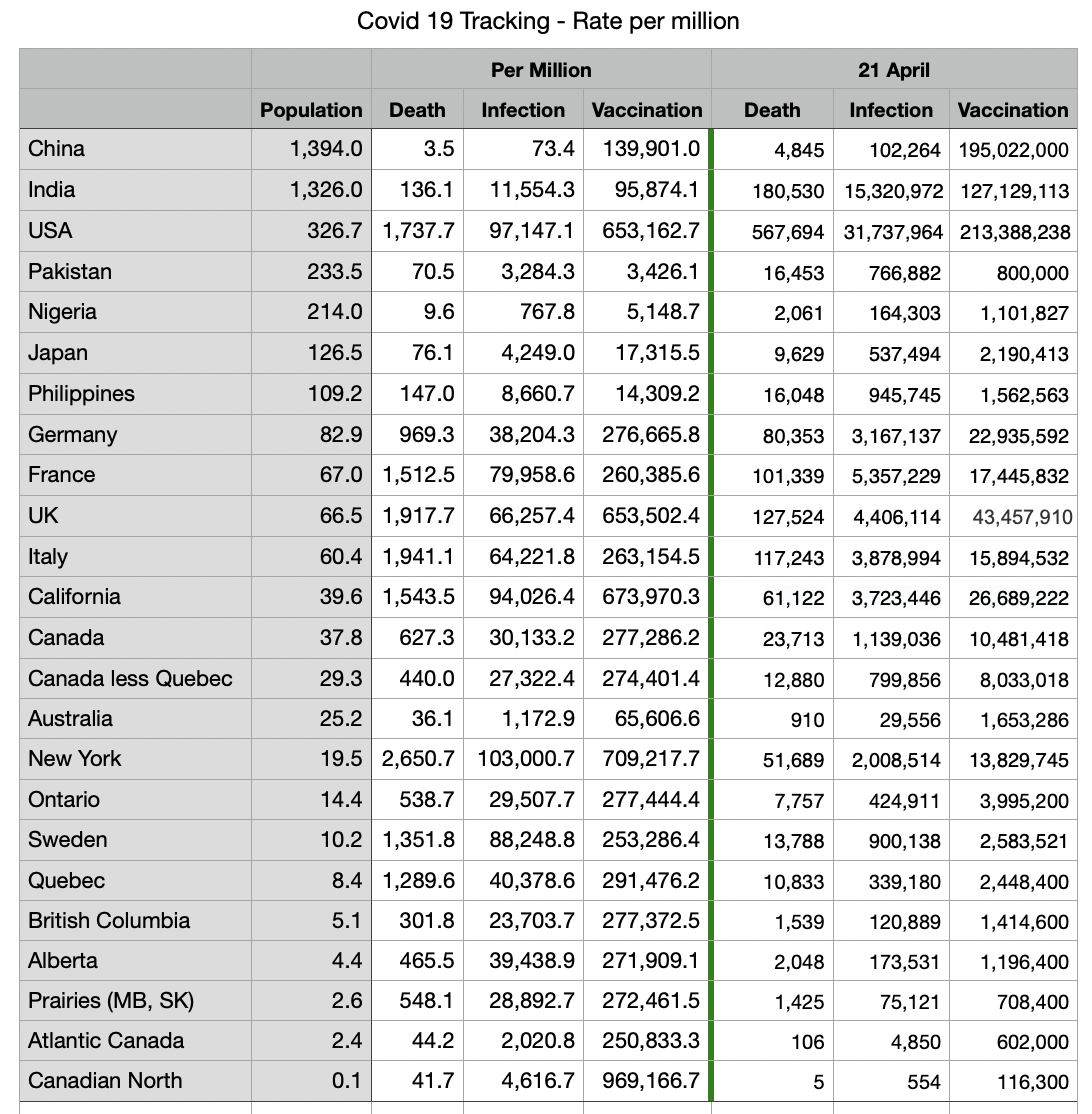
The latest charts, compiled 21 April as the third wave has started.

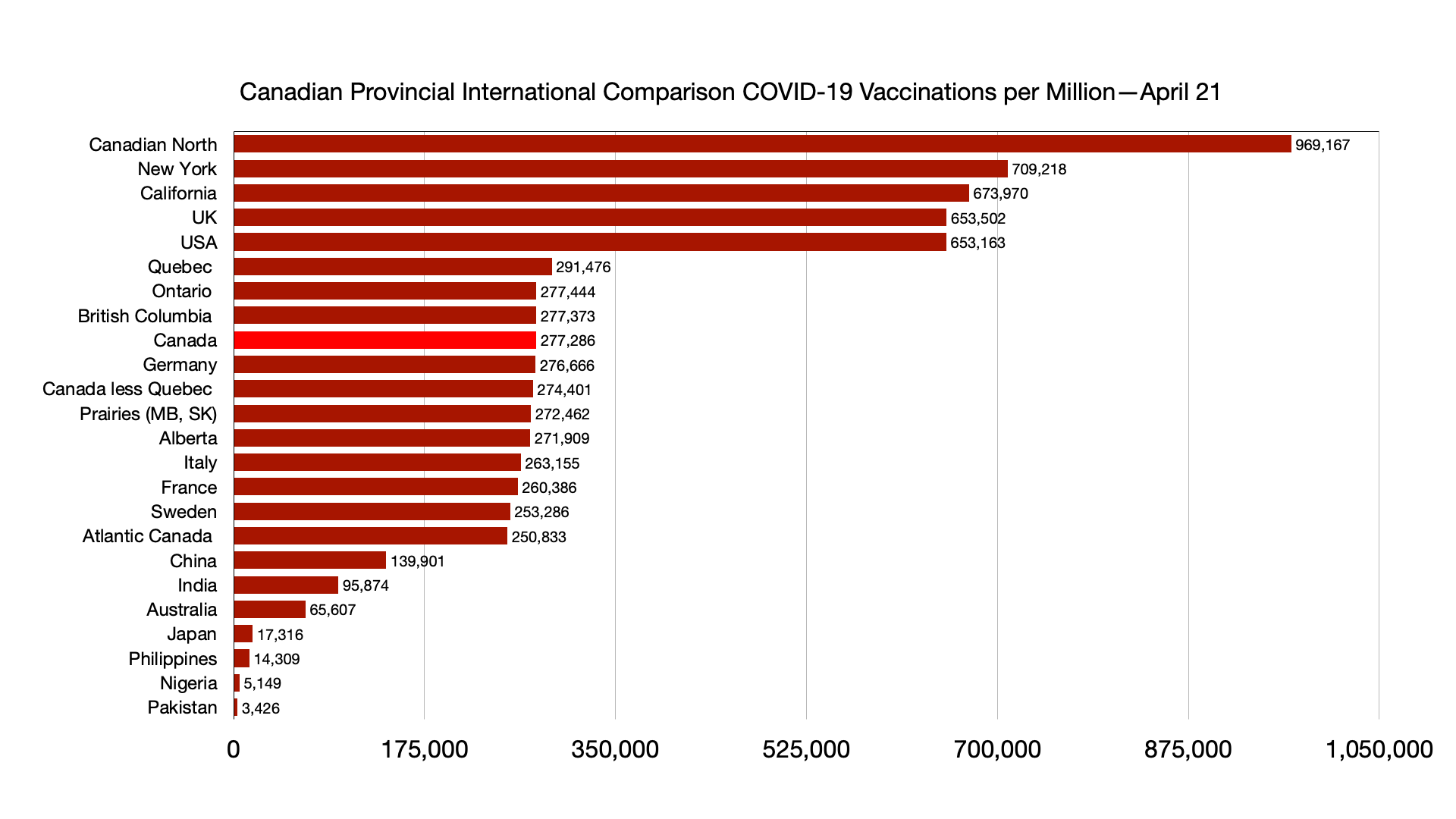
Vaccinations: Overall, Canada and most provinces continue to be comparable to EU countries.

Trendline charts

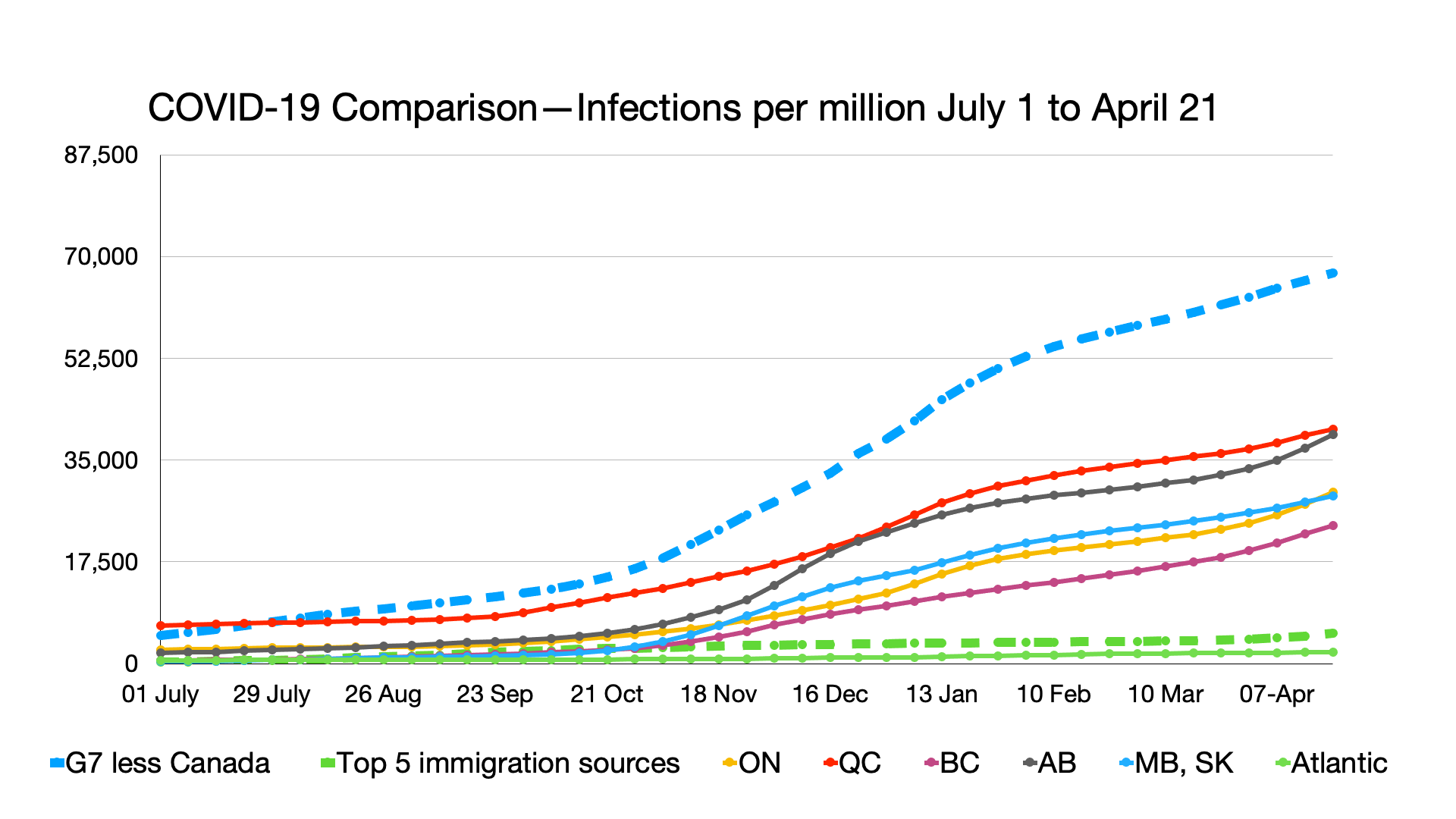
Infections per million: Recent spikes in Ontario and Alberta are more apparent.

Deaths per million: No major changes save for Italy now ahead of UK.

Vaccinations per million: Vaccination rates in Canadian provinces increasing more quickly than overall G7 less Canada countries. Increases among immigration source country reflect China and India mass vaccination roll-out.

Weekly

Infections per million: Surge in Ontario means province has more infections than Prairies.

Deaths per million: Italy ahead of UK.

India is grappling with rapid increase in cases which will likely show-up in their relative ranking over the next few weeks:

Authorities said hospitals in the Indian capital of Delhi would start running out of medical oxygen by Wednesday as Prime Minister Narendra Modi said the country faced a coronavirus “storm” overwhelming its health system.

Major government hospitals in the city of 20 million people had between eight and 24 hours’ worth of oxygen while some private ones had enough for just four to five hours, said Delhi’s deputy chief minister, Manish Sisodia.

“If we don’t get enough supplies by tomorrow morning, it will be a disaster,” he said, calling for urgent help from the federal government.

Mr. Modi said the federal government was working with local authorities nationwide to ensure adequate supplies of hospital beds, oxygen and antiviral drugs to combat a huge second wave of the COVID-19 pandemic.

“The situation was manageable until a few weeks ago. The second wave of infections has come like a storm,” he said in a televised address to the country, urging citizens to stay indoors and not panic amid India’s worst health emergency in memory.

“The central and state governments as well as the private sector are together trying to ensure oxygen supplies to those in need. We are trying to increase oxygen production and supply across the country,” he said.

Mr. Modi faces criticism that his administration lowered its guard when coronavirus infections fell to a multimonth low in February and allowed religious festivals and political rallies that he himself addressed to go ahead.

India, the world’s second-most populous country and currently the hardest hit by COVID-19, reported its worst daily death toll on Tuesday, with large parts of the country now under lockdown amid a fast-rising second surge of contagion.

The health ministry said 1,761 people had died in the past day, raising India’s toll to 180,530 – still well below the 567,538 reported in the United States, though experts believe India’s actual toll far exceeds the official count.

“While we are making all efforts to save lives, we are also trying to ensure minimal impact on livelihoods and economic activity,” Mr. Modi said, urging state governments to use lockdowns only as a last resort.

One local hospital with more than 500 COVID-19 patients on oxygen has enough supplies for only four hours, Delhi’s Health Minister Satyendar Jain said late on Tuesday.

Tata Group, one of India’s biggest business conglomerates, said it was importing 24 cryogenic containers to transport liquid oxygen and help ease the shortage in the country.

The U.S. Centers for Disease Control and Protection has said all travel should be avoided to India, while British Prime Minister Boris Johnson cancelled a visit to New Delhi that had been scheduled for next week, and his government said it will add India to its travel “red list.”

Several major cities are already reporting far larger numbers of cremations and burials under coronavirus protocols than those in official COVID-19 death tolls, according to crematorium and cemetery workers, the media and a review of government data.

Delhi reported more than 28,000 fresh infections on Tuesday, the highest daily rise ever, with one in three people tested returning a positive result.

“The huge pressure on hospitals and the health system right now will mean that a good number who would have recovered, had they been able to access hospital services, may die,” said Gautam I. Menon, a professor at Ashoka University.

On Tuesday, the health ministry reported 259,170 new infections nationwide – a sixth day over 200,000 and getting closer to the peak of nearly 300,000 seen in the U.S. in January.

Total coronavirus cases in India are now at 15.32 million, second only to the U.S., with epidemiologists saying many more infectious new variants of the virus were one of the main factors behind the latest surge in cases.

Source: https://www.theglobeandmail.com/world/article-new-delhi-running-out-of-medical-oxygen-as-india-grapples-with/

Quick Quotes: Reaction to Quebec court ruling on Bill 21, religious symbols law

Useful compilation:

Quebec Superior Court Justice Marc-Andre Blanchard on Tuesday upheld the bulk of the province’s secularism law, known as Bill 21, which bans many public sector workers from wearing religious symbols on the job. Blanchard, however, struck down clauses pertaining to English-language school boards and a ban on members of the provincial legislature wearing face coverings. Quebec has announced it will appeal the ruling.

Here’s a quick look at some of the reaction to the decision:

“Our position has always been that Bill 21 conflicted with our values and our mission and with those of all Quebecers as expressed in the Quebec Charter of Human Rights and Freedoms. Its very adoption was contrary to our societal goal of promoting our peaceful co-existence in a pluralistic and inclusive Quebec.” — Joe Ortona, chairman, English Montreal School Board.

“Of course I’m happy, but this is one small victory because we live in a very big province. My colleagues who work in the French system, they don’t get to celebrate today, and all the other people who aren’t part of English schools, they don’t get to celebrate today.” — Furheen Ahmed, teacher, Westmount High School, in Montreal.

“The laws of the National Assembly apply throughout Quebec. There is no question of dividing Quebec in the application of Quebec legislation. Quebec is united and it will remain so.” — Simon Jolin-Barrette, Quebec justice minister.

“A complex decision was handed down by the Quebec Superior Court that recognizes the inordinate harms done to individuals who wear religious symbols and strikes down certain parts of the law as unconstitutional. The decision also keeps most of the law intact and many of the recognized harms in place.” — Noa Mendelsohn Aviv, director, equality program, Canadian Civil Liberties Association.

“Well, I’m disappointed with the judgment. I find it illogical. Currently, it is as if secularism and values apply differently to anglophones and francophones. So, in Quebec, we protect the rights of anglophones to receive services in English, but now, that would protect different values for anglophones and francophones. I think that in Quebec, all Quebecers, and for all Quebecers, there must be common values.” — Francois Legault, Quebec premier.

“A religious symbol is not a diversity, it is a religious choice, it is a religious message. In that judgment, and in general, there is a tendency in Canada to treat religious signs as an intrinsic part of the body or the person itself.” — Paul St-Pierre Plamondon, Parti Quebecois leader.

“Quebecers who wear religious symbols such as the hijab, the kippa or the turban have been second-class citizens for 674 days. The decision today by the Superior Court of Quebec puts an end to this situation for some Quebecers, but not for all.” — Yusuf Faqiri, Quebec director, public affairs, National Council of Canadian Muslims.

“I’m 100 per cent sure it’ll be appealed to the Supreme Court where I think it will go down and I don’t support the idea of discrimination against people on the basis of race, creed or colour and I believe that the charter is clear on that enough that I disagree with the Quebec court on the decision.” — Brian Pallister, Manitoba premier.

“The result of the Legault government’s Law 21 is: Do you want your fundamental rights respected? Go work in English! Ouch, that hurts. Bill 21 is a law that is discriminatory that simply shouldn’t be there.” — Manon Masse, co-spokesperson, Quebec solidaire, via Twitter.

Source: Quick Quotes: Reaction to Quebec court ruling on Bill 21, religious symbols law

Justin Ling: How Ontario’s health advisors handled the ‘darkest day’ of the pandemic

Case study of speaking truth to power:

There are plenty of tough jobs in Ontario right now: From those moving parcels at Amazon warehouses to those guiding i-beams at a condo construction site, workers are facing the grim of reality of the pandemic.

Workers are going to the job site everyday without the guarantee of sick pay if they fall ill, need to get tested or snag a much-coveted vaccination spot.

There is one particular job that might not carry the same risks, but which still isn’t inspiring much envy these days: Being a member of the Ontario COVID-19 Science Table.

The Table, composed of some 100 doctors, researchers and specialists, is the independent body that furnishes advice to Premier Doug Ford and his cabinet on how best to beat back the deadly pandemic. It is their modelling that shows Ontario careening towards 30,000 news cases per day.

But it was their advice—to shut truly non-essential workplaces, pause construction where possible, and prioritize more vaccines for front-line workers—that was summarily ignored.

Instead, they dispatched officers to police a pandemic: As a pre-teen in Gravenhurst recently found out. They promised more inspectors, but that means very little if the provincial regulations allow employees to remove their masks on the job—a recent outbreak at a provincial testing laboratory shows that nowhere is truly safe from the virus.

The whole Table is in an impossibly awkward spot. Ford continues to tout their work, insisting it has informed his own approach to the pandemic. But, in practise, his actions have consistently been directly at odds with the advice from the Table.

Last week, as the divergence between advice and action grew wider, talk around the Table turned to mass resignation. A protest, in essence, of being used by a government that appears to have little interest in a science-based approach to fighting the pandemic.

But the majority of the Table opted, instead, for a softer approach: One that retains cautious optimism that the Ford government may yet see the light, and pursue measures that may actually avert a worst-case scenario in the province.

To underscore their position, the Science Table drafted a letter to the government with pointed advice on what to do next. It’s a letter that lays out the choice the Ford government faces. Whether or not he will make the right decision is, ultimately, up to him.

***

On Friday afternoon Dr. Adalsteinn Brown, the co-chair of the Science Table, appeared alongside Dr. David Williams, the province’s Chief Medical Officer of Health to present new modelling on the risks facing the province.

“Without stronger system-level measures and immediate support for essential workers and high-risk communities, high case rates will persist through the summer,” the presentation warned.

Brown said financial support for workers and strict measures for workplaces were desperately needed: “We need to stop infection coming into our central workplaces,” he said.

Vaccines, he added, were a central part of the strategy but wouldn’t solve this problem on their own.

The lines on the graph were three colours: Green, which rose slightly, then bent towards the X-axis. Yellow, which wobbled upwards so slightly—hovering right above 10,000 cases per day. And, finally, the red line: A line that sloped menacingly upwards, past the 30,000 marker.

Ontario is currently trending along the yellow line.

Red, yellow, and green dotted lines shadowed each of the solid lines: They represented what case counts would look like if Ontario managed to ramp up from the status quo, 100,000 vaccines administered per day, to an arbitrary number of 300,000 shots per day.

“Under every scenario, more vaccines mean a faster resolution in the long-run,” the presentation explained.

The Table communicated the crisis looming, and provided clear advice on how to avert disaster—both publicly and privately.

Hours later, after prolonged cabinet discussions, Ford appeared in front of television cameras to announce his decision: Playgrounds and outdoor sports would be banned. Outdoor gatherings forbidden, for members outside our household. Police would be dispatched to enforce the orders, with nearly-limitless authority to stop and question anyone in public. More inspectors would be dispatched to workplaces, but there would be no meaningful change to what constituted an ‘essential’ workplace. The number of vaccines reserved for frontline workers in hotspot zones would be set at 25 per cent.

The premier waved a sheet from Brown’s presentation: The chart showing the case projections. He seized on the idea that 300,000 vaccines could blunt this punishing third wave. “Would we be in this position if we were getting 300,000 doses a day back in February? Like the rest of the world? The answer is absolutely not,” Ford said.

The province looked on in alarm. The premier was, effectively, announcing a police state. Meanwhile, he was ranting at the federal government for not sending enough vaccines. When asked directly why he couldn’t shut more businesses, Ford explained how “deep” the supply chains were—light switches wouldn’t be made, he explained.

Reaction from the public was swift, and horrified. But the members of the Science Table, in particular, were beside themselves. Brown and fellow co-chair Brian Schwartz sent an email to dozens of his colleagues on the Science Table.

“We know that many of you are frustrated and angry after today’s announcements,” Brown and Schwartz wrote.

“We did the right thing,” they wrote of their early afternoon briefing, which set the stakes for Ford’s 4 pm announcement. The research and data, furnished by members of the table, they wrote: “Made it possible for us to be firm in saying what we know should be done to fight the pandemic.”

Several members of the Table took to Twitter to blast the decision. One member, Dr. Andrew Morris—who is a University of Toronto professor of medicine, a medical director in the Sinai Health System, and who co-chairs the Table’s working group on drugs and biologics—called the decision “criminal.

Many of their blistering repudiations of the government’s decision were splashed on the frontpage of the Toronto Star on Saturday morning.

Brown and Schwartz didn’t discourage the comments. “The only thing we would ask is that you speak truth to power in the same way you would conduct any other discussion,” they wrote.

They summed up, in bullet points, the recommendations and analysis they had been providing for weeks: More vaccines for high-risk communities, close businesses that are not absolutely necessary, do more to protect workplaces that must remain open, create dedicated sick leave benefits, reduce mobility within the province, and encourage people to meet outside safely.

“Unfortunately, our advice does not align with what the cabinet announced this afternoon,” they wrote. “That requires serious discussion.”

Brown and Schwartz signed off the email, recognizing that many of the members were actually on the front-lines of this deadly fight. For those still on clinical duty, they wrote, “we wish you and your patients the very best through this exceptionally challenging weekend, and that you get a few moments of rest too.”

They arranged a 10 am Sunday morning meeting to discuss next steps.

In the outside world, pressure was mounting. Registered Nurses Association of Ontario CEO Doris Grinspun called for the Science Table to “resign en-masse.”

***

On Saturday afternoon, the Ford government appeared to walk back its enforcement measures, which would have given police nearly unfettered power to stop and interrogate people out for a walk, or driving, and ask their home address and purpose for being out in public.

The retreat came after nearly every police force in the province said they would refuse to conduct the arbitrary stops—journalist Andrew Lawton found that only the Ontario Provincial Police said they would enforce the measures.

Yet the supposedly walked-back regulations still allow police to stop anyone on the suspicion that “an individual may be participating in a gathering that is prohibited.” Of course, provincial regulations now ban any outdoor gathering, except for those in the same household. The new regulations allow police to demand the individual provide “information for the purpose of determining whether they are in compliance with that clause.”

Lawyers pointed out that the new, supposedly “refocused,” measures actually gave police more power to interrogate Ontarians on flimsy grounds. A group of young skateboarders in Gravenhurst would learn that reality pretty quickly on Sunday morning. Leanne Bonnekamp’s 12 year old son was out skateboarding with friends—in a park near the YMCA, as the skate parks were closed by provincial order. That’s when a cop approached.

“Two officers showed up, yelled at these kids—that they weren’t wearing masks, and weren’t socially distanced,” the boy’s mother, Bonnekamp, told me. One of the Ontario Provincial Police officers demanded the kids’ ID, and was running it in his cruiser as his partner stayed with the other youth.

Bonnekamp’s son was giving the officers attitude for the arbitrary stop—though no profanity, she says—as the cop gripped his scooter. In the video, the officer can be seen reaching over the scooter and shoving the pre-teen, who falls on the ground. When another youth asks just what in the hell the officers are doing, the cop yells “he’s failing to identify.”

The OPP says they are investigating the officer’s actions.

The same weekend, an outbreak in Toronto put into sharp focus the inadequacy of the government’s workplace measures. An outbreak of cases in a Toronto lab, run by Public Health Ontario to analyze COVID-19 tests, infected 16 employees.

The agency’s president Colleen Geiger sent an email to staff, which was forwarded to Maclean’s, indicating an investigation into the outbreak was ongoing and that they would identify “areas that require improvement.” Close contacts of those who tested positive, Geiger wrote, were already isolating. Other staff would be tested onsite.

One employee, who contacted Maclean’s with details of the outbreak but asked to remain anonymous because they were not authorized to speak to media, said the outbreak was just waiting to happen. Social distancing in the lab is nearly impossible and good public health measures aren’t being enforced, they wrote. Masks are often worn improperly and limits posted by the lunch tables and elevators aren’t respected.

This outbreak isn’t even the first. Previous instances where employees of the lab caught COVID-19 are “posted on bulletin boards that are tucked away in corners of hallways.”

The employee, quite correctly, argued that “Public Health of Ontario should hold a higher standard than the rest of Ontario residents and I find it shameful that this outbreak could have been avoided.”

Public Health Ontario confirmed to Maclean’s that 16 staff fell ill. “Diagnostic testing for COVID-19 as well as other infectious diseases are continuing as normal and there is no impact on laboratory services at this time,” they wrote.

If the provincial lab responsible for processing COVID-19 tests can’t even keep safe, how much trust can we put in other workplaces?

***

Sunday morning, Dr. David Fisman—professor of epidemiology at the Dalla Lana School of Public Health at the University of Toronto, and a member of the Science Table—wrote to the other members: “My concern is that the science and modeling tables are being used as cover.”

“What we saw on Friday was exactly the sort of thing I’ve been concerned about: Meaningful guidance from this group was disregarded,” he continued. “But the premier took the time to hold up a graph in which a hypothetical 300,000 vaccines per day scenario was plotted, and indicated that this would be the way forward.”

“As I have said at our meetings, at some point this starts to feel like aiding and abetting a government that has prosecuted a pandemic response that frankly feels negligent, or even criminal,” Fisman wrote.

“I don’t think I am on the same team as this government.”

That intense frustration was shared by many of his colleagues.

In an interview with Maclean’s, Morris said he was “dumbfounded” by the Friday announcement. At the same time, he called it an “apex” of a trend that has been growing over the course of the pandemic.

“When we get to Friday, they come out with these measures that are absolutely antithetical to the beliefs and advice of the Science Table — en masse, and individual members,” Morris says. “I don’t think there’s a single member who would have recommended those things.”

He phrases it as a consistent and repeated “gaslighting” by the government.

“Friday, for me, was probably my darkest day in my professional career,” says Dr. Peter Jüni, the scientific director for the Science Table—who is also a world-renowned researcher and a professor at the University of Toronto.

Jüni told me he found himself asking: “Were we not clear enough?”

“It’s pretty clear that there is a gulf between what the Science Table has recommended and what the policy announced in the province was. That’s clear,” says Dr. Isaac Bogoch who sits on the Table’s modelling working group, teaches at the University of Toronto, and who consults on infectious disease outbreaks at the Toronto General Hospital.

When the entire Table joined a Zoom call on Sunday morning, there were divergent views on what to do. Some wanted them all to resign, as a show of force that the government couldn’t use their modelling but ignore their advice.

But, as Bogoch notes, the public outcry about the measures actually prompted a retreat. The Ford government, perhaps more than the average government, is intensely sensitive to criticism. The Table’s advice—enabled by their independence, both from government and from any kind of particular hierarchy—no doubt enabled that public backlash.

There was also some pessimism about whether resigning would have much impact.

“I’m not sure, personally, what resignation would do,” Morris confesses. Bogoch agrees: They still have a job to do, he says. Being ignored “doesn’t mean you fold up your tent.”

Jüni, who publicly mused about resigning, came to a similar conclusion. “I could make a point, not a difference,” he says.

One feeling is particularly stark: The Science Table fears what, if anything, will replace their advice and modelling if they leave.

“There’s no question there are times, it has felt to many people, like we’ve been played,” Morris says. With resignation off the table, his mind turned to: “How can we avoid being played like that?”

***

What, exactly, the Ford government is going to do next is an open question. On Monday, after a brutal weekend for the Ford government, I got on the phone with someone in the Premier’s office. We agreed on anonymity so they could speak freely.

They certainly acknowledged the blowback that came from Friday’s announcement, and recognized more action would be necessary to stem the transmission of the virus. And they were quick to highlight the areas where they did, general speaking, follow the Science Table’s advice. Chiefly, Ford announced his government would dedicate 25 per cent of the vaccine supply for frontline workers in hotspot neighbourhoods.

The Science Table, I pointed out, recommended allocating 50 per cent of the vaccine supply. The government source said: Well, if we had done 50 per cent, they would have called for 75 per cent.

At another point, I noted that the Science Table was apoplectic about how virtually nothing was being done to shut truly not crucial construction projects. Yes, the source said, but the construction industry was furious.

(Indeed, the Ontario Construction Consortium attacked the government’s order barring non-essential construction, bizarrely insisting that “a recent snapshot of 10,000 Workplace Safety and Insurance Board (WSIB) claims related to COVID-19 since the pandemic began showed that fewer than 200 of those cases originated in the construction industry.” Provincial data shows that, since the start of the pandemic, some 10,000 cases were a direct result of outbreaks at offices, warehouses, and construction sites.)

But the balancing act this government is striving for is exactly the problem: Splitting the difference, or trying to strike a balance between rigorous scientific advice and the construction lobby is not a wise or successful move.

“How does a cabinet—that has even a rudimentary understanding of what’s going on—how do they deliberate over numerous hours over two days and come up with this?” Morris asked me.

“If you do half measures, you hurt everybody,” Jüni says. “Including the economy.”

The province has dedicated more inspectors for these workplaces, but its own advice is faulty: The Government of Ontario’s official policy on masks in the workplace holds that “you do not need to wear a face covering when you are working in an area that allows you to maintain a distance of at least 2 metres from anyone else while you are indoors.” (The provincial regulations state that workers may be maskless if they can maintain social distancing and are in an area inaccessible to the public—a construction site, for example.)

That is a fundamentally backwards policy that ignores the strong likelihood of airborne transmission. If workplace inspectors are continuing to enforce that standard, the inspections are going to be largely ineffective.

Things that the science table believes are going to be helpful is more support for workers, essential workers, to access support—primarily financial support so that they can get vaccinated, tested or stay away from work if they’re unwell.

When asked directly whether the government would finally retreat, and ensure sick leave for workers in the province, the government source said they were waiting to see whether Monday’s federal budget would do the job for them. Even though labour law, including sick leave, is explicitly provincial domain, they said, they wanted Ottawa to act.

The federal budget did, in fact, expand the Employment Insurance sickness benefit—but that support is claims-based, meaning it isn’t automatic nor does it mean much for an employee who suddenly falls ill. Those employees, clearly, need sick leave: Something many employers still refuse to provide, but which the provincial government can mandate.

The government source said, despite the Ford government’s dogmatic opposition to date, the government would give “serious consideration” to sick leave. But it would be unlikely any decision would be made anytime in the near future.

Part of the Ford government’s commitment to the status quo seems to stem from their belief that things are heading in the right direction. The government source said that, while things may change fast—and new ICU admissions could force their hand—they do not anticipate announcing new measures this week.

Asked where this optimism was coming from, the source pointed to the mobility data found in the Science Table’s modelling showing that, in recent weeks, fewer people have been travelling outside their home. If mobility trends downward, they think, case counts will flatten.

But that, too, runs contrary to the advice from the Science Table. “Mobility is a surrogate for contact,” Jüni says. “It’s a marker. It isn’t causal.”

As Jüni points out, declining mobility could be a sign that, through general anxiety or enforcement measures, people are staying indoors—a good sign, if social gatherings are driving transmission.

Provincial data shows that a significant number, likely the majority, of COVID-19 cases in the province are coming from workplaces and schools. I asked for data to prove that private gatherings were driving significant caseloads, but have yet to receive it.

On the flipside, however, mobility trends might not mean much if Ontarians are leaving home to engage in low-risk activity, like meeting friends in a park, or going for a walk.

The more I cited the Science Table’s work, the more the government source suggested the advice was at odds with itself. Or unclear. Or, for example, that the Table couldn’t agree on advice about the safety of gathering outdoors.

The Table doesn’t see it that way. Jüni himself presented before cabinet. “Outdoors is safe,” he told them. It can be made more safe, he added, but he says he was abundantly clear. “I do not know what more I could do,” he says.

Morris echoes the sentiment: He says it is “essential” that the province provide clear advice, encouraging outdoor activity.

***

On Tuesday afternoon, the Science Table issued a letter to the Ford government, entitled: The Way Forward.

“Ontario is now facing the most challenging health crisis of our time,” the Table wrote. “Our case counts are at an all-time high. Our hospitals are buckling. Younger people are getting sicker. The disease is ripping through whole families. The Variants of Concern that now dominate COVID in Ontario are, in many ways, a new pandemic. And Ontario needs stronger measures to control the pandemic.”

The letter put to paper, publicly, what the Table has been telling the Ford government emphatically since the third wave began swelling.

It proposed clear strategies—things the Ford government is pointedly not doing:

  • Reducing the list of essential workplaces allowed to remain open to be “as short as possible,” and ensuring that those workers wear masks on the job.
  • “Paying essential workers to stay home when they are sick.” And not, they note, the federal Employment Insurance benefit, which is “cumbersome” and inadequate.
  • Allocating as many vaccine doses as possible to hotspot communities and essential workers—and ensuring “on-the-ground community outreach” to connect doses to those workers.
  • Providing “public health guidance that works.” That means communicating a simple message: Indoor gatherings should be strictly forbidden, while underlining that “Ontarians can spend time with each other outdoors” while social distancing. That means allowing small gatherings of people from different households, while also encouraging masks and two metres distance.

The letter warns that “inconsistent policies, with no clear link to scientific evidence, are ineffective in fighting COVID.” That includes, they wrote, policies that “discourage safe outdoor activity.”

The premier isn’t mentioned by name in the letter, but the closing lines offer a stark warning for the government:

“There is no trade-off between economic, social and health priorities in the midst of a pandemic that is out of control.”
Source: How Ontario’s health advisors handled the ‘darkest day’ of the pandemic

Time for widespread gender-neutral language in federal policy, legislation, say advocates

Of note:

The very act of not being included in government policy is discriminatory, says Estefan Cortes-Vargas, former Alberta MLA, diversity consultant, and one of the first openly non-binary people elected in Canada, referring to the sparse use of gender-neutral language. It’s an issue the federal government says it’s trying to fix, piece by piece.

This area has recently been a focus for the B.C. government, with sweeping changes made to more than 70 laws and regulations in March, replacing 600 clauses with gender-neutral terms.

According to Ravi Kahlon, B.C.’s minister of jobs, economic recovery, and innovation, these changes were made in an effort to increase accessibility.

Sherwin Modeste, executive director of Pride Toronto, praised the changes as very progressive but said it’s something that still needs to be done federally, “because federal legislation carries weight through all the provinces and territories.”

However, the federal justice department told The Hill Times in an email statement that it has been implementing gender-neutral language, albeit in a “piecemeal” fashion.

“Over the years, the practice has evolved with the use of ‘they’ and its other grammatical forms and other drafting techniques in the English version of Acts. New acts are drafted using these techniques. When existing Acts are amended the drafters will, whenever possible, update the wording of the provisions that are being changed to reflect existing drafting conventions,” Justice Canada spokesperson Ian McLeod wrote.

In French, a gendered language, there are grammatical rules that could affect legislative language, he said. The department is studying this area, with the review being undertaken by departmental “jurilinguists.”

“The use of inclusive language acknowledges and values human diversity, and recognizes that individuals have differing experiences, values, beliefs, and lifestyles,” Women and Gender Equality Canada spokesperson Maja Stefanovska said in an email.

While she didn’t specify if they’re being followed, Ms. Stefanovska said the Translation Bureau has linguistic recommendations on inclusive correspondence in French.

While the English side of things generally has gender neutral replacements, like “spouse” for husband and wife, and “they” for he or she, French’s analogues are gendered, said Lee Airton, assistant professor of gender and sexuality studies in education at Queen’s University.

“It is an entirely different process to create gender neutral law and policy in French … it would be much more difficult, but no less necessary,” they said.

Practically speaking, Hélène Frohard-Dourlent, a bilingual senior strategist at gender consulting firm TransFocus, said one possible strategy is adding a dot before the final “e” in a word to indicate both masculine and feminine forms as well as the possibility of other grammatical genders. Another method is to rephrase sentences, they said, like switching “Alex is happy” to “Alex is a happy person” thus preventing happy from being tied to the person’s gender.

“And then, inevitably, if you are committed to neutral or inclusive French, you have to invent some new words and some new endings that are themselves going to be more inclusive,” they said.

The problem with this, Dr. Frohard-Dourlent noted, is that these words have to be socialized to the point where readers will actually understand them.

As for what these terms might look like, Joel Harnest, co-executive director of QMUNITY, an LGBTQ+ resource centre, said that cues should be taken from French-speaking trans folk, who can share the emerging language and phrases.

He also noted that not everything should be gender neutral. While it makes sense for certain words like husband or wife, he said that there is still a need for gender-based language when “you need to specifically call attention to or talk about a certain gender experience.” As an example, he pointed towards policy around gender-based violence.

“If we move too fast to this utopian ideal of a genderless future, we’re not really acknowledging the reality that those people have to live,” Mr. Harnest said.

Overall though, Liana Cusmano, who is interim president of the Green Party and uses they/them pronouns, says they’re receptive to the current approach for changing terminology.

“I think that’s definitely a good place to start, which is to slowly do revisions and then, when drafting new material, to apply the agenda … I don’t think that it would be a good idea to rush,” they said, adding that relying on people practiced in those legislative areas along with consultation with inclusive experts would be the best approach.

Their own party is in the process of implementing gender-neutral language in both English and French. The Liberal Party, according to spokesperson Braeden Caley, also uses gender-inclusive language, with regular policy and document review. The NDP and Conservative Party did not respond to requests for comment on their parties’ approach.

Jade Pichette, Pride at Work Canada’s manager of programs, said that there has been a lot of effort already made to move towards more inclusive language, such as changes to the style guides of the Public Service Alliance Canada—the federal government’s largest public-service union.

“Some of that work has already been done, it’s just being done on a subtle basis, where it isn’t a news story, where it isn’t necessarily picked up in the media, because we use they/them pronouns in our speech naturally,” they said. “We will just read through the document without even considering it.”

But even though some changes may happen without fanfare, they’re still critical according to inclusion experts.

Gender-neutral language has significant benefits, diversity experts say

“The very act of not being included in policy is discriminatory,” Mx. Cortes-Vargas said.

Mx. Pichette pointed towards the need to represent everybody who lives in Canada, including non-binary, agender, and two-spirit people “as a matter of respect but also as recognition of their lives.”

This broader representation, Mx. Airton said, not only has a symbolic impact, but also a practical one in terms of making policy and governance more accurate for the public and professionals. And, if there is no gendered language in a piece of policy, they said, then gender becomes less necessary to think about in a particular context.

“Gender, knowing if someone’s a man or woman, isn’t always relevant and can actually be a distraction because people use their common sense or folk knowledge about what men and women do or want to inform their decision making without realizing what they’re doing.’”

There may even be an impact on employers, Mx. Pichette said, with government stances influencing the polices and procedures of businesses.

According to Vandana Juneja, executive director of Catalyst, a women’s workplace advocacy group, this type of inclusion brings practical benefits to organizations, from enhanced financial performance to improved employee engagement and innovation.

On a more personal level, for Mx. Cortes-Vargas this sort of change would make it easier to navigate systems. For instance, when they go to the bank or fill out forms they have to pick gendered slots.

“They’ll say you have to pick one. And it’s like ‘no, I don’t—this is your problem, this isn’t my problem’ … I can’t go through and just fill out a form without having to negotiate existing in that space,” they said.

The benefit to changing these systems and writing things into policy would be a reduction of barriers, instead of continually having to ask if there’s room for them and having to get exceptions made, they said.

With gender-neutral language, Mx. Cusmano said they feel seen. While it’s difficult to put into words, the impact, they said, is huge and helps to build trust and effective collaboration.

“Gender identity is real to individuals and it has real impacts on their well-being,” they said.

Kai Scott, president of TransFocus, said the pervasive gendering of systems has significant impacts, with this “systemic exclusion” adversely affecting both mental and physical health and causing non-binary people to wonder if they’re important enough to be recognized in official documentation. “And the key thing is that if they have support and they’re affirmed, their social determinants go through the roof, they’re so positively impacted,” he said.

Mr. Modeste tied this to the economy. With more people comfortable and ready to get out there and work, the burden on society is reduced, he said. Respecting people’s gender identity is critical to alleviating these sorts of long-term impacts, he continued.

For him, gender-neutral language allows for authentic expression. In his case, having been married and lived part of the “straight life,” he said that if he had seen more gay men represented in the world when he was growing up his life would’ve been very different “in a positive way.”

Lawyer Raj Anand, a partner at WeirFoulds LLP with practice in constitutional law, pointed towards the Canadian Charter of Rights and Freedoms and its emphasis on gender equality, noting that implementing gender-neutral language would also put into action the promise the Charter was designed to have.

“When the federal government takes [gender-neutral language] on, it sends a huge signal to others, as well as internally,” Mr. Scott said. “It’s really important for employees that work for the federal government to see this change, and if it affects them personally, they benefit from it.”

“But then also for those who it doesn’t impact, they might go, ‘oh well, why is this happening?’ And then we can have conversations about the benefits of gender-neutral language just to bring everybody along on this journey that’s so important for a variety of people.”

Source: Time for widespread gender-neutral language in federal policy, legislation, say advocates

Quebec court upholds law banning religious dress, with exceptions for English schools, MNAs

Don’t think anyone saw this split coming unless I missed it:

A Quebec Superior Court judge has upheld most of the province’s law banning religious dress in some public-service functions but carved out an exception for the anglophone education system, to the dismay of Premier François Legault and other Quebec nationalists.

Justice Marc-André Blanchard ruled Tuesday that Quebec’s “Act respecting the laicity of the State,” better known as Bill 21, infringes fundamental rights to religious expression under the Canadian Charter of Rights and Freedoms, and its Quebec equivalent. He found Bill 21 has “cruel and dehumanizing” effects on the targeted people.

But, he found, the Quebec government’s use of a blanket constitutional override power under Section 33 of the Constitution, known as the notwithstanding clause, prevents him from striking down most of the law.

The judge found an exception for anglophone school boards, which are protected under the Constitution’s minority language rights from having the override applied to them. The judge ruled language rights include cultural issues such as allowing religious expression among school staff.

The ruling cements Quebec’s debate over religious rights into a schism posing proponents of the Canadian model of multiculturalism, including many anglophones, against some Quebec nationalists, mostly francophone, who want to impose a more unitary vision of Quebec culture.

Justice Blanchard also overturned religious dress restrictions on members of the National Assembly who have a Constitutional right to run for election and sit in the legislature without such constraints.

The practical result of Tuesday’s ruling is Quebec’s English-language schools can hire teachers who wear Muslim veils or Jewish kippas, while the rest of Quebec’s school system cannot. Religious symbols will continue to be banned for police officers, judges, government lawyers and others the government has defined as people in positions of authority.

“I am elated and I’m proud of the English Montreal School Board,” said Furheen Ahmed, a high-school teacher who wears a headscarf, and works for the board that was a plaintiff in the case. “But it’s one small victory in a really big province.

“My French counterparts don’t get to celebrate today. And all the other people outside English schools don’t get to celebrate.”

Mr. Legault’s government has already said it will appeal the decision while most plaintiffs and advocacy groups who brought the challenge have strongly hinted they will do likewise. Many legal experts believe a showdown in the Supreme Court of Canada is inevitable.

Justice Blanchard found Mr. Legault’s legislation, passed nearly two years ago with the stated aim of promoting secular values in government institutions, has had serious negative consequences for Quebeckers who wear religious symbols, particularly Muslim women. “Law 21 steps more than minimally on the freedom to show or to practise religious beliefs,” the judge wrote. “This use of the prerogative seems to be imprudent and casual, and its sweep is far too large.”

But, the judge added, while the use of the constitutional exemption to shield the law from challenge appears to be excessive, it does not “violate the architecture of the Canadian Constitution nor primacy of the rule of law.”

The English Montreal School Board was about the only participant in the case declaring victory. While most of the law was upheld, Mr. Legault said he was disappointed and did not understand the judgment.

“I find it illogical. It’s like laïcité and those values are applied differently for anglophones and francophones,” Mr. Legault said. “Quebec and all Quebeckers should live with common values.”

Justice Minister Simon Jolin-Barrette, the architect of the law, accused the judge of dividing Quebeckers. “Quebec is a nation. Some are trying to divide us but we are united,” Mr. Jolin-Barrette said.

Quebec’s law imposes state religious neutrality and includes a dress code prohibiting civil servants holding “positions of authority” from wearing visible religious articles. The jobs under the dress code include teachers, police officers and government lawyers, among others.

People in those jobs who wear the symbols and already hold those posts are allowed to keep working. They cannot be promoted or transferred and new hires must remove the religious symbol to work.

Carissima Mathen, a constitutional law professor at the University of Ottawa, said the ruling sets up an examination of just how far use of the notwithstanding clause can go at the Quebec Court of Appeal and likely the Supreme Court of Canada.

“It’s the first time in maybe 20 years or more that we will have this kind of detailed consideration of Section 33,” Dr. Mathen said. “Lower courts may feel constrained by existing case law. It’s a question more for the appellate court and the Supreme Court of Canada to weigh in and decide if they want to chart a new path or new approach to Section 33.”

Dr. Mathen said while scholars debate how widely the clause should be used, the issue hasn’t gone before the courts because Quebec’s broad use of it is “such a rare choice.”

Advocates for Jewish, Muslim and Sikh organizations who backed the court challenge all expressed disappointment and vowed to keep fighting.

“It came out very clearly there are fundamental problems with Bill 21,” said Yusuf Faqiri, director of Quebec issues with the National Council of Canadian Muslims.

“It’s not constitutional, it’s discriminatory. It has been 674 days that Quebeckers who wear religious symbols are second-class citizens. We will review it in the next couple of days and decide on next steps but one thing is clear. This battle is far from over.”

Source: Quebec court upholds law banning religious dress, with exceptions for English schools, MNAs

Robert Dutrisac in Le Devoir:

Dans sa décision rendue mardi concernant la Loi sur la laïcité de l’État, le juge Marc-André Blanchard, de la Cour supérieure, n’a pas chamboulé l’ordre constitutionnel canadien puisqu’il n’a pu invalider la protection que confère à la loi 21 le recours à la disposition dérogatoire de la Charte canadienne des droits et libertés. Mais il crée deux régimes de droits religieux dans les écoles suivant une démarcation linguistique, sorte de partition juridique du Québec.

À la lecture du jugement, il est évident que c’est à son corps défendant que le juge a écarté les arguments présentés par les demandeurs, notamment l’aspirante enseignante Ichrak Nourel Hak et le National Council of Canadian Muslims, qui visaient à contourner l’article 33 de la Charte canadienne accordant à toute province le droit de dérogation. En fait, le juge Blanchard a invalidé les deux seuls éléments de la loi 21 sur lesquels la dérogation n’avait aucune prise. Il s’agit de l’article 23 de la Charte qui garantit les droits scolaires des minorités linguistiques, droits scolaires qui s’étendent désormais à l’expression de la foi religieuse, selon l’interprétation nouvelle du juge. L’autre élément invalidé, c’est l’obligation faite aux élus de l’Assemblée nationale d’exercer leur fonction à visage découvert. Selon le jugement, cette obligation prive des personnes qui se couvrent le visage du droit de se présenter à une élection québécoise, ce qui contrevient à l’article 3 de la Charte. On peut voir dans cette invalidation une intrusion inédite du pouvoir judiciaire dans la régie interne de l’Assemblée nationale. Dans les deux cas, le gouvernement caquiste va demander d’en appeler.

Quant au recours à la dérogation, le juge Blanchard s’en est tenu au jugement Ford c. Québec qui établit que le législateur n’a pas besoin de justifier l’usage qu’il en fait, et ce, afin « de traduire l’importance que continue de revêtir la souveraineté des législatures », a écrit la Cour suprême il y a plus de 30 ans, préservant ce restant de souveraineté parlementaire britannique que détiennent toujours les provinces. Le juge Blanchard admoneste le gouvernement caquiste qui « ratisse beaucoup trop large » en suspendant des droits qui n’avaient pas de lien avec la loi 21 alors qu’il aurait dû agir de « façon parcimonieuse et circonspecte ». C’est un point de vue, mais si cette suppression est sans objet, elle n’aura pas d’effet. Quoi qu’il en soit, le juge prend sur lui d’envoyer un message aux tribunaux supérieurs : en cas de contestation, le législateur devrait justifier l’existence d’une « certaine connectivité » avec la législation visée. C’est à « l’urne », c’est-à-dire aux citoyens lors d’élections, de décider du sort d’un gouvernement qui exerce ce pouvoir de dérogation, fait-il par ailleurs valoir. Les tribunaux « se doivent d’éclairer cette connaissance [de l’électorat] des fruits de cette expertise », ajoute-t-il. Le juge Blanchard apporte certainement de l’eau au moulin à ceux qui exècrent la Loi sur la laïcité et qui, contre la CAQ, voteront pour le Parti libéral du Québec ou Québec solidaire.

Sur la question de l’accroc aux droits fondamentaux, le juge Blanchard, sans surprise, repousse les arguments qui pourraient justifier cette atteinte « dans une société libre et démocratique », selon la formulation de la Charte. Il rejette du revers de la main les prétentions féministes du groupe PDF Québec voulant que le port du voile soit un symbole de l’asservissement des femmes par une religion patriarcale. Il rejette la position, plus sérieuse selon lui, du Mouvement laïque québécois qui veut que la loi 21 protège la liberté de conscience des enfants et des parents. Reprenant les termes d’un jugement de la Cour suprême, il estime que refuser d’exposer des enfants à différents faits religieux « revient à rejeter la réalité multiculturelle de la société canadienne ». Et le prosélytisme « passif » n’existe pas ; l’enseignante qui porte le voile n’en fait donc pas, à moins de s’y prêter activement. Le fait qu’une enseignante portant le hidjab pourrait l’enlever à l’école afin de respecter la loi est pour lui une aberration en raison de la « symbiose » entre le port de signes religieux et la foi ; l’un ne peut pas exister sans l’autre.

En étendant les droits linguistiques des minorités que protège l’article 23 de la Charte aux droits religieux, le juge Blanchard innove. Qui plus est, la Cour crée une situation inédite de partition juridique de l’État québécois dont on peut craindre qu’elle nuise à la cohésion sociale, à ce qu’il est convenu d’appeler le vivre-ensemble, et qui ne correspond certes pas à la volonté des parlementaires. Quelle que soit l’opinion qu’on peut avoir sur la loi 21, on doit donner raison au gouvernement caquiste de porter cette cause en appel.

Source: Deux régimes de droits au Québec Éditorial La cour entérine une forme de partition juridique.

Budget 2021: Immigration and Multiculturalism/Anti-racism

Overall, significant increases in immigration and multiculturalism/anti-racism program spending, with the relevant budget section excerpts below. Encouraging that IRCC’s IT infrastructure modernization (GCMIS) received multi-year funding.

Most coverage to date has focussed on IRCC and immigration (see CIC news summary below).

What’s not there:

  • Citizenship fee elimination: The government has apparently decided not to implement its 2019 election commitment to waive citizenship fees; and,
  • International students: No measures to assist universities and colleges deal with the fall in revenues and other impact.

Some highlights of the multiculturalism/anti-racism measures:

  • $172 million over five years, starting in 2021-22, with $36.3 million ongoing, to Statistics Canada to implement a Disaggregated Data Action Plan that will fill data and knowledge gaps. 
  • $200 million to establish a fund to combat anti-Black racism and improve social and economic outcomes in Black communities.
  • $126.7 million over three years to prevent racism and discrimination in health-care systems. This funding will support patient advocates, health system navigators, and cultural safety training for medical professionals.
  • $75 million over five years, and $13.5 million ongoing, to the RCMP to combat systemic racism through new recruitment and training processes, community engagement and other measures.

CIC News summary:

The Canadian government has just tabled its first Budget since 2019.

This major announcement usually takes place in the first quarter of each year, however it did not take place last year due to the coronavirus pandemic.

The Canadian federal budget receives a lot of attention domestically since it contains the policy priorities the government will pursue, the government’s spending and revenue projections, as well as an overview of the state of the Canadian economy.

Today’s Budget is of added importance for several reasons. It is the first in two years due to the unprecedented times we are living in. Moreover, the ruling Liberal party has a minority government, and is rumored to be considering calling an early election in 2021, which means it may need to rely on the Budget to convince Canadians to give them a majority.

Sometimes, the Budget contains major Canadian immigration policy announcements.

For example, Budget 2014 proposed terminating the popular federal Immigrant Investor Program and Entrepreneur Program. That same Budget outlined that the federal government would invest millions of dollars to ensure that Express Entrywould successfully launch in January 2015.

Here are the immigration priorities outlined in Budget 2021. It is important to note that these are proposals and the Budget needs to win the approval of the majority of Parliament for the Liberals to go ahead and pursue these priorities. It is likely that Parliament will pass this Budget since defeating it would trigger an election— an outcome that Canada’s federal parties likely do not want while the country continues to fight the coronavirus pandemic.

Nearly $430 million to modernize IT infrastructure

Perhaps the most important immigration proposal in the Budget is a nearly $430 million investment the federal government would like to make to modernize its information technology (IT) infrastructure. The Budget calls for the investment to replace the Global Case Management System (GCMS), which is used to manage immigration applications. The purpose of the investment, according to the Budget, includes allowing the federal government to respond to higher levels of foreign national arrivals in the future, better security, and improved application processing.

Reforms to Express Entry

The Budget notes that the federal government has an eye towards reforming Express Entry. The government would like to give the immigration minister more authority to “select those candidates who best meet Canada’s labour market needs.” What these changes may entail are not specified in the Budget.https://9c6b1105c6868e5597d2724aa137db10.safeframe.googlesyndication.com/safeframe/1-0-38/html/container.html

Express Entry is the main way that Canada selects economic class immigrants. It accounts for about one-quarter of all the immigrants Canada welcomes each year.

Enhancements to the Temporary Foreign Worker Program

The Budget calls for some $110 million in additional spending over the next three years on the Temporary Foreign Worker Program (TFWP). The spending will go towards providing information and support to vulnerable foreign workers, increased inspections of employers to ensure they are treating foreign workers well, and improving service delivery to vulnerable workers so they can obtain open work permits if they have been abused by their previous employers in Canada.

Supporting Racialized Newcomer Women

Newcomer women sometimes face barriers to employment in Canada due to factors such as developing English or French skills, lack of Canadian experience, lack of affordable child care, and discrimination. The Budget proposes an additional $15 million in spending over the next two years to build on existing initiatives aimed at helping to improve the employment outcomes and career advancement of newcomer women.

Accelerated Pathways to Permanent Residence

Budget 2021 references the new immigration programs launched by Immigration, Refugees and Citizenship Canada (IRCC) last week to provide accelerated permanent residence pathways to essential workers and international graduates this year. Some 90,000 individuals living in Canada will be able to begin to apply for permanent residence beginning on May 6.

Source: https://www.cicnews.com/2021/04/budget-2021-what-it-means-for-canadian-immigration-0417836.html#gs.ynuthh

Budget immigration and multiculturalism/anti-racism sections

Immigration section

Diversity is our strength, including as a source of our economic strength. Net immigration contributed to half of Canada’s average GDP growth from 2016 to 2019, and nearly three quarters of its growth in 2019.

As our workforce ages, immigration ensures the Canadian economy continues to grow, that we attract more top talent and investment capital, and that we continue to create good jobs. Welcoming immigrants is an important part of Canada’s recovery.

A well-functioning immigration plan also enriches our communities, reunites families, and provides protection to asylum seekers and refugees.

Budget 2021 puts forward proposals that would ensure Canada stays competitive with its international partners and is prepared to take advantage of the resumption and growth in global travel, post-pandemic. The federal government also recognizes that Quebec shares responsibility for immigration and that certain initiatives will not apply to applicants seeking to reside in Quebec.page218image56412192

Delivering a Modern Immigration Platform

  • The digital infrastructure that supports Canada’s immigration system must be responsive and sustainable to ensure public confidence and support growing visitor, immigration, and refugee levels. A secure, stable, and flexible enterprise- wide digital platform that protects people’s information will improve application processing and help Canada remain a destination of choice.
  • Budget 2021 proposes to invest $428.9 million over five years, with
    $398.5 million in remaining amortization, starting in 2021-22, to develop and deliver an enterprise-wide digital platform that would gradually replace the legacy Global Case Management System. This will enable improved application processing and support for applicants, beginning in 2023.

Enhancing the Temporary Foreign Worker Program

  • For over 50 years, temporary foreign workers have been coming to Canada to help meet the needs of businesses. Recently, the pandemic has highlighted the critical role that these workers—the vast majority of whom are racialized and precariously employed—play in Canada’s economy, particularly at the farms that feed Canada and the world.
  • To build on recent actions taken in 2020 to support temporary foreign workers affected by COVID-19, the Government of Canada will continue to protect our most vulnerable and isolated workers, ensuring their health, safety, and quality of life are protected while working in Canada. To this end, Budget 2021 proposes to provide:
  • $49.5 million over three years, starting in 2021-22, to Employment and Social Development Canada, to support community-based organizations in the provision of migrant worker-centric programs and services, such as on-arrival orientation services and assistance in emergency and at-risk situations, through the new Migrant Worker Support Program.
  • $54.9 million over three years, starting in 2021-22, to Employment and Social Development Canada and Immigration, Refugees and Citizenship Canada, to increase inspections of employers and ensure temporary foreign workers have appropriate working conditions and wages.
  • $6.3 million over three years, starting in 2021-22, to Immigration, Refugees and Citizenship Canada, to support faster processing and improved service delivery of open work permits for vulnerable workers, which helps migrant workers in situations of abuse find a new job. The government has zero tolerance for any abuse of workers.page219image56589760page219image56587680page219image56587472page219image56589136

Supporting Racialized Newcomer Women

  • Many newcomer women face multiple barriers to employment, including language, lack of Canadian experience, and in some cases gender- and race- based discrimination. In Budget 2018, the Government of Canada launched a three-year pilot to support employment-related services for racialized newcomer women, such as networking opportunities, employment counselling, and paid work placements.
  • Budget 2021 proposes to provide $15 million over two years, starting in 2021-22, to Immigration, Refugees and Citizenship Canada to extend the Racialized Newcomer Women Pilot initiative, which will continue to improve their employment outcomes and career advancement.

Accelerated Pathways to Permanent Residence

  • Canada’s immigration system is critical to supporting the economic recovery. That is why the Government of Canada recently announced the introduction of time-limited pathways to permanent residence for foreign nationals already in Canada. This includes recent international graduates and workers in essential occupations, such as health care or other critical sectors. These pathways would not only help retain the talent of those already in Canada, but would also recognize the significant contribution to Canada—and personal sacrifice—these workers have made during the pandemic. In Quebec, which shares responsibility for immigration, this initiative will not apply.

Streamlining Express Entry

  • Canada’s Express Entry system has been in place since 2015. It has a track record of bringing in highly skilled immigrants who succeed in Canada’seconomy and society. These newcomers fill needs in our economy that are critical for our growth and create shared prosperity for all. StreamliningCanada’s Express Entry system will allow the government to ensure our immigration system responds to Canada’s growing economic and labour force needs and help Canada reach its 2021-2023 Immigration Levels Plan.
  • The Government of Canada intends to propose amendments to the Immigration and Refugee Protection Act to provide the Minister of Immigration, Refugees and Citizenship Canada with authority to use Ministerial Instructions to help select those candidates who best meet Canada’s labour market needs from among the growing pool of candidates who wish to become permanent residents through the Express Entry System.

Multiculturalism/Anti-racism

7.1 Fighting Systemic Racism and Empowering Communities

Systemic racism can have devastating consequences for the well-being of Canadians. Violence, harassment, discrimination, exclusion from opportunities, and myriad expressions of unconscious bias deny Canadians their freedoms and fair treatment. A more equitable and inclusive society demands all Canadians come together to address racism in all its forms and make permanent and transformative changes.

In the 2020 Fall Economic Statement, the federal government announced a series of policies and programs to fight against systemic racism and empower racialized communities. These were early steps.

Budget 2021 takes the next steps towards long-term, foundational change. Canada can and will do more to support racialized communities, improve understanding of racial inequities and barriers, build a more diverse and inclusive federal public service, and work with partners to build a more equal and just future.

Strengthening the Canadian Race Relations Foundation and Helping Communities Respond to an Increase in Racism

The COVID-19 pandemic has had an unequal impact on Canadians, with the increase in reports of harassment and attacks against Asian Canadians being an especially disturbing trend.

The work to address systemic racism is ongoing and must be done alongside engaged and knowledgeable partners. Their invaluable on-the-ground knowledge, experiences, learned best practices, and networks are crucial in the work to create foundational change. And their efforts can effectively bring Canadians together in the common purpose of building a fairer, safer, and more equal Canada where all are free from discrimination.

The Canadian Race Relations Foundation is a Crown corporation created in 1996, as part of the Japanese Canadian Redress Agreement. The foundation has a quarter century of history working to eliminate racism, reaffirm the principles of justice and equality for all in Canada, and uphold the principles of the Canadian Charter of Rights and Freedoms. Over the past year, the foundation has focused on supporting specific racialized communities impacted by dramatically rising cases of racism. In Vancouver, for example, there has been a 700 per cent increase in reported cases of anti-Asian racism since the pandemic began.

Budget 2021 proposes to provide $11 million over two years, starting in 2021-22, to expand the impact of the Canadian Race Relations Foundation. This investment would allow the Canadian Race Relations Foundation to scale up efforts to empower racialized Canadians and help community groups combat racism in all its forms. This investment will also enable the foundation to facilitate initiatives like the establishment of a national coalition to support Asian Canadian communities, and create a fund to support all racialized communities directly impacted by increasing acts of racism during the pandemic.

All Canadians should feel safe and be free of discrimination. Sadly, certain people are at risk of racially motivated violence, threatening their personal safety and the security of their communities.

Budget 2021 proposes to provide $2 million in 2021-22 to Public Safety Canada to enhance its Communities at Risk: Security Infrastructure Program. This program helps protect communities at risk of hate-motivated crimes, by providing not-for-profit organizations such as places of worship, schools, and community cultural centres with funding to enhance their security infrastructure.page228image56375312page228image56369904

Supporting Black Canadian Communities

Events over the last year have shone a light on the complex and unique lived realities of Black Canadians. Data show that Canada’s Black population remains one of the most disadvantaged, with a higher prevalence of low-income households, lower employment rates compared to the Canadian average, as well as a much higher likelihood of discriminatory treatment at work.

COVID-19 has only exacerbated these inequities linked to anti-Black racism, and many Black Canadian communities, and the organizations that support them, are increasingly vulnerable to economic hardship.

To continue to support the work of community organizations that empower, advocate for, and lift up Black Canadians:

Budget 2021 proposes to provide $200 million in 2021-22 to Employment and Social Development Canada to establish a new Black-led Philanthropic Endowment Fund. This fund would be led by Black Canadians and would create a sustainable source of funding, including for Black youth and social purpose organizations, and help combat anti-Black racism and improve social and economic outcomes in Black communities.

Budget 2021 proposes to provide $100 million in 2021-22 to the Supporting Black Canadian Communities Initiative at Employment and Social Development Canada.page229image56261872page229image56258128

The Supporting Black Canadian Communities Initiative

The Supporting Black Canadian Communities Initiative is administered by Employment and Social Development Canada. The program supports capacity-building of Black-led non-profit organizations so they can better serve Black Canadian communities.

Organizations that recently received funding include:

  • Black Wellness Cooperative of Nova Scotia (Bedford, Nova Scotia): This organization provides expertise, knowledge, and training to promote health, wellness, and fitness among the African Nova Scotian and Mi’kmaq communities.
  • Association Francophone de Brooks (Brooks, AB): 90 per cent of the francophone community of Brooks is of African origin. This organization offers activities for young people, community celebrations, and social activities for families in the francophone community of Brooks.
  • Youth Stars Foundation (Montréal, QC): This organization supports vulnerable youth populations, including Black youth, by offering a variety of programs and workshops that use the arts, sports, dance, and music to foster life skills, promote self-esteem, and strengthen interpersonal skills.

Mobilizing the reach and expertise of community-based organizations is an important tool for empowering Black communities and confronting systemic economic barriers. It also ensures that federal investments best serve the needs of their communities. New research published by the Network for the Advancement of Black Communities and Carleton University found that Black- led and Black-serving charities receive significantly less grant funding than other charities in Canada.

Better Data for Better Outcomes

For every Canadian to reach their full potential, we need to properly understand the circumstances in which people live and the barriers they face. We cannot improve what we cannot measure.

At present, Canada lacks the detailed statistical data that governments, public institutions, academics, and advocates need in order to take fully informed policy actions and effectively address racial and social inequities. From a detailed understanding of demographic trends to economic and employment data, Statistics Canada has a vital role to play in providing the evidence-based foundation upon which good, effective policies can be built—policies that bring the impacts on marginalized groups into the heart of decision-making.

Journalists and researchers have long worked to tell the stories of where and why disparities in our society exist—whether among racialized groups or the power gap that exists between men and women that leads women’s careers to stall. Better disaggregated data will mean that investigative efforts or research projects like this will have more and better data to analyze.

Budget 2021 proposes to provide $172 million over five years, starting in 2021-22, with $36.3 million ongoing, to Statistics Canada to implement a Disaggregated Data Action Plan that will fill data and knowledge gaps. This funding will support more representative data collection, enhance statistics on diverse populations, and support the government’s, and society’s, efforts to address systemic racism, gender gaps—including the power gaps between men and women—and bring fairness and inclusion considerations into decision making.

Building on other investments in Budget 2021, this provides a combined $250 million over five years to Statistics Canada, ensuring Canada has the data it needs to make evidence-based decisions across priorities including disaggregated data, health, quality of life, the environment, justice, and business and the economy.page230image56253344

To modernize Canada’s justice system, support evidence-based policies, and ensure accountability within the criminal justice system, the government needs to update and fill gaps in its collection and use of data.

Budget 2021 proposes to provide $6.7 million over five years, starting in 2021-22, and $1.4 million ongoing, to Justice Canada and Statistics Canada to improve the collection and use of disaggregated data. This is part of ongoing efforts to address the overrepresentation of Indigenous peoples and racialized groups in the justice system.

Comprehensive academic research enhances our understanding of the causes of discrimination, the impact of oppression on Canadians and our communities, and strategies to support greater justice, equity, and accountability.

Budget 2021 proposes to provide $12 million over three years, starting in 2021-22, to the Social Sciences and Humanities Research Council to fund academic research into systemic barriers facing diverse groups. This research will help inform actions to address social disparities related to race, gender, and other forms of diversity.

Making the Public Service More Diverse

Canadians should have confidence that their public sector workforce is representative of the communities it serves. In the 2020 Speech from the Throne, the government committed to implementing an action plan to increase diversity in hiring and appointments within the public service.

Budget 2021 proposes amendments to the Public Service Employment Act to affirm the importance of a diverse and inclusive workforce and avoid biases and barriers in hiring.

Source: https://www.budget.gc.ca/2021/report-rapport/toc-tdm-en.html

Liberals pledge $300 million to support Black-led community organizations in 2021 federal budget

Of note:

The federal government plans to put $300 million forward to support Black-led charitable organizations in 2021-22.

“We know the pandemic has exacerbated systemic barriers faced by racialized Canadians,” finance minister Chrystia Freeland said in her budget announcement Monday.

The budget proposes $200 million to endow a philanthropic fund dedicated to supporting Black-led charities and organizations serving youth and social initiatives.

As well as $100 million for the “Supporting Black Canadian Communities Initiative.”

Both of which will be administered through Employment and Social Development Canada for the 2021-22 year.

Freeland also announced additional funding for the existing Black entrepreneurship fund.

The Foundation for Black Communities put the proposal forward for an endowment to be written into the 2021 budget.

“This investment will allow for the financial infrastructure to ensure Black communities have long-term, self-directed and self-sustaining resources,” said Rebecca Darwent, a co-steering member of the Foundation for Black Communities. Darwent added that endowing the organization would ensure funding is sustained regardless of changing priorities of future governments.

In a report released at the end of last year, it found that for every $100 of grant funding dispensed by Canada’s leading philanthropic foundations, only 30 cents go to Black community organizations.

The COVID-19 pandemic has disproportionately impacted Black Canadians, and the Foundation for Black Communities has said that Black-led community organizations will be crucial to the response.

“The aftershocks of COVID over the next five to 10 years are what we as a community have to prepare ourselves for,” co-founder Liban Abokor previously told the Star.

Source: Liberals pledge $300 million to support Black-led community organizations in 2021 federal budget

A Different Way of Thinking About Cancel Culture: Social media companies and other organizations are looking out for themselves.

Needed different take on the role that social media companies play:

In March, Alexi McCammond, the newly hired editor of Teen Vogue, resigned following backlash over offensive tweets she’d sent a decade ago, beginning when she was 17. In January, Will Wilkinson lost his job as vice president for research at the center-right Niskanen Center for a satirical tweet about Republicans who wanted to hang Mike Pence. (Wilkinson was also suspended from his role as a Times Opinion contributor.)

To debate whether these punishments were fair is to commit a category error. These weren’t verdicts weighed and delivered on behalf of society. These were the actions of self-interested organizations that had decided their employees were now liabilities. Teen Vogue, which is part of Condé Nast, has remade itself in recent years as a leftist magazine built around anti-racist principles. Niskanen trades on its perceived clout with elected Republicans. In both cases, the organization was trying to protect itself, for its own reasons.

That suggests a different way of thinking about the amorphous thing we call cancel culture, and a more useful one. Cancellations — defined here as actually losing your job or your livelihood — occur when an employee’s speech infraction generates public attention that threatens an employer’s profits, influence or reputation. This isn’t an issue of “wokeness,” as anyone who has been on the business end of a right-wing mob trying to get them or their employees fired — as I have, multiple times — knows. It’s driven by economics, and the key actors are social media giants and employers who really could change the decisions they make in ways that would lead to a better speech climate for us all.

Boundaries on acceptable speech aren’t new, and they’re not narrower today than in the past. Remember the post-9/11 furor over whether you could run for office if you didn’t wear an American flag pin at all times? What is new is the role social media (and, to a lesser extent, digital news) plays in both focusing outrage and scaring employers. And this, too, is a problem of economics, not culture. Social platforms and media publishers want to attract people to their websites or shows and make sure they come back. They do this, in part, by tuning the platforms and home pages and story choices to surface content that outrages the audience.

My former Times colleague Charlie Warzel, in his new newsletter, points to Twitter’s trending box as an example of how this works, and it’s a good one if you want to see the hidden hand of technology and corporate business models in what we keep calling a cultural problem. This box is where Twitter curates its sprawling conversation, directing everyone who logs on to topics drawing unusual interest at the moment. Oftentimes that’s someone who said something stupid, or offensive — or even someone who said something innocuous only to have it misread as stupid or offensive.

The trending box blasts missives meant for one community to all communities. The original context for the tweet collapses; whatever generosity or prior knowledge the intended audience might have brought to the interaction is lost. The loss of context is supercharged by another feature of the platform: the quote-tweet, where instead of answering in the original conversation, you pull the tweet out of its context and write something cutting on top of it. (A crummier version comes when people just screenshot a tweet, so the audience can’t even click back to the original, or see the possible apology.) So the trending box concentrates attention on a particular person, already having a bad day, and the quote-tweet function encourages people to carve up the message for their own purposes.

This is not just a problem of social media platforms. Watch Fox News for a night, and you’ll see a festival of stories elevating some random local excess to national attention and inflicting terrible pain on the people who are targeted. Fox isn’t anti-cancel culture; it just wants to be the one controlling that culture.

Cancellations are sometimes intended, and deserved. Some speech should have consequences. But many of the people who participate in the digital pile-ons that lead to cancellation don’t want to cancel anybody. They’re just joining in that day’s online conversation. They’re criticizing an offensive or even dangerous idea, mocking someone they think deserves it, hunting for retweets, demanding accountability, making a joke. They aren’t trying to get anyone fired. But collectively, they do get someone fired.

In all these cases, the economics of corporations that monetize attention are colliding with the incentives of employers to avoid bad publicity. One structural way social media has changed corporate management is that it has made P.R. problems harder to ignore. Outrage that used to play out relatively quietly, through letters and emails and phone calls, now plays out in public. Hasty meetings get called, senior executives get pulled in, and that’s when people get fired.

An even more sinister version of this operates retrospectively, through search results. An employer considering a job candidate does a basic Google search, finds an embarrassing controversy from three years ago and quietly move on to the next candidate. Wokeness has particular economic power right now because corporations, correctly, don’t want to be seen as racist and homophobic, but imagine how social media would have supercharged the censorious dynamics that dominated right after 9/11, when even french fries were suspected of disloyalty.

Tressie McMillan Cottom, the sociologist and cultural critic, made a great point to me about this on a recent podcast. “One of the problems right now is that social shame, which I think in and of itself is enough, usually, to discipline most people, is now tied to economic and political and cultural capital,” she said.

People should be shamed when they say something awful. Social sanctions are an important mechanism for social change, and they should be used. The problem is when that one awful thing someone said comes to define their online identity, and then it defines their future economic and political and personal opportunities. I don’t like the line that no one deserves to be defined by the worst thing they’ve ever done — tell me the body count first — but let’s agree that most of us don’t deserve to be defined by the dumbest thing we’ve ever said, forever, just because Google’s algorithm noticed that that moment got more links than the rest of our life combined.

I think this suggests a few ways to make online discourse better. Twitter should rethink its trending box, and at least consider the role quote-tweets play on the platform. (It would be easy enough to retain them as a function while throttling their virality.) Fox News should stop being, well, Fox News. All of the social media platforms need to think about the way their algorithms juice outrage and supercharge the human tendency to police group boundaries.

For months, when I logged onto Facebook, I saw the posts of a distant acquaintance who had turned into an anti-masker, and whose comment threads had turned into flame wars. This wasn’t someone I was close to, but the algorithm knew that what was being posted was generating a lot of angry reaction among our mutual friends, and it repeatedly tried to get me to react, too. These are design choices that are making society more toxic. Different choices can, and should, be made.

The rest of corporate America — and that includes my own industry — needs to think seriously about how severe a punishment it is to fire people under public conditions. When termination is for private misdeeds or poor performance, it typically stays private. When it is for something the internet is outraged about, it can shatter someone’s economic prospects for years to come. It’s always hard, from the outside, to evaluate any individual case, but I’ve seen a lot of firings that probably should have been suspensions or scoldings.

This also raises the question of our online identities, and the way strange and unexpected moments come to define them. A person’s Google results can shape the rest of that person’s life, both economically and otherwise. And yet people have almost no control over what’s shown in those results, unless they have the money to hire a firm that specializes in rehabilitating online reputations. This isn’t an easy problem to solve, but our lifelong digital identities are too important to be left to the terms and conditions of a single company, or even a few.

Finally, it would be better to focus on cancel behavior than cancel culture. There is no one ideology that gleefully mobs or targets employers online. Plenty of anti-cancel culture warriors get their retweets directing their followers to mob others. So here’s a guideline that I think would make online discourse better. Unless something that is said is truly dangerous and you actually want to see that person fired from their current job and potentially unable to find a new one — a high bar, but one that is sometimes met — you shouldn’t use social media to join an ongoing pile-on against a normal person. If it’s a politician or a cable news host or a senator, well, that’s politics. But this works differently when it’s someone unprepared for that scrutiny. We would all do better to remember that what feels like an offhand tweet to us could have real consequences for others if there are hundreds or thousands of similar tweets and articles. Scale matters.

What I’m offering here would, I hope, help ease a specific problem: the disproportionate and capricious economic punishments meted out in the aftermath of an online pile-on. It won’t end the political conflict over acceptable speech, nor should it. There have always been things we cannot say in polite society, and those things are changing, in overdue ways. The balance of demographic power is shifting, and groups that had little voice in the language and ordering of the national agenda are gaining that voice and using it.

Slowly and painfully, we are creating a society in which more people can speak and have some say over how they’re spoken of. What I hope we can do is keep that fight from serving the business models of social media platforms and the shifting priorities of corporate marketing departments.

Source: https://www.nytimes.com/2021/04/18/opinion/cancel-culture-social-media.html

After a Year of Turmoil, Elite Universities Welcome More Diverse Freshman Classes

Of interest:

Jianna Curbelo attends a career-focused public high school in New York City, works at McDonald’s and lives in the Bronx with her unemployed mother, who did not graduate from college.

So when her high-school counselor and her Ph.D.-educated aunt urged her to apply to Cornell, on her path to becoming a veterinarian, she had her doubts. But she also had her hopes.

“It was one of those, ‘I’ll give it a shot, boost my ego a little bit,’” she said, laughing infectiously, of her decision to apply.

Then she got the unexpected news: She was accepted. She figured she was helped by the fact that Cornell, like hundreds of other universities, had suspended its standardized test score requirement for admission during the coronavirus pandemic. She also said she believed that protests kindled by the death of George Floyd had caught the attention of admissions officers, inspiring some to draft essay questions aimed at eliciting students’ thoughts on racial justice and the value of diversity.

“Those protests really did inspire me,” she said. “It made it seem like the times were sort of changing, in a way.”

Whether college admissions have changed for the long haul remains unclear. But early data suggests that many elite universities have admitted a higher proportion of traditionally underrepresented students this year — Black, Hispanic and those who were from lower-income communities or were the first generation in their families to go to college, or some combination — than ever before.

The gains seem to reflect a moment of national racial and social awareness not seen since the late 1960s that motivated universities to put a premium on diversity and that prodded students to expand their horizons on possible college experiences.

“I would say the likelihood is that the movement that arose in the wake of George Floyd’s murder has exerted some influence on these institutions’ admissions officers,” said Jerome Karabel, a sociologist at the University of California, Berkeley, and a historian of college admission.

“But I think an equally important factor may be the effect of the pandemic on the applicant pool — they had a much broader range of low-income and minority applicants to choose from.”

Consider Jaylen Cocklin, 18, of Columbia, S.C., the son of a retired police officer and a state worker. Jaylen, whose two older brothers attend historically Black institutions, decided in middle school that he wanted to go to Harvard, but the events of the past year were a part of his thinking as he weighed his opportunities.

“It was just another thing driving me to go to Harvard and prove everyone wrong, and defy the common stereotype placed upon so many African-American males today,” he said.

He also suspected that Harvard might be thinking it had some duty to young men like him “because of the social outcry.” And, now he says, it appears that he was right.

He finds himself deciding among Harvard, Emory, Yale, Princeton, Columbia, the University of Pennsylvania, Wake Forest, Davidson and Georgetown.

The growth in minority admissions at top schools, both private universities and state flagships, has been driven in part by an overall explosion in applications there. Although the total number of students applying to college this year increased only slightly (though slightly more for Black, Hispanic and Asian students than white ones), the number of applications to top schools increased drastically across the board — by 43 percent to Harvard and 66 percent to M.I.T., for example.

At the University of California, Los Angeles, freshman applications rose by 28 percent, and even more for racial minorities — by 48 percent for African-Americans, by 33 percent for Hispanic students and by 16 percent for American Indian students.

The easing of the reliance on standardized tests, which critics say often work to the advantage of more educated and affluent families who can afford tutors and test prep, was most likely the most important factor in encouraging minority applicants.

Only 46 percent of applications this year came from students who reported a test score, down from 77 percent last year, according to Common App, the not-for-profit organization that offers the application used by more than 900 schools. First-generation, lower-income, as well as Black, Hispanic and Native American students were much less likely than others to submit their test scores on college applications.

Schools had been dropping the testing requirement for years, but during the pandemic a wave of 650 schools joined in. In most cases, a student with good scores could still submit them and have them considered; a student who had good grades and recommendations but fell short on test scores could leave them out. 

Most schools have announced that they will continue the test-optional experiment next year, as the normal rhythm of the school year is still roiled by the pandemic. It is unclear whether the shift foretells a permanent change in how students are selected.

Gabriella Codrington, 17, a Black student at Bard, a selective public high school in New York City, submitted her SAT score only to her “safety” schools, like the University of Delaware and Temple University, where she thought it would help her application. She withheld it from more selective schools like Harvard, Michigan, Stanford and N.Y.U., emphasizing her grades and resilience in the face of cancer, now in remission. “It definitely gave me a bit more relief,” she said of the test-optional policy.

Neither her father, a doorman, nor her mother, a sales associate, went to college. She has been admitted to N.Y.U.

Jaylen Cocklin’s family (his father went to a historically Black college and his mother to a Christian one) encouraged him to aim high. 

He “just grinded” for the SAT, he said, using a free online program, books and lessons on YouTube, and drove 45 miles because of the pandemic to take the first of two SAT tests. His score was high enough that he felt it would help him stand out at top schools, so he submitted it.

In his application essay, he wrote about the “struggle to be who I was” at A.C. Flora High School, in suburban Columbia, S.C. “I’ve been quite stereotyped by being African-American, the common stereotypes — thuggish, hoodish, looking down on what African-Americans can do,” he said.

But he also had to deal with being stereotyped as “whitewashed.” He wrote about his efforts to find a balance.

As students like Jaylen and Gabriella told their stories, admissions officers listened.

“You could tell the story of America through the eyes of all these young people, and how they dealt with the times, Black Lives Matter, the wave of unemployment and the uncertainties of the political moment, wanting to make a difference,” said MJ Knoll-Finn, senior vice president for enrollment management at New York University.

At N.Y.U., this year’s admitted class is about 29 percent Black or Hispanic students, up from 27 percent last year, and 20 percent first-generation students, up from 15 percent.

At Harvard, the proportion of admitted students who are Black jumped to 18 percent from 14.8 percent last year. If all of them enrolled, there would be about 63 more Black students in this year’s freshman class than if they were admitted at last year’s rate. Asian-Americans saw the second biggest increase, to 27.2 percent from 24.5 percent, which could be meaningful if a lawsuit accusing Harvard of systematically discriminating against Asian-Americans is taken up by the Supreme Court.

The percentage of Black students offered a spot at the University of Southern California rose to 8.5 percent from 6 percent, and Latino students to 18 percent from 15 percent.

Stu Schmill, dean of admissions at M.I.T., said the school did not release the breakdown of the admitted class because it was not the final enrolling class. “But I can tell you that there is a higher percentage of students of color this year than last,” he said.

A number of schools did not report admissions figures by race, instead reporting nonwhite “students of color” (including Asians) as a group, which generally showed an increase.

Once students actually accept an offer of admission and enroll, the diversity tally may look different, reflecting the difference between students admitted and where those students choose to enroll.

Some admissions experts worry that making standardized tests, like the SAT, optional will make it more difficult to select top students, especially at a time of widespread grade inflation. But when tests were required, “students were taking themselves out of the running,” said Cassie Magesis, director of post-secondary access for the Urban Assembly, a network of small schools that includes the one that Jianna Curbelo attends.

Admissions directors said that in the absence of test scores, they drilled deeper into not only high school grades, but also the rigor of courses taken in high school as well as personal essays and recommendations from teachers and guidance counselors.

Some hired a small army of application readers, like N.Y.U., which added 50 new readers, more than doubling its regular reading staff.

Even some admissions directors who think that standardized tests have been misused have mixed feelings about eliminating them altogether

“In some ways, I would say good riddance to the SAT,” said Joy St. John, dean of admission and financial aid at Wellesley College. “It feels like we just can’t stop gaslighting disadvantaged students.”

Still, she said testing could identify students who rose above their environment, or who excelled in certain subjects, like math and science. “There are aspects I will miss if we don’t have it,” she said. As imperfect as the process is, the admissions directors said they welcomed students taking a chance on challenging schools.

Ms. Knoll-Finn of N.Y.U. said. “Why not reach for the stars and see what you can get?”

Source: https://www.nytimes.com/2021/04/17/us/minority-acceptance-ivy-league-cornell.html?action=click&module=Top%20Stories&pgtype=Homepage

Japan’s proposed immigration law revisions deal fresh blow to refugees

Of note:

While Japan accepts very few refugee applications annually, legal changes designed to crack down on what the government says are abuses of the asylum process are expected to make it even harder for genuine refugees to find shelter in the country.

Japan has been criticized by the U.N. High Commissioner for Refugees for accepting only around 1 percent of applications it receives. In 2020, it certified just 47 people as refugees out of the 3,936 applications lodged.

Moradi, an Iranian who fled to Japan in 2007 and declined to give his full name, was granted refugee status last year after winning a case at the Tokyo High Court to conclude a 13-year legal struggle. He filed a total of three applications and two lawsuits.

“I felt like I was reborn after spending so many days just enduring. I plan to live in this country for the rest of my life,” he said through a Japanese interpreter.

The 56-year-old converted from Islam to Christianity and said he would be considered an apostate and could even face execution if he returns to Iran. Moradi now lives in Saitama Prefecture with his Iranian wife, who he later brought to Japan, and works full-time at a recycling company.

According to the Japan Federation of Bar Associations, of those who were recognized as refugees by Japan between 2010 and 2018, about 9 percent, or 19 people, had applied multiple times.

But Japan’s parliament on Friday started deliberations on a bill that aims to amend the immigration law so that foreigners can be deported after they have applied for refugee status three times.

As of January 2020, there were around 82,000 foreigners illegally overstaying in Japan. Some 10,000 repatriate annually after receiving deportation orders but about 3,000 stay in the country each year, making repeated asylum applications as deportation procedures are automatically halted for people claiming refugee status.

Tomoko Uraki, a lawyer representing Moradi, said the revisions could result in the deportation of refugees who, like her client, should be protected.

“People who would be recognized as refugees in other countries are not being recognized in Japan, but that part of the law is not being revised,” she said.

Shogo Watanabe, a lawyer who specializes in helping people from Myanmar apply for refugee status, notes that none of the 2,000 Myanmarese who applied for asylum in the past three years was approved.

“It is clearly wrong to push through a provision allowing deportation after the third application before carrying out the proper practice of refugee recognition,” he said.

In a joint statement dated March 31, a group of United Nations’ experts called on the Japanese government to review its proposed revisions, saying they failed to meet international standards from the standpoint of human rights.

The bill lacks provisions specifying a maximum detention period and instead contains penalties for foreigners who refuse to return to their countries of origin, including up to one year in prison for those who physically resist while on an airplane.

Source: Japan’s proposed immigration law revisions deal fresh blow to refugees