After Monday’s vote, the federal Conservative caucus will be 95 per cent white

Waiting for the final results and the breakdowns for all parties for women, Indigenous peoples, visible minorities and LGBTQ. In the meantime, am posting some of the group specific articles to date, starting with the CPC:

Only seven of the Conservative candidates leading or elected in 119 ridings across the country are Black, Indigenous or a person of colour (BIPOC) — a share of the total that’s even lower now than it was before the election because some Conservative incumbents lost their seats.

A CBC News analysis of the preliminary results shows the vast majority of the MPs making up the new Conservative caucus — nearly 95 per cent — are white, even as the country’s racial makeup is diversifying. Before this election, nine per cent of Tory MPs were BIPOC.

The Conservatives retained seats in rural areas and picked up some support in Atlantic Canada — parts of the country that are, generally speaking, whiter than others. But the party struggled in Canada’s urban and suburban areas, regions where racial demographics have changed dramatically over the last 40 years due to waves of non-white immigration.

The Tory caucus will be less diverse than the class of 2019 because at least five Conservative MPs — Kenny Chiu, Nelly Shin and Alice Wong from Vancouver-area ridings, Bob Saroya from the riding of Markham-Unionville (a suburb of Toronto) and Calgary’s Jag Sahota — are on track to lose to Liberal or NDP candidates.

A Liberal spokesperson said the party is still awaiting final results, with special ballots still left to be counted in some ridings. The spokesperson said that, based on preliminary results, more than 30 per cent of the Liberal caucus will be MPs who identify as Black, Indigenous or a person of colour.

A spokesperson for the NDP said of the four new NDP MPs elected in Monday’s vote, two are Indigenous.

Under Prime Minister Justin Trudeau, the Liberal Party has had a lock on many of the country’s urban and suburban ridings and there’s some NDP representation in cities like Edmonton, Hamilton, Winnipeg and Vancouver.

Over the past three election cycles, the Conservatives have struggled to reach the high-water mark set in 2011 when former prime minister Stephen Harper cruised to victory thanks in part to strong suburban support in the Toronto and Vancouver areas.

The seven racially diverse Conservative candidates who were elected on Monday are Leslyn Lewis in Haldimand—Norfolk and Michael Chong in Wellington—Halton Hills (two more rural parts of Ontario), Jasraj Singh Hallan in Calgary Forest Lawn, Ziad Aboultaif and Tim Uppal in Edmonton-area seats, Alain Rayes from Richmond—Arthabaska in Quebec and Marc Dalton, who identifies as Métis, in the B.C. riding of Pitt Meadows—Maple Ridge.

It’s a disappointing result for Conservative Leader Erin O’Toole, who sought to bring more BIPOC Canadians into the Conservative fold as part of a push to unseat the governing Liberals.

O’Toole stressed the importance of diversity in his Monday concession speech after it became clear that the party was poised to lose some of the diversity in its caucus.

“We will continue to put in the time showing more Canadians that they are welcome in the Conservative Party of Canada,” O’Toole said at his event in Oshawa, Ont.

“Above all, we must continue to show Canadians, whether you’re black, white, brown or from any race or creed, whether you’re LGBTQ or straight, whether you are an Indigenous Canadian or came to Canada five weeks ago or five generations ago … you have a place in the Conservative Party.”

Some racialized voters ‘nervous’ about voting Conservative: activist

Sukhi Sandhu is a former Liberal voter from Surrey, B.C. who backed the Conservatives in this campaign. He’s also co-founder of Wake Up Surrey, a grassroots anti-gang violence group.

He said he has soured on what he calls Liberal “lip-service” and “performative politics” on issues that matter to his South Asian community, such as crime and gang violence, immigration fraud and international student exploitation.

Sandhu said many racialized Canadians are frustrated with the Liberal government’s record in office — and O’Toole and his team failed to capitalize on their disillusionment.

He said that, based on conversations with his neighbours, some Canadians from diverse backgrounds are still skeptical of the Conservatives.

The party’s platform made no mention of racism or systemic discrimination — a red flag for some would-be Conservative voters, Sandhu said. During the campaign, O’Toole faced pointed questions about why “Canada’s recovery plan” had more to say about dogs and animal welfare than marginalized communities.

“People were still nervous about what the Conservative brand stood for. They were asking, ‘Do they actually value inclusion and equity?’ I’m sure many second- and third-generation immigrants were looking for a political home and the Conservative approach wasn’t compelling enough,” Sandhu told CBC News.

“The issues of systemic racism, inequity and social justice — those issues have to be paramount in every party. There’s a responsibility for the Conservative Party to engage with these issues. It’s not just about star candidates from an immigrant background. It’s not about tokenism. You’ve got to understand what your potential voter pool really cares about.

“If you’re out to lunch on this or if you have your head in the sand, then you’re going to lose at the ballot box. On systemic racism, the Conservatives need to wrap their heads around it. It’s about setting the foundation and building trusting relationships, not hollow words.”

Sandhu said he’s not surprised to hear the Conservative caucus in the Commons will be 95 per cent white. He said the party hasn’t built strong relationships with racial and ethnic community leaders in the swing ridings that often decide which party will be in power in Ottawa.

“It tells me the Conservative Party is struggling. You need to develop a pipeline of activists from marginalized communities — and there’s still some concern that this party does not respect or understand our unique identity as racialized Canadians,” he said.

Source: https://www.cbc.ca/news/politics/conserative-caucus-95-per-cent-white-1.6185707
Palmater: The PPC got more than 800,000 votes, and that should worry all of us

Not to dismiss the increase, but may be premature to make a definitive assessment given the uniqueness of the various factors involved. But we always knew that a percentage of voters had more extreme views or felt disconnected, with the PPC providing a vehicle for that discontent:

The Liberals held a snap election in the middle of a pandemic, rolling the dice to gain a majority government, and they lost. Although the votes are still being counted, 320 of the 338 seats have been confirmed, and while the Liberals held on to their minority government status, they look to only gain one additional seat. At an approximate cost of $610 million dollars—which does not include the costs borne by Canadians to travel to their voting station or arrange child care while they stood in line for hours—this election, by any measure, cost far more than it was worth. However, the results did reveal a growing threat to public safety that has been largely unaddressed—the rise of far-right groups who have used the stress and uncertainty of the pandemic to gain support.

While most political analysts were focused on whether the Liberals would hold on to their minority government, something else was happening throughout election night: the People’s Party of Canada (PPC) popular vote count continued to rise. In fact, they more than doubled the votes for the Green Party. In 2019, the PPC had almost 300,000 votes. But this election, at last count, the current total is more than 800,000—more than double that of two years ago. While none of the candidates in the PPC—not even leader Maxime Bernier—has won a seat, the party has been able rally the angry anti-maskers and those opposed to pandemic health measures under their far-right umbrella. A closer look at some of those who’ve joined the party include those who were rejected by the Conservative party or gained some degree of notoriety from racist rhetoric, or are opposed to pandemic health protections. And almost a million Canadians support them.

Although the rise of far-right populist rhetoric and groups is not unique to Canada, the federal government has been largely silent about the public safety risk it poses to Canadians—especially Black, Indigenous, and racialized people and women. Hate crimes have increased by 37 per cent in the last year and the proliferation of online hate groups in Canada is of particular concern. According to recent international studies, Canadians are among the most active in online right-wing extremism, which includes spreading racist, white supremacist and misogynistic views, and plotting acts of violence. While the United States has received the bulk of media attention for the rise in far-right ideology and violence in their country, the disturbing fact is, that Canada produces more far-right online content per web user than any other country. The violent inclinations, and ability to wield social media to recruit and radicalize younger Canadians, must be understood more broadly than the current lens of trying to address individual hate crimes: this is a group mentality

The PPC platform contained just the right combination of commitments to speak to those with far-right ideologies, anti-Indigenous views, pandemic gripes and pro-gun attitudes, including their promises to maximize freedom of expression (allow more hate speech); cut funding to universities if they silence those espousing hateful views; cut funding for CBC; cut funding for foreign aide; and lower the number of immigrants and stop the flow of refugees into Canada.

Beneath the surface of these promises are deeply embedded racist views against non-white people which would be bolstered by their plan to repeal multiculturalism laws and cut funding for multiculturalism with a view to forcing integration into Canadian society and culture. This together with the party’s promise to end the ban on military style weapons, is a recipe for disaster that appears to be gaining traction in Canada. While some may see individual incidents of Proud Boys and other white supremacist groups as one-off incidents, we know they are part of a larger phenomenon that is loosely rallying around the PPC. This Liberal minority government must look beyond the politics of the vote count and the fact that neither Bernier nor any of his candidates won any seats and consider carefully at what 800,000 votes for the PPC means in terms of far-right organizing and to public safety in the future.

Pamela Palmater is a Mi’kmaw lawyer and the chair in Indigenous governance at Ryerson University. 

Source: The PPC got more than 800,000 votes, and that should worry all of us

Islamic Terrorists or Chinese Dissidents? U.S. Grapples with Uyghur Dilemma

Header over-emphasizes terrorist/extremist angle and underplays, unlike article, human rights and cultural genocide angle:

President Joe Biden and his administration are grappling with a new foreign policy dilemma: how to deal with Uyghur separatists seeking to take on the People’s Republic of China and establish an independent Islamic state in the northwestern Xinjiang region at a time when Washington is also increasing pressure on Beijing.

The U.S. stance for the last two decades since the “war on terror” was declared after 9/11 has been to view groups such as Uyghurs factions as enemy actors, due to their reported links to Al-Qaeda. One such organization, a Uyghur separatist group known as the East Turkestan Islamic Movement (ETIM), was added to the Terrorist Exclusion List, a Patriot Act measure designed to disallow suspected militant group members from entering the United States.

Over the course of the past 20 years, however, Washington’s foreign policy priorities have shifted dramatically, a change marked most notably by Biden’s military exit from Afghanistan. That exit was set in motion by Donald Trump, whose focus throughout his tenure in office was on another national foe, China.

In addition to confronting Beijing on trade, political unrest in Hong Kong and tensions over Taiwan, the Trump administration endorsed allegations that China was conducting a “genocide” in Xinjiang, the northwestern province that is home to the Uyghurs. The offenses were said to have occurred as part of China’s extensive counterterrorism measures in the region that included sprawling detainment camps, known officially as vocational education and training centers, in which more than one million people are believed by international critics to have been detained.

Chinese officials have strongly rejected these allegations, arguing that the facilities are a crucial part of the Communist nation’s national security strategy, Beijing’s own “war on terror.” Xinjiang was the site of a deadly Uyghur insurgency that began in the 1990s in the form of bombings, stabbings and vehicle rammings that killed scores of authorities and civilians alike.

The widening U.S.-China divergence on the narrative took a dramatic turn just days after the U.S. presidential election last November, when the Trump administration removed ETIM from the Terrorist Exclusion List, citing a lack of activity, even as Uyghur fighters set up camp in Afghanistan and Syria.

The Biden administration continues to support that stance.

“ETIM was removed from the list because, for more than a decade, there has been no credible evidence that ETIM continues to exist as the same organization that was conducting terrorist attacks in Syria at the time of their designation,” a State Department spokesperson told Newsweek.

As recently as February 2018, however, the Pentagon was conducting airstrikes against targets said to be linked to ETIM in Afghanistan.

But the State Department now sees it as a separate group altogether, one which is behind the active Uyghur insurgency in two conflict-ridden countries.

“Uyghur terrorists fighting in Syria and Afghanistan are members of the Turkistan Islamic Party (TIP),” the State Department spokesperson said, “a separate organization that China and others have incorrectly identified as ETIM.”

Yet the spokesperson noted that the two groups have nearly identical goals.

“TIP is an organization allied with the Taliban in Afghanistan and al-Qa’ida elements operating in Syria, and the group seeks to establish an independent Uyghur state, East Turkistan, in the area of the Xinjiang Uyghur Autonomous Region in northwestern China,” the State Department spokesperson said.

Asked by Newsweek whether the Biden administration planned to brand the still-active Turkistan Islamic Party as a candidate for the Terrorist Exclusion List or the list of Foreign Terrorist Organizations, the spokesperson declined to comment as a matter of protocol.

“The United States does not comment on deliberations related to our terrorist designation process,” the State Department spokesperson said.

One Man’s Terrorist, Another Man’s Freedom Fighter

The Turkestan Islamic Party itself has spurned the “terrorist” label that officials in Washington, Beijing and other governments have ascribed to it.

“We, on the part of the group, have not posed any threat to any person, group, state or people,” a spokesperson for the Turkestan Islamic Party’s political office told Newsweek, “and even the Chinese people only see good from us, because we do not oppress the people like the Chinese government.”

The spokesperson said that the group’s activities were limited to the Chinese state itself due to its controversial policies in Xinjiang.

“Even in the future, we do not have any idea for the likes of targeting, kidnapping, threatening or [doing] anything bad against an innocent person or country,” the Turkestan Islamic Party spokesperson said, “and we do not have a problem with any person or country other than the unjust Chinese government.”

The spokesperson argued that any other illicit activities may be carried out by Chinese spy agencies in order to blame the Turkestan Islamic Party.

“Anything that happened or happens, this is not from our side, but will be from the unjust Chinese intelligence,” the Turkestan Islamic Party spokesperson added, “because we are not terrorists who target innocent people like the Chinese government [does].”

At the same time, the group does not rule out waging armed struggle as a means to achieve its political aims.

“The Chinese government should leave the land of East Turkestan by the peaceful path,” the spokesperson said. “If they choose the path of war without leaving peacefully, then we have the right to choose all kinds of paths in order to restore our homeland.”

The region known to Uyghur separatist proponents as East Turkestan comprises around 25 million people living across a span of some 700,000 miles of China’s Xinjiang and parts of neighboring Gansu and Qinghai provinces — roughly the size of France, Germany, Spain, the United Kingdom and Ireland combined.

The area came under the rule of the Chinese Communist Party with the rest of the mainland as Mao Zedong’s victorious People’s Liberation Army drove the nationalist Republic of China forces to exile in Taiwan in 1949.

At the time, the Soviet Union, the world’s top communist power, backed the East Turkestan separatists as a check against Chinese power.

The People’s Republic of China today recognizes some 56 ethnic communities, including the majority Han population, the world’s largest ethnic group, which has increasingly expanded throughout the nation.

This migration is rooted in economic motives as China rapidly developed in recent decades, but those supportive of the separatist East Turkestan cause saw a state-sponsored plot to actively suppress Uyghur culture.

“East Turkestan is the land of the Uyghurs,” the Turkestan Islamic Party spokesperson said. “After the Chinese government occupied our homeland by force, they forced us to leave our homeland because of their oppression against us. The whole world knows that East Turkestan has always been the land of the Uyghurs.”

Source: Islamic Terrorists or Chinese Dissidents? U.S. Grapples with Uyghur Dilemma

Latinos vastly underrepresented in media, new report finds

Of note (not surprising):

Latinos are perpetually absent in major newsrooms, Hollywood films and other media industries where their portrayals — or lack thereof — could deeply impact how their fellow Americans view them, according to a government report released Tuesday.

The Congressional Hispanic Caucus asked the U.S. Government Accountability Office to investigate last October.

U.S. Rep. Joaquin Castro, D-Texas, has made the inclusion of Latinos in media a principal issue, imploring Hollywood studio directors, journalism leaders and book publishers to include their perspectives.

Castro says the lack of accurate representation, especially in Hollywood, means at the very best that Americans don’t get a full understanding of Latinos and their contributions. At worst — especially when Latinos are solely portrayed as drug dealers or criminals — it invites politicians to exploit negative stereotypes for political gain, Castro said.

That could engender violence against Latinos, like the killing of 23 people in El Paso in 2019 by a gunman who was targeting Hispanics.

“None of this has been an effort to tell people exactly what to write, but to encourage that media institutions reflect the face of America. Because then we believe that the stories will be more accurate and more reflective of the truth and less stereotypical,” Castro said in an interview with The Associated Press. “American media, including print journalism, has relied on stereotypes of Latinos. If the goal is the truth, well that certainly has not served the truth.”

The report found that in 2019, the estimated percentage of Latinos working in newspaper, periodical, book and directory publishers was about 8%. An estimated 11% of news analysts, reporters and journalists were Latino, although the GAO used data that included Spanish-language networks, where virtually all contributors are Latino, and those employed in other sectors of news, not just necessarily news gatherers. That could inflate the figures significantly.

The report also found that the biggest growth among Hispanics in the media industry was in service jobs, while management jobs had the lowest representation.

Ana-Christina Ramón is one half of a team that has been collecting data on diversity in Hollywood for a decade, and began publishing annual reports in 2014. Ramón is the director of research and civic engagement at the UCLA College of Letters and Science.

Latinos account for only about 5% to 6% of main cast members in TV and film, despite being roughly 18% of the U.S. population, her research has found.

“It’s a bit of a ceiling. It doesn’t go over that percentage,” Ramón said, although she added that TV has made much bigger strides in significant roles for Latinos than movies have.

For years, Hollywood executives argued that films with diverse leads don’t make money. Ramón found that they do.

“There’s this idea that Hollywood has that ‘Oh, we can’t do too much diversity, it will scare off the white people.’ Well, it has not scared off the white people,” Ramón said.

Cristina Mislán, an associate professor of journalism at the University of Missouri, Columbia, was not surprised by the figures the GAO found, and noted that much of the growth in Latinos in media professions stems from the service industry.

“It’s important because the more representation we have of diverse cultures and peoples does allow for more opportunities to have richer, more complicated stories being told,” Mislán said.

Source: Latinos vastly underrepresented in media, new report finds

[Us and Them] I’m Korean, you’re not, and there’s a fine line you can’t cross

Of note:

Silas Harper Bray, a 30-year-old English teacher based in Gyeonggi Province, has never regretted marrying her Korean husband. But others weren’t so fond of her decision, and they weren’t shy about letting her know.

She has found out during her three-year stay in South Korea that some Koreans do not like the idea of “mixing blood,” and they made sure she got the message, no matter how offensive it might be.

“Many people have told my husband that he should have married a Korean,” Harper Bray told The Korea Herald. “Two people have told us that if we had kids they would be ‘mongrels’ and to take them out of Korea as they will never be Korean.”

Most people may not care about foreigners marrying Koreans, but Harper Bray sensed that racism is a reality in Korea, and she learned that the ideology of homogeneity definitely had a role in it.

What Harper Bray learned goes back to how many South Koreans have erroneously taken pride in Korea being ethnically homogeneous. This has given reason for Koreans to treat those of other ethnicities differently and effectively bar them from identifying themselves as Koreans.

And that is slowly eating away at Korea’s reputation built with cultural heritage and economic success, as foreigners are left out and ostracized, told there’s no room for them at the party.

The country has been rapidly transforming with its demographic landscape becoming more colorful than ever before. With its socioeconomic and cultural appeal, Korea has become a destination of choice for many immigrants.

However, much more is needed for the country and its people to truly accept newcomers, experts say, especially when many Koreans still believe today that they live in a single-race nation, which must be protected to preserve its identity and sacredness.

More than 2.3 million foreigners were reported to be in Korea as of late last year, but the notion of Korea being a single-race nation remains alive today, expressed through stereotypes and discriminatory actions against immigrants.

“My grandmother always says that white, Black or whoever other than Koreans aren’t Koreans and can never be one, as they belong to places other than here by blood,” recalled Lee Jin-ho, a 30-year-old who said his grandparents maintained a tight boundary of who can and can’t be a Korean.

“She went full-on rage mode when she learned that my brother was dating a white American. She threatened to oust him from the family and whatever, and he had to give up. It was intense back then.”

Experts say such belief in homogeneity, a belief that Korea was born to life exclusively by the work of ethnic Koreans and no one else, is largely unfounded.

Many research projects in recent years have debunked the myth, showing how Koreans today are the result of massive mixtures from war, migration and travel, but the belief remained strong enough to be taught at home and in schools.

According to a report from local genome analysis firm Clinomics released in 2020, Koreans are a group of diverse ethnic backgrounds, best explained by the mix of the Neolithic Devil’s Gate genome in Russia and the Iron Age Vat Komnou in Southeast Asia.

Researchers said Koreans are likely to be the result of large population expansion and mixture that occurred throughout East Asia, rather than a unique isolated group that came into being from unitary migration.

“We speculate that this admixing trend initially occurred mostly outside the Korean Peninsula followed by continuous spread and localization in Korea, corresponding with the general admixture trend of East Asia,” the report said.

“Over 70 percent of extant Korean genetic diversity is said to be derived from a recent population expansion and admixture from the South.”

Yet historians and ethnic studies scholars say scientific backgrounds are not what has formed today‘s belief of homogeneity and the strict definition of “Korean-ness.”

“This concept of ethnic homogeneity that we still emphasize today was born rather recently,” said Shin Gi-wook, a sociology professor at Stanford University who is an expert on Korea’s demographics.

“This kind of idea didn’t exist in Joseon Dynasty, and it hasn’t been that long since Korean became a national language. Discussions on the identity of those in the Korean Peninsula only started in late 19th century, but still that wasn’t about ethnic homogeneity or anything.”

Shin says the nationalist belief dates back to the Japanese occupation in the early 20th century, when Koreans emphasized their own identity in distinguishing themselves from the Japanese.

Countering Japan’s objective to unite Asians from different countries under its colonial empire, Koreans preferred to categorize themselves as a different ethnicity, a tendency that peaked in the 1920s and ’30s.

The ideology grew again under the Park Chung-hee administration in the 1960s and ‘70s, which promoted modernization coupled with national awareness in strengthening the nation with everyone working as a single organism.

While Park’s dictatorship ended and democratization sped up, the ideological unity mostly remained. It has continued to today and served as a blockade between conservative ethnic Koreans and those who do not look like them.

“South Korea divides people into insiders and outsiders, and there is no concept of minority in their minds,” Shin added.

“Reality is that Korea is not so much a livable country for foreigners. They are categorized as outsiders, and they are never truly welcomed as valued members of the society even though Korea wants to be viewed as a country that is desired to be visited from elsewhere.”

Even though the country has been promoting multiculturalism as a policy initiative since 2006, Korea has not been very inclusive. Instead, newcomers are asked to assimilate into Korean culture and society on their own.

And even then, Koreans do not always consider those who have worked to assimilate as part of Korean society, believing they will leave soon or give birth to “mongrels,” as Harper Bray described.

This has also made Koreans take the problem of racism lightly, Shin says, believing the issue is more relatable to other diverse nations like the US and other countries in the West.

“We tend to examine cases of racial discrimination against ethnic Koreans in countries like the United States, but we don‘t really spend much time reviewing such cases in Korea,” he said.

“This is a sign that people take this issue of racism less seriously in Korea.”

Source: [Us and Them] I’m Korean, you’re not, and there’s a fine line you can’t cross

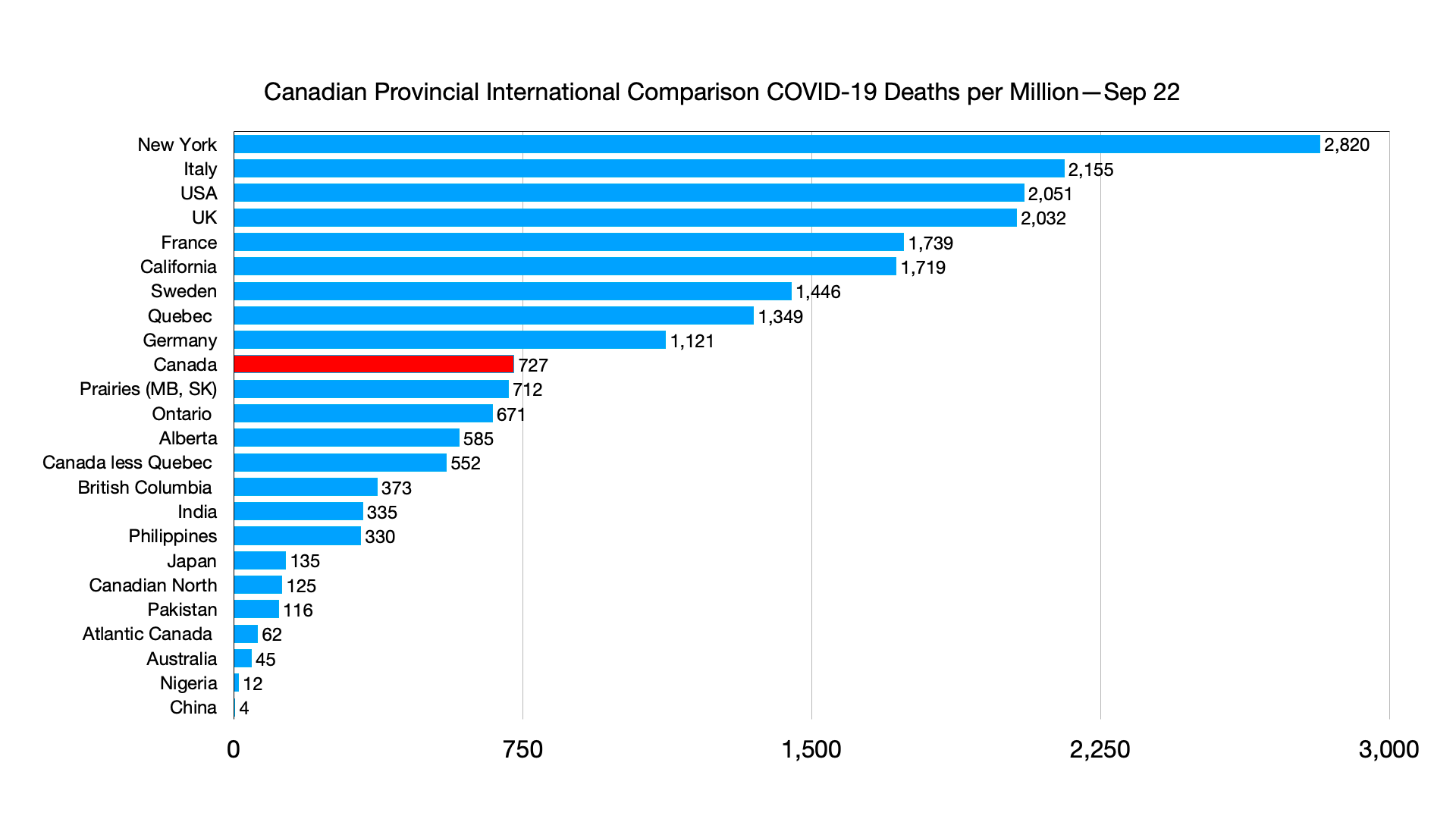
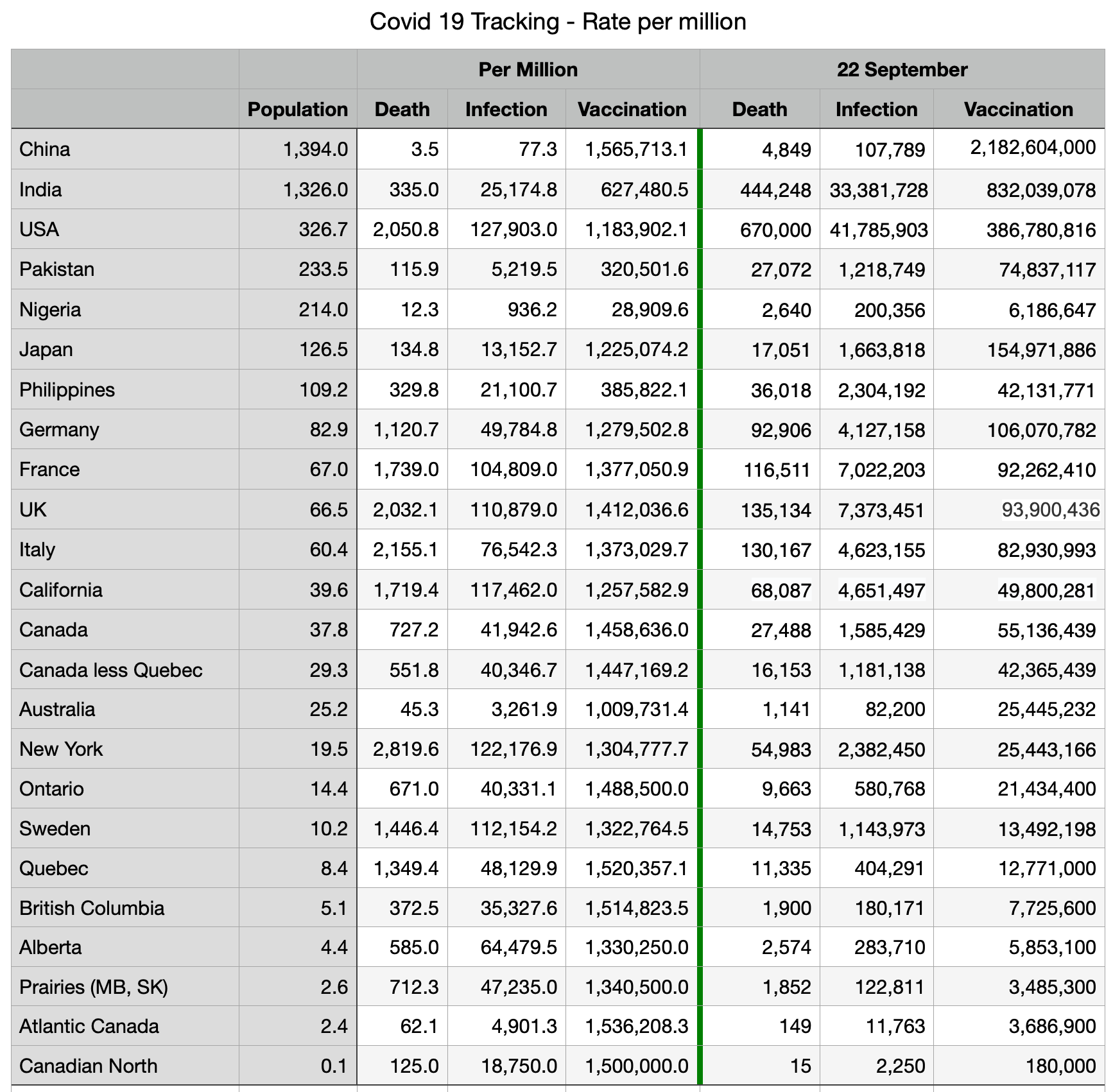
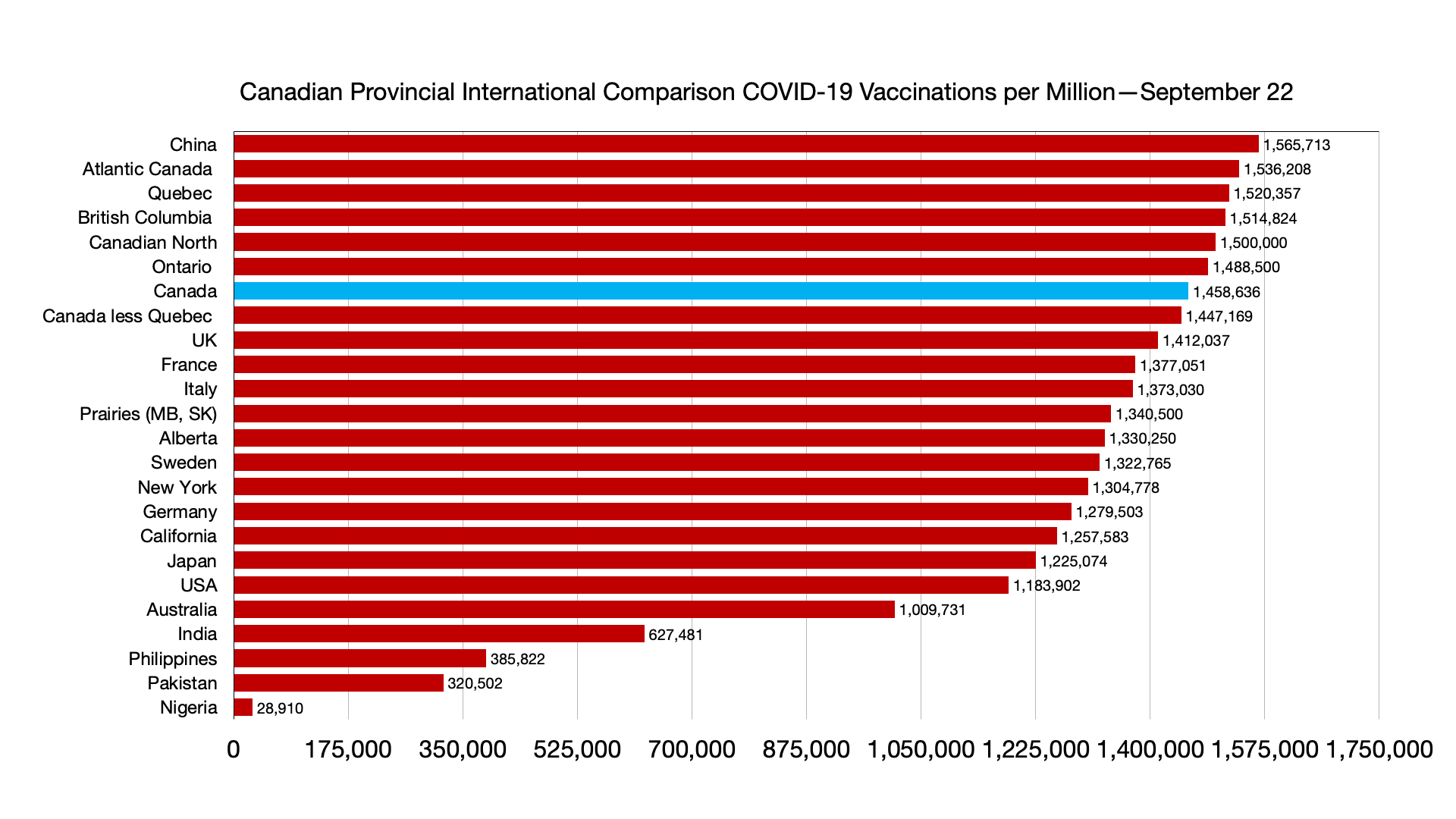
#COVID-19: Comparing provinces with other countries 22 September Update

The latest charts, compiled 22 September as overall rates in Canada increase slightly due to the variant. Canadians fully vaccinated 70.5 percent, higher than USA 55.5 percent and the UK 66.6 percent) but all three countries are hitting a wall, with only minimal increases in the past week.

Vaccinations: Alberta ahead of Sweden, Japan ahead of USA, and India ahead of Philippines. China fully vaccinated 73.1 percent, India 15.3 percent.

Trendline Charts:

Infections: Continued trend of pronounced uptick in G7 less Canada (driven largely by USA). While all provinces showing increased infections, Alberta and Prairies showing the highest, followed by British Columbia.

Deaths: No major change but continued uptick G7 less Canada and in Alberta.

Vaccinations: Ongoing steady gap between Alberta and Prairies with lower vaccination rates than elsewhere in Canada but impact of Alberta backtracking and imposing a vaccine mandate shows increase over past week.

Weekly

Infections: Canada less Quebec now ahead of Ontario (thanks to Alberta and Prairies):

Deaths per million: USA now ahead of UK.

Dutrisac: Placer ses pions (identity politics and polarization in Quebec)

Of interest:

Les élections à date fixe ont un effet pervers : comme on connaît l’échéance électorale, il s’instaure, avant la campagne officielle d’une trentaine de jours habituellement, une précampagne informelle qui peut durer des mois. Or, à plus d’un an des élections d’octobre 2022, François Legault place déjà ses pions, comme on l’a vu à l’ouverture de la session parlementaire cette semaine.

On a dit que le premier ministre avait été « piqué au vif » quand le nouveau chef parlementaire de Québec solidaire (QS), Gabriel Nadeau-Dubois, l’a accusé d’imiter Maurice Duplessis. Rien n’est moins sûr. Il a plutôt semblé sauter, tel un félin, sur l’occasion, que lui offrait le solidaire sur un plateau d’argent, de le qualifier de woke.

Chez les caquistes, on parle sans gêne aucune de former une union des Bleus, une nouvelle union nationale. Le sentiment que la souveraineté n’est plus dans l’air du temps — leur idée première —, associé à la dégénérescence du Parti québécois, les conforte dans cette ambition unificatrice. François Legault ne ressent pas d’aversion viscérale envers le « cheuf ». Il n’a pas hésité au printemps dernier à livrer sur les réseaux sociaux qu’il avait lu avec intérêt l’essai Duplessis est encore en vie, de Pierre B. Berthelot. Il a révélé qu’il avait été marqué par une scène de la remarquable série télévisée Duplessis, de Denys Arcand.

Il est ironique que Gabriel Nadeau-Dubois se fasse traiter de woke puisqu’il incarne au sein de QS la gauche classique, celle qui fait grand cas des inégalités sociales, et qu’il a dû lutter contre une faction de la gauche identitaire radicale au sein du parti, le Collectif antiraciste décolonial.

Revenant de lui-même sur le sujet au lendemain de son échange avec le chef solidaire, le premier ministre nous a donné sa propre définition d’un woke : « C’est quelqu’un qui veut nous rendre coupables de défendre la nation québécoise, de défendre ses valeurs, comme on l’avait fait avec la loi 21, de défendre nos compétences », a-t-il dit. Il y a deux partis multiculturalistes, le Parti libéral du Québec et QS, qui sont contre la loi 21 sur la laïcité, caractérise-t-il.

Évidemment, François Legault tourne les coins ronds. On peut être nationaliste et s’opposer à la loi 21. Dans le passé, plusieurs souverainistes au sein du PQ ont d’ailleurs exprimé leurs réserves relativement à l’interdiction du port de signes religieux.

Habilement, Gabriel Nadeau-Dubois a fait semblant de ne pas savoir ce que c’était un woke. D’ailleurs, comme l’écrivait notre journaliste Stéphane Baillargeon, si la définition du mot telle qu’elle est contenue dans l’Oxford English Dictionary est simple (le fait d’être « conscient des problèmes sociaux et politiques, en particulier le racisme »), certaines manifestations du phénomène, qui se présentent comme une exacerbation du « politically correct » — la culture du bannissement (cancel culture), la censure et l’autocensure à l’université, et maintenant l’autodafé —, conduisent à un extrémisme qui recourt à l’affect plutôt qu’à la raison. Sur les campus universitaires, ce « crois ou meurs » bien-pensant, cette ferveur presque religieuse ne sont pas sans rappeler l’orthodoxie liberticide et anti-intellectualiste des militants marxistes-léninistes et maoïstes des années 1970.

Agissant en chef de parti qui prépare le terrain du prochain affrontement électoral, François Legault, loin de la réflexion sociologique, a voulu définir ses adversaires en grossissant le trait et proposer un choix binaire entre le duplessisme et le wokisme, entre la défense de la nation et le progressisme multiculturaliste. Dans cette dichotomie, solidaires et libéraux se retrouvent dans le même sac. Quant aux péquistes, ils ne figurent plus, ou à peine, dans l’équation.

Le grand gagnant de cette semaine parlementaire, c’est sans aucun doute Gabriel Nadeau-Dubois, qui faisait ses premières armes dans sa nouvelle fonction. Le chef de la deuxième opposition a éclipsé la cheffe de l’opposition officielle, Dominique Anglade. La perspective que les solidaires puissent incarner la véritable opposition à l’Assemblée nationale va dans le sens d’une polarisation qui ne peut que réjouir les caquistes. Rappelons d’ailleurs que QS est maintenant le deuxième parti après la CAQ chez les francophones avec environ 15 % des intentions de vote, soit au moins une fois et demie plus d’appuis que le Parti libéral.

La CAQ pratique ainsi une forme de politique de la division ou de polarisation (wedge politics) qui semble désormais bien ancrée dans les mœurs partisanes. C’est détestable. Mais comme l’a déjà dit Brian Mulroney, cité récemment par Michel C. Auger, « en politique, il est important d’avoir des amis, mais il est encore plus important d’avoir des ennemis ». Et s’ils peuvent se trouver à un extrême du spectre politique, c’est encore mieux.

Source: https://www.ledevoir.com/opinion/editoriaux/633687/duplessis-et-les-placer-ses-pions?utm_source=infolettre-2021-09-20&utm_medium=email&utm_campaign=infolettre-quotidienne

Racism led to a rise in anti-Asian hate in the pandemic. What the community wants to see in Canada’s next leader

More anecdotal than systemic treatment of hate:

Canada has faced a rude awakening around the rise of anti-Asian racism. The COVID-19 pandemic brought along a surge of attacks on Asian-Canadian seniorsand vandalism of many Asian-Canadian businesses. As a result, the Chinese-Canadian community continues to silently live in fear, isolation and anger.

On the eve of the 44th Canadian federal election, they’re now speaking out about what they demand from the federal electoral candidates.

“Canada is a multicultural country with people from all over the world. Our politicians should strive to make it a vibrant nation where everyone is treated with respect and dignity,” Shiwei Mao, a Chinese-Canadian retiree, said in Mandarin, the only language she speaks besides her native Shanghainese. “But what did they do? It’s been almost two years of COVID-19 and our politicians have made a mess. Our society and economy has undergone profound disruptions, with chaos and racism everywhere!”

Mao has encountered racism herself. Early on in the pandemic, before mask mandates, she wore a face mask on public transit. “As soon as I sat down on the bus, the person next to me got up and changed seats. It made me feel very uncomfortable,” she said. “We Chinese understood the importance of wearing masks as the pandemic started in our country. But everyone else was looking at us strangely for wearing masks.”

In her late seventies and living with her husband in Scarborough, Mao is angry that the pandemic has become a political issue and has changed her idea of saftey. She believes that pandemic measures should have been led by experts and scientists instead of politicians who have “little knowledge and training in public health and epidemiology.”

As a direct result of COVID-19, Mao has not been able to go out much. “My husband, who is 86, is of reduced mobility and uses a wheelchair. Every time we want to go out, it’s a huge hassle, as we don’t have a car and use public transit,” she explained. “It’s extremely inconvenient for us that there is not enough public transit and that its schedule is inconsistent. I want more accessible public transit with a more regular and consistent schedule.”

Another issue is accessibility to health care. Though Mao and her husband were able to find a Chinese-Canadian doctor who gave them information on how to protect themselves, she is aware that not everyone in the community is so lucky. “It’s hard for a lot of Chinese people to find a doctor that speaks their particular dialect. I believe the percentage of doctors in Canada who are of certain cultural backgrounds should match the percentage of Canadians who are of that same background,” she said.

Amy Go, the president of the Chinese-Canadian National Council (CCNC), thinks that this pandemic has highlighted wealth disparities in our society. “The pandemic really highlights the differential access to services of racialized seniors and seniors who don’t speak English” she said. “On top of an already scarce amount of culturally adapted services, COVID-19 has disrupted the few services there were. Chinese-Canadian seniors who rely on home-care to get their daily basic needs met and who need regular health care have been hit extremely hard.”

Go has heard from many seniors who have struggled through the pandemic. “They were so afraid because of all the assaults. Many of them made heartbreaking comments such as ‘We moved to Canada in order to build a better life for our children. But now we are questioning that decision and hope our children won’t have to move again,” she said. “Seniors go out and see people treating them differently. They know it is wrong, but they don’t know what to say, as they don’t have the English skills to say anything.”

CCNC has submitted questions to the federal parties regarding these matters, but received no response. The Conservative party, the Liberal party, and the New Democratic Party did not return requests for interviews either.

Canada’s Anti-Racism Strategy said that since its establishment in 2019, “the Federal Anti-Racism Secretariat has since been leading a whole of government approach to tackling racism and discrimination in all of its forms in Canada, including anti-Asian racism.” In March they set up a task force to work with “government organizations and diverse communities in response to the COVID-19 pandemic… including Canadians of Asian descent, to ensure that our response to COVID-19 is informed by lived experiences.”

But for some, the lack of politicial representation leads to a lack of understanding on how to best care for diverse populations which require a more targeted response.

“We need Chinese-Canadian politicians to represent us at the House of Commons so that our demands can be put forward” Ru Xie, another Scarborough resident who lives with her husband and her daughter said. “I believe that in a multicultural country like Canada, it is the federal government’s responsibility to intervene when there is racism.”

Though COVID-19 has largely kept Xie in her home due to safety concerns, she ventured out to participate in an anti-Asian racism protest after seeing reports of attacks circulating on WeChat, a Chinese social network.

Dr. Henry Yu, a professor of Asian-Canadian and Asian Migration studies, believes that this past year and a half has forced Canada to face its history of anti-Asian racism. “Our communities are looking for some commitment from all party leaders that’s not empty. Saying, ‘We’re not racist in Canada’ won’t cut it, because you say that doesn’t mean it’s true. Because this is happening in Canada,” he said. Dr. Yu strongly believes that Canada needs to take a hard look at itself and ask why is it that this nation scapegoats the Asian-Canadian population to solve structural issues rather than simply enact superficial measures.

“What needs to be implemented across the board is to collect more disaggregated data, especially in the context of COVID-19, about who’s being served in the mental health system, and what access is like for people who are linguistically diverse or marginalized and other ways,” said Cindy Quan, a researcher at the University of Victoria. She believes that part of the solution lies in getting disaggregated data on anti-Asian racism, because Canada historically has not been vigilant collecting data to address its issues with racism.

“We need greater accountability at various levels of government, tougher hate crimes and discrimination laws, better crafted legislation along those lines, and clear consequences for engaging in racist behaviour,” she said.

Source: Racism led to a rise in anti-Asian hate in the pandemic. What the community wants to see in Canada’s next leader

Muslim issues not adequately addressed in party platforms, argues advocacy group campaigning for dedicated federal anti-Islamophobia office

New advocacy group but not any new issues:

A new advocacy organization is arguing the federal parties aren’t making sufficient promises related to combating hate crimes against Muslims, and is campaigning for whichever party wins the election to develop an office for combating Islamophobia.

“We don’t think Islamophobia or issues related to Canadian Muslims are being adequately addressed in party platforms. We would have liked to see more concrete commitments, and we don’t see that,” said Sarah Mushtaq, a spokesperson for the Canadian Muslim Public Affairs Council (CMPAC). “We’ve seen the rise of anti-Semitism, of anti-Asian hate crimes, and then specifically Islamophobia. The idea of having this federal office with resources and funding would be [to look] at these issues in a way where we can actually address them from a systemic perspective.”

The CMPAC, a lobby organization dedicated to advancing the interests of Canada’s Muslim population, launched on Sept. 10. Advocacy priorities for the organization include urging the federal government to implement a strategy to address online hate, and to create a federal office that would develop and implement an anti-Islamophobia strategy. The CMPAC is looking for a commitment of $5 million towards a federal anti-Islamophobia office, according to Ms. Mushtaq.

Police-reported hate crimes in Canada reached 2,669 incidents in 2020, representing a 37 per cent increase compared to the 1,951 police-reported hate crimes in 2019, according to Statistics Canada. About 46 per cent of Canadians have an unfavorable view of Islam—more than for any other religious tradition—according to a report on Islamophobia in Canada submitted to the UN Special Rapporteur in Freedom of Religion or Belief on Nov. 30, 2020. The report was submitted by the International Civil Liberties Monitoring Group, the Islamic Social Services Association, and the Noor Cultural Centre.

“We believe that having an office to address Islamophobia could help address these issues in a more fulsome, systemic way, and address hate crimes across the country instead of just kind of letting communities individually deal with them,” said Ms. Mushtaq. “Having this national framework to address hate crimes would be really helpful to ensure that no community is left behind.”

As part of the launch, the CMPAC released a comparison of the various federal parties’ platforms in the 2021 election, which highlighted the strengths and weaknesses of each party when it comes to addressing issues such as Islamophobia, systemic racism and immigration.

The Liberal Party platform failed to address specific asks of the Muslim community based on the input gathered during the National Action Summit on Islamophobia, according to the CMPAC platform comparison. The summit, held virtually on July 22, provided a platform for Muslim communities to discuss ways to combat Islamophobia in Canada. The Liberal platform has not included any proposal to help prevent Muslim charities from being targeted by audits from the Canada Revenue Agency (CRA), which was the “number one” issue raised at the summit, according to the CMPAC. Muslim-led charities are “exceptionally vulnerable to audits” and to the revocation of their charitable status, according to a report released on March 29 by the National Council of Canadian Muslims and the Institute of Islamic Studies at the University of Toronto.

On Aug. 5, Minister of National Revenue Diane LeBoutillier announced that Taxpayers’ Ombudsperson François Boileau will investigate the concerns of Muslim charities in their experiences with the CRA. An update on Boileau’s examination is expected to be provided to the National Revenue minister on Jan. 1, 2022, according to an Aug. 5 press release.

“Together with my office, I commit to examining the concerns raised and will engage charitable organizations led by racialized communities to ensure that the service rights we so strongly represent, are upheld by the CRA. But before we take action, we need to take the time to listen and deepen our knowledge of the issues,” said Mr. Boileau in the press release.

The CMPAC said on its website that Boileau’s review is “non-binding and limited in scope,” and criticized the Liberal government for not proposing any reforms in its platform to address the issues facing Muslim-led charities.

As examples of how the Liberals are addressing Islamophobia in their election platform, the CMPAC lists the party’s plan to present a national action plan for combating hate by 2022 as part of an anti-racism strategy, and a proposal to increase investments in the Canada Centre for Community Engagement and Prevention of Violence to combat hate crime.

The CMPAC argues that the NDP platform makes numerous mention of Islamophobia in addressing hate speech and crimes, but, similar to the Liberals, has not included a commitment to address CRA audits of Muslim-led charities.

Regarding the Conservatives, the CMPAC comparison document argues the party’s platform makes no direct mention of Islamophobia. Steps proposed by the Conservatives that could relate to combating Islamophobia includes a plan to fight online incitement and hatred by criminalizing statements that encourage violence.

Ms. Mushtaq said that the CMPAC plans to register on the federal lobbyists’ registry following the federal election on Sept. 20.

Other organizations currently active on the federal lobbyists’ registry related to advocacy for Muslims includes the Muslim Association of Canada and the National Council of Canadian Muslims.

“The Muslim community is not monolithic. It’s a large community and there’s room, as the community continues to grow, for multiple organizations serving the interest of the community together,” said Ms. Mushtaq. “We definitely want to work together. There might be some things that one organization works on, but there’s definitely going to be a lot of work together behind the scenes, as well.”

Islamophobia was the subject of headlines during the 2021 election, when Lisa Robinson, the Conservative candidate in the Toronto riding of Beaches–East York, was dismissed from the party on Sept. 10 for allegedly posting anti-Islamic statements on social media years prior.

Liberal candidate Nathaniel Erskine-Smith posted a tweet on Sept. 10 containing screenshots from a Twitter account called “Ward 1 city councillor candidate,” which contained derogatory comments towards Muslims living in Canada. In his Twitter post, Mr. Erskine-Smith said that “’Ward 1 city councillor candidate’ is none other than Lisa Robinson.”

Ms. Robinson told The Canadian press she is still running as a “confirmed Conservative” candidate despite being officially dropped by the Party. She claims that she never wrote the online posts that led to her dismissal from the Conservatives. In a Twitter post response to Mr. Erskine-Smith, Ms. Robinson said that the Ward 1 city councillor candidate account was fake, and she had reported it to Durham Regional Police in 2018. She also said in her Twitter post that sharing “false information is defamatory” and that Erskine-Smith would receive a libel notice soon.

“They posted a fake picture, claimed that it must be true, and asked me—the victim, to provide proof that it is fake,” said Ms. Robinson in a statement on her campaign website. “If this can be done to me, then it can be done to anyone. Would you want your children subjected to this kind of abuse? If an elected official can spread false information and blame the victim candidate, what else can they be capable of?”

In an emailed statement to The Hill Times, Mr. Erskine-Smith said he would be “open to correcting the record if there is credible information.”

“When I initially saw Lisa’s claim that the account is fake, I privately messaged her and asked her if she had flagged it for Twitter. She said she’d never done so because of a lack of computer literacy, but that she eventually had it removed with the help of a friend. When I asked specifically how that had happened, she stopped responding to me,” said Mr. Erskine-Smith in the email. “I’ve now seen past posts of hers in which she has apologized for remarks, and also in which she has claimed she was hacked. None of it adds up.”

Source: Muslim issues not adequately addressed in party platforms, argues advocacy group campaigning for dedicated federal anti-Islamophobia office

Chinese Culture and the Red Line of Morality

Of note:

Last week, members of China’s television, radio, and online entertainment sectors were made to attend a symposium in Beijing with the theme Love the Party, Love the Country, Advocate Morality and Art. They were instructed to abandon vulgarity, hedonism, the worship of money, and “extreme individualism.” These vague injunctions arrive amid China’s heaviest cultural crackdown in years. Film stars like Zhao Wei have been mysteriously memory-holed, their movies completely removed from streaming platforms, their credits erased from film information sites. “Once you touch the red line of law and morality,” warned state mouthpiece the People’s Daily, “you will reach the finish line of the road of performing arts.” If the exact nature of this “red line” remained unclear, another editorial put a finer point on the matter: Chinese films must be more socialist from now on.

American Idol-style TV shows have been banned; next on the list are karaoke songsthat fail to “promote socialist core values.” These moves are part of an attempt to end the “worship [of] Western culture.” True socialism has no time for smut, and so the sale of sex toys has been banned during livestreams hosted on e-commerce websites. One week before the symposium, the Party zeroed in on the specific problem of effeminate male TV celebrities: “Resolutely put an end to sissy men and other abnormal esthetics,” broadcasters were told. Days later, building on recent video game restrictions for Chinese children, gaming companies Tencent and NetEase were ordered to cut content that encourages effeminacy.

All this machismo is beginning to attract admiring glances and approving noises from Westerners worried about their own culture’s alleged feminisation, but these lessons in morality are being delivered by the worst conceivable teacher. Lest we forget, this is a regime that packs ethnic minorities into concentration camps where the prettiest women are raped every day, sometimes with electric batons. This is a country where the founder of an orphanage for deprived children is arrested, tortured, and then sent to prison for 22 years. Bangri Rinpoche’s orphanage was declared an “illegal organisation” and the children he had saved were turned onto the street. In Communist China, civil society is always smothered in the crib. The moment we turn to such a regime for lessons on morality is the moment we lose our way completely.

The Party’s stern alternative to all that sex and pop and sissy chaos is “Chinese traditional culture, revolutionary culture, and advanced socialist culture.” Numbers two and three on the list indicate that Beijing understands culture about as well as it understands morality. George Orwell saw the problem clearly back in the pre-war years. As he observed in The Road to Wigan Pier, “Nearly everything describable as socialist literature is dull, tasteless, and bad. … Every writer of consequence and every book worth reading is on the other side. … Socialism has produced no literature worth having.”

This truth is borne out by the miserable state of China’s literary scene. When Anna Sun (assistant professor of sociology and Asian studies at Kenyon College) analysed the work of modern Chinese writers, she found that almost all of them had been infected by socialist language dating back to the Mao era—a clumsy jumble of communist jargon and Mao-ti (Maoist literary form). In fact, it’s not just the artists and intellectuals who speak this language—everyone does, from the diner in a restaurant who casually asks his friend to “Xiaomie [annihilate] the leftovers,” to the young mother who tells her little boy, as he struggles not to wet himself on the bus, “Jianchi! [Be resolute!]”

Originally fashioned to represent the authentic voice of the proletariat, Mao-ti is a language “repetitive, predictable, coarse, and mostly devoid of aesthetic value.” Sun argues that the most celebrated of today’s Chinese novelists actually owe everything to their translators. The language in which they were trained acts as a trap constricting thought, and as a result they can neither think nor write with the precision and truthfulness required of genuinely great novelists. Some have found that the only sure way to spring the trap is to abandon Chinese altogether, and write in English.

Even the Soviet Union had its Bulgakovs and its Pasternaks, of course, and there is no doubt that art sometimes flourishes in an atmosphere of oppression. But right from the very beginning, the CCP took the totalitarian impulse further than its predecessors—far enough that its natural supply of great literary voices was never allowed to develop. This was not the case in pre-revolutionary China. Sun cites with admiration Shen Congwen, Wang Zengqi, Lao She, Bing Xin, Qian Zhongshu, Fu Lei, Eileen Chang. In each of these cases the writer’s education occurred before Mao’s takeover, allowing them to develop a voice before they were exposed to the infection. Chang (widely considered the greatest short story writer of 20th-century China) even participated in re-education sessions once the communists were in charge, but it made no difference. Her writing still had too much complexity, too much depth, too much of her own voice. Incapable of descending to their crude level, she left for Hong Kong.

The incompatibility of classical Chinese with Mao-ti—of beauty with ugliness—shows the hopelessness of the Party’s dream to usher in a new culture that is at once “traditional” and “socialist.” These two cultural strains may have co-existed uneasily for decades in China (along with Western influence), but there can be no happy union of the two. They sit at opposite poles. Any emphasis on one of them will automatically undermine the other. It would be better to simply let go of the reins and allow Chinese culture to develop organically—something which has happened only once before.

While state propaganda paints the relatively open pre-communist period (1912–1949) as a time of chaos, societal weakness, and general regression, historian Frank Dikötter makes a convincing case in The Age of Openness: China Before Mao that those years really bore witness to a veritable golden age. Not only did China make political advancements; she enjoyed greater cultural diversity than at any point before or since. Religious movements long persecuted under the Qing were given their freedom. In the absence of both empire and socialism, Shanghai rose to become the Asian jazz Mecca; its numerous venues frequently played host to top musicians from the United States.

With the liberation of culture came the fast flourishing of individualism. Dikötter notes that “Women of all social backgrounds selected scarves, skirts, blouses, gowns, and corsets from a growing range of sartorial possibilities, using them in combinations which were often strikingly original: the use of the one-piece gown with a scarf and coat is but one example.” By 1934, when discussing new developments in public transport, the British traveller Peter Fleming was able to observe: “The running of a bus service, as compared with the running of a railway, is not only easier but offers more scope for individualism, and is therefore better suited to the Chinese character” [emphasis mine]. So much for the inherently collectivist nature of the Chinese. Just a few short years after the cultural shackles were removed, the natural human tendency towards individual self-expression had already asserted itself.

Then came the communist revolution, and the life was abruptly sucked out of China. Shanghai’s cafés and dance halls closed down; the Race Course at Nanking Road was transformed into a military barracks. Lipstick and makeup disappeared. Soon all of the men had crewcuts and all of the women wore their hair in short bobs. Everyone dressed in the same faded blue or grey cotton. And then in the 1960s, of course, Mao’s Great Proletarian Cultural Revolution saw the widespread demolition of statues and temples, the smashing of antiques, and the burning of books. Today’s ominous developments do not mean that China is about to experience a second Cultural Revolution, but the promise of an “advanced socialist culture” bodes ill.

At last week’s Beijing symposium, one film director delivered a sycophantic addressin which he said, “It is our creators’ duty to do every work simply and unadornedly, and to pass positive energy silently to the audience.” This sentiment chimes with Stalin’s pithy proverb about writers being the engineers of the soul (a line echoed in recent years by Xi). And yet, the truth is that creators have a duty to their art and nothing else—not to their audience, not to “positive energy,” and least of all to some high-minded state-determined notion of the improvement of the people. Certainly art elevates, but not for reasons that we will ever be able to fathom.

As for the karaoke singalongs and American Idol copycat shows that sit at the other end of the spectrum, we might imagine that Chinese culture will suffer no great loss. But millions of people are about to have perfectly innocent pleasures removed from their lives, and this matters. In the small ways as well as the large, Xi Jinping continues to impose on a vibrant nation his narrow, pinched, joyless vision.

Source: Chinese Culture and the Red Line of Morality