A broadcast boycott is the last chance to mount serious resistance against the Beijing Olympic Games

Another option:

On Sept. 7, a group of 200 human rights groups wrote to Olympic broadcasters, including the CBC and NBC, asking them to cancel their coverage of the upcoming Beijing Winter Games and refrain from “sport washing” China’s lengthy list of human rights abuses

In doing so, the human rights groups aim to hit the International Olympic Committee (IOC) where it hurts most — its bank account. The IOC’s sale of broadcasting rights accounts for a whopping 73 per cent of its funding. Much of this is distributed to National Olympic Committees, propping up the broader Olympic system.

The COC and CPC can’t help

The call for a broadcast boycott came months after a coalition of 180 human rights groups issued an open letter to international governments back in February, urging nations to withdraw from Beijing 2022. In Canada, the Liberal government passed the buck to leaders of the Canadian Olympic Committee (COC) and Canadian Paralympic Committee (CPC).

Reacting to the letter, the chief executive officers of the COC and the CPC — David Shoemaker and Karen O’Neill respectively — penned a joint op-ed in The Globe and Mail, predictably recycling an old anti-boycott argument.

“Boycotts don’t work. They punish only the athletes prevented from going, those they were meant to compete against and those who would have been inspired by them.”

But that’s not exactly true.

Writing on the international community’s sporting boycott of Apartheid South Africa, historian John Nauright suggests that “the psychological impact of sporting sanctions had perhaps the most potent role in undermining white South African confidence and complacency.” 

Although the Olympic boycott alone didn’t topple apartheid, it was part of an important range of sanctions that ultimately wore down the racist regime.

The COC and CPC’s response is to be expected. Both organizations are embedded in the Olympic industry and have a lot to lose. The COC is partially funded by the IOC, and the COC and CPC have already accepted funding from private sponsors to prepare for 2022.

Both Shoemaker and O’Neill are beholden to their respective board of directors, limiting their ability to rock the Olympic and Paralympic boat. In fact, the head of every national Olympic committee is, by definition, an IOC mouthpiece.

China’s human rights abuses are persistent and documented

The situation in China remains grim. Uyghurs and other Muslim minorities are detained in massive concentration camps and reduced to forced labour. Tibetans continue to struggle under what Human Rights Watch terms “coercive assimilationist policies” intended to strangle and extinguish their culture.

Pro-democracy activists from Hong Kong were recently sentenced to up to five years in prison for participating in an anti-government march in 2019. Freedoms of religion, assembly, expression and speech are stifled. And those who attempt to flee are subject to recapture, imprisonment and torture.

The IOC is likely well informed about China’s human rights abuses. After all, its report, “Recommendations for an IOC Human Rights Strategy” was co-authored by former UN High Commissioner for Human Rights Zeid Ra’ad Al Hussein, who had first-hand experience working with the country. Hussein lamented over China’s lack of co-operation, noting that his staff “have not been given unfettered access to the country, including to the Tibetan Autonomous Region and the Xinjiang Uyghur Autonomous Region, where the human rights situation is reportedly fast deteriorating.”

The IOC won’t budge

The IOC has a long history of paying lip service when it comes to human rights issues. For example, the Olympic Games routinely result in the displacement and abuse of host populations. No amount of lobbying from rights groups makes a difference. The IOC views hosting decisions in dollars and cents, and the cancellation of a single Games would mean billions in lost revenue.

When asked about China and human rights issues, IOC President Thomas Bach refused to denounce the country, skirting the question with vague assurances of peaceful internationalism.

In 2015, just seven years removed from the human rights debacle that was the Beijing 2008 Olympics — including the intimidation and imprisonment of those who dared resist the event — the IOC once again awarded Beijing the Games, this time for the 2022 Winter Olympics. 

It was a controversial decision. Few nations wanted the Olympics, resulting in a two bid race between China and Kazakhstan, neither of which boast a strong human rights record. By selecting Bejing, the IOC chose to be complicit in China’s violation of human rights. 

Bigger than sport

The call for a broadcast boycott opens the door for international broadcasters to do something truly noble — take a stand in support of human rights and refuse to show the 2022 Beijing Olympics. As public and private national broadcasters respectively, the CBC and NBC are beholden to the general public above all else. Not national Olympic and Paralympic Committees. Not advertisers. Not the government. The people.

According to one recent poll, a majority of Canadians — amounting to 64 per cent of those surveyed — either “support” or “somewhat support” boycotting the 2022 Beijing Olympic Games. Americans, meanwhile, are nearly split down the middlewith 49 per cent supporting a boycott. As the Games edge closer, and China’s human rights violations inevitably face heightened scrutiny, the support to boycott will continue to grow.

Many people want to support the Uyghurs, Tibetans, pro-democracy advocates and others struggling for their human rights in China. As national broadcasters, the CBC and NBC can help people do just that. If international broadcasters choose not to boycott the Beijing Olympic Games, they will be complicit in the human rights abuses ongoing in China.

Source: https://theconversationcanada.cmail20.com/t/r-l-trqkijd-kyldjlthkt-f/

AI’s anti-Muslim bias problem

Of note (and unfortunately, not all that surprising):

Imagine that you’re asked to finish this sentence: “Two Muslims walked into a …”

Which word would you add? “Bar,” maybe?

It sounds like the start of a joke. But when Stanford researchers fed the unfinished sentence into GPT-3, an artificial intelligence system that generates text, the AI completed the sentence in distinctly unfunny ways. “Two Muslims walked into a synagogue with axes and a bomb,” it said. Or, on another try, “Two Muslims walked into a Texas cartoon contest and opened fire.”

For Abubakar Abid, one of the researchers, the AI’s output came as a rude awakening. “We were just trying to see if it could tell jokes,” he recounted to me. “I even tried numerous prompts to steer it away from violent completions, and it would find some way to make it violent.”

Language models such as GPT-3 have been hailed for their potential to enhance our creativity. Given a phrase or two written by a human, they can add on more phrases that sound uncannily human-like. They can be great collaborators for anyone trying to write a novel, say, or a poem.

Source: AI’s anti-Muslim bias problem

Data science education lacks a much-needed focus on ethics

Of note:

Undergraduate training for data scientists – dubbed the sexiest job of the 21st century by Harvard Business Review – falls short in preparing students for the ethical use of data science, our new study found.

Data science lies at the nexus of statistics and computer science applied to a particular field such as astronomy, linguistics, medicine, psychology or sociology. The idea behind this data crunching is to use big data to address otherwise unsolvable problems, such as how health care providers can create personalized medicine based on a patient’s genes and how businesses can make purchase predictions based on customers’ behavior

The U.S. Bureau of Labor Statistics projects a 15% growth in data science careers over the period of 2019-2029, corresponding with an increased demand for data science training. Universities and colleges have responded to the demand by creating new programs or revamping existing ones. The number of undergraduate data science programs in the U.S. jumped from 13 in 2014 to at least 50 as of September 2020. 

As educators and practitioners in data science, we were prompted by the growth in programs to investigate what is covered, and what is not covered, in data science undergraduate education.

In our study, we compared undergraduate data science curricula with the expectations for undergraduate data science training put forth by the National Academies of Sciences, Engineering and Medicine. Those expectations include training in ethics. We found most programs dedicated considerable coursework to mathematics, statistics and computer science, but little training in ethical considerations such as privacy and systemic bias. Only 50% of the degree programs we investigated required any coursework in ethics.

Why it matters

As with any powerful tool, the responsible application of data science requires training in how to use data science and to understand its impacts. Our results align with prior work that found little attention is paid to ethics in data science degree programs. This suggests that undergraduate data science degree programs may produce a workforce without the training and judgment to apply data science methods responsibly. This primer on data science ethics covers real-world harms.

It isn’t hard to find examples of irresponsible use of data science. For instance, policing models that have a built-in data bias can lead to an elevated police presence in historically over-policed neighborhoods. In another example, algorithms used by the U.S. health care system are biased in a way that causes Black patients to receive less care than white patients with similar needs. 

We believe explicit training in ethical practices would better prepare a socially responsible data science workforce.

What still isn’t known

While data science is a relatively new field – still being defined as a discipline – guidelines exist for training undergraduate students in data science. These guidelines prompt the question: How much training can we expect in an undergraduate degree? 

The National Academies recommend training in 10 areas, including ethical problem solving, communication and data management.

Our work focused on undergraduate data science degrees at schools classified as R1, meaning they engage in high levels of research activity. Further research could examine the amount of training and preparation in various aspects of data science at the Masters and Ph.D. levels and the nature of undergraduate data science training at schools of different research levels.

Given that many data science programs are new, there is considerable opportunity to compare the training that students receive with the expectations of employers. 

What’s next

We plan to expand on our findings by investigating the pressures that might be driving curriculum development for degrees in other disciplines that are seeing similar job market growth.

Source: https://theconversation.com/data-science-education-lacks-a-much-needed-focus-on-ethics-164372

Australia: ‘Be less of a white boys’ club’: How to address Parliament’s lack of diversity

Of note (Canadian Parliament and Senate are much more diverse than Australia):

“Stale, pale and male” has become a shorthand for the lack of diversity of all kinds across society’s institutions. Parliament has not escaped its accusations and even federal politicians have levelled the tag at it.

Labor frequently pats itself on the back for achieving near-gender parity in its caucus room but this week it has been beset by criticism it has not done enough to address other types of diversity.

The decision to parachute senator Kristina Keneally into the safe lower house seat of Fowler, in Sydney’s west, at the expense of local, young, Vietnamese lawyer Tu Le has led to calls for diversity quotas and divisions over “token” multiculturalism.

But it’s not only Labor’s politicians who are overwhelmingly white.

Out of the 226 men and women who make up Federal Parliament, 23 were born overseas but only five in non-European countries to parents who weren’t Australian. Another 52 have parents who were born overseas, overwhelmingly in the UK.

Contrast this with the general population. Just under half of all Australians were either born overseas or their parents were. Nearly three times more people in the wider Australian community were born overseas than their parliamentary representatives.

However, Parliament this week hit a milestone of proportionate representation of Indigenous people. There are now seven Indigenous members after the Greens’ newest senator Dorinda Cox, a Yamatji-Noongar woman, replaced Rachel Siewert.

Tim Soutphommasane, a professor at the University of Sydney and a former race discrimination commissioner, says Parliament “fails dismally” on cultural diversity.

“It doesn’t look remotely like today’s multicultural Australia. It might make some uncomfortable, but our political class looks like it’s stuck in the White Australia era,” he says.

“If you don’t have cultural diversity in our politics, you don’t have a politics that’s representative. That’s a pretty basic problem.”

Dr Blair Williams from the Global Institute for Women’s Leadership at ANU says while an exact representation of the community isn’t possible, “it just needs to be a bit more focused on being less of a white boys’ club from a certain background”.

There has been a strong focus for some time now on increasing the number of women elected, but Williams says there also should have been thought put into improving cultural diversity. She’d also like to see more young people, people with disabilities and those from different class backgrounds.

The problem is self-perpetuating, says Race Discrimination Commissioner Chin Tan. If people don’t see anyone like them in Parliament, they’re less likely to get involved in the political process.

“The lack of diverse and inclusive parliaments means certain groups are poorly represented and their interests are not well spoken for,” he says.

“Even aside from the importance of involving diverse voices in the legislative process, Parliament provides a tremendous platform for engaging in public debate. We have often seen that when politicians from diverse backgrounds enter Parliament, they achieve great outcomes by focusing attention on issues that might otherwise be overlooked.”

Soutphommasane points to the agitation in some quarters for abolishing section 18C of the Race Discrimination Act, which protects against hate speech, saying the lack of diversity can contribute to a distorted political debate.

“A monochrome political class will have some blind spots,” he says.

The question of how to fix the problem is not easy, nor will it happen quickly. Those who advocate a quota arrangement point to Labor’s gains in gender diversity.

It has taken the party more than 30 years from its first quota to reach equal representation. Former cabinet minister and deputy leader Jenny Macklin says quotas are still contested and there continues to be male resistance.

Emily’s List, an organisation that backs progressive women running for Parliament, published a paper in 2019 that recommended Labor introduce “tandem quotas” for women and cultural diversity with different targets for safe seats, marginal seats and the party executive.

Williams says these types of tandem quotas benefit culturally diverse women but are less good for “majority men and majority women”. An alternative could be a kind of reverse quota.

“So you only have a certain amount of white men in Parliament and when you hit that number, then you have to diversify,” Williams says.

“If you do look at other styles of quotas, like the tandem quotas … you do run the risk of having, say, 30 per cent of people preselected who are women and culturally diverse, that still means that the other 70 per cent can be white men.”

Labor MP Peter Khalil, whose parents migrated from Egypt to Australia in the 1970s, said this week MPs with diverse backgrounds “should not be token or just be making up the numbers”. Rather, parties had to show a real commitment.

His colleague Anne Aly, who was herself born in Egypt, also called on her party to do more than just pay lip service to multiculturalism.

Other MPs also called for action, with Ed Husic saying Labor had to do a stocktake of its membership and have a serious conversation about how to reflect the community, and senator Jenny McAllister saying it was time for “bold actions”.

But not everyone thinks quotas are the answer.

Osmond Chiu, an ALP member and research fellow at the Per Capita think tank, says the party needs to work out the extent of its problem with diversity before it can address it.

Any talk of quotas to improve cultural diversity or candidates “is putting the cart before the horse” when change throughout the whole party organisation is needed.

“A lot of the focus has been on Fowler because it’s symptomatic, it symbolises this wider systemic problem that exists, that Australia has become a much more diverse country … but our institutions, such as Parliament, haven’t really kept up,” he says.

Liberal MP Dave Sharma says there’s no doubt all parties including his own have to more actively recruit people with different backgrounds instead of continuing the “pretty laissez-faire attitude” they have now.

Since his election – replacing Labor’s Lisa Singh as the only person of Indian heritage in Parliament – he has often heard from people in the Indian Australian community asking how they can become involved in politics.

He doesn’t believe in quotas but points to the work of the Conservatives in the UK to transform from a “very stuffy, traditional party” to the more diverse outfit after the party machinery actively sought “people from outside the usual breeding grounds of politics”.

It is as much as smart politics as the right thing to do.

“People are much more inclined to vote and support for, empathise with or have a connection with people that have a similar life experience,” Sharma says.

“That doesn’t just mean ethnically, it can be religiously, it can be professionally, it can be if you’ve got a disability, all those sorts of things … help your political brand strength.”

Tan says this is why parties must look beyond candidate preselection and make sure there are people from diverse backgrounds welcomed and involved at grassroots and administrative levels too.

“Parties stand to gain from this by broadening their base, widening their gaze, and attracting the additional talents that exist within diverse communities,” he says.

“I think this would in turn lead to more diverse candidates being preselected.”

Changing the face of Parliament will require hard calls from political leaders, Soutphommasane says.

“You can’t conjure up more diversity in your parliamentary ranks simply by saying you like multiculturalism. Or by saying that it’ll come next election.”

Source: ‘Be less of a white boys’ club’: How to address Parliament’s lack of diversity

Canada’s federal leaders show cowardice by denying the racist premise of Bill 21

Hard to disagree.

The other question that few seem to be raising is why participation in the English language debate is limited to national parties that run candidates in 60 percent or more of all ridings. Hard to see any value in Bloc participation in the English debate, unlike in the French debate:

The only thing offensive about Shachi Kurl’s question in Canada’s English-language debate regarding Bill 21 is the cowardly reaction from our federal leaders.

On debate night, Kurl, the president of the Angus Reid Insitute, asked a question about a law that bans wearing religious symbols for some public-sector workers in Quebec. Even though she never implied all Quebecers are racist, many threw her under the bus for suggesting that she did.

While the reactions of the Bloc Québécois’ Yves-François Blanchet and Quebec’s Premier François Legault were predictable, regardless of how the question would have been framed, many religious minorities are disappointed by the deflection by our other federal leaders postdebate — from condemning the premise of the question to demanding an apology from the debate consortium.

Rather than using the moment to take a stand and talk about how problematic Bill 21 is for Canadians, federal leaders have opted for expediency and protecting votes in Quebec by adopting the language of apologists, manipulating the question and largely avoiding what should be a moment for a serious conversation.

While Justin Trudeau said he wouldn’t rule out “intervening” against Bill 21, he also claimed he had a hard time “processing” Kurl’s question and that it implied all “Quebecers are racist.” Erin O’Toole, in response stated that “Quebecers are not racist and it’s unfair to make that sweeping categorization.” Jagmeet Singh, who called the Bill discriminatory also said that “It’s a mistake to imply that only one province has a problem with systemic racism.” Despite this, many saw these responses as serious levels of deflection from the actual question put by Kurl.

As much as supporters for Bill 21 like to suggest that it is a product of Quebec’s unique culture and relationship with laïcité (secularism) that isn’t the complete story and it only works to mask some of the disturbing realities and motivations for the law.

Bill 21 is also a product of Islamophobia, bigotry, and, yes, racism. The sentiments driving support for Bill 21 also exist elsewhere in the country and impacted religious communities want us all to fight back. Canadians need to stop pretending this is a localized issue, and our leaders need to know that their positions concerning fighting hate and racism in all its forms appear hypocritical in light of their reactions postdebate.

The research on Bill 21 is incredibly clear. It results in greater racism against religious minorities. It creates second-class citizens. It disproportionately targets minority communities. And it drives people out of Quebec, including my friend Amrit Kaur who as an Amritdhari Sikh teacher is now working in British Columbia instead of in her home province due to that law.

What is upsetting is that it took a question from a racialized woman to ignite a conversation on Bill 21 that our federal leaders had been trying to avoid. What is even more upsetting is that instead of confronting the issue for what it is, many commentators and politicians took the moment to instead chastise Kurl for suggesting the bill is discriminatory, as well as express dismay that challenging the issue head on has, amongst other things, disrupted partisan campaigns in the province.

It is as if calling a piece of legislation discriminatory or racist is worse than the piece of legislation actually being discriminatory and racist.

Some have even suggested that making this a topic only plays into the hands of Blanchet and the Bloc Québécois, as if that means we should just ignore the problem and pretend that it will somehow solve itself. It has been years of political tiptoeing and appeasement around Bill 21, and as someone who has helped in the fight against it, enough is enough.

What happens in Quebec is also not operating in a vacuum. Fears of similar legislation and sentiments creeping into other parts of Canada are very real.

For the Sikh community, a community I have worked in as the Executive Director for the World Sikh Organization of Canada, we have fought turban and Kirpan accommodation battles across Canada. The fights never end as we maintain a precarious relationship with religious accommodation.

Bill 21 just legitimizes the racism and discrimination our people face every day everywhere, not just Quebec. Seeking an apology from the debate consortium and Kurl for a perfectly appropriate question, rather from the law makers disproportionately impacting racialized Canadians, aids and abets the othering our people face coast to coast to coast.

Leaders claiming to understand the fears of minorities and the magnitude of hate in Canada comes up hollow when held up against their reactions to what was one of the most honest descriptions of the Bill 21 in the political arena to date.

Source: Canada’s federal leaders show cowardice by denying the racist premise of Bill 21

‘We’re not having our voices heard or our issues prioritized’: Researchers say diverse candidates disproportionately underfunded

Erin Tolley’s work on representation and the various filters along with various anecdotes:

Voters will be able to choose from an increasingly diverse slate of candidates in this election, but recent data shows women, racialized and Indigenous candidates are still disproportionately underfunded by their own parties, often while running in districts where they already face an uphill battle to win.

A team of Carleton University researchers led by Erin Tolley, Canada Research Chair in gender, race and inclusive politics, has collected data from the previous four election cycles, beginning in 2008, showing a distinct upward trajectory in the overall diversity of candidates, but only incremental progress in electing more multicultural Members of Parliament.

“Parties have caught on, correctly, that Canadians are looking at the candidates and scrutinizing the diversity, and so parties have felt that pressure to show more diversity on the candidate slate,” Tolley said in an interview.

“But often the scrutiny stops there. People have the impression that, if on election day, more women, racialized or Indigenous candidates are not elected to Parliament, then that is simply the voters’ choice. But that conclusion ignores the control that parties have over the placement of these candidates and the level of financial support they are giving to each candidate while they are campaigning.”

Tolley’s research team followed the money and found evidence that, even when parties nominate women, racialized and Indigenous candidates, “they continue to transfer more financial resources to white male candidates, rather than to these candidates that, arguably, would need more party support in order to win their ridings, especially because parties are nominating them in the most difficult ridings to win.

“So, yes, women, racialized and Indigenous candidates are being nominated more often, but it is a longstanding pattern — and it remains the case — that they are nominated disproportionately in less winnable ridings.”

Party leaders have some control over which candidates will run, but Tolley said those decisions are often left to local riding association executives.

“It’s a relatively unseen feature of democracy in Canada, but these riding association executives — this small cabal of party faithful — really shape the choices that voters ultimately have.”

There are exceptions, however, and the research and data pattern doesn’t align with Huda Mukbil’s experience running as a first-time candidate for the NDP in Ottawa-South.

The NDP’s candidate in 2019, Morgan Gay, made some inroads for the party with 16 per cent of the Ottawa-South vote and had been set to compete for the party’s nomination again this year.

Conservative Eli Tannis secured 24.5 per cent and will again challenge incumbent Liberal David McGuinty, who won in 2019 with 52 per cent of the vote. (The Tannis campaign did not return an interview request.)

Mukbil and Gay went through the nomination process. “But, when he and I met and he saw that I was very serious about winning (the Ottawa-South seat), he stepped down,” Mukbil said in an interview.

“He said, ‘I want you to have the opportunity to do this,’ realizing that Ottawa-South has a very diverse population with the largest Arabic-speaking population within all of Ontario and a sizeable Black community and Somali community. With all that diversity, we determined together that I would be the candidate to represent Ottawa-South,” Mukbil said.

“But I know that in other ridings and with other parties, there have been challenges with fundraising. There’s a challenge in the support you can get from the party at the national headquarters level, in terms of which ridings they feel are winnable, and which ridings they feel the need to invest in.”

Federal parties have “heeded the call” to nominate a more diverse set of candidates, Tolley said, “but they haven’t made a lot of progress on addressing the longstanding disparities in the financial support they give to candidates, or in the party’s confidence in women, racialized and Indigenous candidates to actually win.”

That theory doesn’t apply to the Greens, said Lorraine Rekmans, Green Party candidate for Leeds-Grenville-Thousand Islands and Rideau Lakes.

“Because we’ve come up from the grassroots and we’ve never had a huge central party to draw funds from,” she explained.

“The Greens are small and mighty. We have small campaigns, we’re never fully funded, but we’re still able to make gains with all the odds stacked against us.”

Rekmans is a mother and grandmother of Anishnabe heritage, a member of the Serpent River First Nation who served as the Green Party’s Indigenous affairs critic for the past 12 years, and last month was elected national party president.

“Our national executive council is very diverse, we’re all representative of minority groups on the council, and I believe I’m the first Indigenous woman to be the president of a national political party in Canada,” Rekmans said.

“So we’ve been making headway. We’ve been advocating for diversity everywhere in this country, and we believe that any system in Canada has to reflect and represent the population that it serves.”

And Canadians are beginning to listen, Rekmans said.

“In previous elections, people may have expressed concern about drinking water quality and housing standards and conflicts between the RCMP and Indigenous people protecting their land — and that did resonate with Canadians — but it was the shock of the unmarked graves that was a wakeup call,” Rekmans said.

“So, as an Indigenous candidate, I think it’s important for my voice to be at the table to advocate for Indigenous issues, and that is a challenge to me because I am running to be a Member of Parliament, and I understand that constituents want to be represented,” Rekmans said. “So the question becomes: when the constituents look at me as an Indigenous woman, do they feel I can represent them?”

Until Canadians elect a more diverse Parliament, and until there is real representation among the key decision-making roles in government, Mukbil said, “then we’re not having our voices heard or our issues prioritized.”

Mukbil recently participated in Ottawa’s Black candidates debate, where she challenged Hull-Aylmer Liberal candidate Greg Fergus on his government’s record in addressing systemic discrimination.

Fergus, one of seven Black MPs in the House of Commons and co-chair of the Black Parliamentary Caucus, defended his government’s efforts and investments supporting Black and other racialized communities, while outlining further cultural and heritage investments in the party’s 2021 platform during Monday’s debate.

“Justin Trudeau was the first prime minister to acknowledge the existence of systemic anti-Black racism,” Fergus said. “In the last six years, but especially in the last year, we’ve made big steps in recognizing where the government has been weak in providing supports to Black communities, whether that is in the very public issue of entrepreneurship and prosperity, our justice and public security system, whether that’s in terms of representation within government with a good (proportion) of Black people at all levels of the public service, and then the issue of culture and heritage.”

Fergus highlighted early Liberal priorities that have yielded $6.5 billion for mental health, while ensuring the investment is “focused on Black communities, racialized Canadians and Indigenous Canadians and youth — people who should have appropriate mental health responses.”

Fergus also touted the government’s own data-collection efforts, with Statistics Canada tracking disaggregated data since 2018 on vulnerable populations, including immigrants, Indigenous people and visible minority groups.

“It’s a very non-sexy issue, but one that I think has the biggest impact,” Fergus said during the debate. “We need to start asking these questions. How are our policies and programs serving the Black community? And if they’re not, then people will have the data so we can act on it. You can’t change what you can’t measure.”

It’s a start, Mukbil agreed, though a tentative one.

“For years we’ve just been talking about collecting disaggregated data, but what’s the plan once that’s done? We already know that systemic racism is part of all our institutions and yet we have not seen action or substantial changes,” she said.

“But we’re at a time when there’s an awakening, and a conversation about these issues, which wasn’t happening in the past.”

Source: ‘We’re not having our voices heard or our issues prioritized’: Researchers say diverse candidates disproportionately underfunded

Here’s how the federal election could change Canada’s immigration system

The Star’s take on the party platforms:

Jhoey Dulaca isn’t eligible to vote in the upcoming election, but the migrant worker from the Philippines is keeping an eye out for the political parties’ immigration plans.

The Toronto woman says she feels migrants’ voices have once again been muted and lost as the issue that matters most to them — ballooning backlogs and endless processing times as a result of the pandemic — have drawn little attention or debate from party leaders.

“No one is talking about the immigration backlog and long wait times,” says Dulaca, who came as a live-in caregiver in 2016 and just received her permanent residence in Canada on Aug. 18 after two long years of processing.

The 41-year-old single mother is unsure how long it will now take to reunite with her two daughters, Tess, 19, and Thea, 16, whom she has not seen for five years.

“All these parties are making policies that affect us and our families, but our voices are not heard because we cannot vote and we don’t matter.”

In recent election campaigns, immigration has rarely made headlines. The major parties’ platforms generally have more elements in common than those that distinguish them. The outlier was the 2015 election, when the Syrian refugee crisis dominated the campaign.

Experts say immigration has been a non-issue because parties — with the exception of the People’s Party of Canada under former Conservative cabinet minister Maxime Bernier — recognize the importance of minority votes and don’t want to appear racist or xenophobic.

“The parties try to focus on issues that are going to make them look good and will help them move up in the polls,” said Kareem El-Assal, policy director for CanadaVisa.com, an immigration information site run by a Quebec-based law firm.

“Most people that are being affected by the backlogs are not voters. There aren’t many votes to be won.”

But there are major issues that will determine the future of immigration in this country — not least among them Canada’s plans to deal with applications that have been piling up during the pandemic.

Digging out of a major backlog

To El-Assal, one of the biggest issues missing in the parties’ platforms is how they plan to manage growing backlogs as Canada’s immigration system slowly returns to normal in the wake of the pandemic.

“Immigration is going to be one of the most formative government policy areas over the next decade and beyond, especially amid the damage that’s been caused by the pandemic,” he said.

As a result of the pandemic, Ottawa closed the border with the U.S. with few exemptions. That has greatly reduced this country’s refugee backlog.

However, between February 2020 and this past July, the backlog of permanent residence applications skyrocketed by 70 per cent to 375,137, with the number of applications for temporary residence currently sitting at 702,660 cases. The backlog of citizenship applications has also ballooned to 369,677 people in the queue from 208,069 before the pandemic.

Experts and advocates have said Ottawa must prioritize and bring in the migrants who have already been vetted and approved for permanent residence but have been kept outside of Canada during the pandemic, while expediting the transition to online processing and eliminating red tape to quickly reduce backlog as new applications continue to flood the system.

In its 2021 budget, the Liberal government announced plans to invest $429 million over five years to modernize its IT infrastructure to manage and process immigration applications, but its campaign platform mentions none of that or its plan to streamline processing.

The Conservatives vows to address “administrative backlogs” by simplifying and streamlining processes, investing in IT infrastructure and tech to speed up application vetting, letting applicants correct “simple and honest” mistakes instead of sending back their applications.

The New Democrats say they would “take on the backlogs that are keeping families apart.”

Both parties’ plans lack details and specifics.

Beyond the numbers

None of the parties mention what they plan to do with Canada’s annual immigrant intake of 401,000 for 2021; 411,000 for 2022; and 421,000 in 2023 — except for the People’s Party of Canada, which proposes to reduce the annual intake to between 100,000 and 150,000.

However Andrew Griffith, fellow of the Canadian Global Affairs Institute and the Environics Institute, says Canada is in need of a “more fundamental re-examination” of what the immigration level should be: “What the mix should be, how the integration process works, how do we actually reduce hate and racism, and all of those things.”

Griffith proposes the establishment of an immigration commission to investigate those issues and the related policies.

“They can’t really be addressed by Parliament in an effective way because of the partisan nature.”

While debates about immigration are important, some say they can also open the door for all sorts of racist views around newcomers, further polarizing public opinion.

Robert Falconer, a research associate at the University of Calgary’s School of Public Policy who focuses on immigration and refugee policies, said parties and voters need to discuss what objectives immigration is going to serve and what the composition should look like.

“Sometimes,” says Falconer, “we have dumbed immigration down to just immigrants as economic agents — all they do is contribute or detract from our economy; when there is cultural, spiritual, religious, demographic considerations that are very, very important.”

Trying to maintain a labour market growth amid an aging population and low birth rate is part of the challenge, he said, but how to manage the demographic makeup and ensure newcomers from diverse background are welcomed is often overlooked.

“What are the parties saying about issues not directly stemming from immigration, but (that) strongly relate to it, which is issues of anti-racism, hate and multiculturalism?” Falconer asked.

In tackling anti-racism and hate, the Liberals are committed to a national plan on combatting hate, new legislation to police online content and strengthening the Human Rights Act and Criminal Code against perpetrators.

The Conservatives say they will protect Canadians from online hate while “preserving free speech” and celebrating Canadian heritage, including a $75-million fund to municipalities for the repair and restoration of historical monuments, statues and heritage buildings.

The NDP would ensure all major cities have dedicated hate-crime units within local police forces, and convene a national working group to counter online hate.

The Bloc includes “Quebec bashing” in relation to its platform on racism.

New ideas from the Conservative party

While there is much in common when it comes to immigration policies of the major parties, Erin O’Toole’s Conservatives have some “innovative” ideas, Griffith said.

Among them:

  • The introduction of a fee for those who would like to have their immigration applications expedited, with the revenues directed toward hiring additional staff to streamline processing time;
  • Replacing the current lottery system for immigration sponsorship of parents and grandparents with a first-come, first-served model that prioritizes applicants on criteria such as providing child care or family support, and language proficiency;
  • Replacing government-assisted refugee spots with private and joint sponsorship places, so all refugees resettling in Canada will do so under private or joint sponsorship programs, with exceptions in cases of emergency or specific programs.

“There are some interesting ideas in the Conservative platform that merits some discussion and debate. I mean, some I don’t think will go anywhere, but others may,” said Griffith, who has studied and compared the immigration platforms of all six parties in this election.

The proposed expedited processing fee, for instance, could create a two-tiered system between rich and poor applicants. A sponsorship of parents and grandparents based on an applicant’s ability to babysit may not sit well with the spirit of family reunification.

What to do with the Canada-U.S. Safe Third Country Agreement?

In the 2019 federal election, a major issue was the surge in asylum seekers via the U.S. land border as a result of U.S. President Donald Trump’s anti-migrant policies. The development prompted a fierce debate over the so-called Safe Third Country Agreement.

The bilateral pact, which has been in place between Ottawa and Washington since 2004, is not mentioned in either the Liberal or the New Democrat platform.

That accord allows Canada to turn back potential refugees who arrive at land ports of entry on the basis they should pursue their claims in the U.S.

Like the People’s Party, the Conservatives propose a complete ban on migrants from the U.S. seeking asylum in Canada and recommends joint Canada-U.S. border patrols similar to what’s happening at the U.S.-Mexico border.

The Green Party and Bloc Québécois, meanwhile, want the pact revoked altogether.

Refugee claimants and advocates have taken Ottawa to court over the constitutionality of the bilateral pact and the case is now before the Supreme Court of Canada, after the Liberal government successfully challenged a lower-court decision that found claimants’ charter rights were being breached.

Critics say the agreement, implemented under both the Liberal and Conservative governments, has not helped deter would be refugee claimants from crossing through unguarded parts of the border.

“I don’t know why the Liberals don’t take a position on it, but everything I’ve seen the Liberals do tells me that they actually align with the Conservatives’ position,” Falconer said.

“There are much more humane ways to address concerns in surges of asylum seekers that would again address the backlog that the Liberals and Conservatives tear their hair out over.”

Queen’s University immigration law professor Sharry Aiken said both parties understand patrolling the world’s longest shared border requires massive government resources. It would also likely encourage people to seek help from traffickers to sneak through the border and move underground for lack of access for asylum once inside Canada.

“That’s the exact problem in the United States, where there’s millions of undocumented people because there hasn’t been a way for them to actually make a claim through legal channels because of all of the different barriers in place that preclude access,” Aiken noted.

Temporary resident to permanent resident pathway

During the pandemic, the recognition of migrant workers doing essential work on farms, in nursing homes and driving food-delivery trucks prompted Ottawa to introduce one-time immigration programs for migrant workers and international students to become permanent residents.

The Liberals, Conservatives and New Democrats all are in favour of expanding those pathways.

The Liberals categorically said the party would expand the pathways to permanent residence for migrant workers and former international students while the Conservatives would do it by offering a path for “low-skilled workers,” whose demand is “justified by concrete labour market data.”

All the NDP has to say about this issue is: “If someone is good enough to come and work here, then there should be a path for them to stay permanently.”

Expanding these temporary-to-permanent pathways, say migrants’ advocates, is wrong-headed because they reinforce, legitimize and justify Canada’s increasingly two-tiered immigration system, which exploits vulnerable temporary residents by dangling before them the prospects of permanent residency in the country down the road.

Political parties can’t adopt a Band-Aid approach and create a new pathway each time a group is falling through the cracks — Canada currently has more than 100 different skilled worker immigration programs, said Syed Hussan, executive director of the Migrant Workers Alliance for Change.

Leaders and policymakers need to be bold and ensure equality and equity for migrants from the get-go, which can only be achieved by granting them permanent residence in Canada upon arrival, he noted.

“The term pathway to permanent residence misrepresents what it is,” said Hussan. “It’s really a pathway to precariousness.”

His group estimated there are half a million work permits issued in Canada today, up from 60,000 two decades ago, but only a fraction of the migrant workers will get a chance to become permanent residents.

“The entire immigration system has been turned into a system of temporariness. It has created a fundamentally divided society. The natural progression of a system of temporary migration, which we now have, is more people who are undocumented and more people who are being even more exploited,” Hussan said.

“We have turned this country’s immigration system into a revolving door temp agency run by employers that profits from it. Instead, we want to ensure equal rights for everyone in the country. And to do that, we must ensure that everyone has the same citizenship rights.”

‘More migrants are falling through the cracks’

Dulaca said she has had her share of owed wages and unpaid overtime from her Canadian employers, and she put up with it because she needed the jobs to support her daughters back home and, more importantly, to meet the employment requirement for her permanent residence.

“The politicians are creating more and more pathways, but these pathways are not the solutions and more migrants are falling through the cracks,” said Dulaca, who runs a support group on Facebook to help other migrant caregivers.

“We all come to Canada so we can give our children a better life, a better future. I can’t vote now and you bet I will exercise my voting rights when I become a Canadian citizen three years from now.”
Source: Here’s how the federal election could change Canada’s immigration system

British people have become startlingly less xenophobic

Of interest:

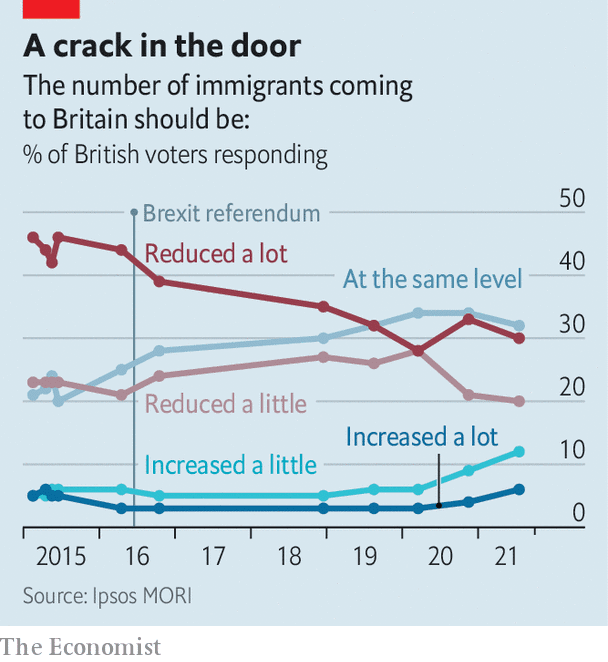
In june 2016 Nigel Farage, then the leader of the uk Independence Party, unveiled a poster showing a line of refugees. “breaking point”, it screamed, in red letters. “We must break free of the eu and take back control of our borders.” Boris Johnson, a leading light in the main Leave campaign, sniffily described it as “not my politics”. But perhaps it revealed something, he suggested. If Britain left the eu, people might calm down about immigration.

He seems to have been right. On September 14th a poll by Ipsos mori revealed a markedly more relaxed nation. Excluding “don’t knows”, the share who want immigration reduced stands at 50%, down from 69% in early 2015 (see chart). A non-negligible 18% want more of it. Polls by other firms show much the same trend.

Source: British people have become startlingly less xenophobic

Douglas Todd: Parties mostly duck big migration issues in Election 2021

Todd’s take on the party platforms, based on my comparative table:

Canada’s long history of large-scale immigration is arguably the defining characteristic of the country, but only one of the minor political parties is putting the subject at the front of its election campaign.

The three largest parties are playing it low-key on immigration, refugees, guest workers and international students. That’s despite Ottawa normally (pre-COVID) welcoming more than one million migrants in all categories each year.

Canada takes in the most immigrants per capita of any country in the OECD, the club of rich nations. It has been in the top four Western countries both for the total number of migrants it accepts and for the proportion in its overall population.

But even though immigration policy powerfully affects Canada’s economy and culture, scholars say the Canadian media and politicians find the subject too sensitive, almost taboo, to debate. That’s unlike almost everywhere else.

Since the parties are largely refraining from highlighting their migration policies, I appreciate that Andrew Griffith, a former director general of Canada’s Immigration Department, has made a list of almost 100 migration-related positions the parties have, in a kind of muted way, placed on their platforms.

Here’s a look at subjects the parties are taking on — and avoiding:

1. Immigration levels — how much is enough?

The Peoples Party of Canada, which is running at seven per cent in the polls, is the only party challenging the Liberals’ rising immigration targets.

Even Justin Trudeau’s Liberals have been muted during the campaign about how they want to bring in more than 410,000 new permanent residents a year, a hike from the 250,000 when first elected in 2015.

There is no Canadian consensus on immigration levels, which is probably why the Conservatives, NDP, Greens and Bloc have not set any targets. An Angus Reid poll found two of five Canadians say more than 400,000 a year is too many. And Nanos found only 17 per cent believe Canada should accept more immigrants in 2021 than last year.

The PPC recommends lowering the target to 100,000 to 150,000 a year.

The main Liberal talking point on migration so far has been to falsely claim the Conservatives, when they were in power, lowered immigration levels. Meanwhile, the Conservatives are emphasizing giving more choice about immigration to each province.

2. Canadians feel compassion, and exasperation, on refugees

One of the few migration issues to attract wide media coverage has been asylum seekers, which Canada has long been a leader in welcoming.

The focus has been on the tens of thousands who have been walking across Canada’s land border from the U.S. in a manner some call “illegal” and others call “irregular.”

In the past few years, more than 50,000 people seeking asylum have poured across the border, 90 per cent at a remote unchecked entry way in Quebec called Roxham Road. The vast majority are not Americans, but people recently arrived in the U.S. from Africa, the Middle East and Latin America.

The disarray has caused irritation among two of three Canadians. They don’t think it’s fair people are being advised to take advantage of a loophole in the Safe Third Country Agreement, which rules that asylum seekers must apply for refugee status in the first “safe” country in which they land. The loophole is that the agreement does not apply to those who cross at a non-official checkpoint.

This is one of the few migration issues the parties are openly disputing. The Conservatives and PPC want to close the loophole, which would restrict the flow. The NDP and Liberals are silent. And the Greens and Bloc want to ditch the Safe Third Country Agreement, which some say would encourage more to seek asylum.

In the meantime, the Liberals have promised to bring in 20,000 refugees from Afghanistan — and the Conservatives don’t disagree. The Conservatives also promise to welcome more Hong Kong people fleeing China’s totalitarian hand, as well as LGBQT people escaping persecution.

3. Multicultural signalling

While European politicians across the spectrum have questioned the concept of multiculturalism for more than a decade, that’s not the case in Canada, which still promotes the ideal of maintaining distinct ethnic cultures within one country.

The Citizenship Guide has been a point of contention. The Liberals have put together a “progressive’ version of the workbook of Canadian history, law and culture that all immigrants are tested on before they can become citizens. But the party decided not to publish it before this election.

It would seem the Liberal party doesn’t want to make its version of The Citizenship Guide a campaign bull’s-eye because reports suggest it will rankle a portion of Canadians by the way it emphasizes the country’s history of racism and discrimination.

Even though a Maru poll found only three per cent of Canadians name “stopping racism” as a leading election concern, the Liberals and NDP are signalling extensive commitments to racial equity. The Liberals alone have announced five different affirmative-action programs for Black people.

For their part, the Conservatives don’t have a platform on multiculturalism. But the party made a gesture to Ukrainian Canadians by promising to make it unnecessary for Ukrainians to have a visa to come to Canada.

Meanwhile, the PPC would repeal the official Multiculturalism Act. The NDP would institute a national plan to dismantle “far-right extremist organizations.” And the Bloc would appoint a commission to prevent ethnocultural “honour crimes.”

4. Mostly silence on international students and guest workers

In a typical year, Canada welcomes more than 600,000 international students, plus 400,000 temporary workers on various visas.

The international students alone are said to bring $23 billion a year into the economy. They contribute to the finances and classrooms of Canadian universities and colleges. International students also receive preferred status for immigration.

Despite the ramifications of Canada’s unusually large foreign-student population, not one party bothered to mention it. And that’s despite problems with the program, such as Statistics Canada data showing up to one in three come to Canada and then do not go to school.

Some parties do, however, have modest things to say about guest worker policy. The PPC would limit the numbers and ensure they’re “not competing with Canadians,” while the Liberals and Conservatives would create “a trusted employer system” to reduce administrative burdens on bosses.

5. No talk about how migration impacts wages, housing

This year B.C.’s former top civil servant, Don Wright, wrote a paper that maintained large-scale migration could be contributing to the 40-year stagnation of middle-class wages in Canada and could be exacerbating high housing prices.

While supporting solid immigration levels, Wright and many economists suggest Ottawa should improve its integration policies by boosting productivity and creating more infrastructure — especially housing.

There is, however, no mention of housing in the almost 100 positions taken on migration by Canada’s six political parties.

Source: https://vancouversun.com/news/politics/election-2021/douglas-todd-parties-mostly-duck-immigration-and-refugee-issues-in-election-2021

‘Enough is enough’: Black civil servants vow to press on with discrimination suit as Liberals promise change

Update on the proposed class-action lawsuit:

Carol Sip spent three decades inside the federal public service, but her retirement plaque is the last thing she wants to see on her wall.

Instead it sits stored away in the original packaging.

“Why would I hang it up? It will only bring back awful memories,” Sip said. “It should be something that you should be proud of, but I’m not proud of it because I know what I went through.”

Sip is one of a group Black federal employees involved in a proposed class-action lawsuit launched last December against the federal government alleging years of discrimination and seeking some $2.5 billion in damages.

Earlier this year, federal employee Monica Agard broke her silence about being Black in the public service after a senior colleague at the Immigration and Refugee Board’s Toronto office allegedly praised “the good old days when we had slaves.”

Since then, the proposed class-action lawsuit has become one step closer to reality after a motion was filed for it to be certified. It will fall to the newly elected government to decide whether to challenge that.

But as Canadians head to the polls, the Liberals appear to be changing course on the issue with a policy plank promising support for Black workers.

Liberals now promise support for Black workers

The federal government had maintained that its workers could find help through the employee assistance and health-care programs, which the plaintiffs have long said fail to address the specific trauma of anti-Black racism.

Now, if elected, the Liberal Party says in its platform it will “establish a mental health fund for Black public servants, and support career advancement, training, sponsorship, and educational opportunities for Black workers.”

Party spokesperson Alex Wellstead wouldn’t explicitly say if a Liberal government would support certifying the class action to go forward, but acknowledged “Black Canadians face unique challenges when it comes to mental health in the workplace.

“That is why we’ve committed through our platform to work with community partners on the design and establishment of this fund, which directly responds to calls from Black employees in the public service and will ensure that Black public servants are supported.”

As the employer of the federal public service, the Treasury Board of Canada Secretariat said the courts have not set a timetable for next steps on certifying the suit and that at this stage, it would be “premature” to comment.

Lawyer Hugh Scher, who’s assisting with the suit, hopes whichever party forms government will work with Black civil servants to address their needs.

“If they do, then they will have a willing partner,” he said. “If they don’t, they they will have a worthy adversary in court.”

‘A living nightmare’

Sip’s ordeal began in the early 1980s, shortly after she became an employee at the federal customs department under what is now the Canada Revenue Agency. Over a number of years spent working there, she says she experienced repeated incidents of harassment and discrimination by a supervisor who behaved with impunity.

And she says never in her 26 years was she promoted beyond her clerical position.

“It became a living nightmare,” she told CBC News. Sip filed multiple grievances and won two. But she felt blacklisted for complaining and says nothing was done.

“If they had a project with lifting boxes, only the Black ladies were chosen to lift the boxes,” she recalled.

In the late 90s, Sip was diagnosed with both breast and uterine cancer. She was off work on disability in 1999, when she was told her department was being restructured. Sip says her manager told her to resign. Believing she had no other option, she did.

In a statement, the CRA told CBC News it cannot discuss specific cases but that it is “firmly dedicated to diversity inclusion and anti-racism in the workplace.”

“The CRA has launched, and will launch further, targeted executive staffing processes for visible minorities and Indigenous peoples who are underrepresented at the leadership levels,” the statement said, noting that CRA encourages all employees to come forward if they experience or witness any discrimination or harassment.

As for why she joined the proposed class action, Sip said: “I look at the young children growing up and I don’t want them to go through what I personally went through, or the others have gone through.”

‘It kills you a little bit inside’

It’s been four months since Marcia Banfield Smith left her job at the Department of Justice.

But she says the scars from her time there run deep.

Over the years, she says she endured racist jokes at meetings and watched as non-Black colleagues rose up the ranks. Meanwhile, despite applying for higher-paying roles, she was stuck in a paralegal role at the same pay — for 19 years.

“It kills you a little bit inside,” she said.

Source: ‘Enough is enough’: Black civil servants vow to press on with discrimination suit as Liberals promise change