The Other Census Disaster That’s Waiting to Happen

Have seen earlier discussion of the issue but this is the most comprehensive analysis:

Everyone hoping for an accurate 2020 Census breathed a sigh of relief two weeks ago when the Supreme Court ruled 5-4 to block the Trump administration’s cynical attempt to add a citizenship question to the forms—only to experience Twitter-tantrum whiplash when the president ordered his administration to make a last-ditch attempt to include it.

But with so much attention focused on the controversy over the citizenship question, another similarly disastrous Census Bureau decision has gone largely unnoticed: the administration’s choice not to substantively update the decennial survey’s questions on race. As a result, no matter how conscientiously Census Bureau staff administer the survey, a woefully inadequate portrait of the changing face of America will emerge.

The last census, in 2010, became a data disaster when “some other race,” showed up as the third-largest racial group in America. Over 20 million respondents, most with roots in Latin America or the Middle East, selected this none-of-the-above option, making it the most popular choice after white and black. Any time a public-opinion survey asks respondents to self-categorize and “none of the above” comes back as a popular answer, it’s a clear sign that the choices given don’t match up with people’s identities.

Facing this problem squarely, the Obama administration convened the National Advisory Committee on Racial, Ethnic and Other Populations, a panel of academic experts and minority community leaders, to advise the Bureau on improving its race questions for 2020. The committee made myriad recommendations, most crucially suggesting that a “Middle East or North Africa” category sit alongside the “Hispanic origins” box in the upcoming questionnaire. But the Trump administration overruled this advice and, aside from a few minor tweaks, is flying into the 2020 survey without substantive changes. Given continued Latin American and Middle Eastern immigration since 2010, and the more extreme forms of racial “othering” these groups have faced ever since candidate Donald J. Trump came down the escalator in 2015, experts fear that “some other race” will become the second-largest racial group in America according to the 2020 Census.

Every census since the founding of the country has asked about race and ethnicity. Until recent decades, race was not a matter of self-identification; historically, federal census-takers were charged with determining the race of each resident of their assigned census tracts according to their era’s standards. Tracing how race questions have changed over time offers a time-lapse history of American racial concepts in 10-year snapshots. (All of the race questions are conveniently archived on the website racebox.org.)

The most drastic changes to the census race questions took place after the fall of Reconstruction, at the rise of Jim Crow, when America’s mixed-race realities were blotted out and a strict racial binary imposed. Openly mixed-race activists, in particular Charleston’s “Browns” and New Orleans’s “Creoles of color,” had been central to post-Civil War civil rights progress. Their court challenges to segregation, of which Plessy v. Ferguson (1896) was only the last and most famous, assailed the notion that Europeans and Africans remained distinct racial groups in America given centuries of overt and covert race-mixing. At the time, the “one-drop rule” that any African ancestry at all made an American a “Negro” was still new and not widely accepted. This more fluid racial mindset was reflected in the late 19th-century censuses, which all catalogued biracial “mulattos” as distinct from “whites” and “blacks.” The 1890 questionnaire recorded even finer-grained mixed-race categories: “quadroon” (an American with three European grandparents and one African grandparent) and “octoroon” (an American with seven European great-grandparents and one African great-grandparent). But with the firm establishment of the color line post-Plessy, the 1900 census switched to a unitary race. (Not until 2000 would the census again allow respondents to claim mixed-race identities, this time by checking more than one racial box.)

“Only in 1980 did the Census begin to grapple with Latino identity.”

As segregation took root, the stakes of being deemed “white” grew higher. Even as Jim Crow laws proliferated in the early 20th century, the states differed on their official definitions of what exactly a “white person” was and who precisely constituted a “colored person.” Myriad ethnic groups clamored to get into whiteness, often petitioning through the courts. “Semites,” for example, won their way into whiteness using clever, albeit pseudo-scientific, arguments. Their trump card, first argued in 1907 by H. A. Elkourie, a Syrian Christian physician in Birmingham, Alabama, was that if he wasn’t white then Jesus hadn’t been white either. Anglo-Americans’ revulsion at the thought they were worshipping a person of color each Sunday was strong enough that Elkourie and the fellow members of his “Semitic” “race” were deemed “white.”

The next major revamp of the census’s race questions came in the wake of the 1960s civil rights movement. For the first time, the Census Bureau empowered each respondent to choose her own race rather than have a census-taker determine it for her. And embracing the modern understanding that race has no biological reality, only societal meanings, the Census Bureau modified the racial categories to learn more about American society rather than engage in the fool’s errand of sorting humans into some fixed number of distinct races. To this end, the 1970 Census listed eight racial categories, one of which was “Hawaiian”—a useful category for understanding American society but a group so tiny no early-20th-century race scientists ever elevated it into their core “Races of Man.”

Only in 1980 did the census begin to grapple with Latino identity. Rather than add “Hispanic” to the list of races, it introduced a question to stand apart from the various racial choices: “Is this person of Spanish/Hispanic origin or descent?” By noting that Hispanics can be of any race, the Census Bureau hoped to track the growth of this community that comes in all colors. But this well-meaning attempt never fully worked since the Latin American and Anglo-American conceptions of race are fundamentally incompatible.

While the U.S., after Reconstruction, forced Americans to claim a retroactive racial purity, Latin America never denied its mestizo realities. On the most recent Brazilian census, for example, the majority of respondents identified as afrodecendente (Afro-descended). But in Brazil this identity does not in any way suggest that the same person is not also of European, Native American, and/or Asian descent; indeed, over 80 percent of self-identified afrodecendente Brazilians claimed roots on non-African continents as well.

In Mexico, the concept of race (la raza) is even more un-American. The Mexican supposition is that the people of the New World are, in a sense, a new race unto themselves, a mixture of all the world’s peoples. It is these mutually-incompatible conceptions of race between the U.S. and Latin America that has led millions of census respondents to check that they are of Latino origin but are members of “some other race.”

Arab-Americans are similarly migrants from an alternate racial system. Arab identity embraces people of all skin colors and is largely tied to language—people whose mother tongue is Arabic are Arabs even if they don’t live on Asia’s Arabian Peninsula. Though officially white in America since the early-20th-century rulings that “Semites” are white, contemporary American racism has again called Arab whiteness into question.

“The best-case scenario is that none-of-the-above comes out as the third-largest race in America rather than second-largest.”

The most recent federal definition of a “white person,” formulated in 1997 by the Office of Management and Budget and currently used by the Census Bureau—“A person having origins in any of the original peoples of Europe, the Middle East, or North Africa”—clearly includes Arabs. But if “whiteness” has no biological reality and is purely a socially-constructed category in American society for those who enjoy full citizenship, including the presumption of innocence, since 9/11, Middle Easterners have no longer been white. This mismatch between being officially white by the federal definition but not being treated as white in American society has sparked a wildcat campaign among some Middle Easterners not to check the “white” box on the Census (tag-line: “Check it right, you ain’t white”). Indeed, the National Advisory Committee on Racial, Ethnic and Other Populations found many Middle Eastern- and North African-Americans are doing just that, checking “some other race” in defiance of the current federal definition of whiteness.

At this point the 2020 race questions are set, with just a few tweaks from 2010. The 2020 form will include “Lebanese” and “Egyptian” as examples of white ethnicities to remind Arabs to, essentially, “check it right, you are white.” The new wording also adds “Aztec” and “Mayan” as examples of American Indian ethnicities to instruct people with roots in the New World beyond the United States borders that they should still identify themselves as indigenous.

Even with these minor changes, the best-case scenario is that none-of-the-above comes out as the third-largest race in America rather than second-largest. Whiteness in America is in flux today in a way it hasn’t been in a century—even if the Census Bureau’s political appointees, in keeping with the Trump administration’s Know-Nothingism on race, won’t admit it. An administration that has backed border walls and Muslim bans has already shown Latinos and Middle Easterners that, if whiteness means first-class citizenship, they’re no longer white. The painful irony is that the rise of “some other race” at first glance suggests America is becoming post-racial, while its real roots are in rising racism.

Source: The Other Census Disaster That’s Waiting to Happen

Cultural heritage destroyed by Isis roars back to life

Important exhibition and raising awareness:

A figure of a roaring lion, about the size of a loaf of bread, is the latest step in the fight to preserve culture from conflict.

The sculpture is a replica of a colossal 3,000-year-old statue from the Temple of Ishtar in Nimrud, in what is now Iraq. The stone statue was one of many artefacts from the Mosul Museum destroyed by the Islamic State group after it overran the city in 2014.

The replica Lion of Mosul, which can be viewed online, was modelled from crowdsourced photos taken by Mosul Museum visitors in happier times, and 3D printed as part of Google’s digital arts and culture project.

It is going on display at London’s Imperial War Museum in an exhibition that looks at how war devastates societies’ cultural fabric – and how ingenious and often heroic steps are taken to preserve it.

Chance Coughenour, digital archaeologist at Google Arts and Culture, says the exhibition “highlights the potential of technology – both in terms of digitally preserving culture and telling these amazing stories in engaging new ways.”

It also illustrates a grim truth: culture has long been a casualty of conflict. Museums, monuments and even music are often deliberately targeted by combatants.

Source: Cultural heritage destroyed by Isis roars back to life

Most UK news coverage of Muslims is negative, major study finds

Not unique to the UK, both in terms of coverage and which outlets have greater negative focus:

Most coverage of Muslims in British news outlets has a negative slant, according to a major analysis by the Muslim Council of Britain, which concludes that news stories in the mainstream media are contributing to Islamophobia.

The study found the Mail on Sunday had the most negative coverage of Islam, with 78% of its stories featuring Muslims having negative themes – above an already-high industry average of 59%.

The New Statesman, Observer and Guardian were the least likely to portray Muslims in a negative light, according to the analysis of 11,000 articles and news broadcasts during the final three months of last year.

The findings come amid growing scrutiny of Islamophobia in the Conservative party and whether its roots lie in rightwing media coverage. A YouGov poll of Tory members by the campaign group Hope Not Hate found that 60% believe “Islam is generally a threat to western civilisation” and more than half believe “Islam is generally a threat to the British way of life”.

Source: Most UK news coverage of Muslims is negative, major study finds

Francisation «obligatoire» des immigrants: Legault souffle le chaud et le froid

More ambiguity than in the case of Malala not being able to teach in Quebec:

Les immigrants qui débarquent au Québec seront-ils bientôt forcés d’apprendre le français ? Les paris sont ouverts.

Posée au premier ministre François Legault lundi, cette question demeure sans réponse claire.

En mêlée de presse, M. Legault a soufflé le chaud et le froid, paraissant dire une chose et son contraire.

Chose certaine, forcés ou non, les nouveaux arrivants auront intérêt à maîtriser le français s’ils veulent obtenir leurs papiers pour demeurer au Québec.

Le premier ministre réagissait lundi à une entrevue de La Presse canadienne, diffusée la veille, avec la députée caquiste Claire Samson, qui rappelait que le programme de la CAQ prévoyait la francisation « obligatoire » des immigrants ne maîtrisant pas le français à leur arrivée au Québec.

Elle disait que le gouvernement devrait aller en ce sens, pour s’assurer que le Québec de demain demeure un État où la langue française domine.

Or, le ministre de l’Immigration, Simon Jolin-Barrette, a annoncé vendredi des mesures visant à étendre l’accès aux cours de francisation, mais sur une base volontaire.

Lundi, le premier ministre a convenu que le caractère obligatoire des cours de francisation pour les immigrants figurait parmi les engagements de son parti, mais qu’il voulait procéder « graduellement ». Il semble donc vouloir procéder par étapes.

« Cela fait partie de nos propositions », a reconnu M. Legault, rappelant qu’il avait un mandat de quatre ans et qu’il comptait « y aller graduellement ».

Une « priorité nationale »

En 2016, dans un rapport visant à définir la position de son parti sur cette question, la députée Claire Samson avait préconisé la francisation obligatoire des immigrants.

Lundi, le premier ministre a réitéré qu’il était « d’accord avec ce rapport-là ».

Il a ajouté que, de toute façon, les immigrants seront forcés de passer un test de français et un test de valeurs pour obtenir le certificat de résident permanent au pays.

Et il a ajouté que la réussite de ces tests sera elle aussi « obligatoire » pour rester au Québec.

Pour l’instant, « ce qu’on s’engage à faire, c’est de rendre les cours de français obligatoires… pas obligatoires, à rendre les cours de français disponibles », a dit le premier ministre.

« Les cours vont être disponibles, les tests de français vont être obligatoires. Je vois pas pourquoi les nouveaux arrivants ne suivraient pas les cours de français », a-t-il ajouté.

Avant d’aller de l’avant, le Québec devra cependant négocier avec le gouvernement fédéral les conditions qu’il souhaite imposer aux nouveaux arrivants pour obtenir le statut de résident permanent, une compétence fédérale.

M. Legault s’est engagé lundi à « convaincre le gouvernement fédéral » de lui accorder les pouvoirs réclamés, qui figurent dans la nouvelle loi 9 adoptée en juin.

Dans son rapport de 2016, assorti de nombreuses recommandations, Mme Samson proposait notamment qu’un gouvernement de la CAQ fasse de la francisation des immigrants une « véritable priorité nationale ».

D’où l’importance d’obliger les immigrants à suivre des cours de français, grâce à une formation d’une durée variant de 30 à 72 semaines, à temps complet.

Cette formation, rémunérée, serait nécessaire pour obtenir un certificat de sélection du Québec.

Tous les nouveaux arrivants ne maîtrisant pas le français devraient s’y soumettre, qu’ils soient immigrants économiques, réfugiés ou faisant partie d’un regroupement familial.

Ce programme devrait également être suivi le plus tôt possible suivant l’arrivée au Québec.

On prévoyait inclure un volet d’initiation aux réalités du Québec, sa culture, ses institutions sociales et politiques, ses valeurs, etc.

Un soutien financier devait être prévu pour les parents de jeunes enfants, en vue d’assumer les frais de garde.

Mme Samson proposait également dans son rapport de créer un guichet unique pour la francisation des immigrants adultes.

Tous les programmes de francisation — actuellement éparpillés entre le ministère de l’Éducation et celui de l’Immigration — seraient rapatriés à l’intérieur d’un nouveau ministère : le ministère de l’Immigration et de la Francisation.

Source: Francisation «obligatoire» des immigrants: Legault souffle le chaud et le froid

CBSA has increased deportations, though removals of irregular asylum seekers remain low

Some useful numbers in this update:

The Canada Border Services Agency has ramped up deportations of failed refugee claimants and other foreign nationals and permanent residents who have lost the right to stay in Canada, amid concerns about the ability of Canada’s asylum system to respond quickly to spikes in refugee claims.

Removals from Canada have dropped significantly in the last several years, from more than 19,000 people in 2012-13 to around 8,000 in recent years. But that number climbed to roughly 9,500 people in 2018-19, following an internal effort to speed up the pace of deportations.

Despite the overall increase, the numbers remain low for removals of failed irregular asylum seekers — those who enter Canada from the U.S. between official border crossings, but who are unsuccessful in claiming refugee status — even though Ottawa has said it is prioritizing their removal.

A spokesperson for Border Security Minister Bill Blair told the National Post that anyone to be deported from Canada is given due process. “But once legal avenues have been exhausted, individuals are expected to respect our laws and leave Canada, or as per our commitments, be removed,” said Marie-Emmanuelle Cadieux in an email. “We are re-investing in the agency to ensure that processing continues to happen in a manner that is fair, fast and final.”

Last fall, the CBSA confirmed it had set a target of 10,000 removals for the 2018-19 fiscal year, a notable increase over the previous three years, when removals ranged from 7,900 to 8,600. At the time, Public Safety Minister Ralph Goodale said the agency needed to “pick up the pace” of removals, and pointed to $7.5 million in funding allocated to the CBSA in Budget 2018. “We’ve provided some extra resources for CBSA to do the work that’s necessary,” Goodale said. The agency has now confirmed it removed a total of 9,584 people last year.

Backlogs in Canada’s immigration system have been the subject of increased scrutiny since an influx of asylum seekers began crossing the Canada-U.S. border between official ports of entry after the 2016 election of U.S. President Donald Trump. Since January 2017, about 45,000 people have entered Canada in this way, using a loophole in the Canada-U.S. Safe Third Country Agreement that generally requires asylum seekers to make a refugee claim in whichever country they get to first.

In May, the auditor general found that Canada’s asylum system is unable to cope with such surges, with refugee claimants waiting two years for decisions on their claims. The backlog of asylum seekers numbered about 75,000 at the time and will likely continue to grow. However, the number of people entering Canada illegally has dropped considerably, and is currently only half what it was at this time last year.

The government is taking steps to speed up the entire system, from claim hearings to removals. Budget 2019 earmarked $1.18 billion over five years for border security and processing of asylum claims.

The CBSA also says it is now prioritizing the removal of irregular asylum seekers whose claims have been denied, as it does people who are deemed threats to national security or who are involved in organized crime, crimes against humanity or other types of criminal activity. However, Canada has still deported only a small minority of the tens of thousands of irregular asylum seekers who’ve entered the country in the last two years. According to figures the CBSA provided to the Post, the agency removed just 723 irregular migrants with failed refugee claims between April 1, 2017 and June 21, 2019.

This is largely because asylum seekers must exhaust all legal avenues of appeal before they can be removed, which takes time. The agency also pointed to a number of other factors that can delay removals, including the fact that Canada temporarily halts removals to countries in armed conflict or experiencing environmental disasters — such measures are currently in place for Afghanistan, the Democratic Republic of Congo and Iraq. A lack of valid travel documents and medical issues can also delay removals.

“The CBSA is firmly committed to meeting its mandate under the Immigration and Refugee Protection Act to conduct removals as soon as possible,” a spokesperson told the Post in an email, adding that the agency has increased staffing levels and improved co-ordination with other branches of the immigration system to speed up removals. The agency said there are currently just under 3,000 people with an “actionable removal order” in Canada, meaning with no barrier to deportation.

Still, Janet Dench, executive director of the Canadian Council for Refugees, said setting quotas for deportations like the CBSA’s target of 10,000 removals can be problematic. “One of the concerns is who ends up being a priority for removal,” she said. When border officers are given targets they need to meet, there’s an incentive to prioritize families over criminals because officials can remove a number of people at once, often with less effort, she said.

Dench said the removal process can often feel arbitrary, with some people getting calls from the CBSA almost immediately, while others wait years before being asked to leave.

Source: CBSA has increased deportations, though removals of irregular asylum seekers remain low

Detroit music festival removes race-based ticket prices

Sensible retraction. Better way is lower rates for students, youth and senior discounts etc:

A local music festival in Detroit has moved away from ticket prices based on race after drawing international attention when a rapper pulled out of the show over the price discrepancy.

The organizers behind Afrofuture Fest announced on their Eventbrite listing last week that tickets for people of colour would cost $20 US. Tickets for “non-people of colour,” however, were priced at $40 US.

Afrofuture Fest, which is scheduled to take place Aug. 3-4, describes itself as as a home for arts and healing, advertising a “day parade, drum circle and bonfire.” It’s put on by Afrofuture Youth, a non-profit organization dedicated to helping young people create a more equitable world.

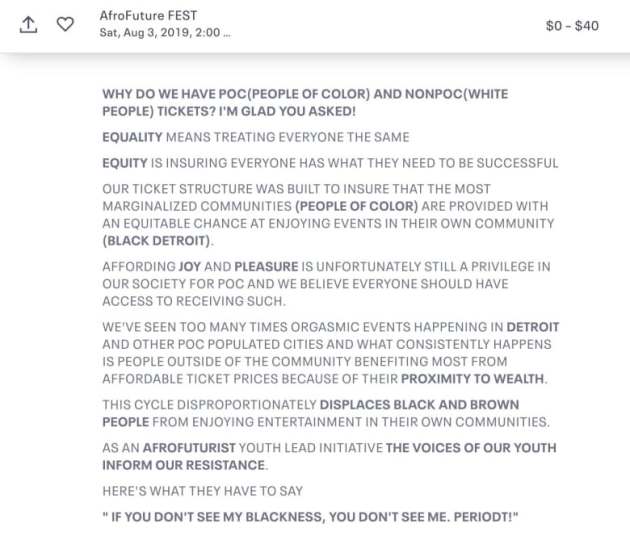
“Our ticket structure was built to [ensure] that the most marginalized communities (people of colour) are provided with an equitable chance at enjoying events in their own community (Black Detroit),” organizers had posted on Eventbrite.

The pricing has since been changed but debate over the plan, which sparked both outrage and support, continued into the weekend.

The explanation from organizers went on to argue that “people outside of the community” benefit most “from affordable ticket prices because of their proximity to wealth.”

“This cycle disproportionately displaces black and brown people from enjoying entertainment in their own communities.”

Afrofuture Festival advertised a different price scale for tickets based on race, prompting both outrage and support for the idea. The tiered pricing existed for both early bird and regular tickets before the change.

The original ticketing idea prompted a Detroit-based rapper — who is of mixed race — to pull out of the event.

“My grandmother and her husband, they both had a big influence on me,” said Tiny Jag, whose real name is Jillian Graham. “Even my first mixtape is named after my grandmother who would have been charged double to come support me.”

Eventbrite said festival organizers were violating a rule and would unpublish the event if changes weren’t made to the pricing structure.

“We do not permit events that require attendees to pay different prices based on their protected characteristics such as race or ethnicity,” Eventbrite told CBC News in a statement Sunday.

CBC News reached out to event organizers on Sunday afternoon, but has not heard back.

Tiny Jag said she has received a combination of support and hostility for her decision.

While some people lauded the musician for taking a stand, others accused her of misunderstanding the point they believe organizers were trying to make.

The music festival offered an explanation for the race-based discrepancy in tickets on its Eventbrite page.

“Gawd this is embarrassing,” Ijeoma Oluo, author of the New York Times bestseller So You Want To Talk About Race, posted on Twitter regarding the rapper’s comments.

“My white mom would be proud to pay more because she understands the history of economic exploitation of black folk in this country to benefit whiteness & she wants a better future for black folk, including her black kids.”

At the same time, A U.K-based rapper, who goes under the stage name Zuby, commended Tiny Jag for withdrawing and criticized the festival in a series of tweets, telling organizers: “You’ve become the very racists you claim to stand against.”

“I think it’s offensive regardless of what angle you look at it,” Zuby, whose full name is Zuby Udezue, told CBC News in a phone interview Sunday.

“As someone who is black, the idea that I’m going to be charged less money for something because the assumption is, ‘oh, this person is not white so therefore, they are poor and can’t afford this,’ that is racism itself.”

He added not everyone in Detroit who is below the poverty level is black.

“If the intention were to make it more accessible to people who are not financially well off, you could just lower the ticket price,” he said.

‘We have options’

And that’s just what the event decided to do.

The festival is now charging a general admission price of $20 US, with an option for a “Non-POC suggested donation.”

Tiny Jag says she supports the goals of Afrofuture organizers, but not the means. Since she went public with her decision not to perform, she says she has also received support from groups she would never support, such as white supremacists. She’s also been told music festival organizers were receiving threatening calls, which wasn’t her intent.

“I’m not supporting any supremacy, that’s the whole point of this,” she said. “We have options as a race … We have options to get ourselves in a better place.”

Source: Detroit music festival removes race-based ticket prices

How H-1B visa quotas are denying educated immigrants the American dream

A good individual example, along with some relevant data and analysis:

Marie Francois grew up in Haiti reading books her mother picked up from a local thrift shop, often tomes that had smart-looking people on the cover. She read mostly during the day when it didn’t matter that their small home didn’t have electricity. At night, she read by candlelight.

Her single mother, who worked as a cleaning lady while studying to be a nurse, told her oldest daughter not to get used to living in poverty.

“We’re going to get out of here,” she would say.

College graduate Marie Francois, pictured in Salt Lake City on Thursday, May 23, 2019, has received more than 10 job offers as a project engineer, but because of the current immigration system, none of the companies want to go through H-1B visa process to to hire her.

Francois’ mother valued education. Though she didn’t have much money, she paid for her children to attend private Catholic school. Sometimes a school kicked Francois out when her mother couldn’t pay the tuition.

Her mother eventually became a nurse at the company where she had worked as a cleaner. She later went into the wheat and flour business, a popular commodity in the Caribbean. She became active in politics.

It took 15 years, but Francois’ mother was true to her word.

“My mom never takes no for an answer,” Francois said. “She’s not afraid to start from the bottom and work her way up. That’s why the American dream attracted me, I believe.”

But the American dream isn’t coming easy for the 30-year-old married mother of a 15-month old son who has lived legally in the United States on a student visa for the past decade. (Her husband also is Haitian and in the country on a student visa.)

Francois has a bachelor’s degree in construction management from Brigham Young University-Idaho. She studied business management at the State University of New York, one of three Haitian students selected among thousands for a special program. She has put in hundreds of hours of community service. She was a missionary for The Church of Jesus Christ of Latter-day Saints in Paraguay. She has volunteered on political campaigns. She speaks four languages. She wants to go to Harvard Law School.

“I feel like I’m the ultimate immigrant,” she said.

What Francois doesn’t have is U.S. citizenship or a green card, and that is making it difficult for her to land a job.

“We’re not your enemy,” she said. “We’re here because we love this country and we want to be part of this great nation.”

Companies, she said, aren’t willing to work through the immigration system to help her get a highly sought-after H1-B visa for college graduates with special skills. Businesses don’t want to take a chance on someone who might not be in the country very long, nor do they want to wade through the immigration system to help her get a special visa.

One Utah company gave her a start date and even sent her pictures of her cubicle before abruptly rescinding the offer.

“It’s disappointing and sometimes discouraging, but I’m still pursuing the American dream because I’m a hard worker and we are tough enough and we will move forward,” she while sipping a hot chocolate on a chilly spring evening at the City Creek food court.

Immigrants like Francois see the H1-B visa as a path to furthering their career and making a life in America. Many applicants are international students trying to transition from student visas to H1-B visas and eventually green cards.

Visa crunch

There are 65,000 H-1B visas available, and another 20,000 for people who hold advanced degrees from U.S. colleges and universities. All of the visas have been issued within the first week for the past 16 years. To deal with the glut of applications, U.S. Citizenship and Immigration Services has moved to lottery system.

Last year, employers filed 190,098 petitions, including 95,855 on behalf of foreign-born professionals who had earned a graduate degree from a U.S. university, well above the 85,000 cap.

Thousands of talented professionals get turned away, including people who already know English, understand American culture and who have conducted research in the U.S. as graduate students.

“This is not an unfamiliar scenario to me,” Salt Lake immigration attorney Tim Wheelwright said of Francois’ situation. He does not represent her.

Francois is in the country on an F-1 student visa, which allows her optional practical training, or OPT, for one year in her major area of study. After that, she doesn’t know where she will be. Her construction management degree doesn’t qualify for the two-year science, technology, engineering and math extension.

” Employers are getting tired of applying and not being selected. “
Tim Wheelwright, Salt Lake immigration attorney

Optional practical training is intended to give U.S. companies that employ foreign workers multiple opportunities to apply for an H-1B visa, which would be a logical next step for Francois.

“But as she’s encountered, there are a number of employers that are leery of the H-1B process because of the expense and the uncertainty,” Wheelwright said, noting businesses filed more than 200,000 petitions for the 85,000 visas made available in April. “Employers are getting tired of applying and not being selected.”

Choke points

President Donald Trump’s “Buy America, Hire American” executive order has had an impact on employers.

According to data obtained by the National Foundation for American Policy, immigration services has begun to increase H-1B visa denials as well as the number of requests for evidence issued for applicants, Forbes reported.

“Employers report the time lost due to the increase in denials and requests for evidence has cost millions of dollars in project delays and contract penalties, while aiding competitors that operate exclusively outside the United States,” Forbes reported, citing a National Foundation for American Policy source.

An Orrin G. Hatch Foundation report in April showed that the H-1B is “vastly overextended.”

“This overreliance on the H-1B visa program creates choke points in our talent pipeline where skilled individuals either cannot move forward or simply choose to leave,” according the report.

The foundation suggests raising the H-1B cap and tying it to market demand to meet the needs of a modern economy. It also calls for immigration reform, including a fast track to citizenship for international student graduates and entrepreneurs.

Sen. Mike Lee has attempted to break up the work visa backlog since being elected nearly nine years ago. Per-country quotas cause much longer wait times for immigrants from countries with large populations than for those from smaller countries.

The Utah Republican has introduced bills to remove per-country caps for H-1B visas and employment-based green cards, but despite bipartisan support, none have passed, including one a conservative senator blocked from advancing at the end of June.

Lee has said educating, training and employing the best and brightest, whether from the U.S. or abroad, is essential to the vibrancy of the economy and continued innovation.

Brain drain

An Arizona congressman, though, wants to cut off one path that foreign graduates take to get an H-1B visa.

Republican Rep. Paul Gosar plans to introduce legislation to end the optional practical training program, which according to Pew Research grew 400% in the decade after the government in 2008 boosted the amount of time STEM students and graduates could stay in the U.S. and work, Bloomberg reported in June.

Pew found that between 2004 and 2016, almost 1.5 million foreign graduates of U.S. colleges and universities have been allowed to work through the program, with 53% specializing in STEM fields.

Gosar also wrote a letter to Trump asking him to kill the optional practical training program by executive order, arguing millions of American citizens are willing and able to take those jobs, they just need a chance at employment.

But a recent study by the Society for Human Resources Management found that 83% of employers were having difficulty filling open positions, with 75% of those employers saying candidates did not have the necessary skills, like data science and STEM training.

Filling unfilled jobs like those is precisely the role immigration should play, but it is proving increasingly more difficult as employers use a 20th century immigration system to meet the needs of a 21st century economy, according to the Hatch report.

Francois said she feels like a pawn in a political game.

“I feel like that’s a big brain drain for the U.S. because all of us were getting our education here. We love this country. We love our friends, families and we want to build a life here. We want to see this country be more competitive, still be a big country. But when you treat us like we’re an enemy, it’s not a good thing. It’s not contributing to what this country was founded upon,” Francois said.

Seeking asylum

In 2014, Francois’ politically active mother in Haiti started receiving threatening phone calls. Antagonists burned down one of her stores. She fled to the United States seeking asylum through U.S. Citizenship and Immigration Services but eventually returned to Haiti.

Francois sought political asylum at the time as well, but being in the country legally worked against her.

The email she received from the Houston Asylum Office reads: “On the matter of your asylum case, you received a final denial of your claim. Because you were/are still in status, you were not placed in removal proceedings, and you may refile your asylum case if you wish.”

Francois took the decision hard.

“I was really disappointed and shocked. I feel like I was treated as an object. I feel that as an immigrant I was dehumanized,” she said.

U.S. Citizenship and Immigration Services spokeswoman Debbie Cannon said the agency doesn’t comment on individual cases.

Francois has tried navigating the labyrinth that is the U.S. immigration system. The Citizenship and Immigration Services website, she said, is maddening.

“You go through forms and forms and forms, links and links and links, and then you end nowhere. You get confused and you don’t understand what they are requiring, and that can be the downfall for any immigrant because what you don’t know can hurt you so much more. You can find yourself waking up the next day and you are to be deported just because you ignored one thing in a new law or in a revised law,” she said.

Francois’ reapplied for asylum but for more than two months had no idea how immigration services treated her application because she never heard back. She resubmitted it a few weeks ago. The delays could effect her eligibility.

“It’s really draining mentally, emotionally, everything. It’s hard. At the end, you feel like you’re just an object, you’re just a piece of something people can mold as they wish during political battles,” she said.

In mid-June, Citizenship and Immigration Services announced expansion of its information services modernization program to Utah, Idaho, Colorado, Montana and Wyoming.

The agency encourages applicants to look at its website or call its contact center to get questions answered rather than visit local immigration offices. The agency says it saves people time and allows immigration officers to work on completing cases quicker.

The problem with that, Francois said, is that often no one answers the phone.

Where to turn

Francois and her husband have also sought out top lawyers for help.

“Crazily,” she admits, they traveled to New York to meet with a lawyer who charged $500 an hour. One hour was all they could afford. They went to Florida only to learn the attorney there didn’t take out-of-state cases. They have even resorted to attending events where they might meet a famous person who has the president’s ear.

“Right now, I’m thinking maybe I should go to (Democratic U.S. House Speaker) Nancy Pelosi because she’s pretty fierce. I like her. … And maybe she would do something about it. I don’t know,” Francois said.

Francois said she’ll leave it to politicians figure out how fix the nation’s immigration system. But she does have some advice:

“Just see other people as human beings. Humanize them, and then you will find the solution. Humanize every single person who is contributing to this country and you will resolve any other issue,” she said.

The struggle for citizenship is draining on her family’s energy and bank account. And even if she were to get a work visa, Francois would have another battle to fight.

Women aren’t exactly welcome in the construction business. She started out as not just the only woman but the only black woman in construction management at BYU-Idaho. When she was failing her statics class, a professor told her she wasn’t going to make it and that she should quit.

“I went to the bathroom and cried for four hours,” she said. “I cried my soul out.”

That same semester she won an award at a competition with 120 other schools.

“I call it a tender mercy,” Francois said. “I call it a sign from God that I was supposed to stay in construction.”

Francois has a passion for commercial construction, big buildings and challenging projects. Like her mother, she won’t take no for an answer. She intends to stick with it whether she gets a job or not. She knows she will find a way.

In addition to her mom, Oprah Winfrey had an influence on Francois from the time she started reading Winfrey’s magazine O as a teenager in Haiti.

24comments on this story“I was like, ‘One day I’m going to meet that woman. I’m going to tell her I want to talk to her.’ It hasn’t happened or maybe it won’t happen, I don’t know,” she said.

Meantime, Francois is doing everything she can to get more women excited about STEM careers. She’s working in a peer program to encourage young women to enter those fields.

America, she said, is full of opportunities, seen and unseen.

“Ii doesn’t matter if I get a job that pays or I don’t,” Francois said. “What’s important for me is if I die tomorrow, I would feel like I’ve been here, I left a little mark.”

Source: How H-1B visa quotas are denying educated immigrants the American dream

Quebec MNA wants French classes to be mandatory for immigrants

An illustration of the range of views in the CAQ caucus, this one on the more hardline side:

The more MNA Claire Samson is calling on the Quebec government to make French language courses mandatory for immigrants.

Samson, a member of the governing Coalition Avenir Québec who represents Iberville riding, was her party’s culture critic when in the opposition.

In 2016, she produced a report on language and immigration calling for compulsory French classes for immigrants and to make their immigration status conditional on passing a language test.

In an interview with Presse canadienne, Samson said her party campaigned on the report and now it needs to follow up.

Immigration Minister Simon Jolin-Barrette announced Friday that the government would spend an additional $70 million on French classes for immigrants.

But Samson said the government has not gone far enough, and she intends to lobby for more aggressive measures to force newcomers to learn French when the National Assembly resumes in the fall.

French in Quebec is threatened in the very short term and the situation could become irreversible within 15 years, she said.

“It would be difficult to turn it around if there is too much laxity and there is no follow-up,” she said.

Quebec needs to impose the French language on immigrants to counterbalance to the powerful attraction of English, she said.

“It must be done now, because eventually it may be too late,” she warned.

Samson said she has recovered from the health problems that had prevented her from attending the National Assembly regularly since November.

Samson considered quitting politics last fall after she was bypassed for a cabinet post. At the time, she attributed her health problems partly to being left out of cabinet. In March, she attended a meeting in a daycare centre, where constituents complained that she was rude and arrogant. She later apologized.

Source: MNA wants French classes to be mandatory for immigrants

Douglas Todd: The political use and misuse of Canada’s ethnic media

Nice piece on diversityvotes.ca and ethnic media election coverage:

Thousands of stories are coming out of the country’s ethnic-language media — and only pockets of Canadians know anything about them.

More than 800 ethnic media outlets reach a range of distinct communities across this country, publishing and broadcasting in more than 30 major languages — including Mandarin, Punjabi, Farsi and Ukrainian.

It’s only rarely that the so-called mainstream English- and French-language media learns what issues are hot at such media outlets, given the barrier of language. But buried within the country’s proliferating ethnic-language media are potentially high-impact stories.

The Vancouver Sun last month, for instance, ran a prominent article about the way major Chinese-language newspapers in Vancouver and Toronto were running large ads criticizing recent protests in Hong Kong, promoting views that reflect the Chinese Communist Party’s position, including that the demonstrators are nothing but destructive “radicals.”

Since I write about diversity and migration, sources have helped me find other stories enclosed in Metro Vancouver’s ethnic-language media outlets, of which there are more than 100 in B.C. Some stories revealed, for instance, how local South Asians are in an uproar about a recent surge in foreign students, about how B.C.-based Iranians fear spies from their theocratic homeland and about how Canadian politicians frequently give speeches inside Chinese-language churches and Sikh gurdwaras.

Two well-placed Canadians, Andres Machalski, a veteran media monitoring specialist, Andrew Griffith, a former Immigration Department director, are doing the country a service by trying to make ethnic-media journalism more transparent to the public, bringing it out of its language silos.

They’ve just created the online tool, Diversityvotes.ca, to monitor and translate stories from Canada’s ethnic media, which Machalski says may be more pervasive in this country than almost anywhere. Diversityvotes.ca emphasizes articles with political implications, since politicians of every stripe already use ethnic media outlets to try to grab the precious votes of minority members and immigrants.

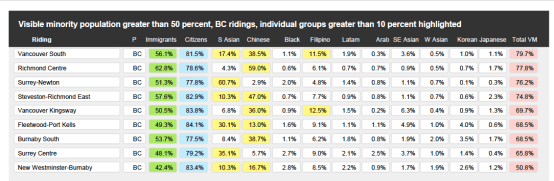
The electoral stakes are high. Canada has 41 federal ridings in which more than half the population is made up of people of colour. Metro Vancouver alone has four ridings in which more than 70 per cent of the population are people of colour, plus five more in which the proportion is above 50 per cent. They’re concentrated in Richmond, Vancouver, Surrey and Burnaby.

Winning as many high-immigrant ridings as possible in Metro Vancouver and Greater Toronto is key to national success for any federal party. And so far Justin Trudeau’s Liberals are doing the best at wooing such minorities, with a recent poll suggesting they’re primed to take 39 per cent of the votes of immigrants, compared to the Conservatives’ 29 per cent, NDP’s 14 per cent and Green’s nine.

Monitoring the ethnic-language media will be informative for all, regardless of ethnicity or place of birth, since Machalski is convinced most Canadians have no clue about the sway of the ethnic-language media. Keeping informed can also help expose when politicians speak out of both sides of their mouths, telling one ethnic group one thing and the general population something else.

That’s in part what happened this year when the mainstream media learned the Liberal candidate in the riding of Burnaby South, Karen Wang, was posting in Chinese-language social media that she was the “only” Chinese candidate, while her opponent, NDP leader Jagmeet Singh, was “of Indian descent.” Wang resigned and apologized.

Ethnic diversity has been formally celebrated in Canada for more than three decades, since former prime minister Pierre Trudeau promoted it through the official multiculturalism policy, said Machalski, president of Mirems, which created the online tool that each day translates many ethnic-media headlines and some specific articles.  But the situation is increasingly, he said, becoming polarized.

“Is the ethnic media strong? Is it influential? In a country that’s bringing in 300,000 newcomers a year, what do you think? Just look at the demographics and make up your own opinion,” Machalski, an immigrant from Argentina whose ethnic background is Anglo-Polish, said from Toronto.

The Italian-language media in Canada, which has more than 25 different outlets, is full of stories about Trudeau promising to apologize for detaining 700 Italian-Canadians during the Second World War, Machalski said. It’s a huge issue for some Italian-Canadians, but off the radar of most others Canadians, he said, acknowledging an apology could be loaded for the families of thousands of Canadian loved ones who died or were wounded fighting Italian fascism.

Vancouver-based Blythe Irwin, who directs media monitoring for Diversityvotes.ca, said the feedback she gets is most Canadians have no idea that ethnic media has grown so pervasive across Canada, with 110 Punjabi-language alone media outlets alone. There are also more than 100 various Chinese-language outlets, 62 in Spanish, 31 in Farsi, 29 in Arabic, 24 in Russian, 16 in Hindi, 12 in Greek, 12 in Polish and three in German.

The more that all Canadians can learn about what’s being prioritized in ethnic-language media, the more they will understand the diverse political forces at play in this fast-changing country. Machalski is onto something when he says, “We have to vaccinate the public against political gullibility.” Canadians in general, he said, are wet behind the ears in the way that they think: “If I can’t read it, it doesn’t exist.”

Source: Douglas Todd: The political use and misuse of Canada’s ethnic media

For some supplementary riding level data, lists showing ridings with more than 10 percent of particular groups,. see Top ridings by group

The Dominance of the White Male Critic Conversations about our monuments, museums, screens and stages have the same blind spots as our political discourse.

Good raising of an issue its disconnect:

“It’s 2019 and we are in the middle of a renaissance in black artistic production. And you are telling me the best people to evaluate that are the same ones who basically ignored black artists for decades?” the art critic Antwaun Sargent tweeted in May.

He was referring to reviews of this year’s Whitney Biennial, which will close in late September. But he could have been writing about reviews of film, theater, dance, even hip-hop.

The curators were a black woman and a white woman, and a majority of the artists they featured were people of color. Half were women; many were young.

But in major media outlets, white critics wrote the reviews that defined the conversation about the country’s pre-eminent contemporary art show. But not without resistance.