Are Sweden, Norway and New Zealand really the most Islamic countries?

Hadn’t heard of this before. Like all indices, depends on the indicators and their weighting, an OIC index or a Salafist one would have a different ranking:

Each year the Islamicity Foundation, a U.S.-based non-profit organisation, publishes an index of which countries comply most with Islamic teaching.

Each year countries such as Sweden, Norway and New Zealand top the Islamicity Index, but many Muslim countries do not do so well. The overall ranking is made up of scores in four areas according to the principles of the Quran; economic, legal and governance, human and political rights and international relations.

But is it correct to define these standards as being Islamic? The same standards are also endorsed by other belief systems such as socialism, Christianity and Buddhism. Values such as integrity, justice, honesty and peace are not the monopoly of a specific religion or ideology. Given that, it is also possible to declare countries like Norway or New Zealand as the most socialist or Buddhist countries in the world.

The countries that top the Islamicity Index also do well in the United Nations’ Human Development Index.

The Islamicity index also reads the Quran selectively. For example, it is not clear how the index weighs aspects of Islamic law in matters such as gender equality, the freedom to change religion and Islamic punishment. Thus it is not clear how countries like Norway and New Zealand are seen as the most Islamic when they recognise gay marriage for example.

New Zealand, rated by the Islamicity Index as the Islamic country, has a prime minister who gave birth out of wedlock while in office. I do not think there is any recognised interpretation of Islam that would concede that a woman has the right to have baby out of wedlock, let alone remain in the highest office while doing so.

While the Islamicity Index defines Islamic values in terms such as justice and rights, in the Muslim world it is more often defined by adherence to ritual. Being Islamic in the Muslim world is firstly about praying five times a day and performing other forms of worships. Today no mainstream interpretation of Islam endorses a religiosity based on morality without an emphasis on ritual. There is almost no Islamic approach that is ready to label a person as religious or pious only by judging their morality independent of whether they perform prayers five times a day. Islamic orthodoxy is clear today: If you are not performing five times prayer, you are not religious. Contemporary Islam has almost been transformed into a religion of ritual and worship rather than morality.

That is the value of the Islamicity Index – to remind Muslims that Islam is firstly about moral values rather than ritual.

Source: Are Sweden, Norway and New Zealand really the most Islamic countries?

Australia: The Section 44 soap opera: why more MPs could be in danger of being forced out

Good overview on the issues and likely one of the factors in relatively poor representation of visible minorities and immigrants in Australia:

One thing we learned from the recent election campaign is that the political crisis over Section 44 of the Constitution has not gone away.

Many candidates in the election had their eligibility to stand for parliament questioned and some were even forced to withdraw from their races.

Despite all the attention given to this matter over the last couple of years, and the various procedures introduced to address it, Section 44 will only continue to be a problem until the parliament steps in to address it.

To do that, we first need to address seven myths about Section 44.

1. Everyone knows their citizenship, they just need to do their paperwork

Section 44 is about more than just citizenship – it covers a variety of restrictions on who can serve in parliament.

For instance, a GP who bulk-bills a patient could be considered to have a “pecuniary interest in an agreement with the Commonwealth.” And a postman or a nurse in a public hospital could be deemed to hold “an office of profit under the Crown.”

On citizenship, the section doesn’t just disqualify dual citizens, it also bars those “entitled” to citizenship elsewhere (even if they haven’t applied for it) and those “entitled to the rights and privileges” of citizenship (basically, the “right of abode”, or being entitled to enter a country and live there).

Such entitlements are not easy to discover and almost impossible to remove, because they’re embedded in foreign legislation.

2. It doesn’t affect many people

On the contrary, the parliamentary committee investigating the matterestimated half the adult Australian population, or more, could be disqualified by law or impeded in practice from standing for parliament.

In the recent election, we saw one potential candidate withdraw because she was an Australia Post employee and another because she was entitled under Indian law to some privileges of Indian citizenship.

As a result, the Australian parliament becomes even less representative of the Australian people.

3. The constitution framers knew what they were doing

The original text agreed to at the constitutional convention in 1898 simply said anyone who had acquired foreign citizenship by their own actwas disqualified from standing for parliament.

The text that eventually became Section 44 was inserted surreptitiously by one of the key architects of the constitution (and Australia’s first prime minister), Edmund Barton, as a drafting amendment. He introduced 400 amendments on the second-to-last day of the convention, but made no mention of this change, and expressly denied there had been any changes to Section 44 apart from a minor one to another subsection.

4. The High Court has sorted it out

Far from it. Very few cases challenging Section 44 have made it that far, partly because the court has done everything possible to fend them off, including trashing the constitutional provision giving citizens the right to challenge the eligibility of parliamentarians. Politicians have also refused to refer cases to the court unless it’s advantageous to their party.

And when the court has heard a case, it has construed its task so narrowlyas to give little guidance to future action on the section. In particular, it has said nothing about the disqualification of those MPs “entitled to the rights and privileges of citizenship” in other countries.

In fact, when Senator Matthew Canavan’s eligibility was challenged because Italian laws had changed to permit citizenship to descendents of native Italians, the High Court noted that the law was fairly generous, but one had to apply. Canavan hadn’t applied, therefore couldn’t be an Italian citizen.

But if he had applied and then received Italian citizenship because he was eligible (as his brother had done), he would have been disqualified by Section 44.

This was all too much for the court to sort out. As a result, it offered no clarity on the large number of MPs whose eligibility hangs on what sorts of “entitlement” would disqualify them.

5. But there are administrative checks now, too

Well, yes, but nobody does anything about them. In 2017, all MPs were asked to fill out a form documenting their ancestry and citizenship, and the responses were then logged in a citizenship register. This showed some 15-20 MPs were entitled to foreign citizenship and a total of 59 had the “right of abode” in the UK, which the High Court has decided is the key to the “right and privilege” of citizenship.

But no action was taken on any of these cases. The register appears as a matter of record only.

Similarly, although the Australian Electoral Commission is now requiring candidates to complete a similar form, it does not take action against those who refuse to submit it, or leave sections blank. One candidate was referred to the police, but this was clearly a pointless face-saving exercise.

6. We want our MPs to be unequivocally Australian

Having foreign ancestry does not make you un-Australian. Section 44 does nothing to establish the strength of identity or loyalty – it simply prevents an undefined, but potentially very large, slice of the population from standing for parliament.

One case illustrates the ludicrous reach of the present wording.

After Lithuania regained its independence in 1990, it passed a citizenship law that gave people born outside the country to Lithuanian parents the right to citizenship. In 2016, this provision was expanded to cover those with Lithuanian grandparents. As a result, Senator Doug Cameron, whose Scottish burr we are used to hearing on news broadcasts, became eligible for Lithuanian citizenship.

While Cameron could (and did) renounce his British citizenship to qualify for election to the Australian parliament, he cannot renounce his entitlement to Lithuanian citizenship. And while some people have very strong views about Cameron, I have never heard it suggested he was working to a Lithuanian agenda rather than an Australian one.

7. It’s too hard to change the Constitution

The same thing was said about amending the Marriage Act to permit same-sex couples to marry. The public recognises there’s a problem with Section 44 and it expects the politicians to fix it.

The best shot came with the Joint Standing Committee on Electoral Matters, which recommended adding the words “until the parliament otherwise provides” to Section 44. This would not change the law, just where the law is made.

Instead of disqualifications being defined by the laws in foreign countries, as the High Court has interpreted Section 44, they could be determined by the Australian parliament. This is how qualifications of senators and members are currently decided. It’s also how women got the vote in 1902.

If this proposal was strongly supported by all the parties and clearly explained to the electorate, it would likely pass in the next election.

So where does this leave us?

It all comes down to leadership. Up to now, both the Coalition and Labor have been primarily motivated by partisan advantage: how can we use Section 44 to score a political point?

The Joint Standing Committee showed that with a willingness to collaborate, there is a path forward to solving the problem. The best we can hope for is that after the trauma of the last few years, and the evidence of the continuing decline in support for the main parties, political leaders will see that acting constructively on Section 44 might actually be in the best interests of both parties.

Source: The Section 44 soap opera: why more MPs could be in danger of being forced out

Recent immigrants and non-permanent residents missed in the 2011 Census

May have missed this but important analysis of the data limitations regarding immigrants and non-permanent residents in the 2011 NHS, regarding the characteristics of those missed and plausible explanations.

No discussion as to whether the shift from the mandatory long-form census questionnaire to the voluntary NHS questionnaire made a difference and we will see once an equivalent analysis is done for the 2016 census:

Recent immigrants and NPRs are growing segments of the Canadian population. While censuses strive to provide comprehensive coverage of the population, these groups are less likely to be enumerated. The purpose of this analysis was to examine the factors associated with the propensity for being missed in the 2011 Census for recent immigrants and NPRs using RRC data.

According to the RRC, just under 20% of recent immigrants and more than 40% of NPRs were missed by the 2011 Census, compared with 8.3% of the total population. While missed rates are not a direct reflection of undercoverage but are rather one of the elements of undercoverage, they are still a clear sign that these two populations could have been less covered than the rest of the population in the 2011 Census.

Some characteristics of recent immigrants and NPRs are associated with the propensity for being missed.

First of all, this study highlighted the close links between the year at landing and the propensity of recent immigrants for being missed. More than one-third of immigrants who settled in 2011 and almost a quarter of those who settled in 2010 were missed in the 2011 Census. Immigrants who held a temporary residence permit before being admitted as immigrants were also slightly less likely to be missed, when the effect of other characteristics are accounted for.

About 30% of recent immigrants whose mother tongue was Punjabi were missed in the 2011 Census. The multivariate analysis also highlighted the higher likelihood for immigrants with an Arabic mother tongue to be missed. These results might stem from cultural factors specific to immigrants from certain countries, notably regarding social integration to Canada.

The context in which immigrants are admitted to the country might also affect the likelihood to be missed in the census. While a fifth of immigrants were missed in 2011, 12.3% of refugees were missed. These immigrants fled very difficult situations in their home country and usually maintain contacts with the Canadian government on a regular basis. For these reasons, they may have a better relationship with the government.

Multivariate analysis identified additional correlates of the likelihood for recent immigrants to be missed. Immigrants who were in a couple, who were living in Quebec and who were under the age of 20 were less likely to be missed. These results are similar to the ones observed for the entire Canadian population.

Knowledge of the official languages is a very important marker of integration into a new country. Recent immigrants who reported not speaking English or French at landing seem to be less likely to be missed. This could be because they take language training classes, which might introduce them to the topic of the census, because they learn an official language shortly after landing, and because of differences in concepts and measurement of concepts between census data and IRCC data. It would be very relevant to examine the 2016 RRC data when they become available to see if there is the same finding.

For NPRs, the duration of the permit held by NPRs played a role in being missed in the 2011 Census. For example, more than half of NPRs who received their temporary resident permit no more than six months before the census were missed in 2011. Because they arrived in the country very recently, these NPRs may consider their usual residence to still be in their country of origin, and therefore not consider themselves part of the census universe. Conversely, 36.4% of NPRs who were granted temporary residence two or more years before census day were missed.

Missed rates for NPRs were above 45% for NPRs who were not in a couple. NPRs in their twenties were also more likely to be missed. As with immigrants, these results tend to be similar to the results of the general population.

When accounting for the effect of other factors, NPRs who held their first temporary permit were less likely to be missed than those who already had a permit in the past. This is difficult to interpret and could be studied a second time when the 2016 RRC data become available. It should be noted that the sample from the NPR frame was increased in 2016; as a result, more precise analyses could be conducted for this subpopulation when the data become available.

Refugee status claimants were less likely to be missed than other NPRs. However, the multivariate analysis revealed that much of this difference could come from the specific characteristics of refugee claimants, including their length of stay in the country.

Source: Statistics Canada – Catalogue no. 89-657-X2019008 25 –Recent immigrants and non-permanent residents missed in the 2011 Census (NHS)

The first Chinese-Australian female MP hopes to unite divided community after historic win

One wonders what took them so long (the first Chinese Canadian MP was Douglas Jung, a Conservative MP elected in the Diefenbaker landslide of 1957):

Liberal candidate Gladys Liu has been officially announced as the winner in the Victorian seat of Chisholm — making her the first ever Chinese-Australian female member of Federal Parliament’s Lower House.

Key points:

  • Roughly 20 per cent of the population in the seat of Chisholm are of Chinese ancestry
  • Ms Liu beat out Labor’s candidate with a margin of 1,100 votes
  • If a Labor challenge is successful, it could trigger a by-election in Chisholm

Speaking for the first time after being declared the winner, Ms Liu said she was thrilled to have won what was one of the election’s tightest contests.

Ms Liu beat Labor’s candidate and fellow Chinese-Australian Jennifer Yang by just 1,100 votes to gain the crucial multicultural seat.

She praised her team for their deep commitment to her campaign and said she received a great welcome when she arrived in Canberra to take up her historic new role.

“It is a great addition to a great team, because not only am I female but I can speak … two other languages, and also I am coming from a different ethnic background and that will enrich not only the country but also the parliamentary setting,” she said.

The challenges of a divided community

Ms Liu was born in Hong Kong, but the former speech pathologist has put down roots in Chisholm since moving to Australia three decades ago.

Roughly 20 per cent of the population in the seat of Chisholm are of Chinese ancestry, but the community is heavily divided along politcal lines.

Ms Liu won the seat with just 50.58 per cent of the vote over Ms Yang who gained 49.42 per cent for Labor.

Ms Liu seemed unfazed by the narrow margin, saying “no one party can have 100 per cent support”, and the split vote among the Chinese community was “consistent with the voting trend in the country”.

“In terms of the political awareness … a lot of Chinese have shown interest in different political parties, their values, their policies,” she said. “I think this a great achievement and improvement from the whole community.”

Ms Liu said her goal was to represent everyone in the community “whether they voted for me or not”.

“This is one of my jobs — to make sure they are well represented and their voices are heard in Canberra,” she said.

Accusations of dirty tactics

But Ms Liu’s win has been called into question by Labor party officials.

Last month, she had to fend off accusations of using dirty tactics during the campaign after the ABC revealed she had posted a how-to-vote card on Chinese social media platform WeChat.

Ms Liu at first denied authorising the material, but the ABC recorded information showing she posted the how-to-vote card under her own WeChat account at the end of April.

“I feel there were a lot of nitty gritty, some minor things or even non issues and some lies as well.”

The message told voters to “copy exactly as it is to avoid an informal vote”, suggesting any other preferencing would result in an invalid ballot.

The Labor Party is set to challenge Ms Liu’s win,alleging such material was designed to confuse voters into voting for the Liberals.

If a Labor challenge was successful, it could trigger a by-election in Chisholm.

But Ms Liu said she only posted material that was “authorised by the Liberal Party headquarters” and she had “no control” over what her supporters posted.

When challenged over the how-to-vote card, Ms Liu responded, “What’s wrong with that? All parties do that”.

As for her political future, Ms Liu said her “priority is to serve Chisholm and represent them”.

When asked if she will be running for minister she replied, “Let me go to Federal Parliament for the first sitting and see how it goes.”

first Chinese-Australian female MP hopes to unite divided community after historic win ABC News Liberal candidate Gladys Liu has today been officially announced as the winner in the Victorian seat of Chisolm — making her the first ever Chinese-Australian female member of Federal Parliament’s Lower House.

Source: The first Chinese-Australian female MP hopes to unite divided community after historic win

Vancouver Has Been Transformed By Chinese Immigrants

Getting more international attention:

When you cross over the Granville Street Bridge that winds into downtown Vancouver, you’d be forgiven for thinking you’re in Hong Kong. The skyline has the same ribbon of gleaming apartment towers hugging the waterfront, and similar mountains in the distance.

There is also an unabashed display of wealth, readily apparent in the city’s Kitsilano neighborhood. Within a few short blocks, you can find dealerships for some of the world’s most expensive cars: Lamborghini, Ferrari, Rolls-Royce and Aston Martin, among others.

At the front of the McLaren showroom are four sleek, high-performance sports cars, known as supercars. Wilson Ng, an account manager with McLaren Automotive, gently runs his hand over one of the 570GT models. “They’re starting around $200,000 to up to $250,000 to $300,000,” he says, up to about $222,000 in U.S. dollars.

That’s for one of the cheaper models in this showroom. The most expensive runs about CA$1 million ($740,587) — the Vancouver showroom sold six last year. Ng says there’s a big market in Vancouver. Most customers are foreign.

“There is a large amount of Asian [supercar buyers], including mainland China, Taiwan, Hong Kong, East India, Singapore … so a lot of foreign money,” he says.

Ng says the supercar market in Vancouver started to really take off around 2010, when China’s economy was red-hot. Wealthy Asian immigrants and investors also started buying up businesses and property in the city. The result has been a real estate market now out of reach for many residents, something that is straining the city’s reputation for welcoming newcomers.

A magnet for immigrants

Marianne Wu first came from China to Vancouver as a student seven years ago and now works in marketing and translating. The 27-year-old says she loves the city, just received her permanent residency card and bought a two-bedroom condo downtown.

“You know, people really want to own something because that’s where their security comes from,” she says. Owning property is deeply rooted in Chinese culture, she says, but the government in Beijing doesn’t allow people to own the land their homes are built on.

Wu says her family back in China helped her buy a home in Vancouver. “They push me to buy a property here,” she says. “They want me to have a stable life, which everybody wants.”

Vancouver has long been a magnet for immigrants from all over the world. It is one of Canada’s most diverse cities and prides itself on its multiculturalism. Immigrants began arriving from China in the late 1800s, when laborers came to help build the trans-Canada railway. Shortly after its completion, Canada began cracking down on Chinese immigrants, and banned most of them in the early 1920s.

Half a century later, those policies changed and Canada began encouraging Chinese professionals and entrepreneurs to come. About 20% of Vancouver’s population now identifies as ethnic Chinese.

Don’t see the graphic above? Click here.

The Chinese community has made a positive contribution to Vancouver, says Henry Yu, a historian at the University of British Columbia.

“You’ll see hospital wings, you’ll see at UBC, the Chan Centre for [the] Performing Arts. There are Chinese names on all of the institutions of arts and culture,” he says.

Yu says there was a surge of Chinese immigrants and investment in the Vancouver region in the 1990s, when there was concern over what would happen in 1997, the year Britain handed sovereignty of Hong Kong back to China.

Source: Vancouver Has Been Transformed By Chinese Immigrants

The Legault government is dividing Quebec: Excluding Montreal and Millenials

A bit of a rant but some merit to the distinction between Montreal and the rest of Quebec as well as millennials and older generations:

For the first time in the history of Quebec, the provincial government has no senior ministers and only two elected representatives from the island of Montreal, and it shows.

Nothing makes this more evident than Bill 21, the secularism law proposed by the Coalition Avenir Québec (CAQ) government that is especially contentious for banning certain public workers from wearing religious symbols. Notable among them are teachers and school principals, police officers, judges, Crown prosecutors and prison guards.

In an attempt to pre-empt litigation, the government has invoked the notwithstanding clause that allows the Government of Quebec to override portions of the Quebec Charter of Human Rights and Freedoms and the Canadian Charter of Rights and Freedoms.

Putting a lid on debate on the bill, the CAQ limited public hearings to six days, ending May 16, 2019. The CAQ indicated it would use closure to limit debate in the legislature, in hopes of speedy adoption by June 15th at the latest.

On April 15, 2019, Montreal City Council in rare unanimity adopted a resolution condemning Bill 21. The resolution was introduced by Lionel Perez, who wears a kippa and is the leader of the opposition Ensemble Montreal. Perez said he is as Québécois as any other resident of Quebec and was warmly applauded by council members. Shortly before the meeting, Mayor Valérie Plante and Perez held a joint press conference to present their common position.

Proposed law generating tensions

Testifying at legislative hearings on May 14, 2019, Plante made a passionate plea on grounds the law stigmatizes the most vulnerable women in society. She noted that unemployment among female immigrants in Quebec is twice that of other women. She said the bill generates tensions in the province. Plante also said the law would be difficult to apply because it is unclear what is meant by religious symbols. She argued against using the notwithstanding clause, saying the law should be solid enough to withstand challenges in the courts.

Montreal’s largest and most multicultural francophone school board in Quebec, Commission scolaire de Montréal (CSDM), produced a report implying Bill 21 cannot be implemented without creating an unmanageable administrative burden that could not be justified. The board declared that the bill doesn’t correspond with reality in that it has many employees who are not teachers and would not be subject to the legislation. Among them are specialists in learning disabilities and day care service providers. That was echoed at the legislative hearings by Alain Fortier of the Fédération des commissions scolaires du Québec, (Quebec school board federation).

Jean-Claude Hébert, a criminal lawyer and a familiar face in Quebec francophone media, indicated that jurisprudence is such that the proposed law would be the object of many court battles despite the notwithstanding clause.

Pierre Bosset, a jurist from the Université du Québec à Montréal, noted that while changes to the Quebec Charter of Human Rights and Freedoms have been based on substantive research and unanimous or near unanimous support in the National Assembly, such is not the case with Bill 21.

At the hearings on May 8, Gérald Bouchard, who co-presided over the 2007 hearings on Bouchard-Taylor Commission on reasonable accommodations, concurred with the City of Montreal that CAQ had not justified the use of the notwithstanding clause. Bouchard argued that the government had offered absolutely no evidence to support assertions by Premier François Legault and Simon Jolin-Barrette, minister of inclusion, diversity and immigration, that the wearing of religious symbols by teachers constitutes religious indoctrination on impressionable children.

Settling accounts with a bygone era

In a response to Bouchard’s testimony at the Parliamentary hearings, Guy Rocher, a 95-year-old sociologist who is well-known in Quebec, insisted that permitting religious symbols in schools would lead to a return to the era of the defunct confessional school systems. In that era school boards were based on either the Catholic or Protestant religions, rather than language, as they are today.

Rocher claimed that Quebec, having experienced an era when highly visible Catholic religious symbols were worn by teachers, must not risk having a dictatorship of minority religions imposed on the majority. But Rocher did not offer any evidence to support his conclusions, saying the methodology and data on this matter do not exist.

Yet many in Quebec’s francophone community share this fear, having had the Church-ridden era embedded in their psyche the way residential schools are ingrained in the memories of Canada’s Aboriginal communities. For many older francophones, Bill 21 is a matter of settling accounts with a bygone Catholic monopoly on the francophone school system. A perverse impact of Bill 21 could be more children going to private confessional schools where the legislation does not apply, despite public subsidies.

Bouchard said the notwithstanding clause should only be used for exceptional situations to better protect rights, such as the language legislation to assure the survival of French as the language of the majority in Quebec, in the North American context. Bill 21 suppresses rights, thus portraying Quebec as disrespectful of a decent democratic society, he said. Evidence of a tarnished international portrait of Quebec is in reports by the New York Times, The Washington Post and The Guardian. Bouchard projected that the bill would cultivate tensions between francophone and non-francophone communities.

Bouchard’s analyses of tensions are reflected in an Angus-Reid survey showing that while 64 per cent of Quebecers support the proposed bill, 57 per cent don’t think the ban should be applied to someone wearing a crucifix. By contrast, only seven per cent think that a hijab should be exempt from a ban. This Islamophobia indicator was confirmed by Charles Taylor, of the above noted Bouchard-Taylor Commission and professor emeritus at McGill University. He said Bill 21 has fueled toxic comments about Muslims in social media and warned that studies show hate incidents were encouraged by election campaigns based on ethnic restrictions in France, the United States and the United Kingdom.

Geographical and generational divides

Also, differences in levels of xenophobia are inter-generational, in addition to reflecting a divide between Montreal and other regions of the province.

The Confédération des syndicats nationaux (CSN), one of the largest unions in Québec, expressed opposition at the legislative hearings to applying Bill 21 to teachers. When questioned as to why the CSN supported the 2013 Parti Québécois proposed secular legislation, the Charter of Values, CSN president Jacques Létourneau said it is a generational thing, the new wave of CSN people having replaced older activists. A CROP survey supports this analysis, with support for Bill 21 restrictions on teachers at 55-56 per cent of those older than 55, much higher than the 28 per cent among respondents aged 18-34.

On a May 6 segment of Le Téléjournal, the Radio-Canada equivalent to the CBC national news, the views of multicultural adolescents in a Montreal francophone school were compared with those of a francophone school in the small municipalitiy of Matane in Eastern Quebec. The Montreal students totally opposed Bill 21 application to teachers while the Matane students were divided. Those against Bill 21 in the Matane group conveyed it is an inter-generational difference of opinion, the older generation fearing a return of confessional schools while the current generation of students have no such fears.

A poll showed differences among the non-francophone minority and the francophone majority. Inclusion of teachers in the religious symbol ban is supported by 69 per cent of francophones but only 22-23 per cent of non-francophones. Only 22 per cent of francophones has a positive opinion on wearing the hijab, whereas 46 per cent of anglophones and 52 of allophones (groups other than francophones and anglophones) share a positive opinion.

A contributing factor to the linguistic contrast is that most of Quebec’s regions are nearly entirely francophone with very few immigrants, while Montreal is multicultural. It is important to make a linguistic clarification here in that francophones in multicultural Montreal are not necessarily aligned with francophones in regions, as is evident in the City of Montreal’s unanimous resolution, by francophone and non-francophone representatives alike, opposing Bill 21.

At the hearings on May 14, the Quebec English School Boards Association (QESBA) pledged to contest the legislation based on a 1990 Supreme Court of Canada decision in Mahé v. Alberta. The court ruled that minority education rights are such that, French-language schools in Alberta had full authority to recruit and assign teachers and other personnel, as they see fit. The QESBA argued that the Bill 21 notwithstanding clause would not hold up to article 23 on minority rights in the Canadian Charter of Rights and Freedoms. This could be a Pandora’s Box that would bring down the law.

Ironically, the law would encourage new arrivals to associate with the anglophone community where they would be more readily accepted as equals. That is, the consequences of implementing Bill 21 could undermine the goals of Quebec parties of all stripes to make Quebec as much a multicultural francophone society where French is the common language of use in a mixed mother-tongue context, as English is the common language of use in multicultural English Canada.

Immigration quotas compound divisions

Compounding the divisiveness, the CAQ wants to reduce the quota of new immigrants received per year by 20 per cent, which Mayor Plante strongly opposes. She highlighted Quebec’s shortage of employees to fill vacant positions as an impediment to economic development. The vast majority of new immigrants to Quebec, 90 per cent, take up residence in the Montreal area. But Labour Minister Jean Boulet prefers to address the matter with incentives for those aged 60 and older, to stay at their job, or return to work from retirement.

Plante is at odds with the CAQ government on transportation too. The first CAQ budget allocated 70 per cent of transport financing to road construction and 30 per cent to public transit. Plante’s position is this ratio should be inverted, similar to that in Ontario. CAQ’s priority is to widen and prolong major highways and add a third link across the St. Lawrence River between Quebec and its southern suburb Lévis.

Regarding the expansion of a planned 67 kilometre light train network, Réseau Express Montréal (REM), the CAQ administration said it will have the last word. The government prefers expansion to the suburbs where CAQ candidates won seats, instead of adhering to a long-term plan of the Montreal regional transport organization made up of elected representatives, l’Autorité régionale de transport métropolitain (ARTM).

The government position is that the ARTM should have an advisory role only. Plante wants the ARTM to be in charge, having indicated that the CAQ plans would increase overcrowding on the subway network. In her election campaign, Plante proposed a Métro Pink Line, from a station in northwest Montreal to Lachine in the southwest, to relieve saturation on a line from suburban Laval to downtown. Premier Legault dismissed this option, although CAQ may be softening its stance by committing $5 million to study solutions to congestion during peak hours on the eastern Orange Line.

Combining CAQ transport and immigration dividing lines, under Bill 17, CAQ plans to allow anyone to provide a taxi service in Quebec. This initiative would bring an abrupt end to the system of taxi permits which controls the supply of taxis to assure Quebec’s taxi drivers, particularly in Montreal, can make a decent living. As it happens, many Montreal taxi drivers are immigrants.

The Bureau de Taxi de Montréal and the City of Montreal are on the same wavelength against Bill 17, but Quebec Transport Minister François Bonnardel wants the free market to prevail. And similar to the scenario with Bill 21 on secularism, CAQ offered no evidence to substantiate its position while the government’s own preliminary report concluded Bill 17 would spell the demise of the industry.

When one puts pieces of the puzzle together, it is clear that the CAQ wants to impose its own inward-looking nationalism, dividing Quebec as never before, with multicultural Montreal and millennials to suffer the consequences.

Source: The Legault government is dividing Quebec: Excluding Montreal and Millenials

Erna Paris: The MMIWG report was searing and important, marred only by its inaccurate genocide charge

Erna Paris on why the word matters:

Watching the National Inquiry into Missing and Murdered Indigenous Women and Girls present its final report to federal government officials in Gatineau, Que., earlier this week was a searing experience. The ceremony helped to restore respect and dignity to the more than 1,000 murdered women whose lives were taken by perpetrators who preyed upon their vulnerability.

Many of the Inquiry’s hundreds of recommendations regarding the safety of Indigenous women and girls look like useful proposals, such as a possible shift to Indigenous-specific sentencing options, improvements to the restraining-order system for violent partners and inclusive police work. The Canadian government has vowed to move on the file.

For much of my professional life, I have explored the origins of racism, the retrieval of national historical memory after strategically forgotten crimes against humanity, the role of courtroom justice in bringing accountability to the victims of the worst crimes known to humankind and the importance of simple acknowledgement to the reconciliation process.

In doing so I have learned the importance of factual precision regarding criminal accusations, and in this respect, I believe the commissioners’ otherwise excellent report was marred by the gratuitous charge that Canada has committed, and continues to commit, genocide against its Indigenous populations. Not cultural genocide, a concept that is broadly accepted today with reference to the attempted obliteration of aboriginal culture in the Indian Residential Schools, but all-out genocide – without qualification.

In its report the National Inquiry into Missing and Murdered Indigenous Women and Girls has conflated the recent murders of women and girls with the entirety of the Indigenous experience in Canada, past and present, then framed its conclusions under the powerful rubric of genocide, for which both past and present federal governments are held directly responsible.

But these extrapolations are overly broad. The men who killed Indigenous women were not génocidaires set on destroying a group. They were commonplace domestic criminals – murderers and predators who ought not to have been elevated to fit a paradigm.

We forget, at our peril, that genocide is a legal term, not a societal term. It is the worst crime in the lexicon of international law, the apex of “crimes against humanity,” the most powerful criminal designation ever codified. Genocide is a crime whose proper referent is the United Nations Convention on the Prevention and Punishment of the Crime of Genocide (the Genocide Convention) of 1948, and its most important characteristic is intent: “The deliberate and systematic destruction, in whole or in part, of an ethnic, racial, religious or national group.” Genocide, as opposed to cultural genocide, is the planned extermination of peoples. It is not, as asserted by the Inquiry, “the sum of the social practices, assumptions, and actions detailed within this report.” Genocide (like all crimes) is an act. To lose sight of this fact is to jeopardize the usefulness of one of the most important tools of international criminal law.

In recent years, the abuse of the word genocide has become almost commonplace, almost like a Twitter hashtag, an epithet and, in some places, a propaganda tool. State-controlled television in Russia is a prime (though not unique) illustration; for example, in 2017 both Ukraine and Latvia were accused of planning a “genocide” of minority Russian speakers. One is reminded of Lewis Carroll’s sly observation: “’When I use a word,’ Humpty Dumpty said…, ‘it means just what I choose it to mean – neither more nor less.’ ‘The question is,’ said Alice, ‘whether you can make words mean so many different things.’ ‘The question is,’ said Humpty Dumpty, ‘which is to be master – that’s all.’”

The Inquiry’s conclusion that Canada is a genocidal state lines up with the distortion of language characterizing much of contemporary political discourse. It may also be an assertion of power, à la Lewis Carroll. In the era of Donald Trump, where insult is normalized, where journalists are characterized as “enemies of the people” and where Canada’s negotiable trade demands are improbably described as a “national security issue,” shock-and-awe language may be seen as a way of propelling one’s words above the din.

That this may be true is suggested by the surprising fact that although “genocide” was he framing concept of the report, many of its defenders have subsequently downplayed its import.

But words do matter. They matter because they have commonly agreed-to referents and because once they are stripped of these through misuse, we are in Humpty-Dumpty land.

I know from experience that the victims of violence and state-sponsored harm burn with the humiliation of generations, that reconciliation is a difficult, incremental process that sometimes looks out of reach and that it is dependent upon mutual respect. In this regard, the Inquiry’s report contains important lessons about the need for empathy for those who continue to suffer and for vigilance in opposing stereotyping and racism.

It is my personal observation that non-Indigenous Canadians have been sensitized to Indigenous history in recent years, and that many champion a vision of reconciliation. Whether we get there or not will naturally depend on government action. But it will also depend on the tenor of our shared public discourse.

Source: Opinion The MMIWG report was searing and important, marred only by its inaccurate genocide charge

Our Canadian war dead deserve the honour of their citizenship

Largely a repeat of previous columns, with Chapman remaining in denial about Canadian soldiers being British subjects at the time. The distinct Canadian citizenship, versus British subjects resident in Canada, only became a legal reality upon the implementation of the first Canadian citizenship act in 1947:

Over the course of both world wars, 111,000 servicemen wearing Canadian uniforms gave their lives, their last full measure of devotion. Our government calls them Canadian heroes but not Canadian citizens. They’re embraced as British Subjects only.

That means the Brits fought all our infamous “Canadian” battles — from the Somme, Arras, and Vimy Ridge during the First World War, to Dieppe and D-Day in the Second.

This is an egregious rewrite of history, perpetrated by former prime minister William Lyon Mackenzie King — the force behind deliberate deceptions as to the origin of Canadian citizenship.

That means the Brits fought all our infamous ‘Canadian’ battles

In 1867 our first governor general announced, with pride, that Canada had just created a new nationality. Over time, often controversial legislation evolved further the definition of Canadian citizenship. In 1943 as a rallying cry to the soldiers heading into war, Ottawa published a booklet saying they were fighting as “citizens of Canada,” a widely accepted belief, both then and now. Numerous Supreme Court decisions upheld this as truth.

Nonetheless, like a magical sleight of hand, in January 1947, King had himself sworn in as Canada’s first-ever citizen. While historic nonsense, today’s government buys into it, thus refusing to accept our war dead.

This June 6, on the 75th anniversary of D-Day, will we be honouring Canadian or British soldiers?

Canadians don’t seem to care — a stark contrast to our southern neighbours. If the U.S. rejected their war dead, Americans would be screaming — and rightly so. In Canada, the Lost Canadians organization is almost alone in embracing our heroes as also having been citizens.

During the Harper years we filed a petition asking the government to recognize them. The Conservatives refused. Next came the Trudeau government, responding similarly. Interesting how both sides publicly and eagerly embrace “our” soldiers, like on Remembrance Day or the 75th anniversary of D-Day, but behind the scenes with double-standard clarity, they snub with equal enthusiasm.

Don’t our Canadian heroes deserve better?

Mackenzie King’s racist and anti-Semitic ways are well documented. Catering to his base, he wanted to rid Canada of what they considered to be “undesirables.” Targeted were Asians, starting with Japanese-Canadians. In the mid-1940s Mackenzie King’s cabinet issued an Order in Council cancelling their citizenship. The Supreme Court upheld that Order in 1946, leading to 4,000 people first being stripped of their Canadian citizenship and their legal rights, then deported. Seven hundred were children born in Canada.

How can you cancel citizenship in 1946 if it didn’t exist till 1947? You can’t in law, but you can through grandstanding and creating false narratives.

To explain King’s about-face, it had everything to do with getting rid of the Japanese-Canadians. At the time, in 1946, the United Nations considered the deportation of one’s own citizens to be a “crime against humanity,” especially after what had just happened in Germany. To avoid running afoul of international opinion, King cancelled the citizenship of Japanese-Canadians. Almost 4,000, most of them born or naturalized Canadians, were sent to Japan. Almost immediately afterwards King had himself sworn in as “Canada’s first Canadian citizen.”

It was a lie then, and it’s a lie now. The problem is that for 72 years, Canada has denied citizenship to people born before 1947, saying it didn’t exist until then.

Lost Canadians has advocated for legislation to correct the pre-1947 citizenship anomalies. To date there have been seven bills correcting most of the citizenship problems. But not, as of yet, for those who gave their lives for Canada in the world wars.

This D-Day, who will you be honouring? Every Canadian prime minister should be proud to call Canada’s fallen heroes “citizens.” Whomever is buried in the Tomb of Canada’s Unknown Soldier should not be a foreigner.

Commentary on the use of the term genocide in the MMIWG report

Some of the more interesting commentary on both sides of the issue (I favour the critics on this one):

Starting with Jon Kay:

…….Discussing the number of people killed in a genocide has an inherently dehumanizing effect on individual victims. But numbers matter, since the term “genocide” becomes completely meaningless if is used as a catch-all to describe all forms of homicide that afflict disadvantaged groups. The government of Canada recognizes five genocides—corresponding to Armenia, Rwanda, Ukraine, Bosnia and the Nazi Holocaust. The average fatality count for these genocides was about three million. The total number of Canadian MMIWG killed over the last half century is about one thousandth that number.

A finding of genocide does not require the discovery of concentration camps and gas chambers: As with the Armenian and Ukrainian genocides, one may infer genocidal intent based on policies that inflicted deadly conditions on men, women and children by intentionally destroying their property and livelihoods, or casting them out into the wilderness to die by exposure, starvation or pogroms. This is in fact how many real historical genocides against Indigenous peoples were perpetrated. But that has no relevance to the manner by which MMIWG are dying in 2019—which is not by pogrom or rampaging militia, but by the same ordinarily horrible way that most homicide victims meet their end: domestic violence and street crime. Nor is there statistical evidence to suggest that Canadian constabularies as a whole don’t take these crimes seriously—though there are individual cases in which police have acted disgracefully. “In 2014, a higher proportion of homicides of Aboriginal victims were solved by police compared with non-Aboriginal victims (85 percent versus 71 percent),” the government reportedin 2015.

The homicide rate for Aboriginal females in Canada, measured in 2014, was 4.82 per 100,000 population. This is about 30 percent less than the homicide rate for the entire U.S. population (6.2). So the statistical implication of this week’s report from the National Inquiry into Missing and Murdered Indigenous Women and Girls (to cite the body’s full name) is that the entire United States exists in a daily state of permanent genocide.

Of course, one could attempt to prove the existence of such an ongoing U.S. genocide by claiming—truthfully—that the higher rates of black homicide are connected to the American legacy of slavery and other genocidal practices. But if this sort of historical analysis is invoked as a means to justify the use of the term genocide, then literally every killing known to humankind can be swallowed up by the word, since no human being exists in isolation from the past. And that is just one of the many bizarre corollaries that emerge from this inaccurate use of language: Since about 70 percent of MMIWG are killed by Indigenous men, the effect of this week’s declaration is to present Canada’s Indigenous peoples as genocidaires of themselves.

Despite this, many Canadians seem anxious to embrace the report, as it affirms the simple narrative that the challenges faced by Canada’s Indigenous peoples are largely the result of white racism, and so can be solved if Canadians simply awaken to their own collective bigotry. Indeed, the problem of MMIWG has been studied comprehensively on previous occasions, and so it was never completely clear what this new inquiry would supply Canada, except a sort of quasi-evangelical call to arms against the forces of racism. Given this, the inquiry commissioners no doubt felt enormous pressure to deliver a dramatic new re-formulation of the moral stakes at play in the MMIWG crisis, which perhaps explains their decision to supply a grandiose new label to stick on front pages.

In the long run, the effect of this will be not only to erode the moral force of the term genocide, but also to hurt indigenous people by encouraging the terrifying and condescending conceit that their status in Canada is akin to that of Tutsis in 1994 Rwanda or Jews in 1939 Germany. The MMIWG inquiry set out 231 recommendations, which deserve to be taken seriously. Unfortunately, the whole $92-million exercise now is coloured by the rhetorical overreach surrounding the final report.

All societies lie to themselves about genocide. But the nature of the lies change over time. In Tacitus’ channeling of Calgacus, the Romans would “make a solitude and call it peace.” In Canada, we now do something closer to the opposite—summoning into being a spirit of genocide that hasn’t existed since those shameful days of universal plunder.

Source: The Ultimate ‘Concept Creep’: How a Canadian Inquiry Strips the Word ‘Genocide’ of Meaning

Neil Macdonald, on the other hand, avoids the issue:

Buller, with her serene smile, was explicit at the ceremony: “The significant, persistent and deliberate pattern of systemic racial and gendered human and indigenous rights violations and abuses perpetuated historically and maintained today by the Canadian state … is the cause of the disappearances, murders, and violence experienced by Indigenous women … and this is genocide.”

I’m not going to argue with that, as some foolish people like former Conservative minister Bernard Valcourt have already loudly done. Quibbling over the definition of genocide does nothing but help obscure the long history of vicious racism and undeniable suffering of Indigenous people in this country. It’s bad enough whatever you want to call it.

Source: Opinion: Our casual racism causes Indigenous suffering: Neil MacdonaldQuibbling over the definition of genocide does nothing but help obscure the long history of vicious racism and undeniable suffering of Indigenous people in this country. It’s bad enough whatever you want to call it.Opinion |8 hours ago,

Tanya Talaga makes the case in favour, but one that I find less convincing than the arguments against:

Almost four years to the day after the Truth and Reconciliation Commission said Canada committed a cultural genocide against Indigenous people, the national inquiry into our murdered and missing Indigenous women and girls took it a step further.

They said the death of our women, by the thousands, was simply a genocide.

The echo is not coincidental.

The genocidal process was the same.

In the words of the four-person commission, the epidemic of deaths and disappearances is the direct result of a “persistent and deliberate pattern of systemic racial and gendered … rights violations and abuses, perpetuated historically and maintained today by the Canadian state, designed to displace Indigenous people from their lands, social structures and governments, and to eradicate their existence as nations, communities, families and individuals.”

As expected, the protests quickly emerged. This is no “genocide,” the critics said. The coast-to-coast-to-coast commission, which interviewed over 2,000 families, survivors and knowledge keepers, exaggerated or got it wrong. Former aboriginal affairs minister Bernard Valcourt, who served under Stephen Harper, started off the bashing with a bang:

“What has been the cost to Canadians for this propagandist report?” he tweeted.

For his part, Prime Minister Justin Trudeau refused to say the word “genocide” as he addressed the assembled families, survivors and commissioners.

But those of us who have been on the wrong side of the “persistent and deliberate pattern” know that “genocide” is the right word.

As the ceremony began, it was Chief Commissioner Marion Buller who said the hard truth is that “we live in a country whose laws and institutions perpetuate violations of fundamental rights, amounting to a genocide.”

Buller, the first appointed First Nations female judge in British Columbia, took a lot of heat when the inquiry began. Members of her team were quitting, families weren’t being properly notified or compensated. Many said her mandate was overly narrow. Yet she weathered it all and fulfilled her highest purpose. She gave voice to the victims.

The inescapable conclusion of all their harrowing and beautiful testimony is that “genocide” is the only word for the state-enabled deaths of thousands of sisters, aunties, grandmothers, cousins and friends.

So why won’t our prime minister say it? What’s he afraid of?

Perhaps he understands that calling the genocide a genocide would acknowledge that his government — and others — are morally culpable for the losses of the thousands of our women, girls and 2SLGBTQQIA people. Or maybe it was the legal culpability that worried him; lawyers no doubt advised Trudeau not to say it. The pollsters, too, were probably against it, as we edge towards an election. It isn’t as easy to take a principled stand when votes are potentially at stake.

Whatever his reasons, his omission was telling. But it hardly dampened the power of the day.

“We don’t need to hear the word genocide come out of the prime minister’s mouth because families have told us their truth,” Buller said during the press conference.

The families of the taken, not forgotten women, agree. They don’t need to hear arguments over what constitutes genocide. They know it to be true because they live it.

As the ceremony drew to a close on Monday, Thunder Bay’s Maddy Murray stopped me and asked me to remember Alinda Lahteenmaki, who died in Winnipeg on Jan. 30, 2009 after plunging 11 storeys. She was 23 years old and her boyfriend pleaded guilty to manslaughter.

“There is no closure,” she said to me as the drums began to beat the warrior song.

But there can be an end to the violence.

The murders and rapes, the violence against Indigenous women and girls will continue until Canada confronts the genocide and the long-promised new relationship is finally delivered.

This requires that Canada confront the historical disadvantages, intergenerational trauma, and discrimination experienced by Indigenous people, the report explained. And that begins with making significant strides toward substantive equality through changes to our justice system, to policing, to social and health services, to education, to everything Canada prides itself on and holds dear.

To many, these institutions are a symbol of what makes Canada great. But the report makes clear that they are far from perfect. That they are rigged against Canada’s first peoples. That they are tools of colonial violence, of genocide.

That is the conclusion of Buller and her team of commissioners.

It is disappointing that many of our politicians refuse to say the word. It would be far worse — a terrible tragedy — if they continued to be complicit in the act.

Source: Tanya Talaga: Why can’t we use the word genocide 

The more pragmatic takes include Chantal Hébert:

As opposition leader in the lead-up to the last federal election, Justin Trudeau did not waste a single day to commit to implement the 94 recommendations of the truth and reconciliation commission.

He made the promise mere hours after the commission reported on the damage inflicted on Canada’s Indigenous peoples by the residential school system and the way forward.

Almost four years into the Liberals’ current term, Trudeau’s government is still struggling to honour that pledge.

That goes some way to account for the contrast in the reception he gave on Monday to the final report of the National Inquiry into Missing and Murdered Indigenous Women and Girls.

The prime minister refrained from embracing its 200-plus recommendations, sticking instead to a more general promise to not let the report gather dust.

Most notably, Trudeau steered clear of endorsing the group’s core finding that a planned genocide was the root cause of the violence endured by past and present generations of Indigenous women.

It remains to be seen whether the provocative conclusion that tops the inquiry’s prescriptions will eventually resurface in an official government of Canada statement or in Trudeau’s promised action plan.

Equating the violence Indigenous women have and, in many cases, continue to endure with the interracial mass killings that saw thousands massacred by their compatriots in Rwanda in the late nineties will not come easily to many Canadians or their elected officials.

Indeed, one of the first to reject the equation on Monday was none other than Roméo Dallaire, the Canadian general who led a UN force of peacekeepers in Rwanda at the time of that genocide and who continues to suffer mental anguish from having been powerless to prevent it.

The risk here is that the argument over the use of the term “genocide” steals the show from the reforms the report advocates.

No one — least of all the Indigenous women whose future the inquiry is determined to help make brighter — will be advanced by a fight over what to call an undeniably dismal legacy of discrimination.

As the distinct society debate demonstrated at the time of the Canada/Quebec constitutional wars, words often take on a life of their own, to the detriment of the reconciliation they are meant to advance.

The commission sets ambitious goals and the authors of the report insist their prescriptions are a package deal that has to be accepted as a whole by all levels of governments.

In so doing, they may be programming their report to fail.

One only needs to look at the federation’s difficulty in coming to a common federal-provincial approach to climate change and carbon pricing to know that even with the strongest political will no federal government has it in its power to force the provinces to sing from its hymn book.

The combination of an all-or-nothing approach to the report’s implementation combined with the implication that anyone not on board with its findings is somewhat complicit in a genocide was likely designed to induce a greater sense of public urgency. But it could achieve the opposite.

In the ongoing debate over climate change, increasingly dire predictions about the impact of global warming have as often as not overwhelmed large segments of the target audience. Many simply tuned out.

Every prime minister since Brian Mulroney has either had an Indigenous-related inquiry in progress or had a multi-year commission report on his watch.

It has been 26 years since the Erasmus-Dussault commission handed the federal government of the day a 20-year plan to reset the relationship between Canada and its Indigenous peoples.

That report was the fruit of five year’s work. It was 4,000 pages long and it listed 440 recommendations. Most of them have not been implemented.

In 2015, the truth and reconciliation report — at more than 2,500 pages over six volumes — produced 94 recommendations. (That comparatively modest number is somewhat misleading as more than a few had multiple subsets.) Their implementation is, at best, still a work in progress.

On Monday, the national inquiry recycled many of its predecessors’ recommendations. It expanded the scope of previous prescriptions that have yet to be even partly followed up on.

The 2015 truth and reconciliation report described the residential schools as a feature of a “cultural genocide” and issued “calls for action.”

The national inquiry’s report concludes that the violence against Indigenous women and girls is part of a planned genocide and issues “calls for justice.”

When it comes to achieving reconciliation with the country’s Indigenous peoples, Monday’s report like the others before it makes it clear that Canada still has miles and miles to go.

But when it comes to the federal government tasking commissions of inquiry with drafting road maps, this report should probably mark the end of the road.

Source: https://www.thestar.com/politics/political-opinion/2019/06/03/murdered-and-missing-women-report-risks-being-ignored-with-its-all-or-nothing-approach.html

John Ivison in the National Post:

….The MMIWG probe was launched by Prime Minster Justin Trudeau’s Liberal government as part of its commitment to implement the recommendations of the Truth and Reconciliation Commission. It was a reasonable gesture of reconciliation, charged with symbolism, in the face of truly appalling statistics of violence against Indigenous women. The RCMP has said they made up 16 per cent of all female homicides between 1980 and 2012, despite comprising just 4 per cent of the population.

Victimization rates are not only triple those of non-Indigenous women, they are double those of Indigenous males.

While Indigenous identity does not explain the high victimization rate among native men — analysts suggest the increased presence of other risk factors such as homelessness, drug use or poor mental health are more responsible — Indigenous women are the country’s most vulnerable citizens simply by virtue of being Indigenous and female.

As Trudeau said, this is “not a relic of our past.”

No parent could read Bernice C.’s testimony and not be moved — certainly not this parent.

But the report’s release seems set to stoke division rather than engender good will.

It could have offered a focused blueprint on how to improve the safety of Indigenous women; instead the inquiry commissioners have produced a sprawling report that demands transformational change in all corners of Canadian society.

Despite Trudeau’s assurances that the document will not end up gathering dust, it appears destined to join the growing bibliotheca of mothballed Indigenous reports.

For that, the commissioners have themselves to blame.

They were asked to investigate violence against Indigenous women and to recommend concrete actions to increase their safety.

They chose to make the broadest possible interpretation of that mandate, rather than limit it to the specific issue of murdered and missing women.

The report spends comparatively little time looking at household victimization and spousal violence rates

Their conclusion is that the disproportionate rate of violence against Indigenous women is a direct consequence of hundreds of years of colonialism and discrimination that constitutes a “genocide.”

If it is a genocide, it is not one recognized by retired Lt.-General Romeo Dallaire — and he should know, having seen the real thing up close while commanding the UN mission in Rwanda in 1994. He said Monday that for him, genocide is the deliberate act of killing people of a certain ethnicity.

But the commissioners chose instead to use the interpretation of Polish-Jewish scholar Raphael Lemkin, who deemed that genocide is a co-ordinated plan to destroy the foundations of a national group with the aim of annihilating the group.

Systemic racism, sexism and colonialism has produced “institutional violence,” perpetuated by institutions such as the military, the church, the educational system, the health system, the police, emergency responders and the justice system, the report asserted.

The commissioners called on everyday Canadians to help “decolonization” by becoming strong allies. But even right-thinking people who are appalled by the victimization statistics are likely to recoil at the charge they are complicit in genocide. Canada has added three million new citizens in the past decade. Are newly-arrived Canadians going to feel remorse for a colonial past for which they bear no responsibility? To ask the question is to answer it.

While focusing on “institutional violence,” the report spends comparatively little time looking at household victimization and spousal violence rates that are significantly higher than those for non-Indigenous Canadians.

The inquiry’s time would have been better spent detailing the report’s principle recommendation — the creation of a national action plan to address violence against Indigenous women. It calls for equitable access to employment, housing, education, safety and health care but offers few specifics.

In his sober response Monday, Trudeau said his government will develop a national plan to augment its efforts on housing, boil water advisories, education and indigenous languages.

He called the report’s release “an essential day in the history of this country” — but, noticeably, he made no mention of genocide.

Many of the report’s “calls for justice” from government are sensible; others are unworkable.

In the former category, the production of an annual report of ongoing action; the creation of an Indigenous rights ombudsman; the delivery of violence prevention programs; and improved access to major crime units in the north appear to be good ideas.

Among the less pragmatic recommendations are the suggestion to re-open the Constitution to bring it into conformity with the U.N. Declaration on the Rights of Indigenous People; and, the creation of a guaranteed annual liveable income.

Some are borderline satirical — such as the recommendation calling for the promotion of Indigenous women to leadership positions (this government has tried that, with unfortunate consequence).

Others are set to get a frosty reception from the Liberals — for example, the suggestion that in murder cases where there is a pattern of intimate partner violence and abuse, a harsher sentence is awarded. Crown-Indigenous Relations minister Carolyn Bennett has already said she has heard a negative response to the idea because it removes the discretion of judges in similar fashion to mandatory minimum sentencing guidelines.

Most of the recommendations can be debated by reasonable people as part of a public policy discussion.

What is regrettable is the uncompromising claim by chief commissioner Marion Buller that all Canadians, except the country’s Indigenous inhabitants, are party to a “deliberate, race, identity and gender-based genocide.”

The final report offered the chance for closure and for families to put their pain behind them. The world is full of weeping but it does not go backward.

Yet, rather than a new dawn, where Indigenous and non-Indigenous Canadians could come together to condemn an unacceptable past and commit to build a better future, the opportunity has been eclipsed. Instead, we have the indictment that the bulk of the citizenry is engaged in annihilating its Indigenous minority.

That is not going to help the healing to begin.

Source: John Ivison: MMIW report is devastating, but its uncompromising nature may limit its impact

Lastly, a thoughtful exploration of the issue by:

Il est temps, peut-on lire dans une explication juridique publiée en marge de l’Enquête nationale sur les femmes et les filles autochtones disparues et assassinées, « de regarder la réalité en face : les politiques, actions et inactions coloniales passées et actuelles du Canada à l’égard des peuples autochtones constituent un génocide, lequel, conformément au droit liant le Canada, exige l’imputabilité ». L’Enquête affirme que « les structures et les politiques coloniales persistent aujourd’hui au Canada et qu’elles constituent l’une des causes profondes de la violence ».

Pour certains critiques, cette vision plus large des causes du drame qui touche les femmes décentre la portée du rapport qui leur est consacré en le propulsant dans un procès qui concerne toute l’histoire coloniale du pays. De fait, l’usage même du terme « génocide » est remis en cause.

Mais de l’avis même du rapport, l’Enquête nationale « ne prétend pas démontrer pleinement tous les éléments de la politique génocidaire », faute d’avoir entendu « l’ensemble de la preuve ». Mais elle penche néanmoins de ce côté, au point de ne pas se refuser un usage abondant du terme, tout en répétant que « la détermination formelle de la responsabilité pour génocide doit être déterminée par des organes judiciaires ».

Un abus de langage ?

Est-ce donc un abus de langage ou encore le fait d’une inflation verbale que d’user ainsi du terme « génocide » ?

Oui, dit l’ancien militaire Roméo Dallaire. À l’occasion d’un colloque organisé lundi par l’Institut d’études sur le génocide et les droits humains à l’Université Concordia, l’ancien commandant de la Mission des Nations unies au Rwanda a dénoncé cet usage du mot génocide. À son sens, la condition des femmes autochtones ne tient pas à l’effet d’un génocide, puisqu’il n’y a pas eu de volonté formelle de détruire un groupe humain au nom de leur caractère ethnique. L’ancien militaire n’en dénonce pas moins la condition faite aux Autochtones au Canada.

Sa définition, fondée sur une idée de la destruction physique d’un peuple, est partagée par l’historienne Deborah Lipstadt, professeure en études juives à l’Université Emory. Sans vouloir se prononcer sur la condition historique des Autochtones du Canada, mais tout en étant au fait de leur réalité, l’historienne affirme au Devoirqu’« il doit y avoir une volonté de destruction intentionnelle, une volonté d’éradiquer » pour parler de génocide. « Il faut consulter les documents, écouter les peuples concernés, analyser les décisions gouvernementales ». Le génocide, dit-elle, conduit à une destruction physique ou, à tout le moins, à une tentative de destruction.

Pour l’historien Pierre Anctil de l’Université d’Ottawa, spécialiste de l’histoire juive, l’usage du mot « génocide » en ce cas est étonnant. « Un crime contre un peuple est annoncé et planifié ». Il ne saurait être « le fait d’une série de gestes individuels, qui ne sont pas coordonnés. Je ne pense pas que ça corresponde aux sévices subis par les femmes autochtones. Je ne crois pas que ce soit concerté. Mais c’est par ailleurs une tendance de parler de génocide culturel. Dans ce cas, on rend difficile, voire impossible, la perpétuation d’une culture. Ce peut être une autre forme de génocide ».

Les mésusages

Dans Génocides, usages et mésusages d’un concept(CNRS éditions), un livre qui vient de paraître, l’historien des idées Bernard Bruneteau met en garde contre l’utilisation du terme dans une spirale inflationniste. Cette escalade rhétorique s’inscrit désormais « dans le registre émotionnel et le désir de souffrir par comparaison ».

Il existe des cas de génocides, selon la définition de 1948 des Nations unies, qui sont consacrés par l’alignement de la mémoire du groupe victime, de l’histoire scientifique de l’événement et du droit : le génocide des juifs européens (1941?1945), des Tutsis du Rwanda (1994), des musulmans bosniaques de Srebrenica (juillet 1995), des Khmers rouges à l’encontre des minorités Chams et vietnamiennes (1975?1979). Il existe aussi d’autres cas « en attente de pleine reconnaissance et à ce titre parfois contestés ou relativisés », dit l’historien Bruneteau. Par exemple, l’Arménie (1915?1916), l’Ukraine (1932?1933) ou le Cambodge (1975?1979).

Mais on trouve aussi désormais des cas où « le droit et l’histoire sont en retrait d’une mémoire sociale souvent militante qui entend sensibiliser le monde à la réalité d’un préjudice passé ». Des demandes de reconnaissance pourront sur cette base se multiplier, dit-il, par une extension de l’idée de génocide, « notamment chez les descendants des peuples indigènes victimes de la destruction de leur environnement (aborigènes d’Australie, Maya Achis du Guatemala, Yanomanis d’Amazonie, Achés du Paraguay…), chez les porte-parole autoproclamés des minorités ethniques opprimées aux quatre coins de la planète et chez les descendants de tous les groupes se percevant comme victimes de l’histoire ». En d’autres termes se profile un divorce entre la définition juridique du génocide et la réalité qu’elle est censée résumer, affirme Bernard Bruneteau.

Source: Inflation verbale ou définition élargie?

Recently arrived U.S. immigrants, growing in number, differ from long-term residents

More analysis of the changing nature of immigrants to the USA:

Recently arrived U.S. immigrants are a growing part of the nation’s foreign-born population, which reached a record 44.4 million in 2017. Overall, their profile differs from immigrants who have been in the country longer.

About 7.6 million immigrants have lived in the country for five years or less. They make up 17% of the foreign-born population, a share that has returned to 2010 levels after a slight dip. Recently arrived immigrants have markedly different education, income and other characteristics from those who have been in the U.S. for more than a decade. Proposed changes to U.S. immigration lawscould favor highly skilled immigrants, which could further change the demographics of the nation’s foreign-born population. U.S. adults support encouraging highly skilled people to immigrate and work in the U.S., according to a 2018 survey from Pew Research Center.

View interactive charts and detailed tables on U.S. immigrants.

Related: A statistical portrait of the nation’s foreign-born population, which includes historical trends since 1960

Here are several ways the differences between shorter- and longer-tenured U.S. immigrants have changed over time:

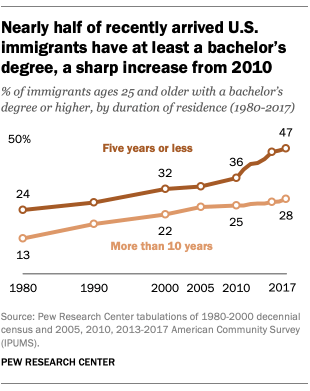
1Nearly half of recently arrived U.S. immigrants have at least a bachelor's degree, a sharp increase from 2010. Short-term residents have more education than long-term residents, and the gap between these immigrant groups has widened. Almost half (47%) of immigrants ages 25 and older who arrived in the U.S. during the previous five years have a bachelor’s degree or more as of 2017, compared with just 28% of those who have lived in the country for more than 10 years. The share among newer arrivals has grown since 2010, when 36% had a college degree, compared with 25% of longer-tenured immigrants. Overall, the education levels of U.S. immigrants have increased, due in part to growing numbers of international students and highly skilled workers. By contrast, 32% of the U.S.-born population has a bachelor’s degree or higher.

2. Recently arrived immigrants have higher unemployment rates than longer-term immigrants. Immigrants who arrived in the past five years have a 7.1% unemployment rate, compared with a 3.9% unemployment rate for immigrants who have lived in the country for more than 10 years, according to Pew Research Center analysis of American Community Survey. Both groups have seen declines in unemployment since 2010, when their rates were 12.8% and 9.7%, respectively. More-recent arrivals have for decades had higher unemployment rates than longer-term residents, despite having more education. The opposite is true for the U.S. population overall: Those with more education have lower unemployment rates.

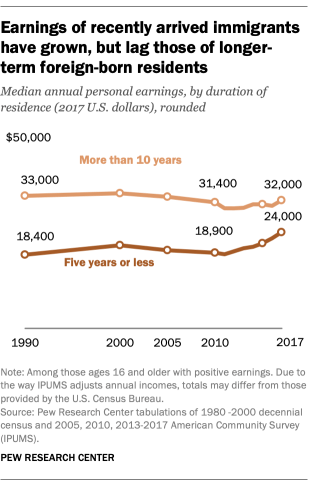
3. Earnings of recently arrived immigrants have grown, but lag those of longer-term foreign-born residentsThe personal earnings of recently arrived U.S. immigrants have increased, but trail those of longer-term immigrants. Those who arrived in the past five years had median annual personal earnings of $24,000 in 2017, compared with $32,000 among those who have lived in the country more than 10 years. For decades, more-recent arrivals have lagged longer-term residents in personal earnings despite having higher levels of education. For the U.S. population, by contrast, those with a college education have higher earnings. Since the Great Recession, the personal earnings of newer arrivals have increased while those of longer-tenured residents have remained flat.

4English proficiency among recently arrived immigrants is up since 2010. English proficiency among recently arrived immigrants is on the rise. Among those who arrived in the U.S. in the past five years, 45% said in 2017 that they either speak only English at home or speak English very well, up from 38% in 2010. Due to this increase, recent arrivals are closing the gap with longer-term immigrants, who have seen little change in their English proficiency. About half of immigrants who have lived in the U.S. for more than 10 years said in 2017 that they either speak only English at home or speak English very well, a share little changed from 2010.

5, South and East Asia is approaching Latin America and the Caribbean as the top origin region of recently arrived immigrants. Latin Americans account for 38% of U.S. immigrants who have arrived in the past five years, as of 2017, compared with 35% from Asia. This has changed since 2010, when immigrants from Latin America (48%) made up a far higher share of recent arrivals than Asia (30%).

Latin America and the Caribbean is by far the largest origin region among immigrants who have lived the country for more than 10 years. In 2017, immigrants from Latin America accounted for more than half (54%) of longer-term residents, compared with 25% among those from South and East Asia.