Why it’s time to restart the federal immigrant-investor program

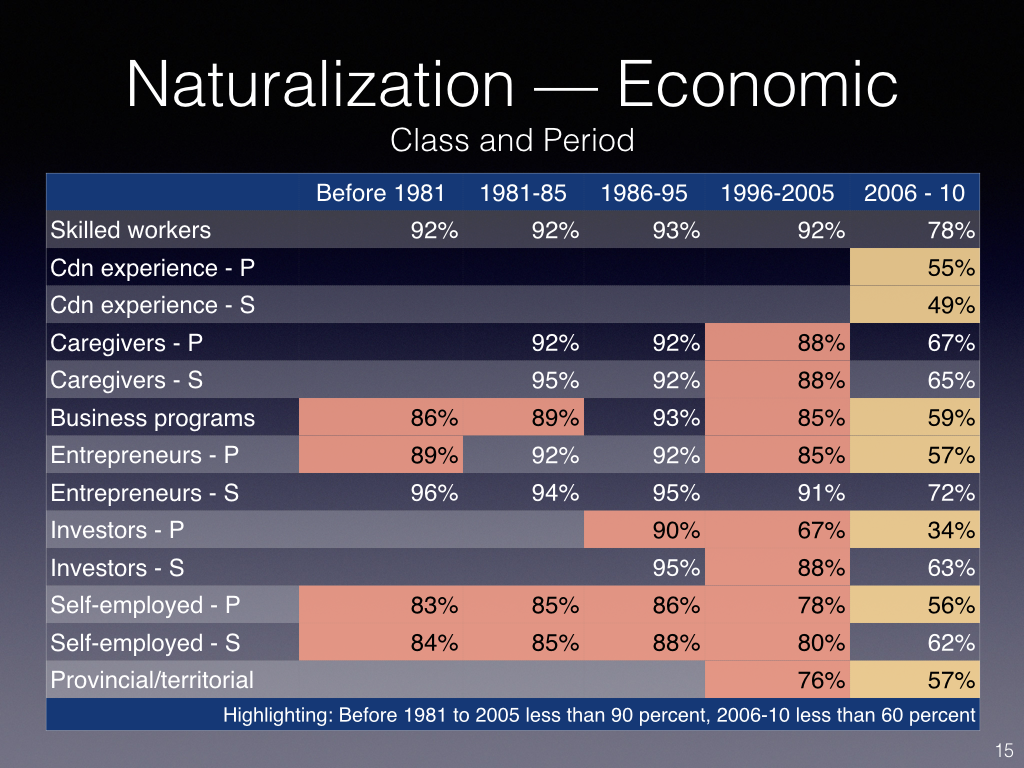
No, it’s not (apart from creating business for immigration lawyers, some increased pressures on the housing market and some increased consumer spending. It is striking when looking at Canadian immigration data, that the incomes of primary applicants under the previous investment programs, based on tax data, are less than refugees since 1996.

I have not been able to find a Quebec government evaluation of its investor immigrant program on their website so it is hard to substantiate or refute Silverstone’s claim that it has pumped “billions” into the Quebec economy. We do know, however, that most of these immigrants end up elsewhere and pay little to know tax (Opinion | Study reveals awfulness of Canadian investor immigration):

These are exhilarating times for Canadian immigration. Ottawa announced last December that it would be accepting more than one million immigrants over the next three years, with an increase in 2018 to 310,000 from the previous 300,000 annually, followed by a further increase to 330,000 in 2019 then to 340,000 in 2020.The Province of Quebec, which essentially runs its own immigrant selection process, is, however, reducing its intake by some 20 per cent.

The large majority of these new entrants to Canada will be in various economic categories. In particular, the federal government’s new global talent stream, with its quick-processing turnaround time, and enhancement of the startup visa program, are becoming very useful mechanisms for recruiting and retaining international high-tech talent.The express entry stream, which brings skilled workers to Canada, broke a record in 2018, with almost 90,000 invitations to apply issued. This represents an increase of nearly 4,000 over the previous record set in 2017. Immigration authorities are also promising to clear some of the backlog in the family-reunification class, including the families of the much-needed live-in caregivers. The rules for obtaining Canadian citizenship have also been significantly relaxed.

With the national unemployment rate at a 40-year low 5.6 per cent, immigration is on its way to being an ever-more significant factor satisfying the Canadian labour market. It’s the major factor in Canada’s population growth, which rose by about 1.4 per cent last year. About 71 per cent of this growth is as a result of immigration.

However, processing immigration applications as well as refugee claims does not come cheap. The 2018 federal budget supports increased immigration levels to the tune of $440-million, with an additional $173-million for asylum seekers. The government’s pre-election budget earmarked $1.18-billion over five years to “accelerate” the claims process and to “facilitate the removal of failed asylum claimants.”

Quebec’s immigrant investor program 

Since its inception in 1986, the Quebec immigrant investor program has pumped billions of dollars into the Quebec economy. Quebec’s is a passive investment program. This means that potential immigrants must ante up $1.2-million for a period of five years, after which the money is returned in full but without interest. The prospective investor must establish a minimum personal net worth of $2-million and be able to demonstrate the legal provenance of the funds. They also have to be able to show at least two years of business management experience. The vast majority of the thousands of immigrant investors come from China and elsewhere in Asia, with some from the Middle East. Quebec charges a substantial application fee. The program is well run and has proved to be an economic winner.

Although the program is administered by the province, investors and their families must satisfy federal security and medical standards. One of the criticisms is that the bulk of successful applicants do not maintain their residence in Quebec, but rather flow to other parts of Canada, primarily southern Ontario and British Columbia. Quebec has responded to this by adding an intent to reside in the province proviso, but, in practice, inter-provincial mobility will really not be restricted.

Restarting the federal investor program 

Canada’s federal immigrant investor program was terminated in 2014. It is time for it to be restarted. An immigrant investor program geared toward job creation in economically challenged areas of the country should be implemented now. Such a program could require an active investment of $1-million, with perhaps a lower amount geared toward areas of higher unemployment. This money would be risk capital directed toward private-sector enterprises with job creation as an essential component. The Canadian stream should, of course, include all necessary checks to ensure the legitimate source of the funds as well as to determine the net worth of the applicant.

Borrowing from the EB-5 conditional-visa system in the United States, the Canadian plan should provide for the creation of regional centres, which would enable the private sector in any given area to participate constructively in the allocation of the investment by the foreign applicant. Regional centres in the U.S. bring together investors and local and regional entrepreneurs and economic development officials to ensure the best use of funds. Studies have found that, in the U.S., immigrant investor capital has played a key role in financing several large projects in areas as diverse as New York and Las Vegas.

In the Canadian context, the regional centre would always have as its focus the creation of at least two permanent jobs per investor. Substantial application fees and a security deposit, along with strict monitoring of the investment, will keep away tire kickers and fraudsters, and the regional centre must be prepared to provide complete transparency with regard to the investment process and allocation of resources. In addition, it should be tasked with assisting the immigrant investor as well as other classes of immigration, including refugees, by providing integration and employment services in order to ensure that newcomers build successful lives in this country. Refugees could be major beneficiaries of the job-creation component of a rejuvenated immigration investor program.

Alternatively, the government could just reinstate the discontinued federal immigrant investor program as it was, basically mimicking Quebec’s passive investment initiative. Either way, an essential element that would maximize chances for success would be a firm undertaking by the federal government that applications would be handled in a timely fashion. Serious overseas investors are not going to wait four and five years to have their applications processed.

A typical immigrant investor arriving with a family in a struggling area of the country will be serious and motivated. The investor, having paid perhaps $30,00 in application fees, along with a risk capital investment of a million dollars—and spending perhaps nearly that amount again in dwelling costs, clothing, schooling, vehicles, and many other needed expenditures—will surely be an asset rooted in his or her chosen community. This, combined with the establishment of a viable commercial enterprise and the creation of employment opportunities, produces a winning situation that could economically and socially boost many Canadian locales, especially those outside Montreal, Toronto, and Vancouver—that attract the bulk of new immigrants.

Ramping up to receiving 10,000 families annually could generate billions and create 20,000 jobs. Now is the time to act and get new money into our system before we lose more highly desirable investor immigrants to other jurisdictions.

Source: Why it’s time to restart the federal immigrant-investor program

The tropes around Jews and ‘Jewish money’

Of note:

The charcoal illustration on the front of the London Saturday Journal, a popular Victorian magazine, published in late March 1841, pictured a rather sinister looking man, with a cap in hand and a sack on his back looking slyly at the reader. Entitled “The Jew Old Clothes Man”, an article inside the magazine goes on to describe Jewish second-hand clothes sellers in London in particularly prejudiced terms.

The cover is one of the many chilling images and texts on display at a new exhibition at London’s Jewish Museum. Entitled “Jews, Money, Myth,” the exhibition, on till July 7, examines both the role that money has played in Jewish life as well as the ways in which the associations — mostly negative — between Jews and money and profit have developed over the centuries.

The exhibition is particularly timely. Concerns around anti-Semitism have risen in the U.K. as they have across much of the rest of the world. While the Labour Party has faced allegations that it has not been tough enough on anti-Semitism within its ranks, the Jewish charity Community Security Trust reported a record number of anti-Semitic incidents last year. It is striking that even in Camden, a diverse London neighbourhood, entry into the museum is subject to security checks.

Even as major political parties have attempted to crack down on anti-Semitic rhetoric, others have got away with sharply divisive language. In 2017, the former head of the U.K. Independence Party (UKIP) Nigel Farage faced considerable criticism over remarks on LBC radio about how a “Jewish lobby” in the U.S. was “very powerful”. He is yet to apologise.

In this context, the exhibition is particularly striking and powerful, drawing both on objects involved in Jewish rituals, art, literature, and other objects of life such as board games. It also has some newly created videos to explore and build up an understanding of how the tropes around Jews and money have come to be built up — as well as the reality. “Throughout history, there have been both rich and poor Jews. The exhibition shows how Jewish wealth and poverty have been created by circumstances as well as the activity and acumen of Jews themselves — rather than ‘Jewishness’ itself,” says a note on the exhibition.

Objects, ancient and modern

There are ancient Judean coins, ceremonial objects involved in charitable giving and, in more modern times, the paperwork of efforts made by Jewish communities in the U.K., during and before the Second World War to bring Jewish refugees to Britain. Chillingly — particularly in the context of the heated discussion on immigration and refugees under way across much of the West — there is a reminder of the difficulties that Jewish refugees faced coming to the U.K. even at that time: to seek refuge, they needed to prove they were able to finance themselves privately.

There are literary explorations of the stereotypes built up around Jews and money — from Shakespearean characters such as Shylock and Charles Dickens’s Fagin, to literature such as the Nazi propaganda book The Poisonous Mushroom.

There are also exhibits such as Rembrandt’s “Judas Returning the Thirty Pieces of Silver,” rather sympathetically picturing the biblical figure down on his knees begging for forgiveness from a group of priests as he attempts to return the thirty pieces of silver he was said to have betrayed Christ for. That story, the exhibition notes, has been key to propelling anti-Jewish stereotypes till this day.

Given the weight of the matter, it is perhaps unsurprising that some of the material resorts to black humour and satire, such as a video by U.S.-based artist Doug Fishbone. At one point, he notes the extent to which Indians in the West are now out-earning Jews there, leading British politician and author Lord Archer to declare, back in 2008, that Indians were the new Jews. “Maybe they will be accused of being the puppet masters behind the throne too?” asks Mr. Fishbone in his video.

Source: The tropes around Jews and ‘Jewish money’

Signes religieux: volte-face à Québec solidaire

Interesting:

Les militants de Québec solidaire ont rejeté par une écrasante majorité la position traditionnelle de leur parti sur le port de signes religieux, la recommandation du rapport Bouchard-Taylor. Ils ont voté pour s’opposer à toute interdiction, la même position que le Parti libéral du Québec.

À l’occasion du conseil national de leur parti, les quelque 300 délégués étaient appelés à reconsidérer la position sur les signes religieux. La direction de QS a donné le feu vert à la réouverture de ce débat après les élections du 1er octobre, à la suite de pressions exercées par des associations de circonscription.

Deux choix étaient offerts aux délégués : « l’option A » en faveur de la recommandation Bouchard-Taylor, celle de proscrire les signes religieux pour les agents de l’État ayant un pouvoir de coercition (policiers, gardiens de prison, procureurs de la Couronne et juges). QS défendait cette position depuis longtemps : Françoise David avait déposé un projet de loi en ce sens en 2013.

Mais une tendance claire se dessinait avant même l’assemblée plénière de samedi en faveur de « l’option B », selon laquelle « aucune règle particulière sur les signes religieux ne devrait s’appliquer à certaines professions plutôt qu’à d’autres, incluant celles qui exercent un pouvoir de coercition ».

Les délégués ont voté massivement en faveur de l’option B ce qui a déclenché un tonnerre d’applaudissements. L’assemblée plénière a été ouverte aux médias, contrairement au huis clos qui avait été voté lors du conseil national de décembre où le même sujet était sur le tapis.

Il y avait des militants en faveur d’une « option C » : interdire le port de signes religieux à tout employé de l’État en contact avec les citoyens. Ils ont accusé le parti de les avoir marginalisés, d’avoir orienté les discussions en refusant de soumettre leur option au conseil national.

La direction du parti a jugé que leur demande n’était pas recevable, en contradiction avec le programme. « On nous a nui, on ne nous a pas laissé parler trop librement », a soutenu Richard Aubert, du « collectif laïcité ». Que le parti ait accepté de présenter une candidate voilée, Eve Torres, aux élections du 1er octobre, une première au Québec, « ça me pose problème », a-t-il affirmé. « Ça me dérange qu’au niveau du Canada  un parti pour lequel je voterais au niveau du fédéral c’est un sikh qui le dirige, le NPD », a-t-il ajouté.

Is there an Austrian link to New Zealand mosque attacks?

More on the possible Austrian link:

The Austrian authorities are investigating possible connections after it emerged that the main suspect in the Christchurch mosque attacks made a donation of €1,500 (£1,293) to the far-right Identitarian Movement in Austria (IBÖ).

The suspect visited Austria from 27 November to 4 December last year, according to Austria’s Interior Minister Herbert Kickl, who said that potential links to Austrian extremists were being looked into.

Police have searched the house of the charismatic, social media-savvy IBÖ leader, Martin Sellner, who has done much to raise the profile of the Identitarians throughout Europe.

The group is hostile to multiculturalism, and claims to defend Europe against migrants, especially Muslims.

Mr Sellner has firmly denied any involvement with the 15 March attacks, which killed 50 people, but admits he received the donation and wrote an email of thanks.

In a video posted online, he said: “I am not a member of a terrorist organisation. I have nothing to do with this man, other than that I passively received a donation from him.”

Austria’s Chancellor Sebastian Kurz has said the group will be dissolved if it is deemed to be a terrorist organisation.

“There must be no tolerance for dangerous ideologies in our country – no matter if it’s radical Islam or right-wing fanaticism,” he said.

The main suspect in the Christchurch mosque attacks, Australian Brenton Tarrant, also seems to have had a preoccupation with Austrian history – something the interior minister said was being investigated.

Austrian landmark

The suspect’s clothes and weapons were covered with writing and symbols.

One of the words daubed in white on a gun magazine was “Vienna”.

There was also a string of names of historical figures, including that of Count Ernst Rüdiger von Starhemberg, the military commander of Vienna during the Ottoman siege of 1683.

Starhemberg and his company of 20,000 men defended the city against the 120,000-strong Ottoman army, which was eventually defeated by the combined forces of Poles, Habsburgs and the Holy Roman Empire.

The Battle of Vienna in 1683 is often cited by historians as the point where the Ottoman advance on Western Europe was stopped; the turning of the tide in the Muslim/Christian struggle for the control of Europe.

As such, it is a date celebrated by the far right, including, it seems, the Christchurch suspect, who is a self-confessed anti-Muslim white supremacist.

‘The Great Replacement’

The Documentation Archive of the Austrian Resistance (DOEW), which researches extreme-right activity, says there are “many rhetorical and ideological overlaps” between groups like the Identitarians and the suspected Christchurch attacker.

“The title of the attacker’s manifesto, The Great Replacement (which sees immigrants as a threat to “white” Western culture) was a slogan popularised by the Identitarians,” DOEW said on its website.

“Regardless of the outcome of the investigation,” DOEW says, the Identitarians seem to be sticking to their narrative “for the time being”. It points to an IBÖ statement from last week, which speaks of the “Great Replacement” and calls for “De-Islamification”.

The whole affair is uncomfortable not just for the Identitarians, but for Austria’s government as well.

Mr Kurz’s own conservative Austrian People’s Party is in coalition with the far-right Freedom Party (FPÖ), making Austria the only country in Western Europe with a far-right presence in government.

FPÖ leader and Vice-Chancellor Heinz-Christian Strache said on Wednesday that his party had “nothing to do with the Identitarians”.

However, Austrian media published photos of FPÖ politicians with members of the group, and Bernhard Weidinger from DOEW told the BBC that there were many links between FPÖ politicians and members of the IBÖ, who often attended each other’s events.

In 2016, before he became interior minister, Herbert Kickl gave a speech to a far-right conference in Linz, called Defenders of Europe. The FPÖ politician addressed his audience, which included Identitarians, as “like-minded people”, according to Austrian media reports.

The FPÖ has also long celebrated the Battle of Vienna victory of 1683. In 2010 it even published a comic, set during the siege, featuring Mr Strache as a knight saving Vienna’s cathedral from an Ottoman minaret.

And when Mr Strache and Mr Kurz presented their government programme back in 2017, shortly before the coalition was sworn in, they broke with tradition, and held the event on Vienna’s Kahlenberg mountain, where the Battle of Vienna took place.

Asked if there was any historical significance to the choice of venue, Mr Kurz said no.

But in a video blog, Mr Sellner hailed it as “a good omen”.

Source: Is there an Austrian link to New Zealand mosque attacks?