La CAQ et la laïcité, ou un début laborieux

A reminder of the more global approach to integration and reasonable accommodation of the Bouchard-Taylor Commission, with appropriate caution to the incoming CAQ government:

Lors de son élection, François Legault a promis d’être un premier ministre rassembleur et de sortir le Québec de la polarisation entre souverainistes et fédéralistes qui a marqué le débat politique des cinquante dernières années. Son premier geste fut de ramener à l’avant-plan une polarisation entre la gauche et la droite, d’une part, et entre Montréal et les régions, d’autre part, ce qui sera le trait distinctif de son mandat.

On ne pourra reprocher à M. Legault de manquer de cohérence. Il l’avait promis : il le fera. Le gouvernement caquiste va légiférer pour interdire le port de signes religieux dans la fonction publique pour les personnes en situation d’autorité. Jusque-là, il n’y a pas de quoi s’affoler et crier à la montée de l’intolérance et du populisme au Québec. D’autres nations ont fait le choix assumé de la laïcité dans les relations de l’État avec ses citoyens. Le rapport final de la commission Bouchard-Taylor sur les accommodements raisonnables, rendu public en 2008, recommandait d’ailleurs l’interdiction du port des signes religieux pour les agents de l’État en situation de coercition : juges, procureurs de la Couronne, policiers, gardiens de prison, président et vice-présidents de l’Assemblée nationale.

Le véritable scandale n’est pas qu’un gouvernement élu tente de mettre en application les recommandations d’une commission qui a sillonné le Québec, pour en arriver à une série de recommandations justes et raisonnables afin de concilier l’interculturalisme et la laïcité ouverte distinctive du Québec avec les exigences d’intégration et de francisation des nouveaux arrivants. Le véritable scandale réside dans la procrastination crasse des gouvernements libéraux de Jean Charest et de Philippe Couillard, qui ont négligé pendant de trop nombreuses années de donner suite aux recommandations. Le fait que Charles Taylor se soit dissocié du rapport depuis n’enlève en rien à la lucidité du diagnostic de l’époque et à la pertinence de l’ouvrage. Nous n’en serions pas là, à rejouer dans le vieux film identitaire post-Bouchard-Taylor, si les libéraux avaient accordé un peu plus de poids aux préoccupations de la majorité francophone.

Il y a toutefois un hic dans la démarche de François Legault. Sans en avoir fait un enjeu de fond de la campagne électorale, il s’éloigne de l’esprit et de la lettre du rapport Bouchard-Taylor en voulant désormais interdire le port des signes religieux pour le personnel de l’État en situation d’autorité (et non de coercition), ce qui revient à inclure dans un éventuel projet de loi les enseignants. Qui plus est, M. Legault menace de limoger les fonctionnaires qui ne se conformeront pas à la nouvelle directive, quitte à utiliser la disposition de dérogation au passage. Gérard Bouchard et Charles Taylor ne s’étaient jamais rendus aussi loin dans leurs réflexions.

La proposition caquiste dévie donc du consensus social arraché à la dure en 2008, sans guère de justification. Malgré le passage du temps, Le Devoirsoutient l’application des recommandations du rapport Bouchard-Taylor. Pas plus, pas moins.

Les fondements du « vivre-ensemble » n’étaient guère menacés à l’époque. Ils ne le sont pas plus aujourd’hui. François Legault s’apprête à légiférer pour régler un « problème » par anticipation, soit l’émergence d’un contingent de femmes voilées dans l’appareil d’État. Disons-le, la femme voilée est encore la mère de tous les maux dans ce débat politique à géométrie variable sur la laïcité. Qu’adviendra-t-il du crucifix à l’Assemblée nationale ? Celui-là semble bénéficier d’une clause de droits acquis.

Le gouvernement Legault rouvre des blessures mal cicatrisées. Déjà, le président de la Fédération autonome de l’enseignement, Sylvain Mallette, a indiqué que les écoles publiques n’avaient nullement besoin de ce nouveau « psychodrame ». « Interdire le port de signes religieux, ça ne donne pas plus de services aux élèves », a-t-il dit. La démarche du gouvernement Legault accentuera à coup sûr le clivage entre Montréal et le reste du Québec, la métropole se trouvant dans une situation unique en matière de diversité et de cohabitation. Des groupuscules de gauche ont déjà fait leur nid, avec bien des maladresses et des raccourcis intellectuels : la CAQ est raciste, liberticide, antiféministe. Un danger social dénoncé avec véhémence lors d’une manifestation contre le racisme dimanche à Montréal.

Dans ce climat de polarisation exacerbée, que vaut encore le rapport Bouchard-Taylor ? Cet ouvrage mesuré assoyait la légitimité de l’interculturalisme dont se réclame François Legault, tout en ratissant plus large. Les nationalistes contemporains ont réduit le débat au port de signes religieux, alors que MM. Bouchard et Taylor élargissaient la réflexion sur les accommodements raisonnables à l’intégration des nouveaux arrivants au marché du travail, à la francisation, à la régionalisation de l’immigration, à la reconnaissance des diplômes et à la lutte contre les inégalités et la discrimination.

Vivement cette approche holistique, réalisée avec doigté et pondération en lieu et place de la précipitation et de l’approximation. À moins de vouloir à tout prix un nouveau psychodrame.

Source: La CAQ et la laïcité, ou un début laborieux

Refugee and immigrant youth are more likely to end up in the emergency room during a mental health crisis than their Canadian-born peers, a new medical study shows

Not too surprising but nevertheless significant:

Refugee and immigrant youth are more likely to end up in the emergency room during a mental health crisis than their Canadian-born peers, a new medical study shows.

Newcomers did not seek early help from primary care doctors likely due to barriers in accessing and using outpatient mental health services, said researchers from the Institute for Clinical Evaluative Sciences (ICES) and the Hospital for Sick Children.

“Efforts are needed to reduce stigma and identify mental health problems early, before crises, among immigrant populations,” said the study published in the Canadian Medical Association Journal Tuesday.

Based on health and demographic data, researchers looked at emergency department visits for mental health issues by youth between the ages of 10 and 24 years in Ontario.

They identified a total of 118,851 young people who visited an ER with a mental health concern between 2010 and 2014, including 1.8 per cent or 2,194 refugees and 5.6 per cent or 6,680 non-refugee immigrants. The rest were Canadian.

“Most major mental illnesses have an age of onset in adolescence and young adulthood with about 20 per cent of youth experiencing mental illness. Our findings suggest that there are important subgroups of immigrant and refugee children who face barriers in accessing outpatient mental health care,” said study co-author Dr. Astrid Guttmann, chief science officer at ICES and staff pediatrician at Sick Kids.

“Interventions to improve access to the mental health system should consider the needs of specific immigrant populations.”

The gaps between immigrant and non-immigrant youth can be attributed to differences in culture, language proficiency, ability to navigate health services and even referral biases by health care providers, said the report.

While the majority of youth sought help for mental health issues at an emergency department first, the rate was higher for newcomers. The study found 61.3 per cent of refugee youth, 57.6 per cent of non-refugee immigrants and 51.3 per cent of Canadian youth went to an ER first.

Report lead author Dr. Natasha Saunders, a pediatrician at Sick Kids and adjunct scientist at ICES, said the differences are both statistically and clinically significant.

“Emergency services are important for managing acute mental health crises, but for most mental health disorders, primary care would be the most appropriate place for treatment and referral to specialized services,” she explained

“The high proportion of immigrant and refugee youth who have not been previously assessed for mental health problems suggests a need to understand specific cultural and other barriers and enabling factors related to the use of mental health services and access to care.”

Among all immigrants, recent arrivals had the highest proportion (64.3 per cent) of first contact in the emergency department, as did non-refugee immigrants from East Asia (61.7 per cent) and refugees from Africa (65.4 per cent), Central America (64.6 per cent) and East Asia (62.5 per cent).

Those who live in low-income and rural areas and those without OHIP coverage also had higher rates of first contact for mental health in the ER, said the report.

Source: Refugee and immigrant youth more likely to end up in ER during mental health crisis, study shows

France tells Italy to stop ‘posturing’ on immigration and find a solution

All governments posture to a certain extent. The question lies more how they posture and for what purpose and in this case, the French critique is correct:
French Prime Minister Edouard Philippe urged far-right Italian leader Matteo Salvini on Monday to drop his “posturing” on immigration and help find a European response to the issue.

Salvini, Italy’s powerful interior minister and deputy premier, has singled out French President Emmanuel Macron for criticism in recent weeks, as well as other EU leaders he considers too soft on immigration.

Philippe promised to be “direct” in his conversation with the 45-year-old Italian, head of the far-right League party, over dinner on Monday night in the French city of Lyon where the two men, along with ministers from Britain, Germany, Spain, Poland and Morocco, met for talks on immigration.

“I rarely use the same words or the same vocabulary (as Salvini) but that doesn’t stop me being direct as well. I hope we’ll have a frank and direct exchange,” Philippe said.

“Beyond the posturing, the issue of immigration cannot be solved with a national response. It requires coordination. It’s a complex issue of common interest.

“I think you have to tackle it with conviction, with respect for national interests, but also with the desire to build a common position that is the only way to find a solution.”

Philippe’s statement came amid open conflict between the new populist Italian government, led by Salvini and the head of the Five Star movement, Luigi Di Maio, and Macron’s centrist administration in Paris.

Last week, an aide to the French president accused Salvini of “living off the migrant crisis” and blocking attempts to forge a common EU migration policy.

Leaving the dinner, Salvini made no attempt to disguise his differences with the Paris government — just hours after meeting French far-right leader Marine Le Pen in Rome, whom Macron defeated in last year’s presidential election.

“I had the pleasure of seeing Marine Le Pen this morning and talking with her about Europe, the future of young people, trade and work,” he said.

“I need to work with everyone, but I feel closer to the views of Marine Le Pen,” he said.

The talks in Lyon were an attempt to bridge differences between hardline anti-immigration EU member states such as Poland and Italy and others like France and Germany that are in favour of accepting refugees.

The gathering, which continues for a second day on Tuesday focused on efforts to combat terrorism, precedes a larger meeting of European interior ministers in Luxembourg on Friday.

Morocco’s interior minister, Abdelouafi Laftit, was also invited to the talks amid rising concern in Europe about the increasing number of migrants heading to Spanish territory via Morocco.

Spain has become the biggest port of entry for illegal migration into Europe.

The issue of returning Moroccan migrants to their home country, particularly thousands of unaccompanied minors in Spain and France, was discussed on Monday night.

“It’s in the process of being resolved,” Laftit told reporters.

How Canada became an international surrogacy destination [another form of birth tourism]

Just as I am working on my article on birth tourism, another example of “reproductive tourism” emerges.

The same issues larger apply in terms of abuse of birthright citizenship.

In addition, given that Canadian surrogate mothers use Canadian healthcare, there is an effective subsidy to foreign parents engaging a Canadian surrogate. Not right (and appears Canada is one of the few countries that allows intended parents living outside the country.

Hard to understand the rationale for continuing this other form of birth tourism:

Here’s an arresting statistic: Almost half of the babies born to Canadian surrogates in the province of British Columbia in 2016 and 2017 were for intended parents who lived outside the country. That’s 45 of the 102 babies born to surrogates there – 44 per cent.

What’s the national tally on such outbound babies? We don’t know. Rather, we aren’t told. The number could presumably be calculated, since individual physicians carry out the procedures and bill for them, and provinces issue birth certificates. But the information is not publicly available. Then again, we should hardly be surprised: In Canada, we don’t even know the total number of babies born to surrogates for any parent, Canadian or otherwise. I and others have been asking around for some time now.

Those B.C. numbers come to us thanks to the hard work of Pamela White, at the Kent Law School in Britain, who had to put in an access to information request with the B.C. government. She tried the province of Ontario, too, but they said they don’t collect data on residency. In the United States, such information is collected by law and published by the Centers for Disease Control and Prevention.

Prof. White, a former Statistics Canada director and data analyst, argues that Canadians deserve that level of transparency, too. She is absolutely right. Without real data, available for scrutiny, how can we make informed public policy decisions? We can’t.

Anecdotal reports and incomplete data suggest that the number of intended parents (IPs) from outside Canada has been growing in recent years. At the annual meeting of the Canadian Fertility & Andrology Society (CFAS) last month, Karen Busby, a professor in the faculty of law at the University of Manitoba, who co-authored a forthcoming paper on the topic with Prof. White, discussed why Canada is becoming an international surrogacy magnet and whether it is desirable.

The backdrop, Prof. Busby says, is that worldwide demand is huge. Many people want to be parents and can’t do so without surrogacy, but they live in countries where surrogacy is either prohibited entirely, or prohibited for them. China, Japan and many European and predominantly Muslim countries have restrictions, she says. People in such places who decide to pursue surrogacy must look beyond their own borders.

Coupled with this growing demand is shrinking supply. In the last few years, India, Nepal, Thailand and Mexico – former international surrogacy hotspots – have closed their doors to non-residents.

So why Canada? For one thing, Prof. Busby says, Canada is one of the few jurisdictions left in the world that both allows surrogacy and allows foreign participation in it. Countries such as Britain, South Africa and Israel, she says, permit surrogacy, but not for foreigners. The only other places that allow foreigners to access surrogacy within their borders, apart from a couple of completely unregulated jurisdictions, are Greece, Ukraine, Russia, Georgia and a few U.S. states.

For a number of reasons, Canada stacks up well against these others. Russia and Ukraine, for instance, only allow married heterosexual couples to participate. Canada, by contrast, does not allow discrimination on the basis of marital status or sexual orientation, Prof. Busby says.

Canada is also fairly efficient about granting legal parental rights. It varies by province, but generally speaking, IPs can be declared legal parents without a lot of hassle in just a few days, and they can be issued a birth certificate within weeks. Also, any child born in Canada has the right to citizenship, so a passport can be issued, and in short order, the families can head home and start their new lives.

Financially, Canada also compares well. Women in Canada enjoy high quality, publicly funded health care throughout the pregnancy, during the delivery and after the birth. This is as true for a woman carrying a baby for someone from France or China as it is for a woman carrying a baby for herself. Our neonatal care is also top-notch – and also publicly funded. Another perk, Prof. Busby says, is that if a Canadian surrogate has a job, then she may also qualify for employment insurance benefits following birth – to a maximum of $6,500.

Here’s another interesting twist. In Canada, it’s illegal – a criminal offence, according to the Assisted Human Reproduction Act – to pay a woman to carry a baby for you, or to pay someone else to arrange for her to do so. Since the law first passed in 2004, this prohibition has caused enormous hand-wringing for Canadian would-be parents looking to form their families with the help of a surrogate. They rightly fear that they could be prosecuted for paying a surrogate, and the penalty is steep: up to 10 years in prison and $500,000 in fines. The prohibition has reportedly driven some Canadian families to leave the country to seek surrogates elsewhere.

Ironically, this prohibition, which was designed to deter commercial surrogacy, may actually be stimulating it – and may favour foreign IPs over domestic ones. Domestic IPs may be reluctant to offer money or will only offer it under the table, but because the law is not applied to acts committed outside the country, Prof. Busby says, foreign IPs can offer money openly, so long as it changes hands somewhere else. It’s conceivable that, given the choice between being paid and not being paid, Canadian surrogates – who are legally allowed to accept the money – may opt to be paid. So foreign IPs may actually be more attractive to Canadian surrogates than domestic IPs. (There’s no data on that, of course, since there’s no data.)

It is true that foreign IPs coming to Canada will still be subject to our other prohibitions, such as paying for local egg or sperm donations or performing sex selection. But, as Prof. Busby points out, most Canadians live near the U.S. border and have easy access to the services offered there. This ability to enjoy the best of both systems only adds to Canada’s appeal.

All of these factors help to explain why Canada has become a go-to place for surrogacy. I’ll add one more that Prof. Busby did not explicitly mention: There are Canadian doctors, lawyers and agencies who actively recruit IPs from around the world. If foreign parents weren’t already aware of Canada’s considerable merits, representatives of the industry are more than happy to point them out. In fact, the newly minted president of the CFAS himself, alongside the CEO of the country’s top surrogacy agency, was recently in London, promoting Canada as a premier surrogacy destination.

And they are right: For all of the above reasons, Canada is a great place to do surrogacy. Loads of people already want to come here and we can only expect that number will grow.

Not everything about this picture is rosy, however. A big question is whether Canadians need to think about recovering medical costs. Pregnancy care, even for an uneventful pregnancy, costs money. So does birth. The average uncomplicated birth in Canada rings in at between $3,000 and $6,000, depending on whether it’s a vaginal or surgical delivery. Complications can increase that figure considerably. Neonatal care can also be pricey. For instance, according to the Canadian Institute of Health Information, care for a baby born at 29 weeks weighing less than kilogram costs an average of $91,946. One baby.

“I am pretty sure that if you asked the average Canadian whether or not the Canadian health-care system should pay for any of the health-care costs incurred in order to produce a child for a non-resident IP, the answer would be no,” Prof. Busby told the CFAS meeting. “In fact, I think it would be an emphatic no.” I suspect she’s right.

As far as Prof. Busby is aware, no province has put in place laws or policies to recover the cost of surrogate pregnancy care from foreign IPs. (A few Ontario hospitals have started charging for infant care, if the infants are for out-of-province parents.) Prof. Busby says governments could consider measures such as asking IPs for money up front or not issuing a birth certificate or passport until the bill is settled.

That’s a lot of work. It would involve co-ordination across departments and even, in some scenarios, levels of government. Another option, she says, would be to follow the lead of other countries and create residency restrictions, stipulating that only people who live in Canada can work with a surrogate here. That option would, in one fell swoop, alleviate the shortage of surrogates available to work with Canadians and eliminate the cost-recovery conundrum.

That would be a tidy solution, and, all things considered, maybe the most workable one. The cost-recovery issue is challenging. Access to surrogates by Canadians is challenging, too. There are other problems. Our country is struggling under a 14-year-old law that still hasn’t rolled out the meat of its regulatory details. We are woefully lacking in transparency about surrogacy – and assisted reproduction in general. Finally, although preliminary findings are reassuring, we have not yet done nearly enough research to establish that Canadian women who act as surrogates are not exploited.

I am not hopeful, given Canada’s track record in this sphere, that we will crack these tough problems any time soon, or ever. But let’s imagine we did – no cost to the Canadian public, adequate numbers of surrogates to work with Canadian families, effective laws for and public scrutiny of the process and confidence that women were treated fairly. Then, it seems to me, Canada would be an excellent place for international surrogacy. Surely the ideal is for surrogates and babies to have quality medical care, for IPs to be free from discrimination, for parentage issues to be resolved quickly.

If we did somehow get our house in order, I’d be the first to ask: If you believe that surrogacy is a legitimate way of achieving parenthood, what would be the argument against welcoming it here?

Source: How Canada became an international surrogacy destination: Alison Motluck

One year later, Citizenship Act improvements lead to more new citizens – The numbers

Almost one year after the changes to residency requirements (from 4 to 3 years) and fewer applicants having to be tested for language and knowledge (from 14-64 to 18-54), the number of applications has increased.

As noted before, the residency requirement change is a one time impact, with this year being a “double year” with 3 and 4 year cohorts combined. The reduced testing requirements, primarily the 55-64 year olds, has both a one-time impact (those who put off getting citizenship) as well as ongoing.

The new “normal” will be known with the 2019 numbers:

This year, Citizenship Week (October 8 to 14, 2018) will be celebrated with 72 special citizenship ceremonies across the country. Citizenship Week also marks the 1 year anniversary of Bill C 6, which brought in important changes to the Citizenship Act, helping qualified applicants get citizenship faster.

The changes from Bill C 6 came into effect on October 11, 2017, and provided those wanting to become Canadian citizens with greater flexibility to meet the requirements. In particular, the changes reduced the time permanent residents must be physically present in Canada before applying for citizenship from 4 out of 6 years to 3 out of 5 years.

By the end of October 2018, an estimated 152,000 people will have obtained Canadian citizenship since the changes came into effect, an increase of 40%, compared to the 108,000 people who obtained citizenship in the same period the year before.

Bill C 6 has allowed more permanent residents to apply for citizenship. In the 9 month period from October 2017 to June 2018, Immigration, Refugees and Citizenship Canada (IRCC) received 242,680 applications, more than double the 102,261 applications that were received in the same period the year before. Despite the increase in applications, processing times for routine citizenship applications remain under 12 months.

Source: Taking Canadian Citizenship to New Heights This Citizenship Week

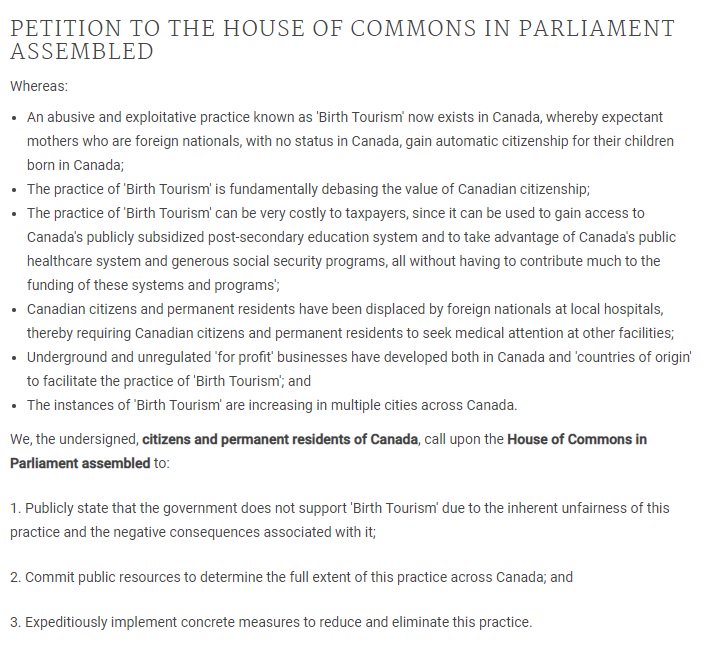
Yet another petition on birth tourism

Likely a political response to the tensions in Richmond, where over 20 percent of live births are to non-resident mothers and positioning given the Conservative party resolution calling to limit birthright citizenship to offspring of Canadian citizens or permanent residents.
Working on an article with more accurate and. spoiler alert, higher numbers which should be out later this month or early November:

Australia: Plans to outsource visa processing are scary, former immigration official says

The risks are real without proper consideration and oversight:

A Department of Home Affairs plan to outsource visa processing will lead to increased automation and “premium” services that could undermine the integrity of the system, a former senior immigration official has warned.

Abul Rizvi, a former departmental deputy secretary, told Guardian Australia the potential for a private provider to create a fast and slow lane for processing had “frightening” long-term implications and the proposed use of applicants’ data for marketing purposes was “appalling”.

Rizvi joins the Community and Public Sector Union (CPSU) and the Federation of Ethnic Communities Councils of Australia in expressing concern about the outsourcing plan, which has not received a final sign-off from the cabinet after months of testing the market for expressions of interest.

In February Guardian Australia reported that departmental briefings to industry had revealed that a successful private bidder could offset the $1bn cost of a new visa processing system by raising revenue through “premium services for high-value applicants”, different access for those able to pay more, and “commercial value-added services”, such as offers from banks, telcos and tourist operators.

Rizvi said he was “very concerned” about the prospect of premium services because “there would inevitably be an incentive for the company to be more facilitative with regard to subjective criteria for applicants who have paid for the fast lane”.

“Any monopoly provider would want to maximise charges for the fast lane and try to drive as many applicants as possible into that lane.”

He said applicants whocould not afford the higher charges were likely to come to Australia on visitor visas and apply for other visas after arrival, exacerbating “integrity problems” caused by the existing backlog of people in Australia because of the department’s “extraordinarily poor administration”.

In July, the home affairs minister, Peter Dutton, boasted about a decline in permanent migration, despite industry warning that the government was “throttling back the rate of migration by stealth” through longer wait times.

Rizvi predicted that outsourced visa processing would lead to tension between the Department of Home Affairs’ increased use of “subjective criteria” for certain visas and the private operator’s desire for increased automation.

“The company or companies that win these tenders will want to automate decision-making as much as possible to minimise costs.”

Rizvi said it was appalling that “extraordinarily personal information” such as an applicant’s relationship status, job, income and health could be used by a commercial firm for marketing purposes.

The chairwoman of the Federation of Ethnic Community Councils of Australia, Mary Patetsos, said it would be “very concerned” about commercialisation of applicant information. She also opposed measures that could lead to an increased cost of visas, particularly for family and partner visas.

“Australia has a long-standing reputation for its impartial, fair and transparent immigration system,” she said. “It should not be put at risk.”

Patetsos warned that premium services “could undermine fairness”. “The opportunity to bring family to Australia to live or visit for extended periods should be available to all Australians – not just the wealthy.”

She said it would be unacceptable for Australian families of limited means to be denied family reunion, which was “integral to successful settlement, social cohesion and wellbeing”.

The deputy national president of the CPSU, Lisa Newman, said a two-tiered visa processing system “will lead to dangerous outcomes”, with the operating company incentivised to to put its profits ahead of the need to assess “gold-plated” visa applicants to the same standards applied to those who could not afford to pay a premium.

“It would also give the company an incentive to further delay processing times for regular customers to try to force them into upgrading.”

She called on the Coalition to abandon the proposal.

The CPSU intends to campaign on the visa outsourcing issue at the next federal election, targeting the immigration minister David Coleman’s seat of Banks, and other electorates with a high number of Australians born overseas, including in western Sydney.

Tender requests went to the market in July and there have been industry briefings in Sydney, Canberra, San Francisco, Singapore and Bengaluru, as well as consultation by the Department of Home Affairs with its workforce.

Groups reportedly keen to bid include a joint venture between Accenture and Australia Post, and a consortium involving Pacific Blue Capital, Qantas Ventures, PwC and Ellerston Capital.

Pacific Blue Capital is run by Malcolm Turnbull’s former employee and friend Scott Briggs. In September, Labor signalled it would pursue the government’s planned outsourcing of the $1bn visa processing system in Senate estimates and called on ministers linked to Briggs to recuse themselves from consideration of the outsourcing proposal.

Source: Plans to outsource visa processing are scary, former immigration official says

‘We Are Facing a Monster’ Right-wing extremism in Germany

Good and thoughtful interview:

DER SPIEGEL: Ms. Knobloch, 73 years after the end of the Holocaust, right-wing extremists in Germany are once again stretching out their right arms in the Hitler salute. Jews are being threatened in public while parliamentary opposition leader Alexander Gauland, of the right-wing Alternative for Germany (AfD) party, recently said that the Nazi period was nothing but a “speck of bird shit” on German history. What is your reaction to the last several months?

Knobloch: These events weigh on us heavily. By “us” I mean the members of all Jewish communities in Germany. I am actually an optimist, something I inherited from my devout father. After the Holocaust, he was convinced Germany would once again have a future. I have thought a lot about my father recently. And I hope the alarming spectacle of the last few months will somehow come to an end like many others have before.

DER SPIEGEL: You don’t sound terribly optimistic.

Knobloch: I never thought it could get so bad again. Recently, I was at a high school with 300 students and told them: Take the responsibility we hand down to you. Be proud of your country. It has achieved a lot and is continuing to achieve. And as I was speaking, I was thinking: What are you even saying? Is it true at all?

DER SPIEGEL: You have your doubts?

Knobloch: There have been worrisome developments earlier. A few years ago, for example, there was a right-wing extremist demonstration in Munich where marchers shouted, “Jews in the gas, Jews out,” and the police didn’t intervene. But it has never been as bad as it is today. For the first time, a party has made it into national parliament whose program can be summarized with the words: Jews Out.

DER SPIEGEL: You are referring to the AfD.

Knobloch: I don’t actually want to even say their name. “Alternative for Germany,” what impudence. But yes, I am referring to the AfD.

DER SPIEGEL: Do you view the AfD as a Nazi party?

Knobloch: What else are you supposed to call a party that disseminates a platform that makes Jewish life impossible? This party is opposed to ritual circumcision and seeks to ban the shechita of animals, through which meat becomes kosher for practicing Jews.

DER SPIEGEL: There are more than a few Jews involved in the AfD. How can the party be anti-Semitic?

Knobloch: Just like a person with Jewish friends can still be an anti-Semite, Jewish party members are in no way a guarantee that a party doesn’t have anti-Semitic tendencies. The simple presence of Jews, in any case, isn’t enough and a group like the one calling itself “Jews in the AfD” is no proof of the lack of anti-Semitism. Particularly since the group isn’t just made up of Jews.

DER SPIEGEL: Among the established parties in Germany, there is a significant degree of uncertainty about how they should confront the AfD. Should they go on the attack? Ignore them? Try to expose them with arguments? They are trying everything and nothing seems to be working.

Knobloch: I like how the single neo-Nazi in the Munich city council is being dealt with. He is simply completely ignored by the other parties. He files inquiries and they simply go unanswered.

DER SPIEGEL: But in Germany’s federal parliament, the Bundestag, every deputy has rights. And with 92 members of parliament, the AfD is the largest opposition party. How can they be ignored?

Knobloch: There needs to be a consensus among all the other parties. The AfD has positioned itself outside of our liberal values. Period. It bothers me that there isn’t even consensus on this point at the moment. What other viewpoint can there possibly be?

DER SPIEGEL: The debate surrounding how to deal with the AfD recently intensified after an extremely emotional plenary speech by former Social Democrat leader Martin Schulz, who linked the right-wing populists with fascism.

Knobloch: I thought Schulz’s reaction was absolutely the correct one. Everybody needs to know who they are voting for when they cast their ballot for the AfD. Our task is to clearly draw the line. If we don’t, we are merely helping normalize the right-wing populists. I wanted to write Martin Schulz a letter, but I never got around to it because of the Jewish holidays. His dedication is admirable.

DER SPIEGEL: Among other things, Schulz said that AfD co-leader Gauland belongs on the “manure heap of history.” Should he be stooping to the level of the right-wing populists?

Knobloch: We can’t always obey the rules of politesse when dealing with a Nazi party. When politicians from the AfD refer to the Nazi period as “a speck of bird shit” in German history and refer to the Holocaust memorial as a monument to shame, then we need to strike back rhetorically. We are facing a monster. We have to fight it before it becomes stronger.

DER SPIEGEL: Following the recent riotsin Chemnitz, German President Frank-Walter Steinmeier harkened to the collapse of the Weimar Republic

Knobloch: That wasn’t an exaggeration. Weimar collapsed because the democrats, who were actually supposed to be the pillars of the system, ducked responsibility. I find it extremely troubling that people today aren’t taking to the streets in large numbers to demonstrate. There are distressing parallels between then and now. You just have to listen to the things politicians from this party say without facing repercussions. It is reminiscent of the rise of the NSDAP (Nazi party). Personally, I feel like it is 1928 again.

DER SPIEGEL: Do you think the AfD should be monitored by the Federal Office for the Protection of the Constitution (BfV), Germany’s domestic intelligence agency?

Knobloch: I find it completely incomprehensible as to why that wasn’t started long ago. I am stunned. If the AfD was being monitored, their representative would perhaps tone themselves down in public instead of inciting the population. Instead, there are rumors that Mr. Maassen …

DER SPIEGEL: … the former head of the BfV Hans-Georg Maassen, who wasrelieved of his duties recently for allegedly pandering to the far right …

Knobloch: … may have given tips to AfD members on how to avoid monitoring from the BfV. If that is true, that would be a catastrophe from my point of view.

DER SPIEGEL: Maassen expressed doubt about the authenticity of a video from Chemnitz that showed migrants being chased down.

Knobloch: Someone in his position should not just say something like that without presenting proof. That is a break with our political culture.

DER SPIEGEL: The rise of the AfD is inseparably connected with the refugee policies of Chancellor Angela Merkel. Do you think it was the correct decision to not seal off the German border in September 2015?

Knobloch: I view the issue through the lens of my own biography. If the U.S. immigration authorities in the late 1930s had approved the visas that my uncle applied for on behalf of his brother, his mother and me, my grandmother would not have had to suffer such a horrific death. She was too old to be accepted into the U.S. There were similar fates people faced that I heard about at the time. That is why I was very much in favor of Germany taking in the people who were living in horrific conditions in the Budapest train station in September 2015. After all, we became a humane country after 1945.

DER SPIEGEL: The Christian Social Union, the Bavarian sister party to Merkel’s Christian Democrats, believes the chancellor’s refugee policies are misguided.

Knobloch: We can’t take on more than we can handle, I agree with that. First and foremost, we have to help those who have had to leave their homes to escape war. When I see the terrible images from Syria, then we can’t hesitate for a moment. But we need a migration law to decide who fits, who can be integrated, who we need on the job market.

DER SPIEGEL: Do you see a connection between Merkel’s refugee policies and increasing anti-Semitism?

Knobloch: I’m wary on that issue. We don’t have an anti-Semitism problem because people from other cultures are coming to us. That would be an extremely simplistic view.

DER SPIEGEL: You don’t see a qualitative difference between European anti-Semitism from the Christian West and Muslim anti-Semitism?

Knobloch: I didn’t say that. Muslim anti-Semitism works primarily by way of the delegitimization of Israel. And there is a specific form of anti-Semitism that has its roots in the Koran. That also has an influence over how anti-Semitism develops in this country.

DER SPIEGEL: What do you mean?

Knobloch: Anti-Semitism used to be the rejection of a certain group of people. Today, it is simply hatred of the Jews.

DER SPIEGEL: Anti-Semitism has radicalized?

Knobloch: Absolutely.

DER SPIEGEL: Is there a recipe for fighting it?

Knobloch: Not enough is being done, that is the frightening thing. We have been calling attention to the problem for years. And there are actually institutions that should be taking action. Political leaders, for example. Security authorities. Educational institutions. All of them should focus on fighting anti-Semitism, especially given our history. But not nearly enough is being done. Those who are blaming the refugees exclusively for anti-Semitism are making it too easy on themselves. These people, if you will, can’t help it. That’s how they were raised.

DER SPIEGEL: Where do you think the largest shortcomings are to be found?

Knobloch: In education. We are way behind there. You can’t fight anti-Semitism by simply talking about anti-Semitism. You fight it by learning to love your own country and by defending its values.

DER SPIEGEL: In a recent op-ed for the Israeli daily Haaretz, you sharply criticized Richard Grenell, the U.S. ambassador to Germany, saying that he has positioned himself as an ally to right-wing populists in Europe. Why did you get involved?

Knobloch: When Mr. Grenell welcomes the rise of anti-establishment populists in a country where the extreme right has won seats in parliament, we Jews feel threatened. The fact that he apparently doesn’t see this connection is appalling. Mr. Grenell uses the same language as the AfD. This cycle of mutual encouragement is a danger to our liberal democracy. In such a situation, I don’t care if he is the U.S. ambassador or whatever else.

DER SPIEGEL: Has Mr. Grenell contacted you at all?

Knobloch: No.

DER SPIEGEL: Would you like to meet with him?

Knobloch: It would depend on the subject matter. I am happy to talk at any time with young people who have adopted different ideas and to try and convince them.

DER SPIEGEL: Mr. Grenell claims to be a great friend of Israel’s.

Knobloch: Friendship is a rather broad term. Many people use it to put themselves in the center of attention because they think it looks good.

DER SPIEGEL: What do you think of the Israel policies of U.S. President Donald Trump?

Knobloch: I have family in Israel: a daughter, several grandchildren and two great-grandchildren. I have a special relationship to the country and advocate for its security wherever I can. The Israeli people want nothing more than peace, I am 100 percent convinced of that. That is why I welcome the fundamental tenets of Trump’s Middle East policy. I wouldn’t, however, have moved the U.S. Embassy to Jerusalem. That is such a sensitive issue that doing so merely makes in more difficult to find the solutions to problems.

DER SPIEGEL: You belong to the last generation of Holocaust survivors. How should the memory be kept alive once all those who witnessed it firsthand are gone.

Knobloch: My hopes are very much pinned on young people who are more interested in the history of their own country than was the case 10 or 15 years ago.

DER SPIEGEL: The Berlin municipal official Sawsan Chebli has proposed making it a requirement for young people to visit a concentration camp memorial. What do you think of the idea?

Knobloch: The only camp where it is still possible to really get a sense for the tragedy is Auschwitz. Such visits, though, can only take place if there has been sufficient preparation. Young people have to know what they are visiting. And if one of them doesn’t want to, you can’t force them.

DER SPIEGEL: What do you have against the so-called “Stolpersteine,” the gold-colored paving stones placed in front of buildings in German cities to commemorate Jews who lived there until they were deported by the Nazis?

Knobloch: I find this type of commemoration to be a catastrophe. People trample on the names of those who were murdered and dogs pee on them. The Munich city council has resolved that commemoration must take place at eye level. I hope that our example is followed elsewhere.

DER SPIEGEL: Jews who live in Israel often can’t understand how Jews can continue to live in the diaspora.

Knobloch: In the diaspora or in Germany?

DER SPIEGEL: Does it make a difference?

Knobloch: Of course it does. Given recent developments, I am being asked such questions more often.

DER SPIEGEL: By whom?

Knobloch: The part of my family that lives in Israel has already come to terms with it. My granddaughter is now grown up, but when she was in the ninth grade, she visited Auschwitz with her class. In Israel, it is a visit everybody makes. Afterwards, she wrote me a six-page letter and asked me how I can live in Germany.

DER SPIEGEL: The attacks on Jews in France triggered something of an exodus of Jews fleeing the country to Israel. Do you think there is a danger of something similar occurring in Germany?

Knobloch: Yes, there is a danger. Members of the Jewish community come to me and tell me that they are afraid. It is equal parts irrational and understandable. I try to give them courage, despite everything. That is part of the optimism that I mentioned earlier.

DER SPIEGEL: Ignatz Bubis, one of your predecessors as president of the Central Council of Jews in Germany, said toward the end of his life that he accomplished “almost nothing.” What are your feelings when you look back on your own life?

Knobloch: He was already quite sick when he said that. I called him and said: How can you say such a thing? I know how much you have accomplished.

DER SPIEGEL: You have a more positive view than Bubis did at the end of his life?

Knobloch: It is a question I ask myself every day, when I see the terrible developments in Chemnitz and elsewhere. But then I always think: I did achieve something. It’s just a gut feeling I have.

DER SPIEGEL: Bubis never wanted to live in Israel, but he wanted to be laid to rest there.

Knobloch: He didn’t want his grave to be vandalized. And given the increasing anti-Semitism, that is a very real danger.

DER SPIEGEL: And where do you want to be buried?

Knobloch: I have our family plot here in Munich.

DER SPIEGEL: Ms. Knobloch, thank you very much for this interview.
Immigration consultant council suspends licence of former Edmonton MLA Carl Benito

Yet another one:

The federal council that regulates immigration consultants has temporarily suspended the licences of former Edmonton MLA Carl Benito and one of his sons, as it awaits the outcome of a Canada Border Services investigation of an alleged large-scale immigration fraud.

At a hearing Tuesday, Cindy Ramkissoon-Shears, an independent chairperson of the Immigration Consultants of Canada Regulatory Council (ICCRC), determined there were reasonable grounds to conclude that allowing Benito and his son Charles to continue practising as consultants may cause harm to the public and could undermine the reputation of the profession.

The temporary suspensions mean the Benitos must have no further involvement with their clients. They must immediately make arrangements for another consultant or lawyer to assume their clients’ files.

Benito and his son did not respond to interview requests from CBC News on Tuesday.

The ICCRC is the national body that, by federal law, regulates all individuals, except lawyers, providing Canadian immigration, citizenship, and international-student advising services.

The council only seeks an interim suspension in exceptional circumstances, following a preliminary investigation, when it considers allegations so serious that allowing the consultant to continue to practise poses a potential risk to the public.

The hearing Tuesday heard evidence the ICCRC had received three complaints about the Benitos’ immigration consulting practice dating back to 2016.

But the council only began its investigation after it learned from CBC News on Aug. 16 that the Canada Border Services Agency (CBSA) had raided Benito’s home and office in late June as part of a major immigration fraud investigation.

Bundles of $100 bills seized

Court documents obtained by CBC News revealed the CBSA seized more than $250,000 in cash — mostly bundles of $100 bills stashed in two floor safes — as part of an investigation into what the agency alleges was a three-year immigration fraud scheme. The agency also seized numerous cash-filled payment envelopes bearing what appear to be the names of clients.

In search-warrant documents, the CBSA alleged that since Nov. 11, 2015, Carl Benito had counselled dozens of Filipino immigrants to improperly extend their stay in Alberta. The agency claimed Benito organized a scheme involving bogus applications for study and work-permit extensions.

The CBSA also alleges it found at least one Filipino immigrant, and possibly several more, working illegally for the Benitos’ consulting business.

The ICCRC had previously determined there was sufficient evidence to hold a hearing for  interim suspensions against Carl and Charles but there was not enough direct evidence to include a third son, Mark, in the proceedings.

During Tuesday’s hearing, Carl Benito’s lawyer, William Macintosh, argued the information contained in the CBSA search-warrant documents did not constitute sufficient evidence because it was essentially hearsay and, in some cases, double hearsay.

But a lawyer acting for the ICCRC said the information in the search-warrant documents, supplemented by similar information contained in the three previous complaints, created credible and compelling grounds to support the suspension of the Benitos.

“In my submission, there are more than reasonable grounds to believe the Benitos have been running a practice, the modus operandi of which was to perpetuate a fraud against the Canadian government,” lawyer Lisa Freeman told the hearing.

Carl Benito did not speak at Tuesday’s hearing. His son, Charles, who was self represented, told the hearing that he had done nothing wrong and was innocent.

None of the Benitos has been criminally charged and none of the allegations from the search-warrant documents has been proven in court. The CBSA has confirmed its investigation is ongoing.

Council investigation delayed

An ICCRC investigator admitted under questioning by Macintosh that the council’s investigation, and potentially a full disciplinary hearing, can’t continue until after the CBSA concludes its investigation.

The investigator conceded the council is wholly dependent on documents from the CBSA for its investigation, and it could take up to a year for the CBSA to conclude its investigation.

In an August interview, the council’s director of professional conduct told CBC News the investigation process can be complicated by the immigration status of individuals who may be critical witnesses in a disciplinary hearing.

Immigration Consultants of Canada Regulatory Council director of professional conduct Michael Huynh says the investigation process can be complicated by the immigration status of people who might be critical witnesses in a disciplinary hearing.

“Because of the nature of the services members provide — that is, the members of the ICCRC — a lot of the complainants sometimes are of precarious status,” Michael Huynh said. “So they might not be willing to, after filing the complaint, testify, in which case it gets a little harder for us to procure the evidence necessary to prove our case.”

Huynh said there are also situations where a complainant may have been “complicit” in the immigration consultant’s activities, which may make them reluctant to testify for fear of compromising their status.

Benito was elected to the Alberta legislature in 2008. He became an immigration consultant after losing the Progressive Conservative nomination in 2012.

On websites and Facebook pages filled with photos of beaming clients, “Kuya Carl” (Brother Carl) claims he can help fellow Filipino immigrants secure residency, study permits, and work permits.

“Carl is simply the best in immigration consulting in Edmonton,” one of his websites reads.

In an article recently published in a local Filipino newspaper, and republished on his immigration firm’s website, Benito claimed he was a victim of “sensationalized” journalism.

“We have several clients who are our direct witnesses on how Triple Maple Leaf Canada and Carl Benito conducts his Consulting Services with utmost transparency and within legal bounds and following the guidelines as set by Immigration Canada,” Benito wrote in the article.

Source: Immigration consultant council suspends licence of former Edmonton MLA Carl Benito

Immigration department changed ‘illegal’ to ‘irregular’ on webpage about asylum seekers as debate flared

Suspect someone finally noticed the inconsistency in language between the website and ministerial remarks:

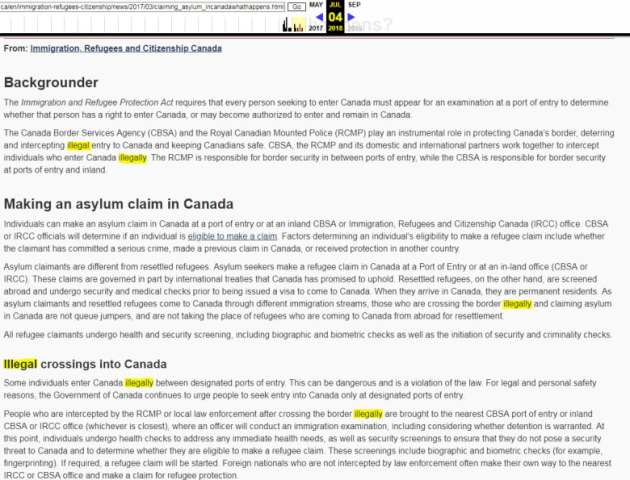
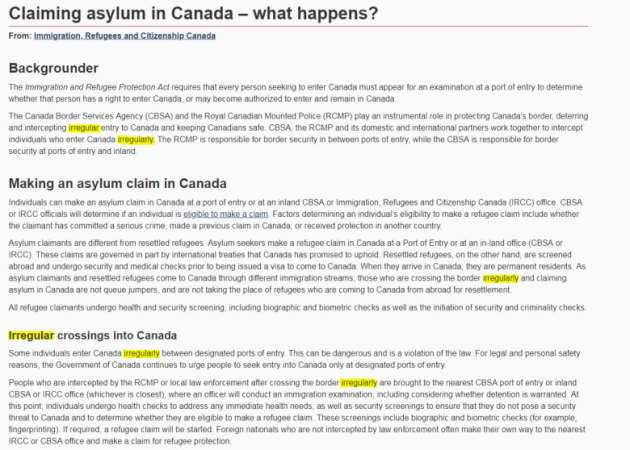
The immigration department changed a web page about asylum seekers to swap the word “illegal” for “irregular” as a debate was erupting between the federal government and Ontario on the issue, CBC News has learned.

The change in July came 18 months after the web page, titled “Claiming asylum in Canada – what happens?,” was first published — and just one day after federal Immigration Minister Ahmed Hussen suggested the provincial Progressive Conservatives were mistaken in the way they were describing the status of people entering Canada at non-official entry points.

Throughout the web page, which is intended to provide information on Canada’s asylum laws, the words “illegal” and “illegally” were switched to “irregular” or “irregularly” in six separate instances on July 10, 2018.

A Wayback Machine snapshot shows that “illegal” was the word of choice on the immigration web page before it was changed 18 months later. (CBC News/Olivia Chandler)

On July 9, Hussen attacked Ontario’s newly-elected premier, Doug Ford, and provincial Social Services Minister Lisa MacLeod, who oversees the immigration file, over their use of the term “illegal border-crossers” when describing asylum seekers crossing at non-official border points.

As Hussen was telling a news conference Ford and MacLeod were wrong to call those border crossings ‘illegal’, his own department was still using that word to describe such crossings on the asylum web page. The next day, the wording was changed to “irregular.”

The change was not ordered by Hussen, said Mathieu Genest, the minister’s spokesperson.

Cached web page reveals change

The Wayback Machine website, an open online library that archives published internet pages, retains a snapshot of the immigration web page as it appeared on July 4, 2018 — when it was still using the word “illegal.” The backgrounder was published originally on March 2, 2017.

The web page lays out the process for seeking asylum or claiming refugee status after crossing the U.S.-Canada border at a designated port of entry, or after arrival at an unofficial crossing point.

Language used on the immigration department web page – “Claiming asylum in Canada – what happens?” – was modified on June 11, 2018. (CBC News/Olivia Chandler)

“The Canada Border Services Agency (CBSA) and the Royal Canadian Mounted Police (RCMP) play an instrumental role in protecting Canada’s border, deterring and intercepting irregular entry to Canada and keeping Canadians safe. CBSA, the RCMP and its domestic and international partners work together to intercept individuals who enter Canada irregularly,” the website now reads.

“Given significant confusion around the terminology, the department made incremental updates to all pages to minimize mischaracterization of asylum seekers as being in Canada illegally,” said Nancy Caron, spokesperson for Immigration, Refugees and Citizenship Canada, in an email to CBC News.

“‎Until their claim is decided, or if they are found to be a refugee, a person will not be charged with an offence based on how they entered Canada.”

However, the change does not appear to be consistent across the department’s website. Another web page that provides monthly updates on the numbers on asylum claims and interceptions still refers to “illegal entry to Canada” and to the CBSA and RCMP’s efforts to “intercept individuals who enter Canada illegally.”

Conservative immigration critic Michelle Rempel dismissed the changes and said she’s more troubled that the government has not tabled a concrete plan to deal with the problem.

“They need to be focusing on solving this problem that’s being created by tens of thousands of people illegally crossing on the border into Canada after having reached the United States, and the strains that it’s placing on Canada’s social program and, frankly, the backlog it’s creating,” she said.

NDP immigration critic Jenny Kwan — who has pushed all levels of government to stop using the word ‘illegal’ in the context of asylum-seekers — welcome the department’s changes, but noted the government’s decision to do it under the radar.

“I think it’s very significant for that change to have been made, and for it to be acknowledged publicly really through their website. I guess I should say ‘quietly’ through their website, because the government loathed to admit that they are wrong,” she said.

“When we call asylum seekers ‘illegals’ we are denigrating them as people.”

Charged debate

The language surrounding the emotionally-charged political debate over border-crossers has been a source of friction and confusion.

(The CBC’s Language Guide allows for the use of both terms to describe border-crossings outside of official border points, depending on the context. See more below.)

Last March, Hussen was asked by Conservative MP David Tilson at a committee hearing which word he prefers to use to describe the act of crossing the border to claim asylum at an irregular crossing point.

“I have used the word ‘illegal’ and I have used the word ‘irregular,’ and I think both are accurate,” Hussen replied.

Weeks later, the immigration minister had changed his tune.

On July 13, Hussen called MacLeod’s approach to the issue of asylum seekers “not Canadian.”

Federal Immigration Minister Ahmed Hussen and his provincial counterpart from Ontario, Lisa MacLeod fall out over irregular migration at minister’s meeting in Winnipeg. 1:23

“Asylum seekers are processed in a separate queue at the IRB and all the other regular immigration programs are processed by IRCC, and conflating the two knowingly is irresponsible, it’s divisive, it’s fearmongering and it’s not Canadian. And it’s very dangerous,” he said.

MacLeod fired back.

“The minister should sit down, have a nice cup of tea, calm down a little bit, and maybe phone me and apologize for calling me un-Canadian,” she said.

“There is a problem at the border. The border must be enforced.”

Caron said that the department chose to standardize its terminology on the website “to underscore that it is not illegal for someone to enter Canada for the purpose of making an asylum claim at any point along the Canada-U.S. border.”

In late July, MPs held special “emergency” committee hearings that led to heated debates between the Liberals and opposition parties over the government’s handling of border-crossers.

Kwan has made repeated requests for all parties to stop calling asylum seekers “illegal” because it generates negative public opinion.

“The immigration refugee protection act clearly states when a person crosses over to the border directly or indirectly for the purposes of seeking asylum, they are not committing a criminal offence,” she said.

According to the RCMP, authorities intercepted 14,125 border crossers at the border between Jan. 1 and Aug. 31, 2018.

CBC uses the terms “illegal crossing” or “illegal migration” when referring to the act, but does not describe the individual making the crossing as an “illegal migrant” or “illegal border crosser.”

Crossing into Canada outside a formal border point is against the law under the Customs Act.The UN Convention on Refugees acknowledges throughout its statutes that some refugees cross borders illegally and states that they should not be prosecuted for it if they are legitimately seeking asylum.


The CBC Language Guide on border crossings:

Illegal border crossing, irregular border crossing

It’s against the law to enter Canada without the proper papers, and without going through an official port of entry during designated operating hours, according to the federal Customs Act. Asylum seekers are not prosecuted for such illegal crossings, pending a review of their refugee applications, according to the Immigration and Refugee Protection Act. But this does not make the crossing, itself, lawful. The government reserves the right to pursue charges later. Applicable international law uses similar language. For example, the UN Status of Refugees Convention and Protocol specifically refers to such unauthorized border crossings as “illegal entry.” The convention goes on to state that countries “shall not impose penalties” on refugee claimants solely because of “their illegal entry” as long as they “present themselves without delay to the authorities and show good cause for their illegal entry or presence.” For this reason, it’s OK to use terms such as “illegal border crossings” and “unlawful border crossings”.

Some politicians and refugee activists prefer the term “irregular border crossings”. While the word “irregular” is becoming more common, choosing between “illegal” and “irregular” is now also seen by some as a partisan decision. CBC News strives to avoid taking sides in political debates over language. We believe the modifier “illegal” is generally preferable because it is accurate and entrenched, and so, instantly helps our audience understand the story. “Irregular” is less familiar and more bureaucratic, but there’s no ban against using the word as long as a given story’s context makes its meaning clear. Just be sure to explain or define “irregular border crossing” if you use the term (e.g., “refugee claimants entering Canada without going through official border points”). It’s worth noting that “irregular” is a statutory designation found in Section 20.1 of Canada’s 2001 Immigration and Refugee Protection Act. The once-obscure jargon started becoming more widely used by federal officials in 2017.

Illegal migration

Be aware that while the modifier illegal is an entrenched and acceptable way to describe the general act of unlawful movement across borders (e.g., illegal immigration and illegal migration), it’s viewed by many as a poor way to describe people themselves. Instead of using a term such as “illegal immigrant,” therefore, prefer specific detail (e.g., “entering or living in a country illegally”). Another option is to use a neutral modifier that applies to a given set of facts (e.g., undocumented worker). The same principle applies to asylum seekers and refugee claimants. While it’s OK to describe an act as technically unlawful (e.g., an illegal border crossing), we should not call people “illegal border crossers.” Avoid shorthand such as “an illegal” or rounding up “the illegals,” which reduces the identities of human beings to a criminal act they’re accused of

Source: Immigration department changed ‘illegal’ to ‘irregular’ on webpage about asylum seekers as debate flared