Why Ottawa needs to nudge Canada’s boards toward greater diversity: Senators Massicotte and Omidvar

Agree – sensible amendments that provide latitude for companies to set their objectives with accountability and transparency provided through regular company and overall reporting:

This week, the Senate will vote on Bill C-25. The bill proposes to reform the process for electing directors of distributing corporations and co-operatives and modernize communications between corporations and their shareholders. It also requires distributing corporations to provide shareholders, at annual general meetings, information about diversity among directors and senior management.

The goal of the legislation is to increase diversity among corporate boards and among their executive ranks. The intent of the legislation is right. We need more diversity. But the measures proposed are not enough.

Three years ago, the Canadian Securities Administrators adopted a “comply or explain” model that is specific to the representation of women on boards and applies to most publicly traded companies in Canada. Bill C-25 emulates this approach.

Results have been disappointing: Only 14 per cent of board seats are now occupied by women, a meagre three-percentage-point progress from 11 per cent in 2015. Regarding senior management, only 15 per cent of positions are filled by women, a proportion that has not progressed at all since 2015.

Women are better represented on boards and in senior executive positions at larger firms. But even in FP500 companies, other groups are unacceptably underrepresented. Only 1.1 per cent of board members are Indigenous, 3.2 per cent are persons with a disability and 4.3 per cent are members of a visible minority.

Why would an approach that has yielded so few advances in recent years work better in the future? The government is asking Canadians to be patient, but shouldn’t we request an improved approach? We strongly believe we should.

This week, we will table an amendment in order to ensure we do more than what is timidly proposed in Bill C-25. This amendment puts forward an approach that is both progressive and respectful of corporations’ choices and strategies.

The term “diversity” is not defined in Bill C-25. When diversity is left undefined, even on the most basic level, as we saw in the United States, it loses its emphasis. It becomes experiential rather than identity-based. Given the myriad interpretations possible, the term risks being diluted beyond recognition, with very little accountability in place.

Our amendment would require publicly traded corporations to set self-determined numerical goals, such as percentages and timetables, to bolster the representation of at least four underrepresented groups within boards and senior management. It would specifically target the designated groups identified in the 1995 Employment Equity Act: women, Indigenous peoples, persons with disabilities and visible minorities.

To be clear: Companies would be allowed to establish numerical goals for these four groups, considering industry and company-specific factors and also include other forms of diversity if they so wish.

We know this approach works. According to the Canadian Securities Administrators, issuers that set themselves targets for the representation of women on boards do more than twice as well (reaching a 26-per-cent female composition of their boards) than companies that do not set such goals (12 per cent being their proportion).

So, by requiring corporations to report policies and goals to their shareholders, this amendment is designed to nudge them to accelerate change.

But if we are to know whether real progress is made, we need a periodical, complete, up-to-date picture of the situation in the upper echelons of the corporate world. That is why the amendment would require that corporations also send diversity and numerical goals information to the government. As well, each year, the minister would be required to prepare and publish a report presenting the aggregate data received.

The approach that we propose seeks better representation for women and other underrepresented groups, while leaving corporations free to take into account their particular circumstances. It is not a one-size-fits-all approach and it is a much better alternative than the wait-and-see approach proposed by the government.

This is an important piece of legislation. Diversity is our strength but inclusion is our choice. We need to make these changes to improve the bill and accelerate progress.

via Why Ottawa needs to nudge Canada’s boards toward greater diversity – The Globe and Mail
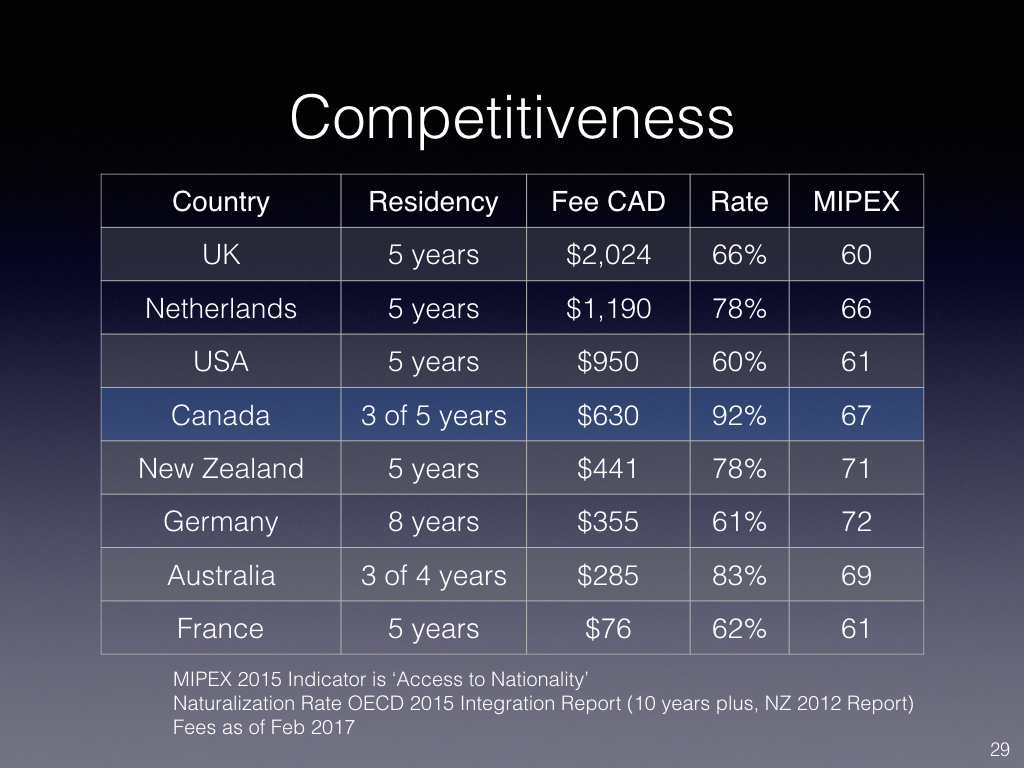
Cost of British citizenship for children is now 22 times more expensive than Germany | The Independent

I had not done the comparison of fees for children so the data in this article is revealing. The last time I checked, UK was also the most expensive for adults:

The Government is under pressure over the “astronomical” rise in the cost of British citizenship for children, which is now 22 times more expensive than in Germany.

Costs to register a child’s citizenship application have soared by 153 per cent in the last seven years, from £386 in 2010 to £973 today.

Scores of youngsters descended on Westminster on Wednesday morning with Citizens UK in protest against the fee, which sees many children unable to become British citizens despite having a legal right.

The fee is considerably higher than in other European countries, with the figure standing at 80 euros in Belgium, 55 euros in France and just 51 euros in Germany.

Each application costs the Home Office £386, meaning the department makes a £586 profit per child registered. With 40,537 applications made in the year to September 2017, the Home Office is expected to make almost £24m this year from children registering for citizenship.

The soaring costs mean a family with three children who have come from abroad and settled in the UK for 10 years, accessing citizenship for all members, including those born here, would have paid out more than £15,000 to be “naturalised” as British citizens, taking into account all migration fees.

Many of these families suffer in-work poverty due to their low wages, so are unable to afford the cost of citizenship, which can prevent children from fully participating in the life of their community, experts warn.

There are an estimated 120,000 “undocumented” children across the UK, more than half of whom are legally entitled to a UK passport. Many are unaware of their status until they apply to university, try to open a bank account or need a passport for foreign travel, according to Citizens UK.

Anne-Marie Canning, director of social mobility and student success at King’s College London, said this can lead to problems when youngsters wish to go into higher education, with many facing difficulties due to not having the correct documents to access student loans.

“There are a large number of students in Greater London who are unable to access university because they are locked out of the student loans system due to paperwork,” she said.

Revd Mother Ellen Eames and school children singing carols outside the Home Office. Hundreds delivered Christmas cards to Secretary of State Amber Rudd asking her to cut the cost of British Citizenship (James Asfa @ Citizens UK)
“We’ve heard stories of parents having to pick which of their children’s paperwork they process so they can access student finance, as they cannot afford to do it for all of their children. We and other universities in London and across the UK are concerned about this issue and have made scholarships available for these learners.

“If the Home Office reduced their fees it would enable more children and talented young people to secure their papers and access higher education like other students.”

Citizens UK leader Fiona Carrick Davis said: “Over the past few years Citizenship fees have risen astronomically and far exceed those of other European countries.

“Many of these children were born in the UK or have spent much of their lives in the UK and have a legal right to citizenship. This is their home, they are British in all respects except they don’t have Citizenship.

via Cost of British citizenship for children is now 22 times more expensive than Germany | The Independent

Census 2016: Where is the discussion about Indigenous education? John Richards

Valid points:

Recently, Statistics Canada released the final batch of results from the 2016 census. It included education statistics for Canadians – including Indigenous Canadians.

Perhaps Indigenous education outcomes are the most important findings in this final batch, and among Indigenous education outcomes, perhaps the most important are high school completion results among young adults. They provide a snapshot of how Canada’s K-12 school systems are performing. For the record, among non-Indigenous young adults (20-24) in 2016, 92 per cent have at least a high school certificate. (Canada is above the overall OECD average.) Among Métis, 84 per cent have completed high school. Among First Nations young adults living off reserve, 75 per cent. But among those living on reserve, only 48 per cent have done so – less than half.

Regardless of race, children who do not complete at least high school are unlikely to gain regular employment and are probably doomed to poverty as adults. Arguably the best way to promote reconciliation between Indigenous and “settler” populations is to close unacceptably large education gaps, starting with high school.

Admittedly, both on and off reserve, First Nations results are five to six percentage points better than in the 2011 census. However, if any other sizable group of young Canadians realized such large high school completion gaps relative to the Canadian average, there would be a hue and cry.

Earlier in the decade, there was. Shawn Atleo, at the time national chief of the Assembly of First Nations (AFN), spoke eloquently about the importance of education. Despite some serious disagreements between them, Atleo and then-prime minister Stephen Harper succeeded in negotiating legislation for the organization of reserve schools, plus a large increase in federal funding. Rather than look at the Atleo-Harper agreement as a glass half-full – which could be topped up – most chiefs and Liberal MPs denounced their efforts. Atleo resigned, and Harper let the legislation die when the election writ was issued in 2015.

While I think the legislation was a decent compromise, perhaps I am wrong and the legislation deserved to die. In 2016, the new, Liberal government quietly increased funding for reserve schools in line with the Atleo-Harper agreement, but there is little evidence of urgency on this file from either Ottawa or most Indigenous leaders. Among the 94 “calls to action” of the Truth and Reconciliation Commission (TRC), only seven concerned K-12 education and only one referred explicitly to the provinces, the order of government responsible for almost all Indigenous students in high school.

It is important to realize that only half the Indigenous population are “registered Indians” entitled to live on reserve, and fewer than half of those “registered” actually live on reserve. Since there are few on-reserve high schools, most children living on reserve attend provincial high schools.

The AFN, the TRC and everyone else involved in K-12 education should be raising a hue and cry with provincial governments and their education ministries. The census shows which provinces deserve the most aggressive prodding. Among the six with large Indigenous student cohorts (Quebec to British Columbia), B.C. stands out as by far the best, Manitoba as the worst. In 2016, 70 per cent of on-reserve First Nations young adults in B.C. had completed high school; in Manitoba, only 36 per cent. In B.C., among First Nations young adults living off reserve, 81 per cent had a high school certificate; in Manitoba, 61 per cent. Some interprovincial differences are due to variations in social conditions – but only some.

As a generalization, both on-reserve and provincial schools are doing things better in B.C. than in the other provinces. Not perfect, but better. While B.C. has no “silver bullet” to close the gaps, it can point to many incremental initiatives over the past quarter-century that, cumulatively, have succeeded.

If the on-reserve high school completion rate rises six points every five years, then in 35 years it will match the rate for non-Indigenous young adults. That’s a long time to wait.

via Census 2016: Where is the discussion about Indigenous education? – The Globe and Mail

Committee urges federal government to repeal law that bans disabled immigrants

It will be interesting to see what issues emerge in implementation consultations with the provinces given that they have to foot the bill. Good however to see some data on the numbers and anticipated funding requirements:

A parliamentary committee has recommended Ottawa repeal a provision in the law that bans people with disabilities and excessive health needs from immigrating to Canada.

In a groundbreaking report on the controversial practice, the standing committee on citizenship and immigration said the excessive medical demand clause goes against the United Nations Convention on the Rights of Persons with Disabilities and is out of touch with Canadian values.

However, those who pose risks to public health and public safety should still be barred from being admitted to Canada, said the committee report, released Wednesday.

“Our immigration laws unjustifiably violate human rights of certain would-be newcomers to Canada and this is inconsistent with the modern values Canadians associate with contemporary human rights protections,” said the committee in a 76-page report.

“Canadians value diversity and inclusiveness and it should be mindful of all the abilities and contributions of its citizens, newcomers and potential immigrants as it moves forward with reviewing the medical inadmissibility.”

The recommendation was applauded by rights groups who have criticized what they call discriminatory treatment against people with disabilities.

“I have seen how the application of this provision has caused a great deal of hardship over the years. This provision has been a barrier to family reunification for many Canadian families,” said Toronto immigration lawyer Lorne Waldman. “It has also prevented many qualified immigrants from settling in Canada.”

Under the medical inadmissibility provision of the immigration law, which does not apply to refugees, medical demand is found to be excessive if it exceeds the average annual health care costs for a Canadian, which is currently estimated at $6,655 a year.

In 2016, there were 21 exemptions issued to overcome medical inadmissibility out of 995 applications deemed inadmissible, according to the Immigration Department. The main conditions included chronic kidney problems, intellectual disability, developmental delays, autism and being HIV-positive.

Advocates for foreign caregivers said some 150 foreign caregivers were denied permanent residence in 2014 alone because a dependant child was deemed medically inadmissible. Temporary foreign worker Mercedes Benitez, for example, was slapped with a medical inadmissibility opinion this year because her 18-year-old son is developmentally delayed.

“Denying permanent residency to entire families was never fair or just, thousands of people have suffered under this law already and hundreds of families are waiting to be reunited. There is no time for delay. It is time to repeal this law,” said Anna Malla of Toronto’s Caregivers Action Centre.

Immigration officials said the total number of medical inadmissibility cases amount to about 0.2 per cent of all applications (or between 900 to 1,000 individuals), representing savings of at least $135 million over five years — or 0.1 per cent of all provincial and territorial health spending in 2015.

Although the law allows exemptions at the discretion of immigration officials, they are determined on a case-by-case basis and applicants must prove the disabled individual would not cause excessive burden on Canadian taxpayers and they have a solid “mitigation plan” to care for the person.

“It is easy for MPs on the committee to say this is a good idea because it is the provinces that pay for the health care,” said Janet Dench of the Canadian Council for Refugees, which supports the repeal. “The recommendation is significant because it’s moving the dial further than what the expectations are.”

Admitting immigrants with excessive medical demands is a polarizing issue and even provinces fail to come to consensus on this issue.

During the public hearings by the standing committee, the Saskatchewan government insisted that the current policy “is the best option for ensuring that Canadians continue to have timely and quality access to health, education and social services.”

Others like Newfoundland and Labrador and Nunavut said the excessive demand provision is “unfair and unjust” considering immigrant applicants’ long-term contributions to Canada.

“Canada’s immigration system needs to ensure that Canada continues to attract the brightest and best newcomers to this country,” said MP Rob Oliphant, chair of the committee. “If (renowned physicist) Stephen Hawking wanted to immigrate to Canada, he would not be allowed under the current provision of the law. This is not what Canadians want.”

The report also recommended Immigration Minister Ahmed Hussen continue consultations with provinces regarding the implementations of the repeal. “This is not for permission, but for consultation,” said Oliphant.

Although Hussen has yet to officially respond to the parliamentary report, he has said the law has to be changed because it’s against the government’s policies to move toward “an accessibility agenda.”

via Committee urges federal government to repeal law that bans disabled immigrants | Toronto Star

Americans revoking travel visas from visitors who plan to claim asylum in Canada

Another push factor for asylum seekers:

American authorities say an ongoing operation along their northern border has led them to revoke U.S.-issued travel visas for thousands of people, most of whom were headed to Canada to claim asylum.

Some, according to a U.S. State Department report, are associated with terrorist groups.

The revocations happened as part of what’s called Operation Northern Watch, which focuses on criminal activity such as visa fraud, human smuggling and terrorist threats at the Canada-U.S. border.

Since the operation began in January 2015, authorities have revoked approximately 2,400 visas that were issued from 85 different American diplomatic posts abroad.

“Although some suspects have committed crimes in the United States, the vast majority of the individuals referred through Operation Northern Watch are individuals intending to claim asylum in Canada or have already claimed asylum,” reads the annual report of the State Department’s diplomatic security service (DSS).

“Included in this group were individuals with ties to designated terrorist organizations.”

In an email, a U.S. State Department official told CBC News the DSS is unable to release information about the terrorist groups and any alleged ties people may have had with them.

The DSS also would not specify how many of the revoked visas belonged to people headed to Canada.

“When speaking to law enforcement, some of the identified subjects admitted that they either attempted to claim asylum in Canada or stated that it was their intention to claim asylum in Canada. For others, the diplomatic security service had reason to believe that they planned to claim asylum in Canada,” wrote the official.

The DSS says every prospective traveller to the United States undergoes extensive security screening but that in some cases “derogatory information” surfaces after someone enters the country.

In late October, Public Safety Minister Ralph Goodale told CBC News how Canadian officials had identified trends where documents identified from certain U.S. embassies and consulates are being misused.

“We have asked them to go back upstream and examine the pattern of these travel documents being issued and how come the people to whom they were issued appear to have had no intention of staying in the United States, but were simply using the documents as vehicles to get into the United States and then make a beeline for the Canadian border,” he said at the time.

Undermines narrative

National security expert Christian Leuprecht said Operation Northern Watch demonstrates how the U.S. understands and is acting on loopholes in its travel visa system.

“At the moment, the Americans realize there’s a Canadian dimension to this,” said Leuprecht, who teaches at Queen’s University and the Royal Military College in Kingston, Ont.

Leuprecht said the annual report also undermines the long-standing narrative that people with ties to terrorist organizations easily enter Canada and head to the United States.

“There’s not really much of a problem in terms of people coming from Canada to the U.S., certainly not since 9/11, because of all the measures we’ve put in place. But we continue to have a challenge with people who are inadmissible and who have ties to illegal organizations, who find their way to the United States and then make their way to Canada,” he explained.

Karine Côté-Boucher, an assistant professor at the University of Montreal criminology school, cautions that terrorist ties aren’t always as scary as they sound.

“What are those ties? To know someone or [be] related to [someone], is sometimes enough to put you on a terrorist watch list. We have kids in Canada who are on no-fly lists right now,” she said.

Côté-Boucher added that just because someone used criminal means to enter Canada, does not mean they intend to do harm.

“Do they have criminal intent? That’s different, right? That’s a different question. There’s nothing in there that suggests to me that people have criminal intent in Canada,” she explained.

Travel visa harmonization

But Leuprecht believes, given the ongoing pattern of human migration, that it’s time for North American leaders to take a co-ordinated approach to travel visas to prevent people from abusing the travel visa system.

After all, he said, Canada and the U.S. already share data on land, sea and air ports of entry.

“We probably need to start sharing data on people who request visas into North America, show that we can jointly assess whether the claims that people are making and the intelligence people are providing are effective, because we can see that people are trying to exploit the travel regime,” he said.

For her part though, Côté-Boucher said she can’t see a good reason to give up sovereignty over who gets to come to Canada. She explained how she feels Canada’s tight border control mechanisms are partly responsible for the rise in irregular border crossings by migrants who are looking for a safe place to live.

“We have introduced so many border control mechanisms in North America right now that we have forced people to go through human smuggling networks, to go through visa fraud,” said Côté-Boucher.

As for Operation Northern Watch, the DSS initiative has already expanded beyond its offices in New York State to Minnesota and Detroit as well as its regional security offices in Ottawa, Montreal, Vancouver and Toronto, where it works with Canadian authorities.

No one from the Canadian departments of Public Safety or Immigration responded to requests for more information about the operation.

via Americans revoking travel visas from visitors who plan to claim asylum in Canada – Politics – CBC News

Senate passes bill to remove mention of ‘barbaric cultural practices’ from Harper-era law

Good.

For all the right reasons: keeping the substance while removing the identity politics bumper sticker title (Senator Salma Ataullahjan characterization of the short title as “incendiary and deeply harmful, as it targets a cultural group as a whole rather than individuals who commit the specific acts” worthy of note.

Assume the Liberal government may be considering the same approach with FGM and the upcoming citizenship guide (Conservative MP Rempel’s high profile efforts to press the issue with Minister Hussen ups the stakes):

The Senate has approved a bill that would remove mention of “barbaric cultural practices” from a law that outlaws forced marriage.

Liberal Sen. Mobina Jaffer introduced the bill in December 2015, shortly after the Liberals won the federal election and less than six months after the previous Conservative government passed the so-called “Zero Tolerance for Barbaric Cultural Practices Act” into law.

In a speech introducing her bill — which does nothing more than remove the title of that law — Jaffer said the use of the term “barbaric” is “insulting to cultures in Canada.”

“Can we reasonably call terrorists barbaric? Yes. Are certain acts against humanity barbaric? Yes. Would any reasonable person agree with these points? Yes. Do I agree with these points? Yes,” she said at the time.

“The issue here, frankly, is the pairing of the words ‘barbaric’ and ‘cultural.’ By pairing these two words, we are instead removing the agency from the individual committing an action that is clearly wrong and associating it instead with a cultural group at large. We are implying that these practices are part of cultures and that these cultures are barbaric.”

The Conservative law, called Bill S-7 when it went through parliament, sought to address the issue of forced marriage in a few ways, including by adding polygamy as a reason to deny someone’s admission to Canada, by setting 16 as the minimum age for marriage and by creating new offences related to forced and underage marriage.

It also removed provocation by “wrongful act or insult” as a partial defence in murder cases. The legislative summary for the bill cites a 2006 case at the Ontario Court of Appeal in which a man accused of killing an allegedly unfaithful wife cited “family honour” in arguing the defence of provocation was relevant. The court disagreed and said the premise that violence against women is sometimes accepted is “antithetical” to fundamental Canadian values.

The law itself remains subject to criticism from some quarters. Just this week, during a debate on archaic elements of the Criminal Code, Green Party leader Elizabeth May noted in the Commons that Bill S-7 had made illegal, or recategorized, some things that were already illegal. “I believe that the Zero Tolerance for Barbaric Cultural Practices Act belongs in the same category as banning witchcraft,” she said. (A bill going through parliament now removes pretending to practise witchcraft as a criminal offence.)

However, there is some cross-partisan consensus on the law’s title. Conservative Sen. Salma Ataullahjan agrees with Jaffer that “barbaric” is a problematic word.

The short title, “in my view, is incendiary and deeply harmful, as it targets a cultural group as a whole rather than individuals who commit the specific acts,” Ataullahjan said Monday evening in the Senate.

“Through conversations with my community, I heard from most that they felt the short title was directed solely at them and that from their perspective it served only to further stigmatize and alienate them from the community at large.”

This isn’t the first time a politician has taken issue with such language. When he was a backbench MP in 2011, now-prime minister Justin Trudeau made headlines for challenging the Conservative government’s use of the term in Canada’s citizenship guide, arguing the use of the term “barbaric” to describe “cultural practices” was not neutral enough.

“My problem with the use of the word barbaric is that it was chosen to reassure Canadians rather than actually change unacceptable behaviours,” he said on Twitter at the time, later clarifying that, yes, he did think that “all violence against women is barbaric.”

Trudeau repeated the word again last week as he responded to a question from Conservative immigration critic Michelle Rempel, taking issue with the government’s decision to remove a line about the illegality of female genital mutilation from the citizenship guide.

“We will continue to lead the way, pushing for an end to these barbaric practices of female genital mutilation, everywhere around the world and here in Canada,” he said.

Jaffer’s bill awaits first reading in the House of Commons.

via Senate passes bill to remove mention of ‘barbaric cultural practices’ from Harper-era law | National Post

Will Robots Take Our Children’s Jobs? – The New York Times

Good read by Alex Williams on the occupations most likely to be threatened and the coming disruption:

But artificial intelligence is different, said Martin Ford, the author of “Rise of the Robots: Technology and the Threat of a Jobless Future.” Machine learning does not just give us new machines to replace old machines, pushing human workers from one industry to another. Rather, it gives us new machines to replace us, machines that can follow us to virtually any new industry we flee to.

Since Mr. Ford’s book sent me down this rabbit hole in the first place, I reached out to him to see if he was concerned about all this for his own children: Tristan, 22, Colin, 17, and Elaine, 10.

He said the most vulnerable jobs in the robot economy are those involving predictable, repetitive tasks, however much training they require. “A lot of knowledge-based jobs are really routine — sitting in front of a computer and cranking out the same application over and over, whether it is a report or some kind of quantitative analysis,” he said.

Professions that rely on creative thinking enjoy some protection (Mr. Ford’s older son is a graduate student studying biomedical engineering). So do jobs emphasizing empathy and interpersonal communication (his younger son wants to be a psychologist).

Even so, the ability to think creatively may not provide ultimate salvation. Mr. Ford said he was alarmed in May when Google’s AlphaGo software defeated a 19-year-old Chinese master at Go, considered the world’s most complicated board game.

“If you talk to the best Go players, even they can’t explain what they’re doing,” Mr. Ford said. “They’ll describe it as a ‘feeling.’ It’s moving into the realm of intuition. And yet a computer was able to prove that it can beat anyone in the world.”

Looking for a silver lining, I spent an afternoon Googling TED Talks with catchy titles like “Are Droids Taking Our Jobs?”

In one, Albert Wenger, an influential tech investor, promoted the Basic Income Guarantee concept. Also known as Universal Basic Income, this sunny concept holds that a robot-driven economy may someday produce an unlimited bounty of cool stuff while simultaneously releasing us from the drudgery of old-fashioned labor, leaving our government-funded children to enjoy bountiful lives of leisure as interpretive dancers or practitioners of bee-sting therapy, as touted by Gwyneth Paltrow.

The idea is all the rage among Silicon Valley elites, who not only understand technology’s power, but who also love to believe that it will be used for good. In their vision of a post-A.I. world without traditional jobs, everyone will receive a minimum weekly or monthly stipend (welfare for all, basically).

Another talk by David Autor, an economist, argued that reports of the death of work are greatly exaggerated. Almost 50 years after the introduction of the A.T.M., for instance, more humans actually work as bank tellers than ever. The computers simply freed the humans from mind-numbing work like counting out 20-dollar bills to focus on more cognitively demanding tasks like “forging relationships with customers, solving problems and introducing them to new products like credit cards, loans and investments,” he said.

Computers, after all, are really good at some things and, for the moment, terrible at others. Even Anton intuits this. The other day I asked him if he thought robots were smarter or dumber than humans. “Sdumber,” he said after a long pause. Confused, I pushed him. “Smarter and dumber,” he explained with a cheeky smile.

He was joking. But he also happened to be right, according to Andrew McAfee, a management theorist at the Massachusetts Institute of Technology whom I interviewed a short while later.

Discussing another of Anton’s career aspirations — songwriter — Dr. McAfee said that computers were already smart enough to come up with a better melody than a lot of humans. “The things our ears find pleasant, we know the rules for that stuff,” he said. “However, I’m going to be really surprised when there is a digital lyricist out there, somebody who can put words to that music that will actually resonate with people and make them think something about the human condition.”

Not everyone, of course, is cut out to be a cyborg-Springsteen. I asked Dr. McAfee what other jobs may exist a decade from now.

“I think health coaches are going to be a big industry of the future,” he said. “Restaurants that have a very good hospitality staff are not about to go away, even though we have more options to order via tablet.

“People who are interested in working with their hands, they’re going to be fine,” he said. “The robot plumber is a long, long way away.”

via Will Robots Take Our Children’s Jobs? – The New York Times

Les minorités visibles se sentent moins en sécurité que les autres

GSS Selected Indicators Police Perception

Not surprising in the current climate but somewhat more so given that the GSS data dates from 2014:

Les minorités visibles – surtout les Arabes et les Asiatiques occidentaux – se sentent moins en sécurité que les autres au pays, révèle mardi une analyse de Statistique Canada.

Selon cette étude portant sur les perceptions des Canadiens à l’égard de leur sécurité personnelle, réalisée sur la base des données de 2014, les personnes ayant affirmé appartenir à une minorité visible étaient moins susceptibles que les autres de déclarer se sentir tout à fait en sécurité lorsqu’elles marchent seules dans leur voisinage quand il fait noir.

Elles n’étaient que 44% à se sentir en sécurité, par rapport à 54% pour les Canadiens qui ne sont pas des minorités visibles.

Cette notion de «perception de sécurité» est évidemment différente du taux réel de criminalité observé.

Statistique Canada a bien noté que les habitants des grandes villes se sentent généralement moins en sécurité que ceux des petites localités, et que la majorité des personnes se décrivant comme minorités visibles résident dans les grands centres. Même en tenant compte de ce facteur, les minorités visibles étaient moins susceptibles de déclarer se sentir en sécurité que les autres.

Parmi les différents groupes de minorités visibles, les Arabes (15%) et les Asiatiques occidentaux – par exemple les Iraniens et les Afghans – (16%) étaient les plus susceptibles d’indiquer ne pas se sentir en sécurité lorsqu’ils marchent seuls le soir.

Chez les femmes arabes ou asiatiques occidentales, cette proportion était encore plus élevée, à 25%.

Il s’agit d’un changement par rapport à 10 ans plus tôt, alors que les Arabes et les Asiatiques occidentaux affichaient des sentiments de sécurité semblables à ceux des autres groupes de minorités visibles, note l’organisme fédéral de statistiques.

De même, parmi les principaux groupes religieux, les musulmans (14%), en particulier les femmes musulmanes (21%), étaient aussi les plus susceptibles de dire qu’ils ne se sentaient pas très ou pas du tout en sécurité.

«Certaines études suggèrent que les crimes haineux peuvent avoir une incidence sur le sentiment de sécurité de l’ensemble de la communauté ciblée et non seulement sur la victime directe», note l’organisme fédéral de statistiques. Et puisque les plus récentes données policières font état d’une augmentation du nombre de crimes haineux ciblant les Arabes et la population musulmane, cela pourrait expliquer en partie le fait que les Arabes et les Asiatiques occidentaux soient maintenant plus susceptibles que les autres membres des minorités visibles de déclarer ne pas se sentir en sécurité lorsqu’ils marchent seuls quand il fait noir», est-il écrit, études à l’appui.

via Les minorités visibles se sentent moins en sécurité que les autres | Stéphanie Marin | National

Forget sovereignty, a new political divide is ready to split Quebecers – Macleans.ca

New political fault lines? Or just another variation of identity politics?

The divisions that once defined Quebec are dissolving before the eyes of its oldest political parties. Less than a year before the next election, fear of another referendum—or desire for one—is no longer top of voters’ minds, challenging the raisons d’être of both the ruling federalist Liberals and their rivals, the separatist Parti Québécois. Freed from the old worries, though, Quebecers might soon be following the worldwide trend of right-left polarization, splitting along populist and progressive lines.

The Liberals were elected with a majority in 2014 after the PQ’s attempt to capitalize on Quebec’s decade-long identity debate with the Charter of Quebec Values. It will go down as one of the worst misplays in the province’s political history, says François Pétry, a Université Laval political scientist, because much as they like debating the value of state secularism, Quebecers are disturbed by the idea of fighting with each other.

Now, after three years of focusing on the province’s economy, and pulling it out of deficit, Premier Philippe Couillard is wading into that same territory. Bill 62, a new law banning face coverings while receiving public services, was championed by the Liberals, and is already subject to two court challenges.

 It is drawing ire from all sides. Civil liberties advocates say it unfairly targets a tiny portion of Muslim women, while the nationalist opposition parties, Coalition Avenir Québec (CAQ) and the PQ, say it doesn’t go far enough. Premiers across the country have denounced it and Prime Minister Justin Trudeau has said the federal government is studying legal ways it could join the chorus. “It’s not a good initiative, purely on the electoral front,” Pétry says, adding the law figured nowhere in the Liberals’ election platform. “If you start to create conflicts between Quebecers, [you’re] probably going to suffer the consequences.”
It’s one of the few mistakes Couillard has made, according to Pétry, who tracks politicians’ promises and says Couillard has kept more of his than any premier in recent Quebec history. That and the government’s strong fiscal performance makes the Liberals’ recent slump in the polls a paradox. The most recent by Leger, published in October, had the Liberals running second to the four-year-old, right-of-centre CAQ on the question of voting intentions, with 29 per cent support compared to 34 per cent for the CAQ.

Couillard may be paying, says Pétry, for ethics blunders made by the party under its former leader, Jean Charest, which have tainted how voters view the party. What’s more, the Liberals have been in power since 2003, save for a two-year stint by the PQ under Pauline Marois, leaving many antsy for change.

“For the first time in 40 years, a party other than the PQ and the PLQ could be in power, and that’s a real feat,” says Dan Pelletier, a 45-year-old Laval security guard who plans to vote CAQ in the next election. Pelletier says he’s for legislation like Bill 62, as long as it’s done “with respect for the [minority] communities that live with us, without becoming authoritarian.”

Still, the CAQ, which has been criticized for sowing us-versus-them political division, has vowed to enact even further-reaching religious attire legislation, which would put Quebec at greater odds with the rest of the country. It’s a prospect that worries Emilie Nicolas, co-founder of Québec Inclusif and a Ph.D. candidate in anthropology at the University of Toronto, who says Quebec has seen “a progressive normalization of distrust of Muslim communities” since the early 2000s.

Discussions surrounding religious accommodations have long been placed in the context of Quebec’s separating of church and state in the 1960s. Some say that watershed moment can no longer be used to explain Quebec’s unease with those different from its French settlers. “In this day and age no society is an island,” says Arjun Tremblay, a postdoctoral fellow at the Université du Québec à Montréal who studies the politics of multiculturalism. He doubts any Quebec leader can steer clear of addressing identity for long—it “strikes an emotional chord in a lot of people,” he says, “and can be used to mobilize segments of the electorate.”

Tremblay, like others, points to the Trump administration’s “thinly veiled anti-Muslim” immigration and refugee bans. A far-right movement is gaining ground in the province, especially in Quebec City, where less than a year ago a mass shooting at a mosque left six dead and 19 seriously injured. The suspect, 27-year-old Alexandre Bissonnette, was said to have an affinity for Trump and the white nationalist groups supporting him.

The attack fuelled calls for the Quebec government to launch a formal commission looking into systemic racism in the province. But a month after it launched, Couillard changed its focus and name, ridding it of terms of reference relating to systemic racism in favour of vaguer language on discrimination and integrating immigrants. Nicolas says the move, compounded by Bill 62, shows how out of touch Quebec politicians are with the appetite among young voters to address social justice issues. “Millennials are not that young anymore,” she says, “and it turns out that they can vote if they feel like it makes a difference.”

Case in point: the Nov. 5 election of Valérie Plante, the first woman voted mayor of Montreal, who ran on a platform of progressive politics and on her independence from the political establishment. Her cheery demeanour helped. Plante’s predecessor, Denis Coderre, a former Liberal MP and cabinet minister, was seen as arrogant. Quebec’s main parties may be driven and divided by 1990s politics, Nicolas says, but that’s changing, “actually as we speak.”

Whether the Liberals find a way to renew themselves or dig deeper into old debates will determine how they do come October 2018, she predicts. Either way, the old guard remains in place and has 11 months to pick up the pieces. And if there’s one thing the experts agree on, it’s that 11 months in politics is a long time.

via Forget sovereignty, a new political divide is ready to split Quebecers – Macleans.ca

Umberto Eco Decodes the Secret Meaning of the Cell Phone

Fun and stimulating to read:

I wrote a fairly irate article in the early ’90s when cell phones were in the hands of just a few people, but a few who were making train journeys hell. I said, in short, that cell phones should only be allowed for organ transplanters, plumbers, and adulterers. For everyone else, especially in cases where otherwise unremarkable people were mouthing away in trains or airports about stocks and shares, metal section beams, or bank loans, it was more than anything a sign of social inferiority: those in real power don’t have cell phones but twenty secretaries who filter their calls and messages, whereas those who need them are middle managers who have to answer to the CEO at any moment, or small businessmen whose banks need to tell them their account is overdrawn.

As for adulterers, the situation has changed twice since that article: initially they had to forego this extremely personal means of communication since its acquisition gave rise to entirely justifiable suspicion in the mind of their spouses; then the situation changed—everyone had one, so it was no longer cast-iron evidence of an adulterous relationship. Lovers can now use them, unless they’re having affairs with persons who are to some degree in the public eye, in which case their conversations will certainly be tapped. No change with regard to social inferiority, there are still no photos of Bush with his ear to a cell phone, but it’s a fact that the cell phone has become an instrument for communication, and excessive communication, between mothers and children, for cheating in exams, and for photomania. Younger generations are abandoning their wrist watches because they can check the time on their cell phones; added to this is the birth of text messages, of up-to-the- minute news information, of the opportunity now to connect with the internet and receive wireless emails, offering, in their more sophisticated forms, even the functions of pocket computers, so that we’re now in the presence of a phenomenon that is socially and technologically essential.

Can we still live without a cell phone? Given that “living-with-a-cell-phone” means a total acceptance of the here-and-now and a frenzy of contact that deprives us of a single moment of solitary thought, anyone who cherishes their own inner and outer freedom can exploit the very many services it offers, apart from its use as a telephone. At most it can be switched on just to call a taxi or tell those at home that the train is three hours late, but not for being called: all you have to do is keep it switched off. When anyone complains about this practice of mine, I reply with a rather somber argument: when my father died over forty years ago, and therefore long before cell phones, I was on a journey and it was many hours before I could be reached. Well, those hours of delay had changed nothing. The situation would have been no different had I been called within ten minutes. This all means that instant communication provided by the cell phone has little to do with the great questions of life and death; it’s of no use to someone who is studying Aristotle, nor to someone struggling over the existence of God.

Does a philosopher therefore have no interest in a cell phone, apart from it allowing him to carry in his pocket a list of 3,000 books on Malebranche? On the contrary. Certain technological innovations have changed human life to such an extent as to become a topic for philosophical discussion—and just think of the invention of writing, from Plato to Derrida, or the advent of mechanical looms, see Marx. Curiously there has been little philosophical reflection on other technological changes that seem so important to us, such as the car or the airplane, though there has been on the changing concept of speed. But we use the car and the airplane only at certain times, unless we’re a taxi or a truck driver, or a pilot, whereas writing and the mechanization of most of our daily activities has had a radical impact on every second of our lives.

Maurizio Ferraris has written about the philosophy of the cell phone in Where are you? Ontology of the Cell Phone. Perhaps the title raises a hint of light amusement, but Ferrari draws a number of serious reflections from his subject, and involves us in a rather intriguing philosophical game. Cell phones are radically changing our way of life and have therefore become “philosophically interesting.” Having also taken on the role of pocket diary and mini-computer with Web connection, the cell phone is less and less an oral instrument and more and more an instrument for reading and writing. As such, it has become an all-inclusive instrument for recording, and we’ll see how words like “writing,” “recording,” and “inscription” might make a confederate of Derrida prick up his ears.

“I like to recall the tragedy of Dr. Zhivago who, after many years, sees Lara on the tram. He cannot alight in time to reach her, and dies. If both had had mobile phones, how would their tragic story have ended?”
The first hundred pages on the “anthropology” of the cell phone are fascinating even for the non-specialist. There’s a substantial difference between talking on a telephone and talking on a cell phone. On the telephone we could ask whether a certain person was at home, whereas on the cell phone, unless it’s stolen, we always know who is answering, and whether he or she is there, which also changes the quality of intimacy. But with a landline we know where we are calling. Now, with the cell phone, there’s the problem of where the person is. There again, if he or she replies, “I’m right behind you,” but has an account with a cell phone company in a different country, the answer is travelling halfway round the world. Nonetheless, we don’t know where the other person is whereas the telephone company knows where we both are, so that while we can avoid letting the other person know our precise whereabouts, our movements are totally transparent when it comes to Orwell’s Big Brother.

via Umberto Eco Decodes the Secret Meaning of the Cell Phone