Why Immigrant Kids Excel: They are NOT Tiger Parented – New Canadian Media – NCM

Good piece by Dr. Shimi Kang on the myth of the “Tiger Mom” and success:

Su Yeong Kim, an associate professor at the University of Texas, followed more than 300 Chinese-American families for eight years. She looked at why tiger parenting may work for Chinese-American families, when that same harsh parenting style proved damaging to non-Asian children. As it turns out, tiger parenting doesn’t work for anyone. Kim discovered that most Chinese-American parents aren’t really the authoritarian tigers one might expect after reading Battle Hymn of the Tiger Mother. And, more important, harsh Chinese-American parents end up with children who were just as miserable and rudderless as the children of tiger parents from other ethnicities. The children of parents whom Kim classified as “tiger parents” had lower academic achievement and educational attainment, as well as greater psychological maladjustment and family alienation than the children of parents characterized as “supportive” or “easygoing”. The children of supportive parents had the best developmental outcomes, as measured by academic achievement, educational attainment and family integration. These children also avoided the academic pressure, depressive symptoms and parent–child alienation suffered by their tiger peers.

“There is no question that when we measure success as progress from generation to generation, Mexican-Americans come out ahead.” – Researcher Jennifer Lee

In addition, Chinese kids are not even the immigrant group making the biggest leaps in success – Mexican kids are (and they don’t have tiger parents either). In a study published in the Journal of Race and Social Problems, lead researcher Jennifer Lee concluded, “There is no question that when we measure success as progress from generation to generation, Mexican-Americans come out ahead.” When it comes to the rates of college admissions, Mexican children double the rates of their fathers, and triple that of their mothers. When a child, whose parents have never seen the inside of a classroom (except perhaps to come and clean it like my mom and many other immigrant women did), attends post-secondary education that is self–motivation.

Why Immigrant Kids Excel: They are NOT Tiger Parented – New Canadian Media – NCM.
Alberta plans document dump of freedom of information requests

The reaction is almost comical. Too much information, No opportunities for scoops. Do the critics really prefer the federal approach of not releasing, or delaying to the max, information?

But the first two concerns raised by officials strike me as valid:

Sources said the freedom of information co-ordinators were blindsided by the Prentice directive and immediately identified several problems the new policy could create, including:

The potential for privacy breaches.

An increased legal risk for the government if it discloses copyrighted material, or confidential business information.

Backlash from the media, as the new policy would effectively eliminate scoops and undermine long-term investigations.

The inability of the government to justify charging fees for documents that would soon be publicly posted.

Some freedom of information co-ordinators also privately questioned the propriety of Prentice personally ordering a change to policy while the privacy commissioner’s office is conducting an investigation into political interference in freedom of information.

Sources said these concerns were largely ignored. Co-ordinators were told they had to implement the new policy as planned, although legal research had yet to be completed.

I had initially been less sympathetic to the media concerns but listening to journalists discuss the impact on P&P helped me understand the possible implications for scoops and longer-term investigations. But all they need is a window of exclusivity (a week or two) as they should have a head start in knowing what they would be looking for in a way that most would not.

It is a more sophisticated way to manage controversies; flooding, rather than withholding, information. But to make this work, all documents released should be indexed and tagged on Google to ensure easily searchable.

Alberta plans document dump of freedom of information requests – Edmonton – CBC News.

After Attacks, Denmark Hesitates to Blame Islam – NYTimes.com

The debates in Denmark regarding the role Islam played in the recent attacks and the sophisticated response by the Danish Minister for Integration and Social Affairs, Manu Sareen:

Mr. Mann [a former Copenhagen gang member], who is now studying law and works part-time as a counselor to troubled Muslim youths, said Denmark and other European countries needed to defend, not stigmatize, Islam, as only this can combat “street Islam,” a toxic jumble of half-digested lines from the Quran and political passions plucked from the Internet.

Olivier Roy, a leading French expert on Islam, has taken a similar line, telling Information, a Danish newspaper, that Denmark should counter wild strains of Islam imported from the Middle East by building up a “national version of Islam” through state funding for mosques and preachers, just as it funds Denmark’s state church.

But Mr. Sareen, the integration minister, said such an approach would do nothing to “prevent scenes like we saw at the weekend” because young people were just as likely to get radicalized in jail or sitting at home watching videos on YouTube. “The state could finance dozens of mosques, but you would still see people getting radicalized,” he said.

The trigger for extremist violence, added Mr. Sareen, a self-declared atheist and former social worker, is rarely the result of a single cause. “You have a part that is social, part that is psychiatric, part that is brainwashing and part that comes from messages in the mosque or from radical preachers.”

Mehdi Mozaffari, an Iranian-born Danish political science professor, complained that mainstream Muslims and Western governments often play down the powerful pull of Islamist ideology, which mixes piety and politics.

“It is very evident that this ideology is playing a major role,” he said. “Without it we are facing just hooligans. But these people have an ideology that is very strong. It justifies their behavior and identifies their enemy.”

Sharp contrast to the rhetoric and pandering in Canada.

After Attacks, Denmark Hesitates to Blame Islam – NYTimes.com.

Multiculturalism & Interculturalism: The discussion in Québec

Two interesting and detailed blob posts on multiculturalism and interculturalism in Quebec.

The first covers some of the recent debates and some examples by Quebec leaders and commentators on Quebec society and diversity, who would be well advised to follow the author’s advice:

In summary, when talking about Québec and multiculturalism versus interculturalism, it is very important to understand what multiculturalism is, and what interculturalism is.  When famous celebrity opinion-makers and columnists, with very large audiences, contend that multiculturalism does not protect Québec’s society and/or should be invoked as a reasons for sovereignty, I urge you to take a second look at the definitions of these ideologies, what they truly relate to, and keep it all in context before drawing conclusions.

Multiculturalism & Interculturalism: The discussion in Québec – POST 3 of 3 (#182) « Quebec Culture Blog.

The second explores some of the ongoing themes of multiculturalism and interculturalism and the various approaches for greater codification of values and behaviours:

The Parti Québécois learned the lesson that it cannot continuously flog this and every other topic under the sun in the hopes that they will all become the holy grail of political conflict needed to incite public support for sovereignty.   Thus, the Parti Québécois’ has already “backed-off” – and this might just afford the breathing space that multiculturalism needs in order to slowly have its image repaired.

Where is Multiculturalism heading in the next year or two in Québec? (#183)

New anti-terror program for schools adds ‘radicalization’ to three Rs

Sounds like a better approach, given more personal, than some of the government media efforts:

The video series, which received $332,500 in funding, focuses on the tears and unanswered questions of Calgary’s Christianne Boudreau after her 22-year-old son, Damian Clairmont, was killed last year fighting in Syria’s civil war. It also features the regrets and emotional scars of Daniel Gallant, a former white supremacist who bounced around between British Columbia and Alberta but is now based in Kamloops, B.C.

Gallant, who recounts instigating random fights up to nine times a day as a way to manage the rage of childhood abuse, said the power of the videos is in their ability to show the effects of an extremist lifestyle on families, friends and victims.

There are plenty of similarities between the far-right hate groups and those being radicalized by religion, but the most important, he said, is that both are an extreme reaction to an individual’s social isolation.

“In the past I had conscious thoughts in the forefront of my mind that all I needed was connection with people,” Gallant said. “That’s all I wanted and when I wasn’t able to attain that . . . that’s when my violence progressed. I remember sitting on the streets and having thoughts about that.”

Boudreau’s plight may be more familiar to Canadians because of her activism and media visibility in the year since she learned of Clairmont’s death. She has spoken of the need to prevent young, radicalized Canadians like her son from leaving the country and also set up a de-radicalization program to support those efforts.

Despite her professional exterior, it is still painful to watch her sob and sniffle when she asks her dead son how she is supposed to find peace knowing of the violence that filled the final days of his young life and waits for answers she knows will never come.

“What did all this have to do with God?” she asks in the video.

Other Canadian families are still struggling because of children who are currently in Syria or Iraq, or those who are trying to get there, Boudreau said. That hasn’t changed since last October’s storming of Parliament Hill or the hit-and-run that killed a Canadian soldier in the Quebec town of Saint-Jean-sur-Richelieu. In the latter case, Martin Couture-Rouleau, the author of the terror attack, had had his passport revoked after trying to travel to Syria last summer.

“Kids are still leaving on a regular basis. I don’t think people want to admit it or realize it but it’s still happening. Even with all the knowledge that’s out there it’s still happening and we’re still being blindsided,” Boudreau said in an interview.

New anti-terror program for schools adds ‘radicalization’ to three Rs | Toronto Star.

Citizenship minister’s office declines to clarify “hijab” reference

Canadian_Multiculturalism_Integrated_Book_DraftAs noted by John Geddes, Minister Alexander surely knows the difference between a hijab and niqab (mainly worn in Gulf Arab countries) and the burqa (worn in Afghanistan where he lived and worked).

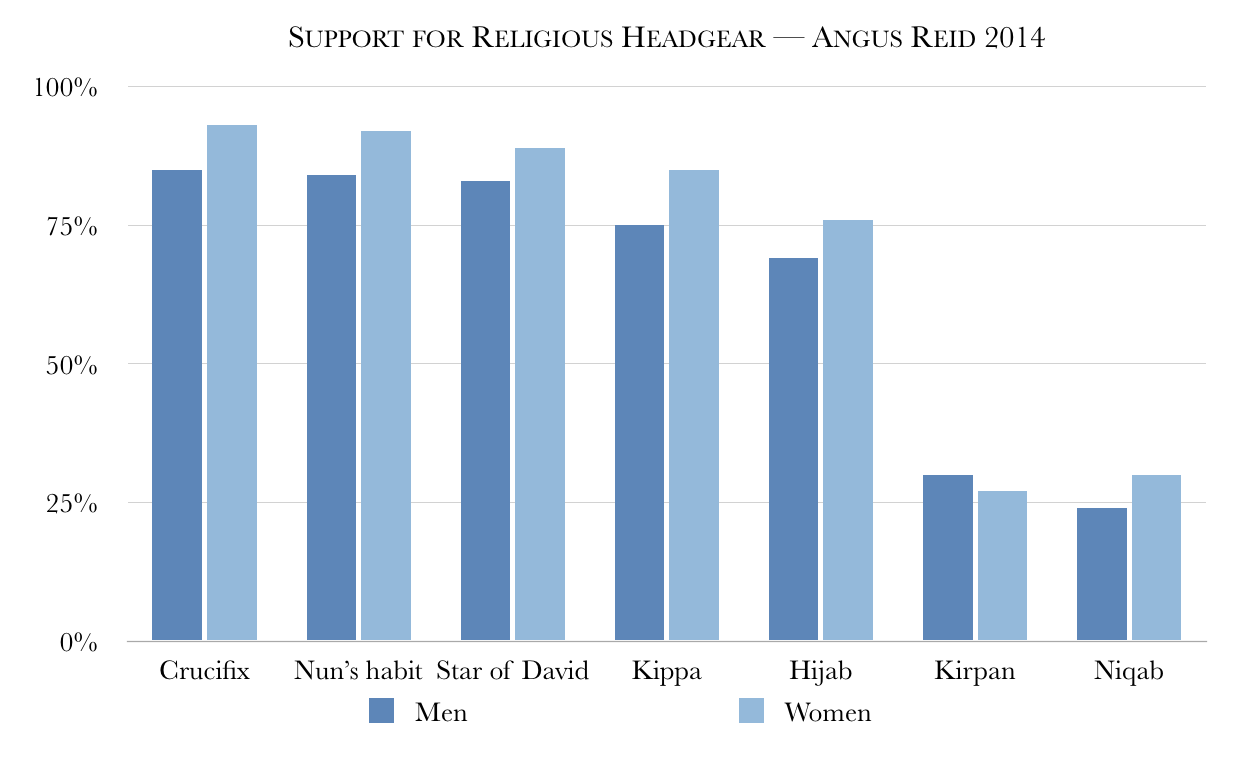
As the above chart shows, Canadians clearly make a distinction between the hijab and the niqab, with the former supported by three-quarters of Canadians, the latter only one-quarter.

Is this part of an emerging Quebec strategy to play on xenophobia? Part of the strategy to play the values card? From another Minister, I might assume an inadvertent slip of the tongue.

And sad to see, after Minister Kenney and the Government, were so strong in their opposition to the PQ’s proposed Charter of Quebec Values:

Based on today’s evidence, you would have been wrong. News that the Conservatives sent out a fundraising email on the topic led to a question from Liberal MP Chrystia Freeland in the House. She focused specifically on how the Tory email mentioned that the government was appealing a judge’s ruling “allowing people to wear the hijab while taking the oath.”

The odd thing about that phrase, which Freeland zeroed in on, is that the word “hijab,” at least in Canada, almost always refers to a Muslim woman’s head scarf that covers only the hair, unlike the “niqab,” which also covers much of the face. Directing her question at Citizenship Minister Chris Alexander, a former diplomat who served in Muslim countries, including Afghanistan, Freeland said, “Surely the minister, of all people, ought to know the difference between a niqab and a hijab.”

But Alexander defended his terminology. He alluded to his experiences “living in a majority Muslim country where the hijab has been used to cover the face of women, just as the niqab and just as the burka has been used under the terrible influence of the Taliban, and other obscure entities, in places like Afghanistan and Pakistan.”

I took that to suggest the government might mean to allow the hijab during the citizenship oath, so long as it wasn’t somehow used to cover the face. To be certain I understood properly, I emailed Alexander’s office for a clarification. The first response said Alexander was referring to “the actual covering of the face during the oath.” Just to be certain, I followed up by asking if, in that case, the hijab would be permitted, if it didn’t cover the face.

Instead of answering that question directly, Alexander’s office forwarded me this statement: “As the Prime Minister said, it is offensive that someone would hide their identity at the very moment where they are committing to join the Canadian family. We are opposed to anything that hides someone’s face when reciting the Oath of Citizenship. We believe the oath should be taken freely, openly and proudly for everyone to hear.”

I don’t think that directly answers my question about the hijab. In fact, I remain puzzled about why Alexander injected such a precise term as “hijab” at all into this already fraught debate. Having used it, though, he should now explain in plain language exactly how he means to be understood.

I assume he means it in a different way than Defence Minister Jason Kenney did, back when he was citizenship minister in 2013, and the Quebec Charter of Values debate was roiling, and he tweeted: ”A child is no less Canadian because she or he wears a kippa, turban, cross, or hijab to school.”

Citizenship minister’s office declines to clarify “hijab” reference.

See How the Wealth Gap Between Whites and Non-Whites Is Getting Wider | TIME

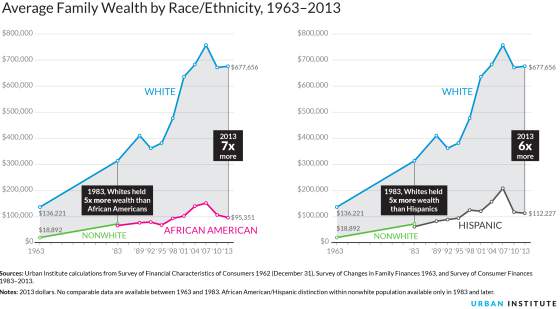
wealthbyrace-avg1Not completely surprising but still striking nevertheless:

The average white family accumulated $677,656 in total assets in 2013, more than six times that of Latino families and seven times that of African-American families, according to a new study that shows ethnic minorities slipping behind in the post-recession economy.

The Urban Institute released a series of graphics that shows the wealth gap between white and non-white families widening from a multiple of five in the early 80’s to multiples of six and seven by 2013.

See How the Wealth Gap Between Whites and Non-Whites Is Getting Wider | TIME.

Why Some New Canadian Communities are More Prominent in Politics – New Canadian Media

Richard Landau on some of the reasons behind greater prominence of some communities over others, highlighting the following factors:

  • Educational Attainment
  • Economic Self-empowerment
  • Longevity & Social Engagement

I think he underplays two additional factors:

  • Community cohesion around ‘homeland’ issues (e.g., Ukrainian Canadians, Canadian Jews);
  • Greater diversity with the community (e.g. among Canadian Muslims with the large number of diverse ethnic origins) or lack thereof (e.g., Haitian Canadians, Italian Canadians).

And of course, as Landau notes correctly, the first-past-the-post system means that communities with higher community concentrations will tend to elect someone from within the community:

Some communities punch far above their weight. For example, if we use political representation as one yardstick, Canada has nearly 500,000 Sikhs (about one and a half per cent) and yet with six MPs, nearly two per cent representation in Parliament. According to the World Sikh Organization of Canada, there are currently 17 elected Sikhs at the provincial and federal levels.

Meanwhile, the close to 1.2 million Muslims in Canada, are vastly under-represented and currently can count amongst themselves only three elected members at the provincial and federal levels along with the Mayor of Calgary.

“Sikhs have been more successful because they tend to concentrate geographically. They are more cohesive as compared to others, especially Muslims. This is not to say there are no internal differences between them.” – Mohammed Ayub Khan

Mohammed Ayub Khan, PhD candidate in the department of political science at McMaster University says Muslims must contend with an immense national linguistic diversity and a lack of effective electoral education in the community. As a result, voting percentages continue to remain low among Muslims.

“Sikhs have been more successful because they tend to concentrate geographically,” Khan says. “They are more cohesive as compared to others, especially Muslims. This is not to say there are no internal differences between them.”

Khan goes on to add that this is exacerbated by an absence of professional media, which can highlight and discuss what the issues are within the Muslim faith community. He also points to negative attitudes, if not outright hostility, from the larger population. He says that while Sikhs come second in terms of unfavourable attitudes, they are able to overcome this due to their geographic concentration.

When a community embraces educational attainment, economic self-empowerment, and to a lesser degree, social engagement with the broad mosaic, it can indeed give itself appropriate representation and a prominent voice in the life of the nation.

Why Some New Canadian Communities are More Prominent in Politics – New Canadian Media – NCM.

All mosques should face ‘Quebec values’ investigation before being allowed to open: CAQ leader

Sigh …

But why stop there? What about churches? Synagogues? Gurdwaras? Is Legault really sure that they also agree or disagree with “Quebec values” as he would define them?

The leader of Coalition Avenir Québec said Tuesday all mosques should be investigated prior to being allowed to open in the province.

François Legault, head of the third-most popular party in Quebec’s legislature, said a public body should be created to investigate people who potentially disagree with so-called Quebec values.

Legault said the body would be able to find out if “applicants [for mosques] have consistently denigrated Quebec values.”

He said municipal authorities could use information collected by investigators in order to deny permits to people wanting to open mosques in the province.

Legault’s comments were in reaction to news that a Quebec town north of Montreal bowed to citizen pressure and denied a zoning change that would have allowed people to build a mosque.

All mosques should face ‘Quebec values’ investigation before being allowed to open: CAQ leader

Graeme Hamilton’s well-put commentary:

Mr. Couillard has criticized Mr. Legault’s proposal to clamp down on speech that runs counter to Quebec values. In the National Assembly Wednesday, Mr. Couillard said Mr. Legault’s plan would affect not just mosques but churches and synagogues. “There exists in Quebec a church that does not allow women to be celebrants,” he said. “There exists in Quebec another church that says women and men must be separated in religious buildings.” He said the CAQ “really likes to talk about Muslims, but religion is a much more complex phenomenon than that.”

But Mr. Couillard has stopped short of condemning Shawinigan’s actions. He simply expressed the hope that a dialogue between municipal officials and Muslim leaders will lead to a solution. Philippe Bégin Garti, a Shawinigan lawyer involved in the mosque project, declined comment Wednesday, saying his group is in talks with the city and seeking “an amicable solution.”

Mr. Legault accused the Premier of giving priority to free speech over other values and said the government’s inaction was sowing fear in the population.

If there is a segment of the population with reason to fear, it is the Muslims who are being told the mere act of worshipping is cause for suspicion. Instead of denouncing the insults thrown at Shawinigan Muslims last week, Mr. Legault sought to score political points by feeding the prejudice.

Shawinigan is a short drive from little Hérouxville. That is where the 2007 adoption of a “code of life” purporting to tell newcomers what’s what helped trigger a full-blown crisis in Quebec, as people objected to the “accommodation” of religious minorities. Then as now, strong political leadership was sorely lacking.

Graeme Hamilton: Quebec politicians playing to ‘irrational fears’ about Islamic extremism

Imams divided on how much scrutiny to give would-be Muslim converts in wake of recent terror charges

Good debate regarding some of the challenges:

Syed Soharwardy, a Calgary imam who founded Muslims Against Terrorism and the Islamic Supreme Council of Canada, says he will publish in the coming weeks a checklist of questions that he thinks all imams should ask prospective converts.

This is not meant to be an interrogation, Mr. Soharwardy said, but rather “passive” questioning aimed at finding out why the person wants to become a Muslim.

“I’m not saying imams should be detectives, but I need to know what kind of person I’m talking to,” Mr. Soharwardy said. “Since many have become Muslim and have shown violent behaviour, I think it is an obligation of our imams to not let Islam be dragged [down] by people who don’t understand Islam.”

It is also “absolutely critical,” he said, that leaders work to stay connected with new Muslims by inviting them to social gatherings and assigning trusted individuals to serve as their mentors.

Aasim Rashid, a spokesman for the B.C. Muslim Association, said the handling of new Muslims can’t be overly prescriptive; otherwise, you run the risk of unfairly stigmatizing them.

“As long as they are accepting Islam for the right reasons I would feel compelled to welcome them warmly and give them the benefit of the doubt,” he said.

He does agree with Mr. Soharwardy about the need to encourage new Muslims to join classes and programs so that they acquire a solid understanding of the religion and are more integrated into the Muslim community.

There is also a need for Muslim leaders to come up with programming that has broader appeal, said Amira Elghawaby, human rights coordinator with the National Council of Canadian Muslims.

One Ottawa mosque held a discussion a few weeks ago about the term “jihad” and it drew hundreds of attendees, she said. But people do not always believe that the topics discussed at sermons are that relevant to them, she said.

Inclusivity is key, said Lorne Dawson, a University of Waterloo expert on radicalization. “Converts to Islam — and especially those who later radicalize — commonly report that while their conversion was encouraged, they did not feel welcome in the often very ethnic mosques and communities with which they tried to associate,” Dawson said in an email.

As a result, they go “searching on and off-line for a Muslim home and that can be the kind of de-cultured fundamentalist forms of Islam associated with the promotion of jihadism.”

Imams divided on how much scrutiny to give would-be Muslim converts in wake of recent terror charges