Some 33 federal ridings with more than 50 per cent visible minority population up for grabs on Oct. 19 | hilltimes.com

Further to the analysis in my book, Multiculturalism in Canada: Evidence and Anecdote, this Hill Times article provides polling results in these ridings along with some riding vignettes that provide colour to the somewhat dry stats:

Based on the transposition of votes analysis conducted by Elections Canada, which shows the results for the new ridings had the boundaries been in place in the 2011 election, Conservatives would have won 17 of the 33, and the NDP and the Liberals would have carried eight each. The analysis also indicated that in 20 of the 33 ridings, the margin of victory for the winning parties would have been 10 per cent or less.

In the Oct. 19 election, there are a total of 338 ridings up for grabs, 30 more than the last election, to reflect the population increase in the country between 2003 and 2012.

Most national polling numbers last week indicated that the three major national parties were in a statistical dead heat. If this trend continues, the next government will be a minority government in which every seat will count.

A Nanos poll on Thursday showed that the Liberals had the support of 31 per cent of decided voters, with the NDP and Conservatives tied at 30 per cent and the Green Party at six per cent.

According to an online national poll by Innovative Research of 2,121 Canadians conducted between Sept. 4 and Sept. 10, the three national parties were running neck and neck with the NDP support at 31 per cent, Liberals at 30 per cent, Conservatives at 28 and the Green Party at six per cent.

In the 33 ridings where the visible minority population is more than 50 per cent, the online poll indicated that the Liberals were leading the pack with 36.6 per cent, the Conservatives next with 33 percent, the NDP at 22.3 per cent and the Green Party at 7.1 per cent.

In an interview last week, Mr. Griffith said the strategic significance of the 33 ridings in this election is evident from the fact that the national party leaders have frequently visited the GTA and Vancouver areas in recent months.

“Leaders seem to be spending a fair amount of time in these ridings. It’s part of every party’s electoral strategy,” said Mr. Griffith.

For those interested in the riding list taken from my book: Visible Minority Ridings and Religious Minority Ridings.

Source: Some 33 federal ridings with more than 50 per cent visible minority population up for grabs on Oct. 19 | hilltimes.com

New Canadians cherish their right to vote, ICC study finds

ICC Reasons for VotingNot surprising and confirms earlier studies but nevertheless important measure of integration and participation, and further reinforces ‘shopping for the ethnic vote’:

The study released this month by the Institute for Canadian Citizenship (ICC) examined political participation of new citizens who received their citizenship between May 2012 and November 2014.

Through focus groups across Canada, it also explored this increasingly important block of voters’ reasons for voting and not voting, as well as their civic engagement beyond the ballot box.

“In 2014, Canada swore in more than 260,000 new citizens. As these people enter the body politic, by definition, they are also changing it. The ICC felt an election year was the perfect moment to examine the ongoing evolution of the Canadian voter,” said Charlie Foran, the institute’s CEO.

“We learned that new citizens believe in political participation, and are finding plenty of ways to become involved. We also learned that they definitely value the vote, and want to overcome any practical barriers that might keep them from casting their ballot.”

The key findings of the report, titled “Ballots & Belonging”:

  • 48 per cent of new citizens felt permanent residents should be allowed to vote in municipal elections;
  • 23 per cent reported having emailed or called an elected official about an issue;
  • 26 per cent had personally spoken with a candidate during their first election;
  • 10 per cent had put a candidate sign on the front lawn;
  • 5 per cent had donated money to a political party or candidate;
  • 12 per cent had attended an all-candidates debate/meeting;
  • 7 per cent had volunteered on a political campaign;
  • 6 per cent had become a member of a political party;
  • 46 per cent cited lack of knowledge of the issues and knowledge of the process as reasons not to vote;
  • 6 per cent said they didn’t vote because of the lack of interest and dissatisfaction with the government or political system.

“ ‘Ballots & Belonging’ speaks to how new citizens feel about the most fundamental marker of democracy — the vote,” said Foran.

Source: New Canadians cherish their right to vote, study finds | Toronto Star

Kelly McParland: Donald Sutherland is from Canada the same way Mike Duffy is from PEI

Good piece by McParland:

The Appeal Court’s reasoning is sound.

“Permitting all non-resident citizens to vote would allow them to participate in making laws that affect Canadian residents on a daily basis but have little to no practical consequence for their own daily lives,” wrote Justice George Strathy.

The decision notes that allowing long-term expats to vote would violate a “social contract” that binds Canadians to laws that they have played a hand in creating.

This makes absolute sense. For every fervent patriot like Sutherland, who presumably lives in the U.S. due to the demands of his acting career, there are tens of thousands, of passport-holders who barely give Canada a thought. At the time the five-year rule was introduced, Canada was in the process of handing out thousands of passports to “investors” who wanted it mainly as a hedge against turmoil in their home country. If you recall, one of Stephen Harper’s earliest international acts as prime minister was a dramatic evacuation of Canadian passport-holders from Lebanon during a confrontation between Israel and Hezbollah forces. It was great theatre, except Canadians learned that thousands of those affected proved to be Lebanese citizens who had met the minimum standards for a Canadian passport before returning home, hanging on to the Canadian document in case of just such an emergency. They knew little about Canada, but without the five-year rule, 50,000 of them would have had the right to vote.

Lebanon is far from the only country where that’s the case. The Vancouver Sun reported in 2013 there were 350,000 residents of Hong Kong holding Canadian passports, and that Asians continue to leave the country in large numbers after completing the minimum requirements. Immigration experts acknowledged many never intended to stay and were merely taking advantage of Canada’s traditional generosity with its citizenship.

The five-year rule may be an inconvenience for Sutherland, who comes across as far less arrogant and self-important than fellow Canadian Neil Young, who prefers jetting into the country just long enough to demand Alberta cripple its economy by getting out of the oil business, before jetting back to California. But both are Canadian the same way Mike Duffy is from Prince Edward Island: it might be where they came from, but it’s not where they live. Even Canada’s Senate now understands that difference.

Kelly McParland: Donald Sutherland is from Canada the same way Mike Duffy is from PEI

And Professor Orwin making a similar point about the link between residency and voting:

Yes, the Charter of Rights proclaims voting a basic right of citizenship. But how far does that right extend? As we’ve already seen, only to the boundaries of one’s riding of primary residence. This is an essential feature of our system. It’s the sacred democratic right of Fort McMurrayites (and conversely of downtown Torontonians) that outsiders not be permitted to vote in their riding. Our representative must be ours, and no one else’s. So while Canadian citizenship may be a necessary condition of voting in a given election, it’s obviously not a sufficient one. This is why it’s mistaken to claim that by denying an expatriate the vote, we are stripping her of anything enjoyed by other Canadians. Rather it’s that by permitting her to vote the current law grants her a right denied to other Canadians. Yes, for five years and no more, but she should be grateful for those years, recognizing (having read this column) just what an anomaly she enjoys.

It’s not just in granting five years of electoral amnesty that the present law is quite generous. It is also so in offering expatriates a varied menu of possible electoral residences. They may choose their last previous Canadian address; but they also enjoy other options equally ungrounded in reality. Let’s face it, once Ms. Choi has decided to live abroad, it is the merest fiction to deem her still resident in my riding. As the years pass this fiction grows ever more glaring, and my neighbours and I increasingly testy. Who is this annoying phantom who pretends to live in our riding and insists on voting there? What does she know or care of our local concerns?

 If I can’t vote in your riding, why should expats vote in mine? 

I’m Canadian – and I should have a right to vote – Donald Sutherland

He forgets that US citizens also have to file US tax returns:

Did you know that? If you don’t live here all the time you can’t vote. Americans who live abroad can vote. They can vote because they’re citizens! Citizens! But I can’t. Because why? Because I’m not a citizen? Because what happens to Canada doesn’t matter to me? Ask any journalist that’s ever interviewed me what nationality I proudly proclaim to have. Ask them. They’ll tell you. I am a Canadian. But I’m an expatriate and the Harper government won’t let expatriates participate in Canadian elections.

But the broader question, for every Donald Sutherland and those like him, there are many more that have a lessor connection to Canada. And there is no way that I can think of that could consistently apply a “connection to Canada” in an administratively fair and efficient manner.

I’m Canadian – and I should have a right to vote – The Globe and Mail.

Are you Canadian enough to vote? – Mark Kersten

Another one of the series of arguments allowing for unlimited voting rights for Canadian expatriates, including having MPs representing overseas constituencies:

Rather than pursuing inward, regressive policies, the government could think creatively. Instead of constructing barriers to democratic participation, what a progressive government could, and should, do is to create a handful of members of Parliament to directly represent Canadians who live abroad. France and Italy already have parliamentarians who represent their respective diasporas. Why not have MPs on Parliament Hill to represent the unique interests and diversity of Canadians living abroad? Surely that could only enrich our democracy.

The arguments of many proponents of extending voting rights to expats have relied on the view that it is unfair to strip voting rights from any tax-paying Canadians living abroad. The assumption is that if you’re contributing money to federal tax coffers, you should be allowed to vote. This may be intuitively persuasive, but there is a danger in taking this argument to its logical extreme. If it were, homeless citizens or some retirees could lose the vote. Paying more taxes surely doesn’t make you “citizen plus,” a better citizen than others. Canadian citizenship, as spelled out in the Charter, is not transactional. We don’t have to buy it.

Still, it is inescapable that the prohibition on long-term Canadian expats to vote in federal elections creates a bifurcated form of citizenship. All Canadian citizens are equal, but if only those living in Canada are allowed to vote, then some are more equal than others.

And while the advocates are all too quick to trot out anecdotes of Canadian expatriates who are connected to Canada in a meaningful way, one could equally draw up a list of those who are not, and likely also find some evidence to buttress the claim that most are not. The tiny number of Canadian expatriates who vote under the current 5-year limit (see Reframing the debate over expat voting: Russell and Sevi, Globe editorial) is illustrative.

Are you Canadian enough to vote? – The Globe and Mail.

Reframing the debate over expat voting: Russell and Sevi, Globe editorial

Reframing_the_debate_over_expat_voting_-_Macleans_caTwo contrasting views on expatriate voting.

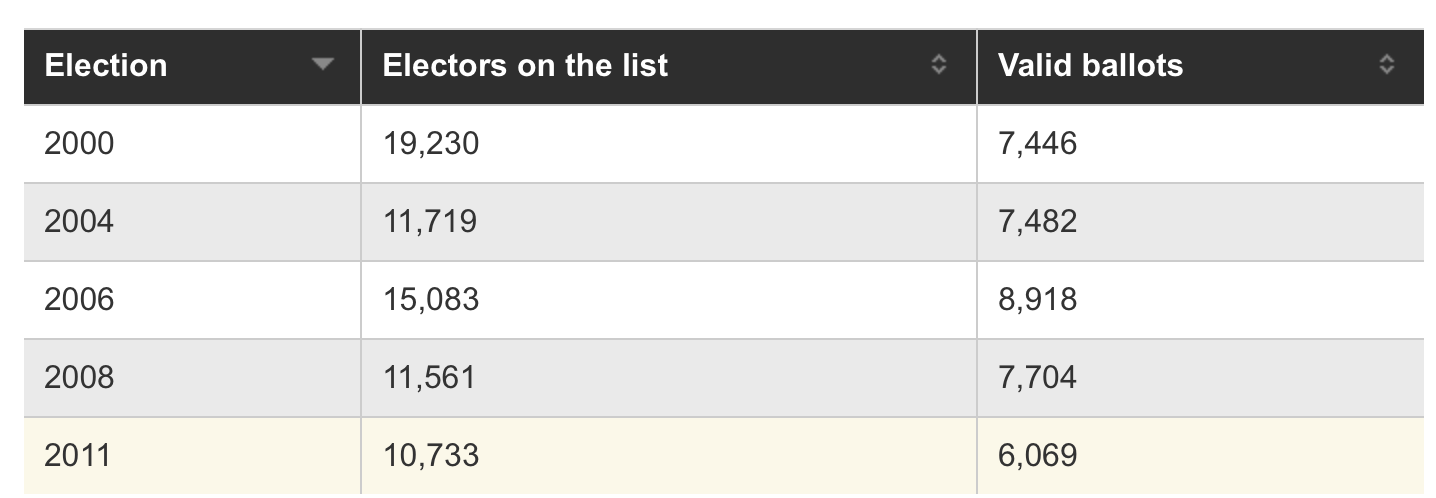
The first, by Peter Russell (a former excellent and insightful professor of mine) and Semra Sevi (who has written before Canadian expatriates should never lose the right to vote), provides useful data on the number of expatriates who actually vote.

The number, as shown above, is minuscule compared to the estimated almost three million Canadian expatriates. The article also has the following international comparisons:

The five-year limitation, as opposed to some other limit, is overly drastic and Canada’s provision is not comparable with similar democracies around the world.

Americans living outside of the country have the right to vote no matter how long they have been abroad providing they pay taxes. The right to vote expires in the United Kingdom after 15 years abroad. To put this into perspective, this is three times longer than what Canada permits even though Canada is part of the Commonwealth.

Australian citizens abroad are allowed to vote so long as they intend to return to Australia within six years. After six years, citizens can renew their status by making an annual declaration of their intention to return “at some point” thereby voting for an indefinite period. In New Zealand, there is a three-year limit but the clock restarts every time citizens visit the country. Moreover, New Zealand extends the right to vote to non-citizen residents from other Commonwealth countries.

The United Kingdom extends similar voting rights to citizens of Commonwealth countries and citizens of the Republic of Ireland. The five-year limit in Canada is an arbitrary number and is unnecessarily onerous. On the surface, it is a year less generous than Australia, but Australians can renew their status by expressing a mere intent to return to the country “at some point” in the future. Canadians, on the other hand, need to resume residency to regain their right to vote abroad.

The right to vote is a fundamental right of citizenship that is protected by the Charter and does not depend on place of residence. The five-year limitation does not conform to the 21st-century demands of globalization. While there is currently an NDP-sponsored bill to repeal the provision that limits voting rights for Canadians abroad as unconstitutional, it is possible that the unconvincing judgment of two Ontario appellate judges could be overturned on appeal to the Supreme Court of Canada—but, alas, not in time to restore democratic rights to the close to a million and a half Canadians living abroad for the fall election.

Reframing the debate over expat voting – Macleans.ca.

Expatriate Voter TurnoutThe Globe editorial takes, correctly in my view, takes the opposite view:

We think the decision is the right one, for three reasons.

First, because our electoral system, based as it is on residence in a particular electoral district, assumes a connection between residence and voting, governors and the governed.

Second, because we live in a world of national borders and laws that do not apply extraterritorially, which means the lives of non-resident Canadians are largely not governed by Canadian law. As Ontario Chief Justice George Strathy put it, “permitting all non-resident citizens to vote would allow them to participate in making laws that affect Canadian residents on a daily basis, but have little to no practical consequence for their own daily lives.”

And third, because reasonable people can disagree, reasonably, over how long a citizen should reside outside of Canada before having her vote suspended. Should the limit be five years? Ten? Two generations? Never? The practical question of setting reasonable limits is best left where the Ontario Court of Appeal left it, in the hands of Parliament.

The Canada Elections Act says that Canadian citizens are entitled to vote in the riding in which they typically reside. However, the Act also says that Canadian citizens living abroad for more than five years cannot vote. There are exceptions for people sent overseas in service to the country, such as members of the Armed Forces.

All of which is not unreasonable. Justice Strathy noted that “residence is a determinant of voter eligibility in all provinces and territories.” If you move from Nova Scotia to Alberta, you can’t continue voting in Nova Scotia in perpetuity.

He also pointed out that “residence is a requirement of the electoral laws of the other Westminster democracies. The U.K., Australia and New Zealand limit the voting rights of non-resident citizens to those temporarily resident abroad.” The maximum time overseas before one loses the vote is 15 years in Britain, six years in Australia and three years in New Zealand. Canada’s current law is fair.

 No, Canadians living abroad shouldn’t get to vote 

Tory bill raises too many barriers for expat Canadian voters: Globe editorial

Unfortunately, all too characteristic of the Government in making it harder to vote (as in the case of Elections Act revisions), even if  maintaining the 5 year rule makes sense:

Last year, an Ontario Superior Court judge struck down a rule that barred citizens living abroad for more than five years from voting in federal elections. The government has rightly appealed that decision, while also introducing legislation that will enshrine expats’ voting rights, but with a twist. Expats will get to vote – it will just be really, really hard.

So hard, in fact, that many of the 2.8 million expats around the globe may well not bother. Others will try but won’t be able to meet the onerous new requirements in Bill C-50.

Under the bill, currently in committee after second reading, Elections Canada will eliminate the international register of electors, the long-established list of expat Canadians eligible to vote federally. In future, expats will have to re-register for each election, and can only do so after the writ is dropped.

That means an overseas Canadian would have about 36 days, the minimum length of an election campaign, to write to Elections Canada to request a ballot, wait while officials examine the extensive paperwork the bill requires, receive a ballot in the mail, make their mark, and then return the ballot by mail.

Critics say many long-time expats won’t be able to produce the new documentation required, which includes proof of the voter’s last Canadian address provided by a Canadian company or government office. The alternative is to find someone in the voter’s last riding who will vouch that the person in question once lived there – a time-consuming process.

The Harper government says the goal of the new rules is to prevent voter fraud, the same canard that it used to justify the Fair Elections Act. There are widespread concerns that as many as 400,000 eligible voters will be unable to cast a ballot in the fall election because of the Fair Elections Act. If Bill C-50 is adopted before Parliament is dissolved, the franchise of thousands of expats could also be compromised.

We are not convinced that the right to vote extends to Canadian who have chosen to live outside the country for decades, or even a lifetime. The government was right to appeal, and we hope a higher court will side with it. But in the interim, that lower court’s decision has to be respected. The bill should not be recognizing a right with one hand, while effectively taking it away with the other.

Tory bill raises too many barriers for expat Canadian voters – The Globe and Mail.

ICYMI: Ontario imams to urge Muslims vote in federal election

Good article on Canadian Muslim voting and the ridings in which it can make a difference:

Of course, Canadian Muslims don’t vote as a united front.

According to an Ipsos Reid exit poll from the 2011 election, 12 per cent of Muslims who voted supported the Conservative party, while 46 per cent voted Liberal, and another 38 per cent voted NDP.

That doesn’t bother Sajan. “Our goal is that all eligible Canadian Muslims vote, period,” she says.

Nevertheless, higher Muslim voter turnout could make a significant difference not only in ridings with high Muslim populations such as Don Valley East and Mississauga Centre, but also in key ridings in Calgary and Edmonton, according to former Liberal MP Omar Alghabra.

“I lost an election by 300 votes,” says Alghabra, who represented the federal riding of Mississauga-Erindale from 2006-08.  “I know from experience that every vote counts.”

According to Statistics Canada, Muslims comprise between 12 and 19 per cent of the populations in 19 federal ridings, 11 in Ontario, six in Quebec and two in Alberta.

Mohammed Ayub Khan, a political science researcher at McMaster University, says one of the reasons that Muslims haven’t been very active at the polls historically is that they haven’t felt especially connected with the issues highlighted by parties.

Another reason may be the apparent rise in Islamophobia in recent years, which has left many Muslim Canadians feeling alienated and unengaged in the political process, says University of Toronto political science professor Katherine Bullock.

For his part, Khan says this year may be different. “2015 may well serve as the watershed event in Canadian Muslim political history” because of the intense focus surrounding Bill C-51 and things like the niqab debate, he says.

“It has really galvanized the various Muslim communities to start a conversation around the issue and consider their options.”

Bullock agrees, and Canadian Muslim Vote hopes to seize on that interest and expand its presence in other cities after this year’s election, translating its campaign materials into different languages to reach as wide a group as possible.

Friday’s launch will see imams from Ajax all the way to Kitchener touting the importance of civic engagement and calling Canada home.

Ontario imams to urge Muslims vote in federal election – Politics – CBC News.

Overseas voters will have to prove citizenship, residency under new rules

While I suspect that the extent of “riding shopping” is quite limited, and the Government provided no numbers to indicate that it is, the basic requirements for voting abroad to provide proof of citizenship and last place of residence in Canada are reasonable.

Interesting that both opposition parties have not condemned these measures off the bat:

A government-issued backgrounder accompanying the bill notes that in Canada, voters “cannot pick and choose their riding,” but are required to cast a ballot in the riding in which they live.”

By contrast, Canadians living abroad do not have to prove any past residence in the riding in which they vote,” it notes.

“It is unfair to allow a person who has never lived in a community to vote on who will represent that community.”

The bill was introduced by Minister of State for Democratic Reform Pierre Poilievre Wednesday afternoon. In a written statement, he said the new rules “will help ensure that only citizens vote, that their votes only count in their home ridings and that they show ID to prove both.”

The bill also seems to be a response to a recent Federal Court ruling that upheld the right of Canadians abroad to vote in federal elections even after being out of the country for five years.

Overseas voters will have to prove citizenship, residency under new rules – Politics – CBC News.

Federal Liberals cultivate Mandarin powerhouse in GTA

This is not good, by any standard, relying exclusively on one ethnic community to win party nominations.

Even if in ethnic communities like Surrey, Richmond, Brampton, Markham etc, most candidates from all parties are from the largest community as part of “Shopping for Votes,” this is not an example to be emulated.

And as noted in the article, this may not help in the election when more than one community’s votes are needed:

By either grand design or ferocious grassroots organization, Toronto’s suburbs are shaping up to be a Mandarin-speaking powerhouse for the federal Liberal Party.

Four ridings around the GTA have Chinese-Canadians candidates, and in sharp contrast to the Conservatives’ top-down ethnic strategy of wooing voters through messaging that appeals to a specific minority, the Mandarin community is fielding its own candidates. In Don Valley North’s nomination contest, scientist Geng Tan upset presumed front-runner Rana Sarkar, a veteran party member and friend of Gerald Butts, Leader Justin Trudeau’s top adviser. Mr. Geng accomplished this by appealing almost solely to a monolithic base of Mandarin-speakers in Mandarin only.

On one hand, this trend represents the essence of the multicultural experiment. Arnold Chan, elected in Scarborough-Agincourt last month, is the GTA’s first Liberal Chinese MP. On the other hand, pursuing a single group for support, as Mr. Geng appears to have done, may alienate other minorities. It strikes critics as anti-pluralistic.

A pivotal figure in this wider political development is Michael Chan, an influential Ontario cabinet minister and fundraiser who stepped outside his daily sphere during June’s provincial election to bolster his community’s voice in the federal party. Mr. Chan’s involvement, along with the number of Chinese-Canadian candidates, indicates the growing demographic power of the Mandarin vote, whose participation has long been seen as dormant. The Conservatives and New Democrats have vowed to conduct open nominations as well – meaning the party leadership does not protect its preferred candidates – clearing the way for other ethnic groups to launch similar campaigns.

In the case of Mr. Geng’s campaign, his website was mostly in Mandarin and was changed to English only after a conversation with The Globe and Mail last week. His membership list, which The Globe reviewed, was composed exclusively of Chinese names.

Federal Liberals cultivate Mandarin powerhouse in GTA – The Globe and Mail.