Ottawa under pressure to recognize Canadian citizenship of soldiers who fought in the First and Second World Wars

A more detailed article than the one in the Star, with more comments than just Don Chapman.

One thought that I have been increasingly pondering is the extent to which the government’s restoration of citizenship to earlier generations of those Canadian descendants in C-3, given that it has no generation limit and a significant number have applied whose ancestors pre-dated Canadian citizenship, would undermine previous government arguments maintaining the 1947 date.

Welcome any thoughts from those with greater legal knowledge than me.

…Ottawa lawyer Charles Gibson, who will lead the federal court challenge, said the government had “created a legal fallacy which will be rebutted easily by the overwhelming evidence that citizenship existed before 1947.”

But Andrew Griffith, a former director general at Immigration, Refugees and Citizenship Canada (IRCC), urged caution in changing the 1947 Citizenship Act, warning the ramifications of doing so would have to be looked at closely by the federal government.

He said whether citizenship predated 1947 is a “legitimate point of discussion,” but changing the government’s official position “can’t be a quick and easy decision.”

IRCC spokesperson Anahita Beladi said the Citizenship Act “introduced Canadian citizenship as a distinct legal status.”

“While the Federal Court of Appeal and the Supreme Court of Canada have confirmed that Canadian citizenship did not exist as a legal status with general application before January 1, 1947, this in no way diminishes the profound sacrifices made by those who served,” she added.

“Their courage, commitment and sacrifice remain an important part of Canada’s history and national identity.”

Source: Ottawa under pressure to recognize Canadian citizenship of soldiers who fought in the First and Second World Wars

The ‘lost Canadians’ of the world wars: Inside the fight to claim citizenship for those ‘willing to die for Canada’

Don Chapman continues his advocacy. Legally, Canadian citizenship only came into being in 1947 and informal recognition of those as “effectively” Canadian, as the maple leaf on their gravestones and the like, is different from formal legislative change:

…Chapman said the petition, which had been signed by more than 475 people as of Monday, is calling on the Canadian government to change its interpretation of the law, which holds that citizenship didn’t officially exist until Jan. 1, 1947. Before 1947, when the first Canadian Citizenship Act officially came into effect, all individuals born or naturalized in Canada were considered British subjects; others, like those of Chinese descent, had no legal status due to discriminatory and racist legislation such as the Chinese Exclusion Act.

Chapman, who has dedicated more than two decades to fighting for reforms to Canadian citizenship regulations, said he’s gearing up to take the federal government to court over his bid for a resolution formally declaring that those killed in the service of Canada during two world wars were in fact citizens.

Chapman pointed out that while Canada commemorates the sacrifice made by these military members each Remembrance Day — some of their graves are even marked by maple leaves — they are still not officially considered citizens because of what he considers to be archaic rules.

He wants the approximately 110,000 who died for Canada in both world wars to be recognized, regardless of their status before 1947.

“We celebrate people as Canadian who the state says were not,” said Chapman, 72, a former airline pilot who authored “The Lost Canadians: A Struggle for Citizenship Rights” and founded the Lost Canadians movement. “This is a historic wrong. These are people who have fallen through the cracks.”

Immigration, Refugees and Citizenship Canada acknowledged but didn’t respond to the Star’s questions about the petition by publication time….

Source: The ‘lost Canadians’ of the world wars: Inside the fight to claim citizenship for those ‘willing to die for Canada’

New documentary tells the story of Ukrainians’ role in Canada’s war effort

As one of my multiculturalism files was historical recognition of communities that were either subject to immigration restrictions or wartime internment, found this documentary of interest:

The late Ukrainian Canadian poet Michael Gowda, who in 1907 enlisted in the Canadian Home Guard and sought to create a Ukrainian regiment to serve the British army, once wrote a series of verses addressed directly to his new homeland.

Written from the perspective of an immigrant allowed to live in Canada primarily to colonize the prairie, as 170,000 Ukrainians did between 1891 and 1914, “To Canada” describes these new Canadians as in some sense merely “holders of thy soil.” To be recognized as fully Canadians, their people would have to fight and even die for Canada. It would take a blood sacrifice for their children to one day be “free to call thee theirs,” as the poem reads.

It is an outmoded vision of Canadian citizenship but no less powerful for the cultural change that has occurred since then, as Ukrainian-Canadians established themselves in Canada over many generations, with veterans of every war Canada has fought.

Award-winning Winnipeg filmmaker John Paskievich said this poem “proved prophetic.” The sacrifice was real, and the sense of belonging was finally ensured.

His new documentary, A Canadian War Story, describes Ukrainian Canadians’ contribution to Canada’s war efforts. Working for the Ukrainian Canadian Research & Documentation Centre, he and other researchers tracked down details of veterans in Legion Halls and various archives, and gave voice to old correspondences.

As a story of racist exclusion giving way to acceptance, the film also offers a chance to reflect on the ethnic diversity of military service, especially from an ethnicity of Canadians who, like Japanese Canadians, were once persecuted as enemy aliens, even interned in work camps.

For Ukrainian Canadians in the late 19th and early 20th century, many of whom immigrated with the promise of title to a quarter section if they could farm it, resentment and suspicion were the norm. The film quotes then Prime Minister Mackenzie Bowell referring to the consternation felt by established Canadians as trainloads passed through Ontario on their way west, filled with “disgusting creatures… being bearing human form” but having “sunk to such a bestial level.”

That was the climate in which Gowda tried to create a Ukrainian Canadian regiment as the threat of war grew in Europe. Canada was not interested. On the contrary, Ukrainians were suspected of sympathy for the enemy Austro-Hungarian empire, whence they came. Those who were not naturalized were forced to register as enemy aliens. Others were disenfranchised, and some were interned in forced labour camps.

There were exceptions, and the film describes how Filip Konowal, a Ukrainian Canadian from the allied Russian empire, became the only Eastern European born person to win the Victoria Cross, for “most conspicuous bravery and leadership when in charge of a section in attack.”

The second wave of Ukrainian immigration in the 1920s was similarly met with broad racism and exclusion. By the end of the 1930s, the reasons for enlisting were similar to other Canadians — patriotism, duty, excitement, lack of other work — but with that added cultural sense that Gowda’s blood sacrifice had not yet been paid.

The film quotes veterans such as Joseph Romanow of Saskatoon, who described an awareness that Ukrainian Canadians mustn’t be seen as second-rate citizens, and one way to do that was to fight for their country.
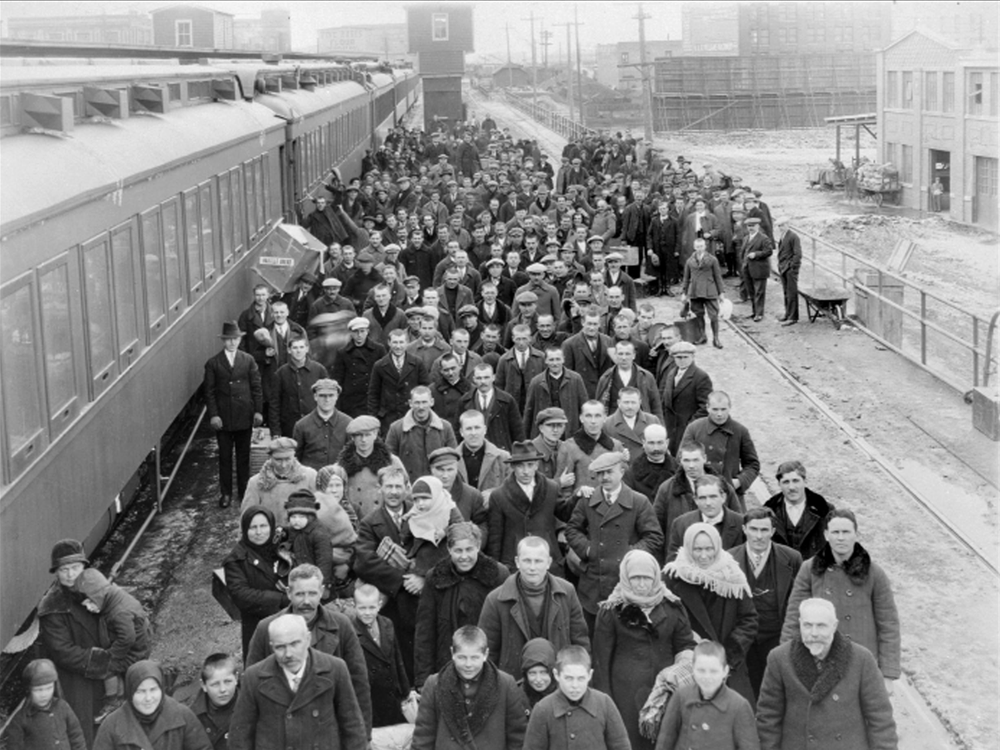
John Yuzyk of Rhein, Sask., said the economic climate was also so bad that “guys joined up because it paid and you could get three square meals a day.”

Ann Crapleve of Ladywood, Man., who would later participate in reconstruction efforts after the war, said: “I was a Canadian and wanted to do my bit for the country.”

The film ends with a description of Ukrainian Canadians assisting in this effort to rebuild Europe, and sometimes finding Ukrainians in camps for displaced persons, and facilitating their immigration to Canada rather than repatriation to the Soviet Union.

Source: New documentary tells the story of Ukrainians’ role in Canada’s war effort