U.S. Multiculturalism or Cultural Assimilation? | A. B. Wilkinson

Good commentary by A.B. Wilkinson of University of Nevada on US Republican primary candidate Jeb Bush’s comment on multiculturalism:

Last week a woman in Iowa asked Jeb Bush how he thought immigrants and refugees could best “become Americans.” Without hesitation he responded:

“We should not have a multicultural society. America is so much better than every other country because of the values that people share — it defines our national identity. Not race or ethnicity, not where you come from. When you create pockets of isolation — and in some cases the assimilation process is retarded because it’s slowed down — it’s wrong. It limits peoples’ aspirations.”

 First, the U.S. has always been and will always be a multicultural society — one where people from many distinct ethnic backgrounds have come together and form a society as a whole. Many people (not just immigrants) do not believe they should have to fully assimilate, or give up their traditional culture or heritage from where their ancestors originated, just in order to become “American.”

Next, what are the values that Bush and others assume that immigrants lack? Most immigrants are familiar with extreme struggle in their home countries and commit themselves to hard work in this country. These immigrants also have extremely strong family values, especially those from various parts of Latin America.

In other words, how are U.S. values essentially any different or better than those found south of its border?

While Jeb Bush may mean well, he missteps when he opts for colorblind rhetoric and ignores discussing the importance of race and ethnicity. When Bush suggests that immigrants “create pockets of isolation” on their own, he also misses how social systems founded on race and class have essentially created internal colonies within U.S. borders.

Low-income people of color do not ghettoize themselves. Both historically and presently, certain institutions have funneled African Americans, Latina/os, and Native Americans into ghettos, barrios, and reservations.

Still, politicians and mass media often connect impoverished people in communities of color with an unwillingness to adopt some ideal type of respectable Anglo-American culture. They stereotype those who refuse to assimilate as culturally backward, inept, and void of the attributes needed to attain the middle-class “American Dream.”

In reality, inadequate schools, poor housing opportunities, lack of career options, and few viable paths to citizenship (for immigrants) all play a much larger role in limiting people’s opportunities and aspirations. In the past, many of these factors defined colonial structures.

Source: U.S. Multiculturalism or Cultural Assimilation? | A. B. Wilkinson
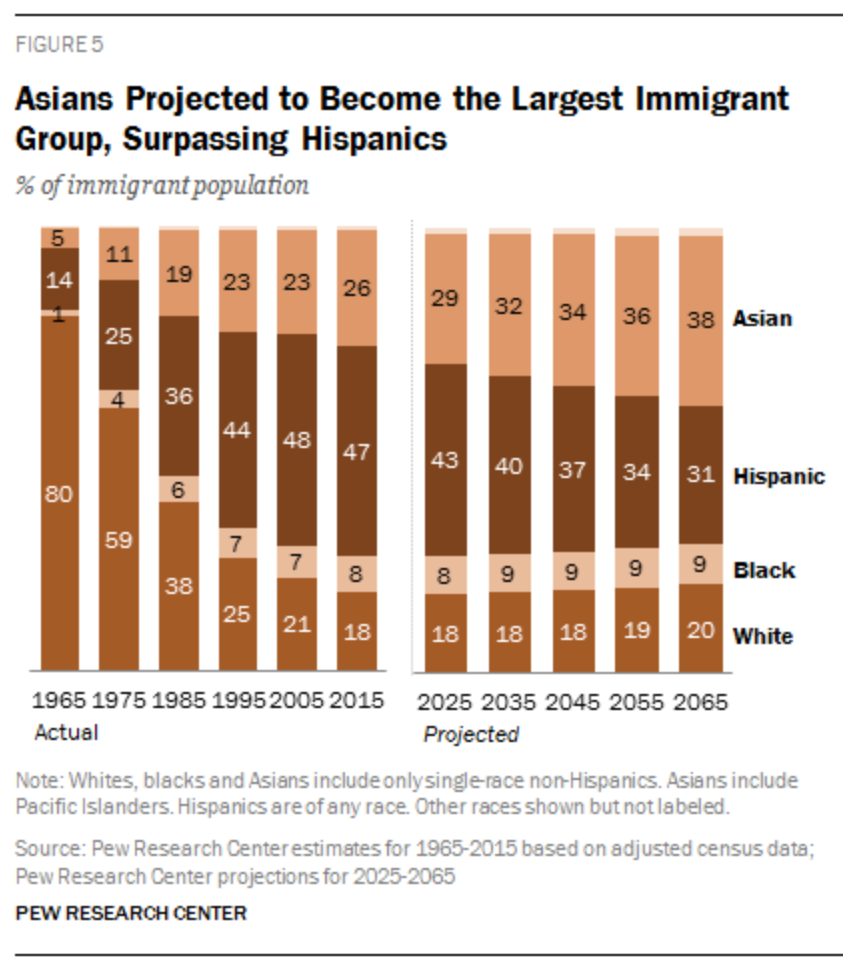
Asians will be largest immigrant group in U.S. in 50 years: Pew study

Pew_Immigration_ProjectionsInteresting demographic shift and may, over time, shift immigration debate in USA:

In a major shift in immigration patterns over the next 50 years, Asians will have surged past Hispanics to become the largest group of immigrants heading to the United States, according to estimates in a new immigration study.

The study looks in detail at what will happen by 2065, but the actual tipping point comes in 2055.

An increase in Asian and Hispanic immigration also will drive U.S. population growth, with foreign-born residents expected to make up 18 per cent of the country’s projected 441 million people in 50 years, the Pew Research Center said in a report being released Monday. This will be a record, higher than the nearly 15 per cent during the late 19th century and early 20th century wave of immigration from Europe.

Today, immigrants make up 14 per cent of the population, an increase from five per cent in 1965.

The actual change is expected to come in 2055, when Asians will become the largest immigrant group at 36 per cent, compared with Hispanics at 34 per cent. White immigrants to America, 80 per cent back in 1965, will hover somewhere between 18 and 20 per cent with black immigrants in the eight per cent to nine per cent range, the study said.

Without any post-1965 immigration, the U.S. would be 75 per cent white, 14 per cent black, eight per cent Hispanic and less than one per cent Asian, Pew said.

Currently, 47 per cent of immigrants living in the United States are Hispanic, but by 2065 that number will have dropped to 31 per cent. Asians currently make up 26 per cent of the immigrant population but in 50 years that percentage is expected to increase to 38 per cent.

Pew researchers analyzed a combination of Census Bureau information and its own data to develop its projections.

Part of the reason for the shift is that the fertility rate of women in Latin America and especially Mexico has decreased, said Mark Hugo Lopez, Pew’s director of Hispanic research. In Mexico, Lopez said, women are now having around two children, when back in the 1960s and 1970s, they were having about seven children per woman.

“There are relatively fewer people who would choose to migrate from Mexico so demographic changes in Mexico have led to a somewhat smaller pool of potential migrants,” he said. “At the same time we’ve seen a growing number of immigrants particularly from China or India who are coming for reasons such as pursuing a college degree or coming here to work temporarily in the high-tech sector.”

Source: Asians will be largest immigrant group in U.S. in 50 years: Pew study – World – CBC News

Link to study: Modern Immigration Wave Brings 59 Million to US, Driving Population Growth and Change Through 2065

US: Obesity Maps Put Racial Differences On Stark Display

Obesity_Maps_Put_Racial_Differences_On_Stark_Display___Shots_-_Health_News___NPRCorrelation between race, socio-economic status and obesity:

Take a look at the latest obesity data from the Centers for Disease Control and Prevention and you can see that the country’s obesity epidemic is far from over.

Even in Colorado, the state with the lowest rate, 21.3 percent of its population is obese. Arkansas tops the list with 35.9 percent.

“It is the largest epidemic of a chronic disease that we’ve ever seen in human history,” says Dr. Donald Lloyd-Jones, chair of the department of preventive medicine at the Northwestern University Feinberg School of Medicine.

Click on the CDC’s obesity prevalence maps and you’ll see something even more startling — the disparity among different ethnic groups. It’s not new that the obesity epidemic is hitting African-Americans the hardest, followed by Hispanics, but the maps highlight this worrying trend.

For African-Americans for example, there are 33 states with an obesity rate of at least 35 percent, whereas for white Americans only 1 state reports that rate. Nine states estimate the Hispanic obesity rate at 35 percent or higher.

“It is not about one group doing something wrong,” says Lloyd-Jones, who was not involved in creating the CDC maps. “It is about the environment that we have built that sets people up to fail.”

Race and ethnicity are often a surrogate for low socioeconomic status, he says.

“Our neighborhoods, workplaces and schools expose people, especially poor people, to less choices of healthy foods,” Lloyd-Jones says. There are also fewer places outside to be safe and burn off calories.

This has huge implications for the health of individuals and for health costs in the future, because obesity causes significant downstream health problems like diabetes, heart disease and cancer.

Source: Obesity Maps Put Racial Differences On Stark Display : Shots – Health News : NPR

Pentagon’s take on ISIS fight nothing like Canada’s campaign rhetoric

Contrast between measured and political language, the latter used to install fear and division:

The leaders of the Liberal and New Democratic parties, Stephen Harper tells his election rallies, are such a couple of timorous wet smacks that they can’t possibly be trusted to shield Canadians from the evil that constantly bears down upon us all.

“Justin Trudeau and Thomas Mulcair are so wrapped up in some form of twisted form of political correctness that they won’t even call jihadist terrorism what it is,” Harper told cheering supporters in Sault Ste. Marie this month.

“If you cannot even bring yourself to call jihadist terrorism what it is, then you cannot be trusted to confront it, and you cannot be trusted to keep Canadians safe from it.”

So, to summarize, and I’m using the words of the prime minister here, ISIS is a barbaric, fanatic, radically violent bunch of jihadist terrorist murderers. And they threaten Canadians every single day. And fighting them begins with calling them all those things, and if you can’t call them those things, you aren’t a fighter.

Now, here are the words of Christine Wormuth, the under-secretary of defence at the Pentagon, in testimony to Congress last week:

“While not 10 feet tall,” she told the Senate armed services committee last week, ISIS “remains a thinking enemy that adapts to evolving conditions on the battlefield.”

Wormuth, of course, is not running for office, and it is her job to take a clear-eyed view of her adversary.

She is tasked by President Barack Obama to help lead the military offensive in which Canada has been a proud participant, to use Stephen Harper’s words again.

Wormuth and the two top American generals who flanked her in the hearings tried to focus on the coalition’s meagre gains, but couldn’t obscure the utterly bleak reality that has emerged in the year since Obama announced the offensive.

Just a few days earlier, the outgoing chairman of the joint chiefs, Gen. Martin Dempsey, described the situation as “tactically stalemated.”

Senator John McCain, former naval commander, chairman of the armed forces committee and easily the Republican party’s reigning expert on war, used more pungent language.

“It seems impossible to assert that ISIL is losing and that we are winning. And if you’re not winning in this kind of warfare, you are losing. . . It’s an abject failure.”

McCain, like Wormuth and the generals, didn’t bother with any of the jihadist-murderer-terrorist-barbaric-fanatic-radical references Stephen Harper says a leader must make in order to protect the nation.

Source: Pentagon’s take on ISIS fight nothing like Canada’s campaign rhetoric – Politics – CBC News

The Franco-American Flophouse: US State Department Confirms the New Consular Fee for Expatriation

Victoria Ferauge on the explanation of the fee structure for renouncing US citizenship:

The US State Department has finally responded to those of us who took exception to the rather extraordinary rise in the fee to renounce US citizenship.  It now costs $2,350 USD for an American citizen to exercise his or right under international law to expatriate.

Does this fee constitute a barrier to exercising that right?  The State Department doesn’t think so.  I disagree and it’s not just the fee that’s the problem, it’s the entire process which is cumbersome, time-consuming and, yes, costly for everyone – renunciants and State Department alike.

A US citizen wishing to renounce or relinquish citizenship must travel to the nearest US consulate which may be in a city far from where he or she actually lives.  There can be more than one interview required which means multiple trips.   Some of the paperwork is complex enough it would be wise to consult a lawyer before filling them out and filing the tax and bank account declarations.   All of these things taken together can make paying that high consular fee another burden laid on top of the others that already exist.  The onus should be on the State Department to prove that these burdens placed before someone seeking to exercise the human right to expatriate are legitimate and necessary.

In the State Department response they offer their justifications for the fee raise and answer those of us who sent comments.  For this they have my thanks.  I and others have answered other agencies’ requests for comments on matters concerning Americans abroad, and never received the dignity of a reply.  I may not like the answers but I appreciate that they took the time.

State argues that there is no burden, no restrictions on the right to expatriate and there is nothing punitive about the fee raise.   It is, they say, a matter of money.

Rather, the fee is a cost-based user fee for consular services. Conforming to guidance from the Office of Management and Budget (OMB), federal agencies make every effort to ensure that each service provided to specific recipients is self-sustaining, charging fees that are sufficient to recover the full cost to the government.”

A perfectly reasonable argument if we were talking about something like, say, camping in a national park.  Not so reasonable when it concerns a fundamental human right guaranteed by national or international law.  It certainly costs money for US civilians and military to vote from abroad, but could we really argue that the FVAP and the local consulates should start charging overseas voters for providing services like the Federal Write-in Absentee Ballot?

That analogy is not perfect but the underlying principle is the same.  There are things that government does for which it has both a monopoly and a duty to provide services to its citizens in the exercise of their rights.  Voting is not just another service , and neither is expatriation.

My take on this is that there should be no fee for renunciations, relinquishments or requests for CLNs.  The first two concern a fundamental human right for which I contend cost should never be an issue.  As for the last, the CLN, this is a necessary document, the only one that exists to prove that one is no longer a US citizen and is often required by states that do not allow dual citizenship.

If that’s not possible then I’d propose an option to waive the fee if the renunciant can demonstrate that it would be a financial hardship to pay it.  That would be a very reasonable compromise and one that would be more consistent with what State claims is their goal:  protecting a US citizen’s right to expatriate.

Source: The Franco-American Flophouse: US State Department Confirms the New Consular Fee for Expatriation

Donald Trump’s campaign manager: 400,000 ‘anchor babies’ born in U.S. every year | PolitiFact

The numbers in America of those born to undocumented immigrants and the much smaller amount due to ‘birth tourism’ (340,000 compared to 8,600, or 8 and 0.2 percent of total births respectively – Canadian figures from CIC analysis show 500 out of 360,000 total live births or 0.14 percent) :

Those figures may have been accurate several years ago, but they are outdated when compared to current estimates, said Jeffrey Passel, a senior demographer with the Pew Research Center. Passel is the author of a widely cited 2010 Pew Hispanic Center report that pins the number of children born to undocumented immigrants at 340,000 in 2008 (about 8 percent of all births that year).

“Figures as high as 400,000 per year are plausible for the mid 2000s, but our current estimates are around 300,000 per year,” he told us. “The numbers were higher in the mid 2000s than now — in part because there were more unauthorized immigrants then and overall birth rates, for natives and immigrants alike, were higher before the recession.”

So Lewandowski’s number is slightly exaggerated.

His characterization of these births as “anchor babies” is also problematic, however, as the metaphor implies intent that the numbers don’t back up. Based on past reporting, it’s not clear whether every birth to an undocumented mother was for the purpose of tethering the family to American soil.

“There are a million hardworking Hispanic people in San Diego who came here to work and then happened to have a baby,” midwife Lauren Weber said in the 2010 fact-check. “Then, there are people who come over in order to have a baby.”

Weber also described a practice known as “birth tourism,” in which middle- and upper-class visitors on tourist visas travel to the United States specifically to have a baby. The numbers for these types of births are much lower, at around 8,600, or 0.2 percent of all births, in 2013, according to the Centers for Disease Control and Prevention.

As for undocummented immigrants, experts don’t think they have the same motivations.

“I believe that most migrants come for economic reasons and opportunity,” said Theresa Brown, the director of immigration policy at the Bipartisan Policy Institute. “The idea that their child may be able to sponsor them for a green card in 21 years is probably too long term to be a primary driver of immigration.”

Source: Donald Trump’s campaign manager: 400,000 ‘anchor babies’ born in U.S. every year | PolitiFact

ICYMI: Whose Neighborhood Is It? – The New York Times

Tom Edsall on some of the integration challenges in the US and the progress that has been made:

These suburban Detroit communities provide a case study in what has come to be called the “tipping point,” the point at which whites begin to leave a residential locale en masse as African-Americans or other minorities move in.

This phenomenon puzzled Thomas Schelling, a professor emeritus of economics at Harvard and a Nobel Laureate, who was struck by the lack of stable integrated communities. In 1971, he began work on a mathematical theory to explain the prevalence of racial segregation in a paper titled “Dynamic Models of Segregation,” published in the Journal of Mathematical Sociology.

Schelling’s famous thesis has been carefully summarized by Junfu Zhang, an economist at Clark University. Zhang writes:

Schelling’s most striking finding is that moderate preferences for same-color neighbors at the individual level can be amplified into complete residential segregation at the macro level. For example, if every agent requires at least half of her neighbors to be of the same color―a preference far from extreme―the final outcome, after a series of moves, is almost always complete segregation.
In other words, residential segregation can emerge even if initial preferences are very slight.

According to Schelling, Zhang writes,

“in an all-white neighborhood, some residents may be willing to tolerate a maximum of 5 percent black neighbors; others may tolerate 10 percent, 20 percent, and so on.

The ones with the lowest tolerance level will move out if the proportion of black residents exceeds 5 percent. If only blacks move in to fill the vacancies after the whites move out, then the proportion of blacks in the neighborhood may reach a level high enough to trigger the move-out of the next group of whites who are only slightly more tolerant than the early movers. This process may continue and eventually result in an all-black neighborhood.

Similarly, an all-black neighborhood may be tipped into an all-white neighborhood, and a mixed-race neighborhood can be tipped into a highly segregated one, depending on the tolerance.”

In the years since 1971, scholars have followed up on the Schelling argument with empirical studies.

Residential and public school integration remain an immense challenge. Affordable housing, one piece of the integrative process, got a boost from a favorable Supreme Court decision in June, Texas Department of Housing, that further empowers plaintiffs in housing discrimination cases. A second boost came from new HUD regulations issued in July requiring local governments “to take significant actions to overcome historic patterns of segregation, achieve truly balanced and integrated living patterns, promote fair housing choice, and foster inclusive communities.”

Government action has often been resisted but, over time, it has pulled millions of blacks into the mainstream of American life. From 1940 to 2014, the percentage of African-Americans ages 25 to 29 with high school degrees rose from 6.9 percent to 91.9 percent. Over the same period, the percentage of blacks with college degrees grew from 1.4 percent to 22.4 percent. From 1963 (a year before enactment of the Civil Rights Act of 1964) to 2015, the percentage of blacks employed in management, professional and related occupations more than tripled, from 8.7 percent to 29.5 percent.

Although progress toward racial and ethnic integration has been sporadic – frequently one step forward, two steps back – credible progress has been made over the last 75 years. We have not come to the end of the story, but there are grounds for optimism.

Source: Whose Neighborhood Is It? – The New York Times

Birthright citizenship: Fewer babies being born to women in U.S. illegally – LA Times

Some useful birth statistics to provide context for the USA debate:

For all of this summer’s heated campaign-trail rhetoric about immigration and women in the country illegally giving birth in the U.S., new data show that the number of such babies born here is on the decline.

The number of babies born to immigrants in the U.S. illegally is on the decline, according to the nonpartisan Pew Research Center. Such births still made up 8% of total U.S. births in 2013, the center found.

The issue has been in the spotlight in recent months, with Republican presidential front-runner Donald Trump and other GOP candidates decrying such children as “anchor babies,” a term considered derogatory, and calling for an end to automatic citizenship for children born to immigrants in the country illegally. They say that the practice encourages illegal immigration.

According to the Pew report released late Thursday, about 295,000 such babies were born in 2013. That was a decline from a peak of 370,000 in 2007. The downward trend echos the overall drop in illegal immigration in recent years, which has been driven largely by a decrease in the number of immigrants crossing illegally from Mexico.

The population of immigrants illegally in the country dropped about 1 million during the Great Recession of 2007-2009 and has remained stable since.

“When the population went down, the births went down,” said D’Vera Cohn, a co-author of the Pew report.

The report found that about 8% of babies born in the U.S. in 2013 were to immigrants in the country illegally, a group that makes up only about 4% of the total U.S. population.

The loaded term ‘anchor baby’ conceals complex issues The high birthrate to immigrants can be explained by the differing demographics of the American-born and the foreign-born populations, according to Cohn. The immigrant group has a higher share of women of childbearing age, she said.

“In general, immigrants tend to be younger,” said Cohn. “They are the people who are willing to get up and leave and take the risk of going to another country, legally or not.”

This number is significantly larger than ‘birth tourism’ numbers (women who come to the USA to give birth and then leave, where hard data is scarce).

Source: Birthright citizenship: Fewer babies being born to women in U.S. illegally – LA Times

Racism Vs. Whites? You’re Kidding Me – The Daily Beast

Interesting and disturbing polling and related commentary by Barrett Holmes Pitner:

[Tom] Edsall pointed to a study conducted last fall by the Public Religion Research Institute (PRRI) that found that 52 percent of white respondents agreed with the following statement: “Today discrimination against whites has become as big a problem as discrimination against blacks and other minorities.”

Among subsets of respondents, 76 percent of those affiliated with the Tea Party agreed with the statement. Another 61 percent of Republicans, and 53 percent of independents. A majority of whites over age 50 also agreed with the statement, and 58 percent of working-class whites agreed. Evangelical Protestants (63 percent) and Catholics (56 percent) also agreed.

62 percent of white Democrats disagreed, and 61 percent of those with a college education. White Americans under 50 also disagreed, even though it was close. Only 48 percent of whites between the ages of 18-29 agreed, and 49 percent of them disagreed. Of whites 30-49, 46 percent agreed and 52 percent disagreed.

Upon seeing these figures I immediately wondered about what exactly white Americans perceive racism to be, and how the supposed racism they receive has become equal to that of African Americans and other minority groups.

Did a leading American presidential candidate refer to large swaths of the white American population as “rapists” and “murderers”?

Have countless white Americans taken to the streets to express their frustrations with a criminal justice system that disproportionately harms and negatively impacts the lives of white Americans?

Are white Americans campaigning against profound levels of income inequality that negatively impact the white community far worse than other racial and ethnic groups in America?

When I look around America I do not see white voices making these complaints. Instead I see large amounts of white Americans expressing their frustration that some traditional white American values are being questioned, or are “under attack,” as some might say.

Source: Racism Vs. Whites? You’re Kidding Me – The Daily Beast

Donald Trump, Elizabeth I, and the English Origins of Birthright Citizenship

A good in-depth piece on the history of birthright citizenship, and how it was derived from British judicial decisions:

The Republican frontrunner’s assertion that the United States is “just about” the only country “stupid enough” to grant citizenship to all children born within its borders is easily proven false. Far from a scarlet letter of perversion, the U.S. policy is more like a badge of membership in the Western Hemisphere, where nearly all countries adhere to a version of the principle, a commonality some scholars argue is a legacy of colonial pro-immigration policies in the New World.

But the term “birthright citizenship” is also misleading. There are actually two common types of birthright citizenship in the modern world, and both are incorporated into U.S. policy. Trump and those who agree with him apparently only object to one of them.

You can be born into U.S. citizenship by being born in the United States—the principle known as jus soli, or “right of the soil.” Most countries in the Americas feature jus soli citizenship. And you can also be born into U.S. citizenship by being born to U.S. citizens, even if you’re born abroad—a concept known as jus sanguinis, or “right of blood.” “Roman law,” said University of Michigan law and classics professor Bruce Frier, “was very distinctly in the jus sanguinis category.” The policy has also frequently been incorporated into modern European states, emphasizing membership in the nation through parentage.

Yet the real irony of calling “birthright citizenship” a peculiarly American stupidity is that historically and theoretically speaking, geographical birthright citizenship is precisely as American as apple pie. That is to say: it’s English—and thoroughly monarchical in origin.

Given his “anchor baby” rhetoric, Trump may be pleased to learn one thing: The case many scholars cite as establishing the theoretical basis for geographical birthright citizenship did indeed involve a troublemaking toddler. The toddler was a Scottish aristocrat, and the case was a property battle.

In 1603, Elizabeth I, the “Virgin Queen,” died without an heir. The solution was to give her cousin Mary’s son, James VI of Scotland, a second crown, making him James I of England. The tough part about that, according to the University of Miami law professor Kunal Parker, author of a forthcoming history of immigration and citizenship law, was that “under English law, aliens—those who were born outside the allegiance to the king—were not able to hold or convey titles of real property.” Thus, in 1608, an English court found itself answering an intriguing question: If two-year-old Scottish infant Robert Colville had been given lands in England, were his claims on those lands valid? The traditional English position at the time of the case, Parker said, “was of course because he’s Scottish and hence an alien he should not have good titles to lands in England.” “Every one born within the dominions of the King of England is entitled to enjoy all the rights and liberties of an Englishman.”

In his influential report on what has, inexplicably given the actual names of those involved, become known as Calvin’s Case, the English judge Sir Edward Coke articulated a distinctly feudal-sounding jus soli principle that formed the basis of much law to come: “Every one born within the dominions of the King of England, whether here or in his colonies or dependencies, being under the protection of—therefore, according to our common law, owes allegiance to—the King and is subject to all the duties and entitled to enjoy all the rights and liberties of an Englishman.” Furthermore, “Seeing then that faith, obedience, and ligeance are due by the law of nature, it followeth that the same cannot be changed or taken away.”

In other words: People born in the king’s lands are his subjects and owe him allegiance, while he owes them protection, and there’s nothing the subject can do about it. This idea failed to delight the Lockean consent-of-the-governed junkies of later decades and centuries. As the law professor Peter Schuck and the political-science professor Rogers Smith put it in their famous 1985 critique of U.S. immigration policy, Citizenship Without Consent, “At a conceptual level, [birthright citizenship] was fundamentally opposed to the consensual assumptions that guided the political handiwork of 1776 and 1787.”

Source: Donald Trump, Elizabeth I, and the English Origins of Birthright Citizenship – The Atlantic