A potentially historic number of people are giving up their U.S. citizenship – The Washington Post

More on the increasing number of American expats renouncing citizenship for tax reasons (FATCA), not Trump. Again, while the increase is dramatic, still small in relation to the number of expatriates (State department estimates between three and eight million):

It can be difficult to become a U.S. citizen. A lot of people put a large amount of time, effort and money into the process of gaining an American passport or, failing that, the right to permanent residency.

But to some people, U.S. citizenship can apparently be a burden. And it’s a burden that people seem to be shaking off in increasing numbers. This week, the Treasury Department released its quarterly list of individuals who had chosen to “expatriate” — i.e., renounced their U.S. citizenship or gave up their rights to permanent residence.

The list is notable for a couple of reasons. First off, Britain’s Foreign Secretary Boris Johnson is on it. This means that Johnson, a dual-national who was born in New York City, has finally renounced his citizenship (as he had long promised he would). Secondly — and far more importantly in the grand scheme of things — the list shows that Johnson is just one of a total 5,411 individuals to expatriate in 2016.

The number of people giving up their U.S. citizenship may in fact be higher. Ryan Dunn, a lawyer with Andrew Mitchel LLC, explained via email that his firm has suspicions that the lists released by Treasury are incomplete. However, this would not change the trend. America is seeing what is likely a historically high level of expatriation. And it seems only likely to rise further.

“Given that we’ve seen year-over-year increases in expatriation since 2012, we speculate that the trend will continue,” Dunn explained.

But why would anyone renounce their citizenship to the United States? Dunn said that in his firm’s experience, it wasn’t usually political. “We have not been contacted by anyone saying that they wanted to give up their citizenship because Trump won the election,” he said. Instead the motivation was simpler: money.

The United States is one of the only countries in the world that requires its citizens and permanent residents to file taxes even when they live abroad. Eritrea is the only other country to have a similar policy. This unusual policy a relic of the Civil War and the Revenue Act of 1862, which called for the taxing of U.S. citizens abroad — in part to punish men who fled the country to avoid joining the Union army.

This is no new policy — Americans abroad have always been covered by federal tax laws. However, things changed in 2010, when the Foreign Account Tax Compliance Act (FATCA) was enacted. This law essentially requires foreign financial institutions to check whether an account holder is a U.S. citizen or permanent resident. In some cases, Dunn said, they would ask for proof that the account holder is not a U.S. citizen.

The end result here is that whereas in the past a U.S. citizen abroad might be able to get away with not filing their U.S. taxes, that has become vastly less likely under these new circumstances. In some cases, this can be extremely costly: Johnson was known to have racked up a large U.S. tax bill for the sale of his home in London, even though he had not lived in Britain since he was a small child.

But even for those without Johnson’s wealth, it can be tricky. “FATCA is a dirty word to Americans abroad,” Peter Spiro, a Temple University law professor and the author of “At Home in Two Countries: The Past and Future of Dual Citizenship,” explained. “Think lots of extra forms that have to be filed even by citizens who aren’t wealthy by any standard. Americans abroad used to be able to do their taxes just like Americans at home. Now they have to hire expensive accountants.”

Giving up your citizenship isn’t necessarily cheap either. It can take a long time to get an appointment in some places, and the processing fee is around $2,350. More important, Dunn said, was the “exit tax” that some high-earning or high-net-worth individuals have to pay — and also some people who forget to file their forms correctly too. But evidently, for some people it’s worth it. (Green-card holders have a simpler and cheaper process.)

Source: A potentially historic number of people are giving up their U.S. citizenship – The Washington Post
Shouldn’t Israel Care About Anti-Semitism? – The New York Times

This piece by Shmuel Rosner worth noting post-Trump International Holocaust Remembrance Day deliberately not mentioning Jewish victims:

Occasionally, there is even a temptation for Israel to benefit from anti-Semitism. In recent years, rather than focus on the need to fight anti-Semitism in France, Israel called on French Jews to come live in Israel.

Of course, when Israel encounters a clear-cut case of Holocaust denial, or of persecution of Jews, it does not shy away from making its voice heard. Two years ago, the Israeli foreign minister warned European far-right parties that they must shun neo-Nazis and described Hungary’s Jobbik and Greece’s Golden Dawn as “illegitimate.”

But most of the time, Israel attempts to delicately balance its wish to delegitimize anti-Semitism and its need to maintain foreign relations that advance its causes. Sometimes this means using attacks on Jews to attract Jewish immigration to Israel. Sometimes this means turning a blind eye to anti-Semitism in exchange for political support. Sometimes this means ignoring the trivialization of Jewish deaths in the Holocaust.

This is as unavoidable as it is troubling, even painful. Israel is a state with interests and priorities among which censuring anti-Semitism is one, but not the only one.

David Ben-Gurion, Israel’s founding father, understood this when he agreed to accept reparations from Germany, less than a decade after the Holocaust. Mr. Ben-Gurion’s opponents had a strong moral case against accepting money from the country that had just orchestrated the murder of millions of Jews, but the prime minister thought that his duty as the man in charge of building and defending a new state trumped such considerations. Then, as now, Israel sometimes agreed to help other countries and parties whitewash their images. It’s often a trade: We, Israel, will get what we need in the form of money or arms or political support. You will get the right to showcase Israel as proof that you aren’t an anti-Semite.

This could become much more uncomfortable when the country in question is the United States and when the person accused of tolerating anti-Semitism is the American president. Israel depends on the United States more than it does on any other country for aid, security and diplomatic support. And the American Jewish community is the other main pillar of world Jewry, alongside Israel. More than 80 percent of Jews live and thrive either in Israel or in the United States. This makes the United States the place in which official anti-Semitism cannot be overlooked — and the place where it must be overlooked.

That could result in an irreparable split between Jews. The statement on International Holocaust Remembrance Day — provoking Jewish outcry in the United States, while provoking nothing from Israel — just proved it.

Americans View Islam Less Negatively Than They Did A Year Ago | The Huffington Post

Not sure the extent to which this is positive (fewer negative views) or negative (greater political polarization) but ironic given the words of the Trump campaign and the words and actions of the Trump administration:

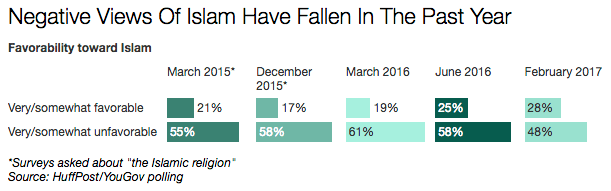
Americans’ view of Islam are, by and large, hostile. But negative opinions of the religion have dropped significantly during the past year, a new HuffPost/YouGov poll finds, despite ― or perhaps in response to ― the anti-Islam rhetoric often espousedby President Donald Trump and his advisers.

Last March, Americans were 42 points more likely to view the religion negatively than they were to view it positively. That gap dropped to 33 points by June, and to 20 points in the most recent survey, the lowest it’s been since HuffPost/YouGov surveys first asked the question nearly two years ago.

HUFFINGTON POST

At least one other pollster has noticed a similar shift. Shibley Telhami, the director of the University of Maryland Critical Issues Poll, wrote in The Washington Post earlier this year about having seen attitudes toward “Muslim people” growing progressively more favorable between November 2015 and October 2016 ― even after Trump’s anti-Muslim rhetoric and the terrorist attacks in San Bernardino, California, and Orlando, Florida.

He attributed some of the change to polarization, noting that the biggest driver was evolving opinions among Democrats, and, to a lesser extent, independents.

“As on almost all issues, partisan divisions intensified during a highly divisive election year,” he wrote. “The more one side emphasized the issue — as happened with Trump on Islam and Muslims — the more the other side took the opposite position. … Trump the president should have more sway. But he is starting at place where partisanship is not diminishing, and where his presidential rhetoric mirrors his words as a partisan candidate.”

Breaking down the two most recent HuffPost/YouGov surveys along party lines yields similar results, suggesting that the Trump administration’s rhetoric has actually galvanized Democrats, and some independents, into greater support of Islam.

HUFFINGTON POST

In June 2016, Democrats, Republicans and independents all held net negative views of Islam, although the gap was most pronounced among Republicans. Since then, Democrats’ opinions of the religion have improved significantly ― favorable opinions have risen by 11 points, while unfavorable opinions have fallen by 13 points.

FBI Reports Show Terror Suspects Coming From Canada While Trump Stares at Mexico – The Daily Beast

Expect this story and data to have some legs in the current political context (has in the past, and is always an ongoing challenge with our American neighbours):

Donald Trump keeps talking about the threat from the U.S.-Mexico border. But he may be looking in the wrong direction. FBI reports reviewed by The Daily Beast reveal that far more suspected terrorists try to enter the country from the northern border with Canada than from the south.

Seven FBI Terrorist Screening Center “monthly domestic encounter reports” dating from April 2014 to August 2016 detail the number, type, and location of encounters with known or suspected terrorists across the United States. The encounters are based on information in various watchlist databases. In all seven reports, the numbers of encounters at land border crossings were higher in northern states than southern.

“We are looking the wrong direction,” said a senior DHS official familiar with the data. “Not to say that Mexico isn’t a problem, but the real bad guys aren’t coming from there—at least not yet.”

On Monday, press secretary Sean Spicer told reporters he would not disclose evidence behind the President’s claims that jihadis are “pouring” into the country. “I’m not going to get into specific information that the president has,” he said.

The FBI reports obtained by The Daily Beast provide data on known or suspected terrorists attempting to enter the country, or who are already in the United States.

These reports show hundreds of watchlisted passengers encountered on domestic flights—meaning they are already in the country—and a smaller percentage crossing the border over land.

Those encounters are reported back to the FBI’s Terrorist Screening Center and used to compile the monthly domestic encounter overview reports, which are classified “Law Enforcement Sensitive.”

Newly installed Department of Homeland Security Secretary John Kelly traveled to Texas last week to survey the border in the Rio Grande Valley with local law enforcement. He is scheduled to testify Tuesday morning at a House Homeland Security Committee hearing on threats to the southern border.

But the FBI data shows concerns about terrorists crossing into the U.S. from Canada may be a more immediate concern, or is at least worthy of considerable attention, according to border and congressional officials.

Source: FBI Reports Show Terror Suspects Coming From Canada While Trump Stares at Mexico – The Daily Beast

The Data That Turned the World Upside Down – Motherboard

While much of this is alarming and disturbing – particularly voter suppression – I would love to see some psychometrics complement conventional polling with respect to immigration issues to test different ways of posing questions:

But to what extent did psychometric methods influence the outcome of the election? When asked, Cambridge Analytica was unwilling to provide any proof of the effectiveness of its campaign. And it is quite possible that the question is impossible to answer.

And yet there are clues: There is the fact of the surprising rise of Ted Cruz during the primaries. Also there was an increased number of voters in rural areas. There was the decline in the number of African-American early votes. The fact that Trump spent so little money may also be explained by the effectiveness of personality-based advertising. As does the fact that he invested far more in digital than TV campaigning compared to Hillary Clinton. Facebook proved to be the ultimate weapon and the best election campaigner, as Nix explained, and as comments by several core Trump campaigners demonstrate.

Many voices have claimed that the statisticians lost the election because their predictions were so off the mark. But what if statisticians in fact helped win the election—but only those who were using the new method? It is an irony of history that Trump, who often grumbled about scientific research, used a highly scientific approach in his campaign.

Another big winner is Cambridge Analytica. Its board member Steve Bannon, former executive chair of the right-wing online newspaper Breitbart News, has been appointed as Donald Trump’s senior counselor and chief strategist. Whilst Cambridge Analytica is not willing to comment on alleged ongoing talks with UK Prime Minister Theresa May, Alexander Nix claims that he is building up his client base worldwide, and that he has received inquiries from Switzerland, Germany, and Australia. His company is currently touring European conferences showcasing their success in the United States. This year three core countries of the EU are facing elections with resurgent populist parties: France, Holland and Germany. The electoral successes come at an opportune time, as the company is readying for a push into commercial advertising.

Kosinski has observed all of this from his office at Stanford. Following the US election, the university is in turmoil. Kosinski is responding to developments with the sharpest weapon available to a researcher: a scientific analysis. Together with his research colleague Sandra Matz, he has conducted a series of tests, which will soon be published. The initial results are alarming: The study shows the effectiveness of personality targeting by showing that marketers can attract up to 63 percent more clicks and up to 1,400 more conversions in real-life advertising campaigns on Facebook when matching products and marketing messages to consumers’ personality characteristics. They further demonstrate the scalability of personality targeting by showing that the majority of Facebook Pages promoting products or brands are affected by personality and that large numbers of consumers can be accurately targeted based on a single Facebook Page.

In a statement after the German publication of this article, a Cambridge Analytica spokesperson said, “Cambridge Analytica does not use data from Facebook. It has had no dealings with Dr. Michal Kosinski. It does not subcontract research. It does not use the same methodology. Psychographics was hardly used at all. Cambridge Analytica did not engage in efforts to discourage any Americans from casting their vote in the presidential election. Its efforts were solely directed towards increasing the number of voters in the election.”

The world has been turned upside down. Great Britain is leaving the EU, Donald Trump is president of the United States of America. And in Stanford, Kosinski, who wanted to warn against the danger of using psychological targeting in a political setting, is once again receiving accusatory emails. “No,” says Kosinski, quietly and shaking his head. “This is not my fault. I did not build the bomb. I only showed that it exists.”

Source: The Data That Turned the World Upside Down – Motherboard

Trump Backers Want Ideology Test For Extreme Vetting : NPR

Orwellian and ineffective given that those requesting entry are highly unlikely to openly express such views, if indeed they have them (Kellie Leitch to note):

The Trump administration says it is suspending all refugee admissions to the United States until it can come up with a plan for “extreme vetting.”

So what could that mean?

Refugees are already subjected to multiple interviews and a security vetting by nine U.S. law enforcement, intelligence and security agencies that check their backgrounds, social media activity and the reasons they fled their countries. The process usually takes 18 months or more, according to resettlement agencies.

But some of those who helped form President Trump’s policies on refugees are upfront in saying this is not actually about stricter security screening. It’s about something else.

“It means a kind of ideological screening to keep out people who hate a free society even if they are not violent,” says Mark Krikorian, executive director of the Center for Immigration Studies, a Washington think tank that supports tighter controls on immigration. Krikorian met with Trump during the campaign and backs the president’s executive order as a “corrective” to the vetting system in place during the Obama years.

In an interview with NPR, Krikorian said he backs an ideological test that poses questions for refugees in the vetting process including, in his words, “Do you think it’s okay to kill apostates? Do you think it’s okay to throw gays off of buildings? Or if Islam’s Prophet Muhammad is insulted, there should be a punishment?”

If a refugee says yes to any of these questions, says Krikorian, “Then we don’t want you here.”

Trump’s executive order on immigration appears to refer to these views by declaring the United States should keep out those with “hostile attitudes toward it and its founding principles” and “those who would place violent ideologies over American law.”

This is all of intense concern for refugee advocates. The most pressing refugee need today is among Syrians — some 5 million have fled the country’s civil war. The vast majority are Muslim.

“It’s clearly Muslim-targeted,” says Muna Jondy, a Michigan immigration lawyer of Syrian descent who’s been fielding frantic calls from refugee families in the U.S. whose relatives are now barred from joining them.

She points out the refugee screening process already targets those with extreme Islamist views via counter-terrorism vetting, which checks for links to radical Islamist groups.

But the president appears to echo opinions of a web of supporters who have warned about the wider “dangers” of Islam and more recently have called for rigorous ideological vetting. His national security adviser, retired Lt. Gen. Michael Flynn, has called fear of Islam “rational” and equates Islam with a political ideology.

One of the most outspoken of these supporters is Frank Gaffney, founder and president of the Center for Policy Studies and a leading anti-immigration advocate. Human rights groups have described Gaffney as a conspiracy theorist and Islamophobe, but his views have gained traction in the Trump administration. Trump cited his work during his campaign.

…In a broad sense, tests of attitudes aren’t unprecedented. Doris Meissner, a former commissioner of the Immigration and Naturalization Service, notes that an ideological test for newcomers is “deeply embedded” in U.S. history. The U.S. barred anarchists in 1903. During the Cold War, she says, “It was people who believed in communism. It’s still in our law.”

But Meissner points out these ideological tests have not had the desired outcome, because over time, the tests “have proven to be poorly equipped to actually predict what people are going to do.” And it gets more complex when the beliefs straddle the line between politics and religion.

Meissner compares Trump supporters’ fear of sharia law and their view that it’s at odds with the U.S. system with the fears and debates surrounding the candidacy of John F. Kennedy in the early 1960s. Kennedy was Catholic and his detractors feared that if elected, the American president would be taking orders from the Pope.

“Then, JFK made his well-known statement about his personal faith and his responsibility to the civil system,” Meissner says.

Source: Trump Backers Want Ideology Test For Extreme Vetting : Parallels : NPR

At first citizenship ceremony since Trump’s order, flags and frayed nerves – The Boston Globe

The federal judge at the ceremony tries to reassure:

At the citizenship ceremony Thursday in Faneuil Hall, where revolutionaries, abolitionists, and suffragists once gathered to debate, the crowd was solemn. Typically the mood at citizenship ceremonies is festive, with immigrants waving American flags and joyfully snapping photos.

But under Trump, immigrants said, they were unsure how to feel.

“It’s sad,” said Yuly Mosca, a nursing student from Colombia who also became a citizen.

Federal Judge Patti Saris sought to reassure the new citizens. She quoted lyrics from the musical “Hamilton,” after former Treasury secretary Alexander Hamilton, who grew up in the Caribbean. She spoke of the work it had taken to reach this point. She reminded them that the Constitution protects everyone.

“We as a society cherish civil rights, including the civil rights of new Americans,” she said to loud applause.

Without mentioning Trump, she urged immigrants to take heart in her own story. Her grandparents arrived from Russia with little money. They did not speak English. But now she is a federal judge.

Asa Valenti from Iran and her husband Paul checked on their 6-day old baby Amelia after the ceremony.

JOHN TLUMACKI/GLOBE STAFF

Asa Valenti from Iran and her husband Paul checked on their 6-day old baby Amelia after the ceremony.

“So in the context of the heated rhetoric, I imagine that some of you may have turned on the TV or opened a paper or read a blog and thought about whether the United States remains welcome to immigrants,” Saris said. “Let me assure you, it does.”

Source: At first citizenship ceremony since Trump’s order, flags and frayed nerves – The Boston Globe

Trump Pushes Dark View of Islam to Center of U.S. Policy-Making – The New York Times

Yet another test for the institutional checks and balances:

It was at a campaign rally in August that President Trump most fully unveiled the dark vision of an America under siege by “radical Islam” that is now radically reshaping the policies of the United States.

On a stage lined with American flags in Youngstown, Ohio, Mr. Trump, who months before had called for a “total and complete shutdown” of Muslim immigration, argued that the United States faced a threat on par with the greatest evils of the 20th century. The Islamic State was brutalizing the Middle East, and Muslim immigrants in the West were killing innocents at nightclubs, offices and churches, he said. Extreme measures were needed.

“The hateful ideology of radical Islam,” he told supporters, must not be “allowed to reside or spread within our own communities.”

Mr. Trump was echoing a strain of anti-Islamic theorizing familiar to anyone who has been immersed in security and counterterrorism debates over the last 20 years. He has embraced a deeply suspicious view of Islam that several of his aides have promoted, notably retired Lt. Gen. Michael T. Flynn, now his national security adviser, and Stephen K. Bannon, the president’s top strategist.

This worldview borrows from the “clash of civilizations” thesis of the political scientist Samuel P. Huntington, and combines straightforward warnings about extremist violence with broad-brush critiques of Islam. It sometimes conflates terrorist groups like Al Qaeda and the Islamic State with largely nonviolent groups such as the Muslim Brotherhood and its offshoots and, at times, with the 1.7 billion Muslims around the world. In its more extreme forms, this view promotes conspiracies about government infiltration and the danger that Shariah, the legal code of Islam, may take over in the United States.

Those espousing such views present Islam as an inherently hostile ideology whose adherents are enemies of Christianity and Judaism and seek to conquer nonbelievers either by violence or through a sort of stealthy brainwashing.

The executive order on immigration that Mr. Trump signed on Friday might be viewed as the first major victory for this geopolitical school. And a second action, which would designate the Muslim Brotherhood, the Islamist political movement in the Middle East, as a terrorist organization, is now under discussion at the White House, administration officials say.

Beyond the restrictions the order imposed on refugees and visitors from seven predominantly Muslim countries, it declared that the United States should keep out those with “hostile attitudes toward it and its founding principles” and “those who would place violent ideologies over American law,” clearly a reference to Shariah.

Rejected by most serious scholars of religion and shunned by Presidents George W. Bush and Barack Obama, this dark view of Islam has nonetheless flourished on the fringes of the American right since before the Sept. 11, 2001, terrorist attacks. With Mr. Trump’s election, it has now moved to the center of American decision-making on security and law, alarming many Muslims.

Trudeau must match words with action in Trump era, say critics, rights groups

Government is wise to wait and monitor before changing such a fundamental policy as safe third country. In the end, should the Trump administration continue with such policies, it will likely become harder to resist such calls, on both policy and political grounds:

Justin Trudeau’s invitation on Twitter to “those fleeing persecution, terror & war” attracted global attention as a subtle response to President Donald Trump’s order temporarily banning refugees and immigrants from seven Muslim-majority countries, but now Canadian opposition politicians and human rights groups want Mr. Trudeau to match his words with action.

Mr. Trump’s executive order banned refugees from resettling in the United States for 120 days and nationals from Iran, Iraq, Libya, Syria, Somalia, Sudan, and Yemen from entering the U.S. for 90 days. Thousands of people gathered outside of the U.S. embassy in Washington and consulate in Toronto to protest the decision Monday.

The prime minister’s “diversity is our strength” tweet sent the message that “regardless of [their] faith,” those seeking refuge will find an open door to Canada as the one in the U.S. temporarily closes.

The New Democratic and Green parties, along with Amnesty International’s Canadian and U.S. sections, in turn have called on the federal government to remove the U.S. as a “safe third country” for refugee determination under Canada’s Immigration and Refugee Protection Act.

A 2004 order-in-council giving the U.S. that designation, which was briefly overturned by the Federal Court and later reinstituted by the Federal Court of Appeal, requires most refugees travelling through the U.S. to Canada to make a claim for protection in the U.S.

Amnesty wants Immigration, Refugees, and Citizenship Minister Ahmed Hussen (York-South Weston, Ont.) to immediately rescind the U.S. as a safe country and allow refugees to cross the border and seek asylum in Canada. “The risk of not doing this is going to deny an avenue of protection for people who are going to need it in the days, weeks, and months to come,” said Alex Neve, secretary general of Amnesty International Canada, who believes that Mr. Trump might support the U.S.’s removal as a safe haven.

“It would mean more refugee claimants turning to Canada for protection rather than the United States, which seems to be what he wants,” said Mr. Neve. “Canada doesn’t have to issue a press release loudly and angrily denouncing the U.S.’s refugee-protection record. It’s something that can be done quietly and quickly through an order-in-council.”

Source: Trudeau must match words with action in Trump era, say critics, rights groups – The Hill Times – The Hill Times

In Iran, Shock and Bewilderment Over Trump Visa Crackdown – The New York Times

Laying out the impact on people and families (article was written before the weekend chaos):

TEHRAN — Families, businesspeople, athletes and tourists from seven countries in the Middle East and Africa found their travel plans — and even their futures — in a state of suspension on Friday after President Trump signed an executive order temporarily barring thousands from obtaining visas to travel to the United States.

The order is expected to freeze almost all travel to the United States by citizens from the Muslim-majority countries of Iran, Iraq, Libya, Somalia, Sudan, Syria and Yemen for at least 90 days. Three of those countries are considered sponsors of terrorism (Iran, Sudan and Syria), and three are designated countries of concern (Libya, Somalia and Yemen).

Passport-holders from those countries, who have American visas but are outside the United States, will not be permitted to return.

“We only want to admit those who will support our country and love deeply our people,” Mr. Trump said on Friday before signing the order at the Pentagon. “We will never forget the lessons of 9/11, nor the heroes who lost their lives at the Pentagon.”

(The 19 hijackers implicated in the Sept. 11, 2001, terrorist attack came from Egypt, Lebanon, Saudi Arabia and the United Arab Emirates. None of those countries will be subject to what Mr. Trump described as “new vetting measures.”)

During the 90-day period, the Trump administration will assess if the foreign governments on the list are providing enough information about citizens seeking visas to enable the United States to assess whether they pose a terrorism risk. If the governments do not comply, they will be given 60 days to do so; failing that, their citizens will be barred from entering the United States.

Government reaction to the order has been cautious. But there is little doubt that the demand for information will be a challenge for Iran, which sends far more people to the United States each year, around 35,000, than any other country on the list.

While Iran willingly allows its citizens to travel to the United States, it is ideologically opposed to sharing information with Washington. But if it does not, many of its citizens will be cut off from visiting relatives who are among the estimated one million Iranian-Americans living in America.

The visa ban will provide an early indication of where relations between Tehran and the Trump administration are headed, one analyst said.

Photo

The Iranian actress Taraneh Alidoosti in “The Salesman.” She canceled her trip to the Academy Awards on Feb. 26 on news of President Trump’s visa crackdown.CreditHabib Majidi/Cohen Media Group, via Amazon Studios, via Associated Press 

“Trump will regard the Iranian reaction as a test,” said Farshad Ghorbanpour, who is close to the government of President Hassan Rouhani. “If Iran doesn’t comply, they won’t do so either on other issues. We will see in 30 days.”

Another analyst doubted the government would comply with the order.

“We are not obliged to give information about our citizens to the Trump administration,” said Hamidreza Taraghi, considered a hard-liner. “Such a move would be unjustifiable.”

In the United States, Americans of Iranian descent expressed shock and dismay at news of Mr. Trump’s impending policy change, and were particularly concerned about their relatives and friends in Iran.

Trita Parsi, president of the National Iranian American Council, a Washington-based advocacy group, said many Iranian citizens with valid green cards and American visas were distraught. Those outside the United States are fretting they will not be allowed in, and those already in the country fear they will not be able to leave, even temporarily, because they will be barred from returning.

“There is a sense of bewilderment, as well as a sense of injustice,” over why Iran was even included on the list of targeted countries, Mr. Parsi said. No Iranian has been accused of an attack on the American homeland. By contrast, he said, the Sept. 11 attackers included citizens from countries which are not on the list — and “the United States has produced more ISIS fighters than Iran has.”

Iran’s most popular actress, Taraneh Alidoosti, announced on Twitterthat she was canceling her trip to the Academy Awards ceremony in Los Angeles on Feb. 26, after reports that Mr. Trump was about to sign the sweeping executive order.

Ms. Alidoosti plays a leading role in ‘‘The Salesman,’’ directed by the acclaimed Iranian director Asghar Farhadi and nominated for best foreign film. She almost certainly could have obtained a visa as a ‘‘culturally unique artist,’’ but said she no longer felt like making the trip.

“This is not about me or the Academy Awards, it’s about having a discussion about this decision,” Ms. Alidoosti said. “This is such a bizarre ban, it is uprooting people’s lives in ways not imaginable.”

In 2015, according to the Department of Homeland Security, a total of 35,266 nonimmigrant visas were granted to Iranians to enter the United States, compared with 21,381 for Iraq; 16,010 for Syria; 5,549 for Yemen; 4,792 for Sudan; 2,879 for Libya and 359 for Somalia.

GRAPHIC

How Trump’s Executive Order Will Affect the U.S. Refugee Program

The order cuts the number of refugees to the U.S. in half and bars those from Syria.

 OPEN GRAPHIC 

As there is no American embassy or consulate in Iran, Iranians must travel to Ankara, Turkey, Dushanbe in Tajikistan or to Dubai, in the United Arab Emirates, to apply for a visa. The State Department says that more than 40 percent of all applications are rejected. There are numerous agencies in Iran and other countries that mediate and assist Iranians seeking appointments.