Ethnic Studies: A Movement Born Of A Ban : NPR

Interesting account of some of the history of ethnic studies, the political debates and the evidence of how it encourages more engagement among minority students:

In Jr Arimboanga’s ninth-grade classroom, students learn about critical consciousness: how to read the word, but also the world. It’s a concept popularized by a Brazilian educational theorist named Paulo Freire in his book, Pedagogy of the Oppressed.

The class is ethnic studies. It’s part of an effort by San Francisco educators like Arimboanga to teach courses centered on the perspectives of historically marginalized groups. Just last year, California passed a law mandating a model ethnic studies curriculum.

Sometimes called multicultural education or culturally responsive teaching (though there are subtle differences among the three), ethnic studies has been expanding on the west coast and in pockets across the country. San Francisco’s curriculum is “designed to give high school students an introduction to the experiences of ethnic communities that are rarely represented in textbooks,” according to the school district’s website.

Teachers of ethnic studies argue that these courses give students a pathway to break the cycles of poverty, violence, and incarceration that so many communities of color face.

“Ethnic studies works,” says Artnelson Concordia, a veteran teacher who is helping to develop the San Francisco curriculum. He wants students to see that “all of their experiences can be connected to larger issues.”

“So by the end of the school year, they’re seeing themselves as makers of history,” Concordia says.

Movements and Counter-Movements

Ethnic studies has “gained momentum, frankly, with the election of Donald Trump,” says Ravi Perry, president of the National Association for Ethnic Studies. This summer, Oregon set a timetable for the adoption of K-12 ethnic studies standards. Efforts to introduce statewide legislation are also ongoing in Kansas and starting this year, Indiana high schools will be required to offer ethnic and racial studies as an elective course. States with large indigenous populations — like Montana and Alaska — have already written standards for culturally responsive teaching.

“We have an obligation to ensure their heritage is aptly reflected in how we talk about America,” Perry says. “This is not about promoting an individual agenda. It’s about understanding the importance of community solidarity.”

Other movements are concentrated at the district level. Seattle has passed a resolution, based on recommendations from the NAACP. Students in Providence, R.I., have successfully lobbied for a pilot of the ethnic studies curriculum. Albuquerque, N.M., has launched ethnic studies courses in all of its high schools.

Though the start of the ethnic studies movement can be traced to the early 1900s, it really kicked off in the 1960s at colleges and universities. In the past decade, the growth has accelerated in K-12 schools, partly in response to an Arizona law that banned the curriculum.

There, Republican lawmakers were specifically targeting a Mexican-American studies program at Tucson High School — where minority enrollment is 88 percent. The Republicans who wrote the legislation, Tom Horne and John Huppenthal, claimed the classes were stoking racial tensions and “radicalizing students.” They pointed to the course materials — among them, Freire’s Pedagogy of the Oppressed and Rodolfo Acuña’s Occupied America — as well as the class decor, which included a poster of Che Guevara.

In 2010, Horne and Huppenthal passed HB 2281, prohibiting classes and materials that “promote the overthrow of the U.S. government,” “resentment toward a race or class or people,” or “ethnic solidarity.” (This happened soon after the passage of SB 1070, which gave local police the authority to question a person’s citizenship.)

There were other ethnic studies courses in Tucson that were not touched by the bill, Huppenthal says. He mentions African-American studies, for one. But the teachers of Mexican-American studies classes at Tucson High, Huppenthal says, were “indoctrinating students.”

“They were doing a very simplistic application of Karl Marx’s dictum: All of history is the struggle between the ‘oppressor’ and the ‘oppressed,’ ” Huppenthal says. “And they were going to identify whites as oppressors and Hispanics as the oppressed.”

Myths and Truths

“One of the things you would hear was that our classes were hateful. That we were teaching resentment,” says Curtis Acosta, who piloted one of the Mexican-American studies classes that sparked the controversy in Arizona. “That’s exactly the antithesis of what you would see.”

Acosta taught for 18 years in Tucson Unified School District. On a typical day in his Chicano literature class, Acosta says, you’d find students sitting at tables “doing really controversial things like reading and writing well.”

Each morning, his class would begin with an affirmation, a Mayan precept called In Lak Ech, which translates to “You are another me.” Students would recite in Spanish and English part of the poem by Luís Valdez:

Tú eres mi otro yo. You are my other me. Si te hago daño a ti, If I do harm to you, Me hago daño a mi mismo. I do harm to myself. Si te amo y respeto, If I love and respect you, Me amo y respeto yo. I love and respect myself.

“Students were sharing and taking risks and that didn’t happen by accident,” Acosta says. “It was real intentional.”

Alexei Marquez can attest to that. She was in Acosta’s class the first year it was offered. Up until then, she had been a dutiful, if disengaged, student. “I learned from an early age to play the game as it was,” Marquez says.

When she took Acosta’s class, it was the first time she’d connected to literature on a personal level. She fell in love with The Devil’s Highway by Luís Alberto Urrea. “I can’t even tell you what I read in AP English,” Marquez says.

She is starting her PhD in Educational Leadership and Policy at the University of Arizona. And she is not a lone success story. While 48 percent of Latino students were dropping out of high school, 100 percent of those students enrolled in Mexican-American studies classes at Tucson High were graduating, and 85 percent were going on to college.

Impact

“The research says, plainly, that this stuff works,” explains Christine Sleeter, a California State University professor and ethnic studies expert. In 2010, the National Education Association asked her to review the academic and social impact of ethnic studies.

A few things happen when students take courses that connect with their lived experience, Sleeter says. Engagement increases, as do literacy skills, overall achievement and attitudes toward learning.

“As students of color proceed through the school system, research finds that the overwhelming dominance of Euro-American perspectives leads many such students to disengage from academic learning,” Sleeter writes in the NEA report. “Ethnic studies curricula exist in part because students of color have demanded an education that is relevant, meaningful, and affirming of their identities.”

Something else happens in these classes: students develop “a sense of agency,” Sleeter writes. So they aren’t just learning about history, they’re engaging with it and shaping it — reading the word and the world.

A Stanford study finds similar outcomes — particularly for high school students at risk of dropping out. Taking a course which examines “the roles of race, nationality and culture on identity and experience” improved not only academic performance, but also attendance.

“Kids react when the curriculum isn’t speaking to their experiences or to the things that really matter to them,” Sleeter says. “They just get bored and they either intellectually drop out or physically drop out.”

Source: Ethnic Studies: A Movement Born Of A Ban : NPR Ed : NPR

The Political Payoff of Making Whites Feel Like a Minority – New York Times

Interesting analysis of identity politics in action:

Nationality, race and ethnicity are a large part of identity for most people. Factors like this matter more for some people than others — and for some groups more than others — but a sense of group awareness or membership exists in varying degrees across all segments of American society.

Often it’s easy to see the signifiers of such group identity, in distinctive music, food or clothing, for example. But sometimes when symbols or language are co-opted, it is harder to spot. In 2015, Donald J. Trump’s “make America great again” and “build a wall” started out as simple but powerful slogans. As time went on, they became more infused with a specific meaning that symbolized the concerns and preferences of a substantial set of white Americans.

Mr. Trump’s appeals were a form of group politics or identity politics, and he continues to focus on threats to white identity as president.

Some Trump critics find his focus on whites as a group outrageous or counterproductive. But survey data suggest that many white Americans do feel threatened, and that they think there are policies that discriminate against them and should be changed.

Two examples of the president’s efforts and the underlying support for his positions illustrate these trends.

On Wednesday, he offered his support for a bill that would cut legal immigration to the United States in half, saying “this legislation demonstrates our compassion for struggling American families who deserve an immigration system that puts their needs first and that puts America first.” To achieve its goal, the plan would limit entry for some family members of American citizens and permanent residents.

In explaining how limiting the entry of relatives would put the needs of American families first, a White House policy adviser, Stephen Miller, said it was “common sense” that immigration was costing Americans jobs. He then suggested that the family members who would be denied entry under the proposal were largely low-skill workers who were taking jobs away from struggling Americans.

The claim about who, if anyone, suffers from the immigration of low-skilled workers is nuanced. Debate on the question is active. If people come to America because they have a relative living here, it does not mean by definition that they are low-skilled workers. Despite the difficulty of nailing down the effects of low-skilled immigration on American families, public opinion on the topic — at least for a particular set of Americans — may reflect the “common sense” Mr. Miller described.

In January 2016, the American National Election Study asked 875 white Americans this question: How likely is it that many whites are unable to find a job because employers are hiring minorities instead? On average, 28 percent of the white population thought it was extremely or very likely that white people could not find work because of minorities seeking those same jobs. Roughly half the white population thought it was at least moderately or slightly likely. Only 21 percent thought this was not at all likely.

Differences emerge across party lines, even among whites. Close to 20 percent of Democrats thought it was extremely likely that the prospects for white job-seekers would be threatened by the presence of minority workers, while 34 percent of Republicans (and 30 percent of independents) felt this way.

Among white Republicans and independents, an even greater divide becomes clear: White voters who preferred Mr. Trump to one of the other candidates in the Republican field were nearly twice as likely to anticipate white job loss to nonwhite workers (48 percent compared with 24 percent).

The survey also asked white people how important it was for whites to work together to change laws that are unfair to whites. On average, 38 percent said it was extremely or very important. Only a quarter thought it was not important at all — a category that presumably also encompasses people who thought no such laws existed.

These trends also help to frame President Trump’s other recent announcement that the Justice Department would be investigating college admissions procedures that might discriminate against white applicants.

The difference between white Democrats and Republicans on the importance of uniting as a group against discriminatory laws is only five percentage points, with Republicans believing it was more important than Democrats and independents.

The divide, however, among Republicans who preferred Mr. Trump in the primaries and those who chose someone else is overwhelming. Nearly 60 percent of Mr. Trump’s primary supporters thought organizing to change laws that are unfair to white people was extremely or very important. Only 15 percent thought it was not important at all to do so. Supporters of other G.O.P. candidates, on average, were about half as concerned.

The data show that race is less important to white Americans’ sense of self than to nonwhites — more white people say being white is not at all important to their identity relative to the numbers who say so in other groups. But Mr. Trump’s continued efforts to remind white Americans of their group status may increase the number of white people who think of themselves through a racial lens. It is one of the ways that his campaign and presidency may reshape public opinion and politics.

He is capitalizing both on an existing sense of threat among white voters and the opportunity to shape the way whites — because of their group membership — think of themselves.

Canada welcomes refugees, but shuts the door on asylum seekers: Vic Satzewich

A reminder to those critical from the right of the Liberal government’s approach of the alternative critique from the left, suggesting that the Liberals remain in the centre:

Prime Minister Justin Trudeau and Immigration Minister Ahmed Hussen sound a lot like former Conservative Immigration Minister Jason Kenney these days when it comes to immigration. Last Friday the Prime Minister said, “Protecting Canadians’ confidence in the integrity of our system allows us to continue to be open, and that’s exactly what I plan to continue to do.” Over the weekend, both the Prime Minister and the Immigration Minister counselled Haitians thinking about crossing the U.S. border into Canada to stay where they are and make their refugee claim in the United States. Many of Mr. Kenney’s public comments about changes to the immigration system introduced under his watch were also peppered with references to the need to maintain the integrity of, and public confidence in, the immigration system.

Maintaining the “integrity of the immigration system” is in part the shared code language for how our governments (Conservative or Liberal) think about asylum seekers. Canada may love refugees like Syrians who are selected and screened abroad before they set foot in the country, but the same cannot be said about asylum seekers who wash up on our shores in boats, or who walk across our border with the U.S.

Canada’s approach to asylum seekers pokes holes in the image of the country as inherently welcoming to immigrants and refugees. The fear and panic Canadians expressed about the arrival of 174 Sikhs off the coast of Nova Scotia in 1987, the arrival of “ghost ships” from Fujian, China in 1999, and 492 Tamils aboard the MV Sun Sea in 2010, bear little resemblance to Mr. Trudeau’s tweet in January where he told the world that, “To those fleeing persecution, terror and war, Canadians will welcome you.” Indeed, a 2015 Environics poll found that nearly half of Canadians believe that refugees coming to Canada do not have a legitimate claim.

Though the policy climate in the United States toward immigrants and refugees is changing for the worse, I am not optimistic that the Liberals will do much to make it easier for Haitians and others to make a refugee claim in Canada.

The immigration department is obsessed – and this is not too strong a word – with preventing the arrival in Canada of “jumpers” (their shorthand for “queue jumpers.”) One of the responsibilities of a visa officer is to try to predict whether a person who applies for a visitor visa will make an asylum claim after they arrive. If they think a person might “jump,” they can refuse to issue a visa. Even though making an asylum claim in Canada is not illegal, Canadian authorities dislike it when individuals use the visitor visa system to get to Canada to make a refugee claim.

Nor am I optimistic that the Liberals will rescind the Safe Third Country Agreement. Doing so would be a slap in the face to American authorities because it would send a very clear message that Canada does not have confidence that U.S. authorities can deal fairly with asylum claims. Some might say that with the current chaos in the White House, the U.S. will not notice, but at a time when there are heightened tensions about immigration in that country, you bet they will. I also doubt whether the Liberals are going to want to muddy the waters as we renegotiate NAFTA.

Nor is the government likely to close the “loophole” in the Safe Third Country Agreement that allows individuals to make an asylum claim if they cross into Canada outside of an official port of entry. To do so would involve an unprecedented militarization of the Canadian border and most Canadians are not ready to see the spectacle of the RCMP or CBSA officials physically preventing asylum seekers from crossing into Canada. We would look a lot like Hungary and its approach to preventing the arrival of asylum seekers.

The government of Canada has benefited more from the Safe Third Country Agreement than the United States. The two countries entered into the agreement for different reasons. For the U.S., it was part of a post-9/11 effort to enhance security. For Canada, it was an effort to stop asylum seekers from entering from the United States. One study found that before the Safe Third Country Agreement was put into effect, between 8,000 and 13,000 refugee claimants entered Canada annually from the United States. During the same period (1995-2001), only about 200 refugee claimants entered the United States from Canada.

The sad reality is that Canada’s welcoming approach to immigrants and refugees comes at the expense of asylum seekers.

Source: Canada welcomes refugees, but shuts the door on asylum seekers – The Globe and Mail

ICYMI: Some Colleges Have More Students From the Top 1 Percent Than the Bottom 60. Find Yours. – The New York Times


Students at elite colleges are even richer than experts realized, according to a new study based on millions of anonymous tax filings and tuition records.

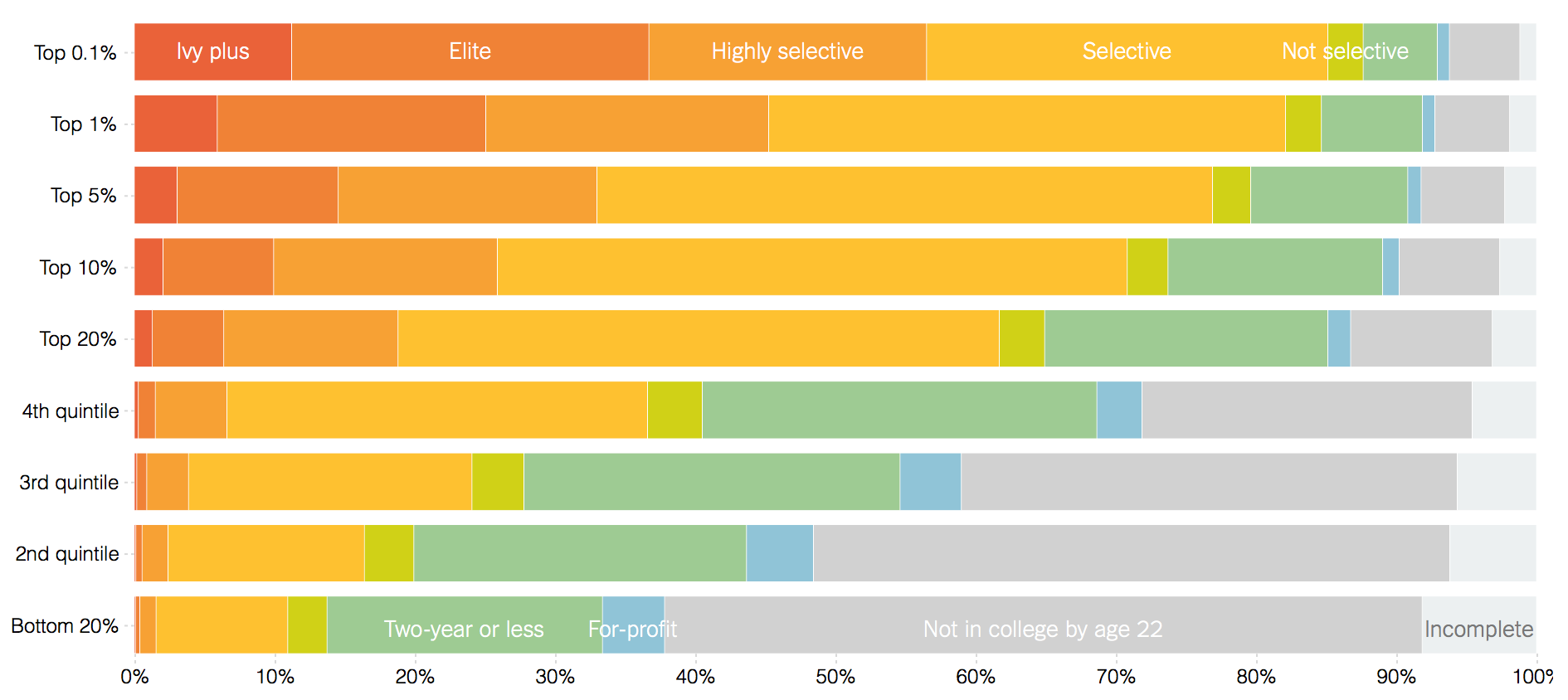
At 38 colleges in America, including five in the Ivy League – Dartmouth, Princeton, Yale, Penn and Brown – more students came from the top 1 percent of the income scale than from the entire bottom 60 percent.

38 colleges had more students from the top 1 percent than the bottom 60 percent

STUDENTS FROM … THE TOP 1%
($630K+)
BOTTOM 60%
(<$65K)
1. Washington University in St. Louis 21.7 6.1
2. Colorado College 24.2 10.5
3. Washington and Lee University 19.1 8.4
4. Colby College 20.4 11.1
5. Trinity College (Conn.) 26.2 14.3
6. Bucknell University 20.4 12.2
7. Colgate University 22.6 13.6
8. Kenyon College 19.8 12.2
9. Middlebury College 22.8 14.2
10. Tufts University 18.6 11.8
These estimates are for the 1991 cohort (approximately the class of 2013). Rankings are shown for colleges with at least 200 students in this cohort, sorted here by the ratio between the two income groups.

Roughly one in four of the richest students attend an elite college – universities that typically cluster toward the top of annual rankings (you can find more on our definition of “elite” at the bottom).

In contrast, less than one-half of 1 percent of children from the bottom fifth of American families attend an elite college; less than half attend any college at all.

Where today’s 25-year-olds went to college, grouped by their parents’ income

About four in 10 students from the top 0.1 percent attend an Ivy League or elite university, roughly equivalent to the share of students from poor families who attend any two- or four-year college.

Colleges often promote their role in helping poorer students rise in life, and their commitments to affordability. But some elite colleges have focused more on being affordable to low-income families than on expanding access. “Free tuition only helps if you can get in,” said Danny Yagan, an assistant professor of economics at the University of California, Berkeley, and one of the authors of the study.

The study – by Raj Chetty, John Friedman, Emmanuel Saez, Nicholas Turner and Mr. Yagan – provides the most comprehensive look at how well or how poorly colleges have built an economically diverse student body. The researchers tracked about 30 million students born between 1980 and 1991, linking anonymized tax returns to attendance records from nearly every college in the country.

We’re offering detailed information on each of more than 2,000 American colleges on separate pages. See how your college compares – by clicking any college name like Harvard, U.C.L.A., Penn State, Texas A&M or Northern Virginia Community College – or search for schools that interest you.

At elite colleges, the share of students from the bottom 40 percent has remained mostly flat for a decade. Access to top colleges has not changed much, at least when measured in quintiles. (The poor have gotten poorer over that time, and the very rich have gotten richer.)

False information sends asylum-seeking Haitians to Canada

Suggests that more targeted communications, using diaspora networks, are needed to help reduce expectations and false information (beyond the recent PM and IRCC Minister comments in that regard):

An exodus of Haitian migrants seeking asylum at the Canadian border is being fuelled by incomplete and false information spreading like wildfire throughout the community.

Refugee advocates say many of the 58,000 Haitians living in the United States under temporary protection – which was granted after the 2010 earthquake in Haiti and exempted them from deportation to the devastated country – began to look at options in May when the administration of U.S. President Donald Trump announced the status would end in January. Attention turned to Canada in June when false rumours spread that the country was automatically welcoming people with temporary protected status (TPS) in the United States.

The effect was quickly felt in Quebec, where the daily arrival of about 50 asylum seekers a month tripled in July. Montreal’s Olympic Stadium is now being used as a temporary shelter for up to 1,050 people. Hundreds of Quebeckers rallied at the stadium Sunday to show support for the migrants. An anticipated anti-immigration protest did not happen.

Farrah Larrieux, a Haitian TPS holder and advocate who lives in Florida, said when the Trump administration announced the status would end Haitians were faced with a choice: spend nearly $500 (U.S.) in fees to extend their stay for six months or put the money toward an attempt to get into Canada.

Opportunists quickly popped up advertising Canada was offering a free ride. “There are posts on social media, ads on messaging apps, even Haitian radio hosts telling people they were willing to organize a bus to get them to Canada where they would be welcomed with open arms,” said Ms. Larrieux, who was facing deportation in 2010 for overstaying a tourist visa when an earthquake struck Haiti and she received TPS protection. “When you have this kind of chaos, you have people willing to take advantage.”

Sophia Cineas, a 31-year-old Haitian woman, was one of hundreds of people who arrived at an unofficial border crossing between upstate New York and Quebec last week. She described how much more welcoming Prime Minister Justin Trudeau is to immigrants than Mr. Trump and how she believed Canada would welcome her. “I cannot stay in the United States and there’s no better place than Canada,” she said. “I’m doing what I’ve got to do.”

Jean-Nicolas Beuze, the representative in Canada for the United Nations High Commissioner for Refugees (UNHCR), interviewed 30 newly arrived asylum seekers last week, about two-thirds of whom were Haitian. He said many of them appeared to have bad information about how easily they could get established in Canada. “There is an impression that Canada is a more generous country when it comes to refugees, but when you look at the statistics, it’s very similar.”

In Canada, 52 per cent of Haitian refugee claims were accepted in 2016, compared with 48 per cent in the United States, Mr. Beuze noted, but refugee claims will be tough to make for Haitians who have been living in the United States with protected status. “They have a different profile from the Haitians who normally come to Canada,” he said.

Many of the Haitians under TPS permits have been in the United States for years and often arrived with legitimate visitor visas or by clandestine methods. People who want to make asylum claims from within the United States are generally required to make the claim within their first year in the country. Many of the new arrivals in Quebec say they’ve been living in the United States for five to 10 years.

Most people who have legitimate refugee claims would have likely made them upon arrival in the United States, Mr. Beuze said.

In the first six months of the year, Canada processed 18,306 asylum claims. Official numbers for July are not available, but estimates indicate a big spike, ranging from about 1,100 to 2,500 for the month in Quebec alone. If the pattern continues, the numbers might approach the recent high of 44,640 in 2001, when the rules were more relaxed.

Canada can handle the load, Mr. Beuze said. The UN representative also cautioned against relying too much on projections. He noted Canada expected an influx of Mexican asylum seekers when Ottawa lifted a visa requirement for visits. It didn’t happen. This winter, as the number of border-hopping asylum claimants increased exponentially from January to March, many predicted the numbers would explode when the snow melted. Instead, the numbers from April to June stabilized before the July spike.

“You do not always understand the triggers, the push and the pull factors,” Mr. Beuze said. “People have different profiles and weigh different factors while making very personal decisions.”

The difficulty of claiming refugee status in Canada may become clearer to potential migrants and people may pursue other options to stay in the United States or return home to Haiti, he added.

Source: False information sends asylum-seeking Haitians to Canada – The Globe and Mail

The mystery of high unemployment rates for black Americans – The Economist

Further to earlier posts on blind cvs and discrimination:

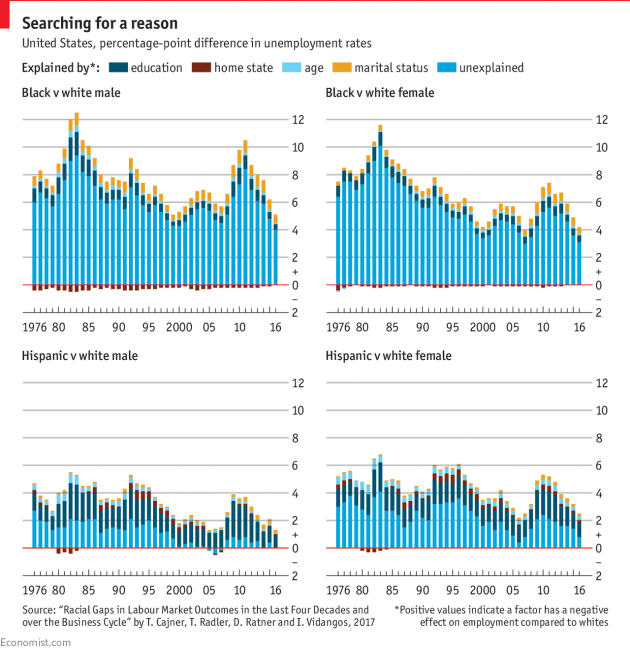
Lower levels of education cannot account for the size of the racial gap. The real cause may be discrimination

Using American census data from 1976 to 2016, the authors built a statistical model using four factors they expected to account for variations in unemployment between racial minorities and whites: education, age, marital status and the state a person lives in. Among men, these variables collectively explained around three-quarters of the difference in joblessness rates between Hispanics and whites—but only about one-fifth of the gap between blacks and whites.

The authors put forward three possible reasons for this stubborn discrepancy. First, they suggest that nominal educational attainment could be a poor measure of labour-market skills: schools vary widely in quality, and those in majority-black districts tend to underperform on standardised tests. A second potential reason is mass incarceration. Around one in three black men spend time behind bars during their lives, which severely hampers their employment prospects upon release.

The third possible explanation is outright discrimination. One study in 2004 provided strong evidence that racism among employers is at least partly to blame. The authors responded to “help wanted” advertisements in newspapers in Boston and Chicago with fake resumes. They gave names common to black Americans to some fictitious applicants, and names common to whites to the rest. Every other detail was identical. Sure enough, the candidates with stereotypically white names received 50% more job interviews.

Source: The mystery of high unemployment rates for black Americans

Trump Administration Changes Focus of USCIS Immigrant #Citizenship Training to Assimilation – Breitbart

Not an insignificant shift, if followed through by programming and other substantive changes:

The Trump administration has changed the focus of a Department of Homeland Security immigrant citizenship training program managed by USCIS to “assimilation,” a significant shift from the Obama era focus on “integration.”

The change of focus was made official in the announcement on Tuesday that “U.S. Citizenship and Immigration Services (USCIS) began accepting applications for two competitive funding opportunities under the Citizenship and Assimilation Grant Program.” (emphasis added)

“Both funding opportunities aim to prepare lawful permanent residents for naturalization and promote civic assimilation through increased knowledge of English, U.S. history, and civics. Through these two funding opportunities, USCIS will offer up to $10 million in competitive funding for citizenship preparation programs in communities across the country,” the announcement said.

The program, which began in 2009, President Obama’s first year in office, was previously called the “Citizenship and Integration Grant Program” (emphasis added) and “has awarded $63 million through 308 competitive grants to immigrant-serving organizations in 37 states and the District of Columbia. The program has helped more than 170,000 permanent residents prepare for citizenship.”

The name change appears to have taken place this month. A screenshot taken from the Internet Wayback Machine shows the word “integration” was used to describe the grant program as recently as July 3.

“The Department of Homeland Security (DHS) initiated the name change of the grants program. This change in language reflects one of the primary goals of USCIS, which is to facilitate the full assimilation of lawful permanents into society,” Gillian Christensen, a spokesperson for DHS, tells Breitbart News, adding:

Through the Citizenship and Assimilation Grant Program, USCIS will ensure that lawful permanent residents seeking U.S. citizenship understand the fundamental civic values that unite all Americans. Through the teaching of English, U.S. history and government, and fostering a greater understanding and connection to key principles and institutions, the grant program strives to encourage a greater attachment to the Constitution and the American ideals that strengthen this Nation and secure our homeland.

As Breitbart News reported previously, “assimilation” into American culture by immigrants–the adoption of American mores, language, and culture, as well as the full fledged acceptance of our legal and political system–has been the hallmark of the American experience for two centuries.

That all changed in the early 1990s, when under the Clinton administration a phalanx of left wing social engineers were brought into top levels of the federal bureaucracy, especially the State Department and the Office of Refugee Resettlement in the Department of Homeland Security, where the word “integration”–with a markedly different connotation than what the word meant during the 1950s and 1960s–replaced traditional concepts of immigrant assimilation.

In his 1998 book, The Unmaking of Americans: How Multiculturalism Has Undermined the Assimilation Ethic, John J. Miller saw early signs of the damage this shift from “assimilation” to “integration” would have on the country.   “In his book, Miller contends that the United States is currently in the midst of an assimilation crisis—one brought about not by immigrants, but by American institutions that have surrendered in the struggle to help newcomers assimilate,” the Ashbrook Institute noted at the time.

Almost two decades later, the change of focus on the USCIS citizenship training program from “integration” to “assimilation” is a clear signal the Trump administration intends to reverse that damage.

The liberal establishment and mainstream media, predictably, has reacted unfavorably to the Trump administration’s bold move.

“Justin Gest, a Professor at George Mason University’s Schar School of Policy and Government and author of The New Minority: White Working Class Politics in an Era of Immigration and Inequality, tells Newsweek that the two words have come to have quite different connotations,” Josh Lowe reported at Newsweek on Thursday:

“The history of the words assimilation and integration are not necessarily that different,” Gest says, but “through selective use, and adoption by different idealogues and commentators, they have developed divergent connotations.”

“Integration implies a two-way process, whereby the immigrant adapts to their new environment, and those in the new environment attempt to facilitate the adaptation and co-evolve with immigrants themselves.”

“Assimilation has come to connote a one-way process, where there is a monolithic understanding—a static understanding— of what society is like, and that the immigrants hold all responsibility for adapting to it, and society is subject to no obligation to change to welcome or facilitate the arrival of newcomers.”

Unlike most conservatives, Gest thinks this is a bad thing, and blames Donald Trump, Gest told Newsweek.

Donald Trump has overtly sought to re-establish a bygone era of what he portrays as safety, stability and prosperity, and in trying to re-establish that era there is the implication that that era A) existed, and B) was something that actually was stable and that was static. Whereas in reality, there has never been that kind of stability in the American identity or American society.

Gest’s criticism of assimilation is in line with other earlier criticisms of assimilation in America made by London mayor Sadiq Khan and the controversial Muslim/progressive Democrat activist Linda Sarsour.

Source: Trump Administration Changes Focus of USCIS Immigrant Citizenship Training to Assimilation – Breitbart

White Economic Privilege Is Alive and Well – The New York Times

Good analysis:

Is the white working class losing economic ground because of policies intended to improve the lives of black people? Anxiety and resentment among some white voters about those policies certainly seemed to benefit Donald Trump’s campaign last year, with its populist, ethno-nationalist message.

The problem with this belief is that it is false. The income gap between black and white working-class Americans, like the gap between black and white Americans at every income level, remains every bit as extreme as it was five decades ago. (This is also true of the income gap between Hispanic and white Americans.)

In 2015 — the most recent year for which data are available — black households at the 20th and 40th percentiles of household income earned an average of 55 percent as much as white households at those same percentiles. This is exactly the same figure as in 1967.

Indeed, five decades of household income data reveal a yawning and uncannily consistent income gap between black and white Americans across the economic spectrum. Fifty years ago, black upper-class Americans had incomes about two-thirds those of white upper-class Americans, while the black middle class — those in the 60th percentile — earned about two-thirds as much as its white counterpart. Those ratios remain the same today.

The Income Gap That Won’t Close

These numbers should shock us. Consider that in the mid-1960s, Jim Crow practices were still being dismantled and affirmative action hardly existed. Yet a half-century of initiatives intended to combat the effects of centuries of virulent racism appear to have done nothing to ameliorate inequality between white and black America.

Conservatives like Charles Murray tend to blame either social welfare programs for sapping initiative and keeping black people poor, or black people themselves for being less intelligent than whites, or a “pathological” culture that now manifests itself in the white working class as well.

But the historical pervasiveness and contemporary persistence of racism in America offer more than adequate explanations for what should be considered a scandalous state of affairs in regard to race-based economic inequality.

Many black children, for example, attend schools that once again are as segregated as they were in the 1960s, and they are far more likely to become trapped in a prison-industrial complex that the scholar Michelle Alexander has called “the new Jim Crow.”

Research by the sociologist Devah Pager in 2009 also found that black job applicants for low-wage jobs receive callback interviews or job offers at half the rate of equally well-qualified white applicants and that black and Latino applicants with clean records “fare no better” than white applicants just released from prison.

It is important to remember the extent to which the civil rights movement led by the Rev. Dr. Martin Luther King Jr. was focused on economic injustice. Indeed, A. Philip Randolph and Bayard Rustin, who planned the March on Washington that culminated with Dr. King’s “I Have a Dream” speech, organized the event primarily to highlight and protest what they called “the economic subordination of the American Negro.”

And Dr. King’s Poor People’s Campaign, which he was organizing at the time of his murder, was an even more explicit argument that racial and economic justice are inextricably linked.

None of this is intended to minimize the legitimate anxiety felt by white families at a time when wages for low-wage workers have declined and middle-class incomes have stagnated, even as the economy has boomed and upper-class incomes have soared. Between 1980 and 2014, the post-tax income of the bottom 50 percent of the population grew by 21 percent, while that of the top .01 percent grew by 424 percent.

But over that same time, black working- and middle-class households have seen their incomes stagnate in exactly the same fashion as those of their white neighbors — and from a base that was and thus remains little more than half as large.

A genuine populist movement would unite working- and middle-class Americans of all backgrounds, rather than dividing them by exploiting false beliefs about the supposed loss of white economic privilege.

Muslims In The U.S. Face Increased Discrimination, PEW Report Says : NPR

Interesting interview regarding some of the latest findings on American Muslims:

A newly-released poll from the Pew Research Center finds Muslims in the U.S. are facing increased discrimination but are optimistic about being both Muslim and American.

KELLY MCEVERS, HOST:

There are an estimated 3.3 million Muslims in the United States, and that number is growing. Today the Pew Research Center released a wide-ranging poll on Muslims in America. And while almost half the Muslims surveyed reported incidents of verbal or physical abuse in the past 12 months, many still say they are optimistic about their future and about this country. To talk about this, we’re joined now by NPR’s Leila Fadel. You might remember her from her time as NPR’s Cairo correspondent. Now she has taken on a new job covering culture, race and diversity here in the U.S. She is with us from her new base in Las Vegas. Hi there.

LEILA FADEL, BYLINE: Hi.

MCEVERS: So what were the most striking findings in this poll of Muslim-Americans?

FADEL: Well, this is the third Pew poll on Muslims in America in 10 years. And I think the first thing that’s so noticeable is the incredible diversity of Muslim communities in this country. Often Muslims are spoken about as a monolith when, in fact, this is a population that’s really a diverse mosaic. There’s no one ethnic group that dominates the population. It’s African-American. It’s white. It’s Asian. It’s Arab. It’s Latino. And list goes on. And it’s really young. The majority of Muslims in America are under 40.

MCEVERS: And what about that finding that I mentioned in the introduction that Muslims are feeling optimistic?

FADEL: Yeah, it’s interesting. Despite this feeling that they’re not accepted as part of the mainstream, that the president is unfriendly toward Muslims and that discrimination is going up, 7 in 10 respondents really believe in the American dream still, that if you work hard, you can get ahead. And the overwhelming majority are proud to be both American and Muslim. This is what Besheer Mohamed, lead author of the report, had to say.

BESHEER MOHAMED: There’s a thread throughout the survey of this tension that our Muslim respondents tell us about where on the one hand, they’re uncertain about their acceptance by the larger society. But on the other hand, they’re committed to an American identity. And I think this finding that 9 in 10 say they’re proud to be American is sort of a perfect example of that commitment.

MCEVERS: Who did the poll survey?

FADEL: So the poll was conducted on a sample size of about a thousand Muslim adults living in the U.S. And really there’s not that much data out there on Muslims in the U.S. Muslims are a group of people in America that are often spoken about and scrutinized, but there’s very little data, including how many there are because being Muslim is not something you check on the census form.

MCEVERS: You’ve been traveling and visiting a lot of different Muslim communities across the U.S. Does this poll reflect what you’ve been seeing?

FADEL: Well, yeah. I visited communities in Texas and California as well as cities like Chicago and New York and spoke to Muslims in all parts of the country. And it’s funny because in the poll, it seems that women are more worried about discrimination. They’re more worried about their place in society. And I really felt that same way in doing interviews across the country. And I think that’s really because when a woman decides to put a scarf on her head and cover her hair, she suddenly becomes unmistakably Muslim and de facto ambassador of the faith and a de facto target for the faith.

So, you know, I met people like a young girl in California who’s being bullied at school. And she decided to put on the scarf because her mom does, and she loves her mom and admires her mom. And she found at school that suddenly kids were whispering behind her back allahu akbar, pinning things to her backpack. And the teacher was handing out articles about stonings in Afghanistan as an example of her faith. And this is what she was having to deal with and answer for in her faith at just 14 years old while her sister, who doesn’t cover her hair, didn’t have to deal with any of that.

Source: Muslims In The U.S. Face Increased Discrimination, PEW Report Says : NPR

US Immigration Announces $10 Million Citizenship and Assimilation Grant Opportunities

Not yet cut by the Trump administration.

While Canada spends considerable on settlement services (primarily language along with some employment and orientation services), Canada does not dedicate funding for citizenship knowledge requirements preparation.

Given the greater difficulties faced by family class and refugees (see chart above), this may be a gap that the Government should consider filling when it rolls out its new citizenship study guide:

U.S. Citizenship and Immigration Services (USCIS) is now accepting applications for two funding opportunities under the Citizenship and Assimilation Grant Program.

These are competitive grant opportunities for organizations that prepare lawful permanent residents for naturalization and promote civic assimilation through increased knowledge of English, U.S. history and civics.

The two programs will provide up to $10 million in grants for citizenship preparation programs in communities across the country. Applications are due by August 6.

USCIS wants to expand the availability of high-quality citizenship preparation services throughout the country with these two opportunities:

  • Citizenship instruction and naturalization application services: This opportunity will fund up to 36 organizations that offer both citizenship instruction and naturalization application services to lawful permanent residents.
  • Citizenship instruction only: This grant opportunity will assist nonprofit organizations in establishing new citizenship instruction programs or expanding the quality and reach of existing citizenship instruction programs. We expect to award up to 10 nonprofit organizations through this opportunity. In doing so, we want to encourage the expansion of the existing field of citizenship instruction programs, particularly those offered by small community-based organizations that have not previously received a grant from us.

USCIS expects to announce all 46 award recipients in September.

Since 2009, USCIS has awarded approximately $63 million through 308 grants to organizations that have provided citizenship preparation services to more than 170,000 permanent residents in 37 states and the District of Columbia.

To apply for this funding opportunity, visit grants.gov. For additional information on the Citizenship and Assimilation Grant Program for fiscal year 2017, visit uscis.gov/grants or email the USCIS Office of Citizenship at citizenshipgrantprogram@uscis.dhs.gov.