Majority of Americans continue to say immigrants strengthen the U.S.

More data from Pew, confirming the highly partisan nature of views:

The American public’s views of the impact immigrants have on the country remain largely positive – and deeply partisan.

Partisan gap in views of immigrants as wide as at any point in at least 25 yearsAs in recent years, a majority (62%) say immigrants strengthen the country because of their hard work and talents. Just 28% say immigrants are a burden on the country because they take jobs, housing and health care, according to a new survey by Pew Research Center.

These attitudes have changed little in the past few years, but they are very different from a quarter-century ago. In 1994, attitudes were nearly the reverse of what they are today: 63% of Americans said immigrants burdened the country and 31% said they strengthened it.

An estimated 45.1 million immigrants were living in the U.S. in 2016, accounting for 13.9% of the nation’s population. Most (76%) are in the country legally.

Republicans and Democrats have never been further apart in their views of immigrants than they are currently. Democrats and those who lean to the Democratic Party overwhelmingly say immigrants are a strength to the nation (83% say this); just 11% say immigrants burden the United States. Among Republicans and Republican-leaning independents, 38% say immigrants strengthen the country, while nearly half (49%) say they burden it.

Generational differences in views of immigrantsThere also are sizable generational differences in opinions about immigrants. Three-quarters of Millennials (75%) say immigrants strengthen rather than burden the U.S. That compares with 63% of Gen Xers, 52% of Baby Boomers and 44% in the Silent Generation. In 1994, roughly comparable shares of Gen Xers, Boomers and Silents expressed positive views of immigrants.

Generational differences are evident in both parties but are particularly stark among Republicans. More than half of Millennial Republicans (58%) say immigrants strengthen the country, compared with just 36% of Gen Xer Republicans and even smaller shares among older GOP generations. Among Democrats, there are only modest generational differences in these views, with no fewer than seven-in-ten of those in all generations saying this, including nearly nine-in-ten Millennial (88%) and Gen Xer (87%) Democrats.

Note: See full topline results and methodology

Source: Majority of Americans continue to say immigrants strengthen the U.S.

Immigrant share in U.S. nears record high but remains below that of many other countries

Good recap of comparative statistics:

Nearly 14% of the U.S. population was born in another country, numbering more than 44 million people in 2017, according to a Pew Research Center analysis of the U.S. Census Bureau’s American Community Survey.

Immigrant share of U.S. population approaches historic highThis was the highest share of foreign-born people in the United States since 1910, when immigrants accounted for 14.7% of the American population. The record share was 14.8% in 1890, when 9.2 million immigrants lived in the United States.

The foreign-born population in the U.S. grew substantially during the late 1800s, when immigration from Europe and elsewhere brought millions of new residents to the nation’s shores. In the 1920s, the U.S. adopted a series of more restrictive immigration laws, eventually leading to the establishment of a national-origin quota system in 1924 and a subsequent decline in the foreign-born share of the nation’s population. That immigration system was not changed until 1965, when the Immigration and Nationality Act created the same overarching immigration laws that the U.S. still uses today. Since 1965, at least 59 million immigrants have come to the United States.

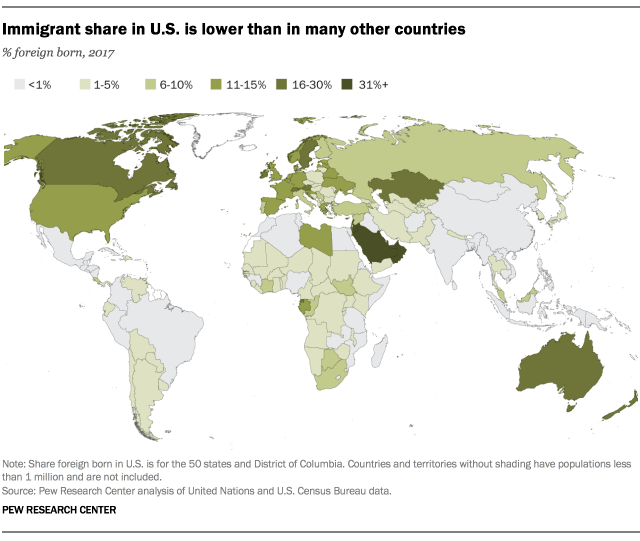
Immigrant share in U.S. is lower than in many other countriesEven though the U.S. has more immigrants than any other country, the foreign-born share of its population is far from the highest in the world. In 2017, 25 countries and territories had higher shares of foreign-born people than the U.S., according to United Nations data.

In 2017, large majorities of populations in some Persian Gulf nations, such as the United Arab Emirates (88%) and Kuwait (76%), were born in other countries. (Most foreign-born persons living in Persian Gulf nations are labor migrants and live in the region temporarily.)

Foreign-born people also accounted for a substantial share of the population in Australia (29%), New Zealand (23%) and Canada (21%), as well as in several European countries, such as Switzerland (30%), Austria (19%) and Sweden (18%).

Explore detailed tables on the number and share of immigrants and emigrants by country.

The share of foreign-born people has changed over time in many nations, just as it has in the U.S. Several European countries, as well as other immigrant destinations (Canada and Australia, for example), have seen steady increases in recent decades. But some nations have seen their immigrant shares drop. In several Central and Eastern European countries – such as Latvia and Estonia – more people are leaving than entering, and remaining immigrants are getting older and dying, all leading to a decreasing share of foreign-born people.

In several immigrant destination countries, larger shares of publics want fewer or no immigrants to move to their country, according to a Pew Research Center survey conducted in the spring of 2018. However, support for taking in high-skilled immigrants and refugees fleeing war remains high in some destination countries.

Worldwide, most people do not move across international borders. In all, only 3.4% of the world’s population lives in a country they were not born in, according to data from the UN. This share has ticked up over time, but marginally so: In 1990, 2.9% of the world’s population did not live in their country of birth.

Source: Immigrant share in U.S. nears record high but remains below that of many other countries

Yes, you can buy your way into U.S. citizenship

Not sure how this program is being affected by the Trump administration (85 percent of applications are from China and, like other investment immigration programs, has been dogged by questions of fraud and questionable value):

Yes, you can buy your way into U.S. citizenship The Globe and Mail It’s known as the ‘million dollar

It’s known as the “million dollar green card,” a visa program that gives wealthy people the ability to move to the United States by creating economic opportunities and employment there.

The EB-5 investor visa offers permanent U.S. residency and eventually citizenship when a person invests between US$500,000 and US$1-million in a new commercial enterprise that produces at least 10 full-time jobs.

The program is becoming popular among Canadians with financial means, experts say, from retirees who want to live for extended periods south of the border to families that eventually want their children to be able to study and work there.

But it’s important to understand the program’s rules, costs and timing, they warn, as well as to seek qualified advice about issues such as health care, estate and tax planning as well as payments associated with the Canadian exit and U.S. entry.

“You need to ask questions,” says Joe Kirkwood, a dual Canadian-U.S. citizen who is an immigration attorney and partner at Leibl & Kirkwood, a private law firm in San Diego that specializes in U.S. immigration law. Three-quarters of the firm’s clients are Canadian, he says, and about 10 per cent are getting EB-5 visas, an overall number that is “increasing for sure,” especially as retiring baby boomers often don’t have other ways to become U.S. residents. “You’re buying green card status.”

The U.S. Congress created the EB-5 Immigrant Investor Program in 1990 to help stimulate the country’s economy by attracting new business investment from abroad. It is administered by U.S. Citizenship and Immigration Services, a division of the Department of Homeland Security.

Up to 10,000 EB-5 visas are issued each year. Chinese nationals typically account for three-quarters of them, but Canada consistently ranks among the top 20 source countries. In 2017, according to U.S. State Department statistics, 55 EB-5 visas were issued to Canadian investors and family members.

Applicants can “fly solo,” Mr. Kirkwood says, making a direct investment of US$1-million in an eligible small business that creates at least 10 jobs and then actively managing it. Or they can passively invest US$500,000 in one of about 900 EB-5 regional centres, approved organizations designed to manage EB-5 investor funds and the immigration approval process. These centres finance or buy equity in job-creating capital projects in certain areas, typically smaller communities with high jobless rates.

For the first two years, EB-5 visa holders are granted conditional permanent-resident status in the United States. After 24 months of compliance with the program, they can apply to have the conditions removed. Dependent children under 21 and spouses get the same visa status as the primary EB-5 investor and receive their own green cards. All are eligible for U.S. citizenship five years after initial approval.

EB-5 funds have been used to build office towers, shopping malls, ski resorts, hospitals and film studios.

One of the bigger downsides for participants in the program is that their cash is locked up for perhaps five years, says Terry Ritchie, director of cross-border wealth services for Cardinal Point Capital Management Inc., a firm with offices in Canada and the United States that specializes in wealth management for people in both countries.

Mr. Ritchie says it’s critical for would-be EB-5 investors to look at their tax and estate planning structures, their other investments and the tax implications of leaving Canada.

He cautions that the program comes with a “a nuisance factor because you’re dealing with government.” For example there’s a lot of poking and prodding through your personal information and tax returns. “You’re laying bare your financials,” he says.

The visa applicant must also show evidence that the investment is being made with capital acquired lawfully, for example earnings from employment, private businesses, real estate, stocks and bonds, an inheritance or a gift.

It typically takes 18 to 20 months for applications to be processed, and the filing fee is US$3,675. Plans to update the program and increase the minimum investments required have been reported but not implemented. There have also been warnings that the program might be cancelled altogether.

Mr. Kirkwood suggests that Canadians exhaust other options for U.S. residency, such as family sponsorship or sponsorship by an employer, as it can take a significant amount of time and money to go the EB-5 route. Administrative fees for the EB-5 program can range from $30,000 to $50,000, with legal costs of around $25,000, he says, plus the cost of other professional and financial planning advice.

Entrepreneurs looking to live full-time in the United States, he notes, have other options, such as the E-2 investor visa, which requires a smaller investment in a business – say an outlay of US$150,000 to start a yogurt shop in Florida, for instance – but does not come with a green card and must be renewed periodically.

The principal residence of EB-5 visa holders must be in the United States, Mr. Kirkwood notes. Direct investors are expected to live in the same area as their project, in order to develop and manage the business, while passive investors can live anywhere in the country.

Another motivation for EB-5 investors is attendance at elite universities. For example, it may be easier for the children of EB-5 visa holders to ultimately get into an Ivy League school as a green card holder or dual citizen rather than an international student, and they might qualify for in-state tuition at universities. But Mr. Kirkwood warns that dependent children must be younger than 21 upon the initial program approval to qualify for green cards.

Source: Yes, you can buy your way into U.S. citizenship

USA: A Judge Blocked the Census From Asking About Citizenship. Here’s Why It Matters

One of the better analysis that I have seen:

A federal judge in New York has blocked the Trump Administration from adding a question about citizenship status to the 2020 Census, marking a victory for critics who have said the question is unnecessary and is intended to decrease the number of immigrants and minorities counted in the decennial survey.

The ruling is just the first in a series of cases on the issue, which has significant implications for future elections, political representation at every level and federal funding decisions for the next decade. The Trump Administration is also facing five other lawsuits over the Census question, and the battle is expected to end up at the Supreme Court.

But U.S. District Judge Jesse Furman’s decision on Tuesday was an important moment. The suit’s plaintiffs — a collection of immigrant advocacy groups, states and local officials — argued that the Trump Administration tried to add the citizenship question to intentionally dissuade immigrants from responding to the survey. The U.S. Census, which is conducted every 10 years, has not included a question about citizenship since 1950. More detailed sampling surveys have done so, but those go out to far fewer households.

Furman ruled that the way Commerce Secretary Wilbur Ross added the question was “arbitrary and capricious” and violated administrative procedures.

“He failed to consider several important aspects of the problem; alternately ignored, cherry-picked, or badly misconstrued the evidence in the record before him; acted irrationally both in light of that evidence and his own stated decisional criteria; and failed to justify significant departures from past policies and practices,” Furman wrote in his 227-page decision.

The judge also ruled that Ross’s explanation for the citizenship change — that the Justice Department said it was needed to help enforce the Voting Rights Act — was “pretextual.”

Ross initially offered voting rights enforcement as his official explanation, but documents released as part of the ongoing lawsuits revealed that he began pushing the issue on his own soon after becoming Commerce Secretary.

The Justice Department said it was disappointed in the ruling, while advocacy groups like the ACLU cheered the decision.

“This ruling is a forceful rebuke of the Trump administration’s attempt to weaponize the census for an attack on immigrant communities,” Dale Ho, director of the ACLU’s Voting Rights Project, said in a statement. “The evidence at trial, including from the government’s own witness, exposed how adding a citizenship question would wreck the once-in-a-decade count of the nation’s population. The inevitable result would have been — and the administration’s clear intent was — to strip federal resources and political representation from those needing it most.”

As this was the first ruling in the cases against the citizenship question, evidence that came out during the trial could encourage those pursuing similar lawsuits, said William H. Frey, a demographer and expert on the Census at the Brookings Institution.

“This is good news for people who want to have a Census that represents America,” Frey told TIME. “You want to make sure that all groups are represented and it helps the proper apportionment of Congress, it helps federal spending that is allocated to different groups around the country.”

If immigrants and other minorities avoid responding to the census because of a question about citizenship, experts, including the Census Bureau itself, say it would likely result in a survey that significantly undercounts those populations.

The Census provides crucial data that is used for a wide variety of decisions, including how many representatives each state sends to Congress and how much federal money different areas receive for everything from highway funds to Medicaid. The data can also affect state representation and even the Electoral College, which is based on Congressional delegations.

The private sector often relies on Census numbers as well for decisions about where to open stores or where to base factories and other employment opportunities, Frey notes.

“The Constitution says that we need to count everyone in the United States and I think that as a scientist, as a demographer, as someone who has been doing this for a long time, the research is pretty unequivocal that that’s going to not be done if the citizenship question is on there,” he said.

Source: A Judge Blocked the Census From Asking About Citizenship. Here’s Why It Matters

Trump Claims There Is a Crisis at the Border. What’s the Reality?

Good analysis of the numbers:

President Trump has frequently called the situation at the southern border with Mexico a crisis and insists that building his long-promised border wall will fix it. Here are some of Mr. Trump’s most common assertions of a crisis, and the reality of what we know about immigrants and the border.

“We can’t have people pouring into our country like they have over the last 10 years.”

THE REALITY Illegal border crossings have been declining for nearly two decades. In 2017, border-crossing apprehensions were at their lowest point since 1971.

Total number of arrests for illegally crossing the Mexican border

Undetected illegal border crossings have dropped at an even faster rate, from 851,000 in 2006 to approximately 62,000 in 2016, according to estimates by the Department of Homeland Security.

However, there is one group of migrants that is on the rise: families. A record number of families have tried to cross the border in recent months, overwhelming officials at the border and creating a new kind of humanitarian crisis.

Number of arrests for illegally crossing the Mexican border

Asylum claims have also jumped, with many migrant families telling officials that they fear returning to their home countries. Seeking asylum is one way to legally migrate to the United States, but only 21 percent of asylum claims were granted in 2018, and many cases can take years to be resolved.

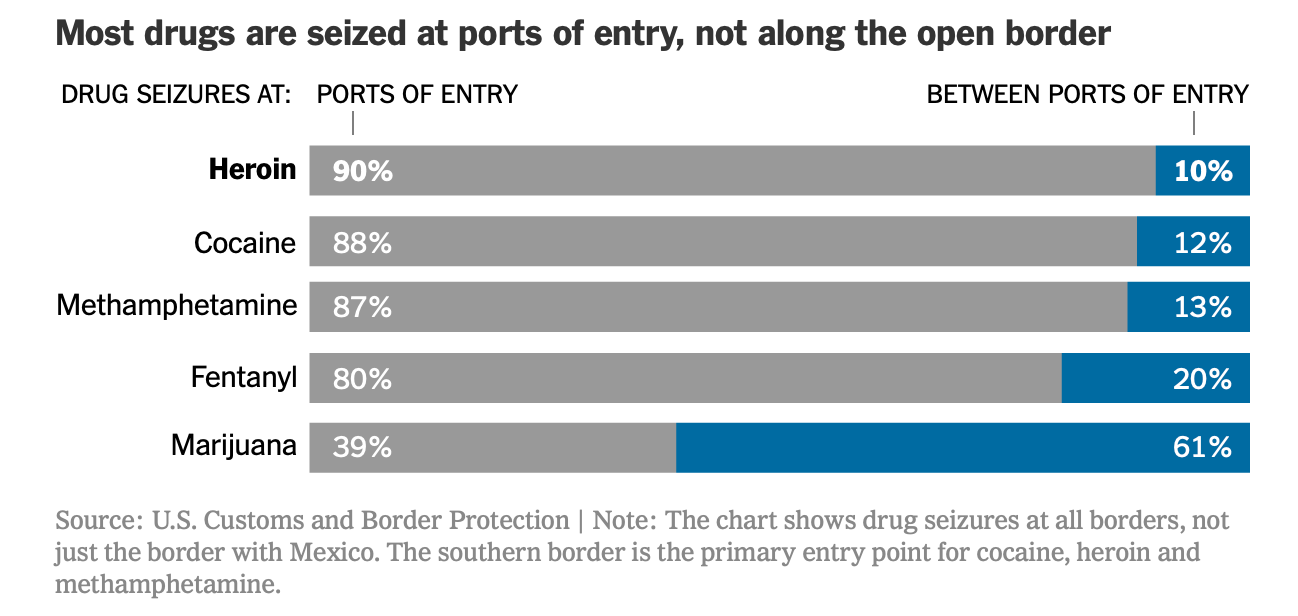
“Every week, 300 of our citizens are killed by heroin alone, 90 percent of which floods across from our southern border.”

THE REALITY It is true that the majority of heroin enters the United States through the southern border, according to the Drug Enforcement Administration. But the D.E.A. also saysthat most heroin is brought into the country in vehicles entering through legal border crossings, not through the areas where walls are proposed or already exist.

Most drugs are seized at ports of entry, not along the open border

There are more than two dozen ports of entry along the southern border. Barriers are already present in Border Patrol sectors with the highest volumes of heroin seizures.

“Over the years, thousands of Americans have been brutally killed by those who illegally entered our country, and thousands more lives will be lost if we don’t act right now.”

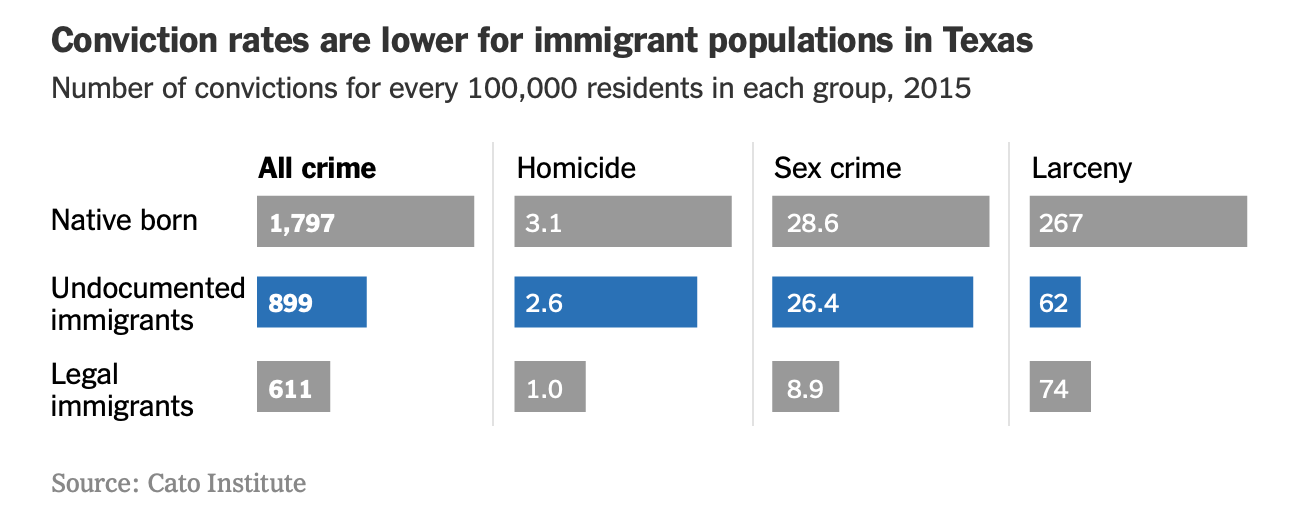
THE REALITY It is difficult to assess the president’s claims that illegal immigration leads to more crime because few law enforcement agencies release crime data that includes immigration status. However, several studies have found no link between immigration and crime, and some have found lower crime rates among immigrants.

Texas, which has the longest border with Mexico and has one of the largest populations of undocumented immigrants of any state, keeps track of immigration status as part of its crime data. The Cato Institute, a libertarian research center, analyzed the Texas data in a 2015 study and found that the rate of crime among undocumented immigrants was generally lower than among native-born Americans.

Conviction rates are lower for immigrant populations in Texas

Some critics of the study argued that the reason undocumented immigrant conviction rates were low was because immigrants were deported after they served their sentences, which prevented them from committing another crime in the United States, reducing their rate of crime relative to native-born Americans.

Alex Nowrasteh, senior immigration policy analyst at the institute, addressed the complaint by comparing first-time criminal conviction rates among undocumented immigrants in Texas and native-born Americans in Texas. He found that undocumented immigrants still committed crimes at a rate “32 percent below that of native-born Americans.”

President Trump frequently tells the stories of Americans who have been killed by undocumented immigrants as examples of criminal behavior. These terrible crimes have happened, but there is no comprehensive data that shows whether these killings are happening at crisis levels.

Trump touts plan to change visas for skilled foreign workers

All those articles contrasting Canada vs US policies under Trump have provoked a reaction (factually incorrect as per usual practice):

U.S. President Donald Trump said on Friday he plans changes to the H-1B program that grants temporary visas for specialty occupations such as technology or medicine, but his administration said later he was referring to changes that were proposed last year.

“H1-B (sic) holders in the United States can rest assured that changes are soon coming which will bring both simplicity and certainty to your stay, including a potential path to citizenship,” Trump said on Twitter. “We want to encourage talented and highly skilled people to pursue career options in the U.S.”

It was unclear what Trump meant by a “potential path to citizenship” for H-1B visa holders, who already are eligible to be sponsored by employers for legal permanent residency, which would then make them eligible to become U.S. citizens.

When asked about Trump’s tweet, U.S. Citizenship and Immigration Services spokesman Michael Bars provided a statement about a formal proposal in December for changes to the H-1B process, which are likely to become final later this year.

The proposal is designed to increase by 5,340, or 16 percent, the number of H-1B beneficiaries who hold advanced degrees from American universities. It would also streamline the application process with a new electronic registration system.

“These proposed regulatory changes would help ensure more of the best and brightest workers from around the world come to America under the H-1B program,” Bars said.

Critics questioned why Trump tweeted about a month-old proposal at a time when he is battling with congressional Democrats over spending legislation to fund the federal government. Trump wants to include $5.6 billion for a wall along the border with Mexico, which he says will stem illegal immigration.

Democrats call the proposed wall expensive, ineffective and immoral. The dispute has led to a partial shutdown of the U.S. government that is now in its 21st day.

Doug Rand, a former White House official in the Obama administration who worked on immigration issues, said the proposed changes to the lottery selection process were at best modest and at worst could cause chaos. Some immigration experts do not believe the new registration system will be ready in time for the next lottery, which occurs in the spring.

“The odds that a complicated new electronic processing system will be effectively launched by DHS in time for the next lottery on April 1 is low probability and has nothing to do with a potential path to citizenship,” Rand said.

Trump backs off emergency declaration – for now

Throughout his presidency, Trump has sought to stem illegal immigration and to deport more immigrants living in the United States illegally. His administration has also worked to limit legal immigration, including through a proposal that would penalize aspiring immigrants who use public benefits.

Trump has also derided visas granted to family members of U.S. residents or citizens as “chain migration,” and backed a Republican proposal in 2017 that would have slashed legal immigration in half.

“The devil is in the details, said Todd Schulte, president of FWD.us, a nonprofit group which advocates for pro-immigration policies. He said his group, which was founded by tech executives including Facebook founder Mark Zuckerberg, remains “skeptical of vague pronouncements given the administration’s track record.”

U.S. companies often use H-1B visas to hire graduate-level workers in specialized fields including information technology, medicine, engineering and mathematics. But the visa program has also drawn criticism for being used heavily by foreign outsourcing companies that squeeze out American firms.

Source: Trump touts plan to change visas for skilled foreign workers

Trump’s immigration policy has foreign tech talent looking north of the border

These articles keep on coming in the US press (less so in conservative medias like Fox):

Over dinner at a noodle bar, a Canadian entrepreneur pitched a table of U.S. tech executives: Your foreign workers should trade sunny California for snowy Calgary, he told them. And they listened.

Highly skilled foreign workers and the American firms that employ them are in a bit of a visa panic. President Trump has vowed to crack down on the H-1B visa program, which allows 85,000 foreigners per year to work in “specialty occupations” in the United States. But there are no new rules yet, creating climate of uncertainty and fear, particularly in Silicon Valley.

Canadian businesses sense an opportunity. The Canadian tech scene has sought for years to compete with Silicon Valley, trying to lure talent north. In the early days of the Trump administration, “moving to Canada” talk surged among Americans, but most foreign workers waited.

Now some are making the move.

Though it is hard to track how many foreign nationals have moved from the United States — the Canadian government tracks newcomers by country of citizenship, not residence — immigration lawyers and recruiters on both sides of the border say the number of inquiries from nervous H-1B holders has skyrocketed since 2017.

A small group of Canadian entrepreneurs are dropping into Silicon Valley to persuade companies that rely on foreign tech workers to move them across the border.

Irfhan Rawji, the Canadian entrepreneur trying to sell U.S. tech executives on Canada over dinner, last year founded a company called MobSquad that helps tech companies move software engineers and other highly skilled workers to Canada. He travels regularly to Silicon Valley to promote his Canadian “solution.”

“Our turnaround to bring a foreign worker to Canada is under four weeks,” he said. “It’s typically longer for them to pack up their stuff.”

For Akshaya Murali, an Indian national who spent nearly a decade in the United States working for companies such as Microsoft and Expedia, moving to Toronto meant an end to living visa to visa.

She and her family applied for permanent residence in Canada and were approved.

Her employer, Remitly, then worked with MobSquad to move her job north. MobSquad signed a contract with Remitly and then hired her to do the same job — senior product manager — for Remitly from Toronto.

MobSquad’s cut is the difference between her total compensation in pricey San Francisco and the cost of the same work in Toronto, which is lower.

Remitly’s chief product officer, Karim Meghji, said the process went so smoothly that he will probably do it again. “My next step is thinking through, ‘What else can I do in Canada?’ ” he said.

Murali landed in Toronto in October and is settling in. “It’s a nice place to bring up our son, really family-friendly,” she said. “The only thing is the weather.”

Seeking stability

Silicon Valley’s visa anxiety did not start with Trump, but his policy moves and anti-immigrant rhetoric have compounded the problem, according to tech executives, immigration lawyers and people who have moved.

Months into his presidency, Trump issued a “Buy American and Hire American” executive order that ordered the Department of Homeland Security to review the H-1B visa program with the intention of more closely vetting applicants.

In the wake of the order, there were reports of an uptick in visa denials and requests by immigration officials for additional information, turning the issue into a topic of conversation for big U.S. companies and immigrant communities alike.

In August, chief executives from top U.S. firms including Apple, Cisco and IBM sent a letter to DHS expressing concern about the changes. “Inconsistent immigration policies are unfair and discourage talented and highly skilled individuals from pursuing career options in the United States,” it said.

Asked to comment on these reported changes, United States Citizenship and Immigration Services spokesman Michael Bars said, “Increasing our confidence in who receives benefits is a hallmark of this administration.”

Bars said proposed changes now under review would make the H-1B process more efficient and ensure the best applicants get visas.

Many have found the uncertainty over the changes to the H-1B program confusing and costly.

S. “Sundi” Sundaresh, the chief executive of Cinarra Systems, a start-up that provides location analytics based on mobile data to businesses, says getting U.S. work visas is a significant challenge.

His company employs 55 people worldwide, including 15 in the United States. He has three people on H-1Bs but would hire more if the process were easier.

Recently, an employee who was working remotely and waiting on a U.S. visa quit in frustration. When a second worker reached the same point, he started looking for options and is now talking to MobSquad about Canada. “We can’t lose a second one,” he said.

Michael Tippet, a Canadian entrepreneur who founded a company that helps U.S. firms set up satellite offices in Vancouver as a buffer against uncertainty in the United States, said highly skilled, foreign-born workers feel anxious and frustrated.

“From the company’s perspective, the primary motivation is that they can continue to attract top talent,” he said. “To have those people work for you, you have to show you’ve got their back.”

If you don’t have their back, they may leave.

Amogh Phadke, an Indian citizen with a master’s degree in computer science, an MBA and work experience at FedEx and Fannie Mae, wanted to build his life in the United States.

“I was struggling for 10 years with my immigration status,” he said. His breaking point was the Trump administration’s as-yet-unrealized threat to stop granting work visas for spouses of H-1B holders.

His wife, an Indian national who was studying in Canada, no longer wanted to join him stateside. “She said, ‘It’s here, or we are going back to India.’ ”

He decamped to Edmonton, the chilly capital of Alberta, last year.

The pitch for Canada

While the debate over immigration roils the United States, Canada’s major political parties are broadly supportive of increasing the number of immigrants, as long as they are skilled.

In 2017, Prime Minister Justin Trudeau’s government launched the Global Talent Stream, a program designed to fast-track work authorization for those with job offers in high-demand realms of science and tech.

Successful applicants can get a work permit in a matter of weeks. Spouses and children are eligible for work or study permits.

More than 2,000 companies have applied to hire Talent Stream workers, the department for Immigration, Refugees and Citizenship Canada said in an emailed statement.

With the door wide open, the Canadian government’s biggest challenge may be actually making the case for Canada.

Recent arrivals said the country is not really on the radar. When Phadke told Americans he was moving to Edmonton, they were shocked. “My colleagues were like, ‘Oh, my God, nobody lives in the middle of Canada. Are there going to be roads there?’ ”

When people heard how quickly he could move, he was met with more skepticism. “They asked, ‘Is it a scam?’ ”

“Canada is really bad at marketing itself,” said Vikram Rangnekar, a former software developer for LinkedIn who recently moved from the Bay Area to Toronto.

When he landed, he was so impressed with the city that he started writing about it. He later started Mov North, a site for people thinking about moving.

The site includes information on dressing for the cold — “The adage ‘There’s no such thing as bad weather, only bad clothes’ is entirely true” — and information about benefits like paid maternity leave. It also tries to connect software engineers with Canadian companies.

Hugo O’Doherty, an editor at Moving2Canada.com, a website catering to would-be immigrants and new arrivals, said Canada can’t often compete with Silicon Valley salaries, but that tech types make good money relative to the cost of living.

They also gain peace of mind. Noncitizens in the United States “don’t know if they will able to stay, if their spouse will be able to work, if their kids will have a pathway to citizenship,” he said. In his experience, Canada appeals to people who want stability.

For MobSquad’s Rawji, it is all about seeking out the best and brightest and putting them on a path to citizenship. “Our social mission is to change the Canadian economy,” he said.

To those wondering about their status in the United States, he says: Come north.

Source: Trump’s immigration policy has foreign tech talent looking north of the border

Immigrant kids in U.S. deliberately build STEM skills


Similar pattern in Canada (chart above looks at Canadian-born visible minority university and college graduates compared to Not VisMin):

U.S. immigrant children study more math and science in high school and college, which leads to their greater presence in STEM careers, according to new findings from scholars at Duke University and Stanford University.

“Most studies on the assimilation of immigrants focus on the language disadvantage of non-English-speaking immigrants,” said Marcos Rangel, assistant professor at Duke’s Sanford School of Public Policy. “We focus instead on the comparative strength certain immigrant children develop in numerical subjects, and how that leads to majoring in STEM subjects in college.”

About 20 percent of U.S.-born college students major in STEM subjects. Yet those numbers are much higher among immigrants — particularly among who arrive the U.S. after age 10, and who come from countries whose native languages are dissimilar to English, Rangel said. Within that group, 36 percent major in STEM subjects.

“Some children who immigrate to the U.S., particularly older children from a country where the main language is very dissimilar to English, quite rationally decide to build on skills they are relatively more comfortable with, such as math and science,” said Rangel.

Those older immigrant children take more math and science courses in high school, the authors found. Immigrant children arriving after age 10 earn approximately 20 percent more credits in math-intensive courses than they do in English-intensive courses.

This focus continues in college, where immigrant children are more likely to pursue science, technology, engineering and math majors. Those majors, in turn, lead to careers in STEM fields. Previous research has shown that immigrants are more highly represented in many STEM careers.

“Meaningful differences in skill accumulation … shape the consequent contributions of childhood immigrants to the educated labor force,” the authors write.

Source: Immigrant kids in U.S. deliberately build STEM skills

USA demographic changes and political shifts: Asians, Latinos and Orange County

Good question regarding whether or not Asian Americans will be influenced by the Trump administration’s anti-immigration rhetoric and actions:

The same sort of panic that hit California’s Latinos after the 1994 passage of the anti-illegal immigrant Proposition 187 is now hitting many of this state’s almost 6 million ethnic-Asian residents.

Latino fears in the wake of Prop. 187, which sought to keep the undocumented immigrant out of public schools, hospital emergency rooms and seemingly any place its authors could imagine, led to citizenship applications and then voter registration by more than 2.5 million Hispanics over the next three years.

They caused a political revolution in California, which morphed from a swing state equally likely to elect Republicans or Democrats into one of the most staunchly Democratic states in the Union. Only one Republican has been elected to statewide office in the last 20 years, the almost non-partisan former Gov. Arnold Schwarzenegger, who won out in the 2003 recall of ex-Gov. Gray Davis.

Now Asian immigrants are feeling fearful because of President Trump’s ban on entry to this country by residents of several Muslim-majority countries and his attempts to restrict the number of political and humanitarian refugees allowed in, plus a drive to deport Vietnamese refugees with any kind of crime on their record, no matter how old or minor.

Asians also remember the Japanese internment during World War II, in which 120,000 Japanese-Americans were held in remote camps for several years.

“You hope things like that can’t happen again, but they really can,” said one green card holder from Thailand. “So I will become a citizen.”

Like her, thousands of Asians in California, from countries as diverse as China, the Philippines and India, see citizenship as the best protection from a potential future expulsion.

If they become citizens in anything like the proportions of Latinos who felt similarly in California after passage of Prop. 187, they could spur vast political changes well beyond this state’s borders. In fact, if both they and citizenship-eligible Latino immigrants ever register in large numbers, they could turn several once-solid Republican states into battlegrounds or cause them to lean Democratic.

And Asians here are applying, although there are impediments Latinos did not face in the late 1990s. Example: Of the 220,000 immigrants in Orange County now eligible for naturalization, nearly 30 percent are Asian. Of them, about 4,500 applied for naturalization through the first three quarters of 2017. If that trend continues statewide for the remainder of Trump’s current term, more than 150,000 Asians will be added to California’s voting rolls.

Because they’re registering largely for the same reasons as Latinos once did, they probably won’t change this state’s political composition. But what about other states? Taking Texas as an example, more than 680,000 Asians are now eligible for citizenship but have not applied. That could make for big change in a state that in November almost gave a Democrats their first statewide victory in more than 20 years.

Yes, the $725 naturalization application fee is a roadblock for many. So is the required blizzard of paperwork. But Texas saw more than 20,000 citizenship applications from Asians last year. If Latinos, many even more apprehensive about Trump’s policies than Asians, register in Texas in similar percentages – and they have not yet – they could combine with Asians to turn Texas Democratic. For that state contains more than 3 million Hispanics who have not sought naturalization despite being eligible.

For sure, the numbers indicate fear among both Latinos and Asians has not reached the same levels it did among California Hispanics after Prop. 187.

But what happens when and if Trump begins serious work on his long-advertised border wall? And what if he attempts mass deportations of illegal immigrants, as former Attorney General Jeff Sessions advocated during his days in the Senate?

For sure, hate crimes against immigrants of all kinds increased during Trump’s presidential campaign and his first year in office. If that trend accelerates, it may spur the kind of fears that pushed Latinos to get naturalized here.

Isaac Newton’s third law of motion tells us that for every action, there is an equal and opposite reaction. Just as former President Obama’s policies produced the backlash that elected Trump, so Trump’s policies may already have begun producing an even stronger national backlash against him and his party.

Source: Thomas D. Elias: Will Asians spur big new political changes?

And this analysis of the shift from solidly Republican to leaning Democratic in Orange Country is revealing:

To appreciate the vast cultural and political upheaval across Orange County over the last 40 years, look no further than Bolsa Avenue. The auto body shop, the tax preparer, a church, a food market, countless restaurants — all are marked by signs written in Vietnamese.

Or head seven miles west to Santa Ana, where Vietnamese makes way for Spanish along Calle Cuatro, a bustling enclave of stores and sidewalk stands serving an overwhelming Latino clientele.

The Democratic capture of four Republican-held congressional seats in Orange County in November — more than half the seven congressional seats Democrats won from Republicans in California — toppled what had long been a fortress of conservative Republicanism. The sweep stunned party leaders, among them Paul D. Ryan, the outgoing House speaker. Even Gavin Newsom, the Democratic governor-elect of California, won the county where Richard M. Nixon was born.

But the results reflected what has been a nearly 40-year rise in the number of immigrants, nonwhite residents and college graduates that has transformed this iconic American suburb into a Democratic outpost, highlighted in a Times analysis of demographic data going back to 1980, the year Ronald Reagan was elected president.

The ideological shift signaled by the most recent election results, on the heels of Hillary Clinton beating Donald J. Trump here in 2016, is viewed by leaders in both parties as a warning sign for national Republicans, as suburban communities like this one loom as central battle grounds in the 2020 elections and beyond.

Those new swing suburban counties were one of the central factors behind the 40-seat Democratic gain in the House in November. Many of them have been changed by an increase in educated and affluent voters who have been pushed toward the Democratic column by some of Mr. Trump’s policies. That partly accounts for what is happening here in Orange County, but the political shifts can also be explained by the rapidly changing cultural, political and economic face of the region and are on display in places like Bolsa Avenue, which is known as Little Saigon.

“There are so many of us here and that is what is contributing to these changes,” said Tracy La, 23, who is Vietnamese. Ms. La helped organize a rally in Westminster in mid-December to protest an attempt by the Trump administration to deport thousands of Vietnam War refugees. It drew hundreds of people to the Asian Garden Mall, one of the largest and oldest Vietnamese-operated malls in the nation.

“This is where the future is heading,” said Mark Baldassare, the president of the Public Policy Institute of California. “I don’t see anything that took place in these elections or the demographic trends that are ongoing, to make me think this is a one-time incident.”

That said, the critical question for Democrats — and for Republicans eager to get back in the game — is how much of the November outcome, and the large turnout of younger Latino and Asian-American voters, was because of Mr. Trump.

Kyle Layman, who ran the Southern California congressional campaigns for the Democratic Congressional Campaign Committee, said this election had apparently begun to cement long-term changes in voter behavior — an assessment that is not disputed by California Republican leaders.

“I think what we have done is built a foundation that is going to be sustainable,” he said. “These seats are going to be swing seats moving forward. They are going to be very, very tight. But this is part of a long-term trend.”

Indeed, even if the dramatic shift on display in 2018 was in reaction to Mr. Trump — and particularly the immigration policies he has embraced — analysts said that he had only accelerated political movements that were well underway.

“Because it’s becoming more diverse it’s becoming more Democratic, because the Democratic Party is more inclusive,” said Gil Cisneros, a Democrat from Yorba Linda who captured a House seat held by Representative Ed Royce, a Republican. “This is no fluke at all. It’s been this way for a long time and it’s going to continue to trend this way for a long time.”

There was a steady decrease in white voters in the seven congressional districts that are in and around Orange County between 1980 and 2017, according to census data. In 1980, whites made up 75 percent of the population in the district where Mr. Cisneros won. By 2017, that number dropped to 30 percent.

The county’s immigrant population grew five times as fast as the general population between 1980 and 2000, and while the pace of immigration has slowed, the Latino and Asian populations continues to increase, driven by the children of immigrant families born in the United States.

“The Republican Party in Orange County has been traditionally all white,” said Carlos Perea, 25, who moved to Santa Ana from Mexico to join his parents 11 years ago. “The party has pushed for policies that are very harmful to those communities: 2018 was a referendum on that old Orange County.”

Source: In Orange County, a Republican Fortress Turns Democratic

In contrast, Republican support among Latinos, although low at about one-third of voters, is holding steady:

The 55-year-old Colombian immigrant is a pastor at an evangelical church in suburban Denver. Initially repelled by Trump in 2016, he’s been heartened by the president’s steps to protect religious groups and appoint judges who oppose abortion rights. More important, Gonzalez sees Trump’s presidency as part of a divine plan.

“It doesn’t matter what I think,” Gonzalez said of the president. “He was put there.”

Though Latino voters are a key part of the Democratic coalition, there is a larger bloc of reliable Republican Latinos than many think. And the GOP’s position among Latinos has not weakened during the Trump administration, despite the president’s rhetoric against immigrants and the party’s shift to the right on immigration.

In November’s elections, 32 percent of Latinos voted for Republicans, according to AP VoteCast data. The survey of more than 115,000 midterm voters — including 7,738 Latino voters — was conducted for The Associated Press by NORC at the University of Chicago.

Other surveys also found roughly one-third of Latinos supporting the GOP. Data from the Pew Research Center and from exit polls suggests that a comparable share of about 3 in 10 Latino voters supported Trump in 2016. That tracks the share of Latinos supporting Republicans for the last decade.

The stability of Republicans’ share of the Latino vote frustrates Democrats, who say actions like Trump’s family separation policy and his demonization of an immigrant caravan should drive Latinos out of the GOP.

“The question is not are Democrats winning the Hispanic vote — it’s why aren’t Democrats winning the Hispanic vote 80-20 or 90-10 the way black voters are?” said Fernand Amandi, a Miami-based Democratic pollster. He argues Democrats must invest more in winning Latino voters.

The VoteCast data shows that, like white voters, Latinos are split by gender — 61 percent of men voted Democratic in November, while 69 percent of women did. And while Republican-leaning Latinos can be found everywhere in the country, two groups stand out as especially likely to back the GOP — evangelicals and veterans.

Evangelicals comprised about one-quarter of Latino voters, and veterans were 13 percent. Both groups were about evenly split between the two parties. Mike Madrid, a Republican strategist in California, said those groups have reliably provided the GOP with many Latino votes for years.

“They stick and they do not go away,” Madrid said. Much as with Trump’s own core white voters, attacks on the president and other Republicans for being anti-immigrant “just make them dig in even more,” he added.

Sacramento-based Rev. Sam Rodriguez, one of Trump’s spiritual advisers, said evangelical Latinos have a clear reason to vote Republican. “Why do 30 percent of Latinos still support Trump? Because of the Democratic Party’s obsession with abortion,” Rodriguez said. “It’s life and religious liberty and everything else follows.”

Some conservative Latinos say their political leanings make them feel more like a minority than their ethnicity does. Irina Vilariño, 43, a Miami restauranteur and Cuban immigrant, said she had presidential bumper stickers for Sen. John McCain, Mitt Romney and Trump scratched off her car. She said she never suffered from discrimination growing up in a predominantly white south Florida community, “but I remember during the McCain campaign being discriminated against because I supported him.”

The 2018 election was good to Democrats, but Florida disappointed them. They couldn’t convince enough of the state’s often right-leaning Cuban-American voters to support Sen. Bill Nelson, who was ousted by the GOP’s Spanish-speaking Gov. Rick Scott, or rally behind Democrats’ gubernatorial candidate, Tallahassee Mayor Andrew Gillum, who lost to Republican Rep. Ron DeSantis.

Still, in the rest of the country, there were signs that pleased Democrats. Latinos voted at high rates in an election that saw record-setting turnout among all demographic groups. Latinos normally have among the worst midterm turnout rates, and while official data won’t be available for months, a number of formerly-Republican congressional districts in California and New Mexico flipped Democratic.

That’s why Republicans shouldn’t take solace from being able to consistently win about one-third of Latinos, said Madrid. They’re still losing two-thirds of an electorate that’s being goaded into the voting booth by Trump.

“That is contributing to the death spiral of the Republican Party — even if it holds at 30 percent,” Madrid said. “That’s a route to death, it’s just a slower one.”

Gonzalez, the pastor, sees the trend in Colorado. He distributed literature across Spanish-speaking congregations supporting Republican gubernatorial candidate Walker Stapleton, who was crushed by Democratic Rep. Jared Polis as the GOP lost every race for statewide office.

Gonzalez understands the anger among some Latinos at the GOP and Trump for what he says is a false impression of a solely hardline immigration stance. “In the community that is not informed, that is following the rhetoric of the media, there’s a view that Donald Trump is a bad guy,” Gonzalez said. Evangelicals “understand that he’s there to defend values.”

Gonzalez’s church is Iglesia Embajada del Reino, or Church of the Kingdom’s Embassy. On a recent Saturday night, an eight-piece band played Spanish-language Christian rock before Gonzalez walked to the podium. Wearing a blue corduroy blazer, blue shirt and grey slacks, Gonzalez, a onetime member of a Marxist group in Colombia, told his congregants that they were ambassadors of a higher power — the kingdom of God.

“It’s important that your political opinions, your social opinions,” not enter into it, Gonzalez said. “We need to represent the position of ‘The Kingdom.’ ”

Gonzalez did not mention Trump in his sermon, though he spoke about the Bible as a book of governance.

Afterward the congregation gathered for bowls of posole, a traditional Mexican soup. When politics came up, church-goers struggled to balance their enthusiasm for some of Trump’s judicial appointments with their distaste at his rhetoric and actions.

“I think the president has good, Christian principles,” said Jose Larios, a parks worker. “But we feel as Latinos that he doesn’t embrace our community, and our community is good and hard-working.”

Oscar Murillo, a 37-year-old horse trainer, is not a fan of Trump’s. But he tries to stay open-minded about Republicans. He voted for the GOP candidate for state attorney general, who visited the congregation before the election. “He’s in the same party as Trump, but he seems different,” Murillo said.

Source: Latino support for GOP steady despite Trump immigration talk


Trump Is Making Americans More Immigrant-Friendly

The irony:

President Donald Trump may ultimately be a unifying force on one of the most divisive issues in U.S. politics: immigration.

That’s not Trump’s intent, of course. Having launched his presidential campaign in 2015 with a demagogic assault on immigrants, Trump has been a reliable fount of calumny ever since. His policies, from brutalizing children at the border — a 7-year-old girl died in U.S. custody last week — to terminating Temporary Protected Status for refugees, appear designed to convince his MAGAnauts that he can, and somehow will, forestall the further browning of America.

In public opinion, immigration is an imperfect substitute for “race.” However, Trump has succeeded in making it a more meaningful one. As numerous political science analyseshave determined, Trump’s racial animus is the sticky goo that binds him to his most enthusiastic followers. That goo may be a potent political force, but it’s not a boundless one. Trump appears to have found its limits.

The NBC/Wall Street Journal poll has been asking survey respondents since 2005 whether “immigration helps the United States more than it hurts it.” In December 2005, 37 percent said immigration helps more, while 53 percent said it hurts.

That anti-immigrant sentiment, regularly measured by the poll, largely prevailed until 2012, when opinions started gradually to shift. In the most recent poll, taken in September, the pro-immigration “helps” line reached a peak of 61 while the anti-immigration “hurts” side hit a new low at 28. Measured from December 2005 until September 2018, there is a 49-point swing in favor of immigration “helps.”

Likewise, in June this year, Gallup recorded a new high of 75 percent of Americans saying they believe immigration is a “good thing.”

In the 2018 midterm elections, Democratic pollster Stanley Greenberg wrote, Democrats ran as a “self-confident multicultural party” against a GOP running as an “anti-immigrant party.” The results were not good for the anti-immigrant side.

The greatest risk for Republicans is that Trump’s racial malice will energize nonwhite voters to be more politically engaged while also alienating them, long-term, from the GOP.

That’s what may have happened in California after the state GOP’s anti-immigrant turn under Republican Governor Pete Wilson, who won election in 1994 with a sharp anti-immigrant campaign. “The California GOP went from virtually splitting the Hispanic vote in 1990 to only capturing 17 percent of it in 1998,” wrote Alex Nowrasteh, an immigration expert at the Cato Institute, in an analysis of the electoral consequences. By contrast, during the same period Republicans in Texas continued to be competitive with Hispanic voters and in Florida, then-Governor Jeb Bush claimed to have won 60 percent of the Hispanic vote in his 2002 re-election.

I asked veteran Democratic consultant Bill Carrick, adviser to California Senator Dianne Feinstein, whether he sees Trump cultivating a California-style backlash. “Trump is doing for immigration nationwide what Pete Wilson did in 1994,” Carrick emailed. “The more we debate the immigration issue, the more supportive voters become of immigration reform.”

Political scientist Dan Hopkins of the University of Pennsylvania wrote in 2017 that “Americans became more liberal on immigration at exactly the time that Trump and the Republicans turned more hard-line.”

However, in an email last week, Hopkins said that his research, using a survey group that has been stable over several years, suggests that the pro-immigrant drift in the electorate has slowed. “The big-picture summary from my data,” he wrote, “is one of remarkable stability since Trump took office.”

That’s largely what Republican pollster David Winston sees as well. In a detailed report on the 2018 midterms, Winston concluded that the immigration debate did hurt Republican candidates. “The focus on the immigration/caravan issue instead of the positive jobs report in the last days of the campaign had a net result of late deciders breaking for Democrats by 12 points,” Winston wrote.

But Winston doesn’t think Democrats are necessarily gaining ground. The basic values debate between the parties, Winston said in a telephone interview, is that the U.S. is a “country of laws” (Republican) versus a “country of immigrants” (Democratic). “The public believes in both of these values,” Winston said. The job of politicians, he said, is to figure out how to make those values work together.

Making things work is not Trump’s strong suit. Consequently, there is a high probability that the immigration issue will fester until a new president is sworn in. But even if Trump doesn’t drive still more Americans into the pro-immigrant camp, the next president appears poised to have a stronger pro-immigrant constituency than Barack Obama had at any point during his presidency.

“There is a Trump effect,” said immigration advocate Frank Sharry, via email. “When it comes to the public’s view of immigrants and pro-immigration policies, Trump has made them more popular than ever.”

Source: Trump Is Making Americans More Immigrant-Friendly