The Trump Administration is making significant moves in an apparent effort to reduce the number of successful migrant applications for asylum at the border. Rather than a ban, which the Trump Administration has explored, U.S. Attorney General William Barr has promoted six immigrations judges to the Department of Justice’s Board of Immigration Appeals (BIA) — all of whom have “high rates” of denying asylum claims, the San Francisco Chroniclereported on Friday.
According to the report, the six appointees who were sworn in on Friday will comprise more than 25-percent of the 21-member BIA. In case you are unfamiliar with what this board is for and how powerful it is, don’t worry, the Department of Justice has got you covered [all emphases ours]:
“The Board of Immigration Appeals (BIA) is the highest administrative body for interpreting and applying immigration laws. It is authorized up to 21 Board Members, including the Chairman and Vice Chairman who share responsibility for BIA management. The BIA is located at EOIR headquarters in Falls Church, Virginia. Generally, the BIA does not conduct courtroom proceedings – it decides appeals by conducting a “paper review” of cases. On rare occasions, however, the BIA hears oral arguments of appealed cases, predominately at headquarters.
The BIA has been given nationwide jurisdiction to hear appeals from certain decisions rendered by immigration judges and by district directors of the Department of Homeland Security (DHS) in a wide variety of proceedings in which the Government of the United States is one party and the other party is an alien, a citizen, or a business firm.
BIA decisions are binding on all DHS officers and immigration judges unless modified or overruled by the Attorney General or a federal court. Most BIA decisions are subject to judicial review in the federal courts. The majority of appeals reaching the BIA involve orders of removal and applications for relief from removal. Other cases before the BIA include the exclusion of aliens applying for admission to the United States, petitions to classify the status of alien relatives for the issuance of preference immigrant visas, fines imposed upon carriers for the violation of immigration laws, and motions for reopening and reconsideration of decisions previously rendered.”
Importantly, this board’s decisions are to be recognized as binding policy by hundreds of immigration judges across the United States. Barr moved to expand the powers of the BIA in July:
“Prior to the new rule, the Attorney General’s own decisions were binding on all of DHS, but the BIA’s decisions weren’t binding on the entire system unless a majority of Board members voted to publish them. Currently, this happens about 30 times a year. By giving the Attorney General unilateral power to designate BIA decisions as precedent with the stroke of a pen, the regulation destabilizes the fair checks and balances in the court process.”
The names of the promoted judges: William Cassidy, Earle Wilson, Keith Hunsucker, Deborah Goodwin, Stephanie Gorman, Stuart Couch.
Cassidy and Wilson respectively rejected 95.8-percent and and 98.1-percent of asylum claims between 2013 and 2018; the national denial average was 57.6 percent, the Chronicle reported. (Both of them have inspired complaints of unfairness.) With the national average in mind, consider the other rejection rates added to the board: Hunsucker, 81.6-percent; Goodwin, 89.4-percent; Gorman, 86.9-percent; Couch, 92.1%. These percentages came from data tracked by Syracuse University — data the DOJ claimed it doesn’t track and can’t verify when responding to the Chronicle story.
“DOJ doesn’t track asylum approval and denial rates for individual immigration judges, and (Syracuse) uses its own methodologies in interpreting the data it receives, resulting in conclusions that we cannot verify,” a DOJ spokesperson said. “Collectively these judges … have nearly 120 years of immigration law (experience) through multiple administrations. Advocates that attack their integrity and professionalism only undermine the entire system.”
In 1985, two Salvadoran children, ages twelve and fifteen, were held in a squalid, overcrowded room in a rundown motel in Pasadena, California. For weeks, the government denied them food and kept them from seeing doctors or family members. The circumstances, one of the girls later told the Times, were “too painful to remember, to discuss.” A team of lawyers who went on to represent them and two other girls sued the government, in a case that dragged on for more than a decade, well after the initial plaintiffs were released. By 1997, two Presidential Administrations later, the government decided to settle. Doris Meissner, who was then the head of the Immigration and Naturalization Service, said, “If there are real issues surrounding the detention of minors, and the government is being held responsible for poor conditions, why are we litigating in favor of what we are doing wrong?”
For the past twenty-two years, the terms of this legal settlement, known as the Flores Agreement, have been a central tenet of U.S. immigration policy. When dealing with children, the most vulnerable immigrants to enter federal custody, the government must provide certain, baseline protections, including access to food and medical care; it must also promise to detain them for the shortest possible amount of time, in the “least restrictive” settings.
On Wednesday, the Trump Administration announced a sweeping new set of regulations to gut the Flores Agreement. “It is a wholesale attack on kids in custody,” Jennifer Podkul, the policy director of Kids in Need of Defense (kind), told me. The Administration’s immediate target is an outgrowth of the agreement, shored up by a judge a few years ago, which prevents children from being held in the custody of the Department of Homeland Security for more than twenty days. The agreement applies not just to children who came to the U.S. alone but also to those who crossed the border with their parents. This has meant, in effect, that thousands of asylum-seeking families have been released from detention while their cases have moved through the immigration courts. Now, according to Kevin McAleenan, the acting Secretary of Homeland Security, the government will detain families together for as long as it takes to resolve their immigration claims. For tens of thousands of families, that could easily amount to months in custody—an especially alarming prospect considering that another critical component of Flores, a requirement that the government keep children in licensed facilities overseen by independent monitors, would also fall away under the Administration’s plan.
In his announcement on Wednesday, McAleenan claimed that “all children in U.S. government custody” would be “treated with dignity, respect, and special concern for their particular vulnerability.” But his reassurances sound especially hollow at the present moment. In the past year and a half, seven children have died in immigration custody, and there have been widespread complaints about the conditions in which children are being held. Earlier this summer, at a Border Patrol facility in Clint, Texas, two hundred and fifty infants, children, and teen-agers spent weeks without adequate food and water, and were denied soap and toothbrushes; despite lice and flu outbreaks, authorities skimped on providing medical care. “The Flores monitors are the reason we knew about what was happening at Clint,” Podkul said.
On Monday, a lawyer known as a “special master,” who was appointed last year to investigate potential violations of Flores in facilities run by D.H.S. and the Department of Health and Human Services, filed a report with further details. In Customs and Border Protection facilities, in the Rio Grande Valley of Texas, “allegations of severe overcrowding and excessive length of custody, lack of appropriate food for minors, inability of detainees to sleep, ambient temperatures outside a reasonably comfortable range, and lack of access to medical treatment remain unresolved,” the special master wrote. At H.H.S. shelters across the country, the average time that children spent in government custody, between January of 2018 and May of 2019, was sixty-seven days. Nearly three thousand children who turned eighteen while in detention were transferred to Immigration and Customs Enforcement because they “aged out” and were no longer treated as minors.
The Trump Administration has, from the start, attacked Flores as a “loophole” that immigrant families have continually sought to exploit; closing it was part of a broader mission to deter other families from coming to the U.S. to seek asylum in the first place. In August, 2017, a group of Administration officials met at D.H.S. headquarters, in Washington, to devise a series of policies to restrict the number of asylum seekers entering the country. Among the proposals was separating families at the border and a move to end the Flores agreement. Attendees were also tasked with writing ten separate memos with blueprints for how the Administration could implement each policy goal. “I recall being stumped about what we could do by decree or executive action to get around Flores,” one former official, who was present at the meeting, told me. “It was one of the memos that floundered,” the former official added, because of its “questionable legality.”
The White House decided to work around Flores instead. When the Trump Administration began separating families at the border, in the summer of 2017, part of its rationalization was that, by criminally charging parents for entering the country illegally, the government could detain the adults, and their children would be treated as unaccompanied minors and transferred to the Department of Health and Human Services. The government could thus hold the parents indefinitely and penalize the entire family, as the children were kept in conditions that were notionally consistent with the terms of Flores. By late June, 2018, amid a national outcry, Trump promised to stop separating families at the border. But, in the same breath, he announced that the Administration would hold families together instead. Almost immediately, a federal judge in California named Dolly Gee, who is in charge of supervising the government’s compliance with Flores, blocked the Administration. There was a clear precedent for her decision, which the Trump Administration willfully ignored: in 2015, when President Obama responded to a sudden spike in Central American families seeking asylum by trying to detain families in ice facilities, Gee blocked him, too.
In September, 2018, the Trump Administration released a two-hundred-page document outlining proposed regulations that would end Flores altogether. Immigration advocates immediately appealed to Gee, in California, who took the challenge under advisement but withheld final judgment until after the Administration’s regulations were entered in the federal register, which is slated for Friday. “The President is telling [D.H.S.] they must terminate the settlement,” Peter Schey, one of the lead attorneys in the initial Flores class-action suit, told the Washington Post at the time. “They tried it in court, and now they’re trying it through regulations. But they’re in a bind, because the only way the regulations will be valid is if they’re consistent with the settlement, and if they’re consistent with the settlement then they won’t achieve the changes the President has demanded.” Now the Flores plaintiffs will have a week to amend their suit. Jennifer Nagda, an attorney at the Young Center for Immigrant Children’s Rights, told me, “We’ll have to do a line-by-line comparison between the new regulations and the proposed version from last September to decide how to direct our energy in the next seven days.”
The broader consequences of the Administration’s rollback could extend well beyond detention conditions. When minors travel to the U.S. alone, for instance, they’re categorized as unaccompanied, a designation that affords them additional rights such as the ability to apply for asylum through an asylum officer, as opposed to a judge in the more adversarial setting of an immigration court. “This isn’t just about being detained,” Podkul said. “It’s about the next two to three years an immigrant child spends going through the judicial system.” Earlier this summer, an official at H.H.S.—who at the time suspected that the President’s senior adviser, Stephen Miller, was behind an unprecedented push to reclassify unaccompanied children—told me, “The expectation is that the Administration will change the policy regarding the definition of an unaccompanied child. . . . A child arriving at the border alone will not be declared unaccompanied if they have a parent ‘available’ in the U.S. to care for them. That means the child will be subject to expedited removal.” The idea, the official added, was to skirt Congress by instituting the change in the form of a regulation, while creating yet another pretext for assailing lawmakers for their failure to take some radical action of their own. And that is exactly what has happened: the regulations announced this week will further whittle away the legal rights of immigrant children. “The change will end up in court immediately,” the official had told me. But the Administration wanted to send a message anyway.
President Donald Trump said Wednesday he was looking “very seriously” at ending the right to citizenship for babies born to non-U.S. citizens on American soil.
Trump spoke to reporters as he departed the White House for a speech in Louisville, Kentucky. He said birthright citizenship was “frankly ridiculous.”
“We’re looking at it very, very seriously,” he said.
This isn’t the first time Trump has claimed he’d do away with it — he said something similar in October.
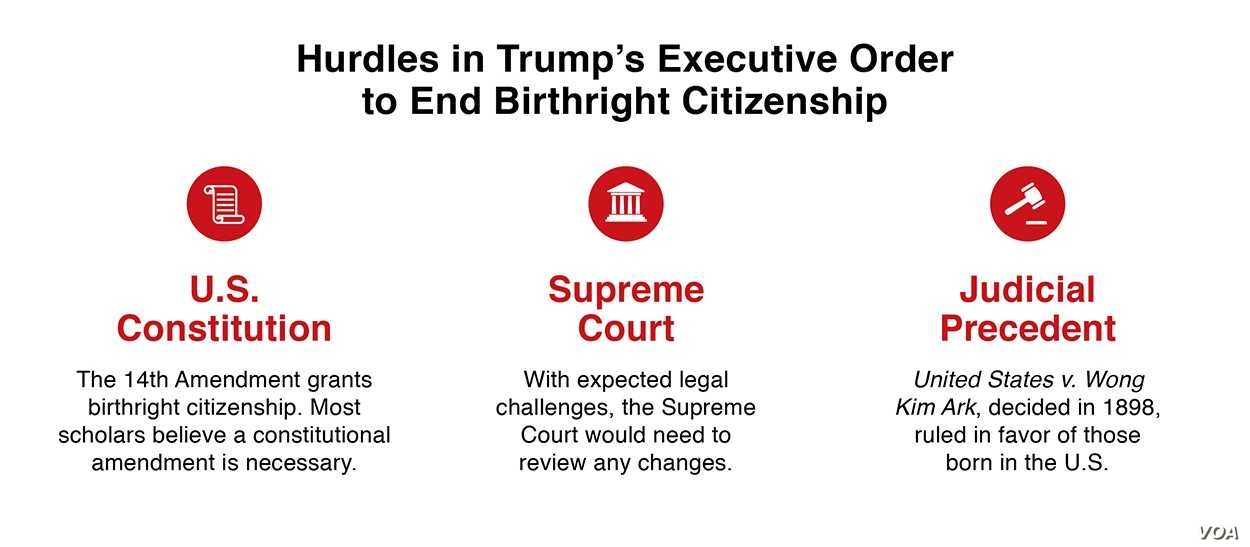
But the citizenship proposal would inevitably spark a long-shot legal battle over whether the president can alter the long accepted understanding that the 14th Amendment grants citizenship to any child born on U.S. soil, regardless of a parent’s immigration status.
Hurdles in President Trump’s executive order to end birthright citizenship
Executive order
James Ho, a conservative Trump-appointed federal appeals court judge, wrote in 2006, before his appointment, that birthright citizenship “is protected no less for children of undocumented persons than for descendants of Mayflower passengers.”
But Trump has said he was assured by his lawyers that the change could be made “just with an executive order” — an argument he has been making since his early days as a candidate, when he dubbed birthright citizenship a “magnet for illegal immigration” and pledged to end it.
There are no figures on how many foreign women travel to the U.S. specifically to give birth. The Center for Immigration Studies, a group that advocates for stricter immigration laws, estimated that in 2012 about 36,000 foreign-born women gave birth in the U.S., then left the country.
Places like Florida have seen in a boom in so-called “birth tourism.” Every year, hundreds of pregnant Russian women travel to the United States to give birth, paying from $20,000 to more than $50,000 to brokers who arrange their travel documents, accommodations and hospital stays. Sizable numbers of women from China and Nigeria also come to the U.S. for the same reason.
Immigrant detention
Trump’s comments Wednesday came as the administration continued to make immigration changes pushed by his hard-line advisers that have been in the works for months. On Wednesday, the Department of Homeland Security announced it had moved to end a longstanding federal agreement that limits how long immigrant children can be kept in detention. The decision will almost certainly lead to a legal battle over the government’s desire to hold migrant families until their cases are decided.
The rule also follows moves last week to broaden the definition of a “public charge” — a burden to the U.S. — to include immigrants on public assistance, potentially denying green cards to more immigrants. There was also a recent effort to effectively end asylum altogether at the southern border.
Haven’t done a similar analysis on Canadian participation and employment rates but income data shows similar pattern, but which reflects length of time in Canada. Similar pattern regarding eduction as well:
Foreign-born residents had higher rates of full-time employment than those born in the United States last year, and naturalized immigrants were more likely to have advanced degrees than the native-born, according to figures released Monday by the U.S. Census Bureau.
The new figures show that the economic gap between the native-born and the foreign-born in the United States appears to narrow with citizenship.
Immigrants who weren’t citizens had higher rates of poverty, lower income and less education compared with native-born citizens last year. But immigrants who were citizens had less poverty, close to equal earnings and higher rates of advanced degrees than native U.S. citizens.
“Usually immigrants start off in the U.S. lagging behind a bit in terms of income, as they need to find the right job, learn local skills and so on and then catch up,” said Giovanni Peri, an economist at the University of California, Davis. “Immigrants also are very different among each other, and those naturalized may be a selection of those more educated and with better jobs.”
Naturalized immigrants had a full-time employment rate of about 83 percent last year, noncitizens had about 81 percent and native citizens had 77 percent.
“Some immigrant groups have to be employed to stay in this country — those on work visas, which would raise the proportion,” said Stefan Rayer, a demographer at the University of Florida.
About 1 in 6.5 naturalized immigrants have a master’s degree or higher, while that is true for only about 1 in 8 native-born citizens and noncitizens.
The 2018 Current Population Survey figures offer a view of immigrants’ education levels, wealth and jobs as the U.S. engages in one of the fiercest debates about the role of immigration in decades.
Stopping the flow of immigrants into the U.S. has been a priority of President Donald Trump’s administration, which has proposed denying green cards to immigrants who use Medicaid and fought to put a citizenship question on the decennial census questionnaire.
Monday’s figures also look at differences between naturalized immigrants and those who aren’t citizens. In 2018, the U.S. had 45.4 million foreign-born residents, or about 1 in 7 U.S. residents.
Education appears to play a role in narrowing the income gap between the native-born and the foreign-born.
Overall, naturalized immigrants had a slightly smaller median income than the native-born — $50,786 compared with $51,547 — but noncitizen immigrants trailed them both with a median income of $36,449.
But naturalized immigrants with a college degree surpassed college-educated natives’ income, and both naturalized immigrants and noncitizens with advanced degrees had higher median incomes than U.S. natives with advanced degrees.
“Immigrants with advanced degrees, whether naturalized or not, may be more clustered in occupations with higher pay than the native population,” Rayer said.
About half of the U.S. foreign-born came from Latin America, less than a third came from Asia and 10 percent came from Europe. European immigrants’ median age — 50 — was roughly six years older than other immigrants.
More than a quarter of noncitizen immigrants were in service jobs, while almost a quarter of immigrants who were citizens were in professional jobs, according to the Census Bureau figures.
Asians and Europeans had the highest rates of advanced degrees — about a quarter of both immigrant groups had a master’s degree or higher. About 1 in 20 immigrants from Latin America had a master’s degree or higher.
Immigrants, both naturalized and noncitizens, were overwhelmingly urban and suburban dwellers. Less than 1 in 20 immigrants lived outside of a metropolitan area last year, compared with about 1 in 7 for native-born citizens, according to the figures.
President Donald Trump’s base simultaneously cares deeply about defending Christianity and restraining immigration.
It’s a stance we’ve come to expect, but there’s an irony to this. At a moment when more and more Americans are unaffiliated with religion, immigration is providing a counterbalance.
In fact, nothing would do more to strengthen Christianity than embracing undocumented immigrants. Most undocumented immigrants come from Latin America, so 83 percent are Christian. If they were all expelled, the United States would lose 9 million Christians. By contrast, legal immigrants tend to come from countries like India, Pakistan and China, with majority non-Christian populations.
Beyond that, it is well known that for the past few decades Latino immigration has energized, and in some ways saved, the Catholic Church in the United States. About 40 percent of American Catholics are Hispanic, and they’re more likely to say religion is “very important” in their lives than white Catholics.
What’s less acknowledged is that Latinos have also bolstered evangelical communities. Some 16 million evangelicals are Hispanic, and about 15 percent of all immigrants are evangelical.
Going back through history, immigration has repeatedly injected energy and piety to the American religious landscape.
From our country’s founding, diversity has been important to ensuring religious liberty. When James Madison guided the creation of the First Amendment, he believed that a “multiplicity of sects” would be more important than “parchment barriers.” Having a variety of religions or Christian denominations would prevent one religion from dominating the others, and therefore help create a fluid religious marketing place that would encourage religious vibrancy.
In the United States, religious diversity has flowered in three different ways: homegrown religious entrepreneurship (American-created religions like Mormonism, Seventh Day Adventism or Jehovah’s Witnesses); denominational splintering, and finally, immigration.
In the case of immigration, the positive effects may not be evident right way. Throughout American history, the arrival of new immigrants practicing minority religions has often prompted backlash, as happened throughout the 19th century with Irish Catholics. In 1835, Samuel Morse, who would later invent the telegraph, warned that foreign countries were sending us “their criminals” because America hadn’t erected the right “walls.” He also complained that he and his allies were being unfairly attacked by a liberal media that was “on the side of your enemies.”
But the Catholic influx not only enriched American life in countless ways, it strengthened religious freedom by making it impossible for Protestant majorities to impose their faith approach on others. For instance, until Catholics objected, public schools in the 19th century had insisted on teaching the Protestant translation of the Bible to children. Catholics demanded that if the Bible were to be taught, their translation had to be included too. This established the idea that religion can only live in public places if other religions are invited to participate too.
At another point in the 19th century, Protestants became worried about a different group of immigrants flooding across the border – Mormons coming from Canada. Horrible persecution ensued. In 1838, the governor of Missouri proclaimed that “the Mormons must be treated as enemies, and must be exterminated or driven from the State if necessary for the public peace.” Over time, the growth and persistence of the Mormons forced Americans to expand their definition of religious freedom.
In the 1920s, efforts to restrict immigration were driven in part by the fear that too many Jews had arrived from Eastern Europe. By World War II, though, America decided that Jews needed to be incorporated as full partners in the pluralistic model and that their presence demonstrated something inspiring about the nation. Presidents Roosevelt, Truman and Eisenhower cast religious freedom and pluralism as a sign of America’s moral superiority over fascism and communism.
Eisenhower became the first president to use the term “Judeo-Christian.” He explained, “Our form of government has no sense unless it is founded in a deeply felt religious faith, and I don’t care what it is. With us of course it is the Judeo-Christian concept, but it must be a religion that all men are created equal.”
In 1993, Congress proposed the Religious Freedom Restoration Act, which more deeply enshrined key modern principles of religious liberty. Tellingly, the bill’s main sponsors were religious minorities with immigrant ancestors: Charles Schumer and Stephen Solarz, both Jewish, in the House, and Ted Kennedy, an Irish Catholic and Orrin Hatch, a Mormon.
Over America’s history, immigration has helped fuel a virtuous cycle for religious freedom. Immigration has brought energy to religious institutions – and has prevented just one denomination from becoming powerful enough to squelch liberty.
Madison didn’t argue explicitly for immigration as a lubricant for religious freedom’s mechanisms. But he did argue for variety. It turns out that immigration has been a major reason this system has worked so well.
President Trump can be a master of distraction, but when it comes to judges, his administration has demonstrated steely discipline.
In the 2 1/2 years that Trump has been in office, his administration has appointed nearly 1 in 4 of the nation’s federal appeals court judges and 1 in 7 of its district court judges.
The president recently called filling those vacancies for lifetime appointments a big part of his legacy. Given the relative youth of some of his judicial picks, experts say, those judges could remain on the bench for 30 or even 40 years.
Legal observers say Trump and his Republican allies in the Senate have placed an unmistakable stamp on the federal judiciary, not only in ideology but in identity.
“What stands out to me is that President Trump is deliberately nominating the least diverse class of judicial nominees that we have seen in modern history,” said Kristine Lucius, executive vice president for policy at the Leadership Conference on Civil and Human Rights. “It is stunning to me that 2 1/2 years in, he has not nominated a single African American or a single Latinx to the appellate courts.”
In all, around 70% of Trump’s judicial appointees are white men. Dozens of those nominees have refused to answer whether they support the Supreme Court’s holding in Brown v. Board of Education, the 1954 opinion that said racial segregation of public schools is unconstitutional.
Civil rights advocates say those nonanswers should be disqualifying. But with Republicans holding 53 seats in the Senate and on board with Trump’s program to confirm as many judges as possible, these nonanswers usually aren’t.
Conservative legal analyst Ed Whelan said there are good reasons why some judicial candidates balk at those questions.
“I think there’s a game being played here, and the critics are part of that game,” said Whelan, who leads the Ethics and Public Policy Center in Washington, D.C. “It’s quite clear that what Democratic senators aim to do with that questioning is say, ‘Well, if you can answer questions about Brown, why won’t you answer questions about Roe?”
Whelan was alluding to Roe v. Wade, the decision that legalized abortion.
Consequences of courts transformed
Abortion-rights groups worry that Roe is now in peril from the new generation of judges with ties to the conservative Federalist Society, whose leader has consulted with the White House to select two Supreme Court justices and many other candidates for the lower courts.
With all his judicial appointees, however, Trump has not transformed the courts as much as he could have, legal analysts say. If more Democratic vacancies had been open, Trump’s impact could have been even more dramatic.
Russell Wheeler, a visiting fellow at the Brookings Institution, said Trump has mostly replaced judges appointed by Republican presidents with his own candidates, adding to conservative majorities in courts based in the South and narrowing the margin in the 9th Circuit in San Francisco — a frequent target of the president’s attacks.
All the same, Wheeler said, the new judges of the Trump era are generally more conservative than the older ones winding down their careers.
“When you replace a 70-year-old George W. Bush appointee who is slightly to the right of center with a 45-year-old movement conservative, obviously you’re not trading apples for apples,” Wheeler said.
A high-water mark?
Trump and Senate Majority Leader Mitch McConnell, R-Ky., may have reached a “high-water mark” on the federal appeals courts, Wheeler said.
They may have filled vacancies so quickly that there are unlikely to be many more openings on the circuit courts in the year ahead — unless judges appointed by Democrats decide to retire in large numbers.
That means attention is turning to the lower courts, which handle cases on civil rights, the environment, financial regulation and federal crimes.
On July 30 and 31, the Senate confirmed 13 district court judges before leaving the Capitol for its August recess. The Senate Judiciary Committee, run by Chairman Lindsey Graham, R-S.C., is poised to pick up the district court judge process again this fall.
Whelan, of the Ethics and Public Policy Center, said evangelicals and other conservatives are delighted with that pace — and with the White House for delivering on its promises to prioritize the judiciary.
In a few cases, Republican senators have brought down the president’s own nominees, getting the candidates to withdraw sometimes because they’re not conservative enough.
For progressive activists, that only highlights the need for Democrats to take judicial appointments more seriously. The subject has so far not been a focus in any of the Democratic presidential debates, in which 2020 hopefuls are making the case for why they should be the Democratic Party’s nominee to take on Trump.
But as Brian Fallon of the group Demand Justice pointed out, the Democratic presidential candidates are campaigning on ambitious ideas — climate change policies, health care and financial regulation.
Those things, he said, will be disputed in court and will need to survive judicial review in front of judges — many of whom were appointed by Trump.
Fallon has this to say to Democrats vying for the White House: “They actually owe it to the voters to explain very clearly what they’re going to do to take back the courts and who they’ll nominate in order to do that.”
Good serious comparison of the various datasets available. The observations regarding the limitations of ADL statistics also apply to B’nai Brith as to those on FBI data also apply to StatsCan complication of police reported hate crimes.
With respect to the National Crime Victimization Survey, the closest Canadian equivalent is the currently underway General Social Survey – Canadians’ Safety (GSS) which includes self-reported victimization, to be released winter 2020-21:
On Sunday, a Jewish man standing outside a synagogue was shot in the leg in what police are investigating as a possible hate crime. It was only the latest in a string of anti-Semitic attacks this year.
These attacks have brought in their wake headlines declaring “a spike in hate crimes” and “increased anti-Semitic attacks all across this country,” based on episodes like Sunday’s as well as data. Earlier this year, the FBI reported the largest increase in hate crimes since 2001, and the Anti-Defamation League reported that anti-semitic incidents rose by 57% in 2017.
As a result, a consensus has developed around the idea that hate crime and anti-Semitism are rising, and that Jews are no longer safe in the U.S. Leaders across the political divide agree.
But I’ve found myself skeptical of these claims of rising hate. Partly, this is because of a rather personal reason: Since moving to the US over a decade ago, I have never personally experienced hate or a hate crime.
But I was skeptical for a professional reason too. As a mathematician by training, I spent my PhD years working with messy crime data. And the truth is, it cannot be trusted at face value.
I couldn’t help but wonder if the data on hate crimes, especially those pertaining to the Jewish community, might have similar problems.
And it does. Big time.
To dig deeper, I looked at all the available data on hate crimes, which included incidents of hate by year, surveys, and reports. I sought out datasets, what are in their ideal form collected methodically year after year by faceless government statisticians. I also downloaded spreadsheets and mined the numbers myself.
What I found will probably surprise you: We have a real anti-Semitism problem in this country. But it’s not getting worse.
But you can’t compare hate crimes to road accidents; with a hate crime, like with terrorism, the victim is targeted because of their group identity, and the entire group feels threatened. Hate crimes select symbolic targets, such as community buildings, whose significance far exceeds their property value.
And research indicates that being in a targeted group is not just discomforting but can have a tangible effect how people behave. We know from Europe that attacks on Jews can trigger a wave of immigration to Israel, and it should not be assumed that the same cannot happen to American Jews.
Even more disturbingly, research on fertility data from 170 countries found that during waves of terrorism there is a decline in births.
All of this made me even more anxious to find out if there was actually a wave of anti-Semitism sweeping through America. So I sought out the two most frequently-cited sources of hate crime data: reports from the ADL and the FBI.
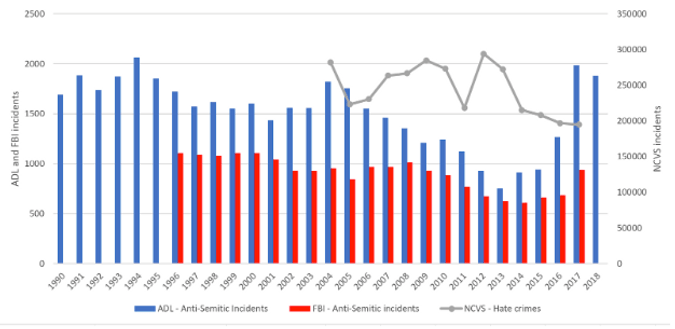
Let’s start with baselines. According to the FBI’s most recent data, 2017 saw 7,175 hate crimes nationwide, including 15 hate murders. Anti-Jewish hate crime incidents represented 13% of all incidents – 923 – coming in second only to Anti-Black hate crimes, which numbered 2,013 incidents.
There were also more anti-Semitic incidents than “anti-gay” crimes, for example. Most importantly for our purposes, because Jews make up just 1-2%of the US population, these numbers mean that the Jewish community is targeted by hate crimes disproportionately to its numbers by a factor of ten.
The ADL has been tabulating data on anti-Semitic hate crime for an impressive 40 years, and it receives data both from the police and the public. The ADL has built out a modern data center and has interactive online visualizations.
In its most recent audit, the ADL reported that 2018 had the third-highest number of incidents of the past four decades, with 1,879 incidents. The 2018 total is 48% higher than the number of incidents in 2016, and 99% higher than in 2015. Both 2017 and 2018 had far more incidents than typical for the previous eight years. This is, indeed, alarming.
However, these numbers should be taken with a mild dose of the proverbial salt. The problem with hate data is that only 20% of hate crimes are reported to the police, and, one suspects, even fewer to the ADL. So the statistics give just the tip of an iceberg; the majority of hate times are not included in this count.
This makes them somewhat unreliable. To rely on 20% of the data to determine if there is a wave of anti-Semitic hate crimes would be like looking at the top shelf of your fridge, and finding it overflowing, deciding that you need to buy a larger fridge (I would suggest looking at the other four shelves first).
And you can’t just compare the 20% of reported crimes each year to the 20% from last for the simple fact that the reporting rate is not a constant 20% of all crimes. Reporting goes up and down along with public concern. An increase in concern about hate crimes can increase the number of reports by the public, and even the number of police investigations, making more of the “iceberg” (or fridge) visible and inflating the numbers.
To put it plainly, if many people started to believe, fairly or not, that we are in the midst of a wave of hate, they would also start to report more hate crimes, making the data inconsistent with the past.
This is not to say that the jump in anti-Semitic hate crimes reported by sources like the ADL is a statistical mirage. But the reality is probably different from what the numbers suggest.
Independently of the ADL, the FBI has been reporting hate crime data since the 1990s through its Hate Crime database. It has developed impressive guidelinesto judge if a crime incident is indeed a hate crime, and its reports are available online. Surely, here we can expect to finally find deep databases processed by standard and reliable statistical methods!
But alas, the FBI’s numbers also need to be taken with a little grain of kosher salt. The problem is that crimes are generally reported to the local police department and not to the FBI directly, so the FBI’s data is only as good as the reports it receives.
In some states, less than 10% of the police agencies bother to report to the FBI at all, and likely only report the more severe crimes. As a credit to the system, the FBI provides consistent data that goes back to the 1990s, and thus is well-suited to recording if there are any national trends.
But charting the FBI data from 1996 to 2017 suggests that we are far from having achieved new heights of anti-Semitism. Rather, anti-Semitic incidents peaked in 1999 at 1,109 per year, then declined from 2008 to 2014, and have been trending up since then, reaching 976 in 2017.
As with the ADL numbers, the data quality is not great, thanks to under-reporting. But even taking that into account, we appear to still be well below the numbers of the 1990s.
Alex GutfrainStatistics of Anti-Semitism
Fortunately, there is another government crime tracking program that has been all but forgotten by the press: the National Crime Victimization Survey. Unlike the ADL and the FBI, who collect reports, the NCVS goes out to the communities and interviews some 160,000 people every year, asking them if they were victims of various crimes.
Because the NCVS uses a representative sample, it can reliably estimate the number of crimes in the entire country, including hate crimes. If there is a wave of hate in America, the NCVS would detect it in its survey.
In its most recent report, NCVS estimated that 204,000 hate crimes occur in the US annually, of which just 15,000 are confirmed by the police.
There is no data specifically on anti-Semitism in NCVS, but if we assume per the FBI’s estimate that about 13% of hate crimes are anti-Semitic, then there are a staggering 26,000 anti-Semitic crimes every year in the US — 30 times more than reported by the FBI and 14 times more than the ADL.
What we can learn from these statistics is both good and bad. For all the problems of the last few years, there is no reason to fear a wave of hate, because the wave, if it exists, is a small one.
Today’s Jewish America has probably the safest existence of any Jewish community in history. In this generation, a Jew is much more likely to suffer a car accident than a hate crime.
But to believe naively in the American utopia is to ignore the truth: Hate is alive and well in America, and Jews are often the target of it.
How the removal of country caps may impact on other groups:
Much of our community, the Iranian-American community, owes its citizenship to the green card process. However, a bill moving through Congress would slam shut that pathway for countless Iranians and communities like ours, shifting outrageous backlogs onto nationals from Iran and other smaller countries.
Unfortunately, the House of Representatives recently passed a bill, known as the Fairness for High-Skilled Immigrants Act of 2019 (H.R. 1044/S. 386) which would eliminate caps that prevent any one country from receiving more than 7 percent of green cards for highly-skilled workers. These caps were put in place, according to the State Department, to guard against the monopolization of the green card process by a few larger countries. While eliminating the caps would reduce the backlog for nationals from large countries, like India and China, it would shift that backlog onto nationals from smaller countries—adding years of delays. For Iranian nationals, who are already separated from loved ones due to the president’s cruel travel ban, this would extend their separation by up to a decade.
Why is this legislation moving so fast? At a time when Congress has been unable to pass any meaningful reforms to address the multitude of crises in our immigration system, how are lawmakers on the verge of passing such a fundamental overhaul of the immigration system with almost zero debate on the unanticipated consequences? Because nationals who would benefit from the bill are vocal and backed by corporate interests who would also benefit, while the many who would be affected negatively by the change have been quiet by comparison. That needs to change if we want to safeguard the green card process for all nationalities.
In working with our community, NIAC has heard from many Iranian high-skilled workers in the U.S. who would be affected by this legislation. Their very future, and the American dream, is at stake. Worse yet, the vast majority of these individuals are also impacted by Donald Trump’s Muslim travel ban—unable to have their family secure a visa to visit, and unable to return home to visit family without jeopardizing their future in the United States.
Despite its name, the Fairness for High-Skilled Immigrants Act is not a fair way to deal with backlogs. Congress must consider a solution that actually addresses the problem instead of shifting the backlog from one group to another. One option would be to increase the number of green cards issued, which recent legislation introduced by Sen. Rand Paul (R-Ky.) would accomplish. Paul’s BELIEVE Act would quadruple the number of employment-based visas to address the backlog problem that particularly affects nationals from large countries. Additional measures proposed by this bill would exempt dependents and certain categories of specialists from the cap altogether.
As an Iranian-American organization, NIAC is tasked with the responsibility to not just advocate for our community and protect their civil rights, but also to protect the American dream that allowed our community to be built here in the first place. That means we must fight to keep the path to green cards open to all and ensure Congress passes a solution to the green card backlog that actually is fair.
Jamal Abdi is the president of the National Iranian American Council.
Good post by Stephens on the bankruptcy of contemporary American conservatives:
Friedrich Hayek, whose thoughts used to count for something among well-educated conservatives, made short work of nationalism as a guiding principle in politics. “It is this nationalistic bias which frequently provides the bridge from conservatism to collectivism,” he wrote in “The Constitution of Liberty.”
That point alone ought to have been enough to dim the right’s new enthusiasm for old-style nationalism. It hasn’t.
A three-day public conference this month on “national conservatism” featured some bold-faced right-wing names, including John Bolton, Tucker Carlson and Peter Thiel. The Wall Street Journal’s editorial page published a piece from Christopher DeMuth, a former president of the American Enterprise Institute, on the “nationalist awakening.” Yoram Hazony, an Israeli political theorist, has gained wide attention among U.S. conservatives with his book, “The Virtue of Nationalism.”
And, of course, Donald Trump: “You know, they have a word, it sort of became old-fashioned, it’s called a nationalist,” the president said last October. “And I say, really, we’re not supposed to use that word. You know what I am, I’m a nationalist.”
Interesting shift but not surprising given the impact of the Trump administration on US immigration policy and practices:
After spending almost all her life in immigration limbo in the United States, Paras Pizada can finally set down roots and plan for a future … in Canada.
The 27-year-old woman is part of a surge of non-American citizens arriving here legally from south of the border where they’ve faced an increasingly hostile environment since President Donald Trump was elected in 2016.
Canada’s new biometrics visa requirements, however, could prove a deterrent for undocumented migrants in the U.S. who, like Pizada, try to come here legally.
Since January, applicants worldwide must provide fingerprints and have their photos taken at facilities designated by Canadian immigration.
In the U.S., almost all facilities are operated by American immigration officials. Undocumented migrants fear this will put them at risk of arrest and deportation. Indeed, the Canadian immigration website warns biometric applicants that they must be legally in the U.S. to go to a centre.
These biometrics requirements could potentially drive up irregular migration into Canada which has dropped by half to 5,140, between January and May, compared to the same period last year.
“Since these people can’t get fingerprinted to apply for Canadian work permits and study permits legally, they will all just walk across the border. Ottawa has made it impossible for the majority of undocumented U.S. residents who want to apply legally for Canada to do so,” said Winnipeg-based immigration lawyer Vanessa Routley.
According to Canadian immigration data revealed for the first time, in 2018, non-Americans in the U.S. accounted for 85 per cent or 13,754 of the 16,158 permanent residence applicants from south of the border, up from just 48 per cent or 1,477 of the total 3,077 applicants in 2015, with India (10,556), China (768) and Nigeria (337) being the top three source countries in 2018.
In 2015, non-Americans made up just 14 per cent or 4,664 of 33,062 applicants in the U.S. for Canadian work permits and student visas.
In 2018, the number almost doubled to 26 per cent or 11,840 of all 45,202 applicants.
It is not known how many of these applicants were actually undocumented in the U.S., because that data is not collected.
Pizada was two when her family arrived as visitors to the United States from Pakistan in 1994. They never left, moving from place to place to evade detection by immigration enforcement officials. Though both Pizada and her sister later qualified to remain temporarily in the U.S. under a special program for undocumented children launched under then-President Barack Obama, they had had no access to permanent residence and citizenship.
When Trump was elected in 2016 and stepped up the removal of undocumented migrants, the sisters started looking for places to go outside the U.S. In June, Pizada, who has a master’s degree in media studies from Pratt Institute in New York, came to Canada as a permanent resident under the federal skilled workers program, following in the steps of her sibling, Mahaik, who had arrived here the year before.
“We are so relieved,” said Pizada, who now lives in Niagara Falls. “I can finally put down roots and have a place to call home. I’m allowed here and no one can kick me out.”
Pizada was lucky she could avoid the biometrics dilemma presented by Canadian immigration because she had already been known to American homeland security officials by having registered with the Obama administration’s program that offered her a renewable temporary residence in the U.S. every two years. Most undocumented migrants didn’t meet that program’s criteria and are off the enforcement officials’ radar.
Of the 133 facilities in the U.S., only two, one in Los Angeles and the other in New York City, are run by private contractors, which means most undocumented applicants must either travel long distances to those two offices or take the risk of going to their local centres and potentially be intercepted by American immigration authorities.
Sharma, who asked that her full name not be used because she is undocumented in the U.S., has been accepted by four Canadian universities — these are Waterloo, Concordia, New Brunswick and Dalhousie — in their graduate programs, but is afraid of setting foot in her local centre run by the U.S. Department of Homeland Security as it collects fingerprints.
“There is definitely a heightened fear of getting arrested with all these government raids against migrants,” said Sharma, 21, who arrived in the U.S. from Indian with her family 12 years ago.
She graduated in May with an undergrad degree in biomedical engineering.
“This biometrics requirement is hindering our ability to regularize our status in Canada. We just want to make a better life.”
Canada is doing everything it can to make the biometrics collection process as smooth as possible for all applicants, according to Canadian immigration department spokesperson Nancy Caron.
“In a situation where an applicant is unable to comply with the biometric requirement, these individuals can self-identify themselves by contacting the department and provide a supporting rationale for their situation. Canadian migration officers have the discretion, in specific circumstances, to exempt an applicant from providing biometric information,” Caron told the Star in an email.
“It is important (for us) to be aware of an applicant’s previous immigration history and their compliance with immigration laws, including their current immigration status. This helps in determining whether an applicant is admissible to Canada and whether they are likely to respect the conditions of their visa.”
Officials said the data on biometrics exemptions requested and granted is unavailable.