After Trump’s Covid-19 diagnosis, anti-Asian tweets and conspiracies rose 85%: report

Not surprising. Words matter:

Anti-Asian bigotry and conspiracy theories spiked on Twitter immediately following President Donald Trump’s Covid-19 diagnosis this month, new findings reveal.

The report, released last week by the Anti-Defamation League, a civil rights group, examined Twitter activity surrounding Trump’s diagnosis on Oct. 2. Researchers found an 85 percent increase in anti-Asian rhetoric and conspiracy theories on the platform in the 12 hours following the announcement, many blaming China.

The surge in bigoted tweets also occurred shortly after Trump said the pandemic is “China’s fault” during the first presidential debate and further referred to the virus as the “China plague.”

Rep. Judy Chu, D-Calif., chair of the Congressional Asian Pacific American Caucus, said the research shows that anyone who fails to see the link between the harmful rhetoric and subsequent bigotry is “lying to themselves.”

“These people — who include the president and congressional Republicans — want to stoke xenophobia and anger but also want to deny the dangerous impact their own words are having,” Chu said. “You can’t have it both ways, and this report exposes the danger of pushing racially based conspiracy theories like this.”

The report, “At the Extremes: The 2020 Election and American Extremism,” examined more than 2.7 million tweets that were posted from the four hours before Trump announced his diagnosis, as well as that of Melania Trump, to the afternoon the following day.

Researchers looked at tweets with mentions of the accounts @realdonaldtrump, @potus and @flotus, as well as @senatorloeffler, the account of Sen. Kelly Loeffler, R-Ga., who had pushed people to “hold China accountable” and “remember: China gave this virus to our President.” The researchers also looked at tweets with at least one of the keywords “trump,” “melania,” “first lady,” “china virus,” “plague,” “kung flu” and “Wuhan.”

Researchers found not only that was there a surge in anti-Asian tweets in the hours after Trump’s diagnosis was announced, but also that anti-Asian sentiment on the platform remained elevated for days afterward. The report revealed that the rate of discussions about various conspiracy theories — including one that alleges that the virus was engineered by humans and another that claims that Covid-19 is “patented,” a bioweapon created by the Chinese government — increased by 41 percent. The research also shows that some of the conversations veered into anti-Semitism or had anti-Semitic overtones.

Asian Americans have been weathering increased hostility since the beginning of the pandemic. The reporting forum Stop AAPI Hate collected reports of 2,583 hate incidents directed at Asian Americans from March 19 to Aug. 5, during the pandemic. Almost 800 of the reports said anti-Chinese rhetoric was used. What’s more, previous research suggests that the use of terms like “China virus” and “kung flu,” particularly by conservative outlets, has already seeped into U.S. perceptions of Asian Americans.

While anti-Asian bias had been in steady decline for over a decade, the trend reversed in days after a significant uptick in discriminatory coronavirus speech, according to a study published in September.On March 9 alone, there was an 800 percent increase in such rhetoric among conservative media outlets. The language led to an increased subconscious belief that Asian Americans are “perpetual foreigners,” researchers said.

“Progress against bias is generally stable,” Eli Michaels, a researcher on that study, has said previously. “But this particular rhetoric, which associates a racial group with a global pandemic, has particularly pernicious effects.”

Rep. Grace Meng, D-N.Y., the main sponsor of a House resolution that called on public officials to denounce any anti-Asian sentiment, said she herself had been targeted with a slew of racist voicemails after the legislation was passed in September. In one message, a caller said she looked “like a Chinese virus, you fat slob.” And she said another claimed that the harmful rhetoric is “not racist, it’s the truth. Filthy people.”

“The report shows no signs of this bigotry and xenophobia ending any time soon,” Meng said. She said the racist and obscenity-laced voicemails were filled anti-Asian remarks that Trump has made about the coronavirus, such as “Chinese virus” and “kung flu” — “the very things I and the House condemned in passing my measure.”

Chu said that as the election approaches, she is “absolutely afraid of more attacks” against Asian Americans. The report ultimately “draws a clear line from the kinds of conspiracy theories Trump spreads to help his own re-election directly to the spike in anti-Asian hate that we are seeing,” she said.

“Covid-19 is continuing to ravage this country, claiming hundreds of lives a day, but the president still does not have a plan to address it,” Chu said. “While he downplays the virus, he still blames China for every death and continues to stoke xenophobia that puts innocent Asian Americans at risk of violence. The president isn’t only indifferent to that. He’s accelerating it.”

Is the US the next big market for outbound students?

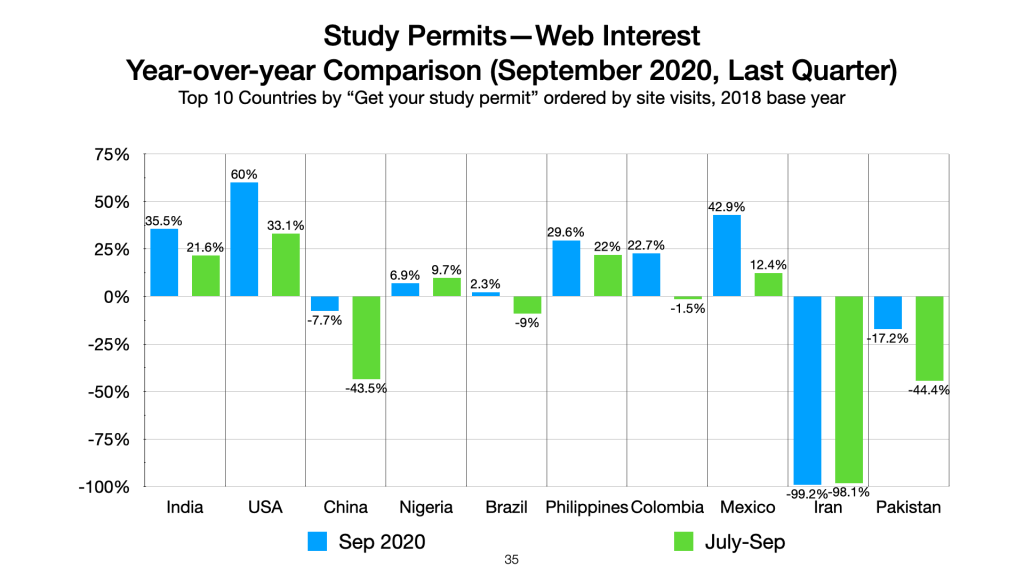
While Canadian study permit data to date does not show a significant increase, web data on “Get your study permit” shows an increase as seen in the chart below:

Looking at Canadian study permit data, no major difference between the There may be some major shifts under way in international student mobility patterns. The current upheavals in the United States higher education landscape appear to be driving greater numbers of US students to consider full degrees abroad. 

US universities and colleges were on the ropes prior to the COVID-19 pandemic, with many institutions already facing shrinking enrolments, budget crunches and stagnating public funding. Add COVID-19 to the mix and the challenges only get worse for US higher education. The cracks in the system are growing into chasms and the landscape may be forever changed. 

From reassurance to panic

Over the past few years an energetic debate has emerged among educational leaders regarding the tenuous nature of US higher education. The range of opinions fall along two extremes: reassurance and panic. 

On the reassurance end, some are arguing for maintaining the status quo, offering polite mollifications that enrolment fluctuations and changes in disciplinary offerings are perfectly normal and there will be hardly any permanent disruption to higher education as we have known it. 

On the panic end, some are questioning the long-term viability of ‘bricks and mortar’ institutions and are calling for a broad rethinking of US higher education. 

Indeed, these are challenging times for higher education in the US and pressure to act is growing. Already this year, a number of institutions have closed, including Urbana University, MacMurray College, Robert Morris University, Concordia University Portland and Marlboro College, and more are expected

Further complicated by the COVID-19 pandemic, some observers predict that between 10% and 20% of the more than 4,000 institutions in the US may close or merge in the near future and many more may be facing insolvency

Already, international students have begun to turn away from the US. According to the Institute of International Education (IIE), the number of new international students choosing to study in the US has been declining since 2015-16. Unfriendly national rhetoric, frequent and punishing shifts in immigration policy and fears for safety and security in the US, along with increasing international competition, are channelling student flows away from the US, particularly to the UK, Canada, Australia and New Zealand. 

A future recruitment market?

Not surprisingly, it appears that a growing number of US students are beginning to show greater interest in pursuing study outside of the country. And why not? US students and their families are under tremendous strain. The rising cost of education and student debt, increasing scrutiny about the time needed to complete a bachelor’s degree and the ever-shifting nature of industry-driven qualifications combine to create a sense of considerable uncertainty for US students. 

Moreover, the country’s chaotic response to the COVID-19 pandemic and the questionable promise of residential instruction going forward are awakening in students the need to consider other viable alternatives. 

Dissatisfaction with racial justice and a generally increased awareness of the importance of global engagement are among other reasons pushing students to consider foreign study. The obvious question is not if, but when the US will become a robust market for recruiting prospective degree-seeking students. 

Heading abroad

According to IIE, about 340,000 US students studied abroad in 2017/18 as part of their respective home university degree studies. Compared to China and India, both countries that account for the largest proportion of degree-seeking international students, there has been little attention given to international degree-seeking mobility among US students. Because each country collects data differently, it has been challenging to ascertain an accurate and consistent accounting of US students seeking full degrees abroad. 

According to UNESCO, about 86,500 US students were studying abroad in 2017, which is about 15% higher than what was reported just five years earlier. In 2013, IIE conducted a comprehensive survey on US students enrolled in degree-seeking programmes abroad and reported that there were more than 46,500 students

Through its Project Atlas initiative, IIE has continued observing degree-seeking enrolments and in 2018 tallied more than 53,000 students from the relatively few countries that reported such enrolments. Still, IIE observes steady year-on-year increases, especially among graduate students pursuing degrees in specialised STEM (science, technology, engineering and maths) fields. 

The majority of US students abroad in 2018 were studying in Anglophone countries, of which the UK (16,805) and Canada (13,035) were the top hosting countries, followed by France (6,264) Germany (4,242), China (3,333), Australia (2,875), New Zealand (2,405), Spain (2,030), Denmark (1,248) and Japan (757). 

Despite the lack of reliable data, various advisory organisations are emerging with hopes of capitalising on student interest by building the case for why and how US students should pursue full degrees abroad. 

Study.EU is one such organisation that provides an extensive online database with information on English-taught degree programmes throughout Europe. According to Study.EU, US students make up the second-largest group of users on the website, after Indian students. This continues in spite of a long list of closed borders for US citizens in response to the COVID-19 pandemic. 

The factors encouraging US students abroad

Affordable Degrees Abroad is another organisation that appeals to prospective US students by emphasising the relative affordability and high academic quality of international degrees. Affordable Degrees Abroad has identified several factors that appear to be driving US students to consider full degrees abroad. 

1. Affordability. Affordability is a significant factor for US students. Compared to the US, many international institutions are considerably more affordable, with a significant number under US$17,000 a year. Some institutions charge under $3,000 a year which is practically free by US standards. US students may even use US federal financial aid at more than 400 international institutions. 

2. High-quality education. In the past the perceived educational quality of international degrees was questioned by some US parents, students or employers who were not familiar with global education. With the increasing popularity of global university rankings and other indicators of institutional reputation and prestige, uncertainty is being replaced with admiration and respect. 

3. Timespan to degree completion. Many degrees abroad are shorter. For example, some undergraduate degrees abroad can be completed in three years and graduate degrees in one to two years. Shorter time to degree completion further bolsters the case for affordability. 

4. Language of instruction. The number of English-taught degrees has grown dramatically around the world, even in countries where English may not be the primary language. For example, Germany now offers more than 1,600 programmes taught in English.

5. Career readiness. As international business and global operations have increased so, too, have demands for employees with international savvy. Earning a foreign degree, while once perceived by some US employers with suspicion, can be an asset today. Additionally, many countries have attractive post-study work visas that allow for students to gain valuable work experience before returning. 

6. Health, safety and security. The US response to the COVID-19 pandemic has revealed something that was present all along: it can be safer to live in another country with less crime, fewer gun deaths and stronger public health systems than in the US. A growing refrain is: “I want to send my kid somewhere that is handling COVID better.”

7. Racial injustice and inequality. The growing Black Lives Matter movement against racial disparities and injustice in the US has elevated a critical conversation. The legacy of racial inequalities, harsh political rhetoric and violence has left many students of colour, in particular black students, wary. For some, the promise of studying abroad in a more accepting and welcoming environment is attractive.

8. Political instability. The growth of nationalism and isolationist rhetoric, coupled with the anxieties of the current US election season, have created tensions and unease across the US. For some students, pursuing an international degree can be a way to achieve a solid education in a less fractured country. 

The right message and the right strategy

There are challenges, of course, that discourage US students from pursuing full degrees abroad, notwithstanding language and cultural issues. Of particular importance is ensuring that US students are prepared for the level of independence needed to succeed. US institutions generally have more robust campus and student service infrastructures compared to international institutions. Students must be prepared to navigate different cultural and academic systems. 

Although the US has largely been viewed by international recruiters as a non-degree market for outbound mobility, things may be changing. International institutions seeking to increase and further diversify international student enrolment, particularly from North America, might want to reassess the US market and begin positioning themselves accordingly. 

Although the sheer size, scope and complexity of the US education system can be daunting, those institutions with a compelling message, a clear value proposition and an informed strategy will likely find greater receptivity among US students than ever before. 

Dr Anthony C Ogden is managing partner of Gateway International Group, a global organisation seeking to accelerate international learning and engagement by assisting institutions and organisations around the world to succeed in a new era of higher education. For more information, click here. Denise Cope is president of Affordable Degrees Abroad through which she offers guidance to US students seeking affordable undergraduate or graduate degree options abroad. She also helps international universities formulate strategies for the US student market. For more information, click here.

Source: https://www.universityworldnews.com/post-nl.php?story=20201002154520979

Trump to cut 2021 refugee admission to 15,000

No real surprise:

The Trump administration has proposed further slashing the number of refugees the United States accepts to a new record low in the coming year.

In a notice sent to Congress late Wednesday, just 34 minutes before a statutory deadline to do so, the administration said it intended to admit a maximum of 15,000 refugees in fiscal year 2021. That’s 3,000 fewer than the 18,000 ceiling the administration had set for fiscal year 2020, which expired at midnight Wednesday.

The proposal will now be reviewed by Congress, where there are strong objections to the cuts, but lawmakers will be largely powerless to force changes.

The more than 16.5% reduction was announced shortly after President Donald Trump vilified refugees as an unwanted burden at a campaign rally in Duluth, Minnesota, where he assailed his opponent, former Vice President Joe Biden. He claimed Biden wants to flood the state with foreigners.

“Biden will turn Minnesota into a refugee camp, and he said that — overwhelming public resources, overcrowding schools and inundating hospitals. You know that. It’s already there. It’s a disgrace what they’ve done to your state,” Trump told supporters.

Trump froze refugee admissions in March amid the coronavirus pandemic, citing a need to protect American jobs as fallout from the coronavirus crashed the economy.

Secretary of State Mike Pompeo said the administration is committed to the country’s history of leading the world in providing a safe place for refugees.

“We continue to be the single greatest contributor to the relief of humanitarian crisis all around the world, and we will continue to do so,” Pompeo told reporters in Rome on the sidelines of a conference on religious freedom organized by the U.S. Embassy. “Certainly so long as President Trump is in office, I can promise you this administration is deeply committed to that.”

But advocates say the government’s actions do not show that. Since taking office, Trump has slashed the number of refugees allowed into the country by more than 80%, reflecting his broader efforts to drastically reduce both legal and illegal immigration.

The U.S. allowed in just over 10,800 refugees — a little more than half of the 18,000 cap set by Trump for 2020 — before the State Department suspended the program because of the coronavirus.

The 18,000 cap was already the lowest in the history of the program. In addition, the State Department announced last week that it would no longer provide some statistical information on refugee resettlement, sparking more concerns.

Advocates say the Trump administration is dismantling a program that has long enjoyed bipartisan support and has been considered a model for protecting the world’s most vulnerable people.

Scores of resettlement offices have closed because of the drop in federal funding, which is tied to the number of refugees placed in the U.S.

And the damage is reverberating beyond American borders as other countries close their doors to refugees as well.

“We’re talking about tens of millions of desperate families with no place to go and having no hope for protection in the near term,” said Krish Vignarajah, president of the Lutheran Immigration and Refugee Service, a federally funded agency charged with resettling refugees in the United States.

Bisrat Sibhatu, an Eritrean refugee, does not want to think about the possibility of another year passing without reuniting with his wife.

For the past 2 1/2 years, he has called the caseworker who helped him resettle in Milwaukee every two weeks to inquire about the status of his wife’s refugee case.

The answer is always the same — nothing to report.

“My wife is always asking me: ‘Is there news?’” said Sibhatu, who talks to her daily over a messaging app. “It’s very tough. How would you feel if you were separated from your husband? It’s not easy. I don’t know what to say to her.”

He said the couple fled Eritrea’s authoritarian government and went to neighboring Ethiopia, which hosts more than 170,000 Eritrean refugees and asylum-seekers. Between 2017 and 2019, his wife, Ruta, was interviewed, vetted and approved to be admitted to the United States as a refugee. Then everything came to a halt.

Sibhatu, who works as a machine operator at a spa factory, sends her about $500 every month to cover her living expenses in Ethiopia.

“I worry about her, about her life,” Sibhatu said, noting Ethiopia’s spiraling violence and the pandemic. “But there is nothing we can do.”

He hopes his wife will be among the refugees who make it to the United States in 2021.

Source: Trump to cut 2021 refugee admission to 15,000

Canada No. 1 for Migrants, U.S. in Sixth Place

Given the contrast in media coverage and political discourse in both countries, would have expected a larger gap:

Canada and the U.S. remained among the most-accepting countries in the world for migrants in 2019. In fact, with a score of 8.46 (out of a possible 9.0) on Gallup’s second administration of its Migrant Acceptance Index, Canada, for the first time, led the rest of the world. The U.S. ranked sixth, with a score of 7.95.

Most-Accepting Countries for Migrants
Migrant Acceptance Index
Canada 8.46
Iceland 8.41
New Zealand 8.32
Australia 8.28
Sierra Leone 8.14
United States 7.95
Burkina Faso* 7.93
Sweden 7.92
Chad* 7.91
Ireland* 7.88
Rwanda 7.88
*Country not on the list in 2016-2017
GALLUP WORLD POLL, 2019

The index is based on three questions that Gallup asked in 140 countries in 2016 and 2017 and updated again in 145 countries in 2019. The questions ask whether people think migrants living in their country, becoming their neighbors and marrying into their families are good things or bad things.

The index is a sum of the points across the three questions, with a maximum possible score of 9.0 (all three are good things) and a minimum possible score of zero (all three are bad things). The higher the score, the more accepting the population is of migrants.

Both Canada and the U.S., which have long histories as receiving countries for migrants, made the most-accepting list in 2017 as well. Migration policies in each country have taken different paths since then, with Prime Minister Justin Trudeau opening Canada’s doors even wider, as President Donald Trump has tried to shut doors in the U.S. However, the acceptance of migrants among residents in each country has remained resolute and relatively unchanged from where they stood three years ago.

In Canada, residents almost universally saw migrants living in their country (94%) and being in their neighborhoods (95%) as good things, while more than nine in 10 (91%) said a migrant marrying into their family would be a good thing. Most Americans said the same, although not nearly to the same degree as Canadians. Nine in 10 (90%) said a migrant living in their neighborhood would be a good thing, and similar percentages said migrants living in their country (87%) and marrying into their families (85%) would be good things.

Migrant Acceptance Continues to Follow Political Fault Lines

As in 2017, migrant acceptance in both countries continues to be polarized. In the U.S., those who approved of Trump’s job performance scored a 7.10 out of a possible 9.0 on the Migrant Acceptance Index, while those who disapproved scored an 8.59 on the index. In Canada, those who approved of Trudeau’s job performance scored an 8.73, while the score was 8.21 among those who disapproved.

The same relationships persist, although not to the same degree, looking at approval of the country’s leadership in general.

Political Divides on Migration in Canada, U.S.
Migrant Acceptance Index
Americans
Approve of Trump 7.10
Disapprove of Trump 8.59
Approve of country’s leadership 7.10
Disapprove of country’s leadership 8.49
Canadians
Approve of Trudeau 8.73
Disapprove of Trudeau 8.21
Approve of country’s leadership 8.59
Disapprove of country’s leadership 8.31
GALLUP WORLD POLL, 2019

In the U.S., interestingly, there are differences in migrant acceptance among those who personally identified most with their city and country where they live (8.16) compared with those who identified most with their race or religion (7.69). In Canada, there were no differences in migrant acceptance based on how people identified themselves.

Most Educated in Each Country Are Most Accepting

For the most part, as it did in 2017, people’s acceptance of migrants follow the same patterns in both Canada and the U.S.: Acceptance is higher among those with the most education and among those living in urban areas.

Interestingly, the patterns by age in the two countries are different. In the U.S., acceptance was highest among the youngest Americans and then declined with age. Among Americans between the ages of 15 and 29, the index score was 8.34; it measured nearly a full point lower among those aged 65 and older (7.37). In Canada, there were no real statistical differences by age group.

Migrant Acceptance by Age in the U.S., Canada
Migrant Acceptance Index
Americans
15-29 8.34
30-44 8.11
45-54 8.04
55-64 7.79
65+ 7.37
Canadians
15-29* 8.32
30-44 8.54
45-54 8.53
55-64 8.41
65+ 8.51
*Difference not significant because of smaller sample sizes
GALLUP WORLD POLL, 2019

Bottom Line

Both Canada and the U.S. have long histories as receiving countries, but over the past several years, policies in each country have moved in opposite directions. Until the pandemic forced Canada to slow immigration to a trickle, the country was poised to admit more than 1 million permanent residents between 2019 and 2021, with targets increasing every year. In the U.S., the Trump administration is estimated to have cut legal immigration by almost half since taking office.

However, it appears that these changes in policies haven’t drastically changed most people’s acceptance of migrants. Residents in each country, and particularly in Canada, are accepting of the migrants who will continue to play a huge role in shaping their country’s future.

Source: https://news.gallup.com/poll/320669/canada-migrants-sixth-place.aspx

And for a broader take:

Global tolerance of migrants declined between 2016 and 2019, Gallup’s Migrant Acceptance Indexrevealed on Wednesday.

The survey showed that several of the least tolerant countries were from the EU. Member states met Wednesday to discuss a new joint migration policy.

The report gave countries scores based on the attitudes of respondents to the idea of migrants living in their country, moving into their neighborhood and marrying into their family. The average score globally fell from 5.34 in 2016 to 5.21 in 2019. Nne was the highest possible result.

The largest drop in tolerant attitudes towards migrants was seen in South America, where several countries have experienced a large influx of refugees from Venezuela. In Colombia, which bore the brunt of the exodus, the percentage of respondents with a positive view of migrants living in the country plummeted from 61% to 29%.

Belgium and Switzerland had some of the largest decreases in tolerant attitudes. Belgium, home to the European Parliament, saw its score fall by 1.33.

EU member states Hungary, Croatia, Latvia and Slovakia were among the top ten least accepting countries according to the poll, with a further four Balkan countries making it onto the list.

Another country which has played a significant role in the EU’s immigration policy was also revealed to have largely negative attitudes towards immigration. Turkey, which became home to some 4 million refugees as part of a deal with the European bloc, was the 10th least accepting country for migrants according to the data collected by Gallup.

However, one eastern European country with a traditionally low tolerance of immigration saw an increase in positive and tolerant attitudes. A share of 42% of Polish respondents said that they considered migrants living in the country as something good, up from 29% three years prior.

Which countries are most tolerant of immigration?

Canada topped the list for the countries most accepting of immigration — 94% of respondents had positive views of immigrants living in their country, followed by Iceland and New Zealand. Within the EU, only Sweden and Ireland made it into the top 10.

Despite a series of anti-immigration policies by President Donald Trump’s administration in the US, the country came in sixth place for its generally pro-immigration attitudes. When asked about immigrants moving into their neighborhood, 90% of US respondents said this was a good thing.

Among those who supported Trump, the average score was 7.1 out of nine. The biggest difference was between the younger and older generations with 16- to 29-year-olds scoring 8.34 and those older than 65 scoring around one point less, at 7.37.

How The Pandemic Is Widening The Racial Wealth Gap

Good data-based analysis:

Joeller Stanton used to be an assistant teacher at a private school in Baltimore and made about $30,000 a year. In mid-March, when the pandemic was just starting, her school closed for what was supposed to be two weeks. “Up to that point, we were under the impression that it wasn’t that serious, that everything was going to be OK,” Stanton recalls.

But as schools in Maryland switched to virtual learning indefinitely, Stanton was let go from her job. She received her last paycheck in March. “I had about $300 savings that was basically gone by the end of March,” she says.

She says she applied for unemployment but was denied initially. And by April, she had no money to pay for rent and utilities, and was struggling to put food on the table for her two children.

Stanton, who is Black, is caught up in a huge wave of economic stress hitting Americans, especially people of color.

Sixty percent of Black households are facing serious financial problems since the pandemic began, according to a national poll released this week by NPR, the Robert Wood Johnson Foundation and the Harvard T.H. Chan School of Public Health. That includes 41% who say they’ve used up most or all their savings, while an additional 10% had no savings before the outbreak.

Latinos and Native Americans are also disproportionately affected by the pandemic’s economic impact. Seventy-two percent of Latino and 55% of Native American respondents say their households are facing serious financial problems, compared with 36% of whites.

“The thing that immediately struck me was how large the gap was by race for the people who said they were facing serious problems,” says Valerie Wilson, director of the Program on Race, Ethnicity and the Economy at the Economic Policy Institute.

The pandemic’s disproportionate financial impact on communities of color reflects — and is worsening — existing racial disparities in wealth, she adds.

Struggles with income, housing, food

“The three groups that are being just ravaged by this epidemic are reporting unbelievable problems of just trying to cope with their day-to-day lives,” says Robert Blendon, professor emeritus of health policy and political analysis at the Harvard T.H. Chan School of Public Health, who oversaw the poll.

Thirty-two percent of Latino and 28% of Black respondents say they’re having problems paying rent or mortgages. About a third of respondents in both groups were struggling to pay credit cards or other loans. And 26% of Latino and Native American respondents say they struggle to afford food, while 22% of Black respondents do.

Among households that reported they lost income, survival is even more of a challenge. For Black respondents, 40% say they’re struggling to pay rent or mortgage, and 43% say they’re having trouble paying utilities. For Latino households that lost income, 46% say they’re struggling to pay mortgage or rent. About a third of both Black and Latino respondents who lost household income said they’re struggling to pay for food.

The fact that many minority groups are also experiencing higher rates of coronavirus infections makes it even harder for them to cope financially, Blendon adds.

“You have people who don’t have savings, they can’t pay bills,” he says. “And then you’re going to tell them, ‘Well, somebody in the household tested positive, nobody can go work.’ How are they going to keep their lives going?”

Stanton’s sister, who works for the city government, got COVID-19 earlier this year and had to isolate in her basement. “She had a cough, and she couldn’t eat because her taste buds were completely gone,” Stanton says. “I would cook meals, and I would take it to the basement, put it down on the floor for her.”

Luckily, she says, no one else in the family — including her 82-year-old mother and her 7-year-old son, who has asthma — got infected.

But Stanton says she has lost a sister-in-law to the disease and had a friend in coma for six weeks on a ventilator. She knows of many others in her community who have died.

And most of her co-workers and friends are out of work.

Worsening existing disparities

Even during the economic recovery of recent years, minority groups were lagging behind, says Wilson of the Economic Policy Institute. “There were significant racial disparities in wages, significant racial disparities in unemployment, significant racial disparities in the kinds of jobs people held.”

Black, Latino and Native American workers were more likely to have jobs that were lost during the pandemic, Wilson says. A Harvard University analysis of the U.S. Census Bureau’s Pulse Survey, released in July, found that 58% of Latino and 53% of Black households experienced loss in earnings early in the pandemic. Wilson’s own research has shown that Latino workers have been particularly affected by job losses during the pandemic.

Wilson adds that people in these groups are also more likely to have jobs that didn’t allow them to work from the safety of their homes, therefore putting them more at risk of getting infected. And they’re also less likely to have substantial savings. As a result, it makes it harder for them to weather times of economic downturn, she says.

Wilson says she worries that the pandemic is worsening racial disparities.

“We’re going to see coming out of this pandemic an expansion of the racial wealth gap,” she says. “We saw the same kind of thing in the Great Recession in 2007-2008 — in particular then with the extensive foreclosures in communities of color and the loss of housing wealth.”

“You just pray”

The pandemic forced Stanton to give up her rental home back in April. But she says she was fortunate not to end up homeless, thanks to her sister.

“My sister helped me get a storage unit,” Stanton says. “I moved my furniture into a storage unit. And I moved in with my sister, me and my two kids — my 11-year-old daughter and my 7-year-old son.”

She is grateful to have a roof over her head, but money, she says, is still tight.

She now gets $280 a week from the state of Maryland as unemployment, but it doesn’t go far.

“The first thing I buy is any personal hygiene items me or my kids need,” she says. She buys food, above what food stamps get her; she pays her phone bill and covers her sister’s utility bills. “That’s my only way of telling her, ‘Thank you,’ to show her that I appreciate what she’s doing.”

What little she has left, she buys a treat or two for her children, who have mostly been stuck indoors since the pandemic began: “Just trying to keep them happy,” she says.

But she’s far from happy herself. She hasn’t been able to find a new job because of the nature of remote learning. “They don’t need an assistant right now because the kids are not physically in the building,” she says.

And even if she did find a job, she worries she’d have to use pay to cover child care. Her kids are now also learning virtually from home and need constant supervision.

Stanton says the only way she copes with her daily struggles is through faith. “A lot of prayer and a lot of patience,” she says. “I try not to let things bother me because I don’t want to become depressed. So, you know, you just pray. I hope this is all over soon.”

Source: How The Pandemic Is Widening The Racial Wealth Gap

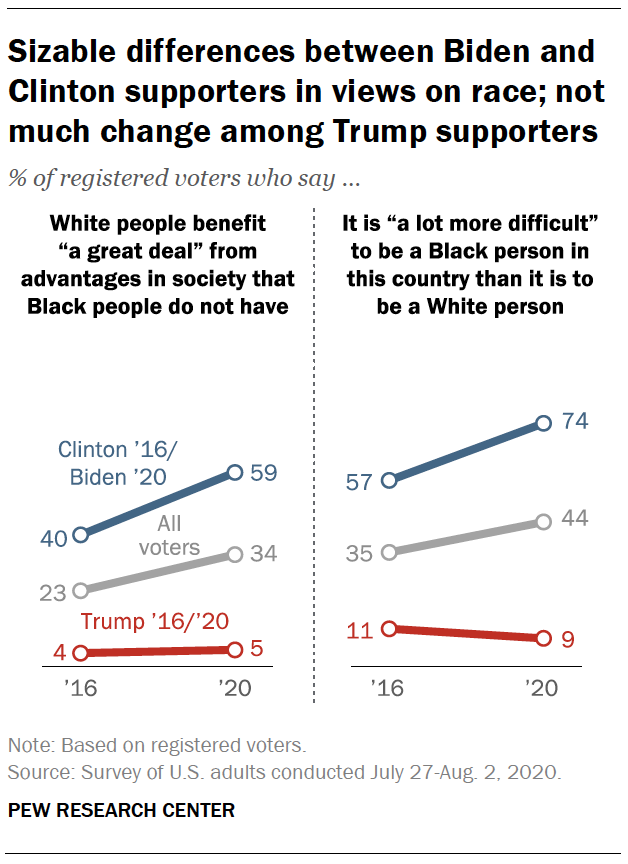
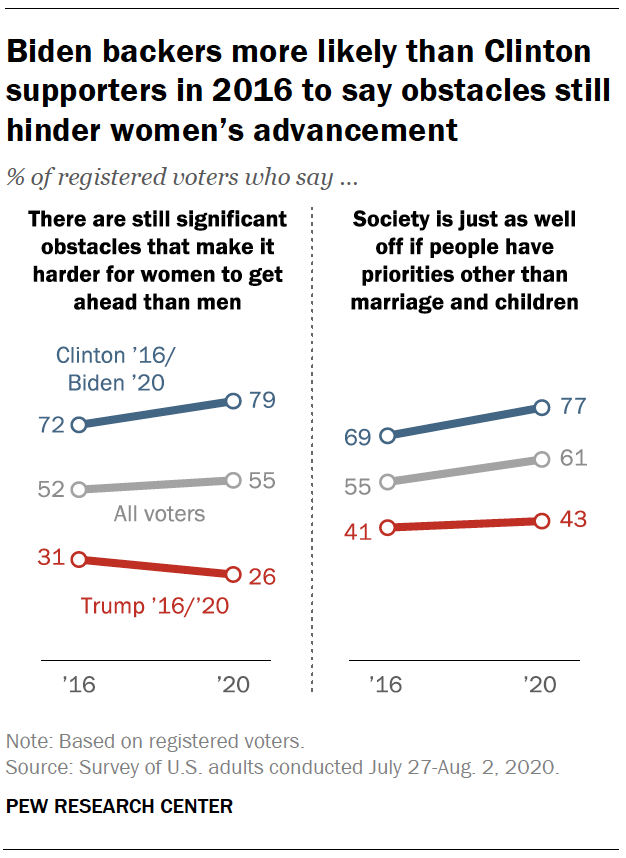
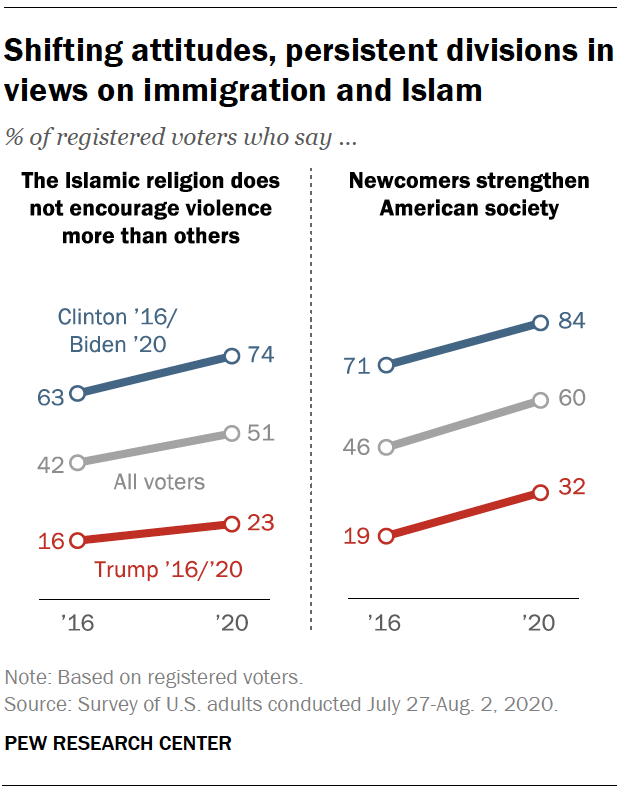
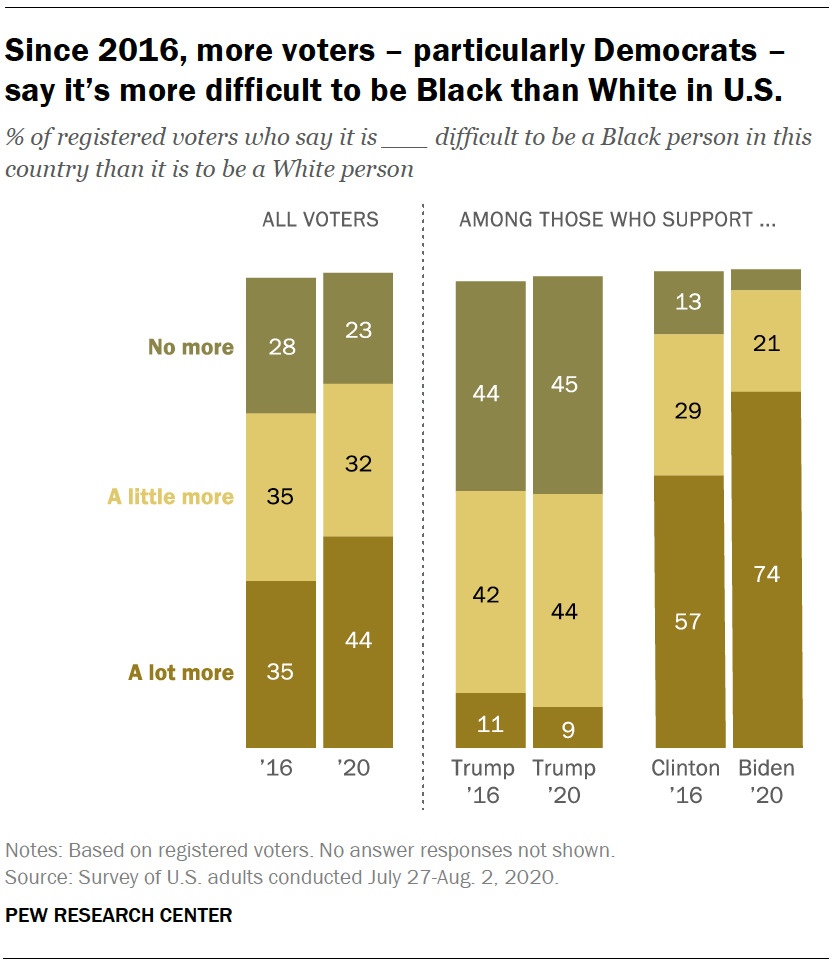
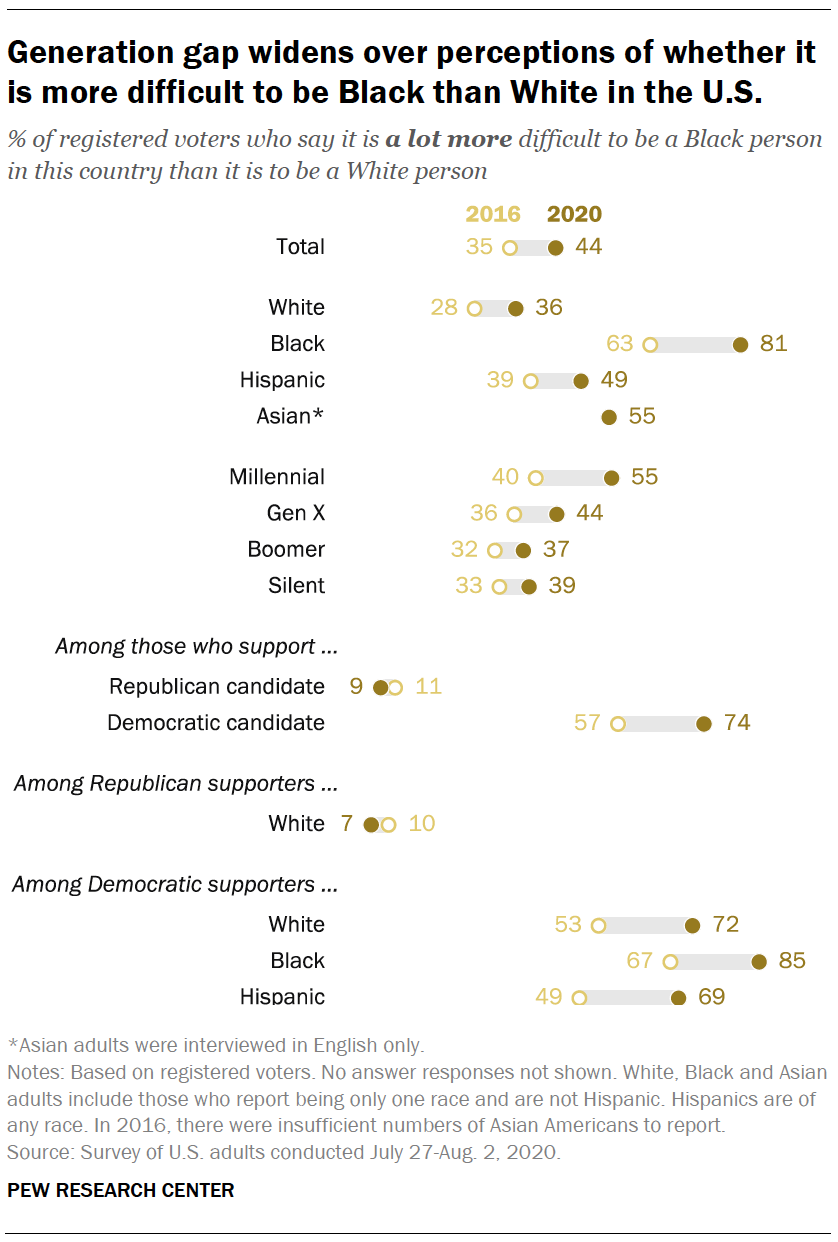
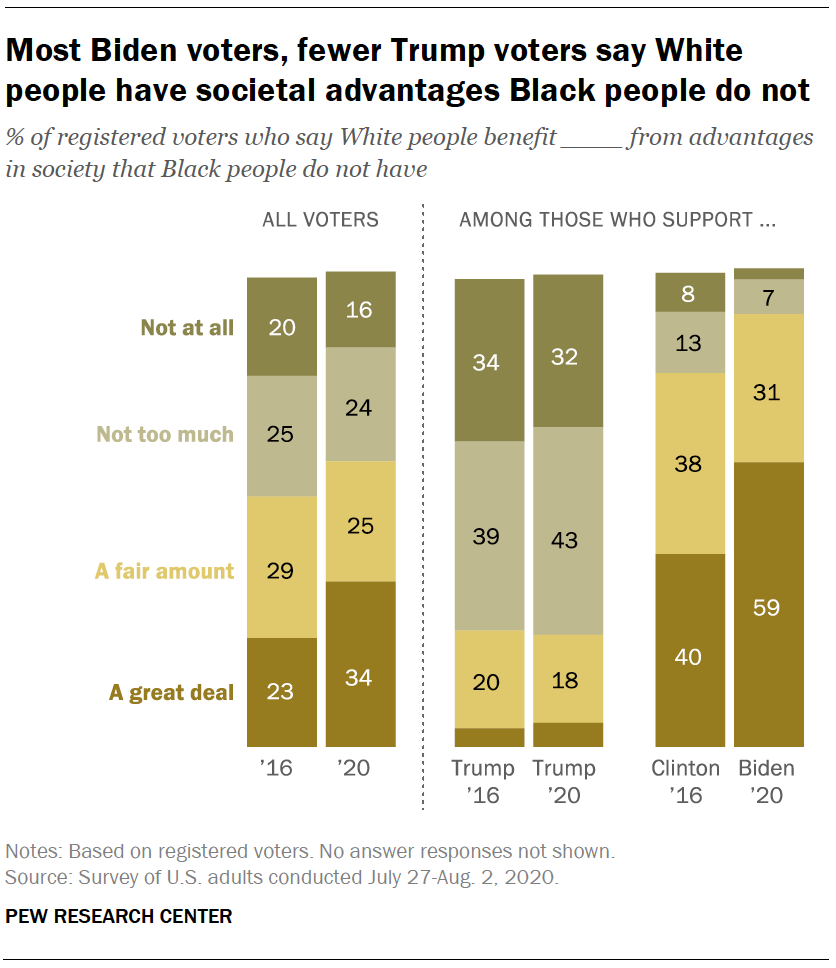
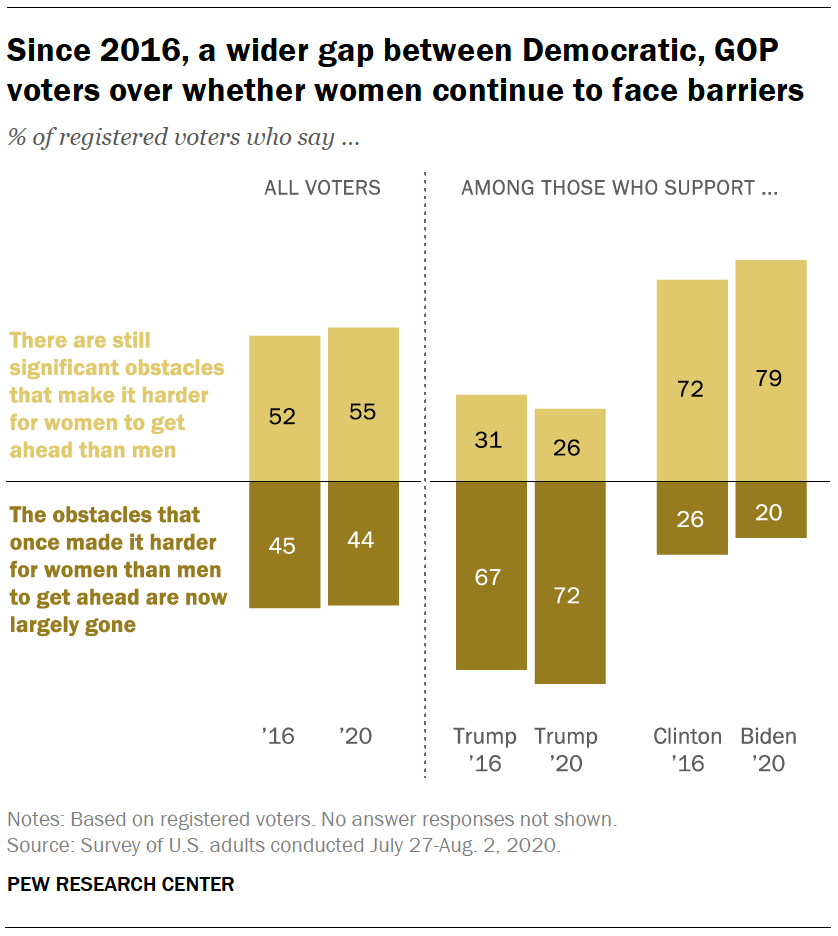
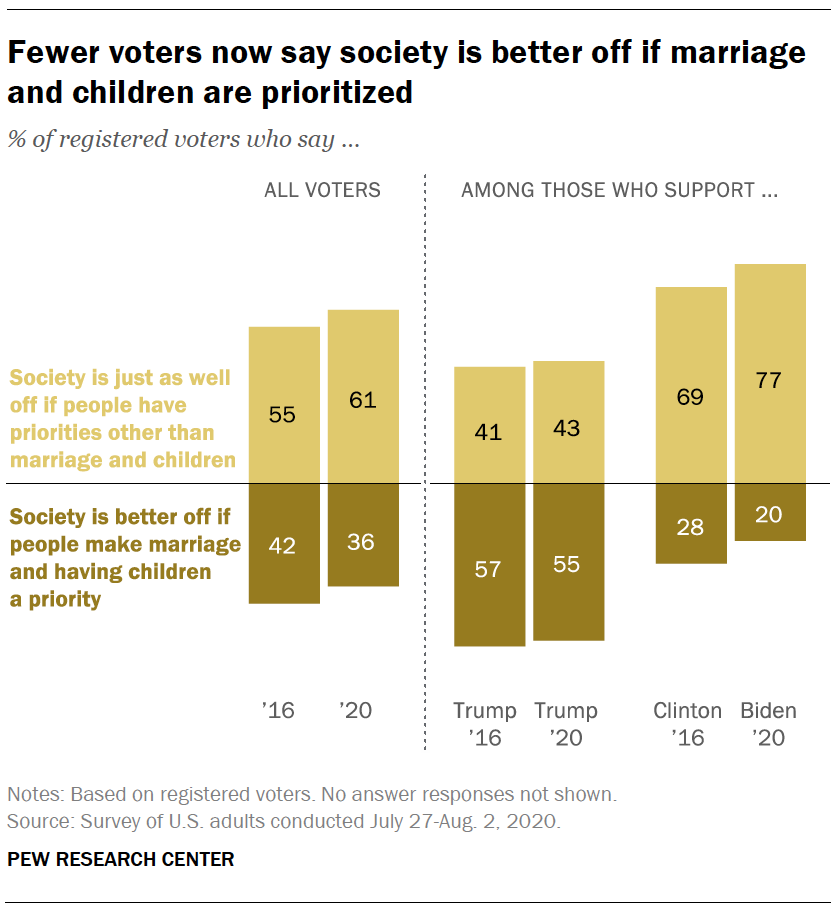
Voters’ Attitudes About Race and Gender Are Even More Divided Than in 2016

Source: Voters’ Attitudes About Race and Gender Are Even More Divided Than in 2016

Glavin: Don’t show up at Black Lives Matter rallies in clothes made by slaves

While much of Glavin’s commentary is appropriate, he overstates IMO the contrast between the USA and Canada, given that all the big companies he lists as being complicit, have a large American retail presence with comparable sourcing issues. Not too mention Disney’s Mulan shot in Xinjiang.

So while American laws may be better, is the reality?

It’s positively uplifting, you could say, that owing to the protests and riots and presidential election-year shouting about systemic racism and police violence in the United States, quite a few Canadians seem to have developed an acutely attentive awareness of the history of Black slavery in America and its enduring legacy. Perhaps not so heartwarming is that the throngs of earnest protesters turning out for all those Black Lives Matter rallies across Canada are wearing clothes made by slaves.

That Canadians of even the most advanced progressive sophistication give every appearance of being completely oblivious to this ugly irony is even less uplifting. An entire summer of American-style protests about the wickedness of racism and capitalism has come and gone without any obvious notice that Tommy Hilfiger, Nike, Adidas, Esprit, Calvin Klein, Nike, UNIQLO, H&M, Lacoste and quite a few other globe-spanning corporations are demonstrably implicated in slavery, child labour, and forced-labour production in prisons and detention centres and sweatshops from Dhaka to Urumqi.

In July, the International Confederation of Trade Unions joined with 180 human rights and Uyghur advocacy organizations to launch an ambitious campaign to bring all this to light and to bring forced Uyghur labour to an end. It’s hard to say whether the campaign has gained much traction. Perhaps they should pull down some statues.

At least the U.S. Congress has been doing its bit. The bipartisan Uyghur Forced Labor Prevention Act would build on existing U.S. prohibitions on the import of slave-made goods, and the proposed Slave-Free Business Certification Act is an even tougher law, promising penalties of up to $500 million.

Canadians, however – for all our boasts about being unstained by the original American sin of slavery – have long been global laggards in the cause of slavery’s abolition. Unlike the United States, Britain, Australia, France, Italy, Germany, Norway and so on, Canada has no specific legislation aimed at banning the import of goods produced by forced labour. World Vision Canada reckons that forced labour or child labour is implicated in $34 billion in products imported into Canada annually.

It is doubly embarrassing – maybe this is why it’s been the subject of nearly no public notice at all – that it’s taking the United States-Mexico-Canada Agreement, the deal that replaced the North American Free Trade Agreement, to drag Canada into the world’s anti-slavery camp. Effective July 1, USMCA requires Canada to amend the Customs tariff laws to impose prohibitions on the importation of goods produced wholly or in part by forced labour.The USMCA’s forced-labour provisions should be expected to put wind in the sails of an effort by Liberal MP John McKay and Quebec Sen. Julie Miville-Dechêne that has been marooned in a procedural tidepool of committee hearings and on-again, off-again consultations for two years. Their proposed law, the Modern Slavery Act, would force corporations to show that their supply chains are free of forced labour, on pain of fines of up to $250,000.

Because the Americans were already in compliance with the UMSCA’s forced-labour provisions, on July 1 they hit the ground running. U.S. law already allows for the seizure of goods and criminal charges for violators, and just this week, the U.S. Customs and Border Protection agency was preparing to block imports of cotton from Xinjiang, where almost all of China’s cotton fields are located. One in five garments worldwide contains cotton from Xinjiang.

The U.S. import bans are expected to also include tomato products and human hair, and computer parts from Hefei Bitland Information Technology. Products from the Lop County Industrial Park and Lop County No. 4 Vocational Skills Education and Training Center are headed for banned list, following the July 1 seizure of several tons of hair extensions shipped to the U.S. believed to have been “harvested” from Uyghur women by the Lop County Meixin Hair Products Company. The U.S. State Department has also warned Walmart, Amazon and the Apple corporation that they face severe legal risks over their supply chains associated with Xinjiang.

According to the Walk Free Foundation’s 2018 Global Slavery Index, Canada is vulnerable to slave-labour contamination in supply chains involving nearly $10 billion worth of laptop computers and mobile phones annually imported from China and Malaysia, and $6 billion worth of apparel imports. Several other supply chains are suspect, including gold from Peru and sugarcane from Brazil.

While Canada has been noticeably absent in the global struggle against slavery, there is one Canadian bright spot, involving a particularly grotesque Canadian embarrassment.

The bright spot: Last March, the Supreme Court of Canada ruled that three Eritrean refugees could sue the Vancouver-based mining company Nevsun Resources for engaging in slavery and committing crimes against humanity at the notorious Bisha gold, copper and zinc mine in Eritrea, co-owned by Nevsun and the Eritrean dictatorship. The three plaintiffs in the case say they were conscripted into the military and forced to work at the mine for 11, 14 and 17 years respectively, and that they were tortured and made to put in 12-hour days, sometimes seven days a week.

The embarrassment: Four years ago, when a UN commission of inquiry confirmed reports of abuse at the mine so grotesque as to amount to crimes against humanity, it turned out that the Canada Pension Plan Investment Board owned 1.5 million shares of Bevsun Resources. In 2018, Nevsun’s shareholders agreed to sell the company for $1.86 billion to China’s Zijin Mining Group.

Perhaps Prime Minister Justin Trudeau should take a knee.

Source: Glavin: Don’t show up at Black Lives Matter rallies in clothes made by slaves

Black, Native American, and Fighting for Recognition in Indian Country

Of interest:

Ron Graham never had to prove to anyone that he was Black. But he has spent more than 30 years haunting tribal offices and genealogical archives, fighting for recognition that he is also a citizen of the Muscogee (Creek) Nation.

“We’re African-American,” Mr. Graham, 55, said. “But we’re Native American also.”

His family history is part of a little-known saga of bondage, blood and belonging within tribal nations, one that stretches from the Trail of Tears to this summer of uprisings in America’s streets over racial injustice.

His ancestors are known as Creek Freedmen. They were among the thousands of African-Americans who were once enslaved by tribal members in the South and who migrated to Oklahoma when the tribes were forced off their homelands and marched west in the 1830s.

In treaties signed after the Civil War, they won freedom and were promised tribal citizenship and an equal stake in the tribes’ lands and fortunes. But what followed were broken promises, exclusions and painful fights over whether tens of thousands of their descendants should now be recognized as tribal members.

Some of the descendants have won lawsuits seeking inclusion in the Cherokee Nation. Some gained nominal citizenship as Seminoles, but said they could not access tribal services. Others, like Mr. Graham, have nothing.

But now, a landmark Supreme Court decision for tribal sovereignty has breathed new life into their fight.

In July, the Supreme Court recognized a huge portion of eastern Oklahoma as reservation land under the terms of an 1866 treaty. The same treaty also guaranteed that freed slaves and their descendants would “have and enjoy all the rights and privileges of native citizens.”

To groups of their descendants, the logic was simple: If the United States still had to honor treaty promises it made to tribal nations, then tribal nations had to keep their word to the descendants of those formerly enslaved by the tribes.

“We’re making noise,” said Marilyn Vann, a Cherokee citizen and president of the Descendants of Freedmen of the Five Civilized Tribes.

Ms. Vann estimated that there was a diaspora of some 160,000 descendants of those formerly enslaved by the tribes, many of them living in Oklahoma. There are groups representing descendants from each of the five tribes who meet to share sepia photographs of ancestors, compare genealogical records and plan protests.

Ms. Vann added: “There are chiefs who’d like to get rid of what they think of as the Freedmen problem. We have our rights.”

Now, as they file lawsuits in federal and tribal courts, they say they are fighting for tribal benefits including access to jobs, health care at tribal clinics and hospitals, housing, scholarship funds for their children and the right to vote in tribal elections. But also for something more fundamental: “My identity,” Mr. Graham said.

In a statement, the Muscogee (Creek) Nation said that the issue of the status of the descendants of enslaved people raised thorny questions about tribal citizenship that “cut to the core of self-determination.” They said the tribes had fundamental rights to run their own governments and decide for themselves who qualifies as a citizen. Some said that a reconciliation commission would be a better way to resolve the issue, rather than an edict from Congress.

“Many of our citizens feel that identity is at the heart of this issue and that blood lineage is essential to protecting it,” the Muscogee Nation said. “But, on the other hand, the grave injustice done to the slaves owned by some Creeks has to be acknowledged and discussed.”

The fight is unfolding as Oklahoma grapples with another bloody chapter of its history: A white mob’s massacre and destruction of a thriving Black neighborhood in Tulsa in 1921. Many of the Tulsa victims were descendants of people formerly enslaved by the tribes, activists say. This summer, crews excavated a suspected mass burial site searching for remains, and survivors and descendants of the victims recently sued the city.

The legacy of anti-Black racism in tribal nations can be a fraught, uncomfortable topic, one that forces communities who have suffered centuries of land theft, colonialism and genocide to confront the darker corners of their own past. Several tribal officials declined interview requests to discuss the issue.

“When we have that difficult history to deal with, we don’t talk about it,” said Chief Chuck Hoskin Jr. of the Cherokee Nation. About 7,000 descendants of Freedmen were incorporated into the Cherokee Nation after a federal judge ruled in 2017 that they had tribal citizenship rights. That history is “a stain on the Cherokee Nation we’ve got to remove,” the chief said.

Spanish and English colonizers enslaved Native people across the Americas. But tribes in Alabama, Georgia and Florida also adopted the practice themselves, enslaving African-Americans to work on cotton plantations and in homes. When the United States government forcibly removed the Cherokee, Seminole, Choctaw, Chickasaw and Muscogee people to Oklahoma, their slaves also made the deadly march or were transported west in boats, according to historians.

The Civil War and the question of slavery divided tribes, with some fighting for the Union and other tribal members declaring loyalty to the Confederacy. Some enslavers retreated to Arkansas or Texas to escape skirmishes and raids. Black Indians joined the Union or Confederate armies, and later escaped to freedom in Kansas.

“It’s a history that still divides our citizens over what rights the descendants of those Freedmen should have, as well as the larger conversation concerning who is ‘legitimately’ Cherokee,” Rebecca Nagle, a Cherokee writer and host of the podcast “This Land,” wrote this summer after the Cherokee Nation removed two Confederate war memorials in eastern Oklahoma. “We need to do more to confront that history within our tribe.”

The Freedmen were granted tribal citizenship — and in some cases “an equal interest in the soil and national funds” of the tribe — in the treaties that Oklahoma’s tribes signed with the federal government after the Civil War, in which the tribes were forced to cede huge portions of their land to the government.

On the Muscogee (Creek) Nation, there were once three “colored” tribal towns that formed their own small governments. Despite segregation and racist legal structures, Freedmen served as council members, ministers, judges. Jesse Franklin, who was born a slave in Alabama in 1817, was named to the Creek Supreme Court in 1874 — some 93 years before Thurgood Marshall ascended to the United States Supreme Court.

But their descendants say they were edited out of existence over the past half-century by tribal constitutions and other laws denying them citizenship because they were not citizens by blood, or because they or their ancestors had been placed on a roster of ineligible people when government agents began sorting Oklahoma’s tribes into “citizens” and “Freedmen” in the 1890s.

Sharon Lenzy Scott said her mother was stripped of her Creek citizenship when a new constitution was passed in 1979, and spent the next 20 years until her death trying to ensure that her family never forgot.

“She called all her children into the living room and said, ‘I’m going to tell you who you are, and don’t let anyone tell you you’re not,” Ms. Scott said. “She knew who she was.”

The N.A.A.C.P. has weighed in to support the descendants of those formerly enslaved by the tribes, and some members of Congress have proposed legislation that would sever ties between the United States and the Creek Nation, or withhold housing money from other tribes, until the descendants are granted tribal citizenship.

But to some tribal leaders, those threats undermine tribal sovereignty.

Gary Batton, the chief of the Choctaw Nation, wrote in a June letter to the speaker of the House, Nancy Pelosi, that he objected to any legislative maneuvering, and said the “Freedmen issue is a problem caused by the United States, not the Choctaw Nation.”

“America should solve its own problems,” Chief Batton wrote.

Still, the descendants’ cause has supporters among tribal members. Eli Grayson, a Muscogee (Creek) citizen whose family once owned slaves, said the Freedmen’s descendants had been excluded for too long.

“These Freedmen lives don’t matter,” he said, echoing the Black Lives Matter mantra.

Mr. Graham said he has been petitioning for his Muscogee (Creek) status since he went to a tribal citizenship office in 1983 and told the office workers that his father was Theodore “Blue” Graham, who spoke the Creek language and went to traditional stomp dances. On that long-ago day, he said, the clerk told him his father had been nothing but a slave: “It tore my heart out.”

Mr. Graham can speak a few shards of Creek himself, enough to say “Come to dinner” or teach his children “Mvto” for thank you. He has come to dislike the term Freedmen, calling it a pejorative relic.

He would like, one day, to just be a citizen of his tribe.

Racial authoritarianism in US democracy

Bit of a dense read but nevertheless a reminder of the lingering influence of the past on the present:

Recently, casual and savage violence of police against peaceful protesters and images of police in military gear sweeping up residents into unmarked vans has led journalists to question whether U.S. democracy is in peril. Many observers described these recent actions as authoritarian. But racial authoritarianism has been central to citizenship and governance of race-class subjugated communities throughout the 20th and early 21st centuries. It describes state oppression such that groups of residents live under extremely divergent experiences of government and laws. Yet when police engage in excessive surveillance, incursions on civil liberties, and arbitrary force as a matter of routine patrol, many scholars of American politics are reluctant to consider it a violation of democracy and instead deem them aberrations in an otherwise functioning democracy. This mischaracterization is not limited only to intellectual discourse but also affects the public sphere. By obscuring evidence of racial authoritarianism, reforms will not land where needed. Procedural reform is useful when we are simply improving policing, not ridding democracy of authoritarian practices.

Racial authoritarian governance has deeply shaped our institutions, political arrangements, and state development, and virtually every racial justice movement over the past 100 years has tried to expose its operation, challenge it, and seek freedom from it (1). Coterminous with democracy in the United States, racially authoritarian patterns are reproduced and innovated after periods of democratic expansion in the United States. Since the 1960s, policing has been the primary administrative tool of racial authoritarianism: One segment of the population effectively lives under a different set of rules and, as a result, experiences differential power and citizenship.

Although many Black intellectuals and citizens have understood how authoritarian power operates on citizens within a democracy, scholars of U.S. politics largely overlook state power to coerce, surveil, and enact violence often by police authorities and treat it as unimportant to theorizing our democracy. Starting from the assumption of a liberal tradition and examining deviations from a mostly pluralistic polity, they document evidence of democratic retreat only when political competition is curtailed and trust in governing institutions erodes, despite overwhelming evidence of racial authoritarianism. This view, stretching from the field’s defining scholars to the present day, is housed within a polity that was increasingly turning to, and expanding, its coercive instruments of surveillance, predation, violent intimidation, and confinement, concentrated on race-class subjugated residents.

The result is a substantive and substantial narrowing: By failing to consider the possibility of widespread, coherent, and racially targeted authoritarian practices, the focus in academic debates becomes improving aspects of democratic quality and the distribution and delivery of democratic goods—more representation, more votes, more responsive policy—while rendering invisible the lack of autonomy and freedom, and the vulnerability to state violence and illegal takings, that characterizes the experience of U.S. democracy for those experiencing its more authoritarian aspects. We should augment our understanding, theories, and measurement to encompass or reconcile the presence of such authoritarian practices within U.S. democracy. In addition to measuring democratic performance through national indicators such as free and fair elections, we should also include local coercive practices concentrated on subgroups of the population.

A Trenchant Rebuttal

Once we look beyond democracy’s formal structures, institutions, and rules to the lived experiences of political authority, we see that they pose a sharp contrast, and a trenchant rebuttal, to the conventional understandings of liberal democracy. For example, drawing on the largest database of narrative accounts of policing in U.S. cities after the Baltimore uprising of 2015, we see that U.S. residents have a sophisticated understanding of the actual operation of democracy and are witnesses to its relationship to authoritarian practices (2). Stopped by police, subject to violation of privacy and displays of force, routine seizure of resources, and unable to freely assemble because of police occupation of their neighborhoods, they described being effectively outside the provisions of the main text of U.S. democracy—the Constitution:

“But every black and every Hispanic that gets stopped, especially here in LA, they asked to get out their car…okay. And it’s a difference. When you’re telling me, you’re going to go and say, ‘Oh you’re just nitpicking, you’re crying, you’re complaining.’ But we live this. You see? We live it” [(2), p. 1162].

“They’re paid to protect and serve but they’re not protecting us, they’re not serving us, they’re killing us and eliminating us” [(2), p. 1160].

Police have long proscribed the movement of Black communities and engaged in racial and social control. When historians interviewed several thousand Black Americans who had lived under Jim Crow (state and local laws that enforced racial segregation and disenfranchisement in the U.S. South) in the 1930s and 1940s, police were understood to be guardians of white democracy (3). They described orientations similar to conversations about life decades later. For example, how police goaded Black people into displays of force: “They would come and mess with you in order for you to say something … This gave them an excuse to hit you, you know” (3). State violence through police was witnessed, as well as the absence of accountability when police executed Black people.

When we look to narrative accounts and the undemocratic practices they reveal, we may be better equipped to anticipate critical ruptures in political life. State practices of policing, surveillance, and impunity that are quotidian for racially subjugated people, when popularized, become worrying signs of an authoritarian turn.

Hiding in Plain View

Despite racial authoritarianism’s glaring presence in experiential accounts of U.S. democracy, it has been hiding in plain view in the field of political science. In a field responsible for constructing metrics on democratic stability and political behavior, our failure to theorize racial authoritarianism has had consequences for how U.S. democracy is conceived by the public and policy-makers.

There are several reasons why racial authoritarianism in the United States has, for so long, gone unnamed by our field. One reason is because scholars tend to discount knowledge derived from a bottom-up approach (actual citizen experience), which may obscure our understanding of how government authority is actually experienced. Empirical research on democracy leans heavily on quantifiable indices (such as the Polity Index) and nationally representative survey samples. These measures are useful tools for comparative analysis and standardized snapshots for change over time, but they do not leave room for citizens to define democratic deficits on their own terms or through their own experiential accounts. When we use narrative accounts as the lens through which we view U.S. democracy, racial authoritarianism comes clearly into focus.

Relatedly, scholars tend to fixate on nationally representative institutions and political activities such as voting and operate from an overly narrow definition of authoritarian practices (executive power grabs, direct police collusion, and limited political competition). But the focus on executive overreach can be misleading in a political system as decentralized as the United States, where local governments have high levels of autonomy over police authority in particular. Without a focus on the local or subnational level, it is easy to overlook the ways in which U.S. federalism facilitates racial authoritarianism.

Third, for scholars who have written about modern policing practices, there is no shortage of analysis of their racially disparate outcomes (1). But students of political science have tended to examine the coercion, occupation, subjectivity, and extraction that constitute what we call racial authoritarianism in isolation from democracy. We tend to analyze racialized policing within a separate literature on incarceration and criminal justice; but why should we not also analyze it in the literature on democratic transitions, subnational or group-based authoritarianism, and political violence?

If the field of political science sequestered police repression from questions of democracy, historical Black thinkers did not. An understanding of racial authoritarianism—although completely absent in mainstream scholarship—animated historical Black theorizations that contested U.S. democracy’s hard line boundary from authoritarian modes of governance. They saw police violence and power as a central instrument upholding the differentiated citizenship key to the operation of democracy in the United States. For example, in 1966 James Baldwin wrote, “I have witnessed and endured the brutality of the police many more times than once—but, of course, I cannot prove it. I cannot prove it because the Police Department investigates itself, quite as though it were answerable only to itself. But it cannot be allowed to be answerable only to itself. It must be made to answer to the community which pays it, and which it is legally sworn to protect, and if American Negroes are not a part of the American community, then all of the American professions are a fraud” (4).

This brings us to the final reason, which is that we have been working from foundations of a discipline that has segregated and isolated Black knowledge. For example, our field’s most vaunted scholar of American democracy, Robert Dahl, theorized civic life through a case study in New Haven during a period of mass racial upheaval across northern U.S. cities (5). Yet, Dahl’s account portrayed a democracy that subjugated Black citizens did not live and had never taken part in. Political science scholars have typically examined democratic deficits as a question of who is represented and how; they tend to focus on exclusion from political participation or social citizenship, or hindrances on the ability of citizens to have equal influence (6).

Scholarly treatises flowed from Dahl’s conceptions but stood uneasily alongside a chorus of Black intellectuals, folk leaders, and activists that contested the clean distinction between democracy and authoritarian rule. Instead of describing pluralism, polyarchy, and liberalism, they called attention to undemocratic legacies, visible and unapologetically practiced on their streets.

That mainstream approaches have hardened into deep scholarly grooves has had consequences. Today, students learn about authoritarianism abroad. We are taught American exceptionalism, the idea that the United States is singular for its old constitution, institutional arrangements such as federalism, lack of feudalism, and weaker welfare state, not because we have a racial authoritarianism distinct from any other nation in the western world. When we do recognize authoritarian governance in the United States, it is a past relic, confined to the post-emancipation U.S. South where Black disenfranchisement, one-party rule, and explicit political violence reigned but was eventually overcome. And when scholars present evidence of democratic backsliding in contemporary U.S. politics, they ignore the expansion of racial repression, focusing instead on polarization, distrust in institutions, and extreme income inequality—all of which themselves derive from or are linked to racial authoritarianism.

Promising Frameworks

How can scholars study authoritarian modes of governance within democratic states? What can attending to racial authoritarianism teach us about the nature and evolution of U.S. democracy? Fortunately, there are promising theories on which we can build. A few scholars have pointed to the possibility that authoritarian practices co-exist within formally democratic states and institutions. King and Smith have argued that U.S. democracy was formed through the contestation of liberal egalitarian ideologies and illiberal, ascriptive hierarchy (7). Miller describes “racialized state failure” in which U.S. federalism and racism interact to create conditions comparable with those of failed states (such as extreme levels of homicide, state violence, and imprisonment) (8). Hanchard reminds us that the most celebrated democracies, back to ancient Athens, had the longest histories of racial slavery, subjugation, imperialism, police terror, and highly unequal labor regimes (9). He argues against typical stances in our field that tend to ignore the coexistence of democracy and ethnoracial hierarchy and that the former’s institutional development was shaped by the latter: “The seemingly straightforward genealogy that reduces democracy to its formal and performative elements ignores how coercion, empire, and forced labor have been deeply intertwined in democratic experiments in the Greek city-states and in contemporary societies” [(10), p. 68].

The literature on the relatively recent democratization of the United States also offers an opening. Scholars of U.S. and comparative political development have long understood one-party rule in the South before the Second Reconstruction (1945–1968) as authoritarian. Mickey has analyzed these “authoritarian enclaves,” that “created and regulated racially separate—and significantly unfree—civic spheres” [(10), p. 5]. Gibson has described subnational authoritarianism in the United States as compatible with, and enabled by, federal democratic institutions before the Second Reconstruction (11). However, scholars stop shy of theorizing the persistence or reemergence of authoritarian practices after the fall of territorial subnational authoritarianism in the 1960s.

Last, we can learn from scholars working outside the United States who have analyzed and provided theories to explain conditions that aid the endurance of coercive institutions in democracies, including the police, who further “stratify citizenship” along the dimensions of race, class, and geography by failing to protect citizens, serving instead the interests of the state and engaging in extralegal force (12). In countries with histories of military rule, norms of police violence endure in the transition to democracy. During dictatorships, even the middle classes are subject to state and police repression, but this falls away under democratic reforms; ironically, the rise of democracy helps concentrate police violence on poor and raced groups. Citizens being “outlaws” in Bolivia—unprotected by police and law but also subject to its capricious regulation—draws parallel to Black communities in the United States experiencing “legal estrangement” (13, 14). How might scholars better connect racial authoritarianism across democracies?

Unlike Latin American cases, where authoritarian practices predated and then survived democratic openings, in the United States, authoritarian policing tended to develop after democratic expansions. State power to surveil and confine citizens increased in response to a wave of democratization in both the First (1863–1877) and Second Reconstruction . On the heels of the abolition of slavery, new forms of repression evolved, including the leasing of Black convict labor; after the voting, civil rights, and fair housing acts of the 1960s, racially targeted policing practices grew on nearly every indicator (1). Scholars should account for whether and why police power and Black mass imprisonment have tended to grow in relation to periods of formal democratization.

Anemic, Distorted, Dire

The United States is now and has historically been characterized by high levels of state control of and violence toward racially subjugated groups alongside formal political freedom. Just as racial slavery defined U.S. democracy historically, racial authoritarianism continues to define the practices of our democracy. In the current political moment, recognition of the fraying of democratic institutions has collided with a movement for Black liberation from police atrocities. Scholars often do the work of making such a connection legible more broadly. But if scholars continue to keep the former separate from the latter by ignoring racial authoritarianism, we will continue to have an anemic and distorted conception of U.S. democracy, with potentially dire consequences for policy. It is perhaps unsurprising that the media has followed suit, presenting racialized policing as distinct from democratic backsliding, linked only by the executive’s rhetoric and actions.

Political scientists prepare and educate the next generation of civic leaders, teachers, policy-makers, pollsters, and change agents; by representing to them democracy in this way, we give them a half-truth, a flawed understanding of U.S. democracy, which may shrink policy agendas and political discourse more broadly. The analysis and description of democratic frameworks—and, for example, backsliding—influences the media and carries weight in policy circles (15). Thus, it is essential that political scientists continue to offer theories for understanding democracy with attention to its actual practice in heavily policed communities, so as not to squander an opportunity to improve it.

Source: Racial authoritarianism in US democracy

China’s Population To Drop By Half, Immigration Helps U.S. Labor Force

Of note:

China’s population is projected to drop by half by 2100, calling into question the country’s future economic growth in the face of a sharp decline in its labor force. In contrast, America’s population and labor force is likely to be sustained if the Trump administration’s policy of reducing U.S. immigration level is reversed.

The population of China is projected to decline from 1.4 billion in 2017 to 732 million by 2100, a drop of 48%, according to a new report published in the medical journal The Lancet and authored by University of Washington School of Medicine Professor Stein Emil Vollset and 23 coauthors. The number of people of working age in China is expected to plummet. The report forecasts a decline of 64% for China’s population aged 20–24 years. That is the prime age for a country’s military, the authors note.

“In raw numbers, China’s labor force has been declining over the last decade, but they have more than made up for numbers with higher levels of education,” said Mark Regets, a labor economist and senior fellow at the National Foundation for American Policy. “They cannot keep doing that as their population falls by half.”

Regets notes that population size is only one source of national power, but it makes a difference whether your population is slowly increasing or is declining. “A falling population has serious implications for the average age in society,” said Regets. “In percentage terms, the size of the labor force will fall even more than the size of the population.”

Much of the Trump administration’s response to China is based not only on the country’s size but concern about the Chinese government’s ability to direct investment through industrial policy. Economists who study China believe such “ability” has harmed the country’s economy.

Economist Nicholas Lardy, the author of The State Strikes Back, writes that a significant factor in China’s economic slowdown “is the slowing pace of economic reform, reflected in the growing role of the state in resource allocation and deteriorating financial performance of state companies.” Lardy notes, “Under the leadership of President Xi, state industrial policy increasingly displaced the market-oriented economic reform program advanced in the Third Plenum document.”

Trump administration efforts at implementing a U.S. industrial policy during the coronavirus pandemic have so far resulted in scandal and questionable use of taxpayer money. White House adviser Peter Navarro, who has been a chief critic of China, has attempted to implement what some would consider a Chinese-style direction of resources during the pandemic.

“On Monday, the administration terminated one contract that Navarro had directly negotiated – for 42,900 Philips ventilators,” according to the Washington Post. “A Department of Health and Human Services spokesperson said the cancellation was ‘subject to internal HHS investigation and legal review.’ The contract had been criticized by a House oversight subcommittee, which concluded that the government had overpaid for the ventilators by $500 million. The cancellation came after another transaction Navarro championed, a government loan to fund Eastman Kodak’s transformation into a drugmaker, unraveled and became embroiled in a securities investigation. The watchdog panel says it is broadening its inquiry to examine all of Navarro’s deals.”

Like China, America faces its own aging population issues but immigration can address many of them if immigration levels are returned to those in place before Donald Trump took office. The number of legal immigrants will decline by 49% (or 581,845) between FY 2016 and FY 2021 due to Trump administration policies, according to an analysis from the National Foundation for American Policy. “Average annual labor force growth, a key component of the nation’s economic growth, will be approximately 59% lower as a result of the administration’s immigration policies, if the policies continue,” concludes the analysis. “Economic growth is crucial to improving the standard of living, which means lower levels of legal immigration carry significant consequences for Americans.”

Economists Pia Orrenius and Chloe Smith of the Federal Reserve Bank of Dallas found that without immigration, the U.S. economy would struggle to grow: “The economy expands with growth in the labor force and its productivity. Due to the retirement of baby boomers and population aging in general, immigration will play an even larger role in workforce growth going forward than it has in the past. Absent offsetting increases in productivity growth, less immigration will, therefore, translate directly into slower gross domestic product growth.”

The Lancet study, which is based on pre-Trump immigration projections for the United States, estimates the U.S. population will increase slightly from 325 million in 2017 to 336 million in 2100: “In our reference scenario, despite fertility rates lower than the replacement level, immigration sustained the U.S. workforce.”

“[L]liberal immigration policies in the USA have faced a political backlash in recent years, which threatens the country’s potential to sustain population and economic growth,” according to the authors of The Lancet study. “The optimal strategy for economic growth, fiscal stability, and geopolitical security is liberal immigration with effective assimilation into these societies.”

In discussing economic size and global political influence and power, TheLancet authors write, “Nations that sustain their working-age populations over the long-term through migration, such as Canada, Australia, and the USA, would fare well.” Observers cannot miss the irony that the Trump administration’s self-described “nationalist” immigration policy would severely weaken America’s future and the country’s place in the world.

Source: China’s Population To Drop By Half, Immigration Helps U.S. Labor Force