China’s Population To Drop By Half, Immigration Helps U.S. Labor Force

Of note:

China’s population is projected to drop by half by 2100, calling into question the country’s future economic growth in the face of a sharp decline in its labor force. In contrast, America’s population and labor force is likely to be sustained if the Trump administration’s policy of reducing U.S. immigration level is reversed.

The population of China is projected to decline from 1.4 billion in 2017 to 732 million by 2100, a drop of 48%, according to a new report published in the medical journal The Lancet and authored by University of Washington School of Medicine Professor Stein Emil Vollset and 23 coauthors. The number of people of working age in China is expected to plummet. The report forecasts a decline of 64% for China’s population aged 20–24 years. That is the prime age for a country’s military, the authors note.

“In raw numbers, China’s labor force has been declining over the last decade, but they have more than made up for numbers with higher levels of education,” said Mark Regets, a labor economist and senior fellow at the National Foundation for American Policy. “They cannot keep doing that as their population falls by half.”

Regets notes that population size is only one source of national power, but it makes a difference whether your population is slowly increasing or is declining. “A falling population has serious implications for the average age in society,” said Regets. “In percentage terms, the size of the labor force will fall even more than the size of the population.”

Much of the Trump administration’s response to China is based not only on the country’s size but concern about the Chinese government’s ability to direct investment through industrial policy. Economists who study China believe such “ability” has harmed the country’s economy.

Economist Nicholas Lardy, the author of The State Strikes Back, writes that a significant factor in China’s economic slowdown “is the slowing pace of economic reform, reflected in the growing role of the state in resource allocation and deteriorating financial performance of state companies.” Lardy notes, “Under the leadership of President Xi, state industrial policy increasingly displaced the market-oriented economic reform program advanced in the Third Plenum document.”

Trump administration efforts at implementing a U.S. industrial policy during the coronavirus pandemic have so far resulted in scandal and questionable use of taxpayer money. White House adviser Peter Navarro, who has been a chief critic of China, has attempted to implement what some would consider a Chinese-style direction of resources during the pandemic.

“On Monday, the administration terminated one contract that Navarro had directly negotiated – for 42,900 Philips ventilators,” according to the Washington Post. “A Department of Health and Human Services spokesperson said the cancellation was ‘subject to internal HHS investigation and legal review.’ The contract had been criticized by a House oversight subcommittee, which concluded that the government had overpaid for the ventilators by $500 million. The cancellation came after another transaction Navarro championed, a government loan to fund Eastman Kodak’s transformation into a drugmaker, unraveled and became embroiled in a securities investigation. The watchdog panel says it is broadening its inquiry to examine all of Navarro’s deals.”

Like China, America faces its own aging population issues but immigration can address many of them if immigration levels are returned to those in place before Donald Trump took office. The number of legal immigrants will decline by 49% (or 581,845) between FY 2016 and FY 2021 due to Trump administration policies, according to an analysis from the National Foundation for American Policy. “Average annual labor force growth, a key component of the nation’s economic growth, will be approximately 59% lower as a result of the administration’s immigration policies, if the policies continue,” concludes the analysis. “Economic growth is crucial to improving the standard of living, which means lower levels of legal immigration carry significant consequences for Americans.”

Economists Pia Orrenius and Chloe Smith of the Federal Reserve Bank of Dallas found that without immigration, the U.S. economy would struggle to grow: “The economy expands with growth in the labor force and its productivity. Due to the retirement of baby boomers and population aging in general, immigration will play an even larger role in workforce growth going forward than it has in the past. Absent offsetting increases in productivity growth, less immigration will, therefore, translate directly into slower gross domestic product growth.”

The Lancet study, which is based on pre-Trump immigration projections for the United States, estimates the U.S. population will increase slightly from 325 million in 2017 to 336 million in 2100: “In our reference scenario, despite fertility rates lower than the replacement level, immigration sustained the U.S. workforce.”

“[L]liberal immigration policies in the USA have faced a political backlash in recent years, which threatens the country’s potential to sustain population and economic growth,” according to the authors of The Lancet study. “The optimal strategy for economic growth, fiscal stability, and geopolitical security is liberal immigration with effective assimilation into these societies.”

In discussing economic size and global political influence and power, TheLancet authors write, “Nations that sustain their working-age populations over the long-term through migration, such as Canada, Australia, and the USA, would fare well.” Observers cannot miss the irony that the Trump administration’s self-described “nationalist” immigration policy would severely weaken America’s future and the country’s place in the world.

Source: China’s Population To Drop By Half, Immigration Helps U.S. Labor Force

Analysis | U.S. Expats Can’t Renounce Their Citizenship Fast Enough

The most in-depth article and analysis of the data regarding Americans renouncing their citizenship:

The swearing in of new citizens often makes news in the U.S., especially if it happens in unusual circumstances such as one party’s national convention. Much less reported are the many citizenship renunciations by Americans, and the travails leading up to these life decisions. Almost all those giving up their U.S. nationality are expats. And for each renouncer going through the ordeal, there are countless others thinking about it. Why?

One recent press release in particular has caused quite a stir. It suggested that, after “a steep decline” in recent years, renunciations in the first half of this year soared to 5,816, more than twice as many as gave up their passport in all of 2019. The implication, as reported breathlessly in the American media, was that expats, already fed up with President Donald Trump, finally despaired over his mishandling of Covid-19 and quit. Other factors were cited as merely secondary.

But these renunciation numbers are notoriously flawed. They’re based on a list of names of renouncers published every quarter by the Internal Revenue Service — experts call this a form of “doxxing.” That list lags in time and jumbles data. In reality, most embassies and consulates stopped making renunciation appointments this spring, owing to the pandemic. And the dip in prior years, according to experts, was due to backlogs and underreporting.

By the best estimates (see chart), renunciations have been rising since 2010, when the Obama administration passed the notorious Foreign Account Tax Compliance Act (FATCA), inflicting misery on U.S. expats everywhere. In 2014, the government raised the renunciation fee from $450 to $2,350. Undeterred, expats kept at it. The American bureaucracy then indirectly slowed the pace with red tape in the first three Trump years. But we’re back on trend in 2020.

Now, it may be true that most expats aren’t crazy about Trump. Americans abroad tend to be cosmopolitan professionals, often married to foreigners or following international career paths. Watching their home country in their host nation’s news, or talking about it at local dinner parties, has stopped being fun. The images occasionally evoke a banana republic succumbing to pestilence while arming for civil war.

But that’s clearly not the reason why so many expats have been trying to drop their nationality for the past decade. Instead, as I described last year, it’s the nightmare of American tax and financial reporting, in which any accounts or assets deemed in Washington, D.C. to be “foreign” are automatically suspect, requiring extra disclosures that can be ruinous in time, expense and peace of mind.

The U.S. is almost unique in the world in taxing based on citizenship rather than residency. It’s also uniquely parochial in being unable or unwilling to distinguish between, say, a rich American living stateside and stashing money offshore and, for example, a middle-class American married to a German and teaching elementary school in Berlin. The hell starts with that conflation.

Before 2010 America’s citizen-based taxation didn’t necessarily disrupt the lives of expats like this school teacher. That’s because few expats even knew about the horrendously complex reporting rules or bothered with them. But FATCA required them to make new and redundant disclosures or face the prospect of tens of thousands of dollars in fines or even prison. It also required their foreign banks, brokers and insurers to report on them to the IRS, or face draconian sanctions.

Unsurprisingly, many foreign banks and brokers therefore stopped taking “U.S. persons” or green-card holders as customers. So American expats have increasingly been locked out of retail finance in their host countries.

Worse, the European Union then started passing laws with bureaucratically sublime names such as MiFID II and PRIIPs that imposed new rules on everything from mutual funds to life insurance. This scared the U.S. banks and brokers of American expats living in Europe, so they also started kicking out their customers with foreign addresses. Many Americans overseas are financially marooned.

In their desperation, several have been taking their struggle to the courts. Fabien Lehagre, a French citizen who is also an “accidental American” because he was born in California, wants to invoke the EU’s data-privacy laws to have FATCA declared illegal in Europe. A U.S.-British dual citizen calling herself “Jenny” is trying to crowdfund a legal odyssey to do something similar in the U.K. Another challenge is underway in Canada. Occasionally, there are even small victories.

But on the whole, Americans abroad feel ostracized by their own country. Like their fellow citizens back home, they’re caught up in the tribal clash between Republicans and Democrats. But when it comes to acknowledging the hardship of expats, the Democrats have mostly refused to listen. The GOP has since 2016 called for the abolition of FATCA and citizenship-based taxation in its platform. But the few Republicans who’ve tried to effect change have so far failed.

If the estimated 9 million Americans living abroad were recognized as a political geography, they would rank ahead of 40 states by population. Their ill treatment by the U.S. tax and compliance regime would be headline news, and probably solved in a bipartisan tweak of common sense. But they’re not a bloc. Like much about American democracy, this discrimination seems unfair. And yet, these millions of voices must be heard.

‘Racial Inequality May Be As Deadly As COVID-19,’ Analysis Finds

Yet another study, highlighting racial disparities in health:

Even during the COVID-19 pandemic, mortality rates and life expectancy are far better for white Americans than they are for Black people during normal, non-pandemic years, according to an analysis published this weekin the Proceedings of the National Academy of Sciences.

The analysis, which looked at U.S. mortality statistics back to 1900, finds an additional 1 million white Americans would have to die this year in order for their life expectancy to fall to the best-ever levels recorded for Black Americans — back in 2014. That year, the average life expectancy for African Americans was 75.3 years — similar to the average life expectancy for white Americans back in 1989, says study author Elizabeth Wrigley-Field.

“It’s as though Blacks have just missed out on the last three decades of [life expectancy] progress,” says Wrigley-Field, a demographer and infectious disease historian at the Minnesota Population Center at the University of Minnesota.

The findings underscore the pandemic scale of the racial inequalities in mortality in the U.S., she says.

“We don’t know what the ultimate scale of COVID-19 deaths is going to be,” Wrigley-Field says. “But what we can say is that white deaths to COVID would have to increase from what they are right now by a factor of [more than] five to make white death rates this year look like the best that Black death rates have ever been.”

She notes that 2014 was also the year when Black Americans had their lowest age-adjusted death rates on record — 1,061 deaths per 100,000. By comparison, for whites, the age-adjusted mortality rate was 899 per 100,000 in 2017 (the last year with available data). To match the lowestmortality rates on record for Black Americans, more than an additional 400,000 white Americans would have to die this year, her analysis found.

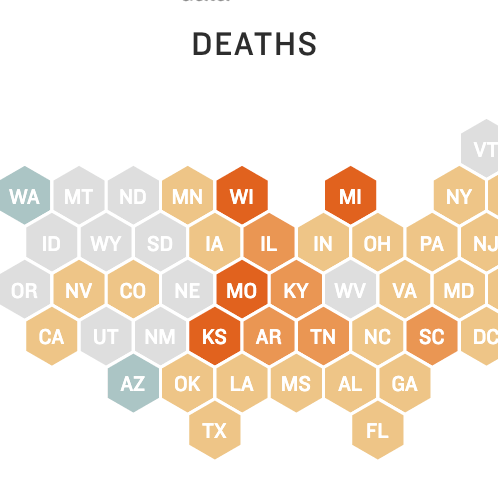
Thus far, COVID-19 has taken a disproportionate toll on Black people and other communities of color. Black Americans have experienced the highest death rates from the pandemic — about 88.4 deaths per 100,000, compared to 40.4 per 100,000 for white Americans, according to data compiled by the APM Research Lab.

But there are also longstanding systemic reasons behind these racial health disparities, notes Dr. Utibe Essien, a health equity researcher with the University of Pittsburgh — factors that include Black Americans’ well-documented disparities in access to quality health care.

African Americans have higher rates of underlying medical conditions, including diabetes, heart disease and lung disease, that are linked to more severe cases of COVID-19. Black people in the U.S. also bear the burden of historic discrimination policies, Essien says, such as redlining policies in housing that limited African Americans’ ability to accumulate wealth through property ownership. And wealth is a significant driver of health, Essien notes.

“I think it’s important to … appreciate that the pandemic didn’t start something new, but that these disparities really, unfortunately, have been seen for decades, if not centuries,” he says.

Indeed, Wrigley-Field says she was inspired to carry out the current analysis after conducting an earlier study on regional mortality rates from infectious disease during the early 20th century. “The thing that we found that stunned us was that white deaths in 1918 during the flu pandemic” — which killed more than a half-million Americans — “were less than what Black deaths had been in every prior year.” A century later, she writes in her paper, “the basic fact endures that Black disadvantage is on the scale of the worst pandemics in modern U.S. history.”

Wrigley-Field says she hopes her analysis will help reframe the discussion in the U.S. about the kinds of policy changes that society can realistically embrace to address health disparities stemming from systemic racism.

“To me, this really changes the question about how we think about, ‘What are we willing to do to stop these deaths?’ ” she says. “Because we know what we’re willing to do to stop deaths from COVID. We’re basically willing to change every aspect of how we live, how we work, how we do our family lives, whether we travel, whether schools are in session. Absolutely everything is on the table. And all of that is controversial, but it’s actually all pretty popular, too. ”

“Meanwhile,” she says, “we have this similar or probably larger scale of deaths happening every year, just to Blacks. But proposals that would try to address that in some way are often very controversial. Most people do not support, for example, reparations. Most people do not support defunding the police, although the opinions about that are changing pretty quickly. … To me, these results, more than anything, just kind of reframe that question about what’s realistic.

“So what are the things that we think are unimaginable that would address racism that we have to similarly say, we have no choice but to do this because the scale of death that’s resulting is unacceptable?”

Source: ‘Racial Inequality May Be As Deadly As COVID-19,’ Analysis Finds

How the U.S. asylum system’s biases affect migrants’ chances

Good data-based analysis, showing how outcomes depend upon nationality, where seekers wait (what part of the country, whether in detention or not), and the judge assigned. Sean Rehaag continues his annual analysis with respect to outcome differences, showing wide variations between IRB Members, some explicable, some not:

For the world’s most vulnerable, protection in the United States has all but disappeared.

Wait times for asylum seekers at the U.S.-Mexico border that already seemed indefinite now seem impossible. Families struggle to find food and shelter to outlast a pandemic order with no end date.

Those who cross north are sent back to Mexico in a matter of hours — or even put onto planes back to the countries from which they fled — without any opportunity to explain why they came.

In its response to COVID-19, the Trump administration achieved what it long sought, a shutdown of the U.S. asylum system. And with new regulations introduced this summer, the administration has moved to squeeze out any real chance at refuge in case the pandemic order is lifted.

But even before the current president began his campaign against asylum in the United States, people often struggled to win protection — no matter how strong their cases appeared to be.

In its 40-year history, the system has chronically fallen short of its promise of safety.

The Trump administration has used statistics about grant rates to justify closing off access to asylum, saying that those who lose their cases are illegitimate asylum seekers.

The facts show a different story: Thousands of people turned away based not on the merits of their cases, but on the capriciousness of a system so riven with inequity that many outcomes seem little more than arbitrary.

A San Diego Union-Tribune analysis of 10 years of court outcomes uncovered many symptoms of the system’s biases — shortcomings that date to the system’s creation.

Numerous factors can sway a case’s result, calling into question the administration’s assertion that a denial means an asylum seeker was lying.

Where asylum seekers wait for their day in court can mean the difference between protection and deportation.

That “where” depends on two decisions mostly out of asylum seekers’ control — whether they are held in detention and in which part of the country their hearings are scheduled.

It can ultimately influence several other important factors: their chances of finding legal representation, the judge assigned and what legal precedents the judge must follow.

Outcomes also vary by nationality, discrepancies that cannot be fully explained by the human rights violations that vary from country to country.

Mixed into all of this are the tendencies of each judge. Even among judges at the same court, grant and deportation rates vary widely.

Stories of different outcomes for similar cases, even for family members fleeing the same danger, are common.

Not a simple yes or no

When people ask for protection at the border, they enter a maze of bureaucracy that is the U.S. asylum system.

Herding them along are thousands of federal employees and contractors — asylum officers, detention center guards, deportation officers, immigration judges, court interpreters and government attorneys.

The process is an adversarial one, with a goal of determining whether the person is deportable from the United States, not whether that person merits protection.

U.S. asylum law, based on international agreements, protects people who flee persecution based on race, nationality, religion, political opinion or membership in a social group such as the LGBTQ community. Persecution must come directly from the government or from someone whom the government cannot or will not control.

In the decade of cases analyzed by the Union-Tribune, immigration judges granted asylum about 19% of the time.

These findings are based on roughly 146,300 immigration court cases with asylum applications filed that reached initial decisions from fiscal 2009 through 2018, excluding some asylum requests that didn’t originate at the border.

But asylum is not always a simple yes or no.

About a quarter of cases were closed without judges making decisions on the merits of the asylum applications. These closures generally meant that asylum seekers were allowed to stay, at least temporarily, in the United States.

Judges ordered deportations in nearly half of the total cases.

The Executive Office for Immigration Review, the agency within the Department of Justice responsible for immigration courts, did not respond to a request for comment about the various findings of the Union-Tribune’s investigation.

Where they wait

Asylum seekers often have little control over where their cases end up — and it’s not necessarily tied to where they arrived at the border.

Though the Trump administration drastically changed where asylum seekers wait beginning in 2019, during the decade analyzed by the Union-Tribune the federal government had two main options.

If immigration officials decided to keep asylum seekers in custody, they were sent to detention centers around the country depending on bed space.

If released, they went wherever someone was willing to help them — a cousin in New York, a friend in Colorado, or an unknown sponsor linked to an advocacy group.

Where this fateful combination of circumstances takes an asylum seeker can make a big difference.

Based on the 10 years of case data analyzed by the Union-Tribune, a detained asylum seeker in Texas was 9.3 times more likely to be ordered deported than a non-detained asylum seeker in New York.

Nationwide, asylum seekers who remained in custody were ordered deported at a higher rate — in 74% of cases — compared with 44% for those who were never detained. Those who were initially detained and then released were ordered deported in 37% of cases.

Being detained doesn’t necessarily reflect anything about the legitimacy of an asylum seeker’s case or hint at a criminal past. Rather, Immigration and Customs Enforcement, the agency responsible for immigration detention, has longstanding policies to keep many asylum seekers in custody regardless of their circumstances.

In or out of custody, the region where an asylum seeker ends up dictates what legal precedents will be used to decide their cases.

The example most widely cited by attorneys is the debate over the definition of what constitutes a “social group” for asylum purposes. The 5th U.S. Circuit Court of Appeals, which governs Texas, along with Louisiana and Mississippi, has long used a narrow interpretation.

How courts define which categories count as social groups makes a difference for people whose persecution claims are based on their membership in a family, or as part of a broader group such as women fleeing domestic violence in countries that don’t protect them or as young men targeted for gang recruitment, among others.

Records show judges under the 5th Circuit ordered 3 in 4 asylum seekers deported from fiscal 2009 through 2018 — more than any other circuit in the country.

At the other end of the spectrum, judges in the 2nd Circuit, which guides case law in New York, Connecticut and Vermont, ordered fewer than 1 in 3 deported.

Judges in the 9th Circuit, which includes California, ordered just over 2 in 5 asylum seekers deported.

Location also dictates how many immigration attorneys, particularly those willing to work pro bono, are available. It is notoriously difficult for asylum seekers held in rural detention centers to find attorneys.

Asylum seekers who did not have representation were ordered deported in 60% of cases in the Union-Tribune analysis, compared with 42% for those with legal help.

Unlike cases in criminal courts, attorneys are not provided to those who cannot afford them — not even when the asylum seeker is a child.

Where they’re from

Geography plays a role in another way — the Union-Tribune’s analysis revealed disparities in outcomes based on nationality.

Part of that has to do with conditions in the country and whether they create reasons to flee that are clearly defined under asylum law.

But another part may have to do with biases and preconceptions in U.S. culture about that country.

This may help explain why asylum seekers from China are much more successful than those from Somalia.

Out of the 10 nationalities with the most asylum applications filed, those two countries of origin, both with long histories of human rights violations, are near the top of the list for grant rates. China ranks second, and Somalia ranks third.

And yet, the odds of asylum seekers from China being granted asylum were 2.2 times higher than those from Somalia, according to the Union-Tribune analysis.

This disparity might be explained by the outsized focus on China in U.S. media coverage and in federal government. China’s notorious treatment of Uighurs — an ethnic minority — and the country’s violent repression of pro-democracy protests in Hong Kong are just the latest examples of human rights violations in the public eye.

In contrast, the decades-long rampant human rights abuses in Somalia that have created hundreds of thousands of refugees do not often make front-page headlines.

Add in racism and xenophobia toward people from certain regions of the world, as well as potential anti-Muslim bias, said Karen Musalo, director of the Center for Gender & Refugee Studies at UC Hastings College of the Law, and the potential for discrepancy grows.

“The relationship between the United States and the country you’re from is a big factor,” said Jeremy Slack, a University of Texas at El Paso professor and author of the book “Deported to Death.” “Chinese people get asylum right now much, much easier than most other countries because we like to poke China as a human rights abuser.”

China’s affiliation with communism is another likely influencer, especially after Congress, in 1996, made it easier for people fleeing the country because of its one-child policy to claim asylum.

These kinds of systemic biases regarding nationality have been in place since the asylum system was created.

In the early days, immigration officials who processed asylum requests relied on U.S. State Department recommendations for each individual case, guidance that was heavily influenced by U.S. foreign policy — in particular, the country’s war on communism.

Under the Reagan administration, Central Americans fleeing powerful communist leaders were granted asylum far more often than those fleeing right-leaning strongman governments because of the United States’ involvement in proxy wars in their countries.

“There was a refusal to recognize that the governments we were supporting were engaging in human rights violations,” said Lucas Guttentag, who teaches immigration law at Stanford University and Yale University.

This meant that Nicaraguan migrants, who were fleeing the left-wing Sandinistas, were granted asylum at a rate of 26%, according to a report published in the book “Threatened Peoples, Threatened Borders: World Migration Policy” in 1995, compared with Salvadorans at 2.6% and Guatemalans at 1.8%, who were fleeing right-wing regimes.

Guttentag was one of the lead attorneys in a lawsuit calling for an end to systemic discrimination based on U.S. foreign policy.

A 1990 settlement in the case allowed Salvadorans and Guatemalans to have their claims reassessed, and Congress made other changes to try to account for the system’s shortcomings.

But as the Union-Tribune’s data analysis suggests, systemic bias based on country of origin has not disappeared.

“It’s cynical to say this, but it needs to be said, which is even though the refugee definition is supposed to be applied in a neutral way, the same way to all nationalities, that has never been the case in the U.S.,” Musalo said.

The difference a judge makes

Even for nationalities with higher grant rates, family members fleeing the same persecution can be split apart by different results.

There are glaring examples among many Chinese families that sought asylum based on the country’s former one-child policy. On multiple occasions, immigration judges granted asylum to the father who was seeking refuge from forced abortions, but not the mother.

“It is difficult to imagine how a rational system of law could tolerate such inconsistent results,” appellate judges in the 2nd Circuit wrote in changing the outcome for a mother in one such case.

The difference for many of these families came down to which judges decided the cases.

The Union-Tribune found large differences in decisions among judges at the same immigration court, even when taking into account that asylum seekers held in detention facilities tend to be ordered deported at higher rates.

Take, for instance, the three judges in San Diego who heard mostly detained cases over the course of the decade analyzed by the Union-Tribune.

Judge Robert McSeveny had the highest deportation rate and ordered about 81% of asylum seekers before him deported. He also had the lowest grant rate at 13%.

Judge Carmene “Zsa Zsa” DePaolo ranked somewhere in the middle, ordering 41% deported. She granted asylum in about 55% of cases.

Judge Anthony Atenaide ordered about 20% deported and granted about 76% asylum.

These gaps between judges — some well over 60 percentage points — exist in courts across the United States.

“There shouldn’t be that much difference,” said Paul Schmidt, a former immigration judge. “It’s hard to make sense out of the system because there are so many variables superimposed on each other.”

Ashley Tabaddor, president of the National Assn. of Immigration Judges, said that different rates among judges should be expected.

There might be details in cases of two people fleeing the same harm in the same country that lead to different outcomes depending on how good their attorneys are — if they have them — as well as how much the government attorneys push back and what the judges’ own previous courtroom experiences are, she said.

Even in cases where details are exactly the same, Tabaddor said, judges can have different opinions.

“It’s not unusual for people looking at the same set of facts and same set of rules to have differing opinions about how much weight to give evidence and what the conclusion should be. That’s in every court,” Tabaddor said, pointing to differences among U.S. Supreme Court justices.

Judges’ grant rates are also influenced by their work history, according to a study from 2007 titled “Refugee Roulette” by researchers from Temple University and Georgetown University Law Center.

The Union-Tribune analysis corroborated this finding. Judges who previously worked as ICE attorneys — generally arguing in immigration court against asylum seekers and other immigrants requesting to stay in the U.S. — were about 1.4 times more likely to order asylum seekers deported during the decade analyzed.

A little more than half of immigration judges who heard cases analyzed by the Union-Tribune previously worked for ICE.

When they make the career switch, they go from one federal agency to another.

That’s because, like ICE employees, immigration judges work for the executive branch rather than the judicial branch.

The judges’ boss is the attorney general, the nation’s highest-ranking prosecutor in the Department of Justice.

Tabaddor and other leaders of the judges’ union have long argued that immigration courts should be part of the judicial branch instead — a solution that could help reduce the mistrust that many critics have toward the system.

“Why don’t you trust the judge?” Tabaddor said, addressing those critics. “It’s because you know the court is run by a law enforcement agency. You feel like the court is stacked. You feel like there’s something inherently wrong. And on those grounds I say, ‘You’re absolutely right.’”

A family separated

For one asylum seeker from Central Asia, this fateful lottery of circumstances could mean that he is deported while his family stays in the United States.

The Russian-speaking man, Mr. U, declined to fully identify himself, as well as the country that he fled, to protect family members he left behind. But he allowed the Union-Tribune to review his case files.

His experience navigating the system presents a striking example of how an asylum seeker’s physical location can impact other factors in a case — and ultimately the outcome.

Mr. U first entered the asylum system in San Diego.

He was separated from his 13-year-old son, as well as his adult stepson and his stepson’s wife, shortly after the family arrived at the San Ysidro Port of Entry in 2017.

The physical separation meant their immigration court cases were split, as well.

Though their asylum claims were all tied to the stepson’s political activities, their separation would ultimately result in dramatically different asylum outcomes.

Mr. U would spend the remainder of his case locked up at Otay Mesa Detention Center while his son was taken to a facility for unaccompanied migrant children in Chicago.

His adult stepson and the stepson’s wife ended up at a detention facility in Adelanto, a few hours north. Mr. U did not know where they were.

The day before his trial, Mr. U got some of the best news he’d received since his arrival. He finally found a pro bono lawyer willing to take his case.

“I was very happy,” Mr. U told the Union-Tribune through a translator. “I had a new hope to see my son sooner.”

On the day of his trial, he handed the judge a written statement explaining that the attorney, who then worked at Catholic Charities, was unable to be in court that day because another client had a hearing.

The statement added that Mr. U’s adult stepson was also in immigration custody and that their cases were related. Mr. U hoped that his stepson could be a witness in his case.

Mr. U asked to postpone his trial for about a month and a half.

“I do not wish to prolong my case any longer than necessary,” Mr. U said in his statement. “My young child has been taken from me and is in the custody of the government far away. He is alone and without me, and I need to get back to him.”

Immigration Judge Scott Simpson insisted that Mr. U proceed with his trial that day without the attorney and without his stepson as a witness.

“You’ve been detained for over eight months,” Simpson told Mr. U, according to court records. “That’s ample time to find an attorney. So, there’s no good cause to continue any longer.”

On his own, Mr. U, who has a high school education, struggled to explain his story clearly to the judge.

The Russian interpreter also struggled to understand him, frequently interrupting the dialogue between Mr. U and Simpson to get clarifications.

Both Simpson and ICE attorney Guy Grande called out details from his testimony that were slightly different from what a fellow detainee had translated into English for Mr. U’s asylum application.

For instance, Mr. U testified that his wife had loaned money to someone, but his application said, “I lent” the money.

He also testified in court about an incident in which police threatened him that he did not mention in his application. His application did mention other instances of threats.

In the end, Simpson did not find him credible. He ordered Mr. U deported.

Mr. U felt fear flood his body, terrified what might wait for him in his country.

“It was a big shock and a hit for me. I immediately felt bad,” Mr. U said. “My blood pressure spiked, and my heart was hurting because I cannot return home.”

Simpson had the highest deportation rate of judges at Otay Mesa Detention Center, according to the Union-Tribune analysis.

The judge, who previously worked as an ICE attorney, ordered asylum seekers deported in more than 80% of the cases he heard. He granted relief in about 15%.

About a month after Simpson decided Mr. U’s case, the stepson and the stepson’s wife were granted asylum by a different judge. They did not have a lawyer either.

That judge, Ian Simons, had the highest grant rate and one of the lowest deportation rates among judges who heard cases at Adelanto at the time. He granted asylum in more than 30% of cases and ordered asylum seekers deported in over 60%.

Holding out for appeal

Appeals are an increasingly important part of the path toward protection, a reality often reflected in high reversal rates among some judges.

The Board of Immigration Appeals, or BIA, part of the same agency in the Department of Justice that employs immigration judges, is the first step in the process.

In the cases analyzed by the Union-Tribune, the BIA told more than 1 in 5 judges nationwide that their decisions were wrong at least 20% of the time.

Judges with fewer than 25 appealed cases were not included in the analysis.

A reversal rate of 20% is a common measure when looking for red flags with judges’ decisions, according to University of San Diego law professor Shaun Martin.

Four judges had reversal rates of 40% or higher.

“A consistently high reversal rate like that would cause you to look very closely to see if the judge was doing something systemically wrong,” Martin said.

Cases appealed beyond the BIA go to the federal circuit courts of appeal, leaving the immigration court system and entering the traditional legal process in the judicial branch. Data analyzed by the Union-Tribune did not include those court decisions.

Attorneys worry that more and more asylum seekers will have to go to the circuit courts to be granted relief. Under Trump, most recent appointees to the BIA are former immigration judges who had some of the highest asylum denial rates in the nation.

Ten members of the current 23-person board are former immigration judges appointed to their positions during the Trump administration.

All but one had deportation rates of more than 70% in at least one of the courts where they heard cases during the decade analyzed by the Union-Tribune. Eight of them had asylum grant rates below 10%, including two judges who didn’t award a single grant of asylum while at a particular court.

The board includes two other Trump appointees who worked in the Office of Immigration Litigation in the Department of Justice, which argues against asylum seekers who have appealed their cases to federal circuit courts, and one Trump appointee who worked for ICE before the administration hired her as an assistant chief immigration judge and ultimately a board member.

Six board members were appointed under the Obama administration, and four were appointed by earlier administrations.

So much is riding on appeals that attorney Dree Collopy, who wrote a 1,680-page legal guide on asylum, encourages lawyers to make sure that the record created in immigration court is incredibly thorough.

“We honestly can’t depend on immigration courts or the Board of Immigration Appeals to give any kind of due process or meaningful review of asylum cases anymore,” Collopy said.

But navigating the appeals process can be daunting and often takes years. Those who are already detained usually stay in custody for the duration. Many give up before they get that far.

Mr. U is better positioned than many.

Because of the outcry over family separation at the border and a class-action lawsuit in San Diego, he was released from detention and reunited with his family in Chicago. And he has a pair of attorneys — Bardis Vakili with the American Civil Liberties Union of San Diego and Imperial Counties and Luis Gonzalez, the attorney who’d originally agreed to take his case — working on his appeal.

They argued that Simpson denied Mr. U his right to an attorney, as well as his right to present evidence.

The BIA sided with Simpson.

Now Mr. U is waiting to find out if the 9th Circuit will change the outcome in his case.

He’s not allowed to work while he waits, so he has to depend on his stepson, who already has a green card.

He hopes to learn English and one day find a profession that will allow him to be useful to the country he wants to call home.

And he worries about the family members left behind.

Dwindling odds

Though asylum has become an increasingly polarized topic, building enough political will to make the system more equitable has historically been difficult.

“Asylum was always a political football,” said Ruth Wasem, who specialized in immigration policy at the nonpartisan Congressional Research Service before becoming a professor at the University of Texas at Austin.

The asylum system is part of a worldwide effort that grew out of failures to protect Jewish migrants during the Holocaust. It took the United States decades to fully codify its commitment to help victims of future atrocities.

Larry Gollub, a retired asylum officer, said that low grant rates are not proof that asylum seekers are filing frivolous or fraudulent claims.

“It’s just proof that they can’t meet the high standard for asylum,” Gollub said.

And they are struggling with the obstacles built into the system that make it less likely for them to win.

Methodology

Immigration court records are collected, tracked and released monthly by the Executive Office for Immigration Review within the Department of Justice. The San Diego Union-Tribune used the June 2019 release in its analysis.

Since case information is entered manually, various columns throughout the more than 50 million rows of data in the various tables contained slight inconsistencies, and the Union-Tribune cleaned these entries when necessary.

The analysis includes any cases with asylum applications that were completed from fiscal 2009 through fiscal 2018. Cases flagged as legal permanent residents, rider cases, cases originating with U.S. Citizenship and Immigration Services, and cases that did not include either a charge of being present without admission or arriving without a valid entry document were excluded from the analysis. Cases with incomplete information on these distinctions remained in the analysis.

Judges who heard less than 50 cases in a particular location and nationalities with less than 100 cases during the 10-year period were excluded to prevent skewed results.

Judge work histories were gathered by the Union-Tribune based on summaries released by EOIR when the judge was hired. When necessary, histories were confirmed or clarified using news clippings, court records, law firm biographies, law school newsletters, and in some cases, contacting individuals directly.

With guidance from statisticians, the Union-Tribune performed various statistical tests, including logistic and multivariate regressions, to determine the significance of findings.

Case data and analyses steps can be found on the Union-Tribune’s GitHub page.

With few exceptions, most of the changes to the system since it was created have made the process more difficult for asylum seekers, particularly for those who come to the border.

Among recent changes is the Trump administration’s “Remain in Mexico” program, which forces many asylum seekers to wait for their cases across the border.

Most recently, the administration published new rules that would narrow longstanding definitions in parts of asylum law and fundamentally shrink what options asylum seekers have if they manage to get their cases into immigration court. A second set of proposed rules would allow the government to bar people from asylum because of the pandemic.

The changes would further erode access to a system that is meant to function as part of an international screening process, one that determines which migrants should be recognized as refugees.

“I see our current moment as one of real crisis,” said Denise Gilman, co-director of the immigration clinic at the University of Texas at Austin School of Law. “Even as limited and paltry as the system was, we’re experiencing a moment of doubt as to whether it will even exist in any meaningful way.”

The Trump administration has argued that because the majority do not win their cases, many people applying for asylum do not have valid reasons to ask for help. Recent outcomes appear even lower than in previous years, partly because the administration changed the way outcome statistics are calculated in official reports.
Source: How the U.S. asylum system’s biases affect migrants’ chances

Immigrants in America: Current Data and Demographics

Good reference source (MPI also has a great reference collection):

There were a record 44.8 million immigrants living in the U.S. in 2018, making up 13.7% of the nation’s population. This represents a more than fourfold increase since 1960, when 9.7 million immigrants lived in the U.S., accounting for 5.4% of the total U.S. population. Click the link below each summary table to download the data.

To find more context on the figures below, visit the blog post “Key findings about U.S. immigrants,” and for a downloadable version of the tables below, see the PDF and the Excel workbook. For facts on Latinos in the United States, see our profile on U.S. Hispanics.

For details on our regional grouping of countries, see our “Countries by regional classification” document (PDF).

Nativity of U.S. immigrants

Foreign-born population total 44,760,622
Percent born in Mexico 25.0%
Percent who are citizens 50.7%

Download Excel sheet with all population and nativity findings


Race of U.S. immigrants

Percent who are white alone, not Hispanic 17.7%

Download Excel sheet with all race findings


Language use among U.S. immigrants

Percent speaking English at least very well
(ages 5 and older)
53.2%

Download Excel sheet with all language findings


Age and gender of U.S. immigrants

Median age of foreign-born population (in years) 45
Percent of foreign born who are female 51.8%

Download Excel sheet with all age and gender findings


Marital status and fertility of U.S. immigrants

Percent who are married
(ages 18 and older)
61.2%
Percent who are women ages 15-44 giving birth in past year 7.5%

Download Excel sheet with all marriage and fertility findings


Education of U.S. immigrants

Highest degree completed, ages 25 and older

High school or less 49.2%
Two-year degree/Some college 18.8%
Bachelor’s degree or more 32.0%

Download Excel sheet with all education findings


Work status and occupations of U.S. immigrants

Ages 16 and older

Percent in labor force
(among civilian population)
66.6%

Download Excel sheet with all work findings


Earnings and income of U.S. immigrants

Ages 16 and older

Median annual personal earnings
(in 2018 dollars, among those with earnings)
$31,900
Median annual household income
(in 2018 dollars)
$59,000

Download Excel sheet with all income findings


Poverty and health insurance among U.S. immigrants

Percent living in poverty 14.6%
Percent uninsured 19.6%

Download Excel sheet with all poverty and insurance findings


Homeownership and households of U.S. immigrants

Percent in family households 82.3%

Download Excel sheet with all homeownership and household findings


Region and top states of residence of U.S. immigrants

West 33.9%
California 23.7%
South 33.7%
Texas 11.0%
Florida 10.0%
Northeast 21.2%
New York 10.0%
New Jersey 4.6%
Midwest 11.3%

Source: Immigrants in America: Current Data and Demographics

Looming Fee Increase Could Thwart Many U.S. Citizenship Applications

Yet another Trump administration anti-immigration initiative. Cost matters, and fees need not to pose an excessive financial burden on immigrants:

When Guadalupe Rubio, 41, contracted the coronavirus in July, she struggled to make the few steps to the bathroom in the mobile home that she shared with her teenage daughter in Kent, Wash.

The pandemic had already shuttered her small construction business, which also provided for her parents and three children in Sinaloa, Mexico. Now, the virus left her struggling to breathe, trapped inside without any means to support the six family members who depended on her.

Around the time the pandemic hit Washington State, Ms. Rubio became eligible to apply for United States citizenship. She made a bit too much money to qualify for a reduction in the application fee, currently $640, and the economic effects of the pandemic and her illness sapped away her savings. She applied for food stamps, a benefit that could also provide a break on the fee, but has so far been unable to reach the overwhelmed social services agency that could help her.

If she cannot save the money or obtain a fee waiver before the fall, Ms. Rubio’s prospects of becoming a citizen will become more remote. The Trump administration moved late last month to raise the cost of naturalization applications by more than 80 percent and to substantially tighten eligibility requirements for a subsidized application.

The price for naturalization will jump to $1,160 or $1,170 for online applications. The rule will also lower the income threshold to qualify for a fee waiver and eliminate the partial subsidy for the application.

Almost all other exceptions that allowed immigrants to waive the fee will be eliminated, including extenuating financial hardship and means-tested public benefits, like food stamps. Only some protected immigrants, including victims of domestic violence and human trafficking, will remain eligible.

Ms. Rubio is one of many who would no longer be eligible for a waiver. Immigration lawyers across the country are rushing to submit their clients’ applications to the already backlogged agency before the fee increases are introduced on Oct. 2.

“It’s a low blow during a pandemic,” Ms. Rubio said through a translator. “I have worked a lot for this country, and if I’m a citizen, I can — not just contribute more — but I can also better reap the benefits of all of my hard work in this country.”

Advocates for immigrants say the fee increase is intended to stymie legal immigration and deprive immigrants of their right to vote before the election in November.

China’s Confucius Institutes confronting US demand to register

While no fan of the Trump administration, Canada should consider a similar measure:

The Trump administration is increasing scrutiny of a long-established Chinese-government funded programme that’s dedicated to teaching Chinese language and culture in the US and other nations, the latest escalation of tensions with Beijing.

The State Department plans to announce as soon as Thursday (Aug 13) that Confucius Institutes in the US – many of which are based on college campuses – will need to register as “foreign missions,” according to people familiar with the matter who asked not to be identified.

The designation would amount to a conclusion that Confucius Institutes are “substantially owned or effectively controlled” by a foreign government. That would subject them to administrative requirements similar to those for embassies and consulates.

The State Department, which didn’t immediately respond to a request for comment, took similar action toward several Chinese media outlets earlier this year.

The institutes have long been a target of China hawks, with lawmakers including Senator Marco Rubio, a Florida Republican, urging schools in his state to terminate their agreements with them.

He called them “Chinese government-run programmes that use the teaching of Chinese language and culture as a tool to expand the political influence” of the government.

The move is likely to further stoke tensions with Beijing as the two countries clash over everything from the governance of Hong Kong to 5G technology.

This week, Health and Human Services Secretary Alex Azar became the highest-ranking American official to visit Taiwan in more than 40 years, while Secretary of State Michael Pompeo used a speech in Prague to blast the Chinese Communist Party’s “campaigns of coercion and control.”

Of some 550 Confucius Institutes around the world, 80 are based at US colleges, including Stanford University and Savannah State University in Georgia, according to the National Association of Scholars, a non-partisan research group that has studied them.

Although the institutes generally steer clear of history, politics and current affairs, critics say they are vehicles for Chinese influence on campuses, providing the government in Beijing leverage to censor teaching materials and academic events by threatening to withdraw funding for the institutes.

The National Association of Scholars opposes them because it says their funding lacks transparency and topics sensitive to China’s government are off limits.

Source: https://www.straitstimes.com/world/united-states/chinas-confucius-institutes-confronting-us-demand-to-register

Some Questions for Kamala Harris About Eligibility | Opinion

Elegant birtherism, presented in formal legal reasoning. And his rhetorical question, “how else could we possibly expect the candidates, if elected, to honor their oaths to “faithfully execute the Office of President of the United States, and…to the best of [their] Ability, preserve, protect and defend the Constitution of the United States?” is just that, one designed to raise doubts when none are warranted:

The fact that Senator Kamala Harris has just been named the vice presidential running mate for presumptive Democratic presidential nominee Joe Biden has some questioning her eligibility for the position. The 12th Amendment provides that “no person constitutionally ineligible to the office of President shall be eligible to that of Vice-President of the United States.” And Article II of the Constitution specifies that “[n]o person except a natural born citizen…shall be eligible to the office of President.” Her father was (and is) a Jamaican national, her mother was from India, and neither was a naturalized U.S. citizen at the time of Harris’ birth in 1964. That, according to these commentators, makes her not a “natural born citizen”—and therefore ineligible for the office of the president and, hence, ineligible for the office of the vice president.

“Nonsense,” runs the counter-commentary. Indeed, PolitiFact rated the claim of ineligibility as “Pants on Fire” false, Snopes rated it simply “False,” and from the other side of the political spectrum, Conservative Daily News likewise rated it “False.” All three (and numerous others) simply assert that Harris is eligible because she was born in Oakland—and is therefore a natural-born citizen from location of birth. The 14th Amendment says so, they all claim, and the Supreme Court so held in the 1898 case of U.S. v. Wong Kim Ark.

But those claims are erroneous, at least as the Citizenship Clause of the 14th Amendment was originally understood—an error to which even my good friend, renowned UCLA School of Law professor Eugene Volokh, has fallen prey.

The language of Article II is that one must be a natural-born citizen. The original Constitution did not define citizenship, but the 14th Amendment does—and it provides that “all persons born…in the United States, and subject to the jurisdiction thereof, are citizens.” Those who claim that birth alone is sufficient overlook the second phrase. The person must also be “subject to the jurisdiction” of the United States, and that meant subject to the complete jurisdiction, not merely a partial jurisdiction such as that which applies to anyone temporarily sojourning in the United States (whether lawfully or unlawfully). Such was the view of those who authored the 14th Amendment’s Citizenship Clause; of the Supreme Court of the United States in the 1872 Slaughter-House Cases and the 1884 case of Elk v. Wilkins; of Thomas Cooley, the leading constitutional treatise writer of the day; and of the State Department, which, in the 1880s, issued directives to U.S. embassies to that effect.

The Supreme Court’s subsequent decision in Wong Kim Ark is not to the contrary. At issue there was a child born to Chinese immigrants who had become lawful, permanent residents in the United States—”domiciled” was the legally significant word used by the Court. But that was the extent of the Court’s holding (as opposed to broader language that was dicta, and therefore not binding). Indeed, the Supreme Court has never heldthat anyone born on U.S. soil, no matter the circumstances of the parents, is automatically a U.S. citizen.

Granted, our government’s view of the Constitution’s citizenship mandate has morphed over the decades to what is now an absolute “birth on the soil no matter the circumstances” view—but that morphing does not appear to have begun until the late 1960s, after Kamala Harris’ birth in 1964. The children born on U.S. soil to guest workers from Mexico during the Roaring 1920s were not viewed as citizens, for example, when, in the wake of the Great Depression, their families were repatriated to Mexico. Nor were the children born on U.S. soil to guest workers in the bracero program of the 1950s and early 1960s deemed citizens when that program ended, and their families emigrated back to their home countries.

So before we so cavalierly accept Senator Harris’ eligibility for the office of vice president, we should ask her a few questions about the status of her parents at the time of her birth.

Were Harris’ parents lawful permanent residents at the time of her birth? If so, then under the actual holding of Wong Kim Ark, she should be deemed a citizen at birth—that is, a natural-born citizen—and hence eligible. Or were they instead, as seems to be the case, merely temporary visitors, perhaps on student visas issued pursuant to Section 101(15)(F) of Title I of the 1952 Immigration Act? If the latter were indeed the case, then derivatively from her parents, Harris was not subject to the complete jurisdiction of the United States at birth, but instead owed her allegiance to a foreign power or powers—Jamaica, in the case of her father, and India, in the case of her mother—and was therefore not entitled to birthright citizenship under the 14th Amendment as originally understood.

Interestingly, this recitation of the original meaning of the 14th Amendment Citizenship Clause might also call into question Harris’ eligibility for her current position as a United States senator. Article I, Section 3 of the Constitution specifies that to be eligible for the office of senator, one must have been “nine Years a Citizen of the United States.” If Harris was not a citizen at birth, we would need to know when (if ever) she became a citizen. Her father’s biographical page at Stanford University identifies his citizenship status as follows: “Jamaica (by birth); U.S. (by naturalization).” But there is some dispute over whether he was in fact ever naturalized, and it is also unclear whether Harris’ mother ever became a naturalized citizen. If neither was ever naturalized, or at least not naturalized before Harris’ 16th birthday (which would have allowed her to obtain citizenship derived from their naturalization under the immigration law, at the time), then she would have had to become naturalized herself in order to be a citizen. That does not appear to have ever happened, yet without it, she could not have been “nine Years a Citizen of the United States” before her election to the U.S. Senate.

I have no doubt that this significant challenge to Harris’ constitutional eligibility to the second-highest office in the land will be dismissed out of hand as so much antiquated constitutional tripe. But the concerns about divided allegiance that led our nation’s Founders to include the “natural-born citizen” requirement for the office of president and commander-in-chief remain important; indeed, with persistent threats from Russia, China and others to our sovereignty and electoral process, those concerns are perhaps even more important today. It would be an inauspicious start for any campaign for the highest offices in the land to ignore the Constitution’s eligibility requirements; how else could we possibly expect the candidates, if elected, to honor their oaths to “faithfully execute the Office of President of the United States, and…to the best of [their] Ability, preserve, protect and defend the Constitution of the United States?”

Dr. John C. Eastman is the Henry Salvatori professor of law & community service and former dean at Chapman University’s Fowler School of Law. He is also the 2020-21 visitor scholar in conservative thought and policy at the Benson Center for the Study of Western Civilization, University of Colorado Boulder. Dr. Eastman is also a senior fellow at the Claremont Institute and founding Director of the Institute’s Center for Constitutional Jurisprudence.

Source: Some Questions for Kamala Harris About Eligibility | Opinion

And no surprise, President Trump’s reaction:

U.S. President Donald Trump said he would have to look into claims that Sen. Kamala Harris, who is the 2020 Democratic vice-presidential nominee as Joe Biden’s running mate, may not be eligible to run for office after Newsweek published an opinion article questioning her citizenship.

‘Hispanic,’ ‘Latino,’ or ‘Latinx’? Survey Says…

Interesting survey and differences in use:

We’ve been using the term “Latinx” on NPR’s Code Switch podcast regularly. But new research shows it hasn’t really caught on among Latino adults in the U.S.: While one in four have heard of the term, only 3% use it.

The Pew Research Center’s national survey of Latinos queried more than 3,000 respondents about the term Latinx, and I spoke with their director of global migration and demography research, Mark Hugo Lopez, about their findings. Our conversation has been condensed and edited for clarity.

In Pew’s latest survey of Latinx adults living in the United States, you found that only three percent self-identify as Latinx. What’s being used instead?

a pie chart showing that most Latino adults have not heard of the term "Latinx" and that fewer use it

What we found is that “Hispanic” is preferred by far. Then, Latino, and finally, as you noted, a very small share say that they prefer Latinx. But there’s another important finding in the report, which is about awareness of the term. Latinx is a relatively new umbrella term on the scene. It’s been around for about 20 years, but it’s only recently — in the last five or six years— really begun to be used widely in the news media, in pop culture and by corporations. Universities have been using it for a while, but only about a quarter of people in this population say they’ve actually heard the term. So the term is relatively unknown to the population it’s meant to describe.

You say it’s been around for 20 years. That’s longer than I thought. Where did it originate?

There’s actually been Google searches all the way back to 2004, the beginning of Google Trends’ search data. However, in the ’90s, there were a lot of changes at universities. For example – Chicano studies programs were renamed Chicana/o studies, to better represent the experiences of both men and women, to be gender inclusive.

As people were searching for a way to be inclusive, Latinx emerged sometime in the late’ 90s. That’s the earliest reference that I found as we were doing this study. But it did start to rise in use, especially after the Pulse nightclub shooting. Latinx is a term that is gender inclusive and inclusive of LGBT adults. That’s where you started to see it in headlines and in news coverage. And that may have led to more Google searches. There have been other events, like when Elizabeth Warren used it. But we saw the highest level of searches in June of 2020, more than we’ve ever seen relative to the past, so we’re actually at a high point right now. But just because there are more Google searches, that doesn’t mean that’s the term people want to use to describe themselves.

So, who are the 3% your survey says self-identify as Latinx?

It is young people, people ages 18 to 29 who are most likely to be aware of the term. Forty-two percent of them, for example, say that they’ve heard the term Latinx. Interestingly, only seven percent of that group actually use the term to describe themselves. Another group that uses it more than others are college-educated people. U.S.-born English speakers are also more likely to use it.

a graph showing that one-third of Latinos who are aware of the term "Latinx" say it should be used as a pan-ethnic term

And interestingly, the one group that uses it the most is young Hispanic women ages 18 to 29. About 14 percent of Hispanic women say that they use the term to describe themselves. That’s almost one in seven people, and that’s one of the highest shares of use that we see among the data that we collected.

We’ve done stories on the Code Switch podcast about the birth of the pan-ethnic label to refer to people in the U.S. who trace their roots to Latin America. And we know how hard-won those labels were, whether it’s Hispanic or Latino. But, based on your research, people would still rather identify based on country of origin, not based on these broad umbrella terms.

That’s right. We found over the years, over 15 years of surveys, that when it comes to the labels that people want to use to describe themselves, more often than not, they prefer their country of origin. That’s true particularly of immigrants, but it’s also true even of U.S.-born Hispanics or Latinos who are the children of U.S.-born parents. Into the third generation, oftentimes the most common term used references the country of origin, like Mexican, Dominican, Cuban or Puerto Rican. And that’s something that’s been pretty strong over the years.

In your research over the last two decades, specifically on this issue, do you feel like the adoption of pan-ethnic labels is becoming more popular?

That’s a really great question, because there are a number of demographic trends underway that are impacting the way in which this population that we’re talking about sees itself. About a quarter of all newlyweds who are Latino have a spouse who’s non-Latino. And that’s been true for about 30 years. But, an inflow of new immigrants during the 1980s, ’90s and into the 2000s softened the impact of that of intermarriage in terms of identity. But now it’s US births that are the biggest source of growth of the Latino population.

What does this mean in terms of self-identification? You’ll find that, for example, among immigrants, nearly 90% will say they’re Hispanic. Among U.S.-born children of immigrant parents of this heritage, you’ll also find about 90%will self-identify as Hispanic. But by the third generation that falls to about 75%. And then by the fourth generation, only half of them self-identify as Hispanic.

So what happens to the identity and self-identifying with this group over the course of several decades with high rates of intermarriage and without a new inflow of immigrants? What would that mean for this population in terms of how they identify?

What pan-ethnic label do you use? I heard you say Hispanic and Latino a lot.

The Pew Research Center uses them interchangeably in our reports, as does the U.S. Census Bureau. For me personally, it varies depending on where I’m at, because it does matter who asks. For example, I might say I’m Hispanic in a certain part of the country. I’m here in Southern California right now, here I tend to use Chicano, because my dad had been in the Chicano movement in the ’60s and ’70s locally, and so it was important to identify as such. And when I travel abroad, for example, I might actually say that I’m American because most people in Europe, for example, may not be aware of the distinctions between Hispanic, Latino, etc. And if I am in other parts of the country, I might use Latino. It depends how I feel that day. I think that’s really important here, what people use can change depending on the circumstances, who’s asking and how and where they are.

Source: ‘Hispanic,’ ‘Latino,’ or ‘Latinx’? Survey Says…

Wealthy Americans invest in foreign passports, US visa loses lustre

Decline in value of US citizenship and its passport, according to the citizenship-by-investment industry:

There is a must-have travel accessory that wealthy Americans are buying this year: foreign citizenship.

A financial advisory firm specialising in “global citizenship” has been inundated by requests from US clients looking to “invest” in a foreign passport, reported The Washington Post.

The Toronto-based firm Arton Capital says that there has been a 30-40 per cent increase on last year in clients looking to obtain “a second citizenship and passport by investing in the economy of the host country.”

With severe outbreaks of coronavirus closing international borders to travellers from the US, it would appear a second passport has become the final refuge of wealthy Americans.

“This limitation of mobility has made more people aware of … the benefits of having more than one passport,” Armand Arton, president of Arton Capital told The Washington Post.

In response to the high community transmission rates, many destinations are refusing inbound travel from the US for all reasons but repatriation.

These travel restrictions have been put in place for public health reasons. However, for those with enough personal wealth, it might still be possible to buy their way out.

Some governments including Portugal, the United Kingdom and the Dominican Republic offer investment-based citizenship as through “job creation and capital investment by foreign investors”. Established to attract investment into local economies, these schemes are essentially passports for sale.

The cost of these “golden visas” ranges from around $100,000 for some Caribbean nations to over $3 million for passports within the EU.

“We’ve had Americans contacting us and saying, ‘Listen, I cannot believe that my American super passport cannot get me into as many countries as it used to before. What can I do?’ “Arton says. “That was never the case for us before.”

New Zealand also offers pathways to citizenship for investors, although notably there are requirements on the amount of time a candidate has spent in the country to qualify for an “Investor” class visa.

An applicant for a class 1 Investor visa must spend an average of 30 days in New Zealand a year over a three-year period, on top of a $2.5 million investment. Due to the closure of New Zealand borders since March to all but New Zealand residents, the process has become far more difficult.

However, this hasn’t stopped wishful thinking. In June the Herald revealed that 112,800 Americans visited the Immigration New Zealand Site, a spike of 160 per cent on last year.

Unlike other pathway’s to residency, many schemes do not require claim by heritage or even having to have ever stepped foot in the country, which makes them extremely appealing as an investment.

Residency via investment it is not a quick process. For most countries it can take months even years to have residency granted. Applicants and the source of their investments are subject to scrutiny.

“The one thing that we do have to explain to clients is this will take longer than you think”, says Paddy Blewer, PR director for Henley & Partners. Applicants are up to “hardcore investigation” not only by the country granting prospective citizenship, but also the agencies themselves.

Henley & Partners which helps clients with citizenship-via-investment programmes and also keeps track of the Henley & Partners passport rankings says they are very discerning with the clients they take on.

“We do that because we care about our reputation. We do that because we want to be around for the next 20 years.”

The US also offers a pathway to citizenship though investment via the EB5 visa.

The scheme which was established in 1990 was opened up to international investors willing to put between $1.3 and $2.7million into qualifying schemes in the States.

The USCIS has granted almost 80,000 paid-for visas via the programme, though demand for US citizenship via investment tailed off dramatically since 2016. The appeal of American citizenship began to lose its lustre, even before the coronaviurs pandemic.

Last month reports by the Passport Index and Henley and Partners Passport Rankings found a dramatic reordering in the value of international travel documents. Comparing passports by the number of countries offering visa-free to holders, the US passport in particular had suffered since the outbreak the Covid 19 crisis.

The Passport Index recently recorded a 20-place fall for the US passport, with 86 countries having put a coronavirus related ban on travellers from the US.

Source: Wealthy Americans invest in foreign passports, US visa loses lustre