Prime Minister Trudeau failed to follow his own advice on temporary foreign workers

Always easier in opposition than in government but valid reminder of how soon they forget once in government. Trudeau in 2014 had it right:

Massive growth in Canada’s non-permanent resident streams of immigration (including temporary foreign workers and international students) has led to growing calls on the Trudeau government to reform the system. Immigration Minister Marc Miller recently announced a two-year reduction to student visas. The government has so far been silent on possible reforms to the temporary foreign workers stream. 

One unlikely source of advice on such reforms might be Prime Minister Justin Trudeau himself. In 2014, the then-Liberal Party leader wrote a scathing op-ed in the Toronto Star that excoriated the Harper government for the growth of the Temporary Foreign Workers Program (TFWP) under its administration and highlighted the need to “scale it back dramatically.”

He wrote: 

“As a result [of Harper-era policies], the number of short-term foreign workers in Canada has more than doubled, from 141,000 in 2005 to 338,000 in 2012. There were nearly as many temporary foreign workers admitted into the country in 2012 as there were permanent residents — 213,573 of the former compared to 257,887.

At this rate, by 2015, temporary worker entries will outnumber permanent resident entries.

This has all happened under the Conservatives’ watch, despite repeated warnings from the Liberal Party and from Canadians across the country about its impact on middle-class Canadians: it drives down wages and displaces Canadian workers.”

Fast forward a decade and the Trudeau government’s own record on the TFWP has failed to adhere to these sensible insights. 

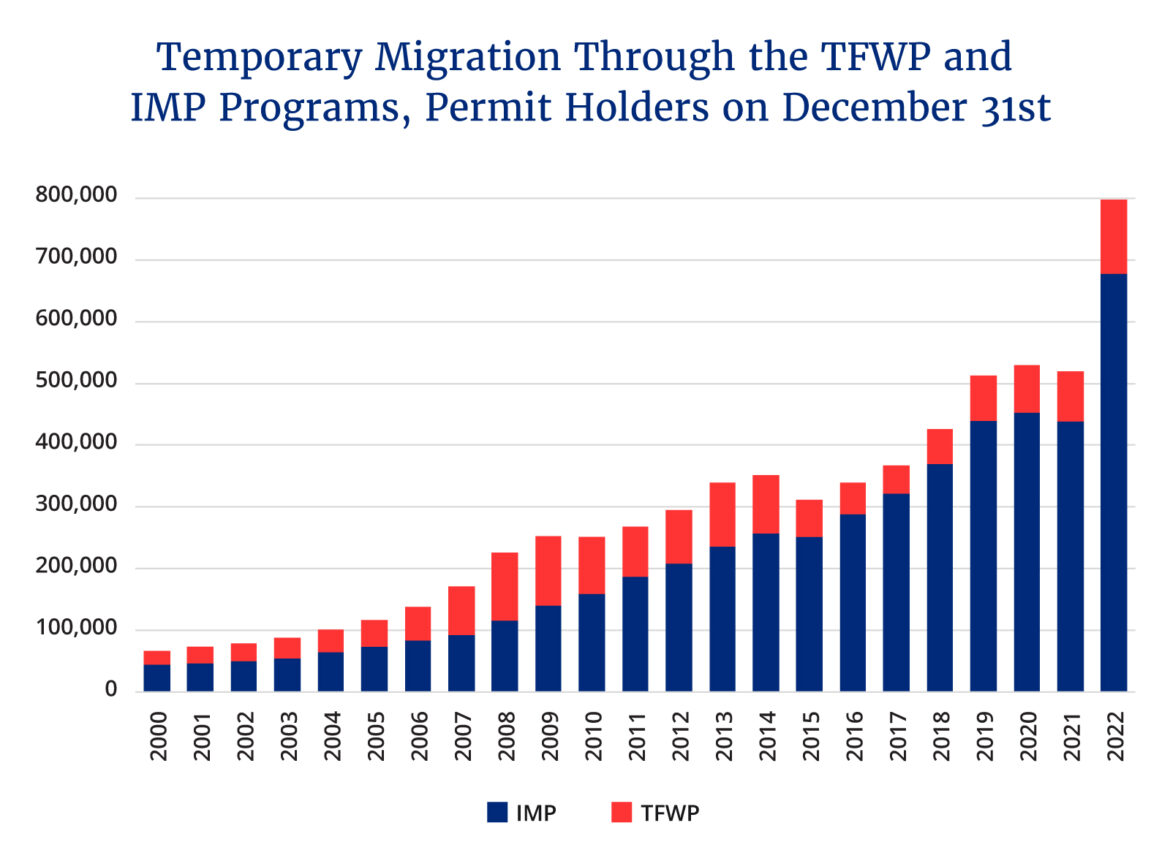
The figure below displays the number of work permit holders at the end of 2022 through Canada’s two temporary labour migration streams—the TFWP and the International Mobility Program (IMP). The TFWP covers migration programs that require a Labour Market Impact Assessment to receive a work permit such as the live-in caregiver program and various agricultural programs. The IMP does not require labour market assessments and includes individuals working on visas related to trade agreements such as the Canada-U.S.-Mexico Trade Agreement, individuals on post-graduate work permits, and so on. 

Mr. Trudeau was correct in 2014 to observe that there was a more than doubling of the program under the Conservatives before a slight reduction owing to policy changes later that year that included a partial moratorium on new permits and visas.

Graphic credit: Janice Nelson.

Under Trudeau’s tenure as prime minister, however, the number of temporary work permits has grown dramatically—far outstripping those during the Harper government. In 2015, there were a little more than 310,000 temporary work permits. By 2022, the number had more than doubled to almost 800,000. Partial data from 2023 indicate that there was a further increase last year. 

One way to understand this massive increase in the number of temporary foreign workers is to use Trudeau’s own standard of the share relative to permanent residents. He warned in 2014 that the ratio was approaching 1:1. In 2022, there were roughly 440,000 permanent residents admitted into Canada compared to the almost 800,000 working on temporary visas.

This significant growth not only conflicts with Trudeau’s chief recommendation in his op-ed that the TFWP needed to be constrained but also his broader concerns about the risks of an over reliance on temporary foreign workers. 

He concluded: 

“It cuts to the heart of who we are as a country. I believe it is wrong for Canada to follow the path of countries who exploit large numbers of guest workers, who have no realistic prospect of citizenship. It is bad for our economy in that it depresses wages for all Canadians, but it’s even worse for our country. It puts pressure on our commitment to diversity, and creates more opportunities for division and rancour.

We can and must do better.”

Source: Prime Minister Trudeau failed to follow his own advice on temporary foreign workers

Most Canadians support bringing in temporary foreign workers to fill jobs, says poll

Bit surprising that the housing impact, which factors into recent declines in support for current levels, has not impacted the support for temporary workers and students, which also has an impact:

Most Canadians support employers bringing in temporary foreign workers to fill jobs they can’t find Canadians to do, according to a poll for The Globe and Mail, despite growing numbers opposed to increased immigration.

The survey also found that more than eight in 10 Canadians feel that temporary foreign workers are important to the country’s economy.

And over two-thirds show support for temporary foreign workers who wish to remain in Canada becoming citizens, according to the Nanos Research poll.

The findings are released as a growing proportion of Canadians say they want the country to accept fewer immigrants in 2024 compared to 2023, with opposition to more immigration growing since September, according to other Nanos polling.

Nik Nanos, chairman of Nanos Research, said Canadians are increasingly against more immigration, but are more supportive of migrants coming to do specific jobs….

Source: Most Canadians support bringing in temporary foreign workers to fill jobs, says poll

Migrant farm workers pay into EI, but can’t access it. Now they’re suing the federal government

Yet another possible class action suit. Another to watch:

Migrant agricultural workers in Canada pay into employment insurance (EI), but they are not able to access it when their contracts expire and they return to their home country.

They also have employment contracts that are tied to one employer, preventing them from changing their employer while they’re in Canada.

A proposed $500-million class action lawsuit is aiming to challenge those regulations.

“It’s an issue that has been around for some time now,” said Jody Brown, a partner at Goldblatt Partners LLP, the law firm that filed the statement of claim. “The time is now for workers to come forward and try and make a change to this program.”

Kevin Palmer and Andrel Peters, seasonal migrant workers from the Caribbean who worked for companies in Leamington, Ont., are the lead plaintiffs in the suit, filed last month at the Ontario Superior Court of Justice in Toronto.

It was filed on behalf of workers in the Seasonal Agricultural Worker Program and the Temporary Foreign Workers Program-Agricultural Stream for the last 15 years.

“They’re seeking to bring a case not just on their own behalf, but on behalf of 10s of thousands of other workers who have been in a similar situation,” said Brown.

Class action lawsuits have to be certified by a judge in order to proceed. The allegations in the proposed lawsuit have not been proven in court.

A 2022 report from Statistics Canada stated that Canada is “increasingly reliant on TFWs to fill labour shortage gaps” and that the number of TFWs in Canada increased by 600 per cent from 2000 to 777,000 in 2021.

An advocate for migrant workers says the suit is important in the fight to get more rights for migrant workers.

“The feedback from workers has been quite positive,” said Chris Ramsaroop, an organizer with Justice for Migrant Workers. “The biggest concerns that they’ve got are around immigration and around employment insurance and that in their time of need, they can’t claim or access this benefit.”

In an emailed statement to CBC News, a spokesperson for Employment and Social Development Canada says the government does not comment on ongoing cases or “an individual’s personal circumstances,” but said that it takes “its responsibilities with respect to the protection of temporary foreign workers very seriously and the safety and protection of workers is paramount…

Source: Migrant farm workers pay into EI, but can’t access it. Now they’re suing the federal government

Mahboubi and Skuterud: Canada must stem the surge in temporary foreign workers and international students

More needed analysis and commentary:

Recent years have seen an unprecedented increase in Canada’s non-permanent resident population, far surpassing increases in annual admissions of new permanent residents. The unbalanced growth in Canada’s temporary and permanent migration inflows will inevitably result in a growing undocumented population and forced deportations. Both developments risk inflaming Canada’s immigration politics and undermining public confidence in the immigration system.

It is imperative that the government take immediate steps to stem the continuing growth in foreign student and temporary foreign worker entries.

Several factors have contributed to the non-permanent resident (NPR) population surge, including ad-hoc programs aimed at expanding eligibility for permanent resident (PR) status, increasing postsecondary reliance on international student tuition revenue and eased employer access to temporary foreign workers, most notably those in low-wage occupations.

Statistics Canada estimates that by the third quarter of 2023 Canada’s NPR population had reached 2.2 million, while entries of new permanent residents remained below 500,000 and which the government has announced will stabilize in 2025. The tightening bottleneck in temporary-to-permanent residency flows is, in fact, worse, because most PR slots continue to be filled by applicants residing abroad, not from Canada’s NPR population.

A key factor driving the growth in NPR inflows is the government’s repeated announcements of ad-hoc programs aimed at easing the pathway to PR status for lower-skilled migrants who would otherwise struggle to clear the hurdle of the Express Entry skills-based points system. Allocation of PR slots has increasingly become a lottery incentivizing large numbers of migrants to try their luck at obtaining Canadian PR status.

But given the limited number of PR admissions, large numbers of justifiably hopeful NPRs will be unable to realize their dreams. As their study and work permits expire, many will be unable or unwilling to return to their home countries. These migrants will become increasingly vulnerable to workplace exploitation, distorting wage outcomes in lower-skilled labour markets, and poverty, which government supports are unable to address because of their ineligibility.

Canada urgently requires a multipronged strategy to stem the continuing growth of the NPR population and restore the stability and integrity of the immigration system. In our view, policies should be aimed at augmenting migrants’ own incentives to seek NPR status in Canada.

On the international student front, we recommend reintroducing the cap on foreign students’ off-campus work hours at 20 a week; it was waived in October, 2022, and recently extended to April 30, 2024. The punting of this issue down the road is unhelpful in restoring predictability for prospective foreign students. Study permits have become de facto work permits incentivizing migrants whose primary objective is accessing Canadian jobs, not human capital investments.

We also recommend restricting study permits to institutions of a certain standard. Too many private colleges are essentially used as stepping stones to residency. Designated learning institutionswhose students are currently ineligible for postgraduation work permits should also be ineligible for study permits. The government should also seek to undesignate institutions based on the measured immigration and labour market outcomes of their graduates. Moreover, these metrics should be regularly published by Immigration, Refugees and Citizenship Canada (IRCC) to help prospective migrants make informed decisions and to combat false dreams pushed by education recruiters.

On the temporary foreign worker front, the government must reconsider extended measures allowing, for example, 30 per cent of the work forces of employers in specific industries to be composed of low-wage temporary foreign workers. Stemming the growth in the low-wage stream of the Temporary Foreign Worker Program and restoring the pre-2020 hiring regulations would recognize recent evidence of the adverse effects of this program on wages and local unemployment rates.

Most important, the government needs to bring back predictability in its system for allocating PR admissions in the economic-class applicant pool. Though well-intentioned, ad-hoc programs aimed at easing the pathway to PR status are contributing to growth in TR inflow. IRCC needs to return to relying on the Comprehensive Ranking System (CRS) for allocating PR admissions, as it did before 2020. Given the transparency of the CRS “points system” and a stable CRS cutoff over time, unsuccessful applicants can see what human capital investments they need to be successful, thereby advancing the objectives of our skilled immigration program.

If these policy levers are collectively applied, they can stem growth in Canada’s NPR population, restore fairness and transparency in the PR system and secure the immigration system’s integrity and sustainability. In doing so, we can ensure that Canada continues to be a welcoming and prosperous country for all.

Parisa Mahboubi is a senior policy analyst at the C.D. Howe Institute. Mikal Skuterud is a professor of economics at the University of Waterloo, director of the Canadian Labour Economics Forum and a fellow-in-residence of the C.D. Howe Institute.

Source: Canada must stem the surge in temporary foreign workers and international students

Yalnizyan: Canada’s Temporary Foreign Worker program is ballooning — creating a new class of wage slaves from abroad

Good commentary with reasonable recommendations:

This time last year, the media buzz about the labour market was over The Great Resignation, a bigger phenomenon in the United States but occurring here too, as workers took advantage of record-high job vacancy rates to abandon suboptimal jobs for better ones.

This year there’s an emerging made-in-Canada phenomenon that has barely generated a whisper, let alone a buzz: wage slaves from abroad. It’s a result of public policy.

The idea of owning workers seems like an abomination from another time and place. In Canada, in 2023, it’s difficult to comprehend how any worker could be beholden to a single employer.

Nonetheless, this year the government of Canada has issued more than 142,000 permits to employers to hire temporary foreign workers who are not allowed to work for anyone else. It’s the highest number ever issued, and that figure only covers up to August. Intake through the Temporary Foreign Worker Program has grown by 45 per cent across Canada this year compared with the same eight months in 2022, a record-breaking year of population growth, almost exclusively (96 per cent) due to newcomers.

Permits are issued to employers who make the case that they cannot find a Canadian to do the job — at “prevailing wage rates,” that is. When the federal government finds the reasons provided on the Labour Market Impact Assessment form acceptable, it permits a foreign worker to enter Canada to work only temporarily, and only for that employer.

Just since August 2021, the federal government has expanded the categories of occupations eligible for such a permit and increased the allowable proportion of migrant workers working for an individual employer to 30 per cent from 10 per cent. That gives such employers huge influence over not just their migrant workers but all their workers. It is far from clear this was necessary policy reform. It should be reversed.

Ontario’s employers are escalating their dependence on the permanently temporary in sectors such as warehousing and transport trucking, personal care workers in long-term-care facilities, restaurants and fast food outlets, and farm workers.

The vast majority of employers are moral. But tying permits to a single employer increases the odds of exploitation and abuse.

Although the federal government conducts investigations of employers using the Temporary Foreign Worker Program, employers are often given a heads-up before the inspection takes place. Last year, more than 2,100 inspections were carried out. Only 116 were found non-compliant.

Of the 766 employers on a public registry of employers who broke the rules over the past seven years, the most frequent violation was wage theft — not providing the pay promised in the contract. Only seven employers were banned even temporarily from hiring migrant workers through this program; 23 were just given warnings.

Wage theft is not the only issue. Farm workers had an extraordinarily high incidence of disease and death during COVID because of their living conditions. Abuse and assault of workers providing care to people in their homes and institutions remains all too common. These are the very categories of migrant workers least likely to find a pathway to permanence.

Migrant workers may have the same rights as Canadian workers on paper but are less likely to know what those rights are and even less likely to exercise them for fear of jeopardizing their jobs and futures. That kind of contagion needs to be contained. It spreads rapidly in an uncertain world.

The Standing Senate Committee on Social Affairs, Science and Technology is studying this area of public policy. Last week, Tomoya Obokata, the UN Special Rapporteur on contemporary forms of slavery, presented testimony to the committee about his recent visit to Canada, expressing concern for “low-wage and agricultural streams of the Temporary Foreign Worker Program as the workers at the higher risk of labour exploitation, which may amount to forced labour or servitude.”

I appeared before the committee as well and presented some ideas for policy reform.

First: end the practice of tying work permits to an employer. An open work permit, tied to a region (for example, in parts of the country that are aging more rapidly) or in an industry or sector with high vacancies (such as hospitality or long-term care) would mean workers could leave terrible workplaces without risking deportation. This change could reduce the number of bad jobs and improve the quality of life in communities. Addressing potentially crippling labour shortages, while limiting the abuse of workers, seems a promising avenue of reform.

Second: create simpler pathways to permanent residency for all those who seek it and make those pathways clear before people arrive. Canada has developed an incredibly complex system, with more than 140 types of temporary permits in the immigration database, according to Rupa Banerjee of Toronto Metropolitan University.

In 2022, three times as many people were permitted temporary resident status versus permanent resident status in Canada. Less than a third of those who came here to work or study for a restricted period transitioned to permanent status, even after 10 years of temporary residency; but many more will grab at the chance, without knowing the odds.

There is a whole industry designed to lure international students and migrant workers here on what often turns out to be the false hope of permanent residency; and the relationship between temporary and permanent admissions to Canada is getting more lopsided every year.

Although Canada’s job creation rate has been remarkable, including for Canadian-born and landed immigrant workers, the fastest-growing rate of job creation has been among migrant workers: 61 per cent more jobs than pre-pandemic levels.

We are expediting the intake of migrant workers for entrenched needs, not temporary ones.

Increasing reliance on temporary foreign workers to do the work that needs doing, while not allowing them to form families, get sick, age or retire may be an employer’s dream and a labour market “solution.” But it risks creating a dystopian future for Canadian society.

Armine Yalnizyan is a leading voice in Canada’s economic scene and Atkinson Fellow on the Future of Workers. She is a freelance contributing columnist for the Star’s Business section. Follow her on Twitter: @ArmineYalnizyan. You can write to her at ayalnizyan@atkinsonfoundation.ca.

Source: Canada’s Temporary Foreign Worker program is ballooning — creating a new class of wage slaves from abroad

MPs call for House study after UN report slams Canada’s efforts to combat contemporary slavery, forced labour

Of note:

A recent report from the United Nations’ special rapporteur on contemporary forms of slavery has raised alarm over Canada’s handling of the issue at home, including particular criticism for the Temporary Foreign Workers Program. With Parliament now back from its summer recess, NDP, Liberal, and Conservative MPs say they want to see a House committee undertake a study in response. 

Following a two-week visit, UN Special Rapporteur Tomoya Obokata released a 12-page statement of preliminary findings on Sept. 6, within which he highlighted Canada’s Temporary Foreign Workers Program (TFWP) as a top source of concern, saying the program’s low-wage and agricultural streams in particular “constitute a breeding ground for contemporary forms of slavery,” and that he is “perturbed by reports” that the number of workers entering Canada through this program is “sharply on the rise.”

“The Special Rapporteur is disturbed by the fact that certain categories of migrant workers are made vulnerable to contemporary forms of slavery in Canada, by the policies that regulate their immigration status, employment, and housing in Canada, and he is particularly concerned that this workforce is disproportionately racialized, attesting to deep-rooted racism and xenophobia entrenched in Canada’s immigration system,” reads the statement.

Obokata was in Canada between Aug. 23 and Sept. 6 to assess Canada’s efforts to prevent and address contemporary forms of slavery, including forced and child labour. He’s set to present a full report, which will expand on his initial findings and cover additional issues, to the UN Human Rights Council in September 2024. 

NDP MP Heather McPherson (Edmonton Strathcona, Alta.) said the rapporteur’s initial findings need to be raised in the House of Commons.

McPherson is a member of the House Foreign Affairs Committee’s Subcommittee on International Human Rights, which studied the human rights situation of the Uyghurs, and the role of the Canadian Ombudsperson for Responsible Enterprise in 2021. In light of the rapporteur’s findings, she said she’d like the “subcommittee to be looking at this again.” 

“We’ll be bringing that forward at that point [when the House returns], that they examine this and that we do get testimony on this report,” and look at the issue “from a larger frame,” beyond the ombudsperson, to also include examination of due diligence and human rights legislation, McPherson told The Hill Times on Sept. 15. 

She pointed to the Special Committee on Canada-China Relations and the House Foreign Affairs Committee itself—she is a member of both groups—as other potential arenas to pursue a study, noting, for example, the issue of Uyghur forced labour in Canada’s supply chains. 

“We have an awful lot to study within those committees, and so it’ll be a situation of trying to find the right place for it to land, and whether there’s bandwidth to do that,” said McPherson, adding she thinks the House International Trade Committee should also pick up the issue.

Conservative MP Arnold Viersen (Peace River–Westlock, Alta.), a member of the Subcommittee on International Human Rights and of the All-Party Parliamentary Group to End Modern Slavery and Human Trafficking, said he’s in favour of “studying the issue of human trafficking and how Canada can better fight it at any and every turn, so I would welcome a study in that respect.” 

Liberal MP John McKay (Scarborough–Guildwood, Ont.), another member of the all-party group, agreed the rapporteur’s findings bear “an examination by a House of Commons committee.” 

“We are bringing in a lot of people under particular policies, and it’s always worthwhile to examine the efficacy of those policies. Canada has a labour shortage … but we simply cannot be a nation that exploits other human beings in labour conditions that are such as the rapporteur has described. He used very strong language,” said McKay.

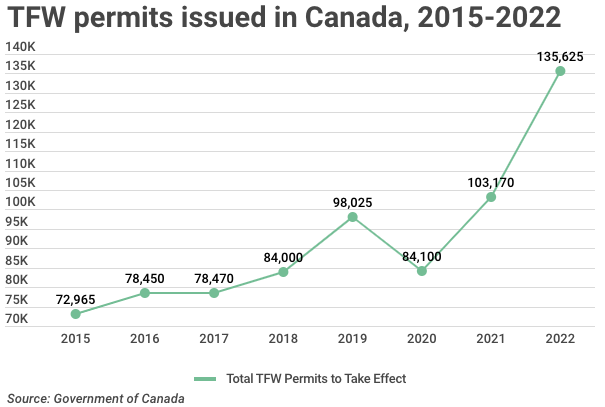
As noted by Obokata, use of the TFWP is on the rise in Canada. Between 2021 and 2022, the number of TFW permit holders increased by 31.5 per cent to reach 135,625 individuals. It’s on track to surpass that total in 2023, with 130,155 such permits already having come into effect in the first three quarters of the year, according to federal data

“It is a fact that temporary foreign workers make vital contributions to Canada’s national economy and possess valuable skills for which there is consistent demand, and yet paths for long-term or permanent residency is extremely limited or non-existent for most workers working in agriculture and other low-skills sectors,” reads the rapporteur’s report.

Obokata said while in Canada, he “received first-hand information from a large number of stakeholders, notably migrant workers themselves, pointing to the appalling working and living conditions in reality,” including excessive work hours, “extra-contractual tasks, physically dangerous tasks, low wages, no overtime pay,” access being denied to health care, limited access to social services, overcrowded and unsanitary employer-provided housing, “as well as sexual harassment, intimidation, and violence at the hands of their employers and their family.”

Such issues could be prevented through “effective labour and health and safety inspections,” but Obokata said from what he heard, those being done by federal, provincial, and territorial inspectors “are grossly ineffective,” don’t happen regularly, can be done remotely, and allow for advance notice to employers when done in person, enabling them to “make necessary preparations on the day of inspection.” Moreover, he said “most migrant workers are unaware” of the existence of existing federal, provincial, and territorial complaint mechanisms, or are afraid to report labour law violations “due to the fear of unemployment or deportation.”

While acknowledging “important developments” in the effort to protect the human rights of workers, and eradicate forced and child labour in the country’s supply chains—like the 2022 release of the Responsible Business Conduct Strategy and the 2021 update to the Code of Conduct for Procurement—Obokata said he still has “some concerns over Canada’s current approach to human rights due diligence for Canadian companies.”

He noted, for example, that Bill S-211’s reliance on self-reporting, lack of monitoring mechanism, and lack of requirements to implement “human rights due diligence” or measures to “prevent, address, and remedy abuses once identified,” risks it “becoming a box ticking exercise where companies simply submit the same statement every year, as has been reported in other jurisdictions.” The Fighting Against Forced Labour and Child Labour in Supply Chains Act, which comes into force in January 2024, requires companies that check two of three boxes—having at least $20-million in assets, $40-million in revenue, or 250 employees—to report on measures taken to “prevent and reduce the risk” of forced or child labour in their operations and supply chains.

Obokata said in raising concerns with the federal government, he was told draft legislation on due diligence to complement Bill S-211 is “currently” being considered. He urged the government to do so “expeditiously,” and for clear guidance on reporting requirements under S-211, and monitoring and oversight mechanisms to be established in the interim. 

McKay, Viersen, and Independent Senator Julie Miville-Dechêne (Inkerman, Que.) were among those who met with Obokata virtually on Aug. 15 just before his visit in their capacity as members of the all-party parliamentary group, with talk focused on S-211, which was sponsored by McKay and Miville-Dechêne in the House and Senate, respectively. 

McKay and Miville-Dechêne told The Hill Times they disagree with Obokata’s assessment of S-211 as a mere “box-ticking exercise,” with McKay saying he takes “strong exception to anyone who says this legislation will not be effective.” 

There’s an “immense amount of work that entities are going to have to do in order to be able to comply with the legislation,” argued McKay, with potential “enormous” consequences, including the fact that “the regulatory filing signed by a senior officer and approved by the board of the entity” will be “looked at by other regulators,” and “by those who do financing,” consumers, and NGOs. McKay said in discussions with lawyers and others “who work in this area” in Toronto last week alongside Miville-Dechêne, the pair heard serious concerns “about the work that’s going to be required in order to make sure that they comply.” 

“Our model is a stronger model than the U.K. model,” said Miville-Dechêne of S-211, noting the bill includes fines for non-compliance, and transmitting information that’s knowingly false. “I would say it’s a step, but a very important step and the first step, too, for a country that has … talked, politically, a lot about our respect for human rights, and by implementing this law, it is a step in the right direction.” 

McKay, Miville-Dechêne, and Viersen all said they expect clear guidance on reporting requirements under S-211 to come through its enacting regulations, which are still being awaited from the minister responsible, Public Safety Minister Dominic LeBlanc (Beauséjour, N.B.). Asked when those regulations would be tabled, LeBlanc’s office did not respond by filing deadline. 

McKay and Miville-Dechêne urged the government to table its draft regulations as soon as possible, with the Senator noting there are only three-and-a-half months left before S-211 comes into force, “which is not, in political terms, that long to give clear guidance to companies.”

Viersen called the wait on regulations “quite frustrating.” 

As for a parliamentary study, Miville-Dechêne said while the rapporteur’s preliminary findings must be listened to—and that she, too, is “very worried” about the potential for exploitation through Canada’s TFW program—she noted “he’s going to have more to say” when the full report is released next year. She highlighted that the Senate Social Affairs Committee is already in the midst of a study on Canada’s temporary and migrant labour force. 

“I find on this particular issue [the TFWP], Mr. Obokata is right on,” she said. 

Among other things, the rapporteur’s report also raised concern over the effectiveness of the federal Ombudsperson for Responsible Enterprisesestablished in 2019, which Obokata noted didn’t release its first initial assessment reports on complaints until this year—nearly four years after its creation. He highlighted that its mandate covers “only a limited number of sectors,” and excludes a number “where labour exploitation is rife, like agriculture, fishery, manufacturing, and construction,” which the rapporteur said should be “core” to the office’s mandate. He called for the ombudsperson to be given statutory powers to compel witnesses and documents, “with clear consequences” for companies that don’t comply, and for its independence to be ensured.  

McPherson said the rapporteur’s report has “echoed all of the concerns that the NDP has raised for some time,” including its criticisms of Bill S-211, which her party voted against in the House, and the effectiveness of the ombudsperson.

“We’ve got a government right now who is saying that they care about human rights, they’re talking about the need to ensure that Canadian companies working abroad are acting effectively, but every chance they have to bring forward good, strong legislation, they fail,” she said.

On the TFWP, McPherson said the NDP, “from the very get-go,” has said “the program needs to be revamped” and “that any individual who comes to Canada to be a worker needs to have a path to become a Canadian citizen.” 

“This program has been flawed” from the very beginning, she said, starting under the previous Conservative government, and continuing under the Liberals, despite its pledge to fix it.

The Hill Times reached out to Trade Minister Mary Ng (Markham–Thornhill, Ont.) and Immigration Minister Marc Miller (Ville-Marie–Le Sud-Ouest–Île-des-Soeurs, Que.) for comment and reaction to the rapporteur’s report. 

An emailed response from Global Affairs Canada confirmed Ng’s office has “reviewed the rapporteur’s statement.”

“We are taking into consideration the findings in the statement and how we can reflect on them moving forward as we work to eradicate forced labour from Canadian supply chains and ensure that Canadian businesses operating abroad do not contribute to human rights abuses,” reads GAC’s response. 

In its emailed response, Miller’s office highlighted “several permanent immigration pathways available for workers,” including through an Agri-Food pilot launched in May 2020 and recently extended until May 2025; the Provincial Nominee Program; the Atlantic Immigration Program; and express entry eligibility for agricultural supervisors and managers, among other things. 

“In Canada, the rights of all workers—including temporary foreign workers—are protected by law. Temporary foreign workers have the same rights and workplace protections as Canadians and permanent residents,” reads the response from Miller’s office, noting that new regulations aimed at increasing protections for foreign workers were implemented federally in September 2022.

“We will continue engaging all levels of government, provinces, and territories—to ensure all workers are safe and protected wherever they are in the country.”
Source: MPs call for House study after UN report slams Canada’s efforts to combat contemporary slavery, forced labour

Ottawa faces class action alleging rules around migrant workers are discriminatory

We shall see (all immigration policy is inherently discriminatory, the question revolves around whether it is for legitimate reasons or not).

It seems like a bit of a stretch to argue that:

“There were now increasing numbers of persons of colour. These schemes were justified on the basis that the immigrants of certain races, colours, or ethnic or national origins were considered unable to assimilate to Canada’s climate and society and to be better-suited for ‘unfree’ and low-skilled work.”

Whe Canada was also abolishing race-based restrictions on permanent residents.

As a child, he would get postcards from his aunt in Canada and dream to see the country and live here one day.

In 2014, as a 22-year-old, he reached out to a compatriot from Guatemala and scraped together $3,000 to pay for a job offer in poultry catching from the man’s employer in Quebec.

He would end up spending most of his next nine years in Canada as a migrant worker — on six separate closed work permits, which only allowed him to work for his sponsoring employers despite what he described as abusive and exploitative conditions and treatment.

Identified in court documents only as A.B., the young man is leading a class-action lawsuit initiated against the Canadian government for violating migrant domestic workers’ and farm workers’ Charter Rights under the closed work permit regime.

“What we’re trying to do is challenge all the provisions of the immigration regulations that allow the federal government to bind these workers and to restrict their rights to change employers,” said Eugénie Depatie-Pelletier, executive director of the Association for the Rights of Household and Farm Workers, which filed the court case on behalf of closed work permit holders.

“It’s time to put an end to nonfree work, a system that treats the worker as the quasi-property of her employer.”

The plaintiffs are asking the court to declare the provisions of the immigration law that allow such practice unconstitutional, and to award damages to migrant workers who have been subjected to “employer-tying measures” on or after April 17, 1982, when the Canadian Charter of Rights and Freedoms took effect.

None of the claims have been proven in court.

As opposed to an “open” work permit, foreign workers on a “closed” or “employer-specific” work permit can only work here according to the specific conditions on the work permit, such as working for the named employer. Migrant workers in low-wage, low-skill jobs are generally issued a closed work permit.

The lawsuit alleged that “employer-tying measures” were rooted in direct discrimination based on race, national or ethnic origin and colour.

“The development of these schemes coincided with a shift in the demographics of the immigrants entering Canada to work in these occupations. They had previously included predominantly ‘white’ immigrants,” said the 55-page court application filed on Thursday.

“There were now increasing numbers of persons of colour. These schemes were justified on the basis that the immigrants of certain races, colours, or ethnic or national origins were considered unable to assimilate to Canada’s climate and society and to be better-suited for ‘unfree’ and low-skilled work.”

When migrants on closed work permits are terminated, they lose legal status in Canada and must secure another employer with authorization by Employment and Social Development Canada to hire foreign workers.

That process can be “lengthy, difficult, costly, and most importantly highly unpredictable” as the person may risk being denied a new work permit, the lawsuit claims. It can result in the worker being prohibited from working and making a living for an indeterminate period of time.

The plaintiffs said the harmful impacts of those measures are widely known and well-documented, including:

Restricting workers’ capacity to resign and make choices concerning their work and livelihood in Canada;

Limiting their freedom of movement;

Impeding their ability to assert their rights and access help.

“The employer-tied workers’ inability to change employers creates a striking power imbalance in favour of the employer, making migrant workers uniquely vulnerable,” the lawsuit argues.

“These harmful impacts are compounded when temporary foreign workers work in remote locations, reside in employer-provided accommodation or live in their employer’s own home.”

In the lead case, the Guatemalan man obtained his first “closed” work permit valid from 2014 to 2016. The lawsuit claims he had to work between 7 p.m. and 7 a.m., Monday to Friday, with only three 10-minute breaks per night, and was required to catch up to 40,000 chickens per shift, at a rate of five in each hand for every catch.

A.B. would get $3.75 per thousand chickens and $12 for the same number of turkeys. His Canadian co-workers, however, would be paid double these rates, the lawsuit alleges.

A.B. would go to bed with rips and tears on the skin of his hands and with sore muscles. When he woke up, he was often unable to extend his hands, which would remain contracted and curled in a “catching” position.

“As a result of his ‘closed’ work permit, A.B. had no choice but to endure this treatment,” he said in his claim. “He feared that complaining could lead to being fired, threatening his status in Canada, his ability to obtain a renewal of his permit.”

After a work injury in 2015, A.B. required leave from work. His contract was not renewed and he returned to Guatemala, where he underwent an MRI and found out he suffered a herniated disc.

He found another job at a family dairy farm in Quebec in 2017 and worked there until 2019, on three yearly closed work permits.

There, he claimed he was paid late, sometimes by weeks, and subjected to the employer’s “aggressive behaviour, homophobic and racial slurs, rants against the incompetence of migrant workers, and humiliating and degrading comments.” An accident in 2019 aggravated his previous work injury, and he was dismissed.

From 2020 to 2022, A.B. worked for another dairy farm — on two more “closed” permits, where he claimed he suffered similar abuse.

“The Government of Canada has not ceased to resort to employer-tying measures. It has instead continued to subject a growing number of temporary foreign workers to those measures — and it still continues to do so today,” the lawsuit said.

“The Government of Canada’s failure to put an end to those measures evidences its continued clear disregard for the employer-tied migrant workers’ Charter rights and human dignity.”

Source: Ottawa faces class action alleging rules around migrant workers are discriminatory

Star Editorial: Ottawa is changing its temporary foreign worker program. It’s not clear this will help workers

Related editorial on the Recognized Employer Pilot along with advocating for open work permits to reduce abuse:

In early 2020, many Canadians noticed the once lush produce sections of their grocery stores were increasingly barren.

What many Canadians didn’t notice is the reason for the absence of fresh fruits and vegetables: COVID-19 outbreaks among migrant farm workers across Canada, including in southern Ontario.

The outbreaks, and their effect on food supply, reveal the value and vulnerability of the migrant workers, many of whom are hired through Canada’s Temporary Foreign Worker Program.

The program, which is set to be altered this September, permits employers to hire foreign workers when no qualified Canadians are available. The initiative has proven wildly popular, and successful applications have increased exponentially in recent years. But so too have accusations of abuse, of workers enduring unsafe workplace and living conditions.

Temporary labourers frequently work long hours for low pay and limited benefits, and they often live in employer-supplied, cramped quarters replete with shared sleeping and washroom facilities — the very conditions that increase the risk of infectious disease outbreaks and other health threats.

Consequently, for the welfare of the workers Ottawa needs to ensure that changing the program doesn’t increase the abuse that has long plagued the regime.

For its part, the federal government insists the alteration, known as the Recognized Employer Pilot, will do the opposite. According to Employment Minister Randy Boissonnault, the pilot will reduce the administrative burden on employers who “demonstrate the highest level of protection for workers,” and allow them to receive permits lasting three years, rather than the current 18 months. The change will come first to employers in agriculture, then to all others starting in January.

Rewarding responsible employers could help to protect both workers and ease the paperwork, and Ottawa has also promised to conduct more rigorous assessments before permits are issued. But three years is a long time, long enough for workplace and living conditions to deteriorate dramatically.

Government inspectors do monitor employers’ compliance with regulations, but that oversight has itself been substandard. In response to the COVID outbreaks among farm workers, federal Auditor General Karen Hogan issued a scathing report accusing inspectors of failing to ensure employers followed regulations.

If the pilot program is to be successful, then, it must be accompanied by improved, vigilant monitoring of employers’ compliance with safety standards throughout the three-year period.

That won’t, however, eliminate the problem that makes abuse possible: The power imbalance between employers and workers. That is the product of two factors — employer-specific work permits, and the tenuous immigration status of workers.

Employer-specific permits require workers to remain with the employer who hired them, which means some must make the impossible choice of suffering abuse or unemployment.

Aware of this, Ottawa introduced the Vulnerable Worker Open Work Permit program, which can grant abused workers a permit that allows them to move to a different employer. But the worker must first complain, something many are loath to do for fear of deportation or reprisals for employers.

In any case, by limiting open permits to those who have faced abuse, the program essentially treats abuse as a kind of hazing, an initiation rite workers must endure if they’re to gain entry to the exclusive club of open permit holders.

In contrast, if Ottawa granted open permits to all temporary workers, it would help to empower them as they could choose their employers — and abusive employers would have trouble retaining talent unless they cleaned up their act.

As for immigration status, the Star reported that workers pay income tax and employment insurance and contribute to the Canada Pension Plan, yet most remain “guests” in the country.

Most workers therefore live under constant fear of deportation, some for decades, which eliminates what little leverage they have with employers. Opening up new pathways for permanent residence would, on the other hand, help to equalize the relationship between employers and workers.

And when workers’ welfare and Canada’s food system are on the line, an equal relationship is, quite literally, a matter of life and death.

Source: Ottawa is changing its temporary foreign worker program. It’s not clear this will help workers

ICYMI: Canada plans new temporary foreign workers program to give ‘trusted’ employers quicker access

Of note, including the cautions by Rupa Banerjee and Syed Hussan:

The federal government is rolling out a “trusted employer program” that is meant to reduce red tape and make it easier for Canadian employers to bring in temporary foreign workers.

Officials say the Recognized Employer Pilot program will be open for applications as soon as September, first to employers in agriculture, then to all others starting in January.

It will provide employers that have “a history of complying with program requirements” with a permit to usher in foreign workers that’s good for three years, without the need to reapply within that period.

But experts and advocates are expressing some concerns over the level of scrutiny that will be in place to ensure workers are being treated well, as well as the economic conditions into which Canada will be bringing more temporary workers: a crisis of affordable housing, rising interest rates and high inflation.

The new measures come amid skyrocketing numbers of temporary foreign workers in Canada.

“There’s an overreliance on temporary workers at the detriment of Canadian workers, and in particular, newcomers,” said Toronto Metropolitan University professor Rupa Banerjee, Canada Research Chair of economic inclusion, employment and entrepreneurship.

“It also really shows how much the temporary foreign worker program is really about responding to employer demand. The employer lobby really is that strong.”

Currently, employers must undergo what’s known as labour market impact assessment (LMIA), every time they hire workers under the Temporary Foreign Worker Program to ensure there’s a need to fill the job. They must receive a positive assessment from Employment and Social Development Canada in order to hire the foreign workers.

The number of temporary foreign worker positions approved through an LMIA annually have skyrocketed from 89,416 in 2015 to 221,933 last year, according to federal data.

Those numbers don’t include the hundreds of thousands of international students and graduates who have open-work permits, and those who arrive from more than two dozen countries that have shared mobility agreements with Canada.

“The Recognized Employer Pilot will cut red tape for eligible employers, who demonstrate the highest level of protection for workers, and make it easier for them to access the labour they need to fill jobs that are essential to Canada’s economy and food security,” Employment Minister Randy Boissonnault said in a statement Tuesday.

Applications to the pilot program, which has a budget of $29.3 million over three years, will close next September.

To qualify, employers must have received a minimum of three positive LMIAs for the same occupation over the past five years from a list of occupations that have been designated as in-shortage.

Officials said employers will be subject to a more rigorous upfront assessment process than they currently undergo, based on their history and track record with the program, ensuring that it “targets employers with the best recruitment practices.”

Canada, like other countries, has been increasingly relying on foreign workers to address labour and skills shortages despite criticisms that the workers’ precarious immigration status has exposed them to abuse and exploitation by employers.

Foreign workers, especially those in low-skill, low-wage jobs, have reported owed wages and unpaid overtime, and complained about unsafe work conditions and a lack of employment standard enforcement.

“Things like that easily get swept under the radar. And an employer could easily remain on the trusted employer list while still engaging in, sort of, very mundane and regular forms of exploitation to workers,” Banerjee said.

“Without a lot of really careful oversight and auditing, it’s very easy to allow the kinds of abuses and exploitations that exist very routinely to go under the radar and get worse because it’ll be just easier to get more and more people in.”

Further facilitating the entry of migrant workers will create a more “flexible” labour force for employers but may further strain the tight housing market, access to health care and even the school system.

“Not only is it a concern of the workers themselves, but the level of scrutiny that needs to be put into place to ensure that this is a win-win, not just a win or lose,” said Banerjee.

“There’s a bigger story of, kind of, what does this mean for Canadian society and the ability to actually absorb these extra temporary foreign workers.”

Federal Agriculture and Agri-Food Minister Lawrence MacAulay said the new pilot will help secure Canada’s food supply chain.

“From Canada’s farm fields to our grocery stores, workers throughout the food supply chain provide an essential service,” he said. “It is vital that Canadian employers, including farmers and food processors, are able to hire workers who are critical to food production and food security in Canada.”

Syed Hussan, executive director of Migrant Workers Alliance for Change, said what will matter is how employers are scrutinized.

“It’s not possible to identify good employers based on complaints or inspections. Workers don’t complain because, when workers complain, they face deportation, eviction, homelessness, lack of work and other reprisals from employers,” said Hussan.

“Employers want quicker access to temporary foreign workers because temporary foreign workers have the least rights.”

Boissonnault said the government over the past few years has strengthened protection of migrant workers by preventing employers from charging recruitment fees, providing workers with information about their rights and launching a tip line for complaints.

“These are steps in the right direction in demonstrating that we take our responsibility seriously,” Boissonnault told reporters.

Source: Canada plans new temporary foreign workers program to give ‘trusted’ employers quicker access

Keller: The Liberals have broken Canada’s immigration system

The Globe continues its transition from an immigration booster, hosting Century Initiative events, to one of the more trenchant critics of current policies, with weekly if not more frequent negative and well argued commentary:

Canada’s immigration system used to be the envy of the world.

Note my use of the past tense.

To appreciate what was good about Canada’s previous immigration strategy – the one followed until recently through governments Progressive Conservative, Conservative and Liberal – contrast it with the dysfunction of our friends down south.

Since the 1980s, the United States has had relatively low legal immigration compared with Canada. The U.S. also wasn’t particularly focused on admitting the highly educated and highly skilled. And there was an unofficial immigration stream – called illegal immigration or undocumented immigration, depending on one’s politics – that involved millions of people, most in low-skill, low-wage jobs.

In 2015, when the Trudeau Liberals came into office, Canada was already a high-immigration country, with a rate two-and-a-half times higher than the U.S. More importantly, Canada was a smart immigration country, with immigration selection built around the points system, which sent educated, skilled, young immigrants to the front of the line.

Both countries’ immigration had long been a mix of family reunification, refugees and economic immigrants, but Canada put the accent on the latter. Within the economic stream, our points system put the emphasis on people who were more educated or skilled than the average Canadian, and whose contribution could boost not just gross domestic product, but GDP per capita.

A skilled immigrant doesn’t just grow the size of the economic pie. They’re likely to grow it at a rate greater than the rising number of forks in the pie.

As for the U.S., it stood out for having a large pool of permanently temporary immigrants, most filling low-wage jobs. In 2015, the U.S. Department of Homeland Security estimated that there were 12 million people classified as illegal aliens in the country.

Canada’s own count was unclear, but clearly far lower.

And that was at least partly because of another bipartisan Canadian policy choice. This country had long devoted considerable efforts to making it hard to enter or remain in Canada without permission. People from countries whose citizens had a record of overstaying tourist visas found it extremely difficult to get a tourist visa.

A 2017 World Economic Forum survey ranked Canada as having among the world’s most stringent travel visa rules, placing us at 120th out of 136 countries. But that this was a feature of the Canadian system, not a bug.

We had a wider door than the U.S., yet taller walls. The welcome mat and the walls were complimentary, not contradictory. Canada was a high immigration country with unusually high public support for immigration. Why? Because the manner, scale, makeup and regularity of immigration clearly benefitted Canada, and Canadians.

Our immigration approach was successful, stable and boring.

In 2013, the U.S. Senate passed the Border Security, Economic Opportunity and Immigration Modernization Act. The bill died in the House of Representatives because the Republican leadership refused to take it up – they wanted to campaign against illegal immigration, not fix it – but in the Senate it was supported by the entire Democratic caucus, plus a third of Republicans.

The legislation proposed a points system to focus admissions on skilled immigrants; more opportunities for visa students who earned advanced degrees in science, technology and engineering to remain in the U.S.; and strong measures to discourage illegal immigration.

Had it become law, it would have given the U.S. a more Canadian-style immigration system.

A lot has changed over the past decade. But not so much in the U.S.

Since 2015, the Trudeau government – with the co-operation of the provinces, educational institutions and business – has remade our immigration system. Without anyone noticing, and without public debate, it has become more American.

What gets most talked about most – and what isn’t American – is how Canadian immigration levels that had been stable for a generation are being steadily increased. By 2025, this country will be welcoming half a million new Canadians a year, and rising, double the number of a decade earlier.

But the Liberals have brought about a much bigger and little-noticed revolution in the shadow immigration system’s various temporary foreign worker streams – whose accent is on admitting people for low-skill, low-wage, low productivity jobs. Just like the shadow immigration system in the U.S.

Canada’s streams of temporary admissions are now larger than traditional immigration, and growing fast.

I’ve recently written about how hard it is for doctors – even Canadian graduates of overseas medical school – to get permission to work in Canada. The supply of these highly-educated professionals is greatly restricted.

At the same time, however, the Liberal government has gone to extraordinary lengths to give employers a nearly unlimited supply of low-wage workers, with many of those now arriving via the education visa stream. Those visas used to be entirely about education, but many schools now appear to be partly or even mostly peddling something else, namely the opportunity to reside and work in Canada, usually in a low-wage job.

More on this, and how to fix it, next week.

Source: Opinion: The Liberals have broken Canada’s immigration system