Settlement Services: 2024 data

For some reason, IRCC does not regularly publish use of settlement services on open data and thus I submit annual requests. The following slides contrast 2024 with previous years by service, region and province.

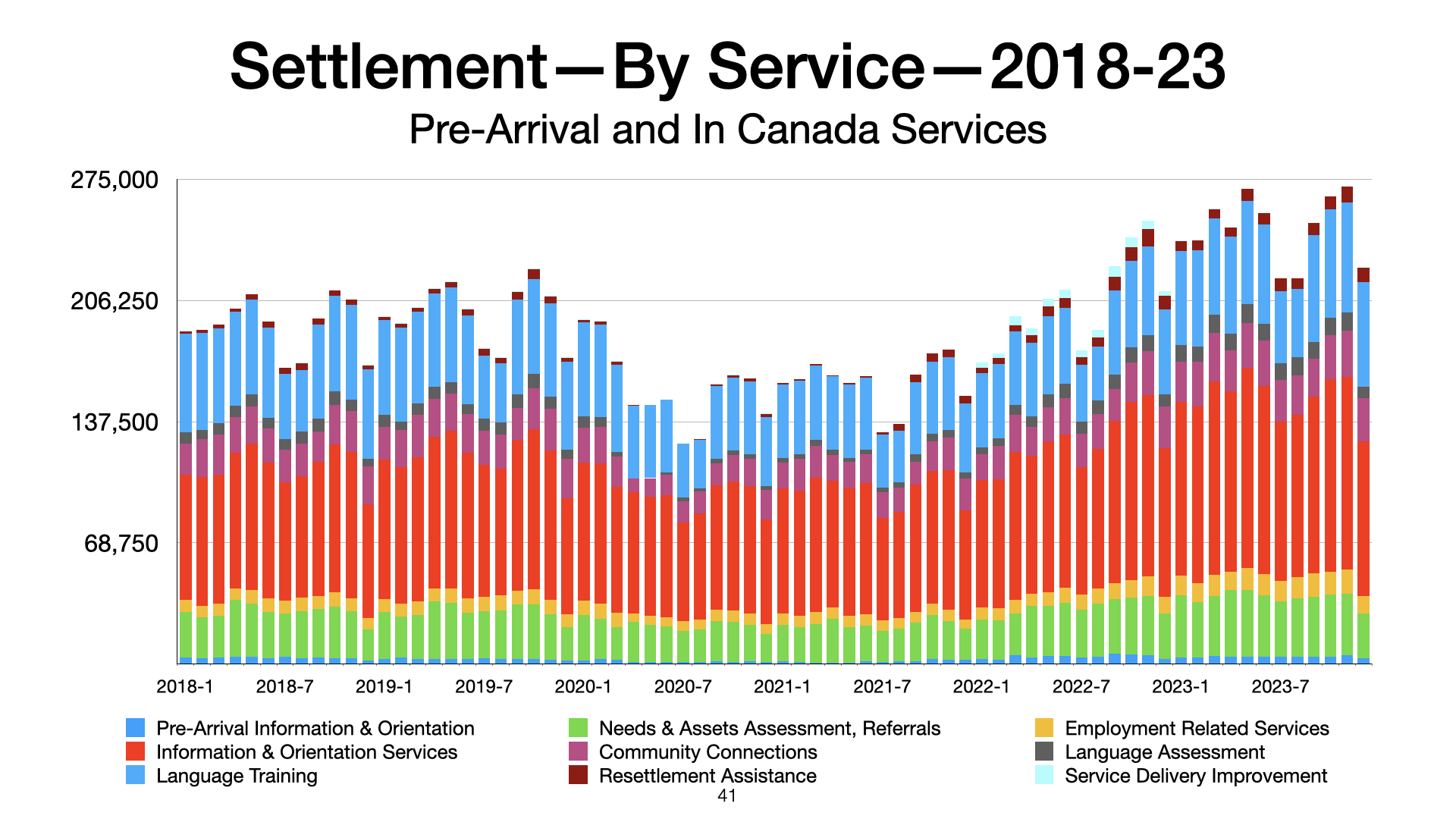
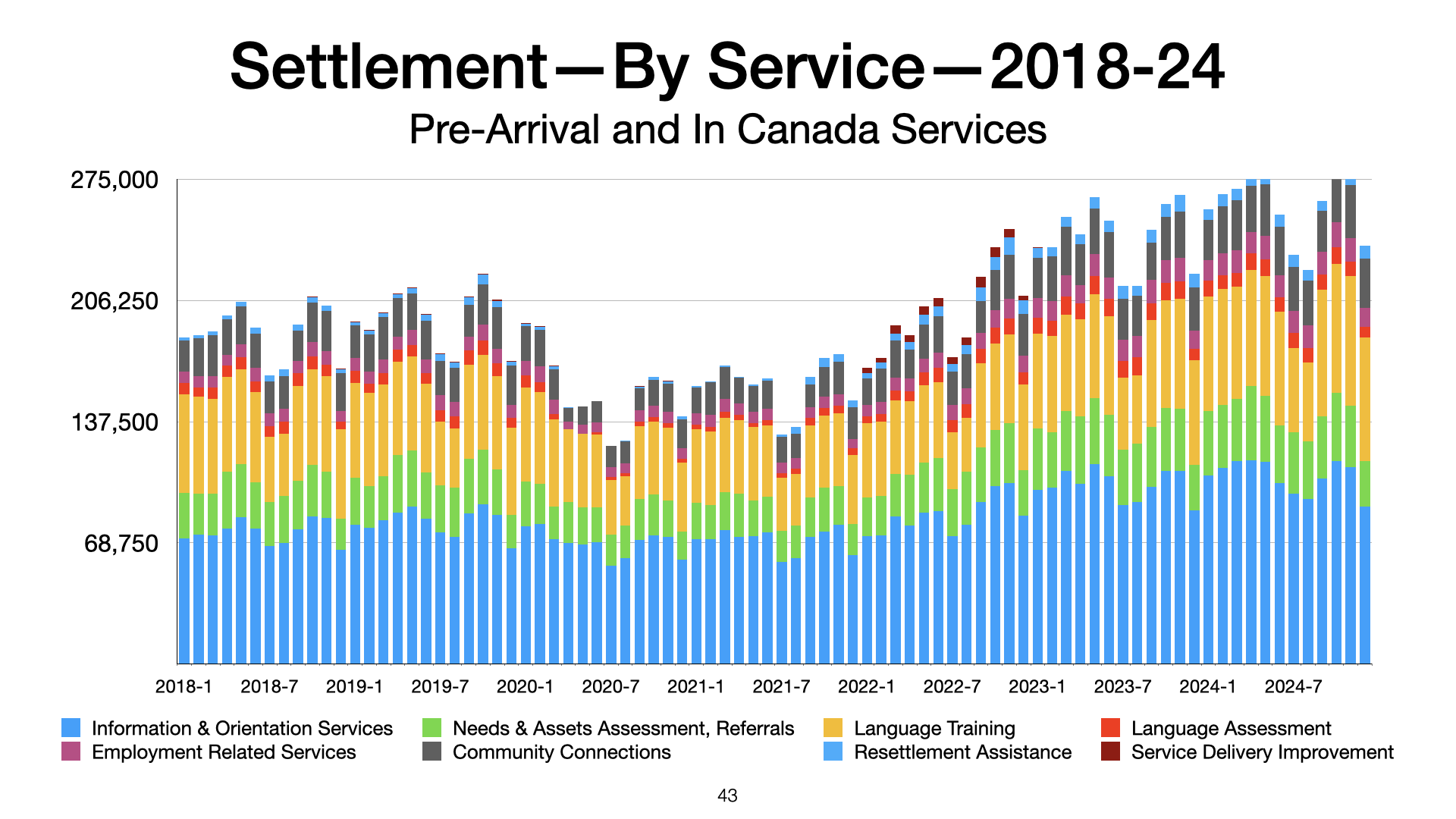
Starting with monthly data, the first chart shows the pandemic dip has been completely eclipsed by post pandemic growth:

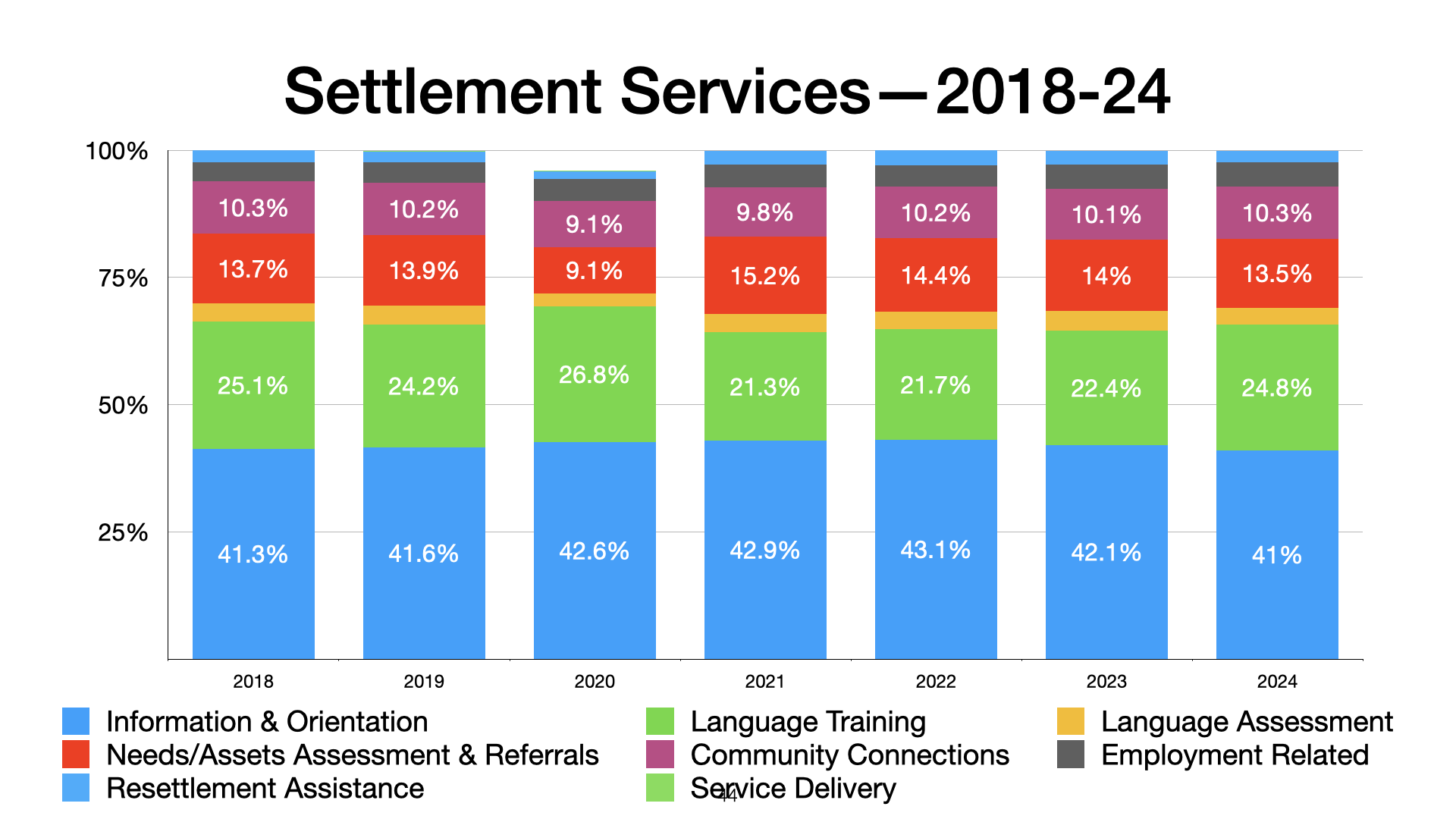
The next chart shows how the proportion of different services has remained relatively constant:

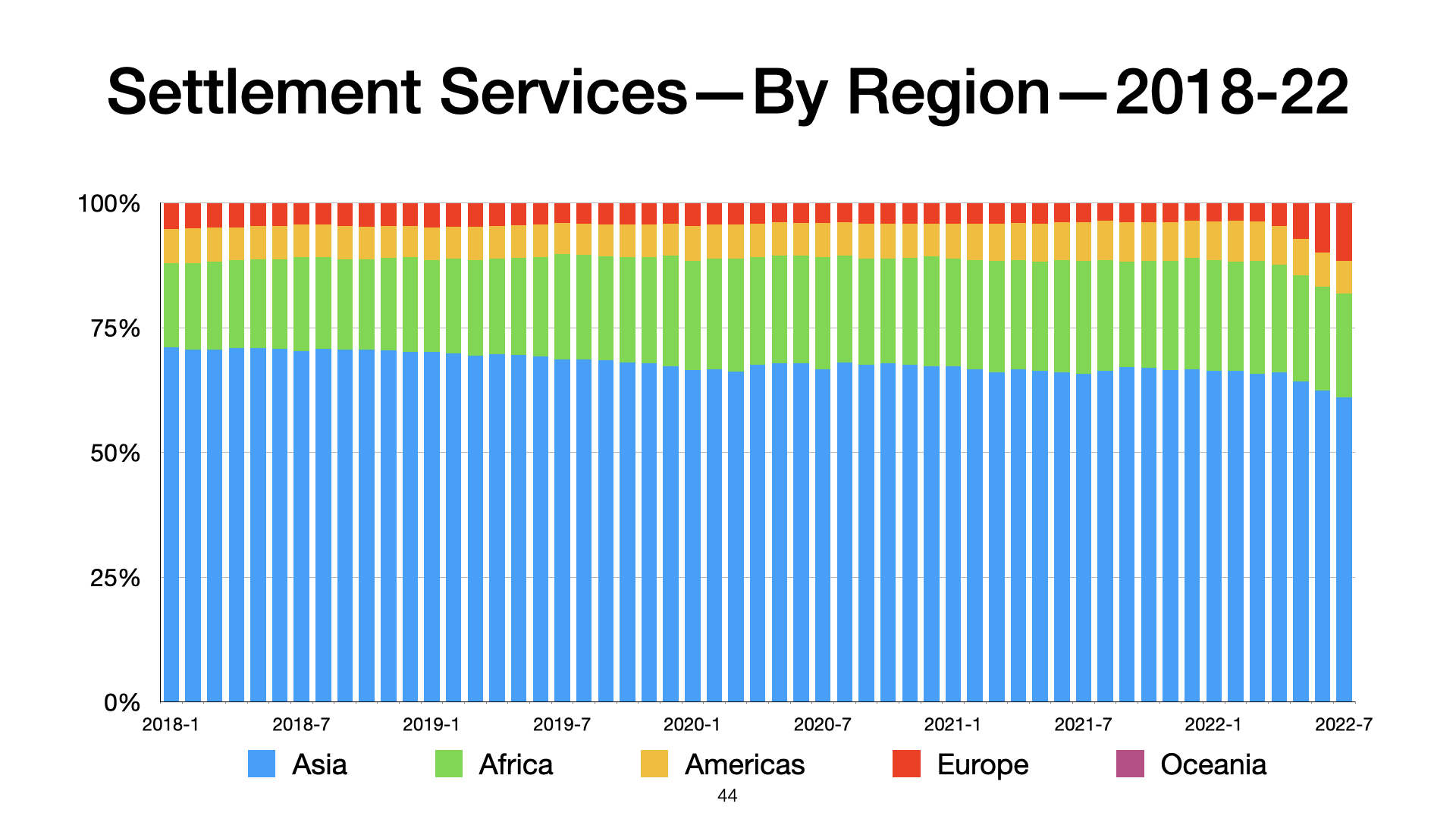
The regional breakdown highlights the sharp increase in settlement services to Europe, driven entirely by those from Ukraine:

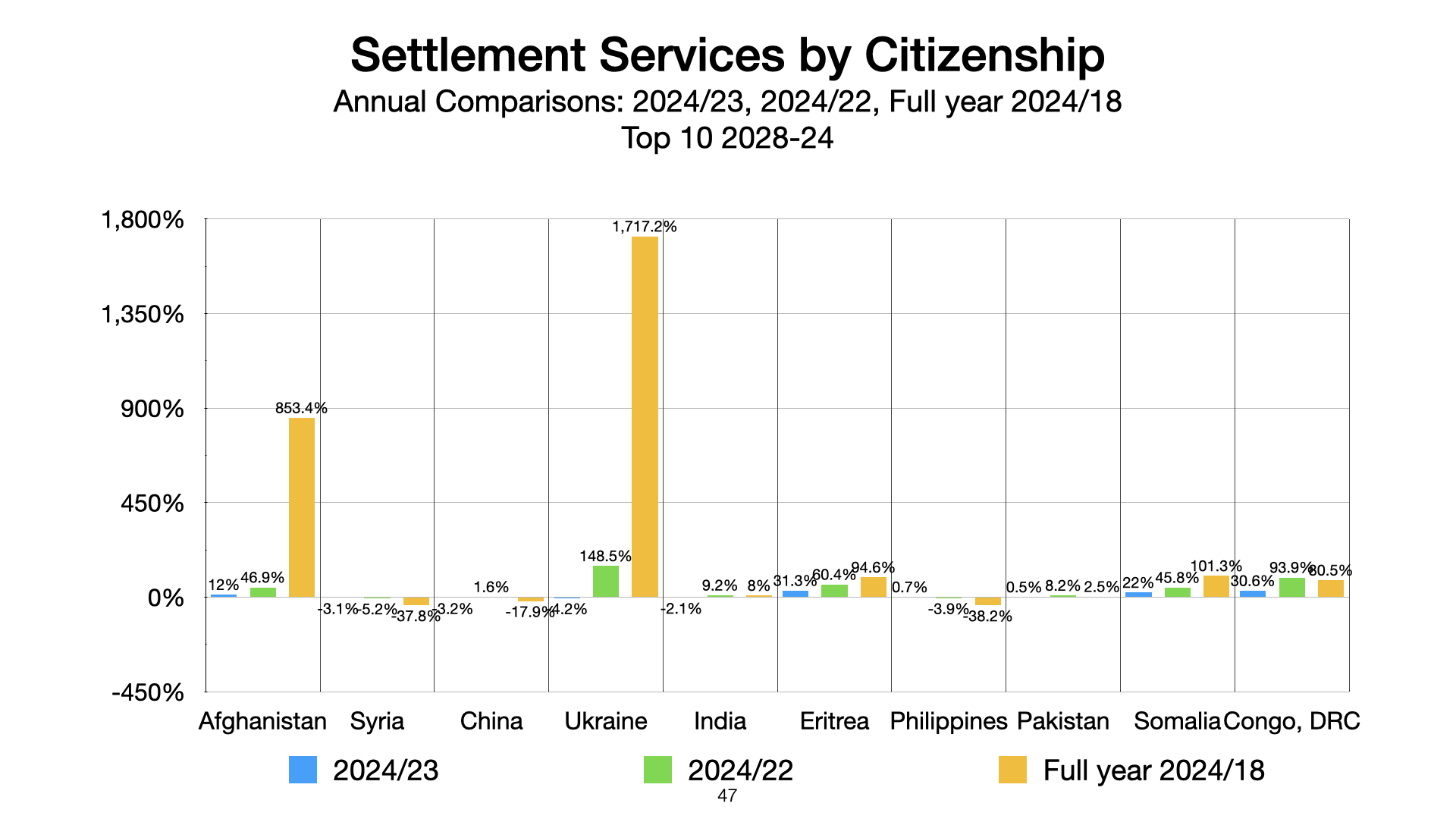
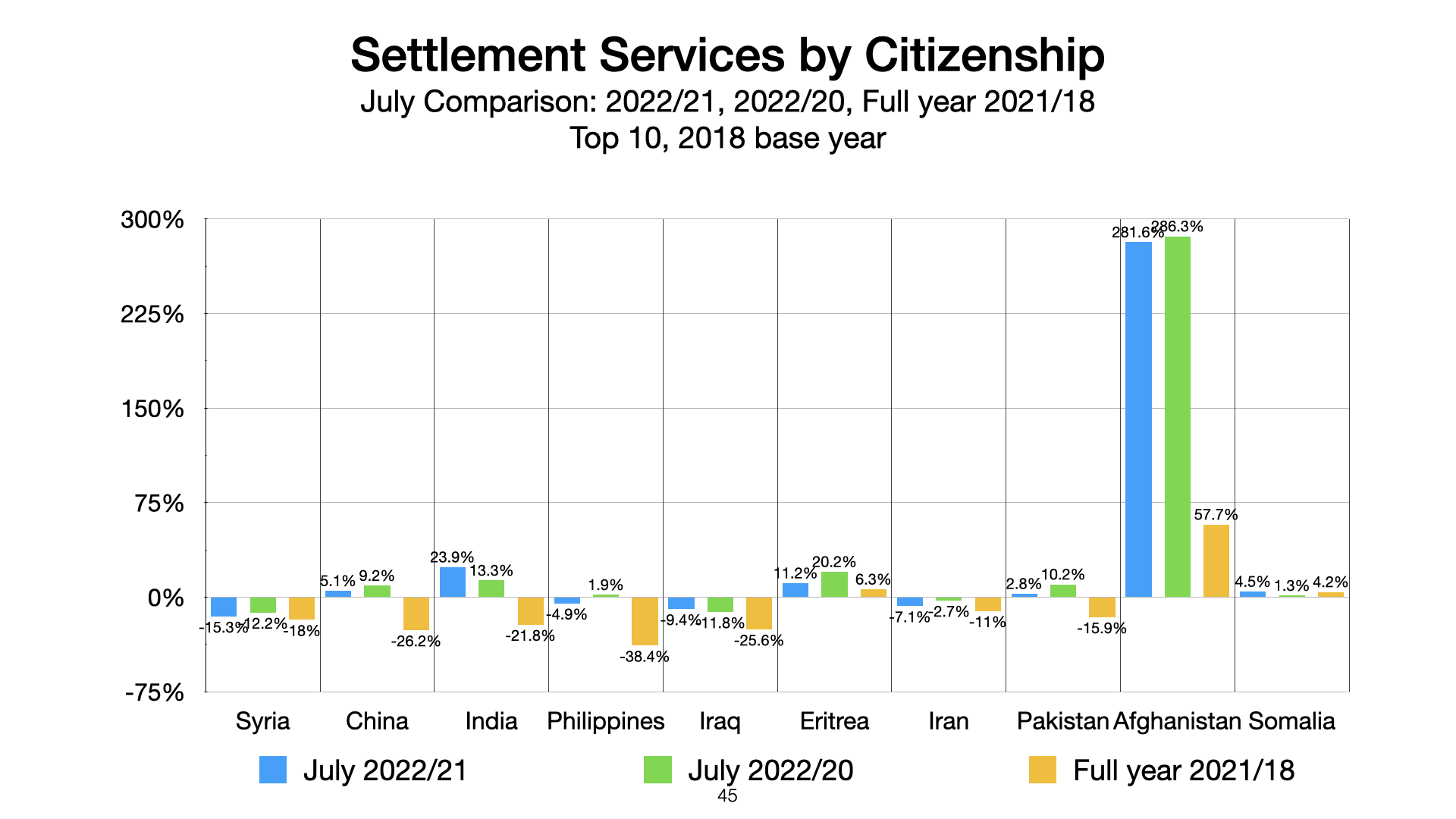
The country view shows not unsurprisingly that it has been Ukraine and Afghanistan where growth has been greatest:

Lastly, usage by province, comparing recent and overall period changes, with Atlantic Canada and Ontario having the largest increase since 2018 (most Quebec settlement services are delivered by the province, not the federal government so hard to compare trends):

Akbar: Canada’s labour market is failing racialized immigrant women, requiring an urgent policy response

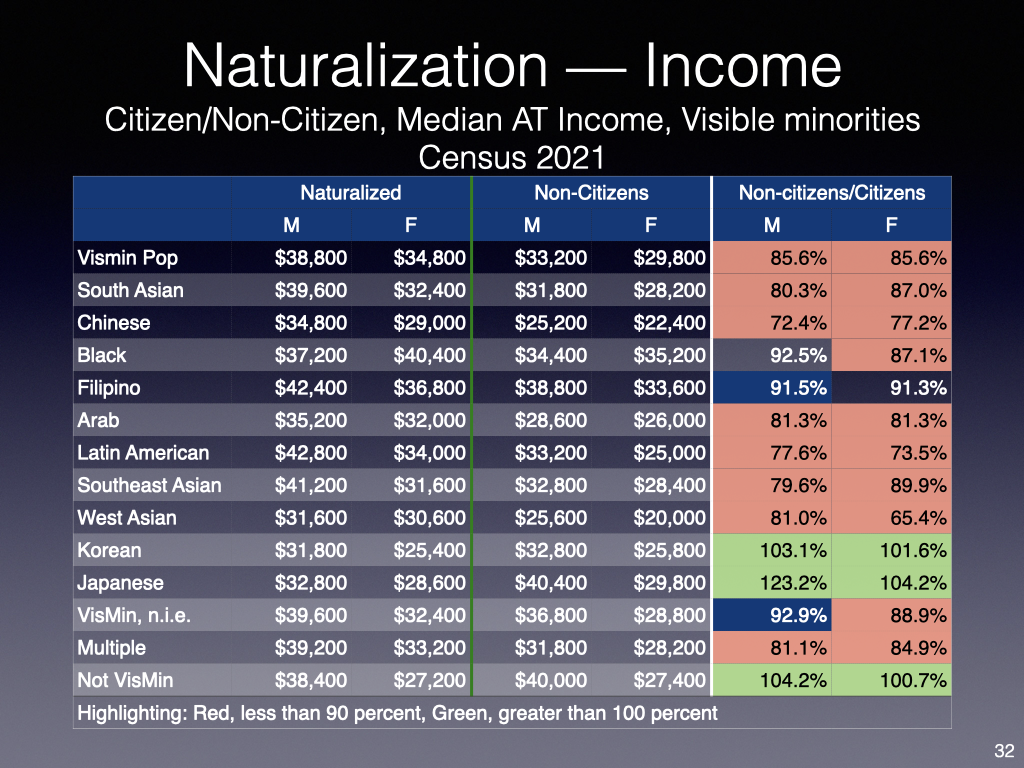
Would be helpful to have breakdowns by visible minority groups as they are significant (chart below compares citizens and non-citizens by visible minority group and not visible minority):

…To address these challenges, future research should adopt a problem-solving approach to address the root causes. Simultaneously, a comprehensive policy response is needed to tackle the systemic barriers in the labour market. 

Targeted solutions are needed to help racialized immigrant women. Strengthening credential recognition, for instance, can help employers assess transferable skills across countries. Implementing equitable hiring practices and workplace integration policies are also essential. 

Digital technology and artificial intelligence can also help eliminate bias in hiring and job matchingSettlement programsshould account for the intersecting identities of racialized immigrant women to provide tailored support.

Most importantly, it’s crucial to recognize that ensuring equitable access to meaningful employment is not only vital for advancing gender and racial equity, but also essential for unlocking Canada’s full economic potential.

Source: Canada’s labour market is failing racialized immigrant women, requiring an urgent policy response

Canada’s plan to reduce immigration levels leaves newcomer organizations scrambling with ‘off-the-cliff’ funding cuts

Reduced levels means reduced demand for services, so it should not come as a complete surprise to the settlement sector:

Newcomer Oleksandr Krestych and his wife Olena have been taking English classes full-time while working full-time since they arrived from Ukraine in 2022.

The couple — him an orthopedic surgeon and her a dermatologist — know learning the language is key to their success in Canada. They’ve made progress, moving from basic English courses that helped navigate day-to-day life to now focusing on language training for employment and professional communication. 

Every weekday, they attend classes at Enhanced English Skills for Employment in Winnipeg from 9 a.m. to 3 p.m. before heading to a 3:30-to-11:30 p.m. job assembling fibre-optic cables in a factory.

“It’s hard and tiring,” said Krestych, 50. “But it helps improve our English so we can get better jobs and improve our life.”

However, after their last class at the end of this month, the couple must find another school — if they can find one with available spots.

Enhanced English Skills for Employment has been informed its current Immigration Department funding agreement, worth $650,000 a year, will not be renewed when it ends on March 31.

Across Canada, excluding Quebec, the Immigration Department is axing funding to organizations that assist newcomers with settlement and integration through employment-related services, language training and community support programs.

The cuts follow the reduction in immigration targets announced by Immigration Minister Marc Miller in October, which aims to welcome 395,000 new permanent residents in 2025, 380,000 in 2026 and 365,000 in 2027 — a 20 per cent drop from 485,000 last year.

The Immigration Department is also reducing the new funding cycle from five to three years, making long-term planning harder for funded agencies. Additionally, it will only continue funding English classes beyond level 4 of the Canadian Language Benchmark until September 2026.

“With funding being tied to the number of past arrivals and future admissions, the funding for settlement services has also been readjusted downward, at first by a small amount in 2025-26 and then further in the following fiscal years,” it told the Star in an email.

Funding allocated for settlement services outside of Quebec will drop from about $1.17B in 2024-25 and $1.12B in 2025-26, it said, adding that funding decisions are based on the number of newcomers expected, the needs for those accessing services, relationships with partner organizations and available resources.

The immigrant settlement sector said it’s been caught off guard by the “off-the-cliff” cuts that were made without consultation and enough time to wind down programs to minimize impacts on clients and staff, most of whom are immigrant women from racialized communities.

“While the funding cuts happened, the folks these agencies are seeing now are not going away,” said Debbie Douglas, executive director of the Ontario Council of Agencies Serving Immigrants, which has more than 240 member organizations.

“We don’t anticipate a reduction in service demand, but we certainly will see a reduction in services available.”

Kathryn Friesen, executive of the Alberta Association of Immigrant Serving Agencies, warns that recent cuts to settlement services funding will leave many newcomers vulnerable amid an economic slowdown and affordability crisis.

Douglas said her member organizations in Ontario are expected to see a modest one per cent reduction in federal settlement funding for 2025 and up to 20 per cent next year. However, the Toronto District School Board is set to lose a third of its federal funding for newcomer language training, closing five learning sites as of March 31 and reducing its program capacity from 2,485 to 1,800 learners. Its enhanced language training programs will be phased out over two years.

Due to the exponential immigration growth following the pandemic, including newcomers from Afghanistan and Ukraine, some service providers have already been struggling with waiting lists for programs, especially in language training.

The Star has learned that Western provinces are hardest hit, though provincial bodies representing the settlement sector are still trying to calculate the extent and impacts of the cuts. Some service providers are desperately trying to find alternative funding sources while making plans to move clients to unaffected agencies.  

In B.C., more than 20 organizations have been completely defunded, with others facing funding reduction ranging from 15 per cent to 75 per cent. In Alberta, some groups faced cuts as deep as 35 per cent. In Manitoba, at least 12 agencies have lost their entire funding.

Kathryn Friesen, executive director of the Alberta Association of Immigrant Serving Agencies, said the cuts could not have come at a worse time, as recent newcomers are the most vulnerable to the current affordability crisis, soft job market and economic slowdown.

“It’s a small investment to help people upon arrival reach success a lot sooner than if they’re having to go it alone to navigate so many of the systems that they have to navigate,” said Friesen, whose umbrella group has 60 organizational members.

And newcomers’ journeys are not linear, and they may access supports at different stages of their settlement. 

Karen Sawatzky, executive director of the Hecate Strait Employment Development Society, expresses frustration over losing funding after a decade of service, leaving her remote community in Prince Rupert without crucial settlement support.

“Settlement services continue to be essential to those already here,” said Katie Crocker, CEO of the Affiliations of Multicultural Societies and Service Agencies of BC, in a statement. The group is made up of 94 member organizations.

Newcomers “depend on settlement supports to integrate and thrive in their communities. The settlement and integration sector’s specialized and crucial support better equips immigrants to contribute to Canada’s social and economic growth, enriching communities across the country.”

Both large and small agencies are impacted by the cuts. In B.C., for example, the Vancouver Community College has lost its entire $4 million yearly funding for language training for 2,400 students; the Hecate Strait Employment Development Society will have its entire $150,000 support axed.

The latter serves newcomers in remote Prince Rupert, 1,500 kilometres north of Vancouver, and the agency will have to send clients to organizations in Terrace, which is at least 90 minutes away by car.

“We have yet to sit down with someone at immigration and have them tell me why they declined us funding after providing these services for 10 years,” said its executive director Karen Sawatzky.

“They have not given us a clear (transition) plan. I’ve been in touch informally with the other service providers to help each other.” 

At Winnipeg’s Enhanced Language Skills for Employment, its executive director Louise Giesbrecht has to let go of six language instructors and some administration staff. She is knocking on the doors of the province and charitable foundations to fill the impossible gap. 

While her biggest concern is where to send current students and the 400 on the waiting list, she is busy trying to find the money for staff’s accrued vacation pay and closing costs on things such as shedding documents to comply with client privacy terms, emptying offices and getting rid of furniture.
Source: Canada’s plan to reduce immigration levels leaves newcomer organizations scrambling with ‘off-the-cliff’ funding cuts

Un service de Québec dédié aux nouveaux arrivants rate la cible

Of note. Those in the rest of Canada shouldn’t feel to smug as they also have gaps in settlement services:

Le service Accompagnement Québec, visant à guider les nouveaux arrivants dans leurs démarches d’installation et d’intégration, rate sa cible. Alors que certains organismes d’aide aux immigrants s’interrogent sur son utilité, les plus récentes données démontrent que le service est très peu utilisé, voire carrément méconnu.

En 2023-2024, à peine plus de 12 000 personnes ont bénéficié d’une évaluation de leurs besoins par Accompagnement Québec, révèlent les plus récentes données du ministère de l’Immigration, de la Francisation et de l’Intégration (MIFI). L’année précédente, en 2022-2023, près de 10 000 personnes immigrantes avaient eu une rencontre avec un agent du service.

Pour Stephan Reichhold, directeur de la Table de concertation des organismes au service des réfugiés et immigrants, atteindre quelques milliers de personnes sur un total de centaines de milliers d’immigrants qui arrivent ici, « c’est rien ! »

Selon lui, la centaine d’organismes d’aide aux immigrants qu’il représente et qui sont aussi financés par le MIFI pour soutenir et accompagner les immigrants en a accueilli bien plus : soit près de 100 000 personnes au cours des 12 derniers mois. « Tout le monde est d’accord pour dire qu’[Accompagnement Québec], ça ne fonctionne pas », a-t-il déclaré. « C’est une marque de commerce du gouvernement, mais [en fait], ça ne peut pas continuer. »

Parachevé en mai 2023, un sondage réalisé par le MIFI obtenu par Le Devoir révèle que 70 % des répondants affirmaient ne pas connaître Accompagnement Québec. De plus, environ la moitié des personnes interrogées indiquaient ne pas connaître les étapes à suivre pour immigrer, pour chercher un emploi ou pour faire reconnaître leurs compétences.

Qu’il soit ici ou dans son pays d’origine, un immigrant qui reçoit un certificat pour résider au Québec de manière permanente ou temporaire devrait être invité par courriel à s’inscrire à Accompagnement Québec par l’entremise de la plateforme Arrima. Il sera par la suite contacté par un agent d’aide à l’intégration qui lui concoctera un plan individualisé en fonction de ses besoins (francisation, emploi, etc.) et le dirigera vers un organisme sur le terrain.

Un service qui fait doublon

À l’été 2019, le ministre de l’Immigration d’alors, Simon Jolin-Barrette, avait bonifié le service Accompagnement Québec en ouvrant plus de bureaux régionaux et en augmentant l’effectif en région. Il réagissait ainsi aux critiques dans le rapport de la vérificatrice générale, qui reprochait au gouvernement de ne pas connaître les besoins réels des immigrants et d’échouer à les orienter vers les bons services.

Depuis la réforme, Accompagnement Québec a plus spécifiquement comme mission d’inciter les immigrants à s’installer en région et d’aider les employeurs à recruter ces derniers. Mais, sur le terrain, certains organismes se questionnent sur le rôle que joue le service.

À l’organisme Groupe Inclusia, au Saguenay, très peu d’immigrants — environ 5 % — ont été envoyés par Accompagnement Québec. « La grande majorité des gens qui viennent à nous, c’est grâce au bouche à oreille ou à des employeurs qui recrutent à l’international », explique la coordonnatrice, Sylvie Pedneault. Même si plusieurs rencontres ont lieu par année avec les fonctionnaires de Québec et les organismes de la région afin d’arrimer leur travail, elle constate qu’il y a quand même « des doublons ». « Nous, les organismes d’accueil, on a toujours fait des plans d’intégration pour diriger la personne immigrante vers les ressources appropriées. Mais c’est le rôle qu’Accompagnement Québec a pris », dit-elle. « Concrètement, ce que ce service fait de plus, je ne le sais pas. »

Le fait que les immigrants doivent eux-mêmes s’inscrire aux services d’Accompagnement Québec dans Arrima ajoute une certaine « lourdeur » pour eux, croit Mme Pedneault. « C’est comme une étape qui se rajoute dans leur parcours, alors qu’ils ont déjà un paquet d’autres choses à faire. Ce n’est pas optimal. » Cette lourdeur s’étend aussi aux organismes vers qui les immigrants sont de toute manière redirigés et qui ont la charge de les accompagner dans les méandres d’Arrima.

Pour plus d’efficacité, Sylvie Pedneault suggère qu’Accompagnement Québec s’occupe des personnes qui ne tombent pas dans les critères de financement de son organisme, comme les demandeurs d’asile, par exemple.

Des dirigeants d’un centre de francisation en région se sont également montrés très critiques à l’endroit de ce service gouvernemental. « C’est quoi, leur mission ? On ne le sait pas », a indiqué au Devoir l’un de ces dirigeants, qui demeure anonyme pour ne pas nuire à ses relations avec le MIFI. Il dit avoir contacté à maintes reprises les agents pour mieux connaître leurs services et savoir comment conseiller des immigrants qui ont des besoins excédant la francisation… en vain. « On dirait que personne ne travaille là. On ne sait pas ce qu’ils font. C’est très flou », avance cette personne. « Les organismes d’aide aux immigrants, on voit leurs actions sur le terrain, mais Accompagnement Québec… on ne sait pas trop. »

Peu d’accueils à l’aéroport

À l’aéroport de Montréal, le service d’accueil pour immigrants, notamment censé les diriger vers Accompagnement Québec, est un échec. Selon le rapport annuel de gestion de 2022-2023, à peine 9 % des immigrants adultes ayant transité par ce comptoir d’accueil se sont véritablement inscrits à Accompagnement Québec, ce qui rate complètement la cible de 75 % qui avait été fixée.

Selon le MIFI, la non-atteinte de l’objectif s’explique par le fait que les immigrants sont, depuis le printemps 2021, invités à s’inscrire en ligne directement sur la plateforme Arrima. Depuis 2020, le nombre de personnes accueillies par le service à l’aéroport est en chute libre, selon des données obtenues par la Loi sur l’accès à l’information. Les travailleurs étrangers temporaires, qui sont à peine quelques dizaines à être passés par ce comptoir, ne sont pas reçus « systématiquement » par le service d’accueil de l’aéroport. « Une réflexion plus large est en cours », lit-on dans le rapport.

Source: Un service de Québec dédié aux nouveaux arrivants rate la cible

Ismail: Canada welcomes record number of newcomers. Now what?

Raises many of the needed issues but remains fixed on current and planned levels as well as uncapped temporary residents. As I have argued before, unlikely that Canada will be able to address its housing, healthcare and infrastructure needs given these numbers.

And it is striking that IRCC has not published any data on the use of settlement services since 2016, even though the government spends over one billion annually. The only semi-public data we have are web enquiries which are low, between 10-15,000 per month, about a third of pre-pandemic levels:

Canada announced recently it had reached a significant milestone: welcoming over 30,000 Afghan refugees to the country since 2021, putting it on track to resettle at least 40,000 by the end of 2023.

Newcomers are critical in shaping the nation’s economy, particularly given the ongoing challenges around an aging population and persistent post COVID-19 labour shortages.

In 2022, Canada welcomed 437,180 immigrants — the highest on record, according to Statistics Canada. Further, the government announced a plan to welcome 1.5 million more by 2025.

Despite the need and the numbers, we continue to hear stories of highly skilled and foreign-trained newcomers facing challenges in transitioning to life in Canada.

The concept of the “Canadian Experience” is still a stereotype for some employers and creates barriers to joining the labour market and expediting the settlement process. Additionally, the costs and availability of housing are major issues — as it is for many Canadians. While efforts are being made by the government and settlement services to encourage newcomers to settle outside of major urban centres, there is a lack of vital support in those areas.

While some may see newcomers as a burden on our system, the numbers prove that to be the opposite. Data from the United Nations High Commissioner for Refugees (UNHCR) shows that refugees join Canada’s middle-class within five years of their arrival and, over time, pay more in income taxes on average than they receive in public benefits and services. 

When it comes to home ownership, 65 per cent of refugee families who have been in Canada for 10 years or more live in homes they own, compared to 70 per cent of Canadian born citizens.

As Canada welcomes more people from around the world, the need for infrastructure to support the growth in our housing markets, schools, and health care systems, is critical. The appropriate funding and management of this growth needs to be considered by all levels of government, and support from various organizations, like Polycultural Immigrant and Community Services, is paramount.

Between 2021 and 2022, Polycultural’s Afghan Initiative Program supported over 7,000 government-assisted refugees who were brought to Canada under the emergency evacuation initiative. And the organization has also provided settlement and housing supports to nearly 1,500 Ukrainian temporary residents under the Canada-Ukraine Authorization for Emergency Travel. Overall, over 30,000 immigrants were supported by Polycultural over the last year.

Polycultural works with Immigration Refugees and Citizenship Canada (IRCC), provincial, regional, and local partners to address the needs of the refugees, including providing employment services, language classes, access to health care, and support in finding housing.

By 2036, up to 30 per cent of the country’s population will be immigrants. The government and its partners should continue to aid newcomers and advocate for the funding and investments that enable Canada’s newest citizens to truly thrive in their new home.

Marwan Ismail is the executive director of Polycultural Immigrant and Community Services, a charitable, non-profit, community-based agency.

Source: Canada welcomes record number of newcomers. Now what?

IRCC Settlement Services Statistics 2018-2022 to date

I recently received settlement service data from IRCC (open data tables date from 2019). Some highlights below.

Starting with the monthly data by service type, the effect of COVID can clearly be seen with levels having largely caught up with the pre-pandemic period, albeit during higher immigration levels.

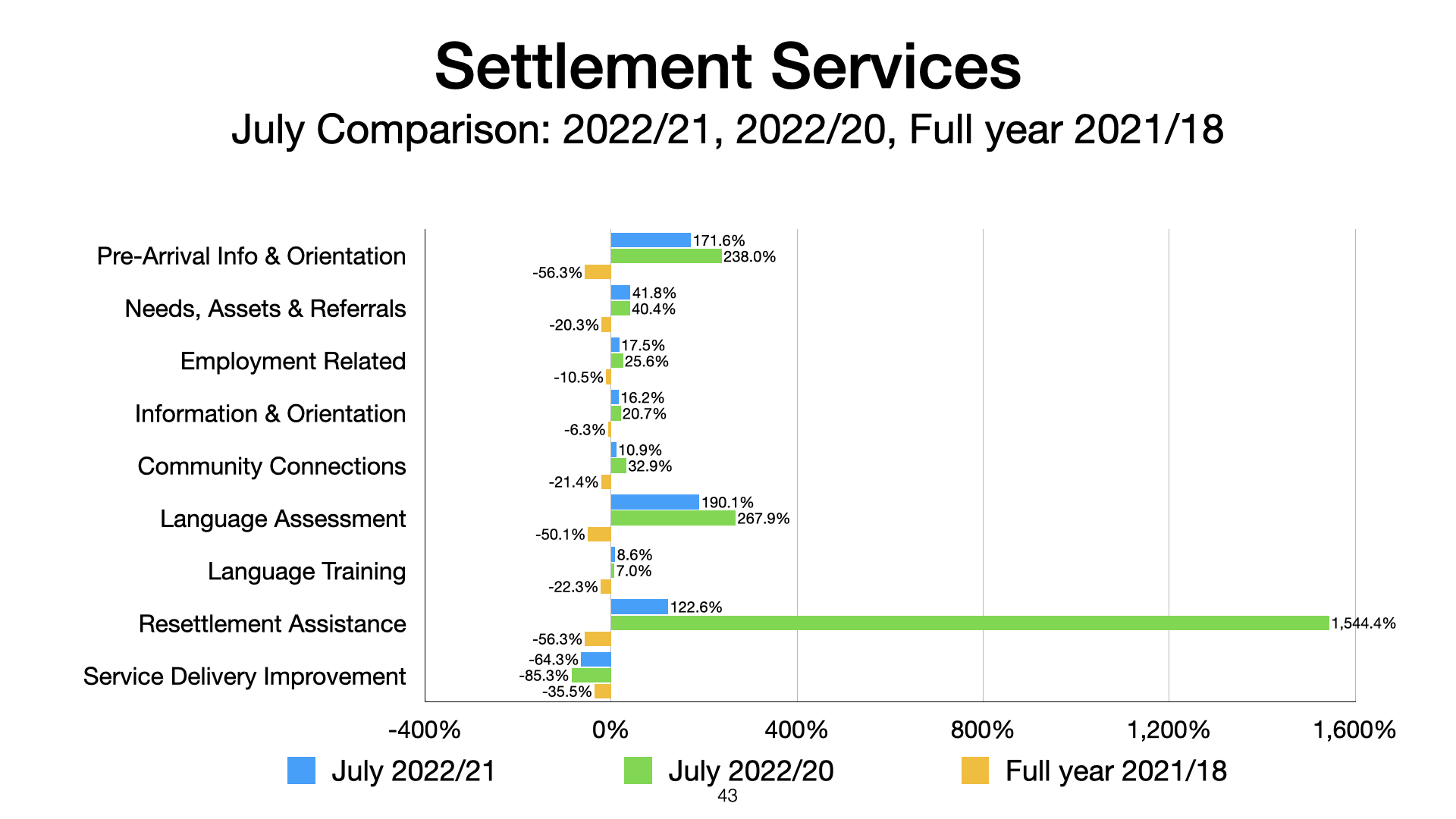
The second chart compares the current July 2022 period with July 2021 and July 2020 periods, along with full-year 2021 with full year 2018, highlighting the increase on a monthly basis and the overall decrease compared to pre-pandemic levels.

Again, given that immigration has increased significantly since 2018, this understates the decline from 2018.

While the regional breakdown has generally been fairly stable, the recent increase in the share of European-origin users of settlement services reflects increased Ukrainian users while the decline in Asia reflects declines from Syria, China, India and Afghanistan.

Of the top 10 countries, Afghan users have increased the most following the Taliban takeover and consequent refugees. Ukrainian users, not shown, increased about 10 fold following the Russian war and consequent migration flows.

The last chart compares users by province with Alberta showing the greatest monthly increases and Atlantic Canada the only region showing an increase compared to 2018.

Settlement services need to improve their online offerings for tech-savvy newcomers

Interestingly, the number of those from outside Canada accessing IRCC’s “Find immigrant services near you” is comparatively small: about 10,000 per month in 2021, a small decline from pre-pandemic 13,000 per month in 2019.

Given the diversity among immigrants, clearly more segmentation of services, more digital for the digital savvy and more high touch in person for those less so.

Will see what Ryerson’s Virtual Bridge comes up with in terms of recommendations:

Welcoming and including newcomers is increasingly becoming an important part of creating vibrant cities. 

Settlement agencies don’t just deliver services to newcomers. They also identify the best possible channels to reach them and provide them with the necessary information to make settlement in Canada a seamless process. 

But a 2021 study found that although newcomers were using the internet for many things, few were using it to look for settlement services. There’s still a gap when it comes to helping newcomers with better targeted online services. 

The federal government is investing in pre-arrival settlement service delivery so that newcomers are prepared for life in Canada. 

There are currently 147 active settlement program initiativesbeing funded by Immigration, Refugees and Citizenship Canada. These projects are valued at over $250 million, with a goal of finding new ways of delivering services to newcomers. 

About 45 per cent of these funds went towards 17 pre-arrival settlement service initiatives that virtually prepare newcomers for life in Canada. The initiatives provide employment-related services, orientation services, needs assessment and referral services. 

Pre-arrival initiatives have seen success in digital learningcounselling and community-building, including tackling xenophobia and misinformationskills training and starting an online business.

The initiative taken by Immigration, Refugees and Citizenship Canada and local governments are in step with the embrace of digital technologies and the internet among newcomer communities and the demand for more pre-arrival information.

But more must be done to increase awareness among newcomers about the services provided by settlement agencies. 

This is an area of focus for the project Virtual Bridge, which aims to provide research and tools for settlement service agencies to improve their online communications and service delivery. Given the technological aptitude of so many newcomers to Canada, online outreach and services are critical to ensuring their successful resettlement.

Canadian municipalities like TorontoLondonWinnipeg and Halton Region open their doors to a large number of newcomers.

These communities recognize the importance of digital initiatives like welcome portals, pre-arrival services, web/mobile phone applications and online newcomer guides in creating a welcoming environment. The mobility restrictions imposed by the COVID-19 pandemic has heightened the need for these online services and has even spurred digital adoption among migrants themselves.

Settlement agencies, however, still have work to do to ensure they’re offering enough online services to newcomers, including using online channels to communicate with them before they arrive in Canada.

Digital divide

Make no mistake — some newcomers may be excluded because of pre-existing inequalities in access to internet services or devices in their home countries. Demographics will determine whether they have access to digital services. 

Those include age (young people use the internet more often than older generations), gender, location (including whether they come from places in their home country with poor internet service or expensive or absent broadband services), household wealth, education levels and migration status (some refugees and asylum-seekers depend on internet service and social media platforms to navigate the journey between home and host country). 

This is known as the digital divide. For host countries like Canada, unequal access to digital services means another layer of inequality that must also be addressed by settlement services. Failure to do so could further exacerbate what’s known as digital poverty.

Newcomers who do go online must be skilled enough to navigate various platforms, persistent misinformation and hate speech on social media. 

This requires them to obtain vital and accurate information. They can and do. Refugee youth from the Middle East and East Africa, for example, use various platforms like Facebook, WhatsApp, Instagram, Snapchat and Viber before and after coming to Canada to communicate and get information. 

Similar examples are found among immigrants from Bangladeshrefugees from Syria and the Tamil diaspora.

A 2018 report found that newcomers who used pre-arrival settlement services were more informed about where to go to find more information after they arrive, they knew how to get their professional credentials evaluated and they had an overall better understanding of Canadian workplace culture.

They also actively looked for work, while some enrolled in further education to upgrade their skills.

New tech transformation

Before coming to Canada, migrants often have limited sources of information about life here, relying mostly on their social networks. 

Technology allows potential newcomers — with the assistance of friends and family on social media — to make informed migration decisions and improve their search for job market information.

Even before the pandemic, 67 per cent of newcomers to Canada were using social media, similar to Canadian-born usage rates (68 per cent)

Newcomers were mainly using it to learn English, get local news, learn about the Canadian cultureconnect with family and friends, find job market information and for further education opportunities.

Nonetheless there can be some negative impacts on newcomer integration due to social media, meaning there’s a role for newcomer settlement service agencies to build greater trust into virtual spaces.

Some platforms can potentially inhibit integration if they limit interactions with local citizens. Chinese immigrants using WeChat, for example, interact a lot more with other Chinese immigrants and much less with Canadian-born citizens. This can delay how newcomers learn about Canadian social practices. 

Social media can also create privacy and security challenges for newcomers that leave them vulnerable to fraud, identity theft and misinformation. 

Searching for settlement services

Settlement agencies don’t just deliver services to newcomers. They also identify the best possible channels to reach them and provide them with the necessary information to make settlement in Canada a seamless process. 

But a 2021 study found that although newcomers were using the internet for many things, few were using it to look for settlement services. There’s still a gap when it comes to helping newcomers with better targeted online services. 

The federal government is investing in pre-arrival settlement service delivery so that newcomers are prepared for life in Canada. 

There are currently 147 active settlement program initiativesbeing funded by Immigration, Refugees and Citizenship Canada. These projects are valued at over $250 million, with a goal of finding new ways of delivering services to newcomers. 

About 45 per cent of these funds went towards 17 pre-arrival settlement service initiatives that virtually prepare newcomers for life in Canada. The initiatives provide employment-related services, orientation services, needs assessment and referral services. 

Pre-arrival initiatives have seen success in digital learningcounselling and community-building, including tackling xenophobia and misinformationskills training and starting an online business.

The initiative taken by Immigration, Refugees and Citizenship Canada and local governments are in step with the embrace of digital technologies and the internet among newcomer communities and the demand for more pre-arrival information.

But more must be done to increase awareness among newcomers about the services provided by settlement agencies. 

This is an area of focus for the project Virtual Bridge, which aims to provide research and tools for settlement service agencies to improve their online communications and service delivery. Given the technological aptitude of so many newcomers to Canada, online outreach and services are critical to ensuring their successful resettlement.

Source: Settlement services need to improve their online offerings for tech-savvy newcomers

Canada to offer language training, employment assistance to Ukrainians fleeing war

Significant change, one that continues to blur the previous lines between temporary residents, previously not able to access settlement services, and Permanent Residents who were, as well as highlighting the preferential treatment of Ukrainian nationals compared to others fleeing from their country.

Reality, both policy (the distinction between temporary and permanent has become increasingly arbitrary given that most new Permanent Residents are not former temporary residents) and political (the size and influence of Ukrainian Canadians), results in a major change.

The government will help Ukrainians arriving in Canada find a job and learn to speak English or French, Immigration Minister Sean Fraser said Monday.

Applications opened March 17 for a program to allow an unlimited number of Ukrainians fleeing war in their home country to come to Canada for up to three years while they decide whether they want to apply for permanent residency.

Those who are approved can work or study in Canada during their stay.

The Immigration Department says nearly 60,000 Ukrainians and their family members have applied for the program so far.

“We’re expanding the federal settlement program to offer key services such as language training, orientation, employment assistance and other supports for Ukrainians as they settle into their new communities,” Fraser said as part of a series of Tweets Monday.

More details are expected Tuesday.

The department estimated it would take about two weeks to process each application, so Ukrainians could begin to arrive under the new program as early as this weekend.

Russia’s invasion of Ukraine sparked a mass exodus of mainly women and children who fled the violence that erupted one month ago.

The UN refugee agency estimates 3.8 million people have fled Ukraine since Feb. 24.

The temporary program for people who have left Ukraine is unlike the regular process for refugees, which includes help to find housing and community orientation.

Fraser’s department is working on more ways to help settle the potentially thousands of Ukrainians who could come to Canada over the next several weeks.

“We’ll continue to support Ukrainians, before and after they arrive in Canada,” the minister tweeted.

Beginning Friday, help will be available at certain airports to welcome Ukrainians, with assistance and arrival information in their language.

The Ukrainian Congress has called on the government to provide the new arrivals with financial support for food and shelter during a three-month transitional period.

On Monday the government announced a special grant program for graduate students and post-doctoral researchers affected by the invasion.

“We are establishing this measure as another way of demonstrating our support for Ukraine, to help Ukrainian researchers and students working in Canada to continue their important work,” Health Minister Jean-Yves Duclos said in a statement.

“It will also help protect the future growth of the Ukrainian scientific community.”

The program will provide grants of up to $45,000 for Ukrainians who wish to continue their studies and research in Canada, as well as Ukrainians in Canada who can’t return home because of the war.

Source: Canada to offer language training, employment assistance to Ukrainians fleeing war

IRCC Evaluation of Language Training Services

Of interest, particularly the differences between settlement service language training clients and non-clients, the greater effectiveness of employment-focussed language training and the overall impact of the socio-demographic profile of clients and non-clients:

This report presents the findings of the evaluation of Immigration, Refugee and Citizenship Canada’s (IRCC) Language Training Services. The evaluation was conducted to provide an in- depth assessment of this major program and considered issues of program effectiveness, covering the period from 2015 to 2018.

The Evaluation of the Settlement Program (2018) highlighted the need to further assess the different success factors and approaches to language learning. While language training is helping newcomers improve their language ability, progression was shown to vary by skill (i.e., reading, writing, listening and speaking), as well as client characteristics, which pointed to the need for a greater understanding of progression across skills. As such, the evaluation recommended an in- depth examination and thorough analysis to provide fulsome outcomes results and specific recommendations for improvements to the Department with the aim of improving language training effectiveness.

The language learning services have been evaluated, focusing on two key areas. The main focus was to better understand language skills improvement – what works for whom and under what conditions, with a view to determining the specific characteristics that influence language skills improvement. The secondary area of focus was to examine whether the language learning framework is adapted to address newcomers’ needs.

Summary of conclusions and recommendations

Based on the evidence analyzed, it was found that language learning services are designed to be flexible and effective in meeting the diverse needs of newcomers and to support their progression. The findings also show that language progression for newcomers is mostly positive, but there are differences between clients and non-clients with respect to likelihood of progression. While clients were seen to progress at the same pace as non-clients when assessed in the short term, using an objective measure, clients appeared to progress more than their non- client counterparts when assessed on a longer timeframe using a subjective measure. It was also found that some components of language training are associated with a greater likelihood of newcomers improving their language skills, such as full-time language training and multi-level classes, while others lowered chances of progression, such as continuous intake classes.

Furthermore, when assessing other settlement outcomes, the evidence indicated that:

  •   clients of general formal language training use official languages less frequently than non- clients, while formal language training focused on employment were using it significantly more than non-clients.
  •   clients of formal language training, and clients who took both formal and informal language training, are more likely to report an increase in the frequency of use of official languages.Although not a direct objective of language training, employability remains a primary concern for clients. The evaluation carefully analyzed this theme and assessed the impact of language training on various labour market outcomes. Clients of general language training used English or French at work less frequently and were less comfortable using official languages than non-clients, however taking language training focused on employment contributed to making these gaps smaller. Also, clients often had poorer labour market outcomes than non-clients on the short to medium term. The analysis showed that a large part of the difference in employment outcomes between clients and non-clients could be attributed to socio-demographic profiles of individuals (e.g., education, age, gender, year of admission). This suggests that taking language training is not necessarily a cause of poorer labour market outcomes, but rather that clients and non-clients may have different characteristics that explain their outcomes on the labour market. Furthermore, the evaluation found that employment outcomes of clients do not vary greatly based on how language training is delivered, language training focused on employment generally had a positive impact on employment outcomes, and taking language training during core hours was associated with less favourable results.

While the client progression and their labour market outcomes show mixed results, it should be noted that language learning services correspond to the diversity in clients’ need and IRCC- funded language learning services are designed in a manner to be conducive to language improvement for newcomers.

In response to the findings from the evaluation, this report has grouped the recommendations into two main themes. First, the evaluation proposes three recommendations around the topic of outcomes measurement. Second, the evaluation recommends improvements to the program to foster success. To this end, the evaluation proposes seven additional recommendations to further support clients, instructors and program stakeholders.

Source: https://www.canada.ca/content/dam/ircc/documents/pdf/english/corporate/reports-statistics/evaluations/E4-2018_LanguageTrain_Eng.pdf

Les cours de francisation gagnent en popularité

May be some lessons for settlement services elsewhere in Canada in terms of which supports may be more effective:

La hausse de l’allocation hebdomadaire remise aux immigrants pour leur apprentissage de la langue a fait bondir la popularité des cours de francisation de 10 % au cours de la dernière année. C’est ce que constate le ministère de l’Immigration, de la Francisation et de l’Intégration dans son rapport annuel déposé mardi à l’Assemblée nationale.

Près de 31 000 personnes se sont inscrites au cours de français en 2018-2019 comparativement à un peu plus de 28 000 en 2017-2018, la plupart à temps complet. La hausse est plus marquée chez les femmes. Elles étaient près de 8500 à avoir suivi ces cours en 2018-2019, contre près de 7000 en 2017-2018. Une augmentation presque deux fois plus importante que celle des hommes.

L’allocation hebdomadaire remise aux immigrants inscrits aux cours avait été haussée de 25 $ par les libéraux et ainsi fixée à 140 $ en août 2017. Le nouveau gouvernement caquiste a fait de la francisation des immigrants l’une de ses priorités. Le ministre de l’Immigration, Simon Jolin-Barrette, a augmenté cette allocation à nouveau le 1er juillet 2019, à 185 $ par semaine. Il a également ajouté une allocation de transport et de frais de garde, en plus de donner accès à ces cours offerts par l’État à tous les immigrants vivant au Québec, y compris les travailleurs temporaires et les étudiants étrangers. Anticipant une plus forte demande, le ministre Jolin-Barrette avait également annoncé l’ajout de 300 nouvelles classes. Le coût de ces nouvelles mesures s’élève à 70,3 millions.

Si les inscriptions aux cours de francisation à temps plein offerts en territoire québécois ont augmenté, celles aux cours offerts en ligne ratent leur cible. Seulement 30 % des immigrants les ont suivis depuis l’étranger, alors que le ministère visait un objectif de 70 %. La baisse de participation à ces cours sur Internet est attribuable à la diminution du nombre de certificats de sélection du Québec délivrés aux personnes à l’étranger, selon le rapport annuel.

Source: Les cours de francisation gagnent en popularité