Kelly McParland: Trudeau’s first senate appointees are exactly the sort of people you’d expect Liberals to appoint

Valid points by McParland but one can have general values and experience ‘alignment’ while also having a measure of independence. And notably, he criticizes the general orientation of the appointees rather than taking issue with their individual qualifications.

But the degree with which they may or may not exercise their independence may be seen not just in their review of Government legislation but on the nature and tone of debates in the Senate and its committees:

Still, you’d think there would be at least a smidgen of curiosity about the latest appointees. They’re the first by the new prime minister, the first in three years (since former prime minister Harper gave up in disgust and quit appointing anyone at all), the first under the Liberals’ heralded new arm’s-length advisory council, the first to be appointed entirely as independents, and the opening wave in the Liberals’ proclaimed plan to de-partisan the benighted second chamber.

Surveying the names on the Liberal list of appointees, two thoughts spring to mind. 1. The Liberals appear to have concluded that the best way to escape the sort of Senate controversy that engulfed the Tories is to make the process as boring as humanly possible. 2. Having achieved that, they’ve used public ennui to appoint exactly the sort of people you’d expect Liberals to appoint.

To get the apathy ball rolling, Trudeau’s government announced in January it had appointed a three-member committee to advise it on potential appointees. It had three permanent members: a federal bureaucrat and two academics, plus “ad hoc” members from provinces with vacancies. The first ad hoc advisers included another bureaucrat, the head of a native women’s group, the head of a Quebec doctor’s organization, an athlete, a singer and the head of a charity.

It duly sent some names to Ottawa, from which Trudeau picked his chosen seven: the head of his transition team, a former Ontario NDP cabinet minister, an academic, an “expert on migration and diversity”, a Paralympic athlete, a federalist journalist from Quebec and the head of the Truth and Reconciliation Commission into residential schools.

Since the Liberals claim all new senators have to be non-partisan, we’ll have to assume all these people assured the prime minister of their independence, though, looking at the list, it’s not hard to guess they skew pretty much to the left. Not a lot of closet Tories in that group. As my colleague John Robson put it, the list is so predictable of a Liberal government it might have been selected by an affirmative action random-elite-candidate-generator.

And what else would you expect? Examine the membership of the advisory committee and you notice it’s heavy with people paid from the public purse, or dependent on government for grace and favour. Who else would they put forward but Canadians who reflect their own background: public servants, academics, friendly faces, administrators, reliable interest groups and members of other Liberal-friendly operations. They don’t reflect Canada so much as they reflect the Liberals’ view of Canada: people like them; people you see in the salons of Ottawa, people who will be sympathetic to Liberal aspirations and the Liberal way of doing things. Even if, under Trudeau’s directive, they have to promise not to call themselves Liberals.
Source: Kelly McParland: Trudeau’s first senate appointees are exactly the sort of people you’d expect Liberals to appoint

Trudeau appoints seven new senators: Diversity and inclusion in this first batch

The first batch of Senate appointments provide initial confirmation of the Government’s intent to diversity and inclusion in appointments. The chart above contrasts appointments by previous Prime Ministers with those made Friday (former PM Martin made no appointments during his short tenure).

Prime Minister Harper made many visible minority Senate appointments, partially as part of its engagement strategy with new Canadian voters and to address representation gaps elsewhere.

In addition to the large share of women appointed, the presence of one visible minority, one Indigenous person, and one person with disability (although given her accomplishments, hard to consider Chantal Petitclerc as such), the regional balance of these initial appointments include three from Ontario and two each from Quebec and Manitoba.

The real challenge for the Government will be less with respect to these high profile announcements but the more mundane Governor-in-Council appointments that will be made over coming years (about 1,500 positions, currently just over 1,300 filled) and the range of judicial appointments that will emerge in coming years:

Prime Minister Justin Trudeau is appointing the head of his transition team and six other Canadians to the Senate in the first injection of fresh blood to the scandal-plagued institution in three years, sources said.

Mr. Trudeau is set to announce on Friday that he is calling on Peter Harder, a retired senior bureaucrat and high-level corporate adviser, to be the Liberal government’s leader in the Senate. In addition to Mr. Harder, the six new senators will be:

  • Raymonde Gagné, former president of Manitoba’s Université de Saint-Boniface;
  • Frances Lankin, a minister in the former Ontario NDP government and a national security expert;
  • Ratna Omidvar, an expert on migration and diversity, and executive director at Ryerson University’s Global Diversity Exchange;
  • Chantal Petitclerc, a champion Paralympic wheelchair racer and Team Canada chef de mission at the Rio Paralympic Games;
  • André Pratte, an award-winning editorial writer and federalist thinker from Quebec;
  • Murray Sinclair, a retired Manitoba judge and former chair of the Truth and Reconciliation Commission into residential schools.

Mr. Harder will face the tough task of moving government legislation through a fractious Senate in which the Liberal Party has no control over any other members. Still stinging from a recent spending scandal, the institution is also set to release on Monday a final report on the expenses claims of 14 senators who challenged the Auditor-General’s call for reimbursements.

Mr. Trudeau’s six other appointees will be expected to act as independent-minded legislators, as the Prime Minister aims to eliminate partisanship in the upper chamber and improve its reputation.

The Senate is currently composed of 42 Conservative senators, 26 Liberal senators (who are not part of the Liberal caucus of MPs) and 13 non-aligned senators.

Source: Trudeau set to appoint seven new senators – The Globe and Mail

Diversity of Senate Appointments – Comparing Chrétien and Harper

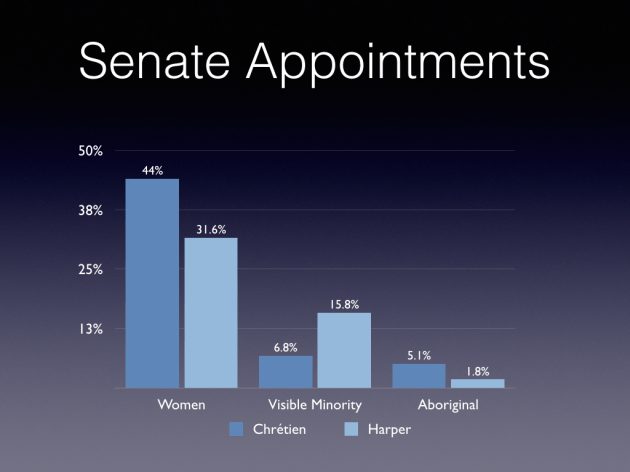
Senate Appointments.001Given the push for gender parity and greater diversity in upcoming Senate appointments (see Trudeau urged to create gender-balanced Senate), I thought it might be interesting to compare the Chrétien and Harper records with respect to diversity.

Chrétien, with his 75 appointments, achieved close to parity for women, with aboriginal peoples slightly over-represented. Visible minorities were under-represented, however.

Harper with his 57 appointments, in contrast, slightly over-represented visible minorities while under-representing women and aboriginal peoples (the fewer number of appointments over a comparable time period reflects his decision to stop appointing senators in response to the Duffy and other scandals).

Will see what PM Trudeau and the advisory body come up with.

John Ibbitson’s take on how gender parity would result in a more ‘progressive’ Senate:

 The other reason Trudeau would want gender parity in the Senate 

Trudeau urged to create gender-balanced Senate

Holding the Government to the spirit of the common wording in the mandate letters (“You are expected to do your part to fulfill our government’s commitment to transparent, merit-based appointments, to help ensure gender parity and that Indigenous Canadians and minority groups are better reflected in positions of leadership.”).

The previous Conservative government appointed 18 women out of 57 appointments (32 percent) and 9 visible minorities (16 percent – in line with the percentage of visible minorities who are Canadian citizens) by my rough count.

Good that this group has appropriately broadened their focus beyond gender parity:

The federal government is facing pressure to create gender parity in Canada’s upper chamber, two months after Prime Minister Justin Trudeau attracted global attention by forming a cabinet whose membership is half female.

A group of prominent women from across the country has seized on Mr. Trudeau’s move to achieve gender equality in the cabinet and his promise of Senate reform, and is now calling on him to fill the 22 current vacancies in the Senate with women – which would create gender balance for the first time in the chamber’s history.

In addition, the group – led by Donna Dasko, co-founder and former national chair of Equal Voice, a non-partisan organization advocating for women in politics – is asking that the female appointees be from diverse backgrounds, such as indigenous women and those from minority linguistic, racial and ethnic communities. This, they point out in a letter sent late last month to the Prime Minister, is in keeping with the Senate’s mandate to represent minorities.

“This is an historic opportunity,” Ms. Dasko wrote in the letter that is signed by more than 80 women, including former Progressive Conservative prime minister Kim Campbell, former Liberal deputy prime minister Sheila Copps, actress Sonja Smits and Vancouver’s deputy mayor, Andrea Reimer.

Currently there are 83 senators, 30 of which are women – representing 36 per cent of the Senate. Appointing 22 women immediately would make the chamber 50-per-cent female. The group says in the letter that “future appointees could include both men and women in equal numbers.”

Paul Duchesne, a spokesman for Democratic Institutions Minister Maryam Monsef, told The Globe and Mail in an e-mail on Sunday that “we share the desire of the signatories to achieve gender balance in the Senate.”

Source: Trudeau urged to create gender-balanced Senate – The Globe and Mail

ICYMI – The U.S. Senate: Still One of the World’s Whitest Workplaces – The Atlantic

Not that surprising. Have not seen a comparative Canadian study on staffers (anyone know one?) but I would suspect that visible minority percentages would be higher:

The U.S. Senate is famously known as the world’s most deliberative body, but it has never been its most representative. And that remains true not only of the 100 people elected to serve, but of the hundreds more hired as their top advisers.

Just over 7 percent of congressional aides who hold senior staff positions in the Senate are people of color, according to a new study set to be released Tuesday by the Joint Center for Political and Economic Studies. That amounts to just about 24 of the 336 people who hold top job titles, and it is a far lower percentage than the country as a whole, where people of color—defined as African Americans, Hispanic Americans, Asian Americans, and Native Americans—comprise about one-third of the population. The lack of diversity is particularly glaring among African Americans (0.9 percent of top staff positions) and in the offices of senators hailing from states with large black and Hispanic populations. And it suggests that little has changed in the decade since the online magazine Diversity Inc. called the Senate the nation’s worst employer for diversity.

In one way, the finding is not surprising. While the 114th Congress as a whole is the most diverse in history (admittedly a low bar), the Senate itself is notoriously unrepresentative as an elected body. There are just two African American senators and three Hispanics to go along with 20 women out of 100 senators. Yet the report’s author, James Jones of Columbia University, said he was still shocked to find the staff numbers to be so low, particularly in the offices of Democratic senators. “I didn’t expect it to be this bad,” he told me. The social demographics of senators naturally influences the social demographics of the people they hire as their senior advisers, Jones said. But, he added, “I don’t think diversity in the Senate—especially racial diversity—should be dependent on the racial backgrounds of senators. All senators come from states with racially diverse demographics, and so I think they have a responsibility to have staffs that look like the states that they represent.”

The Senate’s static diversity also bucks a trend in the federal government under President Obama, who has appointed a record percentage of minorities and women to posts requiring confirmation. The Senate, therefore, is approving a lot of minorities; it just isn’t hiring them. Jones told me that his research indicated that staff diversity in the top rungs of the Senate hadn’t changed much since the 1980s, despite periodic efforts to highlight and remedy the problem. In the mid-2000s, then-Senate Majority Leader Harry Reid created a diversity initiative to encourage minority hiring by Democratic offices. But Jones said the impact of that effort had been mixed: It helped staffers of color get their foot in the door with entry-level positions, but it didn’t make much difference in senior-level jobs. “Senior positions are more competitive, they’re more political, and the opportunities to fill these vacancies are more rare,” Jones said.

Source: The U.S. Senate: Still One of the World’s Whitest Workplaces – The Atlantic

Canada’s democratic institutions are on trial: Savoie

Donald Savoie on the broader implications of centralization and the ever-growing role of PMO as highlighted in the release of PMO emails during the Duffy trial:

Governing from the centre first took shape under Pierre Trudeau. It has only grown in scope and intensity since. We have reached the point where our national political and bureaucratic institutions have lost their way. We see evidence of this everywhere – voter participation has been drifting down for the past 40 years or so and our national public service suffers from a worrisome morale problem. Why bother voting if what matters is decided by economic and political elites talking to one another or through lobbyists, and why bother generating well-thought and evidence-based policy advice, knowing that there is no political market for it? Why bother trying to manage operations as competently as your private sector counterparts when you are told to avoid all risks in the interest of managing the blame game?

Canadians are paying a high price for this state of affairs. Governing from the centre tosses aside not only Parliament but the voice of the regions as well. Governing Canada as it were a unitary state in a country as geographically and economically diverse as Canada is fraught with danger. Not only are regional ministers now a relic of Canadian political history, provincial premiers are left on the sideline, talking to one another with little influence on national policy.

The state of Canadian democracy and the health of our political institutions require the attention of Canadians and our political leaders. They cannot be relegated to a segment of the leaders debate. Sound public policies and the ability of Canada’s regions to work toward a common purpose are tied to our political institutions.

What the 450+ pages of e-mails reveal is the sorry state of our institutions. An upstairs-downstairs to governing and treating our political institutions as an appendage of the PMO is fraught with danger for democracy, for national unity and sound public policy and for the pursuit of the public interest.

Canada’s democratic institutions are on trial – The Globe and Mail.

Register your imam, senators say – Globe Editorial

Globe has it right:

Now that the federal gun registry is no more, Canada is suffering from a large, gaping registry deficit. But be of good cheer, because salvation is at hand! The Senate committee on national security and defence, deftly leaping into the vacuum, has a plan to make Canada a safer place. It is calling for the creation of a Muslim imam registry.

The committee’s majority, all of them Conservatives, think it’s time to get the state in the business of deciding who is allowed to preach and teach which religion, and implicitly what they get to say while preaching and teaching. But just for Muslims.

In true Canadian fashion, the senators want The Department of Imam Approval and Oversight, or whatever a future body doing this important work might be called, to be a joint federal-provincial partnership. The idea is to “investigate the options that are available for the training and certification of imams in Canada.” The timing of the senators’ report, during the holy month of Ramadan, is particularly ideal.

More sweepingly, the committee recommends a protocol with CSIS “to require mandatory screening of citizens involved in public outreach.” On the other hand, Canadians “who are participating in the public discourse” should be “protected from vexatious litigation” – presumably, libel and slander actions by Muslims.

The certification of acceptable, or at least tolerable, Muslim religious teachers would presumably be accompanied by permits. Would clerics have to wear a cresent symbol on their lapel? Would police be empowered to demand a permit from anyone who appeared to be wearing certain types of headgear – defined of course by regulation?

Earlier this year, in Shawinigan, Que., in the same patriotic spirit as the Senate committee’s report, local authorities denied a minor zoning variance, to prevent Muslims from building a mosque in an industrial park. François Legault, Leader of the opposition Coalition Avenir Québec, called for the regulation of mosques in the province, with municipalities empowered to deny operating permits to mosques whose imams have engaged in “consistent denigration of Quebec values,” whatever that means. And now a group of federal Senators in Ottawa are picking up on the idea. Shame.

Register your imam, senators say – The Globe and Mail.

Harper senators hold McCarthyesque hearings: Siddiqui | Toronto Star

Not the Senate’s finest hour, particularly on the Government side:

[Liberal Senator] Mitchell accused [Marc] Lebuis for making “very, very sweeping allegations, based on anecdotal evidence,” without “any intellectual, academic, empirical evidence.”

But the Conservative senators thought otherwise.

Senator Beyak: “Thank you, Mr. Lebuis, for an excellent, well-informed and documented presentation.” Senator Stewart Olsen: “Thank you, Mr. Lebuis. What you are suggesting is that vigilance is necessary for the preservation of democracy and that our ancestors were extremely vigilant.”

Another witness was Shahina Siddiqui (no relation), head of the Islamic Social Services Association, Winnipeg: “Please do not treat Muslim Canadians as if they are the enemy because we are not … Don’t give in to fear and propaganda, otherwise, we will tear each other apart.”

Senator Beyak told her, thrice, to stop being “thin-skinned.” Canadians are “tired of hearing excuses. If 21 Christians were beheaded by Jews, they would be called ‘radical extremist Jews.’ And if pilots were burned in cages by a Christian, they would be called ‘radical violent Christians’ … What would you answer to people who are legitimately concerned” (emphasis mine).

So, this Muslim from Manitoba must answer for the atrocities committed by the Islamic State in Syria and Iraq.

But she remained remarkably calm: “Canadians are as concerned about the loss of innocent life, whether it is done by ISIL, Al Qaeda or by all other terrorist groups. The number one target of these groups are Muslims.

“It’s not about Muslim versus Canadians or Canadians versus Muslims; it is humanity versus terrorism.”

Liberal Senator Joseph Day told her:

“I have a grave, grave concern that we’re going to see more retaliation. We’re going to see more bullet holes in mosques and mosques burned …

“As soon as your community starts seeing this activity, which has been triggered by something happening way off somewhere else, more and more young people are going to join up to go fight for the jihad. It’s going to be more and more difficult for your community … We’ve got to stop it now or it’s going to get out of control.”

Siddiqui: “We have to stop it now because we have the experience of Japanese internment. We did that to Japanese-Canadians out of fear. I hope this is not going to go there.”

She told me later that the committee hearing felt like the “Tea Party was in action. It was a very charged atmosphere — more like an inquisition from her (Senator Beyak).”

Harper senators hold McCarthyesque hearings: Siddiqui | Toronto Star.

C-24 Citizenship Act – Passed by Senate Committee 17 June

Clause-by-clause review of Bill C-24 by Senate Committee had no surprises, with Government using majority to approve Bill without amendment.

Debate started with Senator Eggleton’s motion to defer clause-by-clause review given the need for more discussion on the evidence regarding difficulties with the Bill. He noted:

The Bill is  “headed for nowhere. Even if passed, it will be challenged and go to the Supreme Court. It is better to come to grips with the changes needed. I don’t know what it is, the government decides or officials lead them down the garden path. It is not good for the country that so many bills are rejected by the Supreme Court.”

Eggleton contrasted the consultations that took place during the 1977 revisions to the Citizenship Act with the lack of public consultations on C-24, supported by Senator Cordy.

Senator Eaton for the Government countered:

“The Bill was very well thought out.” Department officials had laid out the steps required for revocation. Revocation has the court system to fall back upon.

She strongly disagreed on the likelihood of court challenges. If there be challenges, “so be it.” Those who are opposed have a “conflict of interest given that it involves their business” as lawyers. “I think it will go much more smoothly.”

Motion to defer clause by clause review was defeated along party lines.

Eggleton proposed 4 amendments, all defeated along party lines:

  • Elimination of intent-to-reside;
  • Reversal of language test requirements for those between 55-64 years old;
  • Restoration of pre-permanent residency time for temporary residents (international students, live-in caregivers, temporary foreign workers):
  • Restoration of full right of appeal to the Federal Court for any revocation decisions, whether for fraud or national security (treason or terror).

Eggleton proposed an observation to the report regarding the impact of the increase in fees, noting the burden this placed on low-income families and refugees, and that the US could waive fees in such cases. He proposed that the Minister should consider introducing a similar provision. This observation was supported unanimously.

With that, C-24 proceeds to a full vote by the Senate and Royal Assent.

And likely, sooner than later, some court challenges.