Critical considerations for the future of the public service

Hard to argue with the principles enunciated but perhaps even harder to think that this would result in meaningful change (which is hard given ministerial and bureaucratic roles and perspectives). The track record of previous reform efforts is not encouraging…:

In a December 2022 column in Policy Options“Canada needs a royal commission to fix problems with the federal public service,” Kathryn May conveyed Donald Savoie’s reluctant call for a royal commission to explore the state of the Canadian public service and its future direction. Many different reasons were highlighted. The public service is overloaded, relying on slow and outdated processes. There has been rapid growth after COVID and yet – despite an arguably quick pivot to implement government policies – it has been slow to handle the demand for essential services. It also seems incapable of responding in a timely manner to access-to-information requests despite politicians’ trumpeting of “open government.”

We could also add that there are long-held concerns about top public servants being too responsive to the government of the day, along with central agencies micro-managing and contributing to the centralization of power in the Prime Minister’s Office. There have been concerns about declining or insufficient skills or resources, and over-reliance on consultants and human resource practices that have led to a risk-averse culture.

These issues are concerning and deserve attention, but a royal commission would not be a productive way to resolve them. Instead, implementing a review process that’s designed correctly from the beginning is important. That means striking a balance between the political side and the department leadership, regional representatives and public servants, aided by some external perspective. Perhaps most importantly, the first phase needs to be taking stock of the changes that have occurred since the pandemic especially, and understanding the motivations for change while assessing gaps in capabilities and opportunities for reform.

Why the lack of enthusiasm for a comprehensive review?

There have been more than 20 federal reviews and reform efforts since 1867, each with their own attributes. Phil Charko and Stephen Van Dinehave identified several initiatives since the 1980s. Recent initiatives such as Blueprint 2020 and Beyond2020, were not, in fact, “blueprints,” but invitations to “experiment” in a “bottom-up” way, with no systematic reporting about how the contours and capabilities of the public service and its organizations were evolving.

Likewise, former prime minister Stephen Harper’s embedded strategic and operational reviews (2010-15) were efforts to reduce costs and rethink specific lines of business internally, not efforts to reimagine the overall management of the public service. In short, there has been neither stock-taking nor a rethink of the direction of the public service overall.

One could conclude that political and public service leaders have been disinterested or unaware of the need for reform, but some former Privy Council clerks (for example, Paul Tellier and Michael Wernick) have been among those issuing calls for reform – sometimes after they left the public service. There are also calls for reform coming from academics or civil society that are difficult to ignore.

A more generous interpretation is that political and public service leaders are too focused on immediate policy priorities with few resources to call for a wide-ranging assessment. Or, like Savoie, they may experience the issues and see the need for reform but have reservations about the merits of relying on a royal commission. Indeed, they have not considered alternatives other than centrally driven, closely held senior-led approaches.

The fact is that the public service is aware of its challenges. Countless internal and external reports have provided direction for needed reforms and when given political and financial support, they can be innovative and accomplish a great deal (look to Citizens First as an example).

Most issues and frustrations are not new, but the call for sustained action and continuous reflection is more urgent than ever. However, even if largely self-managed by the public service and its leaders, concerted reform requires the interest and support of prime ministers, as well as responding to recommendations in a timely way.

Why not a royal commission?

Royal commissions vary in size and scope, are usually convened outside government and are given a mandate and budget. Commissioners are appointed, reflecting their scope, who then refine and operationalize their mandates and appoint staff, commission research, receive submissions, and hold hearings. Sometimes public servants are seconded to assist, and often scholars and experts are asked to provide advice and undertake research. The entity works apart from the public service and can take on a life of its own. It is more of a topical treatment than a cure.

Moreover, though often quoted, royal commissions seldom show tangible results in actual public service reforms or behavioural change. They are excellent for spotting or tapping into talent, developing new advisory networks, consolidating knowledge and identifying new approaches and generating new ideas.

However, given the changing political environment and working in a social-media environment, governments have not been willing to convene royal commissions. Instead, public inquiries have been the preferred approach – and only if there has been a serious failure or scandal such as the Gomery Inquiry or the Phoenix pay system.

Aside from the mechanics of how to better deliver on its responsibilities, what has not taken place since the 1960 Glassco Commission is an analysis of the organization and delivery changes in public responsibilities. This seems important in the wake of the pandemic.

An understanding of how programs and the public service have evolved, an appraisal of recent practices, new ideas about future directions and removing barriers for transformation is needed. Given the pace of change and the institutional limitations, royal commissions, blue-ribbon panels and task forces are unlikely to be accepted nor perceived as useful internally if they are regarded as one-time initiatives. Likewise, a top-down internal approach modeled on PS2000 (1989) or LaRelève (1997) will not generate the legitimacy and commitment from public servants.

What are some considerations for ongoing review?

Several key elements are critical for reviewing how the public service has evolved and what needs to happen next. The design must acknowledge the realities of working in and around public services, how change takes place and what is required to anchor it over time. These include:

1. Institutional complexity. The federal public service is extremely large, with more than 80 departments and agencies employing approximately 320,000 people in 2020 – a number that is expected to increase to more than 400,000 by 2025. An overly centralized approach is likely to be met with resistance, if not outright rejection. The public service is disparate, disaggregated and decentralized. The process must anticipate the differences in mandates, responsibilities, structures and cultures, and at what level changes or reforms are needed.

2. Engaging the diversity of public-service talent. Public servants from various areas must be engaged and must participate. Different competencies will be needed to understand change and reform efforts while taking advantage of central versus regional perspectives.

3. Tapping into external perspectives. Practitioners leading the initiative may need to heed various external perspectives. For example, including the beneficiaries of programs and services could help to understand the changing nature of relationships with vulnerable communities, the shifting boundaries between public and private, and the interconnectedness of jurisdictions and responsibilities. Current efforts to address public health reforms is a good example.

4. Anticipating how reform actually takes place. Few believe that top-down reforms or “fixes” will have much impact on behaviours. Change and innovation stem from meeting governmental priorities as expressed by ministers through mandate letters or other directives. These should determine how departments and agencies organize themselves if accompanied with appropriate financial and political support, and related accountabilities.

5. Effective reform is ongoing. This is about developing an approach to reform that requires introducing new operational repertoires dependent on data for evidence-based decision-making. Instead of one-time exercises, ongoing reviews must be built into routines with a learning focus that feeds departmental plans.

6. The need for political attention, monitoring and reporting. No approach will be effective if efforts are not properly monitored so that public servants can visualize real-time shifts by leaders and the implications for their place in these changes.

In short, forward-looking decisions must be undertaken that balance the perspectives of politicians and staffers, public service leaders, regional bodies, rank-and-file public servants, and concerned and affected citizens. The way forward is to move away from subjective and sporadic reform efforts to a routine system that generates institutional learning based on ongoing evidence. This will take significant commitment to create but may generate the momentum needed that previous reform efforts could not sustain. For the present, however, an initial analysis of changes occurring, understanding motivations for change, assessing gaps in capabilities, identifying opportunities for reform and future needs should be undertaken – and be done quickly with clear steps throughout.

Source: Critical considerations for the future of the public service

Encore loin de la représentativité dans la fonction publique québécoise

Of note. But as in the case of the federal government, progress:

Le gouvernement du Québec tarde à atteindre ses objectifs d’accès à l’emploi pour les fonctionnaires des minorités visibles et ethniques. La fonction publique doit ajouter au strict minimum deux milliers d’employés issus de la diversité d’ici l’an prochain, mais le compte à rebours est bien amorcé.

Pour que « l’ensemble de la population du Québec puisse se reconnaître dans la fonction publique », Québec s’était fixé l’objectif que 18 % des employés de l’État fassent partie d’une minorité visible ou ethnique (MVE) en mars 2023. Or, selon des statistiques tout juste rendues publiques, le gouvernement est encore loin du compte.

Le 31 mars 2022, le taux de présence des personnes racisées parmi les quelque 60 000 employés de l’État s’élevait à 15,4 %, révèlent les données du Secrétariat du Conseil du trésor. C’est 1,4 point de pourcentage de plus que l’année précédente (14 %), mais encore loin de la cible réitérée l’an dernier par le Groupe d’action contre le racisme (GACR).

Mis sur pied lors du dernier mandat caquiste, ce comité interministériel n’a pas pu faire le bilan de ses actions en 2022 à temps pour les Fêtes. Celui-ci paraîtra « cet hiver, [donc] en 2023 », a indiqué au Devoir le cabinet du ministre responsable de la Lutte contre le racisme,Christopher Skeete. En décembre 2021, cependant, le ministre responsable de l’époque, Benoit Charette, avait convenu que la fonction publique en faisait « trop peu » en matière d’embauche de personnes racisées.

En quatre ans, la représentativité des personnes issues des MVE au gouvernement a grimpé de 4,1 points de pourcentage.

Des meilleurs aux pires

Le ministère de l’Immigration, de la Francisation et de l’Intégration remporte, et de loin, la palme de la représentativité. En mars, près de la moitié (46,1 %) de ses employés provenait de la diversité, et l’ensemble de ses objectifs régionaux avaient été atteints. Au second rang : le ministère de la Famille, à 28,4 %, puis l’Économie, à 21,1 %.

Parmi les cancres, le ministère de la Forêt, de la Faune et des Parcs — depuis scindé —, qui comptait dans ses rangs 3,4 % de personnes racisées en mars 2022. Non loin de là, le ministère de l’Énergie et des Ressources naturelles — lui aussi remanié cet automne — (8,9 %), ainsi que celui de la Culture et des Communications (10,9 %).Interrogé par Le Devoir à ce sujet, le ministère de la Forêt, de la Faune et des Parcs n’a pas répondu dans les temps impartis. Son rapport annuel de gestion 2021-2022 indique cependant que sur 1112 nouvelles embauches, 63 personnes étaient issues des MVE.

Le ministère du Conseil exécutif, qui est piloté par l’équipe du premier ministre, atterrit aussi parmi les moins représentatifs. Au total, 8,3 % de ses employés sont des personnes racisées.

Dans son plan d’action déposé en décembre 2020, le GACR avait formulé cinq recommandations quant à l’emploi des minorités visibles et ethniques. « Pour faire de la fonction publique […] un employeur exemplaire », Québec s’engageait notamment à « négocier et à conclure, d’ici cinq ans, des ententes internationales en matière de reconnaissance des qualifications professionnelles » et à « garantir la présence d’au moins un membre provenant d’une minorité visible au sein de la majorité des conseils d’administration des sociétés d’État ».Le Secrétariat du Conseil du trésor, qui gère l’embauche des fonctionnaires, assure « met[tre] en place des actions pour soutenir les [ministères et organismes] dans l’atteinte des cibles ». « Au printemps et à l’automne 2021, le secrétaire du Conseil du trésor a transmis deux communications aux sous-ministres et aux dirigeants d’organismes afin de dresser le portrait de la situation et les inciter à mettre les efforts nécessaires en vue d’atteindre la cible de 18 % en 2023 », a écrit l’équipe des communications au Devoir vendredi.

Source: Encore loin de la représentativité dans la fonction publique québécoise

May/Savoie: Canada needs a royal commission to fix problems with the federal public service

There are so many issues where a royal commission would be useful and provide deeper insights and solutions to some of the weaknesses of Canadian government policies and programs:

Canada’s public service needs to be fixed. It’s growing like gangbusters, faces relentless attack, is losing the confidence of politicians, and struggles to keep up in a changing world because it is using decades-old policies and processes, says a leading expert.

Donald Savoie, Canada’s pre-eminent scholar and expert on public administration, is calling for a royal commission into the role of the public service, the first in more than 45 years, to fix its deteriorating relationship with ministers, Parliament and Canadians.

Savoie has written exhaustively about what’s wrong with the public service. But he now believes the non-partisan institution has so irreparably come off its moorings that only an independent royal commission can fix it.

“I reluctantly came around to a royal commission because I see no better option. I’m not a big fan of them. They’re costly and once launched can go off on tangents… But what else can we do?”

He says the time is right because the public service is under “sustained criticism with bureaucrat bashing taking hold everywhere.”

The work and expectations of the public service has changed dramatically over the past 45 years while the rules under which they operate stayed the same. Ministers of all political stripes have hired large staffs for policy advice, whereas they used to rely on getting that from public servants.

All of that is taking its toll on the morale of the public service, frustrating those who work there and discouraging those who may be interested in working in government.

The most worrisome problem is the lack of trust.

Forty years ago, a minister ‘s office had three or four assistants and the main policy adviser was the department’s deputy minister. Today, ministers have several dozen staff headed by chiefs of staff ­— equivalent to assistant deputy ministers — and have their own policy advisers.

“Why is it that 40 years ago there was no such thing as a policy adviser to a minister? It used to be a deputy minister, but now every minister’s office has four or five,” says Savoie. “That tells me ministers are saying: ‘we don’t accept the policy advice that comes from our deputy minister.’ That’s a pretty fundamental question.”

Public servants basked in accolades in the early days of the pandemic for responding quickly and getting benefits out to Canadians. That all turned as the pandemic eased and public servants were lambasted for moving too fast and making mistakes.

Service debacles such as passport and immigration delays fed Canadians’ growing discontent with government, while populist leaders such as Pierre Poilievre and anti-institution protest groups are tapping into that mistrust.

Savoie says it’s now increasingly popular to deride the public service as too big, overpaid, underworked and pampered with pensions and benefits few Canadians enjoy.

“I hear it, I understand it,” he says. “But where does all that bashing take you? We better have a sober second thought. This is a vitally important institution and all we’re doing is belittling it.”

Then, the rapid growth in the size of the public service, which went into overdrive during the pandemic, grabbed the spotlight.

The public service is growing faster than the private sector as the economy recovers from the pandemic. It’s bigger than ever and the Parliamentary Budget Office expects it will hit 409,000 employees within five years – and maybe more.

On top of that, outsourcing work to contractors – the so-called shadow public service – is also soaring. But all that growth isn’t paying off with better services.

Savoie laments that fixing the situation isn’t on anyone’s radar. The public service can’t do it. The prime minister, ministers and even the clerk of the Privy Council, the head of the public service, already have too much on their plate. On top of that, he argues, “nobody knows what to do about it. “

“The public service is an institution that’s been buffeted about for so long…but it can’t speak out,” says Savoie. “They can’t voice what they think is wrong.

“So how do we get to the bottom of these issues? I think we can only do that with a detached body, that’s neither reporting to the public service nor politicians, and can look coldly at how it has evolved and what needs to be done to fix it.”

Reforming the public service has been an enduring challenge for more than 50 years. There’s been debate over the years about who’s best to lead the way on reform – public servants, the government or Parliament.

A royal commission is an independent investigation into matters of national importance. It comes with broad powers to hold public hearings, call witnesses under oath and compel evidence. They make recommendations to the government on what should change.

There have been at least four such royal commissions into the public service over the years. The last ones are the Glassco Commission in the 1960s and the Lambert Commission in the 1970s.

The Glassco commission focused on government organization. Its recommendations can be summed up as “let the managers manage.” The Lambert Commission delved into financial management and accountability. Its work can be summed up as “make the managers manage.”

But Savoie says both commissions, led by businessmen, never considered how management reforms related to Parliament or ministers.

They were followed by a series of reform initiatives led by the public service – Public Service 2000; the 1990s Chretien government Program Review; La Relève of 1998; the Task Force on the Human Resources Services Modernization Initiative of 2015-16, through to Blueprint 2020, which has been updated with Beyond 2020.

Savoie holds the Canada Research Chair in Public Administration and Governance at the Université de Moncton. His research and achievements are prodigious, and have influenced policy and public management. He has won too many awards to count ­— including being named a Companion of the Order of Canada in 2022 — and has published 52 books and is always working on another.

Savoie has warned about eroding trust, the concentration of power and “politicization” of the public service in articles and books ever since he wrote the 1999 book, Governing from the Centre, a must-read in Ottawa circles that made him persona non-grata with then-prime minister Jean Chrétien.

Back in 2003, Savoie wrote Breaking the Bargain, about the unravelling of the traditional bargain underpinning the relationship between politicians and public servants.

Public servants are still nominally bound by that bargain. They are still expected to be anonymous and non-partisan and when meeting with parliamentarians, “have no distinct personality from their ministers” – like bureaucrats 45 years ago, says Savoie.

A recent report, Top of Mind, by two think tanks – the Ottawa-based Institute on Governance and the Brian Mulroney Institute of Government at St. Francis Xavier University – also threw the spotlight on the increasingly troubled relationship after probing public service executives at all levels of government about their biggest challenges.

Stephen Van Dine, who led the project, argues reform is overdue and supports the idea of independent review by a royal commission.

“Recent events have shown a fundamental decline in understanding between the roles of elected and unelected public officials resulting in poor decisions, absence of foresight and planning to anticipate policy needs,” he says. “It means policy options to address climate change, health care reform, and cost of living are likely less robust.”

The Top-of-Mind report found that today’s executives worry about falling public trust in government; the decline in senior bureaucrats giving “fearless advice” to ministers; a hollowing-out of policy capacity; a post-pandemic economic reckoning; conflicts among levels of government; and the need for public service reform.

There is a growing appetite to reform the public service. Politicians, public servants and Canadians don’t feel it is working like it should, but it’s not a groundswell and won’t be a vote-winner for the campaign trail.

The Trudeau government was elected in 2015 as saviours of the public service, with promises of a new “golden age,” but some argue an all-powerful PMO and mistrust has made things worse.

The big worry for those like Savoie who believe the “strength of Canada depends on the strength of the public service” is that with the rise of populism and its push for smaller and less intrusive government it will be fixed by sweeping cuts, downsizing and privatization.

“There has to be a rational way to do this,” said Savoie.

Source: Canada needs a royal commission to fix problems with the federal public service

Proportion of women civil service leaders improves internationally – but only one G20 country [Canada] has achieved gender parity in top jobs

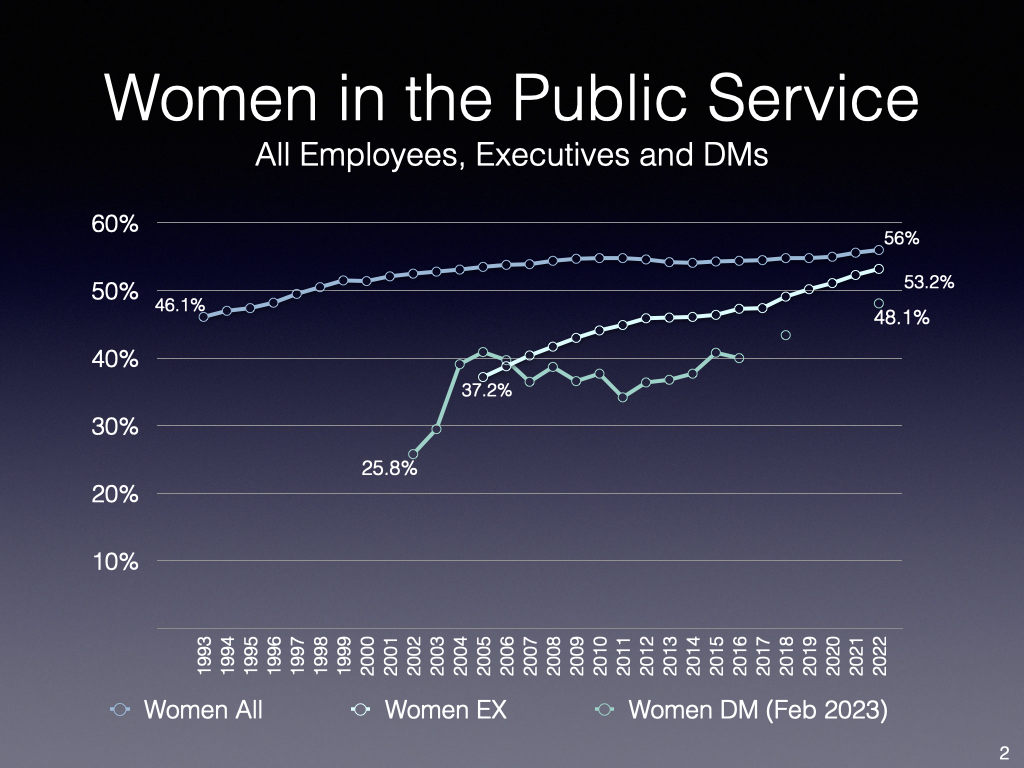
Of note. When I last looked at EX breakdowns a number of years ago, there was, as one would expect, greater representation at more junior levels (directors and DGs EX1-3) than at the ADM level (EX4-5):

Less than one in three senior civil servants across the governments of G20 countries are women, new research from Global Government Forum has found.

The latest Women Leaders Index found that only one G20 country – Canada – has reached gender parity in the top five grades of its public service (at 51.1%), and just four more are within 10 percentage points of doing so.

However, there has been improvement – the G20 mean (29.3%) has increased by 1.6 percentage points since our last Index in 2020 and by 6.0 points since our first 10 years ago.

The long-running Women Leaders Index is a league table ranking G20, EU and OECD countries on the proportion of women in senior roles within their national civil services. As well as tracking progress over time, it includes comparisons with women in government, women politicians, and women on private sector boards, alongside interviews with public service leaders in two of the top performing countries – Canada and South Africa.    

Those leading the G20 pack behind Canada, are Australia and South Africa – which tie in second place – the UK, Brazil, and Mexico and the European Commission, which tie in fifth place. Mexico has increased the representation of women in civil service leadership positions the most of all G20 nations, by a dramatic 24.3 percentage points over the last decade, while South Africa has made the most improvement in the two years since the last Index – a jump of 7.2 points.

Bringing up the G20 rear are Saudi Arabia, Japan, South Korea, China and Turkey, in which representation of women in the senior civil service is between 2.5% and 11.7%.

Countries including Germany, Italy, France and the US reside in the middle of the G20 ranking, with women accounting for between 32.0% and 38.0% of top roles in each.   https://datawrapper.dwcdn.net/rr33B/4/

EU and OECD countries faring better than those in the G20  

Though the G20 has traditionally been the main ranking in the Women Leaders Index, it also analyses representation of women in the highest grades of national civil services in EU and OECD countries.

The Index found that overall, EU and OECD countries are doing better on representation of women in senior positions in government departments and agencies – for which the mean proportions are 42.7% and 36.2% respectively – than those in the G20*.

The mean across the European Union’s member states has improved by 0.8 percentage points since 2020, and by 7.5 points since 2012, with nine of the EU’s 27 member states having reached gender parity in the top two tiers of their civil services. Bulgaria tops this ranking, with women accounting for 59.5% of those running government departments, followed by Croatia, Slovenia, Greece, Finland, Latvia, Romania, Lithuania, and Portugal.https://datawrapper.dwcdn.net/GU3A7/4/

Read our Canada perspective from seasoned public service leader Yazmine Laroche, including transferable lessons on how to make progress towards gender parity

Croatia has made the most improvement of all EU nations since 2012 – a rise of 21.1 percentage points, while Bulgaria has made the greatest improvement since the 2020 Index, of 7.8 points.

Latvia, where women account for 56% of the top tiers of its civil service, tops the OECD ranking, while six more – Sweden, Iceland, New Zealand, Greece, Canada and Slovakia – have reached or exceeded gender parity.https://datawrapper.dwcdn.net/wpOb5/2/

Regression in some countries – but public services performing better overall

While most G20, EU and OECD countries have improved the representation of women in the highest grades of their civil services in recent years, some have regressed.

The G20 data shows that in Russia and Argentina there are fewer officials in senior positions now than in 2020, while China, Turkey and South Korea have regressed since 2012.  

Six EU countries – Sweden, Poland, Cyprus, Italy, the Czech Republic and Luxembourg – perform worse in terms of representation of women in the top two tiers of the civil service since 2020, while Hungary is worse off now than 10 years ago.  

However, on a positive note, when looking at the means across the G20, EU and OECD, it is clear that civil services are doing better on representation of women in leadership roles compared with ministerial cabinet appointments, elected politicians and the boards of publicly-listed private sector companies.

Read our South Africa perspective from Zukiswa Mqolomba, deputy chairperson of the country’s Public Service Commission, on why making real and positive change isn’t just a numbers game

“Many governments have made impressive gains on representation of women in leadership positions in recent years as a result of concerted efforts to make change and should be applauded,” said Mia Hunt, author of the Women Leaders Index report and editor of globalgovernmentforum.com. 

“However, while it is widely accepted that civil services with diverse workforces that resemble the populations they serve turn out better policies and better outcomes for citizens, the mean proportion of women in top civil service positions across G20 nations is still less than 30%. Clearly, there is much more work to be done.

“We hope this Index gives the countries that have made progress the recognition they deserve, whilst serving as a wake-up call for those most in need of improvement. Let us see what’s changed when we publish the next in this Women Leaders Index series.”

*Please note that grade definitions vary between the G20, EU and OECD datasets. Caution should be exercised when making comparisons – see methodology here.

Source: Proportion of women civil service leaders improves internationally – but only one G20 country has achieved gender parity in top jobs

The public service’s biggest disruption in decades : hybrid work

Happy I’m retired. That being said, I tried to work from home one day every week or two weeks to prepare presentations or thought pieces, away from the transactional files (but of course remaining available as need be).

In some cases, such as coordination with regions, being virtual placed NHQ on the same footing and improved engagement compared to the tedious phone conference calls, according to some colleagues and friends who worked during the pandemic.

But understand employee preference as well as political and management concerns regarding appearances, after all, those who can work from home are privileged compared to those in front-line service, whether public or private sector:

The return-to-work pushback of Canada’s public servants could lay the groundwork for the most radical change in the federal government’s relationship with its employees in a century.

The resistance reveals a grassroots shift taking place in the public service that’s all about power and control.

The public service is one of the most hierarchical employers in the country. It has operated the same way for decades. Management decides everything about staffing; how and where people work. Employees have little choice but to toe the line.

The pandemic that sent public servants home to work challenged that hierarchy by giving federal employees a taste of controlling their time and job location – factors that had been largely out of their hands.

After more than two years of working remotely, public servants like it and resent the idea of giving up the newfound control of time. They feel more productive, enjoy better work-life balance, have more child-care options. It’s also cheaper: no commuting, no parking, no restaurant or takeout lunches.

And for the first time, they had control of their space. No more cubicles. Hundreds took jobs without having to move to Ottawa and many others picked up and moved around the country.

But that flexibility has come with a price, and no city has felt the pinch like Ottawa, the nation’s capital and home to most departmental headquarters. The Ottawa Board of Trade estimates one-quarter of the city’s workforce worked downtown pre-pandemic and 55 per cent of those downtown workers were public servants sent home, leaving ghost offices behind. (A CBC radio broadcast on Aug. 25 talked about the topic.)

It also forced the biggest rethink of the future of work and the government’s relationship with employees as it officially shifted to a hybrid workforce this fall.

It will not be an easy ride.

Lori Turnbull, director of the school of public administration at Dalhousie University, called the shift to a hybrid workforce the most disruptive change in decades.

The public service has had its share of disruptions over the years – unionization and collective bargaining in the 1960s, massive downsizings and restructuring in the 1990s, the Y2K bug, 9/11, even the disastrous Phoenix pay system. This, however, could be as seismic a shift for the employer-employee relationship as when patronage was abolished a century ago and replaced with the merit system for the hiring and promotions of public servants.

“As far as disruptions go, this is the biggest one in decades, if not ever, because it’s a completely different ballgame when it comes to relationships, and how people manage their lives,” Turnbull said.

Turnbull said remote work gave workers flexibility and the value of that newfound freedom flowed more to their personal lives than their work lives. The government can’t expect to “put that genie back in the bottle,” without a fight, she said.

“Now, people, even the lowest rungs of the organization and seen as the least powerful, were given the sense of autonomy about their time and space and that is having fundamental repercussions on how the organization and management works,” said Turnbull.

The big question is whether the return-to-office will end this flexibility or will it spark worker rebellion? Before the pandemic, the thought of working only two days at the office was beyond the wildest of dreams. Today, it’s not flexible enough.

Public servants are openly voicing their displeasure about returning to the office. A growing number are mobilizing internally, speaking out on social media, signing petitions and writing letters to MPs. Some are resorting to access to information requests to get to the bottom of the decision to send them back.

Employees who want to work remotely feel the return-to-work guidelines are arbitrary and imposed top-down from management with no rationale. They feel unheard and that there is no evidence supporting why employees have to spend specified days in the office unless to satisfy political pressures, said one union official who is not authorized to speak publicly.

“If there’s a need to have public servants in the office, what is it?” the official said. “What we’re seeing right now is people being called back for the sake of being called back for political reasons.”

It will be a top issue at the bargaining table. Unions are hoping to enshrine remote work provisions into the collective agreement to give employees more say in determining where they work. Just as important is inflation, and unions, which are emboldened by a global talent shortage, are asking for big raises.

The unions’ long game is that employees will permanently have the option to work remotely. That’s a big and controversial change, however, which would mean rewriting rules, policies and collective agreements. Not to mention that Treasury Board President Mona Fortier has already said working at home is a privilege, not a right. She insists Treasury Board won’t give up its power to organize the workplace, including where employees work.

Unions hope to find some negotiating room around where public servants work. They also want less arbitrary decisions about who can work from home and what they can do remotely. That could mean explanations in writing beyond the blanket “operational requirements” that workers are hearing.

Turnbull warns a workforce feeling management exercises too much control over their time can breed mistrust and resentment that undermines productivity.

But flexibility is unknown territory for the government. More than any other employer, it has little experience with flexible work models. A study by Jeffrey Roy showed that the senior echelons are most comfortable with the traditional in-person office model – from ministers’ offices to deputy ministers and central agencies.

Flexibility on where people work opens a pandora’s box of issues. What happens to the value of work? How does it affect the 7.5-hour work day, overtime and pay? How are employees accountable when they no longer report to the office? How to track productivity, performance or deal with discipline when working from home.

Meredith Thatcher, cofounder and workplace strategist at Agile Work Evolutions, said the unfolding workplace evolution will depend on the “maturity and skills of the individual managers and whether they have the trust of their employees.”

“It is a societal earthquake that has happened, and the fallout will be years to come,” she said. “Assuming everyone will just fall in line and return to the office either full-time or mandated time is naive. The world of the office has shifted on its axis and many executives have not figured that out yet.”

But Donald Savoie, a leading public administration expert at University of Moncton, argues there is a lot more at stake than flexibility. Back in 2003, Savoie wrote Breaking the Bargain, about the unravelling of the traditional bargain underpinning the relationship between politicians and public servants.

He says public servants also have a bargain undergirding their relationship with Canadians. The public is losing confidence in the public service and its ability to deliver services – crystalized by a summer of chaotic delays at airports and passport offices.

He said Canadians are discontent with government, and populist leaders like Pierre Poilievre and anti-institution protest groups are tapping into that mistrust. He said a public service griping about going back to the office is ripe for attack.

Many see public servants asking for the freedom of an independent contractor or entrepreneur to work when and where they want while keeping the job security, pay and benefits few other Canadians enjoy.

“My advice to federal public servants: think about the institution. Think of the public service, not just your self-interest. There’s something bigger at play here. It’s called protecting the institution that you’re being asked to serve. I think too many federal public servants have lost sight of that.”

And Turnbull said Privy Council Clerk Janice Charette, a head of the public service, bears a big responsibility for the institution. She’s out in front urging departments to get employees back to the office.

“The clerk has to worry about the reputation of the public service and the sense that they have been given too much flexibility and now we see services crumbling. Even if there’s no truth to that the perception, it’s something she has to worry about,” said Turnbull.

Source: The public service’s biggest disruption in decades : hybrid work

‘Be an ally’: Black public servants facing ‘trauma’ amid class action, says organizer

Thompson is an effective communicator and advocate.

Unfortunately, the employment equity data for the public service does not indicate that Black public servants representation are disproportionately under-represented at the EX and other levels compared  to other visible minorities for the most part.

However, the public service employee survey does show higher perceptions of discrimination than most other visible minority groups.

One of the organizers behind the class action lawsuit filed against the federal government by Black public servants says he wants Canadians learning about the experiences of claimants in the case to “be an ally” amid a process that is causing “trauma” for those involved.

In an interview with The West Block‘s Mercedes Stephenson, Nicholas Marcus Thompson said the government is “speaking from both sides of its mouth” when it comes to squaring the treatment of claimants in the lawsuit in court with the comments officials make publicly about dismantling racism.

“They’re saying one thing publicly and they’re fighting Black workers in court,” he said, adding federal lawyers keep bringing forward motions “to delay the case.”

“The government has fully acknowledged that this issue exists in all of its institutions and that the pain and damage that it causes is real. And then it shows up in court fighting Black workers, forcing Black workers to recount the trauma that they’ve endured at the hands of the government for decades.”

The class action lawsuit filed last year alleges systemic discrimination by the government when it comes to hiring and promotional decisions in the federal public service, dating back decades.

Plaintiffs in the case are seeking $2.5 billion in compensation for lost income, opportunities, and lost pension values as a result of systemic discrimination that prevented qualified Black public servants from being promoted into higher paying and more senior jobs.

Federal public service pensions are calculated based on the averages of an individual’s highest earning years, meaning those who get paid less throughout their careers get smaller pensions when they retire.

“There has been a de facto practice of Black employee exclusion from hiring and promotion throughout the Public Service because of the permeation of systemic discrimination through Canada’s institutional structures,” the statement of claim says.

The statement of claim also says that equity measures taken to date have “merely masked the increasing disparity, exclusion and marginalization of Black Canadians” from equal opportunities in the public service, and that there remains a “pernicious” underrepresentation in the upper ranks.

Thompson said he wants to see the government come to the table and commit to working towards the solutions that plaintiffs say would help fix the problem, and to make legislative changes to the Employment Equity Act as well.

“We’re seeking to create a separate and distinct category for Black workers under the legislation to ensure that Black workers are not left behind when it comes to hiring and promotional opportunities,” he said. Thompson also added there needs to be a commission formed to track concrete progress on preventing future discrimination.

“Black people want to fully participate and they’re being denied that opportunity at the highest level and the largest employer in Canada,” he said.

“So listen to us. Be an ally and let’s work together because we want to make Canada a better place and to fully participate in Canada.”

Source: ‘Be an ally’: Black public servants facing ‘trauma’ amid class action, says organizer

Clerk Report to PM 2022 – Service Delivery Language [more candour required]

Like all government reports (save audits and evaluations), the Clerk report focuses on successes, not failures. Certainly, COVID financial support and vaccine procurement are right to be highlighted as overall successes, as are ongoing efforts to increase diversity and representation, as highlighted in the report and data tables.

But its characterization of how the government responded to Afghan refugees following the Taliban takeover presents a far more positive picture than warranted, to be diplomatic.

But looking ahead, curious to see how the recent failures of government service delivery (i.e., passports and immigration) will be treated in the 2023 report, given this 2022 commitment:

Deliver results for Canadians.

We have clearly shown the Public Service’s ability to step up and overcome every obstacle to get things done and deliver real results for Canadians. We have proven what we can do during times of crisis and we have learned much from this. But this has also disrupted our usual lines of work. Now, we must apply what we have learned to how we approach everything —from delivering core programs and services to responding to unexpected challenges. We must build on our enhanced capacity to deliver digitally while holding true to the importance of providing in-person support, to ensure every Canadian gets the service and results they need in a timely manner. Public servants should feel empowered to ask how things could be done better, and they should be supported in taking thoughtful risks in how we implement to achieve results for Canadians. The lessons we learned from the pandemic will help us get there.

Certainly, some honesty regarding the public service service delivery failings will be needed for the 2023 report’s (and Clerk’s) credibility.

To be mischievous, I redrafted this paragraph for the 2023 report to encourage drafters of next year’s report to be more candid regarding areas where the government had significant policy and program failures (“challenges” in bureaucratese):

Deliver results for Canadians – Lessons learned from program failures

We have clearly shown the Public Service’s (in) ability to step up and overcome every obstacle to get things done and (fail to) deliver real results for Canadians. We have proven what we can do during times of crisis (and what we cannot do) and we have learned much from this (particularly from failures in passport and immigration service delivery). But this has also disrupted our usual lines of work. Now, we must apply what we have learned (from successes and failures) to how we approach everything —from delivering core programs and services to responding to unexpected challenges. We must renew focus on service delivery in order to restore trust. We must build on our enhanced capacity to deliver digitally, including real time status updates and greater transparency, while holding true to the importance of providing in-person support (including reducing waiting times and lines), to ensure every Canadian gets the service and results they need in a timely manner. Public servants should feel empowered to ask how things could be done better (without penalty), and they should be supported in taking thoughtful (to be defined) risks in how we implement to achieve results for Canadians. The lessons we learned from the pandemic (service failures) will help us get there.

Source: 29th Annual Report to the Prime Minister on the Public Service of Canada

Myles: Le bilinguisme avant la réconciliation

A Quebec perspective on the government discussion draft on possibly exempting Indigenous Canadians from the public service bilingualism requirement:

Selon des informations obtenues par La Presse canadienne, de hauts fonctionnaires fédéraux étudient la possibilité d’accorder une exemption à l’exigence de bilinguisme à leurs employés qui parlent une langue autochtone, mais qui ne maîtrisent pas l’anglais ou le français. Aucune décision n’a été prise, mais le gouvernement Trudeau ferait mieux d’y penser deux fois avant de s’engager sur cette voie.

Une note obtenue par La Presse canadienne fait état de « tensions croissantes » au sein des fonctionnaires fédéraux autochtones qui ne maîtrisent pas les deux langues officielles du Canada. Environ 400 d’entre eux ont exprimé leur souhait d’obtenir une exemption générale aux exigences de bilinguisme dans la fonction publique fédérale. La Gouverneure générale, Mary Simon, a été citée en exemple par une sous-ministre à Patrimoine canadien. Mme Simon parle l’inuktitut et l’anglais, mais pas le français, une langue qu’elle a promis d’apprendre lors de sa nomination. À son sujet, l’heure des bilans est prématurée quoiqu’il soit permis de douter qu’elle puisse faire des progrès significatifs, à l’aube de ses 75 ans.

Le ministre des Relations Couronne-Autochtones, Marc Miller, a joué de prudence en commentant le sujet délicat de l’exemption de bilinguisme des fonctionnaires autochtones. « Quand on prend ce genre de décision, c’est presque toujours au détriment du français, a-t-il dit. Ce n’est pas quelque chose qu’une majorité de gens trouveront acceptable. »

Le ministre Miller a dit tout ce qu’il fallait pour prendre une décision éclairée. En matière de dualité linguistique, les assouplissements se font inévitablement au détriment du français. On tolère bien les juges unilingues anglophones à la Cour suprême, mais accepterait-on un juge unilingue francophone ? L’histoire de ce beau pays bilingue, au sein duquel une langue est plus officielle que l’autre, regorge d’exemples où le français est déconsidéré dans la prestation de services et de travail par les institutions fédérales.

Au nom de la réconciliation avec les Autochtones, le gouvernement Trudeau avait sans doute de bonnes raisons de faire de Mary Simon la première Gouverneure générale inuite dans l’histoire du Canada. Que dire de sa décision subséquente de nommer une lieutenante-gouverneure unilingue anglophone, Brenda Murphy, dans la seule province officiellement bilingue du pays, le Nouveau-Brunswick ? Encore là, l’inverse aurait été impensable. Pour couronner le tout, les libéraux de Justin Trudeau n’acceptent pas le jugement d’un tribunal du Nouveau-Brunswick qui a déclaré inconstitutionnel le processus de nomination de Mme Murphy, justement parce qu’elle ne maîtrisait pas le français. Ottawa a choisi de porter la cause en appel, si bien qu’il faut se questionner sur la valeur symbolique de tels gestes.

En nommant avec autant de désinvolture des unilingues anglophones à des postes clés de l’appareil étatique, le premier ministre, Justin Trudeau, libère les voix dissidentes qui se moquent de la Loi sur les langues officielles. À la moindre difficulté, « c’est le français qui prend le bord », fait remarquer le porte-parole du Bloc québécois en matière de langues officielles, Mario Beaulieu.

Malgré les nobles intentions et les boniments d’usage sur le bilinguisme du Canada, les francophones ne sont pas dupes de l’inégalité de rapports de force dans la fonction publique fédérale. Selon une compilation récente de Radio-Canada, les postes de sous-ministres et de sous-ministres associés sont occupés par des anglophones quatre fois sur cinq. Le poids des hauts fonctionnaires francophones (19 %) est inférieur à leur poids réel dans la population (23 %). Le bassin de fonctionnaires francophones (31 %) rend encore plus incompréhensible leur faible représentativité dans les postes d’influence.

Les conséquences ne surprendront guère. Une « insécurité linguistique » plombe l’usage du français dans les officines fédérales à Ottawa, à Gatineau et à Montréal. Pas moins de 44 % des fonctionnaires francophones sont mal à l’aise d’utiliser leur langue première sur les lieux de travail, par crainte d’être jugés, d’être mal compris par leurs supérieurs ou d’exiger des efforts de compréhension supplémentaires de leurs collègues anglophones. Le constat provient d’une source fiable : le Commissaire aux langues officielles du Canada. Voilà l’état de cette maison bilingue irréformable.

Les critiques rappelleront que les Autochtones sont encore plus sous-représentés que les francophones dans la fonction publique et que leur accorder une exemption est un moindre mal dans la perspective d’une réconciliation avec les peuples autochtones. La réconciliation, nous en sommes. Elle sera nettement plus féconde et durable si elle englobe les deux « peuples fondateurs » de jadis, aux côtés des Autochtones. Ceux-ci sont bien placés pour comprendre les risques et périls qui guettent les langues en situation de minorité. Ce n’est rien leur enlever que de maintenir les exigences de bilinguisme dans la fonction publique, quitte à leur donner du temps et du soutien pour qu’ils puissent avoir la possibilité de s’ouvrir au français avec la même générosité qu’à l’anglais.

Source: Le bilinguisme avant la réconciliation

Ottawa should offer Indigenous-language training, exemptions to public servants, memo says

Easier to see from a service perspective in certain localities where numbers warrant but does pose significant operational challenges. The risk of an exemption, of course, is that it may provoke further requests for exemptions:

Senior civil servants explored offering Indigenous-language training to federal employees and possible exemptions to those who already speak one from requiring fluency in both English and French, newly released documents show.

Deputy ministers from several departments discussed the issue last fall.

A memo, released to The Canadian Press under federal access-to-information laws, flagged a “growing tension” between official-language requirements and Indigenous languages.

Under Canada’s Official Languages Act, federal institutions must offer working environments for employees to communicate in both French and English, and offer services to Canadians in either language.

As such, communicating in both is expected for senior executives and there are a number of public-service jobs where bilingualism is mandatory. There is room, however, for an employee to take classes and learn French or English as a second language.

The memo issued last fall said a working group was held about making changes to the official-language requirements. It said some Indigenous public servants belonging to a network of around 400 who work for the federal government asserted the need for a “blanket exemption.”

“My own personal view is there are opportunities for exemption – if the individual speaks an Indigenous language,” Gina Wilson, a deputy minister who champions the needs of federal Indigenous public servants, wrote in an e-mail to colleagues last November.

“Our GG [Governor-General] is a good example.”

Inuk leader Mary Simon’s appointment in 2021 sparked a discussion – and some controversy – over bilingualism in Canada’s highest offices, given how Ms. Simon, the first Indigenous person named as Governor-General, spoke English and Inuktitut, but not French.

Ms. Simon, who was born in Kangiqsualujjuaq, in the Nunavik region of northern Quebec, said she attended a federal day school and wasn’t able to learn French.

She committed to doing so after her appointment and has been taking lessons, delivering some French remarks in public speeches.

Commissioner of official languages Raymond Théberge said more than 1,000 complaints about Ms. Simon’s lack of French were lodged with his office after Prime Minister Justin Trudeau named her to the role.

Language training has been identified as one of the issues preventing Indigenous employees in the federal public service from advancing in their careers.

A report authored by public servants around the celebration of Canada’s 150th anniversary recommended those who are Indigenous be exempt from official-language requirements and instead be provided with chances to learn the language of their community.

It’s unclear if Ottawa plans to move ahead on changes to language requirements, training or exemptions.

A spokeswoman for Crown-Indigenous-Relations and Northern Affairs Canada said both that ministry and Indigenous Services Canada “have no plans to offer departmentwide Indigenous language training,” noting employees have offered workshops in the past.

It said Indigenous employees are encouraged to talk to their managers about language training.

Crown-Indigenous Relations Minister Marc Miller, an anglophone who speaks French and is learning Mohawk, said in an interview that the idea of an exemption is a sensitive issue.

“Inevitably, when you have to make one of those decisions, it is more often than not, and almost always, at the expense of jettisoning French,” said Mr. Miller, who represents a riding in Montreal.

“I don’t think that’s something that most people would find palatable … there are resources to learn it and I think there is the availability to do so.”

In their talks last fall, senior officials proposed ways to address concerns from Indigenous public servants about languages.

Ideas included providing more time to learn a second language and even offering Indigenous-language training, including to non-Indigenous public servants, as a show of reconciliation.

“I certainly recall during my French classes having this nagging thought in the back of my mind that I would be so much more open to this if I had the opportunity to be given training in my own Algonquin language,” Ms. Wilson wrote in her e-mail.

“I had a pretty good base in both, but of course my French is much better than my Algonquin now.”

Mr. Miller said he supports the idea of Ottawa providing classes, particularly to Indigenous public servants who were not provided the chance to learn these languages for themselves.

He said one challenge to doing so would be making sure Ottawa wasn’t taking language teachers away from communities.

“When you look at the fragility of Indigenous languages across the country, you would not want to be in a circumstance where we’re taking really valuable assets … people in many circumstances that are quite older, and just walking dictionaries out of their communities where communities are struggling to regain their languages.”

The same concern was highlighted by government officials. Both they and Mr. Miller said Ottawa faces calls to ensure it provides services to Inuit in Inuktitut.

“We could do better on that,” he said.

One change Lori Idlout, Nunavut’s federal member of Parliament, said should happen – and which officials also pitch in the memo – is for Ottawa to extend the $800 annual bonus it pays to employees who are bilingual to those who speak an Indigenous language.

The representative says she’s been approached by a union about federal employees in Nunavut who speak Inuktitut but are unable to access the compensation because they are not bilingual in French.

“Meanwhile, they’re providing valuable services to Inuit in Inuktitut,” she said. “It’s a huge issue.”

Ms. Idlout said Nunavut residents face many barriers when it comes to accessing federal services in general, including in Inuktitut.

According to the memo, officials recommend the government explore a pilot in Nunavut where jobs that require they speak Inuktitut “would not require competency in a second official language.”

Source: Ottawa should offer Indigenous-language training, exemptions to public servants, memo says

Diversity of UK senior civil service falls, rises at lower grades

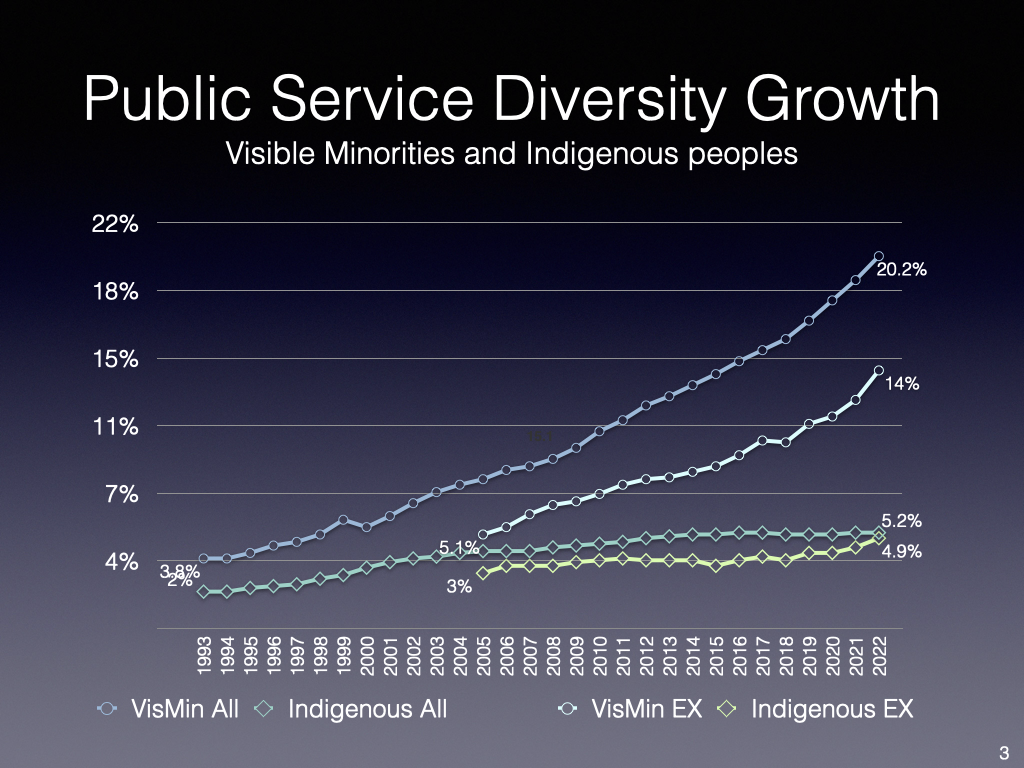
Of note. Canadian figures by way of comparison, all visible minorities 18.9 percent, executives 12.4 percent, EX-4 10.1 percent, EX-5 9.2 percent (EX-4 and 5 likely equivalent to senior UK public servants):

The percentage of UK civil servants from an ethnic minority background is at a record high, according to the latest figures, but the proportion in top jobs has fallen for the first time since 2015.

Official figures for 2022 revealed that, of those with a known ethnicity, the percentage of government officials who are from an ethnic minority background is at a record high of 15.0% – up from 14.3% in 2021, and 9.3% a decade ago.

There was a year-on-year increase at all grades, with the exception of the senior civil service – the group of officials who run government departments or hold other top posts. In this group, there was a year-on-year decline from 10.6% in 2021 to 10.3% in 2022.

Percentage of civil servants from an ethnic minority background by grade 2012 to 2022

Civil Service Statistics 2022

The government had previously pledged to increase the percentage of senior civil servants who are from an ethnic minority year-on-year to reach 13.2% in the three year period from 2022 to 2025. However, in its Diversity and Inclusion Strategy: 2022 to 2025, published earlier this year, the government said it had stopped using targets to measure progress. “We will mainstream our success measures with our broader organisational priorities, such as Places for Growth [the plan to move officials out of London and into the regions of the UK], senior civil service workforce planning, talent schemes and recruitment priorities. Rather than relying on standalone targets, our ambitions will be embedded in these key deliverables designed to improve our delivery for citizens. Where our data indicates progress is not being made, action will be taken,” the strategy said.

The strategy made only one mention of people from ethnic minority backgrounds, stating: “We will make sure that people from minority ethnic backgrounds, those living with disabilities and those who have experienced disadvantage in their early lives can flourish in public service.”

Source: Diversity of UK senior civil service falls, rises at lower grades