Ifill: Bureaucratic efforts are just ‘diversity’ icing on a white cake

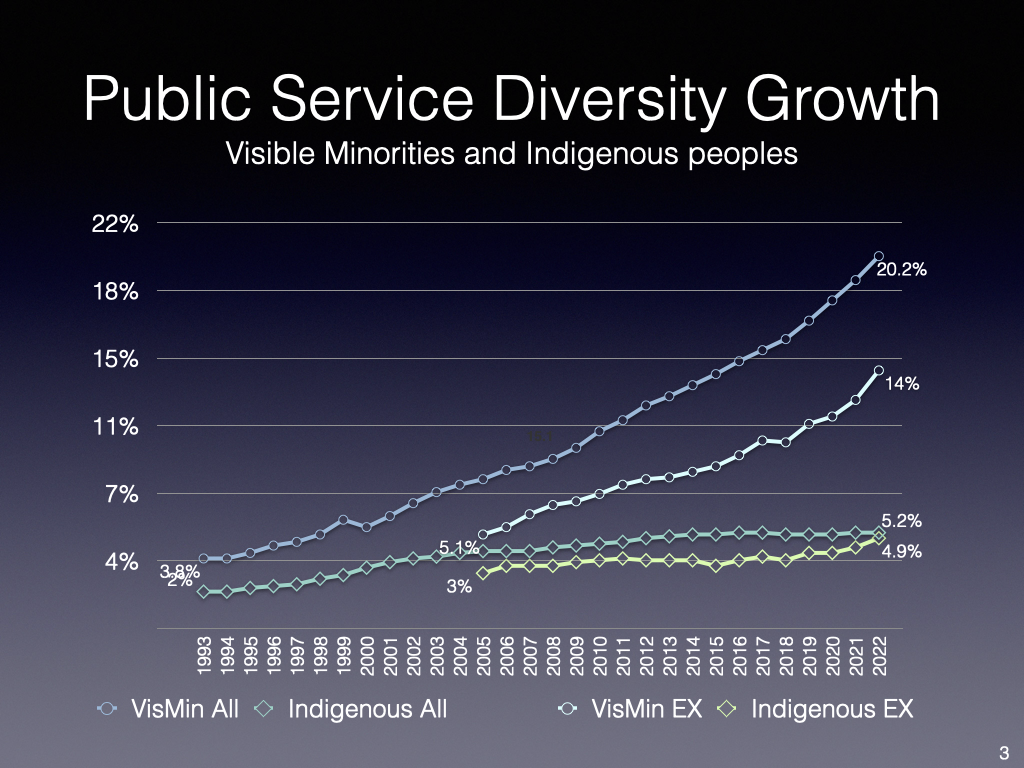
The overall data, of course, shows marked improvement in the past six years in which desegregated data by equity group, particularly for visible minorities and within visible minorities, for Black public servants including executives.

Somewhat unserious to ignore this data…

Calling for DMs to be replaced may feel good but is unrealistic, and she clearly has little understanding about how government and the public service work and that change, albeit too slow for some, occurs within a bureaucratic context.

As for the call for action, I also tend to be somewhat cynical as it appears to be adding yet another reporting requirement and it is too early to assess whether it has moved the needle beyond process:

In the months following the murder of George Floyd in 2020, and the global protests against police brutality and anti-Black racism that lasted the summer of that year, every corporation and government agency vowed to improve the economic lot of Black people by introducing watered-down diversity, equity, and inclusion (DEI) practices. Naturally, I was skeptical, considering my own experiences in the public service with anti-Black racism. I knew that nothing but transformative change led by Black and Indigenous people would suffice. As I wrote in this paper in February 2021, the Privy Council Office clerk’s effort was “a diversity and inclusion endeavour, dressed up as anti-racism. Devoid of an accountability framework, it makes no tangible effort to interrogate the systems that perpetuate racism.”

Two-and-a-half years later, the anti-Black racism measures the Liberals introduced for the public service are as good as six feet under. In the 2021 mandate letter to then-Treasury Board president Mona Fortier, the prime minister directed her to establish “a mental health fund for Black public servants and supporting career advancement, training, sponsorship and educational opportunities.” A year later, Black public servants involved in the fund blew the whistle on the racism they experienced while working on an anti-racism measure. As the Canadian Press reported last December, “The Federal Black Employee Caucus [FBEC] sent a letter to the Treasury Board’s chief human resources officer this month saying the workers supported efforts to address racism within the public service, only to be ‘continuously faced with the crushing weight of it.’”

I feel for those who worked so hard to make these initiatives happen. Countless hours and emotional labour have been added to the workload of many racialized employees for free, only for them to experience more racism. The CBC reported on the treatment of Black employees as outlined in FBEC’s letter to the Treasury Board Secretariat: “The email alleges that senior Treasury Board Secretariat officials created a toxic workplace culture. When the Federal Employee Black Caucus members pushed back, the email states, they were met with micro-aggressions and ‘character assassinations.’”

And those experiences bear out in evidence provided by the auditor general.

On Oct. 19, Auditor General Karen Hogan tabled the semi-annual report on performance audits of the public service—and government writ large—to the House of Commons in a series of nine parts. Report 5 looked at Inclusion in the Workplace of Racialized Employees, and it is not kind. It determined that “Canada’s efforts to combat racism and discrimination in major departments and agencies are falling short,” as reported by the Canadian PressThe AG selected a sample of six organizations“responsible in whole or in part for providing safety, the administration of justice, or policing services in Canada. Together, they employ about 21 per cent of workers in the federal core public administration.” Note that 20 per cent of the public service is racialized.

Let’s look at the highlights from the report:

  • Racialized employees reported rates of discrimination at least 30 per cent higher than non‑racialized respondents;
  • The organizations all established DEI plans to correct the conditions of disadvantage experienced by racialized employees, but failed to develop and institute accountability measures (I called this: “A system without accountability is a corrupt one, and in this system there is no justice”);
  • They failed to collect or use data to assess progress on their plans, and failed to create, assess and implement key performance indicators; and
  • No specific initiatives in action plans to address concerns and complaints related to barriers to raising instances of racism.

So basically, the public service wasted everyone’s time with this theatrical performance of DEI icing on a white cake, as I said they would. But it’s no surprise considering that we’re led by a performative government.

Furthermore, if the public service has discriminated against you, the institutions set up to “help” you only double down on that discrimination. As the Canadian Press reported in March, “The Treasury Board Secretariat found last week that the Canadian Human Rights Commission [CHRC], whose mandate is to protect the core principle of equal opportunity, discriminated against Black and racialized employees.”

Remember the Black Class Action lawsuit? The Trudeau government is still trying to ignore the problem by refusing to negotiate while attempting to get the case dismissed. In response to the CHRC discriminating against Black employees, the Class Action Secretariat said, “It also raises concerns about the CHRC’s capacity to offer justice to the broader experiences of Black workers across the entirety of the federal public service who share similar stories and experiences for over 50 years.”

This is how racism is systemic, systematic, and institutional. I have written about how racism within institutions carries over into public policy. Remember the three words: “the dirty 30.”

There is no reason to trust these corrupt systems that are intended to keep Black and racialized employees in subservient positions to white, male, heterosexual power. Deputy ministers have shown us, through action, that they are unserious “leaders” who are comfortable with overseeing abusive, toxic environments that increase the burden of performance on their employees, according to race. Seems discriminatory in itself.

Those who do not follow the directives from mandate letters and budget direction are committing insubordination, and are undermining political decisions. They should be removed from their positions. Deputy ministers are only supposed to oversee the implementation of policy; they are unelected administrators, not representatives elected by the people. Therefore, their decisions cannot supersede those political directives. Do we really want deputy ministers quietly subverting democracy just because they don’t like particular groups of people?

Source: Bureaucratic efforts are just ‘diversity’ icing on a white cake

Heintzman and MacQuarrie: Dialogue on public service more important than ever

Of note:

Given the state of the world these days, the recent announcement by Clerk of the Privy Council John Hannaford creating a “task team” of deputy ministers on the values and ethics of public service may seem frivolous. 

But we believe the clerk’s initiative is significant with the potential to influence the quality of our democracy for a generation.  

Canada’s public service is an important national institution, one of the key pillars of our parliamentary democracy. As we watch the erosion of democratic institutions elsewhere, the condition of our federal public service, and the quality of its democratic vocation, should concern all of us.

The clerk’s initiative recognizes that recent events show the federal public service faces some major performance challenges that call for a new effort of renewal. To make wise choices for renewal, you must know who you are, what a public service is for, and what it should be. Without this conscious awareness, a public service can easily fall short of its distinct standards of professionalism and service

The clerk’s initiative recognizes that recent events show the federal public service faces some major performance challenges that call for a new effort of renewal. To make wise choices for renewal, you must know who you are, what a public service is for, and what it should be. Without this conscious awareness, a public service can easily fall short of its distinct standards of professionalism and service.

Hannaford’s announcement comes exactly 30 years after the creation of a celebrated task force on public service and ethics under the leadership of John Tait, the former federal deputy minister of justice. The “Tait Report” set the agenda for public service values and ethics for a generation.

But times change. Every decade brings its own issues which challenge a public service to rediscover its distinctive identity as a “compass” (the clerk’s word) to guide direction for the future. He has asked the new task team to lead a “broad conversation” on how to bring the public service’s values and ethics “to life within a dynamic and increasingly complex environment.”

We think there are three conditions for the team’s success.

First, the “conversations” with public servants and others must take the form of what the Tait Report called “honest dialogue” about problems like these, among other things:

  • Performance: the federal public service has recently lost its reputation for providing timely, citizen-centred service to Canadians;
  • Trust: the civil service no longer enjoys the automatic trust and legitimacy that is essential to our democracy;
  • Boundaries: the public service has not yet acquired or sought the tools for drawing a line between the values and accountability of elected and non-elected officials, as recommended by the Gomery Report and others;
  • Accountability: public service leaders do not appear to take accountability for their own shortcomings, including the enormous expansion of the public service over the last decade and declining efficiency, and; 
  • Technology: the civil service has notoriously mismanaged implementation of digital technology, and has not yet brought public service values seriously to bear on public servants’ use of social media and artificial intelligence.

These are the kinds of real problems the task team’s “conversations” with public servants and others should openly confront if its work is to have legitimacy. 

Second, this dialogue should not be rushed. Nothing will be accomplished by simply repeating the public service’s stated core values. To recover their motivating power and urgency, public service values must reemerge from honest dialogue, modelled by the task team itself, about the problems at hand.

Third, the “conversation” must go beyond the public service to include parliamentarians. This is the unfinished business from the Tait Report. Tait recommended a dialogue about public service values should engage ministers and MPs, leading to a new “moral contract between the public service, government and Parliament of Canada.” The state of the federal public service is not just a concern for the government of the day. The quality and honesty of its advice and its ability to deliver programs and service efficiently and effectively are important to us all.

The current federal political context makes this kind of dialogue—about the kind of public service we need to support our parliamentary democracy—more urgent than ever. Now is the time. And the Clerk of the Privy Council has just set the table.

Ralph Heintzman and Catherine MacQuarrie are former senior public servants, and both served as head of the federal government’s Office of Public Service Values and Ethics.

Source: Dialogue on public service more important than ever

Annual public service report to PM should prompt ‘serious conversation’ about bureaucracy’s future, says former PCO clerk Wernick

Civil service renewal is ‘fairly low down on the political radar screen,’ says bureaucracy expert Andrew Griffith. 

Begs the question, if nobody in Parliament is paying attention, what is the value of the report? Part of the problem, as in many (most?) such reports, is the lack of frank language on failures and challenges and general bureaucratic tone (been responsible for comparable reports).

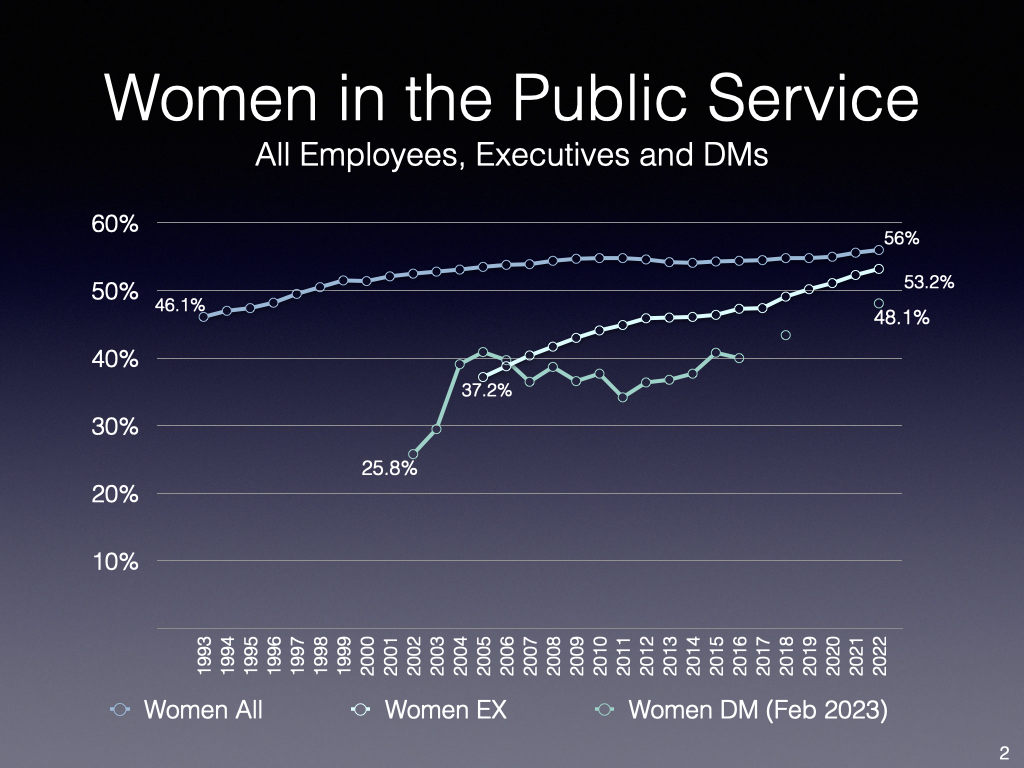
My comments on the relative success of government in increasing representation among the equity groups part of the article:

Michael Wernick, the former clerk of the Privy Council Office, says the annual report on the public service of Canada, released on July 19, should serve as a “jumping-off point” for a “serious, more grown-up conversation about the state of the public service going forward,” especially since the government has lost traction and focus on public-sector capability, but he says the report is usually ignored by Parliament.

“You want to tell a positive story. It’s a rare opportunity to push back against the usual negative feedback loops where people only pay attention to things that go wrong, and highlight some of the hidden stories and what’s going on and tell us the bigger picture,” Wernick explained to The Hill Times after last week’s massive cabinet shuffle. “The risk is always getting it right—you want it to also be candid about where there were issues, and you want it to sort of set up a conversation about the state of the pubic service ideally.”

Anita Anand (Oakville, Ont.), who most recently served as defence minister, was appointed as Treasury Board president in Prime Minister Justin Trudeau’s (Papineau, Que.) cabinet shuffle on July 26. Her arrival into the role comes not long after John Hannaford’s appointment as Clerk of the Privy Council following Janice Charette’s retirement.

Charette officially ended her time in the role and in the public service on June 24, telling The Hill Times that “anything that’s on the prime minister’s desk is on my desk; anything that he’s dealing with, I’m dealing with.”

Wernick told The Hill Times that, during his time in the top job, he signed off on annual reports four times between 2016 and 2019.

Wernick said his point was not to be critical of the report, given that “it’s a difficult balancing point.”

The former top bureaucrat called it “frustrating” that Parliament passed a law requiring an annual report on the state of the public service “and then has never shown any interest in it.”

The government first introduced the annual report in 1992, a requirement under section 127 of the Public Service Employment Act, according to the Prime Minister’s Office.

“I tabled four of them, and was never, ever asked to go to a parliamentary committee and discuss the report or the state of the public service,” said Wernick.

Wernick also said that there was nothing in the report about the service review which was alluded to a few years ago, and that digital government projects are “waiting in a queue.”

“And that’s where finance comes in—if you were going to be serious about public-sector capability, you’d have to spend money,” said Wernick. “You’d have to invest in training and leadership development, you’d have to put some money into it and buildings and equipment … it won’t come for free. And so far, this government has lost any sort of focus and traction on public-sector capability.”

“The idea of having a serious discussion at parliamentary committees about the public service would be a good start,” said Wernick, alluding to a Globe and Mail opinion article he penned earlier this year where he argued that the government “should work with Parliament to create a new Joint Committee of the House of Commons and Senate on the Public Service” as well as create a “permanent Better Government Fund in the care of the Treasury Board.”

“I’m not sure that the timing is great, which goes back to the cabinet shuffle, where we’re in this phase of the government where the hourglass sands are running out, there’s less than two years left, two budgets, maybe about 200 days of parliamentary time,” said Wernick. “The last two years of a mandate of a government that’s 10 points behind in the polls is probably not where you’re going to see bold ideas on the public sector.”

The disruptions caused by the pandemic were “enormous,” said Wernick, and the opportunities for some parts of the public service that hybrid work creates “are interesting.”

“Their promise in the strike settlement to add seniority to the algorithm for laying people off could be very relevant two years from now,” said Wernick. “If I was a younger public servant I’d be quite worried.”

Any return to the size of the public service when the Liberals took power in 2015 would involve tens of thousands of job losses, said Wernick. 

“Is this government going to try to tap the brakes in its last two years? I don’t know,” he said. 

But Wernick also noted that this government, at this point in its mandate, “wants to deliver stuff.”

“Climate change, green transition, hugely ambitious immigration numbers, housing, reconciliation, the defense policy review and implementing something out of that, the review of the foreign service—they’re going to run out of time in June of 2025, which is not so far away,” said Wernick. 

Data shows growth in public service, progress in diversity and inclusion

In terms of the diversity goals, Andrew Griffith, a former director general for Citizenship and Multiculturalism who keeps a close eye on public service survey results and reports, said that “virtually, for all visible minority groups, their relative share in promotions has increased.”

There has been significant growth in the size of the federal public service recently, with the report noting that the number of employees grew from 319,601 in March 2021 to 335,957 in March 2022.

The number of executives grew from 7,972 to 8,506 during that time period, with the number of deputy ministers increasing from 37 to 41. The number of associate deputy ministers fell slightly, from 39 in March 2021 to 36 a year later.

In the report’s “year ahead” section, Charette notes that the government’s agenda on diversity and inclusion “must be inclusive” and must advance commitments around reconciliation, accessibility, combating transphobia and better support for 2SLGBTQIA+ communities.

Charette also writes that the government must continue to prioritize the recruitment and retention of persons with disabilities, and “ensure employees in religious minority communities feel safe and supported in their workplaces.”

Griffith told The Hill Times that “the overall pattern of the public service becoming more diverse with better representation is there, at both the executive level and non-executive level.”

Griffith also said that based on the data he sees and analyzes surrounding the bureaucracy, the visible minority category as a whole is doing better in the last six years than the non-visible minority community—which applies to both men and women.

According to the report, which outlines disaggregated employment equity representation and workforce availability, the number of women in the public service increased from 127,043 at the end of March 2021, to 132,299 one year later.

The number of Indigenous Peoples in the public service increased from 11,977 to 12,336 over the same time period, with the number of persons with disabilities increasing from 12,893 in March 2021 to 14,573 in March 2022.

In terms of visible minorities, the total increased from 43,122 to 47,728, with Black employees increasing from 8,754 to 9,809. Non-White Latin Americans and persons of mixed origin both saw increases of 0.1 per cent in the public service population.

Chinese, Japanese, Korean, Filipino, and South Asian/East Indian employees also saw increases within the bureaucracy’s ranks, as well as Non-White West Asians, North Africans or Arabs, Southeast Asians, or other visible minority groups, according to the report.

At the executive level, the percentage of women increased from 52.3 per cent to 53.2 per cent, persons with disabilities increased 5.6 per cent to 6.5 per cent, and members of visible minorities increased from 12.4 per cent to 13 per cent.

Public service renewal ‘fairly low down on the political radar’

When asked about recent changes both at the top level of the public service with a new clerk, as well as a new Treasury Board president in Anand, Griffith said he thought “sometimes one reads a bit too much into these changes.”

“Public service renewal isn’t [something] that directly affects [most] Canadians,” said Griffith. “It’s fairly low down on the political radar screenthis is largely managed through the bureaucracy—there are checks and balances as there always are, but I don’t really think that any of these changes will drastically modify the path that the current clerk was on, and that likely the new clerk will have more important issues that take up his time.”

Wernick noted that the Liberals left Innovation Minister François-Philippe Champagne (Saint-Maurice-Champlain, Que.), Finance Minister Chrystia Freeland (University—Rosedale, Ont.) and Environment Minister Steven Guilbeault (Laurier-Sainte-Marie, Que.) where they already were in cabinet, but “it doesn’t explain moving Anand out of defence, frankly, because now you’ve got to bring a new person in in the middle of a defence policy review.” 

Wernick also said going through the disruption of the pandemic and now trying to adapt in some places to hybrid work possibilities, there’s now a government “in the late stages, pedal to the metal, trying to deliver stuff.”

“So it’s going to be hard to pay attention to its actual capabilities,” said Wernick, who added that he agreed with what is flagged in the report in terms of organizational health, burnout, mental health, and diversity.

“But there’s not a lot in there about the basic capabilities of the public service,” said Wernick.

‘I know getting here has not always been easy,’ writes Charette on hybrid work

The report also highlights the shift in the past year towards a hybrid work model, a change that made headlines for months and raised the ire of many public servants both in mainstream media and on social media. 

“Once we were able to safely welcome more employees back into the workplace, I outlined my expectations for deputies, including that they encourage employees to test new hybrid work models, wrote Charette in the report. “The shift to a hybrid model was about putting our effectiveness first and making a change that would best enable us to support government and serve Canadians, while giving employees flexibility to support their well-being.”

Direction on the common hybrid work model was released in December 2022, which set out guidelines requiring that employees work on-site at least two to three days per week.

“I know getting here has not always been easy,” wrote Charette, noting that the public service is the largest employer in the country and is made up of hundreds of thousands of public servants in a wide range of roles across Canada and abroad.

Source: Annual public service report to PM should prompt ‘serious conversation’ about bureaucracy’s future, says former PCO clerk Wernick

The public service is ailing. Janice Charette says organizational health is the next big challenge

Perennial challenge, diagnostic easier than solutions given size, complexity and diversity of government programs along with the political-public service interface:

Janice Charette left the job as Canada’s top bureaucrat stressing that the public service must turn its attention to “organizational health” so it can manage in a world seemingly gone haywire with one crisis on top of another.

Charette, who retired last week as clerk of the Privy Council Office, called organizational health the “new frontier” in renewing the public service, which emerged from a once-in-a-century pandemic with its management performance – the good and the bad – fully exposed.

Every part of society, every family, every employer is dealing with significant changes to the way we live, socialize and interact because of the pandemic, she said in an interview.

“But the conversation we need now is around organizational wellness. How are organizations dealing with one crisis after another, with workload pressures 24/7 and in the complicated and somewhat conflictual operating environments governments are functioning in?”

That conversation is a tall order. Critics and observers say there’s so much that needs fixing in the way human resources, technology and finances are managed. They were built for another time and are out sync with the speed and expectations of the digital age.

The public service, with 350,000 employees, is also as big as it has ever been, and the social and economic problems it tackles more complex.

Organizational health is one of those corporate buzzwords that boils down to how effectively an organization manages and adapts to change.

“An enterprise focus on organizational health is exactly what this government needs because the need to be adaptable, resilient, and engaged is not going away,” said Stephen Harrington, Deloitte’s workforce strategy advisory leader.

He likens it to training for a marathon. You have to prepare, eat, train, and sleep right.

Charette and her predecessors have spent years working on ways to support health and wellbeing of their employees – with varying degrees of success. They’ve made mental health, accessibility for persons with disabilities, reducing anti-Black racism and increasing diversity and inclusion top management priorities. They’re all linked and part of recruiting a public service that reflects the country.

The shift in emphasis must come as workloads are increasing, stress is high and disability claims are climbing. Workplace issues have a disproportionate impact on the mental health of Indigenous, Black and racialized workers, those with disabilities, and those from religious minorities and the 2SLGBTQIA+ community.

Charette said examining organizational health means analyzing how structures, controls, rules, processes and oversight is contributing to work overload, long hours, and stress, as well as turning off the skilled workers it needs to keep and attract.

Charette recently told a mental-health conference that Canada’s largest employer needs a reset.

“You can’t boil an ocean”

“Leaders need to think about how we pivot now to support organizational wellness. COVID also gave us some not-so-great work practices – workers were at home and available to work 24/7. That is wonderful and essential in a crisis.  But it is not sustainable.”

She argues a key part of the next renewal is figuring out what issues to focus on because “you can’t boil an ocean.” Charette, however, steers clear of prioritizing what should be tackled first, leaving that up to her successor, John Hannaford, who takes over this week.

“How do you make sure that public service is fit for purpose in a very different world going forward? That is a timely question, and that’s going to be a question for my successor,” she said.

“I’m going to leave to John to define what his priorities are going to be and how to approach them.”

Clearly, the big issue is workload.

The Liberals have an ambitious agenda with big plans for climate change, transition to a clean-energy economy, and reconciliation – not to mention cabinet ministers loaded up with hundreds of must-dos in their mandate letters. Then there’s the impact of crises erupting around the world and all those day-to-day issues that crop up.

And she’s lived it. As she says, whatever issues landed on the prime minister’s desk landed on hers.

As clerk, she stickhandled the emergence from the pandemic, a shift to hybrid work, service delivery cockups with passport and immigration backlogs and the biggest public-service strike in 30 years. There is the war in Ukraine, a trucker protest, the invoking of the Emergencies Act and the machinery-of-government crisis over foreign interference. Don’t forget floods, fires, soaring inflation, housing shortages and all the day-to-day distractions of social media, partisan attacks and 24-hour news cycle.

Everyone talks about the world being in  “polycrisis,” the term popularized by historian Adam Tooze to describe the coming together of multiple crises at once with the ensuing damage greater than the sum of each part.

“I’m a believer that the polycrisis is here to stay. I think that is a feature of public administration,” Charette says.

The government has enduring priorities, she says, that include addressing inequality, fixing climate change, Canada’s economic growth, prosperity and role in the world.

“All those (priorities) don’t change. It’s the layer of stuff that’s sitting on top of it, and then the crises,” she says.

“The questions for renewal going forward are whether we are affectively organized for that world. Are we trying to do that and everything else at the same time?”

And Charette worries the public service is not ready.

She said it’s as if everyone thought that once the pandemic was over, we would get back to the way things were. She likens it to waiting for “regular programming to resume after this special broadcast.”

“You know what?” she said. “There is always going to be a new special broadcast. I think the world of ongoing special broadcasts in a world of regular programming is here to stay.”

A more permeable public service

During Charette’s final days as clerk, senior bureaucrats, academics and politicians were blocks away in an Ottawa hotel at a conference talking about governments’ institutional resilience during COVID-19. They talked about lessons learned by governing in a crisis and how to adapt for the next one.

They rhymed off examples of governments pulling off feats unimagined pre-pandemic – and in record time. But there’s a lot that needs fixing for public servants to do their jobs better: procurement rules, an outdated job classification system and staffing rules. It can take nearly a year to hire someone. Unions are stuck in an industrial labour regime. There’s too much reliance on contracting. Old legacy IT systems had to be tricked to get out COVID-19 benefits.

A key piece of a reset should be driven by skills, Harrington of Deloitte argues. The government needs to “upskill and reskill” because the skills the government needs will change rapidly. Generative AI alone is going to replace tasks, eliminate jobs and even create new ones.

Charette acknowledged it may also be time to re-think a career public service and make it more “permeable.” Rather than spending 35 years in the public service, people could work there for a few years, move to the private and nonprofit sectors, and perhaps return to the federal government.

Alasdair Roberts, a professor of public policy at the University of Massachusetts, just finished a stint as the Jocelyne Bourgon Visiting Scholar at the Canada School of Public Service, where he studied adaptability as key to countries’ survival in this turbulent century.

He argues one of the big threats to Canada’s adaptability is the health of the public service. Public servants’ risk aversion stems from a 50-year build-up of controls with new oversight watchdogs to improve accountability, he maintains. On top of that, bureaucrats face a new layer of political control, the growing arm of ministerial staffers he calls the “political service.”

“A country cannot be adaptable if its public service is incapable of taking new ideas and translating them into action efficiently,” he said.

Charette cautions a big challenge in sorting out the obstacles is “how we put a bias on agility and responsiveness without losing the due diligence we need as stewards of public resources and the public interest.”

Roberts joins Donald Savoie, Canada’s pre-eminent scholar on public administration, in calling for a royal commission on reforming the public service.

“We can’t expect public-service managers to have the kind of oversight bodies we have now looking over their shoulders every single day,” said Savoie.

The clerk’s role comes with the power and influence to lead a major reform, but Hannaford won’t have the time to do it, Savoie argues.

“It’s not that the incoming clerk is not up to it, but he is too busy. Too many crises thrown at him. Too many issues. Ministers bouncing around to keep under control. So many issues. I think what you needed is a parallel process, call it what you want, to look at these fundamental issues.”

Source: The public service is ailing. Janice Charette says organizational health is the next big challenge

Canada’s public service is stuck in ‘analog’ and the world ‘has moved on’: Former clerk

All too true but she was understandably more cautious when DM at ESDC and the initial vision of Service Canada was to move to digital and give greater priority to service delivery considerations and simplification centred around citizens, not programs:

The public service is not keeping pace with Canadians’ needs in a digital world, says the woman who used to lead it.

“The public service is still working in what I would describe as kind of analog ways and the world has moved on,” former clerk of the Privy Council Janice Charette, told Rosemary Barton Live in an interview airing Sunday.

“You can make a dinner reservation, you can book a cruise, you can move money in and out of your bank account, transfer between the two of us — it’s remarkable the things you can do in a digital world and the public service, and our service delivery infrastructure has not kept up with that.”

It’s a gap that Charette said was on display when the public service couldn’t deliver services such as passports once COVID-19 restrictions were lifted.

“In all humility, we know we have to do a better job there,” she said.

Proud of initial pandemic response

Charette, who refers to her job as being “steward of one of the most important institutions in our democracy,” retired Friday after nearly 40 years in the service, including stints as clerk for prime ministers Stephen Harper and Justin Trudeau.

Reflecting on her tenure, Charette said she’s proud of the way the public service jumped into action during the onset of the COVID-19 pandemic, spending billions to support people and businesses.

“One of the things I completely believe about public service is that in a crisis we can be magnificent,” she said.

“Decisions had to move quickly, benefits had to move quickly … and the challenge is, how do you maintain that going forward?”

As the lockdowns lifted, services lagged and frustrations grew.

The government was put on the defensive last year when passport offices were overwhelmed by a surge of applications.

The immigration department was also caught on its back foot by demand. At one point last year more than 2.4 million applications were stuck waiting for processing.

“I think in the public service maybe we underestimated how quickly people were going to want to return to their lives, how quickly they were gonna want to travel and have their passports, and how quickly we were gonna start the immigration system, how much people were going to want to move,” Charette said.

“This was not the best of times for the public service because we underestimated that ramp-up.”

Charette defends outside contracts

Another issue for her successor, John Hannaford, will be how to handle procuring outside consultations.

The auditor general is reviewing the millions of dollars worth of contracts the federal government awarded to management consulting firm McKinsey & Company following news reports.

Charette said she believes there are times when it makes sense to bring in outside experts.

“The public service is not and never should be seen as a source of all knowledge,” she said.

“There are many cases where, whether it’s something which is a temporary need or a specialized kind of need, that we don’t want to build it inside the public service. It’s actually more economical and more efficient and maybe better for the public that we actually go out and get external expertise.”

Besides being the head of the public service, the clerk acts as the deputy minister to the prime minister and secretary to the cabinet.

“I have had the honour of sitting in the cabinet room for some of the most fascinating conversations about issues that really matter to Canadians,” Charette told Barton.

That would have included the tense discussions in February 2022 around whether or not the government should invoke the Emergencies Act.

Didn’t want to be ‘intimidated’ by Emergencies Act decision

As clerk, Charette recommended the government use the never-before-used law to clear anti-public health measure protests that had gridlocked downtown Ottawa for nearly a month.

That decision thrust her into the spotlight when she was later called to testify at the Public Order Emergency Commission last fall and defended her rationale.

While Commissioner Paul Rouleau ultimately ruled that the federal government met the threshold needed to invoke the Emergencies Act, the government’s decision remains polarizing for many across the country.

Charette said she couldn’t let the unprecedented use of the act scare her and other decision-makers away from using it if it was needed.

“I remember very much thinking we have never used this piece of legislation, so implicit in that is you’re going to make history, but you also don’t want to be intimidated by that either,” she said.

“The public service is known for being risk-averse. You don’t want to bring a bias, ‘Oh my gosh, it’s such a big thing. Oh, maybe we shouldn’t do it.’ Is it the right instrument at the right time with all the right protections around it?”

Charette said many protesters had “totally legitimate questions.”

“There’s only so long you can kind of hold people back. Then there’s like, OK, well, what about me? What about my interest in my family’s interest?” she said.

“The concern for me was this other element that we saw creeping into it and it almost felt like there some taking advantage of what was a widespread protest, a widespread debate going on, by people who had a different point to make.”

Source: Canada’s public service is stuck in ‘analog’ and the world ‘has moved on’: Former clerk

Sandra Griffith-Bonaparte has worked 22 years for the government. She’s never gotten a promotion

The numbers are less negative than presented in the article and by the Black Class Action Secretariat given the ongoing increase in representation at all levels.

Will be doing an intersectionality analysis once I have the 2022 data tables broken down by visible minority and Indigenous groups and gender but last year’s analysis showed women visible minorities and Indigenous peoples were doing better than men and that recent hiring was largely representative of overall demographics.

Sandra Griffith-Bonaparte hasn’t gotten a promotion in her 22 years of working for the government.

And it’s not for a lack of trying.

Despite having work experience as a high school teacher in Grenada, before she immigrated to Canada from Grenada in 1988; two undergraduate degrees from Carleton University; a Master’s of Arts and Public Ethics at St. Paul’s University and the University of Ottawa, she still does the same clerical work at the Department of National Defence.

“Time and time again, I’m either blocked, overlooked, ostracized, and this has me questioning: Why?” she says. “My story is not unique, this is happening all over in the Canadian government, in the public service, in the city, in provincial workplaces. Highly qualified, hardworking and dedicated public servants, like me, are being really kept in very low positions.”

Griffith-Bonaparte’s struggle for her own career—and financial—advancement echoes data shared in the Treasury Board of Canada Secretariat’s latest employment equity report, which indicates that women, Indigenous people, members of visible minorities and people with disabilities continue to be over-represented in the lowest salary levels of the public service.

In its Employment Equity in the Public Service of Canada report for the 2021-2022 fiscal year, Treasury Board President Mona Fortier states the government is committed to working towards creating an “inclusive and diverse federal public service,” with the document outlining plans to continue modernizing self-identification methods and improving the recruitment, retention and advancement of employees with disabilities.

Fortier acknowledged there is “still work to do” to improve representation.

“As the country’s largest employer, we know that strength lies in our diversity, which is why we must continue to work to create a workplace that is truly inclusive and one that better reflects the diverse communities we serve,” Fortier said.

Between 2020-21 and 2021-22, the core public service gained 7,788 employees, according to the report. Over that time, the number of employees identifying as belonging to the four employment equity groups — women, visible minorities, Indigenous people, and people with disabilities — increased by 7,472 to a total of 161,649 (or 68.4 per cent) of the 236,133 public servants, as of March 31, 2022.

The report found that Black employees represented 20.6 per cent of the visible minority population, or 4.2 per cent of the entire core public service.

Despite growing numbers of people in equity groups, those employees were over-represented in the lowest salary levels and under-represented at the highest, the report found.

While women account for 56 per cent of the 236,133 total employees, they made up less than half all employees earning more than $75,000, according to the report. And of the nearly 95,000 employees earning in the $50,000 to $74,999 salary range, two-thirds of them are women. However, half of the 422 employees earning between $200,000 and $250,000 are women.

Indigenous employees were similarly over-represented in salary ranges below $100,000 and under-represented in all salary ranges of $100,000 and above.

Employees with disabilities and employees identifying as members of visible minorities were also over-represented among those with salary ranges below $75,000.

Though not included as an equity group, the report found that Black employees were disproportionately earning salary ranges below $75,000.

Nicholas Marcus Thompson, executive director of the Black Class Action Secretariat, which has launched a lawsuit seeking long-term solutions to permanently address alleged systemic racism and discrimination within the public service, said the Treasury Board’s latest report demonstrates that Black employees remain at entry-level positions within the government.

He said it also points to the need for amendments to the Employment Equity Act, specifically including Black employees as a separate equity group.

“It confirms that the systemic barriers are continuing with very small progress,” Thompson said. “We want real change.”

When she first entered the public service, Griffith-Bonaparte said she was paid around $30,000, a number that has slowly grown to $54,800 due to inflation.

Without being promoted, Griffith-Bonaparte said she had been stuck doing clerical work such as booking conference rooms, which has both left her in a difficult financial situation and has greatly affected her mental health, leading her to suffer from anxiety and depression. While she has applied for countless jobs within the public service in hopes of moving up, she has never been offered an opportunity to advance within her unit or other units.

Due to her low-paying salary, Griffith-Bonaparte said she started teaching singing lessons on the side in order to make her mortgage, buy food, pay utilities, and support her family. She also started working as a union representative over 16 years ago to have something rewarding to work on related to the public service, and is now the president of the Union Of National Defence Employees Local 70607 in the National Capital Region.

“Sometimes I regret ever entering the public service,” she said, “It saddens me greatly to see I’ve accomplished nothing in the federal public service at all.”

Source: Sandra Griffith-Bonaparte has worked 22 years for the government. She’s never gotten a promotion

How to create an adaptive culture in the public service

Perhaps I am getting too removed from the day-to-day realities of the public service but I find the various calls for reform are all too similar without any realistic means of implementation, whether by sophisticated academics or equally sophisticated former clerks and other senior officials.

In the case of the latter, a more reflective examination of how they tried to effect change and the roadblocks they faced would be more useful and practical than calls for change in specific areas:

Public service institutions have long been challenged to deliver a wide array of programs for governments and the public, and they continue to deliver programs and services as technology and public expectations evolve. However, what is driving change and creating anxiety in public services is the frequency and complexity of emerging new policy issues, as well as structural concerns such as competency gaps and the ability to address future issues.

This is not news to those in public management: cabinets and ministers are attuned to the policy agenda and drive policy as best they can with available resources. Climate change and environmental sustainability, working digitally, migration and immigration and an aging population are issues that have risen to the fore of an already heavy public service agenda.

For the public service to cope with these demands requires change in activities, new decision processes and institutional arrangements, and, most fundamentally, adapting its culture. By this we mean improving leadership, responsiveness and innovative capacity in working horizontally such as through a willingness to share information and responsibilities. This will be essential for consistent and productive transformation.

Multiple perspectives highlight the shifts in the way public services will have to adapt which will have implications on technology, approaches to employment and the characteristics of jobs and how public organizations maintain coherence. Four points must be stressed about the role of public services.

1. The changes in the environment will result in structural shifts in how public organizations work. Public service leaders must be skilled at anticipating shifts and conceptualizing innovative institutional arrangements, including adopting new technology, and managing the transition. Structural changes driven by technology also need capable people who can adapt and learn alongside new technology in order to be effective. This also includes rethinking several outdated administrative policies that do not reflect the evolving work environment.

2. A key driver to effective public services is a motivated and capable workforce. This means that sustainable change cannot take hold without engaged, passionate public servants who look beyond the daily grind of tending files and communicating with other public servants. Being engaged not only means contributing to the strategic direction of government and better public policymaking, but also creating and re-creating organizations to meet new needs of their policy environments. It also means attracting, developing and leading the right talent for new challenges.

3. Relying on large consulting houses to carry out policy and organizational change signals a lack of trust in the public service. One explanation could be that decision makers do not believe the public service can think innovatively. The effect is a decline in internal capability and leadership competence due to years of neglect in effective internal recruitment strategies and training. Focusing on improving service rather than perpetuating a transactional culture would go a long way to repair current dysfunctions.

4. There is always a constituency for systematic change in public institutions and we believe that is true of the Canadian public service. Public servants at all levels want to be more responsive to governments and public needs but are frustrated by the lack of support and recognition from senior leaders on ways to innovate and to improve systems and processes. On the other hand, senior leaders want to build an engaged public service, but may be focusing on the wrong things such as compliance and oversight measures.

The pandemic brought about creative ways of generating ideas and delivering public services but there are questions about leaders embracing these changes for the future. The question is how to understand change, generate reform, produce a sustainable and adaptive culture and to prepare for the future.

Lost opportunities, new possibilities

Governments have initiated high-level periodic institution-wide review efforts focused on diverse areas of public sector management. This included human resources in 2019, ongoing changes to procurement practices, changes to government accountability with the Gomery Commission in 2006 or public service operational practices and results delivery beginning in 2007. These reviews were carried out internally or independently, but rarely convinced decision-makers to institute recommended changes. In addition, the reviews did not take the other reviews and functions into account, often recommending changes that were contradictory.

Embedded regularized spending reviews could be used to drive public service reform, but these were abandoned in 2012 in Canada. The United Kingdom, Australia and Netherlands conduct regular reviews of fixed elements of spending focusing on making room for policy priorities while improving efficiencies in existing program areas. It is apparent that the federal government has initiated spending reviews but it is unclear if and how these will be linked in a coherent way to public service reform efforts. Other countries are beginning to think about linking spending reviews and reform to ensure policy and spending coherence.

Reform is multi-level and multi-faceted          

Embracing change requires adopting a dynamic approach. Multi-level reform means accepting that the public service is highly decentralized and operates in diverse areas of responsibility. Organizational structures and operating environments vary widely, and departments and agencies will know best how to respond to them. What gets in the way of relevant reforms are highly centralized systems and a lack of management autonomy to achieve expected results.

The public service depends on several important systems to work properly. Human resources involve recruitment, skills development and competency training and retention. Information and technology management is driven by digitalization, worker’s autonomy and mobility, data storage and sharing. Policy development and advice must acknowledge and balance strategic, administrative and operational elements. There needs to be effective procurement of goods and services along with sound financial management, oversight and monitoring.

Finally, there is the machinery of government and performance indicators that track results and assesses risks for their achievement. All of these must be simultaneously considered in any transformation.

Previous reform attempts, however, have tended to focus on defined problems associated with one or two of these systems. They did not recognize the complexity of how public organizations work, how these systems intersect with others, or the unique operational challenges of departments and agencies.

Reform cannot be a one-size-fits all solution. Significant discretion, in exchange for regular reporting, must be given to deputy ministers and their management teams to support administrative and management reform. As highlighted long ago in the Glassco Commission (1963) and Lambert Commission (1979), “letting the managers manage” involves providing space to public servants to improve services and implement policy without creating unnecessary administrative burden and excessive control by central agencies.

Leaders must be given room to imagine and propose changes to various systems that can be considered by the center of government in a timely way. This does not suggest a patchwork of changes without coherence, but rather a dialogue that gauges how these changes could be adapted to support the achievement of outcomes, and seriously monitors what sort of progress is being made in a tailored way.

This means looking at what has worked elsewhere and innovating with other executives in the public service to find support when there appears to be no workable solution. The central agencies must be willing to ensure tailored coherence for departments rather than uniformity and perpetuating a compliance culture.

Collaboration and coordination are critical

For change to work in such a multi-level embedded system to work effectively, additional conditions must be met. First, there must be engagement and support between ministers and the public service leadership. There also has to be a greater emphasis placed on learning, rather than managing, from the center of government. Central agenciesshould take on the role of enablers and coordinators rather than assuming primary leadership over such change.

There should be clear roles and responsibilities for executives so they can use their discretion to implement appropriate systems and processes in concert with others to ensure coherence. Administrative tools such as the Management Accountability FrameworkPolicy on ResultsDirective on Performance Management and Policy on Service and Digital should provide stronger forward-looking emphasis and support on organizational learning in a coordinated way. Reporting on these must also be joined up to demonstrate outcomes.

These changes require a shift in sensibilities, capabilities, readiness to contribute, senior management commitment and the motivation to drive organizational change. It also needs external input from academics, think tanks and other communities – and not high-priced secretive and ungrounded consulting contracts – to work in partnership. The public service no longer has the luxury to operate as an island.

An adaptive public service for the 21st century

Other countries are using the pandemic as an opportunity to advance reforms. A key criticism of public services is their lack of nimbleness. They are comprised of organizations operating not only in silos but also as rule-bound sub-systems working within centralized, homogenous processes. Although rules and hierarchy are essential for ensuring some level of administrative and management coherence, particularly for democratic governance, they must be balanced with the need for innovation and creativity when change is rapid and often unpredictable.

Our systems must accept that change is constant, and that reform will be ongoing rather than periodic. It also means learning from past mistakes. The public service needs scope to learn and manage, connecting responsibilities more directly to their authorities and resources, joining up otherwise independent reporting, and better monitoring progress. Better monitoring and reporting would ensure that departments are better held to account for their valuable work.

Source: How to create an adaptive culture in the public service

Critical considerations for the future of the public service

Hard to argue with the principles enunciated but perhaps even harder to think that this would result in meaningful change (which is hard given ministerial and bureaucratic roles and perspectives). The track record of previous reform efforts is not encouraging…:

In a December 2022 column in Policy Options“Canada needs a royal commission to fix problems with the federal public service,” Kathryn May conveyed Donald Savoie’s reluctant call for a royal commission to explore the state of the Canadian public service and its future direction. Many different reasons were highlighted. The public service is overloaded, relying on slow and outdated processes. There has been rapid growth after COVID and yet – despite an arguably quick pivot to implement government policies – it has been slow to handle the demand for essential services. It also seems incapable of responding in a timely manner to access-to-information requests despite politicians’ trumpeting of “open government.”

We could also add that there are long-held concerns about top public servants being too responsive to the government of the day, along with central agencies micro-managing and contributing to the centralization of power in the Prime Minister’s Office. There have been concerns about declining or insufficient skills or resources, and over-reliance on consultants and human resource practices that have led to a risk-averse culture.

These issues are concerning and deserve attention, but a royal commission would not be a productive way to resolve them. Instead, implementing a review process that’s designed correctly from the beginning is important. That means striking a balance between the political side and the department leadership, regional representatives and public servants, aided by some external perspective. Perhaps most importantly, the first phase needs to be taking stock of the changes that have occurred since the pandemic especially, and understanding the motivations for change while assessing gaps in capabilities and opportunities for reform.

Why the lack of enthusiasm for a comprehensive review?

There have been more than 20 federal reviews and reform efforts since 1867, each with their own attributes. Phil Charko and Stephen Van Dinehave identified several initiatives since the 1980s. Recent initiatives such as Blueprint 2020 and Beyond2020, were not, in fact, “blueprints,” but invitations to “experiment” in a “bottom-up” way, with no systematic reporting about how the contours and capabilities of the public service and its organizations were evolving.

Likewise, former prime minister Stephen Harper’s embedded strategic and operational reviews (2010-15) were efforts to reduce costs and rethink specific lines of business internally, not efforts to reimagine the overall management of the public service. In short, there has been neither stock-taking nor a rethink of the direction of the public service overall.

One could conclude that political and public service leaders have been disinterested or unaware of the need for reform, but some former Privy Council clerks (for example, Paul Tellier and Michael Wernick) have been among those issuing calls for reform – sometimes after they left the public service. There are also calls for reform coming from academics or civil society that are difficult to ignore.

A more generous interpretation is that political and public service leaders are too focused on immediate policy priorities with few resources to call for a wide-ranging assessment. Or, like Savoie, they may experience the issues and see the need for reform but have reservations about the merits of relying on a royal commission. Indeed, they have not considered alternatives other than centrally driven, closely held senior-led approaches.

The fact is that the public service is aware of its challenges. Countless internal and external reports have provided direction for needed reforms and when given political and financial support, they can be innovative and accomplish a great deal (look to Citizens First as an example).

Most issues and frustrations are not new, but the call for sustained action and continuous reflection is more urgent than ever. However, even if largely self-managed by the public service and its leaders, concerted reform requires the interest and support of prime ministers, as well as responding to recommendations in a timely way.

Why not a royal commission?

Royal commissions vary in size and scope, are usually convened outside government and are given a mandate and budget. Commissioners are appointed, reflecting their scope, who then refine and operationalize their mandates and appoint staff, commission research, receive submissions, and hold hearings. Sometimes public servants are seconded to assist, and often scholars and experts are asked to provide advice and undertake research. The entity works apart from the public service and can take on a life of its own. It is more of a topical treatment than a cure.

Moreover, though often quoted, royal commissions seldom show tangible results in actual public service reforms or behavioural change. They are excellent for spotting or tapping into talent, developing new advisory networks, consolidating knowledge and identifying new approaches and generating new ideas.

However, given the changing political environment and working in a social-media environment, governments have not been willing to convene royal commissions. Instead, public inquiries have been the preferred approach – and only if there has been a serious failure or scandal such as the Gomery Inquiry or the Phoenix pay system.

Aside from the mechanics of how to better deliver on its responsibilities, what has not taken place since the 1960 Glassco Commission is an analysis of the organization and delivery changes in public responsibilities. This seems important in the wake of the pandemic.

An understanding of how programs and the public service have evolved, an appraisal of recent practices, new ideas about future directions and removing barriers for transformation is needed. Given the pace of change and the institutional limitations, royal commissions, blue-ribbon panels and task forces are unlikely to be accepted nor perceived as useful internally if they are regarded as one-time initiatives. Likewise, a top-down internal approach modeled on PS2000 (1989) or LaRelève (1997) will not generate the legitimacy and commitment from public servants.

What are some considerations for ongoing review?

Several key elements are critical for reviewing how the public service has evolved and what needs to happen next. The design must acknowledge the realities of working in and around public services, how change takes place and what is required to anchor it over time. These include:

1. Institutional complexity. The federal public service is extremely large, with more than 80 departments and agencies employing approximately 320,000 people in 2020 – a number that is expected to increase to more than 400,000 by 2025. An overly centralized approach is likely to be met with resistance, if not outright rejection. The public service is disparate, disaggregated and decentralized. The process must anticipate the differences in mandates, responsibilities, structures and cultures, and at what level changes or reforms are needed.

2. Engaging the diversity of public-service talent. Public servants from various areas must be engaged and must participate. Different competencies will be needed to understand change and reform efforts while taking advantage of central versus regional perspectives.

3. Tapping into external perspectives. Practitioners leading the initiative may need to heed various external perspectives. For example, including the beneficiaries of programs and services could help to understand the changing nature of relationships with vulnerable communities, the shifting boundaries between public and private, and the interconnectedness of jurisdictions and responsibilities. Current efforts to address public health reforms is a good example.

4. Anticipating how reform actually takes place. Few believe that top-down reforms or “fixes” will have much impact on behaviours. Change and innovation stem from meeting governmental priorities as expressed by ministers through mandate letters or other directives. These should determine how departments and agencies organize themselves if accompanied with appropriate financial and political support, and related accountabilities.

5. Effective reform is ongoing. This is about developing an approach to reform that requires introducing new operational repertoires dependent on data for evidence-based decision-making. Instead of one-time exercises, ongoing reviews must be built into routines with a learning focus that feeds departmental plans.

6. The need for political attention, monitoring and reporting. No approach will be effective if efforts are not properly monitored so that public servants can visualize real-time shifts by leaders and the implications for their place in these changes.

In short, forward-looking decisions must be undertaken that balance the perspectives of politicians and staffers, public service leaders, regional bodies, rank-and-file public servants, and concerned and affected citizens. The way forward is to move away from subjective and sporadic reform efforts to a routine system that generates institutional learning based on ongoing evidence. This will take significant commitment to create but may generate the momentum needed that previous reform efforts could not sustain. For the present, however, an initial analysis of changes occurring, understanding motivations for change, assessing gaps in capabilities, identifying opportunities for reform and future needs should be undertaken – and be done quickly with clear steps throughout.

Source: Critical considerations for the future of the public service

Encore loin de la représentativité dans la fonction publique québécoise

Of note. But as in the case of the federal government, progress:

Le gouvernement du Québec tarde à atteindre ses objectifs d’accès à l’emploi pour les fonctionnaires des minorités visibles et ethniques. La fonction publique doit ajouter au strict minimum deux milliers d’employés issus de la diversité d’ici l’an prochain, mais le compte à rebours est bien amorcé.

Pour que « l’ensemble de la population du Québec puisse se reconnaître dans la fonction publique », Québec s’était fixé l’objectif que 18 % des employés de l’État fassent partie d’une minorité visible ou ethnique (MVE) en mars 2023. Or, selon des statistiques tout juste rendues publiques, le gouvernement est encore loin du compte.

Le 31 mars 2022, le taux de présence des personnes racisées parmi les quelque 60 000 employés de l’État s’élevait à 15,4 %, révèlent les données du Secrétariat du Conseil du trésor. C’est 1,4 point de pourcentage de plus que l’année précédente (14 %), mais encore loin de la cible réitérée l’an dernier par le Groupe d’action contre le racisme (GACR).

Mis sur pied lors du dernier mandat caquiste, ce comité interministériel n’a pas pu faire le bilan de ses actions en 2022 à temps pour les Fêtes. Celui-ci paraîtra « cet hiver, [donc] en 2023 », a indiqué au Devoir le cabinet du ministre responsable de la Lutte contre le racisme,Christopher Skeete. En décembre 2021, cependant, le ministre responsable de l’époque, Benoit Charette, avait convenu que la fonction publique en faisait « trop peu » en matière d’embauche de personnes racisées.

En quatre ans, la représentativité des personnes issues des MVE au gouvernement a grimpé de 4,1 points de pourcentage.

Des meilleurs aux pires

Le ministère de l’Immigration, de la Francisation et de l’Intégration remporte, et de loin, la palme de la représentativité. En mars, près de la moitié (46,1 %) de ses employés provenait de la diversité, et l’ensemble de ses objectifs régionaux avaient été atteints. Au second rang : le ministère de la Famille, à 28,4 %, puis l’Économie, à 21,1 %.

Parmi les cancres, le ministère de la Forêt, de la Faune et des Parcs — depuis scindé —, qui comptait dans ses rangs 3,4 % de personnes racisées en mars 2022. Non loin de là, le ministère de l’Énergie et des Ressources naturelles — lui aussi remanié cet automne — (8,9 %), ainsi que celui de la Culture et des Communications (10,9 %).Interrogé par Le Devoir à ce sujet, le ministère de la Forêt, de la Faune et des Parcs n’a pas répondu dans les temps impartis. Son rapport annuel de gestion 2021-2022 indique cependant que sur 1112 nouvelles embauches, 63 personnes étaient issues des MVE.

Le ministère du Conseil exécutif, qui est piloté par l’équipe du premier ministre, atterrit aussi parmi les moins représentatifs. Au total, 8,3 % de ses employés sont des personnes racisées.

Dans son plan d’action déposé en décembre 2020, le GACR avait formulé cinq recommandations quant à l’emploi des minorités visibles et ethniques. « Pour faire de la fonction publique […] un employeur exemplaire », Québec s’engageait notamment à « négocier et à conclure, d’ici cinq ans, des ententes internationales en matière de reconnaissance des qualifications professionnelles » et à « garantir la présence d’au moins un membre provenant d’une minorité visible au sein de la majorité des conseils d’administration des sociétés d’État ».Le Secrétariat du Conseil du trésor, qui gère l’embauche des fonctionnaires, assure « met[tre] en place des actions pour soutenir les [ministères et organismes] dans l’atteinte des cibles ». « Au printemps et à l’automne 2021, le secrétaire du Conseil du trésor a transmis deux communications aux sous-ministres et aux dirigeants d’organismes afin de dresser le portrait de la situation et les inciter à mettre les efforts nécessaires en vue d’atteindre la cible de 18 % en 2023 », a écrit l’équipe des communications au Devoir vendredi.

Source: Encore loin de la représentativité dans la fonction publique québécoise

May/Savoie: Canada needs a royal commission to fix problems with the federal public service

There are so many issues where a royal commission would be useful and provide deeper insights and solutions to some of the weaknesses of Canadian government policies and programs:

Canada’s public service needs to be fixed. It’s growing like gangbusters, faces relentless attack, is losing the confidence of politicians, and struggles to keep up in a changing world because it is using decades-old policies and processes, says a leading expert.

Donald Savoie, Canada’s pre-eminent scholar and expert on public administration, is calling for a royal commission into the role of the public service, the first in more than 45 years, to fix its deteriorating relationship with ministers, Parliament and Canadians.

Savoie has written exhaustively about what’s wrong with the public service. But he now believes the non-partisan institution has so irreparably come off its moorings that only an independent royal commission can fix it.

“I reluctantly came around to a royal commission because I see no better option. I’m not a big fan of them. They’re costly and once launched can go off on tangents… But what else can we do?”

He says the time is right because the public service is under “sustained criticism with bureaucrat bashing taking hold everywhere.”

The work and expectations of the public service has changed dramatically over the past 45 years while the rules under which they operate stayed the same. Ministers of all political stripes have hired large staffs for policy advice, whereas they used to rely on getting that from public servants.

All of that is taking its toll on the morale of the public service, frustrating those who work there and discouraging those who may be interested in working in government.

The most worrisome problem is the lack of trust.

Forty years ago, a minister ‘s office had three or four assistants and the main policy adviser was the department’s deputy minister. Today, ministers have several dozen staff headed by chiefs of staff ­— equivalent to assistant deputy ministers — and have their own policy advisers.

“Why is it that 40 years ago there was no such thing as a policy adviser to a minister? It used to be a deputy minister, but now every minister’s office has four or five,” says Savoie. “That tells me ministers are saying: ‘we don’t accept the policy advice that comes from our deputy minister.’ That’s a pretty fundamental question.”

Public servants basked in accolades in the early days of the pandemic for responding quickly and getting benefits out to Canadians. That all turned as the pandemic eased and public servants were lambasted for moving too fast and making mistakes.

Service debacles such as passport and immigration delays fed Canadians’ growing discontent with government, while populist leaders such as Pierre Poilievre and anti-institution protest groups are tapping into that mistrust.

Savoie says it’s now increasingly popular to deride the public service as too big, overpaid, underworked and pampered with pensions and benefits few Canadians enjoy.

“I hear it, I understand it,” he says. “But where does all that bashing take you? We better have a sober second thought. This is a vitally important institution and all we’re doing is belittling it.”

Then, the rapid growth in the size of the public service, which went into overdrive during the pandemic, grabbed the spotlight.

The public service is growing faster than the private sector as the economy recovers from the pandemic. It’s bigger than ever and the Parliamentary Budget Office expects it will hit 409,000 employees within five years – and maybe more.

On top of that, outsourcing work to contractors – the so-called shadow public service – is also soaring. But all that growth isn’t paying off with better services.

Savoie laments that fixing the situation isn’t on anyone’s radar. The public service can’t do it. The prime minister, ministers and even the clerk of the Privy Council, the head of the public service, already have too much on their plate. On top of that, he argues, “nobody knows what to do about it. “

“The public service is an institution that’s been buffeted about for so long…but it can’t speak out,” says Savoie. “They can’t voice what they think is wrong.

“So how do we get to the bottom of these issues? I think we can only do that with a detached body, that’s neither reporting to the public service nor politicians, and can look coldly at how it has evolved and what needs to be done to fix it.”

Reforming the public service has been an enduring challenge for more than 50 years. There’s been debate over the years about who’s best to lead the way on reform – public servants, the government or Parliament.

A royal commission is an independent investigation into matters of national importance. It comes with broad powers to hold public hearings, call witnesses under oath and compel evidence. They make recommendations to the government on what should change.

There have been at least four such royal commissions into the public service over the years. The last ones are the Glassco Commission in the 1960s and the Lambert Commission in the 1970s.

The Glassco commission focused on government organization. Its recommendations can be summed up as “let the managers manage.” The Lambert Commission delved into financial management and accountability. Its work can be summed up as “make the managers manage.”

But Savoie says both commissions, led by businessmen, never considered how management reforms related to Parliament or ministers.

They were followed by a series of reform initiatives led by the public service – Public Service 2000; the 1990s Chretien government Program Review; La Relève of 1998; the Task Force on the Human Resources Services Modernization Initiative of 2015-16, through to Blueprint 2020, which has been updated with Beyond 2020.

Savoie holds the Canada Research Chair in Public Administration and Governance at the Université de Moncton. His research and achievements are prodigious, and have influenced policy and public management. He has won too many awards to count ­— including being named a Companion of the Order of Canada in 2022 — and has published 52 books and is always working on another.

Savoie has warned about eroding trust, the concentration of power and “politicization” of the public service in articles and books ever since he wrote the 1999 book, Governing from the Centre, a must-read in Ottawa circles that made him persona non-grata with then-prime minister Jean Chrétien.

Back in 2003, Savoie wrote Breaking the Bargain, about the unravelling of the traditional bargain underpinning the relationship between politicians and public servants.

Public servants are still nominally bound by that bargain. They are still expected to be anonymous and non-partisan and when meeting with parliamentarians, “have no distinct personality from their ministers” – like bureaucrats 45 years ago, says Savoie.

A recent report, Top of Mind, by two think tanks – the Ottawa-based Institute on Governance and the Brian Mulroney Institute of Government at St. Francis Xavier University – also threw the spotlight on the increasingly troubled relationship after probing public service executives at all levels of government about their biggest challenges.

Stephen Van Dine, who led the project, argues reform is overdue and supports the idea of independent review by a royal commission.

“Recent events have shown a fundamental decline in understanding between the roles of elected and unelected public officials resulting in poor decisions, absence of foresight and planning to anticipate policy needs,” he says. “It means policy options to address climate change, health care reform, and cost of living are likely less robust.”

The Top-of-Mind report found that today’s executives worry about falling public trust in government; the decline in senior bureaucrats giving “fearless advice” to ministers; a hollowing-out of policy capacity; a post-pandemic economic reckoning; conflicts among levels of government; and the need for public service reform.

There is a growing appetite to reform the public service. Politicians, public servants and Canadians don’t feel it is working like it should, but it’s not a groundswell and won’t be a vote-winner for the campaign trail.

The Trudeau government was elected in 2015 as saviours of the public service, with promises of a new “golden age,” but some argue an all-powerful PMO and mistrust has made things worse.

The big worry for those like Savoie who believe the “strength of Canada depends on the strength of the public service” is that with the rise of populism and its push for smaller and less intrusive government it will be fixed by sweeping cuts, downsizing and privatization.

“There has to be a rational way to do this,” said Savoie.

Source: Canada needs a royal commission to fix problems with the federal public service