Keller: Justin Trudeau has the power to fix one of his biggest political problems. Joe Biden isn’t so lucky

Not as easy as portrayed but definitely compared to the USA:

….Mr. Biden and Democrats want to address this. This year, after Senate Democrats gave in to long-standing Republican demands and agreed to a tough border bill, the President said he would gladly sign it the minute it hit his desk.

Former president Donald Trump responded by ordering Republicans to kill the bill. He wants disorder at the border.

And Canada?

Our immigration surge – a mix of low-wage temporary foreign workers, schools peddling visas to aspiring low-wage workers, and refugee claimants arriving as alleged tourists from countries such as Mexico – is having effects similar to those in the U.S. Similar, but bigger.

On the one hand, GDP is higher than it would have been. But GDP per person has been shrinking since 2022. A country with a history of lagging productivity is lagging more than ever. Each piece of pie is getting smaller.

And population growth has been so large and fast that rental housing vacancies are at a record low, and heading lower. Rents are very high relative to wages, and unlikely to moderate any time soon. Ditto housing prices. Voters have noticed.

Mr. Biden can’t fix his immigration problem because Mr. Trump’s congressional minions won’t let him.

Prime Minister Justin Trudeau, in contrast, has all the tools to rewrite the story he authored.

Most of what needs doing – downsizing but up-skilling the student visa program; eliminating temporary foreign work visas outside of agriculture and high-wage jobs; reimposing visa requirements on countries such as Mexico; returning permanent immigration to a focus on skilled immigrants – is up to the executive in the Canadian system.

If he wants to, the PM can make like Nike, and Just Do It.

Source: Justin Trudeau has the power to fix one of his biggest political problems. Joe Biden isn’t so lucky

Prime Minister Trudeau failed to follow his own advice on temporary foreign workers

Always easier in opposition than in government but valid reminder of how soon they forget once in government. Trudeau in 2014 had it right:

Massive growth in Canada’s non-permanent resident streams of immigration (including temporary foreign workers and international students) has led to growing calls on the Trudeau government to reform the system. Immigration Minister Marc Miller recently announced a two-year reduction to student visas. The government has so far been silent on possible reforms to the temporary foreign workers stream. 

One unlikely source of advice on such reforms might be Prime Minister Justin Trudeau himself. In 2014, the then-Liberal Party leader wrote a scathing op-ed in the Toronto Star that excoriated the Harper government for the growth of the Temporary Foreign Workers Program (TFWP) under its administration and highlighted the need to “scale it back dramatically.”

He wrote: 

“As a result [of Harper-era policies], the number of short-term foreign workers in Canada has more than doubled, from 141,000 in 2005 to 338,000 in 2012. There were nearly as many temporary foreign workers admitted into the country in 2012 as there were permanent residents — 213,573 of the former compared to 257,887.

At this rate, by 2015, temporary worker entries will outnumber permanent resident entries.

This has all happened under the Conservatives’ watch, despite repeated warnings from the Liberal Party and from Canadians across the country about its impact on middle-class Canadians: it drives down wages and displaces Canadian workers.”

Fast forward a decade and the Trudeau government’s own record on the TFWP has failed to adhere to these sensible insights. 

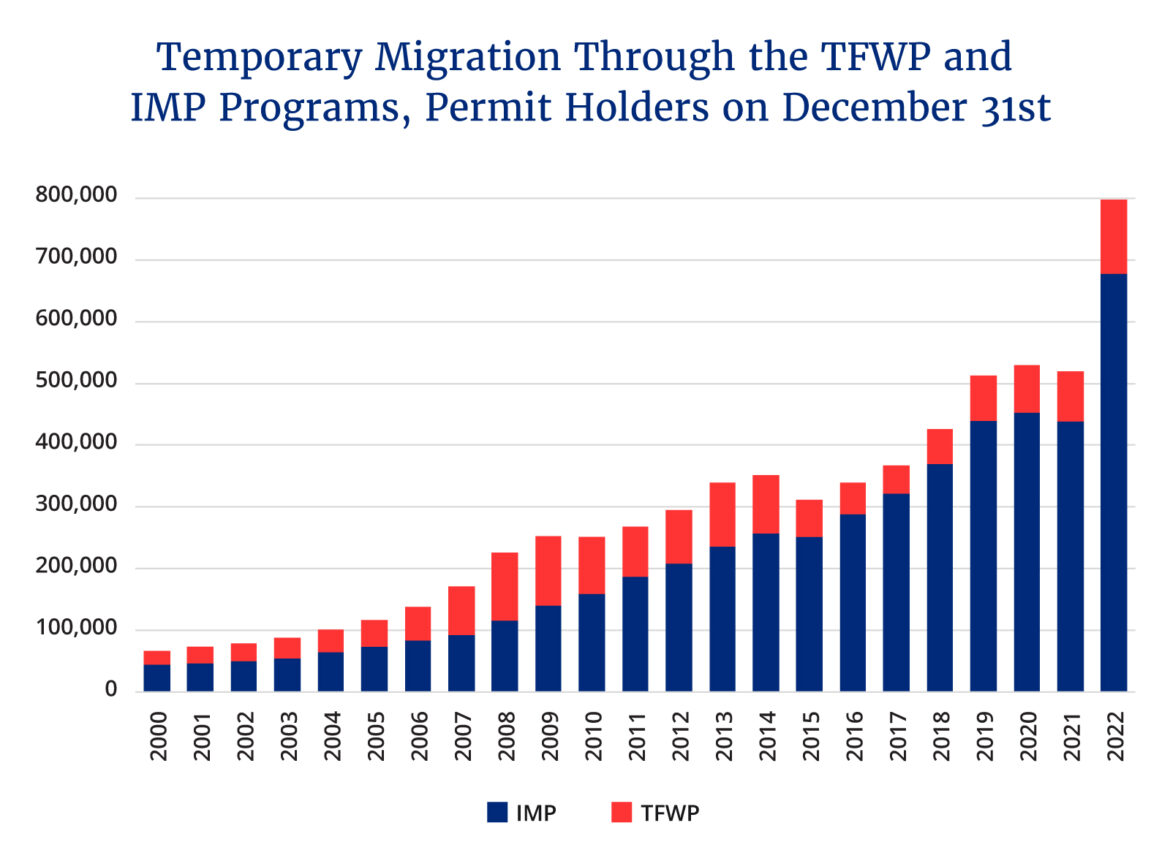
The figure below displays the number of work permit holders at the end of 2022 through Canada’s two temporary labour migration streams—the TFWP and the International Mobility Program (IMP). The TFWP covers migration programs that require a Labour Market Impact Assessment to receive a work permit such as the live-in caregiver program and various agricultural programs. The IMP does not require labour market assessments and includes individuals working on visas related to trade agreements such as the Canada-U.S.-Mexico Trade Agreement, individuals on post-graduate work permits, and so on. 

Mr. Trudeau was correct in 2014 to observe that there was a more than doubling of the program under the Conservatives before a slight reduction owing to policy changes later that year that included a partial moratorium on new permits and visas.

Graphic credit: Janice Nelson.

Under Trudeau’s tenure as prime minister, however, the number of temporary work permits has grown dramatically—far outstripping those during the Harper government. In 2015, there were a little more than 310,000 temporary work permits. By 2022, the number had more than doubled to almost 800,000. Partial data from 2023 indicate that there was a further increase last year. 

One way to understand this massive increase in the number of temporary foreign workers is to use Trudeau’s own standard of the share relative to permanent residents. He warned in 2014 that the ratio was approaching 1:1. In 2022, there were roughly 440,000 permanent residents admitted into Canada compared to the almost 800,000 working on temporary visas.

This significant growth not only conflicts with Trudeau’s chief recommendation in his op-ed that the TFWP needed to be constrained but also his broader concerns about the risks of an over reliance on temporary foreign workers. 

He concluded: 

“It cuts to the heart of who we are as a country. I believe it is wrong for Canada to follow the path of countries who exploit large numbers of guest workers, who have no realistic prospect of citizenship. It is bad for our economy in that it depresses wages for all Canadians, but it’s even worse for our country. It puts pressure on our commitment to diversity, and creates more opportunities for division and rancour.

We can and must do better.”

Source: Prime Minister Trudeau failed to follow his own advice on temporary foreign workers

Lisée: L’immigration et la loi de la gravité

Sarcasm, well justified:

Le saviez-vous ? Avant qu’Isaac Newton ne découvre la gravité, tout le monde prenait les choses à la légère. La boutade s’applique superbement à la soudaine épiphanie de membres du gouvernement Trudeau face à l’immigration.

« Je crois que personne n’a besoin d’un briefing pour comprendre que, s’il y a plus de gens qui ont besoin de se loger, cela va avoir un impact sur la situation du logement », affirmait cette semaine l’un des architectes de l’immigration massive trudeauiste, car jusqu’à récemment titulaire de ce portefeuille, Sean Fraser, mais qui, depuis l’été, est puni par là où il a péché, car il est désormais ministre du Logement.

Son successeur, Marc Miller, est allé jusqu’à déclarer que le pays avait « perdu le contrôle » du nombre d’étudiants étrangers au pays, mais que cet état de fait était la responsabilité des provinces, dont certaines tolèrent la présence sur leur territoire de ce qu’il a appelé des « puppy mills ». En français, il s’agit d’« usines à chiots ». Il parle de ces écoles privées qui sont des usines à diplômes de qualité incertaine, délivrés dans un temps record à des étudiants pour beaucoup venus de l’Inde et de la Chine, et qui leur donne, selon les généreuses règles en vigueur, un accès rapide à la citoyenneté.

Une des meilleures recettes de la mauvaise foi politique est d’identifier, à l’intérieur d’un problème majeur, un élément réel, mais secondaire, et de faire semblant qu’en s’y attaquant, on prend l’enjeu de front. Car, au fond, les membres du gouvernement Trudeau pensent-ils qu’avoir haussé à un demi-million par an le nombre d’immigrants permanents est excessif ? Non. 

« Les Canadiens sont presque unanimes dans leur appui à l’immigration. C’est un avantage extraordinaire. Nos seuils actuels d’immigration permanente sont ceux dont on a besoin pour notre économie », a déclaré sans rire Justin Trudeau. Tous les sondages récents démontrent au contraire que l’appui des Canadiens aux seuils d’immigration connaît une chute historique. Près des trois quarts jugent — avec sagesse — qu’il faut réduire les seuils au moins le temps que se résorbe la crise du logement. Si la tendance se maintient, il y aura bientôt unanimité.

Le festival du sophisme

Peut-être pense-t-il que les milieux d’affaires torontois, qui ont plaidé pendant des années pour une augmentation de l’immigration et qui alimentent sa caisse électorale, sont toujours avec lui. Pas selon leur Pravda, le Financial Post, qui résume ainsi le consensus ambiant : « La décision du premier ministre Justin Trudeau d’augmenter considérablement l’immigration […] sans fournir un soutien adéquat a créé une longue liste de problèmes économiques, notamment une inflation plus élevée et une faible productivité. » L’économiste en chef de la Banque TD, Beata Caranci, résume la chose ainsi : Trudeau « screwed up ». 

Comment le jugement du premier ministre peut-il être aussi éloigné du réel ? Les solutions, explique-t-il en empirant son cas, sont à portée de main : les 500 000 permanents par an peuvent trouver à se loger, prétend-il, pour peu que les universités dénichent des logements pour leurs étudiants internationaux et les entreprises pour leurs travailleurs temporaires. Il suffisait d’y penser. Car dans l’univers trudeauiste, il y a trois marchés distincts du logement. Incrédule ? Rappelons qu’on parle d’un homme qui, ayant obtenu pour ses vacances en Jamaïque un hébergement d’une valeur de 84 000 $, a déclaré que, « comme énormément de familles canadiennes, on est allés rester chez des amis pour les vacances de Noël ».

On s’ennuie du temps où il débitait des phrases creuses. Car ses nouvelles déclarations sont pires : fausses. Il continue à affirmer qu’il nous faut davantage d’immigration pour résoudre les pénuries de main-d’oeuvre. Mais puisque le Canada a reçu plus de deux millions d’arrivants en deux ans, ne devrions-nous pas avoir réglé le problème et être en surplus de main-d’oeuvre ? 

L’économiste Pierre Fortin a conclu de la revue de la littérature scientifique récente que cette conclusion « n’est rien d’autre qu’un gros sophisme ». Chaque immigrant qui pourvoit un emploi requiert la création d’un autre emploi pour lui fournir tous ses services. Idem pour la prétention que l’immigration nous enrichit (l’impact est non significatif) ou nous rajeunit (même résultat). On continue cependant à entendre politiciens, patrons et commentateurs répéter ces sornettes.

Pour entrer dans le détail, disons qu’il est vrai que, si on déverse un million de Chinois au Québec ayant chacun 1000 $ en poche, le PIB va croître d’un milliard. Si vous êtes un PIB, c’est la joie. Si vous n’êtes pas un PIB, c’est moins drôle. Et s’il s’agissait d’éviter un déclin démographique en maintenant la croissance récente de la population du Québec, le démographe Marc Termotte a conclu qu’il ne faudrait, pour ce faire, toutes catégories comprises, que 58 000 immigrants par année, plutôt que les 580 000 actuels — les 55 000 permanents et les 528 000 non permanents. Donc, le dixième.

Les sophismes sur les bienfaits de l’immigration ne seraient que du bruit de fond si les conséquences ne devenaient pas si graves, pour le logement, l’éducation — 1500 classes d’accueil supplémentaires au Québec — et, au bout du compte, l’explosion de l’itinérance.

Difficulté cognitive

Des esprits tordus prétendent que la difficulté cognitive des libéraux fédéraux en matière d’immigration tient à cette information, rapportée dans Le Soleil par Hélène Buzzetti : « À leur dernier congrès, le sondeur Dan Arnold a révélé que les électeurs nés à l’extérieur du Canada sont les plus susceptibles de voter libéral. Leur niveau d’appui au Parti libéral a dépassé celui des non-immigrants par 8 points à l’élection de 2015, par 13 points en 2019 et par 19 points en 2021 . » Réduire le flot d’entrées de cette manne électorale est un pensez-y bien, surtout pendant une traversée du désert.

François Legault a de son côté utilisé la formule Miller : identifier une partie du problème et faire comme s’il s’agissait de l’essentiel. Le trop-plein de demandeurs d’asile, écrit-il à Trudeau, ne peut plus durer. Certes. Mais Legault a toujours eu le loisir de limiter le nombre d’étudiants étrangers et de travailleurs temporaires sur son territoire. Il a choisi de ne pas le faire. Sa ministre Christine Fréchette se plaint qu’une bonne part des immigrants temporaires ne sont que du ressort d’Ottawa. Mais c’est parce qu’elle refuse d’invoquer l’entente Canada-Québec sur l’immigration pour exiger d’en avoir le contrôle.

C’est le malheur particulier des Québécois d’être en ce moment gouvernés à Ottawa par des trudeauistes qui prennent leurs lubies de grandeur postnationales pour des vérités et à Québec par un premier ministre qui avouait en campagne électorale ne pas être « un génie en herbe de l’immigration ». Cela paraît.

Paul St-Pierre Plamondon a beau jeu de pousser ce cortège de sophistes dans leurs contradictions, et d’éclairer combien la passivité de la Coalition avenir Québec (CAQ) est navrante et combien le projet canadien est contraire, non seulement à nos intérêts, mais à la simple bonne gestion de nos affaires. Il semble être le seul à comprendre la gravité de l’enjeu. Il mérite donc, pour cette semaine, le prix Isaac Newton.

Source: L’immigration et la loi de la gravité

Michael Taube: Leave it to Trudeau to destroy his party’s reputation on immigration

Overly partisan but not without some valid criticisms. And Taube leaves out the bigger issue of the larger number of temporary residents:

Prime Minister Justin Trudeau’s immigration plan is broken. His Liberal government may not have admitted it in so many words, but their recent actions speak quite clearly.

After steadily increasing the number of newcomers over the years, Ottawa has announced it will cap the number of permanent residents it accepts at 500,000 in both 2025 and 2026. It’s finally dawned on the Trudeau Liberals that there needs to be an economic reset. Canada’s housing market is too expensive and our health care system is overloaded — and the impact of costly temporary resident programs is too often overlooked.

From a historical perspective, the decision to put a forthcoming freeze on immigration is certainly interesting. For the first time in a long time, the Liberals will likely be viewed in a more negative light when it comes to Canada and its immigration policies.

The Liberals were consistently put on a high pedestal by many generations of newcomers due to their seemingly positive approach to immigration. The fact that former prime minister William Lyon Mackenzie King, a Liberal, committed one of the worst immigration-related atrocities in Canadian history, turning away 900 Jewish refugees who fled Nazi Germany aboard the MS St. Louis in 1939, and oversaw the disgraceful internment of Japanese Canadians during the Second World War, was largely (and conveniently) forgotten.

As for Conservative prime ministers like Brian Mulroney and Stephen Harper, who both supported immigration from a personal standpoint and as a means to enhance the country’s economic engine, they never received nearly the same amount of praise and adulation for their efforts.

In particular, Pierre Trudeau’s tenure as prime minister was consistently viewed in the most positive light by most Canadian newcomers. He could do no wrong when it came to immigration. Yet, here’s the historical irony. This Liberal leader actually oversaw a significant decline in total immigration numbers.

According to Bob Plamondon in his book, The Truth about Trudeau, Canada had 183,974 immigrants when he was first elected in 1968, or roughly one per cent of the population. When Trudeau left politics in 1984, the immigration rate dwindled to 0.3 per cent.

“These reductions did not reflect an anti-immigrant policy per se, but flowed out of a choice made by the Trudeau government in response to a weaker economic climate and higher unemployment,” Plamondon wrote.

His assessment was that “holding the line on immigration is exactly the opposite of what Trudeau is known for,” and it’s entirely accurate. That’s not what most Canadians know or want to remember about him, however.

They would rather focus on the elder Trudeau’s decision to introduce the Canadian multiculturalism policy in 1971 that touted personal and cultural freedom for ethnic minorities.

“A policy of multiculturalism within a bilingual framework commends itself to the government as the most suitable means of assuring the cultural freedom of Canadians,” he told the House of Commons on Oct. 8, 1971. “Such a policy should help to break down discriminatory attitudes and cultural jealousies … It can form the base of a society which is based on fair play for all.”

They also remember when he brought in a new Immigration Act in 1976 with fondness. The act supported economic and cultural policies for newcomers, the need for diversity and promoting non-discrimination against newcomers. Government and the volunteer sector would work together to help new immigrants adapt to our country, and refugees became a distinct group of immigrants protected under Canadian law.

Many immigrants therefore viewed the elder Trudeau as a political saviour and their champion. Criticism of his leadership and policies was often ignored or disregarded. When it came time to vote, most would enthusiastically select the candidate with the word “Liberal” next to his or her name.

But what the elder Trudeau giveth, the younger Trudeau taketh away.

The younger Trudeau’s government has hiked Canada’s immigration numbers far more than most western democratic governments — and his own father’s. When he was first elected in 2015, Canada’s target for permanent residents was below 300,000. We’ll be at 485,000 in 2024 and at 500,000 in 2025.

“Make no mistake. This is a massive increase in economic migration to Canada,” then-immigration minister Sean Fraser told the Canadian Press in 2022. “We have not seen such a focus on economic migration as we’ve seen in this immigration levels plan.”

It was a massive increase, but to what end?

The younger Trudeau’s poor reputation on the international stage has tarnished Canada’s reputation as a welcoming country to newcomers; this is a result of, for instance, icy relations with G20 leaders, problems with India (costumes and otherwise), older instances of blackface and more. Trudeau also paid plenty of lip service to Syrian and Afghan refugees in past years — in practice, however, refugee resettlement has dropped overall from 76,000 in 2023 to below 73,000 in 2025.

Furthermore, the Trudeau government’s decision to ignore the affordability crisis until just recently has made Canada a tough environment for newcomers, who now have trouble finding work, paying rent and feeding their families.

Whereas the elder Trudeau and other Liberal prime ministers regularly built voter confidence with new immigrants, the younger Trudeau has developed into a leader who tries to desperately grab immigrant votes at all costs. Based on his economic mismanagement and forthcoming freeze on newcomer numbers, that political farce won’t be happening for much longer.

Source: Michael Taube: Leave it to Trudeau to destroy his party’s reputation on immigration

Yakabuski: Fin de la récréation pour Trudeau

Hard hitting but merited:

Depuis l’attaque des militants du Hamas contre Israël du 7 octobre dernier, le premier ministre Justin Trudeau se garde soigneusement de dévier de la position américaine sur le conflit, qui menace de se propager à d’autres pays du Proche-Orient.

Son refus d’appeler à un cessez-le-feu crée des remous au sein du caucus libéral. Pas moins de 23 députés libéraux ont signé une lettre lui demandant que le Canada « se joigne au nombre croissant de pays qui demandent un cessez-le-feu immédiat ». M. Trudeau leur a répondu cette semaine en se disant favorable « à l’idée de pauses humanitaires », qui permettraient l’acheminement d’aide aux civils piégés à Gaza tout en n’empêchant pas Israël de reprendre son assaut sur le territoire palestinien dans le but d’éliminer le Hamas.

Sa déclaration, mardi, est arrivée presque simultanément à celle du secrétaire d’État américain, Antony Blinken. Devant l’Organisation des Nations unies, à New York, il a, lui aussi, appelé à des pauses humanitaires.

Depuis son arrivée au pouvoir, en 2015, le gouvernement de M. Trudeau semble élaborer sa politique étrangère en fonction des désirs des clientèles ethniques de certaines circonscriptions clés, notamment de la banlieue de Toronto et de Vancouver. Dans beaucoup de cas, ses positions n’attirent pas l’attention du public en dehors de ces enclaves ethniques, où l’appui — ou pas — de la population sikhe, tamoule, chinoise ou autre peut tout changer entre une victoire ou une défaite des libéraux lors d’élections fédérales.

Puisque leurs mots et leurs actions ne pèsent pas beaucoup sur la scène internationale, les gouvernements canadiens, sauf de rares exceptions, ont tous traditionnellement eu le luxe de concevoir leur politique étrangère comme un bidule à faire gagner des votes. Toutefois, cette approche s’est retournée deux fois contre le gouvernement Trudeau dans la dernière année.

Il a longtemps cherché à minimiser les allégations d’ingérence chinoise dans les élections fédérales de 2019 afin de ne pas se mettre à dos les électeurs chinois des circonscriptions baromètres de Toronto et de Vancouver. Mais ce scandale a fini par lui éclater au visage, avec les révélations dans les médias des avertissements répétés sur l’ingérence chinoise que lui aurait lancés le Service canadien du renseignement de sécurité.

On est en droit de se demander si M. Trudeau aurait fait une sortie aussi dramatique pour annoncer que l’Inde serait impliquée dans l’assassinat d’un militant séparatiste sikh commis en banlieue de Vancouver en juin dernier s’il ne se préoccupait pas autant du sort des libéraux dans les circonscriptions où la population sikhe est majoritaire ou presque. La réaction du gouvernement indien à ses propos menace maintenant les relations du Canada avec le pays que tous nos alliés cherchent à courtiser pour contrer l’influence chinoise dans le monde.

Dans le dossier du conflit entre Israël et le Hamas, M. Trudeau, contrairement à certains de ses députés, ne peut pas contredire nos alliés sans qu’ils s’en aperçoivent. Tout comme pour la guerre en Ukraine, les enjeux de ce conflit sont trop importants pour que le premier ministre ose aller à contre-courant.

Certes, des divisions existent aussi au sein même de l’alliance occidentale, comme en témoigne la difficulté qu’ont les pays de l’Union européenne à s’entendre sur une position commune. Seul le premier ministre espagnol, le socialiste Pedro Sánchez, qui lutte pour sa survie politique après avoir perdu les élections en juillet, a jusqu’ici exigé publiquement un cessez-le-feu. Mais, dans son cas, toute autre position ferait éclater la coalition de partis de gauche qu’il essaie de préserver afin de garder le pouvoir et d’éviter la tenue d’élections, qui pourraient mener à sa défaite définitive.

Le président américain, Joe Biden, n’est pas prêt à appeler à un cessez-le-feu, même s’il dit déplorer les conséquences des actions militaires d’Israël contre le Hamas pour la population de Gaza et qu’il milite pour une accélération dans la livraison d’aide humanitaire. D’abord, parce qu’il sait que le Hamas, un groupe terroriste qui se consacre à la destruction d’Israël, ne respecterait jamais ses conditions. Ensuite, parce que toute clémence envers cette organisation serait perçue comme une invitation, pour les ennemis des États-Unis, à commencer par l’Iran, à semer la terreur à travers la région et le monde.

Tout au plus M. Biden demande-t-il à Israël d’exercer une certaine prudence en menant sa campagne contre le Hamas. Il sait pertinemment que cette situation est un bourbier géopolitique qui risque de plomber sa présidence et de mener à de multiples conflagrations militaires ailleurs au Proche-Orient et dans le monde. La dernière chose dont il a besoin, c’est de voir un gouvernement canadien soucieux de plaire à l’opinion publique lui compliquer davantage la tâche, déjà si délicate. M. Trudeau semble l’avoir compris.

Source: Fin de la récréation pour Trudeau

John Ivison: Who really killed Canadian moderation?

Thoughtful analysis:

I’ve been immersed in Winston Churchill’s My Early Years, a ripping yarn that sees the future wartime leader take part in a cavalry charge at the battle of Omdurman in Sudan and escape captivity during the Boer War in the late 1890s.

As gripping as the incredible Boy’s Own adventures are his accounts of the fin-de-siecle British Empire — which, when he is writing in 1928, he described as a “vanished age.”

Ages always vanish, of course, usually because of traumatic cataclysms like wars or pandemics.

In our own time, COVID seems to have been the catalyst for a new age of discontent, accelerating anxieties that were already percolating, and taking with it the classical liberal consensus that dominated the postwar world.

It is paradoxical that a prime minister who ventured the thought that Canada is stronger because of its differences, rather than in spite of them, is now presiding over a political landscape dominated as never before by ill-will and alienation.

Politics in this country may never have been exactly civil — it’s been said the best explanation for the good old days is a bad memory. But the respect and a broad policy consensus that undeniably existed has been replaced by loathing and partisan hostility. Illiberalism is the dominant strain on both the left and the right.

There is empirical evidence that Canada is a meaner country than it was a few short years ago.

Police-reported hate crimes have soared 72 per cent from 2019 to 2021. The homicide rate has risen steadily to its highest level in 30 years. Meanwhile, social trust has plummeted. Only a third of adults now agree that most people can be trusted.

The political system is a direct casualty of that disillusionment. A recent study by the Public Policy Forum into the rise of polarization, appropriately called Far and Widening, said only 50 per cent of the respondents it polled believe voting is the best way to enact change. One person in six said that only taking power from “global elites” would effect real change.

It used to be the case that most people could agree on what many consider to be “Canada’s advantage” — an immigration policy that has attracted the best and brightest from around the world.

Yet that too is breaking down, in large part because of careless, incoherent federal government policy.

Last week, a video on social media featured a long lineup of what appeared to be Southeast Asian students queuing to apply for jobs at a Food Basics supermarket in Hamilton, Ont. The comments in response to the video suggested that a nativist backlash to Liberal immigration policy is in full swing.

The government has overseen an explosion in international students coming to Canada — 900,000 this year alone — many of whom are using education as a back door to citizenship.

By paying tuition fees of around $25,000, students can come to Canada, study part-time at a private college, work legally in low-wage jobs and stay in the country for years after graduating. Coupled with a Liberal plan to boost the number of permanent residents to 500,000 by 2025 — double the number from a decade earlier — it is clear that there has been a massive increase in low-skilled immigration that threatens to put pressure on wages at the bottom end of the labour market.

The lobby group Colleges and Institutes Canada, whose members are the main beneficiaries of the huge influx in tuition fees, acknowledged as much when it said in a statement that the cap on international students being contemplated by Ottawa could “exacerbate current labour shortages.” A reminder: this is a program for international students, not temporary foreign workers.

As many economists have noted, such high numbers of newcomers have the happy corollary for the government of boosting GDP — immigration is likely to account for the total output increases of 1.5 per cent in 2023 and 2024.

But those gains will mask a cumulative decrease in output per person and add to the housing crisis. In short, Canadians will be worse off under this policy and resistance to similar levels of immigration will surely follow.

The Liberals have to accept a disproportionate share of the blame for the state we’re in because they have been in government for nearly eight years.

But the conditions for a more bitter politics were already ripe in 2015. After the Second World War, average real wages doubled in roughly 30 years. In the subsequent half-century they have been relatively stagnant. Poll after poll has shown the majority of Canadians think the next generation will have a lower standard of living than their parents did — an economic backdrop against which it is hard to generate optimism.

The advent of social media that prioritizes provocative content has helped erode the common ground most Canadians shared in the postwar world.

Politicians have found that what former Conservative leader Erin O’Toole called “performance politics” works for them: ramping up the rhetoric and demonizing their opponents in order to get noticed. MPs not viewed as being sufficiently combative are considered suspect by their colleagues and partisan constituents.

O’Toole’s successor, Pierre Poilievre, has fine-tuned the cartoonish manipulation of the outrage machine that is X (formerly Twitter), combining bombastic rhetoric and an indifference to truth. Impressively, in one recent tweet, he managed to malign the trifecta of Conservative scourges — the prime minister, the CBC and the World Economic Forum — in under 140 characters.

As Justin Ling, author of the PPF report on polarization, noted, political parties used to be big tents, a microcosm of the country at large, but they now more closely resemble special interest groups.

The pandemic only accelerated that division of Canadians into two tribes, when a material minority emerged who were vocal in their belief that governing elites had lost their connection to the people they are meant to serve. That gave birth to the truckers’ convoy protest that blockaded downtown Ottawa last year. It is a significant indication of widespread disillusionment that one poll suggested a majority of 18- to 34-year-olds sympathized with the protest against vaccine mandates, even if they didn’t agree with the blockade.

Justin Trudeau did little to reconcile alienated voters by calling a snap election and using vaccine status as a wedge issue. He even referred to his opponents as “often anti-science, often misogynistic, often racist” and wondered if they should be tolerated.

For a leader who is quick to blame those who disagree with him of engaging in “the politics of fear and division,” it revealed his own tendency toward intolerance.

His critics contend that Trudeau has been on a quest to transform Canada into something more closely resembling his own progressive leanings — and of portraying those who oppose him as uninformed, irresponsible or motivated by unworthy goals.

Moderation and the modest compromises that characterized much of Canadian political history have been jettisoned in favour of lofty goals that often come with unintended consequences, such as the immigration targets. It is telling that the debate around the cabinet table apparently was not whether 500,000 newcomers was too many, but rather whether that number was ambitious enough.

In the current fervid political environment, it is unrealistic to expect a politician to emerge who will appeal for calmer heads to prevail, like the medieval knight in the middle of melee in the Far Side cartoon: “Hey, c’mon. Hold it! Hold it! Or someone’s gonna get hurt.”

Voters are in a vitriolic mood. Appealing to their better angels is likely to leave any politician feeling like Winston Churchill after his first abortive venture into politics, “deflated as a bottle of champagne when it has been half-emptied and left uncorked for a night.”
Source: John Ivison: Who really killed Canadian moderation?

Sun Editorial: Federal policies made housing crisis inevitable

Recognizes role that provinces also play:

The way the Trudeau government talks about Canada’s affordable housing crisis, it’s as if the rapidly increasing number of international students and immigrants it’s admitting to Canada every year snuck up on it.

When Prime Minister Justin Trudeau and the Liberals came to power in 2015, Canada accepted 352,325 international students.

This year, according to Immigration Minister Marc Miller, the number will be about 900,000.

Miller told CBC’s The House on Saturday this isn’t just contributing to Canada’s affordable housing crisis, but also creating problems with “the integrity of the system, that has mushroomed, ballooned in the past couple of years.”

Now add the fact that when the Liberals came to power in 2015, 271,845 immigrants became permanent residents of Canada.

The Trudeau government’s plan is to boost that number to 465,000 this year, 485,000 in 2024 and to 500,000 in 2025.

Three Canadian banks have warned the federal government’s policy is misguided.

TD Bank said “continuing with a high-growth immigration strategy could widen the housing shortfall by about a half-million units within just two years.”

National Bank of Canada said “the federal government’s decision to open the immigration floodgates during the most aggressive monetary tightening cycle in a generation has created a record imbalance between housing and demand.”

BMO said “heightened immigration flows designed to ease labour supply pressure immediately add to the housing demand they are trying to meet.”

The Trudeau government says it’s wrong to blame international students — on whom it may be considering a cap on admissions — and immigrants for Canada’s housing crisis.

Of course they’re not to blame.

The government is to blame for increasing their numbers so rapidly, with no coherent plan to house them, consistent with Trudeau’s view that “housing isn’t a primary federal responsibility. It’s not something that we have direct carriage of.”

To be fair, provincial and municipal governments share responsibility for housing with the federal government, which also says we need high immigration levels because of our low domestic birth rate to bolster the economy, including having sufficient workers to build homes.

But what’s also true is that issues the federal government has direct carriage of — immigration and international students — are contributing to Canada’s affordable housing crisis.

Source: EDITORIAL: Federal policies made housing crisis inevitable

ICYMI: Don Wright: Why did Justin Trudeau switch sides in the ‘class struggle?’

More on the recent expansion of temporary foreign workers and relaxation of conditions, along with contrast when the PM was in opposition:

In 2014, Justin Trudeau wrote an op-ed arguing that the Stephen Harper government should dramatically scale back the Temporary Foreign Worker (TFW) program.

His reasoning was sound – both in moral terms and in economic terms. He wrote: “I believe it is wrong for Canada to follow the path of countries who exploit large numbers of guest workers.” He also pointed out that large numbers of TFWs “drives down wages.”

We might have expected, therefore, that things would change under his leadership. And indeed, they have. Between 2015 and 2022 the number of TFWs in Canada doubled!

But TFWs are actually only a small fraction of total Non-Permanent Residents (NPR) with work permits in Canada. There is another category known as the “International Mobility Program” (IMP) which provides work permits for international students, graduates of post-secondary programs and other categories. The number of IMP work permit holders almost tripled between 2015 and 2022. In total, NPRs with work permits now exceed 1.1 million people – and have grown from 2.1 per cent to 5.5 per cent of the Canadian labour force.

This hasn’t happened by accident. The current government has made a series of changes that have opened the door to higher numbers of NPRs. Last year, for example, the federal immigration minister made it significantly easier for employers to get permits for TFWs.

Perhaps more significantly, he eliminated the restriction on the number of hours that international students could work while they are supposedly studying. Previously, the limit was 20 hours a week. There are no limits on the number of international students that can be granted a student permit. All they need is acceptance from a “Designated Learning Institution.” In addition to the publicly funded universities, colleges and institutions, there are a large number of private, for-profit colleges that are in this business as well.

One doesn’t have to be too cynical to imagine that some private college operators would market themselves as a way to get a work permit in Canada, with a possible path to permanent resident status down the road, with the quality of the education being offered of secondary importance. Indeed, a casual search of the web will uncover many such stories.

One needs to be only a little more cynical to conclude that this was the federal government’s intention in lifting the restriction on working while studying. What an easy way to appease the demands from many in the employer community to deal with the “worker shortage.”

The jobs that NPRs fill are disproportionately low wage positions – jobs like food counter attendants, kitchen helpers, cooks, cashiers, retail salespersons, shore shelf stockers, clerks,delivery service drivers, and the like. Statistics Canada reports that, even with high educational attainment, NPRs were in occupations requiring no formal education proportionately more than the rest of the Canadian population.

You know, this kind of sounds like something that “those countries who exploit large numbers of guest workers” would do.

And let’s not lose sight of the other point that Mr. Trudeau made back in 2014. This all serves to depress the wages of Canadian workers. In particular, it disproportionately impacts low-wage earners – if employers couldn’t rely on the large number of NPR workers, they would have to raise the wages that they offer.

Why is the federal government aiding and abetting this? Apparently because they are responding to the consistent mantra from the employer community that there is a “worker shortage.” More precisely, there is a shortage of workers willing to work at the wages that certain employers prefer to pay. But whose side should the federal government be on?

Over the past 20 years “the bosses” have done much better than the workers. For example, Statistics Canada data shows that in 2003 the category of workers defined as “senior managers” on average earned 3.9 times more than the category of workers defined as “sales and service support.” In 2023 the multiple had widened significantly to 5.1 times. Sales and service support occupations include cashiers, service station attendants, store shelf stackers, food, accommodation and tourism workers, and cleaners – typical of the positions filled by many NPR workers.

Given this trend one needs to ask: who needs more help in the struggle for fair wages – the workers or the bosses? Why did the federal government apparently change sides in this struggle?

Don Wright was the former deputy minister to the B.C. Premier, Cabinet Secretary and former head of the B.C. Public Service until late 2020. He now is senior counsel at Global Public Affairs.

Source: Don Wright: Why did Justin Trudeau switch sides in the ‘class struggle?’

Chris Selley: In Canada, even Muslims can be conservatives

As can any group. Ibbitson and Bricker made the point about many immigrant-origin communities being more socially conservative in their 2014 book, The Big Shift but this has not hampered the Liberal government in the three subsequent elections, suggesting less important than other issues.

But valid that all parties need to be more careful in their ethnic and religious vote targeting to avoid greater divisiveness just as they also need to ensure inclusive messaging. Not an easy balance…:

Canada’s media-political universe continues to indulge one of the more fascinatingly insulting ideas in recent memory: That some socially conservative Muslims are lining up in opposition to LGBTQ- and especially gender-related school activities — drag queen story times are a prominent example — because they’ve been duped or manipulated into it by non-Muslim conservatives, especially those awful Americans.

There’s a far simpler explanation, of course: Muslim conservatives are leery-to-outraged by such things for the same reason non-Muslim conservatives are, namely some combination of religious and cultural norms, the shock of the new, and good old-fashioned gut instinct.

In addition, many Muslim-Canadians have their roots in countries where homosexuality is forbidden, never mind celebrated at elementary schools. It would be downright shocking if they had arrived pre-installed with Trudeauvian social values.

But some Canadian liberals just can’t seem to accept this.

“To some, the recent protests have been an example of conservative Muslims pushing back against causes championed by the left — which have in the past included standing against Islamophobia — amid concerns that prevailing progressive ideals conflict with their religious teachings,” the Toronto Star reported this week. “To others, it has tones of political manipulation, with members of a minority group being used to mask a larger push toward intolerance.”

“For white supremacists, expanding their base this way, or even appearing to grow support for their ‘causes’, offers (an) advantage,” Star columnist Shree Paradkar observed. “(I)mages with visibly Muslim people in their midst make for an effective cover.”

Paradkar called the situation “heartbreaking,” which epitomizes the condescension inherent in this narrative: After all Canada has done for these people, they take up with … with … conservatives? Woe!

Prime Minister Justin Trudeau has ushered this idea from the country’s faculty lounges and opinion pages into the mainstream, lately lecturing real live Muslim Canadians in the flesh about the error of their ways. “Misinformation” about school curriculums and activities is “being weaponized by people who are not doing it because of their interest in supporting the Muslim community,” he recently admonished parishioners at a Calgary mosque. “These are people on the far-right who have consistently stood against Muslim rights and the Muslim community.”

There it is again — this idea that Muslims are defaulting on some kind of debt.

It’s an Upper Canadian twist on the narrative that’s taken hold in Quebec in recent years: Where Quebec nationalists and conservatives would rather Muslims abandon their hijabs and embrace French-style secularism (because it’s such a success!), liberals in the Rest of Canada are happy for Muslims to worship and dress as they please, just so long as they don’t fraternize with social conservatives or take up social-conservative causes.

This is not the multiculturalism that the Liberals market to potential immigrants — the freedom to believe and worship and influence Canadian society as they choose. It’s more akin to blackmail: “We support you. We stand with you. It’d be a shame if we stopped, wouldn’t it?”

I’m using a very loose definition of “social conservative” here, incidentally. A Léger poll for the Conservative Party of Quebec, published in May, found 38 per cent of Quebecers felt drag queen story times were inappropriate for children. Many if not most would bristle at being called socially conservative. And most would not show up outside a school to protest about it.

But there’s no good reason Muslims shouldn’t pursue so-con causes in Canada unabashedly. And if they make “unlikely allies” with their non-Muslim so-cons, as the media often put it, I submit that’s for one very bad reason: The paranoia over Islamic terrorism and mass Muslim migration that took hold in some quarters after 9/11, which thankfully in Canada has proven unfounded. If that’s now far enough behind us that conservative Muslims and non-Muslims can make common cause in pursuit of common interests, I dare say we might even be looking at a good-news story.

Surely Canada would be better off if its parties and candidates stopped courting ethnic and religious voters en bloc, as if membership in a certain community ought to determine one’s position on housing policy, or the GST, or carbon pricing, or all the other things that affect our day-to-day lives. It would be a big change for Conservative strategists as well as Liberal ones, but we would be much stronger for it as a nation.

Source: Chris Selley: In Canada, even Muslims can be conservatives

Globe editorial: Justin Trudeau should listen to Justin Trudeau on temporary foreign workers

Of course, always easier while in opposition but 2014 should be a cautionary tale about Temporary Foreign Workers as well as an example of a government pivot when the Conservatives and Jason Kenney had to reverse course:

Justin Trudeau has some advice for Justin Trudeau.

Mr. Trudeau, in 2023, leads a federal government that has overseen a surge in the country’s reliance on low-wage temporary foreign workers. The federal Liberals stoked this increase: they loosened the rules early last year. According to the latest data, reported by The Globe last week, Ottawa has approved the hiring of almost 80,000 low-wage foreign workers in the year after the rules were eased. That’s triple the level of the 12 months before the change.

Source: Justin Trudeau should listen to Justin Trudeau on temporary foreign workers