Senator Dasko pitches elections law reforms to address enduring issue of candidate diversity

Repeat of previous bill that died: Highly unlikely that this bill, should it make it to the Commons, will pass given that political parties oppose being shackled by similar provisions as the public service and federally-regulated sectors, as in the case of privacy:

…Experts offered mixed reviews of Bill S-213, describing it as a ‘baby step’ forward, or as a watered-down attempt to address an already well-known problem….

But one area where Tolley said she wishes the bill went further is in terms of broader—not gender specific—diversity.

“There has been a tendency when we have these conversations about diversification to focus on

gender, and assume that if we figure out the gender piece, all of the other diversities will follow.

The research suggests that’s not really the case,” she said. “When we focus on diversity in this sort of aggregate or generic way, the primary beneficiaries tend to be white women, often to the exclusion of other groups.”

Still, recognizing the “balancing act” in play in regulating political parties, Tolley said she sees the bill as a “baby step” forward….

Andrea Lawlor, an associate political science professor at McMaster University, described S-213 as a “very limited way of introducing some requirements around political parties,” but said the voluntary nature of both aspects of the act—of having policies and programs to disclose, and responding to a demographic questionnaire—undermines its effectiveness.

“It takes a kernel of a really good idea, which is enhanced transparency, but I feel it waters itself down,” said Lawlor, who nonetheless lauded S-213 as a good-faith effort.”

Due to its voluntary nature, the survey could produce an “incomplete picture,” and the bill gives parties “that are weaker on these measures” an out in terms of even having policies, programs, or rules to encourage candidate diversity, said Lawlor.

“A party can kind of say, you know, ‘mind your own business, our internal party processes are our own.”…

Source: Senator Dasko pitches elections law reforms to address enduring issue of candidate diversity

Explaining immigration casework in federal Members of Parliament’s district offices in Canada

Interesting and encouraging study, indicating that casework reflects riding demographics, not political affiliation:

In Canada, a majority of federal constituency offices deal primarily with immigration files. The few qualitative studies on the subject show that the resources dedicated to these files and the type of work carried out on the immigration files handled vary between offices, thus contributing to disparities in service between federal electoral districts. How can such variation be explained? Based on the quantitative analysis of unpublished administrative data, this article first highlights the diversity of files handled by constituency offices, as well as the types of intervention carried out by constituency assistants. It then aims to explain the variations in case processing according to the type of case and the volume of requests handled. Studies of constituentsʼ files received and processed at constituency office level have argued that the political ideology, gender and ethnicity of the deputy as well as the demographics of the constituency are explanatory factors. This analysis shows that in the case of immigration files, constituency demography is the most important factor, while the MP’s political affiliation plays a very limited role. These results shed new light on the factors involved in the processing of immigration cases at constituency level, and add nuance to previous, mainly qualitative analyses. Our results also contribute to understanding the work of constituency offices for constituents, which appears to be far less partisan than in other countries where similar offices exist.

Source: Explaining immigration casework in federal Members of Parliament’s district offices in Canada


Chinese Communist Party-affiliated institute compiled profiles of Canadian MPs of Chinese descent

Not unexpected but different than normal engagement of diaspora communties that Canada also practices with respect to its expatriates:

A research institute in China that is affiliated with the ruling Communist Party’s foreign-influence operations compiled extensive profiles of members of Parliament with Chinese ethnicity, two sources say.

The sources say this Chinese institute used large-scale data analytics and artificial intelligence to create detailed profiles in 2022. There are fewer than 10 MPs of Chinese descent in Canada’s House of Commons.

The profiles were drawn up by a research institute that supports the work of China’s United Front Work Department, a body that answers to the party’s central committee. UFWD oversees Beijing’s influence, propaganda and intelligence operations inside and outside China. The Globe and Mail has been unable to confirm the name of the institute.

The sources say China’s cyber and digital operation to gather information on these MPs was first detected by the Communications Security Establishment (CSE), Canada’s secret signals intelligence agency, and shared with the Canadian Security Intelligence Service (CSIS). The Globe is not revealing the identity of the two sources, who risk prosecution under the Security of Information Act for discussing these matters….

Source: Chinese Communist Party-affiliated institute compiled profiles of Canadian MPs of Chinese descent

MPs call for House study after UN report slams Canada’s efforts to combat contemporary slavery, forced labour

Of note:

A recent report from the United Nations’ special rapporteur on contemporary forms of slavery has raised alarm over Canada’s handling of the issue at home, including particular criticism for the Temporary Foreign Workers Program. With Parliament now back from its summer recess, NDP, Liberal, and Conservative MPs say they want to see a House committee undertake a study in response. 

Following a two-week visit, UN Special Rapporteur Tomoya Obokata released a 12-page statement of preliminary findings on Sept. 6, within which he highlighted Canada’s Temporary Foreign Workers Program (TFWP) as a top source of concern, saying the program’s low-wage and agricultural streams in particular “constitute a breeding ground for contemporary forms of slavery,” and that he is “perturbed by reports” that the number of workers entering Canada through this program is “sharply on the rise.”

“The Special Rapporteur is disturbed by the fact that certain categories of migrant workers are made vulnerable to contemporary forms of slavery in Canada, by the policies that regulate their immigration status, employment, and housing in Canada, and he is particularly concerned that this workforce is disproportionately racialized, attesting to deep-rooted racism and xenophobia entrenched in Canada’s immigration system,” reads the statement.

Obokata was in Canada between Aug. 23 and Sept. 6 to assess Canada’s efforts to prevent and address contemporary forms of slavery, including forced and child labour. He’s set to present a full report, which will expand on his initial findings and cover additional issues, to the UN Human Rights Council in September 2024. 

NDP MP Heather McPherson (Edmonton Strathcona, Alta.) said the rapporteur’s initial findings need to be raised in the House of Commons.

McPherson is a member of the House Foreign Affairs Committee’s Subcommittee on International Human Rights, which studied the human rights situation of the Uyghurs, and the role of the Canadian Ombudsperson for Responsible Enterprise in 2021. In light of the rapporteur’s findings, she said she’d like the “subcommittee to be looking at this again.” 

“We’ll be bringing that forward at that point [when the House returns], that they examine this and that we do get testimony on this report,” and look at the issue “from a larger frame,” beyond the ombudsperson, to also include examination of due diligence and human rights legislation, McPherson told The Hill Times on Sept. 15. 

She pointed to the Special Committee on Canada-China Relations and the House Foreign Affairs Committee itself—she is a member of both groups—as other potential arenas to pursue a study, noting, for example, the issue of Uyghur forced labour in Canada’s supply chains. 

“We have an awful lot to study within those committees, and so it’ll be a situation of trying to find the right place for it to land, and whether there’s bandwidth to do that,” said McPherson, adding she thinks the House International Trade Committee should also pick up the issue.

Conservative MP Arnold Viersen (Peace River–Westlock, Alta.), a member of the Subcommittee on International Human Rights and of the All-Party Parliamentary Group to End Modern Slavery and Human Trafficking, said he’s in favour of “studying the issue of human trafficking and how Canada can better fight it at any and every turn, so I would welcome a study in that respect.” 

Liberal MP John McKay (Scarborough–Guildwood, Ont.), another member of the all-party group, agreed the rapporteur’s findings bear “an examination by a House of Commons committee.” 

“We are bringing in a lot of people under particular policies, and it’s always worthwhile to examine the efficacy of those policies. Canada has a labour shortage … but we simply cannot be a nation that exploits other human beings in labour conditions that are such as the rapporteur has described. He used very strong language,” said McKay.

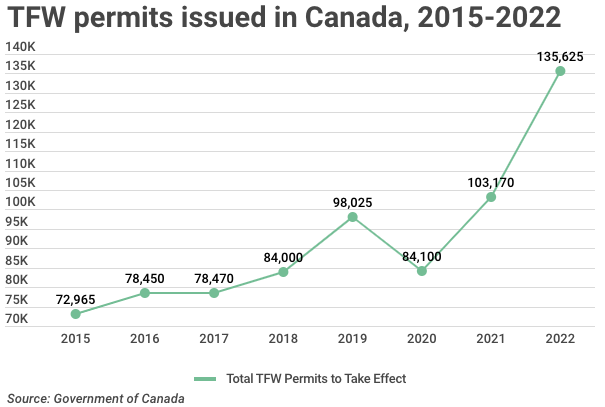
As noted by Obokata, use of the TFWP is on the rise in Canada. Between 2021 and 2022, the number of TFW permit holders increased by 31.5 per cent to reach 135,625 individuals. It’s on track to surpass that total in 2023, with 130,155 such permits already having come into effect in the first three quarters of the year, according to federal data

“It is a fact that temporary foreign workers make vital contributions to Canada’s national economy and possess valuable skills for which there is consistent demand, and yet paths for long-term or permanent residency is extremely limited or non-existent for most workers working in agriculture and other low-skills sectors,” reads the rapporteur’s report.

Obokata said while in Canada, he “received first-hand information from a large number of stakeholders, notably migrant workers themselves, pointing to the appalling working and living conditions in reality,” including excessive work hours, “extra-contractual tasks, physically dangerous tasks, low wages, no overtime pay,” access being denied to health care, limited access to social services, overcrowded and unsanitary employer-provided housing, “as well as sexual harassment, intimidation, and violence at the hands of their employers and their family.”

Such issues could be prevented through “effective labour and health and safety inspections,” but Obokata said from what he heard, those being done by federal, provincial, and territorial inspectors “are grossly ineffective,” don’t happen regularly, can be done remotely, and allow for advance notice to employers when done in person, enabling them to “make necessary preparations on the day of inspection.” Moreover, he said “most migrant workers are unaware” of the existence of existing federal, provincial, and territorial complaint mechanisms, or are afraid to report labour law violations “due to the fear of unemployment or deportation.”

While acknowledging “important developments” in the effort to protect the human rights of workers, and eradicate forced and child labour in the country’s supply chains—like the 2022 release of the Responsible Business Conduct Strategy and the 2021 update to the Code of Conduct for Procurement—Obokata said he still has “some concerns over Canada’s current approach to human rights due diligence for Canadian companies.”

He noted, for example, that Bill S-211’s reliance on self-reporting, lack of monitoring mechanism, and lack of requirements to implement “human rights due diligence” or measures to “prevent, address, and remedy abuses once identified,” risks it “becoming a box ticking exercise where companies simply submit the same statement every year, as has been reported in other jurisdictions.” The Fighting Against Forced Labour and Child Labour in Supply Chains Act, which comes into force in January 2024, requires companies that check two of three boxes—having at least $20-million in assets, $40-million in revenue, or 250 employees—to report on measures taken to “prevent and reduce the risk” of forced or child labour in their operations and supply chains.

Obokata said in raising concerns with the federal government, he was told draft legislation on due diligence to complement Bill S-211 is “currently” being considered. He urged the government to do so “expeditiously,” and for clear guidance on reporting requirements under S-211, and monitoring and oversight mechanisms to be established in the interim. 

McKay, Viersen, and Independent Senator Julie Miville-Dechêne (Inkerman, Que.) were among those who met with Obokata virtually on Aug. 15 just before his visit in their capacity as members of the all-party parliamentary group, with talk focused on S-211, which was sponsored by McKay and Miville-Dechêne in the House and Senate, respectively. 

McKay and Miville-Dechêne told The Hill Times they disagree with Obokata’s assessment of S-211 as a mere “box-ticking exercise,” with McKay saying he takes “strong exception to anyone who says this legislation will not be effective.” 

There’s an “immense amount of work that entities are going to have to do in order to be able to comply with the legislation,” argued McKay, with potential “enormous” consequences, including the fact that “the regulatory filing signed by a senior officer and approved by the board of the entity” will be “looked at by other regulators,” and “by those who do financing,” consumers, and NGOs. McKay said in discussions with lawyers and others “who work in this area” in Toronto last week alongside Miville-Dechêne, the pair heard serious concerns “about the work that’s going to be required in order to make sure that they comply.” 

“Our model is a stronger model than the U.K. model,” said Miville-Dechêne of S-211, noting the bill includes fines for non-compliance, and transmitting information that’s knowingly false. “I would say it’s a step, but a very important step and the first step, too, for a country that has … talked, politically, a lot about our respect for human rights, and by implementing this law, it is a step in the right direction.” 

McKay, Miville-Dechêne, and Viersen all said they expect clear guidance on reporting requirements under S-211 to come through its enacting regulations, which are still being awaited from the minister responsible, Public Safety Minister Dominic LeBlanc (Beauséjour, N.B.). Asked when those regulations would be tabled, LeBlanc’s office did not respond by filing deadline. 

McKay and Miville-Dechêne urged the government to table its draft regulations as soon as possible, with the Senator noting there are only three-and-a-half months left before S-211 comes into force, “which is not, in political terms, that long to give clear guidance to companies.”

Viersen called the wait on regulations “quite frustrating.” 

As for a parliamentary study, Miville-Dechêne said while the rapporteur’s preliminary findings must be listened to—and that she, too, is “very worried” about the potential for exploitation through Canada’s TFW program—she noted “he’s going to have more to say” when the full report is released next year. She highlighted that the Senate Social Affairs Committee is already in the midst of a study on Canada’s temporary and migrant labour force. 

“I find on this particular issue [the TFWP], Mr. Obokata is right on,” she said. 

Among other things, the rapporteur’s report also raised concern over the effectiveness of the federal Ombudsperson for Responsible Enterprisesestablished in 2019, which Obokata noted didn’t release its first initial assessment reports on complaints until this year—nearly four years after its creation. He highlighted that its mandate covers “only a limited number of sectors,” and excludes a number “where labour exploitation is rife, like agriculture, fishery, manufacturing, and construction,” which the rapporteur said should be “core” to the office’s mandate. He called for the ombudsperson to be given statutory powers to compel witnesses and documents, “with clear consequences” for companies that don’t comply, and for its independence to be ensured.  

McPherson said the rapporteur’s report has “echoed all of the concerns that the NDP has raised for some time,” including its criticisms of Bill S-211, which her party voted against in the House, and the effectiveness of the ombudsperson.

“We’ve got a government right now who is saying that they care about human rights, they’re talking about the need to ensure that Canadian companies working abroad are acting effectively, but every chance they have to bring forward good, strong legislation, they fail,” she said.

On the TFWP, McPherson said the NDP, “from the very get-go,” has said “the program needs to be revamped” and “that any individual who comes to Canada to be a worker needs to have a path to become a Canadian citizen.” 

“This program has been flawed” from the very beginning, she said, starting under the previous Conservative government, and continuing under the Liberals, despite its pledge to fix it.

The Hill Times reached out to Trade Minister Mary Ng (Markham–Thornhill, Ont.) and Immigration Minister Marc Miller (Ville-Marie–Le Sud-Ouest–Île-des-Soeurs, Que.) for comment and reaction to the rapporteur’s report. 

An emailed response from Global Affairs Canada confirmed Ng’s office has “reviewed the rapporteur’s statement.”

“We are taking into consideration the findings in the statement and how we can reflect on them moving forward as we work to eradicate forced labour from Canadian supply chains and ensure that Canadian businesses operating abroad do not contribute to human rights abuses,” reads GAC’s response. 

In its emailed response, Miller’s office highlighted “several permanent immigration pathways available for workers,” including through an Agri-Food pilot launched in May 2020 and recently extended until May 2025; the Provincial Nominee Program; the Atlantic Immigration Program; and express entry eligibility for agricultural supervisors and managers, among other things. 

“In Canada, the rights of all workers—including temporary foreign workers—are protected by law. Temporary foreign workers have the same rights and workplace protections as Canadians and permanent residents,” reads the response from Miller’s office, noting that new regulations aimed at increasing protections for foreign workers were implemented federally in September 2022.

“We will continue engaging all levels of government, provinces, and territories—to ensure all workers are safe and protected wherever they are in the country.”

Source: MPs call for House study after UN report slams Canada’s efforts to combat contemporary slavery, forced labour

Incoming sponsored travel rules for lobbyists will limit ‘educational opportunity’ for MPs and Senators, say CIJA and Results Canada

Give me a break, this is lobbying pure and simple, designed to influence, not educate:

Two groups that provide travel programs to parliamentarians are concerned that forthcoming changes to the Lobbyists’ Code of Conduct that will include sponsored travel in rules about gifts will limit their ability to provide MPs and Senators with first-hand experiences in foreign policy and international development issues.

“We don’t use these missions as a gift, but rather as an opportunity for parliamentarians to understand a very complicated region in the world,” said Shimon Koffler Fogel, president and CEO of the Centre for Israel and Jewish Affairs (CIJA). “We explicitly indicate in the invitation that there are no strings attached, there are no expectations of the participants other than that they attend all parts of the program, because it’s essential for them to get that whole view. In and of itself, it’s not a lobbying exercise, it’s an educational opportunity.”

“There’s nothing that beats the real impact of seeing [work] on the ground, of talking to a patient whose life has been changed, or talking to a mom who in years previously had no kids that were vaccinated, but now, five out of her six are vaccinated, and the sixth one is in the queue,” said Chris Dendys, executive director of Results Canada. “So, it’s about the tangibility of literally getting your shoes dirty, having real conversations with frontline community health workers, visiting hospitals and clinics that are far from urban centres and seeing the great work that is being done.” 

The updated Lobbyists’ Code of Conduct will come into force on July 1. It states that lobbyists should “never provide any gift—directly or indirectly—to an official that you lobby or expect to lobby, other than a low‑value gift that is a token of appreciation or promotional item.” The accompanying definitions include “travel, including sponsored travel, an excursion, transportation” under its description of gifts.” The “low-value” criteria is set at a maximum of $40 per gift and an annual maximum of $200.

The code permits the commissioner to grant exemptions to the rule by considering several factors, including whether the gift is related to the exercise of a power, duty or function of the official. If an exemption is granted, the commissioner can impose conditions on the lobbyist, such as a cooling-off period during which they cannot lobby the official.

Lobbying Commissioner Nancy Bélanger told The Hill Times in an interview on May 29 that the code was worded so that lobbyists can still offer sponsored travel to individual parliamentarians, provided they do not intend to lobby them. 

“If they want to lobby them, despite the fact that they’ve given them sponsored travel, they’re going to have to ask for an exemption,” she said. “Depending on the circumstances, we would possibly say, ‘The gift can be given; however, you will have a cooling-off period where you cannot lobby until the sense of obligation is reduced.’ … [that is] how it’s going to have to work.”

Fogel said CIJA does not consider its programs to be a gift to public office holders (POHs). The centre, which has been continuously registered to lobby since Feb. 17, 2005, describes its sponsored travel programs on its website as “fact-finding missions to Israel for Canadian influencers and decision-makers.”

“I think where the difference of opinion is and where we think [the commissioner’s] understanding is not complete is that these programs that we undertake are not a gift. There’s no quid pro quo, there’s no expectation that they’re going to come back and adopt CIJA’s position on any of 100 different issues,” Fogel said. “What we believe is that our constituents consider these issues important enough that they want their public office holders to have a good understanding of the situation rather than the kind of superficial one that one gets by just reading headlines and looking at social media posts.”

CIJA’s submission to the first draft of the updated code of conduct, released in December 2021, asked that sponsored travel remain available to POHs. 

“Our missions to Israel (and the Palestinian Authority) are rigorous and, in short, designed to ensure that the POH experiences the highest possible quality and range of insights and background knowledge of the region,” the submission said.

Results Canada also mentioned sponsored travel in a joint submission to the House Ethics Committee’s (ETHI) study of the lobbyists’ code with World Vision Canada and the Canadian Foodgrains Bank in March 2023. The three international development organizations asked the committee to recommend that sponsored travel be specifically exempted from the application of the gifts rule, and for hospitality costs incurred while hosting parliamentarians on sponsored travel to be similarly exempted.

“We provide opportunities for experiential learning and evidence gathering, allowing parliamentarians to learn first-hand the enormous impact of Canadian organizations and the Government of Canada in international development,” the submission said. “This unique experience cannot be replicated by reading reports.”

Results Canada’s Dendys told The Hill Times that the organization has hosted parliamentary delegations overseas approximately once a year since 2007, with a break during the height of the COVID-19 pandemic. The non-profit advocates for policies and monetary investments to improve health, education, and economic outcomes across the world to eliminate extreme poverty. 

Dendys said the delegations’ value lies in giving parliamentarians a first-hand view of where Canadian international development investments were making a difference.

The most recent delegation was in January, when Liberal MPs Valerie Bradford (Kitchener South–Hespeler, Ont.) and Iqwinder Gaheer (Mississauga–Malton, Ont.), and Conservative MPs Scott Aitchison (Parry Sound–Muskoka, Ont.) and Eric Melillo (Kenora, Ont.) travelled to Kenya.

Results Canada has been continuously registered to lobby federally since Sept. 26, 2011; World Vision Canada since March 22, 2005; and Canadian Foodgrains Bank since Feb. 24, 2005. 

Dendys described the decision to include sponsored travel as a gift in the lobbyists’ code as disappointing. She said her organization was still considering the effect it will have on its work.

“As of right now, our days of providing parliamentarians with on-site experiences will draw to a conclusion unless there’s another review or there’s some amendments,” she said. “It was always just one facet of our overall approach to educating, inspiring and hopefully engaging parliamentarians to become champions. It’s just unfortunate that this very unique and special educational opportunity that organizations like Results and others were providing is seemingly no longer part of the tools in the toolkit.”

Liberal MP John McKay (Scarborough–Guildwood, Ont.) told the House during members’ statements on May 8 that he joined Results Canada on a delegation to Kenya in 2007, “which was far from being a junket; rather, it was a slum tour. Nairobi has some of the biggest slums in the world. What I remember most is the smell of open sewers and the chronic overcrowding.”

Dendys said alternatives to sponsoring parliamentarians’ travel could include closer collaboration with parliamentary associations that have planned delegations to other countries. “It’s also looking at when parliamentarians are travelling anyway, to see if we can inform that travel,” she said.

One solution could be a return to “virtual delegations” held at the height of the pandemic, she said. In February 2022, eight MPs and two Senators took part in such an event with their counterparts in Kenya, alongside health care workers, experts, and advocates in both countries.

CIJA’s Fogel said his organization take its regulatory obligations seriously, and have started consultations with its legal counsel to ensure that the centre fully understands the nuances of the updates before taking the next steps.

“I’m hopeful that we’ll be able to, down the road, see some reconsideration, because everybody has said that they’re valuable experiences. What no-one will say, however, is that they’re a vacation,” he said.

ETHI’s letter to the commissioner supported the call to exempt sponsored travel from the gift rule. 

But Bélanger said in her reply to the committee that she was not persuaded “that automatically exempting sponsored travel from the gift rule would be consistent with the fundamental objectives and expectations set out in the code, including that lobbyists avoid placing officials in conflict of interest situations and that they do not lobby officials who could reasonably be seen to have a sense of obligation towards them.”

She said the rule does not “prevent parliamentarians from accepting sponsored travel. Rather, this rule has been carefully crafted to preclude lobbyists from providing gifts (other than low value tokens of appreciation and promotional items) to officials they lobby or expect to lobby. In practice, this means that lobbyists will not be allowed to lobby officials to whom they have provided sponsored travel.”

The Hill Times reached out to ETHI members to ask about their response to the commissioner’s letter, including Conservative ethics critic Michael Barrett (Leeds–Grenville–Thousand Islands and Rideau Lakes, Ont.), Liberal MP and ETHI vice-chair Iqra Khalid (Mississauga—Erin Mills, Ont.), Bloc Québécois ethics critic and ETHI vice-chair René Villemure (Trois-Rivières, Que.), and NDP ethics critic Matthew Green (Hamilton Centre, Ont.). Responses were not received by deadline.

Section 15 of the MP Conflict of Interest Code permits MPs to accept sponsored travel “that arises from his or her duties.” Members must disclose any travel that exceeds $200 and is not paid in full by the MP, their party or a recognized parliamentary association, or from the consolidated revenue fund, to the Conflict of Interest and Ethics Commissioner within 60 days.

During the Procedure and House Affairs Committee’s most recent review of the code in 2022, members found that the current rule “provides sufficient transparency and accountability, and is in-line with current best practices for the prevention of real or perceived conflicts of interest.” The House agreed to the committee’s report on March 30, 2023.

The Ethics and Confict of Interest Code for Senators has a similar rule in place, with a higher threshold of travel costs exceeding $500. The Senate Ethics Officer published a guideline related to sponsored travel in July 2021, which includes a list of questions for senators to consider before accepting sponsored travel. The questions include: “Is the payor or the sponsor a registered lobbyist? If yes, what is the purpose for which they are lobbying?” and “Would the senator, the sponsor or the payor violate legislation, such as the Criminal Code or the Lobbying Act?”
Source: Incoming sponsored travel rules for lobbyists will limit ‘educational opportunity’ for MPs and Senators, say CIJA and Results Canada

Ie: Minority representation in the House won’t improve without better data

Interesting idea, having the Library of Parliament collect and present data on visible minorities. But having the Library use the analysis of analysts like Jerome Black, Erin Tolley, myself and others, however tempting, is unlikely to be accepted by MPs.

Self-identification in their parliamentary bios would be a better approach, but again would require MP consent

Not sure, of course, that this would result in any substantive change or more accurate numbers:

One of the fundamental purposes of the House of Commons is to represent the diversity of interests, identities, and values of Canadian society.

In 2021, Canadians elected 53 members of Parliament of racialized-minority background, 15.7 per cent of the House of Commons. These represent the highest number and share for minority representation in Canada’s history, but a significant representational deficit remains. The 2021 census indicates that 26.3 per cent of Canadians were “visible minorities,” the standard Statistics Canada term for “persons, other than Aboriginal persons, who are non-Caucasian in race or non-white in colour.” About 20 per cent of Canadian citizens are of racialized background.

Racialized persons in Canada are not evenly distributed across the country, of course. Ninety-five per cent live in a “census metropolitan area,” urban centres of 100,000 people or more. Indeed, in two of Canada’s largest cities, the white population is the minority: 42 per cent in Vancouver and 41 per cent in Toronto.

Because racialized Canadians are concentrated in urban centres, we will tend to be under-represented. Scholar Jerome Black suggests that, as of 2016, 41 of 338 ridings (about 12 per cent) were “minority-majority,” in which visible minorities constituted more than half of the population. In these ridings, parties have been more and more likely to recruit racialized candidates.

However, 109 ridings are more than 95 per cent white. Thus, even though a record 18.2 per cent of 2021 candidates were visible minority, many were running in ridings where there were multiple minority candidates. In Markham-Unionville, for example, all four major party candidates were of racialized status. Many other ridings in the Toronto region, metro Vancouver, and Calgary had similar slates of all or mostly all minority candidates.

Equitable minority representation in Canada’s House of Commons is about both demonstrating a commitment to fundamental values and substantive representation of the diverse needs and interests of Canadians. However, there are no easy solutions. A truly comprehensive, systemic path to improving minority representation needs to consider the roles of electoral systems, party recruitment practices, and other processes outside the halls of the House of Commons.

For the purposes of this series on parliamentary reform, the question, then, is: can anything be done within the bounds of Parliament and its processes?

One small but important step would be to improve the collection of information about the lack of minority representation in the first place. For instance, the Library of Parliament’s database of parliamentarians, Parlinfo, provides information on all MPs and Senators since Confederation, in 1867, including gender and occupation, but not ethnicity or racialized status.

The Library of Parliament provides research and information to parliamentarians and their staffers. Thus, the absence of information on minority representation in Parlinfo suggests lack of interest on the part of parliamentarians rather than deliberate oversight. Nonetheless, given the relatively small number of visible-minority MPs elected in Canada’s history and the fact that scholars such as Jerome Black have already compiled this information, adding it to Parlinfo should be relatively straightforward. The benefit of demonstrating at least modest institutional recognition of racialized status as an important representational concern would surely outweigh the costs of such an effort.

Unfortunately, Parliament itself has shown little concrete interest in this concern. I searched for the term “minority representation” in both the House of Commons and Senate debates from the 41st Parliament (2011-2015) onwards. I found only 13 mentions of the term in the House. None of them concerned the House’s own role and what it could do better. Rather, the mentions mostly related to arguments about electoral and Senate reform – implications for minority representation of different election processes and changes to the way Senators are chosen.

The story is much the same in Senate debate, and searches of committee proceedings in both chambers produce little further evidence of interest. While not an exhaustive search, what I have seen leads me to conclude that parliamentarians have been largely averse to considering their own role in the problem of minority representation, preferring instead to focus on the possibilities, however implausible, of external systemic fixes.

Some of this lack of interest may be complacency about our incremental progress and self-congratulatory belief in Canada as a welcoming, multicultural mosaic. Another reason could be tied to the fact that the political-intellectual class in Canada – opinion-makers and shapers in academia and the media, for example – are significantly more ethnically homogenous than the Canadian population.

The most recent Canadian Newsroom Diversity Surveyconducted by the Canadian Association of Journalists, for instance, reports that “most newsrooms continue to not be representative of the communities they serve.” Minority persons are concentrated in a few large outlets and are less likely to be in full-time leadership positions.

My investigation of diversity in my own field reveals embarrassingly few racialized scholars studying Canadian politics, with less than four per cent of permanent faculty members in departments of political science across Canada. Astonishingly, some larger departments themselves have more white men than there are racialized Canadian politics scholars in the whole country!

The media and academia do not solely determine what is important to parliamentarians, of course, but they do play significant roles in shaping the agenda and the ideas underlying political debate. The lack of diversity in media and academia means that the interests and lived experiences of racialized Canadians are less visible within our political discourse than they should be. It is unsurprising, then, that Parliament and parliamentarians seem so uninterested.

In 2010, a Canadian parliamentary delegation participated in, and signed onto, an Inter-Parliamentary Union statement called the Chiapas Declaration. The declaration committed consenting parliaments to debate and adopt plans to improve minority participation, among other actions. These plans, the declaration states, should include measures such as requiring all legislation to include impact assessment on minorities, regularly discussing minority issues and mainstreaming such issues into parliamentary work, particularly within committees, and allocating resources to provide dialogue spaces for racialized persons and groups within House processes.

Our House of Commons has not followed up on these commitments in any meaningful way. It has not, for instance, created even a committee with a mandate to focus on issues of racialization and minority exclusion, when such a committee is assumed to exist in the Chiapas Declaration. There has been minimal attention to minority representation in debate or committee: what little there is has been focused on external fixes or representation in civil society or the public service rather than in the House itself.

As the Canadian delegation’s report on the declaration reflects, our position has been one of self-satisfaction that because there are no explicit discriminatory laws in Canada preventing minorities from participating in politics and because of the progress we have made, there is not much more we should be doing.

Yet, as this series on parliamentary reform shows, the representational legitimacy and democratic quality of the House of Commons should not be taken for granted. Equitable minority representation and inclusion must be accepted as a core responsibility of the House rather than being considered someone else’s problem.

Source: Minority representation in the House won’t improve without better data

Un projet pilote pour aider des bureaux de député à régler des dossiers d’Immigration

Believe a majority or significant minority of constituent requests for MP help involve immigration and related issues in most ridings:

Des députés du Bloc québécois lancent un projet pilote inédit pour délester leurs bureaux de circonscription, qui croulent sous les dossiers d’immigration. Portée par le député de Lac-Saint-Jean, Alexis Duceppe-Brunelle, la proposition permettra l’embauche à temps plein d’une personne qui s’occupera des cas plus complexes afin de porter secours à sept bureaux bloquistes qui font face à un afflux accru de demandes d’aide.

« Dans un comté comme le mien, 35 à 45 % des dossiers sont des cas d’immigration, mais ils accaparent 60 à 65 % du temps travaillé », explique M. Duceppe-Brunelle. Autant de temps consacré à des cas d’immigration de plus en plus complexes qui n’est pas utilisé pour aider d’autres citoyens aux prises avec des problèmes moins graves ou qui ne relèvent pas de l’immigration, comme l’assurance-emploi.

Le député, qui travaille sur sa proposition depuis l’automne avec la collaboration du ministre Sean Fraser, se félicite d’avoir réussi à faire accepter un assouplissement de certaines règles de la Chambre des communes, assouplissement qui permet de revoir la structure des budgets de circonscription afin de financer un tel poste.

« Cette personne-là va s’occuper sur les cas les plus complexes d’immigration dans [certains] bureaux de député et va finir par prendre énormément d’expérience, soutient-il. Ça va désengorger le travail de nos bureaux. »

Les adjoints de circonscription n’ont pas tous l’habitude de traiter un tel volume de dossiers d’immigration et n’ont pas toujours l’expertise nécessaire. « Les gens sont compétents, mais si quelqu’un qui va normalement s’occuper d’un cas de pension de vieillesse doit mettre le double du temps sur un dossier d’immigration… Ça rend son travail plus difficile à faire. »

Hausse du nombre de dossiers

Dans un sondage interne auquel ont répondu une vingtaine de députés bloquistes sur 32, 85 % ont dit avoir vu le volume de dossiers d’immigration augmenter au cours des trois dernières années, souligne M. Duceppe-Brunelle.

Une récente étude de l’Université Laval s’est intéressée au rôle joué par les adjoints de circonscription dans les dossiers d’immigration : la pile, en effet, n’a pas cessé de grossir, surtout pendant la pandémie. Réalisée par l’équipe de Danièle Bélanger, titulaire de la Chaire de recherche du Canada sur les dynamiques migratoires mondiales, l’enquête a révélé que la COVID-19 a entraîné une réorganisation des services. L’augmentation du volume des demandes (64 %) était d’ailleurs la conséquence la plus fréquemment rapportée.

Et, parallèlement, les outils dont disposent les adjoints de circonscription et les députés, soit une ligne téléphonique privilégiée leur permettant de parler directement à des agents d’immigration, ont été réduits ou passablement transformés dans les deux dernières années.

L’équipe du Centre ministériel pour les députés et sénateurs est d’ailleurs devenue squelettique en raison des crises en Afghanistan et en Ukraine. Depuis l’automne, à la suite d’une réorganisation des services, les bureaux de député doivent désormais prendre rendez-vous avec un agent par le biais d’une plateforme en ligne pour tenter d’avoir de l’information et régler des dossiers.

Autrefois, pour certains cas très urgents, le député pouvait lui-même faire l’appel. « Quand il faut sortir quelqu’un de l’avion, il faut agir vite des fois, soutient Alexis Duceppe-Brunelle. Je l’utilisais avec parcimonie, mais quand même, j’étais un de ceux qui l’utilisaient le plus. Et là, on n’a plus accès à cette ligne. »

Le « bateau » IRCC

Disant ne pas vouloir « faire de politique » sur ce dossier, le député bloquiste constate néanmoins un problème structurel à Immigration, Réfugiés et Citoyenneté Canada (IRCC), notamment en ce qui concerne les délais de traitement, qui ne cessent de s’allonger.

« Le ministre a mis de l’argent, a engagé plus de monde, et je vais donner la chance au coureur. Si ça fonctionne, je vais être le premier à applaudir, mais pour l’instant, il y a de sérieux écueils, a-t-il dit. Je dirais que ce n’est pas le capitaine, le problème, c’est plus le bateau. »

Par ailleurs, en dehors des outils dont dispose le bureau du député, le centre d’appels d’IRCC demeure le seul point de contact pour le grand public depuis la fermeture de tous les bureaux de services en personne. Au printemps 2019, un rapport du Bureau du vérificateur général du Canada avait noté les graves lacunes de ce centre d’appels, qui, lors des années 2017-2018, n’avait répondu qu’à 22 % des 1,7 million d’appels reçus.

Le Bloc québécois réclame depuis 2020 la création d’un poste d’ombudsman au ministère de l’Immigration, une recommandation qui figure aussi dans un rapport du Comité permanent de la citoyenneté et de l’immigration.

Source: Un projet pilote pour aider des bureaux de député à régler des dossiers d’Immigration

Canadian immigrants turn to MPs for help with official documents, but to no avail

Of note (MPs spend a lot of time on immigration and passport issues):

Canadian immigrants say they’ve been reaching out to their federal members of parliament (MPs) for help with their long-delayed immigration files.

For some, it’s been years since they first opened their files with Immigration, Refugees and Citizenship Canada (IRCC).

“MPs used to be the higher level to try and get additional information and even MPs aren’t getting responses,” noted immigration lawyer Tamara Mosher-Kuczer.

Lately, IRCC has been blaming COVID-19 for serious delays — even though some immigrants say they applied for their visas, permanent residences and citizenship before the pandemic hit.

“We can still help them as we did before, but the answers from the department continue to reflect delays in the process due to COVID-19,” explained Anthony Housefather, MP for Mount Royal. “So, the service remains unchanged, but the processing times for almost all applications are slower.”

Mississauga – Erin Mills MP Iqra Khalid noted the federal government has proposed investing $85 million to “boost IRCC’s capacity and reduce processing times in these key areas affected by the pandemic.”

“The COVID-19 pandemic has exacerbated many of the challenges that Canadian residents face, and IRCC is no exception,” said Khalid, who adds her office alone is tracking hundreds of active immigration cases with the department.

Federal Immigration Minister Sean Fraser did not respond to CTV News’ request for comment.

Source: Canadian immigrants turn to MPs for help with official documents, but to no avail

New Parliament has some fresh, diverse faces, but is it enough?

Some good commentary by Erin Tolley. Agree with her that it would be preferable for the Library of Parliament to collect and maintain this data, as they do for women, Indigenous and those born outside Canada:

The number of visible minority MPs and of other historically marginalized communities in Canada’s 44th Parliament, which resumes Monday, Nov. 22, has notably increased, but some analysts question the depth of the changes. 

The number of Indigenous MPs went from 10 in 2019 to 12. There will be a total of eight Black MPs, including the five incumbent from the 2019 Parliament and three new additions.

Based on the validated and judicial recount results posted on Elections Canada website, the Liberals have 160 seats (up by three from 2019), the Conservatives 119 (down two), the NDP 25 (up one), the Bloc Québécois an unchanged 32, and the Greens two.  

Despite seemingly little change on the surface, the election yielded a relatively high turnover — bringing a total of 52 new MPs from all parties who will take their seats in the House of Commons for the first time. 

Critical twists

In at least six ridings where visible minorities were either incumbents or contenders, there were critical twists and turnarounds. 

Liberal Parm Bians unseated the Conservative Kenny Chiu in the riding of Richmond East. Paul Chiang unseated the Conservative Bob Saroya in Markham-Unionville. George Chahal defeated Jagdeep Kaur Sahota in Calgary Skyview, thus swaying an important seat for Liberals in the province of Alberta. Conservative Nelly Shin lost to the NDP candidate in Port Moody-Coquitlam, and the Conservative Michelle Ferreri defeated Maryam Monsef in Peterborough. 

The sixth important riding where visible minorities lost out to a third candidate was Kitchener-Centre, where the dropping out of the race of Raj Saini led to an easier win for the Green party candidate Mike Morris.      

Election 44 reflected the greatest diverse pool of candidates in any election thus far, and as a result, the new Parliament will have greater representation for many historically neglected communities. 

The new Parliament will have 103 female MPs, three more than the previous one, and women MPs in total now make up 30.5 per cent of the House of Commons, a slight increase from 29 per cent. 

For comparison, in 2015, there were 88 women MPs. The Liberal Party has increased its number of female MPs since then from 52 to 57. The NDPs have gone from nine to 11. For the Conservatives, the number of women remained steady at 22, as did the number for the Bloc Québécois at 12 and for the Greens at one. The 44th Parliament likewise marks an increase in LGBTQ2S+ MPs, with eight openly LGBTQ2S+ MPs elected, double the number from 2019.  

In the runup to the September election, a team of Carleton University researchers led by Erin Tolley, Canada research chair in gender, race and inclusive politics, launched a project to track candidate’s diversity. 

The dataset collected includes information about their gender, race, Indigenous background, age, occupation, and prior electoral experience, as well as riding, party, and province. 

Slow and incremental

But while there is visibly increased diversity, Tolley says the progress has been slow and incremental.  

“The snap election and short campaign likely had some impact on who ran for office this time around,” she told New Canadian Media. 

“We know that it takes longer to find and convince women, racialized and Indigenous candidates to run, not because they don’t want to but because politics historically has been inhospitable to them.”

Without being proactive, she says, another election might come sooner than we think. 

“If parties are serious about diversifying politics, they should already be laying out the groundwork, identifying promising candidates, encouraging them to run, and giving them the support they need to do so,” she says. 

Tolley also points out that, based on the observation of successive election cycles, racialized and Indigenous candidates remain somewhat pigeon-holed in a select number of ridings, mostly those with large racialized or Indigenous populations. This, according to her, creates a ceiling in terms of how many can be elected to Parliament. 

“We know that racialized and Indigenous candidates can win in a number of ridings, regardless of the riding’s demographic composition. Parties should think more broadly about the contexts in which they recruit diverse candidates so as not to limit their opportunities,” Tolley suggests. 

Reflecting on the makeup of the new Parliament, Andrew Griffith, a media commentator, policy analyst and the fellow of the Canadian Global Affairs Institute, likewise sees it as a “slow and steady progress,” both in terms of the number of visible minority candidates and elected MPs.  

He also considers that growing diversity is reflected in the new Cabinet that was announced on Oct. 26, and expects this to extend into Parliamentary secretaries. 

Not enough data 

Of the 338 candidates during the election, Liberals had 147 women running for office, 25 Indigenous,18 Black and another 50 visible minority candidates and 17 who identify as LGBTQ2S+.  

The Conservatives, out of 338 candidates in total, had 114 female candidates, their largest number so far. Of those, eight were Indigenous and Metis candidates. The Conservatives also had four LGBTQ2S+ candidates in this election. 

There were also 14 Black and 60 visible minority candidates, bringing the total of the non-white candidates to 74. The NDP had 177 women, 29 of them Indigenous. It had 104 visible minority candidates and 69 LGBTQ2S+ candidates. The Bloc Québécois had a total of 78 candidates, including 37 women, and 13 visible minority candidates, which albeit small, in comparison to others, was the most in the Party’s history. 

Based on the final tally of the candidates, the Liberals once again have the highest number and percentage of MPs, with 43 elected to serve. The Conservatives have six visible minority MPs. The NDP has three. One visible minority MP, a former Liberal candidate, won as an independent. 

Such figures, however, are not readily available as neither the Parliamentary Library nor the political parties put them out. 

Tolley is especially critical of the lack of institutionalized collection of demographic data on candidates or the racial backgrounds of MPs.  

“The Library of Parliament does publish information on women and Indigenous MPs, but nothing related to race. This leaves journalists and researchers without reliable and systematic data on diversity in parliament. That makes it difficult to track progress or hold parties accountable”, she says. 

The first item of business when Parliament resumes will be the election of the Speaker.

Source: https://newcanadianmedia.ca/new-parliament-has-some-fresh-diverse-faces-but-is-it-enough/

Unvaccinated Conservative MPs should ‘stay home’ from Parliament: Bloc leader

Valid given vaccine mandates elsewhere even if this will only affect Conservative MPs:

Bloc Québécois Leader Yves-François Blanchet said Wednesday the next session of Parliament should happen in person with any members who are not fully vaccinated against COVID-19 staying home.

Questions remain about what the return to Parliament will look like for Canada’s 338 elected representatives after the recent federal election saw the Liberals re-elected with a minority government.

Prime Minister Justin Trudeau says he will name his cabinet next month and Parliament will resume sometime in the fall.

Since the pandemic hit in March 2020, the House of Commons and committees had been functioning with some MPs working from Ottawa, but many others appearing virtually, including, later on, to vote, before the election was called.

Blanchet said he wants to see Parliament resume quickly with MPs having to be fully vaccinated in order to be there in person because now vaccines against the novel coronavirus are more widely available.

His party, along with the New Democrats and Liberals, made it a rule that candidates had to be fully vaccinated in order to hit the doorsteps, but the Conservatives did not.

“They get fully vaccinated or they stay home,” Blanchet said of Conservative MPs who might not have had their shots.

“Parliament should not come back under any kind of hybrid formation … now we know that we can go on with the way this building is supposed to work, and we should not refrain from doing so because a few persons don’t believe that the vaccine works. This belongs to another century.”

NDP MP Peter Julian said in a statement that because Canada is battling a fourth wave of the virus, the party wants to talk to others about continuing some of the hybrid practices when Parliament resumes.

“All of our NDP MPs are vaccinated and we’ve been very clear that federal government employees must be vaccinated too. Getting vaccinated is the right thing to do and elected leaders have a responsibility to set a good example by following public health advice,” Julian said.

The Liberals and Conservatives did not immediately respond to requests for comment Wednesday.

The Conservatives saw 119 MPs, including incumbents and new candidates, elected on Sept. 20, after the party spent the race dogged by questions about its opposition to making vaccines mandatory as a tool to defeat COVID-19.

Conservative Leader Erin O’Toole refused to say on the campaign trail whether he knew how many of those running for the Tories had been fully vaccinated, saying he told campaign teams that those who are not immunized against COVID-19 should take daily rapid tests.

O’Toole is himself vaccinated and has been encouraging others to get their shot, but the Conservative leader says he also respects the personal health choices of Canadians and attacked Trudeau for using the issue to sow division in the country.

Conservative MPs will make their way to Ottawa next week to have their first caucus meeting since the election, where they will have to decide whether they want to review O’Toole’s leadership.

The call for MPs to be vaccinated comes as Trudeau works on bringing in a mandate requiring the federal civil service, along with those working in its federally regulated industries, to be fully vaccinated.

His government has promised to make it a rule by the end of October that travellers flying or taking a train in Canada have to be immunized in order to board.

Many provinces have already introduced a vaccine passport system requiring consumers to provide proof of immunization to access non-essential businesses like restaurants and sports and entertainment venues.

“For the safety of House of Commons staff, translators, pages, security, other MPs and their staff, all parliamentarians should show proof that they are fully vaccinated in order to take their seats in the House,” tweeted former Liberal cabinet minister Catherine McKenna, who didn’t seek re-election, but served for six years in government.

As of Friday, Health Canada reported that around 79 per cent of people 12 and older as having being fully vaccinated, with about 85 per cent receiving at least one dose.

Source: Unvaccinated Conservative MPs should ‘stay home’ from Parliament: Bloc leader