Is Canada A Nation Of Immigrants? | Jack Jedwab

Jack and I have a disagreement here, with significant policy implications.

The issue is not, in a labelling sense, of creating multiple classes of Canadians. We are now back in the world of “a Canadian is a Canadian is a Canadian,” whether born here, born abroad or children of immigrants.

In contrast to earlier waves of mainly white and Christian immigrants, with many similar integration challenges, today’s immigrants are largely visible and religious minorities.

Without looking a the different experiences between first and subsequent generations of immigrants, we overlook the very real differences in outcomes for different groups of the second-generation compared to non-visible minority Canadians (or “old-stock” Canadians).

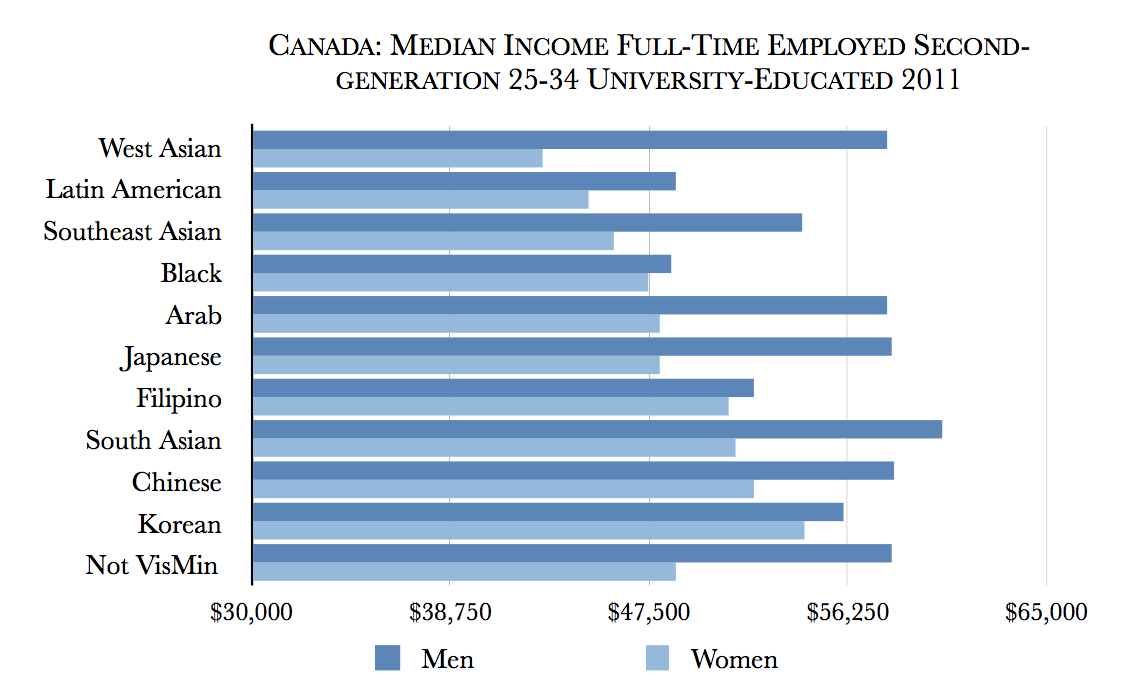
2G_University_Educated_25-34In some cases (i.e., percentage university-educated), the second-generation does significantly better than non-visible minority Canadians. And those that find employment have comparable median salaries.

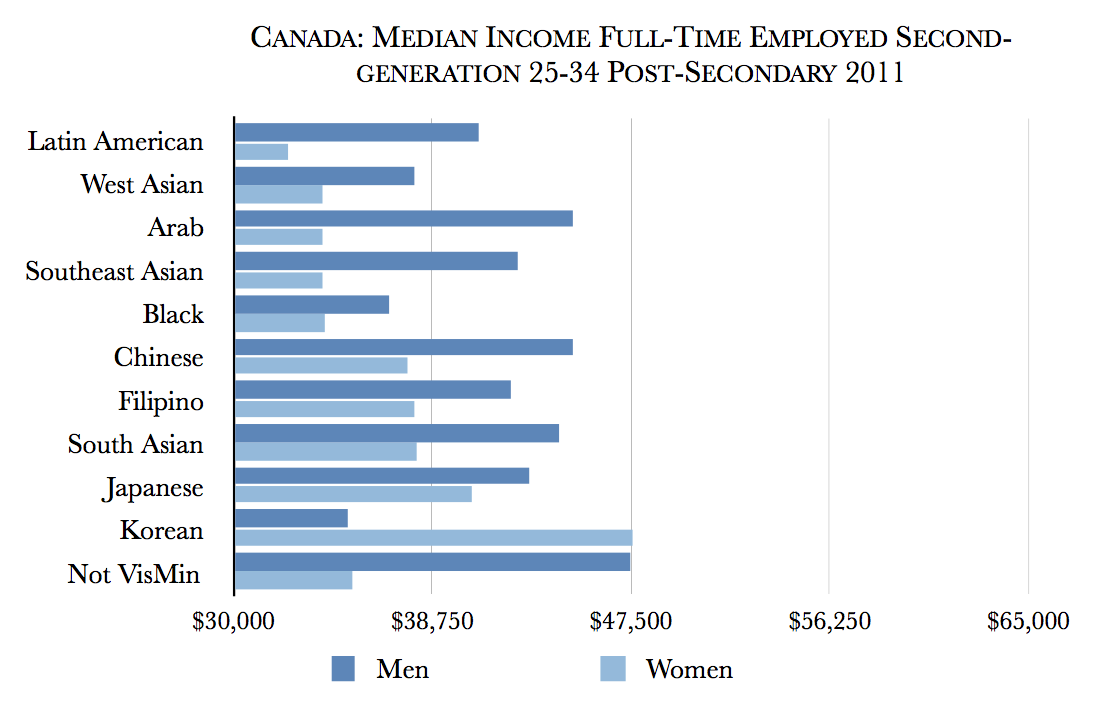
However, the second generation has higher unemployment rates than non-visible minority Canadians. Those that are not university educated have lower median incomes, as shown in the chart below:
2G_Non-Univ_Educated_25-34This is not to mentioned the well-documented instances of discrimination in hiring, police carding and other areas that show significant differences between visible minorities and others.

So while as a ‘value statement,’ one may prefer to refer second-generation immigrants as non-immigrants, this effectively masks some of the ongoing integration challenges that some elements face.

And while I fully agree with Jack that comparisons with Europe are often inappropriate given our differences in history, geography and identities, we do, like other ‘new world’ countries, view ourselves as countries of immigrants, unlike Europe. And this, with the exception of the USA, both reflects and influences how we deal with integration.

Measuring and contrasting the outcomes of both first and second generation outcomes provides useful international and internal benchmarks allow us to identify ongoing integration challenges with a view to overcoming them. Not making the distinction obscures them:

But there a significant segment of the Canadian-born population that sometimes wrongly gets labeled as immigrants. I refer specifically to persons born in Canada of foreign-born parents (a group to which I belong). Much social science literature in Europe refers to these children of immigrants as “second generation immigrants”. To many North American observers the term must seem like an oxymoron. It nonetheless gets employed by a number of Canadian scholars.

There are statistical breakdowns in the census of Canada on the basis of generational status. Immigrants are generally designated as the first generation, their children as second generation and there is a category for third generation or more. It’s inaccurate to refer to second generation Canadians as something other than non-immigrants with whom they are grouped in the census question on immigrant status.

The confusion that is created by designating them as “second generation immigrants” is sometimes influenced by European analysis with the practice in several EU countries of not automatically conferring citizenship on persons born in the country. For example, children born in France of foreign-born parents do not become citizens until reaching the age of the majority. Switzerland does not automatically extend citizenship to a child that is born in the country. Rather, a person is automatically Swiss if at least one of the child’s parents is Swiss.

Relatively few Canadian scholars that use the term second generation immigrants necessarily think of such individuals as immigrants. Rather most simply echo terminology that is used in some of the Canadian literature on immigration and citizenship and/or seek to engage with European policy-makers or scholars by employing a common vocabulary. But the Canadian-European comparisons can be problematic and regrettably they sometimes don’t make for good scholarly work.

Is Canada a nation of immigrants? It is certainly a nation with many immigrants who have played a critical role in the process of nation-building. But it is simply too limiting a concept when “the nation of immigrants” conveys the idea that immigration is the country’s principal defining characteristic.

Source: Is Canada A Nation Of Immigrants? | Jack Jedwab
Opinion: There’s no link between terrorism and multiculturalism – Jedwab

Jack Jedwab of ACS notes the many fallacies in Farid Rohani’s piece on multiculturalism and radicalization (Opinion: Multiculturalism should not be misused to justify divisions: Farid Rohani):

Yet Rohani makes a pernicious link between these heinous acts and Canadian multiculturalism. He establishes this false association by suggesting that the Canadian multicultural framework has seen “activists promote group traditions as having more importance than individual freedoms,” and suggests it creates an environment that enables terrorists to propagate their views. He further states that multiculturalism “is being used to create different groups that contest our tolerant democracy.”

It has been increasingly common for detractors of multiculturalism to make such claims without identifying the culprits. Rohani does precisely this and, regrettably, contributes to the spread of what he describes as “quiet intolerance,” the very thing about which he expresses concern. His observation will end up inviting unfair generalizations about minority religious groups that will fuel the divisions that he suggests he seeks to remedy.

Rohani implies that such things as forced and arranged marriages, honour killings and teaching of hate toward other religions or toward homosexuals or death warrants against apostates are also to be attributed to flawed communications about what pluralism and multiculturalism entail. In general, such things are far more prevalent in non-democratic societies that reject diversity and multiculturalism. The individuals who engage in such egregious acts for the most part wish to erode multiculturalism and replace it with a model of society that would limit individual freedoms and undermine intercultural harmony.

Rohani specifically singles out newcomers to Canada as being particularly exposed to distortion about our national identity and values. So what would he make of the fact that the killings in Ottawa and St-Jean-sur-Richelieu were carried out by individuals born and raised in Canada? Indeed, newcomers value the opportunity to live in our democracy and there is no evidence that they are more likely than non-immigrants to want to undermine it.

Opinion: There’s no link between terrorism and multiculturalism | Montreal Gazette.

Clear case of ‘multicultiphobia,’ to use Phil Ryan’s phrase.

Jedwab also cites the recent polling done for the Canadian Race Relations Foundation as supporting this view (report-on-canadian-values), as do most polls that I have seen.

When Tim’s is more popular than the Queen, how to tell Canada’s story? – The Globe and Mail

Jack Jedwab of the Association of Canadian Studies on recent polling data on elements of the national narrative. Not surprisingly, the Charter still holds first place, probably to the chagrin of the government which has downplayed the Charter and given greater prominence to the Monarchy. In Delacourt’s Shopping for Votes, there is a good section on how Tim Horton advertising captures citizenship better than the government (here).

But the broader challenge remains:

In a regionally diverse and demographically pluralist country like Canada it is no simple task to establish an official or common narrative. It is essential to promote ongoing discussion and debate about the Canadian story that highlights its historic achievements and past failings. That many of us arrive at different conclusions about the meaning of our shared past is the sign of a healthy democracy far more so than a problem for societal cohesion. As we approach the 150th anniversary of Canada we should seize the opportunity to embark upon a national conversation about the nation’s past so as to enhance collective knowledge about ourselves.

When Tim’s is more popular than the Queen, how to tell Canada’s story? – The Globe and Mail.

Du bilinguisme au multiculturalisme – Selon qu’on est anglophone ou francophone…

Interesting poll comparing support for bilingualism, multiculturalism, biculturalism, and official languages. Fairly significant age and regional differences, but nothing too surprising:

Selon Jack Jedwab, ce sondage permet aussi de faire des recoupements fort révélateurs. « Par exemple, le sondage démontre que les répondants qui sont les plus favorables au multiculturalisme sont aussi ceux qui sont les plus favorables au biculturalisme. C’est que, dans leur perception, le multiculturalisme n’est qu’une extension du biculturalisme. À l’inverse, les répondants les moins favorables au multiculturalisme sont aussi ceux qui sont les moins favorables au biculturalisme, leur perception identitaire étant plutôt celle de la singularisation. Il est donc faux de prétendre que les tenants du multiculturalisme sont opposés au biculturalisme et au bilinguisme. Ce sont plutôt les opposants au multiculturalisme qui s’opposent aussi au biculturalisme et au bilinguisme. »

Du bilinguisme au multiculturalisme – Selon qu’on est anglophone ou francophone… | Le Devoir.

France’s ‘beautiful notion’ of secularism is not a model for Quebec – The Globe and Mail

Jack Jedwab of the Association of Canadian Studies on the empirical evidence on France’s secular model. Confirms other analysis, news reports, and general knowledge:

Unfortunately for Ms. Marois and Mr. Moscovici, the evidence on the French model points to a very different conclusion. Surveys conducted in June, 2012, by Eurobarometer (the polling arm of the European Commission) put France on top of the list amongst the 27 countries of the European Union as regards the extent to which its own population feel there is discrimination in society based on religion or beliefs. Two in three French citizens surveyed see such discrimination as widespread compared with half of the U.K. population. As regards discrimination outside the workplace on the basis of religion or beliefs France (55 per cent) records the highest percentage in the EU of people feeling it is widespread. France doesn’t do much better around the perception of ethnic discrimination outside the workplace with yet another EU record 76 per cent seeing it as widespread.

France’s ‘beautiful notion’ of secularism is not a model for Quebec – The Globe and Mail.

Charte des valeurs: Some Good Opinion Pieces

Starting to blink as the Quebec Minister for Montréal, Jean-François Lisée signals open to compromise. However, what sort of compromise, and how do you compromise fundamental human rights, is another matter. A suivre:

Charte des valeurs: porte ouverte aux compromis | Le Devoir.

And a range of commentary in The Globe, ranging from Jeffrey Simpson on the Charter being a wedge issue, one that seems to be backfiring on the PQ,  and not even working well, Jack Jedwab of the Association for Canadian Studies provides a solid critique, contrasting with Canadian multiculturalism, and Lysiane Gagnon reminds us of the different histories of France and Quebec, and how France is hardly a model to follow. Francine Pelletier in Le Devoir also notes the generational gap on how the Charter and related issues are seen..

The Quebec charter is a wedge issue solely of the mind

No thanks Ms. Marois, I’ll take Canada’s brand of multiculturalism

Could Quebec go further than France?

La Charte de la chicane

Less profound commentary comes from Robert Sibley in The Citizen, who focuses on easier issue of the niqab/burqa, and is silent on the hijab. Not one word. And the issue in the Quebec Charter is more the hijab and other head coverings (kippa, turban etc.), rather than the niqab/burqa.

Targeting one religion without making a distinction between the two is intellectually dishonest at best. There is a wide range within the Muslim Canadian community from the secular to those who wear the hijab, and how they wear the hijab a similar range between extreme versions (no hair showing) to colourful and flirtish versions.

Might Quebec’s “charter of values” serve real Islamic values

Tarek Fatah repeats his call in The Sun for banning the burqa/niqab, citing the reason court decision in the UK that allowed for a woman to wear the niqab during her trial. This was a more permissive ruling than the recent Canadian Supreme Court ruling which set some tests. I am with Fatah on this; when it involves government identification requirements, working in a government office, or implicated in the legal system, accommodation is not appropriate. Walking down the street is one thing, compliance with government and legal requirements and practices is another thing.

West should ban niqab