Je suis un « sale multiculturaliste » – La Presse+

Jack Jedwab critiques some of the myths in Quebec about multiculturalism:

Dans un texte percutant, M. Cardinal trouve curieux l’emploi débridé de cette « insulte », car, selon lui, le multiculturalisme n’existe tout simplement pas à proprement parler au Québec. Il constate entre autres que l’ensemble des partis représentés à l’Assemblée nationale rejette le multiculturalisme, que les spécialistes en sciences sociales du Québec rejettent le multiculturalisme presque à l’unanimité, que la commission Bouchard-Taylor a rejeté le modèle multiculturaliste canadien parce qu’il aurait été « non adapté » à la réalité québécoise et que « la quasi-totalité des intervenants qui se sont exprimés lors des consultations Bouchard-Taylor rejette le multiculturalisme ».

Les deux derniers arguments de François Cardinal témoignent d’une certaine méconnaissance de l’opinion des dites « minorités ethnoculturelles et linguistiques » du Québec.

Un survol des mémoires présentés à la commission Bouchard-Taylor par les organismes issus des communautés culturelles révèle en effet que peu d’entre elles rejettent le multiculturalisme.

Quant à l’affirmation selon laquelle les spécialistes en sciences sociales du Québec rejettent presque unanimement le multiculturalisme, elle semble contredite par une courte visite à McGill ou à Concordia.

Est-ce que ceci veut dire que les Québécois francophones et non francophones sont divisés sur la question du multiculturalisme ? Pas vraiment. Peu d’enquêtes démontrent que les Québécois rejettent le multiculturalisme. Un sondage mené par la firme Léger Marketing en 2014 révèle que 53 % des Québécois sont d’accord pour dire que « le multiculturalisme canadien a eu un impact positif sur les minorités ethniques et religieuses », tandis que 56 % sont d’avis que « le multiculturalisme rassemble les gens plutôt que de les diviser ». Autour de 45 % des Québécois sondés pensent que le multiculturalisme canadien favorise « la cohésion sociale » et « permet aux immigrants d’adopter plus facilement les valeurs partagées ».

Ces résultats démontrent que nous sommes beaucoup plus ambivalents sur la question du multiculturalisme que ce que nos élus et certains universitaires souhaitent nous faire croire. Ce qui, bien sûr, ne veut pas dire que les Québécois n’ont pas de réserves ou d’inquiétudes par rapport au multiculturalisme, comme c’est d’ailleurs le cas dans d’autres provinces canadiennes.

M. Cardinal prétend qu’il existe une importante distinction entre multiculturalisme et pluralisme. C’est une distinction que peu de gens à l’extérieur des milieux universitaires peuvent saisir. En fait, le texte de M. Cardinal semble indiquer que, même chez nos intellectuels les plus brillants, les jugements que l’on porte sur les politiques et le programme du multiculturalisme ne sont pas souvent fondés sur des analyses concrètes. De fait, peu de gens savent que la plus récente incarnation de la politique multiculturelle du Canada vise les objectifs suivants :

• favoriser la compréhension interculturelle et interconfessionnelle ;

• encourager la commémoration et la fierté civiques ;

• promouvoir le respect des valeurs démocratiques fondamentales ;

• éliminer la discrimination, le racisme et les préjugés ;

• offrir aux jeunes des occasions d’engagement communautaire ;

• rassembler les gens au moyen de l’art, de la culture ou du sport.

Ces objectifs sont semblables à ce que le Québec propose en matière de gestion de la diversité. Pour sa part, M. Cardinal, sans même offrir de définition du multiculturalisme canadien, semble reprendre le refrain de certains universitaires québécois qui insistent sur les différences irréductibles entre multiculturalisme canadien et interculturalisme québécois.

Selon M. Cardinal, contrairement à la version canadienne du multiculturalisme, l’interculturalisme proposerait la reconnaissance d’une culture officielle et d’une langue commune. Notons qu’à l’heure actuelle, il n’y a pas de politique officielle de l’interculturalisme au Québec et qu’en matière de diversité, il n’y a pas non plus reconnaissance d’une culture officielle. Quant à la langue officielle du Québec, son statut n’a jamais été remis en question par la politique multiculturelle canadienne.

Malgré la volonté affichée par certains de rayer le mot multiculturalisme de notre vocabulaire, les débats autour de cette politique persistent et persisteront pour encore de nombreuses années parce que la réalité est plus forte que l’étiquetage des idées. Nous ne sommes par conséquent pas près de nous débarrasser des « sales multiculturalistes ».
Source: Je suis un « sale multiculturaliste » – La Presse+

Let’s Work Together To Bring Down Canada’s Hierarchy Of Prejudice | Jack Jedwab

From both a policy and operational perspective, there is a challenge of finding a balance between community specific and general anti-discrimination approaches (see my earlier critique of partial approaches – The Canadian government must do more to combat hate crimes in Canada: Fogal, Godoy and Ansong, an example of not building a broad coalition):

Two year-end surveys of Canadians, respectively conducted by Forum Research Group and by Abacus, provide some potentially useful insights into the relationship between discrimination and prejudice. The surveys remind us that prejudice is uneven, and that some groups are viewed less favourably than others. In effect, the surveys reveal that Asians, Blacks and Jews are less likely to be regarded unfavourably by Canadians than are Muslims and Aboriginal Peoples, and that the latter two groups are also more likely than are others to be seen as objects of discrimination.

Although we’ve rarely described it as such, there has always been a hierarchy in the way racial, ethnic and language communities are viewed. Over time, what’s changed is how unfavourably some groups are viewed when compared with others. There is little doubt that prejudice towards Muslims has surged since September 2001 and by consequence they’ve moved to the top of the list of those regarded most unfavourably.

It’s not just where Muslims rank that has evolved. The gap has also widened in the extent to which they’re viewed more unfavourably. As a result, when looking across the list of groups in the two surveys, it’s possible to ascertain that prejudice towards Blacks and Jews is less important than it was in the past, simply by virtue of the fact that the percentage of persons expressing animosity towards them is currently much lower than it is for Muslims.

Eradicating negative stereotypes is essential in the fight against prejudice and discrimination.

This may also give rise to the broader conclusion that societal prejudice and discrimination are in decline. Yet the more cogent observation would be that, with time, there has been a displacement in the degree and the intensity of negative feeling towards those groups that become the object of greater public attention.

Amongst the issues raised by the hierarchy of prejudice and the accompanying perception of discrimination is identifying who’s best situated to combat this destructive phenomenon. It’s a key question for policy makers, educators and anti-racist activists. Often the leaders of those communities whose members are more likely to have experienced prejudice assume that they best understand discrimination and are therefore most qualified to combat it. Conversely, they may also feel that persons who have not been victims of prejudice are ill equipped to deal with it.

Explaining why some groups were liked or overlooked and others were disliked was difficult according to the renowned psychologist Gordon Allport. Yet there is consensus that eradicating negative stereotypes is essential in the fight against prejudice and discrimination. Stereotypes are generalizations that arise when people are either unable or unwilling to acquire the necessary information to make proper assessments about groups. Prejudices are not simple to debunk as they provide reassurance for people’s impressions.

Victims of prejudice may indeed be best placed to undo negative stereotypes about the communities with which they are identified. It’s also true that common stereotypes that serve to denigrate certain groups vary and hence some may assume different approaches are needed to tackle them. In other words, the common stereotypes about Muslims differ from the ones about Jews which in turn differ from those about Blacks, etc. However the removal of one stereotype may have no impact whatsoever on diminishing another. Indeed this appears to be confirmed by the persistence of a hierarchy of prejudice as revealed in the surveys referred to above.

Ideally victims of prejudice should band together across communities to insist that the generalizations that underlie stereotypes are wrong. Ideally they need to work with persons who have not been victims of prejudice and that perhaps previously harbored negative stereotypes and thankfully have since evolved. In the absence of such efforts we can expect some Canadians to continue to provide a rational and/or justification for why some groups deserve to seen more unfavourably than others.

Source: Let’s Work Together To Bring Down Canada’s Hierarchy Of Prejudice | Jack Jedwab

How Angus Reid, CBC got it wrong about multiculturalism: Jedwab

While I don’t have polling expertise, Jack makes valid points regarding the survey and the presenting of false dichotomies:

According to respected pollster Angus Reid, Canadians aren’t as accepting of cultural difference as they think. That’s probably right.

Unfortunately, the observation is based on a misleading question from a survey that the Angus Reid Institute did in partnership with the CBC. Released during the first week of October, the Angus Reid-CBC survey revealed that “by a factor of almost two-to-one, Canadians say they would prefer that minorities do more to fit in with mainstream Canada, rather than encourage cultural diversity in which groups keep their own customs and language.”

Reid construes this finding as a barometer of support for multiculturalism, which he states was stronger when he asked a similar question some 25 years ago.

Reid’s formulation implies that by maintaining one’s customs and language, newcomers and their children won’t fit in to the undefined mainstream to which the survey question alludes. The survey creates additional confusion by referring to minorities in one proposed response and immigrants in the other.

Canadian multiculturalism doesn’t force newcomers to make the stark choice served up to respondents in the Reid survey. Indeed, the manner in which the policy and practice of multiculturalism is conveyed by the government of Canada suggests there is no contradiction between preserving one’s language and customs and fitting into society.

According to the government of Canada “multiculturalism ensures that all citizens can keep their identities, can take pride in their ancestry and have a sense of belonging … through multiculturalism, Canada recognizes the potential of all Canadians, encouraging them to integrate into their society and take an active part in its social, cultural, economic and political affairs. Multiculturalism has led to higher rates of naturalization than ever before. With no pressure to assimilate and give up their culture, immigrants freely choose their new citizenship because they want to be Canadians.”

In other words, someone can preserve their Jewish heritage or celebrate Chinese New Year or speak Arabic with friends at work and still be a full participant in the so-called Canadian mainstream. Certainly our mainstream(s) is diverse and the term is left open to quite broad interpretation. The survey creates far more confusion about newcomer adjustment to Canada that it offers meaningful insights about Canadian views on the process.

The survey results that purport to be about multiculturalism are used by Reid to construct what is referred to as an index of Canadian values. One might deduce from the results that multiculturalism is not a value to which the majority of Canadians adhere. But that conclusion simply cannot be drawn on the basis of the question.

A 2013 Statistics Canada survey of 27,000 Canadians found to a great and moderate extent, 88 per cent of respondents felt ethnic and cultural diversity was a shared Canadian value.

Other questions in the Angus Reid-CBC survey that seek to gauge Canadian values are also awkwardly formulated and thereby lead to yet other unwarranted conclusions.

When it comes to secularism, the Angus Reid-CBC survey asks Canadians whether they prefer “Keeping God and religion completely out of public life” or “publicly celebrating the role of faith in our collective lives.”

Faced with another stark choice, unsurprisingly, most respondents opt for keeping religion out of public life. There is, however, a large grey area between the two visions that Canadians are not permitted to choose.

Wearing a hijab, turban or keepa at work should not be construed as a “public celebration of faith.” By providing no concrete example of what is meant by a “public celebration of faith” Reid leaves the impression most Canadians believe there should be no room whatsoever for religion in the public space. That is certainly not the view of most Canadians.

Multiculturalism and the place of religion in society remain the object of important public debate and it is vital that underlying issues be clearly explained to the population to enable them to make informed decisions. Regrettably, the survey results provided by the Angus Reid Institute and CBC do not move us closer to this objective.

Source: How Angus Reid, CBC got it wrong about multiculturalism | Toronto Star

Broken Melting Pot Is No Alternative To Canadian Multiculturalism | Jack Jedwab

Good commentary by Jedwab.

Reality in many parts of USA is closer to multiculturalism than melting pot, given strong ethnic communities and identities, despite political discourse and posturing:

Those driving the melting pot rhetoric might argue that it refers to the immigrant experience and is therefore not about the American-born black population. That observation however makes illusory the melting pot objective of creating a harmonious whole. As regards immigrant acceptance in the American melting pot, the success of Donald Trump’s campaign has also served as a reminder of the high levels of anxiety and hostility towards immigration and diversity. Then again, perhaps the melting pot theorists were thinking about melting white European and not Hispanic immigrants. Well, so much for the idea that the American model of diversity seeks to make one out the many.

In a thoughtful essay in a 2012 edition of the journal National Identities , northeastern University political science professor David Michael Smith notes that the success of the melting pot rhetoric is attributable to the concept’s ambiguity. It simultaneously represents both uniformity in its end product and the presence of diversity which it must somehow incorporate. Smith observes that “…in the first instance, attention is focused on the creation of a ‘new race” or ”new compound’ which is nonetheless homogeneous in character.” It by virtue of this ambiguity that the concept it used across a spectrum of Americans that rally those who are favorable to immigration and those opposed to it.

Paradoxically, when it comes to describing cultural pluralism in the United States, the trend amongst several American thinkers is towards some variant on the idea of multiculturalism. For some time, the tired melting pot adage has been giving way to a depicting the country as a “salad bowl” with a mixture of various ingredients that keep their individual characteristics. Even the most ardent American proponents of the melting pot acknowledge that it is increasingly difficult to defend the idea.

Sure Canadian multiculturalism has historically and continues to confront a set of important challenges, but it’s difficult to give credibility to misinformed critics that point south of the border to offer a better alternative.

Source: Broken Melting Pot Is No Alternative To Canadian Multiculturalism | Jack Jedwab

Canada Deserves Better Than Those That Bash Multiculturalism | Jack Jedwab

Good piece by Jedwab:

Critics continue to insist that Canadian multiculturalism sends the wrong message to newcomers and their children by discouraging them from becoming more like the rest of us. The critics may however want to pay more attention to the message that multiculturalism is conveying to many non-immigrant Canadians. A March 2016 survey done by the firm Leger Marketing for the Association for Canadian Studies and the Canadian Race Relations Foundation reveals that some 52% of Canadians hold a positive view of Canadian multicultural policy, with 30% holding a negative view and 18% that do not respond.

At 63%, the youngest segment of the population surveyed aged 18-24 is most positive about multicultural policy compared with 46%, of those 65 and over who were the least positive. Those Canadians that are most positive about Canada’s multicultural policy are considerably more likely to have favorable views of indigenous peoples, immigrants, Jews and Muslims.

The most pro-multiculturalism were also far more likely to have contact with members of these groups. It is worth noting that some 85% of the most pro-multicultural have a favorable opinion of language duality in contrast with the 20% that share this favorable view amongst those most negative towards multiculturalism.

So the most negative towards multiculturalism are the most hostile to minorities, have the least contact with them and don’t like bilingualism. The most favorable value diversity, interact more frequently with diverse groups and appreciate our two principal languages. When it comes to my children, I’ll take the more forward-looking pro-multiculturalism message in a flash.

On Canadian multiculturalism day the Prime Minister’s multicultural message was bang on: “Our roots reach out to every corner of the globe. We are from far and wide, and speak over 200 languages. Our national fabric is vibrant and varied, woven together by many cultures and heritages, and underlined by a core value of respect. Today, let us celebrate multiculturalism as a vital component of our national fabric, and let us express gratitude to Canadians of all backgrounds who have made, and who continue to make, such valuable contributions to our country.”

Source: Canada Deserves Better Than Those That Bash Multiculturalism | Jack Jedwab

It Is Time To Redefine Canada’s Vertical Mosaic | Jack Jedwab

Interesting article by Jedwab on the ‘vertical mosaic,’ teasing with a brief discussion of cultural factors but not following up with any information about individual group disparities.

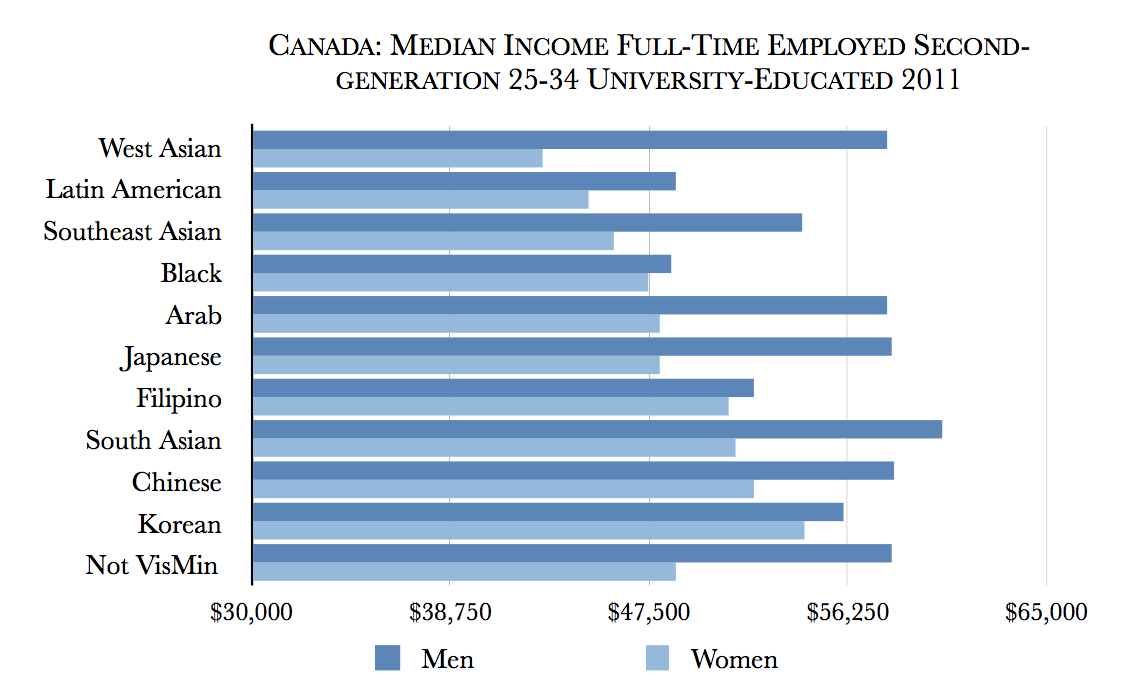
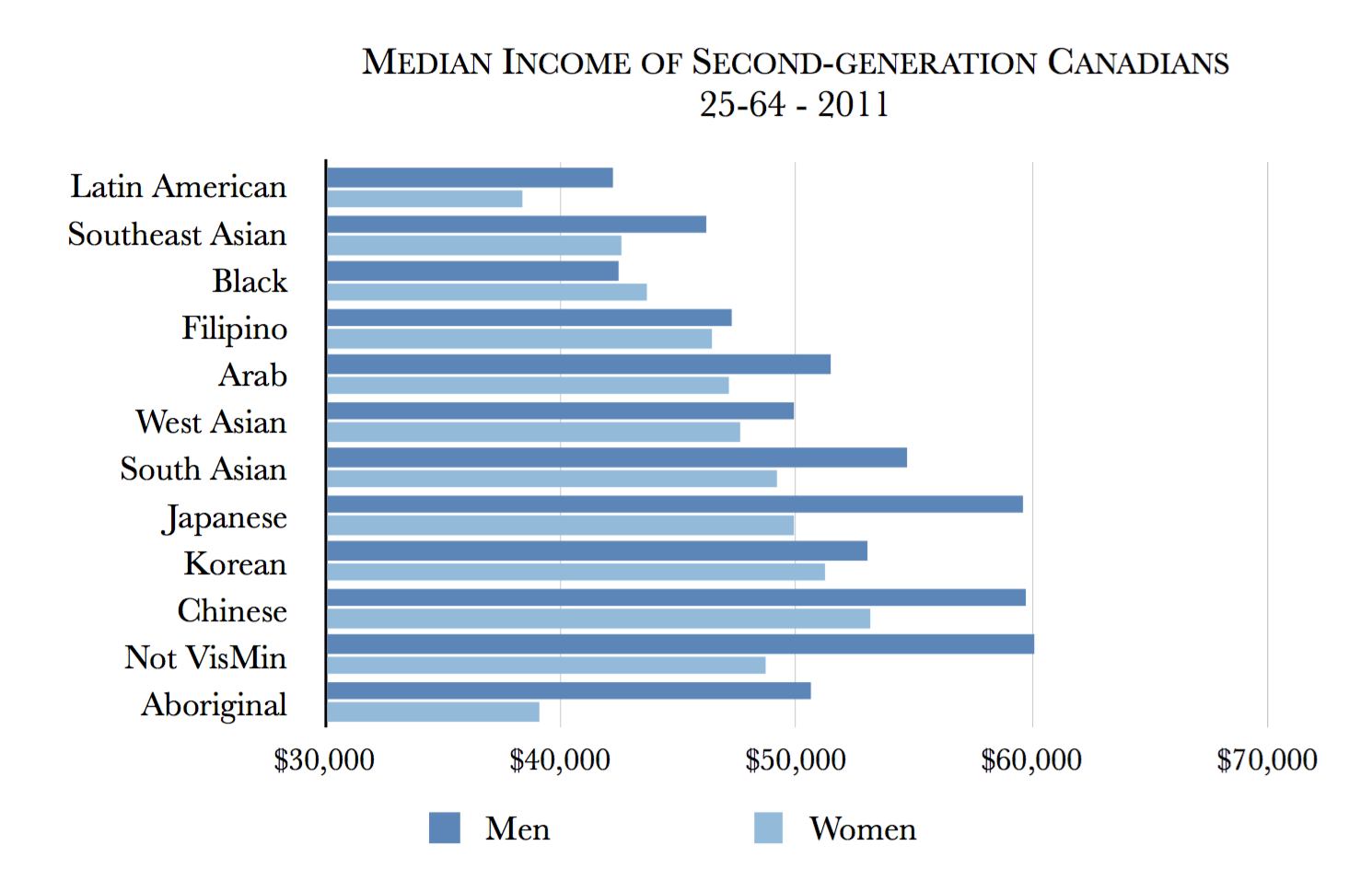
The two charts below, taken from INSERT, indicate the persistence of income differences in second-generation immigrants, both more generally and the university-educated young.

For all second-generation, the disparities with non-visible minorities and among different visible minorities groups are greater.

While for most groups, median incomes for the university-educated are broadly comparable to non-visible minorities, that is less the case for Latin American and Black Canadian men.

The redefinition of the ‘vertical mosaic’ needs to look more at both the overall and the group differences to assess the ongoing impact of external bias and discrimination along with any internal cultural factors and preferences that may also contribute to these disparities:

Median Income G2 VisMin

2G_University_Educated_25-34

Porter made several significant observations about the economic inequality between people of British and French origins and “others” (what he called “minority ethnics”). Porter carefully documented the French population’s lower-income status and disagreed that their situation could be blamed entirely upon the British desire for economic dominance. He insisted that French-Canadian under-representation in the country’s economic elite was as much related to their values as it was to cultural discrimination.

A major part of the problem in French Canada was the dominance of the Catholic Church, which Porter felt reinforced cultural difference, encouraged separateness and diminished educational opportunity. Much has changed since the 1960s with the onset of Quebec’s Quiet Revolution and the ensuing rise to relative economic parity between French and English Canadians. Regrettably Porter said relatively little about the condition of indigenous peoples in Canada’s class structure, a persistent concern that 50 years later still badly needs national attention.

Porter was persuaded that persistent minority ethnic attachments were the principal obstacle to immigrant and minority economic advancement. This conviction was central to his ultimate objection to multiculturalism adopted by the Trudeau Liberal government in 1971. If the Canadian mosaic was vertical, Porter largely blamed it on the encouragement that multiculturalism offered to newcomers and their descendants to retain their ancestral identities. Most European origin post-war immigrants and their children would probably disagree with Porter’s assessment of multiculturalism as constituting such an obstacle.

Canada is now a much larger and more ethnically diverse country than the one Porter studied in 1965. The 1961 census reported that there were approximately 18.5 million Canadians compared with nearly 34 million in 2011.

Prior to the 1970s, immigrants from European countries accounted for over three-quarters of those coming to Canada. For many European origin groups, the story of their place in the vertical mosaic over the past fifty years ended up being one of noteworthy upward mobility. The groups that Porter saw as being locked into some lower status (Ukrainians, Italians, Poles, Finns and Czechs and Slovaks) have generally moved up the socio-economic ranks. The children of Southern and Eastern European immigrants who came to Canada in the late 1940s and 1950s are in retired age and, for the most part, they witnessed the erosion of the ethnically defined barriers to economic mobility.

Today, over three-quarters of immigrants to Canada hail from non-European countries and are defined as visible minorities. The growth in the visible minority population has seemingly changed the nature of the vertical mosaic and the portrait of inequality in Canada. The question that preoccupies researchers is whether the upward mobility experienced by most European origin groups can be replicated by non-European immigrants and their children. Several analysts are decidedly pessimistic about such prospects and argue that “race” has replaced ethnicity as the new dividing line within the Canadian mosaic.

But there are some important caveats to keep in mind when making observations about the economic dream of recent newcomers to Canada. Unlike the post-war immigrants that often came to the country with little formal education, most recent arrivals are a highly educated bunch. Data from Canada’s 2011 national household survey reveal that immigrants that arrived in Canada between 2001 and 2009 were twice as likely to have a university degree as a person born in Canada. Hence in most cases newcomer expectations for their own personal success is higher than was the case for the immigrants in the era Porter documented. While many newcomers want their children to do better than them, an increasing number will be satisfied if they do as well. That’s also a concern for many non-immigrants.

The contemporary version of the Canadian dream for many of us is perhaps more modest. It’s something akin to owning a home and staying out of debt (these two things may seem contradictory to many Canadians).

Recently, the earning power of many university degrees has stagnated. According to Statistics Canada’s 2012 Survey of Financial Security, student debt rose by 44.1 per cent from 1999 to 2012, or 24.4 per cent between 2005 and 2012. So too has the cost of owning a home in Canada. In the final quarter of 2015 Statistics Canada reported that the ratio of household credit-market debt to disposable income, the key measure of the debt load, rose to 165.4 per cent.

Sure interest rates are at record lows and there is fear that a slight rate hike will make the dream of personal debt reduction more elusive. The gap between the highest paid Canadians and others has widened in recent years. The wealthiest 20 per cent of Canadians hold 70 per cent of the country’s wealth.

Source: It Is Time To Redefine Canada’s Vertical Mosaic | Jack Jedwab

No Community Should Have To Publicly Denounce Extremism | Jack Jedwab

Good piece by Jack Jedwab, quoting Rima Elkouri:

When I was employed by the Jewish community, I would occasionally be asked by the media to disassociate myself from individuals or groups that identified with the community. There is a need for greater empathy with members of communities for whom such disassociation is commonplace.

In September 2014, La Presse‘s Rima Elkouri decided to disassociate herself from barbaric acts taking place in Syria. In a climate where the failure on the part of individuals of the Muslim faith to denounce such action is deemed a tacit endorsement, Elkouri chose to respond to such a request on the part of an obnoxious reader of the newspaper.

Paradoxically, Ms. Elkouri is not Muslim. In her response, she noted that it’s never enough for the broader population when large Muslim organizations denounce the Islamic State. Hence, she pointed out that “sometimes it’s our citizens of the Muslim faith that feel compelled to denounce barbaric acts with greater vigour than the rest of us so as not to be seen as guilty by association.”

Elkouri added: “… Muslims, we tend to forget, are the principal victims of jihadists. They are no more likely to have ties with the Islamic State than do Christians with the Ku Klux Klan. Why this persistent societal demand for Muslims to break ranks with a group with which they do not associate? Why this hunting that regards silence with suspicion.” (Editor’s note: blogger’s translation.)

Elkouri concludes by disassociating herself publicly from this absurd logic.

As a solution to the real problem of terrorism in our society, it is counterproductive to collectively accuse persons of being complicit because they happen to share the same faith as a perpetrator of a heinous act. For the time being we can be thankful that in Canada when it comes to such forms of collective stigmatization, it’s the cooler heads that continue to prevail.

Source: No Community Should Have To Publicly Denounce Extremism | Jack Jedwab

Immigrants Feel As Canadian As The Rest Of Us | Jack Jedwab

Jack Jedwab reviews some of the attachment findings of the General Social Survey, contrasting Canadian and foreign-born, along with the particularities of Quebec. Identity is more multifaceted than binary:

Critics of multiculturalism outside of Quebec believe that this undocumented lack of newcomer attachment — however defined — is an integration problem. If attachment to Canada is used as integration criteria, for some Quebec observers the newcomers in the province will appear too well integrated!

But contrary to what some Quebecers assume, those immigrants in the province that possess the strongest degree of attachment to Canada also exhibit a strong sense of attachment to Quebec. It might be said they feel at home in the province and the country, and refuse to see a contradiction in this regard.

You don’t have to live somewhere for a particularly long period of time to appreciate your home. Independent of how long you’ve lived somewhere it may feel as though you’ve always belonged there. Certain immigrants are especially grateful for the opportunity to reside in Canada and this can act as a catalyst for a relatively instant feeling of attachment to the country.

It’s quite possible that the strong initial connection to a place can diminish over time if an immigrant’s expectations are not met. But the same feeling about the country can apply to someone born here across their life cycle.

The 2013 General Social Survey confirms that there is no difference in the level of attachment to Canada between Canadians aged 15 to 24, whether they are domestic (rooted) or foreign-born (less rooted). Surveys repeatedly reveal that the youngest Canadians have the lowest sense of attachment to Canada, but this grows on many of us as we get older. In sum, it is one’s age and not immigrant status that is perhaps the most important predictor of the sense of attachment to country.

Source: Immigrants Feel As Canadian As The Rest Of Us | Jack Jedwab

Is Canada A Nation Of Immigrants? | Jack Jedwab

Jack and I have a disagreement here, with significant policy implications.

The issue is not, in a labelling sense, of creating multiple classes of Canadians. We are now back in the world of “a Canadian is a Canadian is a Canadian,” whether born here, born abroad or children of immigrants.

In contrast to earlier waves of mainly white and Christian immigrants, with many similar integration challenges, today’s immigrants are largely visible and religious minorities.

Without looking a the different experiences between first and subsequent generations of immigrants, we overlook the very real differences in outcomes for different groups of the second-generation compared to non-visible minority Canadians (or “old-stock” Canadians).

2G_University_Educated_25-34In some cases (i.e., percentage university-educated), the second-generation does significantly better than non-visible minority Canadians. And those that find employment have comparable median salaries.

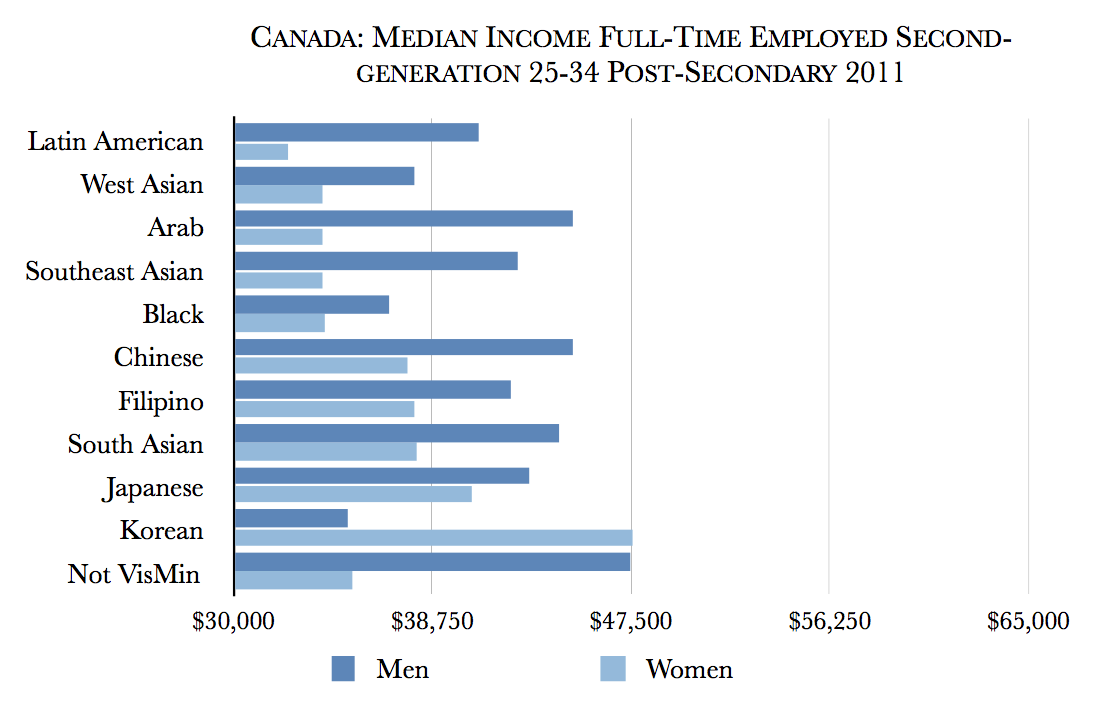
However, the second generation has higher unemployment rates than non-visible minority Canadians. Those that are not university educated have lower median incomes, as shown in the chart below:

2G_Non-Univ_Educated_25-34This is not to mentioned the well-documented instances of discrimination in hiring, police carding and other areas that show significant differences between visible minorities and others.

So while as a ‘value statement,’ one may prefer to refer second-generation immigrants as non-immigrants, this effectively masks some of the ongoing integration challenges that some elements face.

And while I fully agree with Jack that comparisons with Europe are often inappropriate given our differences in history, geography and identities, we do, like other ‘new world’ countries, view ourselves as countries of immigrants, unlike Europe. And this, with the exception of the USA, both reflects and influences how we deal with integration.

Measuring and contrasting the outcomes of both first and second generation outcomes provides useful international and internal benchmarks allow us to identify ongoing integration challenges with a view to overcoming them. Not making the distinction obscures them:

But there a significant segment of the Canadian-born population that sometimes wrongly gets labeled as immigrants. I refer specifically to persons born in Canada of foreign-born parents (a group to which I belong). Much social science literature in Europe refers to these children of immigrants as “second generation immigrants”. To many North American observers the term must seem like an oxymoron. It nonetheless gets employed by a number of Canadian scholars.

There are statistical breakdowns in the census of Canada on the basis of generational status. Immigrants are generally designated as the first generation, their children as second generation and there is a category for third generation or more. It’s inaccurate to refer to second generation Canadians as something other than non-immigrants with whom they are grouped in the census question on immigrant status.

The confusion that is created by designating them as “second generation immigrants” is sometimes influenced by European analysis with the practice in several EU countries of not automatically conferring citizenship on persons born in the country. For example, children born in France of foreign-born parents do not become citizens until reaching the age of the majority. Switzerland does not automatically extend citizenship to a child that is born in the country. Rather, a person is automatically Swiss if at least one of the child’s parents is Swiss.

Relatively few Canadian scholars that use the term second generation immigrants necessarily think of such individuals as immigrants. Rather most simply echo terminology that is used in some of the Canadian literature on immigration and citizenship and/or seek to engage with European policy-makers or scholars by employing a common vocabulary. But the Canadian-European comparisons can be problematic and regrettably they sometimes don’t make for good scholarly work.

Is Canada a nation of immigrants? It is certainly a nation with many immigrants who have played a critical role in the process of nation-building. But it is simply too limiting a concept when “the nation of immigrants” conveys the idea that immigration is the country’s principal defining characteristic.

Source: Is Canada A Nation Of Immigrants? | Jack Jedwab

Opinion: There’s no link between terrorism and multiculturalism – Jedwab

Jack Jedwab of ACS notes the many fallacies in Farid Rohani’s piece on multiculturalism and radicalization (Opinion: Multiculturalism should not be misused to justify divisions: Farid Rohani):

Yet Rohani makes a pernicious link between these heinous acts and Canadian multiculturalism. He establishes this false association by suggesting that the Canadian multicultural framework has seen “activists promote group traditions as having more importance than individual freedoms,” and suggests it creates an environment that enables terrorists to propagate their views. He further states that multiculturalism “is being used to create different groups that contest our tolerant democracy.”

It has been increasingly common for detractors of multiculturalism to make such claims without identifying the culprits. Rohani does precisely this and, regrettably, contributes to the spread of what he describes as “quiet intolerance,” the very thing about which he expresses concern. His observation will end up inviting unfair generalizations about minority religious groups that will fuel the divisions that he suggests he seeks to remedy.

Rohani implies that such things as forced and arranged marriages, honour killings and teaching of hate toward other religions or toward homosexuals or death warrants against apostates are also to be attributed to flawed communications about what pluralism and multiculturalism entail. In general, such things are far more prevalent in non-democratic societies that reject diversity and multiculturalism. The individuals who engage in such egregious acts for the most part wish to erode multiculturalism and replace it with a model of society that would limit individual freedoms and undermine intercultural harmony.

Rohani specifically singles out newcomers to Canada as being particularly exposed to distortion about our national identity and values. So what would he make of the fact that the killings in Ottawa and St-Jean-sur-Richelieu were carried out by individuals born and raised in Canada? Indeed, newcomers value the opportunity to live in our democracy and there is no evidence that they are more likely than non-immigrants to want to undermine it.

Opinion: There’s no link between terrorism and multiculturalism | Montreal Gazette.

Clear case of ‘multicultiphobia,’ to use Phil Ryan’s phrase.

Jedwab also cites the recent polling done for the Canadian Race Relations Foundation as supporting this view (report-on-canadian-values), as do most polls that I have seen.