J.L. Granatstein: Leaving the old country behind

While the examples of diaspora politics and imported conflicts are valid and real, surveys such as the GSS indicate that by and large, multiculturalism is not a barrier to integration. But these conflicts do increase the challenges, as the Israel Hamas war and related increases in hate crimes demonstrate:

…What was going on? Clearly, the old country ties remained strong in immigrants to Canada. Ethnicity is a powerful force, naturally enough, but official multiculturalism encouraged ethnic communities to retain their identities. There were language schools funded by Ottawa, in addition to newspapers, community centres, and dance troupes. The money flowed because there were votes out there waiting to be harvested.

What was not going on was any effective effort by the state to turn immigrant communities into Canadians. Naomi Klein, (not someone I usually quote approvingly), wrote in 2005 after terrorist attacks in London “that the brand of multiculturalism practiced in Britain (and France, Germany, Canada …) has little to do with genuine equality,” she said. She continued:

It is instead a Faustian bargain, struck between vote-seeking politicians and self-appointed community leaders, one that keeps ethnic minorities tucked away in state-funded peripheral ghettoes while the centres of public life remain largely unaffected by seismic shifts in the national ethnic makeup.

Surely she was right, as we can readily observe when our parties scramble for ethnic votes in the suburban areas of the nation’s large cities.

Most Canadians believe immigration is important for Canada, the present difficulties notwithstanding. But polling also shows that most also believe that we must make Canadians of those who come here. It is not enough to leave them alone in the hope that they will quietly assimilate into accepting our values—peace, order and good government, civility, equality, tolerance, respect for rights—and that if they wish to join us they must understand and accept this. Canada is part of Western Civilization, not a community of communities, as Joe Clark put it, not a post-national state, as Justin Trudeau proclaimed. We are a well-established pluralist, democratic, secular nation.

To paraphrase the American writer David Rieff in the New York Times some years ago, the multicultural fantasy in Canada was that, in due course, assuming that the proper resources were committed and benevolence deployed, immigrants would eventually become liberals. As it was said, they would come to “accept” the values of their new countries. It was never clear how this vision was supposed to coexist with multiculturalism’s other main assumption, which was that group identity should be maintained. But by now that question is largely academic: the Canadian vision of multiculturalism, in all its simultaneous goodwill and self-congratulation, is no longer sustainable. And most Canadians know it. What they don’t know is what to do next.

Stephen Marche was right in saying that the old country must be left behind. It is long past time that Canadians figure out how to make this work.

Source: J.L. Granatstein: Leaving the old country behind

Articles of interest: Citizenship

Starting up my blog again, highlighting some of the articles I found of interest.

Past Imperfect: J. L. Granatstein’s prescient warning

Agree, both the good and the bad:

Also regrettable is that Granatstein did not offer a more pointed rationale for learning hist­ory. He argued that an understanding of the subject was “the prerequisite of political ­intelligence” but without going further. The cost of not knowing history is much deeper, in my view. It creates a real disquiet and robs the community of its ability to find nuance in any dispute. Indeed, one could argue that the incoherence of a vast array of policy areas in this country — from cultural and global affairs to housing and homelessness — can be explained only by a general loss of historical consciousness.

To talk historically about any episode — a court case, a medical issue, a construction problem, even a love dispute — is to inquire about “what really took place last time.” It ­naturally invites subtlety, attention to context, and storytelling that can lay the groundwork for compromise. It calls for clarity in sequencing events and necessarily examines what’s behind the story: “Well, we didn’t have the tools” or “Our thinking was wrong” or “We simply didn’t know.” It can build respect and, not least, modesty. But it can also bridge solitudes and open the road to cooperation, better understanding, and perhaps even reconciliation and forgiveness. No one who studies history seriously can be insensitive to the anxieties and cruelties of humanity or unimpressed by its resilience, ­creativity, and kindness.

But that sort of discipline has been evacuated from popular culture. For over a dozen years now, history departments have seen their student numbers decline. Consequently, new hires are even rarer than before. Governments seldom consider the failures and successes of previous policies; museums dedicated to the past are shrivelling without money for new exhibits and programs. Historians, terrified of being misunderstood, refuse to engage in public debates that could bring nuance to policy issues. Canada is not in a state of post-nationalism but is rather a place of hiber‑nation — a country that has fallen asleep and forgotten its past.

This is dangerous. Historical awareness bolsters democracy and democratic instincts. Take away history and you undermine the ability to discuss, to debate, and to share knowledge on how things evolved. Without such skills and knowledge, democracy as we know it will wither and die

Source: Past Imperfect: J. L. Granatstein’s prescient warning

Local citizenship judge wins Community Impact Award – Thorold News

A reminder of the power of in-person ceremonies:

The ceremonies to which she is referring are citizenship ceremonies. For just over five years Ivri has been a citizenship judge with Immigration Refugees and Citizenship Canada. In an average week in this role she swears in between 1,200 and 1,500 new Canadians.

In the relatively short time that she’s been one of nine judges in the Niagara and Hamilton offices of the department, she has welcomed more than 100,000 newcomers to Canada. Besides her family – husband Eldean and children Elijah, Zachariah, Ezekiel and Michaiah – she says it’s the most rewarding thing she’s ever done.

Ivri herself comes from an immigrant family. Her mother Valerie came to Canada to visit an uncle in 1967, leaving behind her husband Roosevelt and their son back in Jamaica. On leave from her job as a customs officer there, Valerie went to a Canadian immigration office to extend her visa. An officer there suggested she instead apply for citizenship, so she did.

Source: Local citizenship judge wins Community Impact Award – Thorold News

Shawn Taylor: Are Immigrants Falling out of Love with Canada? (And is it Because We Feel the Same?)

Overly negative but not without merit:

The evident decline in Canada’s citizenship rates may say more about the attitudes and habits of existing Canadians than those of newly-arriving immigrants. The federal bureaucracy’s failure to meet its own published service standards is certainly a self-inflicted wound. As is the proposal to solve this problem by eliminating much-loved citizenship ceremonies. The effect of both situations is to debase the perceived status of Canadian citizenship by emphasizing the transactional over the transformational. Then there’s the Roxham Road debacle, which offers migrants the opportunity to illegally sneak into our country via a dead-end road rather than at a regular border crossing and still be recognized as refugee claimants, with all the official support and standing this entails. If Canadian citizenship is supposed to be so valuable, it seems foolish to further cheapen the reputation of the entire immigration system in this way.

Beneath these obvious failures of governance and policy, however, lurks an even deeper and more insidious problem. As Bernhard explains, becoming a citizen is akin to joining a team with all other Canadians. A “club,” so to speak, that is exclusive to those who wish to be identified as Canadian and who intend to participate in its promotion and maintenance by voting and performing other civic duties. If we accept such an analogy, then it clearly matters how we advertise and promote this club to new members. So what sort of stories do Canadians tell about their own country these days? And do they amount to an effective marketing strategy?

 “The story of Canada that our major institutions tell has increasingly become one that focuses on only the most negative aspects of our country, such as oppression, racism, discrimination and dispossession,” observes Christopher Dummitt, an historian at Trent University’s School for the Study of Canada in Peterborough, Ontario. Common examples of this new tendency are factually-dubious claims, often from officially sanctioned sources, that Canada has committed and continues to commit genocide against the Indigenous population, is systemically racist towards black people, was once a slave country, and on and on. “It is a deliberate distortion of our actual history,” says Dummitt in an interview.

This sense of national self-loathing has become so encompassing that official multiculturalism, once billed as an unquestionable Canadian value, is now considered evidence of an “unjust society premised on white supremacy,” as two University of Calgary education professors absurdly argued last year. Even professed supporters of Canadian identity, such as ICC co-founder Ralston Saul, now casually declare that “Canada has failed on many fronts.” As for how such a perspective might work as a branding exercise, Dummitt says, “If the story about Canada is that it was an institutionally corrupt nation beset by the original sin of colonialism, then why would anyone want to become a citizen of that?”

Dummitt has been pushing back against the now-pervasive narrative that Canada is, at its core, morally bankrupt. In 2021 he organized a rebuttal signed by many eminent Canadian historians condemning the Canadian Historical Association’s (CHA) unilateral declaration that Canada’s treatment of Indigenous peoples was “genocidal.” In making such a claim, Dummitt’s rebuttal stated, the CHA was “insulting the basic standards of good scholarly conduct.” He has also spoken out against the practice of tearing down statues honouring Canada’s founding fathers, and is currently fighting Toronto’s plans to scrub the name of 18th century British parliamentarian Henry Dundas from its streets and public squares on the (entirely bogus) assertion that he was an ally to the slave trade. “We need to call out these nonsensical claims,” Dummitt states determinedly. “And we need politicians who are willing to celebrate the Canadian nation in diverse ways.”

With this sort of self-hatred being expressed by current citizens, is it any wonder immigrants are having second thoughts about joining Club Canada

Peter Shawn Taylor is senior features editor at C2C Journal. He lives in Waterloo, Ontario. 

Source: Are Immigrants Falling out of Love with Canada? (And is it Because We Feel the Same?)

Is Portugal’s Golden Visa Scheme Worth It?

No:

On Nov. 7, the same day that Portugal’s Prime Minister António Costa resigned amid corruption allegations pertaining to lithium contracts, federal officers in Brazil raided the Portuguese Consulate in Rio de Janeiro.

The Brazil raids were not connected to the Lisbon investigation, a spokesperson said. Instead, according to Brazilian police, they were part of a separate investigation into the falsification of documents in collusion with applicants seeking Portuguese visas and citizenship. Since the 1990s, amid periods of economic downturn and social instability, large numbers of Brazilians have struck out for Portugal. When the country began its “golden visa” program in 2012, wealthy Brazilians became the second largest group to take advantage of it.

Portugal’s golden visa grants European Union access to foreigners in exchange for investment. From its inception in the wake of the 2008 global financial crisis, it has faced backlash, and the criticism has only grown more vocal in recent years. Chiefly, it is blamed for contributing to a severe housing crisis that has made affordable housing unattainable for most Portuguese.

In early October, Costa’s Socialist government finally passed a law that took aim at the issue, removing the real estate investment pathway from the golden visa program. Previously, people who invested in a qualifying property worth at least 280,000 euros (about $305,000) were eligible. The change, almost a year in the making, has ricocheted around the world of global elites, many of whom had come to regard Portugal as a foothold into Europe. Although more than 30,000 foreigners have benefited from Portugal’s golden visa, its benefits for the Portuguese themselves are less clear.

Source: Is Portugal’s Golden Visa Scheme Worth It?

German State Saxony-Anhalt: No citizenship without supporting Israel’s existence 

Hard to see how this will work in practice:

The decree instructs authorities to pay close attention to whether an applicant exhibits antisemiticattitudes and states that “obtaining German citizenship requires a commitment to Israel’s right to exist.”

In a letter to local authorities, the Saxony-Anhalt state Interior Ministry said naturalization is to be denied to foreigners who engage in activities directed at Germany’s liberal democratic order as outlined in the country’s Basic Law. The denial of Israel‘s right to exist and antisemitism are included among such activities.

Local authorities have been instructed to deny an applicant’s naturalization request if they refuse to sign the declaration. A refusal is also to be documented in the individual’s application filing for future reference.

Source: German state: Citizenship applicants must support Israel
Historians say removal not the only way to deal with racist relics

Thoughtful commentary by Granatstein, Stagg and Blackstock on Canadian monuments on alternatives to removal.

Not convinced that moving controversial monuments to museums, as Gabaccia suggests, is preferred approach as it removes and isolates history, rather than exposing history to the broader public:

The trend to remove those memorials — many of which are displayed in prominent public places featuring figures in heroic poses, such as riding on horseback — has provoked strong emotions and violent clashes.

But leading historian and author Jack Granatstein said that rather than allowing these sites to become flashpoints for racial divisions, they should be displayed with contextual information to help people understand, interpret and learn from the past.

“It’s probably inflaming the situation,” Granatstein said of the push to eliminate memorials. “I think we need to remember that history happened, and you don’t simply change it by taking a name off a building or taking down a statue.

“I think what is better than that is to have an explanation for why someone is being honoured for what he or she did in that time, and that explanation can go in to context of what they did.”

Granatstein said taking down monuments allows the wrong people to seize control over the interpretation of history, referring to those who have staged demonstrations protesting their removal, including white supremacists.

“In the American context and to some extent the Canadian context, you give an opportunity to people whose views we don’t particularly enjoy: fascists, Nazis, racists,” he said. “I don’t want them pretending to defend history. The history they are trying to create is not the history I would prefer to see memorialized, or honoured or understood by the public.”

String of controversies

White nationalists protesting the planned removal of a statue memorializing Robert E. Lee, a Confederate top general, clashed violently with counter-demonstrators in Charlottesville, Va., last weekend. One woman was killed and another 20 people were injured.

It was the latest in a growing number of controversies that have erupted over plans to take down Confederate symbols in the U.S. and to change names of sites offensive to Indigenous people in Canada.

With a growing push to remove historical memorials and monikers, Granatstein asked where it would stop.

He noted that in Canada, CBC listeners called Tommy Douglas the greatest Canadian of all time, yet in the 1930s the former premier of Saskatchewan and father of medicare held a then popular belief in eugenics and wanted to sterilize people with mental impairments.

“Attitudes change, and it seems to me that one of the tasks of historians and politicians is to remind people that today’s values are different than past values, and the future’s values will probably be different than ours,” Granatstein said.

Trump emboldens protesters

Ron Stagg, a history professor at Toronto’s Ryerson University, said removing statues of Confederate heroes, which are now interpreted as symbols of slavery and oppression, draws the ire of a certain segment of the white population who see it as an erosion of their rights. Provocative statements from U.S. President Donald Trump have served to embolden these people, who may not have spoken out in the past.

Stagg sees the situation unfolding in the U.S. as different from that in Canada, where most disputes are not fraught with such deep divisions and “intense feelings” on both sides.

Halifax Cornwallis Statue 20151213

A statue of Edward Cornwallis stands facing England – with his back to Halifax – in Cornwallis Park. (Canadian Press)

In Canada, most of the controversies have been around Indigenous people in the context of reconciliation.

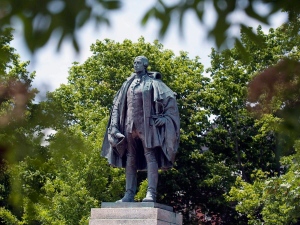
Conflict recently erupted in Nova Scotia over a plan to take down a statue of Edward Cornwallis, a British military officer and one of the founders of Halifax, who in his day had offered a bounty for the scalps of Mi’kmaq.

The federal government also recently removed the name of Hector Langevin from a government building, after Indigenous groups complained that it paid tribute to a man who played a role in the residential schools program.

Stagg called that name removal a “token” gesture by Prime Minister Justin Trudeau, and said it may open the floodgates to other requests for change.

langevin block ottawa parliament hill june 21 2017

The Langevin Block in Ottawa is seen on June 21, 2017 — the same day that Prime Minister Justin Trudeau announced it would be renamed because Hector-Louis Langevin, a father of Confederation, proposed the creation of the residential school system. (Trevor Pritchard/CBC)

“I think we’re going to try and be politically correct in terms of trying to erase aspects of the past that we find offensive,” he said. “I think that’s wrong in the broad sense. I think it’s going to continue to happen and there’s going to be a backlash just as there has been in the States.”

Indigenous child welfare advocate Cindy Blackstock has successfully fought for revised wording on plaques commemorating certain people who had a role in the residential schools program. She said while in some cases symbols such as swastikas must be eliminated, she said most memorials should remain up in order to teach visitors about the past, provided they tell the full story.

“By erasing the monument you can erase the historical lessons, contributing even more to the rampant historical amnesia that feeds discrimination and immorality,” said Blackstock, who is also a professor of social work at McGill University.

Museums as mediators

Donna Gabaccia, a history professor at the University of Toronto who organized a weekend demonstration in Toronto to protest white nationalism and the violence in Charlottesville, said memorials could be taken down and moved to museums where they could be understood in proper context.

“I see museums as important mediators of cultural controversies, where many voices can be and must be heard if the controversies are to be resolved,” she said. “Monuments become controversial when public opinion and historical context changes around them, which is inevitable. Contestation over the meaning of museums can only be resolved when all sides begin to understand the differences between the past that created the monuments and the present that inevitably seeks new meaning in them.”

Granatstein said context about the people being memorialized — including polarizing figures deemed by some to have been heroes in their day — is critical to understanding history.

“Every country has its heroes and most of those heroes have feet of clay or maybe a toe or two of clay. A country without heroes is a country without a past. I’d prefer to have heroes and a past,” he said.

Source: Historians say removal not the only way to deal with racist relics – Politics – CBC News

Cohen: Time to move beyond the myth of Vimy

Andrew Cohen on Vimy, with help from Jack Granatstein:

“For the first time, Canadians soldiers fought as one unit, under the command of Canadian officers and employing tactics developed by Canadians,” according to an article in the National Post in 2013. “And we won, trouncing the Germans where our allies had failed and congratulating ourselves ever since.”

As J.L. Granatstein argues, that view “is almost completely wrong. Almost. All that it gets right is that Canadians have congratulated themselves ever since.”

Granatstein, the highly decorated military historian who chaired the advisory board of the Vimy Foundation until 2014, is not belittling the foundation or Canada’s role in the Allied offensive that spring. Nor am I.

But, as he points out in his provocative new book, The Greatest Victory: Canada’s One Hundred Days, 1918, we have come to believe a more comforting mythology. His persuasive point is that our decisive impact came in the last three months of the war, that those were our greatest battles.

At Vimy, Granatstein writes, the Canadian Corps was not commanded by a Canadian but by British Lieutenant General Sir Julian Byng. The planners were not Canadians, as widely thought, but Britons. Seven of nine of the Heavy Artillery Groups that put Canadians on Vimy Ridge were from the Royal Artillery. And the supplies, weapons and ammunition were largely from Britain, he says.

While thousands of the soldiers at Vimy were born in Canada, most were recent British immigrants to Canada. (Indeed, we had no citizenship then.)

Most important – and hardest for us to accept – is that Vimy changed little. Yes, we took the ridge with courage, daring and innovation, a magnificent victory. But the Germans retreated a few miles east into new trenches, suffering a “tactical” more than a strategic defeat.

“Vimy regrettably did not win the war or even substantially change its course,” concludes Granatstein.

Yet that is not what Canadians know about Vimy. More likely, they hear that it “began our evolution from dominion to independent nation.” Or, more breathlessly, it marked “the birth of a nation.”

It helped that the battle opened under gun metal skies on Easter Sunday, fostering a poetic sense of resurrection. That some 10,300 were killed or wounded, that they fought through snow and sleet, that it was our greatest victory in the war up to then – all contributed to a national mythology.

But the birth of a nation? Lord, we had been here for 300 years, and organized as a country since 1867. To say that we fell from the heavens in 1917 denies centuries of achievement and sacrifice. That we began to emerge in the world afterward because we went to the Versailles Conference is an empty boast; in reality, we had little international influence until the Second World War.

All this may be useful to those who crave a comforting narrative. A century ago, as an adolescent people, we needed one.

Today we should remember Vimy. But we should also ask what we were doing there, and in the slaughterhouse of the Great War itself, and what the war did to us. That’s what a mature, self-confident people does.

Vimy is a myth. It’s time to move beyond it.

Cohen: Time to move beyond the myth of Vimy | Ottawa Citizen.

Homegrown jihadis: Canadians have always fought in other people’s wars – Granatstein

Jack Granatstein’s fine reminder that Canadians have often fought in other wars and conflicts:

The government of Mackenzie King tried to stop Canadians from going to Spain, and it passed the Foreign Enlistment Act in April, 1937, to prevent men from signing up for foreign wars. The volunteers went to Spain anyway, while countless others donated money to the cause. Most of the Canadians who went to fight – 76 per cent, according to Michael Petrou’s fine study of the Mac-Paps – were Communist Party members, most recent immigrants to the Dominion. The Mac-Paps earned a reputation for political unreliability and combat effectiveness, and at least 400 never returned home. These “premature anti-fascists” suffered for their political sins in the Second World War and Cold War years.

The Foreign Enlistment Act remained on the books, but it didn’t stop Canadian Jews from fighting for Israel or raising millions of dollars for its support. Ben Dunkelman, who had served with distinction with the Queen’s Own Rifles in Europe, went to Israel in 1948 and led a brigade with great success in Israel’s independence war. Many others did so, including George Buzz Beurling, a Royal Canadian Air Force fighter ace and a gentile, who joined the Israeli Air Force as a well-paid mercenary. Beurling died in an air crash in Rome on his way to the Middle East. Many other Canadian Jews served in the major Arab-Israeli wars of the following decades. Others serve in the Israeli military to this day, all presumably in violation of Canadian law.

Then there was the Vietnam War. While hard numbers are unavailable, estimates are that as many as 50,000 Canadians served in the U.S. military during that long, bloody struggle. Some enlisted out of the conviction that North Vietnam was an aggressor state, others presumably because of an adventurous spirit that could not be satisfied in the Canadian Forces because of Ottawa’s preference for United Nations peacekeeping. Once again, the law was not applied against Canadians who fought abroad.

None of those war veterans brought jihad home to Canada, a legitimate concern we live with today, although some communists who fought in Spain might have had attitudes inimical to the Canadian capitalist state. Most of the Islamist volunteers, if they survive to return to Canada, will likely settle down to a “normal” life. But so long as ideology, religion, adventurism and a soldier’s pay still matter, Canadians will likely continue going off to fight in other people’s wars.

Not sure where he stands on citizenship revocation in such cases, but clearly his expectation is that most will “grow out of it” and return to Canada, which may be a bit naive given the intensity of their beliefs and the nature of the organizations they are fighting with.

Homegrown jihadis: Canadians have always fought in other people’s wars – The Globe and Mail.

Why is Canada botching the Great War centenary? – Granatstein

Funny to see how the academics who support the overall thrust of the Government’s change of emphasis on Canada’s historical narrative, particularly the increased emphasis on the military, have started to realize the limitations of the Government’s commitment. Jack Granatstein’s commentary on the commemoration of WW1 and Canada’s role is valid and telling (for his critique of the Government’s cuts to Library and Archives Canada see Who will preserve the past for future generations?:

But the Great War years also changed the homeland. Women relatives of Canadian soldiers got the vote in 1917, and thousands of women left farms and hearths to work in munitions factories that produced a quarter of the artillery shells for British and Dominion forces by 1917. Prohibition cut off alcohol sales; millions were raised in Victory Loan campaigns; income tax came into effect (as a “temporary” wartime measure); and farmers and workers began to organize politically as inflation hit everyone. Above all, conscription in 1917 split the nation, pitting farmers against city dwellers, labour against bosses, French against English. That year’s election, won by the pro-conscription Unionist government of Sir Robert Borden, was the most racist in our history.

We certainly don’t want to celebrate all of these wartime events and changes, but we need to talk about them and learn from them. We need TV documentaries on the war and its battles and on the events, positive and negative, on the home front. We need books, conferences, lectures and displays in our national and local museums. We need to remember.

This requires some modest new funding. There will be a surplus by 2015, and there will be money available – if the government wishes to use it. There will also be the money to ensure that veterans get the help they require. It’s not a zero-sum game.

We really must remember the Great War properly. It was when Canada stood proudly on the world stage for the first time, and it would be a disgrace for the government to shortchange it.

Why is Canada botching the Great War centenary? – The Globe and Mail.

Haute fonction publique fédérale – Après le silence, la révolte | Le Devoir

More on Library and Archives Canada (LAC) and its former head, Daniel Caron. Part of his problem was that the savage cuts to traditional archival activities, done to meet government expenditure reductions and generate savings to capture the digital records or contemporary events, never had a public constituency. Meanwhile, the LAC constituency of academics, librarians and archivists strongly protested about the loss of traditional archive activities (see Jack Granatstein’s excellent Who will preserve the past for future generations?).

M. Caron dit avoir été injustement cloué au pilori, sans l’appui du ministre du Patrimoine, James Moore, ni même de BAC, où les réformes liées à la numérisation du présent qu’il était en train de mener créaient beaucoup de remous, admet-il. « Les changements étaient importants et ne plaisaient pas à tout le monde, dit-il. Il y a des gens qui avaient un intérêt à me voir partir. Quant au ministre, il avait, lui, un intérêt à se faire du capital politique en tapant publiquement sur un fonctionnaire pour des allégations de mauvaises gestions de fonds publics. Cela est cohérent avec le discours sur la réduction des dépenses ». Et il ajoute : « J’ai également résisté sur des projets d’acquisition de documents liés à la guerre de 1812 [un dossier historique hautement controversé et alimenté par les conservateurs], et poussé pour documenter des mouvements comme Idle No more [mouvement d’affirmation des autochtones et de contestation ciblant l’administration Harper] ou des projets comme Keystone XL [oléoduc canado-américain]. Cela n’a pas été très bien perçu. J’étais au milieu d’un tir croisé, dans une impasse. Je n’avais pas d’autres choix que de me retirer ».

Haute fonction publique fédérale – Après le silence, la révolte | Le Devoir.

How Stephen Harper is rewriting history – Canada – Macleans.ca

Good overview on the remake of the Canadian Museum of Civilization into the Canadian Museum of History, and the likely narrowing of focus and messaging. While the CMC was ‘content light’, my experience taking visitors around from many countries is that the Canada Hall gave them a powerful image of the diversity and evolution of Canada.

And some of Jack Granatstein’s lament in Who Killed Canadian History seemed exaggerated as our kids went through their primary and high school education with a reasonable amount of ‘traditional’ history in addition to social history. Not to say a refresh is not warranted, but hopefully less jingoistic than the War of 1812 celebrations.

How Stephen Harper is rewriting history – Canada – Macleans.ca.