Islamophobia and AntiSemitism: Equally Abominable – Intifada Palestine

Kourosh Ziabari on the parallels between antisemitism and islamophobia:

Ostracizing and defaming the followers of divine faiths, because people or entities associated or supposedly aligned with that faith commit appalling and vicious crimes, should not be made a tolerable convention: this holds true for the Muslims, Jews, Christians or the people of other faiths. I’m always dismayed and troubled when people, especially my fellow citizens, begin denigrating the Jewish people once Israel launches an offensive into the Gaza Strip and kills a large group of people. The derogatory language used against the Jews and the desecration of their synagogues is utterly obnoxious. Clearly, there’s no justification to the Israeli violence and aggression, but it’s undoubted that the Jewish people are not responsible for what Benjamin Netanyahu decides to do to the suppressed Palestinians overnight. That’s why I reject anti-Semitism in the strongest terms and firmly believe that the Jewish people should be treated courteously, first because they’ve historically undergone discrimination, and the discriminatory measures should come to an end at one point, and also because bigotry against people under the pretext that we don’t like the way they worship or dress, or because a perverted minority has hijacked their ideology and justifies its cruelty through resorting to their sacred beliefs is in my view tantamount to theft in the daylight. For the same reason, I was always disturbed when the statements of my former President Mahmoud Ahmadinejad fueled a vitriolic anti-Semitic discourse in the Iranian society: totally indefensible.

Equally, I believe spreading Islamophobia and fabricating a Muslim demon which everybody should be scared of is not a reasonable way of dealing with 1.5 billion people who bemoan the mayhem and carnage caused by the ISIS terrorists similarly as the people in the United States, Canada, Australia and Europe do. Yes, it’s true that the “ISIS” stands for the words “Islamic State in Iraq and Syria,” but as the British Prime Minister David Cameron, former Australian PM Tony Abbott and the Obama administration officials have accurately argued, ISIS is neither Islamic nor a state. Islamophobia and anti-Semitism are equally abominable. We simply alienate and isolate people by profiling and accusing them over the wrongdoing of a minority that struggles to attribute itself to the nonviolent teachings and principles of an overwhelmingly peaceful majority.

Source: Islamophobia and Anti-Semitism: Equally Abominable – Intifada Palestine

Charlie Hebdo Editor: Europe’s Problem Is Racism, Not Islamophobia | TIME

Deceased Charlie Hebdo editor Stéphane Charbonnier on the need to focus on racism, and the risks of focusing on Islamophobia. Valid arguments, that will likely provoke some debate.

In Canadian context, the previous government’s almost exclusive focus on antisemitism meant broader anti-racism initiatives and programming were neglected. Expect some of this to change with the Liberal government as part of its diversity and inclusion agenda, although likely with a mix of broader messaging and programming and specific community focus (i.e., antisemitism, anti-Muslim):

Minority pressure group activists who seek to impose the concept of “Islamophobia” on judicial and political authorities have only one goal: to persuade the victims of racism to proclaim themselves Muslim. Forgive me, but the fact that racists may also be Islamophobic is essentially incidental. They are racists first, and merely use Islam to target their intended victim: the foreigner or person of foreign extraction. By taking only the racist’s Islamophobia into account, we minimize the danger of his racism. Yesterday’s anti-racism activist is turning into the salesman of a highly specialized commodity: a niche form of discrimination.

The fight against racism is a fight against all forms of racism; but what is the fight against Islamophobia against? Is it against criticizing a religion or against abhorring its practitioners because they are of foreign descent? Racists have a field day when we debate whether it is racist to say the Koran is a useless rag. If tomorrow the Muslims of France were to convert to Catholicism or renounce all religion, it wouldn’t make the least bit of difference to the racists—they would continue to hold these foreigners or French citizens of foreign descent responsible for every affliction.

Okay, so Mouloud and Gérard are Muslims. Mouloud is of North African extraction and comes from a Muslim family; Gérard is of European origin and comes from a Catholic family. Gérard has converted to Islam. Both are trying to rent the same apartment. Assuming they have similar incomes, which of the two Muslims is more likely to get the apartment? The Arab-looking fellow or the white guy? It’s not the Muslim who will be turned away; it’s the Arab. The fact that the Arab bears no outward sign of belonging to the Muslim faith changes nothing. Yet what does the anti-Islamophobia activist do? He charges religious discrimination instead of decrying racism….

Social discrimination, while the subject of much less debate than religious discrimination because it is manifested more insidiously and discreetly, is nevertheless far more predominant in France. Managers choose their future employees less on the basis of their religious membership, true or supposed, than, for instance, on their place of residence. Between the Mouloud who lives in upscale Neuilly-sur-Seine and the Mouloud who lives in the down-at-heel banlieue of Argenteuil, which of the two, assuming they are of equal competence, is more likely to get the job? Yet who ever talks about this kind of discrimination? People are massively discriminated against based on their social class, but since a large proportion of the poor—whom no one wants hanging around their place of work, their neighborhood, or their building—is made up of people of foreign descent and, among these, a great many of Muslim origin, the Islamic activist will claim that the problem is Islamophobia.

Source: Charlie Hebdo Editor: Europe’s Problem Is Racism, Not Islamophobia | TIME

Islamophobia is leading the West to a very dark place: Jebara

Good piece by Mohamad Jebara is Chief Imam and resident scholar at the Cordova Spiritual Education Center in Ottawa:

The demonization of peoples and religions is an insidious process that infects entire cultures. Shakespeare vilified European Jews when he wrote The Merchant of Venice, as Charles Dickens did when he made his child-slaver Fagin a Jew in Oliver Twist. For centuries, Jews were portrayed in Western media as sly, deceitful, evil and merciless — a portrayal that allowed the ‘civilized’ world to stand by in silence — and in some cases even rejoice — as the Nazis worked to annihilate European Jewry.

Muslim people, like people everywhere, are quite diverse. Some are saintly, a few demonic, but most lie somewhere in between — just ordinary people who want to live in peace with their families.

Since the formation of the so-called Islamic State, much of the non-Muslim world has continued to misdirect its rage and resentment against its victims. ISIS has killed over 100,000 Muslims, massacred top-ranking Islamic clerics and destroyed hundreds of mosques, seminaries and Islamic heritage sites. It is the Muslim world that continues to suffer most at the hands of these extremists, who try to disguise their depravity with the language of religion.

Centuries of demonization and scapegoating led directly to the death camps of the Second World War. Then, as now, we said, ‘Never again’ — never again would we allow indoctrination and mob mentality to take human civilization to the gates of hell.

Powerful words. Are we still ready to live by them?

Ottawa-based imam Mohamad Jebara wonders whether the racist panic-mongering

What Canada needs now: a strategy against hate: Elghawaby

Amira Elghawaby, the communications director at the National Council of Canadian Muslims (NCCM), with her suggestions on what should be done to combat anti-Muslim activity:

Yet the events of the past few days, both the terrorist attacks and the apparent backlash, must reinforce our commitment to ensuring Canada remains one of the happiest places on earth—for everyone. Our history shows that we have to work for the country we want.

How should we do this?

First, the federal government should immediately partner with Canadian Muslim communities to fashion an effective strategy to combat extremist narratives. This new brand of terror promotion is a contemporary phenomenon that few know how to tackle. The previous government did provide limited funding for an initiative called Extreme Dialogue which highlights the experiences of a mother of a young Canadian who was killed fighting overseas for extremist groups and the experiences of a former white supremacist. There was also some funding provided to explore community resilience through workshops and public fora. We need more of this, implemented strategically across the country.

Second, community stakeholders must come together to find new ways to teach about acceptance and to promote multiculturalism. Again, leadership is key: for example, provincial ministries of education must ensure that teachers are using the resources that national organizations like MediaSmarts and others provide to ensure curricula are taught through a lens that allows young people to identify stereotypes and to challenge popular misconceptions. We need to create safe spaces for our increasingly global classrooms.

Third, police services must bolster hate crimes units and their responses. Victims are often reluctant to report and it’s important to provide both adequate resources and support. Perpetrators must also be swiftly brought to justice.

Fourth, Islamophobia must be considered as offensive and as socially unacceptable as any other hatemongering out there, whether anti-Semitism, racism, homophobia or sexism. This means that even in political discourse, there must be a responsibility to ensure that questions about refugees, for example, are not giving people license to air anti-Muslim sentiments and fuel suspicions about people fleeing the very same type of terror we witnessed in Paris.

Fifth, it’s time to take the Islam, out of ISIS. Most of the world calls this terrorist movement Daesh and ISIS has been widely condemned by Muslim scholars and institutions worldwide. Muslims and Islam should not be synonymous with a group of barbaric criminals. It hurts our communities, it hurts our children, and it only bolsters their false claims. Even law enforcement agencies agree that language has the power to cast suspicion over entire communities, and provide a veneer of credibility to the terrorists’ claims.

Finally, Canadians must choose “love over fear,” to echo the touching sentiments expressed in a Montreal metro earlier last week by three young men who posted a video of their solidarity. Holding each other’s hands, a Muslim originally from Egypt, his friends from Paris and New York, did what many Canadians must do now—defeat the extremist narrative by coming even closer together.

I would also add to her list: maintain the Statistics Canada annual report on police-reported hate crimes (with the shift of multiculturalism to Canadian Heritage, this should be a priority).

Source: What Canada needs now: a strategy against hate | hilltimes.com

What a difference a day makes: The reframing of Canadian Muslims has begun

More evidence of how the change in tone is being noticed:

Women in headscarves are smiling everywhere. They are in the subway station in Montreal with brightly coloured headgear and cell phones to match. They are at a rally in Ottawa, up close with the prime-minister-designate as they snap selfies that will trend on Twitter. They are walking with their heads held just a little higher, returning smiles offered by random passersby.

What a difference a day makes. The same women who were expressing feelings of fear and discomfort just walking to a mall, or to school, are now the same women whose text emoticons are high-fives, fist bumps, and smiley faces as they share videos of Justin Trudeau bhangra dancing.

It is as though Canadian Muslims, and Canadian Muslim women in particular, stepped out of one frame and into another.

The previous frame had been imposed on them, without their consent and despite their protests. Throughout the election, Canadian Muslims watched as they were vilified as “other,” practitioners of “barbaric cultural practices,” and making choices alien from “Canadian values.”

This othering led to a documented spike in anti-Muslim incidents, including verbal and physical attacks on visibly Muslim women in both hijab and niqab, along with increased Islamophobic online postings and comments.

Yet this deliberate framing throughout the election period was nothing new. Canadian Muslim communities have endured years of it. Whether it was making sweeping generalizations about an entire faith – claiming that “Islamicism” was the greatest threat facing Canada – or suggesting that Canadian mosques could be harbouring radical extremists – a decade of Stephen Harper changed perceptions about Canadian Muslims in deeper and perhaps more hurtful ways than even the aftermath of 9/11.

Back then, Prime Minister Jean Chretien made it a point to visit Ottawa’s main mosque soon after those horrific attacks, memorably doffing his shoes and joining the congregants in a public show of solidarity.

Little of that was on show during the Harper years. After the deadly attack at Parliament Hill by a deranged individual pledging allegiance to violent extremist ideology a year ago, the Prime Minister went nowhere near a mosque.

The local police chief, on the other hand, reached out to community leaders to reassure them that the force was on alert in case of any backlash. Mr. Harper preferred to amplify the incident as a terrorist attack and underplay the details of the perpetrator’s life, including the fact that he was a homeless drug addict who had no formal connection to international terrorist groups.

…Canadian Muslims stepped out of those unfair frames every day as they continued to lead typical lives, yet the national framing and its impacts could not be ignored. A poll found that the number of Canadians holding negative impressions of Islam and Muslims had climbed to 54 per cent in 2013 from 46 per cent in 2009.

Is this now over? Probably not: There is a small but growing cottage industry of anti-Muslim bloggers and commentators who seem bent on suggesting that Islam and Muslims are inherently anti-democratic and dangerous. This may be helping to feed a nascent anti-Muslim movement in this country.

Yet a change in tone and rhetoric from the highest office in the land is certainly something to smile about. That alone will help change the picture, or at least refocus the lens.

UK: Anti-Muslim hate crime to be treated as seriously as antisemitism

Good and needed as part of engagement strategy:
Prime Minister David Cameron will tell police forces in England and Wales to record anti-Muslim hate crimes separately and treat them as seriously as anti-Semitic attacks. The move comes amid rising incidents of Islamophobia.

New funding to boost security at religious buildings, including mosques, will also be announced.

The policy move on Tuesday is designed to reassure Muslim communities that the government’s counter-extremism strategy will be balanced, amid fears that the measures alienate them.

Cameron will make the announcement at the first meeting of his new Community Engagement Forum, which will meet to discuss the government’s counter-extremism strategy, due to be published next month.

Islamophobic crime in London jumped by 70 percent in the year up to July, according to official statistics from the Metropolitan Police, one of the few forces to record anti-Muslim hate crime.

Anti-Muslim hate crimes in other parts of the UK are currently monitored by Tell MAMA, an unofficial recorder of Islamophobia in the UK that relies on victims logging incidents online or over the phone.

Speaking ahead of the announcement, Cameron said he wanted to show Muslim communities support.

I want to build a national coalition to challenge and speak out against extremists and the poison they peddle.

I want British Muslims to know we will back them to stand against those who spread hate and to counter the narrative which says Muslims do not feel British.”

And I want police to take more action against those who persecute others simply because of their religion,” he added.

Source: Anti-Muslim hate crime to be treated as seriously as anti-Semitism – Cameron — RT UK

L’Assemblée nationale dénonce l’islamophobie

Think this is a first in Canada, and striking that it is happening during the federal election and the Conservative use of the niqab for wedge politics, not to mention the bill before the Quebec legislature banning the niqab for giving or receiving public services:

Les 100 députés présents au Salon bleu se sont prononcés en faveur de l’initiative de la députée de Québec solidaire, Françoise David. Aucun ne s’y est opposé.

Le texte appelle les élus à s’inquiéter de la prolifération de matériel «à caractère islamophobe et raciste» sur les réseaux sociaux ces dernières semaines. Il enjoint aussi l’Assemblée nationale à affirmer que «les Québécois de confession musulmane sont des citoyens à part entière et que cette Assemblée condamne sans réserve les appels à la haine et à la violence contre tous les citoyens du Québec».

Le vote survient alors que la question du niqab dans les cérémonies de citoyenneté est devenue un thème central de la campagne fédérale. Il arrive quelques jours après que deux adolescents aient fait chuter une musulmane enceinte en lui arrachant son hijab à Anjou.

Dans ce contexte, Françoise David tenait mordicus à inclure le mot «islamophobe» dans le texte.

«Les incidents qui se multiplient depuis quelques semaines sont des incidents qui touchent particulièrement les musulmans du Québec», a-t-elle indiqué.

Réserves

Sauf que les tractations en coulisse et le débat qui a précédé le vote ont mis en relief une hésitation des partis à dénoncer l’«islamophobie». Le Parti libéral, le Parti québécois et la Coalition avenir Québec ont tous plaidé pour qu’on élargisse le texte de la motion afin de dénoncer tous les actes d’intolérance, et non seulement ceux à l’égard des musulmans.

«Je comprends la députée et la formation de Québec solidaire de vouloir mettre l’accent sur l’islamophobie, mais, nous aussi, on avait souhaité une portée plus large parce qu’en fait, lorsqu’on a fait la consultation sur la politique publique, il y a beaucoup de gens qui sont victimes d’intolérance», a affirmé la ministre de l’Immigration, Kathleen Weil.

Le député péquiste Maka Kotto souhaitait aussi amender la motion de Mme David pour «lui donner une note plus universelle, y intégrer en fait toutes les discriminations possibles, toutes les victimes potentielles de racisme».

Dans les rangs péquistes, on souhaitait éviter que l’appui à la motion soit perçu comme une condamnation du débat sur le niqabLe parti considère qu’il est légitime de s’opposer au port de ce voile intégral et de le considérer comme un instrument d’oppression des femmes.

En entrevue, M. Kotto a noté que les musulmans sont victimes de préjugés depuis les attentats du 11 septembre 2001, une tendance lourde qui dépasse les événements des dernières semaines.

Alors pourquoi cette réserve face au mot «islamophobe»?

«Parce que nous avons conscience du fait que le regard nourri de préjugés n’est pas le monopole de la seule société québécoise dans sa sphère de natifs», a-t-il répondu.

La CAQ a elle aussi plaidé pour qu’on retire les références à l’islamophobie du texte de la motion.

«”Islamophobe” veut aussi dire avoir peur de l’islam, a expliqué la députée caquiste Nathalie Roy. Les citoyens du Québec n’ont pas peur des religions. Cependant, si cette Assemblée nationale avait vraiment du courage, elle défendrait les oppressés, certes, c’est ce que nous disons, mais aussi elle dénoncerait les oppresseurs, elle dénoncerait l’islamisme radical.»

Une poursuite en diffamation contre Harper devant les tribunaux: NCCM Case

Will be interesting to watch (earlier story Why Stephen Harper owes Canadian Muslims an apology):

Le bras de fer entre l’avocat de Stephen Harper et celui d’un groupe musulman qui poursuit en diffamation le premier ministre lui-même a commencé mardi, en pleine période électorale.

Le Conseil national des musulmans canadiens (NCCM) poursuit M. Harper et son ex-directeur des communications, Jason MacDonald, pour avoir affirmé à la télévision Sun News que l’organisme avait «des liens documentés avec une organisation terroriste telle que le Hamas».

Le groupe musulman assure avoir toujours dénoncé le terrorisme et demande une rétractation publique pour laver sa réputation ainsi qu’un montant de 100 000 $ en dommages-intérêts. Mais l’avocat du premier ministre a été clair mardi lors d’une requête présentée devant la cour: il entend prouver que le Conseil a bel et bien des liens avec le Hamas.

Mardi, les discussions ont tourné autour d’une demande de l’avocat du premier ministre, Peter Downard, d’avoir plus de temps pour interroger les intervenants, mais surtout d’avoir accès à plusieurs documents de la NCCM. Sa requête va de la liste des donateurs du groupe musulman à des informations sur certains de ses administrateurs, en passant par les documents liés au changement de nom du groupe (anciennement CAIR-CAN).

L’avocat de l’organisation, Jeff Saikaley, croit que ces documents ne sont pas pertinents à l’affaire, certains n’existant tout simplement pas, et il aimerait aller de l’avant avec le procès.

La juge de la Cour supérieure de l’Ontario Liza Sheard a réservé à plus tard sa décision sur l’affaire. Les deux parties devront s’armer de patience dans cette cause, puisqu’une autre requête devrait être entendue en novembre, et le procès comme tel risque de ne pas commencer avant plusieurs mois.

Une poursuite en diffamation contre Harper devant les tribunaux | Fannie Olivier | Actualités judiciaires.

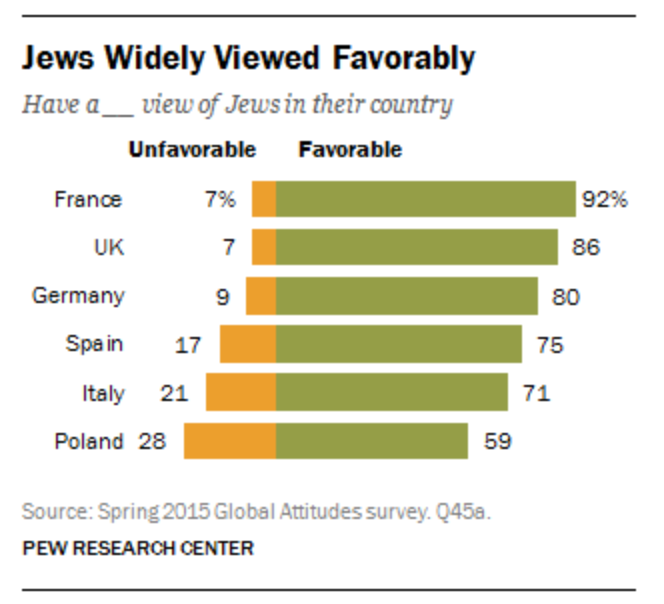
Pew Research: Anti-Minority Sentiment Not Increasing in Europe

European Perceptions of Roma European Perception of Jews European Perceptions of MuslimsInteresting recent public opinion research on attitudes in Europe, with above charts showing highlights. Summary conclusion:

The economic downturn in Europe that followed the euro crisis raised concerns that economic stress would turn Europeans against each other, as many severe economic downturns have done throughout history, sparking xenophobia and anti-Semitism. And Europe has seen a number of hostile actions against Muslims, Jews, Roma and other minorities in recent years. But the activities of a few are not necessarily reflected in the views of the general public.

The 2015 Pew Research Center survey was conducted after the Charlie Hebdo massacre and the simultaneous attack on a Jewish grocery store, perpetrated by radical Islamists in Paris. But, in the wake of these events, there is no evidence that the atrocity sparked new public antipathy toward Muslims in any of the six European Union nations surveyed. In fact, favorability of Muslims actually improved in some nations. At the same time, French sympathy for Jews increased.

http://www.pewglobal.org/2015/06/02/chapter-3-anti-minority-sentiment-not-rising/

In Pam Geller’s World, Everybody Jihads – The Daily Beast

For those who want more background on Pamela Geller and Robert Spencer’s views on Islam:

This sordid episode is typical of the way Geller and her comrade-in-arms Spencer, co-founders of the American Freedom Defense Initiative, conduct their misnamed “anti-jihadist” battle. It is also a good example of why the two are no heroes for free speech. No, Geller did not “provoke” the terror attack in Garland, as a number of pundits (and even the New York Times editorial board) have deplorably suggested; her cartoon contest is not the moral equivalent of the attack, and she does not need to apologize for the exercise of her First Amendment rights or for the terrorists’ actions. She does, however, have to answer for a lengthy record of peddling anti-Muslim hysteria, targeting Muslims’ First Amendment right to worship, smearing innocent people as jihadists, and even excusing the slaughter of Muslims in the former Yugoslavia.  We cannot allow terrorists to curb our speech; but we also cannot allow them to turn hatemongers into heroes.

Whatever valid concerns Geller, Spencer, and their allies may raise about political Islamism wind up being eclipsed by the fact that they not only conflate Islamist radicalism with all Islam but make disturbingly little distinction between criticism of Islam and hostility toward Muslims.

In a contentious interview with CNN host Alisyn Camerota Monday, Geller indignantly denied that she paints Islam “with a broad brush,” declaring that she is “anti-jihad” and “anti-sharia.” But for the most part, she and Spencer make almost no secret that they regard radical Islam as indistinguishable from Islam itself.

Spencer, a prolific author who has a degree in religious studies and whose tone is more judicious than Geller’s, does not quite state outright that non-extremist Islam is impossible. Nonetheless, he calls Islamic reform “quixotic” and “virtually inconceivable,” and sweepingly describes the faith of “millions” of Muslim immigrants in the West as “absolutely incompatible with Western society.” When America’s first Muslim congressman Keith Ellison (D-Minnesota) chose to use a Quran in his swearing-in ceremony, Spencer flatly stated that “no American official should be taking an oath on the Qur’an.” His 2005 best-seller, The Politically Incorrect Guide to Islam (and the Crusades), has such chapter titles as “Islamic Law: Lie, Steal and Kill.”

Critics accuse Spencer of cherry-picking and distortions. While these charges often come from sources with biases of their own, there is no doubt that his account of Islamic history is blatantly one-sided. Thus, he tries to rebut the “PC myth” that Jews in the Middle Ages fared better under Islamic rule than in Christian Europe by quoting from a 13th Century papal bull that affirmed the rights accorded to Jews—but fails to mention the many expulsions of Jewish communities from European countries and glosses over crusader massacres of Jews.

When Spencer writes about moderate Muslims, it is invariably to disparage them as deluded, insincere, or irrelevant. His targets include reformist Muslims who are strongly critical of radical Islamism and have themselves been accused of being Islamophobic shills: Jasser, self-styled “Muslim refusenik” Irshad Manji, Sufi Muslim convert Stephen Schwartz. They also include Kurdish fighters battling the Islamic State: last October, a Spencer post on his site, JihadWatch, reported a Kurdish woman’s suicide bomb attack on ISIS troops in a besieged town under the jeering headline, “Kurdish Muslima carries out moderate jihad/martyrdom suicide attack against the Islamic State,” and sneered at the idea that “the foes of the Islamic State are all moderate.”

But treating Islam as a monolith, denying the possibility of reform, and demonizing Muslims en masse is not the answer. If Christianity and Judaism could transcend their scriptural and theological baggage once used to justify fanaticism and oppression, there is no reason to believe that Islam cannot do the same. Spencer has argued that Islamic reform has no theological foundation, but he ignores the work of such 20th Century thinkers as Mahmoud Mohammed Taha, who made the case for the abrogation of the Quran’s later, harsher texts by the earlier, more peaceful ones (rather than vice versa). Today, there are Muslim scholars who champion a revision of Islamic orthodoxy on everything from women’s rights to religious freedom. In 2004, over 2,500 Muslim academics from 23 countries signed a petition to the United Nations condemning “Sheikhs of terror” who use Islamic scriptures as justification for political violence.

This is why, while we must stand by Geller as a victim of an outrageous attack on fundamental speech rights, it would be a tragic mistake to treat her or Spencer as leaders in the fight against the radical ideology that has been called Islamism or Islamofascism.

In his 2011 response to their attacks, Jasser warned that “Geller’s and Spencer’s genre is headed in only one direction—declaring an ideological war against one-fourth of the world’s population and expecting to neutralize the Islamist threat by asking Muslims to renounce their faith.” It is, perhaps literally, a dead end.

In Pam Geller’s World, Everybody Jihads – The Daily Beast.