Ottawa cheated 107 Iranians out of a fair shot at their Canadian dream, judge finds

Yet another example of IRCC struggles to manage demand and took a shortcut that was justifiably called out for by the court. Kudos to the lawyer involved, Pantea Jafari:

The Federal Court has ordered Canada’s immigration department to reconsider the cases of 107 Iranian immigration applicants who were turned down en masse.

The court also ordered the immigration department to pay the litigants a total of $50,000 in costs — one of the highest amounts ever awarded in an immigration case.

In what he called “an unusual circumstance of litigation,” Justice Henry S. Brown said he had no difficulty finding immigration senior management made “a deliberate and calculated decision” that “reduced” the rights — and fairness — for the applicants.

The issue arose after the files of the applicants — all Iranians who were seeking to come to Canada under the self-employed category of economic immigrants — were moved from a backlogged visa post in Ankara, Turkey, in March 2018 so they could instead be processed in the office in Warsaw, Poland.

There, the applications were all refused for failing to demonstrate the ability and intent to become self-employed in Canada.

At issue was whether the “mass” refusals made in “haste” — according to the applicants’ claim — were the direct result of an effort to clear a backlog, allegedly “at the cost of violation of legal principles.”

The judge was sympathetic to the applicants’ cause.

“Those whose applications are filed before a decision-maker institutes material changes in procedure are entitled to have notice of and be given an opportunity to refile or otherwise so as to comply with the new procedures,” Brown wrote in a 76-page decision last Friday. 

“Failure by a decision-maker to provide an applicant with notice of the case to meet constitutes a breach of procedural fairness.”

Rokhsar MousaviNezhad, a Persian carpet designer and maker, said she and other litigants — who initiated the suit in 2018 — were happy with the decision.

“We were treated unfairly and the court understood what happened,” said MousaviNezhad. “It restored our faith in the Canadian judicial system.

“We hope immigration is now going to act on our applications” according to the court instructions, she said.

The self-employed immigration program is meant to lure exemplary athletes, artists and farmers. The Iranian applicants in this program had been processed by the Ankara visa office, but 479 files in this category were transferred to Warsaw on March 7, 2018, due to backlogs in Turkey.

The court heard that the success rate of self-employed applications by Iranians plummeted from around 80 to 85 per cent between 2015 and 2017, when they were processed by Ankara, to less than 50 per cent when processed by the Warsaw office.

It identified a number of problematic procedural issues when immigration officials in 2016 “purported” to replace an operational manual that had been in place for at least eight years with a new one to guide visa officers in processing applications under the self-employed class.

The older manual referred to the possibility of interviews with applicants and actually instructed visa officers that formal business plans should be “discouraged” where they “would entail unnecessary expense and administrative burden” to the applicants. 

Under the old guideline, officers were also “expressly” advised that if they had “concerns about eligibility or inadmissibility, the applicant must be given a fair opportunity to correct or contradict those concerns” in compliance with the procedural fairness requirements.

“It seems to me this language strongly tends to require visa officers to deal with these concerns through procedural fairness letters, or possibly even through interviews,” wrote Justice Brown.

“The entirety of this procedural fairness-focussed provision was eliminated … Its wholesale removal cannot be seen as other than a deliberate, significant and material reduction in the legitimate expectations of procedural fairness.”

The court was told officials in Ankara always adhered to the practice of asking for supplementary documents, accompanied by a detailed checklist of other documents for additional information required to support a self-employed application, which Brown said was necessary, given lengthy immigration backlog and delays. 

However, he said, officials in Warsaw not only ended the practice of sending supplementary document requests, but made “material change” in assessing an applicant’s business plans and evidence of the person’s intent and ability to establish in Canada.

Given that Ankara had regularly approved Iranian self-employed applications without going into a great deal of specifics in the business plans, the judge said that also gave rise to justified expectations among applicants about the level of detail expected of the business plans they submitted for assessment.

“This legitimate expectation was not carried over to the Warsaw visa post, which rejected a great number of Iranian SE applications based in whole or part on perceived inadequacies of business plans filed in support of ability and intent,” Brown pointed out.

“This resulted in claims being dismissed without the applicants knowing the case they had to meet or having a full and fair chance to respond.”

Although it’s within immigration officials’ authority to replace operational manuals and change procedures, the judge said they did not notify the litigants in the system or prospective claimants, nor did they provide an opportunity to refile to meet “these significantly different requirements.”

Given the lack of notification, the court ruled that only those Iranian self-employed applicants whose cases were filed within six months (when represented by legal counsel) or nine months (if self-represented) after the new operational manual was introduced in 2016 and the applications were moved to Warsaw should be given a chance for reconsideration.

Due to the different timelines of the litigated cases, the judge only sent the eight lead cases back for reconsideration under the old rules and procedures, while asking immigration officials to review the rest and determine which ones meet the timeline and should be reopened.

Pantea Jafari, lawyer for the litigants, said the remaining 99 cases will be examined and those that meet the timeline under the court order will be automatically reopened and resolved, while the rest would be further adjudicated either by negotiation or by a further court order, if necessary.

She said Brown’s decision has a significant implication in the administrative law in the immigration context.

“Essentially, any time where an instruction set to officers or clients from the respondent has been persistent for a prolonged period of time — in our case, eight years — people can argue that created a legitimate expectation that would be followed,” said Jafari.

“Where the respondent makes significant changes to forms, processes, things like that, it is now under the purview of requiring some sort of notice of that or it will be deemed reasonable for people to have relied on the old versions within six or nine months.”

Source: Ottawa cheated 107 Iranians out of a fair shot at their Canadian dream, judge finds

Que se passe-t-il avec les demandes de visa pour le Canada? [sigh…]

Another are of problems at IRCC. Surprising in one sense as visitor visas have been one of the programs that has advanced the most on AI, and thus should be reaping benefits of faster processing for most cases. Requiring applicants to resubmit applications is not, needless to say, good service practice:

En contradiction avec l’information affichée sur son site Web, le gouvernement fédéral demande à certains visiteurs de déposer une seconde demande de visa pour le Canada si leur première a eu le malheur de se retrouver dans la pile des dossiers non traités lors de la pandémie. Une « file d’attente » au sort incertain qui cause bien des maux de tête.

« Si vous devez voyager au Canada en ce moment, veuillez noter qu’une nouvelle demande devrait être soumise. »

L’avocat spécialisé en immigration Denis Girard a été surpris de la réponse que lui a envoyée le bureau des visas de Dakar le 13 décembre 2021, alors qu’il se questionnait sur l’important retard dans la délivrance du visa de visiteur d’une de ses clientes originaires du Mali.

Celle-ci voulait venir visiter sa fille et ses petits-enfants au Canada, un voyage pour lequel elle fait une demande le 25 juillet précédent. Mais voilà que dans ce courriel, que Le Devoir a consulté, on demandait sans explication à la dame de refaire le processus. C’est qu’un événement important est survenu entre-temps : le Canada a rouvert ses frontières aux voyageurs vaccinés venant au pays pour des raisons non essentielles.

Immigration, Réfugiés et Citoyenneté Canada (IRCC) en a profité pour balancer toutes les demandes de visa effectuées avant cette date dans un étrange purgatoire bureaucratique où sont coincés des milliers de dossiers sans que leurs auteurs en soient informés. Cela a eu pour effet de faire gonfler les statistiques d’attente pour l’obtention d’un visa dans certains pays.

Sur son site Web, IRCC recommande aux personnes qui ont soumis une demande de visa de visiteur avant le 7 septembre 2021 d’en soumettre une nouvelle si leur situation a changé. Une consigne qui a rendu perplexe Me Girard. « Une nouvelle demande de visa ne semble pas requise [pour ma cliente], si on se fie aux représentations d’IRCC, représentations qui se révéleront être fausses », souligne l’avocat, qui note une contradiction entre la directive envoyée par courriel et ce qui se retrouve sur le Web.

Sa cliente a finalement déposé une nouvelle demande, sans remboursement, pour un visa qui a été produit 16 jours plus tard.

Le Devoir a tenté d’obtenir des explications d’IRCC concernant l’exigence de dépôt d’une nouvelle demande. À cinq reprises, IRCC a refusé de dire quelle était sa recommandation pour les personnes sans nouvelles de leur dossier et dont la situation n’a pas changé, hormis l’impatience de l’attente. Le ministère recopiait chaque fois la procédure pour les personnes dont la situation a changé.

Manque d’informations

Ce manque de clarté cause beaucoup d’incertitude. Originaire d’Haïti, Michelet Joseph a déposé une demande de visa de visiteur en août 2021. Il fit face à un dilemme : la refaire, ou pas ? « Je n’ai pas envie de retirer ma demande sans être remboursé. Je la maintiens, mais cette dernière n’est pas traitée », laisse-t-il tomber.

IRCC souligne qu’« il n’y a pas de garantie de remboursement » si une nouvelle demande est déposée.

Celui qui travaille comme journaliste à Port-au-Prince, où « il gagne très bien sa vie », souhaite venir au Canada pour rencontrer des artistes de son pays qui se produisent en terre canadienne. « J’ai besoin de les connaître pour pouvoir parler d’eux, dit-il. J’hésite à renvoyer une demande parce que j’ai déjà soumis plein de documents et je ne sais pas s’ils les reçoivent ou s’ils les mettent de côté. C’est frustrant. »

« Je ne sais pas quoi faire », indique également Natasha, qui préfère témoigner sous un nom d’emprunt par crainte de répercussions sur son propre dossier d’immigration. « Si je dépose une nouvelle demande, est-ce qu’on va l’abandonner de nouveau et encore nous dire les mêmes choses ? »

L’étudiante haïtienne à Montréal tente de faire venir sa mère (qui vit toujours en Haïti, mais qui est une habituée des voyages au Canada) pour sa cérémonie de collation des grades au mois d’août. Le Devoir a confirmé que la demande de visa a été enregistrée avec un an d’avance, le 27 août 2021, mais Natasha n’a eu aucune nouvelle du dossier depuis 11 mois. Les délais de traitement pour un visa demandé depuis Haïti sont pourtant estimés à 91 jours, selon le site Web d’IRCC.

« L’information, honnêtement, n’est pas claire du tout. Personne n’est joignable », témoigne celle qui ignore toujours si elle doit ou non déposer une nouvelle demande pour la visite de sa mère.

Petite histoire d’une file d’attente

Trois sources diplomatiques contactées séparément ont confirmé que l’arriéré des demandes de visa pose un problème aux ambassades canadiennes. Deux d’entre elles affirment que des responsables d’IRCC, le ministère qui gère de manière autonome les dossiers d’immigration, leur ont carrément fait savoir que les demandes déposées avant le 7 septembre 2021 ne seraient jamais traitées.

Officiellement, le ministère dit continuer à examiner ces vieilles demandes. Mais par la même occasion, il présente un portrait peu rassurant pour ceux qui attendent leur visa depuis près d’un an.

D’abord, le ministère a suspendu le traitement des demandes non urgentes entre avril et juillet 2020, tout en permettant le dépôt de dossiers. « Ceux qui ont demandé à voyager au Canada pour des raisons non essentielles pendant cette période ont vu leur demande placée dans la file d’attente », explique la porte-parole d’IRCC, Julie Lafortune.

Ensuite, et durant les 14 mois qui ont suivi, les fonctionnaires ont traité principalement les demandes de visiteurs exemptés des restrictions de voyage. « Un arriéré de demandes de visa de visiteur s’est accumulé », admet sans détour un document du ministère.

Finalement, lorsque les restrictions de voyage ont été assouplies, le 7 septembre 2021, IRCC a décidé que les demandes déposées avant cette date tomberaient dans cette malheureuse « file d’attente », qui a pour caractéristique d’imposer un traitement beaucoup plus lent. Le ministère invoque la « complexité » des dossiers, comme des documents périmés ou l’évolution des circonstances.

IRCC soutient par ailleurs toujours suivre un modèle du « premier entré, premier sorti », soit le traitement des plus vieilles demandes de la file d’attente avant les plus récentes ; le ministère se permet toutefois de traiter d’abord des dossiers moins complexes.

Seulement en 2021, près de 250 000 demandes qu’IRCC n’est pas arrivé à traiter se sont ajoutées à la file. La majorité des demandes déposées en 2022 ont, elles, été traitées.

Source: Que se passe-t-il avec les demandes de visa pour le Canada?

IRCC Anti-Racism Strategy 2.0: “Energy, Conviction and Courage” [too preachy for my taste]

Apart from the overly preachy tag line, this strategy reflects considerable work and reflection (disclosure I know some of the people involved). Like so many government reports, far too much emphasis on process and general messaging, but the strategy includes 24 specific action items under four pillars: leadership accountability, equitable workplace, policy and program design, and service delivery.

While it may be churlish to note, reading this detailed over 30 page strategy that clearly involved significant resources across the department is in sharp contrast with IRCC’s inability to deliver on its core responsibilities as seen in immigration and citizenship backlogs and the lack of oversight over Service Canada’s failures on passport.

A large department like IRCC should, of course, be able to “walk and chew gum” at the same time, but, as in so many areas, these kinds of initiatives, valid as they are, further distract or make it harder to deliver on core responsibilities.

Concrete measures highlighted in the report are highlighted below.

Starting with representation, the main gap is with respect to executives with the greatest gap being non-Black visible minorities.

In relation to the overall populations (Census 2016) – Indigenous 4.9 percent, visible minorities 22.3 percent of which Blacks represent 3.5 percent – Black representation at all three levels is the strongest. While the population of Black and non-Black visible minorities will likely be about 10 percent higher in the 2021 Census, the revised numbers are unlikely to change the overall picture significantly.

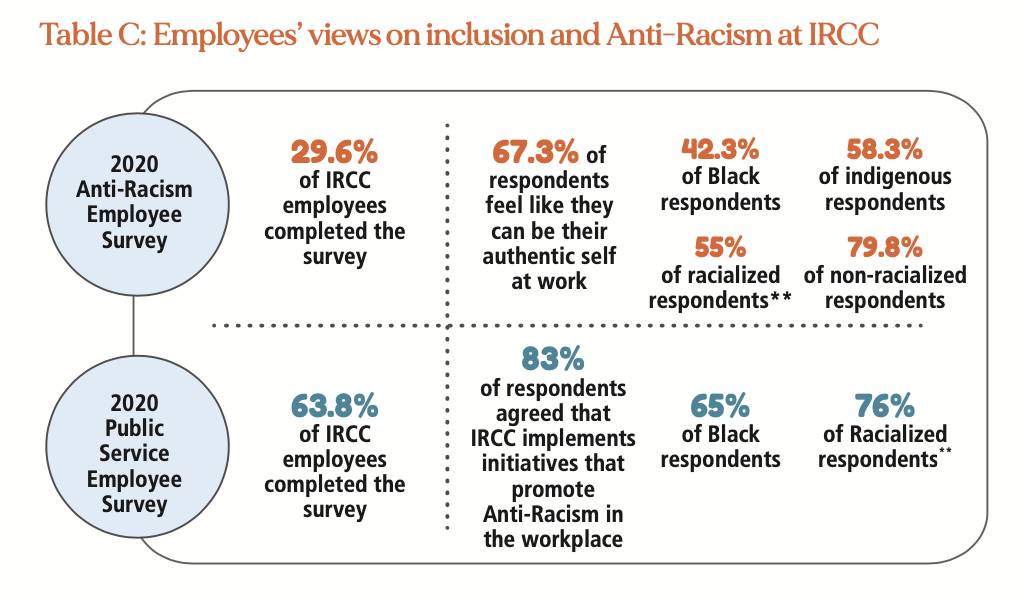
Usefully, the report provides a clear benchmark to measure success: the degree to which IRCC anti-racism initiatives moves the needle on the percentage that feel that “IRCC implements initiatives that promote anti-racism in the workplace.” Current numbers highlight the issue – only 65 percent of Blacks and 76 percent of non-Black visible minorities compared to 83 percent of not visible minorities.

But if the range of initiatives, engagement and comprehensiveness do not move the needle and reduce disparities, one will have to question their effectiveness, the reasons for lack of progress and the reasons why the perception by employees that not much has changed.

Failure to move the needle may also call into question the Clerk’s Call to Action on Anti-Racism, Equity, and Inclusion in the Federal Public Service, as in many ways IRCC was a model department in responding to the call.

And of course, service delivery failures in immigration and citizenship have a greater impact on Black and other visible minorities than than IRCC employees.

Source: Anti-Racism Strategy 2.0

My latest: Disconnect between political priorities and service delivery [focus on passports and immigration]

Article below as behind a paywall:

The disconnect between government commitments and its ability to deliver on targets and service levels has never been clearer as the immigration and passport backlogs attest.

Immigration Minister Sean Fraser indicated that the 2023-25 plan will likely include a target of 500,000 new permanent residents by the end of the plan. The number of temporary foreign workers will also increase significantly following relaxation of eligibility requirements (length of permits; increase in the cap allowed from 10 to 30 per cent; no longer refusing applications in low-wage occupations in regions with unemployment higher than six per cent), and the large number of Ukrainians arriving in Canada due to the war.

These current and planned increases are happening against the backdrop of large backlogs in permanent and temporary resident, citizenship and passport applications.

The resulting public and political outrage has prompted a mix of short-term measures, both symbolic such as the formation of a task force to improve government services as well as substantive, to alleviate applicant frustration (e.g., triage of passport applications, more online application tracking tools for immigration-related programs).

Why the disconnect?

Public service expert Ralph Heintzman focuses on the comparative neglect of service in relation to policy and program development (“poor cousin”) and how Service Canada never lived up to its promise to overturn that hierarchy in favour of citizen-centred service. As someone who has worked at Service Canada to implement that vision during the early days, we developed tools like score cards to maintain focus on service. Heintzman notes that departments do not focus on citizen and applicant satisfaction as current service failures illustrate.

Donald Savoie, a Canadian public administration expert, looks at the more fundamental issue of the relationship between the political and bureaucratic levels, and the need for the latter to have clear goals in order to implement effectively. The political level generally has conflicting goals, reflecting different stakeholder interests, and has a bias for the shiny and new, rather than program management, as any party platform will illustrate. Senior public servants are more akin to “courtiers,” rising through policy rather than service-delivery ranks, and have a “limited understanding of how best to help frontline managers deliver programs and public services.”

While his argument that government cannot be managed by using private-sector practices is valid at the policy level, I would argue that private-sector measurement and service practices are needed for the reasons outlined by Heintzman.

When service delivery is essential, as in the case of pandemic-related financial supports, the political and bureaucratic levels focus accordingly, and address the trade-off between speed of delivery and program integrity.

It is unclear the extent to which the public service advised the government that its focus on meeting its political objective of increased immigration would mean a surge in backlogs across programs, given reduced capacity during the pandemic.

The need for digitalization, modernization, and renewal of IT infrastructure was driven home during the pandemic. In the short-term, the IRCC has delivered online applications and updates for some programs. For the longer term, the challenges are greater, given the complexities of programs and government structures, the time involved and the need for effective management, as the Phoenix pay system debacle illustrates.

While the government is ultimately accountable, stakeholders, with some rare exceptions, bear some of the responsibility. Businesses complain about backlogs, but press for higher levels that exacerbate pressures, as do other levels of government, immigration lawyers, and consultants, settlement agencies, academics, and activists. While the general support for immigration across all these groups is laudable and exceptional compared to other countries, it also reveals an unhealthy group think that is unwilling to consider seriously trade-offs between addressing backlogs and increased levels.

Air Canada’s announcement that it is trimming capacity in order to ensure meeting their on-time performance service standards contrasts with the inability of the government to manage immigration and passport demand and related expectations. While I disagree with the government’s overall approach to increased immigration, a more responsible government would engage with stakeholders to explain the constraints and institute a partial and temporary reduction in immigration levels to reduce the backlog.

Politically, it is harder for governments to be open about service delivery issues than the private sector. However, being up front avoids the inevitable drip-drip of revelations of problems that result in greater public and media attention and prolonged controversies.

The challenge for the public service is to “provide stronger advice to the political level on the constraints and trade-offs inherent in public administration” on service delivery issues, always tricky to carry out in practice.

Canadians may not appreciate the abstraction of large numbers, but they do understand the many personal stories of those who are waiting for decisions, whether in passport lineups or applications in the system. As Heintzman, Savoie, and others have noted, government failure to deliver on services or communicate in advance of service delivery issues undermines overall trust in government.

Source: Disconnect between political priorities and service delivery

Feds aiming to clear passport backlog in next ‘4 to 6 weeks’: minister

Or after the summer travel season! But realistic:

Ottawa is acknowledging it underestimated the demand for passports amid relaxed COVID-19 restrictions, and is aiming to clear backlogs by the end of the summer.

Speaking in Vancouver Monday, Families, Children and Social Development Minister Karina Gould described the long waits and uncertainty Canadians seeking the travel documents have faced for months as “totally unacceptable.”

“Where we want to be is people getting their passports well ahead of time when they apply, and that’s what we’re working towards in the next four to six weeks,” she said.

Throughout the spring and early summer, Canadians seeking to renew their passports have faced long, sometimes multi-day lines at Service Canada offices. Many who have mailed in their documentation have reported poor communication and lack of clarity about when their documents will arrive.

In both cases, some applicants have faced processing times of months, sometimes threatening scheduled flights or planned travel.

On Monday, Gould said the federal government had anticipated an uptick in demand when restrictions were relaxed, but not the scale of applications or the way people chose to apply.

Prior to COVID-19, she said 80 per cent of people applied for passports in-person, with 20 per cent applying by mail. This year, that distribution flipped, she said.

“What we didn’t anticipate was the level of surge we were going to receive,” she said.

“Quite frankly the mail system was not sufficiently staffed to deal with that. That is something we are fixing right now.”

Between April and June this year, Canadians submitted more than 808,000 passport applications, 166,000 more than during the same period in 2019.

That’s pushed the volume of applications for this fiscal year to 4.3 million, up from 2.4 million last year, and left federal public servants clocking about 6,000 hours of overtime a week.

Ottawa has hired 600 additional passport workers, but only about 100 of them have completed training, which takes 12 to 15 weeks.

The remaining workers should be coming on the job within the next month, Gould said.

Despite the uncertainty and extreme delays for some, Gould said the majority of Canadians are getting their passports on time. She said those who are approaching their travel dates with not documentation should go to a Service Canada site, where people with urgent need are being prioritized.

Source: Feds aiming to clear passport backlog in next ‘4 to 6 weeks’: minister

A summer of last-minute passports from a government that was too slow in spring

A number of articles on the passport and other delays.

Starting with Campbell Clark of the Globe:

A month ago, the strategy to beat down Canada’s passport backlog was to get people to apply in-person, rather than by mail. Now workers at big-city passport offices triage the people standing in the long lines outside, sending those travelling in the next 48 hours on, and giving others tickets to come back another time.

The minister responsible for the passport offices, Karina Gould, has started to tell Canadians that she is angry about it, too, or something like that: She calls the situation “totally unacceptable,” and insists more will be done.

But what Ms. Gould really needs is a time machine and a bullhorn, so she can go back four months to March to wake up the slumbering government machine.

That was when the uptick in passport applications was becoming visible. The alarm bells didn’t get sounded loudly enough, quickly enough. In April, the government announced it was hiring 600 staff, but it was too little. And now that more resources are being poured in, it’s too late – or at least too late to avert a summer logjam that has made travellers livid.

“We anticipated a surge, but we didn’t anticipate just how large it would be,” Ms. Gould, the Minister of Families, Children and Social Development, said in an interview with The Globe and Mail.

She said she accepts that people think the government should have seen the problem sooner, but it wasn’t easy to predict. “It doesn’t justify it by any means, because we need to do better and we’re going to do better.”

Perhaps hindsight is 20/20. But the government wasn’t just slow to see the tsunami coming, but slow to react. One problem, as the backlog mounted, was that federal public-health rules kept COVID-19 capacity limits in place at passport offices, with 40 per cent of wickets closed, till May, two months after restrictions were lifted for stores in Ontario, for example.

And more broadly, the federal government was slow to get a grip on reopening. The bureaucracy that delivered CERB cheques in a few weeks in 2020 didn’t spring into action to meet travel-surge challenges in 2022. Justin Trudeau’s Liberal government didn’t put the government on alert for reopening. The passport debacle is one embarrassing result.

The government notes that people are getting their passports. But it is often at the last minute, the day before they fly. The government is leasing space next to passport offices for waiting, or sometimes putting up tents, Ms. Gould said. “This is not the solution. This is just in the interim,” she added.

How did this happen?

In the first wave of the pandemic in 2020, demand for passports pretty much halted. Passport offices were closed. The number of employees shrank. When people started applying again, the numbers rose gradually. Then there was a surge. The immigration department’s forecasts of passport demand for 2022 were low, but revised dramatically upward in January, and again in the spring.

When applications started to pour in March, and pile up in April, there was another problem. In the pandemic, most people hard started mailing applications. But a quarter of them arrived with errors such as missing documents or blank boxes, so they took longer to process. The backlog mounted.

So officials encouraged people to apply in-person instead. And then the lines at offices grew. It wasn’t just new applicants showing up in person, but folks who had mailed in applications, and were getting nervous that their mailed application hadn’t been processed.

“The Easter long weekend was a worrying long weekend for me, because there was a big rush for people who wanted to travel,” Ms. Gould said. “And I would say that in mid-May we really realized we needed to ramp up in a much bigger way than we had been because the number of applications that kept coming in were much greater than the processing capacity.”

There was hiring – 600 in the spring, 600 being hired now and 600 to be seconded from other government jobs. Some get only part of the 12- to 15-week training so they can quickly do one part of the job. Workers were reorganized.

But the backlog of roughly half a million applications isn’t shrinking yet, and it’s a scramble. The government was slow to hit the panic button months ago. And now Ms. Gould forecasts that things will be back to a “steady state” by the end of summer, when most Canadians’ vacations are over.

Source: A summer of last-minute passports from a government that was too slow in spring

Heather Scofield in the Star:

Here’s a number the federal government would like you to know.

Between February and June of this year, the amount of Canadians travelling by air shot up 280 per cent. In the United States, the increase was just 25 per cent.

The number comes from Transport Canada, and the reason federal Liberals want us all to know about it is because they argue it’s why families are camped out at Canadian airports and why police have had to intervene in unruly passport lineups that stretch around the block.

For sure, a 280 per cent spike in demand for travel is enormous, and very difficult for normal-times bureaucracy and travel industry to digest. But it didn’t materialize out of nowhere.

The lineups that have thrown the delivery of government services into disarray are egregious, but they’re also a symptom of the post-pandemic disruption that has afflicted much of the private sector too. And the sooner we address that disruption with the full force of our ingenuity and resources, the better.

“Whatever it takes” defined economic policy on our way down into pandemic recession. The recovery requires an equally concerted effort, because this is more than congestion in airports and on the sidewalks outside Passport Canada.

The erratic flow of people is running amok in our travel industry, for sure, but also our immigration system, our labour markets and our housing markets, showing up in the form of massive lineups, backlogs, erratic prices and inflation. The disruption is not going away on its own, and there are serious implications for both our political landscape and our economy.

Let’s start with the 280-per-cent spike in Canadian travellers this spring, compared to just a 25-per-cent climb in Americans. It’s huge, but not a surprise.

After a couple of years of being mainly housebound here in Canada, we were then sent back home by the sudden restrictions imposed at the end of 2021 because of Omicron. Canadians finally burst out of their homes when Omicron settled down, and they haven’t stopped moving since.

The United States, on the other hand, responded with a lighter touch both to Omicron this winter and even before then, explaining why their wanderlust is not nearly as intense as ours.

Was that kind of surge foreseeable? Probably not to the exact extent we see before us. But one thing we have learned about how the economy and the public respond to the pandemic is that it’s in fits and starts. We have lurched from open to closed with dramatic and volatile effects on how things work.

Strange consumer demands have led to runs on toilet paper and used cars, and — more seriously — a perplexing and persistent shortage of computer chips and shipping containers. Supply chains have seized up, caught between the unpredictable demands coming their way and the unpredictable disruptions in the infrastructure they use.

And the job market is going haywire. Finance Minister Chrystia Freeland is fond of saying it has completely recovered from the pandemic recession because more Canadians are employed now than before the pandemic. But in fact, Stage Two of the pandemic recovery is upon us, where one million jobs sit empty and too-high inflation has dug itself in for the long haul.

We have to expect, and prepare for, a certain amount of chaos.

It’s too soon to abandon the crisis footing that Ottawa and the private sector shifted to in the early days of the coronavirus, when decision-makers quickly learned that projections based on how the world worked in pre-pandemic days were not worth much.

In the past few weeks, we’ve seen some attempts to regain that footing. Transport Canada is meeting with increasing frequency with the Canadian Air Transport Security Authority, border officials, union officials and air navigators to detect every single inefficiency in the airport system, and shave off time and effort wherever possible.

Vaccine requirements have been scaled back and streamlined, airlines have cut flights, and now their attention has turned into the nightmare which is baggage.

It’s hard to know if there is progress, and there’s a recognition that no one was quite ready for the traffic patterns gumming up trips everywhere right now.

As for immigration, the lineups for processing have ballooned over the course of COVID-19. A parliamentary committee was told this spring that the backlog stands at two million people — almost double the pre-pandemic list — and that was considered already way too long. 

Canada’s economic growth and recovery strategy is heavily based on increasing immigration, but with backlogs like that, it’s a bumpy road.

Over in the world of passports, there’s a similar all-hands-on-deck approach that has taken on added urgency as the intractable lineups made a mockery of internal projections and erupted into a backlash on the sidewalks and in the offices of MPs.

Extra workers have been hired, senior managers are now involved in triage, new offices opened, hours extended.

But the pivot takes time, and success is hard to see.

Over on Facebook Marketplace, one enterprising Montrealer was offering to stand in line at 4 a.m. for passport-seekers for $250 just over a week ago. He has since dropped his price to $200. Is that a sign the lineups are easing?

The Liberals had better hope so, because the public patience for queuing and dysfunction in the machinery of government has worn thin.

Source: On passports and airports, public patience with Liberals is running out

And lastly, Minister Gould on the reasons:

The minister responsible for Service Canada admits the government did not fully anticipate the overwhelming surge in passport applications that came with the lifting of travel restrictions and is hopeful waiting times will return to normal by the end of summer.

Families, Children and Social Development Minister Karina Gould said the federal government hired 600 new staff ahead of the anticipated increase in passport applications and renewals, but said “clearly it was not sufficient.” The surge has forced some Canadians to camp overnight outside of government offices in an attempt to obtain their passports.

“If I put myself where we were as Canadians back in February, we weren’t talking about this kind of a surge. We knew it was going to increase and that’s why we took the measures that we did. But I will concede for sure that they were insufficient for what ended up happening,” Ms. Gould said in an interview.

Service Canada issued 363,000 passports during the first year of the pandemic, from April 1, 2020, to March 31, 2021 – and that number jumped to more than 1.27 million the following fiscal year. The government has received 757,207 passport applications since April 1, nearly 60 per cent of the past year’s total.

Service Canada is hiring an additional 600 staff to help with the delays. Ms. Gould said training for some of the new hires is being shortened from the typical 15 weeks to one to two weeks, so that fully trained passport officers can focus on more complex applications, such as children with custody issues, while new hires will work on simpler files.

Ottawa is asking Canadians travelling within the next 45 business days to go to one of the country’s 35 dedicated passport offices for service. Waiting times topped more than six hours at some locations Monday, according to the government’s website. The government is asking those who are not travelling within the next 45 business days to apply at a Service Canada centre or by mail.

Ms. Gould said the return to normal waiting times will depend on the number of applications the government receives in the coming weeks.

“If volumes on a weekly basis continue where they are now and don’t substantially increase, we feel quite confident that we’re going to be in a much better position over the next four to six weeks and definitely by the end of summer,” she said.

The department has a service standard time of 10 business days for passport applications submitted at a passport office. Ms. Gould said 96 per cent of those passports are being issued within the standard, but the government’s website says they could still take up to two weeks.

Ms. Gould said the mail option is about “40 per cent less efficient” than in-person service. The government groups processing times for mail with the in-person option at Service Canada centres; the service standard is 20 business days, but processing can take up to nine weeks.

Raphael Girard, a retired assistant deputy minister who was responsible for Passport Canada in 1993, said the government needs to consider more creative solutions to the problem, such as extending passports for a year so officials can catch up on the backlog. He said this could be done by having Canadians bring their expired passports to a government office, where an agent could extend the document with a stamp.

However, a spokesperson for Immigration Minister Sean Fraser said simply extending expiration dates is not possible. Aidan Strickland said amending an expiry date that is not aligned with the electronic expiry date recorded in the Canadian ePassport could create further travel disruptions for the passport holder, and that the individual could also be refused boarding on a plane and denied entry to some countries.

More generally speaking, Mr. Girard argued the government has “lost the sense of operations designed to improve client service.”

“They’re layering on … controls and slowing things down, whereas 90 per cent of the workload is always routine,” he said.

Last month, Prime Minister Justin Trudeau established a new task force of cabinet ministers to improve government services, such as passports, and monitor the delays causing chaos at Canada’s airports.

Conservative social development critic Laila Goodridge said Ms. Gould and Mr. Fraser, along with the task force, “continue to fumble managing the delivery and processing of passports. This is indicative of what we’ve seen with the Trudeau government that is unprepared for a predictable increase in demand for travel.” She pointed to a recent government tender for 800 chairs for people to sit on as they wait outside of passport offices.

NDP transport critic Taylor Bachrach said the continued delays for Canadians to get new or renewed passports are unacceptable, and that many people are going to their MPs for help to get their documents.

“Ultimately, the increased demand for passports was entirely predictable. But the Liberals failed to act even though they had months to prepare for travel to return. Now they need to urgently address this problem before more Canadians see their travel plans ruined, including speeding up the hiring process to clear the backlog.”

Source: Ottawa acknowledges it underestimated surge in demand for passports

Mason: The gong show at our passport offices is inexcusable

Yet another backlog at IRCC, the department responsible for Passport Canada.

When multiculturalism moved from Canadian Heritage to IRCC in 2008, the then hope within the Citizenship Branch was that the addition of Multiculturalism would rebalance to some extent the IRCC focus on immigration.

Needless to say, that didn’t happen, and citizenship remained the “poor cousin” compared to other IRCC programs and then of course the program moved back to Canadian Heritage and the Liberal government increased its funding.

It appears that the move of passport to IRCC more than 10 years ago has similarly resulted in relative program neglect, an even “poorer cousin.” Telling, as I have noted before, that IRCC does not include current passport statistics on open data:

As COVID-19 vaccines began to do their work last year, more Canadians began to venture out and allow themselves to imagine vacations to exotic locales – or even just to the United States.

Surely, the federal government was aware of this. It must have known that the demand for travel after two years of being cooped up at home would be unprecedented. Airlines began preparing for this eventuality months ago, when it was evident COVID-related travel restrictions were being lifted around the world. You would assume the federal government would have brainstormed as well: What should we be prepared for, when the travel surge occurs?

If anyone in government had been thinking, they would have foreseen the mad march to Service Canada’s passport offices we have recently witnessed – of Canadians seeking to apply for and renew their passports – and come up with a strategy to respond to it. After all, these applications were way down during the pandemic – in no small part because many Service Canada offices were temporarily closed at points during the pandemic – and many of these documents have expired in the interim. It should have been plainly evident there would be overwhelming demand.

The numbers now bear it out: Service Canada issued 363,000 passports from April 1, 2020, to March 31, 2021, a number that jumped to more than 1.27 million in the following fiscal year. (It’s also been reported that the number of passports processed is up 350 per cent over last year). Before the pandemic, Service Canada was getting about 5,000 calls a day related to passport renewals; today, that number has shot up to more than 200,000.

But it’s clear now that whatever plan there was to deal with an inevitable avalanche of applicants was wholly inadequate. Maybe “inept” is a better word. Perhaps “complete disaster” more aptly fits the bill.

Of course, we have seen government incompetence before. But if there was a government-incompetence Hall of Fame, Service Canada’s response to this surge of passport demand would have to rank right up there.

The stories: wow.

Citizens have been lining up for days outside some passport offices. To no one’s surprise, this has led to tensions at some locations. When some of those who had been camped out for days outside an office in Surrey, B.C., noticed little to no movement in the line, they attempted to go inside to see what the issue was. They were met by security, and things escalated to the point police were called – surprise, surprise.

Women with babies in strollers have had to stand in line for hours, with no place to sit down. Pleasant, elderly commissionaires haven’t really been able to give people reliable information about how long if might be before they get processed, or even if they will. There have even been reports of people paying homeless people to hold their place in line.

The government agency has reported that it has hired more than 600 additional staff to handle the extra volume, and yet it does not seem to have alleviated the lineups at many of the most popular centres. People report going inside and seeing only a fraction of the kiosks open, because COVID-19 protocols and social distancing guidelines have kept many stations closed. Strangely, everyone in those same passport centres, including staff, can meet at a bar or restaurant afterward, maskless, and raise a toast to the incompetence and irrationality of all those involved in this utter shemozzle.

The government says you can still get a passport in five days if you apply in person at one of the centres. What it doesn’t say is that you might need to take a week off work so you can sit outside in the rain waiting for your chance to get inside one.

For many, new passports can take up to 12 weeks to get, according to the Travel Industry Council of Ontario.

I realize that having to wait in line to renew a passport seems like the mother of all first-world problems. There may not be a lot of sympathy for people who might not be able to go on their Caribbean cruise because they didn’t anticipate a three-month delay in getting their passports renewed.

That’s not the point.

The point is there are all sorts of legitimate reasons for wanting and needing a passport beyond luxury travel. And people who need those passports shouldn’t have to compete in a real-life version of Survivor to get them from our own government.

Ottawa was completely drunk at the wheel here. And it still hasn’t been able to figure out how to design a system that can eliminate these unconscionable wait times and delays.

The country deserves better.

Source: The gong show at our passport offices is inexcusable

Canada is leaving some would-be immigrants waiting just to hear whether their application has been received

More accounts on backlogs, processing delays and lack of communication:

When Manmeet Kaur applied to sponsor her newlywed husband to come from India to join her in Canada, it seemed like a no-brainer to submit the application online rather than to send the paperwork by courier.

Electronic application through new government portals was supposed to be faster and keep important documents — such as wedding photos and personal identification — from getting lost in the process or mixed up with others’ files.

And so, Kaur applied last September.

As she watched applicants she had met through social media groups, and who had applied around the same time, start to get their acknowledgment of receipt, better known as their “AOR,” the Brampton woman says, she expected that immigration officials would soon open her e-application and that her day would come.

She says she got nervous when others who had applied months after her were getting their AOR, which is only issued once a thorough check by officials ensures an application is complete — with no missing forms, documents and signatures. That’s when an applicant receives a file number and the actual processing starts.

“Many of the September applicants have gotten their passport requests and decisions made in January and February. While we’re still waiting for our AORs, some already have their spouses with them. Now January and February applicants are getting their AORs, too,” said Kaur, 27, a medical lab technician, who last saw her husband in India in July.

“The people who applied first should get processed first. I completely understand each file is different and some take longer than others. But we are talking about just checking if an application is complete or not. It should make no difference. Now, we’re lagging further and further behind.”

Few other federal services have seen so much disruption as the immigration system during the pandemic, with the operation grinding to a halt; staff working remotely with antiquated infrastructure; and travel restricted for newcomers abroad due to border closures.

Source: Canada is leaving some would-be immigrants waiting just to hear whether their application has been received

Automatic for the people [immigration focus]

Of note. Given volumes and resources, no realistic alternative but care need to eliminate biases (either pro or con):

If there was ever any doubt the federal government would use automation to help it make its administrative decisions, Budget 2022 has put that to rest. In it, Ottawa pledges to change the Citizenship Act to allow for the automated and machine-assisted processing of a growing number of immigration-related applications.

In truth, Immigration, Refugees and Citizenship Canada has been looking at analytics systems to automate its activities and help it assess immigrant applications for close to a decade. The government also telegraphed its intention back in 2019, when it issued a Directive on Automated Decision-Making (DADM), which aims to build safeguards and transparency around its use.

“[T]he reference to enable automated and machine-assisted processing for citizenship applications is mentioned in the budget to ensure that in the future, IRCC will have the authority to proceed with our ambition to create a more integrated, modernized and centralized working environment.” said Aidan Stickland, spokesperson for Immigration, Refugees and Citizenship minister Sean Fraser, in an emailed reply.

“This would enable us to streamline the application process for citizenship with the introduction of e-applications in order to help speed up application processing globally and reduce backlogs,” Stickland, added. “Details are currently being formalized.”

But to live a life of ambition requires taking risks. So the DADM comes with an algorithmic impact assessment tool. According to Teresa Scassa, a law professor at the University of Ottawa, it creates obligations for any government department or agency that plans to adopt automated decision-making, either in whole or as a system that makes recommendations. It is a risk-based framework to determine the obligation to be placed on the department or agency.

“The citizenship and immigration context is one where what they’re looking at is that external client,” Scassa says. “It does create this governance framework for those types of projects.”

Scassa says that the higher the risk of impact on a person’s rights, or the environment, the more obligations are placed on the department or agency using it, such as requirements for peer review, monitoring outputs to ensure the system remains consistent with the objectives or that it doesn’t demonstrate improper bias.

“It governs things like what kind of notice should be given,” Scassa says. “If it’s very low-risk, it might be a very general notice, like something on a web page. If it’s high risk, it will be a specific notice to the individual that automated decision-making is in use. Depending on where the project is in the risk framework, there is a sliding scale of obligations to ensure that individuals are protected from adverse impacts.”

Scassa suspects that IRCC may use automated decision-making to determine if someone qualifies for citizenship, which can mean different things.

It could be a triage system, for example, drawing information from applications before using AI to determine which applicants clearly qualify for citizenship. “Everything else [would fall] into a different basket where it needs to be reviewed by an officer,” Scassa says.

Such a system would be relatively low-risk as any decisions would be positive for the applicant, while all others go to a human for review, which would speed up overall processing times.

“That may be less problematic than a system that makes all of the decisions, and people have to figure out why they got rejected, and you have to ask how transparent is the algorithm, and what are your rights to have the decision reviewed,” Scassa adds. “There is the question of how it will be designed, and how impactful the AI tool will be on individuals. On the other hand, a triage system like this could have automation bias where files get flagged. Maybe the human reviewing them approaches them with a particular mindset because they haven’t been considered to be automatically accepted. The automation bias may make the human less likely to approve them.”

Scassa notes that the Open Government platform shows an algorithmic impact assessment for a tool developed for spousal analytics, a form of triage tool, which gives a sense of what kinds of tools the department is contemplating.

Scassa also notes that under the Citizenship Act, a provision allows for the delegation of the minister’s powers to any person authorized in writing. She suspects that the proposed legislative change could be to specifically allow some of the decisions to be made on a fully-automated basis.

When it comes to reviewing decisions, the DADM and its risk framework appears to apply administrative law principles, including procedural fairness protections.

Paul Daly, also a law professor at the University of Ottawa, adds that the administrative law principles apply regardless of whether this type of automated decision-making has been authorized in the statute.

“It’s a common concern for officials using sophisticated machine-learning technology to want legal authority,” Daly says. “Really, that’s only one part of the picture. There’s a whole body of legal principles from administrative law, the Charter, and the [DADM] that have to be complied with when you start to actually use the systems,” Daly says.

Lex Gill, a fellow at Citizen Lab, co-authored a report called “Bots at the Gate,” which looks at the human rights impacts of automated decision-making in Canada’s citizenship and immigration system. She acknowledges there are serious backlogs within the immigration system. But she cautions that faster isn’t always better, particularly when the error rates associated with AI disproportionately affect certain groups who are already treated unfairly.

“Sometimes we adopt technologies that will allow us to believe that we are doing something more scientific, methodical or fair, when really what we are doing is reproducing the status quo, but faster and with less transparency,” Gill says. “That is always my concern when we talk about automating these kinds of administrative processes.”

Gill notes there is a spectrum of technologies available for automated and machine-assisted processing, some of which are not problematic, while others are worrying and raise human rights issues. Still, it is hard to know what we may be dealing with without more information from the minister.

“When we talk about using automated or machine-assisted technology to do things like risk scoring, that’s an area where we know that it’s highly discretionary,” Gill says. “There is an entire universe of academic study that demonstrates that those technologies tend to replicate existing forms of bias and discrimination and profiling that already exists within administrative systems.”

Gill says that these systems tend to learn from existing practices. The result tends to exacerbate discriminatory outcomes and makes them more difficult to challenge because there is the additional layer of perceived scientific or technical neutrality layered on top of a system that demonstrated bias.

“When the government is imagining adopting these kinds of technologies, is it imagining doing that in a way that is enhancing transparency, accountability, and reviewability of decisions?” asks Gill. “Efficiency is clearly an important goal, but the rule of law, accountability and control of administrative discretion also require friction—they require a certain degree of scrutiny, the ability to slow things down, the ability to review things, and the ability to understand why and how a decision was made.”

Gill says that unless these new technologies come with oversight, review and transparency mechanisms, she worries that they will take a system that is already discretionary, opaque, and has the ability to change the direction of a person’s life, and render it even more so.

“If you’re going to start adopting these kinds of technologies, you need to do it in a way that maximally protects a person’s Charter rights, and which honours the seriousness of the decisions at stake,” Gill says. “Don’t start with decisions that engage the liberty interests of a person. Start with things like whether or not this student visa application is missing a supporting document.”

Source: Automatic for the people

Immigration Canada acts to end racism, cultural bias among employees

Of note:

Immigration, Refugees and Citizenship Canada (IRCC) is conducting a study to explore potential cultural bias shown by its employees when it comes to processing visa applications at the country’s points of entry, according to a department spokesperson.

The study comes in response to a survey examining workplace racism at IRCC released last year that revealed multiple reports of racist “microagressions” by employees and supervisors.

Participants interviewed said that some of the overt and subtle racism they have witnessed by both employees and decision makers at IRCC “can and probably must impact case processing.”

The department has also made it mandatory for employees and executives to take unconscious bias training, and instituted a requirement for senior staff to take a specific course on inclusive hiring practices as a prerequisite for obtaining their delegated authority to sign financial and staffing decisions.

In addition, said spokesperson Jeffrey MacDonald, IRCC is appointing anti-racism representatives in each sector of the department to support the work of a newly-established Anti-Racism Task Force and has created a Black Employee Network to ensure Black voices are heard in driving change.

“We must actively fight racism and continue to work tirelessly to foster a culture of inclusion, diversity, and respect…but actions speak louder than words,” MacDonald told New Canadian Media through email.

MacDonald said IRCC will be hiring an independent firm to do an Employment System Review (ESR). The ESR will identify new solutions in core areas such as people management practices and accountability.

IRCC also plans to release its Anti-Racism Strategy and action plan later this year.

Source: Immigration Canada acts to end racism, cultural bias among employees