@IRCC Consultations: Shaping the future of immigration in Canada

Somewhat cynical about the consultations exercise.

On the surface, may be a response to the increased public commentary questioning the impact that current and planned high immigration levels have on housing, healthcare adnn infrastructure but without the political will for a fundamental review of immigration programs and policies, which appear largely based on a “more the merrier” approach. The “learn more” section suggests that no fundamental review is planned.

Will be interesting to see if those consulted include critics of the current approach, not from the various advocacy groups but more broadly:

Immigration is critical to Canada’s long-term success. To fully harness the potential of immigration and create the best experience for newcomers,

Canada needs an immigration system that is strong, easy to navigate and adaptive to change.

The Honourable Sean Fraser, Minister of Immigration, Refugees and Citizenship, today announced the start of a broad-based engagement initiative—An Immigration System for Canada’s Future—aimed at exploring how immigration policies and programs can support a shared vision for Canada’s future. The engagement, which will continue throughout the spring, will include in-person dialogue sessions across the country, thematic workshops and a survey for the public and our clients. The input gathered will inform Canada’s future immigration policies and programs, and will help shape a system that will benefit communities across the country for decades to come.

The next generation of Canada’s immigration system will involve continued, whole-of-society collaboration. That is why this engagement initiative is intended to capture a diversity of perspectives from a broad range of partners and stakeholders, including all levels of government, businesses, academia, post-secondary institutions, settlement organizations, implicated sectors in Canada and our clients.

To kick off the engagement initiative, Minister Fraser chaired the first dialogue session in Halifax. The session provided an opportunity for the Minister and participants to exchange ideas and discuss how Canada’s immigration policies and programs can better support the needs of communities from coast to coast.

If you would like to contribute to the future of Canada’s immigration system, Immigration, Refugees and Citizenship Canada (IRCC) will also be launching a survey, which will be available to the public later in March in addition to the dialogue sessions and thematic workshops with stakeholders. We encourage you to visit our website to learn more about how to get involved.

Source:

IRCC’s reliance on McKinsey explains a ‘disconnect’ between money spent and value added, immigration lawyers say

More on McKinsey and IRCC. Hearing some concerns from within IRCC as well:

The decision by Immigration, Refugees, and Citizenship Canada to hire McKinsey and Company to mobilize its digital transformation explains what immigration lawyers are calling a ‘disconnect’ between the resources being put into IRCC and the results it’s produced.

Barbara Jo (BJ) Caruso, an immigration lawyer speaking on behalf of the Canadian Immigration Lawyers Association (CILA), said when she heard about contracts IRCC had with McKinsey, “a light bulb went on.

“We were then able to sort of connect the dots and say, ‘Okay, now maybe this makes sense why everything’s been sort of haphazard, and pieced together,’ ” she said. 

At the beginning of January, a Radio-Canada report revealedthat the Canada branch of global consulting firm McKinsey and Company had seen a marked increase in the number of contracts it had been awarded by the federal government since 2015. In fact, the government later confirmed it had awarded McKinsey a total of 23 contracts at a cost of $101.4-million since 2015. By comparison, Stephen Harper’s government had spent $2.2-million on the firm throughout its nine year tenure. 

There’s been a disconnect, Caruso said, between the amount of money going into the department and the results it’s been able to produce, adding there’s been a lot of changes made, but “essentially no consultation from our vantage point.” 

“We’ve been perplexed by the amount of money that has been designated to the department and yet, we’re not really reaping the benefits of those financial contributions. We’ve got bigger backlogs than we’ve ever had, and probably the lowest client service standards, ever. And a diminishing trust from the public in the whole immigration system,” she said. 

The House Government Operations and Estimates Committee (OGGO), headed by Conservative MP Kelly McCauley, agreed over the break to undertake a study of the government’s contracts with McKinsey, particularly given this government’s relationship with Dominic Barton, who was Canada’s ambassador to China from 2019 to 2021, head of the Trudeau government’s advisory panel on economic growth, and prior to both those appointments, global managing director at McKinsey and Company between 2009 and 2018. It’s expected to call a total of seven ministers to testify before the committee, as well as top McKinsey executives, and Barton. 

Prime Minister Justin Trudeau (Papineau, Que.) said he welcomes the committee’s probe to determine whether there was “value for money” in the work McKinsey did. 

McKinsey spokesperson Alley Adams said the firm “welcomes the [committee] review of the services we deliver to the federal government.” 

“We look forward to working with the committee to resolve its questions and clarify relevant issues. We are proud of the contributions our firm has had across the public sector and are focused on working with the committee to discuss our impact in detail,” Adams said in an emailed statement. 

McKinsey and Company was a key player in the department’s “transformation agenda” since 2018, when it was awarded a $2.9-million contract to assess the department’s operations and “recommend a way forward for its transformation agenda,” according to IRCC.

Based on McKinsey’s assessment, “and IRCC’s own analysis of its operating context,” IRCC launched its transformation program in 2019, with the overarching goals of improving its operations. 

In 2019, McKinsey and Company was hired for a second contract to set “the service transformation agenda in motion.” According to IRCC, the contract focused on “reviewing, developing, and implementing digital tools, processes, and services.” It was initially valued at $16.37-million, but was later amended to add $8.47-million, bringing the total to $24.8-million. 

“Following the onset of the COVID-19 pandemic, IRCC was faced with an immediate need to further accelerate the development and implementation of digital products and services. That is why the contract was amended in 2021 to help IRCC respond to these pandemic-driven pressures, manage increased volumes, and sustain core client services,” the department added. 

For its part, McKinsey has stressed that it was only involved in non-partisan, government operations, and did not influence policy.

“We work on independent research, economic and sector-based insights, in addition to core management topics such as the reduction of document processing backlogs, digitization of processes, technology strategy, operational improvements, and change management. This work does not include policy development and/or political advice. We support the service delivery objectives pursued by
the professional public servants who lead the departments and agencies we serve,” McKinsey said in a statement issued to media. 

However, Toronto-based immigration lawyer Maureen Silcoff—a former decision-maker at IRCC herself—said she doesn’t think the distinction between the two is so obvious. 

“I’m not sure that there’s really a bright line that can be drawn between the immigration policies and the immigration systems,” said Silcoff, who also sits on the executive of the Canadian Association of Refugee Lawyers. “In the immigration context, [systems] necessarily impact the way laws and policies are implemented, or operationalized.” 

“Efficiency is crucial, but whatever measures are put in place, and have been put in place, have to be alert to the sensitivities of the population affected, which we know involves, very often, racialized people and vulnerable people,” she added.

The move towards digitizing and automating processes at IRCC has already proven to be a sticky process. 

The department has already been the subject of systemic racism allegations, and as the House Citizenship and Immigration Committee heard last March, artificial intelligence, and immigration expert witnesses expressed concern that systemic racism and bias would be embedded in any automated processes the department employs. 

“There’s advantages to algorithms, to artificial intelligence, to web-based portals, but they do come with a cost, and if attention is not paid to the frailties, there could be serious human rights implications,” Silcoff said. 

“A digitized refugee portal, for example. Is that accessible to vulnerable people, people arriving in Canada who have been subjected to torture or remain traumatized, who are new to the country and the systems?” 

An element that further exacerbates this challenge is who can access the portals on behalf of the applicant. 

One complaint Caruso and CILA have with IRCC currently is that lawyers cannot access certain online portals on behalf of their clients. 

According to IRCC, as part of its work on the department’s “digital transformation,” McKinsey helped design, develop, and launch an online citizenship application, which “enabled clients to apply digitally and IRCC to continue business throughout the pandemic.” 

However, Caruso said lawyers have not been able to access this portal on behalf of their clients, which she said is an impediment not only to their work, but to the efficiency of the department as well. 

“In our dialogue with the department, they absolutely recognize the role that counsel plays, that we can add value to the process, eliminate applications that have missing documents, because typically with good counsel, it’s a more complete application. There’s less back and forth and it means they can get to a decision sooner,” she said. 

It struck her and CILA as strange, then, when the department decided to roll out a portal that didn’t allow lawyers to access it. 

“For us, there has been this disconnect with the rollout of the technology and our role in the process. And now it sort of makes sense that it wasn’t the department, but an external player that maybe doesn’t appreciate the role that legal counsel can have in simplifying and ensuring efficiency,” she said. 

NDP MP Jenny Kwan (Vancouver East, B.C.), her party’s immigration critic, said she’s eager to hear more about exactly what work McKinsey was contracted to do for IRCC, but added that overall, departmental work should be done in-house. 

Kwan said the fact that IRCC, along with the Canada Border Services Agency, spent the most money on McKinsey contracts of any department tells her “there’s very little transparency within IRCC.” 

“It’s just so concerning that there’s this discovery of these contracts and the government is anything but transparent about it,” she said, after describing a lack of transparency at IRCC as a “black hole.” 

“It just really speaks to the black hole that exists within IRCC. And it is deeply concerning,” she said.

Source: IRCC’s reliance on McKinsey explains a ‘disconnect’ between money spent and value added, immigration lawyers say

Crise des passeports: Jusqu’à deux fois moins d’employés en 2022

Of note. See my earlier op-ed Passport delays risk undermining our trust in government on the complexity of linkages between IRCC, responsible for passport policy, and Service Canada, responsible for delivery, and the failure of both to anticipate demand even if official planning documents expected a surge once travel restrictions lifted:

Ottawa a réduit considérablement les effectifs affectés au traitement des demandes de passeport entre 2018 et 2021. Résultat : ils étaient presque deux fois moins au début de 2022 pour répondre aux nombreuses demandes des Canadiens désireux de voyager après la levée des principales mesures de restriction pour les déplacements à l’étranger.

Selon des données obtenues par La Presse en vertu de la Loi sur l’accès à l’information auprès d’Immigration, Réfugiés et Citoyenneté Canada, 1512 fonctionnaires étaient chargés de répondre aux demandes de passeport au début de l’année 2018. On n’en comptait plus que 893 en 2021, un nombre qui est passé à 1161 au cours de l’année suivante.

Cette baisse substantielle des effectifs a nui considérablement à la capacité de Passeport Canada de traiter le flot de demandes au cours de l’été 2022, signale Yvon Barrière, vice-président exécutif régional Québec à l’Alliance de la fonction publique du Canada (AFPC). « On avait entre 40 et 50 % de personnel en moins », précise-t-il.

Où sont allés tous ces employés ? Un très grand nombre ont été affectés à d’autres services au plus fort de la pandémie, alors que des mesures de restriction limitaient de façon importante les voyages à l’étranger. De nombreux fonctionnaires de Passeport Canada ont notamment travaillé au traitement des demandes de prestation canadienne d’urgence (PCU) au moment où la COVID-19 forçait l’arrêt de nombreux secteurs d’activité économique.

« Chaque fois qu’il y avait un nouveau programme d’aide aux citoyens, le gouvernement avait tendance à aller chercher du personnel à l’Agence du revenu, à l’Immigration et aux passeports. »

– Yvon Barrière, vice-président exécutif régional Québec à l’Alliance de la fonction publique du Canada

UN AN ET DEMI DE RETARD

Mais selon M. Barrière, la diminution des effectifs n’est pas la seule cause de la crise des passeports qui a fait les manchettes au cours de l’été 2022. Un retard important dans le traitement des demandes au plus fort de la pandémie a aussi aggravé la situation.

« Les demandes de passeport, alors que les gens ne peuvent pas voyager, ils peuvent patienter. Laissez-les de côté, disaient les gestionnaires », indique M. Barrière, qui estime qu’on a ainsi cumulé jusqu’à un an et demi de retard dans le traitement des demandes.

« Tous les ingrédients étaient là pour ce qu’on a connu [à l’été 2022] », soutient-il. Au moment où il n’y avait plus de restrictions pour voyager à l’étranger, les employés se sont donc retrouvés à traiter une hausse considérable de demandes de nouveaux passeports ou de renouvellement. Tout cela avec un retard important cumulé dans les deux années précédentes.

« Ils n’ont pas vu venir la crise », plaide Yvon Barrière. Il estime pourtant que celle-ci était parfaitement prévisible. « Si les gestionnaires avaient prévu le coup, on n’aurait pas eu les files d’attente qu’on a connues », soutient-il.

Quand Ottawa a entrepris d’embaucher du personnel face au flot de demandes, la situation ne s’est pas nécessairement améliorée, du moins pas à court terme. « Il fallait former les employés et souvent, on prenait les meilleurs pour les former. Ils n’avaient pas le temps de traiter les demandes. »

Le représentant syndical rejette par ailleurs l’argument voulant que le grand nombre d’employés en télétravail au cours des trois dernières années ait pu ralentir le traitement des demandes de passeport.

Selon les données obtenues par La Presse, au moins 80 % du personnel traitant les demandes de passeport a travaillé à distance en 2020, 2021 et 2022. « Les gens ont des quotas, ils doivent traiter un certain nombre de demandes chaque jour, qu’ils soient à la maison ou au bureau », explique Yvon Barrière.

« ILS ONT EU LEUR LEÇON »

La majorité des employés prêtés à d’autres services ont été rapatriés, estime-t-il, jugeant que le retard dans le traitement des demandes a été comblé.

« Ils ont eu leur leçon. Ils sont en train de reprendre le contrôle. On ne devrait pas vivre de nouvelle crise », conclut-il.

Immigration, Réfugiés et Citoyenneté Canada n’a pas donné suite aux questions de La Presse, nous invitant à écrire à Emploi et Développement social Canada (EDSC). En réponse à notre courriel, EDSC a précisé ne pas être en mesure de répondre à nos questions vendredi.

Source: Crise des passeports: Jusqu’à deux fois moins d’employés en 2022

No-shows, dropouts and asylum requests — these 10 schools have Canada’s highest rates of ‘non-compliance’ among international students

Time for their “designated learning institution” (DLI) status to be reviewed and possibly revoked. Back door immigration, not education stream.

Overly charitable to state that “While it would be unfair to cast doubt over the integrity and legitimacy of these colleges and universities” given that, at a minimum, they and governments are complicit in this abuse of the program.

Great that IRCC has identified this risk, what remains to be seen if IRCC acts on this by revoking their DLI or other measures to curb this abuse:

Ontario is home to seven of the 10 schools flagged by the Canadian government as having the highest rates of “non-compliance” when it comes to international students failing to show up for their registered courses, or instead applying for asylum.

The names of the so-called designated learning institutions, or DLIs — schools approved to host international students — were revealed in an internal report by the Immigration Department’s integrity risk management branch.

The list raises questions about Canada’s rapidly expanding international education industry, which has seen schools bring in hundreds of thousands of foreign students at significantly higher tuition rates than their Canadian peers, and whether it may be experiencing issues around compliance and enforcement.

Seven of the post-secondary schools on the list, compiled in November 2021, were private institutions while the other three are publicly funded universities: Laurentian University in Sudbury, Cape Breton University and Université Sainte-Anne, both in Nova Scotia.

The ratings of the schools were based on the percentages of “no show,” “no record” or “no longer registered/enrolled” among their enrolled international students. The list also cited the number of asylum claims made by enrolled students.

The overall potential non-compliance rates of the 10 schools ranged from 33 per cent to 95 per cent, compared to the overall average of just seven per cent among some 1,600 DLIs across Canada, according to the list obtained under an access to information request by immigration policy analyst and lawyer Richard Kurland.

Evergreen College in Brampton, renamed Eastview College in 2021, and the Academy of Learning College in Toronto topped the list, both scoring 95 per cent.

At Evergreen, where six asylum claims were traced, 274 of the 288 students were deemed non-compliant, including:

  • 132 no-shows, who were offered admission but never confirmed acceptance, registered but never attended class, or presented in class but stopped attending without telling school administration.
  • 140 “no records,” where the administration does not have a record of a letter of acceptance issued to this person or any record of the person being enrolled in the school, despite immigration records saying otherwise. Experts say such discrepancies can be the result of clerical errors. 
  • two who were dismissed, withdrew voluntarily or transferred to another institution.

A spokesperson for Eastview said the “no record” numbers originated from fake acceptance letters that were issued under Evergreen’s name. The spokesperson said the administration had brought the issue to the attention of the Immigration Department but that no action was taken to address it.

The no-shows, she said, could be attributed to those who just came to the college looking for an acceptance letter so they could extend their work permit or to use it as a stepping stone to gain admission to another college.

“With the acceptance letter, they’re supposed to start with the program. But you know what, they do not. We can’t do anything with it,” noted the spokesperson, adding that some of the no-show students didn’t even bother to ask for refunds of fees and tuitions.

While it would be unfair to cast doubt over the integrity and legitimacy of these colleges and universities based on the data, experts say it does suggest some issues around compliance and enforcement.

“Some students may be bona fide or genuine students coming in and then they can fall through the cracks and then start not showing up to their classes. Could it be that they don’t really have the funds to actually pay for the next semester, so they don’t show up and start going under the table and underground?” asked immigration lawyer Lou Janssen Dangzalan.

“You’ve seen the reports of colleges doing strip-mall classes or theatre classes. That could dissuade an international student from attending classes. If I were an international student and paid so much money for tuition, I would be so demoralized attending classes. Basically that’s recorded as a no-show or no-record or no longer registered.”

Michael Sangster, CEO of the National Association of Career Colleges, said he could not comment on specific cases, but said its 450 provincially regulated members work closely to ensure students are supported and have the skills training needed to succeed.

“As all post-secondary institutions experience, there are many personal reasons why prospective students may ultimately make the decision not to pursue their studies, particularly over the last three years,” he said in a statement.

Other private colleges that made the non-compliant list included the Academy of Learning Career and Business College in Owen Sound, with an 87 per cent rate; Flair College of Management and Technology in Vaughan (82 per cent); Canadian Institute of Management and Technology in Ontario (62 per cent); BITTS International Career College in Mississauga (60 per cent); and Pacific Link College in Surrey, B.C. (47 per cent).

The Star reached out to all 10 institutions on the list. Four had responded by time of publication.

Sandip Dhakecha, Flair College’s campus administrator, said some private institutions do have lower admission criteria than their publicly funded counterparts. Sometimes, international students stop showing up when they realize their programs won’t earn them postgraduate work permits and coveted permanent residence in Canada.

“This is a pressing issue for us also because, you know, it looks bad on our name. We want to provide the quality education. But the thing is, we don’t have any control over our students,” he explained. “If a student comes before the program starts and asks for a refund, we 100 per cent refund them.”

In a statement to the Star, BITTS International said it was surprised by the report because it always follows all procedures for reporting and registration as required by different federal and provincial ministries of all DLIs.

“The non-compliance percentage of students are (those) who obtain their admissions at BITTS and then never continue with their enrolment and full-time studies. Many of these students obtain multiple admissions and then enrol where they find it convenient,” it said.

“Whatever information, that has been obtained in this report, we would like to review all of it, in detail, and respond accordingly.”

At Laurentian University, which has a 39 per cent non-compliant rate (with 321 of the 828 students potentially breaching the rules), registrar Serge Demers said post-secondary classes don’t take attendance and the registration system has become a proxy to monitor students.

“We’re talking about people who are not here, so it’s difficult to ask them why they’re not here,” said Demers. “There’s all of these levels of privacy that exist. In a world where everyone was in good faith, we wouldn’t need this system. I think the system is in place because there are people that are working their way through the cracks.”

A total of 197 asylum claims were reported from students enrolled in the top 10 DLIs — an issue that Dangzalan blames partially on the fact that not all international students have access to permanent residence, as often marketed by unscrupulous recruiters.

“If you run out of your postgraduate work permit, you are able to get a work permit while you’re waiting for your refugee determination,” said Dangzalan. “It’s an offshoot of the problem of overmarketing Canada. The system is just overwhelmed and now they’re trying to use alternative avenues to stay and remain in Canada.”

Source: No-shows, dropouts and asylum requests — these 10 schools have Canada’s highest rates of ‘non-compliance’ among international students

Canada needs to consider the user experience of migrants when designing programs that impact them

Hard to argue with. But implementation will require varied and sophisticated strategies for different immigrants, not just at the category level:

The first interaction many Canadians have with government services today is digital. Older Canadians turn to the internet to understand how to file for Old Age Security or track down a customer service phone number. Parents visit school district websites for information on school closures, schedules and curricula.

These digital offerings present an opportunity to enhance the quality of services and improve citizens’ experiences by taking a human-centred design approach

Our research has revealed that governments across the globe are increasingly leveraging technology in immigration and integration processes. As Canadian government services focus on improving the experience of their citizens, efforts should be extended to future citizens as well.

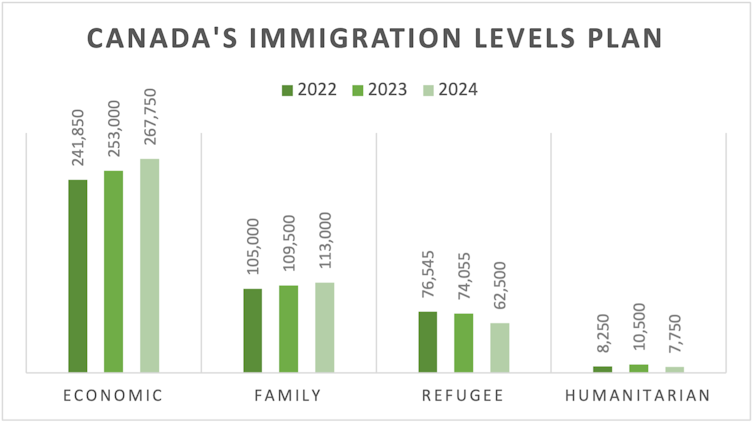
Immigrants are a vital part of the Canadian economy and social fabric. In announcing Canada’s new immigration target of 500,000 permanent residents per year by 2025, Immigration Minister Sean Fraser said the numbers strike a balance between our economic needs and international obligations.

Bar graph showing the increasing amounts of immigrants Canada plans to welcome into the country over the years
Canada’s new Immigration Levels Plan aims to welcome 465,000 new permanent residents in 2023, 485,000 in 2024 and 500,000 in 2025. (Statistics Canada), Author provided

Despite the importance of immigrants for the Canadian economy and national identity, it remains to be seen if immigrants are engaged in the development of policies, services and technological tools that impact them.

Advancements in the immigration sector

Canada has steadily been introducing digital technologies into services, programs and processes that impact migrants. This has especially been the case with the COVID-19 pandemic requiring organizations to innovate their services and programs without diminishing the overall quality of service.

Immigration scholar Maggie Perzyna developed the COVID-19 Immigration Policy Tracker to examine how the Immigration and Refugee Board and Immigration, Refugees and Citizenship Canada (IRCC) used digital tools to enable employees to work from home. This helped reduce the administrative burden and increased efficiency.

There continues to be a strong case for technological transformation in Canada’s immigration-focused departments, programs and services. As of July 31, 2022, Canada has a backlog of 2.4 million immigration applications

In other words, Canada is failing to meet the application processing timelines it has set for itself for services —including passport renewal, refugee travel documents, and work and study permits. 

While the Canadian government is trying to address these backlogs, there appears to be no discussion of asking immigrants about their journey through the application process. Rather, the government appears to centre employees. Still, issues with the Global Case Management System persist, driving current case management system issues for employees and government service users. 

Virtual processes were prioritized

While the Canadian government previously introduced a machine learning pilot tool to sort through temporary resident visa applications, its use stagnated due to pandemic-related border closures. Instead, virtual processes and digitization were prioritized, including:

  • Shifting from paper to digitized applications for the following: spousal and economic class immigration, applicants to the Non-Express Entry Provincial Nominee Program, the Rural and Northern Immigration Pilot, the Agri-Food Pilot, the Atlantic Immigration Pilot, the Québec Selected Investor Program, the Québec Entrepreneur Program, the Québec Self-Employed Persons Program and protected persons. 
  • Hosting digital hearings for spousal immigration applicants, pre-removal risk assessments and refugees using video-conferencing.
  • Introducing secure document exchanges and the ability to view case information across various immigration streams.
  • Offering virtual citizenship tests and citizenship ceremonies.

Additionally, Fraser announced further measures to improve the user experience, modernize the immigration system and address challenges faced by people using IRCC. This strategy will also involve using data analytics to aid officers in sorting and processing visitor visa applications. 

These changes showcase Canada’s efforts to pair existing challenges with existing solutions — initiatives that require relatively low effort. Yet while these digitization efforts streamline administrative processes and reduce administrative burden, application backlogs persist. 

While useful, these initiatives focus on efficiencies in IRCC processing for employees. As IRCC evaluates and develops processes, it should prioritize the experience of end users by taking a migrant-centred design approach.

The value of human-centred design

Human-centred design is the practice of putting real people at the centre of any development process, including for programs, policies or technology. It places the end user at the forefront of development so user needs and preferences are considered each step of the way.

To maximize value in technology implementation, IRCC should take a migrant-centred design approach: apply human-centred design principles with migrants treated as the end users. This approach should consider the following suggestions:

  1. Centre migrants in the development of immigration programs, policies and services, and digital and technological tools by seeking migrants’ input in forthcoming and proposed changes.
  2. Take a life-course approach to human and social service delivery by recognizing that “all stages of a person’s life are intricately intertwined with each other.” Government services prioritize Canadian citizens, but a life-course approach understands that all individuals in Canada, regardless of their current immigration status, represent potential Canadian citizens. Government services should implement a life-course approach by prioritizing quality services for migrants, some of which are seniors that will require different government services in the future.
  3. Combat discrimination and bias in developing new immigration technology tools. Artificial intelligence and other advanced digital technologies have the capacity to reproduce biases and discrimination that currently exist in IRCC. Any new technologies must be evaluated to prevent discrimination or bias. 

As Canada continues to explore how technology can help streamline and improve the migrant journey, migrant-centred design should be at the forefront of their planning. When we design processes, policies and tools with intended users at the centre, they are more likely to resonate with users

If Canada wants to be a first-choice migration destination, we need to approach immigration policies — including technology use — as opportunities to empower and encourage migrants.

Source: Canada needs to consider the user experience of migrants when designing programs that impact them

Immigration backlog leads to surge of legal cases against federal government

Yet another good analysis in the Globe, collateral damage from the government’s immigration policies and operational weaknesses that frustrate applicants and increase workload:

The federal government is facing a barrage of legal cases related to its backlog of immigration applications, which has led to slower processing times and plenty of frustration for those waiting years on a decision.

Immigration, Refugees and Citizenship Canada has been named in 709 mandamus applications filed in federal court this fiscal year, which started in April, according to figures provided by IRCC as of Nov. 14. The filings are easily on pace to surpass the total for the previous fiscal year.

Mandamus is an order issued by a court to a lower court, or government entity, to carry out their duties. Thus, hundreds of people are seeking a judicial order that compels Immigration to finish processing their applications.

Mandamus cases are generally filed when there is an excessive delay in processing an immigration application and without a reasonable explanation provided by the federal government for that delay.

Ottawa is ramping up its intake of immigrants, which it says is crucial to fuelling economic growth and alleviating labour shortages. However, some of its moves to boost immigration have led to significant processing delays, affecting applicants that include skilled workers who are highly sought after by employers.

In search of resolutions, more people are turning to the courts. Slightly more than 800 mandamus applications against IRCC were filed in the 2021-22 fiscal year, an increase of 465 per cent from 143 applications in 2019-20.Glo

While lawyers told The Globe and Mail that mandamus is a last-resort option, it’s increasingly one that immigration applicants are advised to take, given their mounting frustrations over a sluggish and opaque system.

“It’s an effective remedy,” said Mario Bellissimo, founder and principal lawyer of Bellissimo Law Group. “However, it’s a remedy that really shouldn’t be used as frequently as it is, when the system is running the way it’s meant to run.”

The federal government is trying to process a stockpile of immigration applications. As of Oct. 31, there were about 2.2 million applications in IRCC’s inventories. Around 1.2 million were in backlog, meaning they’ve been in the system for longer than service standards for processing. Processing times vary by immigration stream. The mass of applications has fallen since September, but is still much larger than before the pandemic.

The federal government has blamed the buildup on office closings related to COVID-19, hindering its ability to process files efficiently. However, several economists and legal experts say that Ottawa had a large hand in creating the situation.

After failing to hit its immigration targets in 2020, owing to the pandemic, the federal government found various ways of encouraging more people to apply for permanent residency, and the subsequent increase in applications overwhelmed IRCC’s ability to process files in a timely manner.

This has led to a number of grievances. For instance, some high-skilled foreign workers in Canada are nearing the end of their work permits, but have yet to hear about their status. Others applied for their permanent-resident cards years ago, but are unable to find out why processing of their files has stalled.

That is forcing more people to seek legal action.

Out of the 809 mandamus applications that were filed against IRCC in the 2021-22 fiscal year, 333 came from those in economic streams of immigration. Another 183 came from the family class of immigrants. (Many of these are spousal cases, with a partner stuck overseas.)

The mandamus process can be expensive. Max Chaudhary, an immigration lawyer in the GTA, said it can cost roughly $6,000 to $15,000 for a single case, depending on how many stages are involved.

Kerry Molitor, an immigration consultant, is concerned that processing delays are creating a situation in which wealthier individuals are better positioned to force the government’s hand.

“It’s a solution that’s out of reach for most people,” she said.

Lev Abramovich, an immigration lawyer in Toronto, says his firm has filed more than 300 mandamus applications over the past year, which makes him one of the more prolific users of this legal option.

“We take an aggressive approach. We’ve also been successful with it,” he said. “Generally speaking, a mandamus application will wake IRCC up and will put pressure on them to finalize the pending application.”

The process starts with a demand for performance to IRCC, often in the form of a letter. In some cases, the federal government will start processing the file at this point.

If the case remains stalled, lawyers will proceed to file an application for mandamus in federal court. At this stage, the federal government will usually resume working on a file and issue a decision, several lawyers said.

In rare instances, however, cases will proceed to a hearing.

That is what happened to Siavash Bidgoly and his wife, Iranian nationals who moved to Toronto from the U.S. in July, 2018. That same month, Mr. Bidgoly submitted his application for permanent residency, having recently been invited to apply by the federal government. His wife was listed as an accompanying dependent.

Mr. Bidgoly expected an approval within six months, based on the experiences of some friends. Shortly after he arrived, he started a company, Tribe Technologies Inc., which employs about 50 people today.

Instead, the process dragged out for years. Mr. Bidgoly made several attempts to learn more about his application status, often hearing that his security check was still in progress.

Mr. Bidgoly filed a mandamus application in February, 2021. A federal court justice ruled in his favour in March, 2022, ordering IRCC to issue a decision within 90 days. Mr. Bidgoly and his wife were later approved for PR status.

“It is stressful. It is draining. I love Canada, but I questioned myself,” he said. “You are here because you trust their immigration system, and now this is what you get.”

In the hearing, IRCC argued that the delay was not excessive, in light of the pandemic’s effect on processing times. Justice Paul Favel did not find that argument satisfactory.

“Simple statements to the effect that a security check is in progress or that the pandemic is responsible for the delay are insufficient,” read the decision, adding that IRCC “had to provide evidence.”

Source: Immigration backlog leads to surge of legal cases against federal government

Immigration department finds no fault in Montreal AIDS summit visa debacle as another conference looms

Might help communications if IRCC would be more forthcoming with more data on the reasons for refusals, not stating the general reasons. Likely the systemic issue is concern that some attendees may file refugee claims or overstay, and the economic disparities between some of the countries or origin and Canada:

With Canada set to host a major international summit next month, advocates are warning about a possible repeat of issues that prevented some African delegates from attending a conference in Montreal over the summer, leading to allegations that the federal immigration department’s policies are racist.

Immigration, Refugees and Citizenship Canada said it found no fault in its handling of visa applications for the International AIDS Society conference last July. A number of delegates from Africa were either denied visas or were still waiting for a response by the time the conference got underway.

“The whole system is designed to exclude people,” said Madhukar Pai, the Canada Research Chair in translational epidemiology and global health at McGill University in Montreal.

Next month, Montreal is hosting a United Nations conference on biodiversity loss, stoking worries that delegates from the regions most impacted by declining species will be stuck at home.

“There is something about our governmental system that is, what I call anti-Africa or anti-Black, and that worries me a lot,” said Pai.

For years, Pai has attended conferences where his African colleagues have had more difficulty getting visas than his peers from Latin America and Asia.

It’s an issue he’s seen at events hosted in the U.S., Britain and Canada, and one he was particularly concerned about this spring as Ottawa struggled to process everything from refugee applications to passport renewals.

“I don’t know whether the government has genuinely learned much from the AIDS conference fiasco,” Pai said.

“The anger was so palpable, to have all those empty chairs of African delegates missing; it was egregious…I worry about any international conference that is being held in any part of Canada these days.”

The immigration department doesn’t share Pai’s concern.

“IRCC is using all the tools available at its disposal to facilitate the processing of thousands of visa applications in a short period of time,” spokesman Jeffrey MacDonald said in a written statement.

The department says it has a special events unit that works with conference hosts to try and ensure that visa offices abroad have a list of people who have registered for an event. People also use a special code when applying so that their applications are prioritized.

“IRCC works closely with the Canada Border Services Agency and event organizers to ensure the application process and immigration and entry requirements are understood, so that visa applications are processed in a timely manner and admission for participants can go smoothly,” MacDonald wrote.

The department suggested that people invited to this summer’s conference might have botched their applications.

“Waiting too long to apply, or omitting the special event code, may result in their application not being processed in time for the start of the event,” MacDonald wrote, adding that the department won’t get into specifics of the July event due to privacy legislation.

“There are always compelling reasons some individuals are not allowed to enter Canada.”

Issue is ‘systemic’, not technical, gender and health expert says

Lauren Dobson-Hughes, a consultant specializing in global health and gender, said Canada and other Western countries need to look beyond technical fixes and recognize “a much broader pattern” at these summits.

“It is a systemic issue across the world, where we tend to be divided into the Global North donors who host conferences, and the Global South who live these issues and should have ownership of them — and yet the conferences that are about them are not done with them.”

Dobson-Hughes recalled summits in 2016 and 2019 where African delegates had invitation letters on Government of Canada letterhead, but could not actually get a visa.

“I can’t imagine Global Affairs Canada is particularly delighted that they build respectful, meaningful relationships on a personal basis with colleagues in Africa, for example, only to have their own government turn around and deny them a visa,” she said.

“I have not seen anything that gives a sense that they [IRCC officials] have grappled with the sense of the problem as particularly African participants perceive it.”

Source: Immigration department finds no fault in Montreal AIDS summit visa debacle as another conference looms

Canada spent millions to upgrade its systems. Why are immigration backlogs still so bad?

More on the backlogs although it appears the peak has passed according to November stats:

When Ian Bromley invited his girlfriend to come from Costa Rica and visit him after Canada’s border had reopened, the Toronto man thought it would be a few weeks before she could get her visa.

After trying unsuccessfully to navigate the tedious online application process, Bromley paid a lawyer $3,000 to submit an application on Jeannett Anton Mendoza’s behalf in April.

Six months later, in October, the immigration department’s website still showed officials had yet to open Anton Mendoza’s file, which included her fingerprints and a stack of translated documents to prove she had a job, a mortgage and money in her bank accounts to go back to in San Jose.

Despite repeated calls and emails to the department himself and through an MP, Bromley did not once receive an update from immigration officials.

“Rather than fixing the failure, they’ve put a lot of layers on top of it to keep people away from it,” says Bromley, who teaches at University of Toronto Mississauga after years of working in economic development at provincial and municipal governments here and abroad.

Almost three years after the COVID-19 pandemic wreaked havoc on Canada’s immigration system, halting processing, visa offices have reopened, more staff have been hired, and millions of dollars have been invested in upgrading government computer systems to streamline case management and keep applicants updated.

However, officials are still struggling with an unprecedented immigration application backlog.

As of Sept. 30, the number of temporary and permanent residence applications in its inventory had soared from 1.8 million at the end of last year to 2.6 million. Fifty-seven per cent of the files have been in the queue beyond the processing timelines set by the government.

This week, Immigration Minister Sean Fraser unveiled Canada’s latest immigration targets, which will see this country look to bring in 465,000 new permanent residents next year, 485,000 in 2024, and 500,000 in 2025.

Yet with the nagging backlog, and significant delays for applicants to get a visa, critics are asking whether Canada can, in fact, handle more immigration applications despite the injection of an additional $50 million in this week’s fall federal economic statement that is meant to eliminate backlogs.

“There’s no one silver bullet,” Fraser confessed to reporters when asked at the plan’s release about the immigration department’s capacity to handle the workload.

“It takes every tool in the tool box to solve this challenge. It takes resources. It takes policy. It takes technology.”

‘Nothing short of a dumpster fire’

Immigration backlogs and processing times have been the focus of a study by the parliamentary immigration committee. Since May, 44 witnesses — from advocates to legal professionals and policy wonks, as well as community and industry groups — have laid out what they think is wrong with the system.

At a recent committee hearing, immigration lawyer Chantal Desloges summed up the two main causes of the backlogs and delays: the department’s “outdated and ineffective” IT systems and its “culture of secrecy.”

“It seems that every new online system is full of glitches, to the point where lawyers are now actively resisting the move to mandatory online processing, because it is nothing short of a dumpster fire. It is characterized by disappearing data and almost daily system-wide crashes,” said Desloges, who has practised immigration law for more than a quarter of a century.

The lack of transparency breeds delay, she said, and people are left in the dark despite bombarding the immigration call centre and submitting inquiries through web forms.

“Then we have to bother you, the members of Parliament, which again sometimes helps and sometimes doesn’t. So then we’re forced to bother the Access to Information Office, and that takes months. As a last resort, we’re then forced to go to the Federal Court and bother the Federal Court and the Department of Justice through litigation,” Desloges noted.

“It’s a waste of valuable resources at every level, and if we could just get a clear reply the first time, we wouldn’t have to do any of this.”

That’s the situation Bromley and his girlfriend found themselves in.

Two months after they applied for the visa and with no sign that application had been touched, they emailed the immigration department and contacted the call centre; meanwhile, the visa processing time for Costa Rica had ballooned from 26 days in April to 197 days in October.

In July, they contacted MP Carolyn Bennett’s office and say they kept bugging her sympathetic assistant for updates. But even the MP’s office was stonewalled and told officials couldn’t give processing time estimates due to “ongoing effects” of the pandemic on visa offices.

“When we set out to apply for the visa, we thought it would be a slam dunk. Jeannette ticks all the boxes. I had no idea it’s going to be anything like this,” said Bromley, whose girlfriend was only approved the visa late last month, after a Star inquiry into their case.

Back up and running?

An operational update in May from the immigration department said 98 per cent of the Canadian overseas missions and 97 per cent of its visa application centres were open for business. As of March, all immigration offices and service providers in Canada were operating, though 94 per cent of the staff continued to telework.

Fraser said most of the permanent residence processing is back on track — skilled immigrants selected under the Express Entry talent pool face six-month waits; family reunifications are taking 12 months.

“There are still applications that are in the system today that have been in longer than that, and we’re not going to bump them from the line to process new applications first,” he assured reporters.

Fraser’s comment gave no comfort to Tejas Ghutukade of Burlington, who waited almost four months just to get an acknowledgment of receipt this May after applying in January to sponsor his wife, Seema Kore, to come from India as a permanent resident.

Shortly after filing the application, he was asked to provide his proof of permanent residence. He did it immediately through a web form and by mail to the immigration office in Sydney, N.S. He even followed up with the call centre to confirm it had received the documents.

In June, he was shocked to get an email from Immigration telling him his sponsorship was rejected because he had failed to respond to a request. But when he checked his account in the department’s portal, it said the application was still in process.

Ghutukade reached out to the call centre again and the agent was also confused and said he would ask an officer in the processing centre to get back to him. When no one followed up with him, Ghutukade made an access-to-information request for officials’ notes on his file — and asked his MP for help.

“It’s all very confusing,” said the 32-year-old software engineer, whose attempt to bring his spouse here on a visitor visa was refused in January. “We don’t know who’s processing our application. There’s a lot of disconnection within the system. It’s surprising that we still have this backlog almost three years after the pandemic started.

“It’s very frustrating. I’m already having this thought of moving back to India. I’ve been married but separated from my wife. It just doesn’t make sense,” added Ghutukade, who received an update Nov. 4 from immigration to refer his wife to a medical exam.

Solutions?

Although many of the system’s issues can’t be addressed overnight, Desloges said officials in the interim should take all the borderline cases in the backlog and push them through if they have no criminal and security concerns.

“At this point, it is the cost of doing business, because the damage that’s being imposed by the backlog far outweighs any potential damage that could be caused by the odd person who gets erroneously approved,” Desloges said.

Immigration lawyer Mario Bellissimo said the lack of transparency and accessibility is one of the biggest challenges facing the immigration department, which needs a cultural change, he said, from an enforcement-focused mindset to one that strives to serve prospective migrants.

“We’re trying to facilitate immigration. We’re not trying to prevent it.”

He urged Ottawa to follow Australia in establishing an immigration college to provide accredited and consistent training for staff to ensure high quality decision-making. Improved competency, he said, could speed up processing.

And then there’s the other step.

Given the demand to come to Canada always outstrips the country’s visa-processing capacity, Bellissimo said, the only way to keep backlogs in check is to cap intakes and return unprocessed applications to applicants.

“That’s what other countries — the U.K, New Zealand and Australia — have done,” he said. “It’s the only way to solve the backlog. It’s the only way to keep the system nimble and to be able to take on new batches of inventory. Otherwise, you’re just always working in the past.”

Canada’s approach is half-baked, critics say. Although it has annual quotas for most permanent-residence categories, it lets unprocessed applications accumulate — and there’s no cap at all for temporary resident applications. That explains why study and work permits and visitor visas now account for 63 per cent of the 2.6 million immigration inventory in the system.

Bellissimo said officials could complement the caps with new targeted streams to address urgent travel or humanitarian needs, such as the crisis in Ukraine, through what he calls an “applicant-centric” approach.

Fraser agrees there’s a lot more work to do but said the numbers of applications processed this year until July — 275,000 new permanent residents admitted; 349,000 new work permits issued; 360,000 study permits finalized — are trending in the right direction.

“Immigration is about people. It’s about starting a new job, reuniting a family and creating a new life in this beautiful country we call home,” the immigration minister told reporters recently.

“By adding resources where they are needed, and leveraging technology to make processing faster and applying easier for our clients, we can give newcomers and new citizens the welcoming experience they deserve.”

‘My interest and desire to go there has faded’

But time is money for businessman Dilhan De Silva, who bought two franchised home-care services agencies in Greater Toronto last summer and has been waiting for a work permit under the intracompany transfer program since August 2021.

“I didn’t expect this kind of backlog or unresponsiveness from a modern country like Canada,” said De Silva, a chartered accountant, who runs a conglomerate of companies in import and export trades in Colombo, Sri Lanka. “I saw this business opportunity in Canada but now my interest and desire to go there has faded.”

His lawyer has made numerous unreturned inquiries about the delays and is now preparing to sue the immigration department for undue processing delays.

Source: Canada spent millions to upgrade its systems. Why are immigration backlogs still so bad?

Documents senator sent to family trapped in Afghanistan weren’t authentic, says federal immigration department

Embarrassing for Senator McPhedran but good that IRCC caught the error. And I think the Senator has to be more forthcoming on which “trusted high level Canadian government official” reportedly provided advice.

That being said, understandable that those desperate to leave Afghanistan after its fall to the Taliban would resort to such means:

In the final days of a chaotic and inadequate government effort to rescue people from the Taliban last summer, Senator Marilou McPhedran and one of her staff members sent travel documents to a family attempting to flee Afghanistan. The documents, called facilitation letters, were supposed to help the Afghans bypass checkpoints that had been set up around Kabul’s airport, so they could catch one of the last evacuation flights out of the country.

The letters, copies of which were obtained by The Globe and Mail, have the appearance of official Canadian government documents. They say that each of the Afghans named on them has been “granted a VISA to enter Canada” and ask that the group be given “safe travel to the Hamid Karzai International Airport so that they can board their organized flight.”

A year later, the people who received those documents are still stuck in Afghanistan. And the Canadian government has at last explained why: The facilitation letters they received from the senator and her office were not authentic, and the people named on them had not been approved to come to Canada.

Behind the scenes, Immigration, Refugees and Citizenship Canada (IRCC), the federal immigration department, had conducted an internal investigation and referred the matter to police.

Ms. McPhedran, a long-time human-rights activist and lawyer, says she was trying to help, and that she acted in good faith. But communications obtained by The Globe show that receiving the documents from her office could have hampered the Afghans’ efforts to escape by giving them the mistaken impression that they had been cleared for travel.

The family had formally applied for resettlement in Canada, but they would later discover their application had been lost. A second application, which they made this year, was rejected because Canada’s immigration programs for Afghans were already at capacity. The group remains at risk in Afghanistan, hunted by the Taliban.

“The use of inauthentic facilitation letters is a serious matter,” IRCC spokesperson Rémi Larivière said in an e-mailed statement. Following the department’s internal investigation, he added, it “made a referral to the appropriate law enforcement partners.”

The RCMP and the Canada Border Services Agency declined to say whether they have launched investigations, adding that it is generally their policy not to comment on cases unless charges are laid.

E-mailed statements from IRCC about the matter do not name Ms. McPhedran, but two government sources said the internal investigation was directly related to the documents sent by the senator and her office. The Globe is not identifying the sources because they were not authorized to discuss the investigation publicly.

One source said the government is not aware of anyone coming to Canada using the inauthentic documents, but they were unable to say if anyone had successfully used them to get out of Afghanistan.

In an interview, in e-mails to The Globe and in letters sent by her lawyer, Ms. McPhedran defended her efforts to save vulnerable Afghans, who are now subject to the Taliban’s brutal fundamentalist regime. She acknowledged using a template version of a government facilitation letter, but she denied that the documents were fake, or that she had used them in an unauthorized way.

She said the facilitation letter template was sent to her by a “trusted high level Canadian government official,” whom she declined to identify. She also would not say who added the names to the facilitation letters sent by her and her office. And she did not answer a question about whether she knew the Afghans had not been approved for resettlement in Canada.

“There is nothing fraudulent or illicit about any actions I took with regard to the Afghanistan rescue efforts last August,” she said in an e-mail.

”That my good faith efforts to help save Afghan lives are now being mischaracterized as unauthorized or an overreach is a sad commentary about our governance and nothing more than a politically motivated smear campaign.”

Despite repeated requests to IRCC and Global Affairs Canada, the government has refused to say whether any federal officials helped Ms. McPhedran. IRCC’s Mr. Larivière said he would not comment further, to “protect the integrity and privacy of investigations.”

The senator said she had worked around the clock with advocates and non-governmental organizations in August, 2021, as she tried to rescue the people most at risk from hard-line Taliban rule – namely, women and girls. She has spent most of her life fighting for women’s rights. In 1985, she was invested into the Order of Canada for her work ensuring equal rights for women were enshrined in the Charter of Rights and Freedoms. Prime Minister Justin Trudeau recommended her for a Senate appointment in 2016.

For years before the events of 2021, the Canadian government had promised Afghans who had worked closely with the country’s military and diplomatic missions in Afghanistan that they and their families would be able to resettle in Canada. In 2012, embassy staff in Kabul asked the government to launch a special immigration program for those Afghans. Such a program was finally created in July, 2021, just weeks before the Taliban took over on Aug. 15.

On the same day as the takeover, 10,000 kilometres away from Afghanistan, Mr. Trudeau called a snap election, and the government shuttered its mission in Kabul and evacuated its staff from the city.

The speed of Afghanistan’s fall surprised NATO countries. They were left scrambling to evacuate Afghans whose work with foreign governments put them at risk of Taliban reprisals.

Ms. McPhedran’s lawyer, Matthew Gottlieb, said the senator received the facilitation letter template from a government official on Aug. 25. Flights out of Afghanistan were about to end, and the federal government’s immigration programs for Afghans had buckled under overwhelming demand and a cumbersome application process. Advocates say the eligibility criteria were opaque, and that the process was difficult to navigate in a war zone.

At the time, Kabul’s airport was constantly surrounded by thousands of Afghans hoping to be among the lucky minority allowed to pass through military guards and board flights out. The stakes were so high that some resorted to desperate measures. In at least one instance, parents passed an infant to American soldiers over a barbed wire barricade. In other cases, people tried to cling to the outsides of planes as they took off. On Aug. 26, a suicide bombing at one of the airport’s entrances killed scores of civilians.

Ultimately, tens of thousands of people who had helped NATO in its war in Afghanistan were left behind. Some are being tortured by the Taliban.

Ms. McPhedran told The Globe she acted how anyone would have in a life-or-death situation. She said her efforts “were known by high level government officials.” In some cases, she said, those officials “participated directly in these rescue efforts.” She added that there are e-mails that show people in government knew about her work.

Her lawyer, Mr. Gottlieb, said the senator lacked “the authority or permission” to provide those e-mails.

Mr. Gottlieb added that she “understood, and was told,” that the facilitation letters “could and should be used in assisting Afghans to get to the tarmac” at the Kabul airport.

IRCC’s Mr. Larivière said the government was using facilitation letters in August, 2021, to help ensure Afghans were able to get through security checkpoints on their way to the Kabul airport. But he said authentic documents were sent only by Global Affairs Canada and IRCC, and only through official government e-mail addresses.

Ms. McPhedran and her staff member sent at least two identical e-mails to a recipient of the facilitation letters in Afghanistan. The messages said Ms. McPhedran had learned the person’s name from the New York-based Global Network of Women Peacebuilders, where the senator is a board member. The organization did not reply to questions from The Globe.

The e-mails were brief. They said there was “no guarantee” the attached documents would help. They directed the recipient to a specific gate at the Kabul airport and ended by saying: “Please do not discuss; just present this document first to any Canadian soldier – flights end on the 26th!” The Globe is not naming the recipient of the e-mails or the other people named on the documents to protect their safety in Afghanistan.

The Globe also obtained a letter sent by MP Michelle Rempel Garner, whose constituent’s family members in Afghanistan are the people who received the inauthentic documents.

Ms. Rempel Garner’s letter, dated July 7, was sent to the constituent, as well as Immigration Minister Sean Fraser, Global Affairs Minister Mélanie Joly and Ms. McPhedran.

The letter detailed almost a year of work that Ms. Rempel Garner’s office had done to help the constituent’s family navigate the immigration system. It said her office at first believed the facilitation letters were legitimate government documents and tried to help the constituent understand why some members of her family had been approved to come to Canada while others had not been.

Over the course of that work, the letter said, Ms. Rempel Garner’s office began to have concerns about the validity of the facilitation letters. Ms. Rempel Garner wrote that, despite 10 months of work and after corresponding with government officials more than 30 times, no one in government had said whether the documents her constituent’s family had received were legitimate.

The letter also said that, because the family had believed they possessed legitimate documents, they had come out of hiding to travel to the airport and exposed themselves to danger.

Mr. Fraser clarified the status of the facilitation letters in a response to Ms. Rempel Garner later in July. He said IRCC did not issue the documents, nor did it have a record of the first of the family’s two resettlement applications.

“Since finding no record of the application, IRCC took steps to understand the nature of the letter you raised and related communication,” Mr. Fraser wrote. “The use of inauthentic facilitation letters is a serious matter, and IRCC has treated the matter with the attention it deserves.”

Source: Documents senator sent to family trapped in Afghanistan weren’t authentic, says federal immigration department

International students waiting for visas from Ottawa at risk of missing start of classes

An unfortunate additional example at IRCC. Given this and other examples, perhaps time for the government to scale back to program capacity, rather than failing to meet service standards and expectations:

Delays in processing student visas have put a large number of international students at risk of missing the start of fall classes this year, as the federal Immigration Department struggles to keep up with what it describes as a surge in applications.

The issue has sparked a complaint from the Indian High Commission in Ottawa, which said in a statement that it has received a number of petitions from Indian students frustrated with lengthy wait times for visa processing.

India is Canada’s largest source country for international postsecondary students. Students from outside Canada pay tuition fees that are often more than two or three times higher than those paid by domestic students, and that money has become a crucial source of funding to universities and colleges across the country.

According to the Immigration Department, the number of student visa applications is growing. Canada received more than 123,000 applications for student visas from India in the first five months of this year, an increase of 55 per cent over 2019, according to Aidan Strickland, a spokesperson for Immigration Minister Sean Fraser. So far this year, Immigration, Refugees and Citizenship Canada (IRCC) has processed more than 360,000 student visas, a 17-per-cent increase over the same period in 2021.

Students apply for the study permits only after they have been accepted to Canadian universities. Until their visa applications are processed they aren’t allowed to enter Canada to study – and that is true even if they have already paid tuition, or taken out student loans.

Ms. Strickland added in a statement that IRCC is still struggling with the continuing impact of the COVID-19 pandemic on its operations around the world. She said the government is prioritizing applications from students aiming to begin their studies in September, but that not all applications will be processed in time for fall 2022.

“IRCC has seen an unprecedented volume of applications received for both initial study permits and extensions in 2022, not just from citizens of India but on a global scale,” Ms. Strickland said.

The number of students affected is not clear, but Canada’s diplomatic mission in India said in a tweet last week that a “large number” had experienced long wait times or not received visa decisions.

Federal data show that, as of the end of July, 34 per cent of pending international student visa applications were taking longer to process than government standards dictate.

Indian students contribute more than $4-billion in tuition fees to Canada’s postsecondary system, according to the statement from the Indian High Commission. More than 230,000 Indian students are enrolled at Canadian schools, the statement said.

At the University of Toronto, the number of students contacting registrars with study permit concerns is higher than usual, the university said in a statement. The university said it has been in constant contact with IRCC, and with the Minister’s office directly, to advocate for timely processing of study permit applications and to explain the impact of the delays on students. The statement added that any students unable to enter the country because of the delays can seek deferrals if they are eligible.

Gautham Kolluri, an international-student recruiter and immigration consultant based in Waterloo, Ont., said the number of students affected is likely in the thousands.

He said these are students who have accepted places offered to them at Canadian universities or colleges and expected to have their student visas approved in a matter of weeks. Instead, the process is taking months.

One client of his waited six months to get a study permit, he said.

Mr. Kolluri said he is advising some clients that they are unlikely to receive approval from IRCC before classes begin. At this point, he said, he’s recommending they defer until the next available intake, which can mean a delay until January, or in some cases until next September.

“They’re devastated. For them it’s their studies, but also their future career and opportunities in Canada that are affected,” Mr. Kolluri said. “We are losing these kind of good students who could make a contribution to Canada.”

Most students in India take out education loans in their home countries before coming to Canada. Mr. Kolluri said the interest on those loans starts accumulating even if the students haven’t been able to begin their studies, adding to the pressure they feel if there are problems with their study permits.

Before the pandemic, he said, visa approvals often came through in two to three weeks, and in some cases as quickly as 48 hours. Now, IRCC’s website says it takes up to 12 weeks on average for a study permit application from India to be approved. The target is eight weeks, according to the department.

Ms. Strickland said Mr. Fraser has announced that he expects to hire an additional 1,250 officers by the end of fall to tackle application backlogs and processing delays, paid in part with $85-million in additional funds directed to the department in the government’s 2021 fiscal update.

Source: International students waiting for visas from Ottawa at risk of missing start of classes