Canada’s housing and immigration policies are at odds

More commentary on the disconnect between immigration and housing (and other infrastructure and services):

Housing affordability has metastasized from a Toronto and Vancouver problem to a national crisis. Double-digit rent increases have hit traditionally more affordable communities coast to coast, and the cost of home ownership remains persistently high amid rising interest rates. One of the main reasons for the lack of affordability, according to our recent report, is the misalignment between Canada’s different levels of government.

Over all, Canada’s system of decentralized federalism has served us well. Allowing different levels of government to make decisions that suit their own contexts is usually the right approach when it comes to program delivery. A century ago, Louis Brandeis, then a justice on the U.S. Supreme Court, famously referred to states as “laboratories” for policy experimentation. This holds true for Canadian provinces, and on the whole, the structure is healthy for a medium-sized country spread out over the world’s second-largest land mass.

Many factors have contributed to eroding housing affordability, but the fundamental problem is a growing mismatch between supply and demand. While residential construction in Canada has plateaued, falling well short of historical highs, our population is growing faster than that of any other G7 nation.

Canada’s population growth averaged 422,000 additional inhabitants per year (July to July) between 2012 and 2022, compared with 335,000 annually over the previous decade. This trend is accelerating, with net growth of more than 500,000 inhabitants in three of the past five years, including a record 703,404 between 2021 and 2022.

Meanwhile, housing completions have stagnated over the past five decades. Between 2012 and 2022, an average of 195,000 homes were built annually, down from 199,000 annually the decade before – and 229,000 annually during the 1970s, Canada’s home-building highpoint.

Which brings us back to Canada’s system of governance. Population growth is controlled in large part by the federal government, and home building primarily by provincial and local governments.

Since the early 1990s, immigration has replaced net births (births minus deaths) as Canada’s primary driver of population growth. Unlike birth rates, which governments can only indirectly influence, immigration numbers are determined by government policy. For example, Canada’s most recent Immigration Levels Plan aims to add 465,000 new permanent residents in 2023, then 485,000 in 2024, and 500,000 in 2025 – the highest immigration levels ever.

Provincial and local governments, meantime, are tasked with planning for and approving enough housing to keep up with this record population growth. They do so through a series of land-use and growth plans, starting at the provincial or regional level and ending with local plans and bylaws governing how much building is permitted to happen, and where.

In short, the federal government (and, to varying extents, provinces) wield a formidable lever over housing demand, while provinces and municipalities largely control the housing supply. Unfortunately, these two sets of policy levers – immigration policy versus growth planning – are essentially set in isolation of one another.

Immigration levels plans, which are updated every year, are partly informed by a series of federal-provincial/territorial agreements. However, none of the current agreements even mention the word “housing,” focusing instead on concerns such as labour market needs and language requirements. These are important considerations, but newcomers also need places to live.

Meanwhile, provincial and local growth planning takes years to implement and update. For example, the Ontario government updated its 2006 growth plan for the region surrounding Toronto in 2019, and again in 2020, giving municipalities until 2022 to adjust their local plans accordingly. However, municipal plans can take years to translate into updated zoning bylaws, if at all, and since there is no strict enforcement of growth plans’ housing targets, they amount to a best guess as to how communities might grow.

Further, the length of time it takes to create and execute local plans means their population growth assumptions are often outdated before or during their implementation. While immigration levels plans are updated annually, major provincial directives – such as Ontario’s 2022 target of getting 1.5 million homes built over the next decade – are already a step behind.

Federal, provincial and municipal policy makers all need to get on the same page. Canada’s housing shortage won’t end until immigration policies start reflecting the reality of our housing markets, or until land-use and growth planning accurately reflects population growth. Without better co-ordination, the housing crisis will likely get worse.

Steve Lafleur and Josef Filipowicz are policy analysts who research housing and taxation. This article is part of a project they undertook with the Macdonald-Laurier Institute.

Source: Canada’s housing and immigration policies are at odds

Record immigration, nowhere to live. Welcome to Australia’s rent crisis

Sounds familiar:

For Meg Edwards, it was $30 that sealed the deal.

The 20-year-old international relations student and her two housemates were struggling to find a home in Melbourne’s hypercompetitive, inner-city rental market, having inspected close to two dozen properties over the course of a couple of months.

“It was getting pretty stressful,” Edwards tells AFR Weekend. “There’s one place where we were calling the agent every day to make it really clear that we were interested.”

The real estate agent for the three-bedroom terrace house in North Melbourne told the trio they would need to offer more than the advertised $770 price if they wanted to stand out from the other 25 applicants and have a chance of securing the property.

“So we did end up doing that, and we did end up getting it,” Edwards says, with the group offering $800 per week for the home. “Obviously, we were pretty lucky to be able to do that. But not everyone can.”

What happened to Edwards and her friends was a clear breach of Victoria’s tough rental-bidding laws, which state higher offers cannot be solicited by an agent. Unfortunately, with Australia in the grip of what experts say is a rental crisis, what happened to the group is not likely a one-off.

Advertised rents have galloped 10 per cent higher in the past 12 months, research house CoreLogic says, and that adds to the cost-of-living pressures households already grapple with, such as soaring energy bills and grocery prices.

Worse, moving to a cheaper rental isn’t an easy alternative. Finding a place to live is harder now than at any time in at least two decades, with just 1.1 per cent of the nation’s stock of rental properties available for lease.

The country’s rental market is clearly out of balance, says Brendan Coates, the Grattan Institute’s economic policy program director.

“The rule of thumb vacancy rate for a healthy rental market – one where renters can find somewhere to live that suits their preferences and budget in a reasonable time frame – is around 3 per cent,” Coates tells AFR Weekend.

The situation is even worse in smaller capital cities such as Adelaide and Perth, where fewer than 1 in every 200 rental properties were vacant in February.

But the crisis facing renters, with few vacancies and rapidly rising prices, didn’t arise overnight. It’s the inevitable consequence of what happens when high, and rising, demand collides with limited supply. That, in turn, is the result of decades of policy failure and inaction across all levels of government. It took the pandemic, with its resulting inflation outbreak and flood of immigration, to bring it to a head.

It’s a problem being felt around the world. But in this country it is happening alongside forecasts for chronic underbuilding, property prices that have increased so rapidly that an entire generation of Australians believe home ownership is out of reach, and a system that treats property as just another asset class, favouring landlords at the expense of renters.

Finding a way out of this big squeeze won’t be easy.

Immigration and the ‘race for space’

On the demand side, Coates says a shift toward living in smaller households has contributed to the extraordinary tightness in rental markets.

“In a hybrid work world, people want more space to themselves and to live in smaller households. This means for a given number of renters, we need more rentals to go around,” he tells AFR Weekend.

The average number of people living in a household fell to 2.55 in 2021 from 2.59 in 2016, analysis of census data by real estate analysts at PropTrack shows. That means 160,000 more dwellings are required to meet the housing needs of the population.

“The ‘race for space’ started during COVID-19 and had a more subdued effect because borders were closed and there were no arrivals,” Coates says. “Now that migration has come roaring back, we have both more people and each person wanting more space.”

Treasury forecasts an influx of 650,000 migrants between this financial year and the next, as the reopening of Australia’s borders prompts the return of international students, working holidaymakers and skilled migrants, who are in high demand thanks to a chronic shortage of workers.

Coates says the migration boom contributes to the dwindling availability of rentals, as migrants compete with locals to snap up a shrinking number of homes for lease. “The more people there are, the more houses we need. And we are adding people a lot faster than we are adding houses,” he says.

Centre for Independent Studies chief economist Peter Tulip says the federal government has an obligation to help fix the problem of inadequate housing supply given it is responsible for the immigration program. “Canberra needs to ensure that new migrants have somewhere to live,” the former RBA researcher tells AFR Weekend.

The migration surge is bad news for renters in Sydney and Melbourne, where property markets are expected to bear a disproportionate share of the burden of the influx, given their popularity with international students.

Compounding the problem is that the boom comes as the construction industry is scaling back its plans to build more homes, burnt by rising interest rates and soaring material costs that have pushed a raft of builders into bankruptcy.

It means Australia will fall short of its housing needs between 2023 and 2027 by 106,300 dwellings, a report released on Monday by the government-run National Housing Finance and Investment Corporation said.

The rise of NIMBYism

A major handbrake on new housing supply has been the influence of existing homeowners who object to new developments in their communities. Known as NIMBYs (Not In My Backyard), their power is derived from their sheer number.

Twice as many Australians own property than rent – about a third of households own outright, and another third are paying off a mortgage – and to much of that cohort nearby development equates to putting their lifestyle and the value of their property at risk.

As such, the path of least resistance for politicians is to accommodate the will of a homeowning class through tough planning laws that restrict medium- and higher-density construction.

Limiting what can get built and where it’s built restricts the supply of new homes, making life harder for renters and prospective first home buyers by driving up rents and house prices. The problem is most evident in wealthy areas, where demand for new housing is high but very little is being built.

Councils in Sydney’s affluent eastern suburbs and lower north shore were the city’s most anti-development local government areas, CIS’ Tulip’s research showed last month. While the research only looked at Sydney, the findings would almost certainly translate to other housing markets.

Tulip found that council areas like Woollahra, Hunters Hill and Mosman built almost no new homes over the past few years. Between 2016 and 2021, Woollahra council built just 61 homes a year, while Hunters Hill – the smallest council area in Sydney – gained 12 homes annually on average and Mosman built 33 homes a year. The figures equate to tepid 0.2 per cent annual growth in the dwelling stock in each of the three harbourside locales.

Tulip found that most building took place in Sydney’s western suburbs, even though demand for housing was highest in the city’s inner and eastern suburbs.

While some planners argue that NIMBYs are not important since technical panels – not residents – make planning decisions, Tulip says it’s more complex. “The panels are guided by parameters set by politicians. And the politicians set restrictive parameters because they perceive their voters would object to new housing,” he says. “So the implication of this claim that public opinion is not driving planning decisions is false.”

Concerns about higher density developments harming neighbourhood character, which drives opposition to new homes from residents, are misplaced, Tulip says.

“There are lots of stories of people who opposed developments before they were built who then change their mind after seeing the final outcome,” he adds. “In particular, they like the new shops, restaurants and transport services that accompany higher density.”

In Sydney suburbs dominated by high-rise, such as Chatswood, Green Square and Liverpool, Tulip says house prices didn’t fall when development increased, in a sign that the lift in density had no effect on amenity. “I suspect that NIMBY opposition is just fear of the unknown,” Tulip says.

No silver bullet

Because the problem with the housing market stems in part from government policy, relief for renters can only come from government intervention. In the short-term Coates says the immediate priority for the federal government should be to increase rent assistance, which is a supplementary payment made to people on welfare who are also renting.

“Rent assistance works,” Coates says. “In 2021, it reduced housing stress levels for recipients nationwide from 72 per cent to 46 per cent.

“But the maximum rate of rent assistance hasn’t kept pace with the rising rents paid by low-income renters.”

For a single, the maximum fortnightly payment is $157.20, or just $79 per week, and research by economists at AHURI found that over one-third of recipients were still in rental stress after the payment was considered.

Rent assistance was already too low, even before the latest rental squeeze, says Australian National University associate professor Ben Phillips.

“Over the longer term we know that low-income renters are increasingly struggling and for that rent assistance is one part of the answer while the other part is some rebuilding of public housing and encouraging other forms of social housing and rental investment in lower cost housing options,” Phillips says.

A 40 per cent increase in rent assistance would cost the federal government about $2 billion, the Grattan Institute says, but it would go straight towards easing the cost of living for those struggling the most in the private rental market.

One way to pay for the increase would be to make the payment better targeted, with the Australian Housing and Urban Research Institute estimating that 419,000 renters on moderate incomes receive rent assistance, while some renters on low income are missing out.

In a report last year, the Productivity Commission said an increase in rent assistance should be a priority, citing the fact the value of the payment had declined over time relative to rents, while urging the federal government to make the support better targeted.

Coates says there is also a case for state governments to lift the rate of land tax applying to short-stay accommodation platforms like Airbnb to encourage owners to return the properties to the rental market.

“That would come with a cost because fewer Airbnb would mean less regional tourism, and therefore fewer regional jobs. But it would be better than seeing families in regional Australia living in caravan parks, tents and cars.”

He also says state governments should consider expanding “hard leasing”, where the public sector takes out a lease on private rentals and sublets them to vulnerable people. Coates says governments should also buy existing homes and turn them into social housing.

ANU’s Phillips says purchasing existing dwellings would be an easy way for the government to increase the stock of public housing. “This has the advantage of being more timely but also removes the issue of public housing concentrating disadvantage in one small area.”

Build more homes

In the long run, most experts say the only solution is to relax planning laws and build more homes.

“This is the recommendation of a succession of official reports into housing affordability,” Tulip says, referring to reports by the Productivity Commission and former RBA governor Glenn Stevens. “Those reports, in turn, summarise a mountain of academic research from Australia and overseas.“

Tulip says governments need to set and enforce high housing targets for local councils, while also funding infrastructure that would allay concerns about overcrowding. “This preserves local control over the type and precise location of new construction, without letting local residents restrict the supply, as they otherwise would.”

Coates says the focus needs to be on building both government-owned social housing and market rate homes.

Grattan Institute research found the stock of government-subsidised social housing, which stands at 430,000 dwellings, had barely increased in 20 years even though the population had increased by more than a third.

“The Senate should pass the Housing Australia Future Fund (HAFF) bill so we have a healthy stream of funding to help grow our social housing stock in line with population growth, and the fund should be increased from $10 billion to $20 billion,” Coates says.

The HAFF is one of the Albanese government’s two signature housing initiatives, but it lacks Senate support, with the Greens and Independent Senator David Pocock saying it doesn’t go anywhere near far enough given the scale of the problem.

And Tulip says the $10 billion initiative, designed to fund 6000 social and affordable homes per year, is close to useless. “Thirty-thousand new subsidised dwellings over five years is not much more than a rounding error in a housing market with hundreds of thousands of new households each year,” he says.

Labor’s other major policy – an accord with the states to build 1 million homes over five years – has also been criticised for a lack of ambition and insufficient detail. But despite questions over how it will operate, Coates says the accord has the potential to be a game changer.

“But that will only happen if the Albanese government puts enough money on the table to push state and territory governments to ease land-use planning rules, to enable more housing, including more high-density housing, to be built.”

Tough times

The bad news for renters is that the situation will probably get worse before it gets better. An increasing population, a subdued construction pipeline and inaction by federal and state governments means people who don’t own their own home should brace for more rent rises.

Together with already-high property prices and the likelihood that higher mortgage rates will make it even tougher for new buyers to get into the market, the rental crisis is just a part of a longer-term problem.

Australia’s housing economy, and broader social compact, is based around people owning their home by the time they retire. For many who don’t, paying ever-rising rents with modest super and pensions will be unaffordable.

While Tulip concedes it will be politically difficult to relax planning laws and build more homes, he says there is no alternative.

“It will be difficult to get meaningful improvements in affordability until we see a change in social values,” he says. “As a society, we need to show more concern for renters and future homebuyers and less concern for wealthy busybodies.”

Edwards, who is still settling into her North Melbourne home, says enforcing existing rules around rental bidding would make the market fairer.

“[Bidding] just completely rules some people out, which is just not fair. Because some people can offer more money doesn’t really mean that they’re going to be a better tenant.”

While she only signed a one-year lease, Edwards wouldn’t mind staying longer. But under the rules of Australia’s rental market, the decision won’t be entirely her own.

Source: Record immigration, nowhere to live. Welcome to Australia’s rent crisis
Vaughn Palmer: B.C. wants federal housing dollars tied to immigration patterns

Good to see the discussion happening at the political level and that Don Wright’s assessment getting attention (https://www.theorca.ca/commentary/don-wright-will-trudeau-make-it-impossible-for-eby-to-succeed-6762001):

Finance Minister Katrine Conroy expressed disappointment this week that the federal budget did not respond to B.C.’s calls for more funding for housing.

“There doesn’t seem to be funding for the housing that we have been asking for,” she told reporters Tuesday.

Ottawa did allocate new money to an Indigenous housing plan, valued at $4 billion.

Conroy was “really happy to see more funding for that,” though she noted B.C. already funds Indigenous housing.

Based on what she didn’t see in the budget, it appeared to her that B.C. would be left on its own to fund other types of social housing as well as develop housing for middle income levels.

“We need to be in a partnership with the federal government, municipal governments and our provincial government to ensure that we have enough housing for people,” said Conroy.

However, federal Finance Minister Chrystia Freeland had a ready explanation for the apparent shortfall when she visited B.C. on Thursday.

There was no new money for the housing crisis in this year’s budget, because Ottawa is still rolling out the $10 billion commitment in last year’s budget.

“This was a multi-year plan,” Freeland told a news conference in Surrey. “You don’t deploy $10 billion in one month or in one year.”

The plan includes the $4 billion “housing accelerator program” that Prime Minister Justin Trudeau launched in mid-March.

The goal is to accelerate construction of 100,000 homes over 10 years.

To tap the fund, municipalities must submit plans for fast-tracking housing units, with an emphasis on affordability.

“Tell us what your plan is to get more homes built,” said Freeland. “Tell us how some of that money can help you build those homes, and we will write a cheque. And $4 billion will mean we can write a lot of cheques.”

Premier David Eby, who shared the platform with Freeland, took a more conciliatory tone than his finance minister had done earlier in the week.

“There are very significant parcels of federal housing funding from the last budget that have yet to be deployed in a significant way in British Columbia,” he acknowledged. “B.C. needs to see our fair share of that funding. We have partnered with the federal government on many projects and many more to come.”

By way of a hint, the premier added: “If they have surplus from other provinces that is unspent, bring it to British Columbia, because we’re going to put it to work right here. We’re an excellent partner for that.”

On the fairness question, Eby was referring to his government’s argument that B.C. is entitled to a disproportionate share of housing funding because the province receives a disproportionate share of immigrants to Canada.

B.C. Housing Minister Ravi Kahlon made the case at the beginning of the year, and he’s reinforced it at every opportunity since.

“I’ve spoken to the federal ministers multiple times, urging them to consider tying their immigration numbers to both housing starts and affordable housing,” he said recently.

“We know it is going to be critical to build that stock for the amount of people that are coming, not only the new immigrants but also the temporary residents that are being approved to come to Canada.”

Kahlon’s concern was reinforced this week in an opinion piece from Don Wright, who headed the provincial public service in the first term of the John Horgan NDP government.

“B.C.’s success in addressing the public’s concerns here will be largely hostage to the federal government’s immigration policy,” Wright wrote in an article Monday in the online Orca publication that asked, “Will Trudeau make it impossible for Eby to succeed?”

His point was that the federal government’s ambitious immigration targets will add to existing pressures on the supply of doctors and housing, two challenges Eby is pledged to address.

Wright challenged the conventional wisdom that housing affordability is best addressed by the supply side of the housing equation.

“Demand matters too,” he wrote. “And as quickly as we have built new homes, the population in our major urban centres rises as well.”

“The federal government’s prescription for this? Ramp up immigration numbers!” said Wight.

“A story is spun that this will actually increase housing supply because we are going to bring in more trades workers to build the houses we need,” notes Wright, before knocking down the “heroic assumptions” in that statement.

“It is not going to work,” he wrote. “Of the 160,000 new British Columbians last year, more than 95% settled in the Lower Mainland, Southern Vancouver Island, and the Okanagan — where affordable housing was already acutely unavailable.”

Net result, concludes Wright: “Premier Eby is going to have even more difficulty in delivering more affordable housing.”

Wright did not conclude his piece with a call for Ottawa to slam the brakes on immigration.

In less judicious hands, it might come to that. But the New Democrats don’t want it to come to that.

Hence their argument that B.C. should get a greater share of federal housing dollars in recognition that the province also welcomes a greater share of Canada’s newcomers.

Source: Vaughn Palmer: B.C. wants federal housing dollars tied to immigration patterns

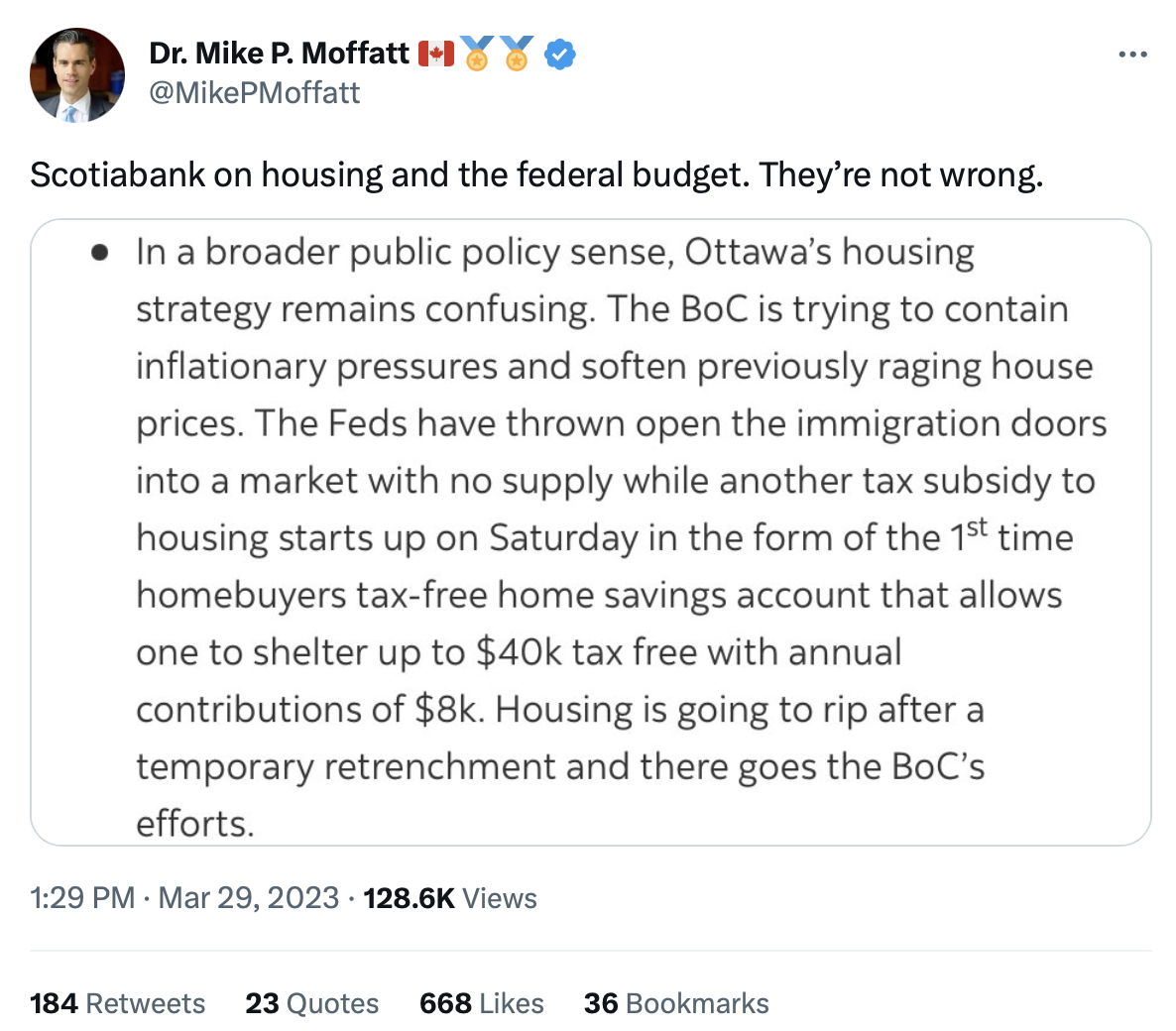
Moffat on disconnect between immigration policy and housing:

Captures the contradiction and policies working at cross-purposes:

Source: https://twitter.com/MikePMoffatt/status/1641130382425833632?s=20

Don Wright: Will Trudeau make it impossible for Eby to succeed?

Another “pointing out” the contradictions between immigration policy, levels set by the federal government, and housing, healthcare, infrastructure etc, largely under provincial jurisdictions:

It is three-and-a-half months since David Eby took the reins of power in B.C. There is no denying the energy and ambition he has brought to the role. Announcement after announcement has rolled out of the Premier’s Office since December 8 across a broad spectrum of initiatives in health care, housing, energy, infrastructure, increases in affordability tax credits and family benefits, and many, many more.

This column isn’t going to analyze the pluses and minuses of this ambition. Instead, I will argue that Premier Eby’s success on the big questions that will ultimately determine his political success may well be largely out of his control.

The most recent polling in B.C. shows that the most important issues are housing affordability, inflation/rising interest rates, and health care. Inflation and rising interest rates are overwhelmingly determined by federal monetary and fiscal policy, so largely outside the control of Premier Eby.  What about the other two big issues – health care and housing affordability?  While these two areas look to be within the domain of the provincial government, B.C.’s success in addressing the public’s concerns here will be largely hostage to the federal government’s immigration policy.  Let me explain.

Since it came to office, the current federal government has increased the level of immigration into Canada significantly.  Most of the attention has been focused on the increase in new permanent residents.  Last year, 438,000 people were granted permanent resident status, a 60% increase over 2015.  The federal government plans to raise this to 500,000 by 2025.

What receives less attention is another category of people coming to Canada – “non-permanent residents.”  This category includes Temporary Foreign Workers, International Students, and the International Mobility Program, which provides multi-year permits to live and work in Canada.  This category has been growing as well.  In fact, this category has been growing at a faster rate than permanent residents.  Last year there was a net increase of 608,000 in non-permanent residents. 

So, in total, the federal immigration policy resulted in an additional 1.045 million people coming to Canada – far and away the largest number of newcomers to Canada in one year ever.  Last year 160,000 of the 1.045 million came to B.C.

The rationale for these unprecedented numbers is that Canada has a “worker shortage.”  This rationale is almost entirely fallacious, but that is a subject for another column.  Let’s focus here on what this means to Premier Eby.

What is the basic problem in health care?  An inability to meet the public’s demands for medical services.  One million British Columbians don’t have a family doctor.  Waiting lists to get to see specialists and to get necessary surgery continue to get longer.  No doubt part of the problem is a result of the Covid pandemic.  But that rationalization is buying less and less forbearance by the public as we get further and further away from those dire days in 2020 and 2021.

The federal government’s prescription for this?  A rapid increase in the number of people who will need services from our health care system!

A story is spun is that the government will use the higher immigration numbers to bring in more health care professionals.  But this would only work if the proportion of qualified doctors, nurses and allied health workers in the more than one million new Canadians is significantly larger than the existing proportion of those professionals in the current Canadian population, and that they could get licenced immediately to practice in Canada.  Neither of these conditions will be met. 

The net result of this?  Premier Eby is going to have even more difficulty in delivering improved health care accessibility to British Columbians.

And then there is housing.  Almost all of the narrative around the shortage of affordable housing focuses on the supply side.  If only we could force municipalities to make permitting easier and faster, and to zone more density, our housing affordability would be solved.  The fact is, we build a lot of homes in B.C.  In Greater Vancouver – ground zero in our housing affordability problem – 365,000 homes were built in the 20 years between 2001 and 2021.  And there has been ample densification, as a walk through any of the redeveloped neighbourhoods in Vancouver shows. 

But supply is only half of the equation. Demand matters too.  And as quickly as we have built new homes, the population in our major urban centres rises as well. 

The Federal Government’s prescription for this?  Ramp up immigration numbers!

Again, a story is spun that this will actually increase housing supply because we are going to bring in more trades workers to build the houses we need.  Suffice it to say there are some pretty heroic assumptions here.  It is not going to work.

Of the 160,000 new British Columbians last year, more than 95% settled in the Lower Mainland, Southern Vancouver Island, and the Okanagan – where affordable housing was already acutely unavailable.

The net result?  Premier Eby is going to have even more difficulty in delivering more affordable housing.

This is all good for one group of British Columbians – those that are fortunate enough to already own a home.  So, thank you, Mr. Trudeau for making me wealthier and my fellow boomers wealthier. 

But if I were Premier Eby, I don’t think I would be quite as grateful.

Don Wright was the former deputy minister to the B.C. Premier, Cabinet Secretary and former head of the B.C. Public Service until late 2020. He now is senior counsel at Global Public Affairs.

Source: Don Wright: Will Trudeau make it impossible for Eby to succeed?

Canada Strong and Free Network conference: Canada’s housing crisis panel excerpt

Notable reference to immigration and housing and how they need to align:

A panel on Canada’s housing crisis was packed with Hub contributors, including John Pasalis, who made the point that the country’s housing supply will not be able to keep up with its immigration targets.

“Governments need to sort out supply and find a way to build faster and build more before tripling our population growth. That should be a pretty basic concept, but apparently I was brought here because it’s controversial,” said Pasalis.

“You’re doing a disservice to everyone who is coming here,” said Pasalis.

Chris Spoke, a housing advocate and Hub contributor, said the issue of densification in big cities is a good one for conservative parties because they can upset big city voters who never vote for them with pro-development policies, and stem the tide of “Toronto refugees” who are moving farther out to the suburbs and pushing prices up.

“If you are a Peterborough NIMBY, you should be a Toronto YIMBY,” said Spoke.

Source: Canada Strong and Free Network conference: Canada’s housing crisis panel excerpt

Kershaw: Canadian immigration targets respond to, and create, generational tensions [housing availability and affordability]

Of note, on another externality of increased immigration levels:

There is an untold story underpinning Canada’s plans to ramp up annual immigration targets from about 250,000 to half a million by 2025.

Yes, wars, famine, discrimination, poverty and climate change offer many humanitarian reasons to welcome more people to Canada. So too do the many job vacancies in our country that need filling.

But more immigration also allows provincial and federal politicians to dodge a hard conversation with baby boomers about taxes. By dodging it, we risk harming newcomers and boomers’ kids and grandchildren. To reduce this risk, we badly need our governments to revisit changes made to taxation for the Canada Pension Plan in the mid-1990s that were not applied to medical care and Old Age Security (OAS).

Here’s the challenge: When boomers started out as young adults, there were 6.9 working-age Canadians for every person over the age of 65. Now there are 3.3.

This wouldn’t pose a problem if medical care and OAS had beenbuilt on a tax system that required Canadians to pay during their working years for health and income supports in retirement. But that isn’t how our policy works – with the exception of CPP.

By the mid-1990s, the federal government recognized that a shrinking ratio of workers to retirees required changes to CPP. To keep the program solvent for future generations, CPP shifted to a prepay system. The payments individuals contribute over their working lives are closer to the average cost of CPP benefits they are expected to use in the future. The change increased annual CPP contribution rates by 65 per cent but ensured the long-term viability of the program.

Unfortunately, Canadian governments didn’t similarly adapt revenue collection for OAS and medical care, which remain “pay as the country goes” systems. Governments collect revenue in each year to correspond (more or less) with the cost of benefits paid in that same year to whomever is using the programs.

This lack of foresight means government budgets are now in a precarious position. Boomers dutifully paid taxes according to the rules of the day. But those rules asked them to pay for the smaller percentage of retirees who came before them – not for the full cost of the medical care and income support they would actually use. As a result, those rules risk leaving unpaid bills for their offspring or insufficient public funding for the medical care and OAS on which boomers will increasingly rely.

Given this historical legacy, larger immigration targets are attractive to governments.

Rather than talk about whether boomers paid enough in taxes to fully cover the cost of their medical care and OAS, Canada plans to attract more workers to increase the total number of people available to pay taxes.

This might have been a fine solution, but our invitation to come to Canada isn’t what it used to be.

It now takes 17 years to save a down payment on an average home in Canada, compared with five to seven years in the 1970s through the 1990s. Whereas in decades past it was possible for newcomers to believe in the Canadian dream that a good home was within reach for a hard-working family, that dream has become increasingly elusive, especially in British Columbia and Ontario.

A sad reality is that the children of immigrants who arrived in the 1970s to the 1990s often struggle with housing affordability more than their parents did. They struggle even though they may have acquired better educations and found better-paying jobs than their parents did upon arriving in Canada decades earlier.

Here we uncover a hard truth. The much larger numbers of newcomers our governments aim to attract will join younger Canadians in the search for affordable housing – and will struggle to find it. Through no fault of their own, a rising number of newcomers will amplify demand for housing, driving up home prices. Rising prices increase housing wealth for long-time homeowners, often boomers – and this additional housing wealth is largely sheltered from taxation.

The irony should not be lost on anyone. The very solution that enables governments to avoid asking boomers to pay more in taxes for their medical care and OAS contributes to many boomer homeowners gaining tax-sheltered wealth. All the while, that strategy erodes housing affordability for their kids and grandchildren, along with the newcomers we welcome to our country.

It’s no surprise that politicians want to avoid talking to boomers about taxes, because that’s a risky business come election time. But we have to find a way to overcome this reticence by returning to the question: Why did we change taxation for CPP decades ago but not for OAS and medical care? And what can be done now to raise additional revenue for medical care and OAS from (affluent) boomers to compensate for the lack of adaptation decades ago?

If we don’t engage with these questions, we will remain en route to securing the well-being of many boomer Canadians at the expense of undermining the financial security of those who follow in their footsteps, including their offspring and millions of hard-working immigrants.

Paul Kershaw is a policy professor at UBC and the founder of Generation Squeeze, Canada’s leading voice for generational fairness. You can follow Gen Squeeze on Twitter and Facebook and subscribe to Dr. Kershaw’s Hard Truths podcast.

Source: Canadian immigration targets respond to, and create, generational tensions

Canada needs 300,000 new rental units to avoid gap quadrupling by 2026: report [the Achilles heel of Canadian immigration policy]

Housing is the Achilles heel of Canadian immigration policy and levels:

Canada’s rental housing shortage will quadruple to 120,000 units by 2026 without a significant boost in stock, Royal Bank of Canada said in a report Wednesday.

In order to reach the optimal vacancy rate of three per cent, the report suggested Canada would need to add 332,000 rental units over the next three years, which would mark an annual increase of 20 per cent compared with the 70,000 units built last year.

The research analyzed vacancy rate data released in January by the Canada Mortgage and Housing Corporation (CMHC).

Canada’s vacancy rate fell to 1.9 per cent in 2022, its lowest point in 21 years, from 3.4 per cent in 2020 and 2021.

Competition for units also drove the highest annual increase in rent growth on record, by 5.6 per cent for a two-bedroom unit.

Canada’s rental housing stock grew by 2.4 per cent in 2022, led by Calgary at 7.4 per cent and Ottawa-Gatineau at 5.5 per cent, while Toronto and Montreal saw the smallest percentage increases at 2.1 per cent and 1.4 per cent, respectively.

“We haven’t seen that many additions to the purpose-built inventory in almost a decade, so you would think that added supply of units would ease some of the competition, but what the CMHC rental market data revealed to us was that it didn’t,” said RBC economist Rachel Battaglia.

Slow growth in Canada’s two most populous cities has been outpaced by rapidly increasing demand, partly fuelled by high immigration levels, she said. Annual federal immigration targets are set to grow eight per cent by 2025, meaning demand is unlikely to let up.

Battaglia also pointed to affordability and behavioural preferences for the influx of rentals sought. She said more Canadians are choosing to live alone, meaning fewer incomes per household.

“You have a lot of people being funnelled into the rental market who maybe would have liked to own something but it’s just not financially in the books for them right now,” said Battaglia.

The report estimated an existing deficit of 25,000 to 30,000 units of rental stock across Canada. In addition to building more supply, it recommended turning condo units into rentals, converting commercial buildings and adding rental suites to existing homes to help ease the pressure.

Without such measures, Battaglia said the market could “become infinitely more competitive.”

“Which is not something that we want to realize given the competition we’re already seeing,” she said.

“You’re already seeing rents increase dramatically.”

Source: Canada needs 300,000 new rental units to avoid gap quadrupling by 2026: report

Nadeau: Les ballons de l’immigration

A reminder from Quebec service provider organizations that the provincial government has failed to act in terms of settlement services and in its public messaging blaming the federal government:

Cela fait plus d’une semaine, mais Mary Claire ne décolère pas. « Lorsque je vais m’être calmée, je vais appeler Denis. Je vais l’appeler, certain ! » Denis qui ? Trudel. Le député du coin, élu sous la bannière du Bloc québécois.

« Quand j’ai vu la publicité du Bloc, qui dit que c’est comme un “tout-inclus” pour les immigrants au Québec maintenant, j’avais envie de leur dire de commencer par venir voir c’est quoi, les conditions réelles de ces gens-là, avant de dire n’importe quoi ! C’est pas un “tout-inclus” pantoute ! Ça n’a pas d’allure de dire ça ! »

Sur la Rive-Sud dans la région de Montréal, Mary Claire Macleod dirige L’Entraide chez nous. Aucune demi-coquille de noix de coco, remplie à ras bord de piña colada, ne traîne dans ses locaux. À midi, une poignée de bénévoles et de permanents mangent leurs sandwiches. Ils attendent qu’arrive, sur le coup de 13 h, un lot de nécessiteux, comme on disait autrefois.

L’Entraide chez nous est installé dans le sous-sol d’une église plantée au milieu d’un quartier défavorisé, comme on dit aujourd’hui pour éviter d’être confronté au sens des mots pauvreté et inégalité. L’organisme a été fondé en 1970 par Mme Robidoux. Elle avait accouché de vingt-trois enfants, Mme Robidoux. Vingt-trois. Elle éprouvait la fragilité de son milieu. Un milieu laissé à lui-même, avec pour seule promesse d’avenir son lot de misères. C’était à l’heure où Robert Bourassa, nouveau premier ministre, se gargarisait de projets de béton et d’acier, au nom d’une modernité dont le monde d’en bas était exclu d’emblée. Bourassa est passé. La misère du quartier est restée.

Yvane Fournier et Diane Roberge distribuent du pain, des fruits, des légumes, de la viande congelée. Ça fait trente ans qu’elles travaillent là. « C’est pire que jamais », dit Yvane.

Ces bénévoles gardent leur téléphone portable à portée de main. Ils l’utilisent à tout moment pour traduire, en espagnol, quelques mots de français. « Le plus dur est de voir des hommes à mon bureau se mettre à pleurer. Ce sont eux qui craquent le plus, on dirait. Ils sont à bout », dit Mary Claire Macleod d’un air dépité.

« Les familles de nouveaux arrivants se retrouvent à devoir vivre les unes avec les autres », explique Lydie, une des responsables de l’accueil. Elle me parle de six adultes, forcés de vivre dans un 5 ½, avec une dizaine d’enfants. « Ils n’ont même pas de matelas pour tout le monde. »

Pour obtenir de quoi manger, il faut présenter sa carte. Les habitués de L’Entraide, avant, l’appelaient « la carte pain ». Cela dit bien le degré de précarité dont témoigne ce bout de carton plastifié.

« Avant, on offrait environ mille services de dépannage par an. Là, en moins de six mois, on en a déjà offert plus que ça », expose Mary Claire. Ce n’est pourtant pas la première fois que la situation est difficile. En 2001, après les attentats aux États-Unis, il y avait eu un afflux de demandes, se souvient-elle. En 2008 aussi, avec la crise financière. Et de nouveau en 2010, avec le tremblement de terre en Haïti. En 2017, pour aider les demandeurs d’asile, le Stade olympique avait été réquisitionné. Mais là, le soutien venu d’en haut fait défaut. Les organismes d’aide sont laissés à eux-mêmes. « En plus, la boîte de tomates coupées en dés que je payais 99 ¢ coûte maintenant le double. »

Pour Eva Gracia-Turgeon, coordonnatrice de Foyer du monde, un centre d’hébergement pour familles demandeuses d’asile, le gouvernement de la CAQ réussit un exploit en matière de communication politique. « La CAQ projette l’illusion que cette situation chaotique dépend entièrement du gouvernement fédéral. Beaucoup de gens achètent ça. Pourtant, c’est faux ! En fait, il faut savoir que, depuis la réouverture des frontières après la pandémie, le provincial n’a pas revu les services. Si ça va mal, c’est beaucoup par sa faute. C’est un gros shitshow. »

En principe, les demandeurs d’asile sont pris en charge par les services québécois du PRAIDA, un programme provincial remboursé par Ottawa. Ses assises remontent à 1956. En 2021, le bel édifice historique qu’occupaient les bureaux du PRAIDA, rue Saint-Denis, a été vidé. N’aurait-il pas pu servir encore, en ces temps où tout déborde ?

Durant la pandémie, le nombre de places d’hébergements du PRAIDA a été réduit, en raison de la fermeture temporaire des frontières. Les places n’ont pourtant pas augmenté depuis, même si tout est redevenu comme avant. Des dix sites d’hébergement, il n’en reste plus que deux, soit 1150 places au total. Ce qui est largement insuffisant. Des hôtels, que le fédéral utilisait pour des quarantaines, sont désormais réquisitionnés pour héberger les migrants, dans des conditions qui laissent beaucoup à désirer. On est loin de Playa del Carmen. « C’est le fédéral qui ramasse les pots cassés, parce que l’administration du PRAIDA ne relève pas de lui », explique Eva Gracia-Turgeon.

« Ça arrange Québec de ne pas bouger », dit Eva. « Ça donne l’impression que, par la seule faute d’Ottawa, nous n’avons pas la capacité de nous occuper de ces gens. Ce n’est pas vrai ! Si ça ne fonctionne pas en ce moment, c’est beaucoup parce que le gouvernement du Québec ne fait rien, qu’il laisse les groupes communautaires s’arranger tout seul, qu’il s’en lave les mains, tout en accusant le fédéral. » Personne ne penserait pour autant donner une médaille du mérite au fédéral.

Pendant ce temps, nos bretteurs aux épées de fer-blanc, ceux qui tiennent des propos incendiaires à propos des immigrants, ont trouvé là des cibles commodes et faciles. Hormis un temps d’arrêt pour considérer quelques ballons chinois, toute leur attention est pointée vers ces boucs émissaires, au nom d’une rhétorique identitaire. Au point de détourner l’attention publique de problèmes pourtant importants. C’est à se demander si nos vaillants tigres de papier, obnubilés par ce seul sujet, ne trouveraient pas le moyen de nous gonfler d’autres ballons si les migrants n’existaient pas. D’ailleurs, n’est-ce pas un peu ce qu’ils font déjà, en nous en parlant tout le temps ?

Source: Nadeau: Les ballons de l’immigration

A surge of temporary residents is boosting demand for homes in supply-starved market 

More on immigration and housing:

A record-setting influx of temporary residents is putting additional strain on the Canadian housing market, just as the construction industry is pulling back on new builds.

By the end of 2022 there were roughly 1.95 million people from abroad with temporary work or study permits in the country, an increase of about 560,000 (40 per cent) over the previous year, according to recently published figures from Immigration, Refugees and Citizenship Canada.

The International Mobility Program accounted for slightly more than one million of those permits – a new high, up more than 300,000 in a year. The program covers a broad group of people, including the spouses of skilled workers and company transfers from foreign offices.

There were slightly more than 800,000 study permit holders at the end of last year, also a record high. Another 120,000 people held permits under the Temporary Foreign Worker (TFW) Program, the most since at least 2000.

Canada is deliberately raising its intake of immigrants, with the goal of admitting 500,000 permanent residents annually by 2025. However, that reflects just a portion of newcomers to the country.

Based on the latest estimates, in the third quarter of 2022 Canada’s population grew at its quickest pace in more than 50 years, mostly because of the increase in temporary residents. Their ranks grew by more than 225,000 during the three-month period, well above the previous record. Many of them aspire to stay in Canada permanently.

Experts say the country is increasingly moving to a two-step immigration process, in which people come for an education or work experience, then apply for permanent resident status.

In recent months, the federal government has been criticized for its immigration policies, particularly when the country is struggling to build enough homes and deliver basic medical services.

It has become “an unplanned, unmanaged, improvised immigration system,” said Anne Michèle Meggs, a former director of planning and accountability at Quebec’s Immigration Ministry. “Who is this helping?”

To some degree, special circumstances have contributed to the population surge. Canada has been admitting thousands of people fleeing Ukraine since the Russian invasion, and there has been a forceful rebound in the number of international students, many of whom delayed their studies here during the acute phases of the pandemic.

Still, the spike in temporary residents over the past year was “driven” by people with work permits, Statistics Canada said in its latest population report.

The federal government is courting more foreign workers, broadening access to low-wage workers through the TFW program and allowing foreign students to work longer hours – moves that it says are aimed at easing labour shortages.

Several economists have criticized Ottawa for flooding the market with cheap labour and suppressing wages.

Meanwhile, colleges and universities have dramatically increased the enrolment of foreign students, who pay significantly more in tuition than their domestic peers. There are no limits on this form of migration.

Many newcomers are discovering that homes in Canada are both pricey and in short supply.

A report by Desjardins Securities published this week said residential home construction would need to immediately increase by 50 per cent through the end of 2024 in order to support higher immigration targets and keep prices from climbing further.

It does not appear that will happen. Facing steep costs and higher interest rates, some developers are cancelling or delaying projects. Earlier this week, Canada Mortgage and Housing Corp. reported that housing starts fell 13 per cent in January from December, to an annualized pace of about 215,000 units.

In parts of Ontario with a population of 10,000 and higher, housing starts fell 31 per cent to an annual rate of roughly 71,500 units. That is well below the provincial government’s target of building 150,000 units a year for the next decade to alleviate the housing crisis.

“It certainly makes sense that building activity would be cooling amid a steep drop in sales and prices,” Bank of Montreal chief economist Doug Porter said in a note to clients, referencing the recent slump in real estate activity amid higher borrowing costs.“Notwithstanding the broad and wide calls for the need for massive increases in new home construction in Canada, the reality is that starts are dictated by the market, and not by pundits.”

Source: A surge of temporary residents is boosting demand for homes in supply-starved market