Nicolas | Paix sociale à la montréalaise

Interesting differences based on geography but the camp-in at McGill may change that:

Alors que tous les yeux sont rivés sur le campement propalestinien à McGill, j’ai envie de vous parler non pas de ce qui se passe, mais de ce qui ne se passe pas à Montréal.

Certes, l’attaque du 7 octobre contre Israël et les bombes qui n’en finissent plus de tomber sur Gaza ont élevé le niveau de tensions intercommunautaires un peu partout dans la ville. Il suffit toutefois de se comparer pour prendre la mesure de la résilience particulière du tissu social montréalais — jusqu’à présent. Il y a plusieurs pistes d’explication à ce phénomène.

D’abord, ça peut sembler étrange à dire, mais la géographie de la ville nous aide. À Toronto, plusieurs des institutions phares de la communauté juive sont en plein centre-ville, sur les grandes artères qui balisent le parcours normal des manifestations. La situation donne lieu à des moments surréels que l’on s’est épargnés ici.

Par exemple, lors d’une grande manifestation, le 12 février dernier, le Spider-Man de Toronto — un peu l’équivalent de l’Anarchopanda du printemps étudiant de Montréal — était parmi la foule à escalader les édifices le long du parcours. Une fois rendu sur la University Avenue, le personnage anonyme a grimpé sur la façade de l’hôpital Mount Sinai avant de continuer son chemin.

Des Canadiens d’origine palestinienne qui ont de la famille à Gaza ont pris la parole lors de cette manifestation, alors que l’armée israélienne annonçait vouloir se lancer dans une offensive sur Rafah. Leur message n’a pas passé. Le lendemain, toute la classe politique canadienne était en train de dénoncer… la présence de Spider-Man et de son drapeau palestinien sur un hôpital fondé par la communauté juive. Même le premier ministre Justin Trudeau a déploré sur X « cette démonstration d’antisémitisme ».

Ce n’était pas la première affaire du genre. Parce que les manifestations se retrouvent parfois en face de leurs institutions, plusieurs membres de la communauté juive de Toronto sentent qu’on manifeste contre eux, personnellement, et non contre le gouvernement d’Israël. Les organisateurs se défendent, bien sûr, d’avoir de telles intentions. Après près de sept mois de telles tensions, le dialogue social, là-bas, est devenu presque impossible.

Par « chance », à Montréal, l’Hôpital général juif n’est pas sur la rue Sherbrooke, et la plupart des écoles, des synagogues et des centres communautaires juifs de Montréal sont situés plus loin du coeur de l’action. On ne se pile pas sur les pieds de la même manière.

On a fait aussi des choix tactiques différents de ceux d’ici. Là-bas, on a manifesté à quelques reprises contre des commerces qui ont des activités dans les territoires palestiniens occupés ou qui soutiennent financièrement l’armée israélienne — et qui sont par ailleurs dirigés par des personnes juives. Alors que, d’un côté, on voit dans ces gestes une dénonciation politique de ce qui est perpétré par Israël, de l’autre, on ne voit là qu’une forme de pogrom. Là aussi, tout le monde est à cran. Plus qu’ici.

À Montréal, le plus important édifice à avoir été ciblé de la sorte est celui de Radio-Canada, qui a fait l’objet de graffitis dénonçant une « complicité avec le génocide » en novembre dernier. Le débat sur l’antisémitisme ne fait pas écran au message des manifestants de la même manière.

Je ne veux pas non plus peindre un portrait trop rose de notre situation. On se souviendra, par exemple, du discours tout à fait inacceptable prononcé par Adil Charkaoui durant la manifestation du 28 octobre dernier. Seulement, à ce point-ci, toute personne qui comprend un peu les mouvements sociaux montréalais sait que l’homme est une espèce de patate chaude opportuniste qui émerge chaque fois qu’il y a de l’action pour faire déraper le dialogue public. Personne de sérieux ne le considère comme une voix rassembleuse.

Par ailleurs, les coups de feu contre deux écoles juives de Côte-des-Neiges ont choqué la ville en novembre dernier. L’affaire a éveillé les craintes des parents, et à juste titre. Notons que des mois plus tard, aucune information ne permet d’établir l’identité ou les motifs des responsables de ces crimes haineux.

Depuis l’automne dernier, on n’a pratiquement pas entendu parler, dans les médias, de la mairesse de Côte-des-Neiges–Notre-Dame-de-Grâce, Gracia Kasoki Katahwa. Si la réponse de son équipe aux attaques commises dans son arrondissement avait été complètement dépourvue de sensibilité, son nom serait partout. Le travail consistant à rassurer les communautés et à faire baisser la tension dans nos quartiers se fait loin des projecteurs. C’est par ce qui ne fait pas la nouvelle, parfois, qu’on peut comprendre que, même si la situation est loin d’être facile, les choses pourraient aller beaucoup, beaucoup plus mal.

Finalement, durant ces presque sept mois d’une guerre qui met bien des gens d’ici sur les nerfs, le Service de police de la Ville de Montréal (SPVM) n’a presque pas fait les manchettes. Non pas parce que la police est inactive. Mais parce que des choix ont été faits, jusqu’à présent, sur la manière d’intervenir dans les manifestations et de répondre aux plaintes pour discours haineux antisémite, antipalestinien ou islamophobe. Quand on ne parle pratiquement pas du SPVM, bien qu’on marche à Montréal semaine après semaine, c’est que, là aussi, ça pourrait aller beaucoup plus mal que ça ne va jusqu’à présent.

Cette relative paix sociale montréalaise qui subsiste malgré tout dans le contexte — j’insiste sur le mot « relative » —, elle est précieuse. Et très fragile. Les décisions du SPVM, de nos tribunaux et de l’administration de l’Université McGill cette semaine pourraient nous rapprocher du niveau de tension qui mine la plupart des grandes villes nord-américaines.

Aujourd’hui, Montréal peut décider d’asseoir fièrement sa différence, ou de l’effacer. La métropole peut se rapprocher de Toronto ou de New York, ou faire les choses à sa manière. Dans les jours, voire les heures qui suivent, son leadership choisira.
Source: Chronique | Paix sociale à la montréalaise

OPINION: University of Ottawa equity, diversity, inclusivity discussion ‘an abject failure’

Does appear to be an unbalanced selection of panelists:

Let’s say you are the vice president of Equity, Diversity and Inclusive (Excellence?), VP EDI, at a Canadian university and you organize an event to have a “courageous conversation” about anti-Palestinian racism, Islamophobia, and anti-Semitism that ends up being a uniform rant against Israel and Zionism with no equity, no diversity, or inclusion for Jews.

This is exactly what happened on March 27 during the two-hour Zoom panel convened by the Vice-Provost of Equity, Diversity and Inclusive Excellence at the University of Ottawa, professor Awad Ibrahim.

With the declared goal of addressing in a balanced and unbiased manner the problem of increasing discrimination against Muslims, Palestinians, and Jews in Canada, especially in light of the conflict between Israel and Hamas after the massacre perpetrated by Palestinian Islamists on Oct. 7, the convened panel theoretically sought a balance: two people would discuss issues linked to anti-Palestinian racism and Islamophobia, and two would talk about anti-Semitism.

In reality, the four speakers spoke with a unified biased voice minimizing the precipitous rise in anti-Semitism in Canada and around the world, because, according to them, many of the events that are reported as anti-Jewish are simply “legitimate” (sic) expressions against Zionism, Israeli colonialism, and the defense of the struggle of the Palestinians against the “Zionist occupation” and do not really target the Jewish community.

The activist Dalia El Farra (senior advisor, Equity, Diversity, and Inclusion – Centre for Human Rights, York University) and professor Jasmin Zine (Wilfrid Laurier University) represented the pro-Palestinian and anti-Islamophobia views. Two members of the Jewish Faculty Network (an anti-Israel organization), professor Sheryl Nestel and professor Alejandro Paz (University of Toronto), both anti-Zionists Jews, were invited to talk about anti-Semitism.

The main function of both Jewish panelists was to assert that the increase in antisemitic incidents is inflated by the “Jewish lobby,” because they dare to count as anti-Jewish events those that are actually demonstrations against the “Western colonial enterprise” (sic) known as Zionism and against Israeli “genocide” (sic).

Although Vice-Provost Ibrahim was asked during the event’s Q&A why he had decided to invite only two anti-Zionist Jewish speakers to talk about anti-Semitism, the VP EDI made only brief mention of the question towards his closing remarks and did not answer the question…

In French, one might have described the event by exclaiming, “Quel gâchis!” (What a flop!) to qualify this EDI event (by the way, if we are talking about inclusion, it should be noted that only English-speaking panelists were invited, thus failing the bilingual mandate of the University of Ottawa). It was certainly not a courageous conversation, nor was it diverse, not equitable, and lacked the inclusiveness of multiple viewpoints. It offered only a single, ahistorical, hateful chorus of anti-Israel propaganda.

Perhaps professor Ibrahim, the vice president of Equity, Diversity and Inclusive Excellence, thought he was promoting balanced perspectives because he had hosted an event as part of the same series on March 21 about Anti-Semitism in Healthcare, University and our Larger Society. Instead, the panel on Demystifying Islamophobia, anti-Palestinian racism and anti-Semitism of March 27 was a missed opportunity for the University of Ottawa’s EDI office to fulfill its mandate, failing to meet the most basic standards of Equity, Diversity, and Inclusion

The false moral equivalence between these two events, the former being grounded in scholarly research and fact, the latter being grounded in one-sided bias attempting to delegitimize Judaism and Israel, undermines inclusive excellence in the academy and further contributes to Jew hatred on Canadian campuses.

This is an abject failure of leadership of the VP EDI at the University of Ottawa and a direct assault on the protection of all minorities on Canadian campuses. It is a betrayal of trust with the Jewish community, and it undermines the core mission of the University to reveal and disseminate truth.

— Isaac Nahon-Serfaty is an Associate Professor at the University of Ottawa and Deron Brown is an MD in Toronto

Source: OPINION: University of Ottawa equity, diversity, inclusivity discussion ‘an abject failure’

Reaction in Canada to Israel-Palestine war has me feeling spiritually homeless and disconnected

Thoughtful reflections, although it would appear that the activists on the Palestinian side have been engaging in more anti-Jewish community activities than vice-versa and her social media posts are more one-sided than this commentary:

The last few months have shown me that the Israel-Palestine war has changed what diversity, inclusion and respect for freedom of speech and religion means in Canada.

Whether these changes are permanent are yet to be determined. It is a sad waiting game and I wonder if my children will grow old in the Canada that is the only home they know.

Suffice to say, two things are true: Almost all Canadians have some opinion on this war, and almost all Canadians have zero control over what is happening in Gaza right now. The same applies to what happened in Israel on Oct. 7.

Where does that leave us? Are broken professional and personal relationships salvageable? Is there any way we can find our way back to one another? Is this the actual hill that professionalism and respect for religion will die on?

Everyone (including me) says this is not a Muslim and Jewish issue. My quivering voice is losing conviction, and here is why:

The social media campaigns are stronger than ever. The protests and public outcry (on both sides) around the atrocities in the Middle East are still making headlines (and they should). People continue to remain obsessed on what qualifies as hate speech conflating freedom of expression with the same. Furious onlookers continue to call for arrests at protests, conflating the right to demonstrate freely with targeted hatred toward a group of people.

People are angry and while they cannot control what is going on there, they are trying hard to control what is happening here. 

Jewish and Muslim businesses, places of worship and neighbourhoods are being targeted. Antisemitism and Islamophobia are rapidly on the rise. Those angry about the war are only targeting members of the Muslim and Jewish communities. That makes this a Muslim and Jewish issue in a morbidly tangible sense.

Our politicians have contributed to this religious divide. Put another way, even when they whisper about respecting religious values, their actions contradict them — loudly.

In the holy month of Ramadan, certain Canadian politicians have failed to offer customary Ramadan well wishes to Canadian Muslims. They have publicly solidified their anger toward Muslim communities. Conversely, other politicians say nothing to remind Jewish communities that they cannot and should not be targeted. They have left Jewish communities feeling painfully isolated.

The silence has incensed both sides, because these politicians care far more about their voter base and less about Canadians in general. A true failure as elected officials.

In my legal community, the divide is vicious and the criticism is relentless. The professional advocates on LinkedIn have spoken and in comparison to your average Canadians, they say they know best. They hold zero sympathy for anyone who disagrees with their view and I know with certainty that some relationships of many years are over — forever.

While I have no interest in debating the politics (to what end?), I would be the first to sit with my fellow Canadians to work toward a solution on how we continue forward with respect and professionalism. This has become imminent in my view. It our right as Canadians to continue to protest, to continue to advocate and to continue to support the causes that are nearest and dearest to us.

Let us also work to repair the damage to relationships preventing us from working together, learning together and respecting one another. Without a commitment from all sides to simply pause and forgive before saying something hateful here about what is happening there, the continued erosion of our Canadianness will continue.

We can protest and disagree, but not in a way that creates hate and division for any group in Canada. This present-day Canada has me feeling spiritually homeless and disconnected. If you are a leader of any kind, take a moment and ask yourself what steps you can take to cultivate safety in your home — if in fac fact, you still consider Canada to be your home.

Muneeza Sheikh is an employment lawyer.

Source: Reaction in Canada to Israel-Palestine war has me feeling spiritually homeless and disconnected

Israel and the International Community

A reminder to those who casually label Israel’s actions in Gaza genocide of what the court actually ruled:

A critical takeaway from all of this should be that the international community, no matter how much Israelis find it vexing, can serve as an important shield and corroborator for Israel. Leftist protestors were not slowed down one bit by Israel dismissing their overreaching claims of genocide, but those claims are now harder to sustain—even if they will continue apace anyway—in the wake of international law’s highest body declining to order Israel’s operations in Gaza to stop. It was easy to dismiss Israeli gripes about UNRWA as hasbara in the service of a battle against Palestinian refugeehood, but that no longer carries the same weight after UNRWA fired its own employees and many of its largest donors halted its funding. While it is absolutely true that hostility to Israel permeates the U.N. and many international institutions and NGOs always have Israel in their crosshairs, that same international community can vindicate Israel in ways that nobody else can.

On the other side, those who have been screaming about genocide and referencing international law and Israel’s allegedly manifest violations of it at every opportunity should have the decency to revisit their prebaked assertions. I don’t expect that most of the protestors who deploy the genocide charge as if they are noting a fact as straightforward as the sun rising in the east will be swayed by the ICJ or any other evidence that contradicts their convictions, but they should acknowledge that the rug has been pulled out from under them. Israel’s war conduct is not perfect, and there are likely plenty of violations of international law and much objectionable conduct that people can find. But that does not make it genocide, and based on the ICJ’s provisional orders, Israel’s war is both ungenocidal and a legitimate defensive response to Hamas’ illegitimate and indefensible actions. If you want to rely on international law to tar Israel, you need to respect that same international law when it tells you that you are wrong.

Source: Israel and the International Community

Ibbitson: Liberals trying to play both sides in Gaza conflict

Definition of middle of the road: road kill!

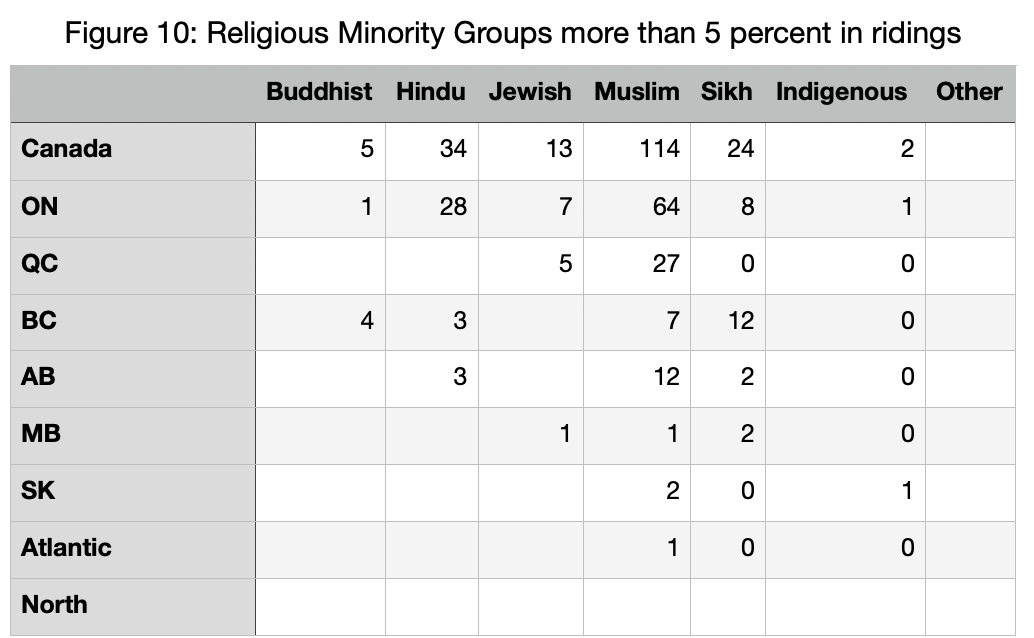
The table below highlights the number of ridings with more than 5 percent religious minorities, highlighting just how many more ridings have significant Muslim populations compared to Jewish populations.

The Liberals find themselves caught between an Israel/Conservative rock and a NDP/Palestinian hard place. And they don’t seem to have a solution, other than to placate both sides, which is no solution at all.

Source: Liberals trying to play both sides in Gaza conflict

Gurski: Canada’s open-door immigration policy shouldn’t mean anything goes

Valid note of caution. Encouragingly, Minister Miller was frank about this concern and the need for rigorous security checks as well as the difference between Ukraine and Gaza:

More to the point, the ongoing war in Gaza has spurred the Liberal government to announce special measures to help the family members of Canadians get out of the war zone. In theory, this is a bold and welcome move but does have a security nexus. Hamas is the ruling party in the area — and is a listed terrorist entity in Canada. Support for it in the wake of Israeli military action after the Oct. 7 terrorist attack in southern Israel is on the rise, in the region, worldwide and possibly in Canada. It is possible and perhaps even probable that Hamas members or supporters will attempt to join the queue. They cannot be allowed to succeed (I am sure CSIS is well aware of the likelihood). Imagine a scenario where a recent arrival carried out an attack in the name of Hamas on Canadian soil: I would prefer not to have to go there.

We do not want to become a nation where the anti-immigrant lobby gains influence and status. We see what is happening in Europe (for instance, the political party led by far-right, anti-Islam politician Geert Wilders recently won the most seats in the Netherlands) and it ain’t pretty. One way to avoid that eventuality is to allow our security agencies to do their job, then take their advice to heart. The consequences of not doing so are dire indeed.

Phil Gurski is President/CEO of Borealis Threat and Risk Consulting, and a firmer CSIS employee. http://www.borealisthreatandrisk.com

Source: Gurski: Canada’s open-door immigration policy shouldn’t mean anything goes

Phillips: How Muslim voters are exerting their growing political influence

Another number: Canadian Jews from more than 5 percent of the population in 13 ridings compared to Canadian Muslims forming more that 5 percent in 114 ridings:

But the Trudeau government surely didn’t need much encouragement to move in that direction, and it didn’t necessarily have to do with geopolitical calculations. You only have to look at changing demographics in this country and their far-reaching political implications.

This can be touchy territory, so let’s specify a couple of things upfront.

There’s nothing wrong with any community, including Muslims, organizing to maximize their political impact. That’s as Canadian as butter tarts. Virtually every group has done it — from the English and Irish to francophone Quebecers, Ukrainians, Italians, Sikhs, you name it.

And ethnic voting doesn’t explain everything about this or any issue. You don’t have to be Muslim to be appalled at the death toll in Gaza, no more than you have to be Jewish to be sickened by the massacre of Israeli civilians on Oct. 7.

But in this case, there’s no ignoring the increase in Muslim voters. A few numbers: the 2001 census showed there were 579,000 Muslims in this country (or 1.95 per cent of the population). The most recent census, in 2021, put that number at 1.77 million (4.9 per cent).

That’s a dramatic rise. By contrast, Muslims are only an estimated 1.1 per cent of the U.S. population, meaning their relative demographic weight in Canada is almost five times as large.

Another relevant comparison: in 2001, Canada’s Jewish population was put at 330,000. The 2021 census measured it at 335,000 — virtually the same. So while the country’s Jewish population flatlined, its Muslim population tripled….

But no party can ignore the new reality. Demographics, they say, are destiny. And right now they’re showing Muslim voters must be taken seriously.

Andrew Phillips is a Toronto-based staff columnist for the Star’s Opinion page. Reach him via email: aphillips@thestar.ca

Source: How Muslim voters are exerting their growing political influence

Regg Cohn: Who says we need to choose between Palestinians and Israelis?

Good and needed commentary. Binary over simplifies. Hopefully Gondek can treat this as a learning moment:

Put simply, to be anti-Zionist today is to be anti-Israel. To be anti-Israel is to show antipathy to all those Jews who believe Israel is a sanctuary and ought not to be a cemetery for Jews.

As to the larger question of whether or not an anti-Zionist is antisemitic, rest assured it is problematic for most Jews. Slogans matter, just as words matter, countries matter, people matter.

Appearances matter, and so do no-shows. It is telling that Her Worship the mayor of Calgary worships at the altar of indifference to Israel, but another current slogan comes to mind:

Happy Hanukkah

Source: Who says we need to choose between Palestinians and Israelis?

Globe editorial: Who we are, and must be, as Canadians

Same principles, of course, apply to any form of racism, discrimination and hate:

…Solidarity can take many forms. Tearing down posters of those held hostage by Hamas is a hateful act; do not let that happen unopposed. Go out of your way to solicit businesses that have been targeted for being Jewish-owned. Most of all, reach out to your fellow citizens to let them know that they are not alone.

That is who we want to be, who we must be, as Canadians…

source: Who we are, and must be, as Canadians

Gaza evacuees question Canada’s policy for who it will help evacuate

Interesting difference in immediate family definitions (USA also includes parents in their definition).

Of course, given that the government’s immigration policies are based on (weak) demographic arguments regarding the impact of an aging population, including parents would further accentuate these impacts.

It will also be interesting to have analysis of the breakdown between long-term Canadian Palestinian expatriates and those who were caught during visits to family:

Unlike America, which, according to the UN refugee agency, typically includes parents in the legal definition of “immediate family,” Canada’s definition in the Immigration and Refugee Protection Act extends only to spouses and common-law partners, dependent children and grandchildren.

That means, for now, Canada has not offered to add parents, in-laws and siblings to its list of potential evacuees.

In any event, Abumiddain’s father isn’t willing to leave without his brother. The pair have long worked the farm together, and Abumiddain’s uncle would otherwise be alone.

If Canada widened its legal definition of immediate family, it would allow the family to stay together and remain united, said Abumiddain, who hasn’t been able to contact his dad since he left Gaza.

The Canadian Council for Refugees has advocated for a broader definition to allow people who escape to find refuge with their loved ones in Canada.

“You may have those who are trying to exit whose immediate support network may be a more distant relative,” said co-executive director Gauri Sreenivasan.

It’s important that the government recognize the unique composition of modern families and their support systems, and avoid narrow definitions, Sreenivasan said.

“I think this is a time for us to to be generous and identify what are the opportunities to get people who are trying to leave to safety, including their families.”

Source: Gaza evacuees question Canada’s policy for who it will help evacuate