America’s immigrant voters and the 2024 presidential election

Useful detailed analysis:

…Immigrants are a diverse, growing, and actively engaged voter base

Of the nation’s nearly 46 million total immigrants (about three-fourths of which are U.S. citizens or permanent residents), migrant voters or naturalized citizens, at roughly 24 million, constitute most of the migrant pool and roughly 10% of the total U.S. electorate. Since 1965, when U.S. law expanded voluntary immigration from non-European nations, the migrant cohort has grown significantly. It has increased from about five percent to 13.9% of the U.S. population today and shifted from being predominantly white (80%) and Western to increasingly majority-non-white and less Western. Roughly two-thirds of that growth stems from Latin America and Asia, and to a lesser extent, from other regions including Africa, the Caribbean, North America, and Europe. Stretching across the globe, this rich mosaic of racial and ethnic groups includes Asians, Arabs or Middle Eastern and North Africans (MENA), sub-Saharan Africans, Caribbean groups, Latinos, and white immigrants, and stands in stark contrast to the mostly white, U.S.-born electorate.

At the ballot box, evidence shows that foreign-born voter turnout has typically lagged behind the general electorate, partly due to navigating both the bureaucratic naturalization and voter registration processes. Nonetheless, distinct differences among racial and ethnic subgroups, along with a highly politicized environment, particularly around immigration in recent years, has affected this trend.

Foreign-born Asian and Latino groups vote at higher rates thantheir U.S.-born ethnic counterparts. Black immigrants vote at similar levels while white immigrants participate at lesser rates compared to U.S.-born whites. Yet, in recent years, the foreign-born population appears to be a much more politically engaged cohort, demonstrating above-average levels of voter enthusiasm with turnout exceeding the general electorate. National-level polling conducted between August 16 and August 28, 2024, prior to the election, showed that roughly 97% of naturalized citizens were “definitely or probably going to vote” in the 2024 election. This is above 2020 election levels, where 86.8% of respondents cast their vote, exceeding the nearly 66% of the total electorate—the highest rate since 1900.

In the wake of the pandemic, restrictive immigration and economic and health concerns in Trump’s first term were likely key factors in an atypical 2020 election. Further, in 2024, where many of the same issues were at the forefront, final calculations of voter turnout are likely to be high. Additionally, while migrant voters constitute a small share nationally, they have sizable clout in competitive battlegrounds. For example, 14% of voters in Nevada, seven percent of voters in Georgia and five percent each in Pennsylvania and Michigan are foreign-born. The start of 2024 saw 7.4 million migrants who were likely eligible to naturalize this year and 3.5 million of them have already done so. Their total size tops the margins of victory in virtually all key swing states in the 2020 election, and projected naturalization rates resemble the prior election cycle. For example, in Georgia, the state’s total of 96,469 new citizens surpassed Biden’s roughly 12,000 margin of victory. Mostly comprising foreign-born Asians and Latinos, immigrant participation in this year’s election was expected to be decisive.

Immigrant party affiliation and voter priorities are not uniform

Still, the key issues that drove new American citizens to the voting booth are not uniform. Despite between four in 10 to six in 10 expressing no strong affiliation/not being sure with either party, immigrant voters still lean Democratic across almost all ethnic groups, except for white immigrants who are more evenly split between Democrats and Republicans. Among those who would certainly vote, the polling found they favored Kamala Harris over Trump (by approximately 55% to 41%), both nationally and with some slight variation across key swing states. Similar to the general electorate, high cost of living/inflation ranked as the top issue with immigration following closely behind. Interestingly, on social values issues, foreign-born migrants are almost twice as likely to hold conservative/very conservative views and still identify as a Democrat compared to the overall population. This is further underscored with religious views—overall, immigrant evangelicals identify less with the Republican Party compared to U.S.-born evangelicals and young individuals (ages 18 to 29) are found to be more religious and conservative on social issues than their U.S.-born counterparts.

Linked fate, the idea that policies or issues that affect one’s broader group also impact individuals, could partly suggest why: 60% of respondents believe that what affects immigrants will “strongly or to some extent” affect their own life. In previous generations, European immigrants in the 19th century who were in a pursuit of a better life, were initially dubbed as non-“white” and encountered fierce anti-immigrant rhetoric and policies. Similarly, several generations later, this modern wave of largely immigrants of color, also in pursuit of a better life, is navigating a 21st century assimilation into the American mainstream. In the past decade, Muslim travel bans, the dehumanization of African, Afro-Caribbean, and Latin American groups, anti-Asian hate crimes, and an even more hardline Trump immigration agenda aimed at legal and illegal immigrants have engulfed the political environment. What’s more, many immigrant voters come from mixed status families where one or more members of the household are undocumented while the rest hold legal status—complicating access to resources such as health care and employment. Ultimately, how migrants continue to navigate their foreign identity and new status in support of a political party varies across ethnic lines.

The policy agenda of the immigrant community  

The post-election results on how all immigrant groups voted are still forthcoming, but recent surveys taken just prior to the election and the latest exit polls offer some insights.

Based on a YouGov national survey of the top issues for over roughly 43,000 immigrant voters (conducted between October 25 and October 27), the key differences across the main issues—such as the economy, abortion, immigration, education, and crime—were along gender, age, race, and ideological lines. Men were found to prioritize the economy more highly than women, whereas women ranked abortion more highly than men. However, older voters rank immigration and the economy above higher than younger voters. Similarly, conservative voters, who are likely older, were more likely to rank immigration and the economy as important relative to moderate and liberal voters. Nonetheless, across almost all policy issues and subgroups, U.S.-born voters rated these issues with greater importance than their foreign-born counterparts. Still, by contrast, across all demographic groups, migrant voters ranked crime and education as more salient than the U.S. native-born electorate.

Along racial and ethnic lines, virtually all migrant voters, regardless of political affiliation, ranked the economy and inflation among their top priorities. However, while the economy and the conflict in Gaza were the two top issues respectively among all Arabs, among Arab American Democrats, the conflict in Gaza was ranked as number one. While most Arabs in the U.S. were born here, about 68% of foreign-born Arabs are citizens.

Historically, over the past 15 years, their political support has stood at a two-to-one margin for Democrats. Nevertheless, the humanitarian crisis in Gaza and U.S. support for Israel led to a dramatic reversal—with Trump slightly leading Harris, 42% to 41% in polls ahead of the election, compared to Biden’s 59% to 35% edge in 2020. Additionally, even though expected turnout in the MENA community slipped from 80% to 63%, Michigan for example, where Biden won by 154,000 votes, houses its largest base of voters among all swing states—over 300,000. Further, the recent Democratic primary saw more than 100,000 Michigan primary voters choose “uncommitted” in protest against the administration’s handling of the war, and Arab Americans make up almost half of the populations in the cities where Biden lost to the protest vote. Taking all these factors into account, there were growing signs that Democrat support could be splintered between Trump, a third party, and/or by abstaining—and those indications proved true. The city of Dearborn, an Arab American majority city, saw Trump winning (42.4%), Harris (36.2%), and Jill Stein (18.3%)—a remarkable shift from Biden’s 68.8% to Trump’s 29.9% in the 2020 election. Further, this appears to be somewhat reflected in the latest exit polls—Trump won 60% of Michigan voters that identify as “other race” and 54% of the same cohort nationally.

Asian Americans as a racial subgroup are majority foreign born (67%), lean Democratic (42%), and contain a large number of Independents (31%), compared to the overall electorate. Partly attributable to the fact that they typically experience less campaign outreach, 27% reported not having been contacted by either political party. As a cohort, according to polling conducted in September, 77% of Asian Americans were likely to vote. Overall, they were expected to support Harris by a 38+ margin—largely along gender lines: 70% of Asian women supported Harris while only 57% of Asian men did. Additionally, while almost all ethnic groups trended in this direction, Hawaiian Natives/Pacific Islanders leaned Republican. However, the actual margin turned out to be considerably smaller (15 points in favor of Harris), according to recent election results. Conversely, Since 2020, Trump has made a five-point gain nationally among Asians and, most notably, carried a majority in Nevada (50% to 47%).  Concerns over inflation, health care, and crime, coupled with diverse political views, were likely key driving factors in the broader shift. With roughly 31% of Asian Americans leaning Independent, Trump made a four-point gain with all Independents—in a race where their turnout exceeded Democrats for the first time and was equal to that of Republicans.

Within the Latino base, where migrant voters comprise 25%(as of 2018), Harris secured a majority of all Latino voters (52% to 46%), However, Trump made significant gains—largely driven by the economic anxieties of Latino men. Notching a 10-point advantage with Latino men (54% to 44%), he overcame a roughly 23-point deficit to Biden just four years prior (59% to 36%). Still, while migrants favored Harris (by a seven-point margin) and also favored a path to citizenship for undocumented immigrants (by an eight-point margin), compared to the overall Latino electorate, they still appear to hold somewhat similar views to U.S.-born Latinos. Despite having been subjects of anti-immigrant language by Trump, polling finds that a majority of both U.S.-born (67%) and foreign-born Latino voters (51%) do not feel that the president-elect is referring to them. Surprisingly, this reflects a sharp reversal of what one might expect to see regarding immigrant linked fate within the Latino community. Certain subsets appear to be prioritizing partisanship and other policy issues (largely inflation) above racial and identity politics and immigration, and to be favoring a more conservative agenda. This may partly explain Trump’s relative insulation from promoting racially prejudiced epithets, which has led to inroads with certain swaths of the Latino electorate.

What’s more, this is underscored by the variation seen across country of origin. South American and Central American immigrants are roughly twice as likely as Mexican immigrants to identify with the Republican Party. Even so, there was some expectation that the denigration of Puerto Rico as a “floating island of garbage” by a comedian at the closing Trump campaign rally could be an outlier—having seeped from politics into the cultural mainstream. Drawing swift condemnation from within the campaign, across the political aisle, and by a slew of high-profile Latino celebrities, it went beyond denouncing mostly illegal immigrants to disparaging the very core identity and cultural heritage of an entire territory. Yet, instead of a wider spillover effect among Latinos in favor of Harris, support swung the other way in Trump’s direction—helping to secure above or near-even margins in key states, such as Michigan, Nevada and North Carolina.

Among Black and white immigrants, there is somewhat limited nationally representative data on their voter priorities compared to other demographics. However, evidence suggests that Black immigrants, primarily from the African and Caribbean regions, and roughly 10% of the overall Black population,tend to vote for Democrats, similarly to U.S.-born Blacks. However, Black migrants rank the economy and immigration as more important than native-born Blacks and also rank the economy higher than all other migrant and non-migrant groups—suggesting that Black immigrants and more specifically Black immigrant men may be one of the most economically vulnerable of all the cohorts. The trends in the polls to some extent suggest why. Trump’s relative gains with Blacks overall (currently at roughly 13% support) was mostly driven by disaffected Black men—particularly in Midwest states such as Wisconsin, with large swaths of blue-collar workers now supporting him.Seventy eight percent of Black men supported Harris, compared to 80% for Biden in 2020, Further, an analysis of Black male voters shows that while roughly 11% of U.S.-born Black men voted for Trump in 2020, an even higher number of foreign-born Black men (30%) did so. This reveals how differing socio-cultural experiences formed in one’s home country, distinct from the U.S., and coupled with the challenges of assimilating into a foreign country, can influence voter choice.

On the other hand, white immigrant voters (roughly three percent of the total white electorate as of 2018), in contrast to other racial groups, exhibited more of an even split between the two parties. Still, while they rank immigration and abortionhigher than all other migrant racial cohorts, they rank the economy/inflation and immigration as significantly less important than would U.S.-born white voters. Based on the latest exit polls, there did not appear to be a significant change in the white electorate compared to the previous 2020 election—white men voted at roughly the same levels of support for Trump with a slight softening of support among white women.

Ultimately, given migrants’ diverse political views and electoral sway in this tight race, both the incoming administration and future campaigns will need to take stock of their concerns. With rising interracial marriages and mixed-race subgroups, not only is international migration estimated to outpace U.S.-born population growth by 2060, but the country is also expected to be majority minority by 2045, more closely resembling its foreign-born makeup of voters. While the president-elect did not secure a majority of migrant voters, he was, with a largely national economic message, able to make significant enough gains within a fractured Democratic coalition. Conversely, the Harris campaign struggled to distance itself from the economic issue saddling the Biden administration, and underperformed among the Democratic base.

Still, despite the deep political rift currently dividing the nation, the country is still inextricably linked to one common shared identity—America is a nation of immigrants, with longer-term descendants of past generations and more recent newcomers. And the majority of its inhabitants continue to pursue the American dream—seeking to make a better life for themselves, their families, and their communities. It is therefore incumbent on the next president to work with Republicans and Democrats to unify the country and enact a set of policies that not only caters to the diverse needs and everyday concerns of the immigrant community across the aisle, but also of the entire country at large. It remains to be seen how this will unfold in the coming weeks, months, and years ahead. But what is certain is that as the country’s racial dynamics continue to evolve, new Americans, like their predecessors from past generations, will continue to play a critical role in U.S. politics for years to come.

Source: America’s immigrant voters and the 2024 presidential election
Immigrants Didn’t Steal the Election After All

Yet another myth questioned:

Among the rampant absurdities about immigration that spread from both the obscure and prominent corners of the Internet, the idea that the Biden administration was “importing” voters from abroad to help Kamala Harris win was simultaneously the silliest and the most common. Setting aside the conspiracy theories, the 2024 election provides the best evidence to date that Republicans can compete when immigration is high.

For reasons I can’t appreciate, many Republicans act as if they cannot do well if there are many immigrants in the electorate. Vice President-elect JD Vance saidrecently that immigration would permanently tilt the balance of power in favor of the Democrats. He said this even as his running mate was poised to make historic gains among Hispanic voters, many of whom are immigrants or children of immigrants. Regardless, the historical evidence shows that GOP performance improves with more immigration, so there are no data behind Vance’s fears.

The immigrant share isn’t associated with a stronger performance of either party in presidential elections. But there is a relationship between stronger Republican performance and a larger immigrant share of the US population. The Democrats controlled both houses of Congress for 83 percent of the years from 1935 to 1994 when the immigrant share of the US population was below 10 percent. Since 1995, Democrats have not controlled either house of Congress 53 percent of the time.

Republicans have performed much better during the high immigration periods of US history. Why? Not only do new populations assimilate, but the more Democrats compete and cater to the votes of naturalized citizens, the more US-born voters drift toward Republicans. An additional factor is that the immigrant share has been high when the unionized share of the labor force has been low, possibly because immigrants undermine unionization

Unions were historically the base of the Democratic Party until recently. Any benefit from naturalized citizens did not outweigh losses among the unionized population.

Does this mean that Democrats needed to be even more anti-immigrant to win? That was Kamala Harris’s assessment of the situation. But my view is that her (and Biden’s) immigration gambit backfired. Polls show that from 2019 to 2023 the share of voters saying immigration should be decreased grew just 6 points. Even though illegal immigration fell sharply in 2024, the share of Americans saying that immigration should be restricted suddenly jumped 14 points in June 2024.

Here’s what happened: Harris and Biden endorsed a bill to “shut the border” in 2024, which they reiterated as their position repeatedly before finally acting unilaterally to ban asylum in June 2024. It’s no surprise that when the heads of both parties endorse immigration restrictions, more people move toward that position. We have seen similar swings on other issues, like trade, when the head of a party (Trump) suddenly endorses a different view. Rather than neutralizing Trump’s immigration attacks, Harris’s flip validated them.

Source: Immigrants Didn’t Steal the Election After All

McQueen: Liberals go hog wild on immigration, hoping to secure victory in 2029 and beyond

Once a partisan, always a partisan, in terms of how one looks at the issues, it would appear.

While certainly political considerations played a role, the increase in the number of permanent residents reflected the misguided belief that Canada needed a larger population to address an aging population and labour shortages. The increase in temporary workers responded, excessively, to business interests, and students to provincial governments and their education institutions.

And surprising, given that voting applies only to citizens, that McQueen doesn’t mention citizenship numbers. And assuming that all new Canadians favour the government of the day, reflects an earlier period and neglects the diversity among new Canadian voters.

…Consider that in 2021, Trudeau’s 5.6 million votes weren’t sufficient to secure another majority. His administration has brought in about 3.2 million new immigrants, and consciously allowed the number of temporary residents to swell to 2.8 million — a large chunk of whom have come post the 2021 election. More than any equivalent period in our history

One has to wonder if Trudeau has weaponized our Immigration system in an effort to build a new base of more than six million grateful future Liberal voters. What might look like “incompetence” may actually be the Liberal 2029 election strategy at work.

Source: Liberals go hog wild on immigration, hoping to secure victory in 2029 and beyond

Rahim Mohamed: National Muslim group demands MPs denounce Israel or face wrath

We shall see the extent the relevant priority that this issue has in 2025 in relation to other issues, and what percentage of Muslim voters decline to vote or vote NDP (CPC harder pro-Israel line). Seen some analysis of the Michigan results that the absolute number of uncommitted not out of line with traditional numbers.

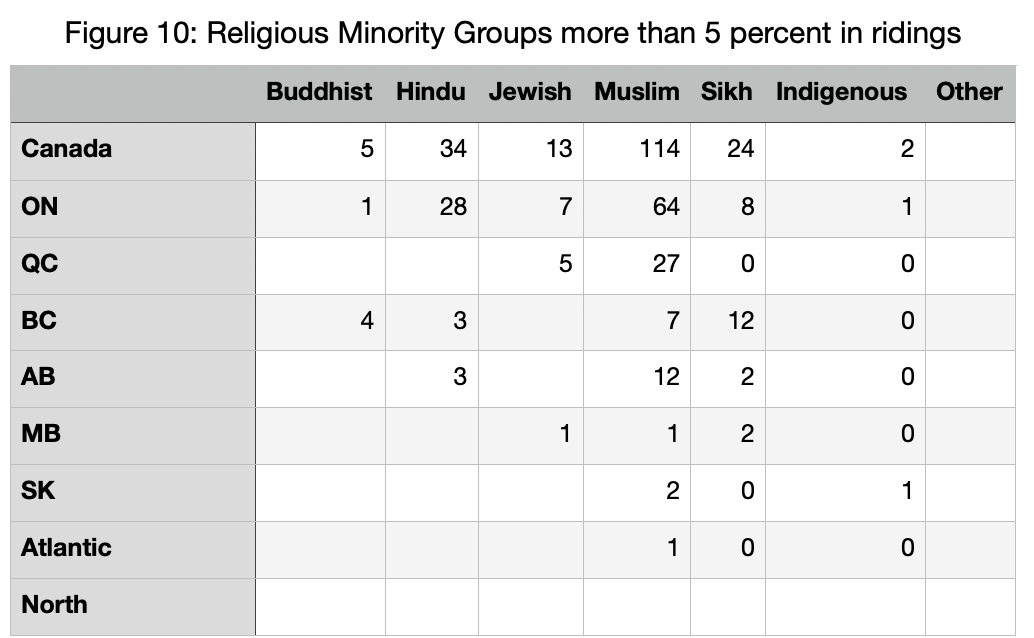
That being said, there are 114 ridings where Muslims form more than 5 percent of the electorate.

… Liberal party insiders were no doubt looking at the Michigan primary results with trepidation. The backlash among Muslim voters to the Stephen Harper government’s niqab ban for citizenship ceremonies and “barbaric cultural practices” hotline likely played a role in helping the Justin Trudeau-led Liberals secure a surprise majority in 2015. Since then, the party has made relations with the community a priority. Trudeau himself stages regular photo-ops at mosques, no doubt savouring every chance he gets to flex his sock game in a setting where shoes are prohibited.

But Trudeau, who appeared to be losing his touch with Muslim Canadians even before Oct. 7, now looks to be in freefall with the community. His multiple calls for a “sustainable ceasefire” in Gaza haven’t been enough to placate intransigent pro-Palestinian activists, who’ve even mobbed the prime minister in public settings. Trudeau has likewise found mosques to be less receptive to him than normal in recent months.

For now, Trudeau doesn’t appear to be too worried about the prospect of a Ramadan mosque ban. When asked on Thursday about the open letter, Trudeau said he’d visit any mosque that would extend him the invitation and gave no indication that he’d publicly commit to the terms enumerated in the statement. Yet Trudeau can’t be overjoyed about the prospect of having to keep his socks firmly in shoe during Islam’s holiest month, especially after seeing Biden’s humiliation in Michigan.

The results of Michigan’s just-held Democratic primary hint that the war in Gaza has triggered a rising tide among Muslim voters in the U.S. Whether electorally vulnerable members of Parliament cede to the demands of the NCCM and its affiliates or risk being shut out of mosques during a critical month for Muslim outreach could be an indication of just how strong the pull of this tide is in Canada.

Source: Rahim Mohamed: National Muslim group demands MPs denounce Israel or face wrath

Tasha Kheiriddin: Trudeau frittered away a good immigration policy for the sake of Liberal votes – National Post

Discounts the flawed policy rationale of the Barton commission recommendations but of course, political considerations also played a role. And, as we saw during the Kenney years, the liberals cannot take these voters for granted:

Immigrants are also grateful to the party that bring them in. Prime Minister Justin Trudeau learned this from his father. Pierre Elliott Trudeau took credit for the citizenship of millions of Canadians, even though many had come to Canada under previous governments. Why? Because they took their oath under his watch. And when it came to elections, the immigrant communities of the day — Italians, Greeks, Haitians, Vietnamese — tended to vote Liberal.

The implications of Trudeau Jr.’s replication of this policy are dire. Studies show that they are turning Canadians against immigration: even 62 per cent of current immigrants think we’re letting in too many people. They are impoverishing Canadians, both current and newcomer, according to the bank study. And they are also helping fuel Quebec separatism, as francophones look with alarm at rising immigrant populations in the Rest-Of-Canada. By the end of the century, Quebec risks becoming a bit player in Confederation, with only 15 per cent of its population.

This cannot continue. Instead of flooding the country with newcomers, the government needs to boost domestic productivity. That’s a harder fix — and one that won’t give them more votes. But then again, if Canadians can’t afford a decent life, the Liberals may not get their votes either.

Source: Tasha Kheiriddin: Trudeau frittered away a good immigration policy for the sake of Liberal votes – National Post

Douglas Todd: How to woo immigrant voters in Canada. And how not to

Suggestions on how to navigate or manage diaspora politics:

The number of federal ridings in which immigrants make up more than half of all voters has grown to 33 in Canada, almost all in pivotal Metro Vancouver and Toronto.

Politicians are desperate to find ways to appeal to the “immigrant vote” in those 33 exceptional ridings — as well as in 122 more electoral districts where the share of immigrants ranges from a consequential 20 to 50 per cent.

Efforts to woo immigrant groups were on display last month when Prime Minister Justin Trudeau inflamed India with the accusation that its agents appeared to be involved in the slaying of a pro-Khalistan activist in Surrey.

One of Trudeau’s unstated aims seemed to be to show support for the country’s 770,000 Sikhs, most of whom are in immigrant families. Unfortunately, Trudeau also alienated many of Canada’s 828,000 Hindus.

Chasing after immigrant voters is a tricky, fraught business.

How best can politicians appeal to immigrants, who have become a force to be reckoned with in almost half of the country’s federal ridings? It’s not easy when immigrants come from disparate countries, ethnicities and religions. Political parties are constantly trying to figure out what appeals to immigrant populations through their private polling, which they resolutely decline to share with journalists.

Here are a few thoughts from experts on working with voters who are immigrants:

Focus on across-the-spectrum issues

Regardless of whether immigrants come from India, China or the Philippines, many issues affect both immigrants and non-immigrants in roughly the same way: All people relate to policies on taxation, employment, education and cost of living.

Defend immigrants against intimidation, foreign and domestic

Since many immigrants not only come to Canada to take advantage of economic opportunities, but also to escape discrimination in their homelands, Andre Machalski, whose company Mirens monitors Canada’s more than 800 ethnic media outlets, says politicians can benefit by defending immigrants’ rights.

That’s a tack Trudeau took when he declared there were “credible allegations” that Indian agents were involved in the June murder of a pro-Khalistan activist outside a Surrey gurdwara.

“Trudeau’s unassailable message to all immigrants is, ‘We will stand up for you,’” said Machalski.

That message can hit home for people who have left behind all sorts of conflict-ridden nations, whether China, Ukraine or Nigeria.

Andrew Griffith, a former high-level director in Canada’s immigration department, says politicians believe they benefit electorally by defending immigrants, 70 per cent of whom are people of colour, from hate or discrimination.

Be in power

It’s conventional political theory that a party draws votes by being in office when a newcomer obtains citizenship status, which includes the right to vote.

B.C. radio talk-show host Harjit Singh Gill is among those convinced one reason Trudeau has hiked migration to record levels is he realizes immigrants and refugees, whether from Iran, Syria or India, “will vote for him because of it. They will worship him, think he’s a hero.”

Since the Liberal party has been in power more than the Conservatives in the past three decades, many say that’s one reason polls generally show immigrants lean toward the Liberals.

The Liberals have raised the immigration target to 500,000 a year, double the number when they came into office. Canada’s population grew by a record 1.1 million last year, 98 per cent due to migrants. CIBC Capital Market economist Benjamin Tal adds Ottawa has also allowed in two million foreign students and guest workers, most of whom yearn to be citizens.

Recognize both pros and cons of migration policy can draw votes

It’s time for politicians to get over the idea immigration is a “third rail,” too controversial to touch, Griffith writes in Policy Options.

Many immigrant families, like many other Canadians, are concerned about immigration levels, Griffith says. While generally pro-immigration, they fear the negative effects of Ottawa inviting too many newcomers too rapidly, particularly because they contribute to demand on housing and medical services, both of which are in crisis.

Sponsoring older immigrants is a winner. And loser

Trudeau’s cabinet ministers often boast they have quadrupled the number of parents and grandparents that can be sponsored to move to Canada. The expanding program aims to bring in 28,500 older family members this year, 34,000 next year and 36,000 in 2025.

“It’s both a real vote getter, and a real vote loser,” says Griffith.

While many immigrants want to bring their parents or grandparents here, others worry about the drain on publicly funded health services, since they arrive as seniors and haven’t had the chance to pay significant taxes in Canada.

Informing parents on pronouns

Since polls show immigrants tend to come from socially conservative cultures, it’s not surprising many Canadian Muslims, most of whom are immigrants, have been at the forefront of opposition to school districts refusing to tell parents if their children want to change their gender pronouns at school.

An Angus Reid poll found 78 per cent of all Canadians believe parents should be informed if their child wants to change their gender identity or pronoun at school.

Support ethnocultural groups, and be honest

The ethnic media in Canada, Machalski says, is full of examples of politicians saying one thing to one ethnic group and another to the wider public. That plays out whether the contentious subject is Khalistan or attending a banquet hosted by an organization that is a mouthpiece for China. When courting immigrant groups, politicians should avoid speaking out of both sides of their mouths.

Show up

The old-fashioned way of wooing a group, whether immigrant or otherwise, might still be best. Show up at town halls, shake some hands, get to know people. For what it’s worth, Machalski, who was born in Argentina, believes these days that Conservative party Leader Pierre Poilievre is showing up the most — “making serious inroads” into immigrant communities.

The timing for Poilievre is also auspicious, Machalski says. “He is going up in the polls, and like most people, immigrants like to back a winner.”

Source: Douglas Todd: How to woo immigrant voters in Canada. And how not to

Shafiq: Getting more immigrants to run for political office means paving the way for active citizenship

Of interest:

Kristyn Wong-Tam just made history. They became the first Asian-Canadian, queer and non-binary person elected to Ontario’s legislature, significantly expanding the vision of what a politician looks like in this country. 

Wong-Tam joins other recent Canadian political “firsts,” including Bhutila Karpoche, the first elected official in North America of Tibetan descent, and Doly Begum, the first Bangladeshi-Canadian woman to be elected in the country.

These leaders share a similar journey that first began with meaningful participation in civic engagement and community work, increasing political engagement, culminating in the decision to run for elected office.

Why does the political engagement of people like Wong-Tam, Karpoche and Begum matter so much?

Seeing a visibly powerful immigrant woman or non-binary person in an elected, decision-making role in the political arena empowers others to do the same. Emerging research shows that visibility and role modelling increases political participation and results in a stronger democracy from more diversified representation.

Higher engagement from traditionally under-represented groups strengthens our social and political fabric, creating more trust in our institutions. This is particularly important now when our democracy is threatened by the rise of misinformation, low voter turnout and a growing distrust of authorities and institutions.

So how can we support civic engagement for future trailblazers like Wong-Tam? In our recent academic and community-based research on civic participation of immigrants and refugees in Canada at the Journeys to Active Citizenship project, we found that the journey starts first with community involvement.

We found newcomers often become involved in local community-based activities before engaging in formal political activities like voting and running for office.

Unsurprisingly, voter turnout amongst immigrants is higher the longer someone has been in Canada. Elections Canada even acknowledges that language can be a barrier to voting for new Canadians, alongside a lack of knowledge of the election process, less awareness of early voting opportunities and a lack of trust in the Canadian political process. However, once immigrants and refugees overcome settlement challenges, they are more likely to vote.

Immigrant women in the past have been less likely to participate in formal political processes, however, they are much more likely to participate in informal civic activities, which often act as a critical stepping-stone to formal participation through actions like voting, writing to your elected representative or running for office.

So how can we bolster opportunities for formal and informal civic participation for immigrants, and particularly immigrant women?

Building social networks has been proven to strengthen integration and belonging and is critical to help immigrants establish trust with fellow Canadians. Enabling community engagement is another key piece of the puzzle.

Creating and strengthening civic education and engagement that is tailored to newcomers, particularly women, would be important to build the skills, knowledge, capacity and confidence that would enable newcomers to engage more fully in Canada’s democracy.

In our interviews and group sessions with immigrants and refugees over the last two years, we found three recurring sources of community: religious spaces, community-based organizations and post-secondary institutions. 

Academic literature also tells us that community-based organizations may act as mobilizing agents for civic participation. Delivering programs through these places of community important to newcomers in their early years would be critical for success.

Supporting programs that bolster opportunities for newcomers to engage in a wide range of community initiatives, such as volunteering, participating in local community events, or joining social clubs, will help foster a sense of trust and belonging in our political processes and institutions, and ultimately lead to an increase in formal political participation.

Canada already benefits greatly from the labour of immigrant women — something that has been highlighted throughout the pandemic. It’s time we included their voices, expertise and experiences in the political process. 

Source: Getting more immigrants to run for political office means paving the way for active citizenship

For campaigns looking to turn support into seats in Parliament, not all ‘ethnic communities’ are created equal

Good overview, particularly the comments by Erin Tolley. Looking forward to the October Census release that will allow for updating of riding demographics in terms of ethnicity, visible and religious minorities:

The conventional wisdom around the potential for so-called “ethnic voting blocs” to swing elections is often overstated, but “parties make a big mistake when they perceive of immigrant and racialized voters as a passive voting bloc,” says political science professor Erin Tolley.

“These are groups that are very politically savvy, and they understand their power and they understand the influence that they can have,” said Tolley, the Canada Research Chair in gender, race, and inclusive politics at Carleton University. “And when parties don’t repay that support by listening to their preferences or by acting to advance their interests, they take that power and they put it elsewhere.”

As communities like Italian Canadians, Sikh Canadians, and Tamil Canadians have each become more established in the country, Tolley said they have “flexed their political muscles” in order to get what they wanted from political parties, and to enter the political arena themselves.

Political commentator Seher Shafiq, a co-founder of the non-profit group Canadian Muslim Vote, said when Canadian Muslims became more organized and dramatically increased their voter engagement levels in the 2015 elections, “all of a sudden we had politicians engaging way more than before.”

“There’s a definite change of tone that wasn’t there before 2015,” said Shafiq, referring to how politicians “at all levels” now pay attention to hate crimes against Muslims, and even to Muslim holidays. Shafiq credits the grassroots organizing of several groups, including the National Council of Canadian Muslims, with increasing community engagement and with grabbing the attention of political parties.

“There’s something to discuss and maybe something to study about how a community that wasn’t organized in the way that the Sikh community or the Ismaili community is, became organized, and how that coincided with a dramatic shift in tone from government, and even to some extent action,” said Shafiq.

Sherry Yu, an associate professor at the University of Toronto who studies multiculturalism, media, and social integration, emphasized the role that so-called ethnic media play in helping new immigrants learn about the Canadian political process, and in boosting civic participation among older immigrants who have been more passive.

Yu told The Hill Times that many communities, especially those that are more concentrated in particular regions, have media outlets and community organizations that reinforce each other, with so-called ethnic newspapers being distributed at local shops and grocery stores.

The Conservatives and the Liberals each had periods during the 20th century where one or the other seemed to have the upper hand in terms of support from immigrants, with John Diefenbaker’s and Pierre Trudeau’s governments each assembling different coalitions of support over the decades. With the Conservatives in the midst of a leadership race, supporters have debated whether the party is doing enough to appeal to a broader voter base and which leadership hopeful can lead the way on that front, with the now-booted Patrick Brown regarded as the candidate who had the strongest ties to cultural and religious minorities.

Tolley said the idea of appealing to immigrant and racialized voters “is not a new idea. It didn’t start with Patrick Brown, it didn’t start with Jason Kenney.”

Under prime minister Stephen Harper and then-immigration minister Jason Kenney, the Conservative Party of Canada made a concerted effort to appeal to communities that had previously been assumed to be steadfastly Liberal out of gratitude for Pierre Trudeau’s policies on immigration and multiculturalism.

The strategy was reportedly born out of a conversation between Harper and Kenney over a pint at the Royal Oak Pub on Bank Street in Ottawa in 1994, when Kenney tried to convince the future prime minister that Canada’s conservative movement should seek out immigrants who shared its values.

Kenney’s packed schedule of visits to temples, gurdwaras, festivals, and other community events, which began during the party’s first mandate when he was secretary of state for multiculturalism and Canadian identity, earned him the moniker of “secretary of state for curry in a hurry.”

But Tolley warned against giving too much credence to sweeping narratives about so-called ethnic voting blocs. “Immigrant and ethnic and racialized Canadians have policy preferences just like other Canadians,” she said, “and they vote for a variety of reasons. Their ethnic or immigrant background is not the only reason and it’s often not even the most important one.”

“Community by community, some parties and some leaders have had success, but when you look in the aggregate, what they gain from appealing to one community, they often lose from a separate community.”

Tolley said there is “a bit of urban lore” that tends to oversimplify the Harper Conservatives’ success at reaching out to immigrant and racialized voters. She said the Conservatives saw a boost in their vote share from particular communities, mostly non-racialized communities such as Ukrainian Canadians, Italian Canadians, and Jewish Canadians, but that they saw very little support from other groups, such as Muslim Canadians.

“And in the aggregate it didn’t really budge the vote share one way or the other when you compare with other parties.”

Drilling down further into the data, Tolley pointed out that the Conservatives under Harper “were quite successful with Cantonese-speaking Chinese Canadians, but less so with Mandarin-speaking Chinese Canadians.”

Political campaigns looking for cohesiveness and geographical concentration

Carleton University political science professor Erin Tolley says former prime minister Stephen Harper used Senate appointments to boost his party’s connection with immigrant communities. Photograph courtesy of Erin Tolley

For political campaigns looking for the most efficient way to turn community support into seats in Parliament, not all immigrant or racialized communities are created equal. Political organizers are focused on winning ridings, said Tolley, more so than they are interested in expending finite resources on driving up their party’s overall vote count. 

“Groups that are larger in number and are cohesive, and who reside together in a district, that’s the kind of group that a party is going to find very attractive,” said Tolley, “because that is how elections are won and lost.”

“I think that’s why you see parties tapping into Ismaili Muslims or Punjabi Sikhs,” said Tolley, “rather than courting the Black vote.”

“One reason that I think parties have largely ignored Black Canadians is that they don’t know how to tap into that community because it is such a diverse community. It is geographically spread out. And that stands in the way of parties figuring out how to effectively organize within that community.”

Shafiq concurred, saying that the fact that much of the Muslim Canadian community is concentrated in key swing ridings in the Greater Toronto Area contributed to creating a perception among political parties “that this is a community they need to engage.”

Sikh Canadians have been elected in ridings where the community forms a substantial segment of the local population, such as Vancouver and Surrey in British Columbia and Brampton and Mississauga in Ontario, with growing populations around Edmonton and Calgary also electing Sikh MPs.

After the 2015 election, The Globe and Mail reported there were 17 Sikh Canadians elected to Parliament–16 for the Liberals, including several who made it in cabinet, like International Development Minister Harjit Sajjan (Vancouver-South, B.C.)–making Punjabi the third-most spoken language in the House of Commons.

The fact that multiple political parties have sent Sikh Canadians to Parliament means those MPs can serve as a pool of knowledge within their community, and an avenue through which the parties can make further connections within the Sikh community. The first waves of Ukrainian Canadian MPs and Italian Canadian MPs filled the same functions in previous decades.

But getting that first generation of leaders elected to Parliament remains a challenge for communities that are less established on the Canadian politician landscape. In these cases, said Tolley, political parties look to other elected bodies, such as school boards, to identify up-and-coming leaders.

As prime minister, Harper also used Senate appointments as a way “to cultivate leadership within the party,” said Tolley, appointing community leaders to generate goodwill and to make inroads into communities that did not yet have representation in the House of Commons.

For all the complaints that Harper’s government shut out the press during its time in power, it actively sought out and tracked political coverage in the so-called ethnic press. In 2012, Kenney told Alec Castonguay, then chief political reporter for L’actualité, that he made it a habit to read translated versions of the ethnic press every morning, before reading the mainstream national papers.

When Kenney was immigration minister, The Canadian Press reported that the department of citizenship and immigration spent $745,050 between March 2009 and May 2012 tracking media coverage by so-called ethnic or multicultural outlets, including assessments of campaign events and perceptions of Kenney.
Yu, whose research includes comparisons of the Vancouver Sun and the Vancouver Province with two local Korean community newspapers, said this media monitoring was an acknowledgement of the significance of ethnic media, but said she was concerned that the information gathered was not shared with the public.
“Until the release of these documents, we did not know that monitoring was done,” said Yu.

Maturation of a community leads to new demands

As communities become more established in Canada, however, they may no longer be satisfied by a meet and greet with a prominent politician or with a promise that a party will consider a particular policy proposal, said Tolley. “There is definitely evidence of a transformation in political behaviour among community members. Some refer to it as a maturation of one’s political involvement.”

The Tamil community has had several decades to establish itself in the political landscape. It has elected MPs from different parties in ridings in Scarborough, Ont., including Liberal MP Gary Anandasangaree (Scarborough-Rouge Park, Ont.), a three-term MP first elected in 2015 who has served as president of the Canadian Tamils’ Chamber of Commerce. Many Tamil Canadians arrived in Canada in the 1980s, during the civil war in Sri Lanka.

Ken Kandeepan, a member of the advisory board for the non-partisan Canadian Tamil Congress (CTC), told The Hill Times that “many people in the Tamil community are actively involved in politics” and that community members have provided “considerable support” to various parties at the federal level.

But, he added, it was “a pet peeve” of his that once the elections are over, “the quid pro quo is somewhat absent.” As an example, Kandeepan mentioned appointments to directorships for government corporations.

“It is unfortunate that once the elections are over, these kinds of outreach are not made to the Tamil community. In asking them for appropriate candidates and individuals to be appointed to these positions, at least to the best of the knowledge of the CTC.”

“So the attitude seems to be ‘please help us,’ and ‘thank you for your help, and we’ll see you at the next election.’” 

Tolley said Kandeepan’s comments are an example of a case where members of a particular community “don’t want to be seen as just a set of votes.”

“They want to be taken seriously, they want to have a voice. They want to be able to run and be successful as candidates supported by parties. And when they are successful, they would like to see themselves in positions of influence. Parties that don’t take that seriously learn pretty quickly that, sure these are potential voting blocs in one’s favour, but they can also shift alliances.”

Source: For campaigns looking to turn support into seats in Parliament, not all ‘ethnic communities’ are created equal

Bell: Kenney’s plan to woo ethnic voters to help him save his job

Back to his days of Minister for Curry in a Hurry:
This is getting to be serious business.
I hear Rishi Nagar on West of Centre, a CBC podcast.When he talks about Premier Jason Kenney courting voters from cultural communities in northeast Calgary in a bid to keep his job it gets me curious.

I decide to give the political deep thinker a call. Nagar also happens to be a heck of a nice guy who knows his stuff.

Nagar is the news director at RED FM, a multicultural radio station in Calgary.

The questions come easily

How many people in northeast Calgary filled out membership forms for Kenney’s United Conservative Party?

Folks who snagged a membership by this past Saturday can register to vote Yes or No next month on the premier’s fate. As many as 20,000 across the province may register. It is an astounding number.

So what is the educated guess, the ballpark number?

Who better to ask than a man who attended a half-dozen Kenney events in the city’s northeast?

He says around 2,000-plus signed up for the premier

The premier. The citizenship, immigration and multiculturalism minister in his previous life in Ottawa.

His job back then was to win new Canadians to the federal Conservative side. Kenney was tagged with a nickname by an MP. The Minister for Curry in a Hurry.

As the premier scrounges for votes in the upcoming vote on his leadership, Nagar mentions organizers from different communities reaching out to their people “to fill the membership form for Mr. Kenney.”

He mentions Hindus and Sikhs and Muslims. He mentions Muslims from Pakistan and Muslims from Lebanon and Muslims from South Africa.

In every event there are forms filled out and collected in groups of 50. The memberships add up, the promises to vote for Kenney.Kenney is a very frequent visitor to the city’s northeast. The premier even goes to very small gatherings, as small as 15 people.

“He’s very happy,” says Nagar, of the premier.

Local members of the legislature, serving under the banner of Kenney’s United Conservatives, are at the back of the room.

It could be Rajan Sawhney or Mickey Amery or Peter Singh.

Nagar cannot say, and nobody knows, how many with UCP memberships will actually vote in Red Deer.

Of course if the UCP decides to have voting in Calgary as well as Red Deer it will be much more convenient.

Ditto if they decide to allow in-person voting in the capital city.

“Mr. Kenney is targeting minority communities here in Calgary. He must be doing the same thing in Edmonton,” adds NagarThe Kenney pitch is first and foremost the fear of the NDP.

Then the fear of breaking up the United Conservatives, an uneasy marriage of convenience with former Wildrosers and former PC types intent on seeing the NDP defeated last election.

Then there’s Kenney on the economy coming out of COVID, pledging to make communities “happy and flourishing.”

Kenney talks a lot about the economy.

The man from RED FM says there is not one single question on the premier’s past comments on the spread of COVID in northeast Calgary or on the issue of hail insurance after the huge storm.

Nagar says just before the Alberta government budget Kenney was “absolutely unpopular.”

After the budget things started changing. He started showing up.

There is “one interesting feature” mentioned. The desire to get a picture with Kenney.

“Whenever there is a photo-op with the premier they forget everything. A picture is important. If I have a picture with Jason Kenney I will hang it in my family room.”

Such is the sentiment.

“There is a lineup for the pictures.”

Nagar says the members Kenney is signing up may not be the deciding factor in his survival but it is big support for him to win.

The premier’s people know they’re in a fight.

They know his approval is nothing to write home about and they don’t talk about it.

They know polls show most Albertans aren’t happy with him.

They emphasize how the UCP could squeak out a win against the NDP, not pointing to the fact some of that UCP vote may come from those who expect Kenney could be gone after his party’s leadership vote

But when the premier is in Calgary’s northeast he is one happy camper

“You can see his tone and language when he departs. He’s super-happy. He’s very confident. His gait is changed. His way of talking changes after seeing all these people.”

Source: Bell: Kenney’s plan to woo ethnic voters to help him save his job

As Tories review election loss, weak support in immigrant communities a crucial issue

Article over-dramatises even if there is a need for a review.
Margins in many of these ridings were relatively small. Moreover, in Ontario, the provincial conservatives swept most of the same seats and, as the article notes, active outreach by Conservatives allowed them to make inroads.
But beyond the 41 ridings, there are an additional 93 ridings with between 20 and 50 percent visible minorities which should also be looked at:
The Conservative Party is only beginning to sift through the data from the 2021 election, but there is at least one warning light flashing red on the dashboard: the party has been nearly wiped out in Canadian ridings where visible minorities form the majority.

Of the 41 ridings in Canada where more than half the population is racialized, the Conservatives won just one in the 2021 election — Calgary Forest Lawn — despite winning 119 seats overall.

Source: As Tories review election loss, weak support in immigrant communities a crucial issue