For Affirmative Action, Brazil Sets Up Controversial Boards To Determine Race: NPR

Orwellian. Self-identification is the only way, even if it risks some “gaming:”

Siqueira considers himself to be mixed race, known in Brazil as pardo, or brown.

“I consider myself to be a very typical Brazilian and I’ve always been very proud of it. In my dad’s family, my grandfather is black, my grandmother has Indian and white roots. And on my mother’s side they are mostly white, mostly Portuguese,” he said.

How he defines himself matters because he was required to self-identify on his application. In 2014, the government introduced a quota system for federal jobs. The affirmative action regulations require that 20 percent of all government positions be filled by people of color – either black or mixed race.

The problem came once the announcement of the appointments was made public.

People started investigating the background of who had gotten the slots. They got into Siqueira’s Instagram, his Facebook feed and they sent his personal photos to the government.

“A lot of people sent pictures saying, ‘Oh, this dude is white, he’s a fraud,'” Siqueira says.

Job Offer Put On Hold

People basically said he was gaming the system, lying about who and what he is to get one of the jobs. The backlash shocked him. He said he hadn’t even considered the quota system. He just put down what he considered himself to be.

But the controversy wouldn’t go away. The government was getting so much flack that it put Siqueira’s offer on hold.

And then the government went a step further.

In response to the outcry, they set up a kind of race committee to review his case, and a few others.

He was asked to present himself to a panel of seven diplomats in a room who would decide if he was really Afro-Brazilian, as he claimed.

They asked him a bunch of questions such as, “Since when do you consider yourself to be a person of this color?”

And then it was over.

What they decided was that he was not pardo, or mixed race. No explanation. No discussion. So he decided to sue.

And that’s when this story gets even more complicated. Because in order to “prove” that he was Afro-Brazilian, his lawyers needed to find some criteria. He went to seven dermatologists who used something called the Fitzpatrick scale that grades skin tone from one to seven, or whitest to darkest. The last doctor even had a special machine.

“Apparently on my face I’m a type four. Which would be like Jennifer Lopez or Dev Patel, Frida Pinto or John Stamos. On my limbs I would be type five, which is Halle Berry, Will Smith, Beyonce and Tiger Woods,” he said.

Like most people he has different skin tones on different parts of his body. But in none of these tests did he come out as lighter skinned.

He says the whole thing struck him as completely bizarre because identity, he says, is made up of more than just physical characteristics.

But this wasn’t just an isolated incident.

Mandatory For All Government Jobs

A few weeks ago, these race tribunals were made mandatory for all government jobs. In one state, they even issued guidelines about how to measure lip size, hair texture and nose width, something that for some has uncomfortable echoes of racist philosophies in the 19th century.

Source: For Affirmative Action, Brazil Sets Up Controversial Boards To Determine Race : Parallels : NPR

Feds prefer proactive take on pay equity: document

Will be interesting to see where the Government takes this in its report back to the Pay Equity Committee October 7:

The federal government would prefer a proactive approach to ensuring that men and women get equal pay for work of equal value, a newly released memo suggests, but officials expressed some caution over how much it could accomplish.

“The proactive approach is generally considered to be more effective at addressing systemic wage discrimination,” said a backgrounder on pay equity legislation provided to Labour Minister MaryAnn Mihychuk on Feb. 1.

“It is less adversarial than a complaints-based approach, with the focus being on assisting employers to comply with the law rather than placing the burden on a complainant to build a case of discrimination,” said the memo from the deputy minister.

The Canadian Press obtained the document through access-to-information legislation.

The document was prepared ahead of an NDP motion that called on the House of Commons to strike a special committee on pay equity to come up with a plan to adopt a proactive pay equity regime, rather than leaving individual women who believe they are being treated unfairly to file complaints.

The motion passed with support from the Liberals and the committee released its report in June.

The report recommended doing away with the controversial Public Sector Equitable Compensation Act brought in by the previous Conservative government.

It also called on the government draft proactive pay equity legislation within 18 months — with the NDP asking for it by the end of this year.

It also urged the government to accept the overall direction — and majority of recommendations — from the 2004 report of the federal Pay Equity Task Force.

Neither Mihychuk nor anyone from the Department of Employment and Social Development was available Monday for an interview.

In an emailed statement, departmental spokesman Josh Bueckert pointed to what the minister said during her May 3 appearance before the committee: “Our government’s goal is to stop this discrimination related to the undervaluation of work traditionally performed by women.”

As for how it plans to do that, the statement said the government will table a comprehensive response to the committee report by Oct. 7.

The briefing note mentions that employers can be taken to task by the Canadian Human Rights Commission without employees or their unions having to file a complaint.

“If an inspector has reasonable grounds to believe that there is gender-based wage discrimination in an establishment, he or she may notify the commission, which can then initiate an investigation. However, there are no known cases of this occurring,” it said.

Barbara Byers, secretary-treasurer of the Canadian Labour Congress, said that should not deter the government from taking a proactive approach.

“Human rights commissions don’t necessarily go out and look for that work, because they’ve got other things they are dealing with as well and they are already understaffed for that,” said Byers.

“If complaint-based was going to work, then quite frankly it would have worked by now,” she said.

New Democrat MP Sheila Malcolmson, who put forward the motion on pay equity, said she hopes the Liberals follow through quickly.

“This is a policy that they can bring in which actually puts some action to their words on gender equality,” said Malcolmson, the status of women critic for her party.

“If they don’t leave a legislative record like this, they will have failed in their commitment around this being the gender parity Parliament,” she said.

Conservative MP Marilyn Gladu, who sat on the special committee, supports proactive legislation.

“Where there was the most success in getting equitable pay, it was legislated,” she said.

Source: Feds prefer proactive take on pay equity: doc

Watchdog condemns lack of diversity in CSIS senior staff

Military, RCMP, CSIS.001Valid observations but in the context of other security-related agencies, the RCMP and the Canadian Forces, CSIS looks good as indicated in the above chart:

The federal government’s human-rights watchdog has repeatedly admonished the Canadian Security Intelligence Service over a lack of diversity in its upper echelons, according to newly disclosed reports.

Records obtained by The Globe and Mail show that the Canadian Human Rights Commission has conducted two employment equity audits of CSIS over the past decade and, on both occasions, the spy agency was criticized because it had not hired a sufficient number of visible minorities, people with disabilities and indigenous Canadians.

The 2014 and 2011 audits found that none of CSIS’s senior managers were indigenous or visible minorities, and only 17 per cent are women, a decrease of 13 per cent since 2009. “Your organization has a lower overall EE [employment equity] result when compared to separate agencies and is therefore considered to be a less successful employer with respect to EE,” the commission wrote, urging the agency to close gaps in its hiring practices. One of its main challenges, the commission noted, was to increase the diversity of its managerial staff.

Formed three decades ago from a former RCMP intelligence division, CSIS is a $500-million-a-year organization with 3,000 employees. Many of its staff are intelligence officers who work to identify terrorists and other threats to national security. Such work has sometimes led to tensions with indigenous and Muslim groups, who have accused the agency of racial profiling.

The documents, obtained under Access to Information laws, offer a sober assessment of an agency that has at times struggled to attract recruits from varied backgrounds, and sheds new light on the workplace culture of the country’s secretive spy service.

One of the areas in which CSIS exceeded the commission’s targets, which are based on the availability of people from different groups in the work force, is gender equity across its departments. According to a 2014 equity report, 48 per cent of CSIS employees are women, a figure that is above the government average.

And over all, 2 per cent of its employees are indigenous, 3.6 per cent have disabilities and 14.4 per cent are visible minorities. Those numbers are generally representative of the country’s population, but they are slightly below the commission’s targets.

A spokeswoman for CSIS said the agency sees diversity as a “core business strategy,” one that allows its agents to “better understand the demographics of the Canadian communities we protect, therefore better equipping us to collect relevant and accurate intelligence.” The human-rights commission investigates government departments that are less diverse than their peers. Under federal law, every department and agency with at least 500 employees is subject to a review of its work force every three years. If a group of Canadians is not well represented, an audit is done.

The documents also suggest visible minorities and indigenous people were sometimes undervalued within CSIS. Members of those groups faced “attitudinal barriers” from colleagues and did not always receive the training needed to “advance to a higher level either due to lack of time, funding or management support,” a report said.

Source: Watchdog condemns lack of diversity in CSIS senior staff – The Globe and Mail

Canada’s diplomatic brass: too white, too male |

Good detailed piece on the Canadian foreign service demographics and head of mission appointments (my examination of the diversity of senior heads of mission – the 16 positions classified at the ADM level – showed 3 women (19 percent) and 1 visible minority (6 percent).

Another illustration of the government being more open in sharing this data:

The Prime Minister is a feminist and there is gender parity in cabinet, but Canada’s foreign service still has a long way to go.

Sources say that the foreign service has negative gaps in regards to the number of women it employs, as well as aboriginal peoples and persons with disabilities.

According to a public report on employment equity in the government for the 2015-16 year, in the entire department of Foreign Affairs, Trade, and Development, 54.8 per cent of employees were women, 2.4 per cent were aboriginal peoples, 3.3 per cent were persons with disabilities, and 14.4 per cent were visible minorities.

However, according to numbers given to The Hill Times from an “internal workforce analysis for the foreign service group,” Canada’s foreign service is significantly lacking in women.

The department has targets for employment equity, and in terms of women in the foreign service, the foreign service has a negative gap of 166, meaning the department would need to employ 166 more women in order achieve equity. There is also a negative gap of 18 for aboriginal people, and 16 for people with disabilities. However, for visible minorities, the department is positive by 64, meaning they have 64 more visible minority employees than required to be equitable, according to the standards set by the Canada Labour Market Availability.

Screen Shot 2016-06-07 at 12.35.59 PM

Employment equity data for the foreign service, provided to The Hill Times by Global Affairs on June 6, 2016.

The document includes data as of March 31 of this year. Global Affairs confirmed the above numbers, and provided a chart demonstrating the employment equity targets and gaps in percentages. According to Eric Pelletier, a spokesperson for Global Affairs, there is a negative gap of 4.1 per cent for women, meaning women are under-represented by 4.1 per cent. It cites that there are currently 48.1 per cent women in the foreign service, and 62 per cent required representation. A negative gap of 1.5 per cent exists for aboriginal peoples, a negative gap of 1.4 per cent for persons with disabilities, and a positive gap of 5.3 per cent for visible minorities. Mr. Pelletier also said that the foreign service is 71.6 per cent anglophone and 28.4 per cent francophone.

Michael Kologie, communications director for the Professional Association of Foreign Service Officers (PAFSO), said in an interview with The Hill Times that overall, “if we’re talking about employment equity gaps, we’re doing very well when it comes to visible minorities. We’re doing okay when it comes to persons with disabilities, and where we’re really lacking is actually with respect to women and aboriginal peoples.” He said for women, the gap is “quite significant.”

Artur Wilczynski, Canada’s ambassador to Norway, further confirmed these gaps in an interview.

“I took a quick peek at the stats in terms of the employment equity. In the executive cadre, if you look at visible minorities in particular, there are no negative gaps there according to our reports, but there is still a lot of work to be done for example in increasing the representation of indigenous persons, persons with disabilities and women, and quite frankly, people of multiple backgrounds,” he said.

In a later emailed statement, Mr. Kologie wrote that PAFSO is committed to working in collaboration with Global Affairs to encourage a diverse foreign service, “with special attention on currently underrepresented groups such as women, aboriginal peoples, and persons with disabilities,” adding that visible minorities are well represented in the foreign service.

It has been reported by both The Ottawa Citizen and The Globe and Mail that Prime Minister Justin Trudeau has given Global Affairs instructions to diversify the foreign service and to specifically hire more women.

The Citizen’s columnist Andrew Cohen wrote in April that “Justin Trudeau has told Global Affairs that its list of career candidates has too many white males and asked it to do better next time.”

The Globe reported at the end of last month that Global Affairs is choosing two women to fill positions in Israel and in Great Britain, naming Deborah Lyons as Canada’s new ambassador to Israel and Janice Charette as the person to take the lead at Canada House.

The article also pointed out that Mr. Trudeau had told Global Affairs “its list of career candidates has too many white males and promised better representation in terms of gender and ethnicity.” Global Affairs would not confirm whether or not it had received these instructions from Mr. Trudeau, with Global Affairs Minister Stéphane Dion’s (Saint-Laurent, Que.) press secretary Chantal Gagnon saying she wasn’t going to answer that question. She also stressed that Ms. Charette and Ms. Lyons had not yet been officially appointed.

Speaking of official appointments, the Trudeau government will take its first crack at shuffling the foreign service this summer, anticipated in June or July.

Anne Leahy, a former Canadian ambassador, said she expects the announcements to come around the end of June. “I would watch [the announcement] because Justin Trudeau made a point of saying that he wanted more women, more diversity,” she said, adding that she “wouldn’t be surprised” to see that come to light. She said from her own experience, she expects anywhere from 10-15 new heads of mission to be appointed, if not more.

A source from Global Affairs told The Hill Times that the department will have more to say about diversity once the heads of mission shuffle happens, hinting that more diverse nominations might be coming.

The Hill Times counted the number of Canadian heads of mission posted abroad as of October 2015. The results showed that of the 134 heads of mission at the time, 90 were men and just 44 were women. That translates to 32 per cent heads of mission positions being held by women.

Source: Canada’s diplomatic brass: too white, too male |

Employment Equity: What the Latest Government Report says – Policy Options

TBS EE 2015 Analysis.007My latest piece comparing the 2015 and 2008 numbers in IRPP’s Perspectives. Detailed charts and tables, including departmental rankings of best and worst representation for women, visible minorities and Indigenous peoples:

The latest Treasury Board (TBS) report, Employment Equity in the Public Service of Canada 2014-15, provides useful information regarding the relative representation of employment equity groups: women, Indigenous peoples, visible minorities and persons with disabilities. Overall, the public service is reasonably diverse for the three groups which are the subject of this article — women, visible minorities and Indigenous peoples.

Unlike Labour Canada’s Employment Equity Act: Annual Report 2015, the TBS report does not present how representation has improved over time. To provide some historical context, this article contrasts the 2014-15 report with the 2007-8 TBS report with respect to overall representation, as well as diving into some of the 2014-15 numbers.

In contrast to earlier TBS reports, the current report only provides a summary analytical narrative for its data tables (one page, compared to over 10 previously), with fewer data tables (six compared to 16).

The following charts and narrative aim to fill that gap and help tell the overall story. While representation for all employees has improved, visible minorities and Indigenous people are relatively less well represented at the executive level, particularly at the Assistant Deputy Minister level (EX4-5).

Source: Employment Equity: What the Latest Government Report says – Policy Options

Because it’s 2015 … Implementing Diversity and Inclusion – My latest ebook

because-its-2015_pdf__page_1_of_59_Over the past months, as many of you know, I have been doing a series of articles on the 2015 election, Cabinet and other senior appointments, along with baseline data for the public service, Governor in Council and judicial appointments by which to measure the government’s implementation of its diversity and inclusion commitments.

I have integrated and updated these in mini-book form, available as a free download from:

iPad/Mac version (iBooks)

Windows version (PDF)

I hope you find this compilation and the reference data it provides of interest and use.

The description is below.


——————-

Because it’s 2015 … Implementing Diversity and Inclusion

Canada’s 2015 election provided a sharp contrast between the social cohesion focus of the Conservative party and its use of identity politics, and the Liberal party’s emphasis on diversity and inclusion. This was not only reflected in policy and language but in candidate recruitment, with the Liberals having the largest number of visible minority candidates, although Conservative and NDP numbers also increased.

The overall voting shift to the Liberals was particularly strong among new Canadian voters, reflecting a mix of the overall shift to the Liberals in this election, perceived anti-immigrant bias and identity politics, and lack of support for Conservative restrictive citizenship and immigration policies.

In power, the Liberals implemented their diversity and inclusion commitment through the establishment of a Cabinet Committee on Diversity and Inclusion, Cabinet and Parliamentary Secretary appointments, Ministerial mandate letters and initial Senate appointments. They also set expectations for other senior appointments.

This short book provides data and related analysis with respect to the election results, political representation and leadership positions, and establishes the 2016 baseline for senior public servants, Governor in Council and judicial appointments by which to judge the Government’s implementation.

With over 40 charts and tables, Because it’s 2015 … is an invaluable reference for those interested in Canadian politics and diversity. iPad optimized.

Table of Contents

  1. Introduction
  2. Political Institutions
  3. Public Service Impact
  4. Governor in Council Appointments
  5. Judicial Diversity
  6. Concluding Observations

RCMP changes application requirements, with permanent residents welcome to apply

Military, RCMP, CSIS.001RCMP employment equity reports consistently show under-representation as the above chart shows. The citizenship requirement change will make a slight difference: after 10 years, about 65 percent of visible minorities are citizens, with the percentage rising to 80 percent after 15 years:

The RCMP has changed its application requirements, with more people now eligible to apply to be a Mountie and some applicants not needing to take some of the previously mandatory tests.

Up until now, Mounties had to be Canadian citizens. But under the changes that took effect today, permanent residents who have lived in Canada for at least 10 years are eligible to apply.

The shift could only help the RCMP meet its target for 20 per cent of its ranks to be comprised of visible minorities.

Last summer, the RCMP exempted university graduates from taking the national police force’s entrance exam. Now, people with a minimum two-year college diploma may also skip the exam, which tests a person’s aptitude for police work.

There are also changes to the physical abilities requirement evaluation. Previously, prospective recruits had to complete the test at their own expense before submitting an application. Going forward, RCMP applicants won’t have to perform the test until they’ve been accepted at the RCMP’s training academy in Regina — called Depot Division — and the Mounties will cover the cost.

The RCMP says it will reimburse the $79 fee to anyone who completed the test between Jan. 1 and March 15, 2016.

These are big changes for the national police force; the RCMP Act says members of the RCMP must be citizens. The only exception is when there is no one available for appointment who meets all the criteria except citizenship.

It suggests the Mounties may not be receiving enough applications to keep up with the pace of retirements or meet the demands of its policing contracts with several provinces. That could explain a notice on the RCMP website that reads: “In order to meet organizational needs, applicants from British Columbia, Alberta, Saskatchewan or Manitoba will have the opportunity to select their home province for their first post following graduation.”

Source: RCMP changes application requirements, with permanent residents welcome to apply – Politics – CBC News

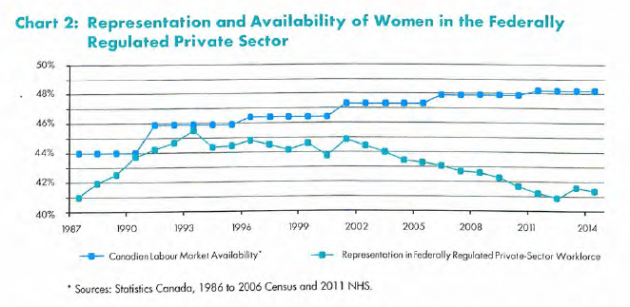
Women in federally regulated workforce declining: study – iPolitics

While the focus of the article is with respect to women, the other results are just as interesting (the largest federally regulated industries are telecoms, banking and transport, and the large retail presence in the first two – think of those cell phone pop-up stands or bank branches – mean strong representation of visible minorities):

The Employment Equity Act Annual Report tracks employment in federal federally regulated industries such as banking, communications and transportation.

The study found that transportation companies had the worst track record when it came to employment equity. Women made up only 27.2 per cent of the employees in private sector transportation sector companies, 14.2 per cent of the workforce were members of visible minorities and 2 per cent had a disability. The only area in which the transportation industry fared better than others was with aboriginal peoples who made up 2.8 per cent of the employees.

Screen Shot 2016-04-19 at 5.30.13 PM

The banking sector had the best track record with three of the four employment equity groups. Women made up 61.5 per cent of the workforce in banking, 30.2 per cent were members of visible minorities and 4 per cent had a disability. However, banking had the lowest proportion of aboriginal Canadians of any sector at 1.3 per cent.

Communications came up the middle with women at 37.4 per cent, visible minorities at 18.6 per cent, people with disabilities at 2.3 per cent and aboriginal peoples making up 1.8 per cent of the employees.

In a fourth category that mixed several different federally regulated industries from metal ore mining and wood to public administration or professional, scientific and technical services, 30.9 per cent of employees were women, 12.2 per cent came from visible minorities, 4.5 per cent were aboriginal and 2.6 per cent had disabilities.

…There was a gap between men and women who come from visible minorities. While 52.1 per cent of visible minority men working in federally regulated industries earned over $60,000, that dropped to 39.8 per cent of women.

Overall, employment equity in federally regulated sectors is improving, the study found.

“Employers are showing greater interest and awareness in employment equity through their commitment to implementing short-term and long-term measures in the workplace, including improvements to hiring and retention processes, accessible training and networking opportunities for advancement and overall evidence of employment equity integration into day-to-day activities.”

Source: Women in federally regulated workforce declining: study – iPolitics

Religious Minorities in the Public Service: What the data tells us

Public_Administration_-_Religious_Minorities_-_Core_Public_AdminTo complement the employment equity analysis in my book Multiculturalism in Canada: Evidence and Anecdote (see here), I applied the same methodology using NHS data for religious minorities.

This was prompted in part by Minister Clement’s comment that hijabs and niqabs “are frequently worn” in the public service and that “I’m sure we have employees in the public sector who wear a niqab – I’m sure we do.”

The full series of charts, tables  and related analysis are found here.

The main conclusions:

Policy makers at all government levels should complement their internal employment equity data with the NHS to assess whether there are issues with respect to particular groups. This analysis of religious and visible minority data indicates that there is variation among groups, and this needs to be considered as part of employment equity strategies and programs. The five-year frequency of this NHS data also provides a longer-term view of employment equity trends than the annual government reports, which tend to focus on year-to-year changes.
Given overall demographic trends, the percentage of newer religious minorities in government will likely continue to increase. While most members of religious minorities may not need or request accommodation, the more traditional members will, and it is likely that the number and type of requests will increase.
Getting back to Minister Clement’s statement, while we know that some 8,800 Canadian Muslims work for the federal government (47 percent women), we do not have any information regarding their religiosity and the extent to which deeper religiosity is reflected in men’s facial hair or women’s head coverings (which do not mean identical religiosity, beliefs or interpretations of the respective religions). Nor do we have such information regarding other religions (e.g., Canadian Jewish public servants wearing the kippa, or Canadian Sikh public servants wearing turbans and carrying the kirpan). Nor to my knowledge is there any publicly available summary of religious accommodation requests.
We may not have hard numbers to back his assertion that “we have employees in the public sector who wear a niqab.” However, any public servant who wished to wear a niqab would provoke considerable bureaucratic discussion regarding whether this could be accommodated. That no such discussion has come to light suggests that there are no such cases at the federal level.
At some time, however, it is likely that someone will request such an accommodation (just as voting, citizenship and judicial processes have shown). While some would argue that such a request should be accommodated, this would not be healthy to an integrated workplace and society given the degree to which the face provides needed cues to interpret words.
In the interim, the public service may wish to consider collecting and analyzing data related to accommodation requests in core public administration to complement employment equity reporting and strengthen the current framework by providing a more comprehensive and consistent evidence base.


Pas assez de femmes et de minorités à la SQ

All police forces struggle with recruitment and retention of women and visible minorities. What surprised me is that data on police force diversity is not automatically made public, and that one has to request it directly from most respective forces (RCMP is required by law to file a report, La Sûreté is one of the few that do publish their data Effectifs et ressources):

La Sûreté du Québec devrait engager plus de femmes, d’autochtones et de membres des minorités visibles et ethniques, selon la Commission des droits de la personne et des droits de la jeunesse. L’organisme croit que la SQ n’en a tout simplement pas fait une priorité par le passé.

Dans un rapport publié hier, la Commission, qui veille à l’application de la Charte des droits et libertés de la personne, juge que la SQ «n’a pas mis en place des mesures raisonnables pour corriger la sous-représentation des membres de ces groupes». Ces mesures sont régies par la Loi sur l’accès à l’égalité en emploi dans les organismes publics, que la Commission est chargée de faire respecter.

«Au cours de la période étudiée – 2007-2013 -, les effectifs policiers ont augmenté de 10%, ce qui aurait normalement dû permettre l’embauche et l’avancement des membres de tous les groupes visés par la loi», a indiqué par voie de communiqué le président Jacques Frémont.

L’organisme pense qu’il faudrait tripler le nombre de femmes au sein du personnel-cadre «intermédiaire», tout en convenant que la situation risque de se détériorer au cours des prochaines années parce que de moins en moins de candidatures féminines sont retenues par le corps policier.

Pas assez de femmes et de minorités à la SQ | Jasmin Lavoie | Actualités.