Andrew Coyne: Ex-Liberal candidate’s only crime was engaging in ethnic politics — out loud

More piling on with respect to former Liberal candidate Wang (the replacement candidate, Richard Lee, also a Chinese Canadian, has provincial political experience).

Coyne ends this column with the quasi-ideological twist that favouring greater representation of under-represented groups is somehow more undermining of social cohesion than not doing so, and that bias is not a factor in hiring and other practices:

You have to feel for the Liberal Party of Canada, who are surely the real victims in the Karen Wang affair.

The party had innocently selected the B.C. daycare operator to run in next month’s byelection in Burnaby South based solely on her obvious merits as a failed former candidate for the provincial Liberals in 2017, and without the slightest regard to her Chinese ethnicity, in a riding in which, according to the 2016 census, nearly 40 per cent of residents identify as ethnically Chinese.

Imagine their shock when they discovered that she was engaging in ethnic politics.

In a now-infamous post on WeChat, a Chinese-language social media site, Wang boasted of being “the only Chinese candidate” in the byelection, whereas her main opponent — NDP Leader Jagmeet Singh — is “of Indian descent.”

The party was instantly and publicly aghast. Pausing only to dictate an apology to be put out under her name (“I believe in the progress that Justin Trudeau and the Liberal team are making for British Columbians and all Canadians, and I do not wish for any of my comments to be a distraction,” etc etc), party officials issued a statement in which they “accepted her resignation.” Her online comments, the statement noted, “are not aligned with the values of the Liberal Party of Canada.”

Certainly not! How she got the idea that the Liberal Party of Canada was in any way a home for ethnic power-brokers prized for their ability to recruit members and raise funds from certain ethnic groups, or that it would even think of campaigning in ridings with heavy concentrations of voters from a given ethnic group by crude appeals to their ethnic identity — for example by nominating a candidate of the same ethnicity — must remain forever a mystery.

Unless, of course, her real crime was to have said out loud what everybody in politics knows to be the practice, not just of the Liberals but of every party, but prefers not to mention. But the thing having been said, the party had no alternative but to pretend to be appalled, just as the other parties had no alternative but to pretend to be outraged.

There is, after all, a script for these things. Usually it is performed at the expense of the Conservatives, as in the controversy a few years back over a leaked party memo proposing an advertising strategy for “very ethnic” ridings, or another that urged a candidate’s photo include voters of different ethnic backgrounds — as if every party did not do this, every day. Again, the crime was to have said what must be left unsaid, or rather to have been caught doing so.

The only difference in this case is that it involves the Liberals, usually the first to feign such outrage, now forced to yield the stage to the NDP. Thus the NDP’s Nathan Cullen was quoted saying Wang’s post was “the worst kind of politics there is,” while Singh himself observed how “politics that divide along racial lines hurt our communities… I want to focus in on politics that bring people together.”

It takes some effort, hearing such admirable sentiments, to recall NDP officials’ open speculation, after Singh was elected party leader, that this would improve their chances in cities such as Brampton, Ont., or Surrey, B.C., with large numbers of Sikh voters. It doesn’t necessarily follow, of course: voters of all ethnicities display a stubborn tendency to think and vote as individuals, frustrating parties’ efforts to sort them into little boxes. But that doesn’t mean the parties don’t think that way, or act accordingly.

For her part, the lesson Wang drew from the controversy was that she should have limited herself to stressing her own ethnicity, without mentioning Singh’s. “As a Canadian with a Chinese background, normally, obviously, you are trying to gain people’s support from the same cultural background,” she told her post-resignation news conference.

Which at least has the virtue of honesty. The hypocrisy of the universal outrage over Wang’s appeal to tribalism is not just that all the parties do it, as a matter of practical politics, but that much respectable opinion believes it to be right and proper as a matter of principle. Thus, for example, electoral boundaries are supposed to be drawn in conformity with what is delicately called “community of interest,” on the precise understanding to which Wang sought to appeal: that membership in an ethnic or other identity group trumps. At the limit, it emerges in calls for special dedicated ridings — even a separate Parliament — for Indigenous voters.

This is hardly confined to politics: across society, progressive ideology has lately taught us, not to emphasize our common humanity, but the opposite: that people of one group may not — cannot — be represented by those of another; that they are to be judged, not as individuals, but on the basis of their race, gender and so on. The current generation of federal Liberals, in particular, has made hiring quotas the defining principle of their government, to be institutionalized from top to bottom.

It is lovely to hear Liberal ministers proclaim, in response to the Wang affair, that “the value we stand for is representing all Canadians,” just as it is heartening to read an NDP commentator denounce the idea of reducing voters to “a passive, two-dimensional identity to be exploited for someone else’s elevation to the political class.” If only they meant it.

Source: Andrew Coyne: Ex-Liberal candidate’s only crime was engaging in ethnic politics — out loud
Can we avoid bias in hiring practices?


Good analysis of some of the weaknesses in the Treasury Board and selected departments piloting of masking applicant names to remove hiring bias.

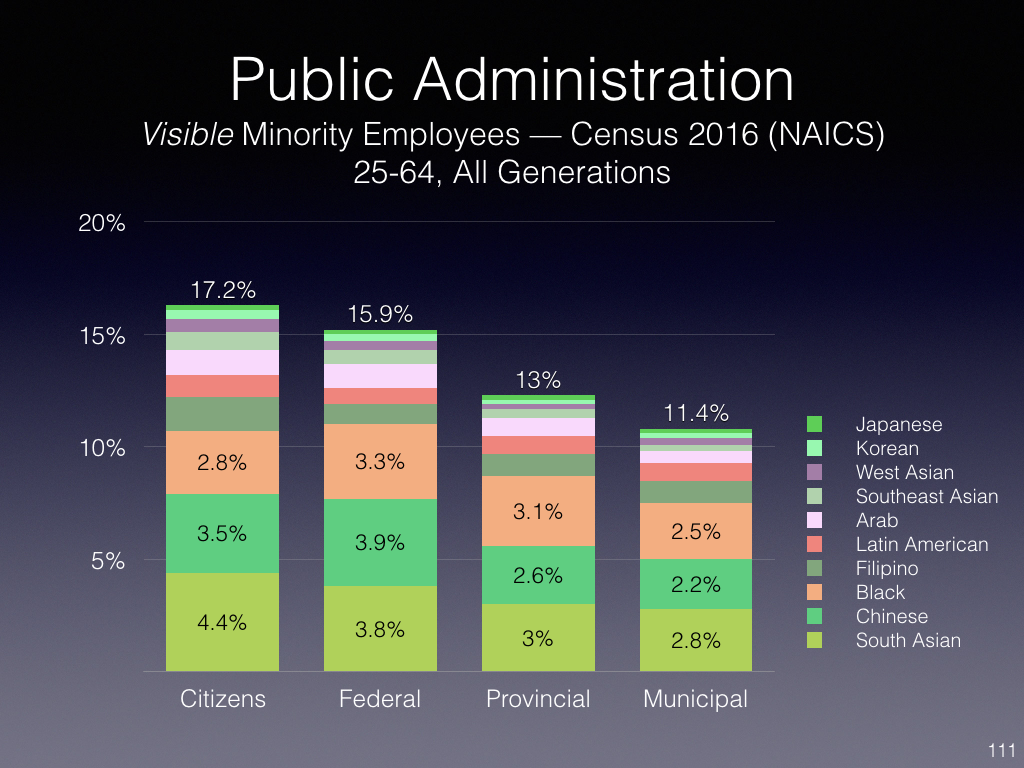
That being said, federal government representation of visible minorities, at 15.9 percent (2016 Census public administration less Canadian Forces, a number slightly higher than the most recent federal employment equity data), is relatively close to the percentage who are also Canadian citizens (17.2 percent, 2016 Census):

Ottawa’s Name-Blind Recruitment Pilot Project was launched in April 2017 to explore whether masking applicants’ names would remove bias in the hiring process for the federal public service. There was a lot to praise in this initiative of the Public Service Commission (PSC). Previous research, including some of our own, has shown that recruiters often react to the name on a resumé, independently of other factors such as education and experience. Our most recent publication (in the March issue of Canadian Public Policy) suggests that much of this discrimination is unconscious and unintentional, so employers actually could benefit from better hires by taking relatively straightforward steps to remove names during the initial stages of the selection process.

One similar and important example is the case of musicians auditioning for positions in popular orchestras in the United States. Traditionally orchestras have been male dominated, and criticized for discriminating against women. Researchers showed convincingly that orchestras that held auditions with the applicants performing behind a screen began to hire more women. Given that auditions are an effective means to observe productivity (music quality), the fact that more women were hired under this method suggests that orchestras previously were missing out on better musicians when gender was known. Most orchestras now audition using screens, showing a desire to avoid discrimination and make better hires. It’s a classic case of win-win-win: a win for women musicians getting more equal opportunity, a win for orchestras tapping a larger talent pool and a win for audiences enjoying better music.

However, the PSC’s hiring bias experiment has yet to yield such positive results. When the project report was released in January 2018, it appeared to show there was in fact “no bias” in federal public service hiring in the first place. This led Treasury Board President Scott Brison to write, “The project did not uncover bias.” National media disseminated this story. The CBC, for example, ran with the headline “No Sign of Bias against Government Job-Seekers with Ethnic-Sounding Names, Pilot Project Finds.” The article states that hiding ethnic-sounding names on resumés was found to have “no real bearing on who’s picked from the pile of applications.”
Unfortunately, this version of the results significantly misrepresents the actual findings of the pilot project. A careful reading of the report indicates that the pilot project was not really designed as a test of discrimination, and the report clearly acknowledged this fact.

The design of the pilot project included two features that would undermine its relevance in assessing the broader use of name-blind hiring. First, the project relied on departments within PSC that volunteered to take part, and within those, job openings were considered for inclusion as they arose; both features introduce a non-random element that undermines the value of the results. Second, and more important, all hiring managers in the project made their decisions knowing that they would be subject to review. For the managers using the traditional method, the awareness that their decisions would be scrutinized and compared with results from name-blind hiring made them more likely to be conscious of bias, and therefore more likely to alter their hiring decisions accordingly.

The procedure in the PSC pilot removed more than the applicant’s name; it also took out all other potentially identifying information — information that might have been useful in assessing the resumé. This was likely why anonymized applications in the pilot were less likely to lead to call-backs.

The report points out that a different study approach used to measure bias, called audit methodology, would have lessened the effect of managers’ awareness of being in a comparative study. Our own study used the audit methodology, in which employers are selected at random and are sent computer-generated resumés for assessment without advance notification. Such a procedure has been employed many times, in a number of countries.

Of course, it’s possible that discrimination against applicants with ethnic-sounding names doesn’t exist in the federal public service. For name-blinding to influence hiring decisions, there must be a problem to begin with. As the report mentions, the PSC is already taking steps to help ensure that the federal government is practising unbiased hiring, and it outlines several important initiatives.

Our research found that bias varies considerably among organizations. We’ve shown in data from Toronto and Montreal that large organizations with over 500 employees practise discrimination against applicants with Asian names about half as often as smaller organizations. This difference may well arise from a tendency for large organizations to have more policies in place to help avoid discriminatory behaviour. The potential benefits from name-blinding may be minimal for the federal government if it is already doing a good job minimizing bias.

However, to conclude that there is no bias in hiring within the federal public service on the basis of the January report — which clearly indicates that the pilot project was not designed to test bias effectively — may move efforts to promote fairness backward rather than forward. There is still a need to follow through on the good intentions that seemed to motivate the name-blind hiring pilot when it was first announced. Ideally, a study on the impact of name-blinding would first identify an organization where clear discrimination occurs, as shown through an audit, and then explore how name-blinding affects the chances of applicants getting an interview, and ultimately getting hired. Tellingly, the report suggested an audit study as a good next step “to improve the understanding of any potential bias during selection of candidates.” In fact, any organization, including the federal public service, that wishes to consider name-blind recruitment as a way to broaden its talent pool would be well-advised to consider an audit as a first step to test for bias.

It can be quite challenging to design an effective name-blind hiring procedure. The procedure in the PSC pilot removed more than just the applicant’s name; it also took out all other potentially identifying information — information that might have been useful in assessing the resumé. This was most likely the reason that anonymized applications in the pilot were less likely to lead to call-backs than traditional applications. One option would be to remove only the name, or only a very limited amount of other information in the resumés that might give away the visible minority status of the applicant. An automated tool for reviewing submitted resumés might be developed to facilitate this approach.

It’s critical that the desire of an organization to burnish its public image not stand in the way of ensuring a fair and equitable process of finding the best candidates for available jobs. It may feel great to say, “We didn’t uncover any bias.” But if bias does exist, it’s better to be able to say, “We found bias and we’ve taken meaningful steps to eliminate it.”

Source: Can we avoid bias in hiring practices?

Québec solidaire dévoile sa politique en matière d’inclusion

Quebec does not require Canadian citizenship as a pre-condition (Permanent Residents acceptable), nor make it a preference as does the federal government. Hence the overall number of visible minorities is a valid benchmark although I would still argue a more realistic one would the visible minority citizenship benchmark (9.9 percent):

Le Québec a un tel retard à corriger en matière d’inclusion qu’il faudrait que le secteur public se fixe un taux d’embauche de 25 % au sein des minorités visibles et ethniques jusqu’à ce que celles-ci représentent 18 % de la main-d’œuvre, affirme Québec solidaire (QS).

Convaincu d’un « coup de barre » à donner, le parti a dévoilé dimanche une politique qui, s’il était porté au pouvoir, prévoirait aussi la création de « Carrefours d’accueil en immigration ». Ceux-ci joueraient un rôle de « guichet unique » permettant d’orienter les nouveaux arrivants vers des services comme l’aide à l’emploi ou des cours de francisation.

« C’est là que le Parti libéral, qui est là depuis 15 ans, a le plus échoué : face aux nouveaux arrivants et arrivantes, face aux gens de la diversité culturelle, des minorités visibles », a dit la députée de Sainte-Marie–Saint-Jacques, Manon Massé, lors de la présentation de la politique dimanche en compagnie du député Amir Khadir, d’Andres Fontecilla, qui se présentera dans Laurier-Dorion, et de plusieurs autres candidats.

« Dans la fonction publique, il y a des règles. Elles sont à peine respectées. D’ailleurs, il manque énormément d’employés issus de la diversité culturelle au sein du secteur public », a ajouté Mme Massé. « Il faut un coup de barre. » Québec solidaire souhaite que le taux de représentation des communautés culturelles soit le même que dans la société, soit d’environ 18 %. D’ici 2024, la fonction publique devrait embaucher un « minimum » de 3750 personnes, a-t-elle dit. Le parti politique souhaite aussi travailler à la reconnaissance des compétences de l’étranger.

En mars 2017, les communautés culturelles comptaient pour 9,4 % des employés du secteur public, selon le Secrétariat du Conseil du trésor. Le gouvernement Couillard a déjà affirmé que le taux d’emploi des immigrants qui sont au Québec depuis plus de dix ans (81,9 %) est inférieur à celui des gens nés au Canada (86,2 %).

À quelques mois des élections, les annonces se succèdent. Le gouvernement Couillard a récemment annoncé une stratégie de la main-d’œuvre 2018-2023 qui promet une somme de 1,3 milliard sur cinq ans. Le plan insiste sur la francisation, mais aussi sur la réduction des délais dans la remise des certificats de sélection.

Le Parti québécois a proposé il y a deux semaines de travailler sur la sélection des immigrants en fonction notamment de leur connaissance du français. Il souhaite aussi qu’ils choisissent de s’installer pas seulement à Montréal, mais en région.

Du côté de la CAQ, des documents révélés récemment par L’actualité montrent que le parti veut mettre un accent particulier sur la francisation et souhaite réformer « en profondeur » le ministère de l’Immigration.

Outre les investissements supplémentaires en francisation, QS souhaite impliquer les entreprises. Par exemple, l’application de la loi 101, qui vise actuellement les entreprises de 50 employés et plus, couvrirait désormais les sociétés de 20 employés et plus.

Source: Québec solidaire dévoile sa politique en matière d’inclusion

Quebec: 3% de minorité visible dans la haute fonction publique

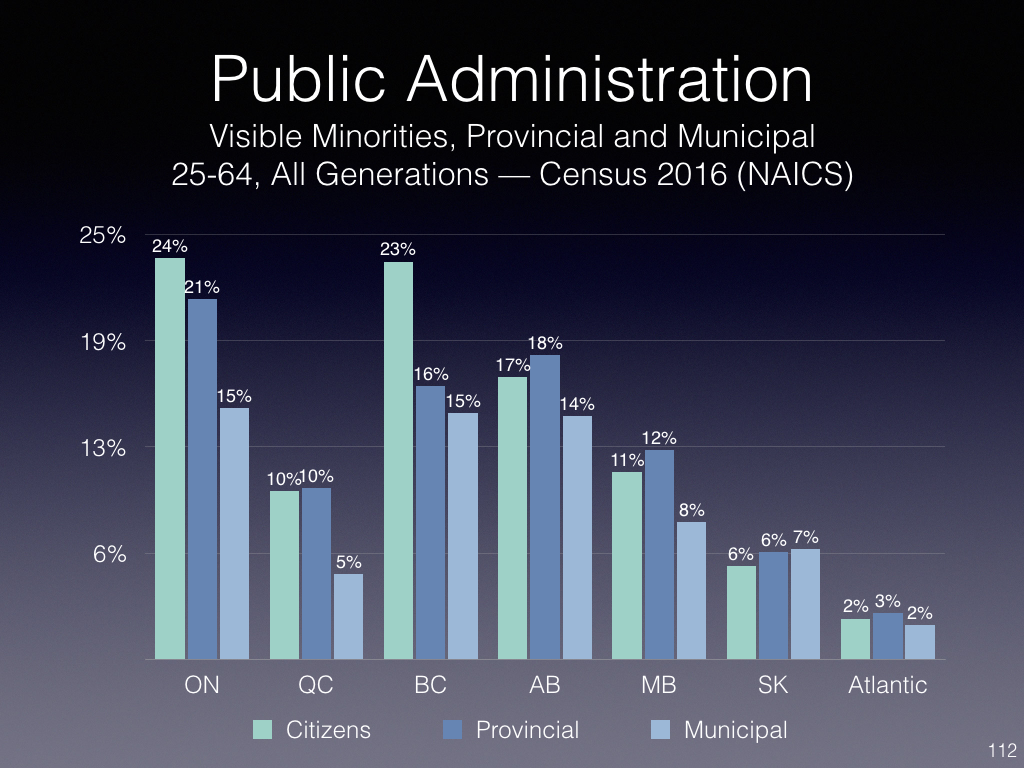
While I do not have breakdowns for senior management in all provinces (not all provide a breakdown like Quebec), this comparative chart on provincial and municipal diversity captures the overall picture (Census 2016 NAICS, visible minority numbers adjusted for citizenship):

Quelque 3% de personnes issues des minorités visibles ont été nommées à des postes de la haute fonction publique depuis 2014. Selon les données compilées par Québec solidaire (QS), parmi les 2330 personnes nommées à ces postes, seulement 72 proviennent des minorités visibles alors que celles-ci représentent 13 % de la population québécoise.

À Montréal, ce taux grimpe toutefois à 22,6 %. Bon an mal an, ce pourcentage est resté le même. De 2014 jusqu’à février 2017, le taux était de 3,7 % . En y ajoutant l’année 2018, en cours, ce taux s’établit à 3 %, selon les calculs de QS, chiffres qu’avait reconnus le Conseil exécutif.

Pour le député de QS Amir Khadir, c’est là un « constat d’échec lamentable » du gouvernement libéral au pouvoir. « Quand on parle de racisme systémique, c’est ça. La machine est structurée de telle sorte qu’elle discrimine, de manière systématique, tout ce qui n’est pas conforme. Ça vient par les accointances et les copinages au sommet », a-t-il déploré. « Si [Philippe Couillard] est sincère, il doit commencer à changer, au lieu de continuer avec des nominations partisanes et intéressées. »

En ce qui concerne plus largement la fonction publique, 9 % des effectifs sont des membres de communautés culturelles, ce qui comprend les minorités visibles et les minorités ethniques (dont la langue maternelle n’est ni le français ni l’anglais). Le gouvernement s’est engagé la semaine dernière à doubler ce pourcentage pour atteindre une cible de représentativité de 18 % des minorités.

via 3% de minorité visible dans la haute fonction publique | Le Devoir

Employment Equity in the Public Service of Canada for Fiscal Year 2016 to 2017: 2016-17 data delayed

Highly unusual for the EE data not to be included in the annual report (can’t recall this happening in recent years). The report’s explanation suggests that this is collateral damage of the Phoenix pay system.

That being said, better to take the necessary time for data verification than publish inaccurate data:

The 2016 to 2017 annual report features a 10-year trend analysis of the representation of the 4 designated groups and reports on results of initiatives that advance employment equity, diversity and inclusion. (Data for 2016 to 2017 will be provided at a later date and included with the report as an annex.) Over the past 4 years, the representation of each employment equity group in the core public administration has exceeded workforce availability. However, gaps persist in some departments and in certain occupational groups. We will continue our efforts to close these gaps.

…. Statistical tables for the 2016 to 2017 fiscal year in 7 areas will be published following:

  • retrieval of data from the Phoenix pay system
  • reconciliation of data with sources from the Public Service Commission of Canada and from departments and agencies
  • validation of the accuracy of the data to be published

via Employment Equity in the Public Service of Canada for Fiscal Year 2016 to 2017 – Canada.ca

No sign of bias against government job-seekers with ethnic-sounding names, pilot project finds

Given the overall employment equity numbers, and how representation at both the all employee and executive levels has continued to increase, not overly surprising but nevertheless helpful to have tested for bias:

Hiding ethnic-sounding names from resumes has no real bearing on who’s picked from the pile of applications for jobs in the federal public service, according to a pilot project on blind hiring.

A report released Tuesday by the Public Service Commission shows visible minorities were short-listed at roughly the same rate through a name-blind recruitment process (46 per cent) as through a traditional process (47 per cent).

“For visible minorities, results indicated no significant effect on the screening decisions of applications,” the report concludes.

The federal government launched the name-blind hiring pilot project last April to reduce bias in recruitment based on the names and ethnic origins of potential candidates.

In a blog post today, Treasury Board president Scott Brison said the pilot project aimed to see if unconscious bias was undermining hiring processes and the government’s efforts to build a more diverse public service.

He called the pilot “ground-breaking” and says it’s in line with the government’s focus on innovation and experimentation.

“The project did not uncover bias, but the findings do contribute to a growing body of knowledge,” he wrote.

“They provide us with insights to further explore in our steadfast support of diversity and inclusion in the public service; two critical characteristics of an energized, innovative and effective workforce, able to meet the demands of our ever-changing world.”

17 departments participated

The pilot project included 17 departments and 27 external hiring processes between April and October 2017. It had a sample of 2,226 applicants, including 685 members of visible minorities (just under 31 per cent.)

Jobs were in the scientific and professional, administrative and foreign service, technical and administrative support, and operational fields.

Applications in the blind process had the name, citizenship, country of origin, mailing address, spoken languages, references to religion, and names of educational institutions removed. The objective was to determine if applicants with ethnic-sounding names were disadvantaged in the screening process.

While the findings did not reveal any bias, the report notes that reviewers were aware they were participating in the blind recruitment project, and that “this awareness could have potentially affected their assessment.”

Because the number of candidates who self-declared as Indigenous (73, or three per cent), or disabled (102, or five per cent,) was small, the analysis was limited to visible minorities.

Among the participating departments were National Defence; Natural Resources; Immigration, Refugees and Citizenship; Global Affairs, the RCMP and Statistics Canada.

Similar studies

The report notes other studies on blind hiring have had mixed results.

A 2011 study in the Australian Public Service found that de-identifying applications at the short-listing stage did not appear to help promote diversity.

“In fact, when all candidate’s information was made available, reviewers discriminated in favour of female and visible minority candidates,” the report reads.

Benefits of name-blind recruitment may be partly dependent on the context of the organization, including whether discrimination is present in the hiring process and whether the organization has policies aimed at improving diversity.

In October 2015, the U.K. Civil Service implemented name-blind recruitment to reduce unconscious bias and boost diversity, but no systematic review of the impact has been carried out yet.

via No sign of bias against government job-seekers with ethnic-sounding names, pilot project finds – Politics – CBC News

ICYMI – Immigration: Gérard Bouchard plaide pour des quotas d’embauche | Réjean Bourdeau | Actualités

Interesting. Personally, I favour the federal approach of transparency and annual reporting for the public service and federally-regulated sectors, which has worked reasonably well over the last 25 years or so but Quebec numbers, last time I checked, are particularly low:

Que faut-il faire pour voir grandir le sentiment d’appartenance des immigrants à l’égard du Québec?

Il faut réussir leur intégration économique et sociale. Quelqu’un d’exclu et victime de discrimination ne développera jamais de sentiment d’appartenance. Pour sensibiliser quelqu’un et pour le faire vibrer à nos valeurs, il faut d’abord lui donner un travail. Et là-dessus, on a vraiment mal joué nos cartes. Le sous-emploi chez les immigrants bouge peu parce qu’on ne fait pas ce qu’il faut. Le gouvernement pourrait mettre en oeuvre des programmes. Une espèce d’affirmative action, comme ils ont fait aux États-Unis pour créer une classe moyenne afro-américaine. Ça prendrait quelque chose de massif, de déterminé. Qui serait soutenu par la population. Qui serait enveloppé dans un discours. Mais nous, on ne le fait pas.

Pourquoi on ne le fait pas?

Il n’y a pas de volonté politique pour ça. Quand il y a eu la tuerie dans la mosquée de Québec en janvier dernier, le premier ministre Couillard a dit : «Il y a eu un avant et il y aura un après.» Ça laissait entendre que cet événement avait été d’une horreur telle que plus rien n’allait se passer de la même manière. Qu’on allait changer les choses en profondeur. Mais il n’y a rien eu. Ce n’est pas la loi 62 (respect de la neutralité religieuse de l’État) qui va régler les problèmes. Et la Consultation sur la discrimination systémique et le racisme n’a pas levé. Ça s’est transformé en Forum sur la valorisation de la diversité et la lutte contre la discrimination qui a lui-même commencé à branler.

Quel type de politique d’intégration faut-il mettre en oeuvre pour offrir des emplois aux immigrants?

Il faut créer des conditions favorables pour réparer le retard social qu’ils ont accusé. Alors, ça va prendre un discours politique qui a beaucoup d’autorité pour faire accepter ça à la population. Parce que plusieurs pourraient dire : «Non, non, l’égalité, ce sont les mêmes conditions pour tout le monde.» Mais il va falloir faire plus que ça, parce que là, c’est quelque chose de structurel.

Que proposez-vous?

Il faut instituer des quotas. Un peu comme on l’a fait pour l’égalité hommes-femmes. Ça, ce sont des choses très concrètes. On fixe la barre. Par exemple, il faut qu’il y ait la moitié des femmes dans les conseils d’administration. Et il y a des organismes de surveillance pour voir comment ça se passe. Pour les travailleurs immigrants, on pourrait soumettre les entreprises à certaines règles pour l’embauche. Bref, il y a plein de mesures qui pourraient être appliquées. Mais il faudrait que ce soit enveloppé dans un discours politique qui rend la chose acceptable à l’ensemble de la population. Autrement, ça va passer pour une injustice, pour des privilèges aux immigrants. Et ce discours-là est déjà présent.

Pourquoi les travailleurs immigrants sont-ils moins recherchés?

D’abord, il y a une forme de corporatisme quand vient le temps de reconnaître les diplômes obtenus à l’étranger. De plus, il y a, étrangement, certaines résistances syndicales à l’embauche d’immigrants dans la fonction publique. Ensuite, du côté des PME, on se tourne souvent vers des connaissances, des parents (appelons ça «le facteur cousin»), quand vient le temps d’engager. Ce facteur est beaucoup moins présent dans les multinationales.

Quels sont les impacts de ce type de discrimination?

Je me suis souvent fait dire par des immigrants, ou par des membres des minorités, qui étaient sans emploi : «M. Bouchard, votre modèle d’interculturalisme, ça a du bon sens, mais pourquoi ce serait très important pour nous… on n’a pas d’emplois. Nos enfants nous regardent et nous demandent pourquoi on ne travaille pas.» Si quelqu’un n’a pas d’emploi, il ne peut pas rêver. Le sensibiliser à nos symboles, à nos valeurs, à nos combats, ça ne marche pas. Il faut d’abord qu’il retrouve un sens de la dignité. Un grand nombre d’immigrants sont humiliés de ne pas avoir d’emploi et de vivre aux crochets de la société dans laquelle ils vivent.

via Immigration: Gérard Bouchard plaide pour des quotas d’embauche | Réjean Bourdeau | Actualités

Diversity in the public service’s executive ranks

My latest, looking at how women, visible minorities and Indigenous people are represented in the highest ranks of the federal public service (DMs and EXs).

The following two charts summarize the historical evolution of how transparency and regular reporting have resulted in a more diverse public service at the overall and executive levels:

Source: Diversity in the public service’s executive ranks

Canada is a leader in public sector gender equality, says new report

Stay tuned for my upcoming analysis of current and historical EX diversity (women, visible minorities and Indigenous peoples):

Canada is a global leader when it comes to gender equality in the public sector’s senior levels, according to a recent report by Global Government Forum, a research group focused on issues facing civil servants.

At 46.4 per cent, Canada has the highest proportion of female senior civil servants of any G20 country, according to the report. Australia and South Africa trail close behind at 43.3 and 41.1 per cent, respectively.

“This kind of progress produces big rewards in terms of better decision-making, bigger talent pools and, ultimately, stronger public service delivery for the public,” Kevin Sorkin, Global Government Forum’s managing director said in a written statement.

“But there is more work to do: we hope that publishing this data will help senior officials both to make the case for change, and to identify the best ways to make progress.”

The index records the proportion of women employed in the top five grades of the senior civil service in each of the G20 countries. This group comprises of roughly the top one per cent of public officials, defined as non-elected senior executives across federal or national governments, or the executive ranks of the core civil service in central government.

In the report, Clerk of the Privy Council Michael Wernick describes Canada as an early adopter of equal rights and anti-discrimination policies, arguing that the country is now experiencing a third wave of gender equality.

“First there were the real pioneers – the first women in jobs or at various tables – then the second wave was probably in the ‘90s, when you saw more and more women in positions of responsibility and the numbers started to move up quite a bit.

“So now we’re in the third wave, which is more about workplace culture: how meetings are conducted; avoiding ‘mansplaining’ and ‘manterruption’; tackling unconscious bias – that more subtle and nuanced stuff.”

Alongside the data on senior civil servants, the report includes figures about the proportion of women among the G20 member nations’ cabinet ministers, national parliamentarians, and directors on the boards of publicly-quoted private companies. A separate section tracks the proportion of women among the most senior civil service leaders of EU countries.

The research was supported by international business services firm EY, formerly known as Ernst & Young.

The top five G20 countries in the 2016-17 Index are:

  • Canada (46.4 per cent)
  • Australia (43.3 per cent)
  • South Africa (41.1 per cent)
  • U.K. (40.1 per cent)
  • Brazil (37.8 per cent)

Wernick said in a statement to the Citizen that “there has been some real leadership on increasing representation of women in positions across the full spectrum of public service jobs, starting with getting more women to the table and then into positions of responsibility.

“We are now tackling some tough issues with respect to inclusive workplaces, and the dialogue has shifted beyond representation and binary definitions of gender, to diversity as an asset that helps us better serve Canadians and creating a workplace where all employees feel engaged and respected,” Wernick said.

Source: Canada is a leader in public sector gender equality, says new report | Ottawa Citizen

Report link: Canada tops gender equality ranking – but Australia gaining fast. More…

Your name may dictate your apartment, degree, and career: Kutty

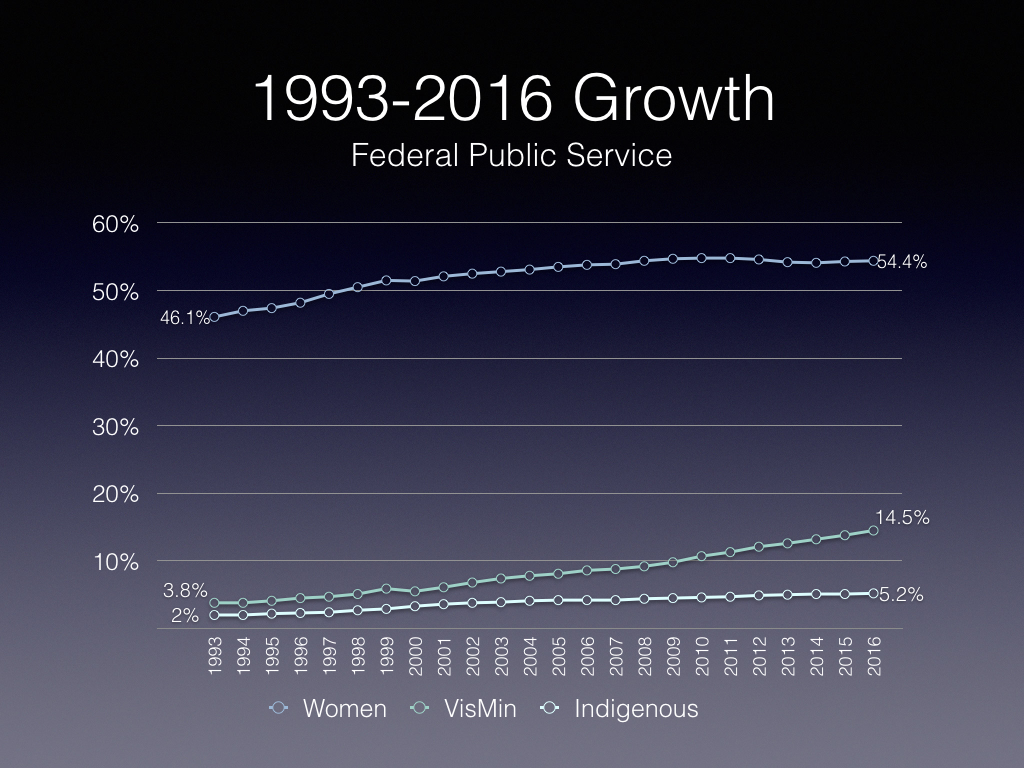
Ironically, although singling out the federal public service and its pilot project, Kutty is silent on the overall numbers which are largely representative of the visible minority population who are also Canadian citizens – 15 percent (some visible minority groups do better than others).

Above chart shows the 25 year trend for women, visible minorities and Indigenous peoples:

Having found the perfect rental property near the law school, a student of mine could not get a call back from the landlord despite repeatedly leaving messages. When a friend of his called, the call was returned within minutes.

Why?

Well, my student’s name was Mohamed. His friend used the name “Joe.”

Many Canadians with non-Anglicized names can speak of similar experiences. A CBC Marketplace segment from last year, for example, explored the idea of implicit bias affecting shoppers, apartment-seekers and job-hunters across Canada, finding that those with “foreign-sounding” names tended to face challenges that the “Joes” of the country did not.

That phenomenon in mind, then-rookie MP Ahmed Hussen — who has since been named immigration minister — introduced the idea of bringing name-blind recruitment to the civil service in Parliament last year. At the time, he said the move would “assist in our fight to end discrimination and attain real equality in our country.”

Ottawa has now adopted as a pilot project involving six federal ministries: National Defence, Global Affairs, Immigration, Refugees and Citizenship, Public Services and Procurement, Environment and Climate Change and the Treasury Board.

According to the Treasury Board, the initiative will “conceal an applicant’s name, email addresses, employment equity information (i.e., gender, visible minority, person with a disability, Indigenous peoples), names of educational institutions, and country of origin at the initial screening stage.” The results will then be compared to outcomes from traditional applicant shortlisting and will be made available in a report due in October.

There is not much available data yet other than figures showing there has been a slight decrease in the number of visible minority applicants from the year 2012-13 to 2013-14 and subsequent years. One can hope that this initiative would reverse that trend.

As with most government pilots, there are surely some critics wondering why the federal civil service is busying itself with such projects.

Well, first off, there shouldn’t be any dispute that this is indeed a problem. A joint study from the University of Toronto and Ryerson University found that job applicants with Asian-sounding names received 20.1 per cent fewer calls from large organizations than those with Anglo names, and 39.4 per cent and 37.1 per cent fewer calls, respectively, from medium-sized and small employers.

A similar study by the U of T in 2011 — one called “Why do some employers prefer to interview Matthew, but not Samir?” — found that employers in Toronto, Montreal and Vancouver were about 40 per cent more likely to interview candidates with Anglo-sounding names, as opposed to those with Chinese or Indian-sounding names, even if the candidates were equally qualified. The government’s pilot project aims to remedy this.

The idea is not new, in fact. Countries such as the U.K. and Australia have led the way in this regard. The British Civil Service and some of the large corporations including HSBC, Deloitte, BBC, and the U.K.’s National Health Service, initiated such a program in 2015. Last year, the Victoria Police, Australia Post and Ernst & Young (Australia) joined a recruitment program that strips out gender, age and cultural details.

Here in Canada, many law schools have implemented a blind grading system whereby students’ names are replaced by numbers to avoid instructor bias. And the Toronto Symphony Orchestra has demonstrated the success of blind auditions for years — evolving from a white, male orchestra in the 1970s to one that is now half female and much more diverse.

A name-blind recruitment process for the federal government is hardly more cumbersome in procedure, and the makeup of the civil service only stands to gain. A more reflective service will have more credibility with the populace but will also better understand the public it is serving. Moreover, as a recent study demonstrated there is a positive correlation between diversity and increased productivity.

That said, as many critics point out: name-blind screening is not a panacea — unconscious biases can’t be eliminated with one little recruitment remedy, and candidates will eventually be evaluated face to face. But removing a barrier to diversity in the federal civil service is a positive step, even if it is a minor one.

Let’s hope that this is just one component of a more comprehensive strategy involving: management acknowledging and confronting their own biases; better training on how biases impact decision-making; more objective hiring processes; and a more diverse group involved in the actual hiring process.

Source: Your name may dictate your apartment, degree, and career: Kutty | Toronto Star