Ethnic media election coverage 7-12 October
2019/10/15 Leave a comment
Latest weekly analysis of ethnic media coverage. For the analytical narrative, go to Ethnic media election coverage 7-12 October:
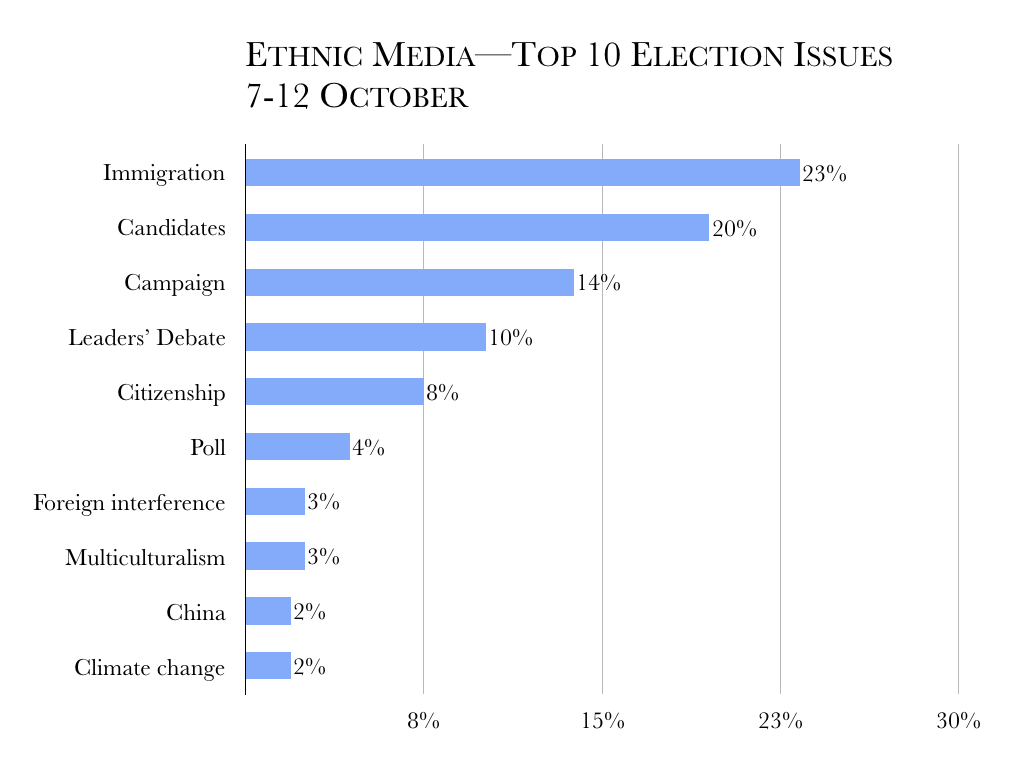
Working site on citizenship and multiculturalism issues.
2019/10/15 Leave a comment
Latest weekly analysis of ethnic media coverage. For the analytical narrative, go to Ethnic media election coverage 7-12 October:
2019/10/07 Leave a comment
Latest weekly analysis of ethnic media coverage. For the analytical narrative, go to Ethnic media election coverage 29 September to 5 October: UPDATE

2019/09/30 Leave a comment
Latest weekly analysis of ethnic media coverage. For the analytical narrative, go to Ethnic media election coverage 22-28 September:

2019/09/28 Leave a comment
What one would expect given other polling data but still of interest:
Conservatives and Liberals tend to agree that jobs and the economy should rank high when it comes to the immigration file, but concerns for the plight of refugees and integration of immigrants depends on where one falls on the political spectrum, suggests a new study released today.
Whereas many Conservatives prioritize on cultural values, national security, and jobs, the Liberals and NDP place less importance on those concerns, according to a survey from the Digital Democracy Project, a months-long effort that the Public Policy Forum and McGill University’s Max Bell School of Public Policy are leading.
“Partisans differ in terms of what they’re talking about when they talk about immigration, what dimensions … they think about,” said Peter Loewen, a political science professor at the University of Toronto’s Munk School of Global Affairs, one of the report’s authors.
Respondents were asked to rank eight dimensions related to immigration, including social services and welfare; diversity and multiculturalism; and illegal immigration, were of high concern.
For example, Conservative partisans expressed more concern over illegal immigration than other partisans, with 42 per cent saying it’s a concern, compared to 28 and 27 per cent of respondents who identified as Liberal and NDP supporters, respectively, the survey suggested.
The data, based on an online panel survey of 1,559 Canadians, was conducted from Sept. 11 to 16. Online polls are not considered to be truly random and cannot be assigned a margin of error.
There are marked differences between the Liberals and NDP on the immigration file, too. NDP supporters rank Canada’s responsibility towards welcoming refugees as higher on the list over jobs and the economy, while Liberal supporters indicated it as less of a priority, with 29 per cent choosing it as a top concern, compared to 44 per cent who identify with the NDP.
Researchers also found that most Canadians are misinformed about Canada’s immigration levels and refugee intake. Asked how many refugees Canada admitted in 2018, only 12 per cent answered correctly, 61 per cent were unsure, and 24 per cent said it was higher than the actual figure of 28,000.
“The worrying takeaway is that the more people are exposed to traditional news, to social media, the more likely they are to give incorrect answers about immigration levels, refugee intake levels,” Prof. Loewen said. “People are taking misinformation from somewhere in the ecosystem.”
Nativism could also explain differences in views on immigration policy, the report noted. In seeking to measure the level of nativist sentiments with a series of questions, researchers found that while Canadians “exhibit modest levels of nativism,” Liberal and NDP supporters have lower scores than Conservative supporters. (To measure respondents’ openness to nativist sentiments, they were asked to rate six statements, including whether they agree “immigrants take jobs from real Canadians” and if Canada “would be stronger if we stopped immigration,” on a five-point scale.
Attempts to provide information on the economic benefits of immigration had an influence on respondents’ perception of immigration, according to the study. Half of respondents were given an excerpt from a 2018 Conference Board of Canada report that said immigrants are key to economic growth. Among those who weren’t given the report, 23 per cent said immigration was bad for the economy and 57 per cent said it was good. Those figures changed slightly to 19 per cent and 63 per cent among those who viewed the report.
“While theories of motivated reasoning suggest that partisan respondents will reject information that doesn’t conform to their existing values or beliefs, the effect of this intervention was stronger for right-leaning partisans than for left-leaning partisans,” the report noted. “…This suggests that providing the public with relevant information could also influence their opinions on public policy, and that nativism is not as much of an immutable sentiment as commonly believed.”
Though Canada isn’t immune from nativist and populist sentiments, the report noted that such expressions don’t mimic the trends in the U.S. and “far-right parties in Europe.” The report suggested that the embrace of populist sentiments is “most common” among NDP supporters than Liberals, while the Conservatives are in between.
Previous studies from the Digital Democracy Project have looked at how Canadians consume and share media and its effects on their support for policies in the lead-up to the federal election.
2019/09/23 Leave a comment
Latest weekly analysis of ethnic media coverage. For the analytical narrative, go to Ethnic media election coverage 15-21 September:

2019/09/19 Leave a comment
Some interesting on the ground reporting in addition to the overall story:
Le Canada compte désormais 41 circonscriptions composées majoritairement de minorités visibles. C’est huit de plus que lors des dernières élections fédérales. Ces champs de bataille clés, souvent des comtés pivots, pourraient jouer un rôle décisif le 21 octobre. Les conservateurs qui avaient perdu la grande partie de ce bloc en 2015 sont-ils mieux placés pour regagner ces sièges?
Quelque chose d’ironique s’est produit dans la circonscription d’Ajax, en banlieue de Toronto.
Elle a connu la plus forte hausse de résidents issus des minorités visibles. Un bon de 11 % en 5 ans.
L’ironie? Ce comté était représenté par l’ancien ministre de l’Immigration, Chris Alexander, défait en 2015.
C’est lui qui avait présenté la promesse électorale conservatrice d’instaurer une ligne de dénonciation pour signaler des cas présumés de
pratiques culturelles barbares. Cette annonce lui a collé à la peau et s’est ajoutée aux prises de position controversées des conservateurs, tant sur la révocation de la citoyenneté que sur le niqab.Tout cela allait être néfaste pour Stephen Harper et son parti, qui avaient mis tant d’efforts à conquérir les communautés culturelles.
Linda et Ernest Ombrog, d’origine philippine, demeurent à Ajax. En cinq ans, cette circonscription à l’est de Toronto a connu la plus forte hausse de population de minorités visibles au Canada.
PHOTO : RADIO-CANADA / MARC GODBOUT
À la gare de train de banlieue d’Ajax, un couple originaire des Philippines attend le prochain départ. Linda et Ernest Ombrog ont entendu parler de cet épisode même s’ils sont arrivés au Canada après l’élection fédérale de 2015.
Nous n’avons pas tout à fait confiance, dit Ernest Ombrog.Je ne crois pas que nous voterons pour les conservateurs, ajoute sa femme.Quelques mètres plus loin se trouve Abdol Nadi, un chirurgien devenu chauffeur de taxi. Cet Afghan raconte que la plupart des immigrants qui se sont installés à Ajax dans les dernières années sont surtout originaires du Tadjikistan, de l’Inde, du Pakistan et de l’Afghanistan. Plusieurs sont ses clients.
Abdol Nadi d’origine afghane est au volant de son taxi à Ajax, en Ontario.
PHOTO : RADIO-CANADA / MARC GODBOUT
Je sens une méfiance chez certains, à tort ou à raison. Même si je trouve que les libéraux sont loin d’être parfaits, je préfère encore les appuyer, affirme-t-il.Les stratégies de campagne de 2015 semblent toujours avoir laissé un goût amer, à tout le moins dans ce comté.
De 33 à 41
À l’époque, Ajax ne faisait pas encore partie des circonscriptions fédérales dont la population est majoritairement composée de minorités visibles. Elle est une des huit circonscriptions qui se sont ajoutées à la liste depuis 2015.
Andrew Griffith, expert en multiculturalisme, a décortiqué les données. Cet ancien haut fonctionnaire du ministère de l’Immigration constate que 27 de ces 41 circonscriptions sont situées en Ontario, 9 en Colombie-Britannique, l’Alberta et le Québec en ont chacune 2 tandis qu’une autre se trouve au Manitoba.
On ne peut pas gagner de gouvernement majoritaire sans gagner ces comtés-là.
Lors du scrutin de 2015, les libéraux ont décroché 85 % de ces circonscriptions, 35 sur 41. Les conservateurs et les néo-démocrates ont dû se contenter de trois sièges chacun.
Andrew Griffith explique qu’on ne peut plus parler des populations immigrantes comme d’un bloc monolithique.
Les groupes qui sont arrivés il y a 20 ans ont peut-être une tendance à être plus conservateurs. Mais ceux qui ont suivi ne sont pas liés automatiquement et continuellement à un parti politique, précise le chercheur.Les placer dans des cases précises serait une erreur, selon lui.
Ils peuvent faire un virage plus à gauche comme ils peuvent faire un virage à droite.
Ce sont des circonscriptions pouvant passer d’un parti à l’autre. Bien entendu, cela a une incidence constante sur les stratégies électorales des différents partis.
Andrew Griffith, expert en multiculturalisme et ancien haut fonctionnaire au ministère de l’Immigration.
PHOTO : RADIO-CANADA / MARC GODBOUT
En 2011, les conservateurs avaient gagné la majorité de ces comtés. En 2015, ils sont passés aux mains des libéraux. Et fait à considérer, lors de l’élection provinciale ontarienne de 2018, Doug Ford et les progressistes conservateurs les avaient presque tous raflés.
Kenney, la carte maîtresse?
Les conservateurs aimeraient bien pouvoir compter sur le premier ministre albertain Jason Kenney dans cette campagne pour venir donner un coup de main à Andrew Scheer dans certaines de ces circonscriptions en Ontario. Ce scénario est toujours sur la table même si aucune stratégie n’a encore été arrêtée.
Jason Kenney, autrefois ministre de l’Immigration du gouvernement Harper, avait été l’architecte de la grande séduction du Parti conservateur à l’endroit des communautés culturelles.
Mais le simple fait de vouloir avoir recours au premier ministre albertain démontre que
les efforts de rapprochement n’ont pas été suffisantsdepuis l’arrivée d’Andrew Scheer à la tête de son parti, estime Ghanaharan S. Pillai.
L’interaction entre les communautés et le Parti conservateur n’est plus celle qu’elle était sous les années Harper.
Pourtant, ils auraient une occasion à saisir.
Selon cet animateur à la radio et télévision tamoule de Toronto qui observe depuis des années le jeu politique dans les communautés culturelles, Justin Trudeau ne jouit pas nécessairement de la même popularité qu’en 2015.
Si les libéraux ont maintenu leur base, ils ne l’ont pas pour autant élargieajoute-t-il.Mais les conservateurs ne contrôlent pas tout. Au-delà du travail sur le terrain, pour Ghanaharan S. Pillai, le principal défi pour eux est de surmonter un obstacle susceptible d’avantager ses adversaires : Doug Ford.
Le premier ministre ontarien a été porté au pouvoir notamment grâce à l’appui de cet électorat composé majoritairement d’immigrants. Or, depuis,
Doug Ford a particulièrement mauvaise presse dans les médias multiculturelsconstate Andrew Griffith qui analyse régulièrement leur contenu.Ils sont très sévères à son endroit.Le facteur médiatique
C’est un facteur non négligeable.
Il existe pas moins de 600 médias multiculturels au Canada. Plus de la moitié se trouvent dans la grande région de Toronto. Leur influence est importante dans les communautés.
Un résident de Brampton, en Ontario, lit un journal en pendjabi.
PHOTO : RADIO-CANADA / MARC GODBOUT
Dans ses émissions de radio, Ghanaharan S. Pillai est à même de constater
le sérieux bris de confianceenvers Doug Ford qui s’est créé après à peine 15 mois.À quel point cette méfiance se répercutera-t-elle contre Andrew Scheer?
À quel point le chef conservateur réussira-t-il à faire oublier les stratégies de campagne de 2015?
L’enjeu est majeur. Après tout, 41 circonscriptions, c’est désormais 9 de plus que celles des quatre provinces de l’Atlantique réunies. 41, presque le même nombre de sièges qu’en Colombie-Britannique.
Source: 41 circonscriptions multiculturelles pourraient faire pencher la balance
2019/09/16 Leave a comment
Latest weekly analysis of ethnic media coverage. For the analytical narrative, go to Ethnic media election coverage 8-14 September: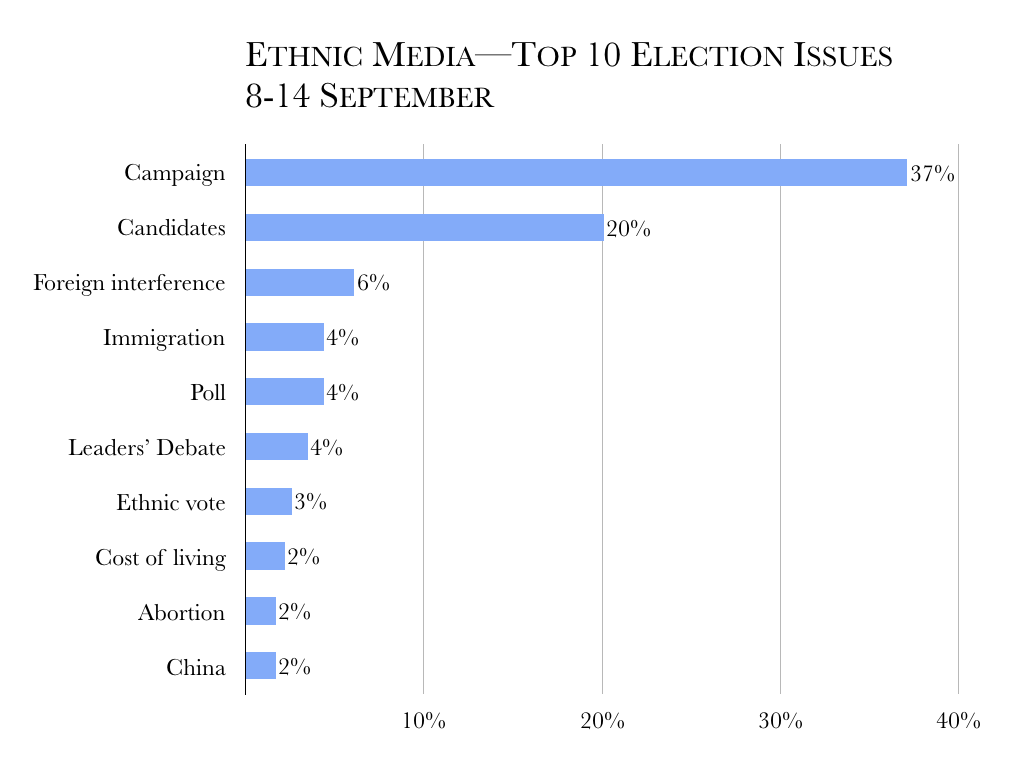
2019/09/16 Leave a comment
Predictable result of the change allowing voting to expatriates without restriction compared to the previous five-year limit.
To date, the number of registered expatriate voters according to the article is 20,000 compared to about 15,000 when the restriction was in place for the 2015 election.
Elections Canada does not provide a riding-level breakdown of expatriate registration and voter turnout, but has provided a list of registered voters by country (see after the article) so hard to assess which ridings will be most affected.
The Conservatives have been cultivating Canadian expatriates in Hong Kong for some time (not sure if the other parties have):
A few days before the federal election campaign got rolling in Canada, it was already underway for Conservatives in Hong Kong.
Former foreign affairs minister John Baird rallied the overseas troops at two events, while volunteers from Canadian Conservatives in Hong Kong helped people register to receive their mail-in ballots.
Notice of last Thursday’s event at a sports bar in Central and one on Sunday in Tsim Sha Tsui was posted on the group’s Facebook page with instructions to bring passports if they wanted to get registered.
The Conservative Party of Canada’s official website also has a page for the group where its invitation to the first event remains prominently displayed.
But a party spokesman said none of it — the event, the fancy logo with the Conservative Party of Canada’s C circling a red junk that’s long been Hong Kong’s tourism symbol or even helping voters get ballots — is affiliated with the party.
But if it’s not party-sanctioned, then why is it on the Conservative Party of Canada’s official website?
“An unaffiliated group of Canadian volunteers living abroad asked if we could host a webpage for their event to help other Canadians living abroad register to vote through Elections Canada’s process and exercise their right as Canadian citizens to participate in our democratic process,” said Simon Jefferies. “We obliged.”
Well, lucky for the Conservatives.
No other party has such eager overseas volunteers in Hong Kong, where there are an estimated 300,000 Canadians — or anywhere else for that matter.
Potentially, the Hong Kong votes could be decisive in Metro Vancouver, Toronto and even Calgary ridings because overseas Canadians vote in the riding where they last lived. But, so far, only 865 have registered as of this week, according to Elections Canada. Globally, fewer than 20,000 have registered with nearly half of those living in the United States and most of the others living in Britain, Australia and Germany.
This is the first time in 25 years that all Canadians living abroad are eligible to vote in the federal election. The Canada Elections Act was amended last year in advance of a January ruling by the Supreme Court of Canada that voting is “a fundamental political right, and the right to vote is a core tenet of our democracy.” Two Canadians living in the United States launched the Charter of Rights challenge in 2011 after Stephen Harper’s Conservative government began more strictly enforcing a 1993 change to the Canada Elections Act. That change denied the vote to Canadians who had lived abroad for five years or more.
It’s also, lucky for the Conservatives that Baird in his new role as a senior business advisor for a big Canadian law firm makes frequent visits to Hong Kong and China, and has lost none of his partisan zeal.
“Obviously we want Canadians living abroad to support the Conservative Party and make Andrew Scheer the next prime minister of Canada,” Baird said prior to his speech. “So, I’m here to encourage people to register and support him. “
That interview plus coverage of the event is posted on YouTube.
“What I hope is that an Andrew Scheer-led government can bring in more competent foreign policies and be able to re-engage with China and so we can be a strong, respected partner with China.”
The unaffiliated Conservatives’ organizers include Barrett Bingley from The Economist Group, who holds executive positions with both the American and Canadian chambers of commerce in Hong Kong, and Brett Stephenson, director of the Asia Business Trade Association.
The group’s Facebook page was only set up on August 28. And while it was set up as “a political organization,” it has yet to register as a third-party under the Elections Act.
Elections Canada spokesperson Natasha Gauthier didn’t know anything about Canadian Conservatives in Hong Kong. But she did outline the rules and noted that enforcement is done on a complaints-based system.
Regardless of where they live, any Canadian individuals or organizations spending $500 or more on partisan activities during the campaign and even in the pre-election period (which began June 30) must register. They need a bank account, a financial agent and an auditor if they spend more than $10,000.
They need to file revenue and expense statements. They need to list their donors because these are challenging times for democracies under threat from foreign interference and influence.
Gauthier emphasized that any person or organization that isn’t Canadian is forbidden from participating as third parties and as donors.
There’s also no official role for political parties to play in registering voters. That’s Election Canada’s job. Even the role of Canadian embassies and consulates is limited to printing out forms or pointing citizens to the Elections Canada website where people can register online and request their mail-in ballots. But they must get them back by Oct. 21. The deadline to register is Oct. 15, but Canadian Conservatives warn that getting it from Hong Kong to Ottawa by voting day means mailing it by Oct. 5.
These are troubled times in Hong Kong and at home in Canada. Linked by history and blood, both are now struggling in China’s dark shadow to preserve the rights and values that have enabled both to thrive.
But with protesters battling in Hong Kong’s streets, there are few places in the world where the right to vote in fair elections holds more meaning.
Source: Daphne Bramham: Conservatives go hunting for overseas votes
Source: Élections Canada lève le voile sur la liste des pays étrangers où résident des Canadiens
2019/09/09 Leave a comment
Latest weekly analysis of ethnic media coverage. For the analytical narrative, go to Ethnic media election coverage 1-7 September

2019/09/03 Leave a comment
Latest weekly analysis of ethnic media coverage. For the analytical narrative, go to Ethnic media election coverage 25-31 August

Click image for book purchase





 Multicultural Meanderings