Canadian economists are questioning why Ottawa is setting record immigration targets in the middle of unprecedented unemployment caused by the pandemic.
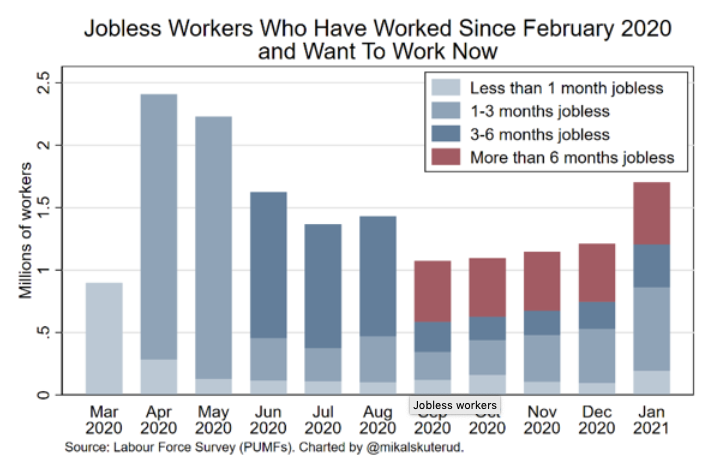
More than 1.7 million Canadians are looking for work, and the economists are warning that the Liberals’ aggressive new target of more than 400,000 new immigrants in 2021 will likely hurt the country’s low-skilled workers, particularly those who have recently become permanent residents.
“It makes no sense,” says University of Waterloo economist Mikal Skuterud, who specializes in Canadian immigration and the labour market. An immigrant himself, Skuterud is joining other economists in questioning why Ottawa has officially claimed its elevated targets are “crucial to Canada’s short-term recovery.”
Even though Skuterud strongly advocates immigration, particularly for humanitarian reasons, he wonders why the Liberals this month drastically lowered the standards for the skills expected of those looking to become Canadian citizens through the country’s economic-class express-entry program.
“As an economist who has studied Canadian immigration for more than two decades, I struggle to understand how increasing immigrant entries in the midst of an economic crisis with historically high and rising levels of joblessness will aid our short-term economic recovery,” he said. “It is unusual for countries to significantly increase immigration levels during recessions, for good reason.”
Largely because of COVID-19 travel restrictions, Canada’s immigration levels fell to 184,000 in 2020, short of Ottawa’s target of 341,000. The new goal of more than 401,000 over each of the next three years is 60 per cent higher than the 2015 level, when Prime Minister Justin Trudeau’s Liberals were first elected.
Despite the economic benefit claims made by Immigration Minister Marco Mendicino, Skuterud is not alone in pointing out that high immigration bolsters Canada’s gross domestic product, but doesn’t necessarily improve GDP per capita. U.S. Senator Bernie Sanders, who unsuccessfully ran on the Democratic Party’s left for the presidential nomination, is among those who have been criticizing right-wing businesspeople who want more open borders so they can bring in migrants who will work for low wages.
With more than 1.7 million Canadians looking for work, economists ask why Ottawa has a new, higher target of more than 400,000 new immigrants in 2021. (Source: U. of Waterloo professor Mikal Skuterud)
“I continue to be baffled at how the ‘increased immigration is crucial for Canada’s economic survival’ narrative has taken hold of our policy discourse. I challenge anyone to find me an academic economist that studies Canadian immigration who believes this narrative,” Skuterud said.
“Increasing immigration in the current economic crisis will come at a cost. But that cost won’t be borne by the loudest proponents of this narrative: businesses who benefit from queues of jobless workers, banks selling mortgages, real estate and immigration law firms.”
The actual cost will fall on “recent immigrants and Canadian workers competing for scarce jobs in the same labour markets.” Canada’s decision makers, he said, should show more concern for recent permanent residents.
Green, Riddell and Worswick have cautioned both critics and boosters of high in-migration to temper their often-overblown rhetoric; noting, for instance, it’s not numerically possible to use immigrants to substantially replace aging baby-boomers in the Canadian workforce.
Immigration policy creates “winners and losers,” says Green, and the losers include relatively recent permanent residents who can be financially hurt when a new wave of immigrants arrives soon after them. Foreign-trained high-tech immigrants who came to Canada in the early 2000s, Skuterud said, were particularly hit hard by this phenomenon.
Skuterud agreed with Sanjay Jeram, a Simon Fraser University political scientist, who says there is an unfortunate “hidden consensus” in English-Canadian media and politics, unlike in Quebec and in other countries, that makes debate of immigration policy a taboo.
“Our biggest problem in this country is we don’t discuss our objectives” in regards to immigration. Only a minority of the world’s countries welcome immigrants. And those that do, Skuterud said, normally tie immigration levels to the country’s economic performance.
The last Canadian prime minister to lower immigration rates was Pierre Elliott Trudeau, father of Justin, who did so in the early 1980s in the face of high unemployment. By the 1990s, however, Skuterud said, Conservative prime minister Brian Mulroney decided that immigration rates would no longer be linked to employment levels.
In his new book, The Expendables: How The Middle Class Got Screwed by Globalization, best-selling Canadian author Jeff Rubin, former chief economist for CIBC World Markets, maintains high-skill workers have less to worry about from the free movement of trade and humans than lower-skilled recent immigrant and domestic-born workers.
While Rubin sympathizes with the 750 million people who Gallup pollsters have found want to permanently leave behind their low-wage country to move to a new country (including 44 million who hope to come to Canada), Rubin says large-scale immigration has often increased competition for jobs in marginalized communities, particularly in the U.S. among Black Americans.
Given that immigrants with high skills, including in the technology sector, generally do better than those with less education, Skuterud can’t figure out why Ottawa has drastically reduced its standards for the 27,332 people it invited this month to apply for permanent residency through its latest express-entry effort.
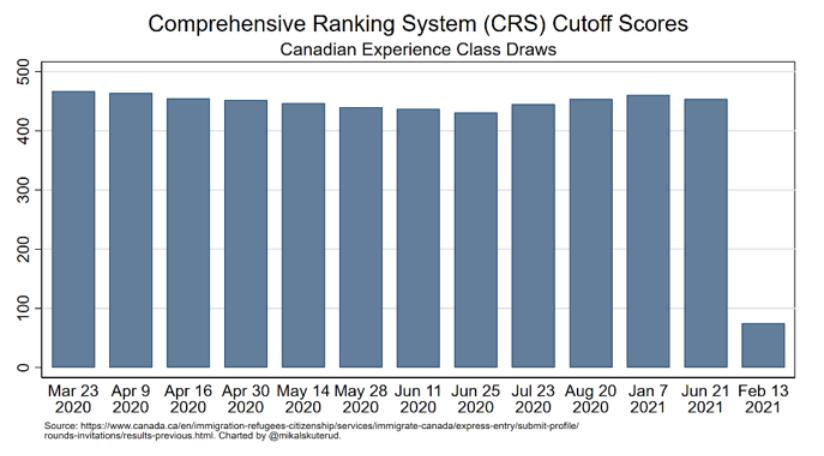
A cut-off score is set for each express-entry draw. Typically, the minimum score for those in the economic-class pool is above 400. This time, however, the points threshold for the draw was just 75. That essentially allowed all available candidates (mostly people already in the country) to qualify, regardless of whether they’re well over 40, speak English or French, have degrees or have Canadian work experience.
Ottawa’s serious attempts to make it make it much easier to become a permanent resident of the country are also coming at the same time the federal Liberals have extended an expensive range of COVID-19 financial benefits to an extraordinarily large number of unemployed people. That’s not a healthy labour market for new migrants.
Even though Skuterud is not necessarily arguing for Canada to reduce immigration to pre-2020 levels, the University of Waterloo professor questions why Ottawa is pushing “the narrative that immigrants make us all richer” during a major recession caused by a devastating pandemic whose end no one can really predict.
“It’s at best naive and at worst dishonest.”
Chart shows this year’s dramatic decline in scoring standards for economic immigrants. Ottawa now expects a score of only 75, which means it’s dropped expectations about educational levels, age and ability to read English or French. (Source: Mikal Skuterud)
Noteworthy from who the call is coming from, the generally pro-immigration experts. Royal commissions appear to have fallen out of favour given the time involved but nevertheless Canada benefits from those more in-depth reviews:
The public is in the dark about how Canadian immigration policy has been changed to give preference to international students, say experts.
Ottawa should set up a royal commission to look into issues such as whether Canadians agree that foreign students, who tend to come from the “cream of the crop” in their homelands, should go to the front of the line for permanent residence status, says Chris Friesen, who chairs the umbrella body overseeing settlement services in Canada.
Most Canadians have no idea that roughly one in three people approved each year as immigrants — especially during COVID-19-battered 2020 — were already living in the country as either foreign students or temporary workers, says Friesen, who also directs the Immigrant Services Society of B.C., which has provided support to tens of thousands of newcomers.
While Friesen can see the logic of giving some priority to in-country international students as future immigrants, he asks, “What about those you’ve got waiting overseas? They’ve paid their fees. They’re doing the point system and all the rest of that. What do they think when they find out the quickest way to Canada is to come on a study visa or as a temporary resident?”
In the past five years, Ottawa has gone from welcoming about 300,000 immigrants a year to more than 400,000, but Friesen said most Canadians don’t realize that this country also takes in at least that many people every year as studentsor guest workers.
In addition to international students being a possible brain drain on their countries of origins, Friesen said, “the vast majority of international students are of a certain economic status. They have the network of financial resources that allows them to consider studying abroad in a country like Canada.”
Immigrants to Canada should come from diverse economic backgrounds, said Friesen. “Immigration is not about the private sector dictating economic theory. Immigration is first and foremost about nation building.”
Even though foreign students bolster the budgets of Canada’s high schools, private language schools and post-secondary institutions, Friesen said, “I don’t personally believe we have a handle at all on international students.
“It feels like the federal government is just reacting to educational institutions. There isn’t any plan. We might plan for permanent residents, but we don’t plan for temporary residents.”
Canada doesn’t just need educated tech workers, bankers and financial analysts, Friesen argues.
The country also needs people in essential services such as farming and elder care, not to mention plumbing and garbage collection, which he called “valued professions that are devalued in our society.” As for the debate over whether large numbers of newcomers lower the wages of domestic workers, Friesen says he’s not too concerned about that happening.
As chair of the national Canadian Immigrant Settlement Sector Alliance,Friesen is calling for a country-wide discussion on Canada’s foreign-student policy in the same month that Ottawa has again been more generous than virtually any other country by offering long-term work permits to international students to encourage them to become permanent residents.
Controversy also hit Canada’s student program this week when Global TV uncovered how the Immigration Department has in the past decade paid almost $200 million to a private offshore company to process hundreds of thousands of study-visa applicants. The company has been based in a tax haven in Mauritius, off the coast of Africa, and is backed by a Chinese state-controlled investment fund. The news is raising alarms over privacy.
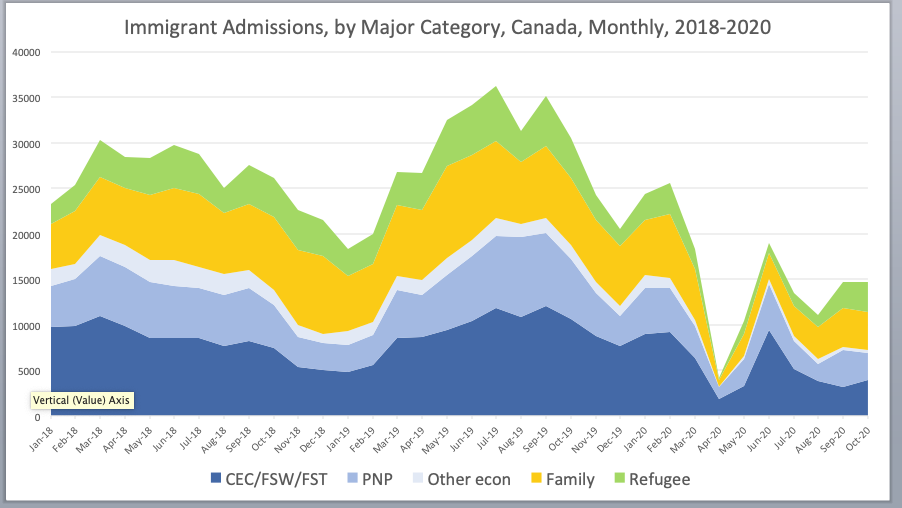
Such debate is starting to swirl at the same time that the COVID-19 pandemic, which has led to the tightening of Canada’s borders, has reduced the number of people obtaining permanent resident cards. An estimated 280,000 people were set to receive permanent resident status in Canada in 2020 compared to 340,000 in 2019, according to figures provided by a UBC geography professor, Daniel Hiebert.
The number of immigrants to Canada has dropped since COVID-19 tightened border controls in March, 2020. And a large portion of those who did receive permanent resident status were already in the country as students or guest workers. (Source: UBC prof. Dan Hiebert. Note: CEC stands for Canadian experience class, FSW for federal skilled worker program and FST for federal skilled trades class. PNP stands for provincial nominee program).
With some border restrictions expected to continue, both Hiebert and Friesen doubted that Mendocino will be able to reach his expanded target of more than 400,000 immigrants a year through to 2023. That’s more than 60 per cent higher than the 250,000 taken in in 2015, when the Liberals were elected.
There’s an additional problem with foreign-student policy, which contributes to its complications and unintended consequences.
That is, the federal government’s decision to allow an almost unlimited number of international students into Canada is setting up many for disappointment when they later apply for permanent resident status, say Friesen and Vancouver immigration lawyer Richard Kurland.
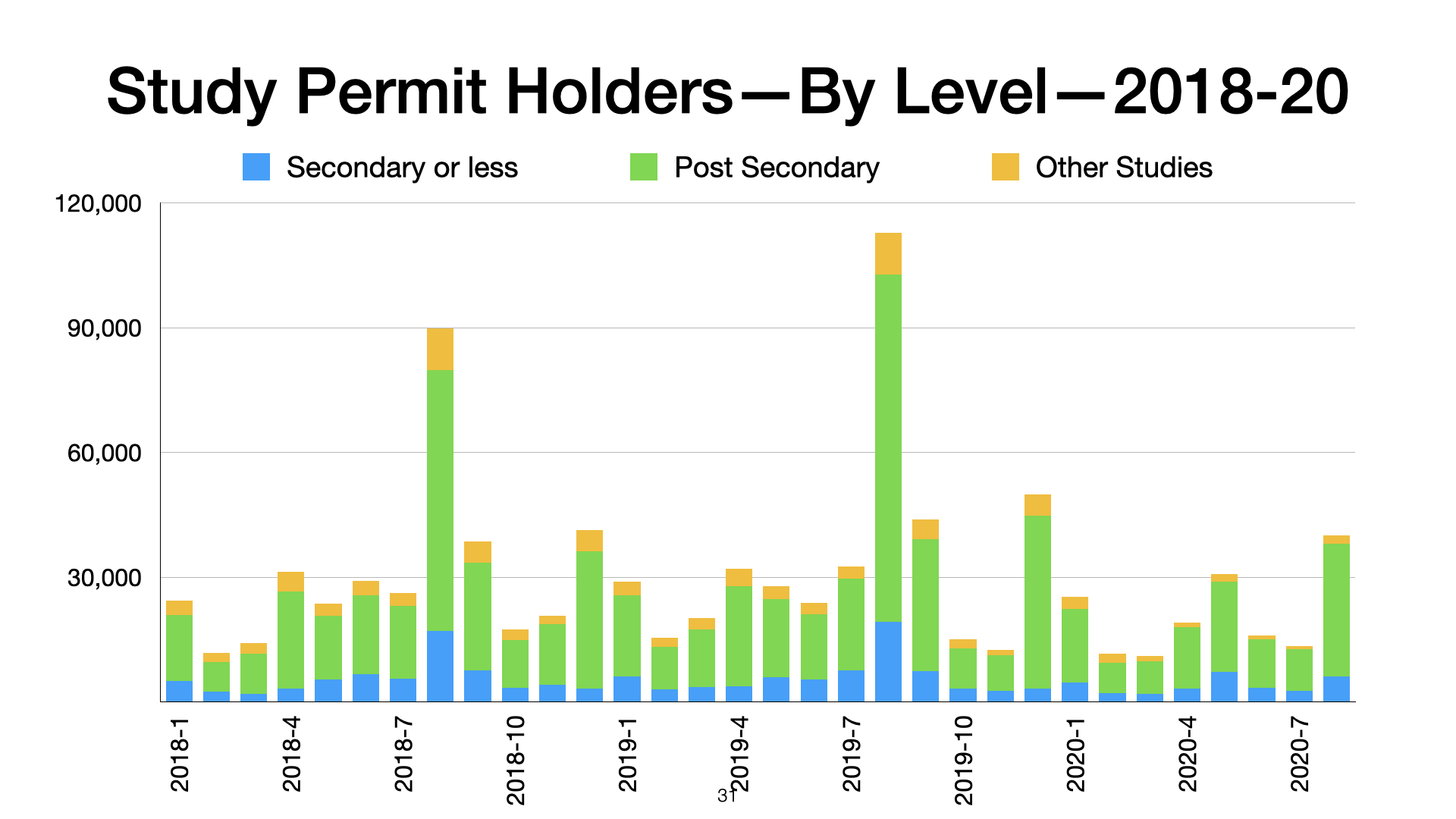
By having more than 600,000 international students in the country in any normal year, Canada has been building up far too big a pool of people who will be highly qualified for immigration status, say the experts. Not every student who wants to will be able rise to the top of the immigration system’s points-system competition, which has an annual cut-off point.
Vancouver-based Lorie Lee, who provides services to some of Canada’s hundreds of private language schools, has also pointed to how entire families around the world are pinning their hopes on young offspring eventually getting permanent resident status in Canada and then sponsoring relatives.
“Families are chipping in large amounts of money to pay for the education abroad of their child because they’re buying their own immigration futures,” Lee said, acknowledging that failure can be devastating.
While the migration specialists generally support large-scale immigration to Canada, Friesen wants a royal commission because he believes the public has a right to provide much more input on high-impact migration policies that always get set behind closed doors in Ottawa.
A Nanos Research poll in October showed only 17 per cent of Canadians want more immigrants, with 36 per cent seeking fewer and the rest hoping rates stay the same. The political decisions being made now about permanent and temporary newcomers coming into the country, Friesen said, are “going to fundamentally change Canada.”
Overall, a good nuanced discussion of where the science largely ends and values and ethnics inform (or not) political choices. The one major weakness in his arguments is that while a focus on seniors primarily means a focus on whites, personal care and healthcare workers tend to be significantly non-white, and so there is less of a contradiction than he assumes:
One of many regrettable features of the Trump era is the way that the president’s lies and conspiracy theories have seemed to vindicate some of his opponents’ most fatuous slogans. I have in mind, in particular, the claim that has echoed through the liberal side of coronavirus-era debates — that the key to sound leadership in a pandemic is just to follow the science, to trust science and scientists, to do what experts suggest instead of letting mere grubby politics determine your response.
Trump made this slogan powerful by conspicuously disdaining expertise and indulging marginal experts who told him what he desired to hear — that the virus isn’t so bad, that life should just go back to normal, usually with dubious statistical analysis to back up that conclusion. And to the extent that trust the science just means that Dr. Anthony Fauci is a better guide to epidemiological trends than someone the president liked on cable news, then it’s a sound and unobjectionable idea.
But for many crucial decisions of the last year, that unobjectionable version of trust the science didn’t get you very far. And when it had more sweeping implications, what the slogan implied was often much more dubious: a deference to the science bureaucracy during a crisis when bureaucratic norms needed to give way; an attempt by para-scientific enterprises to trade on (or trade away) science’s credibility for the sake of political agendas; and an abdication by elected officials of responsibility for decisions that are fundamentally political in nature.
The progress of coronavirus vaccines offers good examples of all these issues. That the vaccines exist at all is an example of science at its purest — a challenge posed, a problem solved, with all the accumulated knowledge of the modern era harnessed to figure out how to defeat a novel pathogen.
But the further you get from the laboratory work, the more complicated and less clearly scientific the key issues become. The timeline on which vaccines have become available, for instance, reflects an attempt to balance the rules of bureaucratic science, their priority on safety and certainty of knowledge, with the urgency of trying something to halt a disease that’s killing thousands of Americans every day. Many scientific factors weigh in that balance, but so do all kinds of extra-scientific variables: moral assumptions about what kinds of vaccine testing we should pursue (one reason we didn’t get the “challenge trials” that might have delivered a vaccine much earlier); legal assumptions about who should be allowed to experiment with unproven treatments; political assumptions about how much bureaucratic hoop-jumping it takes to persuade Americans that a vaccine is safe.
And the closer you get to the finish line, the more notable the bureaucratic and political element becomes. The United States approved its first vaccine after Britain but before the European Union, not because Science says something different in D.C. versus London or Berlin but because the timing was fundamentally political — reflecting different choices by different governing entities on how much to disturb their normal processes, a different calculus about lives lost to delay versus credibility lost if anything goes wrong.
Then there’s the now-pressing question of who actually gets the vaccine first, which has been taken up at the Centers for Disease Control and Prevention in a way that throws the limits of science-trusting into even sharper relief. Last month their Advisory Committee on Immunization Practices produced a working document that’s a masterpiece of para-scientific effort, in which questions that are legitimately medical and scientific (who will the vaccine help the most), questions that are more logistical and sociological (which pattern of distribution will be easier to put in place) and moral questions about who deserves a vaccine are all jumbled up, assessed with a form of pseudo-rigor that resembles someone bluffing the way through a McKinsey job interview and then used to justify the conclusion that we should vaccinate essential workers before seniors … because seniors are more likely to be privileged and white.
As Matthew Yglesias noted, this (provisional, it should be stressed) recommendation is a remarkable example of how a certain kind of progressive moral thinking ignores the actual needs of racial minorities. Because if you vaccinate working-age people before you vaccinate older people, you will actually end up not vaccinating the most vulnerable minority population, African-American seniors — so more minorities might die for the sake of a racial balance in overall vaccination rates.
But even if the recommendation didn’t have that kind of perverse implication, even if all things being equal you were just choosing between more minority deaths and more white deaths in two different vaccination plans, it’s still not the kind of question that the C.D.C.’s Advisory Committee on Immunization Practices has any particular competency to address. If policy X leads to racially disparate death rates but policy Y requires overt racial discrimination, then the choice between the two is moral and political, not medical or scientific — as are other important questions like, “Who is actually an essential worker?” or “Should we focus more on slowing the spread or reducing the death rate?” (Or even, “Should we vaccinate men before women given that men are more likely to die of the disease?”)
These are the kind of questions, in other words, that our elected leaders should be willing to answer without recourse to a self-protective “just following the science” default. But that default is deeply inscribed into our political culture, and especially the culture of liberalism, where even something as obviously moral-political as the decision to let Black Lives Matter protests go forward amid a pandemic was justified by redescribing their motor, antiracism, as a push for better public health.
When we look back over the pandemic era, one of the signal failures will be the inability to acknowledge that many key decisions — from our vaccine policy to our lockdown strategy to our approach to businesses and schools — are fundamentally questions of statesmanship, involving not just the right principles or the right technical understanding of the problem but the prudential balancing of many competing goods.
On the libertarian and populist right, that failure usually involved a recourse to “freedom” as a conversation-stopper, a way to deny that even a deadly disease required any compromises with normal life at all.
But for liberals, especially blue-state politicians and officials, the failure has more often involved invoking capital-S Science to evade their own responsibilities: pretending that a certain kind of scientific knowledge, ideally backed by impeccable credentials, can substitute for prudential and moral judgments that we are all qualified to argue over, and that our elected leaders, not our scientists, have the final responsibility to make.
Certainly hate speech, and interesting point about the impact of the Harper government’s repeal of provisions allowing citizens to launch civil actions against online hate speech:
A militant imam in Victoria who openly calls Jews, Christians, atheists and free-speech advocates “filthy” and “evil” is causing distress among Canadian Muslims, and there are calls for him to be prosecuted for hate speech.
“Younus Kathrada is not taken seriously in our community. Somebody making those claims is not part of Islam. But I guess there is a fringe element that follows him,” says Haroon Khan, a trustee at Vancouver’s Al-Jamia mosque, which belongs to the B.C. Muslim Association and often holds interfaith events.
Kathrada — who leads an organization called Muslim Youth of Victoria that has more than 15,000 Facebook followers — recently referred to the French teacher who was beheaded near Paris for showing cartoons of Muhammad as “a cursed, evil-spirited filthy excuse for a human being.”The hard-line imam has also appealed to his followers in Victoria and beyond to “destroy the enemies of Islam, and annihilate the heretics and the atheists.” He has told members to not vote for “filthy” and “evil” political candidates who support homosexuality or “Zionism.”
Kathrada first made international headlines last year when he called Christmas a “false festival” and said it is worse for a Muslim to wish someone “Merry Christmas” than it is to engage in adultery or murder.And he is continuing with his online denunciations.
A Canadian human rights organization that has been tracking Kathrada’s online sermons for years has been pressing for him to be prosecuted for hate speech.
“There must be consequences for years of relentless hate and incitement against Jews and others,” said Michael Mostyn, chief executive of B’nai Brith Canada, a Jewish service and advocacy group.
This fall, Mostyn said, Kathrada delivered an online sermon that referred to Jews as “brothers of monkeys and khanzeer(pigs in Arabic).” He asked God to “tear them apart.”
B’nai Brith, which has warned the RCMP’s hate crimes unit about Kathrada’s video sermons, says Canada’s law-enforcement system has shown in the past few years that it is capable of prosecuting people who advocate hate.
In November, B.C. resident Arthur Topham was sentenced to a 30-day conditional sentence plus three years probation after failing to comply with the terms of his previous conviction in 2015, when a jury concluded he had wilfully promoted hatred against Jews, Mostyn said. Topham had described Jewish places of worship as “synagogues of Satan” and advocated forcibly sterilizing Jews.
The Victoria police department could not be reached for comment about whether Kathrada has been under investigation.
Vancouver human rights lawyer Aleem Harmal, however, said it’s become difficult to take legal action in Canada for hate speech made on the internet.The Conservative government of Stephen Harper repealed the part of the Human Rights Code that had allowed citizens to launch civil actions against online hate speech, said Harmal. As a result, hate speech on the Web is now treated as a criminal offence, which is much harder to prosecute.
A hate crime is generally defined as speech, writing or behaviour that uses pejorative or discriminatory language about a person or group on the basis of such things as their religion, ethnicity or nationality, Harmal said, adding he didn’t have the expertise to judge whether Kathrada’s actions amount to hate crimes.
Three leaders of the B.C. Muslim Association, which represents most Sunni Muslims, either did not return messages or declined to comment.
However, Khan, noting Kathrada’s group does not belong to the B.C. Muslim Association, said it makes some sense for people to push for the Victoria imam to be charged with a hate crime.
“He seems to be running amok. If he is defaming Christians and Jews, we strongly condemn that kind of language. We’re all brothers and sisters,” said Khan, who is in the pharmacy business when not overseeing the Al Jamia mosque.
Khan will be the MC of a Jan. 29, 2021, Zoom forum against Islamophobia, which will include Liberal Defence Minister Harjit Sajjan, federal Diversity Minister Bardish Chagger, Vancouver councillor Christine Boyle, and RCMP hate crimes officer Anthony Statham.
Maintaining that Kathrada is “sidelined” among B.C.’s roughly 70,000 Sunni and Shia Muslims, Khan said he and other mainstream adherents will look further into what the sharp-tongued imam has been doing. “We’re very open-hearted and open-minded. He’s more of a fringe group.”
Kathrada’s Facebook page, which can be viewed by the public, has long featured running commentary in which he denounces perceived enemies of his intractable form of Islam, while his online followers, apparently using their real names, support and encourage him.
In recent weeks, France has been a key target of Kathrada’s attacks. He has joined calls by some Muslim leaders in the Middle East for a boycott of all French products in protest of President Emmanuel Macron’s defence of beheaded teacher Samuel Paty.
Paty was targeted close to his school near Paris for showing cartoons of the Prophet Muhammad in class. His killer, 18-year-old Abdullakh Anzorov, was shot dead by police. Macron said Paty was killed by an “Islamic terrorist” for standing up for free speech.
Top Muslim leaders in Egypt, Malaysia, Morocco and Pakistan have said freedom of expression does not apply to insulting Islam or Muslims — and they argued Macron, who has launched a major crackdown on Islamic fundamentalism in his country, is promoting Islamophobia.
The lack of connection between soaring housing prices and tepid local wages in Metro Vancouver is caused in large part by hidden foreign ownership, says a peer-reviewed study from Simon Fraser University that is being welcomed by the B.C. minister responsible for housing.
Based on data Statistics Canada has been collecting only recently, SFU public policy specialist Joshua Gordon’s paper shows the “decoupling” of housing prices from incomes in Metro Vancouver has been caused by “significant sums of foreign capital that have been excluded from official statistics.”
Gordon’s research set out to solve a puzzle in Greater Vancouver and, to a lesser extent, Toronto. How can tens of thousands of owners who tell Revenue Canada they are low income (earning less than $44,000 a year) consistently afford homes valued in the $2- to $10-million range?
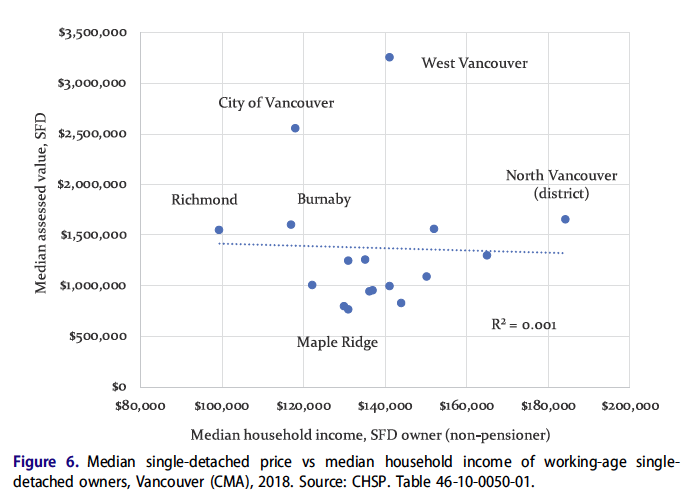
The new data revealed Richmond, West Vancouver, the city of Vancouver and Burnaby were epicentres of the foreign-ownership phenomenon: They have the highest housing prices, low average declared incomes and the largest proportions of non-resident owners.
“This is a powerful corroboration of the idea that substantial amounts of income are not being declared in satellite family situations,” said Gordon, whose paper defines foreign ownership as “housing purchased primarily with income or wealth earned abroad and not taxed as income in Canada.”
The strange decoupling of housing prices from local wages is peculiar to Metro Vancouver and Greater Toronto. It does not show up in most Canadian cities or in the U.S., Gordon says, where high housing prices invariably correspond with high wages.
Gordon’s study is the first to be based on crucial new data from the Canadian Housing Statistics Program, which for the first time began two years ago to track the extent to which non-residents were buying housing.
“The evidence suggests that considerable tax avoidance is occurring in satellite family situations,” says Gordon, who appreciates B.C.’s unique speculation and vacancy tax for monitoring such satellite ownership.
The B.C. NDP government “didn’t wait for the smoking gun” before it brought in its 2019 speculation tax, the first of its kind anywhere, Eby said. Even while many denied the property market was being distorted, Eby said, “we saw enough to realize foreign capital was a factor. So we took action.”
B.C.’s speculation tax applies a two per cent annual surcharge on homes owned by either foreign citizens or satellite families, which it defines as households where over 50 per cent of income is earned abroad.
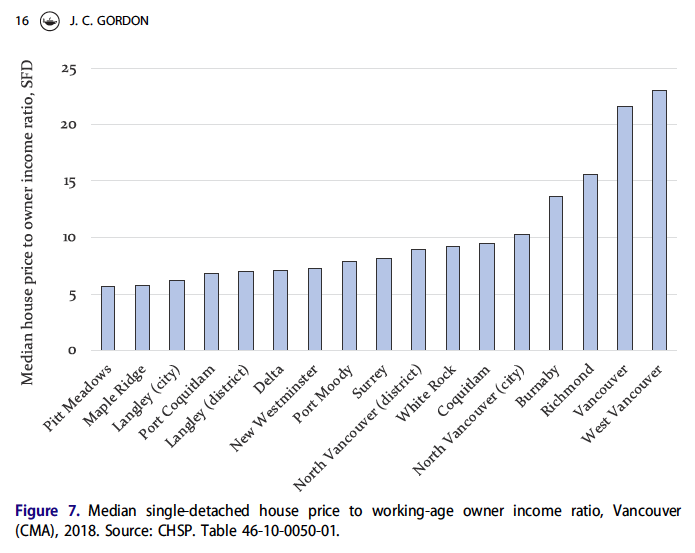
Chart reveals a strange Metro Vancouver phenomenon in which the municipalities in which residents report the lowest incomes — Richmond, the city of Vancouver and Burnaby — also have some of the highest housing prices. (Source: SFU’s Joshua Gordon)
While Gordon generally endorsed B.C.’s speculation and vacancy tax, he stressed it must be rigorously enforced — and also suggested it could be strengthened.
Gordon questioned whether it’s wise to exempt homeowners from the speculation tax if they rent out even part of their dwelling. “This rental exemption for single-detached properties might be eliminated entirely … pressuring foreign-sourced owners to either sell into the local market or to pay an annual property surtax.”
Eby, calling the speculation tax “an experiment,” acknowledged it needs ongoing evaluation. “This phenomenon of Vancouver being an international city and people being resident here but not earning their income here is one that our tax system is still working to come to terms with.”
The cohort of more than 200,000 people who were approved entry to Metro Vancouver through Canada’s business immigrant programs, Gordon said, provide one of the most striking illustrations of satellite families who declare almost no income in Canada yet own costly houses.
“Migrants arriving with substantial wealth can have a pronounced effect on housing prices” by creating “powerful downstream effects,” says Gordon’s paper, citing the research of Markus Moos and Andrejs Skaburskis, who found almost two out of three investor immigrants to Canada, mostly from Asia, choose to buy property in Metro Vancouver.
An earlier Statistics Canada study found the median value of a detached Vancouver home bought by immigrants who arrived via the investor program was $2.55 million, but the same group “declared an average of only around $20,000 in income in the first 10 years after landing.”
Chart shows that West Vancouver, Vancouver, Richmond and Burnaby have by far the highest gaps between median house prices and average incomes. They are also the municipalities with the largest proportion of non-resident owners. (Source: SFU’s Joshua Gordon)
Gordon’s paper captures how Vancouver condo marketer Bob Rennie, former chief fundraiser for the B.C. Liberal Party, acknowledged the decoupling when he joked in a 2012 speech to the Urban Development Institute that “the Vancouver market never went up on fundamentals, so why would we go down on fundamentals.”
Two of the first public figures to try to flag Metro’s decoupling situation were former Richmond mayor Greg Halsey-Brandt and the one-time head of the Canadian Race Relations Foundation, Albert Lo. They expressed concern in 2015 that the homeowners in Richmond most likely to declare poverty-level incomes (and thus pay low taxes) resided in expensive neighbourhoods. The late housing analyst Richard Wozny also tried to bring attention to how housing “fundamentals” were askew in Metro, with no meaningful link between prices and wages.
In the debate over the cause of high housing prices in Canada, Gordon says the conventional explanation, promoted by developers, is that not enough housing supply is being built. But, as Gordon emphasizes, in Canada “there has not been a single peer-reviewed article” exploring the supply theory.
In contrast, Gordon’s paper makes clear “the relationship between foreign ownership and decoupling is very strong and stark: The areas (of Metro Vancouver) with the highest rates of foreign ownership are the areas with the greatest decoupling of prices from homeowner incomes.”
Analysts generally consider housing “affordable” if the ratio of property prices to household income is about four or five to one. But this ratio jumps to a startling 13 to one in Burnaby, 16 to one in Richmond, 22 to one in the city of Vancouver and 23 to one in West Vancouver, which are the municipalities with the highest proportion of non-resident owners.
In Greater Toronto, the municipalities that most follow this same decoupled pattern, Gordon says, are the suburbs of Markham and Richmond Hill.
Eby welcomes how significant new data is now available to shape Canadian tax collectors’ priorities. “I’ve been endlessly frustrated by the proclivity of Revenue Canada to chase small businesses and servers and their tips … instead of being concerned about this phenomenon of people who are very wealthy but who have very low incomes. It undermines public confidence in the tax system of Canada.”
An ongoing trend although fear mixed unions in Canada compared to the US along with some interesting variations among visible minority groups:
The elevation of Kamala Harris to vice-president-elect of the United States of America has many probing the significance of mixed-race partnerships.
Many celebrate how the daughter of an Indian mother and Black father went on to marry a white Jewish lawyer named Douglas Emhoff. Optimists see her journey as a creative blurring of ancestries, which might help soften the harder divisions of identity politics.
Interracial couples make up about 10 per cent of all relationships in the U.S. and about five per cent in Britain and Canada.
While many countries have almost no mixed-race unions, in Brazil roughly 33 per cent of marriages cross racial lines, making ethnic identity highly fluid in that nation. What does it mean for such societies?
A peer-reviewed 2019 research study by Richard Alba of City University of New York and Jeffrey Reitz of the Munk School of Global Affairs at the University of Toronto found most people in mixed unions, and their children, feel more integrated into mainstream culture than do members of a single minority group.
Interracial couples make up about 10 per cent of all relationships in the U.S. and about five per cent in Britain and Canada.
While many countries have almost no mixed-race unions, in Brazil roughly 33 per cent of marriages cross racial lines, making ethnic identity highly fluid in that nation. What does it mean for such societies?
A peer-reviewed 2019 research study by Richard Alba of City University of New York and Jeffrey Reitz of the Munk School of Global Affairs at the University of Toronto found most people in mixed unions, and their children, feel more integrated into mainstream culture than do members of a single minority group.
In Canada and the U.S., more than four out of five members of minority groups who enter a live-in relationship with someone from another ethnicity do so with a woman or man of European background.
The researchers discovered Americans and Canadians with such “majority-minority” identities tend to feel mainstream and experience less discrimination than offspring of a single ethnic minority.
Statistics Canada figures show mixed unions are rising across the country.
The portion of members of single ethnic groups who were inclined to marry or form common-law relationships beyond their group grew slightly in 2016 compared to 2006. It’s intriguing to note the variations among each group.
Women of Latina, South-East Asian and Japanese descent in Canada are the most likely to form live-in partnerships with men outside their ethnic group, according to 2016 census data. Remarkably, 88 per cent of Japanese women in Canada link up with men of another ethnic group.
Meanwhile, 37 per cent of Korean women seek partners of a different ethnicity, 34 per cent of Filipinas and 24 per cent of Blacks and ethnic Chinese.
The ethnic groups in Canada in which women in 2016 were least likely to find partners beyond their cohort include whites (eight per cent) and South Asians (people from India and Pakistan), seven per cent of whom partner with someone outside their cohort.
In general, Feng Hou, a demographics research scholar, has found members of larger ethnic groups in Canada contain fewer people who marry or form common-law relationships outside their group.
The fresh Statistics Canada figures also point to differences between the readiness that males and females show toward entering mixed unions.For instance, 85 per cent of men of Chinese descent in Canada partnered in the same ethnic group in 2016, compared to 76 per cent of Chinese women. Only 56 per cent of Black men formed unions with members of their own racial group, compared to 76 per cent of Black women.
What do these intermarriage trends mean for the rapidly growing number of children of such unions?
The percentage of children of mixed ethnicity in Canada, say Alba and Reitz, jumped from eight per cent in 2001 to 15 per cent in 2016 (if Aboriginal people were not included, the 2016 rate would be nine per cent). That compares to 15 per cent of U.S. children, but that figures doesn’t include Aboriginal people.
The researchers found Canadians of mixed heritage were more likely than children of a single minority ancestry to report feeling and acting as if they were mainstream Canadians.
People who had a mix of European and non-European ancestry were far more likely to say they felt “comfortable” in Canada than those of a single minority ethnicity (72 per cent compared to 54 per cent).
They were also more inclined to describe themselves as “white” (57 per cent to seven per cent) and to say they had not been discriminated against (76 per cent to 56 per cent).
The minority group members who partnered with people of European ancestry who were most inclined to feel like “mainstream Canadians” were Latinos and Arabs. The partners of Europeans who felt the least mainstream were Black Canadians.
Although Alba and Reitz found “the distance of white-Black Canadians from the others is not as extreme as is the case for white-Black individuals in the U.S.,” they drew attention to the discouraging results among the offspring of Black-white parents.
While the children of most majority-minority parents end up having roughly the same financial and educational success as children of two white parents, that wasn’t the case for the Canadian children of Black-white parents.
Despite such serious concerns, Alba and Reitz concluded Canada’s rising rates of intermarriage and mixed-race children will contribute to more people feeling integrated into the larger culture in the future.
While the authors didn’t spell out the political consequences, a related British survey by Ipsos Mori found the increasing number of people who have identities that are difficult to label “weakens rigid identity positions” and leads to fewer people being wary of national institutions.
Clearly, people of any and all ethnicities can make a big difference in their societies. As illustrated by the life and career of Kamala Harris, a senator and former California attorney general, studies also suggest the blurring of ethnicities through-intermarriage can help some feel ready to contribute robustly to the wider culture and the common good.
China is not the only country that does not recognize dual citizenship. Many turn a blind eye except in the case of high profile politicians and others.
China’s enforcement, however, is more thorough and rigorous, which may affect the naturalization rate (about 56 percent of immigrants from China have acquired Canadian citizenship compared to 93 percent of immigrants from Hong Kong):
There is no shortage of rich Chinese citizens picking up second passports to make travel easier and establish a safe haven for their families, particularly in the U.S., Australia, Britain and Canada.
But there’s a hitch: The People’s Republic of China, unlike the other countries above, doesn’t, technically, allow its citizens to hold dual citizenship.
As a result many China-born residents have avoided revealing to their home country they have a second or third passport. They do not want to renounce their Chinese citizenship, in part because it would make it hard to do business in the giant economy.
The complexities of global passport regulations are not something a lot of Canadians think about. But migration specialists say they are often on the minds of many of Canada’s 1.7 million ethnic Chinese, the majority of whom have links to either China or Hong Kong, which in 1997 became part of China.
Nationalistic China takes the opposite approach to citizenship than laissez-faire Canada. While Canada does little to track whether its passport holders keep a meaningful connection to this country, China’s authoritarian leaders are stepping up pressure on the 60 million Chinese people spread around the planet to be more loyal.
China, which accepts almost no immigrants, claims it’s jacking up enforcement to reign in allegedly corrupt Communist party officials and business leaders. But critics say President Xi Jinping is also determined to silence critics and squeeze political rivals.
There are many ways it has turned problematic for a citizen of China to have more than one passport:
Nationalistic China takes the opposite approach to citizenship than laissez-faire Canada. While Canada does little to track whether its passport holders keep a meaningful connection to this country, China’s authoritarian leaders are stepping up pressure on the 60 million Chinese people spread around the planet to be more loyal.
China, which accepts almost no immigrants, claims it’s jacking up enforcement to reign in allegedly corrupt Communist party officials and business leaders. But critics say President Xi Jinping is also determined to silence critics and squeeze political rivals.
There are many ways it has turned problematic for a citizen of China to have more than one passport:
You’re a Chinese citizen if China says you are
With one poll showing 47 per cent of China’s rich want to move to another country, China’s authorities are discovering, including through the leak of the Panama Papers, many prominent citizens have been snagging passports from other countries. The consequences for some have been horrifying.
But Xiao was abducted in 2017 from a Hong Kong hotel and taken to China.
Xiao’s family ran an ad on the front page of a Hong Kong newspaper quoting him saying, “I am under the protection of the Canadian consulate and Hong Kong law” and “I enjoy the right of diplomatic protection.”
But Xiao’s declaration was worthless. Canada could do nothing. He remains incarcerated in an unknown prison in China while the government dismantles his empire.
Then there’s Gui Minhai, who left China, his country of birth, to study in Sweden. He earned a Swedish passport. And, in a bid to do the right thing, he joined the relatively few who renounce their Chinese citizenship.
But then Gui set up a bookshop in Hong Kong, which published gossip about Chinese politicians. Gui was kidnapped in Thailand, at about the same time four other Hong Kong booksellers disappeared.
Gui showed up months later on an official Chinese television station mouthing an apparently forced confession. “Although I have Swedish citizenship, I truly feel I am still Chinese,” he said, urging the Swedish government not to get involved in his case. He’s been sentenced to 10 years in jail.
Some Hong Kong legislators have dared say the obvious: It doesn’t matter if Hongkongers get new passports, because China still regards you as a citizen. It’s deeply troubling, said one diplomat, that China “deliberately blurs ethnicity and nationality.”
Huawei CEO plays a risky game with her passports
The U.S. government, in its extradition request to Canada, maintained Meng Wanzhou had seven different passports from China and Hong Kong. But Meng’s lawyers argued she had just two, one from China and one from Hong Kong.
However, Meng, whose family owns two mansions in Vancouver, has also obtained permanent resident status in Canada. That gives her and her family the right to free education and healthcare. It is also the final step before citizenship.
Since Meng is treated as a hero in China while she fights the U.S. extradition request in B.C. Supreme Court, how do her country’s leaders deal with the embarrassing reality she and some of her family members have been on the verge of becoming Canadian citizens?
Immigration lawyers maintain China turns a blind eye when Communist party favourites take out multiple passports. And that certainly seems possible in this case, since it is unlikely Meng would ever say goodbye to her Chinese citizenship.
What is the value of a Canadian passport in Hong Kong?
Meng’s case points to the confusing and crucial differences between a Chinese passport and a Hong Kong passport.
Contrary to what many people think, historians such as Jason Wordie maintain China’s authorities consider a Hong Kong passport, one of which is called a Special Administrative Region passport, mostly a convenient travel document.
So when Canada’s top diplomat in Hong Kong said last week that Ottawa has drawn up plans for a mass evacuation of more than 300,000 Hongkongers who hold Canadian passports, he did not get into the knotty legalities.
Only a fraction of Hong Kong residents identity more with China than Hong Kong. But since China insists on treating Hongkongers as its citizens, it could mean anyone born there who has a Canadian passport would, especially under the recent crackdown, be on the spot to renounce their Chinese citizenship.
If they do so, and especially if they shift to another country, that could lead to them being treated as foreigners in Hong Kong and China, severely shrinking their prospects: Many residents of Hong Kong who have Canadian, British, U.S. or Australian passports often say they remain in China’s booming protectorate because it is far easier to make serious money there.
In the past such people could get around the system by slightly altering either their Chinese or foreign-language names when they applied for extra passports, which made it hard for officials to track how many they had. But China is now perfecting facial-recognition technology to catch those who break the rules.
Contrary to what many people think, historians such as Jason Wordie maintain China’s authorities consider a Hong Kong passport, one of which is called a Special Administrative Region passport, mostly a convenient travel document.
So when Canada’s top diplomat in Hong Kong said last week that Ottawa has drawn up plans for a mass evacuation of more than 300,000 Hongkongers who hold Canadian passports, he did not get into the knotty legalities.
Only a fraction of Hong Kong residents identity more with China than Hong Kong. But since China insists on treating Hongkongers as its citizens, it could mean anyone born there who has a Canadian passport would, especially under the recent crackdown, be on the spot to renounce their Chinese citizenship.
If they do so, and especially if they shift to another country, that could lead to them being treated as foreigners in Hong Kong and China, severely shrinking their prospects: Many residents of Hong Kong who have Canadian, British, U.S. or Australian passports often say they remain in China’s booming protectorate because it is far easier to make serious money there.
In the past such people could get around the system by slightly altering either their Chinese or foreign-language names when they applied for extra passports, which made it hard for officials to track how many they had. But China is now perfecting facial-recognition technology to catch those who break the rules.
In more ways than one it’s becoming tougher to walk the multi-passport tightrope.
Downtown Vancouver might never look or feel the same, as scores of its English-language schools now sit empty with metal security gates across their doors. Many will never reopen.
B.C.’s once ultra-popular, private English-language schools, which last year enrolled 70,000 to 100,000 students, are concentrated in the city’s core. Each year language students from around the globe enlivened downtown cafes and street life, as well as rental and homestay units through the West End and Yaletown.
Most Canadians don’t give much thought to the often-overlooked English- and French-language industry, but if they did they would recognize COVID-19 has ravaged this formerly booming sector as badly as it has crippled airlines and international tourism.
The health measures brought in in March to secure borders against travellers who could carry the coronavirus into Canada caused upwards of 100 language schools in B.C. alone to close their doors to in-person classes. Some struggle just to offer low-cost online instruction to students spread through mostly Asia and Latin America.
Officials with Languages Canada, an umbrella group for more than 200 registered schools, forecast this summer that three of four of its member schools could be forced to permanently shutter. In Metro Vancouver alone, Languages Canada says their students, almost all from outside the country, were pumping more than $500 million a year into the economy.
Global Village Vancouver gone
More than 23 registered language schools across the country have already permanently packed it in, including Vancouver’s decades-old Global Village Vancouver. And that number doesn’t include the closings at many smaller private schools that are not registered with Languages Canada.
“Metro Vancouver has the most private language schools of any Canadian city. And many of them are never going to open again,” says Lorie Lee, a former language-school owner who has served on federal government trade missions and advisory panels who now works with a company called Guard.me that provides health insurance to international students.
“Not only do these schools employ many teachers and staff, the students stay with host families and rent apartments and spend money in restaurants and on car leases and trips to Whistler. That’s not to mention the schools themselves rent large amounts of space downtown.”
One-third of them, almost always financed by their parents, want to gain permanent resident status in Canada, Lee says. Another cohort aim to get English under their belt so they can be eligible to apply to a Canadian or American university.
Those who belong to a third group want to improve their English because it will enhance their careers in their homelands, Lee says. Many others seek adventure, learning a bit of English along with skiing, partying and hiking in a beautiful province.
Unlike public language schools, which are subsidized by taxpayers, private language businesses, especially those in Vancouver, are stuck having to pay high rents on five-year leases they normally can’t get out of. A typical monthly rent for a school downtown, Lee says, runs about $50,000 a month.
“These schools have had no students since March, so that’s eight months of no income and many are going into debt. Those schools closing will have an economic impact on other businesses, not to mention on the host families that relied on the international students to pay their mortgages.”
The second big dilemma is that language-school students are often in a different immigration category from the 642,000 people who last year were in the country on study-work visas so they could attend public institutions like the University of British Columbia, Simon Fraser University and Kwantlen Polytechnic.
Only a minority of private language-school students obtain such long-term study-work visas to be in Canada, Lee says. Most tend to be here on visitors’ visas, which last less then six months.
That means that Prime Minister Justin Trudeau’s unprecedented move to reopen the border to foreign students on Oct. 20 is of only limited help to most language schools, since the bulk of their students will not be eligible.
Gonzalo Peralta, head of Languages Canada, has said Ottawa’s policy decision extends a lifeline to some private language schools. But Lee stresses that “even with Ottawa opening the gates, there are still going to be problems.”
It’s all having a little-discussed impact on Metro Vancouver. In 1991, when Lee first shifted from teaching English at UBC to launching her own school in Vancouver, her market research showed there were only seven private language schools in the city. “But,” she says, “when I sold my school in 2011 there were approximately 200 private language schools in Vancouver.”
Even though critics have condemned the way some private language schools are shoddily run and some Canadian economists worry they contribute to bringing more low-skilled workers into an already modest-wage job market, Lee generally remains a booster.
She’s excited that language schools bring so many students from Brazil, China, India, Vietnam, Japan, Mexico and South Korea. Four of five head to Ontario or B.C. This province has more than 50 schools registered with Languages Canada, the vast majority being private, employing about 2,000 staff and teachers until COVID-19 hit.
And, as Lee clarifies, Language Canada’s registered schools are only the tip of the language-industry iceberg. There are scores more non-registered private language schools in Metro Vancouver that, until the pandemic, served tens of thousands of pupils.
Glimmers of hope
Some publicly funded language schools and the larger private ones will likely be able to hold out until the end of the health crisis, Lee says. But even they are struggling just to keep afloat by offering online courses, only charging $99 a week. “Meanwhile, think of how expensive their rents are.”
There are glimmers of hope for some schools, Lee suggests, but their survival will likely rely on further easing up of immigration policy, border restrictions and COVID-19 safety rules, which restrict how many students will be allowed in language classrooms at one time.
Even though it’s frustrating to Lee, she recognizes why most Canadians rarely think about the plight of private language schools and their impact on the country.
More anecdotal than evidence-based regarding the extent of the abuse. It would be relatively straightforward to request a dataset from IRCC that would provide the basis for answering the issues raised in the article:
people relinquishing permanent residency by country and immigration category;
those being sponsored for permanent residency; and,
those requesting asylum status.
Canada has given out more than nine million 10-year visitor visas since the program began, with by far the largest bulk of recipients coming from China and India, followed by people from Brazil and Mexico.
The super-popular multiple-entry visas are generally a benefit to Canada’s economy, say immigration lawyers. But they caution the 10-year, multiple-entry visas can be abused by “shadow investors” to avoid paying property and income taxes in Canada — and as a dubious means by which to claim asylum.
Samuel Hyman, a Vancouver immigration lawyer, says citizens from nations that “have a history of non-compliance” with Canadian migration, labour and tax laws can obtain the 10-year visas to stay in this country for up to six months at a time. That’s unlike citizens from visa-exempt countries like Germany, Japan, Britain and Taiwan, who enjoy the right to almost freely come and go to and from Canada.
Since the 10-year visa program began nine years ago, Canada has issued 2.89 million of them to Chinese nationals. It’s also provided 1.774 million to citizens of India, followed by 423,000 to Brazilians, 346,000 to Mexicans, 337,000 to Filipinos, 201,000 to Iranians, 160,000 to Colombians, 148,000 to Vietnamese, 132,000 to Pakistanis and 129,000 to Nigerians.Both Hyman and George Lee, a Burnaby immigration lawyer who was born in China, believe the 10-year visas are good for Canada in the large majority of cases.
They say the visas provide long-term assurance of relatively hassle-free border crossings for tourists who will stimulate the Canadian economy, for relatives who are able to visit close relatives for months at a time and for professionals, business people and scholars on long-term assignments in Canada.
But one of the two downsides of the 10-year visas — which Canada is giving out a rate of more than 1.3 million a year — is they can be abused by wealthy offshore families trying to shift their assets to Canada as a financial haven.
The 10-year visas make it relatively easy, say Hyman and Lee, for so-called “satellite families” to avoid paying income taxes and capital gains taxes in Canada even while they are investing much of their wealth here, most frequently in real estate.
Satellite families are transnational migrants in which the breadwinners sponsor their spouse and children to immigrate to Canada, but end up returning to their country of origin to earn money. Meanwhile their dependents settle in Canada, applying for permanent resident status, attending schools and drawing on government health and social services.
“I’m going to tell you how this scheme works,” said Lee.“The family comes over here to Canada and the breadwinner, usually a male, goes back to his home country, either somewhere in India or China. The breadwinner exports his money and other assets to Canada, while his wife and children stay here.”
“The purpose is two-fold. One, his children are able to receive free public education in Canada and go to university here. Two, the spouses keep permanent resident status. But the breadwinner can go back and forth to Canada on a 10-year visa and in that case doesn’t have to pay taxes to Canada, because he can act as if he’s not a resident for tax purposes.”
Even though B.C.’s NDP government is attempting through the speculation and vacancy tax and other measures to track foreign investors who buy often-luxury property through proxies so they act as if they are not tax residents of Canada, Hyman said Ottawa’s Immigration and Revenue departments have not cooperated with Victoria to share crucial monitoring information.
One of the easiest ways to track people who take advantage of 10-year multiple entry visas to avoid paying taxes in Canada would be to investigate people who are “relinquishing” or “renouncing” their permanent resident status in Canada, say Lee and Hyman. But the federal government is not cooperating with such monitoring.
Relinquishing one’s permanent resident status makes it possible for breadwinners to instead employ a 10-year visa. as if they were tourists, to regularly see their spouse and children in Canada, said Lee. Meanwhile, their family members, who often appear on title as the legal owner of the Canadian properties, can continue on the road to becoming permanent residents and eventually citizens.
The relinquishment scheme involving 10-year visas often comes with a crucial wrinkle, say Lee and Hyman.
“When the breadwinner retires, he still has ties in Canada, including a spouse here. That’s when the spouse can sponsor the husband to come over to Canada to become a permanent resident. I’ve seen a lot of this happen. I don’t have a percentage for this phenomenon, but it’s very common. Very common,” Lee said.
In 2018, roughly 10,000 people a year were relinquishing, for a variety of reasons, their permanent resident status in Canada. But data is not available on how many then turned around to apply for a 10-year visitor’s visa.
There are ways to stop potential abuse of the relinquishment program, said Hyman. “The time has come to look at barring the re-sponsorship of (breadwinners) by their dependents after they voluntarily renounce their permanent residence. Canada prohibits other sponsorships of convenience to maintain program integrity in our immigration system.”
There is one other quite different way for potential abuse of Canada’s in-demand 10-year visas.
That is how, even while an applicant must undergo a degree of vetting before obtaining a 10-year multiple entry visa, Lee and Hyman say they can still be used as a way to land on Canadian soil and then try to obtain asylum, in an irregular way, as a victim of persecution in one’s homeland.
Each year more than 60,000 people in total claim refugee status in Canada. Last year 7,345 of them were from India, 6,345 were from Mexico, 5,620 were from Iran, 4,150 were from Nigeria and 3,395 were from Colombia. The Immigration department, however, doesn’t provide data on how many of the would-be refugees arrived on 10-year visas.
“I think 10-year visas are generally good, but everything can be abused,” said Lee. “We need to come up with a policy to prevent people from abusing the system, including by coming over as visitors and then applying for refugee status.”
Looking forward to the more detailed report correlating crime rates by ethnic status is scheduled to be released on Sept. 30 by StatsCan that will help avoid some of the broad generalizations in the article:
Federal Justice Minister David Lametti has been emphasizing to journalists that it’s time to weed out “systemic racism” in the Canadian police and court system.
“It’s part of a larger foundation of colonialism that sadly has played an important part in our history,” Lametti told Postmedia News in the midst of sweeping anger and debate about police violence against Blacks in the United States.
“It’s absolutely shameful that we have the degree of overrepresentation in our criminal justice system — if you are a Black Canadian, if you are an Indigenous Canadian, if you are a racialized Canadian — that we do. The statistics on it are shocking.”
When Postmedia asked the Justice Department in Ottawa which Canadian data Lametti was citing, a communications official pointed to a Statistics Canada study titled The Impact of Mandatory Minimum Penalties on Indigenous, Black and Other Visible Minorities.
The report found over a 10-year period that Canadian whites accounted for 61 per cent of the serious crimes that warranted federal custody and a mandatory minimum penalty, even as whites in 2011 made up 76 per cent of the population.
The study revealed that Indigenous offenders were incarcerated for 23 per cent of the serious crimes, despite accounting for only 4.3 per cent of the population.
Blacks were jailed for nine per cent of the serious offences, despite comprising 2.9 per cent of the population.
In contrast, other visible minorities were responsible for just nine per cent of the offences involving firearms, sex with minors and drug trafficking, even though they make up 16 per cent of all Canadian residents.
The 2017 StatsCan report on mandatory minimum penalties provided no analysis or commentary related to whether the incarceration imbalances based on Indigenous or ethnic status had anything to do with racism.
Justice Department media officials, in addition to highlighting the single report on mandatory sentencing, also suggested asking Statistics Canada about relevant data that would back up Lametti’s claims about “shocking” systemic racism.
Statistics Canada media officials, in response, provided links to data on homicide rates, which showed the overall murder rate was going down but in 2018 Indigenous people were disproportionately its victims — in 21 per cent of all 651 homicide cases.
While the homicide data compiled by Statistics Canada shows that nen are the most common victims of murder, it didn’t track homicide rates based on whether someone is white or a visible minority (also referred to as a person of colour.)
However, the Statistics Canada media official highlighted how, for the first time in Canadian history, that data correlating crime rates by ethnic status is scheduled to be released on Sept. 30.
That should be an important improvement, because Canada is far behind Britain, Australia and the United States in providing comprehensive analysis of how crime data relate to ethnicity.
Associate Prof. Rick Parent, who has taught criminology at SFU, The University of the Fraser Valley and elsewhere, says the big problem in Canada is that there is no central entity probing the “deeper meaning” of crime data.
“Statistics Canada just sort of throws things on the wall,” he said. It normally publishes police and crime-related data without putting it in broader, relevant perspective.
“The situation does a disservice to marginalized groups,” Parent said, pointing to how Britain, the U.S. and Australia have research teams devoted to understanding how ethnicity relates to arrest rates and other aspects of the justice system.
The problem in Canada, Parent said, is that elected officials and others tend to fling out their positions on crime rates mainly in response to “the loudest voices” on social media and elsewhere.
The justice minister, for instance, used charged concepts, including “colonization” and “racialized,” when he maintained discrimination based on ethnicity is rampant in Canada’s legal system. (“Racialized” is a new term in sociology that refers to ascribing ethnic or racial identities to a group that did not identify itself as such.)
The term “systemic racism” is also disputed. For many it means that racism is a fixed, often subconscious practice within an organization. As some say, a system can be racist even when the individuals in it are not. The term has become so hotly contested that The Oxford Dictionary this summer acknowledged it’s working on clarifying what exactly it means.
For his part, Parent, a former Delta police veteran, says: “Nobody can really say” what contributes to higher incarceration rates for Canada’s Indigenous and Black people.
“Wealth distribution” and lack of adequate housing, he said, may have a more significant correlation to high crime statistics than membership in an ethnic group.
Studies by researchers such as UBC’s Haimin Zhang have consistently shown, for instance, that most immigrants to Canada, three out of four of whom are people of colour, have low arrest rates, Parent said.
“There are lots of well-off and extremely well-off immigrants in North Vancouver and West Vancouver and they’re not committing many crimes. Broad generalities about race and the justice system just don’t fly,” Parent said, adding people of different economic classes tend to engage in different times of crimes.
Parent also doesn’t believe choices made by specific police officers, prosecutors and judges can explain the disparities in Canada’s incarceration rates. “It’s naive to say individuals have that much power in the justice system.”
Rather than blaming systemic racism, Parent said Canada should follow the lead of other countries that have developed more rigorous ways to examine why Indigenous, Black people or others are more likely to be jailed.
“We have to be more proactive and figure out why these things are happening.”

 Multicultural Meanderings