ICYMI – Jamie Sarkonak: The CRTC’s top-down diversity mandate comes for Big Streaming ICYMI

While some like Sarkonak find this ill-thought, there is a history behind these initiatives as many government programs overly favoured previous beneficiaries or incumbents rather than ensuring better representation. And having good or better data is a basic (the Employment Equity Act relative success is arguably largely based on public diversity reporting:

…In addition, the Broadcasting Act now states that the broadcasting system should support programming created by and for non-white communities. While it didn’t outright state that quotas and demographic tracking were now required, that’s increasingly how it’s being interpreted.

In its decision to mandate the collection of diversity statistics, the CRTC notes that some television and radio broadcasters are currently required to include statistics on the presence of women in “key production roles” and track spending on content by Indigenous and official language minority producers.

It considers those data collection initiatives a success, and thus, “the Commission is of the view that the report lends itself well to be expanded to gather information on all equity-deserving groups (specifically, racialized people, people with disabilities and individuals who identify as 2SLGBTQI+, in addition to women).”

Big online streamers operating in Canada under this new regime will have to submit these diversity statistics as part of this. The current lack of data, the CRTC complained, “results in a partial picture of production spending and representation of equity-deserving groups in the production sector.” That information is important because it helps to “monitor compliance and trends and to ensure policy goals are met, especially when it comes to representation of equity-deserving groups.”

We aren’t at the point where the CRTC is ordering Netflix, HBO and Paramount+ to spend a minimum proportion of their production budgets on “diverse” shows and production teams, but we’re awfully close. In 2022, the CRTC ordered the CBC to do just that with its budget for commissioned TV and documentary programs. This year, the English side of CBC was required to dedicate 30 per cent of spending in that category to “diverse” production teams.

Last year, the CRTC also announced that it would be taking a five per cent cut from online streamers to redistribute to industry groups in Canada whose missions include the advancement of DEI in broadcasting. And in July, the CRTC tweaked its funding formula for online news to incentivize coverage of “diverse” communities….

Source: Jamie Sarkonak: The CRTC’s top-down diversity mandate comes for Big Streaming

CRTC erred in its decision on Radio-Canada N-word broadcast, court finds

Of note. Needed sending back of original decision:

A federal court has ruled that the Canadian Radio-television and Telecommunications Commission (CRTC) erred in its decision penalizing Société Radio-Canada (SRC) for broadcasting the N-word.

In a unanimous decision released Thursday, the Federal Court of Appeal said that the broadcast regulator made several mistakes when it ruled against SRC in response to a complaint.

In particular, the court ruled, the CRTC cited sections of the Broadcasting Act which do not give it the authority to regulate speech on the airwaves. The court sent the decision back to the CRTC for reconsideration.

Source: CRTC erred in its decision on Radio-Canada N-word broadcast, court finds

CRTC overstepped in response to use of N-word on Radio-Canada program, attorney general says

Of note. Right call IMO but will see what the Federal Court rules:

The office of the attorney general of Canada has concluded that the Canadian Radio-television and Telecommunications Commission (CRTC) overstepped its authority when it imposed requirements on CBC/Radio-Canada in response to the repeated use of the N-word on-air.

The attorney general’s motion, which ran to more than 100 pages, recommended the Federal Court of Appeal set aside the CRTC’s decision. Although the final decision rests with the court, a lawyer who spoke to Radio-Canada said it is unlikely the court will disagree with the attorney general’s position.

CBC/Radio-Canada disputed the CRTC’s June 29 decision, which required Société Radio-Canada to provide a written apology to the complainant and to report to the CRTC on internal measures and programming practices to address similar issues in the future.

Radio-Canada apologized to the complainant but appealed the CRTC decision regardless, saying the regulator had overstepped its authority.

The CRTC’s decision

The CRTC’s decision came in response to a complaint from Ricardo Lamour, a Black Montreal resident who heard the segment while waiting to appear as a guest on the radio show.

During the roughly six-and-a-half minute segment, which aired on the 15-18 afternoon radio program on Aug. 17, 2020, host Annie Desrochers and columnist Simon Jodoin said the N-word three times in French and once in English.

Desrochers and Jodoin used the word in the context of an on-air discussion about a petition that demanded the dismissal of a Concordia University professor who had quoted the title of a well-known book by Pierre Vallières that includes the N-word.

In its ruling on the complaint, the CRTC found that Radio-Canada did not implement all the necessary measures to mitigate the impact of the word on its audience.

It also said broadcasting the segment “did not provide high-standard programming and did not contribute to the strengthening of the cultural and social fabric and the reflection of the multicultural and multiracial nature of Canada.”

In response, roughly 50 Radio-Canada personalities signed an open letter that appeared in La Presse claiming the decision threatened journalistic freedom and independence while opening the door to censorship and self-censorship.

In a statement, CBC/Radio-Canada apologized to the complainant and other listeners who may have been hurt by the use of the word, while maintaining that the CRTC’s decision represented an attempt “to give itself the power to interfere with journalistic independence.”

Martine Valois, a law professor at the University of Montréal, said the attorney general rarely publishes such an extensive motion. Speaking in French, Valois told Radio-Canada that the importance of the case required a more comprehensive response.

The office of the attorney general of Canada represents the Crown and therefore often defends federal organizations and agencies, such as the CRTC.

Valois said its foremost responsibility, however, is to defend Canadian laws.

The final decision will rest with the Federal Court of Appeal

Source: CRTC overstepped in response to use of N-word on Radio-Canada program, attorney general says

Diversity Minister condemns CRTC for not severing ties with consultant under fire for tweets

Needed but questions remain regarding how Canadian Heritage and CRTC decisions to provide funding to the Community Media Advocacy Centre were made. Recommended by officials (“activists on a pension”) and/or pushed by the political level:

Diversity Minister Ahmed Hussen says he is “surprised and disappointed” by the federal broadcasting regulator’s decision not to ban an anti-racism organization that employs Laith Marouf, a consultant who has been widely condemned for a series of derogatory tweets about “Jewish white supremacists” and francophones.

The Minister made his comments on Friday to the Commons heritage committee, which had summoned him so he could explain how his department’s anti-racism unit had granted the organization, called the Community Media Advocacy Centre, a contract to run an anti-racism project in which Mr. Marouf was to play a key role.

CMAC has been paid over $500,000 to participate in proceedings held by the Canadian Radio-television and Telecommunications Commission, Canada’s broadcasting regulator. Most of the money was provided by the Broadcast Participation Fund, an independent body set up by the CRTC to administer payments to public-interest groups taking part in those proceedings.

The Broadcast Participation Fund told The Globe and Mail in a statement on Friday that it was “currently reviewing the CMAC matter.” The fund is paid into by broadcasting companies, which have no influence over who receives the money.

Opinion: Ahmed Hussen demands to know how someone else let his government partner with an apparent antisemite

A spokeswoman for the CRTC said on Thursday that the regulator would not ban CMAC from its proceedings because it would be inappropriate “to establish lists of parties that may or may not participate.”

At Friday’s committee hearing, Mr. Hussen told MPs that he had been warned by Liberal MP Anthony Housefather about Mr. Marouf’s offensive tweets on July 19th or 20th – a month before the Minister spoke out publicly.

Facing sharp questioning from MPs, the Minister admitted that the Heritage Department’s vetting process failed when it decided to pay $133,000 to CMAC to run the anti-racism project.

Mr. Hussen apologized to Jewish and francophone communities, which he said Mr. Marouf has “continuously attacked with his hateful comments.”

He said it was “completely unacceptable” that “this individual fell through the cracks” and was approved to run a government-funded project. The Heritage Department, which he said approved the funding before he became Diversity and Inclusion Minister, has now cancelled the initiative and is asking CMAC for its money back.

“The antisemitic, hateful and xenophobic comments made by Laith Marouf … I condemn them in the strongest possible terms,” Mr. Hussen said. “The fact that the Community Media Advocacy Centre received federal funding while employing Mr. Marouf is unacceptable and should quite frankly never have happened.”

CMAC describes itself as a non-profit organization supporting the “self-determination of Indigenous, racialized and disabled peoples in the media through research, relationship-building, advocacy and learning.”

Mr. Marouf denies he is antisemitic or racist. He said in an interview that CMAC is currently in discussions with the Heritage Department about the contract. CMAC and Mr. Marouf had already started the project when it was terminated.

Prime Minister Justin Trudeau said in August that the government has launched a complete review of funding for CMAC. He added that it was unacceptable “that federal dollars have gone to this organization that has demonstrated xenophobia, racism and anti-Semitism.”

Mr. Hussen told MPs that CMAC would be blocked from applying for any future funding. He said he has introduced tighter vetting procedures for such contracts, including an obligation to check social media profiles for hateful speech. And he said his department’s contracts now include a clause that allows them to be terminated if hate speech comes to light. He said he has paused all new departmental contracts until more checks are made.

Jewish groups, including the Friends of Simon Wiesenthal Centre, called on the CRTC to follow the government’s lead in severing ties with Mr. Marouf and CMAC, and to ban the organization from taking part in regulatory proceedings.

“Laith Marouf’s hateful statements should have disqualified him, and CMAC, from access to any government funding, let alone to money from an anti-racism program,” said Shimon Koffler Fogel, president of the Centre for Israel and Jewish Affairs. “It is imperative that the values promoted by the government be reflected in the orientation and work of their partners outside government.”

Conservative MP Kevin Waugh told the heritage committee that CRTC chairman Ian Scott and Heritage Minister Pablo Rodriguez should both be summoned to appear before the committee to explain their organizations’ links to CMAC.

Rachael Thomas, a Tory MP, and Melissa Lantsman, deputy leader of the Conservative Party, issued a statement saying “Canadians deserve answers” from Mr. Rodriguez.

Source: Diversity Minister condemns CRTC for not severing ties with consultant under fire for tweets

Trudel: Les mots et leur contexte

Indeed. Context and intent are essential:

Cet été, le CRTC a fait fi de la loi qu’il a pourtant mandat d’appliquer et condamné l’usage d’un mot faisant partie du titre d’un livre sans même prendre la peine de considérer le contexte. Dans le même esprit, le festival Osheaga s’est senti tenu de s’excuser parce qu’un rappeur invité portait un chandail dénonçant le fascisme, mais… qui arborait une croix gammée… Ce refus de considérer le contexte des mots ou des images est l’un des principaux verrous à la mise en place de mesures pour lutter contre les propos préjudiciables en ligne ou ailleurs.

Tenir compte du contexte est une condition de la possibilité de débattre et de discuter. Les mots peuvent blesser, humilier ou exclure. Mais le refus de considérer le contexte d’énonciation d’un mot ou de la diffusion d’une image constitue une grave menace à la liberté d’expression. Il est impossible d’appliquer quelque règle limitant des activités expressives si on postule que le contexte d’énonciation d’un mot ou de diffusion d’une image est sans pertinence.

Les normes d’usage du langage reflètent les évolutions qui se manifestent sur le plan des sensibilités. Celles-ci reflètent les changements dans la reconnaissance de certaines réalités. Par exemple, en 2022, une personne raisonnable n’utilisera pas à tort et à travers des mots portant une charge douloureuse pour des personnes appartenant à des minorités raciales. Alors qu’au début du XXe siècle, certains mots aujourd’hui jugés péjoratifs étaient consignés même dans les documents officiels, il est admis de nos jours qu’une personne raisonnable doit les utiliser avec un minimum de précautions.

Il est légitime de critiquer quelqu’un qui fait le choix de s’exprimer comme on le faisait il y a plusieurs décennies en faisant fi des significations douloureuses de certains mots ou certaines images. Chacun a la faculté de faire des reproches à une personne qui s’exprime de façon maladroite.

Par contre, les autorités publiques ne peuvent punir que les propos contrevenant à une règle de droit, c’est-à-dire une règle connue édictée par les élus. La possibilité pratique d’appliquer les lois requiert de regarder le contexte des mots et des images. Lorsque la liberté d’expression a valeur constitutionnelle, il est essentiel de convenir des raisonnements par lesquels on détermine si un propos a dépassé les limites permises par les lois. Cela est impossible si on ne prend pas la peine de considérer le contexte d’énonciation d’un propos.

De fait, toutes les lois qui punissent ou interdisent des propos prescrivent de regarder le contexte d’énonciation. Au regard de la loi, il n’y a pas de mots ou d’images qui seraient interdits en toutes circonstances. Mais selon le contexte, l’usage d’un mot peut se révéler fautif au regard de la loi. Par exemple, la loi fait une différence entre le fait d’apostropher une personne en lui lançant le mot en n précédé du mot « sale » et le fait de citer le titre d’un livre comportant le mot.

C’est pourquoi l’appel à des sanctions pour avoir prononcé un mot ou exhibé un signe sans égard au contexte est un indice affligeant de la détérioration des conditions qui permettent d’appliquer les limites aux libertés expressives. C’est une entrave à la possibilité de débattre.

Cibler les propos malveillants

En quoi le fait d’accabler ceux qui s’expriment en dehors de tout dessein malveillant permet de faire avancer la lutte contre le harcèlement, l’exclusion et les discriminations ? Il est plutôt à craindre que cela contribue à légitimer les positions de ceux qui s’opposent à la mise en place de mesures proportionnées destinées à lutter contre les propos vraiment abusifs.

Ici et dans d’autres pays, les autorités publiques s’apprêtent à mettre de l’avant des mesures législatives afin de lutter contre le harcèlement et l’intimidation raciste, homophobe ou sexiste, notamment dans les environnements en ligne, où c’est un fléau. Certains sont prompts à crier à la censure aussitôt que de telles mesures sont mises de l’avant. On brandit en exemple les sanctions imposées ou réclamées à l’encontre de ceux qui font un usage parfaitement légitime de certains mots.

Dans une société qui reconnaît la liberté d’expression, il est essentiel de distinguer l’usage malveillant et les usages légitimes des mots et des images. Les lois limitant la liberté d’expression ne peuvent s’appliquer qu’en examinant le contexte d’énonciation des mots et de diffusion des images. Faire fi de cela conduit à censurer dès lors qu’une personne se met à affirmer que certains mots lui sont choquants. C’est incompatible avec la liberté d’expression.

Il est légitime de rappeler, comme on le fait chaque fois qu’éclate une controverse, que des mots sont associés à des souffrances et sont trop souvent utilisés dans un contexte malveillant. Mais pendant que l’on s’épuise à multiplier les condamnations pour des mots et des images pris hors contexte, les propos haineux — les vrais — continuent de sévir. Confondre les propos méprisants et ceux diffusés sans malveillance contribue à délégitimer la mise en place de mesures efficaces contre les propos vraiment préjudiciables. Ce sont les victimes de harcèlement raciste, sexiste ou homophobe qui paient le prix de ce refus de considérer le contexte des mots et des images.

Source: Les mots et leur contexte

CRTC CBC License Renewal: “equity-seeking communities” requirements

Of interest and thanks to Sarkonak for noticing this change and The Line for bringing it to wider attention.,

Significant change from softer encouragement to hard targets, one that suggests the government may adapt a similar approach to employment equity in the public service and possibly federally-regulated sectors (e.g., bank, communications and transport), even if the original policy based on self-declaration and annual reporting has resulted in a much more diverse public service.

I also think their caution that such overt political goals run the risk of undermining the perceived independence of the CRTC and the CBC, one that a future government may use for its own political priorities:

We at The Line have a confession: we don’t slavishly follow every item coming and going out of the CRTC — although it is becoming increasingly clear that we ought to. So we admit that we missed, in June, the decision that came from this regulatory body that renewed CBC’s broadcasting license for another five years. 

Because, frankly, this is usually pretty rubber stamp stuff. 

So credit where it is due, we must tip the hat to Jamie Sarkonak for noticing some pretty significant changes in this renewal notice. 

Jamie Sarkonak @sarkonakjThe CRTC @CRTCeng just imposed DEI requirements onto CBC programming. CBC must dedicate 30% of its independent programming budget to the following identity categories: Indigenous, language minorities, visible minorities, disabled, and LGBTQ. #cdnpoli crtc.gc.ca/eng/archive/20…

Image

We read through the renewal notice ourselves and, yeah, she is correct. The CBC has a vague public mandate to inform and entertain Canadians for the purpose of creating a kind of shared national identity. Implicit in this mandate is the notion that the public broadcaster ought to broadly reflect and represent the Canadians who pay its bills. To that end, although previously the CBC could certainly choose to devote resources to “Canada’s equity-seeking communities” (and it certainly has!) never before to our knowledge has it been required to devote specific expenditure requirements to those communities as part of its license renewal. 

From the ruling: 

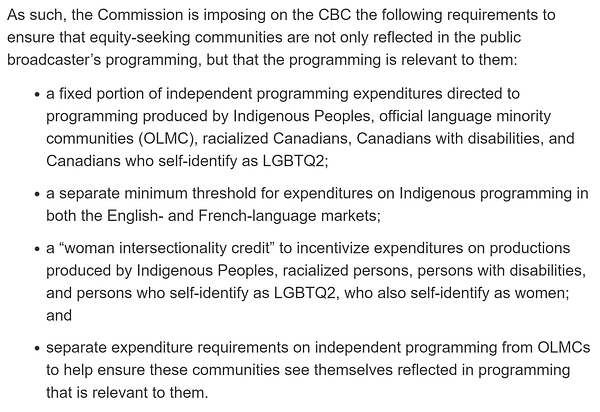
“As such, the Commission is imposing on the CBC the following requirements to ensure that equity-seeking communities are not only reflected in the public broadcaster’s programming, but that the programming is relevant to them.”

The CRTC is demanding a “fixed portion of independent programming expenditures directed to official language minority communities (OLMC), racialized Canadians, Canadians with disabilities, and Canadians who self-identify as LGBTQ2.” Additionally, it will grant a: “‘woman intersectionality credit’ to incentivize expenditures on productions produced by Indigenous Peoples, racialized persons, persons with disabilities, and persons who self-identify as LGBTQ2, who also self-identify as women.”

There are additional requirements for French language programming, of course. 

This line also caught our attention from the notice: 

“The Commission supports the Government of Canada’s commitment to renewing the relationship with Indigenous Peoples, based on the recognition of rights, respect, co-operation and partnership. On a broader level, the Commission also recognizes that Call to Action 84 of the Truth and Reconciliation Commission and the United Nations Declaration on the Rights of Indigenous Peoples (UNDRIP) tie into some of the objectives of the Broadcasting Act in that they refer to the reflection of Indigenous Peoples in the programming broadcast by the CBC.” 

The CRTC is demanding changes to the election of the CBC ombudsman to ensure he or she is “sensitive to issues surrounding Indigenous people, racialized Canadians and other equity-seeking communities.” 

It is also setting out “new expectations regarding the CBC’s Journalistic Standards and Practices to help ensure that journalists can provide relevant feedback and equity-seeking communities are consulted in any future review of the JSP.” 

(The JSP is basically the bible of CBC journalism and guides its employees in how it approaches reporting, analysis and opinion. The JSP has come under particular scrutiny in recent years when it was alleged that the expectation of “objective” journalism would distort how the outlet approaches racism. Attentive readers will note the obvious allusion to “moral clarity” here.)

Whether or not you agree with the outcomes being sought, what is clear is that the CRTC (which is appointed by the governor general, on advice of the privy council) is having explicitly political goals written into its license renewals. 

Now, don’t misread us, here. The CBC ought to be free to pursue equity goals in programming, or reviews of its JSP, or whatever it feels necessary to meet its mandate according to its own discretion. We happen think these outcomes are best exercised by trusted leaders and experienced producers who have the latitude to use editorial discretion, rather than by rigid quota or expenditure goals. 

To have these demands placed on it by an external regulator in order to fulfil the political goals of that regulator and, ultimately, its political masters, is playing with fire in the worst kind of way. 

For starters, one of the first pieces we ran here at The Line was from a documentary filmmaker who noted the ways in which diversity quotas shifted incentives in filmmaking. Just as students write to the test, quotas of this sort shift the focus in content production, forcing creators to produce content that checks a box, rather than fulfil a real audience desire. This creates a CBC that is dooming itself to be less relevant to the general public even as its relevance is growing more crucial thanks to the economic collapse of private media. The system is all the more insulting considering there is, in fact, a real audience desire for different voices and perspectives in our media landscape. 

(The Line can think of two such examples of CBC shows that were compelling and worth watching regardless of their diversity requirements: check out Sort Of and Trickster if you haven’t already. Unfortunately, the latter was cancelled when it was revealed that director Michelle Latimer was not as Indigenous as previously stated.) 

The second most obvious problem with all of this falls under the maxim “Do not give your enemies the weapons they will use to kill you.” In other words, having established this norm, do you not think that Prime Minister Pierre Poilievre, having done his damndest to stack the CRTC, will not do the same thing in turn? What is the CBC going to do when its license renewal is subject not to fulfilling the requirements of UNDRIP, but rather to concepts like “viewpoint diversity” and “journalistic objectivity,” as defined by Poilievre’s crew? The pendulum always swings back, friends, and it usually swings back harder when pushed. 

Source: The Line Dispatch 13 August

Diversité et inclusion: malaise au sein de CBC/Radio-Canada

Of note, and the difference between Radio Canada and CBC:

L’hésitation de CBC/Radio-Canada à se prononcer sur la récente décision du CRTC concernant le mot en n s’inscrit dans un contexte de transformations plus profondes au sein de l’institution. Sous l’impulsion de la présidente-directrice générale Catherine Tait, la société d’État a accéléré depuis 2018 son virage diversité et inclusion. Mais dans la salle de rédaction du service français, certains dénoncent « l’obsession » de la haute direction pour les questions identitaires.

« C’est comme si on voulait nous imposer le contexte sociopolitique de Toronto à Montréal. À Toronto, le multiculturalisme, c’est une réalité. Alors qu’au Québec, je regrette, mais ce n’est pas un concept politique qui est partagé par tout le monde. C’est un concept qui fait débat et il faut rendre compte de cette réalité », résume une personnalité bien connue de Radio-Canada qui tient à garder l’anonymat par crainte de représailles.

Le Devoir a pu s’entretenir dans les derniers jours avec cinq employés de la société d’État qui s’interrogent sur certaines initiatives de la haute direction pour promouvoir la diversité et l’inclusion. Certains sont plus critiques que d’autres, mais ils s’entendent sur une chose : CBC/Radio-Canada doit absolument faire appel de la décision du CRTC, qui a blâmé la semaine dernière le diffuseur public pour un segment dans lequel le chroniqueur Simon Jodoin et l’animatrice Annie Desrochers ont cité à quatre reprises le titre du livre Nègres blancs d’Amérique, de Pierre Vallières. Le CRTC oblige entre autres Radio-Canada à s’excuser.

« Je ne me fais pas d’illusions. Je vois mal comment la haute direction de Catherine Tait pourrait faire appel de la décision du CRTC après ce qui s’est passé avec Wendy Mesley », anticipe l’une des personnes qui ont accepté de parler au Devoir.

Wendy Mesley, c’est cette animatrice vedette de CBC qui avait été suspendue pour avoir cité le nom du livre de Pierre Vallières lors d’une réunion de travail. Cette journaliste d’expérience avait dû s’excuser à la suite de cet épisode, avant d’annoncer sa retraite l’an dernier. « L’histoire de Wendy Mesley nous a marqués. Ça a beaucoup choqué à Montréal, et il y a comme une incompréhension. Bien sûr, on en parle entre nous, mais pas trop fort. Car veut, veut pas, il y a un climat de suspicion qui s’est installé depuis cette histoire », ajoute notre source.

Prioritaire pour la haute direction

Pour certains, l’affaire Wendy Mesley est le point de départ d’un malaise qui n’a cessé de prendre de l’ampleur depuis.

L’année dernière, une formation obligatoire sur les privilèges et les biais inconscients a soulevé l’ire dans la salle de rédaction du service français. On y disait notamment qu’il était stigmatisant de décrire un secteur comme un quartier chaud parce qu’il a un fort taux de criminalité. Un exercice « infantilisant », « digne d’un cours de pastorale », s’insurge une autre employée qui a suivi la formation.

« C’est un objectif très louable de vouloir plus de diversité, et effectivement, il faut plus de diversité à Radio-Canada. Mais le problème, c’est la manière dont on s’y prend », nuance-t-elle.

Certaines déclarations de la p.-d.g. de la société d’État, Catherine Tait, ont aussi fait sourciller dans les dernières années. Après la découverte de potentielles tombes anonymes sur le site de l’ancien pensionnat de Kamloops, cette dernière avait envoyé un mémo aux employés pour les inviter à observer un moment de silence de 215 secondes, une seconde correspondant à chaque enfant autochtone disparu.

À la suite du prononcé de culpabilité d’un policier pour le meurtre de George Floyd à Minneapolis, elle a aussi reconnu explicitement le concept de « racisme systémique » dans une lettre signée par quatre directeurs et conseillers sur les programmes de diversité et inclusion. « Le racisme systémique existe toujours au Canada et au sein de plusieurs de ses institutions, y compris son diffuseur public », écrivait Catherine Tait, qui a fait toute sa carrière au Canada anglais.

Est-ce le rôle de la dirigeante de CBC/Radio-Canada de prendre parti dans des événements qui font l’actualité et que les journalistes de la boîte sont censés traiter ensuite de la manière la plus objective possible ? Pour certains, les prises de position de la haute direction n’affectent pas la manière de couvrir l’information. Mais d’autres sont d’avis que la politique officielle de l’entreprise empiète sur la sacro-sainte objectivité journalistique.

« Sur le concept de racisme systémique, par exemple, il y a un malaise. On peut être pour ou contre, mais ce n’est pas à une entreprise de presse de reconnaître quelque chose que le gouvernement du Québec refuse de reconnaître », illustre une personne qui évolue au sein de Radio-Canada.

Inclusif ou objectif ?

Ce principe d’objectivité journalistique a d’ailleurs été revu du côté anglophone. En juin 2020, dans la foulée de l’assassinat de George Floyd, le rédacteur en chef de CBC a proposé d’ouvrir le débat sur les Normes et pratiques journalistiques dans l’optique d’offrir une couverture plus inclusive. « Nos définitions de l’objectivité, de l’équilibre, de l’équité et de l’impartialité — et notre insistance pour que les journalistes n’expriment pas d’opinions personnelles sur les histoires que nous couvrons — vont-elles à l’encontre de nos objectifs d’inclusion et de faire partie de la communauté et du pays que nous servons ? » s’interrogeait Brodie Fenlon dans son blogue sur le site de CBC.

Côté francophone, ce raisonnement suscite beaucoup d’appréhensions. Des voix se sont fait entendre à l’interne pour implorer Radio-Canada de ne pas suivre la même voie que CBC.

Deux ans plus tard, les normes journalistiques n’ont finalement pas changé en soi, indique Chuck Thompson, chef des relations publiques de CBC, mais leur interprétation, oui. L’exercice en cours pour rendre les pratiques journalistiques plus inclusives porte « sur la façon dont nous interprétons ces principes, et sur l’identification des obstacles qui limitent notre journalisme en excluant des perspectives, des points de vue ou des expériences vécues », confirme M. Thompson. « Ce travail couvre toute une gamme d’actions, des stratégies d’embauche et de promotion aux meilleures pratiques pour couvrir la criminalité et la police, en passant par de la formation sur les préjugés inconscients et l’inclusion. »

Deux solitudes

À l’automne 2020, l’affaire Lieutenant-Duval à l’Université d’Ottawa a aussi mis en évidence des visions divergentes entre Radio-Canada et CBC quant à l’usage du mot en n. Lors d’une rencontre de la haute direction le 14 octobre, Catherine Tait a demandé pourquoi une émission sur le mot en n avait été proposée sur une plateforme de CBC plutôt qu’en français à Radio-Canada, une discussion qui aurait provoqué de vives tensions.

Interrogé à ce sujet il y a plusieurs mois, le bureau de Mme Tait a précisé au Devoir une partie des propos de Catherine Tait pendant cette rencontre : « Je me suis demandé pourquoi cette émission était produite en anglais et non en français puisque [les personnes qui l’animent sont francophones]. Et elles m’ont répondu que l’émission aurait été différente en français, que la conversation sur le racisme n’est pas aussi avancée au Québec. Ce que je veux vous dire aujourd’hui, c’est que c’est notre moment à Radio-Canada, c’est une occasion en or, pour nous, en tant que diffuseur public de vraiment servir tous les Canadiens et d’assurer notre pertinence pour l’avenir », aurait-elle déclaré.

À l’heure de mettre sous presse, le bureau de Catherine Tait n’avait pas donné suite à nos questions. Radio-Canada pour sa part n’a pas souhaité réagir.

La promotion de la diversité fait partie des conditions imposées à la société d’État par le CRTC, l’organisme responsable de lui accorder une licence de diffusion, et ces exigences ont été rehaussées lors du plus récent renouvellement, en juin.
Source: Diversité et inclusion: malaise au sein de CBC/Radio-Canada

Surrey’s Radio India to cease broadcasting

Expect in the long-run, as the recent CRTC television hearings and Netflix and Google testimony indicated, fighting a losing battle as more and more radio and TV shifts to the Internet, beyond the control of regulators:

The CRTC made it clear during Wednesday’s hearing, and with the consent orders, that it will no longer put up with stations that defiantly produce all their broadcasts, and collect 100 per cent of their advertising dollars, on Canadian soil without operating under Canada’s broadcasting regime.

That scenario has existed under the nose of not only federal regulators but Canadian politicians who beat a path to the doors of the pirate radio stations.

“Radio India is regarded as a must-do communications vehicle for politicians,” Gill, who last week mailed photos of himself with Canadian politicians, boasted Wednesday in the same presentation in which he promised to shut down operations. “The B.C. premier, members of parliament, MLAs, city mayors and councillors have been visitors to Radio India studios.“

Radio India has interviewed past and present prime ministers of both Canada and India. During elections, Radio India is chosen as a vehicle to connect with the South Asian community.”

Two CRTC-licensed, B.C.-based Punjabi-language competitors to the pirate stations testified by a remote hook-up Tuesday, saying their unsanctioned rivals have had an unfair advantage in scooping up millions of advertising dollars, including the estimated $2 million to $3 million that Gill says goes annually into Radio India’s coffers.

CRTC-approved broadcasters pay costly licence fees, copyright tariffs and must meet Canadian content rules, said CKYE-FM Red FM lawyer Mark Lewis, who testified along with Spice Radio formerly RJ 1200 owner Shushma Datt.

Surrey’s Radio India to cease broadcasting.