Conservatives call for end to ‘one-click citizenship,’ return to in-person ceremonies

The last public data, from the Minister’s transition briefing book, indicated 45 percent of ceremonies were in person. A significant increase from earlier years but agree, as readers will know, the default should be an in-person ceremony, as citizenship ceremonies are not just about convenience but mark and celebrate becoming a citizen with others joining the “Canadian family:”

The Conservatives are asking the Liberal government to end “one-click citizenship” and return all citizenship ceremonies to in-person events. 

“Last year over half of the people who became Canadian citizens did so by clicking a box online. That’s crazy,” Conservative MP Michelle Rempel Garner said Wednesday. 

“There is no way to justify this practice,” she said. “With support for immigration at an all-time low, returning to inclusive, nation-building ceremonies is a no brainer.”

Describing the in-person citizenship ceremony as the “essential unifying bedrock of Canada’s civic life,” Rempel Garner said the move would restore the ceremony’s “community significance.” 

New Canadians began taking their citizenship oaths through virtual ceremonies in April 2020 in order to adhere to social-distancing guidelines. 

In July 2022 the federal government resumed holding in-person ceremonies but kept the virtual option to help get more people through the system.

The federal government said the option took off in popularity; less than 10 per cent of new Canadians availed themselves of in-person ceremonies in the last six months of 2022.

Cutting down wait times

Virtual ceremonies are not exactly “one-click” affairs. According to Immigration, Refugees and Citizenship Canada (IRCC), they require a number of steps

IRCC provides a videoconference link where the person seeking citizenship meets with an official to have their identity verified and watch them cut their permanent resident card up with scissors.

Once that’s done, the person joins a virtual ceremony where they take the oath of citizenship, sign a document affirming they took the oath and send it to IRCC.

In 2023, the federal government floated the idea of having people self-affirm their citizenship oath. But when that idea went out for public consultation, 61 per cent of respondents were against it, and only 36 per cent supportive. 

Conservative MP Tom Kmiec endorsed a petition calling for IRCC to revert to in-person citizenship ceremonies as the default.

The parliamentary secretary to the minister of immigration, refugees and citizenship, Paul Chiang, responded to the petition saying virtual ceremonies have helped IRCC cut down wait times for citizenship ceremonies.  

Source: Conservatives call for end to ‘one-click citizenship,’ return to in-person ceremonies

Conservatives blast removal of religious exemption in hate-speech laws as ‘assault’ on freedom of speech

Arguably not needed given existing laws but recent occupations, obstructions, demonstrations supporting Palestinians have veered into explicit antisemitism and harassment of Jewish communities. The exemption should not be akin to a “get out of jail” card:

Opposition Conservatives say a deal between the governing Liberals and the Bloc Québécois to remove a religious exemption from Canada’s hate-speech laws, in exchange for passing a bill targeting hate and terror symbols, is an “assault” on freedom of speech and religion….

The Conservatives on Monday slammed the removal of that exemption as an attack on freedom of religion and of free speech, with the party quickly putting together a petition, which was circulated by its Members of Parliament.

“Liberal-Bloc amendments to C-9 will criminalize sections of the Bible, Quran, Torah, and other sacred texts,” Poilievre wrote on social media. “Conservatives will oppose this latest Liberal assault on freedom of expression and religion.”

Conservative Calgary MP Michelle Rempel Garner called on all other parties to oppose the amendment.

“I think it’s an unabashed attack on religious freedom,” Rempel Garner said.

Ontario MP Marilyn Glaudu, who serves as the Conservative critic for civil liberties, in a video on X, said the proposed change amounted to an “attack on people of faith.”

Fortin, the Bloc MP, agreed that the change will curb freedom of expression. However, he argued there must be limits on speech that propagates hate.

“I think this freedom of expression needs to be limited. You’re free to do what you want until you start harming others,” he said.

The bill itself seeks to create new offences around the intimidation and obstruction of sites used by an identifiable group, such as a religious or cultural centre, as well as make it a crime to promote hate by displaying hate symbols like a swastika, or those linked to listed terrorist entities.

The proposed amendments come amid widespread criticism about the Liberals’ bill, with the Canadian Civil Liberties Association (CCLA) and the Canadian Muslim Public Affairs Council calling for it to be withdrawn, along with dozens of advocacy groups. Critics warn that the new offences create the risk of police cracking down on lawful protests, and could lead to a targeting of Muslim and other racialized groups.

When it comes to the proposed removal of religious defences from hate speech laws, Anaïs Bussières McNicoll, director of the CCLA’s fundamental freedoms program, said it raises concerns.

She pointed to how that defence is only available to criminal law dealing specifically with the wilful promotion of hatred and no other offence, even speech-related ones, such as public incitement to hatred, or uttering threats.

“The speech that needs to be criminalized in Canada is already criminalized, and there is no religious exemption applying to that,” she said.

She said the association has for years held concerns around the provision, targeting “the wilful promotion of hatred,” given how broadly it can be applied.

“The concept of hatred is subjective,” she told National Post in an interview on Monday, “so we are always worried about risks of abuse and censorship of unpopular or offensive opinions through this provision. So we fear that removing this religious exemption might gradually erode the protections and increase the scope of this provision.”

Steven Zhou, spokesman for the National Council of Canadian Muslims, said in a statement on Monday that it was “gravely concerned and surprised” about the reported deal to remove the exemption for religious beliefs, saying that doing so “opens the door to a deeply troubling censorship regime.”

Khaled Al-Qazzaz, executive director of the Canadian Muslim Public Affairs Council, said in a statement that it rejects the removal of the religious exemptions, saying it considers doing so “an attack on all places of worship and religious schools.”

Derek Ross, executive director and counsel for the Christian Legal Fellowship, a national association for lawyers and law students who identify as Christian, said removing the exemption for religious opinions could lead individuals to self-censor and create an overall “chilling” effect.

The law must balance competing interests, he said, but pointed to how it must protect those who are fearful of becoming “vilified or detested” because they express viewpoints held by a minority.

Khaled Al-Qazzaz, executive director of the Canadian Muslim Public Affairs Council, said in a statement that it rejects the removal of the religious exemptions, saying it considers doing so “an attack on all places of worship and religious schools.”

Derek Ross, executive director and counsel for the Christian Legal Fellowship, a national association for lawyers and law students who identify as Christian, said removing the exemption for religious opinions could lead individuals to self-censor and create an overall “chilling” effect.

The law must balance competing interests, he said, but pointed to how it must protect those who are fearful of becoming “vilified or detested” because they express viewpoints held by a minority.

“It is a significant change to the law, and one that was not previously the subject of a great deal of discussion or debate by Parliament,” Ross said on Monday. “We hope that further consideration is given before such a move is made.”

As part of the deal with the Bloc, the Liberals are also expected to back off plans to eliminate the need for a provincial attorney general’s sign-off to pursue a hate-propaganda prosecution. The move will likely be supported by both the Bloc and Conservatives.

Fortin, Bussières McNicoll and Al-Qazzaz all said they agreed with maintaining the additional check and balance before charges are laid, which could have a cooling effect on freedom of expression.

Quebec’s Justice Minister Simon Jolin-Barrette, who has called on the federal government for years to remove the religious exemption defence, celebrated the deal between Liberals and Bloc on social media.

Source: Conservatives blast removal of religious exemption in hate-speech laws as ‘assault’ on freedom of speech

Deportations to be reported to Parliament each month under Conservative changes to border bill 

Hard to argue against more data but the Government and NDP rejected a similar amendment in the case of C-3 (citizenship). But yes, quarterly and annual reports are more informative in terms of trends but given that all IRCC immigration-related data sets are released monthly on open data, same should apply here and on open data, not reports to parliament:

Ottawa would have to report to Parliament every month on the number of foreign nationals who have been deported, including those with criminal convictions, under changes to the government’s border bill pushed through by the Conservatives

A slew of amendments to Bill C-12, including boosts to immigrationenforcement, passed in a marathon meeting of the Commons public safety meeting on Tuesday evening, where MPs scrutinized the bill until midnight. 

The committee voted for detailed monthly reports to Parliament on the number of deportations, including on where people came from and their age and gender, despite objections from a senior border official who argued that quarterly or annual reports would paint a clearer picture.

The amendment, proposed by the Conservatives, follows a report earlier this year that hundreds of convicted criminals facing deportation have gone missing. …

Source: Deportations to be reported to Parliament each month under Conservative changes to border bill

Conservative MPs denounce ‘Liberal racism’ and DEI during Jamil Jivani event

Good example of some conservative perspectives on DEI, mirroring some of excesses of liberal perspectives:

….Jivani’s Tuesday event was primarily a broadside at progressive ideologies writ large, but it also referenced federal programs and initiatives. The Prime Minister’s Office was not immediately available for comment on the event, though Jivani said all Liberal MPs were invited to attend his forum, however none took part. 

Jivani — who spoke about his upbringing as the son of an Irish-Scottish mother and a Kenyan father — said people like him “should not be treated as charity cases” and should not be subjected to “lowered” standards to access opportunities.

“I also stand here in opposition to Liberal racism because I completely reject the twisted narrative of Canadian history that liberal elites use to justify the open discrimination against Canadians of European descent and their children. Your heritage in this country should never be used as a weapon against you,” the Bowmanville—Oshawa North MP said, eliciting applause. 

“It’s also my belief that together, we can end Liberal racism by speaking very truthfully and bluntly about what it is, and highlighting the ways that it manipulates our society and divides people against one another.”

In service of that goal, Jivani ceded the stage to three Conservative MPs to share their views on the subject: Calgary’s Shuvaloy Majumdar and two rising stars within Tory caucus, Newmarket-Aurora’s Sandra Cobena and Richmond Hill South’s Vincent Neil Ho….

Source: Conservative MPs denounce ‘Liberal racism’ and DEI during Jamil Jivani event

Coletto: Is the Temporary Foreign Worker Program Canada’s Next Big Political Wedge?

Well, the Conservatives certainly intend it to be, even if their approach is overly simplistic:

…What does this mean politically?

  1. A potent wedge issue: The TFWP is shaping up as a powerful wedge for Conservatives: it stirs young economic anxiety and the populist thread of “Canadian jobs for Canadians.” It’s a clarion call that resonates with those feeling sidelined or squeezed.
  2. A potentially perilous balancing act for Liberals: With their own supporters deeply split, Carney’s Liberals must navigate between addressing economic vulnerabilities and maintaining labour market stability. Any move risks alienating one half of their fractured base.
  3. A broader narrative of precarity: Beyond the TFWP, Canadians are demanding security on jobs, housing, crime, and employment. Immigration is now at the centre of that conversation, reflecting a country where precarity shapes nearly every political debate.

At its core, the TFWP debate isn’t a technical economic tweak, it may become a battle for the narrative of Canada’s economic future. Those who support for scrapping it demand immediate protection; those who defend it warn of cascading supply shocks. 

Source: Is the Temporary Foreign Worker Program Canada’s Next Big Political Wedge?

Geoff Russ: Immigration is how Poilievre will get back on top

Reasonable foreshadowing of likely Conservative attack lines, some more valid than others:

Expect the Conservatives to come out swinging on immigration like never before when the House of Commons reconvenes next month.

Donald Trump gave the Liberals a lifeline to eke out another term in government in the spring, but the Liberals’ failure to get immigration under control is negatively impacting Canadians across the country.

In a statement released on August 25, the Conservatives pointed out that the government set an annual cap of 82,000 temporary foreign workers (TFW), but 105,000 had already been issued.

As for applicants to the International Mobility Program, they wrote 302,000 had been admitted by the first six months of the year in June, despite a promised cap of 285,000 permits.

“Moreover, their so-called caps on permanent residents were already among the highest in our history, yet they’re on track to exceed their own reckless targets, welcoming the equivalent of twice the population of Guelph and four times the population of Abbotsford,” read the statement, credited to Poilievre and Shadow Immigration Critic Michelle Rempel Garner.

This month, Poilievre released a series of graphics on social media highlighting the disparity between the Carney government’s promised targets, and how they are on-track to be exceeded.

This is a taste of what to expect for the fall session of Parliament, and Canadians will be receptive.

Sixty-two per cent of respondents in a Leger poll conducted in July believe there are too many newcomers arriving in Canada, and just 42 percent think they can be trusted. The poll also found that there was little disagreement between immigrant and native-born citizens in this regard.

Last year, Abacus Data found that 53 per cent of those surveyed had a negative view of immigration, and 72 per cent thought that the government’s immigration targets were “too ambitious”.

Abacus published the results of another survey earlier this month, finding that 25 per cent of Canadians now consider immigration to be the top issue facing Canada, and the Conservatives lead the Liberals 56 per cent to 15 per cent when respondents were asked which party was best equipped to handle the issue.

During the last federal election, young Canadians swung heavily towards the Conservatives, 44 percent to 31.2 per cent among 18 to 34 year olds, and with good reason.

Youth unemployment is the highest it has been since the late 1990s, with almost 15 per cent of Canadians aged 15 to 24 unable to find work before returning to school in the fall.

Employers have been greatly incentivized by the TFW program to hire foreigners instead of hiring and training their fellow Canadians.

The reliance on surplus foreign labour is dragging down productivity, while suppressing wages and per-capita GDP. There is no long-term upside to flooding the country with low-skill labour that pushes Canadians out of the job market, and the short-term effects have been socially and economically undesirable.

Investigations by the Toronto Star in 2024 found that government officials in Ottawa told their staff to skip fraud checks on TFW applications. Predictable wrongdoing ensued, such as no confirmation with employers to confirm that posted jobs actually existed, while migrant workers paid up to $70,000 for fake jobs.

As of now, it is estimated that there are somewhere between 600,000 and over 1 million undocumented people within Canada, and federal and provincial agencies seem incapable of remedying the issue.

Expelling people from the country is not a pleasant task when so many people have been duped by villainous immigration consultants who sold them fake dreams. The job must still be done.

You cannot have trust in a government that fails to meet its own immigration caps and enforce deportations.

It is unfair to Canadians, and unfair to newcomers who went through the proper channels.

One of the most infuriating aspects of it all is that Canada should not have an immigration crisis. Our geography gives us the privilege of being generous, and up until 2015 we were more selective about newcomers.

Stephen Harper’s government ran a very tight ship on immigration, and this should be the expectation of every Canadian government, not an exception.

This all started going downhill when Justin Trudeau became prime minister in 2015, and the numbers started climbing sharply. For example, his government lowered the benchmark for Express Entry from 866 out of 1200 points, to just 75.

Nearly five million people have entered the country since 2014, and few can say this country is fairer, more prosperous or more hopeful for it. Those who want Canada to continue as a welcoming country for new arrivals would do well to push for reform.

We are bordered by three oceans and an undefended border with the world’s most powerful economy. Our admission of newcomers is something we can control, and there is no reason why Canada should not have one of the most well-run, careful immigration systems in the world.

The idea that Canadians have been almost unanimously in favour of immigration since the Second World War is a pervasive myth. It has always been controversial among the public, but rarely has it been debated with ferocity in the House of Commons.

Canadians want a debate on current immigration levels to happen, and they will get their wish this fall.

Mark Carney will need creative excuses for why his government blew past its own caps, did not release immigration data for months, and presented no plan to end the economy’s dependence on cheap foreign labour.

For the Conservatives, this is a once-in-a-generation opportunity to finally turn immigration into an issue our politicians can openly and honestly debate.

The Liberals got us into this avoidable mess, and they must be held accountable for it.

Source: Geoff Russ: Immigration is how Poilievre will get back on top

Morton: Why Hiring Professors With Conservative Views Could Backfire on Conservatives

Interesting argument. But greater ideological diversity and openness would be welcome:

…Conservatives have criticized identity-based affirmative action because, they suggest, it imposes an expectation on students of color that they will represent what is presumed to be, say, the Black or Latino view on any given issue, which discourages freethinking. Admitting students for viewpoint diversity would turn the holding of conservative ideas into a quasi-identity, subject to some of the same concerns. Students admitted to help restore ideological balance would likely feel a responsibility to defend certain views, regardless of the force of opposing arguments they might encounter.

For professors hired for their political beliefs, the pressure to maintain those views would be even greater. If you had a tenure-track position, your salary, health insurance and career prospects would all depend on the inflexibility of your ideology. The smart thing to do in that situation would be to interact with other scholars who share your point of view and to read publications that reinforce what you already believe. Or you might simply engage with opposing ideas in bad faith, refusing even to consider their merits. This would create the sort of ideological echo chamber that proponents of viewpoint diversity have suggested, often with some justification, leads to closed-mindedness among left-leaning professors…

Jennifer M. Morton, professor of philosophy at the University of Pennsylvania

Source: Why Hiring Professors With Conservative Views Could Backfire on Conservatives

Poilievre tentatively courts Canada’s rising dissatisfaction with immigration

Not too much new in terms of the general points. More use of Century Initiative as punching ball, particularly given Mark Wiseman, one of the main persons behind CI2100, being appointed an advisor to PM Carney.

My earlier assessment of what to expect under a Conservative government largely still holds with the exception that the changes by former immigration minister Miller have paved the way for further restrictions:

After years of avoiding any clear position on the subject of immigration levels, the Conservatives have opened the 2025 campaign with a hard pledge to “slow immigration down” to sustainable levels.

“I want people to come here (in) numbers that can actually be housed, employed, and cared for,” Poilievre told a reporter on Monday, adding that he would directly tie immigration levels to homebuilding.

“So we’re always going to be adding homes faster than we add people,” he said.

Poilievre also lashed out again at the Century Initiative, a pro-immigration non-profit which advocates for Canada to have a population of 100 million by 2100.

The Conservative leader framed the group as advocating a “radical, crazy idea” to “bring in people from poor countries in large numbers, to take away Canadian jobs, drive wages down and profits up.”

It’s not the first time that Poilievre has criticized Liberal handling of immigration. A common refrain of Poilievre in the House of Commons was that the Liberals had “lost control of immigration.”

Last summer, he told a press conference that “we have to have a smaller population growth.” In a podcast interview with psychologist Jordan Peterson, Poilievre said “we’re not interested in the world’s ethno-cultural conflicts.”

At a Holocaust commemoration ceremony in January, Poilievre said Canada needs to start deporting immigrants involved in hate crimes.

“We must deport from our country any temporary resident that is here on a permit or a visa that is carrying out violence or hate crimes on our soil,” he said.

But this usually stopped short of any specific promises on immigration levels, visa quotas or screening procedures.

In fact, Poilievre’s ambiguity on immigration issues has been slammed by both the Liberals and by his critics on the conservative fringes.

At a media roundtable in Brampton, Ont., earlier this year, then immigration minister Marc Miller defended his government’s sudden turn towards reduced immigration levels, including non-renewal for the visas of more than two million temporary migrants in the country who might have expected permanent residency.

Source: FIRST READING: Poilievre tentatively courts Canada’s rising dissatisfaction with immigration

Conservative government’s immigration formula could result in lower immigration, Tory MP says

Some insights into their thinking, including comments wanting “real, reasonable objective metrics” related to housing, healthcare and jobs and “I don’t want my government determining which values it supports and which it doesn’t.” But of course, the previous conservative government didn’t move the needle either on foreign credential recognition:

The Conservative party’s plan to tie immigration numbers to available jobs and homes could result in a lower immigration target, an MP says.

Conservative immigration critic Tom Kmiec said a Conservative government wouldn’t set an arbitrary number, but rather one that takes into account what the country can sustainably accommodate. This could end up lowering immigration, he said.

“Whatever it comes out to, that will be the number,” Kmiec said on The Andrew Lawton Show. “If it’s lower, it’s lower. If it’s higher, it’s higher.”

Conservative Leader Pierre Poilievre previously said in an interview that immigration had to be tied to key economic numbers reflecting the labour and housing markets.

Kmiec said that under a Conservative government, those calculations wouldn’t just involve permanent immigration but also temporary resident immigration.

“The problem isn’t the permanent residency ones, those PR numbers are often quoted by individuals. In Canada, about 45% to 55% of those, depending on the year, are people who are actually physically in Canada already,” said Kmiec.

“They are just changing their status from studying, from working here on a temporary work permit and they’re becoming permanent residents of Canada, hopefully, on the pathway to becoming citizens and joining the Canadian family.”

Kmiec said it’s “ridiculous” that Prime Minister Justin Trudeau has only recently concluded that Canada’s immigration levels have far outpaced what the country can absorb.

“I guess he doesn’t read any of the briefing notes or documents that come up his way,” Kmiec said.

The Calgary MP pointed out how it was Trudeau himself who appointed the various immigration ministers responsible for the country’s explosive population growth. 

“When he reshuffled his own cabinet, you had this bizarre situation where the previous immigration minister could not let go of his department. He was saying that ‘things are a mess,’ that’s a direct quote and the new minister said ‘things are out of control.’ They’ve been fighting it out in public between the senior immigration minister and the junior immigration minister,” said Kmiec.

“Now the prime minister has weighed in and accused his government of basically failing on the job and that they’re not competent obviously, except he’s the one who appointed everybody. He’s been in charge for almost nine years now and they broke the immigration system. It’s nice of him to recognize that he broke it,” he added. 

When asked if the immigration calculation should be restricted to just economic indicators, instead of factoring in things like Canadian values as well, Kmiec said he was wary of introducing new things that “are not fixed.”

“I don’t want my government determining which values it supports and which it doesn’t and the reason I don’t like it is that for the last nine years, that’s been the Liberal government of Canada,” said Kmiec. 

“I believe things like healthcare, housing jobs, all Canadians can get behind that and be like, ‘yeah, those are real, reasonable objective metrics.’ There’s no subjectivity to them, you either have those services or you don’t.”

According to Kmiec, the immigration debate should be about whether the inputs are correct or not, instead of the number itself, saying, “if you want more immigration, build more housing.” 

It’s a question of changing policies to get more houses built and for cheaper. The same logic should apply to Canada’s healthcare system. 

Kmiec feels policies that don’t allow skilled workers like doctors and nurses who come to work in Canada are the reason for our strained healthcare system. 

“We have over 20,000 internationally trained doctors who cannot practice their profession,” he said. “Same thing for nurses. The country of origin lost a nurse and we didn’t gain a nurse.”

Source: Conservative government’s immigration formula could result in lower immigration, Tory MP says

UK: Say one thing, do another? The government’s record rise in net migration

Highlights the difficulties and how parties get captured by their political promises, and then later pay the political price:

Think back to the 2019 election campaign. Quite reasonably, you may not remember every detail of the Conservatives’ manifesto – but perhaps you do recall one promise: to reduce immigration.

Think back further, to 2016 and the Brexit referendum. Then there was a promise to “take back control” of the UK immigration system. And since it left the EU in 2020, the UK does have more control.

But the numbers of people who’ve moved here didn’t go down, they went up.

Since the Brexit vote and the Conservatives’ victory in 2019, the 12 months to June 2022 saw the fastest population growth since the 1960s. Current projections from the Office for National Statistics put the UK on course for 74 million people by 2036 – six million more than there are today.

You’d be well within your rights to ask how that could be? The answer, according to the ONS, is largely immigration.

And one aspect of immigration has received huge amounts of attention from the government and the media. Statement after statement, story after story, has focused on migrants crossing the Channel in small boats – and the government’s efforts to stop them.

Indeed you’d be forgiven for thinking small boats are a major part of why immigration is up. But they aren’t.

No doubt, small boats are an important issue – on a human and national level. Prime Minister Rishi Sunak has made “stopping the boats” one of his five priorities.

His government’s flagship Rwanda plan aims to send some asylum seekers who arrive on small boats there – and Mr Sunak is still trying to get the bill through parliament.

But it’s not small boats that are driving an increase in immigration – it’s choices made by the government.

Almost 30,000 people arrived in the UK on small boats last year – something the prime minister has vowed to crack down on

There are a number of ways to measure immigration.

Let’s start with one: net migration. That’s the difference between the number of people arriving and leaving the UK each year.

In 2022, it’s estimated to have reached an all-time record of 745,000.

Then, there’s the number of visas issued to people relocating to the UK. Last year there were more than 1.4 million.

For context, last year almost 30,000 people arrived by small boat.

After the UK left the European Union, the government launched a new visa scheme for most people who don’t have a UK passport.

The government decides the criteria for the different visas it issues – these can be for studying, for working, for humanitarian reasons – and other purposes too.

In the words of Prof Brian Bell, who chairs the government’s independent Migration Advisory Committee, the rise in immigration is “the inevitable consequence of government policy”.

We can see how this is the case by breaking down that 1.4 million figure.

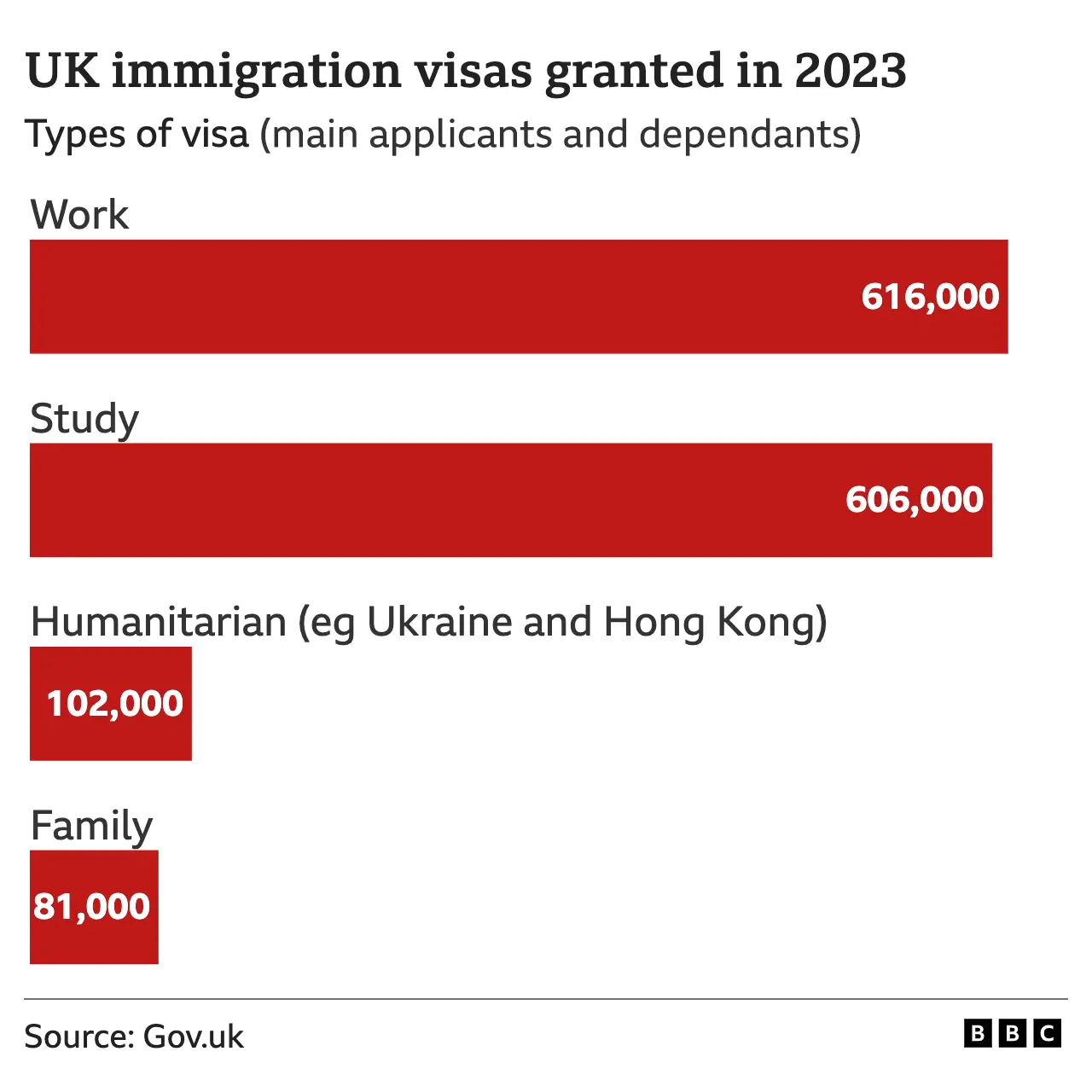
UK immigration visas granted in 2023

In 2022, the government issued almost 300,000 humanitarian visas. But last year the number was 102,000 – that’s just 7% of the 1.4 million visas issued.

The government has been consistent in its response when asked about the record levels of net migration.

Tom Pursglove MP, the Legal Migration Minister, told me: “We’ve seen incredible generosity in our country to people from Ukraine, people from Afghanistan, people from Syria, and other conflict zones. That is an important part of why we’ve seen the figures as they are.”

It is important, no doubt. And there was political consensus that issuing visas to people from Hong Kong, Ukraine and elsewhere was the right thing to do.

But the numbers show that this isn’t the full story.

The government has made other choices that have pushed up immigration.

Brexit and the pandemic added to existing recruitment problems in the social care sector. Care home owners responded by asking the government to make it easier to employ overseas care workers.

Those calls were echoed by the Migration Advisory Committee, which also suggested the government should fund higher wages to attract more British workers into the sector.

The Westminster government agreed more visas could be issued but did not raise wages.

A number of consequences followed.

For care home owners like Raj Sehgal, the changes helped. He filled almost all vacancies in his five Norfolk care homes, with 40% of staff coming from abroad.

“If we didn’t have international recruitment, I think we would probably be closed by now,” he told me.

More overseas staff arrived to work across the sector. But more may be needed. Last year, there were around 150,000 vacancies in England, and recruiting British workers remains difficult.

Let’s look at that 1.4 million figure again. Of all of those visas, more than 146,000 went to health and social care workers, another 203,000 went to their dependants.

This month, the government stopped overseas care workers from bringing dependants, describing the numbers as “disproportionate”. Mr Sehgal says this has already reduced the number of applications he is receiving.

This seems certain to reduce net migration numbers, but it’s not certain how the care sector will find the staff it needs.

If the government’s decisions on social care have driven up immigration, then so have its decisions on overseas students.

First of all, let’s consider the context here.

Tuition fees for domestic undergraduates at English universities are capped at £9,250 a year. That hasn’t risen for seven years – but during the same period, costs have. That has left universities facing financial challenges.

Some of them, like Coventry University, have targeted higher-paying overseas students to help cross-subsidise UK undergraduates. Forty per cent of the students at its campuses across the UK are from overseas.

If domestic tuition fees were raised, it could reduce the need for overseas students. But that would cost a lot. And it hasn’t happened.

Prof Brian Bell argues “that’s a choice of the government not to fund education in a particular way. The inevitable consequence is more immigration.”

The government couldn’t have been clearer about its ambition to attract more overseas students.

In 2019, it even set a target to increase the UK’s overseas student population to 600,000 – by 2030. It achieved that goal nine years early.

On top of that, in 2021, the government reintroduced a post-study work visa which allows overseas postgraduate students to work for two years after their courses finish – or three years if studying for a PhD.

It took the decision despite the Migration Advisory Committee suggesting that it shouldn’t.

All of this did what it was designed to do – attract lots more students. Last year the government issued almost 458,000 sponsored study visas. And almost 144,000 for dependants of postgraduate students.

Together, they made up almost 42% of the more than 1.4 million visas issued last year.

Again, the government was choosing immigration.

Now at this point, we should emphasise that while the government was putting in place policies that promoted immigration, knowing their precise impact was hard.

Dr Madeleine Sumption leads the Oxford Migration Observatory at the University of Oxford. She also sits on the Migration Advisory Committee that advises the government.

Predicting immigration numbers is “incredibly difficult”, Dr Sumption says. “Sometimes it’s much larger than the government expects.”

As the consequences of the government’s own policies became clear, it slammed on the brakes.

In May last year it announced that, from January 2024, most overseas postgraduate students would no longer be able to bring dependants.

This March, the government took further action – it ordered a review of the visa that allows overseas students to stay on and work. This, let’s remember, is the scheme the government had introduced only three years ago.

Legal Migration Minister Tom Pursglove explains: “The government took a view that we thought that that was the right thing to do to support the university sector. But when you consider the dependant numbers that have come with students, that has been very, very challenging.”

The government’s measures appear to be making a difference already. According to Universities UK, some universities are seeing a sharp drop in applications from overseas students for postgraduate courses.

But there’s a risk that as applications go down, so does the income of some universities.

A British Future poll suggests 69% of respondents are dissatisfied with the government on immigration

All of these government decisions have contributed to the record rise in net migration, and along with the rise we’re also seeing a shift in public opinion.

The think tank British Future, which tracks UK attitudes to immigration and describes itself as non-partisan, has shared its latest opinion poll with Panorama.

For the first time in four years, the poll suggests a majority of 3,000 respondents – 52% – want overall immigration to fall.

On top of that, 69% of those polled say they are dissatisfied with the government on immigration – that’s the highest since its polling began in 2015.

And this is where we come back to where we started – to the government’s emphasis on the issue of small boats.

The opinion poll also suggests that a little over half of those who say they are dissatisfied with the government’s handling of immigration pointed to small boats – and those concerns are coinciding with concerns about overall immigration.

Dr Sumption told me the media’s focus on small boats has probably created the impression that almost all migration comes that way, “which obviously it doesn’t”.

To reiterate – almost 30,000 people came by small boats last year and 1.4 million visas were issued by the government for people to come to the UK legally.

Some argue that the government has overemphasised the issue of small boats.

When I put that to Tom Pursglove, he countered that the government has a “moral imperative” to “grip that issue”. But he said that shouldn’t stop them, “delivering on the mission around legal migration, which is to get a better balance to bring those numbers down”.

At the moment, by the prime minister’s admission, that balance is off. In November, Rishi Sunak acknowledged, “immigration is too high and needs to come down”.

But his former Home Secretary Suella Braverman made a series of striking claims when I talked to her about Mr Sunak’s approach.

“I think the prime minister has not necessarily assumed that it’s an important issue for the British people,” Ms Braverman says.

“‘I struggled myself as home secretary, even to have a meaningful conversation with him about it. I was left to written correspondence on several occasions throughout a period of 12 months, putting forward policy proposals. But he refused to talk to me.”

I was taken aback by this. I know there is little political love lost since Mr Sunak sacked Ms Braverman last year – but this is the home secretary during the time of one of the sharpest rises in net migration in the UK’s history – claiming the prime minister wouldn’t talk to her about it – at all – for a year.

I double-checked I had heard right. I had.

“We talked about the boats every week, twice a week. We talked to each other a lot about policing and security. On legal migration, I was unable to get a hearing with the prime minister for 12 months.”

Given the importance of this issue to so many people, it is an extraordinary claim.

When we asked No 10 about this, it did not comment.

At the end of last year, the government announced plans to cut net migration by reducing the number of people coming to the UK by 300,000.

Remember, the latest estimate for net migration is 672,000 for the year to June 2023.

The estimate published just before the Brexit referendum – and which, at the time, Boris Johnson called “scandalous” – was 333,000. That estimate has now been revised down to 303,000.

So if the government meets its new target, that would take the numbers back towards where they were… just before the Brexit vote.

The government emphasises that Brexit has given the UK greater control and flexibility to adapt immigration policy to circumstance

Some observers watching the government’s statements and actions on immigration are gently raising their eyebrows.

Prof Anand Menon, who leads the independent think-tank UK in a Changing Europe, told us: “I think there is an element of dishonesty in the government at one and the same time implementing these policies and bemoaning them. Or bemoaning their impact.”

There seems little doubt the government’s latest measures will make a difference. Net migration is expected to fall. But if it does, the longer-term challenges that immigration has been easing may come into sharper focus.

Paul Johnson of the Institute for Fiscal Studies, which says it operates on a “non-political basis”, has an uncompromising message on this.

“If you want universities to have as much money as they have at the moment without these foreign students, you need to find some money from British students or the British taxpayer. If you want care homes to be staffed without bringing people in from elsewhere, you’re going to have to pay more. You have to make choices here.”

I’d hoped to ask Labour some questions about how it would approach these choices, but it declined.

This month, the Shadow Home Secretary Yvette Cooper said, “We are very clear that net migration needs to come down” and that a practical plan to tackle skills shortages in the UK is needed.

But are politicians of all parties being straight with us about what these choices involve?

For this government, for any government, these choices will involve difficult and sometimes expensive trade-offs.

Legal Migration Minister Tom Pursglove argues “issues have arisen” and it has “responded to those issues”. It emphasises that Brexit has given the UK greater control and flexibility to adapt immigration policy to circumstance.

Others point to recent data showing that one in five working-age adults are off work in the long-term, with record numbers recorded with long-term sickness.

In the Spring Budget, the Chancellor Jeremy Hunt said it would be easy to fill the 900,000 job vacancies with higher migration, but with 10 million adults not in work, it would be “economically and morally wrong”.

It’s inescapable though, that while the UK now has more control of its immigration system, the government has used that control to allow more people to come to the UK.

To come back to the question I posed earlier: how did that happen?

We can answer that by listing the government’s decisions and by acknowledging that there are powerful long-term factors that appear to encourage higher immigration. Our population is ageing, our birth rate is falling and our economy is struggling to grow.

The government though still insists the numbers will and must come down.
However, despite all the promises, this government chose more immigration. It is unlikely to be the last to do so.

Source: Say one thing, do another? The government’s record rise in net migration