Geoff Russ: Mark Carney can’t be trusted to get immigration under control

Example of any number of articles and commentary by Postmedia columnists warning that the appointment of Mark Wiseman, and to a lessor extent, Marco Mendocino, mean that PM Carney will continue the same high immigration policies of Trudeau. IMO, too early to tell, whether he would continue or expand the restrictions of former Minister Miller, or not. But certainly Wiseman’s appointment could be interpreted as such:

Donald Trump and his tariffs will not be the only key issue that determines who will be prime minister after April, 28. Canada has been plagued by a diverse set of problems for years, all of which will be remembered by voters on election day, including immigration.

Prior to Trump’s election and his decision to threaten Canada, one of the biggest controversies in Canada was the abrupt end of an uncontested pillar in Canadian political culture — immigration. It crumbled as if struck by a sledgehammer after just a few years of the Trudeau government’s careless mass-immigration policies.

The numbers laid bare illustrate Canada’s resulting issues of scarcity. Simply put, Canada is not built to sustain half a million newcomers per year.

Stephen Harper’s government admitted roughly 250,000 permanent residents per year between 2006 and 2015. The Trudeau wave saw those numbers increasing from Harper’s pre-2015 levels, to an average around 334,000, with four years (2019, 2021, 2022, and 2023) exceeding 341,000, at a time when Century Initiative, lobby group that advocates for dramatically higher immigration levels, was at the height of its influence in Ottawa.

In 2018, representatives of the Initiative lamented that Canada’s annual intake of about 310,000 people per year would only increase the population to 53 million by 2100, and called for an increase to 450,000 to reach the goal of 100 million.

Created by former McKinsey executive, Dominic Barton and former BlackRock executive Mark Wiseman, Century Initiative publicly endorsed the Trudeau government’s moves to take in 500,000 new immigrants per year by 2025.

However, the scheme rapidly lost all political currency as the population influx rocked Canada. Immigration-driven demand for housing and services vastly outstripped the supply of both, resulting in a palpable decline in affordability and access to health care, schooling and social services.

Between 2015 and 2024, Canada’s ranking in the Human Development Index plummeted from 9th to 18th, while the country fell behind Italy in the average growth of real GDP per capita.

Western governments since the Great Recession have tried to claim that large-scale immigration is an unambiguous economic benefit. Given the state of the economies of Canada, Germany, and others that embraced mass immigration, immigration has not been a silver bullet to remedy slow growth and stagnation.

Immigrants themselves are not at the root of Canada’s long-standing problems. However, it is also clear that increasing their numbers in such a deliberate fashion failed to make Canada more competitive or improve the lives of its citizens.

There has not been a meaningful increase in the numbers of engineers, physicians, and software developers. In essential services like health care, the ratio of family doctors in relation to the general population has actually worsened. Rather, Canada has imported hundreds of thousands of unskilled international students who stock shelves, deliver food, and flip hamburgers for minimum-wage.

On the other hand, academic institutions have become dependent on this new class of economic immigrant, who often enters the country on a student visa to attend suspect career colleges while paying exorbitant international student fees.

This is not an economic climate that breeds dynamism or healthy growth. Canada needs to be a top choice for highly-skilled immigrants, which means having attractively affordable housing and quality services, neither of which have been rapidly deteriorating.

Even if the restrictions on foreign credentials are loosened in Canada, few trained doctors or dentists from India or South Africa will pick Toronto over Dallas as long as the latter offers substantially higher paycheques and cheaper housing.

In-fact, just 46 per cent of immigrants are now choosing to receive Canadian citizenship, compared to 72 per cent in 1996. Last fall, Ipsos found that just over one quarter of all newcomers plan on leaving Canada within two years, with many citing the lack of affordability. This they have in-common with younger Canadians, many of whom are resigned to bleak and leaner lives than those enjoyed by their parents.

It is therefore concerning that Mark Carney has brought on Century Initiative co-founder Mark Wiseman as an advisor, whose name is ironic considering the results of his lobby group’s ideology. Canadians do not want Century Initiative-inspired ideas anymore, with nearly 60 per cent of residents polled last summer wanting substantially less immigration.

Unlike Europe, where mass-immigration has resulted in a slew of cultural and social clashes between asylum seekers and the established population, the pushback to immigration in Canada still mostly stems from economic factors, particularly housing.

Nonetheless, Wiseman’s presence on the prime minister’s team is political poison. He once even publicly endorsed pushing the Century Initiative’s agenda, even if it caused outrage in Quebec.

For many Québécois, their future is a major source of concern as their demographic place in North America shrinks. The prospect of more mass immigration could be the landmine that blows up Carney’s current run of goodwill in Quebec.

Without Quebec, Carney has little hope of winning a majority government, and even a parliamentary plurality is uncertain. Within hours of Wiseman’s involvement being announced, both the Conservatives and the Bloc Québécois went on the attack, in both official languages.

Pierre Poilievre himself attacked the Century Initiative as striving to “bring in people from poor countries in large numbers, to take away Canadian jobs, drive wages down and profits up,” and that Canada should only admit people who can be actually housed and employed

Wiseman’s role will harden the perception that Carney is merely feigning a Liberal shift back to the centre under his leadership. It was a misstep that undercuts Carney’s credibility on immigration caps, which he has nominally pledged to maintain until housing is expanded.

To their credit, the Liberal government significantly scaled back the annual immigration numbers in Trudeau’s final months as PM, if only due to public backlash. A new leader, and Trump’s blustering, has gifted the Liberals a huge opportunity to reinvent themselves as the defenders of the country, while sidestepping hard questions about their thus far poor record in government.

Mark Carney is saying and promising all the right things to pull the Liberals back towards the centre and a genuine pro-growth agenda, earning him plaudits across the political spectrum, even from conservatives. However, if he continues to surround himself with the same crew of advisors and cabinet ministers who sailed Canada into a lost decade, can Carney truly be the captain to right the ship, least of all on immigration?

Source: Geoff Russ: Mark Carney can’t be trusted to get immigration under control

Christopher Dummitt: Canadians need a proud, not guilt-ridden Canada

Ongoing arguments for a needed correction:

…The second key element of any national cultural policy ought to be a more realistic approach to pluralism. Canadians live in a country of different ethnic, linguistic, and religious groups. We aren’t unified. But the fundamental error of the last decade was to do diversity wrong — to engage in a downward spiral of national subtraction. Out of a well-intentioned, but horribly mistaken desire to protect certain historically marginalized groups, we kept demoting our national heroes out of a belief that they “harmed” people in the present.

A pragmatic pluralism would recognize that one people’s hero will be another’s villain. This absolutely should not mean dishonouring anyone because one group says they are hurt.

Heritage harm is a choice. No one has to be offended when they walk into a school named after someone whom they don’t respect. Conservatives aren’t psychologically damaged when they fly out of Pearson airport. Nor do Liberals suffer when they tour the Diefenbunker. Francophones don’t need to avert their gaze as they drive through Durham region just because Lord Durham once advocated for their assimilation. And a Wendat/Huron Canadian doesn’t need to feel threatened when driving past Tyendinaga Mohawk Territory just because the Mohawk people once wiped out Huronia.

Any Canadian party that wants to be seriously considered as a defender of the nation should promise a pragmatic pluralism which builds up and doesn’t tear down our country. Each group of Canadians should be allowed to keep their historical heroes. Instead of tearing down John A. Macdonald statues, a new federal government should promise to raise statues of figures like Tecumseh or Big Bear. Canada is a diverse country. We can have a diverse set of historical heroes. No one gets a veto. Individual Canadians can choose to be harmed by a name if they want — but our national government needs to be bigger than this — stronger and more resilient.

What’s more, a third key promise ought to be the adoption of a culturally mature notion of diversity. Canada hasn’t always looked the way it does today. People in the past didn’t think the same or act the same. A responsible national government would take pride and celebrate this diversity.

Canada’s prehistory was dominated by Indigenous peoples who have fascinating histories that long-predate the origins of Canada itself. We ought to celebrate these histories. And this shouldn’t mean just pretending that pre-contact Indigenous peoples were benign environmental-loving hippies. We should tell the more accurate and much more fascinating stories of conflict and war and struggle.

From the time of New France up to the 1960s, most Canadians could trace their ancestors back to two places — France and the British Isles. This is just a fact of history and demography. We don’t need to apologize for it. We were an overwhelming white western European colony. We shouldn’t expect our historical figures for much of our history to represent the diversity of multicultural Canada in 2025. They didn’t, and they don’t.

We could instead celebrate the amazing fact of Canadian governments in the 1960s — first under Diefenbaker and then under Lester Pearson — to remove racism from our immigration system. This was an astounding decision. Most groups, for almost all of human history, have wanted homogeneity — to insist on sameness. It’s not odd that Canada was similar before the 1960s, but it is quite amazing that Canada changed its tune. A build-it-up national cultural policy would celebrate this fact, and the Canadians who came before. It doesn’t have to be one or the other. Our heritage should be about building up and adding on, not deleting.

Finally, a more mature approach to diversity would acknowledge that Canadians are sophisticated and not bigoted. They don’t have to share the same identity characteristics of our heroes to appreciate Canadian history. That kind of racial in-group thinking is a barrier to true national belonging. You don’t have to be Black to admire Viola Desmond. You certainly don’t need to be white or German-Canadian to be proud of Diefenbaker’s “One Canada vision” and his championing of a Bill of Rights.

Who will offer this proud Canadian vision? Which party will turn its back on the subtraction-heritage distraction of the last decade?

The way ahead ought to be clear: a vision of the country where pride and dignity comes first; a proud pluralism that allows every Canadian group to have its heroes and its stories; and a mature approach to diversity that assumes a resilient Canadian population, one that sees and celebrates our differences over time, and assumes that any Canadian, regardless of their background or when their ancestors arrived here, can share in the story.

Source: Christopher Dummitt: Canadians need a proud, not guilt-ridden Canada

Wright: Canadians don’t want to be the 51st state – and Americans don’t really want us

Another cathartic column for Canadians:

Canadians owe Donald Trump a debt of thanks. His musings about Canada becoming the 51st state have reminded us why we are Canadians in the first place and why we want to remain Canadians.

Still, it’s worth thinking about some of the legal steps to, and political implications of, a possible Canadian statehood.

First, Canada is a constitutional monarchy. To join the United States, it would have to become a republic. While that’s not impossible, it wouldn’t be easy. Amending the Canadian Constitution in relation to the King or Queen requires unanimous provincial consent. When was the last time all 10 provinces agreed on anything?

And what about Indigenous Peoples

Meanwhile, there are 634 First Nations governments – each with their own relationship with Canada or the Crown. Indeed, one of the mandates of the Department of Crown-Indigenous Relations and Northern Affairs is to recognize and implement “treaties concluded between the Crown and Indigenous Peoples.”

If it’s difficult to imagine Indigenous Peoples agreeing to give up their treaty rights, it’s equally difficult to imagine the U.S. negotiating new treaties and nation-to-nation relationships with 634 First Nations.

For its part, Quebec will never agree to give up the substantial power and real sovereignty it has as a province, even if every other province agreed to – which they won’t. In defence of their borders and the French language, Quebecers would likely secede from Canada long before any serious move towards Canadian statehood – and who could blame them?

Of course, this assumes that American lawmakers want a 51st state – and they don’t. Certainly, Republican lawmakers don’t, for the same reason they don’t want Puerto Rico and Washington, D.C. to become states.

Each state has two senators and it’s a safe bet that both Canadian senators would be Democrats or be from a separate party that would caucus with the Democrats. The GOP cannot risk becoming a minority in a closely divided Senate.

When Hawaii joined as the 50th state in 1959, there was a lot of handwringing, especially in the Jim Crow South. For example, a Mississippi senator insisted that Hawaii’s admission would mean “two votes for socialized medicine, two votes for government ownership of industry, two votes against all racial segregation and two votes against the South on all social matters.”

Canada: A potential Republican wasteland 

Republican senators have similar arguments against admitting Canada – two votes for universal, single-payer health care, two votes for abortion rights, two votes for LGBTQ+ rights, two votes for multiculturalism, two votes for science, two votes for vaccines, two votes for climate policies and two votes against tax cuts for the wealthy.

Each U.S. state also has members in the House of Representatives, according to its population. If Quebec doesn’t secede, Canada would be the most populous state in the U.S., giving it as many as 55 seats in the House which, with Canada’s admission, would have about 490 seats. If Quebec does secede, Canada would be the second most populous state, giving it as many as 45 seats.

Not all Canadian representatives would be Democrats or from a party that would caucus with them, but the majority would be, providing the Democratic Party with control over the House of Representatives into the foreseeable future.

Finally, the White House: Does anyone really think that Canadians would vote for the Republican Party in its current incarnation? Some would, but the majority wouldn’t.

In the last federal election, about 60 per cent of Canadians voted for the Liberals, the NDP, the Bloc Québécois or the Green Party – all centre and centre-left parties. Even if Quebec secedes, most Canadian voters still lean centre or centre-left.

In America’s winner-takes-all presidential election, Canada’s roughly 50 electoral college votes would go to the Democratic candidate, not enough to guarantee a Democratic victory when approximately 590 electoral votes would be up for grabs, but enough to permanently narrow the GOP’s path to victory.

If Canada does become part of the United States, it won’t be as a state. It will be as an occupied territory and occupations never end well for the occupier – something Americans understand after 20 years in Afghanistan and Iraq.

Bottom line: Canadians don’t want to become the 51st state and the Americans don’t want us anyways, which leaves us with Donald Trump, a troll with a large following on social media trying to own the libs and get under our skin.

My advice? Ignore him and get on with the related tasks of peace, order and good government and managing the economic fallout of his tariffs.

Source: Canadians don’t want to be the 51st state – and Americans don’t really want us

Canada Curbed Illegal Migration to the U.S. Now People Are Heading to Canada.

Sort of inevitable that increased security patrols mean further persons found. No major uptick to date, February data should be out shortly:

…Canada has directed 1.3 billion Canadian dollars ($900 million) to enhance border security, adding two Black Hawk helicopters and 60 drones equipped with thermal cameras.

It also tightened requirements for temporary visas that some visitors used to arrive in Canada legally but then enter the United States illegally.

The Canadian government says its recent measures have driven down the number of unauthorized crossings into the United States: About 600 migrants were intercepted at the border in January, down from about 900 in January 2024, according to U.S. data.

“Whether or not some of the allegations about what is going on at the border are accurate or not, or credible or not, I don’t have the luxury not to take it seriously,” Marc Miller, Canada’s immigration minister, said in an interview on Thursday.

…The Opposite Direction

Canada’s focus on the border, against the backdrop of Mr. Trump’s domestic crackdown on migrants, is why the nine people walking into Alberta on Feb. 3 raised alarms: It was unusual to see a group this large crossing on foot in the heart of winter. The presence of young children made it all the more troubling.

The Canadian authorities say they have been intercepting more people arriving from the United States, but because of the schedule Canada follows in releasing data, no numbers are yet available for the weeks since Mr. Trump’s inauguration in January. But government news releases suggest the numbers are rising….

“This is the latest sign that Canada is sending people and families with children back to the U.S. with the full knowledge that they are at great risk of being detained and then returned to danger,” said Ketty Nivyabandi, a leader of Amnesty International’s Canada chapter, referring to the nine migrants Canada returned to the United States. 

“The Canadian government must not wait a minute longer to withdraw from the Safe Third Country Agreement,” she added.

But such a move would likely encourage more people to seek refuge in Canada, creating new pressures on the country’s already strained immigration system.

“It would almost certainly lead to a surge in unauthorized border crossings,” said Phil Triadafilopoulos, a political science professor at the University of Toronto.

Still, he added, by continuing to return asylum seekers to the United States, Canada is signaling that “it isn’t going to receive people who have lost their temporary protected status in the U.S. as hospitably as it did in the past.”

And as illustrated by the migrants who crossed in Alberta, those groups, he said, can “include small children in really dire conditions, with the full knowledge that the fate of those children and their families is highly uncertain.”

Mr. Miller, the immigration minister, insisted that Canada believes that the United States remains a safe country for asylum seekers.

“We need to have a proper, managed system at the border,” he said. “But it doesn’t mean that we’re naïve, or we’re not watching events that are currently happening in the U.S.”…

Source: Canada Curbed Illegal Migration to the U.S. Now People Are Heading to Canada.

Liberals set tighter rules for coming leadership race amid foreign interference concerns

Finally reading the room! One can argue about the age but the party has done the necessary in limiting participation to citizens and Permanent Residents:

The Liberals will pick a new leader to replace Prime Minister Justin Trudeau on March 9 under tighter new rules meant to address concerns about potential foreign interference.

Trudeau’s successor will take the reigns of the party just weeks before parliament is set to resume on Mar. 24. The government is almost certain to face a non-confidence vote which would trigger a spring election.

The Liberal Party board decided it will restrict voting rights in the leadership race to permanent residents and Canadian citizens in contrast to its wide-open approach which previously allowed non-Canadians to vote.

“Protecting the integrity of our democratic process, while still engaging as many people as possible, is one of the Liberal Party of Canada’s top priorities,” the party said in a release. 

The party retained rules that allow minors as young as 14 to become registered Liberals and to cast a vote.

To be a registered Liberal, an individual must simply “support the purposes of the party,” not be a member of any other federal party and not have declared to be a candidate for any other federal party.

Source: Liberals set tighter rules for coming leadership race amid foreign interference concerns

Immigration department received intelligence about huge rise in clandestine U.S.-Canada border crossings last year

Good questions regarding senior official and minister awareness:

Intelligence experts within Canada’s border agency informed the federal immigration department last December about a big rise in illegal crossings of the Canada-U.S. border, including into the States, which raises questions about why action to curb it was not taken earlier.

An intelligence document sent to senior Immigration, Refugees and Citizenship Canada officials, says smugglers were moving people across the border in both directions, with some foreign nationals flying into Canada at major airports and swiftly slipping across the border into the United States.

The Canada Border Services Agency’s intelligence analysis says clandestine entries have led to thousands of refugee claims, mostly in the Greater Toronto Area.

The document says “the Southbound movement into the United States (US) has grown significantly since 2022″ adding that “the majority of individuals who attempt to cross southbound illegally arrive by air, mainly at Montreal Trudeau International Airport and Toronto Pearson International Airport and move quickly.”

It found that “the vast majority were very likely in Canada for less than 6 months of which a large portion were in Canada for less than 3 weeks.”

Ministers have insisted in recent weeks, amid heightened tensions between U.S. president-elect Donald Trump and Ottawa over illegal immigration into the U.S., that Canada’s borders are secure.

But the emergence of the detailed analysis by the CBSA’s Intelligence and Investigations Directorate raises questions about whether ministers were ignorant of the extent of people smuggling into the U.S. from Canada, and in the other direction….

Source: Immigration department received intelligence about huge rise in clandestine U.S.-Canada border crossings last year

Québec exige la fin de l’exemption religieuse pour la propagande haineuse

Thorny issue, given some of the examples where appears needed and others where more questionable:

Ottawa a démontré peu d’ouverture à une demande du ministre de la Justice du Québec, Simon Jolin-Barrette, qui ne veut plus que le Code criminel permette à des individus de se livrer à de la propagande haineuse « sous le couvert de la foi ». Pour toute réponse, le gouvernement Trudeau a suggéré au ministre québécois de collaborer à l’avancement d’un projet de loi fédéral sur « les préjudices en ligne ».

Le ministre Jolin-Barrette a envoyé une lettre jeudi à son homologue canadien, Arif Virani, afin de lui demander d’abroger deux articles du Code criminel qui contreviennent, selon son interprétation, au principe de laïcité de l’État.

Ces articles — 319 (3) (b) et 319 (3.1) (b) — font partie d’une courte de liste d’exceptions pouvant être évoquées face à des accusations d’avoir fomenté volontairement la haine ou l’antisémitisme. Ils permettent à un accusé de se défendre en faisant valoir le fait d’avoir, « de bonne foi, exprimé une opinion sur un sujet religieux ou une opinion fondée sur un texte religieux auquel il croit », ou d’avoir « tenté d’en établir le bien-fondé par argument ».

De l’avis du ministre Jolin-Barrette, « cette justification est actuellement exploitée pour légitimer des propos discriminatoires ou incendiaires sous le couvert de la foi ». « Ce genre de discours contribue à un climat toxique, menaçant la sécurité et le bien-être des personnes visées », a-t-il écrit au ministre Virani.

Le cabinet du ministre Virani a fait suivre une réponse au Devoir. La directrice adjointe aux communications, Chantalle Aubertin, y a écrit qu’en guise d’« action décisive », Ottawa avait présenté la Loi sur les préjudices en ligne, « une mesure globale visant à lutter contre la propagation des discours haineux, tant en ligne que dans nos communautés ».

« Nous apprécions les observations du ministre Jolin-Barrette et restons déterminés à travailler ensemble pour trouver des solutions », a-t-elle ajouté. « Nous l’encourageons à collaborer avec les parlementaires afin de soutenir l’avancement de la Loi sur les préjudices en ligne en comité, garantissant ainsi que nous disposons des outils nécessaires pour combattre efficacement la haine », a ensuite suggéré Mme Aubertin….

Source: Québec exige la fin de l’exemption religieuse pour la propagande haineuse

Ottawa has shown little openness to a request from Quebec’s Minister of Justice, Simon Jolin-Barrette, who no longer wants the Criminal Code to allow individuals to engage in hateful propaganda “under the guise of faith”. For any response, the Trudeau government suggested that the Quebec minister collaborate in the progress of a federal bill on “online damage”.

Minister Jolin-Barrette sent a letter on Thursday to his Canadian counterpart, Arif Virani, asking him to repeal two articles of the Criminal Code that, according to his interpretation, contravene the principle of secularism of the State.

These articles – 319 (3) (b) and 319 (3.1) (b) – are part of a short list of exceptions that can be raised in the face of accusations of having voluntarily fomented hatred or anti-Semitism. They allow an accused to defend himself by asserting the fact that he has, “in good faith, expressed an opinion on a religious subject or an opinion based on a religious text in which he believes”, or that he has “tried to establish its merits by argument”.

In the opinion of Minister Jolin-Barrette, “this justification is currently exploited to legitimize discriminatory or incendiary remarks under the guise of faith”. “This kind of speech contributes to a toxic climate, threatening the safety and well-being of the people targeted,” he wrote to Minister Virani.

Minister Virani’s office forwarded a response to the Duty. Assistant Director of Communications, Chantalle Aubertin, wrote that as a “recisive action,” Ottawa had introduced the Online Injuries Act, “a comprehensive measure to combat the spread of hate speech, both online and in our communities.”

“We appreciate Minister Jolin-Barrette’s comments and remain determined to work together to find solutions,” she added. “We encourage her to work with parliamentarians to support the progress of the Online Damages Act in committee, thus ensuring that we have the necessary tools to effectively combat hatred,” Ms. Aubertin then suggested.

Misleading Canadians: The Flawed Assumption Behind the Government’s Planned Reduction in Temporary Residents

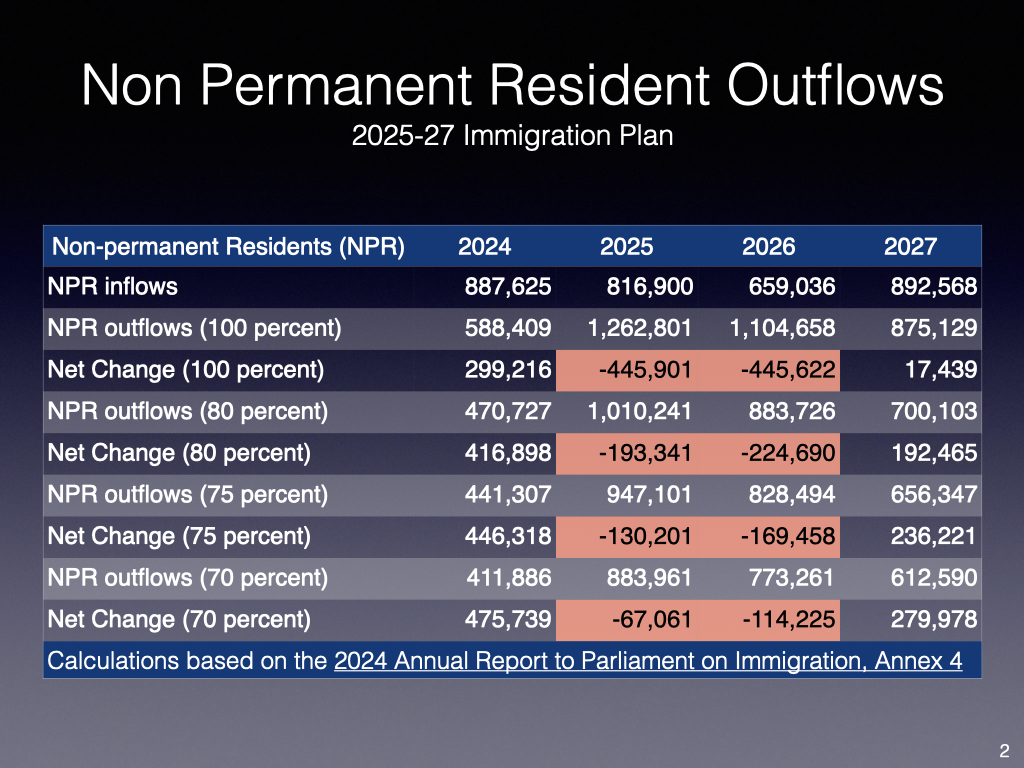
This analysis was prompted by questions regarding the projected numbers of departures with no methodology mentioned, and the suspicion, subsequently confirmed, that it was based on the false assumption that all temporary residents would leave upon expiry of their visa

When IRCC released its annual immigration plan last month, eyebrows were raised over the plan’s prediction of large outflows of temporary residents upon expiry of their visas. The Parliamentary Budget Office noted that “there is significant risk to the demographic projection presented in the Government’s new immigration plan—particularly to the projected outflow of non-permanent residents.” The plan included a table covering projected outflows without indicating the methodology and assumptions behind the table. Subsequently, IRCC has confirmed that the calculations assumed that all temporary residents would leave when their visa expired, save for those who transitioned to permanent residency.

This assumption is just wrong as many temporary residents may well remain in Canada and appears aimed at misleading the public. For illustrative purposes, I revised the plan table to include four assumptions: 100 percent of temporary residents leave (the plan’s assumption), and three alternatives where 80, 75 and 70 percent leave. Should 60 percent or less leave, there would not be any net reduction in the temporary resident population.

The overly precise nature of the numbers—down to individual persons—highlights that the government adapted a purely mathematical approach in its estimates. In the case of permanent resident levels, the government more sensibly uses ranges rather than precise numbers which reflect more accurately operational realities. While politically difficult to admit that some non permanent residents will remain, by not doing so the government attracts more scepticism regarding its plans.

Moreover, as Canada does not track outflows systematically, we will not have accurate data on how many actually leave. The government should explore coordination of flight and CBSA data to obtain better anonymized information on outflows and those who overstay their visa.

The Prime Minister has stated that “Between the amount of people coming and going, we’ll effectively pause population growth for the next two years, then from 2027 onwards, it will balance out and slowly start increasing again at a sustainable pace.” However, this is based on the false assumption that all temporary residents will leave when their visa expires. Unfortunately, as we will not know how many people will stay versus how many people will leave, it will not be possible to verify the extent of errors and estimates.

In short, while inclusion of temporary residents in the annual immigration plan is both overdue and welcome, a more serious approach is needed that better reflects the reality and challenges.

Selected commentary on Government’s reversal of immigration policies

The plan, apart from the numbers and the addition of targets for temporary residents, also had high level discussion of impacts on housing, healthcare and education, as I argued for in my December 2022 article Has immigration become a third rail in Canadian politics?

Major and overdue reversal, one that allows for a more serious discussion regarding immigration policies and priorities without accusations of xenophobia or racism (although see that some activists have already gone there).

Some selected commentary, mix of serious and agenda driven, no doubt more will follow.

Advocates:

A Dark Day for Canada: CILA Condemns Immigration Levels Plan 2025-2027: As an example of this, the federal government’s decision to aggressively increase permanent resident levels in 2021 during a challenging pandemic operating environment created a cascading effect on permanent and temporary resident programs which are still placing immense pressure on the immigration system today and will continue to do so over the foreseeable future. Another example was to allow international students to work full-time while class was in session. This change added to the growing number of foreign students coming to Canada, primarily to seek employment opportunities rather than academic pursuits. Consulting widely with stakeholders would give IRCC the information it needs to plan for the long-term and make policy decisions that are sustainable.  

While we are unable to change the past, it is incumbent on IRCC to learn from its recent shortcomings and ensure it hosts genuine stakeholder consultations moving forward so that immigration levels planning and other major policy decisions consider various viewpoints and we can proactively and effectively manage a healthier immigration system. 

OCASI: Immigration Levels Plan leaves behind refugees, families and people without status: We are deeply concerned that the government continues to incorrectly tie immigration numbers to housing pressures. Scapegoating immigrants for the lack of affordable housing is disgraceful, and will only increase anti-immigrant sentiment from politicians and the public. We expect better from the government and leaders of all political parties. 

These cuts also contradict the government’s acknowledgement that immigration is essential to Canada’s economic success and growth, and that 100% of Canada’s labour market growth comes from immigration. We call on the government to provide greater clarity on how the new levels plan is expected to resolve the public concerns it claims to address.

Canada betrays refugees – CCR Statement on 2025 Levels Announcement: In a shameful abdication of responsibility, the Canadian government has massively reduced its commitment to offer protection to those fleeing persecution and danger in the world, and all but ensured that refugees in Canada will remain separated from their spouses and children for years to come. The CCR condemns today’s announcement and calls on the government to reverse this dangerous course.

Media commentary

Clark: The day Justin Trudeau (sort of) admitted a mistake on immigration: The U-turn is unusual for governments, and out of character for this one. But it had become a political necessity to tell Canadians the Liberals are changing course. Mr. Trudeau even admitted he made a mistake. Or sort of.

Keller: The Trudeau government wants to restore the immigration consensus that it broke: Good news: Canada’s immigration consensus is back. Better news: It’s being restored by the people who broke it.

That means immigration is not going to become a divisive, polarizing and potentially explosive issue in the next federal election. Unlike our peers in Europe and the United States, we’re not going to have a radical left versus radical right brawl over the issue.

Why not? Because Prime Minister Justin Trudeau’s government has come to its senses on this issue. It’s been moving in that direction for the last year and a half, and as of this week, it’s close to fully there.

Phillips | Don’t be fooled into thinking Canadians have soured on immigration — the truth is remarkable
Canadians, by a significant majority, still believe in the value of immigration and they aren’t scapegoating immigrants for their problems, which compared to what’s happening in other countries is quite remarkable. Apparently, not even massive screw-ups in the immigration system can change that. Be grateful.

John Ivison: Red flags all over Trudeau’s flawed plan to curb runaway immigration: The new immigration plan says that 62 per cent of permanent resident admissions will come from the economic class next year, up from 58 per cent in 2024.

But that might simply reflect the adoption of a proposal circulating in the Immigration Department that would create a new economic class of permanent residents for people with high-school education or less, who would otherwise not pass the Comprehensive Ranking point-system that has served Canada so well when it comes to selecting the best and brightest.

The fear among some economists is that this might apply the brakes to a situation that is out of control but risk derailing the whole locomotive by undermining the skills-based system and lowering the standard of permanent resident that Canada accepts.

SUN EDITORIAL: Reducing immigration necessary, not racist: We aren’t going to fault Prime Minister Justin Trudeau for admitting his high immigration policies were a mistake that contributed to today’s affordability crisis, including high housing costs.

We do fault him for his government’s false depiction of Canadians who were raising these concerns long before he did, as racists.

Jesse Kline: Toronto Star paints a skewed picture of Trudeau’s immigration cuts: The bigger problem is that Keung’s story ran in the news section, where reporters have traditionally been expected to provide unbiased accounts of the day’s events. Although Keung is a veteran of the Star’s newsroom, the issue of reporters blurring the line between news and opinion is becoming increasingly common — particularly among young journalists fresh out of university, where many professors now see it as their duty to train activists, rather than extol the virtues of objective journalism.

This influx of woke young journalists has fundamentally changed the culture of many newsrooms, even ones as storied as the New York Times, as its former opinion editor, James Bennet, lamented in a lengthy feature published in The Economist last December. Bennet noted that when he began working at the paper as a reporter in 1991, he started from the bottom and was taught to aspire to “journalistic neutrality and open-mindedness.” In 2006, he left to become editor-in-chief of The Atlantic, where he started to “see some effects of the new campus politics.” [Ironically, the NP increasingly resorts to anti-woke younger columnists.]

Academic

Worswick: As Canada cuts immigration numbers, we must also better select immigrants
The reduction in the immigration and temporary-resident targets can be seen as sound economic policy so long as we as a country maintain our historical focus on selecting economic immigrants who are likely to have high earnings in the Canadian labour market. This focus has played no small part in maintaining our pro-immigration consensus, which can continue under a properly designed set of immigration policies.

Various (Star selection)

Canada’s major changes to immigration targets met with widespread criticism: Diana Palmerin-Velasco, a director of the Canadian Chamber of Commerce, said the business community understands the need for a sustainable immigration system but is concerned about the plan’s implications on the labour market.

“It seems that the government might be overreacting,” she said. “It’s not just 100,000 fewer permanent residents. We are also expecting to see 400,000 fewer temporary residents. We are talking about 500,000 people.”

Scotiabank economist Rebekah Young said the drastic cuts to both permanent and temporary immigration are going to have a near-term macro impact on the economy, and there will be trade-offs.

“They are a source of labour supply and they provide economic activity through the workforce, but they also consume,” said Young. “We’re likely left with lower GDP, but not necessarily a stronger trajectory for the growth outlook.”

Dan Kelly, president of the Canadian Federation of Independent Business, said the cuts are troubling to employers and small businesses.

“A restaurant owner who can’t find a cook ready and willing to work in their community will not have work for the Canadians who may work in the front of the house,” he said. “We need to rethink many of these recent changes and be ready to turn the dial back up.” 

The cuts mean migrants will be forced to remain temporary or become undocumented, and pushed further into exploitative jobs and conditions, said Syed Hussan of the Migrant Rights Network.

The Canadian Immigration Lawyers Association called the pullback a “dark day” for Canada, warning of economic, fiscal and social damage.

“We still have an aging population, low birth rate, and pressing economic and fiscal pressures,” said Barbara Jo Caruso, its co-president. “Canada’s fundamental need for immigration has not changed.”

Diana Gallego, president of the Canadian Council for Refugees, said behind the numbers slashed from the humanitarian component of the levels are 14,000 real people struggling under persecution or in conflict zones around the world.

Business

Statement by Century Initiative in Response to Federal Government’s 2025-2027 Immigration Levels Plan: “Cutting immigration targets is the ultimate hammer solution to a problem far more complex than a few loose nails. This decision projects panic and instability at a time when the country needs clarity and foresight. Canada’s reputation as a stable, welcoming environment for business and talent is now at risk.” — Lisa Lalande, CEO, Century Initiative 

CFIB statement on the latest immigration cuts: These decisions hold huge implications for small business owners, Canadian workers as well as permanent immigrants and temporary workers. A restaurant owner who can’t find a cook ready and willing to work in their community will not have work for the Canadians who may work in the front of the house. We need to rethink many of these recent changes and be ready to turn the dial back up whenever and wherever needed.

Size of Ottawa’s cuts to immigration targets takes business by surprise: Since the reduction is likely to take place when the economy is becoming less inflationary and interest rates decline, this could inspire “existing Canadians to ramp up their spending,” said James Orlando, director of economics at Toronto-Dominion Bank, instead of depending upon newcomers.

Bank of Montreal economist Robert Kavcic in a note on Thursday said that while the government’s decision will reduce demand, the narrative that slower population growth is bad for the economy needs to be dispelled.

He said gross domestic product per capita, which measures the total production of goods and services during a certain period divided by the total population, has fallen in seven of the eight quarters since the second quarter of 2022.

Canada’s immigration pullback may impact economic growth, BoC governor says: “If population growth comes down faster than we have assumed, headline GDP growth will be lower,” Macklem said in response to a question on how the immigration curbs would impact the bank’s forecasts.

If household spending recovers more quickly due to continued cut in interest rates, economic growth could also be higher, he said, while addressing reporters virtually from Washington.

Other

Peter Csillag: Bigger numbers, fewer safeguards, and no accountability—How to fix Canada’s foreign worker program woes: The government’s signal this week that it is willing to not only entertain but actually implement restrictions on its broader immigration agenda is welcome, but far too little, too late. While the high-profile announcement of cuts to the number of permanent residents allowed into Canada is much needed, broader problems persist, particularly with the TFW program. It will be up to the next government to solve them.

Liberals to reduce immigration levels by 135K over two-year period: Sergio Karas, a specialist in immigration law agrees, he told True North that while this reduction is necessary given the housing crisis and the current state of the economy, he still believes that number should be further reduced. 

“As usual, the Trudeau government is doing it wrong,” said Karas. 

“The total number should be reduced to the 2015 levels of approximately 300,000 because the federal government inflated the number exponentially in the last nine years, but more important are the categories where the reduction should be applied. Not all applicants have the same ability to adapt, job security, language skills, and expertise required to ensure economic growth.”

Government announcement

The 2025–2027 Immigration Levels Plan is expected to result in a marginal population decline of 0.2% in both 2025 and 2026 before returning to a population growth of 0.8% in 2027. These forecasts account for today’s announcement of reduced targets across multiple immigration streams over the next two years, as well as expected temporary resident outflows resulting from the 5% target, natural population loss and other factors.

With this year’s levels plan, we have listened to Canadians. We are reducing our permanent resident targets. Compared to last year’s plan, we are:

  • reducing from 500,000 permanent residents to 395,000 in 2025
  • reducing from 500,000 permanent residents to 380,000 in 2026
  • setting a target of 365,000 permanent residents in 2027

The Levels Plan also supports efforts to reduce temporary resident volumes to 5% of Canada’s population by the end of 2026. Given temporary resident reduction measures announced in September and this past year, Canada’s temporary population will decrease over the next few years as significantly more temporary residents will transition to being permanent residents or leave Canada compared to new ones arriving.

Specifically, compared to each previous year, we will see Canada’s temporary population decline by

  • 445,901 in 2025
  • 445,662 in 2026
  • a modest increase of 17,439 in 2027

These reductions are the result of a series of changes over the past year, including a cap on international students and tightened eligibility requirements for temporary foreign workers, implemented to decrease volumes and strengthen the integrity and quality of our temporary resident programs. The changes are designed with long-term economic goals in mind to make sure that we continue to attract the best and the brightest.

These changes will help provinces, territories and stakeholders align their capacities and allow the population to grow at a sustainable pace as we encourage institutions to do their part in better welcoming newcomers.

Other measures from the 2025-2027 Immigration Levels Plan include the following:

  • Transitioning more temporary residents who are already in Canada as students and workers to permanent residents
    Representing more than 40% of overall permanent resident admissions in 2025, these residents are skilled, educated and integrated into Canadian society. They will continue to support the workforce and economy without placing additional demands on our social services because they are already established, with housing and employment.
  • Focusing on long-term economic growth and key labour market sectors, such as health and trades
    Permanent resident admissions in the economic class will reach 61.7% of total admissions by 2027.
  • Strengthening Francophone communities outside Quebec and supporting their economic prosperity
    Of the overall permanent resident admission targets, Francophone immigration will represent
    • 8.5% in 2025
    • 9.5% in 2026
    • 10% in 2027

Through this plan, we are using our existing programs so that everyone—including newcomers—has access to the well-paying jobs, affordable homes and social services they need to thrive in our beautiful country.

Source: Government of Canada reduces immigration


Adams: Why is the Trump campaign getting involved in the gender wars? They’re reading the room

Contrast between Canada and USA with respect to gender always interesting:

…The next few months will reveal whether an openly patriarchal appeal to U.S. voters is a winning move in America in 2024. It’s not a slam dunk: some Americans who believe Dad should be on top may nonetheless be put off by some of the harder edges of the conservative agenda. But while the U.S.’s election result will inevitably influence Canada, Canadian politicians should be careful about borrowing from the gender wars chapter of the U.S. playbook. The underlying values landscape in Canada is marked by more common ground, especially on social issues. Canadian leaders who aspire to be the boss in the House are wise to be circumspect about who’s on top (if anyone) in our households.

Source: Why is the Trump campaign getting involved in the gender wars? They’re reading the room