Minister preemptively shuts down Calgary proposal to let permanent residents vote

Right call, given that Canadian citizenship has reasonable requirements (high fees perhaps excepted) and that backlogs largely eliminated:

A Calgary city council motion to extend municipal voting rights to permanent residents has been stopped in its tracks by Alberta’s municipal affairs minister.

The motion is set to be introduced by councillors Walcott, Wong, Dhaliwal, Mian, and Penner on Tuesday.

However, in a post to X on Saturday, Minister Ric McIver said he’ll “save us all some time.”

“Only citizens of Canada can vote in municipal elections. That will not be changing,” he said.

The motion calls for an amendment to the Local Authorities Election Act, which determines who has the right to vote in municipal elections. 

Because municipalities exist due to provincial legislation, the Alberta government would have to decide to amend the Local Authorities Election Act.

The councillors argued in their motion that all levels of government make decisions that affect residents’ daily lives, regardless of their citizenship status. 

“Municipalities are unique, as the only order of government that is not constitutionally defined. The opportunity to extend voting rights to more members of our local communities would represent a significant shift to ensure our local communities are representative of the people who call them home,” reads the motion.

The procedure on Tuesday is to ensure that the motion is written properly, Wong told True North in an interview. The motion will not be debated until the next regular council meeting on Apr. 30.

Wong said he is eager to hear more about the pros and cons of the motion, including its virtues and benefits, and how it aligns with federal and provincial criteria for voting eligibility

“Our responsibility as municipalities extends to all… who call our communities home, who contribute to civic life, who work here, raise families here, and use city services, should have a democratic right to vote in our municipalities,” reads the motion.

Wong said that councillors have been canvassing their constituents, both citizens and permanent residents.  

The perspectives presented have been varying. Some have said that citizenship is a vital voting criterion.

“We’ve also heard people saying, ‘We’re newcomers. We want to be able to be a citizen.’ There are reasons why it’s been delayed, whether it’s in their control or not. But they also feel that they’d like to have a voice in municipal governance because they are users of our services as well as people who pay taxes,” said Wong.

He added that one of the most pressing questions is the many different types of permanent residents there are and what would determine voting eligibility.

“The nuance of that has to be discovered by the province, and the province needs to make the system fair across the province because this is not just a Calgary-based request,” said Wong.

The Calgary councillor was not surprised at McIver’s response, he said. He added that McIver is very involved and understands Alberta and Calgary’s multiculturalism. 

“I know that he wouldn’t dismiss it just because of personal feelings about us. He would weigh the arguments presented by all municipalities,” said Wong.

“All members of council are always amenable to persuasion, and therefore nobody’s cast a vote as of yet. And I think Calgarians need to understand that.”.

True North reached out to McIver for additional comment. His office said he has nothing more to add to his previous post to X. 

Source: Minister preemptively shuts down Calgary proposal to let permanent residents vote

Dispatch from the Front Line: We need an antidote, not more poison in a blue bottle

Good commentary from the Line (Jen Gerson and Matt Gurney). If you haven’t subscribed already, you may wish to consider doing so given the relevance and overall balance in their discussion of various issues:

No politician should need to be told this to have a bone-deep understanding of it. A politician’s personal feelings about any of these groups or events is irrelevant; they understand that once elected, they represent more than just themselves. These rituals are necessary to social cohesion. 

Likewise, no politician should need to be told the symbolism of not showing up for one of these groups. Of cleaving one religious minority from the herd. 

We cannot remove one without damaging the polity as a whole. This politician doesn’t show up for the Jews; the next one won’t show up for the Muslims. The one after that makes a public stink about Pride; the fourth scores points with his base by abstaining from Christian events, and so on. And so on. When politicians shirk their duty to represent the polity as whole, they instead become instruments of power for specific groups within that polity. 

Where does that lead us? 

When we lose a shared national identity that recognizes us primarily as individuals and citizens, what’s left is democratic tribalism. We revert to more ancient forms of identity — race and religion. Democracy becomes a matter of managing the interests of competing power blocs built on immutable characteristics like skin colour and on irresolvable sectarian divides. Absent a shared identity, it’s all just will to power, and the crass use of violence, bureaucracy, and capital to dominate other sub-groups. 

This is the outcome that white nationalists openly seek. They’ve done the math, and they believe that if white people understand themselves primarily as White People, then this majority tribe will begin to operate in the interests of a narrow ethnic identity rather than a shared national one. 

Ironically, this is also the outcome sought by many identitarian leftists as well, who seem to believe that will to power is an accurate reflection of our democracy right now. We at The Line disagree; friends, our politics gets so much worse if we continue down this path. This will become a self-fulfilling prophecy if we allow it to be. 

Both the extreme right and the extreme left understand that cleaving Jews from the polity is an effective way to shatter the experiment of postmodern nationhood. Of course it’s the Jews. It’s always the Jews. A perpetual religious minority in all nations on earth save one, the Jews have served as scapegoats for internal grievance for centuries. 

This is why growing antisemitism is such an alarming signal of trouble historically. It’s a sign of a society that has fallen into a state of deep spiritual and moral confusion. That red warning light is blinking bright and fast on the Canadian dashboard right now. 

This is not the outcome that your Line editors want for ourselves or our children. We believe in liberal democracy; we believe in the story of Canada, and the ability of this concept of a nation to bind disparate peoples. You know us mostly through our work, but if you knew us personally as well, you’d know that we love and are loved by people of different ethnicities and faiths — something that may not have been possible a few generations ago, and for which we are deeply grateful is possible today. If we backslide, we might lose those gains, and our kids may have a harder time enjoying the kind of lives we both grew up thinking were normal.

It’s not too late to pull ourselves from this brink, as long as enough of us understand that we’re upon it. 

Source: Dispatch from the Front Line: We need an antidote, not more poison in a blue bottle

Alberta, and the rest of Canada, are woefully unprepared for the coming immigration boom 

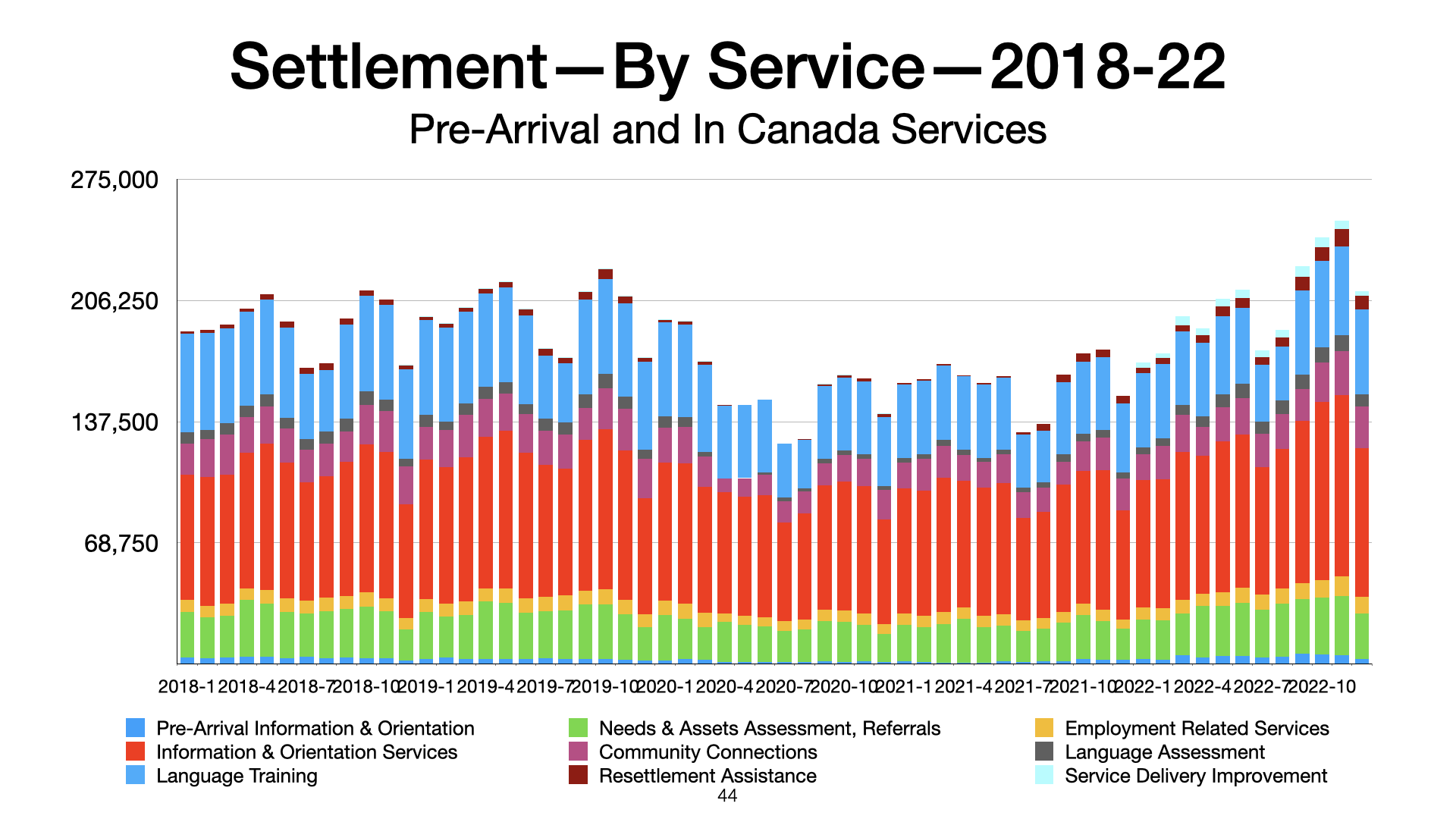
Over focus on the challenge to settlement agencies compared to the real physical and workforce challenges in housing, healthcare and infrastructure. Settlement service stats have been largely flat compared to the pre-pandemic period, suggesting less demand than stated:

There’s a long list of reasons for Canada to open its arms to newcomers from around the world – but when you invite half a million new people to the country every year, you better be prepared. And it’s looking more and more like we’re not.

It goes beyond the affordable-housing crunch and whether everyone will have access to primary health care. Now, some of the Calgary agencies that help people get settled in the country say uncertainty about funding from the federal government is leading to long waiting lists and layoffs.

“It’s always been a challenge, but I’ve never seen it like this. Never,” said Shirley Philips, interim chief executive at Immigrant Services Calgary, who has decades of experience in the sector.

ISC said they will receive less money from Ottawa – which makes up the majority of their funding – this fiscal year than last year. Contract updates from the federal government don’t reflect increased demand even as Alberta’s largest city grows by leaps and bounds, and so job vacancies won’t be filled.

Newcomers are already facing a 55-day wait to get a language proficiency assessment done, Ms. Philips said. And then four to six months to get into English classes after that. As demand continues to grow, she fears those wait times will stretch longer.

“You’ve got this talent pool that Canada says they want in their country, but we’re doing very little even at the basic level of language, employment services and housing.”

Another agency, the Centre for Newcomers, has laid off about 65 people – almost a quarter of its staff – in recent weeks. Chief program officer Kelly Ernst said the issue is a delay in contract updates with the federal government, which would provide a flow of money based on higher demand. He’s worried about some people falling through the cracks, as was the case for a newly arrived Ukrainian family he said his agency found living on the streets of Calgary last week.

“We served over 35,000 people last year, and if this continues, we’re going to break that record again this year,” Mr. Ernst said.

For its part, Immigration, Refugees and Citizenship Canada said planned investment for settlement services in Alberta is increasing by 6 per cent this year, to nearly $133-million.

“These investments align with Alberta’s proportion of all permanent resident landings,” the federal department said in a statement to The Globe and Mail.

IRCC did not comment on the situation for individual agencies, but added it has “in the past, adjusted investments over the course of the year to respond to pressures, such as an influx of newcomers, and when additional funding becomes available.”

Overall, the department’s budget is being reduced beginning this fiscal year. Temporary programs are being wound down, including the commitment to resettle at least 40,000 Afghans by the end of this year, and provisions for Ukrainians making their way to Canada.

The problem is, settlement agencies say, Afghans and Ukrainians are still coming and they still need help getting acclimatized in Canada – as do many more from all around the world.

The numbers are huge. The federal government is aiming to welcome between 410,000 and 505,000 new permanent residents this year, between 430,000 and 542,500 in 2024, and between 442,500 and 550,000 in 2025. Canada is well on its way to reaching – or exceeding – those ambitious goals, with Statistics Canada saying the country welcomed 145,417 immigrants in the first quarter of 2023, the highest number for any quarter on record. (There was also a net gain of 155,300 non-permanent residents in the first quarter.)

It’s unclear whether Calgary immigration agencies are alone in their struggle for federal funding. Edmonton MP and cabinet minister Randy Boissonnault said he’s not hearing the same concerns in Alberta’s capital.

On a percentage basis, the Alberta population is growing at a rate not seen for more than a century – back to a time when prairie sod houses were a perfectly acceptable form of housing. The provincial population has increased by 200,000 in the past 12 months, standing at more than 4.7 million. The numbers are surging in part because of interprovincial migration, but mostly as a result of new arrivals from outside of Canada.

Another factor that might not be fully quantified is that many immigrants land in Ontario or Quebec, and then make their way to Alberta – often Calgary – when they find out housing is less expensive and there’s plentiful work. This “secondary migration” might not be reflected in federal funding to settlement agencies, their leaders say.

Canada is built on immigration. There is a moral imperative for the country to help those whose lives have been torn apart by war or deeply regressive governments. Climate change is likely to force the movement of millions more.

There are also economic reasons to welcome immigrants. The country badly needs workers – everyone from medical professionals to home builders to child care providers. Canada also needs younger workers, as the country’s population grows greyer.

“We actually need a million people a year. But that would definitely crack the system,” Mr. Boissonnault said.

Calgary immigration agencies are looking to increase their budgets through private donations. And the Alberta government said in its budget that it would provide an extra $7-million over three years for settlement and language supports, on top of some regular funding. That money will start to flow by year’s end.

It all might not be fast enough. It’s already a struggle to provide affordable housing for everyone. The Bank of Canada acknowledged this as it hiked interest rates again this week, in part in another desperate attempt to dampen what appears insatiable demand for real estate in the country.

And beyond finding everyone a place to live, not having basic settlement services in place to help people as they arrive on this scale is indefensible. The soaring political messaging from Ottawa on immigration needs to come with solid support for the agencies doing the on-the-ground work.

Source: Alberta, and the rest of Canada, are woefully unprepared for the coming immigration boom

Canada should deny care to pregnant ‘birth tourists,’ doctor argues

Good article based upon the opinion piece by Dr. Barrett shared yesterday:

Should Canada deny care to ”birth tourists,” pregnant women who visit Canada with the sole purpose of delivering their babies here, thereby obtaining automatic Canadian citizenship for their newborns?

It’s a provocative, and, some say, dangerous suggestion. However, a leading expert in preterm and multiple births is arguing that Canadian hospitals and doctors should have “absolutely zero tolerance” for birth tourism, a phenomenon that is rising once again now that COVID travel restrictions have been dropped.

It’s a “sorry state of affairs” that women in Canada face wait times of 18 months or longer for treatment for pelvic pain, uncontrolled bleeding and other women’s health issues, Dr. Jon Barrett, professor and chief of the department of obstetrics and gynaecology at McMaster University wrote in an editorial in the Journal of Obstetrics and Gynaecology Canada.

“The thought that even ONE patient seeking birth tourism would potentially take either an obstetrical spot out of our allocated hospital quota, or even worse, a spot on the gynaecologic waiting list, should be enough to unite all in a position that anything that in any way facilitates this practice should be frowned upon,” Barrett wrote.

“These are non-Canadians getting access to health care, which we haven’t got enough of for our own Canadians,” he said in an interview.

When planned low-risk births go wrong, and babies end up spending weeks in intensive care, hospitals can be left with hundreds of thousands in unpaid bills. One Calgary study found that almost $700,000 was owed to Alberta Health Services over the 16-month study period.

The women themselves are also at risk, Barrett said, of being  “fleeced” by unscrupulous brokers and agencies charging hefty sums upfront for birth tourism packages that include help arranging tourist visas, flights, “maternity” or “baby hotels” and pre-and post-partum care.

And, while he declined to provide specific examples, “Tempted by large sums of money, even the best of us can be tempted into poor practice,” Barrett wrote.

The issue has triggered high emotions and debate among Canada’s baby doctors. Under Canada’s rule of jus soli, Latin for “right of soil,” citizenship is automatically conferred to those born on Canadian soil.

Birthright citizenship gives the child access to a Canadian education and health care. They can also sponsor their parents to immigrate when they turn 18.

Other developed nations require at least one parent to be a citizen, or permanent resident.

According to data collected by Andrew Griffith, a former senior federal bureaucrat in Immigration, Refugees and Citizenship Canada, “tourism” births account for about one per cent, give or take a bit, of total births in Canada. Data from the Canadian Institute for Health Information show Canada hosted 4,400 foreign births in 2019.

At a national level, the numbers aren’t huge, however they can become significant at the local level, Griffith said: In pre-COVID years, non-resident births accounted for up to 25 per cent of all births at a single hospital in Richmond, B.C., while the numbers at a handful of other popular destination hospitals in Ontario and Quebec approached five to 10 per cent of all births.

“In a system that is tight and stretched, it does become an issue at the hospital level,” Griffith said.

But birth tourism also undermines the integrity and confidence in Canada’s citizenship process, he said, “It appears like a short cut, a loophole that people are abusing in order to obtain longer-term benefit for their offspring.”

“It sends the wrong message that basically we’re not very serious in terms of how we consider citizenship and its meaningfulness and its importance to Canada,” Griffith said.

Barrett is careful to stress that birth tourism absolutely doesn’t apply to women who happen to be in Canada because of work, or study programs, or as refugees. “We must declare that people who are here for a genuine reason should have seamless access to health care,” he said.

What he opposes are the “non-urgent planned and deliberate birth tourists in our hospitals.”

Doctors can’t deny care to a woman in labour. Emergency care would always be given, he said. “Obviously you’re never going to turn somebody away.”

But doctors and hospitals could decline to provide pregnancy care before birth. “Eventually, if you create this unfriendly environment,” Barrett said, “if everybody said we are not looking after you and not facilitating this, eventually people will not come. They would realize they are not getting what they are seeking, which is optimal care.”

Some women step off the plane 37 weeks pregnant, three weeks from their due date. “That’s why my colleagues say, ‘You can’t do that. People are going to suffer,’” Barrett said. “Yes, unfortunately, people are going to suffer, because they won’t get pregnancy care, and they’ll show up at the hospital without antenatal care.”

While some women do come to Canada seeking superior medical care, “let’s be frank,” said Calgary obstetrician and gynecologist Dr. Colin Birch. “The principal motivator is jus soli.

“Sometimes its veiled under, ‘I want to get better medical care,’ but, interestingly, they fly over several countries that can give them the equivalent care to Canada to get here,” said Birch, countries that don’t offer jus soli.

Birch is co-author of the Calgary study, the first in-depth look at birth tourism in Canada. Their retrospective analysis, a look back over the data, involved 102 women who gave birth in Calgary between July 2019 and November 2020. A deposit of $15,000 was collected from each birth tourist, and held in trust by a central “triage” office to cover the cost of doctors’ fees. A deposit wasn’t collected to cover fees for hospital stays for the mom or baby; women were made aware they would be billed directly.

The average age of the woman was 32. Most came to Canada with a visitor visa, arriving, on average, 87 days before their due date. Birth tourists were most commonly from Nigeria, followed by the Middle East, China, India and Mexico. Overall, 77 per cent stated that the reason for coming to Canada was to give birth to a “Canadian baby.”

Almost a third of the women had a pre-existing medical condition. One woman needed to be admitted to the ICU after delivery for cardiac reasons, another was admitted for a high blood pressure disorder and stroke. Nine babies required a stay in the neonatal intensive care unit, including one set of twins that stayed several months. Some women skip their bills without paying.

“Every conversation about heath care is that we haven’t got money for health care,” Birch said. “Yet you’ve got unpaid bills of three-quarters of a million. It’s not chump change.”

But denying care is a dangerous and unrealistic “gut reaction” that some hospitals have already taken, Birch wrote in his counter editorial for the Journal of Obstetrics and Gynaecology Canada. “Let’s be very clear: They won’t let them through the front door, or they send them on to another hospital.”

“You cannot have zero tolerance for patients,” Birch said. “You can’t do that because that leads to maternal and fetal complications.”

The federal government could tweak the rule of “jus soli,” excluding people who just come to Canada on a temporary visitor visa to give birth, and then leave, he and others said. “You do the Australian approach, that one of the parents has to be a citizen of the country,” said Griffith, a fellow of the Environics Institute and Canadian Global Affairs Institute.

Three years ago, the United States announced it would start denying visitor visas to pregnant foreign nationals if officials believe the sole purpose was to gain American citizenship for their babies.

While some have said birth tourists are being demonized as “queue jumpers and citizenship fraudsters,” Griffith isn’t convinced birth tourism is a politically divisive issue.

“I don’t think there are very many people that really would get upset if the government sort of said, ‘We’re going to crack down on birth tourists, women who come here specifically to give birth to a child and who have no connection to Canada.’”
Source: Canada should deny care to pregnant ‘birth tourists,’ doctor argues

Bell: Kenney’s plan to woo ethnic voters to help him save his job

Back to his days of Minister for Curry in a Hurry:
This is getting to be serious business.
I hear Rishi Nagar on West of Centre, a CBC podcast.When he talks about Premier Jason Kenney courting voters from cultural communities in northeast Calgary in a bid to keep his job it gets me curious.

I decide to give the political deep thinker a call. Nagar also happens to be a heck of a nice guy who knows his stuff.

Nagar is the news director at RED FM, a multicultural radio station in Calgary.

The questions come easily

How many people in northeast Calgary filled out membership forms for Kenney’s United Conservative Party?

Folks who snagged a membership by this past Saturday can register to vote Yes or No next month on the premier’s fate. As many as 20,000 across the province may register. It is an astounding number.

So what is the educated guess, the ballpark number?

Who better to ask than a man who attended a half-dozen Kenney events in the city’s northeast?

He says around 2,000-plus signed up for the premier

The premier. The citizenship, immigration and multiculturalism minister in his previous life in Ottawa.

His job back then was to win new Canadians to the federal Conservative side. Kenney was tagged with a nickname by an MP. The Minister for Curry in a Hurry.

As the premier scrounges for votes in the upcoming vote on his leadership, Nagar mentions organizers from different communities reaching out to their people “to fill the membership form for Mr. Kenney.”

He mentions Hindus and Sikhs and Muslims. He mentions Muslims from Pakistan and Muslims from Lebanon and Muslims from South Africa.

In every event there are forms filled out and collected in groups of 50. The memberships add up, the promises to vote for Kenney.Kenney is a very frequent visitor to the city’s northeast. The premier even goes to very small gatherings, as small as 15 people.

“He’s very happy,” says Nagar, of the premier.

Local members of the legislature, serving under the banner of Kenney’s United Conservatives, are at the back of the room.

It could be Rajan Sawhney or Mickey Amery or Peter Singh.

Nagar cannot say, and nobody knows, how many with UCP memberships will actually vote in Red Deer.

Of course if the UCP decides to have voting in Calgary as well as Red Deer it will be much more convenient.

Ditto if they decide to allow in-person voting in the capital city.

“Mr. Kenney is targeting minority communities here in Calgary. He must be doing the same thing in Edmonton,” adds NagarThe Kenney pitch is first and foremost the fear of the NDP.

Then the fear of breaking up the United Conservatives, an uneasy marriage of convenience with former Wildrosers and former PC types intent on seeing the NDP defeated last election.

Then there’s Kenney on the economy coming out of COVID, pledging to make communities “happy and flourishing.”

Kenney talks a lot about the economy.

The man from RED FM says there is not one single question on the premier’s past comments on the spread of COVID in northeast Calgary or on the issue of hail insurance after the huge storm.

Nagar says just before the Alberta government budget Kenney was “absolutely unpopular.”

After the budget things started changing. He started showing up.

There is “one interesting feature” mentioned. The desire to get a picture with Kenney.

“Whenever there is a photo-op with the premier they forget everything. A picture is important. If I have a picture with Jason Kenney I will hang it in my family room.”

Such is the sentiment.

“There is a lineup for the pictures.”

Nagar says the members Kenney is signing up may not be the deciding factor in his survival but it is big support for him to win.

The premier’s people know they’re in a fight.

They know his approval is nothing to write home about and they don’t talk about it.

They know polls show most Albertans aren’t happy with him.

They emphasize how the UCP could squeak out a win against the NDP, not pointing to the fact some of that UCP vote may come from those who expect Kenney could be gone after his party’s leadership vote

But when the premier is in Calgary’s northeast he is one happy camper

“You can see his tone and language when he departs. He’s super-happy. He’s very confident. His gait is changed. His way of talking changes after seeing all these people.”

Source: Bell: Kenney’s plan to woo ethnic voters to help him save his job

Impact of birth tourism on health caresystems in Calgary, Alberta

This is exactly the kind of detail that is needed for regions and hospitals that have high numbers of non-resident births.

Some highlights of the study from my perspective:

  • 102/227 patients were identified as birth tourist (45 percent)
  • 83% of patients stated they came to Canada with a Visitor Visa
  • Country of origin: Nigeria (25%), Middle East (18%) China (11%), and India (8%) and Mexico (6%), none from Western Europe or Australia
  • 77% stated that their primary reason to deliver their baby in Canada was for the the baby to be eligible for Canadian citizenship, while only 8% stated their reason to deliver in Canada was to access better health care
  • Almost a third of women had a known preexisting medical condition
  • 29 mothers and 17 newborns had unpaid invoices, $290,000 and $404,000 respectively at the time the report was written.

More kind of this detailed analysis by medical professionals and researchers is needed rather than the legal and policy analyses that diminish the issue (disclosure the researchers and I have been in contact over the past few years).

Hospitals where studies would be useful would be for the top ten hospitals with the largest percentage of non-resident births:

Funding should be provided for these kind of empirical studies rather than for more ideological studies such as the one underway by Megan Gaucher, Jamie Lieu and Amanda Cheong (Insight Grant 2021 Birth Tourism and Citizenship):

Background:  Birth  tourism  refers  to  non-resident  women  giving  birth  in  a  country  outside  of  their  own  in  order  to obtain  citizenship  and/or  healthcare  for  their  newborns. We  undertook  a  study  to  determine  the  extent  of  birth  tourism  in  Calgary,  the  characteristics  and  rationale  of  this  population,  and  the  fnancial  impact  on  the  healthcare  system.

Methods:  A  retrospective  analysis  of  102  women  identifed  through  a  Central Triage  system  as  birth  tourists  who delivered  in  Calgary  between  July  2019  and  November  2020  was  performed.  Primary  outcome  measures  were  mode of  delivery,  length  of  hospital  stay,  complications  or  readmissions  within  6  weeks  for  mother  or  baby,  and  NICU  stay for  baby.

Results:  Birth Tourists  were  most  commonly  from  Nigeria  (24.5%).  77%  of  Birth Tourists  stated  that  their  primary  reason  to  deliver  their  baby  in  Canada  was  for  newborn  Canadian  citizenship. The  average  time  from  arrival  in  Calgary  to the  EDD  was  87  days.  Nine  babies  required  stay  in  the  neonatal  intensive  care  unit  (NICU)  and  3  required  admission  to a  non  NICU  hospital  ward  in  frst  6  weeks  of  life,  including  2  sets  of  twins. The  overall  amount  owed  to  Alberta  Health Services  for  hospital  fees  for  this  time  period  is  approximately  $694  000.00.

Conclusion:  Birth Tourists  remain  a  complex  and  poorly  studied  group. The  process  of  Central Triage  did  help  suport  providers  in  standardizing  process  and  documentation  while  ensuring  that  communication  was  consistent. These  fndings  provide  preliminary  data  to  guide  targeted  public  health  and  policy  interventions  for  this  population.

Source: Impact of birth tourism on health care systems in Calgary, Alberta

Globe editorial: This is a story about race in Canadian politics. And it’s hopeful

Agree. Recent federal election largely confirms:

This is not a story about race.

But to understand how it isn’t, we have to talk about how, in another, less successful country, it could be.

In 2016, the census found that 31 per cent the residents of the City of Calgary were immigrants. Thirty-six per cent of the population were members of a visible minority, including 9.5 per cent who were South Asian. The picture is almost exactly the same in Edmonton: 30 per cent of residents are immigrants and 37 per cent are visible minorities, including 9.5 per cent who identify as South Asian.

Two weeks ago, the people of Edmonton and Calgary went to the polls and elected new mayors. Both were born outside of Canada. Jyoti Gondek, Calgary’s top magistrate, was born in England to parents of Punjabi descent and came to this country as a child; Edmonton’s Amarjeet Sohi was born in India and immigrated in his teens. On the census, both would be counted among the roughly one in 10 city residents of South Asian descent.

We bring up race not because it was an issue in the elections of Ms. Gondek and Mr. Sohi, but because it was not. And let us give thanks for that.

In many other countries – less happy, less peaceful countries – the story would have been very different. There, race, religion or ethnicity are the basis for politics. Sectarian divides slice through the possibility of shared citizenship, with lives and politics organized along those lines.

That’s how much of the world is. (Ask an immigrant.) In the worst cases, it results in the failed state of Lebanon, or the violently extinguished state of Yugoslavia, or the Rwanda genocide.

But here’s what we believe can safely be said about the mayoral elections in Calgary and Edmonton: The race of the candidates, their religion (or lack thereof), and their status as first-generation Canadians appear to have been irrelevant to most voters. Maybe not all voters, whether pro or con, but surely most.

Consider: Nine out of 10 voters in Calgary and Edmonton are not of South Asian heritage. Yet Ms. Gondek and Mr. Sohi each won 45 per cent of the vote. That means that most of those who voted for them were from “another” community.

And we put the word “another” in quotation marks because, this being Canada in 2021, most voters don’t see it that way. They weren’t marking their ballots through a prism of race. They didn’t see the winning candidates as coming from some other community, but rather as part of their shared community – Calgarian, Edmontonian, Albertan, Canadian – that transcends where you or your parents came from, where you pray or do not pray, and what colour your skin is.

Canadians are not saints, and Canada is not some magic land where racism never existed. It is not some place where no lines have ever been drawn labelling some people as “us” and others as “them.” Canada has a long history of evolving varieties of sectarian divisions.

But Canada also has a long and accelerating history of expanding the definition of “us,” and extending membership in the shared community to people who, in another place or another time, might have been excluded. For example, until 1954, the mayor of Toronto had always been a Protestant from the Orange Order. But that year, the citizens of Toronto ended all that, electing Nathan Phillips. Phillips was Jewish; nearly all of the city’s residents were not. Most were Protestants. It didn’t matter.

It was a similar story half a century later, in the three mayoral elections won by Naheed Nenshi in Calgary. The vast majority of the people of Calgary are not Ismaili Muslims; it didn’t matter. Overwhelming majorities chose Mr. Nenshi as their representative. And though three-quarters of the residents of Brampton, Ont., are visible minorities, in 2018 they elected Patrick Brown as mayor.

This ability to see beyond differences and biology and faith is something that Canada will need ever more of in its future. Canada is on the road to becoming a majority-minority nation, where no ethnic or racial group is the majority. That’s already the situation in Metro Vancouver and Greater Toronto, and the other big cities are not far behind.

The voting in Calgary and Edmonton is a reminder that this future is hopeful, not ominous. If a Canadian is defined by all that we hold in common, in spite of differences, then everybody’s part of the majority.

Source: https://www.theglobeandmail.com/opinion/editorials/article-this-is-a-story-about-race-in-canadian-politics-and-its-hopeful/

‘I’m Speaking Out:’ Calgary Firefighters Allege Decades of Racism

Of note:

When Chris Coy became Calgary’s first Black firefighter 25 years ago, his heroic vision of the profession was almost immediately upended.

First, he said, during training he was hazed more than his colleagues, strapped to a stretcher against his will and repeatedly doused with a fire hose. Then there were the co-workers who ostracized him at lunch. Throughout his career, he said, fellow firefighters used a racial slur directed at Black people.

For years, Mr. Coy said he suffered in silence as he feared speaking out would mean dismissal, or, worse, other firefighters not shielding him from danger in the field.

But since retiring in December, Mr. Coy has begun speaking publicly about what he said was decades of racially motived physical and verbal abuse, joining a group of current and former firefighters who have been voicing similar grievances. The city’s mayor and fire chief have acknowledged the racism within the department and pledged to address it.

“Here in Canada we are proud and sometimes smug about our commitment to diversity,” Naheed Nenshi, Calgary’s mayor, said in an interview. “I don’t want anyone who gets a paycheck I sign to feel that they aren’t valued because of the color of their skin.”

In Canada, a country that prides itself on its liberal humanism and multiculturalism, Prime Minister Justin Trudeau made reconciling with Indigenous peoples an early priority of his premiership. Now, the country has been undergoing a national reckoning about institutional racism in its city halls, law enforcement and cultural institutions, particularly since the global uprising for Black rights spurred by last year’s police killing of George Floyd in Minneapolis.

Brenda Lucki, the chief of Canada’s storied national police force, the Royal Canadian Mounted Police, was recently forced to walk back her previous denials of systemic racism within the force. Mr. Trudeau was among those arguing that police forces across the country were grappling with systemic racism.

While there have been complaints of discrimination in other fire departments in Canada, Calgary has become a high-profile case. The accusations of racism at the fire department were first reported by the CBC, the national broadcaster.

Port du hijab: le SPVM «ouvert» à l’idée pour ses policières

Good that it provokes discussion in other police forces located in diverse communities (the SPVM does not report publicly on its diversity last time I checked):

La Gendarmerie royale du Canada (GRC) permet désormais à ses policières musulmanes de porter le hijab, mais qu’en est-il des principaux corps policiers du Québec ? Le Service de police de la Ville de Montréal (SPVM) n’a jamais reçu de demandes à ce sujet, mais se dit « très ouvert » à l’idée.

Afin de refléter davantage la population canadienne et d’encourager des femmes musulmanes à envisager une carrière policière, la GRC a récemment décidé d’autoriser le port du hijab. La GRC insiste sur le fait que le foulard a été conçu pour être sécuritaire, après une série de tests rigoureux. La nouvelle a fait le tour du monde.

« Nous n’avons pas pris position sur le sujet, mais nous sommes très ouverts à ce genre de demandes », a indiqué hier la commandante du SPVM Marie-Claude Dandenault. Cette prise de position de la GRC incite le corps policier montréalais à évaluer la question, dit-elle. Au Canada, les forces armées, la police de Toronto et la police d’Edmonton permettent déjà le port du foulard.

« J’ai toujours dit, tant qu’il y a le visage découvert, je n’ai pas de problème avec ça », a quant à lui déclaré hier le maire de Montréal, Denis Coderre, en réponse à une question sur le sujet.

Comme le SPVM, la Sûreté du Québec (SQ) n’a jamais reçu de demandes de ses membres en ce sens.

 « On n’a jamais pris position », a indiqué le lieutenant Jason Allard, responsable des communications au sein de la police provinciale, qui a souligné qu’il ne voulait pas commenter la décision de la GRC

« On n’a jamais eu de demandes d’accommodement d’uniformes pour des motifs religieux », indique le lieutenant Jason Allard, responsable des communications à la SQ.

Le lieutenant Allard affirme que la Sûreté du Québec a fait des efforts au cours des dernières années afin d’augmenter le nombre de femmes et de membres issus des communautés culturelles au sein du corps policier. « On privilégie une meilleure représentation de toutes les cultures, mais on ne vise pas de groupe spécifique comme l’a fait la GRC », dit-il.

And Calgary is already ahead:

Reaction to Calgary cab video shows progress in fighting racism, says immigration lawyer

Raj Sharma on how Calgary is changing, using the example of a taxi driver who filed a complaint over the racist rant of a passenger:

One way to measure how this city has changed is the public response to a dash-cam video that recently surfaced, which has been seen and shared by many. It shows an enraged drunk inundating Sardar Qayyum — a meek, deferential, Pakistani émigré and Canadian citizen — with a racist diatribe.

Unlike those who preceded him, Qayyum felt that he could go to our law enforcement agencies. He didn’t necessarily have to turn the other cheek.

…The perpetrator in this case has been identified, shamed and has lost his job. Having run the gauntlet of the internet, he and his family will move on after the mob finds their next target.

The public reaction to the video has shown his behaviour is not condoned, it is condemned. That’s a good sign and the support that Qayyum has received is heart-warming.

Racism appears to have progressed. You no longer commonly hear the generic slur of “Paki” being smeared over all South Asians. Unfortunately, racist attacks and tirades against Muslims appear to be increasing. A network of women’s centres is reporting an alarming rise in intolerance, racism and violence against Muslim women in Quebec tied to the proposed Charter of Quebec values, which thankfully remained inchoate.

Violence against Muslim women on the rise, group says

The rant against Qayyum centred around his religion; this incident is merely a symptom of the overall disease wherein the vast majority of Muslims are being tarred and feathered for the actions of a tiny minority. Muslims are “terrorists” or “sympathizers,” but since 2001 nearly twice as many people in the United States have been killed by white supremacists, antigovernment fanatics and other non-Muslim extremists than radical Muslims. Racists, by their very nature, rarely let the facts get in the way.

As a result, it’s been a chilly few years for ordinary Muslims living in the West, including Canada. However, “ordinary” Canadians with their condemnation of one man’s unacceptable actions have spoken loudly. This should be celebrated in moderation for the concerns expressed above.

I am optimistic that, while it may well be chilly right now for Canadian Muslims, the beauty is that in Calgary, the next chinook is already on its way.

Reaction to Calgary cab video shows progress in fighting racism, says immigration lawyer | CBCNews.ca Mobile.