COVID-19 Immigration Effects – July 2024 update

Highlights:

  • Permanent residents admissions: PR Admissions: Increase from 44,530 in June to 47,770 in July. July year-over-year change (change from 2022 in parentheses): Economic – PNP 34.9% (15.0%), Economic – Federal 11.7% (0.7%), Family 2.8% (-2.1%), Refugees 14.4% (30.8%)
  • TR2PR (Those already in Canada): Increase from 19,170 in June (43% of all PRs) to 22,100 in July (46.3% of all PRs). July year-over-year change (change from 2022): 10.6% (32.5%)
  • TRs-IMP: Decrease from 70,435 in June to 61,510 in July. July year-over-year (change from 2022): Agreements: 205.6% (-32.8%), Canadian Interests: -27.7% (29.9%), Other IMP Participants -56.1% (430.3%), Not stated -18.0% (-17.7%)
  • TRs-TFWs: Decrease from 19,230 in June to15,330 in July. July year-over-year change (change from 2022): Caregivers -18.8% (0.0%), Agriculture -23.0% (-19.5%) and Other LMIA -9.4% (79.4%).
  • NEW: TRs by occupation code (June, will be updated quarterly): 58 % low-wage (D), year-over-year change (change from 2022) 18.5% (571.3%): 
  • Students: Increase from 29,420 in June to 35,105 in July. July year-over-year change (change from 2023): -35.4% post-secondary -41.5% (-5.1%). Year-to date 2024 compared to 2023 decline of 4 percent 
  • Asylum Claimants: Stable, from 14,485 in June to 14,825 in July. July year-over-year change (change from 2022): 23.4% (90.1%)
  • Citizenship: Increase from 33,179 in June to 36,070 in July. July year-over-year change (change from 2022): 15.4% (25.0%). Year-to date 2024 compared to 2023 increase of 16 percent
  • Visitor Visas: Increase from 118,402 in June to 127,399 in July. July year-over-year change (change from 2022): -19.7% (37.6%).Slide 3 has the overall numbers and change.

https://www.slideshare.net/slideshow/canadian-immigration-tracker-key-slides-july-2024-pdf/271760138

TFWP: Setting the baseline to evaluate government changes

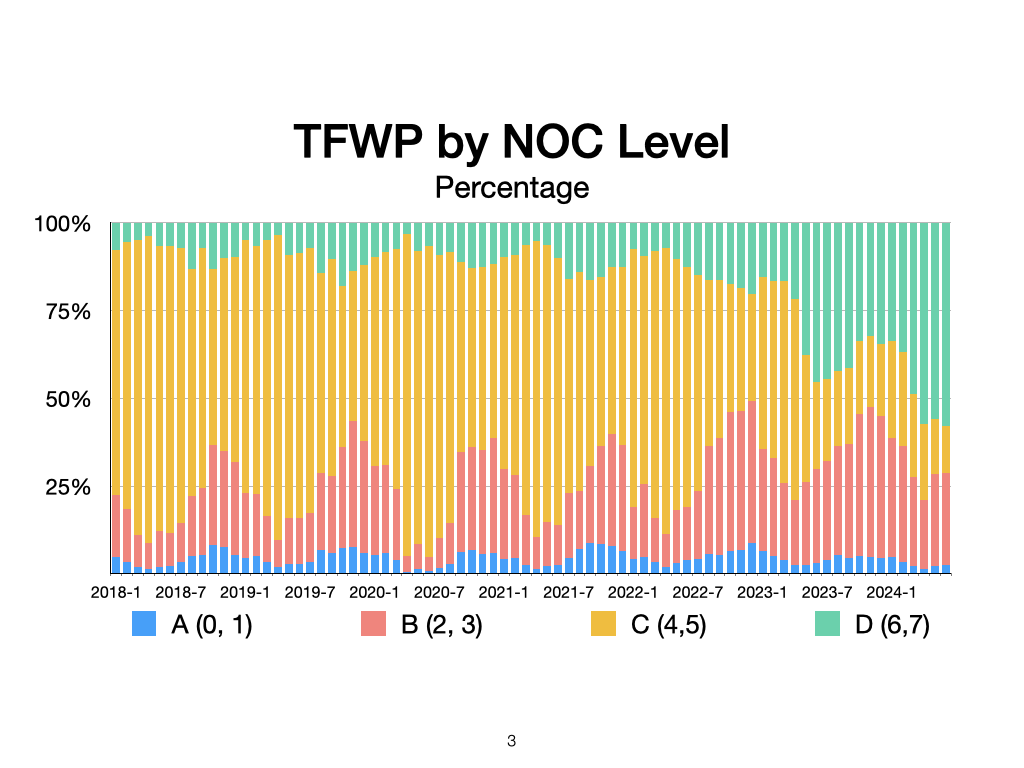
Just as the impact of the caps on international students is becoming apparent through monthly and quarterly numbers for post-secondary study permits, one can expect the government’s restrictions on low-wage temporary workers to start have an impact in the October-December quarter.

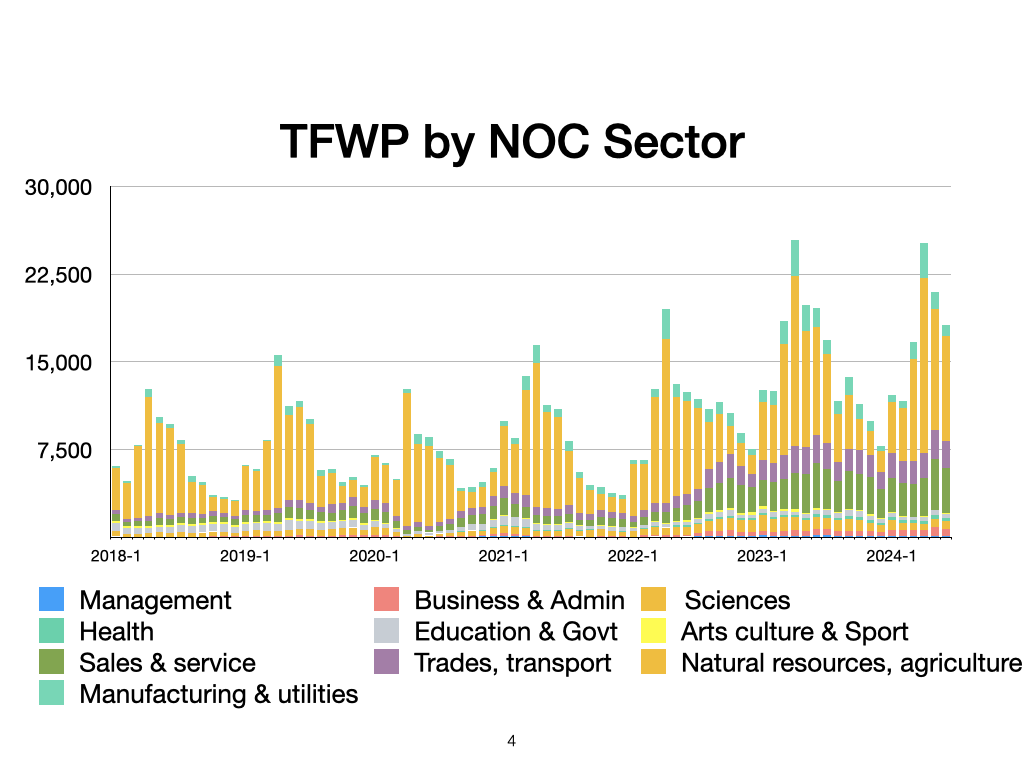
To better monitor and assess the impact, I prepared some charts on Temporary Foreign Workers by NOC Code. For those unfamiliar with the codes A 0 or 1: university degree, B 2 or 3: community college, apprenticeship, more than 2 years on the job, occupations with supervisory responsibilities or significant health and safety responsibilities, C 4 or 5: some secondary education, up to two years on-the-job training or equivalent, D 6 or 7: on-the-job training.

The following slides highlight the shift over the past five years. This provides a good overview and the context for articles like The sudden rise of temporary foreign workers in entry-level office jobs.

Starting with two views by NOC level, the numbers and the percentage shares which show the dramatic increase, both absolute and in percentage, of the low wage and low skilled temporary workers. Interestingly, there has been a squeezing of level C workers:

The next two slides provide the breakdown by NOC sector where sales & service and natural resources & agriculture have increased the most:

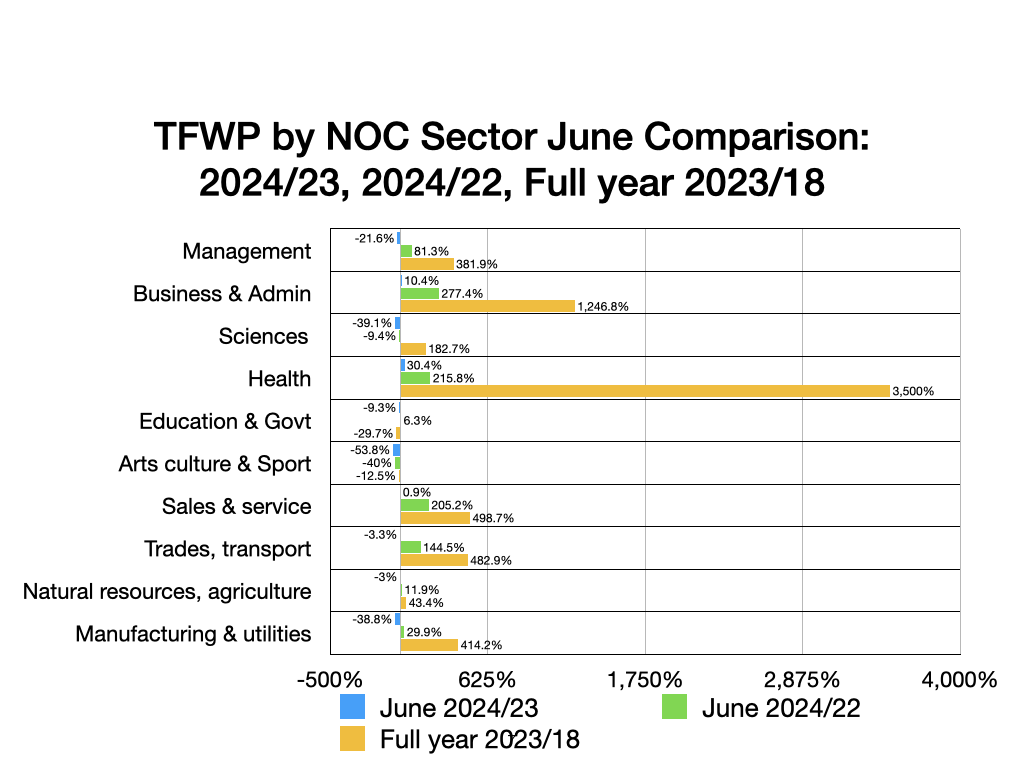
And lastly, looking at June year-over-year change and two year change, as well as from pre-pandemic 2018, showing again the greatest increase in level D occupations and, in terms of sectors, Business & Administration and Health, the latter from a low base:

Note to media: avoid year-to-date analysis in drawing conclusions as happened with Postmedia and other publications and focus on quarterly year-over-year changes.

Anti-hate initiatives have not been able to stop the surge in crimes

My latest:

Police-reported hate crimes keep rising in Canada, no matter which party is governing, and no matter what initiatives have been used to combat the problem. Hate crimes rose 39 per cent between 2008-15, when the Conservatives were in government. But they soared by 239 per cent between 2016-23 with the Liberals in power.  

The true numbers are higher yet, no doubt. Black and Muslim Canadians can be more reluctant than other groups to report hate crimes. We know there is under-reporting. But the rise also reflects a lessening reluctance among others to report such incidents. The latest numbers are some of the most reliable data available. 

The rise comes in an era of high-profile hate crimes including the 2017 Quebec City mosque killings, a spike in incidents against synagogues and Jewish institutionsanti-Asian sentiment during the COVID-19 pandemic and the police killing of George Floyd in May 2020 in Minneapolis.  

The sharp rise has also come despite increased funding for multiculturalism and anti-racism programs under the federal Liberals. The apparent lack of impact of the initiatives does not bode well for their continuation in the years to come.   

Anti-Asian sentiment and the pandemic  

East or Southeast Asians report the greatest increase, as table 1 shows. What is striking is the rise in incidents relative to their share of the population, likely a reflection of the impact and discourse around the pandemic, which sparked anti-Asian sentiment.  

https://e.infogram.com/9eb8007d-6f46-439a-acef-9606167a2a1c?parent_url=https%3A%2F%2Fpolicyoptions.irpp.org%2Fmagazines%2Faugust-2024%2Fhate-crime-policies%2F&src=embed#async_embed

The increase in incidents reported by Black Canadians might reflect a greater willingness to report such crimes after the 2020 Black Lives Matter protests. An increase in reporting among Indigenous Peoples could reflect the aftermath of the 2012 Idle No More protests. These increases might also reflect a backlash against some of these activist movements. And the corrosive language used by Donald Trump has also increased prejudiceamong his supporters and contributed to increasingly divisive politics in the U.S. with some spillover effects in Canadian discourse.  

The number of reported incidents increased sharply in 2023 for both Jews and Muslims, reflecting the Israel-Hamas conflict and the related protests in Canada (table 2). The large number of antisemitic incidents and anti-Israel demonstrations is reflected in the higher rate per 100,000 among Jews, although the overall increase has been greater for Muslims. 

https://e.infogram.com/32874b76-8a91-4d84-bbd7-d2d6cf17b662?parent_url=https%3A%2F%2Fpolicyoptions.irpp.org%2Fmagazines%2Faugust-2024%2Fhate-crime-policies%2F&src=embed#async_embed

Anti-racism initiatives 

In the years between 2008-15, the Conservative government hollowed out the federal multiculturalism program after transferring it to then-Citizenship and Immigration Canada.  

Over the ensuing years (2016-23), the Liberals reversed the move, returning the program to Canadian Heritage. They also doubled funding to $36 million, brought in Canada’s Anti-Racism Strategy 2019-22 and created a Federal Anti-Racism Secretariat.  

Through all this, reported hate crimes have surged. 

Limited outcomes were revealed in the evaluation of the Multiculturalism and Anti-Racism Program and Canada’s Anti-Racism Strategy, 2017-18 to 2021-22. Weak reporting of results and a lack of performance data were also highlighted.  

The extent to which Canadian Heritage has implemented these recommendations is unclear. Canada’s Anti-Racism Strategy 2024-2028 includes recommendations to improve performance reporting in response to these weaknesses. 

Effective outcome and results reporting is particularly challenging for programs like multiculturalism and anti-racism.  

Societal and group relations are complex. Combatting hate crimes involves the reinforcement of social norms against hate and discrimination. Political, business and civil-society leaders play more of a role than government programs. 

The highlighted weaknesses of the federal programs will make it easy for the Conservatives to reverse or severely cut funding if the party is elected next year, a likely outcome. 

Significant or effective pushback is unlikely apart from advocacy organizations that receive government funding. 

Methodological note: Data was taken from the annual police-reported hate crimes reports by Statistics Canada. For the per-capita rates, the year prior to the census was used, e.g., 2010 for the 2011 National Household Survey, and 2020 for the 2021 census (religious affiliation is only counted in the census every 10 years). 

Source: Anti-hate initiatives have not been able to stop the surge in crimes

Canadian Immigration Tracker- May 2024 update

Highlights

Permanent Residents increased but percentage of TR2PR slipped to 53 percent of all Permanent Residents. 

Asylum claimants stable at about 16,000 per month.

Study permit applications increased (seasonal). Study permit web interests have declined by over 25 percent the past year, January to June).

IMP numbers have increased while TFWP numbers have decreased save for those with LMIA.

Citizenship numbers increased. 

Slide 3 has the overall numbers and change.

https://www.slideshare.net/slideshow/canadian-immigration-tracker-key-slides-may-2024-pdf/270213627

Bill C-71 opens up a possible never-ending chain of citizenship

My latest:

Bill C-71 sets out to allow Canadians to pass on their citizenship to any of their children born abroad past the first generation and expands “Lost Canadians” to cover a much larger number than before.

It is fraught with potential unintended consequences.

The bill is in response to a ruling by the Ontario Superior Court of Justice in 2023, which declared previous limitations for citizenship transmission unconstitutional. Essentially, the court objected to a limitation inherent in previous citizenship laws that prevented Canadian citizens born outside Canada from passing on citizenship to a child also born abroad, or for an adopted child born outside Canada.

To remedy the issue, Bill C-71 uses residency as the “substantial connection test.”

However, the new standard in Bill C-71, which requires a foreign-born Canadian parent to have spent a total of 1,095 days in Canada prior to the birth or adoption, differs significantly from what is required of new Canadians.

Specifically, while in both cases the parent must have spent 1,095 days (the equivalent of three years) in Canada, new Canadians must have done so within a five-year time limit.

Bill C-71 places no such time limit to accumulate 1,095 days of residency in Canada for foreign-born Canadian citizens in the same circumstance.

This lack of a timeframe for meeting the critical requirement for passing on citizenship to descendants suggests the government has failed to fully consider the implications of such an open-ended condition.

The number of people potentially affected is significant.

There are an estimated four million Canadians living outside Canada. About half of them were born abroad.

As of 2017, two-thirds of them lived in the U.S., with another 15 per cent in the U.K., Australia, France and Italy – the total living in all other countries has unsurprisingly risen from 14 per cent in 1990 to 20 per cent in 2017.

This trend is significant in the context of Bill C-71: for second- and subsequent-generation expatriates in the U.S., EU and other politically stable places, seeking Canadian citizenship may not be a priority. It is likely a higher priority for those in other countries with less secure conditions.

Fueling the issue triggered by Bill C-71, expatriates as a whole are older than Canadians living in Canada – 45.3 years old compared to 41.7. Citizens by descent are much younger, at an average age of 31.7.

Without an established timeframe, it will be challenging or impossible for the federal government to accurately predict citizenship acquisition year over year.

Same rights, divergent pathways

Consider these scenarios:

My grandson was born in Europe. He cannot pass down Canadian citizenship to any future child. Under C-71, he would have that right, but only after first spending 1,095 cumulative days in Canada. One strategy would be to attend a Canadian university and accumulate most or all of the 1,095 days while getting a degree.

Consider a Canadian born abroad who maintains a cottage in Canada and spends summers there. Spending eight weeks a year in Canada, it would take nearly 20 years to acquire the right to give their descendants Canadian citizenship.

For second-generation Canadians who spend most of their life abroad, the road is even longer. Perhaps they make occasional trips to Canada, accumulating days to meet the 1,095-day requirement. But they would not likely meet the threshold unless they choose to return permanently in retirement.

Many descendants who are temporary residents either through a job transfer or as spouses of skilled workers or students would likely meet the physical-presence requirement. Temporary foreign workers on seasonal or short-terms contracts, on the other hand, would likely not meet the requirement.

The first two scenarios are manageable given that the physical-presence requirement for most would be met within a defined time period. In the latter situations, it is impossible to forecast if or when descendant citizenship rights would eventually be required.

Immigration Refugees and Citizenship Canada (IRCC) needs to determine and share estimates for the approximate number of new citizens expected under the change, along with the incremental workload and resources that are required before the bill goes before committee.

Media in India are characterizing Bill C-71 as legislation that “will open up the chain of citizenship without end as long as the parents have spent at least 1,095 cumulative days.”

Arguably, this change moves Canada closer to a hybrid jus sanguinis/jus soli regime, as it will make it possible for families to maintain intergenerational Canadian citizenship through different scenarios, which currently is not possible.

It may also provide opportunities for longer-term sophisticated foreign-interference efforts by countries like China and India by exploiting descendants who can acquire Canadian citizenship in their recruitment strategies.

Another question that remains unanswered is how many “Lost Canadians” want to be found. As seen in previous efforts to respond to public pressures, the actual number of those who request citizenship proofs is relatively small, at an average of just 1,500 per year between 2009 and 2022. (Similarly, the low number of expatriates who register and vote is another indicator that interest may be limited.)

However, the potential impact of Bil C-71 could be potentially large. So, before the government enshrines a new pathway to citizenship for some, all of the facts need to be properly considered.

Canadian citizenship is a precious gift. At the committee stage, members of Parliament must be able to fulsomely examine the implications of an open-ended residency requirement and consider establishing a specific time frame of five or 10 years.

Source: Bill C-71 opens up a possible never-ending chain of citizenship

COVID-19 Immigration Effects – April 2024 update

Highlights

Permanent Residents increased as did percentage of TR2PR to 62 percent of all Permanent Residents. 

Asylum claimants stable at about 16,000 per month.

Study permit applications flat following last month’s drop due to announced caps. Study permit web interests has also been declining on a year-over-year basis. 

While IMP numbers have declined, TFWP numbers have increased reflecting seasonal agriculture workers and those under LMIAs.

Slide 3 has the overall numbers and change.

https://www.slideshare.net/slideshow/canadian-immigration-tracker-key-slides-april-2024pdf/269927425

‘I Am Canadian’ – Or Not: Essay Collection

Latest publication by ACS focussing on citizenship issues, based upon a conference last year. Good range of perspectives and I encourage you to check it out.

My contribution below where I continue to reinforce themes of concern to me:

Time to take citizenship seriously

The Census 2021 revelation that the naturalization rate of recent immigrants (five to nine
years) in Canada had plummeted to 45.7 percent in the 2011-15 census period compared 60.4
percent for the equivalent period from the 2016 Census provided a needed shock for the
government to take citizenship more seriously. An earlier Statistics Canada study noted a longer-
term trend of declining naturalization which reinforced that need. The analysis indicated that the
main factors influencing naturalization were family income, knowledge of official languages,
and educational attainment.


Some factors are outside the Canadian government’s purview. Whether or not an immigrant
source country permits or prohibits dual citizenship, and the extent to which it enforces a
prohibition, affects naturalization. However, recent analysis by the Institute for Canadian
Citizenship indicates the net effect on naturalization is small despite the fact that a larger number
of immigrants come from countries that do not permit dual citizenship.


The relative economic and other benefits of Canadian citizenship have changed for some
developing countries, resulting in some immigrants returning to their country of origin or
keeping their options open. However, there are a number of measures that the government could
take to strengthen the efficiency, oversight and meaningfulness of citizenship.
Operational efficiency, oversight and accountability


Immigration, Refugees and Citizenship Canada, the federal department responsible for these
issues, has made progress in moving to online applications and updates to manage increased
numbers and improve applicant service. Investment in AI and automation for routine
applications is a logical next step, particularly given that citizenship is straightforward compared
to the multitude of immigration pathways, and should result in faster processing. A pilot program
integrating citizenship and passport applications is a welcome initiative.


IRCC needs to publish more citizenship statistics on the Open Government Portal, as currently
the portal only has monthly statistics on countries of birth with no data on citizenship
applications (unlike for permanent and temporary residents along with international students).
Backlog (inventory) statistics need to be integrated into the portal. Moreover, regular publishing
of citizenship proofs (citizenship certificates), broken down by those submitted from within
Canada and those submitted from outside Canada, should resume given these provide a reality
check on the number of “lost Canadians” from earlier parliamentary testimony.


While broader than citizenship as it will allow for deeper analysis of health and immigration
linkages, IRCC, Statistics Canada and the Canadian Institute for Health Information (CIHI)
should provide more precise information on birth tourism (women travelling to Canada on visitor
visas to obtain Canadian citizenship for their child) by separating out women international
students and temporary foreign workers from the overall numbers of “non-resident” births.
Moreover, MPs need to challenge those advocating the easing of citizenship requirements and
policies given the disparities between claims of the numbers of people affected and actual
numbers and the risks that additional complexity brings to citizen service.


While the number of “Lost Canadians” claimed was around 200,000, the actual number was
about 20,000. Restrictions on voting rights for Canadian expatriates were lifted in 2019 but out
of the estimated 3.6 million adult expatriates, fewer than 30,000 voted in the 2021 election, a
tripling compared to the 2015 election but still a minuscule number. Similarly, while the number
of persons subject to the first generation citizenship transmission cut-off will grow, it is likely
that the numbers of those who have a meaningful connection to Canada will be relatively small
and advocates for change have relied more on anecdotes and country comparisons.


More systemically, all MPs need to recognize that not every situation requires a specific
legislative solution, which only further complicates overall service delivery, as some are best
handled through a discretionary grant in section 5(4) of the Citizenship Act or the permanent
resident application route.


Meaningfulness
The government needs to issue a revision to Discover Canada, the citizenship study guide, first
announced in 2016 four IRCC ministers ago, and reportedly ready for ministerial sign-off for
some time. The current guide, while a significant improvement from its predecessor, is dated in
terms of approach, emphasis and examples, and is not aligned with the government’s inclusion
emphasis.


The government also needs to decide whether it intends to implement, in whole or in part, its
election platform’s commitment in 2019 and 2021 to eliminate citizenship fees, currently around
$1,400 for a family of four. The high fees contribute to lower citizenship take-up among
disadvantaged immigrants. Given that citizenship provides both private benefits such as security
and passports and public benefits such as greater inclusion and political participation, halving the
current fees would balance private and public benefits.


The government needs to abandon its proposed self-administration of the citizenship oath and
revert to in-person citizenship ceremonies for the majority of ceremonies. Moving to “citizenship
on a click” combined with virtual ceremonies largely removes the recognition of the immigration
journey and its celebration by family and friends. The government’s justifications for the
proposed change focusses on saving three months and unspecified savings given that
“participation in ceremonies would be lower than it is currently, and there would likely be fewer
ceremonies overall”. However, it is silent on the more substantive impact that being in a room
together with other new (and already) Canadians brings in terms of belonging and inclusion.


Efficiency should focus on application processing, not the ceremonial and celebratory moment.
Treating citizenship as transactional, much as a driver’s licence, undermines the fundamental
objective of reinforcing integration, a fundamental objective of the Citizenship Act since 1947.
Public commentary has been highly negative, as have the majority responses to the Gazette
notice, and a parliamentary petition was launched to oppose the change. The government should
shift the relatively small needed funds from the integration program (about one billion dollars
outside Quebec) to maintain the in-person citizenship oath and ceremonies.


Ongoing work by the Institute for Canadian Citizenship is focused on understanding the link
between dual citizenship prohibitions and Canadian naturalization, disaggregating average time
between permanent residency and becoming a citizen by gender, immigration category and place
of birth. To further understand the reasons behind declining naturalization, a detailed comparison
between Census 2021 and Census 2016 citizenship data will assess the relative impact of
income, labour force participation and education.


The government also needs to set meaningful performance standards. The current standard is
an 85-per-cent naturalization rate for all immigrants, whether recent or many years ago,
essentially meaning no accountability for the government given that until the 2021 census, it
always met this meaningless standard. A more valid approach, consistent with Statistics Canada
methodology, would be to set the standard for recent immigrants (five to nine years) rather than
all. Recent data suggests a benchmark of 75 per cent of recent immigrants would be appropriate.


Just as the government needs to strike a balance between easing the path to becoming a citizen
and operational efficiency, the government needs to ensure that citizenship reinforces the sense
of belonging and inclusion that citizenship brings. Efficiency improvements in application
processes are needed and welcome but should not be to the detriment to the one moment in
immigration journeys that celebrates and honours this achievement by new Canadians.

Prime ministers, immigration ministers and MPs all treasure these celebratory moments, as do the vast
majority of new Canadians. It is important that this in-person moment not be limited to the few
but provided to all.

Source: ‘I Am Canadian’ – Or Not: Essay Collection

‘We won’t forget’: How Muslims view Pierre Poilievre’s stance on Israel-Hamas war

We shall see, look forwards to any comments on my analysis of the possible impact:

….The National Council of Canadian Muslims and dozens of Muslim organizations, mosques and groups signed an open letter to MPs ahead of Ramadan, asking them to stay away from events during the holy month if they couldn’t commit to taking several stances, including support for an immediate ceasefire and condemning some of the actions of Israeli forces.

When asked about Polievre’s outreach this year, Conservative spokesman Sebastian Skamski said Poilievre has articulated a clear position that Israel has a right to defend itself and that Palestinians need humanitarian relief “as a result of the war that Hamas has started.”

Andrew Griffith, a former director of multiculturalism policy for the federal government, said while Muslims are not a monolithic group, it’s likely Poilievre’s loud pro-Israel stance will cause some people to turn from the party, including in key ridings around Toronto.

However, he said, given the current polling numbers, it would be unlikely to do much damage to Conservative fortunes when the next election rolls around.

Skamski also pointed to a speech Poilievre delivered Tuesday in Montreal to the Beth Israel Beth Aaron Jewish congregation, where he addressed the matter head-on.

“I want you to know,” Poilievre the crowd, “I say all of these things in mosques. I do go to mosques. I love meeting with the Muslim people, they are wonderful people.”

He went on to say that when the issue of Israel is raised, “I say, ‘I’m going to be honest with you — I’m a friend of the state of Israel and I will be a friend of the state of Israel everywhere I go.'”

That runs counter to the approach taken by Justin Trudeau, continued Poilievre, accusing the prime minister of muddying the government’s position.

“While it might make for good politics to have one individual MP who says the right thing in order to get a seat back and keep Justin Trudeau in power, it does not solve the problem of having Canada take a right and principled position,” he said.

Skamski said Poilievre has met with thousands of Muslim Canadians during his team as leader and has connected on their shared values of “faith, family and freedom.”

“You can’t talk to Muslim Canadians about faith, about family values, all of those things, while at the same time turning a blind eye to 30,000 dead,” Tahir said, referring to the number of people killed in Gaza since Israel began bombarding the territory in October.

Tahir said many were disappointed in Poilievre’s opposition to funding the UN aid agency UNRWA….

Source: ‘We won’t forget’: How Muslims view Pierre Poilievre’s stance on Israel-Hamas war

Des experts se sentent ignorés par le ministère de l’Immigration

More on this sorry episode although unclear how widespread these perceptions shared among IRCC staff (but not unique…):

Une personne employée au sein d’IRCC, n’était pas surprise de ce développement. Elle voit le travail de fonctionnaires ignoré depuis des années quand leurs conclusions ne vont pas dans le sens des plans du gouvernement.

Nous donnerons à cette personne le nom fictif de Marie. Francopresse a accepté de protéger son identité, parce qu’elle craint des répercussions au travail.

Un travail qui dérange

Selon elle, la plupart des fonctionnaires n’oseraient jamais aller contre le courant : «Dès que tu dis un peu la vérité, fearless advice, dis ce que tu penses, c’est fini.»

Elle voit donc peu de gens qui osent présenter des points de vue divergents dans la fonction publique. «Il n’y a rien de pire dans une démocratie.»

Elle doute d’ailleurs que même les avertissements émanant de fonctionnaires se rendent toujours au bureau du ministre de l’Immigration.

«Je pense que plusieurs sous-ministres et sous-ministres adjoints croient que leur mission est de protéger [le ministre]. Ils empêchent que des choses soient écrites ou s’assurent que ça ne monte pas pour pouvoir dire “le ministre n’était pas au courant, donc il a continué sa mauvaise idée, mais il ne le savait pas”.»

La vérité étouffée

Selon Andrew Griffith, directeur général à IRCC de 2009 à 2011, un certain degré de tension est normal, même bénéfique.

«La bureaucratie est censée offrir des conseils sans peur en fonction de son analyse et de son expertise et le niveau politique doit apporter sa perspective», explique-t-il.

Mais la transmission des conseils à travers l’échelle bureaucratique est floue, prévient-il. La parole est habituellement plus franche chez les directeurs, mais «plus haut, les sous-ministres adjoints et les sous-ministres sont moins directs en fonction de leurs efforts à répondre aux besoins politiques».

«C’est probablement là que réside la majeure partie de la frustration liée à l’ignorance de l’expertise», précise M. Griffith.

C’est au sein même de la fonction publique que l’information semble bloquer, corrobore Marie. «Les politiciens préfèreraient éviter de faire des erreurs, mais ils se sont entourés de hauts fonctionnaires opportunistes, ambitieux, peu compétents qui étouffent la vérité.»

«Les hauts fonctionnaires qui pensent seulement à leur carrière sont le pire problème, la pire plaie. Les ministres peuvent influencer leur carrière, alors ils s’autocensurent, censurent les autres et s’entourent de gens peu compétents ou qui leur ressemblent», poursuit-elle.

Manque d’expertise chez les cadres supérieurs

Dans le rapport d’un examen effectué par l’ancien sous-ministre d’IRCC, Neil Yeates, ce dernier parle de tensions à IRCC qui seraient «exacerbées par la forte baisse d’expertise en matière d’immigration parmi les [sous-ministres adjoints] et les [directeurs généraux]».

Selon lui, cette baisse d’expertise est relativement nouvelle et crée un «manque de crédibilité vis-à-vis des employés de première ligne et des gestionnaires» qui connaissent bien la Loi sur l’immigration et la protection des réfugiés.

«Qui voudrait d’une douche froide?»

L’immigration a toujours été très politisée, fait remarquer Andrew Griffith. «Là où les choses se sont gâtées, c’est dans l’encouragement de l’immigration à grande échelle qu’a défendu l’Initiative du siècle, diverses organisations commerciales [et d’autres] sans qu’aucun d’entre eux, jusqu’à trop tard, ne commence à dire : “Attendez une minute, il va y avoir des implications à cela. Avons-nous les capacités d’absorption pour tous ces immigrants?”»

Il ne croit pas que l’argument selon lequel il faut hausser les seuils d’immigration afin de remédier au vieillissement de la population ait été assez remis en question. Surtout lorsque l’on considère le nombre de démographes qui ne partageaient pas cette analyse.

Plusieurs économistes ont aussi critiqué cette approche, dont Mikal Skuterud, professeur d’économie à l’Université de Waterloo, en Ontario. Il a l’impression que parmi tous les experts en immigration, ce sont surtout les économistes qui sont ignorés.

«Qui voudrait d’une douche froide? Pourquoi voudraient-ils nous parler si on ne leur donne pas les réponses qu’ils veulent?», demande-t-il.

Le gouvernement avance que l’augmentation de l’immigration permet la croissance économique, «mais pour l’économiste, ce n’est pas vraiment honnête».

«Pour l’économiste, la croissance économique vient de l’augmentation du PIB par habitant, explique-t-il. Et rien ne prouve que l’augmentation de l’immigration fasse croitre le PIB par habitant.»

En fait, dans les dernières années, celui-ci a chuté. «Les économistes avaient donc raison, mais ils ont été complètement ignorés sur cette question», déplore Mikal Skuterud.

«Je ne pense pas que l’identité de la personne qui transmet le message soit importante, tant que le message est conforme aux objectifs du gouvernement», ajoute-t-il.

Étant lui-même immigrant, le professeur aimerait pouvoir dire qu’une hausse de l’immigration améliorera le sort économique de tous. «C’est une très belle histoire à vendre, mais c’est juste faux, martèle-t-il. Ce n’est pas si simple.»

Les affaires, ce n’est pas l’économie

Christopher Ragan, professeur en économie à l’Université McGill, à Montréal, était membre du Conseil consultatif en matière de croissance économique mis sur pied par le gouvernement libéral en 2016 et présidé par Dominic Barton, ex-directeur de la firme McKinsey et cofondateur de l’Initiative du siècle.

«Je ne voyais aucune raison à l’époque, et je n’en vois aucune aujourd’hui, de penser que l’augmentation de l’immigration puisse être le pivot d’une stratégie de croissance. Du moins, pas le type de croissance qui devrait nous intéresser. J’ai mené ce combat au sein du Conseil et j’ai perdu», a déclaré l’économiste sur X en janvier 2024.

Sa position n’a pas été retenue dans les rapports du Conseil, probablement parce qu’«un consensus entre 12 personnes n’arrivera jamais», déclare-t-il en entrevue avec Francopresse.

«Le gouvernement perçoit mal l’immigration et son rôle dans la croissance générale et je crois que le Conseil y est pour quelque chose», assure-t-il.

Christopher Ragan était l’un des seuls économistes au sein de ce conseil : «La plupart étaient des gens d’affaires, ce qui est problématique pour un conseil sur la croissance. […] Leur point de vue est important, mais ils n’ont généralement pas beaucoup de compétences en termes de politiques.»

«Je pense que le gouvernement a aussi écouté le lobby des affaires qui a demandé plus d’immigration, en particulier d’immigration temporaire, pour remplir des pénuries de main-d’œuvre, parce qu’ils préfèrent embaucher des immigrants que d’augmenter les salaires», se désole-t-il.

Source: Des experts se sentent ignorés par le ministère de l’Immigration

COVID-19 Immigration Effects – January 2024 update

Regular monthly data update.

Overall normal post December increase across programs with the exception of asylum claimants and students.

The percentage of former temporary residents transitioning to permanent residency was the highest to date, 78 percent of all Permanent Residents.

Asylum claimants continue at about 15,000 per month.

The impact of the cap on international students is not yet apparent in the February website data (possible leading indicator). February operational data on applications and permits issued will likely indicate impact.

Full 2023 settlement services now included, showing 53 percent increase compared to 2022.

Full 2023 citizenship application data now included, showing 20 percent increase compared to 2022, with the January number of new citizens increasing by a comparable on a year-over-year basis.