Before the cuts: a bureaucracy baseline from an employment equity lens
2025/07/19 Leave a comment
As this article is behind the Hill Times paywall, am sharing this analysis on my blog (have added Indigenous hiring, separation and promotion tables):
Working site on citizenship and multiculturalism issues.
2025/07/19 Leave a comment
As this article is behind the Hill Times paywall, am sharing this analysis on my blog (have added Indigenous hiring, separation and promotion tables):
2025/06/17 Leave a comment
Good question:
The federal public service continued to increase the number of women, Indigenous people, visible minorities, and people with disabilities in its ranks between 2023 and 2024, according to the latest report on employment equity. But as the federal public service now begins to shrink for the first time in over 10 years, some have raised concerns that job cuts will hamper progress for equity-seeking groups….
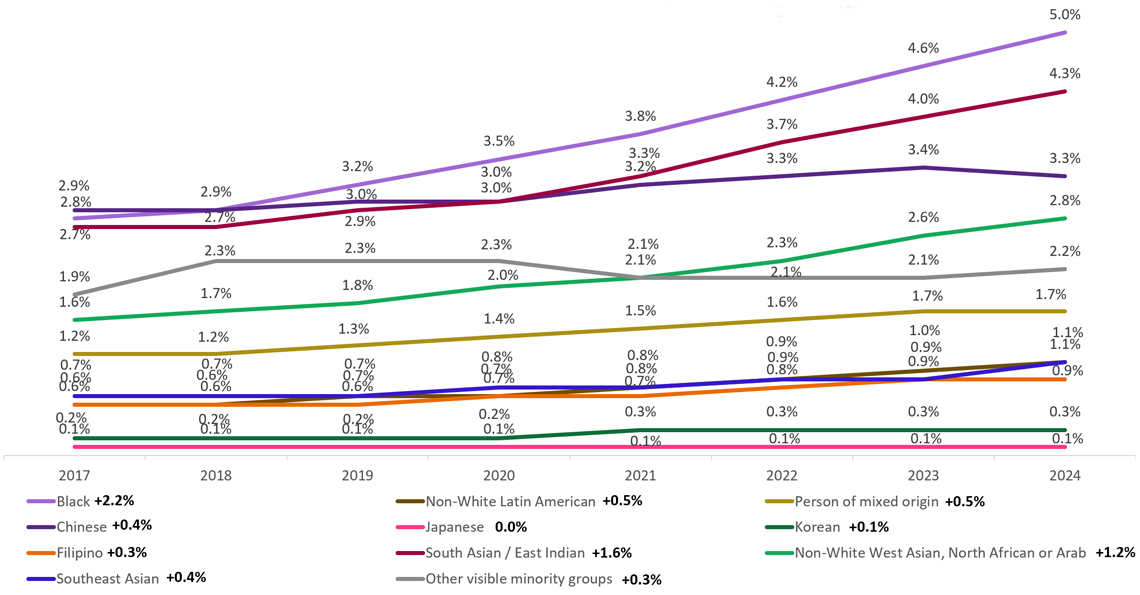
TBS publishes some rich infographics and infographics: Employment Equity Demographic Snapshot 2023–2024
Figure 33: Representation trends for members of visible minorities by subgroup – percentage
2025/06/06 2 Comments
Coverage of our study:
More visible minorities ran and were elected in the spring federal election compared to the previous election, an increase that a new report found was driven by representation in parties on the right.
There were 315 visible minorities representing the six major parties, according to the report published by the Institute for Research on Public Policy. The candidates accounted for 20.1 per cent of the 1,568 candidates in the April 28 election. This was an increase from 18.2 per cent in 2021, 16.8 per cent in 2019 and 13.4 per cent in 2015.
While the Liberals, New Democrats and Greens all reported a drop in their visible minority representation from the 2021 race — by 0.9, 3.2 and 1.3 percentage points respectively — Pierre Poilievre’s Conservatives and Maxime Bernier’s People’s Party of Canada saw their numbers up by 5.9 percentage points and seven points, with the Bloc Québécois up 1.3 points. (The People’s Party failed to win a seat.)
The report refers to “visible minorities” as persons, other than Indigenous people, who are non-Caucasian in race or non-white in colour, as defined by Statistics Canada.
“The Liberals almost seemed to have dropped the ball in terms of candidate recruitment compared to the Conservatives, who obviously were making a fairly concerted effort to recruit a larger number of visible minority candidates,” said Andrew Griffith, who co-authored the report with retired McGill University political science professor Jerome Black.
“They were still building off the Jason Kenney legacy that visible minorities are our natural conservatives,” added Griffith, referring to the former Conservative immigration minister tasked with building bridges with minority communities under the Harper government.
And the deliberate recruitment efforts seemed to yield results, with the proportion of elected visible minority MPs up by 2.4 percentage points, accounting for 17.8 per cent or 61 of the 343 MPs in the new Parliament.
While the number of Liberal MPs who are visible minorities fell by 2.2 percentage points, the Conservatives boosted their visible minority MPs in the House of Commons by 7.5 percentage points.
The MP breakdown, by ethnicity, was South Asian, 29 seats, Black, 11 seats; Chinese and Arab/West Asian, both seven; Latin American, two; Filipino and Southeast Asian, each with one; and three listed under “other/multiple” backgrounds.
University of Toronto professor Emine Fidan Elcioglu said she was not surprised by the shift as the Conservatives rebranded the party under prime minister Stephen Harper to cultivate support from ethnic communities.
“They wanted to seem like the new party of diversity, so they were very intentional in their ethnic outreach,” said the sociologist, who studies migration politics.
“They were (previously) pushing forward policies that alienated immigrant visible minority communities. They were also reframing themselves as pro-good immigrant, anti-bad immigrant.”
Over the years, she said, visible minority groups have also started to embrace that thinking as shown in recent public debates about the impacts of immigration on the housing and affordability crisis.
Poilievre is “very much looking at these groups as a potential part of his base,” Elcioglu noted. “But I think we need to be really careful to not assume that just because there is more visible minority candidates in the party, that is necessarily going to be fundamental in voter motivation.”
Having more racialized candidates doesn’t necessarily translate to more inclusion, she said, and it could just be a cover for more stringent immigration policies, more austerity measures and more gutting of the social security safety net that affect the society’s most marginalized and vulnerable.
“So, great, you recruit people who are not white men, but what are you doing with that?” asked Elcioglu.
The report also found the number of women running in the April election down from the 2021 election by 2.4 per cent to 553, and Indigenous candidates by 0.9 per cent to 48. In total, 104 women and 12 Indigenous people were elected.
“It seems like there’s almost a glass ceiling of about 30 per cent for women,” said Griffith. “For Indigenous MPs, it’s a bit different just because of how the population is distributed across the country, but that also has stalled.”
Candidate profiles and assessments in the analysis are based upon candidate photos, names and biographies, general web searches, and ethnic and other media that focused on particular groups.
2025/05/20 Leave a comment
Another informative and relevant analysis by StatsCan, providing evidence regarding “Canadians of convenience:”
Contrary to public impression, Canadian citizenship turns out to be more a sign of an immigrant’s commitment to the country than a convenience to leave for greener pastures.
In fact, according to a new Statistics Canada report, immigrants from developed countries and those who took longer to become citizens were the ones more likely to leave the country after getting their citizenship.
“Among naturalized immigrants, active presence typically exceeded 90 per cent in the 10th year after immigration,” said the report released on Friday. “It showed minimal variation across educational levels, official language profiles, age at immigration and immigration classes.”
The findings debunk the myth that immigrants are “Canadians of convenience,” who take advantage of citizenship for the privilege of a Canadian passport but have no intention to stay and keep ties with their adopted homeland.
“It demolishes largely the argument that people just get citizenship so they have mobility and they can leave the country to pursue opportunities,” said Andrew Griffith, an expert on Canadian citizenship.
“There aren’t as many citizens of convenience as people might think. That actually is a measure of a longer-term commitment to Canada.”
Based on immigration and income tax filing data, the Statistics Canada study examined the relationship between citizenship acquisition and the “active presence” of immigrants in Canada.
While the absence of an individual’s tax record can mean the person either left Canada or remained in the country without filing taxes, it is unlikely an immigrant living in Canada would stop filing taxes after acquiring citizenship because it gives them access to benefits and services here.
Among immigrants admitted from 2008 to 2012, and 25 to 54 years old at admission, 93 per cent of those who became citizens had an active presence in Canada 10 years later, compared to 67 per cent of their counterparts who did not acquire citizenship.
These rates were higher than that of the immigrant cohorts admitted between 2003 and 2007 — 91 per cent for citizens and 58 per cent for non-citizens. This suggests that recent immigrants are more likely to stay in the country.
Immigrants from developed countries had lower active presence in Canada after 10 years than their counterparts from the developing world. Among naturalized citizens, for instance, 97 per cent of those from the Philippines remained active in Canada a decade after immigration — about 10 percentage points higher than their American and French counterparts, and six percentage points above those from the U.K..
However, among immigrants who didn’t acquire Canadian citizenship, whether they stayed or left relates more to other factors. Those with a graduate degree, who spoke English or French or came as economic immigrants have a remarkably lower presence in Canada after 10 years.
Daniel Bernhard, CEO of the Institute for Canadian Citizenship, said the uptake of Canadian citizenship has been on decline, and the real challenge is for Canada to convince immigrants who have “global options” to stay and devote their talents to the country for the long term.
“Highly educated people are mobile and we select more highly educated people, and that’s going to be part of it,” he said. “Circumstances here are also changing. It’s becoming harder to succeed, to buy properties and get ahead. Most people come here to build a better life. If we can’t provide it, they will take their families and their talents elsewhere.”
The report also tracked immigrants with no tax records and found that about 28 per cent of them had Canadian citizenship. About half of inactive immigrants from Iran were citizens, followed by 39 per cent among inactive Pakistani immigrants and 36 per cent from Colombia. In contrast, only 14 per cent of inactive American immigrants were citizens.
To be granted Canadian citizenship, a permanent resident currently must have lived in the country for at least three years out of the last five, demonstrate language proficiency in English or French, pass a citizenship test and take an oath.
The new report suggests those rules are working, said Griffith.
“You can still argue is it meaningful enough and if we have to change the oath and all those things,” he said. “But I think in a grosso modo sense, people are coming and they’re basically staying despite the retention issues. It’s not a big difference between citizens and non-citizens. I think we’ve roughly got the balance right.”
Source: Is Canadian citizenship mostly a convenience? A new study counters the myth
2025/05/01 Leave a comment
Latest article with preliminary analysis of 2025 election results in terms of MP diversity:
…In Canada, Indigenous representation in the House also dipped slightly, according to an analysis by Andrew Griffith, a fellow of the Environics Institute and a former director-general in the federal immigration department. He found that 3.3 per cent of elected MPs are Indigenous after this election, down from 3.5 per cent in 2021.
However, there was a slight rise in the number of visible minority MPs. Mr. Griffith found that their representation stands at 18.1 per cent now, compared with 15.7 per cent at the last election.
“We appear to have reached a plateau with respect to women and Indigenous peoples MPs,” he said in an e-mail.
“On the other hand, the combination of growth in immigration and visible minorities, matched with most political party candidates being visible minorities in ridings with high numbers of visible minorities and immigrants, continues the trend of increases in their representation.”…
Source: Proportion of women in the House of Commons dips, with slight rise in minority MPs
2025/04/23 Leave a comment
Results of the preliminary analysis by Jerome Black and myself:
…Mr. Griffith, who has carried out similar research for previous elections, said he was surprised to see the drop in the proportion of female candidates, particularly among the Conservatives. They had a lot of candidates in place soon after the election was called, whereas the NDP and Liberals were later with nominations, he said.
“It’s surprising that the number of women standing for the Conservatives actually declined very significantly: a third of the nominations in 2021 to not even a quarter of the nominations in 2025,” he said. “Conservatives actually made a concerted effort to recruit visible minorities, but they seem to have dropped the ball with respect to women.”
He said some women may have been deterred from standing by the rise in abuse directed toward female politicians.
“It’s certainly part of it,” he said. “But I’m still surprised at such a dramatic decline.”
Source: Number of female candidates drops across parties: study
2025/04/10 Leave a comment
Perspectives from economist Mikal Skuterud, focussing on need to focus on high skilled immigrants, Gauri Sreenivasan, CCR, on refugee concerns and myself on the opportunities for rethinking immigration policies and priorities. pdf link not password protected.
Source: Experts urge parties to rethink immigration priorities, pdf
2025/02/24 Leave a comment
Good long and thoughtful commentary:
…There has to be a sensible Canadian space between Trumpist mass deportations and closed borders on one hand, and on the other the current reality of a set of policies and institutions that make Canadian governments unable to control who enters the country.
Luckily, there seems to be an awkward political consensus around this. Both the federal Conservatives and the major Liberal leadership candidates appear to be united (though they might not admit it) around a common set of aspirations: a return to a focus on permanent, citizenship-focused immigration of intact families and a reduction of temporary migration to a minimum; immigration targets tied to economic conditions and population-growth needs; a refugee policy driven by genuine humanitarian need and not by irregular border crossings or opportunism.
Those goals won’t easily be attained with mere tinkering of the sort that governments this century have engaged in. Rather, they require a set of systemwide reforms. After interviewing a dozen former immigration officials and experts, I found a strong consensus on the changes that would make the system work:…
Source: Canada’s border is broken, but not the way Trump thinks. Here’s how the next government can fix it
2025/02/18 Leave a comment
More on birth tourism, based on some of my analysis:
“Birth tourism” is on the rise again in Canada.
In the past year, 5,219 babies were born in Canada to travelling foreign nationals.
In B.C., 102 non-resident births were at Richmond General Hospital; 99 were at Surrey Memorial; 97 were at Vancouver’s St. Paul’s Hospital; and another 85 were at Children’s Hospital, according to Andrew Griffith, a former senior director in Canada’s immigration department who is now an immigration analyst.
At the same time that Griffith was releasing data showing non-resident births are returning to 2019 levels in an article published in Policy Options last month, entrepreneurs in Richmond said there has been an uptick in inquiries from women in China and other parts of East Asia who want to have their babies in Canada now that President Donald Trump aims to end birthright citizenship in the U.S.
The ethical debate over birthright citizenship, also known as jus soli (right of the soil), is coming to a head as Democratic U.S. states challenge Trump’s initiative and non-resident births rise again in Canada with the easing of COVID-19 restrictions.
Data from the Canadian Institute for Health Information shows the percentage of non-resident births in Canada fell from 1.6 per cent of total births in 2019-20 to 0.7 per cent in 2020-22. It rebounded to 1.5 per cent in 2023-24.
A majority of countries forbid birthright citizenship, including virtually every country in Europe, Asia and Africa. It’s permitted in only about 33 nations.
Even though 160 years ago the U.S. enshrined the 14th Amendment to protect the constitutional rights of those born on its soil, particularly former slaves, Griffith said Canada’s laws on birthright citizenship could be more easily changed than in the U.S.
While most countries mandate that a child’s citizenship depends on the passport held by the parents, Canadian academics argue that birthright citizenship should be a “global human right.”
Today, one of the most common rebuttals to such a stand is that babies who receive citizenship only because they were born on Canadian territory are jumping the country’s immigration queue, which others must go through to qualify to become permanent residents and access universal education, health care and social services.
Two Canadian scholars who have obtained federal government grants to research birth tourism insist it must be protected in the name of “reproductive autonomy.” They say those who oppose it are “demonizing” and “criminalizing” non-resident pregnant people.
University of Carleton law professor Megan Gaucher believes critics of birthright citizenship are engaging in “settler-colonial” thinking that reflects “long-standing racist ideas.”
Ottawa’s Gaucher co-wrote an article on the subject with Lindsay Larios, an assistant professor of social work at the University of Manitoba who has obtained a federal grant to do collaborative research on birthright citizenship with B.C.’s Migrant Workers Centre.
Gaucher and Larios maintain attempts to portray birth tourists “as queue jumpers and citizenship fraudsters ignores the real-life obstacles they encounter within the health-care system and the Canadian immigration system.”
Larios argues that opponents who say offspring shouldn’t get citizenship because of their birth parent’s “precarious” immigration status are ignoring what she calls “reproductive justice.”
Opposition to the position set out by Gaucher and Larios has come from politicians, and medical and immigration professionals.
Rather than being disadvantaged, Griffith said, most women who engage in birth tourism come to North America with enough wealth to pay hundreds of thousands of dollars for travel, accommodation (including in so-called “birth hotels”), and hospital deliveries.
The Society of Obstetricians and Gynaecologists of Canada has said birth tourism needs further investigation. And Dr. Jon Barrett, head of obstetrics at McMaster University in Hamilton, has written that Canadian hospitals should have “absolutely zero tolerance” for it.
Doctors “should unite in a firm stand against birth tourism,” Barrett said, arguing it stresses Canada’s health-care system and puts pregnant foreign nationals at risk of being “fleeced by unethical individuals.”
An Angus Reid Institute poll found that in 2019, when Richmond Hospital was the epicentre of Canada’s birth tourism industry, that two-of-three Canadians believed “a child born to parents who are in this country on tourist visas should not be granted Canadian citizenship.”
Births to non-residents now make up 6.9 per cent of all deliveries at Richmond Hospital, which is down from 24 per cent before the pandemic. Despite this year’s jump in inquiries from people seeking to have babies in Canada because of Trump’s threat, Griffith believes the overall decline over the last few years at Richmond Hospital is owed largely to China restricting its citizens’ travel.
There is no data on whether international students in B.C. have given birth in hospitals here. International students in this province can join the Medical Services Plan by paying $75 a month. In Ontario, said Griffith, some non-resident mothers who have paid for hospital deliveries could be foreign students as that province doesn’t allow them to receive subsidized health care.
In light of a lack of government oversight of birth tourism, Griffith said there is need for more research, including like one study from Calgary. Four-of-five non-resident mothers who delivered babies in that city said their primary motivation was to give their newborn Canadian citizenship. The largest group, one-of-four, was from Nigeria.
Given the ethical issues at stake, Griffith suggests Canada, whose citizenship rules aren’t bound by a Constitution like in the U.S., take a responsible middle way in regard to birthright citizenship.
To reduce the chances of exploitation, he recommends Canada follow the lead of Australia, which allows a baby born on its soil to receive citizenship only if at least one of the child’s parents already has that status.
Source: Should birthright citizenship, banned in most countries but not Canada, be a human right?
2025/02/15 Leave a comment

Full Year 2024 annual comparisons
Canadian Immigration Tracker – December 2024 update and full-year comparisons

Click image for book purchase

